



Abstract
The Reducing Emissions from Deforestation and forest Degradation mechanism is a policy instrument intended to achieve environmental conservation and utilization simultaneously. Recently, researchers have adopted ‘environmentality’, a theoretical approach that recognizes the different strategies for the ‘conduct of conduct’ embodied in environmental governance, to parse the diverse governing logics supporting Reducing Emissions from Deforestation and forest Degradation implementation. Thus far, use of this lens has focused predominantly on how Reducing Emissions from Deforestation and forest Degradation introduces new forms of environmentality, overlooking the pre-existing, context-specific approaches to governance on which the mechanism builds, and hence potentially overstating the novelty of its governance techniques. Challenging this dominant use of the environmentality lens, I further develop its critical potential by demonstrating how environmentality's temporal dimensions illuminate the shifts, continuities and disruptions in how environmental governance evolves over time. I do this by demonstrating how Reducing Emissions from Deforestation and forest Degradation builds on pre-existing forest governance interventions in Guyana and neighbouring Suriname. I argue that while Reducing Emissions from Deforestation and forest Degradation remains a global expression of neoliberal environmentality, it builds on a pre-existing sovereign environmentality established throughout the overlapping histories of Guyana and Suriname, draws on but also subverts context-specific truth environmentality in the spiritual relations of forest dependent communities with the forests, and is made palatable for resistant communities through disciplinary environmentality. In this way, these four forms of environmentality help to explain how Reducing Emissions from Deforestation and forest Degradation implementation in the two countries assumes its current character, while demonstrating how environmental projects work towards shaping the subjects of their governance.
Keywords
Introduction
Increasingly, researchers have adopted the environmental governmentality lens, also labelled ‘environmentality’, to analyse the implementation of the Reducing Emissions from Deforestation and forest Degradation (REDD+) mechanism (e.g. Asiyanbi et al., 2019; Astuti and McGregor, 2015; Boer, 2017, 2018; McGregor et al., 2015). REDD+ itself is a tool of global environmental governance (Corbera and Schroeder, 2011; Thompson et al., 2011) that offers financial incentives to reduce deforestation and forest degradation in the interest of mitigating climate change by keeping carbon sequestered in forests. After years of debates and the implementation of numerous pilot projects, the Conference of Parties to the United Nations Framework Convention on Climate Change formally integrated REDD+ into the global framework for addressing climate change in 2015 (Sheng and Qiu, 2018).
The environmentality lens builds on Foucault's influential governmentality concept that seeks to highlight the ‘conduct of conduct’ (Foucault, 2008) embodied in different approaches to governance more broadly (see esp. Agrawal, 2005; Fletcher, 2010; Miller and Rose, 1990). While the environmentality lens has proven productive in analysing diverse forms of environmental governance in myriad contexts throughout the world (see Fletcher, 2017), thus far its application has been largely static, as researchers sought to understand the different forms of environmentality that overlap within a given context at a particular moment in time. Meanwhile, the temporal dimensions of how different environmentalities may be introduced successively and intersect over time have been far less emphasized. In this paper, I therefore develop a temporal analysis of how multiple forms of environmentality inform REDD+ implementation in Guyana and Suriname.
Temporalities are deserving of greater attention in environmentality research, I argue, because treating environmental governance statically tends to obscure pre-existing strategies of forest governance and hence attributes to novel interventions characteristics not limited to them. By contrast, the use of a temporal perspective in environmentality can highlight how the places in which environmental policies are implemented have been shaped by previous governing interventions (Lansing, 2011), thus allowing newly introduced policies to be understood in relation to how these places have been shaped by previous forms of governance. I illustrate the utility of this temporal environmentality perspective by using it to trace the contours of shifts, continuities and disruptions in forest governance over time by analysing how REDD+ governs the forests of Guyana and Suriname. These two countries are the only two participating REDD+ countries within the Guiana Shield, an area of Precambrian rock in northeast Amazonia of South America (pictured in Figure 1) that hosts the world's largest remaining unfragmented block of tropical forest (Haden, 1999). While these countries have been an important focus of REDD+ policy, they have formed a marginal part of the REDD+ literature thus far (for some exceptions, see Airey and Krause, 2017; Bulkan, 2014).
Map of the Guiana Shield in the north of South America.
This paper is structured as follows. First, I outline the multiple environmentality approach and explain how a temporal perspective can enrich the application of the multiple environmentality lens. After describing my research methods, I then explore the history, first in Guyana and then in Suriname, of how different forms of environmentality have been successively employed to eventually support REDD+ governance. I conclude by reflecting on the potential of the temporal perspective of the multiple environmentality lens for furthering our understanding of contemporary environmental policies more generally.
Conceptualizing REDD+ through environmentality
Governmentality, environmentality's theoretical predecessor, is often deployed as a means of understanding how governments seek to achieve some form of improvement in their populations through a manipulation of behaviour by drawing on different types of knowledge, judgments and ways of doing things (Dean, 2009). Governmentality techniques take different forms identifiable through their approaches for achieving the desired change and based on the sets of knowledge from which they are derived (Foucault, 2008). They provide us with insight into ‘how governing is accomplished in practical and technical terms’ (Okereke et al., 2009: 71). Government is understood here, not only as state centred, but in reference to actors more broadly that are imbued with the ability to govern. Governmentality is understood as an art of influence through which diverse actors that are imbued with the ability to govern, even if just temporarily, work to shape outcomes and to guide the population within its remit in the desired direction.
Building on this perspective, the multiple environmentality lens encompasses neoliberal, truth, sovereign and disciplinary forms (Fletcher, 2010), each representing different mentalities of environmental governance. Neoliberal environmentality ‘seeks merely to create external incentive structures within which individuals, understood as self-interested rational actors, can be motivated to exhibit appropriate behaviours through manipulation of incentives’ (Fletcher, 2010: 173). The subject envisioned within this mode of governance is the ideal neoliberal homo economicus (Li, 2014) imagined as manageable and responsive to modifications artificially introduced in the environment (Fletcher, 2010). By contrast, sovereign environmentality functions through the imposition of formal rules and regulations; disciplinary environmentality through the internalization of norms and values; and truth environmentality, by appealing to a ‘natural’ order of things (Fletcher and Breitling, 2012). Sovereign, neoliberal and disciplinary environmentalities are operationalized through calculation and rationality, for example, through a reliance on censuses or statistics (Fletcher, 2010) while truth governs according to the ‘the truth of religious texts, of revelation, and of the order of the world’ (Foucault, 2008: 311).
A subset of this governmentality-inspired research has used the multiple environmentality lens to analyse REDD+ in particular. In doing so, however, such research has tended to focus on the specific environmentalities introduced into a given context through REDD+ and not on pre-existing forms of governance that facilitate its uptake. Using this multiple environmentality lens, McGregor et al. (2015), for instance, argue that while REDD+ governs through neoliberal environmentality globally, within Indonesia liberation, truth and disciplinary environmentalities are also evident, with the last employed to encourage pro-REDD+ subjectivities. Truth environmentalities are apparent in the spiritual connection of local communities to the forests (McGregor et al., 2015). While Astuti and McGregor (2015) focused on the governmental rationalities introduced by REDD+, McGregor et al. (2015) identify new REDD+ centred environmentalities at diverse spatial scales. While insightful, this analysis does not easily allow for connections to be drawn between the governing logics of REDD+ and previous or other efforts to govern forests. Inattention to temporality of this sort has the potential to obscure prior methods of forest governance, a tendency I attribute to the taking of REDD+ as the analytical starting point. In the clearest realization of this potential to obscure that I have found, Boer (2017) explains in his argument for the existence of a new REDD+ ‘welfare’ environmentality in Indonesia, that ‘By providing certain rights to employment, health and education the state exchanges livelihood options and security in return for recipients adopting responsibility for environmental care’ (2). Although Indonesia is recognized to be a developing country, Boer attributes the provision of developmental benefits to local communities through REDD+ as ‘welfare environmentality’, conceptualized as a new expression of environmentality. This use of environmentality removes from view the development histories of these countries and overestimates the novelty of that governing mentality to the point that a new ‘welfare’ environmentality is proposed for inclusion into the established forms of environmentality. I argue that different conclusions can be arrived at when a temporal perspective is employed that recognizes the longer histories of forest governance. REDD+ countries are almost all developing nations, often having had decades of international policy interventions aimed at governing them and their environments in particular ways. Hence, these development histories set the tone for REDD+ to continue in the vein of promising development (Lund et al., 2017), or in Boer's (2017) case, welfare outcomes.
Nevertheless, I similarly draw on environmentality to identify the overlapping scaffold of governing logics, inclusive of contested state governance supporting its operation, but do so over the long term. I complement the existing body of work on REDD+ environmentality by identifying similarly named, yet somewhat differently constituted, context-specific expressions of environmentality from those identified by McGregor et al. (2015). In addition to this axial shift, my analysis of two neighbouring countries with related and overlapping histories of forest governance allows for sovereign environmentality embodied through state formation to be recognized, challenging the taken-for-granted nature of borders in REDD+ implementation and research.
To grasp the importance of engaging with longer-term temporalities in environmentality, one need not look further than Agrawal's (2005) pivotal investigation into the environmental governance techniques of forests and their users situated within a 150-year time frame. Agrawal (2005) focused not only on particular policy interventions but also on how they were situated within long term, place-based governance strategies. In contrast, the dominant, static approach to environmentality in REDD+ research, while valuable for ascertaining the techniques specific to particular environmental policies, obscures the connections between environmental governance policies and previous governing efforts, reducing the potential of those who employ it to point to recurring logics or fads, such as those discussed by Fletcher et al. (2016) and Lund et al. (2017).
My analysis recognizes the historical governing interventions on which REDD+ builds in a manner that is, at times, linear in its description but non-continuous and non-determinative in interpreting this historicity. Given the significance of temporality in my argument, I take care to point out that I am not assuming that the effects of the histories of environmental governance are linear and cumulative. Foucault (2008) himself was interested in challenging the a priori interpretation of sociological categories and linear interpretations of causality in interpreting social events. Hence, I emphasize Foucault's (2008) non-deterministic, anti-teleological accounting of history (Carr, 2016) that does not automatically attribute causative characteristics to continuous historical accounts, and hence, to shifts in forest governance. I caution also that my aim is not to determine the extent of the success of governing interventions. Theorists of governmentality acknowledge that governing interventions often fail to generate the desired outcome (Fletcher, 2010; Miller and Rose, 1990) since there are inherent limitations to governmental power, such as the ability of subjects being governed to act otherwise and the influence of other non-governance related factors (Li, 2007). Hence, governmentality inspired analyses are concerned less with ‘“what happened and why” than with “what authorities of various sorts wanted to happen”’ (Miller and Rose, 1990: 20).
As I demonstrate in the following sections, REDD+ governs forests by building on sovereign environmentality through which rules and regulations on forest use were imposed and market centred development models were pursued; through truth environmentality expressed in the resistance of indigenous communities; and through disciplinary environmentality through which efforts are made to integrate these forest-reliant communities into the mechanism. I develop this argument by first detailing my methods. Then, through environmentality, I outline the process through which REDD+ is made able to govern the forests of Guyana and Suriname. I ground this in the recognition that these localities are often positioned discursively as ready for commodification of their natures through previous development interventions that allow global imperatives to take root (Lansing, 2011; Lund et al., 2017). As such, I am reminded of the importance of extending the timeline and visibility of historical experiences (Lansing, 2011), in analysing governing interventions.
Case selection and methods
Few scholars have examined how REDD+ operates in the Guiana Shield, representing a significant absence given that these forests are central to maintaining the biodiversity and ecosystem functions of the wider Amazon ecosystem (Bovolo et al., 2018). In attempting to remedy this absence, I analyse REDD+ through a multi-sited ethnography (Marcus, 1995) of REDD+ in Guyana and Suriname conducted from January 2014 to January 2015, including an analysis of over 80 development and policy documents, four week-long field visits, two internships with REDD+ related international governmental organizations and approximately 60 in-depth interviews with actors identified as related to REDD+ identified in the national REDD+ Readiness Preparation Proposals. I recognize that covering over 500 years of history and subsequent ongoing events in Guyana and Suriname necessitates that I do not engage with many historical events and nuances. Hence, the environmentalities expressed here do not form an exhaustive list. However, the multiple environmentalities I introduce, evident in REDD+ preparation and implementation, outline those governing approaches perceptible and necessary for operationalizing REDD+. They demonstrate the governing manoeuvres employed to make REDD+ able to govern the forests of these two countries.
As detailed later, Guyana and Suriname share different but overlapping colonial experiences. The area that became Guyana was defined and demarcated through its long history with the Dutch and eventual independence from the British in 1966. The adjacent area that became Suriname, on the other hand, was defined and demarcated through a long history with the British and was eventually made independent from the Dutch in 1975. My recognition of these defining events in the period of their creation, their shifting borders throughout these colonial encounters, along with their continued dispute over territory allows me to problematize sovereign environmentality in state formation and to challenge the taken-for-granted nature of borders in REDD+ implementation and research.
As a legacy of social relations established during colonialism, the economies of Guyana and Suriname continue to rely on the export of raw materials (Knight, 1990; Moore, 2000) with small and medium scale gold mining forming the largest threats to forest conservation. Successive state governments of Guyana and Suriname are preparing for REDD+ by situating it in national green development policy frameworks in the hope of achieving simultaneous forest conservation and utilization. In Guyana, REDD+ was transposed into the national context through the Low Carbon Development Strategy and in Suriname, through the Climate Compatible Development Strategy. In line with an argument developed by Fletcher et al. (2019, I interpret both strategies as green development frameworks that encourage biodiversity conservation in the interest of accessing capital. I turn next to tracing the expressions of sovereign environmentality in Guyana.
How REDD+ governs forests in Guyana
Through the imposition of rules and regulations in sovereign environmentality
The violent disruption of the forest use traditions of indigenous Amerindian people, who were confronted by Europeans in the early 1600s, is the first instance of the establishment of sovereign environmentality through which REDD+ is able to govern. While the history of Guyana 1 prior to colonization is poorly documented (Glasgow, 2012), it is asserted that the Amerindians residing in the area that became Guyana were numerous and diverse. These indigenous groups were nomadic and moved across the Amazon basin (Heemskerk, 2009). The Waroa, for example, were said to be boat builders who foraged and fished for their meals, while the Arawaks were said to prefer higher ground along the rivers and to have practiced agriculture on crops tailored to their environments. Of the nine Amerindian tribes in Guyana, the fierce, warrior-like Caribs were said to be the most dominant at the time of European arrival (Colchester, 1997). Their societies were known to be ‘well-ordered and technologically complex hierarchical societies based on intensive agriculture and fishing’ (Colchester, 1997).
After European arrival, the indigenous tribes began to take on noticeable changes by adopting some European technologies for interacting with the forests (Glasgow, 2012). The Europeans, in turn, established trading relationships with the Amerindians based on barter by trading industrial goods for forest products. The Dutch established their first permanent settlement in the area that became Guyana in 1616 (Colchester, 1997; Glasgow, 2012) and developed sugar estates through the forced labour of ‘red slaves’ captured by other Amerindians and traded with the Dutch. Amerindians continued to be an important source of labour on the plantations until the arrival of enslaved Africans in the 17th century (Colchester, 1997). Throughout colonization, several battles and conquests directly tied to events in Europe saw parts of what became Guyana change hands on numerous occasions, being controlled by the Dutch, the French and the British (Glasgow, 2012) in over 400 years of colonial rule. As such, the borders between the area that became Guyana and the adjacent area that became Suriname changed frequently as determined by the colonial power du jour.
European influence and the need for labour on the plantations spurred the forced relocation of large groups of people from around the globe. Between the 16th and 19th centuries, large numbers of people from Africa, Asia and Europe were brought to work on the coastal plantations (Knight, 1990). The arrival of enslaved Africans to work on the plantations, stimulated by the slave trade in which the Dutch engaged, brought a new role for the Amerindians. The Amerindian trading allies of the Dutch became ‘owls’ or guards of sorts, as the Dutch began to reward Amerindian allies for capturing enslaved Africans who ran away to seek refuge within the forests. In 1803, due to changing power relations between European states, the three Dutch colonies of Essequibo, Demerara and Berbice, comprising modern today Guyana, passed to British control (Josiah, 2011). The colonies were united in 1831 under the banner of British Guiana.
The shifts and exchanges that took place during colonialism were clear expressions of sovereign environmentality through which sovereign rulers in Europe violently exercised a practice of taking life or letting live (Glasgow, 2012) by making claims on human bodies, land and nonhuman biodiversity. The external borders of British Guiana eventually became the demarcations used for national REDD+ programs as expressions of sovereign environmentality. While other environmentalities were likely present during this colonial period, they were secondary to the violence, force and brute power of the colonial sovereign as they employed measures to manage the population.
Eventually, another major disruption to established forest governance practices took place when in 1966, Guyana gained independence from the British to form an independent state (Josiah, 2011). Locals, by then violently and coercively supplanted into this area from other continents to join indigenous inhabitants, were left to govern themselves and the forests. The focus of successive governments of independent Guyana, including previous colonial authorities, remained on the exploitation of timber and mineral resources (Josiah, 2011).
Sovereign environmentality continued in specific relation to the forests in the form of the definition of national forests and encompassed those rules, regulations and organizations guiding forest usage. Through executive authority enshrined in the Constitution of Guyana and control over the legitimate use of force, the Government of Guyana continues to exercise sovereign environmentality over the forests within the territory. The Mining Law, Amerindian Act 2006 and Environmental Protection Act 2006 have implications for REDD+ in Guyana. The Mining Law and its associated regulations govern mining and outline the process of administering permits. With gold mining forming the major threat to forests in Guyana (Haden, 1999), its observance and execution has major implications for REDD+. The mining law, enforced by the Guyana Geology and Mines Commission (GGMC), claims all minerals throughout the country as property of the State, even when the land is under the tutelage of indigenous communities and private persons. The Amerindian Law allows for the demarcation and ownership of significant sections of land that could be used for conservation activities and climate change mitigation. The Amerindian Act allows Amerindian Village Councils to lease communal lands for mining, forestry, hunting and residential purposes. Amerindians collectively have tutelage over 13.9% of Guyana's landmass with Village Councils designated as the governing body of these lands and vested with the responsibility for their conservation. The Environmental Protection Act 2006 enables the ‘management, conservation, protection and improvement of the environment, the prevention or control of pollution, the assessment of the impact of economic development on the environment and the sustainable use of natural resources’ (Conservation International-Guyana, n.d.) and designates the Environmental Protection Agency as its governing body. Other relevant pieces of legislation include the Land Law that outlines the process for managing state land; the Iwokrama Act of 1996 that provides for the sustainable utilization and management of the Iwokrama Conservancy of approximately 360,000 hectares forest for research; and infrastructure policies and international agreements impacting forest use, such as the UNFCCC and the UN Declaration on the Rights of Indigenous Peoples (Conservation International-Guyana, n.d.).
Together, these arrangements form the legal base of REDD+ in Guyana. Parts of this legal framework for utilizing the forests were revised in response to international interest in climate change mitigation through carbon sequestration. The impetus to address climate change on the international level motivated successive independent governments to consider the role of forest conservation in economic development (Conservation International-Guyana, n.d.). These activities take place within an organized policy and legislative framework where certain governmental bodies are designated for working with REDD+.
As such, sovereign environmentality came to be continuously expressed, although constantly in flux, throughout the history of Guyana. It is through sovereign environmentality that independent state governments are designated as the primary actors for forest governance and REDD+ readiness over a particular territory.
Through the pursuance of market-centred development in independent sovereign environmentality
It is also through a form of less coercive, independent state-led sovereign environmentality that development eventually came to be pursued in Guyana through a reliance on markets. After independence in 1966, Guyana was designated a ‘Cooperative Republic’, being governed by significant periods of socialist rule that saw its bauxite and sugar industries nationalized (Vaughn, 2012). By the mid-90s, however, market reliance had begun to develop (Vaughn, 2012). The centrality of markets in Guyana's development thrust became clear in 2006 with the publication of the National Competitiveness Strategy, well before REDD+ developed as a forest governance tool.
Three years later, in 2009, the Forests Act was passed to recognize the work of forests as a tool for climate change mitigation and for the provision of environmental services (Conservation International-Guyana, n.d.). The Forests Act permits the use of state forests by individuals or companies, allowing licences for petroleum or mineral prospecting or production/mining under the Petroleum Act 1986 and the Mining Act 1989; and permitting sustainable use practices performed ‘in accordance with the spiritual relationship of the group to the land’ (Guyana Forests Act, Act No. 6 of 2009, 2009). The Act permits forest conservation, including the ‘the preservation of forests for the purpose of carbon sequestration or any other form of environmental services’ (Guyana Forests Act, Act No. 6 of 2009, 2009) enabled through the grant of a forest concession agreement. The Forest Act also provides a path for granting forest dependent communities secure rights to use forests and land sustainably to enable them to meet local needs while stimulating economic development and enhancing environmental sustainability (Conservation International-Guyana, n.d.).
However, despite this clear conceptual organization of tasks, the process of land use is significantly less clear. Even after being granted land rights in 1976 and 1991, lands claimed by many indigenous forest communities were never surveyed so boundaries are not clearly defined. In addition to some communities claiming the same area of land, land has been encroached on by miners, loggers and others (Heemskerk, 2009). It is unclear which law takes precedence, the Amerindian Act or the State Lands Act.
Also in 2009, the Low Carbon Development Strategy was published, offering the services of Guyana's forests to the world to demonstrate the feasibility of REDD+ while sourcing funding for development. In turn, representatives of the state government signed a Memorandum of Understanding with Norway representing the only affirmative response to Guyana's Low Carbon Development Strategy offer outside of preparation efforts led by the World Bank and the UN-REDD+ program (Office of the President, Guyana, 2010). Norway committed to providing up to 250 million USD to Guyana over a five-year period to ensure the conservation of Guyana's forests while facilitating Guyana's low carbon economic development. To date, Guyana's agreement with Norway has not been concluded with 80 million USD outstanding and contingent on Guyana's development of large-scale renewable energy sources. Only forest managed by the state has been allocated for REDD+ activities thus far. Some Amerindian communities have tenure over the forests within which they reside and will eventually be able to opt into the REDD+ mechanism.
Despite the fact that the National Competitive Strategy was published three years before the Low Carbon Development Strategy as the central REDD+ policy document in Guyana, these two strategies share a strong narrative of economic growth and competitiveness. For example, the 2006 National Competitiveness Strategy states that: Important progress has been made in Guyana in recent years in managing the process of adjustment to the new world economic environment through exercise of monetary discipline, improvements in the environment for private investment, reform of the tax system, creation of a property market, investing in basic education and infrastructure, and boosting productivity in traditional sectors of the economy … At the forefront is achieving the economic imperative of improving national competitiveness and diversifying the economy. (Government of Guyana, 2006: 5, emphasis added) transforming Guyana's economy will require striking a balance between attracting large, long-term private investors who will have a catalytic impact on the national economy, and making significant investments in human capital and social services to equip the population for participation in the new economy. (FCPF, 2012: 9, emphasis added) Competitive advantage does not simply exist. It has to be created. It has to be carved out of initial conditions through the right enabling environment, through conscious investments in technology, education, training, information search, engineering and even research and development to create new skill and technological endowments that can allow the economy to grow by diversifying and deepening the productive base. (Government of Guyana, 2006: 17, emphasis added)
Extending this logic to those forest users who are most dependent on the forests, the United Nations Development Program (2015), which is supporting national REDD+ implementation by spearheading the Amerindian Development Fund funded by Guyana's REDD+ earnings, stated that the project will: … seek to optimize opportunities presented by the asset base of Amerindian communities via specially designed intervention programmes, which address regional and demographic pockets of poverty. It will do this mainly by enabling the Communities to conquer the technical, market, and other barriers to village economy development. (emphasis added)
Through the resistance of forest dependent people in truth environmentality
The truth that indigenous communities have special, spiritual and natural relations with forests (McGregor et al., 2015) is strongly evident in national REDD+ related policy documents (Office of the President, Guyana, 2010). Given the significant claim of Amerindians on the territory of Guyana, their concerns, especially for land rights, are being addressed through the aforementioned Amerindian Development Fund. The Fund and the United Nations Development Program (2015) supporting the initiative describe Amerindian people as ‘at varying stages of integration with the national economy’, defining them as cultural groups that generally feature well-preserved traditional lifestyles. The Amerindian Development Fund (2015) aims to gradually integrate these communities into the ‘production and consumption structures of the national economy’. REDD+ governance, in relation to the Amerindians, is shaped and necessitated by the conceptualization of Amerindian communities as poor and cut off by difficult geographic terrains, accessibility issues and weaknesses in their capacity for governance. REDD+ is then necessitated and operationalized based on these conceptions of forested communities.
However, REDD+ side-lines the ongoing conflict between expressions of sovereign and truth environmentality demonstrated, for example, in a special report on REDD+ produced in part by representatives of the indigenous communities in Guyana, that details how the Guyana Forestry Commission routinely grants concessions to logging companies in indigenous lands without their consent. Indigenous community representatives recommend extensive structural changes to Guyana's state governing architecture including legal and regulatory reforms to the sovereign expressions of environmentality in accordance with international obligations; the adoption of a fair and transparent process for resolving land conflicts; and the annulment of mineral and lumber rights issued to third parties that are currently in effect on customary land without community consent (Dooley and Griffiths, 2014).
In responding to environmental governance through REDD+, representatives of the Amerindian People's Association of Guyana, a civil organization advocating for Amerindian rights, point to the ‘inadequacy of the Amerindian Act to fully protect indigenous land rights’ (APA, Interview, 2014). Behind these expressions of frustration is an acceptance of indigenous historical use rights and a challenge to the sovereign governance of the land. Lamenting the constitution's retention of rights to mineral resources, the indigenous community representatives argued vociferously against the granting of licenses on traditional lands explaining that: One of the only untouched rivers in that area and they (communities) are seeking to protect it, well the mines commission is saying the miners have the right (to mine there). The court is saying the miners have the right … This is where the clash between protection of the environment and extractive activity and protection of a people comes into play. (APA, Interview, 2014)
Through the integration of forest dependent people in disciplinary environmentality
The Amerindian Development Fund supports the socio-economic development of Amerindian communities through the implementation of Community Development Plans that are claimed by the project website to have been developed democratically by the villages. The Amerindian Development Fund problematizes poverty in Amerindian communities by marking out challenges of lack of access ‘… including specific limitations associated with developing rural economies in the context of the remoteness of Amerindian communities’ (GRIF, 2014: 3), the physical conditions of their environment and the absence of infrastructure linking them to capital that could enhance their business opportunities (GRIF, 2014). Side-lining indigenous issues such as the lack of sufficiently strong land rights that allows for forests and the environment to be degraded by gold miners and foresters (Colchester, 1997; Haden, 1999), the document problematizes the communities themselves stating that: … by nature, Amerindian communities evolve and reform through community ownership, responsibility, volunteerism and communal labour. As such, there is a significant gap between livelihood needs and economic enterprises that requires careful and attentive support including nurturing, monitoring and rapid response troubleshooting. (GRIF, 2014: 4)
With the expressions of sovereign, truth and disciplinary environmentalities situated in the temporal, longer-term narrative through environmentality in Guyana, I move next to tracing these environmentalities in neighbouring Suriname.
How REDD+ governs forests in Suriname
Through the imposition of rules and regulations in sovereign environmentality
While the history of indigenous people prior to colonization in Suriname is similarly not well known, 2 it is asserted that Arawak and Carib tribes were at war when they were confronted by European colonizers in the early 1600s (Colchester, 1996; Heemskerk, 2009). In the area that became Suriname, indigenous people had a similar way of life to that previously described in Guyana, relying on the subsistence economy to meet their daily needs (Colchester, 1996). The first successful establishment of a European settlement in the area now known as Suriname was in 1650 by British planters who began to establish plantations through the use of slave labour (Kambel and MacKay, 1999) on the coast. This area changed hands from British rule since 1650, to Dutch rule in 1667 (Fatah-Black, 2015). The planters there also benefited from exploiting indigenous slaves taken by the Caribs. However, the coastal areas continued to be used as plantations producing sugar, coffee, cacao and cotton, eventually through the use of African slave labour. Due to the Dutch presence on the coast, the indigenous populations of Suriname withdrew into the country's forested areas, strengthening Suriname's separation between the coastal and forested zones (Colchester, 1996), a legacy that continues today. Colonies were established featuring the importation of large numbers of people from other continents to work on plantations. The importation of enslaved Africans in particular, eventually resulted in communities of runaway slaves, now called Maroons, taking up residence in the forests (Hoefte, 2013) and adopting some indigenous ways of life.
Suriname fell back under British rule in 1799. After subsequent brief periods of Dutch and British control, it again came under the control of the Dutch for the final time in 1816 (Fatah-Black, 2015), forming a series of events through which the external borders of modern and independent Suriname were established. These borders, though contested, lie between Suriname and Guyana, forming the state demarcations used for national REDD+ efforts.
Through fluctuating sovereign and truth environmentalities
In a significant shift in internal forest governance dynamics during the colonial period, indigenous and maroon communities residing in Suriname's forests were permitted by the Dutch sovereign to benefit from customary laws establishing their arrangements for access to land. These traditional laws were recognized in peace treaties, disrupting the totality of the Dutch sovereign forest governance in the territory. Hence, different swathes of forests in Suriname were being governed through sovereign environmentality by the colonizers, and truth environmentality legitimized by the sovereign to the benefit of indigenous and maroon groups. 3 The peace treaties allowing this were signed between colonial rulers and indigenous peoples in the 17th century and with maroons in the 18th century as confirmation of established arrangements that could be found in legal documents prohibiting settlers from molesting indigenous and maroon occupants of the land and forcing them to respect customary community land rights (Heemskerk, 2005: 3). Meanwhile, under the tutelage of the colonial government in the 20th century, Suriname set out on a path of industrial development in forested areas that later intensified as the eventually independent government sought to gain earnings to recover from a civil war (Colchester, 1996).
In 1975, a major disruption of forest governance and use traditions took place when Suriname gained independence from the Netherlands to form an independent state. In Suriname, a somewhat shaky reliance on the market for facilitating development took time to develop, due partly to a large post-independence payout that the Surinamese government received from its former Dutch colonial master. Through this ‘Golden Handshake’ that generated an income surge of between 300 and 600% (Mhango, 1991), the Netherlands retained substantial control of the direction of the independent Surinamese economy and internal affairs. The Multi-Annual Development Program that formed the basis of the agreement focused on achieving three main policy goals of employment, economic growth and welfare distribution. The plan failed, running into difficulty because Suriname was ill equipped to absorb such large sums (Mhango, 1991) and because the Netherlands suspended the plan from time to time due to concerns about events in Suriname. In 2012, the financial relationship was again suspended, seemingly conclusively, due to the Surinamese government's decision, under the leadership of President Desi Bouterse, to grant amnesty to those suspected of killing 15 of his political opponents in 1982.
Suriname's expression of now independent sovereign environmentality specifically around forests is similarly evident in its definition of forests and its management. The national definition of forest is included in the 1992 Forest Management Act. However, the definition focuses on production forest, making it unsuitable for monitoring and conserving forest cover. Hence, Suriname's REDD+ readiness and implementation process requires the adoption of a new definition of national forests (Svensson, 2014). However, a collection of other laws provides for the conservation of carbon stocks and the sustainable management of natural resources. These are the 1954 Nature Preservation Act establishing administrative arrangements for maintaining natural monuments, the 1973 National Planning Act supporting national and regional planning on issues related to land-use policy, the Forest Management Act of 1992 establishing a legal framework for forest management and sustainable utilization of forest resources, and the 1998 Governmental Decree on Nature Protection establishing the Central Suriname Nature Reserve. An Environmental Framework Act is being prepared to regulate pollution, waste and other environmental impacts. Otherwise, the national development policy, climate change strategy and National Climate Action Plan contribute to mitigation and adaptation (Ministry of Labour, Technological Development and Environment, 2013). Institutional expressions of sovereign environmentality are similarly delineated.
Nevertheless, the indigenous land claim is a truth environmentality that represents the continuous existence of indigenous communities who have special community relations with the forests. This truth remains as a legacy of pre-colonial forest use traditions, as well as disruptions and continuous periods of colonial governance through sovereign environmentality in Suriname. However, the expressions of truth environmentality around customary maroon and indigenous land rights were not included in the legal framework of the new Republic of Suriname as the 1986 constitution declared all untitled land property of the state. Since forest communities did not hold individual titles to the land, the forest use practices of indigenous, and now maroon groups, were subordinated to the benefit of a shifting form of sovereign, though now independent, environmentality.
Notwithstanding, some less impactful regulations do recognize customary resource rights, such as the 1992 Forestry Act and the 1998 Nature Protection Resolution. After the conclusion of the aforementioned civil war that took place largely in the forests of Suriname between 1986 and 1992, the Suriname government committed to resolving the claim of forest communities for land rights, but has not done so despite having signed legally binding national-level documents (Heemskerk, 2005) and having ratified several international treaties that commit them to respecting indigenous rights. In addition, mining and logging concessions were granted by the government that continue to exist in traditional lands. National parks, also subsequently formed, also impose restrictions on traditional practices (Heemskerk, 2005).
Through the pursuance of development in sovereign environmentality
Suriname joined the global REDD+ effort led by the World Bank and the United Nations REDD+ Programme (UN-REDD+) in 2009. Preparing for the suspension of the Multi Annual Development Plan, in 2011, the Surinamese government entered a relationship with the World Bank in a bid to access new development partners. Their engagement focused so far on ‘public financial management (PFM) capacity building, fiduciary improvements, competitiveness, and social development’ (World Bank, 2015: 4) as the government seeks to improve ‘economic diversification to decrease dependence on extractives and increase the resilience of the economy’ (International Bank for Reconstruction and Development/The World Bank, 2017: 2). In Suriname, although there was a weak imagination of the market as the adjudicator of environmental concerns among REDD+ stakeholders, development imaginaries and the need to gain funding to achieve development root REDD+ and its progress locally. Suriname's turn towards REDD+ can then be situated within a national turn to external sources of income to facilitate development and a gradual, though resisted, move towards neoliberal development models as the post-independence payout from the Netherlands dried up or became too onerous for the government to pursue. Thus, through the Climate Compatible Development Strategy that accommodates REDD+, the state government sought to simultaneously address concerns for the environment and demands for economic growth. While Suriname has not benefitted from a bilateral REDD+ agreement, it has been preparing for implementation and has received financial support from the World Bank to the tune of 3.8 million USD and a recent 2.6 million grant thus far.
Notably, forested indigenous and tribal communities who felt inadequately consulted about the Government's decision to participate in REDD+ have challenged REDD+'s progress in Suriname. Community lobbying of the World Bank was successful in bringing about the rejection of Suriname's Readiness Proposal twice before consultation with the communities facilitated its approval in 2013 (WWF Global, 2013). Nevertheless, the need for improved development outcomes through market-based environmental conservation is gradually taking hold. One non-governmental organization representative explained that his organization ‘helps countries identify natural capital and determine how to use it successfully to leverage their development’ once those countries have decided that ‘they want to protect an area or manage it carefully’ (HL, Interview, 2014). However, the extension of market logic to environment management is challenged by actors related to REDD+ with concerns ranging from the methods market valuation should take, to how it is implemented and the adequacy of basing policy on monetary values (BB, 2014, Interview). Representatives of some non-governmental organizations have recognized the inadequacy of monetary values in representing nature's value. One such representative explained that these numerical values are approximated and at times compared to the services nature provides in other countries, explaining that the same ecosystem services in Suriname may be less valued in other countries where there is a higher Gross Domestic Product. The ‘relative’ nature of ascertaining the value of ecosystem functions may assist in planning efforts but are not representative of real value (Conservation NGO, 2014 Interview). As one academic participating in discussions around REDD+ in Suriname sees it, economic values of nature are necessary because ‘it is the only language that politics understands’ (GL, 2014, Interview). More explicitly, the government positions REDD+ as a tool for development in their Readiness Preparation Proposal (FCPF, 2013: 64) and as a means of converting ecosystem services into cash in their most recent development plan (Suriname Development Plan 2017–2021, 2017). Suriname's REDD+ Readiness Preparation Proposal made this development and economic growth focus of REDD+ explicit by stating that: REDD+ is seen as a way of sustainable planning, as part of climate compatible development strategy that Suriname is committed to follow in the years to come. The climate compatible development strategy aims to minimize the impacts of climate change while maximizing opportunities for human development towards a more resilient future. REDD+ can be seen as a pillar of the climate compatible development strategy and will seek out a development path that balances social, economic and environmental issues. It is a tool to find a sustainable way of treating the forests without limiting economic and social development. (FCPF, 2013, 64, emphasis added)
Through the resistance of forest dependent people in truth environmentality
In Suriname, policy expressions of the truth of forested communities intrinsically connected to nature are subtle. Indigenous and maroon communities are not essentialized in policy documents but are understood as particularly valuable stakeholders whose capacity for engagement in REDD+ should be developed. Indigenous communities are depicted as organized and able to legitimately represent their community interests at the national level. Specific activities related to the process of REDD+ readiness seek to strengthen the capacity of indigenous people and maroons including securing the legitimacy of their representative organizations, consolidating the channels of communication to facilitate the sharing of information between communities and the sovereign state government and among communities themselves, training their representatives as REDD+ experts, and organizing and supporting their activities related to REDD+ (FCPF, 2013). While indigenous and maroon communities are recognized in Suriname's REDD+ preparation efforts as partners to be integrated in forest governance, they are categorized as in need of special attention for consultation during REDD+ activities (UNDP, 2014), an implicit recognition of their special relationship to the forests and the land and, perhaps, their demonstrated ability to impede state government REDD+ efforts, as previously described. Perhaps since these communities are currently not accorded land tenure based on special, spiritual relationships with land, this consideration is not overt in Suriname's REDD+ related policy documents where they are represented as one of many social groups with which the independent sovereign state government should engage. The fact that they are set apart as two ethnic groups, when other ethnic groups residing in cities outside of the forests are not, belies this special relationship. Representatives of indigenous and maroon communities, however, do not hesitate to point out their special relationship with the forests, highlighting that despite their continued claims for recognition of their land rights, the demands for forest conservation through REDD+ appear to take priority over the rights of forest peoples (Maroon representative, Interview, 2014). Consequently, the acquiescence of these resistant populations is sought through the disciplinary expressions of environmentality I turn to next.
Through the integration of forest dependent people in disciplinary environmentality
In Suriname, the role of REDD+ assistants was created after the two aforementioned World Bank rejections of the Readiness Preparation Proposal (OIS, Interview, 2014) to discipline indigenous and maroon community members in ways that should make them and their communities amenable to REDD+ imperatives. REDD+ assistants were identified by the traditional forested community chiefs as requested by the sovereign state government, having been trained to ‘facilitate (sic) local dialogues with indigenous and maroon communities’ (Best, 2014: 24). REDD+ assistants work to ‘… enhance the awareness and improve the collaboration and involvement in these often very remote villages’ (Svensson, 2014: 53). Suriname's REDD+ readiness plan explains the process of integrating REDD+ assistants in hopes of their eventual acquiescence to REDD+. It states: REDD+ Assistants are … to be trained in conceptual understanding of REDD+. The REDD+ Assistants Collective will be used to effectively involve Indigenous and Tribal People, which include soliciting the ideas and concerns of the stakeholders after they have been informed about the concept of REDD+ and the Government's plans for implementing REDD+ activities … They will also be helpful to make climate change and REDD + understandable in the local communities in between REDD+ activities. (FCPF, 2013: 20–21)
REDD + environmentalities analysed statically in Guyana and Suriname.
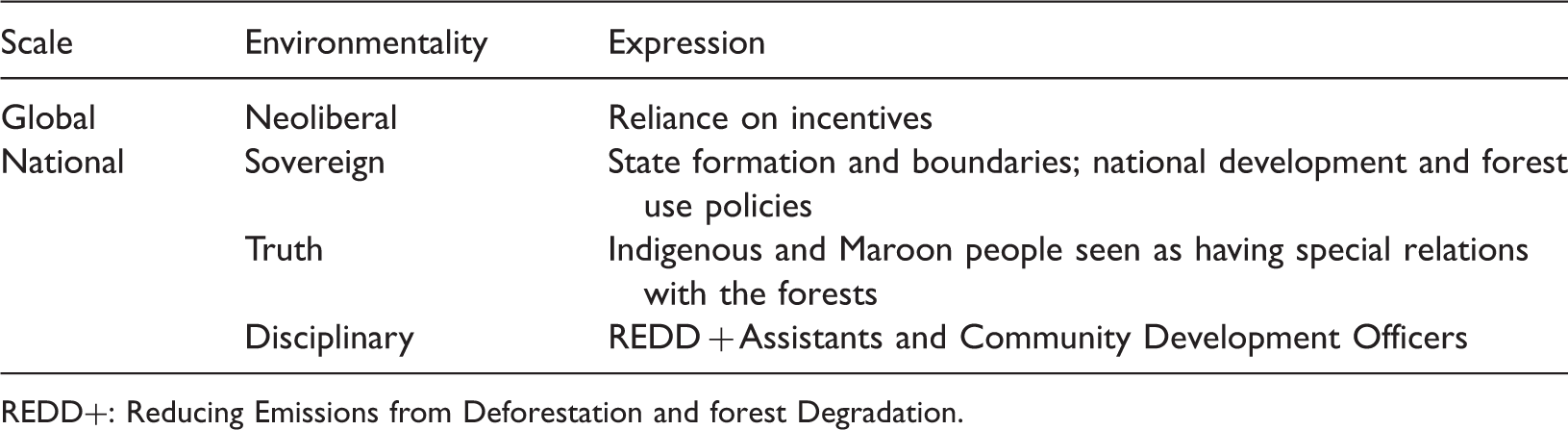
REDD+: Reducing Emissions from Deforestation and forest Degradation.
REDD + environmentalities analysed temporally in Guyana and Suriname.

REDD+: Reducing Emissions from Deforestation and forest Degradation.
Conclusion
The recognition that REDD+ governs forests at the global level through neoliberal environmentality (Sheng and Qiu, 2018) allowed for further exploration of how it is supported by other environmentalities at varying spatial scales (see McGregor et al., 2015). Sovereign, truth and disciplinary environmentalities can be seen to support and challenge its implementation in Guyana and Suriname. However, REDD+ is also supported by multiple overlapping environmentalities at varying temporalities. Hence, while the environmentalities I identify as supporting REDD+ are similar in name to some of those identified by Astuti and McGregor (2015), they are different in terms of temporality. As such, my analysis demonstrates that similarities in naming the different expressions of environmentality may conceal their temporalities.
The interaction of the multiple, long-term environmentalities I identify shows how REDD+ functions as a tool of environmental governance in Guyana and Suriname in the pursuit of simultaneous environmental conservation and economic growth. Sovereign environmentality provides the first step for global REDD+ governance by establishing the legal and institutional grounding for the demarcation of forests and their management as sequesters of carbon. The strength of sovereign environmentality in these contexts, however, appears to correlate inversely to some degree with that of truth environmentality. This correlation is demonstrated in the resistance of some forest communities, known to be users of the forests well before the emergence of REDD+, to be understood not just as challenging REDD+ but as challenging expressions of sovereign environmentality themselves. Truth environmentality here represents nature and forest dependent communities as intrinsically and spiritually connected to the land and forests. Resisting forested communities are then metaphorically whipped into shape through disciplinary environmentality to make them suitable for REDD+'s payment-for-forest conservation mandate.
But this conceptual conditioning for REDD+ suitability is not new, having taken place over recent decades as the independent sovereign state governments of Guyana and Suriname sought to instil and to build on market and development priorities in their state governing processes. Through these pre-REDD+ environmentalities, the conditions for REDD+ governance were set. This conditioning is brought into view through my temporal analysis of REDD+, which stands in contrast to Boer's (2017) static analysis through which he connected the distribution of welfare benefits through REDD+ to a new ‘welfare’ environmentality. The longer term, temporal environmentality analysis adopted here allows me to argue, by contrast, that REDD+ is not introducing novel forms of environmentality but is instead being adapted to suit social contexts (McAfee and Shapiro, 2010) that have been historically conditioned by needs for development and government-provided welfare. Consideration of the influence of previous development histories on REDD+ is side-lined when the frame of analysis is too narrowly focused on the limited time frame within which the mechanism is implemented. When situated temporally, REDD+ can be seen to fit discursively with prior efforts to move society along a market centred, neoliberal pathway that previously stimulated the very deforestation and forest degradation that REDD+ seeks to address. This argument fits well with the recognition by other researchers of continuities between REDD+ and pre-existing forest governance measures (Fletcher et al., 2016; Lund et al., 2017).
More broadly, the value of the temporal perspective lies in its potential for tracing connections between REDD+ and previous governing interventions. Further, a constantly shifting sovereign environmentality is made visible through this longer-term approach and is taken for granted in more short-term analyses. The presence of these overlapping, longer-term environmentalities illustrates how visions of environmental interventions differ in implementation from their original conception (Carrier and West, 2009) and demonstrate the potential of the multiple environmentality lens for supporting analyses of how environmental governance policies take shape in practice. More broadly, these environmentalities highlight the complexity of enacting environmental management policies in general while showing how diverse and conflicting governmental logics are embedded within REDD+ and their associated green growth policy frameworks. I hope to have demonstrated through this somewhat rear-facing exploration of how REDD+ governs forests through multiple environmentalities in the Guiana Shield, the potential of the multiple environmentality lens for shedding light on how global environmental governance is enacted, building on the legacy of prior governmental interventions while being constantly negotiated and challenged through implementation.
Highlights
I further develop the critical potential of the environmentality lens by demonstrating its temporal dimensions. I trace the contours of shifts, continuities and disruptions in environmental governance over time. I argue that REDD+ builds on pre-REDD+ forest governing interventions in Guyana and Suriname. Through environmentality, REDD+ can be seen as supported by a scaffold of governing logics at varying scales and temporalities.
Footnotes
Acknowledgements
Gratitude is extended to Guntra Aistara, Robert Fletcher, Prem Kumar Rajaram and Dan Brockington for comments and reviews.
Declaration of conflicting interests
The author(s) declared no potential conflicts of interest with respect to the research, authorship, and/or publication of this article.
Funding
The author(s) disclosed receipt of the following financial support for the research, authorship, and/or publication of this article: Funding and institutional support was provided by Central European University, Budapest, Hungary; the Centre for Space, Place and Society at Wageningen University, Wageningen, the Netherlands and the Institute for Cultural Inquiry Berlin, Germany.