



Abstract
We are currently witnessing a global trend of intensifying and deepening relationships between extractive companies and biodiversity conservation organisations that warrants closer scrutiny. Although existing literature has established that these two sectors often share the same space and rely on similar logics, it is increasingly common to find biodiversity conservation being carried out through partnerships between extractive and conservation actors. In this article, we explore what this cooperation achieves for both sectors. Using illustrative examples of extractive-conservation collaboration across sub-Saharan Africa, we argue that new entanglements between extractive and conservation actors are motivated by multiple purposes. First, partnering with conservation actors serves as a spatial and socio-ecological fix for extractive companies in response to multiple crises that threaten the sector's productivity. Second, new forms of collaboration between extractive and conservation actors create pathways for both sectors to produce new value from nature. For the extractive sector, creating new value from nature works as a further fix to capitalist crises whereas, for the conservation sector, producing value through nature amounts to new opportunities for capital accumulation. Importantly, working together to produce shared value from nature within and beyond extractive concessions secures both sectors' control over the means of production. Theoretically, our analysis links literature on value in capitalist nature with that on spatial and socio-ecological fixes.
Keywords
Introduction
First Quantum Minerals – a Canadian-based mining company whose principal activities include copper exploration, extraction and development – holds large mining concessions in Zambia. In Zambia's Copperbelt Province, the company operates both the Kansanshi and Kalumbila mines, which account for a significant amount of Zambia's overall copper production. As the largest individual taxpayer in the country, First Quantum is recognised as one of the most important contributors to Zambia's economy (Bochove and Mitimingi, 2018). Yet, in March 2018, the Zambia Revenue Authority sent the company a US$7.9 billion tax bill, along with a letter that stated it had significantly underpaid its taxes over a period of six years (Bochove and Mitimingi, 2018). First Quantum was quick to publically dispute this claim, but its shares fell over 10% the same day (McGee, 2018). This incident was just one of a string of disputes between the mining company and the Zambian government, reflecting ongoing tensions between First Quantum and its host state.
Less than two weeks after news broke about First Quantum's revised tax assessment, the company announced that it would be investing US$2 million in wildlife conservation projects in the near future (Zambian Eye, 2018). A post on First Quantum's Facebook page that same week showed pictures of rangers in West Lunga National Park in Zambia, with text explaining how the company works with Zambia's Ministry of Tourism to set up ranger camps and pay rangers’ salaries to help fight illegal hunting. A critical perspective on First Quantum's interest in biodiversity conservation might hold that this was simply a public relations ploy, as the company attempted to redirect its shareholders’ and the general public's attention towards its positive contributions to Zambia's environment. In other words, First Quantum's most recent commitments to biodiversity conservation could be interpreted as ‘greenwashing’ – the act of projecting a caring image without significant change to harmful business practices (Hamann and Kapelus, 2004).
Yet, a closer examination of First Quantum's participation in biodiversity conservation reveals that the company spends far more time and resources investing in conservation than one might expect of a mere public relations ploy. Around its Kansanshi mine in the Zambian Copperbelt, First Quantum has designated 1400 hectares of its concession as a protected wildlife reserve (FQM, 2014). In this reserve, it is reintroducing several species that were previously indigenous to the area, including giraffes, zebras, elands, kudus, lechwes, pukus, impalas, ostriches and wildebeests (FQM, 2014). Further west, First Quantum has invested in the reintroduction and conservation of wildlife in the West Lunga Management Area, which neighbours its Trident mine site (FQM, 2016). The company has also created a large new forest reserve and a second new wildlife reserve near this mine site (FQM, 2016). First Quantum explains in one of its recent annual reports that its ‘obligation to preserve biodiversity doesn't end at the concession fence’ but instead ‘extend[s] across an entire region’ (FQM, 2016: 96). This is part of the company's larger vision of having a net positive impact on the Zambian environment and becoming a positive force for biodiversity conservation across the nation.
First Quantum's keen interest and significant investment in biodiversity conservation in Zambia is part of a much broader trend of extractive and conservation actors becoming increasingly entwined. The convergence of extractive and conservation interests manifests in extractive companies establishing new protected areas, such as wildlife reserves, as in the case described above. Yet, extractive companies are also partnering with public and private conservation actors to carry out a wide range of other conservation-related activities, including: building security infrastructure in and around protected areas, such as fences and security outposts; implementing carbon trading schemes; establishing community-based conservancies and resource management programmes; training and equipping park rangers; raising community awareness about conservation initiatives; initiating captive breeding and rewilding programmes; and commissioning conservation research. Given that biodiversity conservation is not typically seen as being within the remit of extractive companies, this trend of entanglement between the two sectors is a puzzle worth further attention.
In this article, we critically examine new partnerships between extractive and conservation actors, drawing on illustrative cases from across sub-Saharan Africa 1 to detail key areas of cooperation between the two sectors. We assess what such cooperation achieves for both sectors and conclude by reflecting on some of the broader implications of this trend. Existing neoliberal nature literature has examined complementarities between natural resource extraction and biodiversity conservation, demonstrating that extraction and conservation activities increasingly occur in the same spaces and make use of similar logics, strategies and technologies (Büscher and Davidov, 2013; Norris, 2017; Seagle, 2012). We suggest that we are witnessing an intensifying and deepening of relationships between extractive companies and conservation organisations that warrant closer scrutiny. Rather than simply sharing the same space or relying on similar ideas and tools, biodiversity conservation is increasingly being carried out through partnerships between extractive and conservation actors in pursuit of shared or complementary interests.
We argue that new and intensifying entanglements between extractive and conservation actors are motivated by two purposes. First, we suggest that the extractive sector's growing interest, investment and involvement in biodiversity conservation is part of a spatial and socio-ecological fix. Through our analysis, we show how partnering with the conservation sector enables extractive companies to temporarily resolve crises that threaten their productivity and profitability. This includes crises arising from environmental degradation and natural resource depletion, as well as crises associated with social opposition or political resistance in response to the adverse environmental impacts of the sector. In this sense, the emergence and intensification of cooperation between the extractive and conservation sectors is part of the extractive sector's need to resolve both the first contradiction of capitalism, which relates to an inherent tendency towards underconsumption or overproduction, and the second contradiction of capitalism, which relates to the imperative of continual growth in the context of finite natural resources (O'Connor, 1988).
Second, we see new forms of collaboration between extractive and conservation actors as a way for both sectors to extract new forms of value from nature. As these two sectors partner with one another and implement various types of biodiversity conservation initiatives, natures are valued, revalued or devalued (Collard and Dempsey, 2017b). We provide examples of how partnership between extractive and conservation actors results in some natures – which might have previously been ignored – becoming officially valued. In other cases, extractive–conservation partnerships enable new forms of unpaid work and unpaid energy to be extracted from nature. Bringing value into our analysis enables us to show how cooperation between these two sectors facilitates new opportunities for value production and capital accumulation for both sectors, thereby offering a plausible explanation for why the conservation sector is willing to participate in ‘fixing’ extraction.
Kay and Kenney-Lazar have recently called for research that ‘consider[s] value as central to nature–society relationships, suggesting “value in capitalist natures” as an emerging framework around which research could be organized’ (2017: 306). This article responds to this call by highlighting collaborations between extractive and conservation actors as an emergent pathway through which value is being produced from nature, providing useful empirical examples of relationships between value and nature under contemporary capitalism. Theoretically, our analysis links literature on value with that on spatial and socio-ecological fixes. We show how sectors that use nature in seemingly competing or conflicting ways can partner to reorganise socionatural relationships, landscapes and processes in ways that enable them to simultaneously extract value from nature. This, in turn, enables the extractive sector to ‘fix’ the crises it faces and both sectors to secure the foundation upon which their production and accumulation is based.
Although this article is largely a theoretical exercise, it draws on concrete examples and is informed by our individual and collaborative research into extraction and conservation over the last five years or so. As our central objective is to explain a trend of deepening entanglements between the extractive and conservation sectors, we do not rely on one case study alone but instead uses various illustrative examples to evidence our claims. Many of the examples used were identified through discourse, narrative and semiotic analysis of websites, reports and documents produced by extractive companies, conservation organisations and multistakeholder initiatives that facilitate collaboration between the two sectors. Other examples come from field observations – including site visits, key informant interviews and focus group discussions – in Cameroon, Kenya, Tanzania and Zambia between 2014 and 2019. Given our research backgrounds, we use cases from various African contexts in the analysis that follows.
We begin this article by introducing existing literature that considers the relationship between extractive industries and biodiversity conservation. Next, we reflect on what motivates new and intensifying entanglements between extractive and conservation actors. In the subsequent section, we illustrate how partnering with the conservation sector works as a spatial and socio-ecological fix for the extractive sector in particular. In the penultimate section, we argue that collaboration also enables both sectors to create more value from nature and, in some cases, to extract novel or additional value from nature. We conclude by discussing the broader implications of this trend and outlining directions for further research.
Extractive–conservation convergence in Africa
In this article, we define the global extractive sector as the people, companies and processes involved in extracting non-renewable raw materials from the earth and converting them into value (Bridge, 2009). Extractive practices, organisational structures, labour needs and socio-environmental impacts vary significantly across the sector (Bakker and Bridge, 2006; Bridge, 2002; Bury, 2005). However, there are overarching similarities that make it possible to talk about trends in the extractive sector as a whole. For example, companies across the sector create value in similar ways (Bebbington and Bury, 2013; Bridge, 2009). Moreover, over the past decade or so, escalating demand for oil, gas and minerals has driven unprecedented investments in the extractive sector globally. This has had political, social and economic implications for actors at all scales. It has also resulted in ecological devastation – including deforestation, habitat fragmentation and soil and water contamination – as new investments in the sector have driven rezoning, clear-cutting, infrastructure expansion, urbanisation and migration (Edwards et al., 2014).
If, in the 21st century, the extractive sector is seen as ‘spoiling Eden’ (McAfee, 1999), the biodiversity conservation sector tends to be presented in the opposite light. The conservation sector is often portrayed as the solution to fundamental challenges facing the future of the planet. More specifically, market-based conservation is promised to enable a ‘return to Eden’ in a world where industrialism has ‘run amok’ (McAfee, 1999). Market solutions and growing financial interest in the natural world are forefronted in public discourse: Carbon markets are promoted for their ability to offset greenhouse gas emissions; wetlands and species banks are promised to address environmental degradation caused by industrial development; and ecotourism is encouraged as a means of using conserved nature to drive socio-economic development (Büscher and Fletcher, 2015). As Igoe et al. (2010) write, the struggle to save our planet through market-based conservation is now hegemonic.
Given the contrasting narratives that surround the extractive industries and biodiversity conservation, it might seem that resource extraction and biodiversity conservation are fundamentally incompatible projects. Yet, land use and spatial analysis reveals that this is not the case. Research by the World Resource Institute (WRI) (2003) indicates that at least three quarters of all resource exploration and extraction activities on the planet overlap with biodiversity conservation areas. Moreover, one-third of mining activities globally occur in ecologically stressed watersheds, with one quarter of these occurring within a 10 kilometre radius of areas that the International Union for the Conservation of Nature (IUCN) labels as ‘strictly protected’ (WRI, 2003). Furthermore, it appears that the spatial overlap of resource extraction and ecologically sensitive areas is bound to become more common as the demand for rare earth metals and minerals increases.
The spatial overlap between these two sectors has led some researchers to further consider complementarities between these extractive and conservation activities (Büscher and Davidov, 2013; Norris, 2017; Seagle, 2012, 2013). Their research argues that the mandate and motivation of both the conservation and extractive sectors has become more congruent as a result of the neoliberalisation of conservation: Both sectors now work to transform nature into commodities for exchange, whether such commodities are nuggets of gold or wilderness getaways (Mendoza et al., 2017: 5). Moreover, both sectors make use of similar logics, strategies and technologies to enclose land and to assign value to nature (Büscher and Davidov, 2013; Norris, 2017; Seagle, 2012). For example, the military approach to security common in the conservation sector (Annecke and Masubele, 2016; Büscher, 2018; Duffy et al., 2019) shares remarkable similarities with the militarisation of extractive enclaves. Given similarities in how value is created and the conditions of production are maintained across these two sectors, it follows that both sectors might find themselves expanding into the same landscapes using comparable tactics.
Importantly, however, the relationship between these sectors extends beyond operating in the same space and under similar logics. Increasingly, the extractive and conservation sectors pursue an agenda of cooperation. During the 1990s, many conservation organisations were hesitant to partner with extractive companies, but this is no longer the case. Wildlife Conservation Society, Fauna and Flora International, The Nature Conservancy and the World Wide Fund for Nature (WWF) all have ties with the extractive sector. Extractive companies participate in global biodiversity conservation initiatives, such as IUCN's Business and Biodiversity Programme. Moreover, niche extractive industry associations have been established with the explicit mandate of supporting extractive-led biodiversity conservation. For example, the Energy and Biodiversity Initiative was founded in 2001 by major players in both the energy and conservation sectors, including BP, ChevronTexaco, Statoil and Shell International BV as well as Fauna and Flora International, IUCN and The Nature Conservancy. In 2013, Energy and Biodiversity Initiative was replaced by the Cross-Sector Biodiversity Initiative (CSBI). The CSBI aims ‘to develop and share good practices related to biodiversity and ecosystem services in the extractive industries’ through a partnership involving the International Petroleum Industry Environmental Conservation Association (IPIECA), ICMM, the Equator Principles Association, the European Bank for Reconstruction and Development, the International Finance Corporation and the Inter-American Development Bank (CSBI, 2018). Furthermore, as discussed in greater detail throughout this paper, individual extractive companies are increasingly carrying out conservation activities of their own – either in collaboration with major conservation players or through their own conservation foundations. While such trends might once have seemed paradoxical, today it is common to find the extractive and conservation sectors operating in parallel and in partnership.
Research that touches on the trend of extractive–conservation partnerships tends to link new alliances between these sectors to the extractive sector's need for environmental expertise and the conservation sector's need for funding (for example, see: Igoe et al., 2010; MacDonald, 2010; Seagle, 2012, 2013). The extractive sector is facing growing public pressure to improve its environmental performance – particularly in relation to biodiversity conservation and carbon offsetting. Extractive companies lacking expertise in this area have looked to outsource environmental responsibilities to third-parties to provide technical expertise, policy advice and field capacity. At the same time, conservation organisations have been pushed to diversify their funding strategies to include corporate, bilateral and multilateral sources amidst an ongoing period of austerity (Brockington et al., 2008). Although many organisations were once hesitant to accept funding from the extractive sector and some remain so (such as Greenpeace USA and Friends of the Earth), others have shifted their approach and now financially benefit from and work closely with the extractive sector.
‘Fixing’ extraction through conservation
We now turn to ideas about crises, fixes and value to theorise about why extractive and conservation interests have converged at this particular point in time and how this convergence uniquely benefits both sectors. To begin, in this section, we argue that partnering with the conservation sector provides the extractive sector with a means of sustaining capital accumulation in an era where it faces multiple crises. More specifically, new and intensifying forms of cooperation between extractive and conservation actors serve as both a spatial and socio-ecological fix for the extractive sector.
The spatial fix
Rooted in Marxist critique and initially theorised by David Harvey (1981, 1982, 1985a, 1985b, 1996, 2001, 2003), spatial fix refers to the temporary offsetting of capitalist crises through spatial expansion. Work by Harvey and others offers useful insights into the various ways that space can be reorganised to fix capitalist crises through processes such urbanisation, gentrification or deindustrialisation (see Brenner, 1998; Glassman, 2006; Lang and Knox, 2009). Some scholars have written about how the reorganisation of global space can also serve as a fix, involving processes such as imperialism, colonisation and economic globalisation or transnational neoliberalism. These examples of spatial expansion and reorganisation are fixes in that they serve to temporarily neutralise threats to the ongoing accumulation of capital. By expanding into new spaces – both literally and figuratively – to access cheaper sources of labour and raw materials, it becomes possible to restore the material means of production and alleviate crises.
Curiously, frontier natural resource extraction has received relatively little attention in theoretical work on the spatial fix (Zalik, 2015: 2451), perhaps because it is such an obvious and, therefore, seemingly uninteresting example. Yet, a few exceptions do exist, such as work by Zalik (2015), Barry (2013) and Scott (2013). Such scholars argue that oil and gas infrastructure, like pipelines, exemplify a spatial fix in response to the first contradiction of capitalism – capital's inherent tendency towards underconsumption or overproduction. By building infrastructure that moves oil from one region of the world to another, oil companies and states enable commodities to reach new markets, thereby alleviating such crises. Oil and gas cartels offer another example of a spatial fix in the extractive sector. By limiting the production and distribution of oil and gas in certain parts of the world, cartels sustain high profits and prevent overaccumulation at a global scale (Bina, 2006; Mitchell, 2002). Spatial fixes such as these are enacted through coordination between companies, states and intergovernmental organisations to prevent or offset economic crises in the extractive sector. Along similar lines of reasoning, frontier natural resource extraction can be understood as a fix for capital's inherent tendency towards underconsumption or overproduction: By expanding into new spaces, extractive companies can often access cheaper sources of labour and raw materials to alleviate crises.
At the same time, frontier natural resource extraction can be seen as a spatial fix in response to the second contradiction of capitalism – namely, the tendency of capitalist production relations and productive forces to destroy rather than conserve the conditions they rely on for production (O'Connor, 1988). As easily accessible oil, gas and mineral reserves are exhausted, the productivity of extractive industries faces a looming crisis. Yet, as Robbins et al. write, ‘the crises caused by the treadmill of accumulation can be avoided, in theory, as long as capitalist production and consumption can be extended to new places…’ (2014: 110). To overcome natural resource depletion, extractive industries expand spatially into new commodity frontiers. As more accessible reserves are exhausted, new frontier spaces are found and exploited – often using technological fixes, like deep-sea oil drilling – to once again renew the conditions of production.
Increasingly, extractive companies are moving into spaces previously deemed to be off-limits or no-go zones because of their perceived intrinsic natural value, such as biodiversity, ecosystem services or sites of cultural and spiritual significance. For example, nearly two-thirds of Africa's natural world heritage sites – regarded as globally important sites of biodiversity conservation for their ecological significance and natural beauty – have been identified as promising sites for mining, oil and gas exploration and extraction (WWF, 2015). Such sites include Selous Game Reserve in Tanzania and the Namib Sand Sea in Namibia (WWF, 2015). These sites contain species considered to be endangered or vulnerable to extinction as well as rare landforms, such as shifting sand dunes. WWF reports that the number of mining and oil and gas concessions in or overlapping with natural world heritage sites is quickly expanding (WWF, 2015). Other research has reached similar conclusions about the expansion of commercial mining, oil and gas exploration and extraction into areas with natural value across Africa. For example, both Edwards et al. (2014) and Mascia et al. (2014) note a growing trend in which protected areas across Africa are being degazetted, downgraded or downsized to accommodate natural resource extraction. A recent example of this occurred in July 2018, when the Democratic Republic of Congo (DRC) announced that parts of Virunga and Salonga National Parks, two UNESCO World Heritage Sites, may be open for oil exploration and drilling (BBC, 2018).
By expanding into areas that historically had boundaries and buffer areas to safeguard against extraction, the extractive industries are temporarily alleviating or postponing crises associated with degraded and depleted natural resource reserves. Harvey's work on the spatial fix drew attention to the relationship between limits and crises, noting that resolving capitalist crises requires overcoming the limits of nature's productivity. In this case, the extractive sector is reestablishing the material conditions needed for production by extending its activities beyond the boundaries constructed between protected areas and non-protected areas. 2 In doing so, they are fulfilling O'Connor's (1988) observation that the self-limiting productivity of nature can be temporarily overcome by identifying and deploying appropriate spatial fixes. Such spatial fixes are made possible by complex and often opaque arrangements between extractive, conservation and government actors; yet, other types of entanglements between these different actors also exist.
The socio-ecological fix
Commodity boom and bust cycles and the degradation and depletion of natural resources are not the only crises plaguing the profitability of extractive companies. The extractive sector faces a growing legitimacy crisis as well. This crisis precipitates social movements, which threaten the sector's social conditions of production (O'Connor, 1998). Moreover, as the extractive sector extends its activities into new spaces and employs less conventional methods of extraction to restore the material conditions of production, these social movements often gain momentum and voice. In this sense, attempts to fix crises spatially may actually contribute to deepening and intensifying rather than resolving crises facing the sector.
At the global scale, the sector's legitimacy has been damaged by a number of high-profile environmental disasters caused by extractive operations and the fallout of these catastrophes. The dumping of billions of tons of untreated mining waste into the Ok Tedi River from the Ok Tedi Mine in Papua New Guinea in the mid-1980s and the 11 million gallon crude oil spill that occurred when ExxonValdez crashed into a reef in Alaska's Prince William Sound in 1989 are two prime examples of widely publicised environmental disasters that gripped a global audience. By causing irreparable damage to sensitive ecologies and the human lives and livelihoods intricately connected to them, these events have challenged the reputation of the sector as a whole and led to concerns about expanding extractive activities. More recently, the legitimacy crisis facing the sector has been further heightened by concerns about the link between extraction and climate change and extraction and extinction. Given these links, extractive companies that attempt to exploit remaining and increasingly risky mineral and fuel reserves using unconventional methods often face resistance.
Resistance against natural resource extraction is also increasingly common among those living near extractive sites who are directly exposed to the risk of environmental disasters (Bebbington and Bury, 2013). Local-level resistance often relates to the fact that the conditions needed to produce value in the extractive sector – such as secure access to land and natural resources – tend to be the same ‘conditions of production [that] comprise the lifeworlds and livelihoods of billions of people’ (Surprise, 2018: 5). As land is subjected to degradation and natural resources are depleted by the extractive sector, mines and drilling sites emerge as key sites of sociopolitical struggle.
From everyday resistance to roadblocks to divestment to violence, global and local-level movements against the extractive sector can threaten capital accumulation. Research that attempts to quantify the cost of resistance against extractive industries finds that ‘a major, world-class mining project with capital expenditure of between US $3 and US $5 billion [suffers] roughly US $20 million per week of delayed production in net present value terms as a result of community conflict’ (Franks et al., 2014: 7578). Both the intensity and material risks caused by resistance are likely to increase as extractive companies expand into more ecologically sensitive areas in search of rare and unconventional resources and as activism around fossil fuel extraction and greenhouse gas emissions intensifies. In these ways, the extractive sector's legitimacy crisis threatens the sector's social conditions of production.
To resolve legitimacy crises like those facing the extractive sector, profit must be used to disarm social movements and regain support from the public – for example, by initiating or participating in environmental clean-up, renewal or protection (O'Connor, 1998). Such measures represent socio-ecological fixes as they temporarily offset capitalist crises that threaten the social conditions of production. Ekers and Prudham (2015) conceptualise the socio-ecological fix as the re-working of socionatural relationships, processes and landscapes to secure the conditions of future production.
3
An increasingly common and effective socio-ecological fix deployed by the extractive sector involves investing in biodiversity conservation and partnering with biodiversity actors. As the Energy and Biodiversity Initiative (EBI) explains: … a company's track record for performance on biodiversity – and other social and environmental issues – can in turn affect its global competitiveness, in terms of access to key business resources, including land, oil and gas resources, capital and labor. A company with a positive reputation for responsibly addressing and preventing biodiversity impacts may become a company of choice for governments, investors, business partners and employees. In contrast, not managing biodiversity properly can be a long-term constraint on business and limit opportunities for future activity. (2003: 18)
There is ample evidence to suggest that partnering with the biodiversity sector does, in fact, help extractive companies to (re)establish the social conditions of production. For example, the Campo Ma’an and Mban et Djerem National Parks in Cameroon were created with financing from the consortium of oil and gas companies behind the Chad-Cameroon Petroleum Development and Pipeline Project. When the Chad-Cameroon Pipeline was initially proposed in the late 1990s, the consortium faced a legitimacy crisis. Civil society organisations in Cameroon and around the world feared that the state was not strong enough to regulate the oil and gas sector and that environmental degradation would follow. Due to this legitimacy crisis, the consortium was initially unable to secure financing for the petroleum development and pipeline project. To overcome this challenge, it proposed that it would fund the creation and operation of two new national parks as a way of offsetting environmental degradation linked to the pipeline project, as well as a number of other environmental initiatives. This helped to appease concerns about the environmental impacts of the pipeline project from key financers and, subsequently, secure funding. Today, the WWF and Cameroon Ministry of Forestry and Wildlife co-manage Campo Ma’an and Mban et Djerem National Parks with continued financing from the oil and gas consortium (WWF, 2018). By reimagining extractive landscapes as spaces where oil development and biodiversity conservation can co-exist, and by enrolling conservation experts in the management of these spaces, the consortium was able to overcome a potential crisis.
De Beers’ Forevermark brand offers another example of how ‘landscapes are produced, how human and nonhuman organisms and socionatural relationships are transformed and how labor processes are restructured in order to address or offset (at least temporarily) entangled social and environmental crises of capitalism’ (Ekers and Prudham, 2015: 2438). In 2015, sales of diamonds declined globally by 2% while De Beers’ revenues fell by roughly one-third and its operating profits fell by more than half (Financial Times, 2016). A number of different factors explain declining demand for diamonds; however, one important factor is that some millennials are increasingly concerned with ethical sourcing. One strategy that De Beers is using to convince millennials that its diamonds are ethical is by marketing its ‘Forevermark’ brand of diamonds as a symbol of wildlife conservation. This requires real and imagined transformations to the ecological landscapes within its mining concessions. De Beers has set aside significant amounts of land in its concessions for conservation – an activity that it carries out in collaboration with various conservation actors. The Forevermark brand's website depicts these conservation activities. It is decorated with beautiful pictures of savanna landscapes filled with charismatic megafauna, such as herds of elephant and giraffe. It also includes short films, which describe how buying a Forevermark diamond helps to protect wildlife. Piet Oosthuizen, Senior Manager Ecology and De Beers Properties, states in one of these films: ‘If it was not for diamonds we would not be in a position to contribute to conservation effort[s]. We can actually say that conservation is because of … diamonds’ (De Beers, 2015). This example effectively shows how enrolling new elements of nature into circuits of capital – even symbolically – works as a socio-ecological fix for crises of underconsumption.
In this section, we have shown how extraction can be ‘fixed’ through conservation. We have argued that deepening relationships between the extractive and conservation sector are, at least in part, a means of resolving crises of underconsumption or overproduction that threaten the profitability of the extractive sector. Based on our observations of convergence between these two sectors, we think it is worth reiterating McCarthy's (2015) point that although socio-ecological fixes may seem progressive upon first glance, this may not be the case upon closer examination. As we demonstrate above, new partnerships with the conservation sector enable the extractive sector to restore its legitimacy, thereby overcoming or displacing crises that threaten capital accumulation and making possible expansion into ecologically sensitive spaces previously deemed to be off-limits.
Extraction, conservation and the production of shared value and threat
In 2010, PricewaterhouseCoopers (PWC) advised businesses attending the World Economic Forum that growing pressures for businesses to pay attention to biodiversity loss should be seen as a business opportunity rather than a nuisance. As their paper states: … it should be remembered that where there are risks there are also opportunities; with new trading mechanisms and markets, new technologies and design approaches, and improved land-use models, a new green economy presents a myriad of new areas for businesses to create value (PWC, 2010: 2).
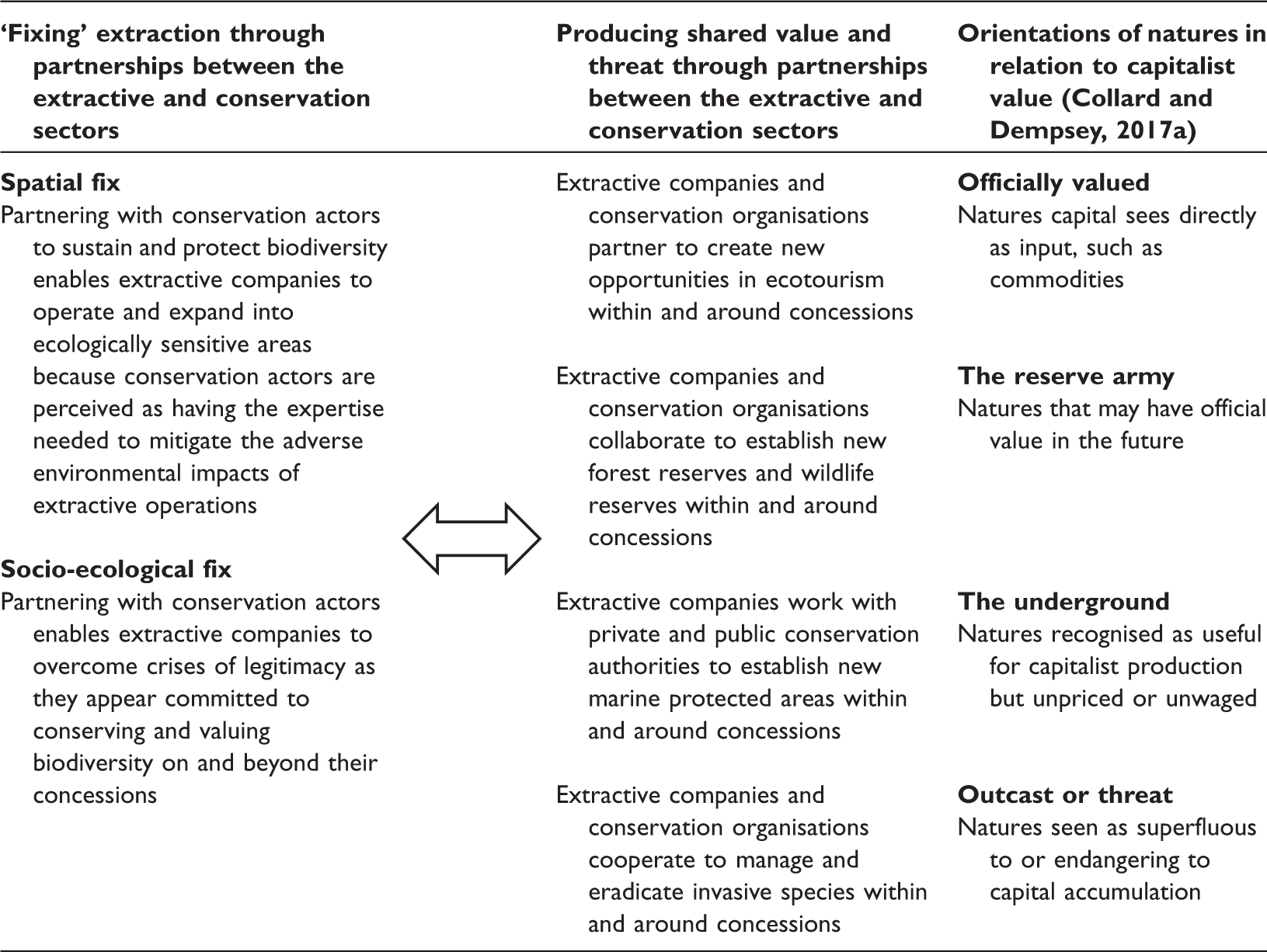
Importantly, our understanding of what it means to produce value through nature extends beyond the production of commodities or entities with exchange value. Rather, our understanding of how nature is valued is informed by Collard and Dempsey's (2017a) work on orientations of capitalist nature, which includes a typology introduced by the authors to describe the multiple ways human and non-human natures are oriented in relation to capitalist production. In their typology, Collard and Dempsey (2017a) outline how nonhuman bodies and populations come to bear capitalist and non-capitalist value and the role that perceived differences and hierarchies play in the value they come bear. The authors detail five hierarchical orientations of humans and nonhumans in relation to capitalist value. These are: (1) ‘officially valued’ (direct inputs of capital, including free or waged labour, unfree or indentured labour and commodities); (2) ‘the reserve army’ (relative surpluses, such as reserves of labour, inputs and commodities that have future exchange value); (3) ‘the underground’ (useful inputs that contribute to capitalist production but that are unwaged or unpriced); (4) ‘outcast surplus’ (things deemed to be of no use to capital or waste produced by capitalist production that is not repurposable); and (5) ‘threat’ (humans or nonhumans that endanger capitalist production) (Collard and Dempsey, 2017a).
Summary of how extractive–conservation partnerships ‘fix’ extraction and create value.
Producing official value through partnership
To begin with, the convergence of extractive industries and biodiversity conservation makes possible the creation of new officially valued natures. Referring to Collard and Dempsey's (2017a) typology, this category includes both commodities and enclosed land. One example of how official value is created through new and deepening partnerships between extractive and conservation actors is through ecotourism. For example, First Quantum Minerals' newly established Kalumbila Wildlife Reserve in northwestern Zambia is creating new opportunities for the commodification of nature. As the company explains in its most recent corporate sustainability report: There's a vision emerging of Kalumbila as a gateway for eco-tourism in the North-Western Province, with easy access not only to West Lunga but to other great national parks such as Kafue, as well as to the massive wildebeest migration routes on the Liuwa Plains, and to places like Mwinilunga, which has one of the largest concentrations of diverse bird species in Africa. This expected growth in tourist traffic will create niche support businesses. In addition, there are many other wildlife-related activities that can potentially contribute to prosperity, from beekeeping in the mavunda to scientific research projects – including those seeking deeper insights into climate change. So as we work with our various partners to protect what's here today, we're helping to create a more hopeful future. (FQM, 2016: 101)
Another example of how official value is created from nature through new partnerships between the extractive and conservation sectors is that of enclosed land. 4 By partnering with one another, extractive and conservation actors have identified an effective way of increasing the amount of land that they have access to and control over, which enables them to produce more and new types of official value from nature. For example, De Beers states that 200,000 hectares of land around its mines are set aside for conservation, and that this land is home to numerous indigenous and endangered species of wildlife (De Beers, 2018). Over the past decade or so, De Beers Group has begun to shift towards ‘more holistic’ management of the land set aside for conservation by creating connections between its different conservation spaces through an initiative called The Diamond Route (De Beers, 2018). The Diamond Route links De Beers Group properties, as well as other conservation spaces that span across South Africa and Botswana, and is promoted as a space for biodiversity conservation, conservation research and training and ecotourism. Researchers can apply to conduct research, postgraduate students can do experiential learning and tourists can stay in luxury accommodation, go on safari and visit cultural and heritage sites within The Diamond Route. At the same time, De Beers leases some of this property out to other conservation actors, including South African National Parks (SANParks) (De Beers, 2016), who use the land to support their own initiatives. This illustrates how partnerships between extractive and conservation actors can be used to reorganise socionatural landscapes so that ongoing forms of capital accumulation are relegitimised – such as diamond mining – while also making new forms of official value production possible, such as by collecting land rent for De Beers and by initiating new ecotourism ventures for conservation actors.
Producing reserve value through partnership
Partnerships between extractive and conservation actors are producing new forms of value by creating ‘a sort of “reserve army” of potentially commodifiable nonhuman natures’ (Collard and Dempsey, 2017a: 78). Collard and Dempsey (2017a) define the reserve army as natures that are not yet commodities but that promise to deliver future use or exchange value. The creation of new forest reserves in and around mining concessions offers one example of how this type of value is being created through partnerships between the two sectors. From Newmont Gold in Ghana to First Quantum Minerals in Zambia to Rio Tinto in Madagascar, establishing new forest reserves within and around mining concessions is an increasingly common strategy used by mining companies in Africa that aspire to have a ‘net positive’ impact on biodiversity. For example, around 1665 hectares of forest will be affected by Rio Tinto's mining operations in Madagascar (Temple et al., 2012). Rio Tinto is attempting to offset this impact by restoring and conserving over 6000 hectares of littoral forest – an area over four times larger than the company's impact (IUCN and Rio Tinto, 2012). At the same time, Rio Tinto is working to create a supply of fast-growing species in areas surrounding its reforestation projects so that communities can access and use timber for fuel without having to enter the replanted forested areas that Rio Tinto is conserving (Rio Tinto, 2016). This project, which has been designed in collaboration with IUCN, is one example of how extractive companies work with conservation organisations to produce natures with the potential to be commodified in the future – by either the extractive or conservation sector – while simultaneously improving the public image of the extractive sector.
Captive breeding programmes are another example of reserve value being created through new partnerships between the extractive and conservation sectors. Through such initiatives, extractive companies and conservation organisations help bring into being wildlife that are not commodified per se but have the potential to bear capitalist value in the future. For example, wildebeest were among the first indigenous species to be reintroduced into First Quantum Minerals’ Kansanshi mine wildlife reserve in Zambia (FQM, 2016). Over the past few years, the wildebeest population has flourished in the reserve, which now supplies wildebeest to its second wildlife reserve in Kalumbila, adjacent to the company's Trident mine site and managed by Trident Foundation (FQM, 2016). Eventually, the wildebeest population in the Kalumbila reserve will provide starter populations for protected zones within West Lunga Management Area – also supported by Trident Foundation and First Quantum Minerals (FQM, 2016). As First Quantum Minerals works with public and private conservation actors to reintroduce native animal species across northwestern Zambia, it is possible to see how wildebeest could become ‘lively commodities’ (Collard and Dempsey, 2013) and represent a new stream of profit – likely for the conservation sector – if other national parks and private reserves wish to pay for starter populations in the future. In the meantime, producing reserve value through nature reflects positively on the extractive sector, helping it to mitigate poor public relations.
Producing underground value through partnership
Collard and Dempsey's typology (2017a) also captures how nature can serve as a ‘hidden underground’ of value production. They define the underground as natures that contribute directly and indirectly to commodity production but are unwaged or unpriced, noting that the nonhuman underground has ‘recently become subject to greater attention in various levels of government, in science and in economics. Ecosystems are increasingly seen as making human life and capitalist social relations possible’ (Collard and Dempsey, 2017a: 90). Examples that Collard and Dempsey (2017a) offer of underground value include bees that pollinate crops and microbes that break down dead organisms – both of which enable agricultural goods to be produced and exchanged as commodities. They also refer to the commons and public goods as services freely provided by ecosystems that are needed for capitalist production (see Collard and Dempsey, 2013).
Through cooperation, extractive companies and conservation organisations aim to protect and, to some extent, control the hidden underground value of nature, which is important for producing and reproducing the conditions of production. For example, the President of Gabon recently announced the establishment of marine protected areas in more than 23% of Gabon's territorial waters (Tullow Oil, 2014). The decision to set aside this space for marine conservation was informed by research conducted by Tullow Oil and the Wildlife Conservation Society on the biodiversity and health of Gabon's marine environment (Tullow Oil, 2014). In addition to contributing to a stronger baseline understanding of Gabon's coastal and marine environment and protecting the global commons, this research informed the country's marine spatial planning process, resulting in specific zones off the coast being designated for oil industry activity, commercial fishing and community fisheries (Tullow Oil, 2014). This spatial planning was important, as the oil industry, commercial fishing sector and community fishers are all (differently) dependent on the invisible work done by nature to accumulate capital or pursue their livelihoods. For example, the oil industry needs access to rock formations under the ocean floor that contain oil while fishers require access to reefs that nurture and sustain marine species. Thus, Tullow Oil and the Wildlife Conservation Society are securing reserve value by supporting the creation of new marine protected areas in Gabon. Yet, at the same time, the spatial planning of these new protected areas – and the divvying up of which sector gets to use which space – helps to ensure that the hidden underground value of the ecosystems can continue to support the multiple types of capitalist production that take place off Gabon's coast, thereby securing multiple sectors' means of production for the future.
Mitigating threat through partnership
So far, we have outlined how new types of value are produced through nature as extractive and conservation actors partner with one another. However, not all nature can be made valuable to capital. As Collard and Dempsey suggest, ‘certain bodies and natures are rendered wholly and enduringly superfluous to the needs of capital’ (2017a: 91) and others are a threat to capitalist production altogether. They refer to these categories of human and non-human natures as outcast surplus and threat, respectively. While extractive and conservation actors pay little attention to outcast surplus, they do work together to manage and control natures deemed to be a threat. In this final section, we reflect on how these actors respond to natures that endanger capitalist production.
‘Invasive species’ are one example of nonhuman natures that the extractive–conservation nexus deems as threatening and works to eradicate. Large-scale developments, such as mining sites and oil camps, are often linked to invasive species introduction. This happens because degraded environments are particularly vulnerable to invasive species establishment and mobile equipment carries invasive species and seeds between sites. The economic impacts of invasive species can be significant. In addition to the environmental costs associated with controlling the spread of invasive species, invasive plant species can increase fire risks and invasive animal species can pose health hazards. In these ways, invasive species can threaten capitalist production.
For example, the Ambatovy Mine in Madagascar has received ample attention for its role in the spread of invasive species around its mine, plant and port sites. Of particular concern has been the mine's role in the spread of Duttaphrynus melanostictus, more commonly known as the Asian common toad. Although it is unclear how this toxic amphibian arrived in Madagascar, it has been reported that the species was first noticed around Ambatovy's port and nearby nickel and cobalt processing plant. The population has bred rapidly and is now altering the local ecology in worrying ways. For instance, some suggest that the toads may be indirectly responsible for the recent bubonic plague outbreak, as they poison snakes which would otherwise control the rat population (Watts, 2018). Facing public criticism for the spread of the species and its slow response, Ambatovy now participates in various measures to mitigate the impacts of the toad. These measures include hiring an invasive species specialist to provide technical advice on species control, partnering with Madagascar's National Environment Office to carry out an eradication programme and financing a third party conservation organisation to manage eradication efforts in nearby communities (Ambatovy, 2017; Sherritt, 2016). Despite the resources committed by Ambatovy to mitigating this threat, a recent study suggests that it is now too late to eradicate the species and merely controlling its spread will cost several million dollars (Reardon et al., 2018). In this case, the framing of the Asian common toad as ‘threat’ creates an opportunity for the conservation sector to accumulate by providing technical advice and support for invasive species management. Demonstrating commitment to this process also shores up social legitimacy for the extractive sector.
While invasive species threaten capital accumulation, their impact pales in comparison to the most significant threat facing the extractive sector – climate change. As the environment becomes less predictable and natural disasters become more common and severe in certain parts of the world, the extraction and transport of metals, oil and gas has also become more risky, creating new physical risks for the sector. At the same time, divestment movements are gaining momentum globally, which threatens to decrease demand for certain extractive resources, such as crude oil and coal. The extractive sector is attempting to mitigate the various challenges presented by climate change on multiple fronts. An increasingly popular approach to mitigating threats created by climate change involves partnering with conservation organisations to implement nature-based projects to offset greenhouse gas emissions. For example, Shell has partnered with Wildlife Works on a project in Kenya to protect 500,000 acres of forested land, which also serves as a wildlife corridor for endangered plants and animals (Shell, 2017). Shell claims that this project ‘acts effectively against climate change’ by ‘balancing’ Shell's carbon footprint and reducing the amount of CO2 in the atmosphere (Shell, 2017). While it is unlikely that offsetting initiatives help companies to mitigate the physical risks of climate change, they do help companies to fix other material risks by improving their perceived legitimacy. This is particularly important in an era where fossil fuel companies are at risk of being sued over climate change. As Collard and Dempsey write, ‘tort law can also render [nature] a kind of threat or at least an unwelcome cost to the production of capitalist value’ (2017a: 93). For the conservation sector, the global increase in offsetting projects creates multiple new avenues for accumulation – from consulting about how offsetting should be done to managing offsetting projects to establishing other biodiversity conservation projects on reforested land, such as wildlife monitoring programmes. For the extractive sector, partnering with the conservation sector to mitigate this threat is now all but necessary for capital accumulation through extraction to continue.
Concluding discussion
In this article, we engage with empirical evidence demonstrating the convergence of extractive and biodiversity conservation interests across different parts of Africa. Given that biodiversity conservation would not have historically fallen within the remit of the extractive sector, we believe this evolving trend deserves ongoing attention. Through our analysis, we unpack why new and intensifying forms of collaboration between extractive and conservation actors have emerged and what these entanglements achieve for both sectors. Specifically, we argue that these partnerships have emerged in response to capitalist crises. Through partnerships, the extractive and conservation sectors reorganise socionatural relationships, landscapes and processes in ways that restore the conditions needed for capital accumulation. At the same time, this reorganisation of relationships and spaces makes new forms of value production possible and enables both sectors to further secure the foundations upon which their modes of production and accumulation are predicated.
For the extractive sector, a primary motivation behind partnering with the conservation sector has been to temporarily resolve or ‘fix’ capitalist crises. Because minerals, metals and fossil fuels are difficult to extract, depleted through use and non-renewable, environmental degradation and natural resource depletion are major challenges facing the extractive sector. These challenges threaten the productivity and profitability of the sector, forcing extractive industries into new spaces in search of unexploited reserves. Remaining reserves often overlap with biodiversity hotspots and are more difficult and risky to extract, resulting in public opposition to the expansion of extractive activities. Demonstrating a commitment to managing negative environmental impacts is no longer enough to quiet this opposition. However, partnering with conservation actors and implementing biodiversity conservation initiatives enables the extractive sector to mitigate some degree of public concern. Partnerships with the conservation sector suggest to the public that extractive companies are not only willing to manage their negative environmental impacts, but that they are also committed to conserving and valuing biodiversity on and beyond their concessions. Images of elephants on mining concessions or dolphins around oil rigs give the impression that the extractive sector creates spaces that sustain biodiversity – biodiversity that might otherwise be unprotected and unvalued.
At the same time, partnering with the extractive sector creates new opportunities for the conservation sector to accumulate capital. As discussed, conservation organisations have been pushed to diversify their funding sources over the last two decades. In looking to corporate, bilateral and multilateral actors for funding, the extractive sector has emerged as a partner in need of conservation expertise and with significant resources to pay for this expertise. The conservation sector is able to benefit financially by partnering with an extractive sector in need of its services (see Smuts, 2010), but these partnerships also enable the conservation sector to produce and extract value from nature in novel ways. For example, although a mining company might pay a conservation organisation for technical advice or skills, this partnership might also result in the creation of new protected areas, breeding programmes or ecotourism ventures. Each of these activities creates new opportunities for conservation actors – operating across different scales – to conjure profit by valuing, revaluing or devaluing nature so that it can circulate in the global economy. It is now possible for a single mining or oil concession to host a range of conservation actors appropriating value from nature in different ways while working together to instill conservation as a mode of production that complements rather than competes with extraction.
Importantly, our analysis also reveals how extractive–conservation partnerships enable both sectors to secure the foundation upon which their production and accumulation is based. For the extractive sector, partnering with the conservation sector provides greater control over natural resources and the land surrounding extractive concessions. For example, by creating spaces on concessions that serve as safe havens for endangered species, extractive companies gain access to new ways of securing and surveilling their land. With the ongoing militarisation of conservation in Africa in particular, it is common to find teams of specialised wildlife rangers equipped with military-grade weapons surveilling protected areas on or surrounding extractive concessions. Such arrangements likely benefit extractive companies wishing to exclude unwanted people from their concessions, given that the use of armed private security forces by extractive companies has become less normalised in recent years – unlike the use of armed security teams to defend wildlife and their habitats (Duffy et al., 2019). At the same time, these partnerships enable the conservation sector to secure its means of production for the future. As with the case of De Beers, vast areas of land that are currently being used for extraction are being primed to become land used for biodiversity conservation after mineral resources are depleted (see also Benjaminsen et al., 2008). Thus, by partnering with one another, extractive and conservation actors are able to re-work socionatural relationships, processes and landscapes in ways that sustain and further their control over the means of production.
If extractive and conservation interests are going to continue to converge, enabling both sectors to extend their control over the means of production and new forms of value creation, more scholarly attention should be directed at the violence(s) that this convergence inflicts on different human and nonhuman populations. Although it is beyond the scope of this paper to discuss the larger implications of extractive–conservation convergence, it appears that this convergence is at risk of sustaining capitalist hierarchies and existing forms of exploitation, discarding forms of life that are seen to be a threat or of no value to capitalist production while devaluing other – possibly more equitable and sustainable – ways of existing with nature. From this perspective, a future research agenda could engage with the expanding scale and scope of extractive–conservation convergence. As new standards, regulations and laws are implemented around the world that require extractive companies to evidence their commitment to protecting biodiversity – a process that the UN refers to as ‘mainstreaming’ biodiversity conservation in the private sector – it is possible that partnerships between extractive and conservation actors will become all the more common. At the same time, however, recent events such as Extinction Rebellion and the publication of the UN-backed global assessment on biodiversity and ecosystem services suggest growing impetus for structural changes that would delink biodiversity conservation from the current paradigm of economic growth (Diaz et al., 2019). It therefore remains to be seen if extractive–conservation entanglements will become widely accepted across different contexts and at different scales as an acceptable solution to biodiversity loss, or if this temporary fix is already beginning to unravel.
Footnotes
Highlights
Globally, relationships between extractive companies and biodiversity conservation organisations are deepening and intensifying. We argue that new and intensifying entanglements between extractive and conservation actors are motivated by multiple purposes. These partnerships serve as a spatial and socio-ecological fix for the extractive sector. The convergence of extractive and conservation interests enables both sectors to produce more and novel value from natures. Furthermore, working together to produce shared value from nature (re)secures both sectors' control over the means of production.
Acknowledgements
The authors would like to thank the two anonymous reviewers for their constructive and thoughtful feedback, which helped to improve the paper. We would also like to thank members of the Political Ecology Group at the University of Sheffield and participants at ISA 2018 and POLLEN 2018 that provided helpful feedback on earlier drafts of this paper.
Declaration of conflicting interests
The author(s) declared no potential conflicts of interest with respect to the research, authorship, and/or publication of this article.
Funding
The author(s) received no financial support for the research, authorship, and/or publication of this article.