



Abstract
China is transitioning from the pursuit of growth at any cost to a stage in which the costs of growth and environmental sustainability have become a consideration. Career incentives for local government officials require them to simultaneously meet stringent targets for economic growth and environmental protection, but these goals are frequently in conflict. Against this backdrop, officials differentiate environment resources into two kinds: privileged and marginal, exploiting the latter to preserve the former. This ‘green self-contradiction’ is generated by two trade-offs: restriction–substitution relationship at the local level and supplement–compensation relationship at the national (trans-local) level. This trade-off framework is examined through two empirical cases: (1) a provincial policy of preservation of plain farmlands along with urbanization of outskirt hills in highland cities like Kunming and Yannan, and (2) a national scheme of stabilization for underground water in the Greater Beijing Region along with exploitation of cloud water from the distant Yangtze River provinces. We argue that these trade-offs embody the Chinese government’s ideological use of technology to preserve certain ‘green’ goals while maintaining a foundational ‘developmentalist’ logic, which we call ‘green developmentalism’.
Keywords
Introduction: Rob ‘Peterson’ to pay Peter and Paul
Governments around the world have reacted to accelerating ecological degradation and unpredictably changing climate conditions by adopting a wide range of environmental policies. While et al. (2010) have indicated that states adopt environmental policies to transform existing state powers, capacities, regulations and territorial structures to reduce environmental damage. A commonly observed consequence is that, in the name of environmental agenda, the negative effects of such efforts disproportionately fall on the poor, socially disadvantaged, economically less powerful, particularly in the context of green neoliberalism (Borras et al., 2011; Bumpus and Liverman, 2008; Dell’Angelo et al., 2018; Fairhead et al., 2012; Mehta et al., 2012). Examples of such sustainable development paradoxes include the privatization of the collective lands of aboriginal people to address biodiversity concerns (Castree, 2003; Corson and MacDonald, 2012; Fairhead et al., 2012; McAfee, 1999) and restrictions on coal heating (predominantly used by the poor) during Beijing’s ‘blue sky’ events in 2017 (Chien, 2019).
However, another paradox exists in that the Chinese state seeks to preserve some aspects of the natural environment at the expense of others. Cases of this can be seen in both the local and national (trans-local) scale. For example, in the context of seeking to limit farmland loss (Chien, 2015), some high-altitude cities like Kunming in Yunnan Province prioritize the protection of farmland near urban areas by opening nearby hillside areas for development under a new urban policy called ‘urbanization of hills’ (Ch. chengzhen shangshan). Meanwhile, under the South Water North Transfer (SWNT) project, cloud seeding and other usage restrictions are applied to cloud water resources around Shiyan in Hubei Province for transfer as part of a large-scale effort to reduce groundwater extraction in the Greater Beijing Region.
In this paper, we argue that these ‘successful’ environment preservations of privileged farmland and aquifer resources come at a significant cost to other marginal environmental resources, and that this trade-off is driven by the underlying developmentalist logic of the state. Given that the principle of trade-off and selectivity developed in the green neoliberalism literature (Castree, 2003; McAfee, 1999; While et al., 2010) cannot properly explain the massive scale of China’s weather modification and hillside urbanization programs, we propose a concept of ‘green developmentalism’ and argue that this paradox marks a new stage of development transition in China. 1
Starting from the 1980s, the Chinese leadership sought to drive economic growth following Deng Xiaoping’s famous development strategy of ‘let some people get rich first (Ch. ran yi bu fen ren xian fu qi lai)’ with very little concern for environmental sustainability. China’s subsequent rapid urbanization and industrialization produced a wide range of severe environmental problems, including soil contamination, water pollution, air pollution and solid waste. This exploitation relation is a classic illustration of ‘Rob Peter to pay Paul’ where Peter is the environment and Paul is the economy.
While China has since developed a clear appreciation for the importance of environmental protection, preservation efforts still take place in the context of the Chinese Communist Party (CCP)’s need to sustain economic growth to maintain legitimacy (Chien, 2013; Eaton and Kostka, 2014; Wang et al., 2015). To drive growth while protecting critical environmental resources, China’s new green developmentalism prioritizes the preservation of primary natural resources (e.g. plain farmland and Beijing’s aquifer) at the expense of secondary resources (nearby hills and cloud water over Hubei). As the government considers both Peter and Paul to be equally important, some less prioritized environmental objects – referred to here as ‘Peterson (i.e. the son of or “secondary” Peter)’ – are further exploited and ‘robbed’ as a trade-off. Thus, in the context of green developmentalism, the appropriate idiom would be ‘rob Peterson to pay Peter and Paul’.
The remainder of this paper is organized as follows. First, we describe the concept of green developmentalism and discuss the trade-off between the resources targeted for preservation and their exploited counterparts. Second, the theoretical framework of green developmentalism is empirically examined through two cases: a territorial expansion process in which plain farmland is preserved at the expense of nearby highlands, and a resource capture process in which Beijing groundwater is preserved at the expense of cloud water resources in distant Shaanxi and Hubei provinces. The empirical data used for the demonstration and analysis in this part were collected through (1) interviews with key stakeholders, (2) site-visiting to Yunnan, Hubei, Gansu, Qinghai, Sichuan, Beijing and (3) second-hand sources such as official reports and local news during authors’ fieldworks between 2016 and 2019. Third, we evaluate the new role of the authoritarian state behind green developmentalism, including the state–resource relationship and the central–local relationship. The paper concludes with theoretical and policy implications.
Theorization of green developmentalism in China
Principles behind economic developmentalism: Trade-offs
At the end of the Cultural Revolution in 1976, China was mired in poverty and technologically backward. Over the ensuing four decades, China demonstrated an unprecedented run of consistently high economic growth to emerge as one of the world’s most powerful economies. This growth is acknowledged as having resulted from strong, entrepreneurial leadership committed to economic advancement through market liberalization (Chien, 2013; He and Wu, 2009; Hsing, 2010). This agenda of ‘growth at any cost’ enjoyed broad popular support, which is regarded as a key characteristic of economic developmentalism in general and in the context of post-socialist China transition in particular (So, 2007). We argue that, similar to other developmentalist state, economic developmentalism in China, which boosted the rapid growth of the Chinese economy since the 1980s yet also caused huge social and environmental inequality, is based on an inherent trade-off logic. This logic can be seen in two principles: (1) a trade-off between preference and sacrifice and (2) a trade-off between the economy and environment.
Firstly, throughout the 1980s and 1990s, market-friendly policies were implemented in China’s coastal regions and urban areas to attract tremendous amounts of foreign investment into China (Wu, 2016). Agricultural and manual labourers from China’s hinterland were incentivized to migrate to the coastal and urban regions to work in factories and construction and in the informal economy (Fan, 1995, 1997). In addition to human resources, the western and central regions also supplied natural resources to fuel the development of the privileged coastal urban regions (Fan and Sun, 2008; Wei, 2002). Under a strategy of ‘state spatial selectivity’ (Brenner, 2004), such traditional economic developmentalism created huge regional inequalities within China. Coastal and urban areas developed much faster than the interior and rural areas, where limited development was driven in part with resource extraction and exploitation by the coastal areas (Fan, 1995; Wei, 2002).
Secondly, these environmental problems have met with growing domestic criticism, while the global community has taken issue with China’s dramatic increase in greenhouse gas emissions. In the early 2000s, China launched a wave of ecological initiatives along with green neoliberal reforms to protect and rehabilitate the natural environment. However, behind these environment-friendly policies, China is still very much dedicated to ‘economic developmentalism’, sacrificing the environment to facilitate economic growth. Initially, green neoliberalism reflects a new capital accumulation by transfer of resource ownership (or user rights and control) from the economically vulnerable to wealthy individuals or corporations (Chen, 2013; Corson and MacDonald, 2012; Fairhead et al., 2012). Ecological conservation and environmental-friendly constructions (like urban subways and national high-speed railway) are promoted along with the mass resettlement of rural peasants and urban poor via forced displacement, benefiting selected business groups and creating economic growth as an intentional consequence (Lee, 2013; Yeh, 2005).
Furthermore, the Ministry of Environmental Protection has little authority to overrule other ministries with authority over economic development. Kostka (2013) finds that only one-fourth of the Chinese provincial environmental protection bureau heads have backgrounds in environmental affairs, while the remaining three-fourths were appointed from business/industry or other provincial administrations which give priority to economic growth. Ran (2013) notes an asymmetry between the heavy responsibility and restricted authority of environmental protection agencies, causing gaps in environmental policy implementation. Taken together, sacrificing the environment to promote the economy is the second trade-off logic behind China’s traditional economic developmentalism.
Self-contradictory coexistence between preservation and exploitation
In this paper, we argue that the first trade-off principle (preference vs. sacrifice) is still commonly found in China, while the second trade-off principle (economy vs environment) does not provide an appropriate understanding of the latest development of China environmental governance. The Chinese state prioritizes some strategically privileged environmental targets including food security, farmland preservation and water protection, which have been repeatedly highlighted in many national plans since 2010, such as the 12th Five-Year National Plan (2011–2015) and the 13th Five-Year National Plan (2016–2020). However, to maintain the economic growth which is the primary source of the government’s legitimacy, China must exploit other secondary environmental resources and permit continued speculative land development to keep the rapid pace of urbanization (Cartier, 2002; Chien, 2013; Lin, 2011; Tsui, 2011; World Bank Group, 2015). From this perspective, a trade-off was struck between privileged and marginal environmental objectives, a phenomenon we call ‘green developmentalism’ in which ‘Peterson’ (the exploited secondary resource) is robbed to pay ‘Peter’ (the preserved primary resource) and ‘Paul’ (the promoted economic growth).
Through this policy of green developmentalism, China institutionally differentiates environmental objectives into primary and secondary resources (Figure 1). Primary resources, including farmland and water supplies, are considered crucial for the regime’s stability. Secondary resources, including marginal hillside land and cloud water, are less intensively used and are seen as (at least temporarily) expendable in the interests of preserving the primarily resources while ensuring resources are available for continued economic development. This simultaneous preservation and exploitation of environmental resources presents a clear self-contradiction. Green developmentalism is itself a deliberate oxymoron, describing a trade-off in which the exploitation of secondary resources should be understood as a mixture of ‘green’ and ‘ecological’ cover for concealed developmentalist goals.
Economic developmentalism and green developmentalism.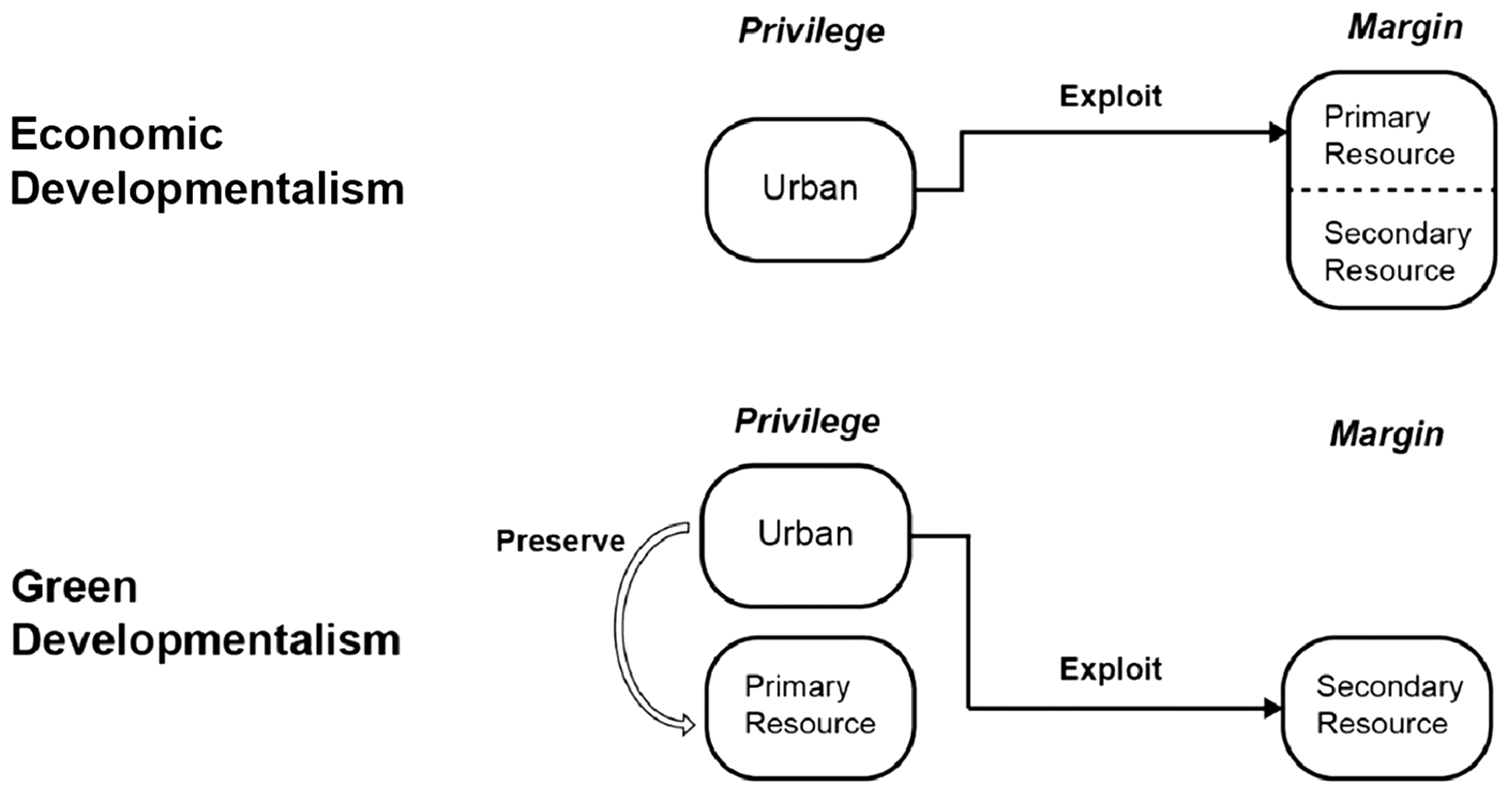
Political construction of scarcity behind green developmentalism
The key question for this system to work is how to politically construct and manage the sense of scarcity of privileged resources for preservation under certain key environmental policies, while devaluing other non-privileged resources for exploitation in order to retain the momentum of economic growth. As critical scholars have pointed out, the problematization and scarcity of environmental resources like water and land is a social-politically constructed issue, rather than an objective measurement (Bakker and Bridge, 2006; Kaika, 2003; Le Billon, 2001; Swyngedouw and Heynen, 2003). Mehta (2007), for intense, argues that water scarcity in western India tends to be ‘naturalized’ and works as a ‘meta-narrative’ to justify conflicting and controversial projects and schemes.
Similarly, under China’s green developmentalism, particular resources are politically privileged and defined as scarce and important to justify certain environmental policies. These environmental policies can be further differentiated as (1) restrictive and (2) supplemental. The former sets restrictions on the use and development of certain environmental resources. A typical example is the ‘land development red line’ which tries to prevent the overdevelopment of arable land. The latter reallocates fluid natural resources (such as water, raw materials and energy) to support the development of resource-scarce urbanized areas, specifically exemplified by the South Water North Transfer (SWNT) project.
However, to maintain growth while implementing these restrictive and supplemental environmental policies, green developmentalism not only needs narratives on the scarcity of resources to be preserved but also requires discourses on the abundance and availability of the resources for exploitation. Green developmentalism relies on two mechanisms to trade-off between the preserved and exploited environmental resources. On the one hand, in response to the restrictive policies on arable land development, urbanized space might directly invade non-urban areas and exploit non-urban farmland resources. This kind of territorial expansion refers to processes through which the substitutional trade-off shifts the development from privileged lands to other substitutional marginal lands. This type of trade-off is often seen at the local scale, where national farmland restrictions are imposed on the local states which then transfer their demand for land finance to the urbanization of other marginal lands 2 (Chien, 2015).
On the other hand, corresponding to the supplemental policies, there is a compensational trade-off in which natural resources are extracted and reallocated from socially and politically marginal areas in return for compensation. This kind of resource capture process involves the exploitation of hinterland resources and services to support the daily operations of the metropolitan area at the trans-local level and even national level. For example, Huasco, an agricultural village in the northern Chile, was designated as the site for several electrical generation plants to support economic activity in other Chilean cities (Arboleda, 2016). This trade-off is more likely to be observed at the trans-local scale with fluid resources like water and electricity under large-scale national projects.
Green developmentalism in China
This section discusses the process of restricted resource preservation at the local level and supplemental resource preservation at the national level in the context of green developmentalism. In the context of traditional economic developmentalism, farmland and underground water are useful environmental resources to be exploited for economic development. However, green developmentalism differentiates between primary farmland and secondary hillside lands, with the latter sacrificed to protect the former. Also, in the new context of China’s green developmentalism, water resources are divided into primary resources (e.g. Beijing’s aquifer) and secondary resources in the hinterlands, with the latter exploited to preserve the former.
Restricted resource preservation and construction land expansion at local scale
Between 1996 and 2005, Chinese cities expanded by about 1000 km2 annually, with many cities developing surrounding farmland for commercial, residential and industrial use and producing a serious reduction of domestic food productivity (Chien, 2015). From 1996 to 2003, total food production in China dropped by 18%. Since the 2000s, the central government has begun to seriously address rural and agricultural crises. For instance, in March 2006, the State Council announced a comprehensive policy to preserve 120 million hectares of farmland (Chien, 2015), followed in 2009 by a program to increase annual grain production by 100 billion kilograms (Chien et al., 2017).
To achieve these goals, local officials were assigned farmland preservation quotas, and failure to meet these quotas would incur a significant negative impact on future promotion opportunities. These officials depend heavily on revenue from land development to fill local government coffers and promote economic growth, another key performance indicator. In highland cities with limited arable land, local cadres faced a conflict between preserving existing farmland and rezoning land for economic development. In a compromise, some cadres opted to preserve existing farmland and shift land development projects to secondary land resources such as peripheral slope land (Chien, 2015).
For example, only 6% of Yunnan province is arable plains. Seeking to preserve existing farmland, local officials adopted a policy of ‘hillside urbanization’ through which slope land at gradients of 5%–18% surrounding existing cities was opened for residential and industrial construction. By 2013, 59 such projects had been officially approved for construction on 2500 km2 of slope land. Yunnan’s Yiliang Industrial Park, originally slated to be situated on farmland was relocated to a barren hillside, half of which is at a gradient exceeding 15%.
Following the principle of hillside urbanization, the Gansu provincial government has announced a policy entitled ‘Flattening Mountains for a New Metropolis’ (Ch. yishan zaozhen) in which hilltops surrounding the provincial capital of Lanzhou are to be flattened, with the removed soil and rock to be used to fill valleys, thus creating 25 km of new level land. In 2005–2011, the local government of Yannan of Shannxi province levelled hilltops to create 1000 km2 of new development land. Yannan is the so-called Red Capital of the CCP, due to its use as the CCP military headquarters during World War II. Development of sacrificial lands in such a politically important city also demonstrates the popularity of this kind of green developmentalism (Figure 2).
Satellite images of change in Yannan of Shaanxi in the early 2010s.
Supplemental resource preservation and remote water capture at the national scale
While certain river basins are still prone to regular flooding, overall, China suffers from a severe water scarcity, and the distribution of existing freshwater resources is highly non-uniform. Chronic drought in the northern China region has been exacerbated by rapid urbanization and economic growth, resulting in severe depletion and pollution of aquifers. For instance, since 1999, Beijing’s water table has been depleted by an annual average of 500 million cubic meters, causing 65 cm of total underground water decline as of 2014.
In response, the Beijing government has promoted policies to reduce water use and waste by investing tremendous resources in the development of a massive infrastructure project to redirect freshwater resources from the Yangtze River Basin in southern China north to the capital. Since 2016, this partially operational SNWT project has moved about 1 billion cubic meters of water to Beijing, helping replenish the groundwater table by 0.25 meters. 3
Since 2015, the SNWT has diverted water from the Danjiangkou reservoir on the Han River, a major tributary of the Yangtze River in Hubei Province (Figure 3). The central government has assigned local officials with jurisdiction over the reservoir to guarantee the quality and quantity of water each year. To ensure water quality, local officials forced the closure of polluting factories along the Han River and another tributary. In nearby Shanluo, 27 large mining companies were forced to cease operations, throwing around 20,000 miners out of work. The Shiyang city government also halted automobile manufacturing, cage culture operations, shipping operations and fishing and aquaculture operations, negatively impacting the local economy and the incomes of local residents (Science Net, 2015).
Cloud water harvesting in Hebei Province to supply the Greater Beijing Region.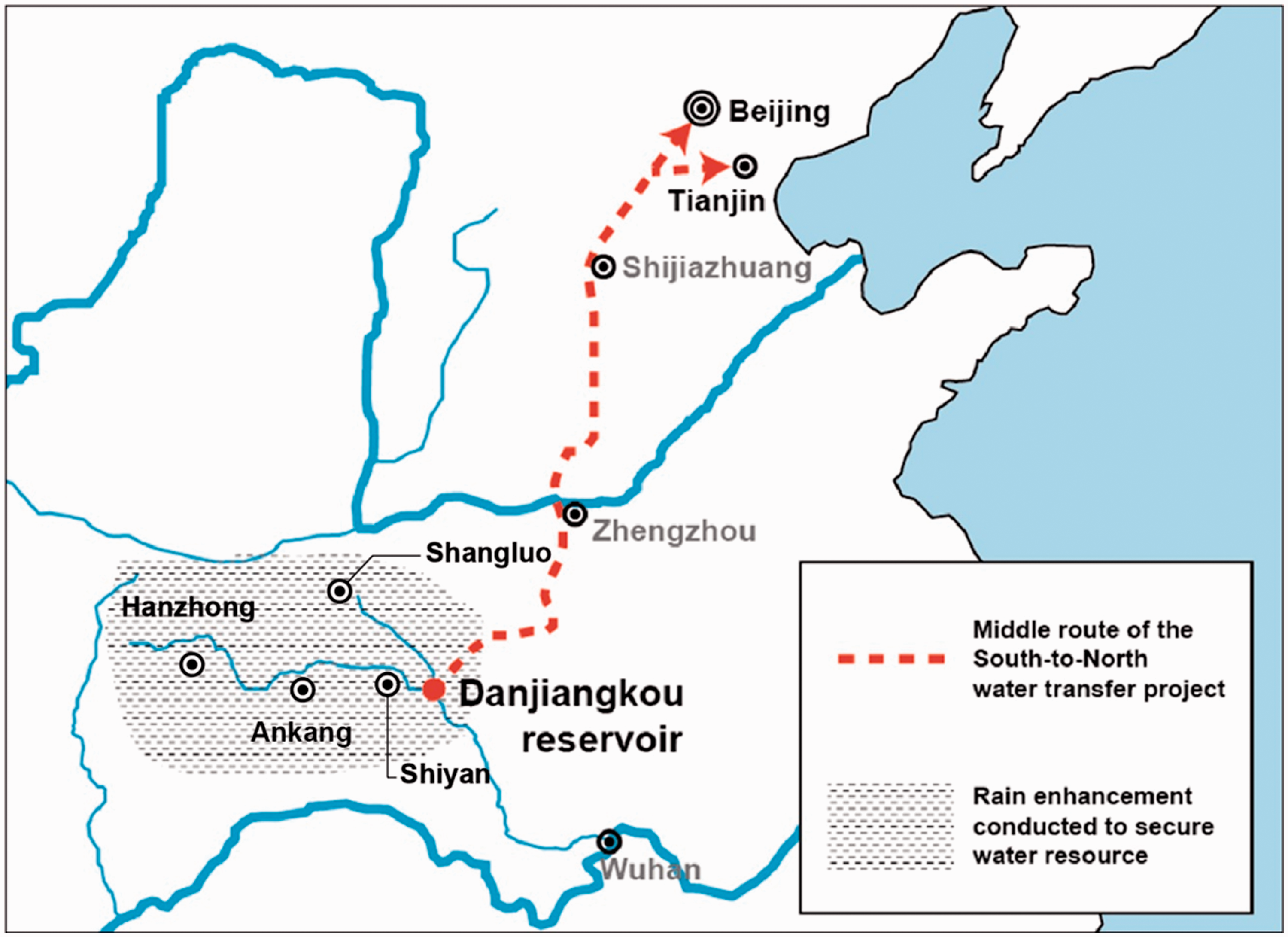
The original designed capacity for local water use in the Danjiangkou Reservoir is 17.5 billion cubic meters, which is certainly sufficient to meet the needs of only Shiyang residents. However, up to 40% of Han River runoff is now reserved for SNWT use. In recent years, climate change has exacerbated rainfall variability in the Danjiangkou watershed, and the compulsory expropriation quota for the SNWT scheme in dry times will likely require frequent weather modification and cloud seeding over the surrounding areas.
For example, Shangluo, a region along the Han River which contributes 75% of the reservoir’s water supply, is required to provide 30 billion cubic meters of water annually regardless of local conditions. The agendas of local weather modification authorities in the Han River watershed prioritize SNWT requirements over local needs. To sum up, stabilizing Beijing’s water supply will necessitate sacrifice on the part of local users of the Danjiangkou Reservoir and require extensive utilization of cloud water resources over the Han River watershed.
Two trade-offs: Restriction–substitution and supplement–compensation
In the case of China, we can identify at least two kinds of trade-off mechanisms. The first is a ‘restriction–substitution’ relationship between farmland and surrounding slope land in the process of territorial expansion. Unlike water which can flow across administrative boundaries, land is fixed in a certain locality (Li, 2014). Therefore, giving farmland a preferential preservation status to ensure food security deprives local officials of a significant source of extra-budgetary finance and institutional power. To meet the simultaneous and conflicting demands for farmland preservation, the rezoning of open land for development allows local governments to develop marginal and peripheral lands (particularly hillsides).
In other words, the restriction quotas are assigned by the top level officials but the means by which these quotas are achieved with various substitutional means is left to the ingenuity of local cadres with agreement by provincial governments. Marginal land is seen as a substitutional space, defined not only by its location but also by its market value (Bryant et al., 2011), particularly given the urgent need for land finance for local development (Figure 4).
Two trade-offs logics within green developmentalism.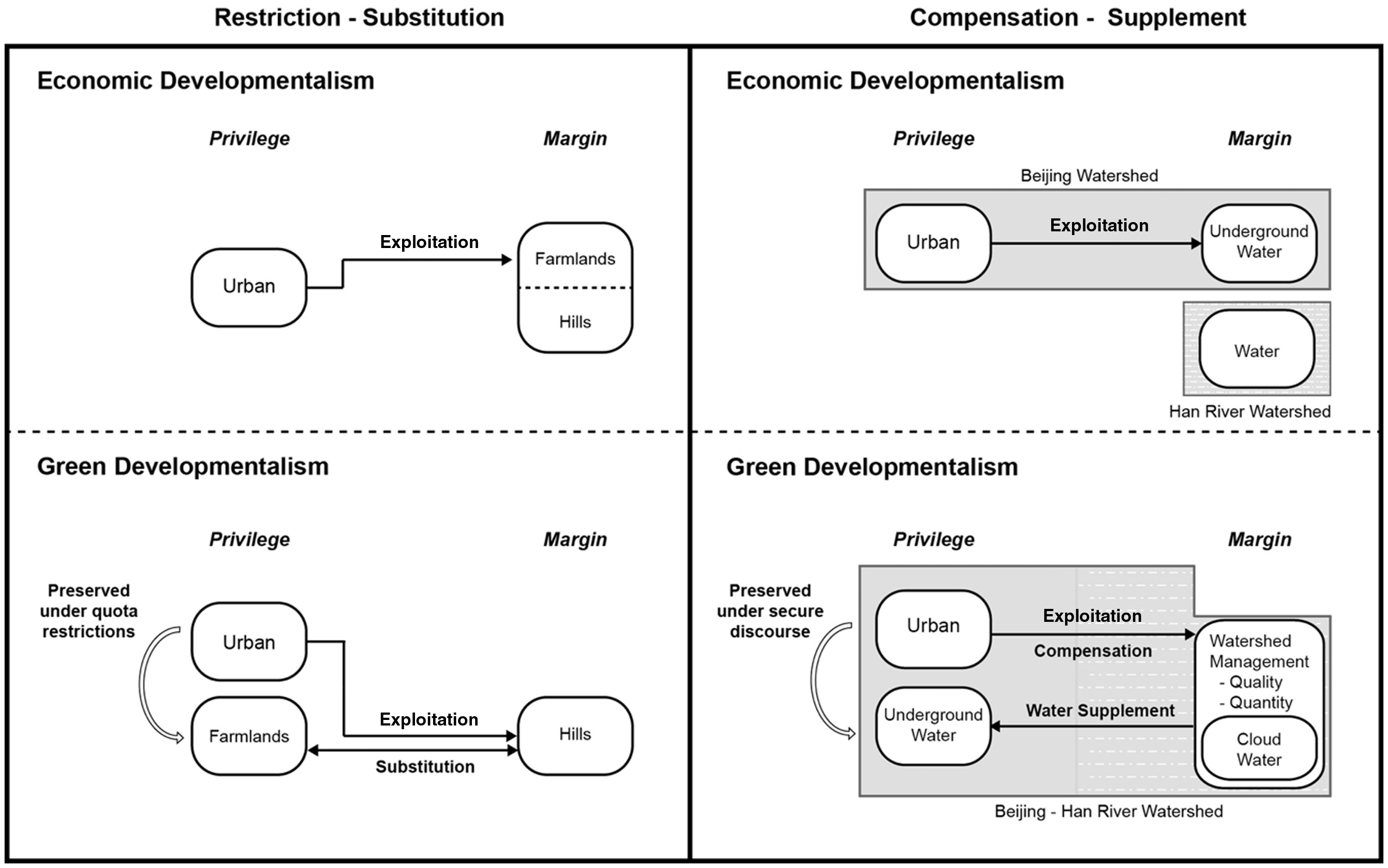
Water capture is characterized by the ‘supplement–compensation’ relationship. The chronic and increasing water shortages in China’s northern cities can only be addressed by restraining urban growth or by accessing new water resources. The legitimacy of the CCP rests on continued economic growth. Thus, anti-growth restrictions for any northern cities in general and for the Greater Beijing Region in particular are not a real option. 4 Therefore, water shortages must be addressed by tapping new supply, through schemes like the SNWT. For the water transfer project to function, it is crucial not only to secure the average amount of inflow but also to mitigate deviation. Thus, the SWNT project transfers the water scarcity of the Greater Beijing Region to Danjiangkou watershed cities and forcing those cities to regularly engage in weather modification.
Under the scheme, Beijing pays financial compensation to the regions which transfer their own water resources to supply the capital and other cities in northern China. For example, under a ‘pairing assistance’ agreement (Chien and Zhao, 2015), in 2014 alone, Beijing’s Haidian District paid around RMB 120 million, and from 2014 to 2020 Beijing city has agreed to make total payments of RMB 2250 million to Shiyan City to fund improved watershed conservation. 5 Although it could happen at any scale of governance, the compensation–supplement trade-off is obviously more influential only when it is conducted by the central government at a national scale (i.e. the SNWT project).
To sum up, the two trade-off mechanisms share a common underlying driving force and logic in the continuous boosting of economic growth based on urbanization and land finance. The case of China suggest that politically constructed land and water scarcities are relocated from the city centre plains to the surrounding slopelands and from one watershed region to another. While some countries recognize the complimentary functions of marginal environmental resources in maintaining a viable and sustainable ecosystem, officials in China are incentivized to sacrifice the marginal resources to preserve the primary counterparts. As a result, terrestrial–social and hydro–social interactions are constituted by processes of inclusion and exclusion, development and marginalization, and the distribution of benefits and burdens.
New roles of the authoritarian environmentalist state behind green developmentalism
China: Green developmentalism along with authoritarian environmentalism
Unlike most western liberal democracies, China presents distinct features of the emerging pro-environment policies under its Leninist one party-state regimes, in a phenomenon referred to as authoritarian environmentalism (Gilley, 2012). Today, China is the most ‘successful’ authoritarian regime, and the empirical case we present in this paper can contribute to the literature on authoritarian environmentalism literature in two ways.
Early studies on authoritarian environmentalism tended to discuss the inconsistency among different administrative entities within an authoritarian regime (Kostka, 2013; Ran, 2013; Wang et al., 2015). Although these perspectives provide insights into the relationships between economic and environmental agendas, they are problematic in two ways. First, these views share an assumption of a clear dichotomy between the state’s environmental and economic agendas. This dichotomous assumption fails to depict the complexity of the empirical cases posed in this paper, in which trade-offs are made between privileged and marginal environmental objects. Indeed, these cases indicate a more intertwining operation of the environmental agenda, which tries to maintain the overall trend of economic growth while preserving some strategically important environmental resources from the state’s viewpoint. Second, the dichotomous assumption leads to ignorance of the intrinsic relationship between China’s environmental governance and its fundamental developmentalist logic. We argue that authoritarian environmentalism and green developmentalism are two sides of a single coin in contemporary Chinese environmental politics.
Furthermore, the authoritarian environmentalism literature reminds us that the authoritarian state’s response to environmental issues is also seen as an attempt to further consolidate the state’s power (Ahlers and Shen, 2018; Beeson, 2010; García, 2011). Environmental-driven social conflicts and political instability are top policy targets for the state to solve in the context of authoritarian environmentalism. This paper further argues that achieving green developmentalism has also been internalized as the state’s highest priority in China. At the local level, food security and land finance are recognized as the most critical forces to keep local growth, a source of legitimacy for the CCP regime. At the national level, promoting prosperity of the capital city Beijing and its surrounding regions is set as a most crucial image for Chinese nationalism by the central state. Through these perspectives, we can explain why any opposite opinions against green developmentalism are not easily sustained.
The following section presents a further discussion of two kinds of new roles of the state behind green developmentalism – one is state–resource relations in terms of the state’s political will and power to tame nature, and the other is central–local relations in a politically centralized authoritarian structure to unify local leaders to fulfil the state’s interests.
State–resource relations: Taming the differentiated nature
In this paper, nature is understood to be an entity territorially framed and administratively governed by the state in the process of state building, including discourse making and institutional building to mobilize resources (Whitehead et al., 2007). Modern states, both capitalist and socialist, usually tame nature through measurement tools and modern management strategies to meet the state’s interests (Scott, 1998). For example, in its 12th Five-Year National Plan (2011–2015), China officially introduced the concept of ecological modernization in relation to an idea of ‘construction of an ecological civilization (Ch. shengtai wenming jianshe)’. Such an ecological modernization mindset allows the state to adopt certain new ideologies and technologies to implement and materialize an environmental-related infrastructure. China’s heavy repression of civil society (including scientist community with different opinions) and the lack of legislative and judicial independence give the party-state it’s a great deal of authoritarian power to use whatever modern technology is at hand to tame both primary and marginal nature environmental resources in the name of state interests. Furthermore, the controlling power of the state is even greater in the case of secondary environmental resources (i.e. hillside lands and cloud water). It is because such resources have fewer stakeholders when compared with primary resources like collective farmland owners and ordinary ground water users.
One example is China’s large-scale use of marginal lands and cloud water, a recent phenomenon despite humanity’s long history of taming nature (Beinart and Coates, 1995; Smith, 2010). China responds to land and water scarcity by modifying the landscape through the urbanization of marginal lands (e.g. building industrial zones on slope land or levelled hilltops) (Chien, 2015) and by extracting cloud water through weather modification (Chien et al., 2017). This nature-taming ideology presents ecological risks and high potential costs, and we argue that this ideology is driven by China’s desire to catch up the modern West (Zhang, 2006).
Qian Quangrong, a former Party Secretary of Yunan Province promoted hillside development as a new style of urbanization based on a harmonic relationship between scientific development and farmland preservation. While hillside development is costlier than development on flat land, Qian argued that hillside development serves to preserve valuable farmland for future generations and helps to prevent further urban sprawl. Qian cited cities such as Seattle, Davos and Innsbruck to promote the virtues of hillside development, but this largely served as cover for economic developmentalism by top local leaders. However, those arguments in favour of such development failed to note that these efforts in China overwhelmed the scale of their western counterparts.
Another case in point is China’s weather modification efforts which began in the 1960s as a technological response to drought. In the years since, rain enhancement via weather modification has remained a popular solution for agricultural production, ecological preservation, water security and to ensure clear weather during large-scale outdoor events (Chien et al., 2017). In the national policy entitled ‘National Plan for Weather Modification Development 2014–2020’ (Ch. quanguo rengong yingxiang tianqi fazhan guihua), the Han River Basin and its upstream catchment area are set as a precipitation enhancement area to ensure water security for the SNWT project.
Furthermore, such exploitation of natural resources is politically constructed by technological development. Nalepa and Bauer (2012) noted that categorizing the material environment through socio-spatial ordering skills is never value neutral, but is necessarily linked to certain political purposes. Responding to local conflicts between hillside urbanization and forestry preservation and restoration, local officials in Yunan produced a slope classification development model which allows for four different degrees and types of development based on slope gradient – <8%, 8%–15%, 15%–25 % and >25%. 6 This provides a sheen of objective and scientific standards to the ecological modernization process, providing a justification for the sudden rezoning (and value inflation) of otherwise idle land. However, the scientific rationale of this approach is belied by China’s lack of sufficient data on the potential ecological and geological risks of such development.
Precipitation efficiency.

CWP: cloud water path; IWP: ice water path.
Note: CWP is the sum of the liquid water path (LWP) and cloud IWP. It represents the total amount of cloud water, in both solid and liquid states, between two points in the atmosphere. This table is measured and calculated from satellite image from 1974 to 2004.
Source: Chen and Tian (2013).
Central–local relation: Politically centralized institutions
While the Chinese leadership is increasingly concerned with environmental issues, the agenda of the CCP is still focused on preserving its legitimacy through delivering economic development. Previous studies have discussed the resulting tensions between central and local agendas through economic decentralization (Hsing, 2010; Landry, 2008; Lin, 2011; Zheng, 2010), focusing on the inconsistency among different entities cross administrative scales leading to difficulty in balancing environmental protection and economic development. For example, Wang et al. (2015) discuss the case of small-hydro power plants in Yunnan where, despite local governments receiving a clear mandate to pursue the central government’s green agenda, local cadres and interest groups tend to subvert green policies into ‘economic-bundled’ projects.
However, this paper actually finds that the decentralization perspectives cannot properly explain why ‘being green’ is seen as the ‘voluntary imposition’ of implementing various environmental restrictions, and local authority are willing to sacrifice the interests of their jurisdictions to comply with centrally assigned policy directives. At the local level, leaders of hillside districts are keen to be included in urbanization plans to better accomplish the goals of farmland preservation set by city-level supervisors. At the trans-local level, a striking example is that of Zhang Weiguo, the Party Secretary of Shiyan in 2007, promoting himself as having responsibility for Beijing’s water security: As we all know, the Han River is our mother river and is now managed by Shiyan city. Danjiangkou Reservoir captures the water of the Han River and is the water source for the northeast provinces. Shiyan city is the well of Beijing and China’s northern provinces. Shiyan’s residents are devoted well keepers, and I am the leader of these wells.
7
Second, many countries feature underrepresentation of ethnic minorities and less developed regions in central politics, the situation is even worse in China’s Leninist state where the CCP Central Standing Committee holds ultimate authority (Zheng, 2010). The centre of national power in China is are 25 members of the CCP’s politburo, who generally are promoted from party secretaries in economically and politically influential provinces or special administration regions (e.g. Beijing, Shanghai, Chongqing, Tianjin and Guangdong). Powerful members of the Party, civil service and military generally hail from coastal regions, leaving the economically laggard central and western regions largely underrepresented in the power structure. A similar arrangement also applies to the CCP’s Central Standing Committee at the provincial and prefecture levels. As a result, high-level officials are unlikely to have significant living or working experience in China’s less developed areas. This is another institutional reason why ‘secondary’ resources slated for priority exploitation and less sympathy for policy conditions tend to be located in those economically laggard areas. In other words, green developmentalism under China’s political centralized mechanism is likely to facilitate more uneven development between better-off regions and underdeveloped counterparts.
Conclusions
In recent years, many countries have put much effort into environmental policies after decades of headlong economic development with little regard for ecological degradation. In particular, most of the existing literature on green neoliberalism discusses different dimensions of the so-called sustainable development paradox, such as the role of markets and trade-offs between the economy and environment. However, scant attention has focused on the role of the state in coordinating local authorities seeking to balance environmental exploitation and preservation together. This paper examines this issue in the context of China. Around a decade ago, China’s central government began promoting policies leading to the development of a series of paradoxical trade-offs between the preservation of privileged natural resources and the exploitation of marginal resources that we refer to as ‘green developmentalism’. Under these policies, peripheral slope land is developed to prevent the rezoning of farmland, while weather modification is used in distant provinces to provide Beijing with a reliable water supply.
This ‘green developmentalism’ theory shows that the state’s tendency to prioritize exploitation of secondary environmental resources is triggered by the evolving relationship between inherited state structures and emergent political strategies to harness state institutions towards particular socioeconomic projects (Brenner, 2004). (1) Authoritarian control civil society and scientist community, (2) less stakeholders on marginal environmental resources, (3) highly emphasized state interests on preservation of primary resources, and (4) more state-dominated nature-taming ideology and technology over resources are together to facilitate the state to ‘greenwash’ itself and its subordinate leaders under the green developmentalism agenda that promotes further economic development. What is more, the state can compel local leaders to fulfil these quotas regardless of the best interests of their local constituents. This frequently results in heavy and unsustainable exploitation of local environmental resources.
The concept of green developmentalism complements the existing literature on environmental politics in a broader context, such as how ideological, technological and institutional processes together facilitate preservation of one environmental resource through the exploitation of another, and the conditions for interaction between substitutional–restriction and compensation–supplement approaches. This paper thus contributes to a better understanding of the sustainable development paradox in the domains of political ecology (particularly in relation to the social construction of scarcity) and green neoliberalism (e.g. the complex trade-offs between primary resources, secondary resources and economic development).
The current promotion system leaves local cadres poorly incentivized to care for local environmental issues. This system is a key element of CCP leadership and management, and is unlikely to significantly change in the foreseeable future. Therefore, it is important to carefully leverage the cadre system to motivate local leaders to improve environmental management. More fundamental reforms to provide appropriate incentives to avoid green developmentalism are urgently needed to develop long-term environmental accountability across the whole of China.
Highlights
Under green developmentalism, China sacrifices marginal environmental resources to preserve other privileged environmental resources to promote continuous economic growth. Two kinds of trade-off relationships: restriction–substitution for territorial expansion at the local level and supplement–compensation related to resource capture at the national (trans-local) level. Illustrative cases include the exploitation of outskirt hilly lands for the preservation of downtown farmlands and exploiting cloud waters around the Yangtze River catchment area to stabilize Beijing’s aquifers. Nature-taming ideology and technology, and authoritarian political institutions jointly facilitate the operations of China’s green developmentalism. Authoritarian environmentalism and green developmentalism should be seen as two sides of a single coin in the context of contemporary Chinese environmental politics.
Footnotes
Declaration of conflicting interests
The author(s) declared no potential conflicts of interest with respect to the research, authorship, and/or publication of this article.
Funding
The author(s) disclosed receipt of the following financial support for the research, authorship, and/or publication of this article: This research was supported by the Ministry of Science and Technology of Taiwan and NTU Research Center for Future Earth.