



Abstract
‘Nature-based solutions’ is the new jargon used to promote ideas of urban sustainability, which is gaining traction in both academic and policy circles, especially in the European Union. Through an analysis of the definitions and discourse around nature-based solutions, we discern a number of assumptions stemming from positivist science that are embedded in the term, and which we find create an inviting space for nature’s neoliberalisation processes. We provide empirical analysis of how these assumptions realise in two city-initiated projects in Barcelona, Spain, that have been identified as nature-based solutions: the green corridor of Passeig de Sant Joan and the community garden of Espai Germanetes supported under the municipal Pla Buits scheme. Both projects were born in a neoliberal political climate, but their outcomes in terms of neoliberalism and its contestation were very distinct – not least because of the different forms of governance and socio-natural interaction that these two projects foster. Urban nature can serve elite economic players at the expense of widespread socio-ecological benefits. But it can also serve as a ground for the articulation of demands for open and participatory green spaces that go beyond precarious and controlled stewardship for, or market-mediated interactions with, urban nature. We urge for future research and practice on nature-based solutions to be more critical of the term itself, and to guide its instrumentalisation in urban planning away from neoliberal agendas and towards more emancipatory and just socio-ecological futures.
Keywords
Introduction
In a recently released video, environmental activists Greta Thunberg and George Monbiot (The Guardian, 2019) highlight the need to protect, restore and use nature to tackle the climate crisis. In their compelling video, they make reference to ‘natural climate solutions’ and ‘natural-based solutions’, highlighting the role of nature in repairing our broken climate but only, they warn, if we also stop extracting and burning fossil fuels. This idea is not new but it is, as they argue, largely ignored. At the same time, over the last decade, a seemingly similar concept has been increasingly promoted in international research and policy circles (Cohen-Shacham et al., 2016). Nature-based solutions (NBS) are defined within these circles as actions that are inspired by, supported by or copied from nature (Bauduceau et al., 2015) (see Table 1).
Aims, governance principles and examples of nature-based solutions.

Based on review of key publications (Cohen-Shacham et al., 2016; Kabisch et al., 2016; Maes and Jacobs, 2017; Raymond et al., 2017) and the Naturvation project website (https://naturvation.eu).
NBS were first developed as a policy instrument by scientifically oriented NGOs and finance organisations such as The Nature Conservancy, the International Union for the Conservation of Nature and the World Bank (Cohen-Shacham et al., 2016; Faivre et al., 2017). NBS is an encompassing term that frames debates and proposals on climate change adaptation and mitigation, sustainable resource use and biodiversity conservation, primarily in cities (Frantzeskaki et al., 2019). NBS is a tool for more generally offsetting carbon emission and fuel dependency (Seddon et al., 2019). Despite scepticism and vagueness that surrounds the concept (Nature Editorial, 2017), in September 2019, the UN Climate Action Summit called for greater investment and financial tools for NBS in order to address the climate crisis.
In Europe, specifically, NBS are seen not only as an alternative means to address social needs and enhance natural environments but also as a way of boosting green innovation and resilience in cities. The European Commission (EC) has been promoting NBS and re-naturing in cities as a way to: […] Simultaneously improve economic (new products, services, business models, mobilization of new investments), social (jobs, wellbeing, community solidarity and health) and environmental (preservation and restoration of biodiversity, ecosystems and ecosystem services, sustainable land use and spatial planning, land take and soil sealing, as well as reduced air and noise pollution) resilience of rural and natural areas by taking into account the wider system and aiming at ecological stability. (EC, 2015)
Up to now, much of the resulting research has been focused on either defining or refining NBS for the purpose of implementation, pointing to their weaknesses, success factors and potential (Cohen-Shacham et al., 2019; Frantzeskaki et al., 2019). However, little attention has been given to questioning the epistemological origin and related political significance of the concept (but see Haase et al., 2017). More specifically, there is no study to date that enquires as to what the different mobilisations of this concept do for signposting urban ecological futures, or what sort of power/knowledge relationships are reflected and reinforced through the propagation and implementation of NBS. In this light, we ask: How, why and to what extent is the NBS concept captured by neoliberal agendas in urban governance?
Our focus on urban NBS stems from the role increasingly played by cities as political and economic players pushing sustainability to the forefront of national and international agendas (Betsill and Bulkeley, 2006; Thorns, 2002: 194). First, cities are called to develop plans to address the impacts of climate change on urban residents, infrastructure and resources (Portney, 2013). Cities are also expected to be the main growth machines of global economies, while at the same time urbanisation appears to be a major driver of climate change (Kalnay and Cai, 2003) and is intensifying climate change impacts (such as elevated urban temperatures) (Chapman et al., 2017). Responding to these multiple – and often contradicting – expectations, urban sustainability seems to be following an orthodoxy for new, green, resilient, smart and sustainable cities (Connolly, 2019) which seeks win-win solutions for both environmentalism and growth in liberal economies (Anguelovski and Alier, 2014). Urban sustainability discourses thus often represent the transformation of more radical ideas for intervention into system-affirming tools that do not question the growth imperative (Sekulova et al., 2017; Tulloch and Neilson, 2014).
This trend cannot be separated from the global acceleration of state-sponsored neoliberalisation since the 1980s (Harvey, 2007). 3 Indeed, sustainability discourse emerged alongside neoliberalism as two parallel and porous processes (Krueger and Gibbs, 2007), giving the latter an air of inevitability (Brand, 2007; Heynen and Robbins, 2005). In formal city politics, neoliberalism is expressed mainly in the decentralisation of state authority and the incorporation of non-state governing actors, the re-structuring of municipal governments into business-like institutions, and the increased number of governance priorities stemming from supranational authorities, like the EU (Swyngedouw, 2005). Nature has been increasingly mobilised as a commodified part of urban neoliberal environmentalism and the so-called ‘sustainability fixes’ can be found in urban agriculture narratives and practices (Pirro and Anguelovski, 2017; Walker, 2016) or entrepreneurial city regimes which ‘selectively incorporate ecological objectives in local territorial structures during an era of ecological modernization’ (While et al., 2004).
The repercussions of these new forms of urban nature’s neoliberalisation are more significant now than ever, as securing the need for clean air, climatic refuge and relief, greener spaces and the overall benefits of urban nature becomes a more urgent task in a changing climate. NBS represent the discursive evolution of urban sustainability into ideas and implementations that intensely mobilise nature and environmental values along with innovation and socio-economic benefits. With this context in mind, our paper uses a critical political ecology framework to look at the relationship between NBS and neoliberal ideologies, examining NBS both as a concept that renders itself vulnerable to neoliberal manipulation and as a diverse bundle of identified practices.
In the next section, we provide an analysis of the ambiguity of the NBS concept emphasising how misleading it is to assume that NBS can – alone – balance trade-offs (Turkelboom et al., 2018) associated with the ‘triple bottom line’ of economic, environmental and social sustainability (or benefits) in some way different than prior sustainability efforts. We point to how the NBS concept is currently mobilised to make ‘certain assumptions about the environment [become] more possible or likely’ (Robbins, 2011: 97), and due to the nature of those assumptions, allows for the expansion of urban nature’s neoliberalisation processes. In the ‘Methods and case study’ section, we describe our methods and selected case study context of Barcelona, and in the ‘Re-naturing the neoliberal city: Tensions and contradictions of NBS projects in Barcelona’ section, we provide our empirical analysis of two city-initiated projects identified (a posteriori) as NBS. In the ‘Discussion’ section, we argue that, while NBS implementations are couched in an emerging global conceptual definition, they are always also characterised by their specific contextual tensions and contestations, navigating the dialectical relationship between urban nature’s neoliberalisation and the counter-narratives and counter-practices of local residents. In this last section, we further argue that an effective future research and policy agenda on planning for urban nature and re-naturing should not continue ignoring questions of conflict, contestation, justice and equity.
NBS and their potential in urban nature’s neoliberalisations
Urban nature’s neoliberalisations
Processes of nature’s neoliberalisation are hard to fit into typologies. Evidence of such processes has been scattered, often describing the phenomenon but not giving it a name. Since the 1990s, environmental concerns have translated into ‘private-oriented governance model(s) for the sustainability of socio-environmental systems’ (Swyngedouw, 2007a: 58). Land and resources are appropriated in the name of the environment (Fairhead et al., 2012), water is privatised for its ‘better management’ (Bakker, 2003), and even environmental justice claims and practices have been captured in neoliberal tendencies (Checker, 2011; Holifield, 2004). Nature is produced and governed in increasingly neoliberal ways (Bakker, 2010; Castree, 2008b; Heynen et al., 2007; Heynen and Robbins, 2005), involving changing nature materially/metabolically, while also governing, contesting and claiming it for the affirmation, power and benefits of certain privileged groups (Bakker, 2015; Castree, 2008b; Heynen et al., 2006).
Since the late 1970s–1980s, pro-environment discourse has taken root in parallel with neoliberalism and has also come to be largely captured by it (McCarthy and Prudham, 2004), as in the example of the sustainable development paradigm. Neoliberalism is, as Castree (2008a) puts it, ‘one possible ‘shell’ for the capitalist mode of production’, which can offer a number of ‘environmental fixes’, ‘to the endemic problem of sustained economic growth’. If the privatisation and de-collectivisation of water resources is one example (Swyngedouw, 2005), so is the ‘smart growth’ politics in cities like Austin (Tretter, 2013), and the marketisation of ecosystem services in the case of wetland mitigation banking (Robertson, 2004). In other words, unfettered capitalism, sustainability practice and technocratic planning have so far largely gone hand in hand (Gibbs et al., 2013; Hagerman, 2007; Krueger and Gibbs, 2007; Swyngedouw, 2007b), and thus the rise of neoliberalism is tightly connected to our shifting commitments to, representations of, and practices in nature (Castree, 2008a, 2008b; Heynen et al., 2007).
With regard to the urban sphere, critical urban scholars have noted the importance of looking at the dialectic between urbanisation and neoliberalisation processes. Here both climate change mitigation and adaptation strategies have often become the proxy for urban environmentalism (Whitehead, 2013) and connected to what scholars have called ‘sustainability fixes’ (While et al., 2004). At the same time, governing through the sustainable city paradigm enters the realm of personal choices and behaviours through self-regulation and technologies of the self (Foucault, 1988). These include the creation of sustainable subjects: citizens that willingly shape their everyday practice and the ‘spatial consumption in the home and neighbourhood, on the streets and around town’ (Brand, 2007), complying with or adapting to sustainability priorities. Self-regulation connects to roll-out neoliberalism 4 where state authorities are actively defining how neoliberalisation will be deployed (e.g. outsourcing services, implementing market proxies or through individual ‘responsibilisation’ policies). In urban sustainability, for example, redistribution of responsibilities for environmental planning and implementation has often been moved from state-driven agendas to corporations, non-profits and citizen groups (McClintock, 2014; Perkins, 2009).
This important literature, however, lacks a core understanding of how urban re-naturing is mobilised (physically and discursively) to enable neoliberal transformations in both institutions and subjects, and the contradictions and limitations of this process. We know, for example, that while the preservation of (public) green/blue space has often competed with real estate, it is now increasingly becoming an integral part of such developments in order to enhance housing value (Immergluck, 2009; Rosol, 2013). More recently, the creation or restoration of green amenities – parks, gardens, greenways – has been associated with gentrification trends in the context of neoliberal development paradigms (Anguelovski, 2016; Anguelovski et al., 2018b; Gould and Lewis, 2016). In the case of urban gardens and local environmental practices driven or sustained by residents, their transformative effects (Pudup, 2008) are also limited by neoliberal embedding and co-optation (McClintock, 2014; Rosol, 2012) as they are underpinned by voluntary labour. Perkins (2011) similarly has argued that tree planting and stewardship can illustrate an instrument for extending market hegemony, even if people’s direct involvement in the production of urban ecologies goes beyond market ideology. This bundle of work makes it clear that mobilising nature might be part of a solution, but it can also be part of the problem – if the problem is too narrowly and apolitically defined – or made invisible. In this regard, we call for a more careful analysis of the concepts used to describe, evaluate and promote urban nature and re-naturing, and a closer examination of their role in shaping power relations in socio-natural assemblages. The newly emerging concept of NBS is a particularly critical example of such concepts and processes.
Most recently, NBS and connected concepts, such as ecosystem services or green infrastructure, have grown in strength within (urban) sustainability discourses and policies. Yet, the novelty of such concepts does not free them from previous contradictions of sustainability, and thus they too need to be problematised and scrutinised (Haase et al., 2017; Turkelboom et al., 2018). In a nutshell, such mechanistic and seemingly apolitical concepts, are according to their critics, ‘blinding us to the ecological, economic, and political complexities of the challenges we actually face’ (Norgaard, 2010). Today, in the policy world, especially so in Europe, NBS seems to be one of the most explicitly utilitarian/instrumental approaches that uses the ‘ecosystem services’ approach and stands as an umbrella term for ‘nature-based interventions’, ‘ecosystem-based solutions’ and ‘ecosystem-based adaptation’, to name a few (Potschin et al., 2015). The disciplinary genealogy of such terms, the metaphors they encompass and the ambiguity that surrounds them, turn them into easily adaptive, flexible tools that can serve distinct agendas – neoliberalism being potentially being one of them (Schröter et al., 2014).
The emergence of NBS and their underlying assumptions
Recent literature on NBS is characterised by a common notion of three underlying assumptions, which connect NBS to urban sustainability discourse and its unresolved contradictions. The first assumption concerns the ability of NBS to deliver triple-win outcomes, aka benefits for the environment, society and the economy (EC, 2015), through a focus on ‘innovation, growth and job creation’ (Faivre et al., 2017). This vision for the role of NBS reproduces a combined and dogmatic belief of trickle-down economics, on the one hand, and on decoupling CO2 emissions (as a proxy for environmental harm) from unfettered economic growth through technology and modernisation, on the other. It thus ignores socio-environmental inequalities and injustices that are built into current capitalist neoliberal economies, and of their dire socio-ecological consequences (D’alisa et al., 2014; Kosoy and Corbera, 2010).
The second assumption, relatedly, sees nature as a repository of prototype processes that can be objectively measured, transformed and harnessed (Potschin et al., 2015; Schröter et al., 2014). This allows for an economistic reading of nature’s services, brushing aside the value of non-replicable human–nature interactions (aka, complex biophysical formations at specific historical and geographical contexts). As a result, nature’s commodification creates new sites for capital valuation and accumulation (Gómez-Baggethun and Ruiz-Pérez, 2011; Kull et al., 2015), while neoliberal ‘environmental fixes’ protect private and privileged interests that depend on natural resource exploitation.
The third assumption has to do with the prescriptive nature of NBS (‘solutions’). It is here assumed that socio-ecological trade-offs or other ‘disservices’ have been negotiated and digested in NBS implementation (Haase et al., 2017; Schaubroeck, 2017). But clashing visions and interests surrounding nature can only be incorporated in NBS as a matter of interpretation and contestation (Eggermont et al., 2015; Kabisch et al., 2016; Nesshöver et al., 2017; Turkelboom et al., 2018). The ambivalence around what to prioritise and who will decide frees the way for NBS to be caught in the neoliberal hegemony of our times. Notably, democracy is compromised when this ambivalence leans towards top-down, technocratic decisions with little consideration of justice, but also, in these circumstances, ‘environmental interpretations are arguably losing out’ (Wright, 2011).
In sum, it is becoming clear that the way in which the NBS concept has so far been proposed and mobilised makes ‘certain assumptions about the environment [become] more possible or likely’ (Robbins, 2011: 97), and due to the nature of those assumptions, allows for the expansion of urban nature’s neoliberalisation processes. Here it is important to consider that most NBS so far have been studied on the basis of their identification as such a posteriori by researchers or stakeholders, who have secured funding to study, promote and/or implement them. By selecting and characterising projects as NBS – independently of whether weaknesses and contradictions are later assigned – researchers and policymakers pre-emptively assign them with the positive notion that comes with the term ‘solution’. Indeed, literature that is critical of how NBS are realised on the ground is increasingly emerging (Cohen-Shacham et al., 2019; Frantzeskaki et al., 2019; Seddon et al., 2019). This, however, does not undo the fact that people, resources and claims have already been mobilised to create traction for NBS-inspired interventions. Research results are presented as knowledge of exemplary practices, and conclusions are drawn based on a conceptual and empirical basis that is not necessarily representative of what is envisioned or practiced on the ground. The idea of NBS, and the projects identified as such, thus creates a dominating discourse around how to envision and implement urban nature; a form of urban ‘greenmentality’, 5 embedded in and feeding from a neoliberal paradigm, truly problematic for a progressive governance of sustainability and nature.
Methods and case study
Our analysis is based both on a critical review of published writings on NBS, including academic publications and policy/research reports, and on empirical qualitative research. For the first part, we analysed documents that referred to and described ‘Nature-based solutions’. Based on discourse analysis, we explored the textual (metaphors, the content matter of words, and ‘macro’ structures such as topics and themes) and contextual (the production and reception processes, and the reproduction of ideology in such processes) discourse (Lupton, 1992) around NBS, paying attention to its disciplinary emergence and use in academia and policy circles.
For the second part, we conducted an in-depth study of two NBS projects to illustrate the nuances of the dialectic between neoliberalism and urban sustainability as it is expressed through the emerging NBS policy framework. Our field research was carried out in Barcelona, a city that despite its relative lack of green spaces in the central part of the city, has in the last two decades become one of the focal and emblematic sites of sustainability policy and practice deployment in Europe (Anguelovski et al., 2018b). For our selection of NBS cases we used a pool of greening projects identified as NBS in the Urban Nature Atlas (https://naturvation.eu/atlas) of the ‘Naturvation’, Horizon 2020 EU-funded project. From the 10 NBS that this Atlas presents as NBS in Barcelona, we selected 2 diverse NBS projects, with different sponsors, funding sources, types of nature, and active stakeholders and participants:
Passeig (Ps.) de Sant Joan: The restoration and transformation of the Sant Joan Avenue into a green corridor boulevard with enlarged sidewalks, variety of trees/shrubs permeable pavements and public green spaces. Espai Germanetes: The development of an urban community garden under the first implementation of the ‘Pla Buits’ plan of vacant lots clean-up and conversion.
Between May and July 2017, we conducted 20 semi-structured qualitative interviews with top-level officials and municipal staff members, as well as key users and stakeholders of the selected interventions. The sample of interviewees was developed through purposive, non-random selection. We augmented these interviews, first, with a review of key academic texts around these specific types of NBS, and second, through key policy documents that describe, promote and evaluate nature in urban environments, focusing on city-level policies for the case of Barcelona. Although the selected projects were not negotiated or implemented as NBS by local stakeholders, they matched the criteria commonly used in NBS definitions (especially by the EU – see the ‘Introduction’ section, in this article), and were identified a posteriori as such by our team of researchers. Our analysis therefore partly emerges from our own reflections about our work and illustrates how applying existing NBS definitions can often perpetuate discourse that is conducive to nature’s neoliberalisation.
Re-naturing the neoliberal city: Tensions and contradictions of NBS projects in Barcelona
Both the green corridor of Passeig (Ps.) de Sant Joan and the municipally supported community garden of Espai Germanetes within the Pla Buits scheme have been celebrated for contributing to greening the dense and heavily polluted Eixample district of central Barcelona. They were also both ‘born’ within a context of supporting the economy, either building ‘the Barcelona brand’ (in the end of 1990s beginning 2000s for Ps. de Sant Joan) or salvaging that brand in the face of economic crisis (2008–2014) through the activity of civil society groups in the case of Espai Germanetes. However, these two projects were not equally or similarly embedded in neoliberal agendas of urban planning, and this owed both to their governance structures (fully participatory in Germanetes versus top-down in Ps. de Sant Joan) and the context of municipal politics, which drastically changed in 2015, with the election of the social movement-born government of Barcelona en Comú.
From grey bureaucracies and the ‘smart city’, to more equitable and participatory greening: Shifts and legacies of environmental governance from 1980s to today
Barcelona, despite its high ratio of street trees per inhabitant (1,2/10) and direct public beach access, has historically faced a deficit of green space compared to other EU cities (Fuller and Gaston, 2009; Pauleit et al., 2002). As a result, in the 1980s, the newly democratic municipality of Barcelona sought to compensate decades of underinvestment with green space provision in lower-income neighbourhoods, by building new parks and gardens, many of which were designed with strong social purposes in mind (Saurí et al., 2009) and motivated by citizens’ demands and mobilisations (Barcelona City Council, 2013: 52). However, during the pre- and post-1992 games, public green spaces started to be seen by municipal supporters as less of a neighbourhood anchor and more an aesthetic amenity (co)-financed by private funds and for the benefit of visitors and tourists (Anguelovski, 2014; Montaner, 2012; Saurí et al., 2009).
By the end of the 1990s and early 2000s, green space provision became intertwined with the redevelopment of large post-industrial areas of the city (i.e. Poble Nou) and anchored around new real estate developments and the rebranding of Barcelona, both through long-standing campaigns (Barcelona posa't guapa 1980s–2009) and more recent ‘smart city’ initiatives (Anguelovski, 2014; del Pulgar et al., 2020). These years were also marked by large-scale traffic reconfiguration and planning of new green space and infrastructure in ways that can also address water permeability, noise reduction and micro-climate regulation needs (Barcelona City Council, 2010).
Alongside greening and urban planning developments, significant shifts can also be observed in the political and institutional terrains that have shaped the governance model of the city more generally. While the 1980s were marked by the formation and consolidation of representative institutions, the 1990s saw the development and rise of the ‘Barcelona Model’ with public–private, inter-governmental arrangements and a shift towards neoliberalisation in the aftermath of the 1992 Olympic Games (Blanco, 2015). At the same time, however, the 1990s illustrated the upsurge of social movements and the increasing role of social organisations and networks advocating for citizen participation in decision-making (Blanco, 2015; Martí, 2012). After more than a decade (2000s–early 2010s) of private-sector and investment oriented urban green politics (Anguelovski et al., 2018b), the City of Barcelona today puts a strong emphasis on equitable access to green and climate change adaptation and mitigation measures tailored to the needs of vulnerable social groups and created with them (Barcelona City Council, 2013, 2018). It is thus in a context of neoliberalisation and its contestation through citizens’ counter-practices, that urban greening/re-naturing has been evolving during the last couple of decades in Barcelona.
Just as in most local policy arenas (Nature Editorial, 2017; Raymond et al., 2017), the concept of NBS does not appear to have been distilled as a key term in the emerging policy panorama of the city. However, many of the implemented and planned projects fit the criteria for NBS, such as turning streets into new green corridors and supporting the creation of urban gardens, both of which have been part of the goal in recent years to (re)naturalise the city. The 2018 municipal Barcelona Climate Plan commits the city to an increase of 1 m2 of green space per inhabitant by 2030 (Barcelona City Council, 2018). A key priority is to enhance the built environment with elements that introduce, restore or reinforce green space, recognising this as an integral and necessary part of urban sustainability. Overall, unlike the emphasis on green innovation and growth that one finds tied to NBS definitions, policy documents that describe climate adaptation and green infrastructure in Barcelona do not explicitly emphasise such elements – yet also do not question or oppose them.
Green corridors were a strong priority articulated through the ‘Green infrastructure and Biodiversity Plan for 2020’ (Barcelona City Council, 2013). The renewal of the Passeig (Ps.) de Sant Joan has been a cornerstone of this policy, despite it being initially planned as an urban regeneration project in the mid-2000s, aiming to enhance the provision of socio-cultural benefits to urban residents. The municipal Biodiversity Department proposed and succeeded in inserting ecological/sustainability priorities and thus Ps. de Sant Joan became Barcelona’s first green corridor, incorporating dense and diverse greenery by reducing car lanes to one on each side (in addition to a bus lane), and expanding the sidewalk to a width of 17 m. Of this unusually large width, 6 m were to be dedicated to pedestrian circulation and 11 m to be occupied by vegetation, resting areas, playgrounds and bar terraces.
While green objectives were gaining ground, during the 2000s, the impacts of socio-economic recession were also becoming more visible, and this triggered new types of intervention and policy. One outcome of the crisis was the abandonment of many real estate development projects and the dereliction of unused urban land. In 2012, to respond to this increase in public vacant plots and to address civic demands for self-managed open spaces, the municipality launched the Pla Buits programme (Urban Vacant Lots with Territorial and Social Involvement Plan) (Barcelona City Council, 2012). Today, this programme offers unused and publicly owned vacant land to non-profit organisations and groups, aiming to involve civil society in defining, installing and managing diverse activities. In the first phase of the programme, 9 of the 14 available plots have been turned into community urban gardens, managed by civic non-profit organisations following different social objectives. Civil participation is central to these projects, as they are designed, proposed, implemented, and managed by these local associations. Gardens emerging from Pla Buits complement an existing municipal garden programme (Giacchè and Tóth, 2013) and an active community garden movement that gained strength with the Spanish economic crisis in 2008 (Camps-Calvet et al., 2016).
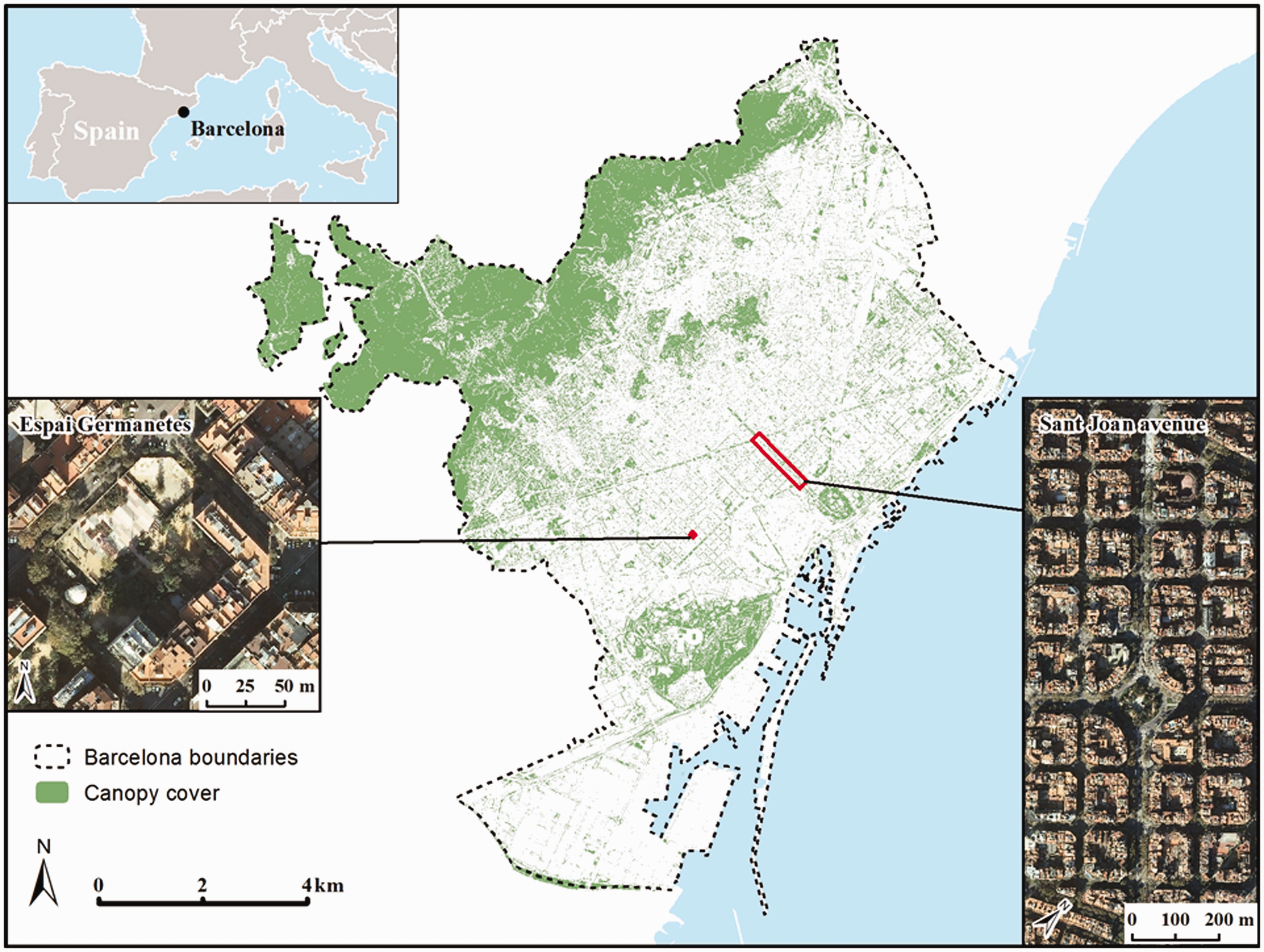
Barcelona city area and canopy cover, with marked the locations of the two case studies (Espai Germanetes, and Passeig Sant Joan, both in the Eixample district).
In the next section, we present an in-depth analysis of these two selected initiatives, which are identified as NBS, in Barcelona. We focus our analysis on how these projects mirror and sustain dominant discourse around NBS and how they expose its contradictions.
Tracing processes and outcomes of urban nature’s neoliberalisation: Two case studies of NBS in Barcelona
Both our selected case studies aimed at creating better health and well-being and enhancing social interaction, albeit in different ways, through the use of ‘nature’ – be it through street trees or food orchards (Figure 1). These projects also had economic benefits in sight, as they either attracted investment, or provided temporary maintenance of idle land during times of recession. The motivations behind these projects thus indeed coincide with the triple-win outcomes that are carried over from sustainability and that the NBS concept now proposes and supports. We, here, examine how this discourse framed the production of the social, ecological and economic benefits that these projects indeed brought, but also note the counter-narratives and counter-practices that emerged responding to the neoliberal embeddedness of these projects.
Green capitalising versus community-oriented urban ecologies in Passeig de Sant Joan (2009–2015)
The redevelopment of Ps. de Sant Joan was a project that coincided with the interest of Barcelona City Council in urban green corridors. The project has been considered emblematic for its innovative landscape architecture and praised for its ‘human’ and ‘quality’ approach to urban space via the use of green amenities such as raised beds, permeable pavements, and small green spaces and playgrounds (Costa, 2016). It combines climate change mitigation and adaptation features through run-off control and anti-heat stress effects, noise control and microclimate regulation. However, what makes Ps. de Sant Joan stand out for many of its supporters, as an exemplary NBS project, are the effects it has had on transforming and boosting the local economy. These effects are closely connected to the design of the intervention and particularly the distribution of open public green space in close proximity to ground floor businesses. The decision for such a design was the result of a constellation of public and private actors aligning their professional, institutional and personal interests with the policy impulse for green infrastructure.
Originally, the 1.2 km of avenue along Ps.de Sant Joan was part of a concrete-dominated street, with automobile circulation on both sides, connecting the Ciutadella Park (and the Old Town) with the districts of Eixample and Gràcia. By the beginning of the 21st century, however, parts of the avenue were showing signs of infrastructural degradation, with broken sidewalks, neglected greenery and little control over business licences (Hoyos Núñez, 2012). Local residents and shop-owners also expressed concerns over its degradation. Meanwhile, the broader Eixample district – with its high cultural tourism offerings (e.g. Sagrada Familia) – was suffering from a lack of green space due to its extreme density and design and from high car contamination. In terms of city branding and tourism attraction and protection, the reconstruction of Ps. de Sant Joan was thus of increased significance.
At the same time as the discussion about redeveloping the avenue began, the lower strip of the Eixample district (Fort Pienc) had started to gather an increasing number of shops owned by Chinese immigrants (reflecting also the demographic trend in the area with 1 in every 32 residents of Chinese origin). Many referred to it as the Barcelona Chinatown (Castan, 2013). The proliferation of shops of Chinese-ownership was presented as part of the neighbourhood’s degraded image and devaluation, via complaints and demonstrations from local residents (Bernal and Castan, 2007). These were, however, contested by some anti-racist groups (Sierra, 2007). A local official shared his view of Chinese businesses as part of a problem that the renovation could address: … The way that the Chinese shops were establishing in this area had some important effects on the surroundings. Basically, due to an ignorance of the law and because these businesses needed a lot of loading/offloading, and accumulated a lot of materials which carried a lot of risk of fire … And the truth is that aesthetically the Chinese shops of that time had little to offer. Now there are a lot of different business types, but this has changed little by little, every day it becomes better. But back then, someone could easily claim that this is degrading my surrounding. (Local official of Eixample district, interview 2017)
The physical re-design of Ps. de Sant Joan was also not exempt from debate and criticism. An interviewee, who was a member of a neighbours’ association stressed how a rambla design with consolidated green space in the center of the street, would have been the most beneficial form of public space for Eixample residents to gather, meet and hold events. The rambla type was also identified by the Urban Ecology Agency of Barcelona (BCNEcologia) as ideal for a green corridor (Agency staff, 24 May 2017), and its benefits in terms of social use and appropriation have been since documented (Hoyos Núñez, 2012). However, this option was pushed aside in favour of expanded sidewalks (boulevard design) with enhanced greenery, which allowed for better pedestrian access to street-level retail, benefitting new bars and restaurants who can now use part of the sidewalk as their private terraces (district officer, 10 July 2017). According to interviewees, weak community organisation in the Eixample district contributed to the domination of business interests: We [residents] were against the [boulevard] solution that was adopted in the part below. We gave our opinion because we were asked, but we couldn’t be part of the decisions … the merchants won. The merchants wanted broad sidewalks, in order for the bars to have terraces. The neighbours as such were not really entering in those discussions. They were not organized. They were not organized because participation is very ‘expensive’ for people. (Neighbours Association, Sant Joan Avenue – Gràcia)
Since then, Ps. de Sant Joan has been rebranded as a new foodie destination in both local lifestyle and tourist-oriented media. 7 The most common businesses are now bars and restaurants (47 establishments), of which 32 have an open-air terraces, 13 can be classified as trendy foodie venues, 8 and only eight count more than 10 years of operation (Giraldo Malca, 2017). Significantly higher rents make it hard for traditional retail businesses to survive, as has been noted by merchants of the area (Giraldo Malca, 2017). New businesses that can invest in high rents aim at a higher-class clientele – a phenomenon described as food gentrification (Anguelovski, 2016). Capturing the value created by new green elements and innovative design, Ps. de Sant Joan is now being marketed as a green street by real estate portals selling or renting upper-end apartments. 9
Turning Ps. de Sant Joan into a green corridor is a good example, on the one hand, of ecology-oriented institutional knowledge taking hold and inserting sustainability priorities in mainstream urban planning and design. It ticks the boxes of widely defined NBS criteria, as it brings a number of ‘ecosystem services’, serves residents by improving their urban experience, and attracts new businesses. However, on the other hand, ecosystem benefits were not prioritised during the planning and implementation process, as evidenced by the fact that the City Ecology Agency’s preferences were not heeded. Scrutinising its ‘triple-win’ outcomes, we find both winners and losers, with the distribution of benefits being particularly racialised and geared towards the big players of the local and global entertainment and recreation economy. An alternative design with potentially greater ecological and social benefits (rambla) was in this case side-lined in the name of economic revitalisation and city branding.
Nature’s neoliberalisation in the case of Ps. de Sant Joan takes place within a context of prioritisation of growth-oriented business interests in a global city positioned at the intersection of international flows of visitors, events and investments (Anguelovski, 2014). While innovative characteristics of green/grey infrastructure are indeed making the project more sustainable, they operate within this prioritisation at the expense of alternatives with potentially greater or better-distributed socio-ecological benefits. Nature-based elements, in the form of permeable pavements and street greenery, were discussed as a means to increase regulation and maintenance of ecosystem services, but primarily intended as an investment that would bring returns in the form of increased consumption and economic growth.
Transience as neoliberal tension in the counter-practices of urban gardening: The case of Espai Germanetes (2012–ongoing)
Urban gardens, and especially those based on grassroots organisation, are known for enacting and offering a new politics of urban space. They focus on production and sharing rather than consumption and competitiveness. They promote social cohesion, collective efficacy, inclusivity and overall wellbeing and health, while also challenging neoliberalism by opposing individualist, profit-oriented values and alienating human relationships (Camps-Calvet et al., 2016; Guitart et al., 2012; Sanyé-Mengual et al., 2016; Teig et al., 2009). And while these benefits are widely recognised by the Barcelona city government – through a network of 15 municipality-supported allotment-based gardening projects for the elderly and those at risk of social exclusion 10 – citizen-led gardening initiatives have an overall precarious status in Barcelona. Unsanctioned efforts have been subject to fines by the municipality and are carried out under a constant fear of being removed by the authorities (Giacchè and Tóth, 2013).
In contrast, as described earlier, Pla Buits gardens are community-managed urban gardens supported by the City Council via temporary land use rights and through the provision of basic infrastructural materials (e.g. electricity and water). This type of ‘support but not involvement’ is similar to the case for many community gardens, at least in Western countries (Rogge and Theesfeld, 2018). Citizen-led efforts within the Pla Buits programme are of limited number and duration. Unlike guerrilla projects or permanently assigned allotment city gardens, citizen groups enter an agreement with the municipality for a maximum three-year time period, with no guarantees about what is to follow. 11 Importantly, this transience is connected to the context of the 2008 economic crisis within which this policy was first conceived and applied.
During the crisis period, the lack of investment funding and the tight city budgets caused a halt in development projects. At the same time, the city was in the midst of anti-austerity mobilisations that unified and reinforced social movements and right-to-the-city claims (2008–2015). The first Pla Buits programme offered a win-win solution for a city administration led by a center-right city council (formed by Convergència i Unió) eager to revalorise unused urban land through temporary practices that could be easily removed (Barcelona City Council, 2012), as has been the tendency in a number of cities in Europe (Demailly and Darly, 2017; Ferreri, 2015). Such an initiative ensured the prevention of public land degradation and value deterioration, while satisfying part of emerging public demands, which were increasingly expressed in the form of urban gardens on squatted land.
The attachment of those gardens to ‘win-win’ crisis politics and, as a consequence, their short lifetime prospect, point to the neoliberal spirit of the Pla Buits policy as a whole, and to the limitations that those garden projects are confronted with in terms of their social transformation effect. Pla Buits gardens, thus, qualify as an exemplar urban NBS because they use improvement in the natural environment to solve the problem of safeguarding the value and aesthetic of publicly owned land – before such land can be turned into more economically profitable projects. Their temporary status however relegates such activities to a secondary status with low political priority, and this occurs despite high civic interest in urban gardening. This dynamic dialectic, between Pla Buits as a neoliberal policy and Pla buits gardens as a counter-practice to neoliberalism, is further illustrated by our case study of Espai Germanetes
Espai Germanetes, located in the central Eixample district, grew out of the 2011 social mobilisation of 15m activists, when a collective of neighbourhood residents decided to occupy and propose a green-oriented and community-organised use for a 5000 m2 vacant plot belonging to the municipality, and which was historically occupied by the ancient ‘Convent of Germanetes’. In 2012, the municipality designated 585 m2 of that plot to the Pla Buits scheme and selected the Espai Germanetes as the winning project. This involved an urban garden, as well as other spaces for social encounter, events and assemblies. As with other Pla Buits projects, after three years of interim use, the plot was to be redeveloped into public facilities (including a nursery, a primary school and social housing) and green space (trees, park), for which social demand was also high in the neighbourhood. In that sense, while it was not meant to be transformed into a private, speculative real estate development (unlike other examples through the city), the project did trigger tensions and social mobilisation among gardeners and other residents who highlighted the scarce availability of green space in that area of the city, the large amount of empty, unused buildings which have the potential to be reused for infrastructure, and the relative waste of time and resources that had been dedicated to making the garden: One thing is the urban garden as such, which is in the 500 m2 of Pla Buits, and another thing is Parc Germanetes as an open space, which we have opened a year and a half ago. But from the beginning they were saying it was provisional, because the developments had to be built … All this will be destroyed. For me it has been a huge waste of money. (Activist, resident in Eixample, 2017) I think that everyone understands that a space, in a dense city like Barcelona, must be able to be enjoyed in its many provisional and definitive facets, thinking about the public interest of the city, and that if a school is to be built somewhere, because the school has higher priority in relation to a community garden, for example, this is accepted. Projects must also be able to be replaced. If there is a project that has a very strong social and community value and has a space to develop, that is great. But often this project cannot stay indefinitely in that same place. (City Council representative, participation sector, 2017)
During the time of our study, the Municipality declared a willingness, and indeed later decided, to keep the 585 m2 Espai Germanetes as a community-managed space. This was, not least, due to the political significance this project had gained, as a symbolic initiative for urban commons that promotes the values of citizens’ participation that the Barcelona en comú government (2015 onwards) embraces. The counter-practices and counter-narratives of citizens/activists within those gardens resisted the risk of non-permanence and managed to insert grassroots demands in the recent measures adopted by the progressive city government. Most recently, the management of Espai Germanetes has been transferred to the neighbourhood association ‘Jardins d’Emma’ which surfaced out of the movement for a self-managed park. The project is now to be included in a new municipal policy around urban gardening (‘Mans al verd, reserves per la biodiversitat’). At the same time, however, the practice of gardening remains at the margins of urban planning in Barcelona, and is therefore jeopardised by neoliberal forces at national and international scales, that cities alone cannot counteract.
Discussion: The nuanced nature of urban greening interventions and the power of concepts as reflected in the Barcelona case studies
Our key goal in this paper was to unpack NBS as a concept and a practice, examining the ways in which projects that are identified as NBS carry the potential to be captured within the neoliberal doctrine. We have substantiated this claim by looking at the discursive framing of the NBS concept and by analysing two projects that are considered to be successful examples of NBS implementation.
On the discursive level, we find that NBS can provide opportunities for nature’s neoliberalisation while claiming sustainable outcomes; thus, they present the same unresolved contradictions of sustainability, that are in turn directly linked to inequalities and injustices (re)produced by neoliberal ideology (McCarthy and Prudham, 2004). For the same reasons as precursor concepts such as ecosystem services or natural capital, NBS is seen as offering a vision of planning that aligns with neoliberal governance and can thus assist the framing of neoliberalism as a nature-friendly process. As jargon such as NBS is flexible and often presented as politically neutral, it does not explicitly address the differential social values and the contradictions of sustainability within a market-led political economy (Campbell, 1996). However, as our case studies also show, ‘umbrella concepts’ like NBS are inherently political, since they represent ideological commitments, inform institutional practices, and produce certain imaginaries of nature and its functions, (Kull et al., 2015) that can then be contested by civic groups.
Our two selected cases of NBS in Barcelona displayed a dialectical relationship between neoliberal city governance, on the one hand, and the counter-narratives and counter-practices of local residents, on the other. Indeed, neoliberal ideology imbues urban environmental governance and environmentalism in multiple ways, and is never free of contradictions and contestations. The municipal and investors’ discourse around Ps. de Sant Joan and the Pla Buits programme hinged on and reinforced a greening turn in the city, which coincided with a larger neoliberal agenda of the time (Anguelovski, 2014; March and Ribera-Fumaz, 2016). Nevertheless, it also coincided with and formed part of contesting neoliberalism through calls for reclamation of public urban space for people and for nature. Resonating with previous findings about the hybrid and incomplete ways in which ‘neoliberalisation tendencies can only be articulated’ (Brenner et al., 2010), NBS-characterised projects cannot be simply seen from the onset as overall good or bad; radical or superficial; transformative or conservative. However, the underlying assumptions/prerequisites that NBS definitions carry, especially in the European urban context, allow for neoliberal practices to seep in and obfuscate the very paths towards environmental, economic, and social sustainability that NBS claim to be opening.
The reconstruction of Ps. de Sant Joan played the role of an ‘environmental fix’ (Castree, 2008a) in an overall densifying and car-oriented grey infrastructure, under the prefix of green innovation and social-ecological connectivity. It provided the opportunity for alternative green visions of the urban environment to become reality (e.g. diverse varieties of plants, reducing car lanes in favour of bike lanes and generous space for social encounter). This change, however, would not have been enough to fulfil triple-win expectations that NBS by definition seek. Such expectations were only realised by adding the opportunity for green to be capitalised upon (offering pleasant green space to new ground-floor, trendy businesses for tourists and visitors). It made access to urban nature significantly conditioned by people’s willingness to sit in the terraces of bars and restaurants that surround it, both because this was promoted as part of the urban green experience and because these businesses had appropriated a considerable part of the amenity. The spatial ‘consumption’ (Brand, 2007) of ecosystem services provided by the re-naturing intervention has been thus conditioned by people’s ability to spend. As our findings demonstrate, the choice between two different street designs was not equally desirable from, or beneficial for, all stakeholders. People voiced their positive experience of a consolidated green rambla and questioned the motives behind choosing a boulevard, but did not manage to make their concerns heard.
Neoliberalisation in the case of Espai Germanetes was found both in the underlying logic of the Pla Buits policy, and in the (otherwise counter-) practices of gardeners. In a context of real estate speculation and dense urban development, community gardens in Barcleona, as elsewhere, struggle ‘to find a permanent location in the neoliberal city’ (Demailly and Darly, 2017). The spirit of the Pla Buits was not aligned with long lasting demands of the neighbourhood for public green space in close proximity, and the short-lived support it provided did not prove enough to maintain the ecological and socio-political cultivations that are taking place in community gardens. On the one hand, Espai Germanetes, as other community gardens (see Classens, 2015; Perkins, 2011; Pudup, 2008; Rosol, 2012), has exhibited a hands-on political ecology of praxis, resisting neoliberal roll-back mechanisms through reclaiming urban space, functioning outside market-led ideologies and state bureaucracies, and enhancing social cohesion and neighbourhood activity, solidarity, direct consumption networks and socio-environmental activism for a different model of the city.
On the other hand, in a context of budgetary cuts, civic mobilisation and volunteerism served also as ‘local entrepreneurialism’ or ‘civic stewardship’ (Colding and Barthel, 2013; Langemeyer et al., 2018) that kept vacant land safe from crime, degradation and thus, depreciation. And although those involved do not see volunteering work negatively (on the contrary, it is cultivation and interaction that people enjoy and see as beneficial to their health and wellbeing), feelings of disappointment and fear of space loss do arise when gardens are conditioned by limited timeframes and threatened by extinction. This is an anxiety-ridden existence that keeps gardeners incentivised to perform the role of preserving the value of urban space in order to avoid the existential threat derived from their precarious status. From the beginning, the temporary prospect created insecurity and demotivated civic engagement. The squat movement that had claimed the overall Germanetes space reformulated and rearticulated itself in order to enter the Pla Buits programme.
While this institutionalisation of the wider gardens movement in Barcelona can be seen as a co-optation of grassroots claims for equitable green spaces beyond market logics (Perkins, 2009; Ferreri, 2015), it has also expanded the possibility for community involvement in public policies. It showed the potential of interim gardens to act as seeds for a wider movement of reclaiming the right to urban nature and triggered political debate on the prioritisation of benefits that (public) urban space shall provide, counteracting neoliberal hegemony and becoming permanent counter powers in the urban space. As a result, the current progressive and assertively anti-neoliberal government took on the movement’s claims and secured Espai Germanetes for gardening and social activities – beyond the Pla Buits policy framework, in essence freeing it from the chains of precarity.
In sum, we claim, it is not the new concept of NBS per se that crafts neoliberalism into urban greening/sustainability projects, but rather tendencies of (nature’s) neoliberalisation are reflected in the promotion of concepts such as NBS, with the purpose to further solidify neoliberal ideology into environmental/sustainability discourse and practice. Blurry boundary concepts, like NBS, serve as vehicles to enforce neoliberal ideology within local city agendas, where they may resonate (Ps. de Sant Joan) or be disputed (Espai Germanetes). More explicitly, it is unlikely that Germanetes would qualify as NBS if it continued to be a guerrilla community garden/space, without the (initially temporary) municipal support through the Pla Buits programme. It is equally unlikely that Ps. de Sant Joan would have received such praise, if it weren’t also meant to completely transform the local business environment around it.
Concluding remarks: Can NBS escape neoliberal ideology?
Would processes of nature’s neoliberalisation be taking place even without the emergence of concepts conducive to justify and support it? Probably yes, but what we importantly observe is how such concepts can serve as discursive tools for shaping and disciplining social activities that are not market-oriented, through justifying a certain choice of green projects and designs over others. While there is room for counter-narratives and counter-practices within NBS, the concept is often discursively mobilised in such a way as to privilege neoliberal values (such as a focus on quantifiable benefits, profit, quick economic returns and growth) within urban nature’s governance. That is, except when governments are explicitly anti-neoliberal. As a result, the contradictions, conflicts and trade-offs that urban planning involves are often concealed through a loosely defined and apolitical conceptualisation of nature and of social benefits – this condition is carried over within the NBS concept.
As our case studies demonstrate, NBS practices are continuously shaped and contested in society. Their contradictions, challenges and contestations should no longer escape academic or policy discussions around nature-based interventions and urban re-naturing. Nature-based solutions as a term can be recaptured to work more towards radical socio-ecological transformations if it escapes the ‘no alternative’ logic of neoliberalism. But to achieve this, critical researchers engaging with issues of climate change adaptation and sustainability should no longer shy away from normatively re-defining what could qualify as (urban) nature-based ‘solution’, and these definitions should align more with demands that come from socio-environmental movements and scholarly ideas of a different (than economics or engineering) tradition. In such manner, future visions of, re-naturing and biodiversity could compliment and inform visions for emancipation, equity and justice that go beyond neoliberal capitalism.
Highlights
‘Nature-based solutions’ is a concept that could assist the framing of neoliberalism as a nature-friendly process. Tendencies of urban nature’s neoliberalisation can be evidenced in the implementation of projects that qualify as nature-based solutions. These tendencies are contested in various social arenas and especially by grassroots initiatives, even as they are part of nature-based solutions implementation.
Footnotes
Author note
Francesc Baró is also affiliated to Vrije Universiteit Brussel (VUB), Geography Department and Sociology Department, Pleinlaan 2, Brussels, Belgium. James Connolly’s affiliation is also affiliated to University of British Columbia, School of Community and Regional Planning. All authors are also affiliated to Barcelona Lab for Urban Environmental Justice and Sustainability (BCNUEJ).
Author note
Isabelle Anguelovski is also affiliated to Catalan Institution for Research and Advanced Studies (ICREA), Spain.
Declaration of conflicting interests
The author(s) declared no potential conflicts of interest with respect to the research, authorship, and/or publication of this article.
Funding
The authors disclosed receipt of the following financial support for the research, authorship, and/or publication of this article: The authors acknowledge financial support from the Spanish Ministry of Science, Innovation and Universities, through the “María de Maeztu” program for Units of Excellence (MDM-2015-0552), for James Connolly through the Juan de la Cierva program (IJCI-2016-31100), and for Johannes Langemeyer and Francesc Baró through the 2015 -2016 BiodivERsA COFUND call for research proposals. Authors also acknowledge the support of the Naturvation (NATure-based URban innoVATION) project funded by the European Union’s Horizon 2020 research and innovation programme under grant agreement No. 730243, and the ERC Starting Grant GreenLULUs (GA678034).
