



Abstract
Urban political ecology has conceptualized the city as a process of urbanization rather than a bounded site. Yet, in practice, the majority of urban political ecology literature has focused on sites within city limits. This tension in urban political ecology evokes broader conversations in urban geography around city-as-place versus urbanization-as-process. In this paper, I bring an urban political ecology analysis to examine co-constitutive urbanization and ruralization processes, focusing on sites beyond city boundaries in three empirical case studies located within the broader hydrosocial territory of urban Southern California. By focusing on the rural components of hydrosocial territories, I show that each of the three case studies has been shaped in very different ways based on its enrollment within urban Southern California’s hydrosocial territory; in turn, the rural has also shaped the cities through flows of politics and resources. The paper demonstrates how urban political ecology can be usefully applied to understand rural places, illustrating how processes of urbanization can be involved in the production of distinctly rural—and distinctly different—landscapes. The cases demonstrate the utility of urban political ecology as an analytical framework that can examine co-constitutive urbanization/ruralization processes and impacts while maintaining enough groundedness to highlight place-based differences.
Keywords
Introduction
Urban political ecology (UPE) examines not only biophysical “nature” within cities, but also the processes of urbanization and the production of urban spaces, focusing on the exercise of power through socio-ecological relationships (Cousins and Newell, 2019; Heynen et al., 2006; Swyngedouw and Heynen, 2003). UPE scholars have conceptualized the city as more than a site, instead examining the uneven processes of urbanization. The urban is described as a “socio-spatial process whose functions are predicated upon ever longer, often globally structured, socio-ecological metabolic flows that not only fuse objects, nature and people together, but do so in socially, ecologically and geographically articulated, but depressingly uneven, manners” (Swyngedouw and Kaika, 2014: 462). However, in practice, the majority of UPE literature has focused on sites within city limits, treating the city as a container for research and, in doing so, implicitly conflating “urban” with “city” (Angelo and Wachsmuth, 2015; Zimmer et al., 2017).
These debates within UPE relate to broader conversations in urban geography around city-as-place versus urbanization-as-process (Shin, 2017). A common theme throughout these conversations is the under-examination of the “rural.” In response to the proposed concept of a ubiquitous “planetary urbanization” (Brenner and Schmid, 2015), urban geographers have noted that even extensive urbanization processes do not necessarily render categories of urban and rural as obsolete concepts (Walker, 2015), and the rural remains an analytically useful category (McKinnon et al., 2019). Some scholars have even proposed the concept of “ruralization” as a way to decenter the urban (Krause, 2013; Mercer, 2017). Meanwhile, empirical examinations of the impacts of urbanization processes in sites beyond the “city proper” have been largely addressed through separate bodies of literature outside of either urban geography or UPE (such as an emergent literature on exurban political ecology) (McKinnon et al., 2019).
Urban metabolism refers to the extensive networks of resources, including food, energy, water, and other materials, that are integral to the development and maintenance of urban areas (Heynen et al., 2006). As a classic flow resource, water represents a frequent object of study in UPE (e.g. Gandy, 2003; Kaika, 2004; Swyngedouw, 1999). Recent literature has used the term “hydrosocial territories” (Boelens et al., 2016) to emphasize spatial dimensions of hydrosocial relationships: the processes through which socio-ecological spaces are made at multiple scales through interactions and material flows of water. By focusing on the diverse spatial configurations and relationships created through the metabolic flows of a particular resource, the concept provides a useful model for demonstrating how UPE can move beyond city borders (Hommes et al., 2019a, 2019b).
Drawing on concepts of UPE and hydrosocial territories, this paper examines urbanization processes beyond city boundaries. The paper focuses on three empirical case studies located within the broader hydrosocial territory of urban Southern California but outside of city bounds. The three distinctly rural case studies are all part of the same hydrosocial territory, yet they are shaped in markedly different ways through their watery entanglement with Southern California’s coastal cities. Together, the cases provide a basis for an empiric examination of how a highly diverse range of rural places are produced through enrollment within an urban hydrosocial territory. The cases also demonstrate the utility of UPE as an analytical framework that can examine urbanization processes outside the city while maintaining enough groundedness and nuance to highlight place-based differences.
The paper first reviews several recent scholarly conversations, including debates in UPE literature around “methodological cityism” and related conversations in urban geography around planetary urbanization. I then discuss the concept of hydrosocial territories and describe the three cases of Southern California’s “hydrosocial hinterlands,” analyzing how processes of urbanization have shaped the distinctly rural cases under consideration, and demonstrating the diversity of places and relationships produced within a broader hydrosocial territory.
UPE beyond the city
UPE, a subfield of political ecology, traces the production of urban spaces through unequal socio-environmental power relations, and challenges the notion that urban spaces are separate from nature by examining cities as socio-ecological processes (Heynen, 2014; Heynen et al., 2006; Keil, 2005; Rocheleau et al., 1996). UPE’s key insights about urban socio-ecological processes and change, the role of capitalist political economy in producing environmental inequality, urban metabolism, and scale have made important contributions to political ecology and the discipline of geography as a whole (Heynen, 2014; McKinnon et al., 2019).
UPE has two main goals: first, to use political ecology as a tool to understand socio-environmental dynamics within urban settings; and second, to re-imagine the “urban” as a set of processes rather than a place located within city boundaries (Heynen et al., 2006). Regarding the second goal, UPE draws from Lefebvre’s contestation that when urban studies are limited to the study of “city” spaces, it is insufficient to understand urbanization and industrialization processes (Lefebvre, 2003 (1970)). Early inspirations to the development of UPE included some investigations of the co-production of urban and rural places: for example, Cronon’s Nature’s Metropolis (1991) served as an early inspiration to the development of UPE in its emphasis on the co-production of Chicago’s metropolis and the simultaneous development of the rural Midwest through processes of material resource transformation in city formation (Heynen et al., 2006). Yet, recently geographers have argued that while UPE has succeeded in its first goal (bringing political ecology to urban settings), UPE has thus far focused almost exclusively on city sites and in doing so has failed to address broader questions of urbanization processes outside the scope of traditional city/country binaries, neglecting the question of what makes city spaces more “urban” than the hinterlands implicated in urbanization processes through dynamics such as resource flows (Angelo and Wachsmuth, 2015). Yet, this task of moving beyond so-called methodological cityism has proven difficult to implement in practice. 1
Meanwhile, broader debates about the scope and scale of urbanization have been taking place within the field of urban studies. Recent scholarship on “planetary urbanization,” also inspired by Lefebvre’s ideas of the “complete urbanization” of society, has renewed calls for attention to—and heated debates over the meaning of—urbanization (Peake et al., 2018; Ruddick et al., 2018). 2 Like urban political ecologists, planetary urbanization scholars have argued for a focus on urbanization-as-process instead of a focus on cities-as-form (Brenner, 2013; Brenner and Schmid, 2015, 2017; Merrifield, 2013). However, planetary urbanization has been critiqued by urban geographers who argue that the approach lacks nuance: its sweeping claims are seen as lacking grounding in empirics (Walker, 2015), and the approach is viewed as overly universal and not well-equipped to handle the issues of difference raised by postcolonial and feminist scholars (Derickson, 2015). 3 Geographers have also critiqued planetary urbanization for conceptualizing urbanization as an overdetermining presence (Ruddick et al., 2018) in which urbanization is conflated with too many factors, e.g. globalization (McCarthy, 2008), capitalism (Merrifield, 2013), neoliberalism, and/or climate change (Keil, 2018).
As part of the critique of planetary urbanization as an overly totalizing perspective, urban geographers have raised questions around what, precisely, constitutes the “urban”—and in contrast, what constitutes the “rural.” According to urban geographers, planetary urbanization lacks a definition of what exactly is meant by the urban, other than that they are not talking about a simplistic and bounded city (Walker, 2015). As Walker (2015) notes, planetary urbanization leaves the urban ill-defined: “If nothing is outside the urban, then the urban is everything, and if it is everything, it is nothing in particular and therefore not an interesting problem” (185). According to both urban and rural geographers, rural and urban remain useful categories with analytical power because these categories still exist in peoples’ lived experience, even if they are ill-defined, socially constructed, and mutually constitutive of one another. Urban geographers have argued that although cities have always relied upon broader territories for their flows of resources, this does not render the entire concept of city meaningless (Davidson and Iveson, 2015; Scott and Storper, 2015). Likewise, rural geographers have noted that even though the rural is difficult to define in precise terms, it remains an important experiential category that persists as a useful categorical distinction because people continue to identify as rural (Cloke et al., 2006; Woods, 2004). As Chen et al. (2017) point out in their examination of contemporary rural China, “When we downplay the rural, we elide the lived experiences of millions of people” (83). Contemporary empirical research continues to demonstrate that rural transformation processes are dynamic, diverse, and worthy of attention in their own right (e.g. Chen et al., 2017, Guin, 2018).
Geographers have further argued that urbanization, while undoubtedly an important process, is not the only dynamic worth studying (Jazeel, 2018; Kipfer, 2018). A few scholars have pushed back on the one-way formulation of planetary urbanization by mobilizing the parallel term “ruralization” to decenter the city, describing multidirectional, co-constitutive processes of socio-spatial transformation (Krause, 2013; Mercer, 2017). Krause (2013) makes the case that “if the whole world is urbanizing, it must also be ruralizing.” She argues that, while a focus on urbanization-as-process has been useful in moving beyond country/city binaries, it is unhelpful to approach all social–ecological relations as primarily urban ones. The idea of ruralization was brought up by Walker (2007) a decade earlier in The Country in the City, describing the “double sense of an urbanized country and a ruralized city” in which the countryside includes processes of urbanization—farms, reservoirs, dumps, etc.—and the city includes “rural” characteristics such as open space and greenery. Scholars have also noted the importance of considering the production of other spaces between those typically categorized as urban and rural: for example, Kiel and others explain the global expansion of suburban environments using the language of “suburbanization” (Hamel and Keil, 2015; Keil, 2017).
These debates raise several questions. A first question is about whether urban and rural (and other forms such as suburbia) should be understood in terms of place—defined by lived experience and identity as well as form—or in terms of processes of urbanization (and parallel processes such as ruralization and suburbanization) as processes of socio-spatial change. UPE has embraced both approaches (Cousins and Newell, 2019). In Table 1, I attempt to summarize these debates through a typology of urban and rural as place and process.
Typology of urban and rural as place and process.

This typology is not meant to reify binary categories; the goals are to summarize and compare place-based versus processes-based definitions, and to highlight the ways in which co-constitutive urbanization/ruralization processes are not limited to their respective spatially defined categories.
A second question raised within these debates is how to study urbanization without falling into the trap of universalism. Scholars have recently emphasized the need to pay close attention to multiple socio-spatial formations and processes, rather than automatically privileging urbanization as the dominant process at work (Derickson, 2018; Jazeel, 2018; Ruddick et al., 2018). In moving toward a more grounded examination of relationships and processes of urbanization/ruralization within and outside of city sites, UPE scholarship offers a potentially useful path forward. UPE, like other subfields of political ecology, emphasizes empirics and attentiveness to the details of on-the-ground power dynamics and diverse processes of socio-ecological change (Connolly, 2019). Recent UPE scholarship has placed specific emphasis on difference and lived experience by expanding from a primarily Marxist-inspired framework to an UPE that mobilizes a wide range of poststructural, feminist, postcolonial, and posthuman approaches (Biehler, 2013; Gabriel, 2014; Gandy, 2012; Heynen, 2018; Lawhon et al., 2014; McKinnon et al., 2019). These feminist and poststructural approaches highlight the importance of difference and multiple lived experiences of urban places and urbanization processes (Derickson, 2015; Lawhon et al., 2014). In this vein, a situated UPE that moves beyond “methodological cityism” while refusing a universal theory of urbanization holds promise. UPE offers an analytical framework well-equipped to examine the specific ways in which processes of socio-environmental change related to urbanization are differentially experienced by people as these processes unfold in actual places.
Urban Southern California’s hydrosocial hinterlands
Water is a nonsubstitutable flow resource that is frequently moved from rural to urban areas to support urban development. Scholars in the field of UPE have developed a significant body of literature calling attention to the struggles to control water and the unequal distribution of benefits and costs associated with water resources (e.g. Bakker, 2003; Gandy, 2004, 2014; Swyngedouw, 1997, 2009, 2015; Swyngedouw et al., 2002). In recent years, a robust literature has emerged using the concept of the hydrosocial cycle to study the dynamic relationships between material water resource flows and social, technological, and political systems (Linton and Budds, 2014; Swyngedouw, 2009). The concept of the hydrosocial cycle has been used in connection with that of urban metabolism to examine the networked relationships of water supply infrastructure that frequently link urban and rural areas (Cousins, 2017; Cousins and Newell, 2015).
Most recently, the concept of “hydrosocial territories” has been defined as “socially, naturally, and politically constituted spaces that are (re)created through the interactions amongst human practices, water flows, hydraulic technologies, biophysical elements, socioeconomic structures and cultural-political institutions” (Boelens et al., 2016). The concept of the hydrosocial territory provides a useful way to examine the spatial dimensions of the hydrosocial cycle, making the case for a vision of “territory” based on material flows. Hydrosocial territories can be understood as both place-based and process-based: they consist of territories that are “rooted” in particular places (e.g. Cantor et al., 2018b; Rocheleau, 2016; Rocheleau and Roth, 2007), but territories that are simultaneously produced and (re)created through interactions amongst a variety of actors across multiple scales. The concept of hydrosocial territories has been usefully applied to explore rural–urban water relationships in particular (Hommes and Boelens, 2017; Hommes et al., 2019a, 2019b). Because water infrastructure so often reaches beyond city bounds, water frequently links urban and rural places, providing a useful illustration of how urbanization processes stretch beyond the city. At the same time, a territorial focus emphasizes place-specificity, employing a nuanced understanding of territories as diverse, imbued with power, both material and imagined, and constantly being renegotiated (Hommes et al., 2019a).
In this paper, I examine several case studies within a broader hydrosocial territory, the extended hydrosocial watershed of Southern California. The links between water and politics throughout the history of California have been well documented in several classic accounts describing the evolution of water systems in the region (e.g. Hundley, 2001; Reisner, 1993; Worster, 1992), as has the issue of urban–rural relationships within the California context (e.g. Brechin, 2006; Henderson, 1999; Walker, 2007). Together, these accounts provide excellent histories of California’s water development, urban and environmental politics, and broader political–ecological landscape, which I do not attempt to repeat here. Instead, I focus on a detailed examination of three specific case studies located within the hydrosocial territory of urban Southern California’s water supply. Through my case studies I develop an empiric understanding of the intimate connections between California’s cities and rural areas, focusing on water to demonstrate how urbanization and hydrosocial relationships are involved in producing a highly diverse range of distinctly rural places.
California’s hydrosocial landscape is characterized by spatial mismatch: the state’s heavily populated cities and intensive agricultural regions are both located far from water resources (Hanak, 2011). The disconnect between water supply and demand has led the state to rely upon vast infrastructural networks to divert and transfer water for both urban and agricultural uses since the beginning of the 20th century (Cousins and Newell, 2015; Reisner, 1993; Worster, 1992). Urban Southern California’s water supply draws upon a broad hydrosocial territory that extends far beyond urban watershed boundaries to include much of California, including the Eastern Sierra Nevada Mountains and the Sacramento Bay-Delta watershed, as well as the entire Colorado River watershed spanning seven states (Figure 1).
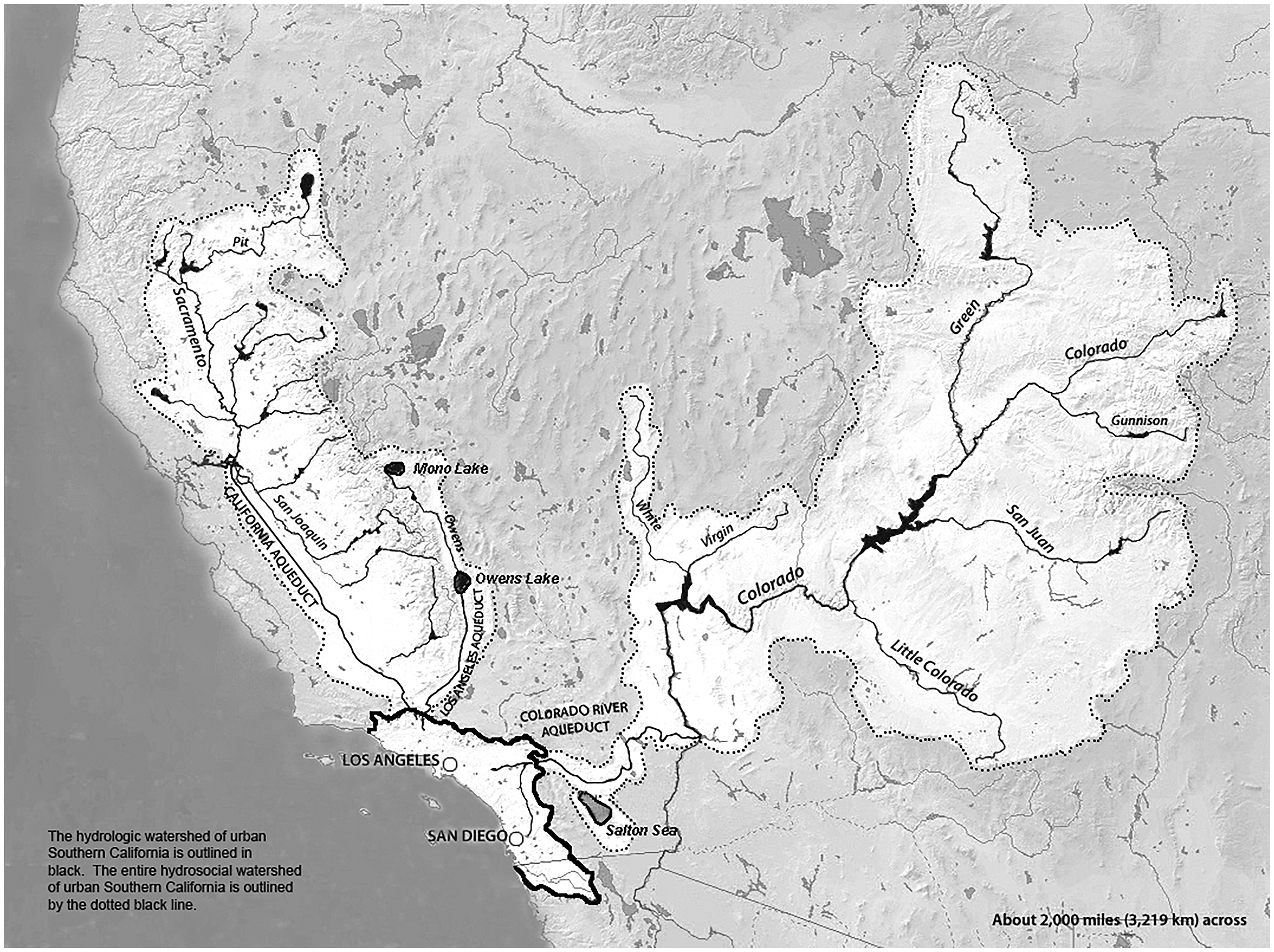
Map of extended hydrosocial territory of urban Southern California. Source: Adapted image from https://commons.wikimedia.org/wiki/File:SoCal_Watershed.jpg.

This paper explores the contexts and histories of three large terminal lakes—Owens Lake, Mono Lake, and the Salton Sea—impacted by water transfers and diversions. Economic analyses of rural-to-urban water transfers and diversions typically show that costs and benefits measured on a regional scale balance out to a net positive, since cities are willing and able to pay more for water (Michelsen and Young, 1993; Taylor and Young, 1995). But, such analyses hide uneven costs to air quality, rural economies, and wildlife habitat, all of which tend to fall disproportionately to rural areas from which the water is sourced (Cantor, 2017; Howe and Goemans, 2003; Howe et al., 1990). The impacts of this uneven development (Smith, 2010) have led to resistance and contestation of water transfers by rural residents, environmental organizations, and environmental justice advocates. The lakes are similar in that all have been impacted by the diversion and transfer of water from rural areas to cities (Horowitz, 2012). However, as Table 2 presents, they vary significantly in their histories and current respective social–ecological statuses.
Description and comparison of case studies.

LA: Los Angeles.
The research used a qualitative case-study approach (Hay, 2000; Yin, 2009) and draws upon 16 months of initial fieldwork which took place from 2013 to 2015. I conducted 52 in-depth semi-structured interviews with people working with urban and rural water districts, environmental and environmental justice organizations, community organizations, government agencies at both local and state levels, and water lawyers. All names of study participants have been changed in this paper to protect privacy. Interviews were supplemented with participant observation, including attendance at community meetings, organizational board meetings, events, and guided tours. I have also reviewed archival documents including newspaper articles and op-eds, historical documents, scientific and technical documents, policy documents, court cases, legal documents, and legal reviews. Since the period of initial fieldwork I have continued to review and incorporate current events and documents related to the three cases.
In the rest of this section, I discuss each of the cases in turn to illustrate the diversity of rural places that make up an urbanized hydrosocial territory. The cases are presented chronologically, in order of incorporation within the hydrosocial territory of urban Southern California. In the first case, Los Angeles’s (LA) acquisition of land in the Owens Valley a century ago for the purposes of securing water rights continues to generate conflict, but also serves to maintain the rural character of the area as the city limits development. In the second case, the city of LA also secured water from the Mono Lake basin, but relationships between urban and rural are more cooperative as environmental advocates have worked to make urban water users aware of their impacts on the broader hydrosocial territory. And in the third case, the more recent impacts of agriculture-to-urban water transfers on Salton Sea have been inadequately addressed, but urban residents may be forced to confront the lake’s decline as it generates dust and odors that may affect the broader region. Together the cases illustrate the diversity of socio-spatial formations that can emerge from processes of urbanization, specifically the process of enrollment of rural areas into a city’s hydrosocial territory as a water source. The cases also demonstrate processes of ruralization at work. The material and political flows involved in urban–rural relationships are bidirectional: for example, civil society organizing stemming from the rural regions has impacted the cities, as have material flows such as odors.
Urban land acquisition causes ongoing resistance yet preserves “rural character” in the Owens Valley
In the early years of California’s urban development, limited local water supplies seemed to limit the prospects of growth for the city of LA (Kahrl, 1983). At the beginning of the 20th century, water managers from LA sought to expand the city’s hydrosocial territory to allow the city to continue to grow into a major metropolis, and identified the Owens Valley as a source (over 200 miles north of LA on the Eastern side of the Sierra Nevada mountain range). The story of how LA surreptitiously bought land from local ranchers to secure urban water supplies is told in accounts detailing the “rape” and “theft” of the Owens Valley water resources by the city of LA (Kahrl, 2000). The construction of the Los Angeles Aqueduct, a gravity-fed engineering marvel of its time, was completed in 1913. In the Owens Valley, the water diversions sparked furious protests by local ranchers and residents who saw their farms and businesses drying up. The aqueduct was bombed by local Owens Valley protestors in 1924 and 1927. In 1970, the Los Angeles Department of Water and Power (LADWP) completed construction of a second aqueduct in order to carry pumped groundwater from the Eastern Sierra region to LA.
The relationship between Owens Valley and LA has been dominated by conflict over the past century, including legal battles over the impacts of water extraction on local vegetation and air quality. In particular, dust has been a major point of conflict. LA’s water diversions cut off Owens Lake’s inflow, causing the lake to dry up by 1926. On windy days, the lakebed’s fine sediment blows from the lakebed, creating massive dust storms and making Owens Lake one of the largest sources of harmful PM-10 dust in the United States. The local Great Basin Air Pollution Control District has been working for decades to hold LA responsible for dust mitigation. Since 2000, LA has spent over $1.3 billion on dust control. Today, relationships between local Owens Valley residents and LADWP range from uneasy cooperation to outright hostility. In 2013, while the city of LA held celebrations for the 100-year anniversary of the aqueduct’s construction, members of the Owens Valley Paiute tribe led protests.
The contemporary relationship between Owens Valley and LA is shaped largely by a century-old strategy: to secure access to water in the early 20th century, LA simply bought much of the Owens Valley land. This dynamic of absentee landownership continues to irk Owens Valley residents to the present day. In interviews, some residents referred to Owens Valley as a “resource colony” for the city of LA. Michael, a local lawyer involved in the Inyo County lawsuits, described the impacts of the water diversions on the local Owens Valley economy. According to Michael, in the 1920s and 1930s,
Regulation and activism build hydrosocial awareness and urban–rural cooperation at Mono Lake
Mono Lake, a 70 square mile body of water located approximately 150 miles north of Owens Lake, is also a part of the hydrosocial territory of LA, but has a very different relationship with the city. Mono Lake, like Owens Lake, is a terminal saline lake in its own hydrologic basin. In 1930, LADWP gained permission to build an extension of the LA Aqueduct reaching north from the Owens Valley to Mono Lake to divert water from Mono Lake’s four main tributary streams into the LA Aqueduct, and diversions from the Mono Lake Basin began in 1941. In 1978, environmentalists became concerned over the lake’s receding shoreline, increasing salinity, and potential impacts on wildlife, especially migratory and nesting birds (Hart, 1996). They formed the Mono Lake Committee, and through a subsequent series of lawsuits, leveraged the Public Trust Doctrine to protect Mono Lake (Cantor, 2016; Hart, 1996). In response to the lawsuits, the state’s Water Resources Control Board issued a decision which ties LA’s water exports to Mono Lake’s levels: if the lake level is high, a certain amount of water can be exported, but once the lake level falls below certain “trigger points,” water exports are limited or cease altogether. This arrangement means that the Mono Lake Committee and LADWP share the goal of raising the lake level.
In the wake of the lawsuits, the working relationships between the Mono Lake Committee and LADWP have shifted from conflict to cooperation. In contrast to the Owens Valley area, those active in the environmental community in the Mono Basin have a more cooperative working relationship with LADWP: the suspicion and conflict that characterize Owens Valley is less pronounced at Mono Lake. Gary, who works with the Mono Lake Committee, explained:
Advocates struggle for attention amidst impending socio-ecological crisis at the Salton Sea
The Salton Sea, a 350 square mile lake in inland Southern California’s Imperial Valley, represents the most recent incorporation into urban Southern California’s hydrosocial territory. Echoing the past cases of Owens Lake and Mono Lake, the Salton Sea is currently experiencing receding shorelines, increasing salinity, and air quality threats as a result of water transfers to the cities of Southern California. However, the Salton Sea is different from the other cases in several important ways.
First, the saline lake has a somewhat unusual origin story. Located below sea level, it has filled up and evaporated multiple times over geologic history with the fluctuations of the Colorado River Delta. The lake’s current iteration was formed in in 1905, when a project to bring irrigation water from the Colorado River to the Imperial Valley went awry, diverting the Colorado River’s entire flow into the Salton Sink for several years. The resulting lake—which is frequently referred to as “accidental” or “manmade”—was expected to dry up shortly, but runoff from irrigated agriculture in the surrounding Imperial Valley has served as inflow to the lake ever since, and the Salton Sea has persisted (Cohen et al., 1999; DeBuys, 2001; Delfino, 2006).
During the 1950s and 1960s, the lake became a popular recreational spot for boating and fishing, but in the 1970s and 1980s, unstable lake levels flooded shoreline property and unstable ecological conditions caused die-offs of fish and birds. Throughout the 1980s and 1990s, a series of negotiations involving the Imperial Irrigation District (IID) and urban Southern California’s water providers (including LA’s Metropolitan Water District and the San Diego County Water Authority) resulted in several large-scale agriculture-to-urban water transfers (see Cantor, 2016, 2017 for more details). Under the water transfer agreements, LA’s Metropolitan Water Agency and the San Diego County Water Authority each pay IID for water; IID then pays farmers to not use the water so that it can instead go to the cities.
As farmers use less water through fallowing fields or implementing water efficiency practices in order to provide more water to the cities, the inflow to the Salton Sea is reduced. This reduced inflow is currently causing receding shorelines, increasing salinity, and harmful impacts to wildlife health and air quality (Cantor, 2017; Cohen, 2014). Salton Sea managers are now scrambling to draw attention to the impending problem and are struggling to raise awareness, support, and money to implement solutions (Cantor and Knuth, 2018). The lake and the surrounding region arguably serve as a “sacrifice zone” within the hydrosocial territory, as the region’s health is put at risk so that urban Southern California can continue to have a secure water supply (Cantor and Knuth, 2018).
Given that it is a saline lake imperiled by water transfers to urban areas, the Salton Sea is frequently compared to both Owens Lake and Mono Lake. Yet the Salton Sea’s situation is uniquely difficult and complicated. As Laura, an ecological restoration specialist involved in issues at both Owens Lake and the Salton Sea, noted in an interview, the complexity of the Salton Sea situation distinguishes it from the other cases:
However, the Salton Sea may be impossible for the broader region to ignore for long. In 2012, eutrophication caused hydrogen sulfide gases to bubble up from the bottom of the Salton Sea. The foul-smelling gases were carried by the wind for over 150 miles to the greater LA area, where residents gained sudden olfactory awareness of the issues involved in broader Southern California’s water supply. The “Big Stink,” as it became known, inadvertently helped to gain attention and support for fixing the issues at the Salton Sea. Will, a local water manager, explained:
The case of the “big stink” at the Salton Sea illustrates that hydrosocial relationships are shaped by more-than-human dynamics; they are dynamic assemblages in which lively nonhuman actors can play critical and unpredictable roles (Bear and Bull, 2011; Gibbs, 2013; Linton and Budds, 2014). Moreover, the “big stink” illustrates the multidirectionality of material flows between urban and rural areas. Where local residents and advocates have struggled to raise awareness throughout the broader hydrosocial territory, unpleasant odors have made the connections more concrete for far-away urban residents. This dynamic also further underscores the environmental justice and sacrificial dimensions of the Salton Sea’s enrollment in the broader hydrosocial territory (Cantor and Knuth, 2018): despite the potential for severe public health impacts at the local scale, the problems at the Salton Sea are considered unworthy of attention until they affect more affluent urban residents in a direct way.
Synthesis: The production of diverse hydrosocial territories in Southern California
Hydrosocial relationships of water have fundamentally shaped—and continue to shape—both urban and rural places. Cities are able to grow and thrive on imported water, while, as this paper demonstrates, the rural areas that serve as water sources for Southern California’s cities have been impacted (and have resisted) in a variety of ways. As this close empirical examination shows, the broader hydrosocial territory is not simply “urbanized” in an undifferentiated way. Instead, hydrosocial relationships—the intra-actions within a broader hydrosocial territory—have been instrumental in producing a diverse range of places which relate to their urban counterparts in very different ways (Table 3).
Comparing case studies: Diversity of hydrosocial territories and relationships.
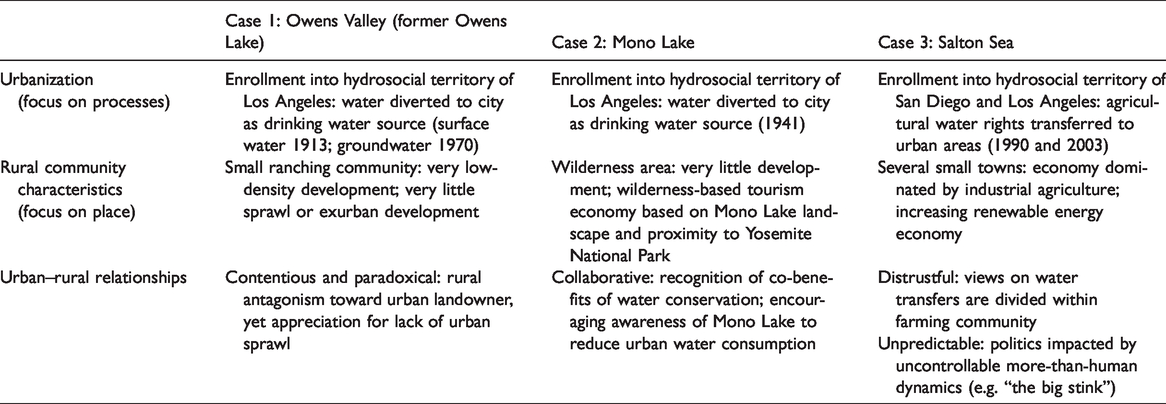
Each of the three cases in this study has been shaped through enrollment into urban hydrosocial territories as a drinking water source. However, at the same time they represent distinctly different places, and different versions of what it means to be “rural” (Table 3). Mono Basin is the least developed, and it is distinguished by its wilderness character and sparse development. Imperial Valley represents a more industrialized rural landscape dominated by agribusiness and, more recently, renewable energy generation. Of the three cases, Owens Valley represents the most paradoxical relationship between urbanization and ruralization. In Owens Valley, local desire for economic development and local control of the valley’s land conflicts with desire to maintain the valley’s rural character and open space, which is itself facilitated by LA’s ownership of land. Returning to the analysis of urbanization and ruralization processes presented in Table 1, Owens Valley can be understood as simultaneously produced by processes of urbanization (enrolled as a source of resources for urban metabolic processes) and also processes of ruralization (through the maintenance of open space and lack of development).
In each case, resistance is also at play: environmentalists, environmental justice advocates, and residents of rural areas have strongly resisted water diversions and transfers. Resistance to water diversions has taken different forms, with varying degrees of success. At Owens Lake, relationships between urban and rural constituents are still tense after over a century of water diversion. At Mono Lake, lawsuits against the city have resulted in restoration of lake levels, while community partnerships between Mono Lake advocates and LA-based water users have built urban appreciation of the hydrosocial hinterlands. The contestation of water transfers and diversions through legal strategies and social movements has shifted power dynamics between urban and rural actors within the hydrosocial territory: urban water managers have been forced to reduce water diversions (at Mono Lake), and pay for cleanup and mitigation of negative consequences (at Owens Lake). In Imperial County, local opinions on the water transfers are mixed, and rallying a cohesive social movement in support of the Salton Sea has proved more difficult; locals are struggling to gain political attention but may inadvertently benefit from events such as the “big stink,” which viscerally emphasize rural–urban connections while underscoring environmental justice dimensions.
Each region faces a range of different futures, as well. Mono Lake’s inflows are more or less guaranteed to remain protected due to the landmark court case and the ongoing work of the Mono Lake Committee. At Owens Lake, agreements between the local air pollution control district and LADWP are expected to mitigate dust problems from the lakebed, and LADWP is currently working on a habitat conservation plan for the lake. However, there remain tensions between local Owens Valley residents and the city over LA’s control of water and land in the region, with some residents and advocacy groups believing the only opportunity for true justice involves the unlikely scenario of LA relinquishing control of Owens Valley resources. The Salton Sea’s future is the most uncertain: while some still hope for a large-scale, large-budget restoration that will bring economic development to the region (Cantor and Knuth, 2018), others simply are hoping for a livable community with breathable air. Together, the cases illustrate the diversity of places that can be produced through urban–rural relationships, as well as the multidirectional processes of urbanization/ruralization through flows of resources such as water.
Conclusions
UPE conceptualizes cities not as bounded spaces but as socio-ecological processes of resource metabolization (Heynen, 2014; Heynen et al., 2006), yet in practice UPE scholarship has focused more on city sites themselves (Angelo and Wachsmuth, 2015). In this paper, I have focused on three very different non-city sites, all of which have been fundamentally shaped in different ways through urbanization as they have been enrolled into a broader urban hydrosocial territory as sources of urban drinking water. In doing so, I demonstrate how UPE can be usefully applied to understand rural sites and rural–urban relationships, illustrating how processes of urbanization and ruralization have produced distinctly different landscapes through relationships of resource flows.
UPE and planetary urbanization have both emphasized the importance of conceptualizing urbanization as a set of processes. Through this lens, urban metabolic processes of extracting resources from broader geographic territories for urban growth and development can be viewed primarily as processes of urbanization, even when they take place in sites that are experienced as rural. Yet both urban and rural geographers have insisted that despite the expansion of such urbanization processes, urban and rural cannot be understood as one and the same, since to do so belies lived experiences. Through this latter lens, urban is defined as a place as well as a process. In this paper, I have examined these dynamics by looking at both (a) rural-as-place, defined by experiential aspects including physical or economic form or lived experience; and (b) urbanization/ruralization processes at work, demonstrating the ways in which non-city places are transformed as they are subsumed into cities as sources of metabolic flows, as well as the ways that non-cities actively transform city spaces through various political and material flows.
To sum, I emphasize three points. First, both interpretations (urban-as-place and urbanization-as-process) are simultaneously possible: that is, on the one hand (as geographers have emphasized) the urban and the rural exist as places that resonate with people’s lived experiences and identities and cannot be conflated into an “urban without an outside”; but on the other hand, processes of urbanization impact places both within and beyond city sites as rural places are enrolled as sites of resource extraction or sinks for waste (McKinnon et al., 2019; Walker, 2007). That is, as Cousins and Newell (2019) put it, we can have both an UPE in the city and an UPE of the city that complement one another. Second, I argue that UPE provides a more useful scholarly framework than planetary urbanization for tackling these tensions and contradictions in an empirical manner. Because UPE retains political ecology’s groundedness in empirics, UPE allows us to analyze a diverse range of on-the-ground urban and rural places to understand the socio-environmental changes, material flows, and processes associated with urbanization/ruralization taking place within those specific places. The huge variation in socio-ecological conditions, power dynamics, and urban–rural relationships described in the three case studies in this paper illustrates the importance of using theoretical and empirical tools that are attentive to place-based difference and nuance. Third, I argue here that the concept of hydrosocial territories provides a way to think beyond the limits of place-bound city/countryside dichotomies by emphasizing how resource flows can shape relationships at multiple scales, including transcending rural–urban divides (Boelens et al., 2016; Hommes and Boelens, 2017; Hommes et al., 2019a, 2019b). An emphasis on territorial dimensions stresses the ways in which multidirectional processes of urban metabolism are “rooted” in specific, actually-existing places (Cantor et al., 2018b; Rocheleau, 2015; Rocheleau and Roth, 2007) in a diversity of forms.
While water serves as an obvious focal point for hydrosocial territories, a myriad of other metabolic flows of resources (including food and energy) could also be analyzed through such a territorial lens, examining their co-constituted urbanization and ruralization processes, as well as the unique and specific urban and rural territories created through these resource flows. This project is currently under way. For example, recent scholarship has used the tools of UPE to examine urban flood hazardscapes as extending beyond the city (Saguin, 2017). Other scholars seek new language to help articulate scalar and territorial relations of resource flows and processes. For example, Gustafson uses the term “megapolitan political ecology” to describe Appalachia’s urban metabolism and the socio-ecological impacts of exurban development at a regional scale (Gustafson, 2015; Gustafson et al., 2014). Meanwhile, Newell and Cousins (2015) propose a “political-industrial ecology” approach that builds upon urban metabolism in order to map networks of resource flows while also taking into account power dynamics (Cousins and Newell, 2015). As these multiple terms illustrate, political ecologists are seeking tools and language to understand the connections and contradictions of resource flows, urbanization processes, and sometimes-blurry territorial boundaries.
Moreover, while this chapter focuses on direct hydrosocial relationships between cities and the surrounding regions providing water to support urban water users’ needs, it is also important to note that water is also indirectly involved in urban metabolic relationships through agriculture. In California, only about 20% of water used by humans is used for urban water supply; the remaining 80% goes to support irrigated agriculture (Mount and Hanak, 2019). Many of California’s agricultural products and produce are exported out of state to feed the entire nation and, indeed, the world. Future research on hydrosocial territories and urbanization should continue to engage with water not only in its form as H2O, but also in the form of “virtual water” used to produce agricultural commodities.
To conclude, political ecology continues to provide a useful empirical and theoretical approach for examining the nuanced dynamics of socio-ecological change in specific places, including dynamics of urbanization outside of the city proper. UPE presents an analytical framework for better understanding socio-ecological dimensions of power and political economy associated with urbanization processes within and beyond city limits. Applying this framework to sites outside of the city, including rural dimensions of hydrosocial territories—or other broader territories linked through urban metabolism processes—demonstrates how dynamic processes of urbanization can produce diverse, specific, and contested places experienced as rural.
Highlights
Urbanization processes are implicated in socio-environmental change beyond city boundaries; UPE is useful for understanding these changes. Rural areas can experience change very differently based on their hydrosocial relationships with urban areas. Urbanization/ruralization are multidirectional processes through which rural areas can also shape cities through flows of politics and resources. The paper explores three rural places shaped in unique ways through enrollment within urban Southern California’s hydrosocial territory.
Footnotes
Acknowledgements
Many thanks to Dianne Rocheleau, Jody Emel, James McCarthy, and Jonathan London for their invaluable contributions throughout this project. Thanks to Nik Heynen for continued helpful editorial assistance. Thanks to all interviewees for their participation in this project. Thanks to the anonymous reviewers who have strengthened this paper through their thoughtful comments. As always, all errors remain my own.
Declaration of conflicting interests
The author(s) declared no potential conflicts of interest with respect to the research, authorship, and/or publication of this article.
Funding
The author(s) disclosed receipt of the following financial support for the research, authorship, and/or publication of this article: Funding for this project was generously provided by the National Science Foundation (DDRI Grant #1433166), Edna Bailey Sussman Foundation, George Perkins Marsh Institute, and Horowitz Foundation for Social Policy.