



Abstract
The United States’ National Environmental Policy Act is a knowledge production process required by federal government agencies to assist in their evaluation of the environmental (and social) impacts of proposed federal agency actions prior to their implementation. The U.S. Department of Homeland Security, which manages immigrant detention in the United States, is included among these federal agencies. Using Texas as a case study, we explore how the National Environmental Policy Act process, as it relates to immigrant detention, systematically produces ignorance while also producing knowledge. We identify four forms of absence: absence of process in Department of Homeland Security’s use of Categorical Exclusions and programmatic Environmental Assessments, absence of actors in the exclusion of people who are detained as an “affected” social group, absence of alternatives in how “meaningful alternatives” are identified in Environmental Assessments, and absence of discourse with the public in the Environmental Assessment process. In addition, we consider how these absences reflect and perpetuate existing social and environmental inequalities.
Keywords
The United States’ National Environmental Policy Act of 1969 (NEPA) requires federal government agencies to evaluate the environmental and social impacts of proposed federal agency actions prior to their implementation. The NEPA process does not require that a federal agency select the least environmentally or socially detrimental decision nor does it require agencies to reduce harmful environmental or social impacts of their decisions. However, it does require agencies to gather information about the environmental and social impacts of their proposed actions. Thus, the NEPA process is largely a means for increasing knowledge for federal agency decision-makers.
As a federal agency, the Department of Homeland Security (DHS) is required to follow the NEPA process, including in its evaluation of proposed agency actions related to its immigrant detention system. These actions often relate to immigrant detention facility building and siting decisions, a topic which has been frequently studied by geographers and environmental sociologists. As immigrant detention has expanded (Gilman and Romero, 2018), a number of individuals, including journalists, community advocates, and civil rights lawyers, have turned their attention to the NEPA process as a way of critiquing both siting decisions, as well as the larger issue of detention. In particular, these individuals have focused on what we are calling “absences” within the NEPA process, including incomplete reviews of information, overlooked alternative options for federal agency actions, and missing groups of people from the NEPA process. As one example, critics have argued that the NEPA process fails to provide any information on the environmental and social impacts of detention to the people who are being detained (e.g. Bernd, 2017). This echoes broader concerns that have been raised about the government’s complete lack of consideration of environmental risks experienced by people in prisons and jails (exceptions including Bradshaw, 2018; Pellow, 2018; Thompson, 2018).
Our study explores how DHS, in conjunction with other agencies such as the U.S. Department of Health and Human Services (HHS) and the Department of Defense, has engaged in the NEPA process in evaluating immigrant detention actions in the state of Texas, the state with the highest number of detention centers and detained immigrants (Ryo and Peacock, 2018). Drawing on social studies of science, this research addresses two questions. First, what forms of absences are systematically embedded in the NEPA knowledge production process as it relates to immigrant detention? Second, how do these absences reflect and perpetuate inequalities in the context of immigrant detention? While this paper does not answer the question of how much environmental risk is experienced by people who are detained, it does draw attention to the ways in which the NEPA process simultaneously produces knowledge and ignorance, which has potential consequences for already vulnerable populations.
Background
Immigrant detention and environmental impacts
Detention is currently used as an “essential” immigrant enforcement strategy (Ryo and Peacock, 2018: 70), though detention has been used in this way for far longer (e.g. Macías-Rojas, 2016). For example, in 1996, President Clinton signed the Illegal Immigration Reform and Immigrant Responsibility Act, which restructured the deportation and detention process, instituting mandatory detention and expedited deportation, both which led to the justification for expanding detention bed space (Macías-Rojas, 2016). Other scholars point to factors contributing to the expanded size of detained populations, including: the “prison-industrial complex,” which includes both public and private structures (Critical Resistance, 2016), “‘tough on crime’ politics, systemic racial injustice, a discourse that dehumanizes immigrants, and citizens-first ideological beliefs,” as well as a “strong law enforcement culture of immigration agencies and their officers” (Gilman and Romero, 2018: 147). Texas is a critical state to consider in the study of immigrant detention, as it leads the nation in detention facilities (115 facilities), as well as detained immigrants (43.6% or 192,771 persons) (Ryo and Peacock, 2018). While the average length of stay for detained adults in 2015 was approximately 38 days, more than 87,000 adults were detained for more than 30 days (Ryo and Peacock, 2018).
In terms of environmental and social risks, studies demonstrate that there are prevalent, varied, and significant impacts of detention and incarceration on human health (e.g. Pellow and Vazin, 2019). For example, one review of the literature on health and immigrant detention found evidence of a clear relationship between “conditions in immigrant detention centers” and “increased anxiety, depression, and overall stress” for those who are detained in the facilities (Martinez et al., 2015: 965). A second review by Pellow and Vazin (2019) found: [T]here are now confirmed reports that dozens of prisons, jails, juvenile detention prisons, and immigrant detention prisons across the nation are located on or in close proximity to toxic superfund sites and other hazardous land uses, are infested with mold and other air contaminants, have significant water contamination, are marked by food injustices, are institutions where inmates and detainees are being forced to take harmful pharmaceuticals, and are spaces where toxic and dangerous work is routine. (3)
Detention also has health impacts on people who are not detained. One study found that undocumented children face mental health concerns, including post-traumatic stress disorder and “anxiety over arrest, incarceration, imprisonment of family members due to immigration status” (Martinez et al., 2015: 965). For undocumented Latino immigrants with U.S.-born citizen children, Rojas-Flores et al. (2017) found that children whose parents were detained or deported experienced higher levels of psychological distress and trauma than their peers without immigration enforcement involvement, which mirrored past research on children of incarcerated parents.
More broadly, studies have shown that immigrant groups face higher and disproportionate levels of exposure to environmental hazards than native born United States citizens (Bakhtiyarava and Nawrotzki, 2017). These findings mirror many other studies of place and environmental inequality, which find disproportionately higher environmental burdens are borne by communities of color and lower income populations (Tripolsky, 2014). Some scholars, like Pulido (2017) and Pulido and De Lara (2018), have described these inequalities, particularly in the form of environmental racism, as the result of racial capitalism and the “devaluation” of nonwhite people, including African Americans, Latinxs, and indigenous peoples. For example, Pulido (2017) argues that “[i]ndustry and manufacturing require sinks – places where pollution can be deposited [which] typically are land, air, or water, but racially devalued bodies also function as ‘sinks’” (529). Pulido (2000) encourages environmental scholars to expand their consideration of siting (and other place-based studies) beyond the idea that siting is a “discrete and conscious act” and to instead think about how “space is essential to the (re)producing of a particular racial formation” (19).
Similarly, in considering prisons, Gilmore (2002) argues that “[p]risons are geographical solutions to social and economic crises, politically organized by a racial state that is itself in crisis” (16). Connecting the idea of expendability to the concept of racialized violence, Márquez (2013) describes: Such expendability is the result of how blackness and latinidad have been produced as either racial (blackness) or ethnoracial (latinidad) signifiers of deficiency and criminality within the assemblage, organization, and governing of bodies that constitute the South as a racial/colonial formation … . The term “foundational blackness” is used to recognize the “normalization of anti-black violence in the region as an essential component of its law enforcement apparatuses and racial/colonial dynamics [which] has been significant both in concrete acts of violence and in the symbolic justification and glorification of such violence to the ways the South’s growing Latino/a population has experienced the racial state of expendability. (32–33)
NEPA
NEPA, which was signed into law in 1970, was originally intended to improve federal agency decision-making through greater consideration of the environmental and social impacts of federal agency actions, and through opening the process up further to the public. The NEPA process is used nation-wide and is federally enforced (Canter and Clark, 1997). NEPA’s (1969) main goals are to: To declare a national policy which will encourage productive and enjoyable harmony between man and his environment; to promote efforts which will prevent or eliminate damage to the environment and biosphere and stimulate the health and welfare of man; to enrich the understanding of the ecological systems and natural resources important to the Nation; and to establish a Council on Environmental Quality.
The NEPA process involves up to three main levels of review: (1) a Categorical Exclusion determination, (2) an Environmental Assessment (EA) and a Finding of No Significant Impact (FONSI), and (3) an Environmental Impact Statement (EIS). A flowchart created by the Council on Environmental Quality (CEQ) (2007) depicting this process is presented in Figure 1.
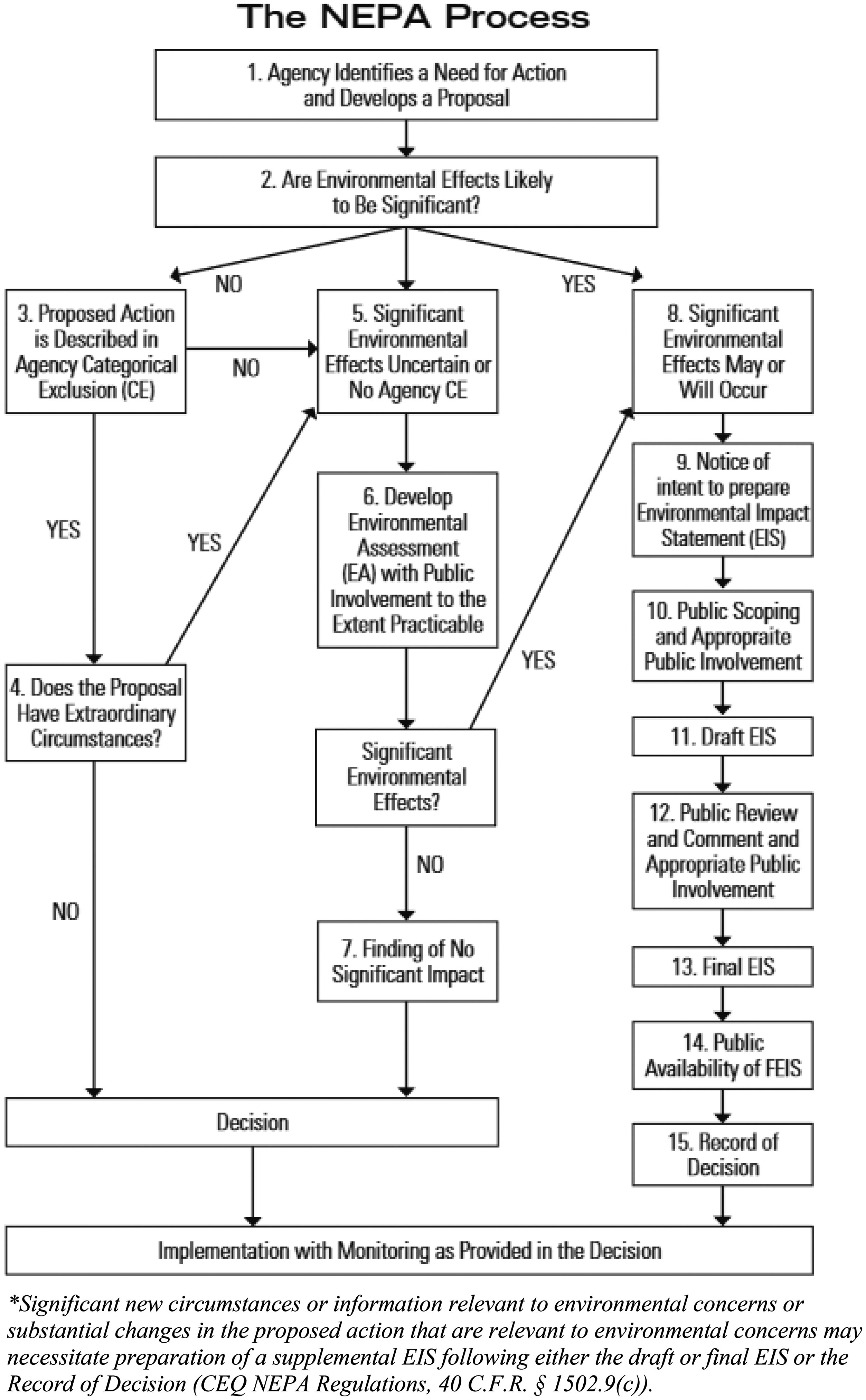
Flowchart of the NEPA Process. Source: Excerpted from the Council on Environmental Quality (2007: 8).
The NEPA process begins with a federal agency (or multiple federal, state, local, or tribal agencies) creating a proposal for action. Following this step, the agency analyzes which path it may need to take depending on whether they determine the potential environmental effects from the proposed action to be significant. If they believe the environmental effects are not likely to be significant, the agency can proceed to determining if the proposed action meets an agency-specific Categorical Exclusion, and assuming the proposal does not have extraordinary circumstances, the agency can move forward with their decision. Categorical Exclusions are categories of actions which agencies have determined do not “individually or cumulatively have a significant effect on the quality of the human environment” (CEQ, 2007: 10). Examples provided by CEQ (2007: 10) include issuing administrative personnel procedures, changing to energy-efficient lighting, and reconstructing hiking trails. Extraordinary circumstances include those such as: a “potentially significant effect on public health or safety,” a “potentially significant effect on species or habitats protected by” various species or habitat protection acts, a “potentially significant effect on historic properties” or those of cultural significance, among others (Department of Homeland Security, 2014e: V6).
However, if the action is determined to not meet one of the Categorical Exclusions or if the agency is uncertain about whether the action would result in significant environmental effects, the agency must then develop an EA. EAs can be either programmatic or site-specific (project-level). Programmatic EAs (PEAs), or in a parallel way, Programmatic EISs (which represent the next level up of review), refer to evaluations of broad proposals, which could include: a wide range of projects, implementation over a long time frame, or implementation over a large geographic area. All EAs conducted by DHS typically consider a number of areas of environmental concern, including: land use; geology, soils, and seismicity (earth resources); water resources; flood plains; wetlands; biological resources (vegetation, birds, wildlife, listed species, critical habitat, and special status species); hazardous materials and waste; utilities and infrastructure; cultural resources and historic properties; air quality; noise; greenhouse gas and climate change; traffic and transportation systems; socioeconomic resources (human health and safety); and social environment and environmental justice (e.g. DHS, 2014c).
If, following the EA, the agency determines that significant environmental effects are not likely, they produce a FONSI document and proceed with their decision. If, however, the agency believes that significant environmental effects may or will occur from the proposed action, it is then required to prepare an EIS, which involves the most significant public participation, as is demonstrated in Figure 1. While an EA “identifies the presence or absence of potential significant impacts after engaging in only a minimal balancing of environmental, social, economic, and other factors,” an EIS is a much more in-depth document that “includes extensive balancing of factors” and “focuses more extensively on alternatives to the action” (Garver, 1986: 197). According to the U.S. Government Accountability Office (GAO) (2014), an estimated 95% of NEPA analyses are Categorical Exclusions, while less than 5% are EAs (the first tier of review that seems to produce documents demonstrating environmental and social assessment), and less than 1% are EISs (the second tier of review that produces the most detailed documents). In other words, only an extremely tiny portion of federal agency actions seem to prompt more than a cursory review of environmental impacts.
Critiques of the NEPA process
The NEPA process is not without critique. On the one hand, some have argued that the NEPA process is overly burdensome and confusing (Bjorkland, 2013) and merely provides a strategic means to “obstruct decisions by federal agencies by slowing down agency decision-making” (Mandelker, 2010: 296). Robisch (2014) describes how the NEPA process has brought about “enough litigation that the American Bar Association published a 400-page ‘NEPA Litigation Guide’” (175). In response to these arguments, congressional statutes have been passed to “streamline” some NEPA procedures (Mandelker, 2010: 296). In contrast, others have critiqued NEPA as “purely procedural” and “lack[ing] substantive bite” (Tripolsky, 2014: 316). Only a few agency actions proceed all the way through development of an EIS, and even then, agencies are rarely required to do post-project monitoring of environmental impacts of agency actions (Bjorkland, 2013).
Some scholars have also critiqued that potential social impacts of a proposed action can only trigger the NEPA process if physical environmental impacts accompany them (Outka, 2006). While little attention in sociology has been devoted to the NEPA process in recent years, in the 1980s, Freudenburg and others devoted several articles to discussing how social scientists could improve their contributions to NEPA assessments (e.g. Freudenburg, 1986; Freudenburg and Keating, 1985). Historically, NEPA considerations of social impacts have focused almost solely on the economic aspects of proposed federal actions, with little input from social scientists, themselves. Freudenburg and Keating (1985) argue that this stems from the difficulty of assessing more abstract social impacts, the predictive focus of assessments, the lack of funding of impact monitoring studies upon which predictions could be made, the lack of disciplinary experience of sociologists in shaping policy, and the federal agency resistance to social science contributions, which tend to critique development and focus on distributive impacts.
Critics have also argued that social impact assessments within the NEPA process have failed to sufficiently protect vulnerable populations, despite President Clinton’s 1994 Executive Order which called for all federal agencies to consider environmental justice issues in their programs, policies, and activities (Tripolsky, 2014). Though some argue that the NEPA process has potential for achieving environmental justice through public participation provisions and the potential delay of harmful actions in vulnerable communities, public participation tends to be very limited if an EIS is not required (Johnson, 1997).
With only a few exceptions (e.g. Bradshaw, 2018; Pellow, 2018; Thompson, 2018), scholars have largely not addressed the exclusion of highly vulnerable populations in NEPA processes, particularly people who are detained in detention centers, jails, and prisons. Though detained and incarcerated individuals are disproportionately people of color and low-income individuals, the Executive Order on environmental justice did not shift the Federal Bureau of Prisons and DHS to include people who are detained and imprisoned as an “affected” social group in the NEPA process (Bradshaw, 2018). People who are imprisoned are also not considered in EAs conducted prior to permitting polluting facilities sited near prisons (Human Rights Defense Center, 2015).
Ignorance/knowledge production in the NEPA process
To better understand how knowledge and ignorance are constructed through the NEPA process, we draw on the field of ignorance studies. Much of the work within the growing field of ignorance studies, sometimes referred to as agnotology, has been focused on shaping the theoretical or conceptual contours of the field (e.g. Croissant, 2014; McGoey, 2012). Less frequent, as Frickel (2014) argues, are empirical considerations of absences or ignorance. Though much attention has been focused on ignorance stemming from manufactured “doubt,” such as the organized denial of climate change (e.g. Dunlap and McCright, 2011; Oreskes and Conway, 2010), in this paper, we turn our attention to ignorance as a regular and possibly unintended “institutional outcome” (Frickel and Edwards, 2014: 215).
Of particular relevance to the investigation of knowledge production practices is empirical work falling under the category of “undone science,” or what Hess (2007) describes as the “empty space” that social-movement leaders and industry reformers often find when looking for “answers to their research questions” (22). As described by Frickel et al. (2010), “undone science” is that which is “left unfunded, incomplete, or generally ignored but that social movements or civil society organizations often identify as worthy of more research” (444). Work on “undone science” often highlights the positional differences between “experts” and “lay” publics in shaping the boundaries of knowledge and ignorance.
Drawing on work by Pred (2007) and Dotson (2011), we recognize the situatedness of the concepts of knowledge and ignorance, where one’s social position and/or epistemic location produces differing understandings of the world. For example, scholars have documented the absence of people of color from environmental organizations, the field of environmental education, and the environmental workforce (Taylor, 2007), which could affect the NEPA process, as those with environmental science backgrounds seem to be actively engaged in preparing and reviewing NEPA analyses. Situated ignorance, in particular, highlights “how a scholar’s position within society – usually reflective of dominant, privileged cultures – can cause researchers to produce knowledge particularly relevant to these standpoints, thereby creating and reinforcing a partial understanding of the world” with little challenge to oppressions (Keenan, 2014: 364). In the context of NEPA, Lutz (2019) describes how detailed [NEPA] documents … suggest to readers that they are being provided with knowledge, that ignorance … can be eliminated by reading them, and that they are meant to be read by the general public rather than being expert and exclusionary discourse. (S116)
Our work also echoes other examinations of the state and its bureaucratic practices as a means for producing violence, both fast and slow forms (e.g. Dillon, 2015; Mathews, 2008; Pulido, 2017). For example, Pulido (2017) argues that environmental justice advocates and scholars have often looked at the state as an “ally or neutral force” (524). However, given the state’s promotion of racial capitalism, she argues that the “state must become a site of opposition, as it sanctions racial violence” (Pulido, 2017: 525). Several authors focused on the everyday activities of the state as a source of violence and ignorance. For example, Mathews (2008), who studied state making in relation to Mexican forestry institutions, argued that the “production of both knowledge and ignorance is a necessary part of the mundane practices of state making” (485). Lutz (2019) pushes this idea further, arguing that bureaucracies, in relation to militarism, produce violence through “innocuous work like ordering supplies or organizing train schedules” (1). To our knowledge, Lutz’s (2019) study of an EIS conducted by the Department of the Navy on military operations on Guam is the only other article in this vein which has investigated the production of knowledge and ignorance specifically related to the NEPA process. As she argues, ignorance produced by everyday activities continues to enable militarized colonialist violence (Lutz, 2019). Lutz (2019) explains: [D]ocuments produced in militarized bureaucratic contexts like this one … are striking for how they navigate between knowledge and ignorance, that is, for how they seek some kinds of information and avoid others, how they use bureaucratic rules to set boundaries on what knowledge they will seek and quietly perform, not knowing what officials at some level in fact know but do not wish to know. (2)
Methods
Data
Data for this project come from an introductory search of documents related to the NEPA process and immigrant detention centers in Texas. These documents included: (1) a document describing the Categorical Exclusions identified by DHS, (2) one PEA, (3) two site-specific EAs related to immigrant detention by DHS, (4) three FONSI documents by DHS, (5) one draft EA and FONSI document related to immigrant detention by the Department of the Air Force, (6) one letter from the University of Texas at Austin (UT) Civil Rights Clinic requesting DHS withdraw their FONSI, and (7) one Freedom of Information Act (FOIA) request for information on Fort Bliss and Goodfellow Air Force Base (AFB) by Earthjustice. Detail on these documents is provided in Table 1. These may not represent all potential EPA-related documents within the state of Texas; however, they represent recent information accessible to the public via online searches without additional FOIA requests. These documents provided the background for our analysis of the research questions.
Description of documents in study.

AFB: Air Force Base; DHS: Department of Homeland Security; FOIA: Freedom of Information Act; FONSI: Finding of No Significant Impact; UT: University of Texas at Austin.
To provide clarification, except for the Goodfellow AFB case, the other documents related to NEPA processes conducted by DHS, which governs immigration apprehension and detention for immigrant adults and children traveling with their parent or legal guardian(s). In contrast, the HHS has custody of and must provide care for unaccompanied immigrant children (which also include children traveling with relatives who are not their parent or legal guardian) (Burnett, 2018). In the case of the Goodfellow AFB case, the EA was prepared for the Department of the Air Force, which would be responsible for providing and clearing land, erecting structures and security fencing, and helping to transport unaccompanied children from one facility to another in a significant weather event or natural disaster, though HHS would operate the proposed temporary facilities.
Analysis
Documentary analysis, or the systematic analysis of written documents, is a key method for qualitatively studying formal organizations and bureaucracies (Bowen, 2009; Hull, 2012). Documents represent “‘social facts’, in that they are produced, shared and used in socially organized ways” (Atkinson and Coffey, 2004: 58) and can provide useful insights into these processes. Though documents play crucial roles in modern bureaucracies, they have sometimes been overlooked by scholars due to their ordinariness (Hull, 2012). In addition, when documents have been analyzed, it is often through a qualitative line-by-line coding of the document, with codes later categorized into themes. While this process can provide critical information, it can sometimes overlook what is absent from these documents.
As others have described, empirically studying what is “not there” can be particularly difficult, particularly when one is interested in what Frickel (2014) calls “absolute absence” or “things that are not there or anywhere else and probably never were” (87–88). Some documentary scholars have also advocated for considering explicit and implicit information. For example, Atkinson and Coffey (2004) note that researchers should consider documents in terms of their “authorship (actual or implied) and readership (actual or implied)” (70). In this study, we were guided by one of Frickel’s (2014) methodological suggestions, which is to “specify the type or form of absence under investigation” or, in other words, “what is absent? Actors? Knowledge? Discourse? Infrastructure? Technique? Labor? All or some of these?” (89).
Our analysis of these documents was primarily focused on identifying how ignorance was constructed through the NEPA knowledge production process, similar to several other researchers who have also studied ignorance by examining documents (e.g. Frickel and Edwards, 2014; Elliott, 2012; Lutz, 2019). To do so, the first author initially read through all of the documents, taking notes on potential absences. Following this process, all three authors met together to discuss these ideas, to brainstorm additional absences, and to find examples that would illuminate each absence. Before writing this paper, the authors revisited the documents a second time to search for additional absences. Similar to traditional qualitative documentary analysis, we categorized these absences into themes and selected examples to demonstrate our arguments. It is these themes which are reported in this paper.
This analysis resulted in the identification of multiple “themes” of absences within the NEPA process. We were particularly guided by absences identified by journalists, immigrant rights advocates, civil rights lawyers, and other critics. While this process did not produce an exhaustive list of absences, which would be extremely difficult to develop, it did allow us to identify a broad range of absences systematically embedded in the NEPA process.
Results
Our investigation of NEPA documents related to immigrant detention in Texas identified four major forms of absences: (1) absence of process in the DHS’s use of Categorical Exclusions and PEAs, (2) absence of actors in the exclusion of people who are detained as an “affected” social group, (3) absence of alternatives in how “meaningful alternatives” are identified in EAs, and (4) absence of discourse with the public in the EA process. In the following sections, we provide examples to illustrate these four forms of absences.
Absence of process
One way in which DHS produced an absence of process was through its use of Categorical Exclusions, which allow agencies to forgo the development of EAs, and PEAs, which allow agencies to forgo site-specific evaluations (e.g. of a particular proposed detention center) by relying upon broader program-oriented evaluations.
First, in terms of Categorical Exclusions, courts typically give “substantial deference” to agencies’ use of Categorical Exclusions (Outka, 2006: 616). Though DHS does not provide specific information on how often it has used Categorical Exclusions and in what contexts, based on the GAO (2014) estimates, it is likely that most of DHS’s engagement with the NEPA process occurs in the context of Categorical Exclusions. In a 215-page document, the 2006 DHS Administrative Record: (1) outlined 48 potential Categorical Exclusions, (2) described comments provided by the public and other environmental professionals, and (3) discussed how these comments were evaluated by a panel of DHS legal and environmental professionals representing 24 DHS components and two independent contractors (Document 1). While many of these may not pertain to immigrant detention facilities, one exclusion in particular seemed relevant: E2* New construction upon or improvement of land where all of the following conditions are met: (a) The structure and proposed use are compatible with applicable Federal, tribal, state, and local planning and zoning standards and consistent with federally approved state coastal management programs, (b) The site is in a developed area and/or a previously disturbed site, (c) The proposed use will not substantially increase the number of motor vehicles at the facility or in the area, (d) The site and scale of construction or improvement are consistent with those of existing, adjacent, or nearby buildings, and, (e) The construction or improvement will not result in uses that exceed existing support infrastructure capacities (roads, sewer, water, parking, etc.). (DHS, 2006: 130) Section 3.2 in Appendix A of the directive contains a list of conditions and extraordinary circumstances that must be satisfied in the application of this categorical exclusion to a specific program or agency within the Department. These conditions and extraordinary circumstances were developed in recognition that, while the vast majority of the Department activities in this category do not have potential for significant impacts to the environment, activity proponents within the Department need to be alert for rare and unique conditions that may require more extensive evaluation of the potential for environmental impacts under NEPA. (132)
Second, PEAs evaluate broader proposals or policies that potentially could cover a range of individual, site-specific projects. Under the CEQ (2014: 76987) guidelines, each federal agency has discretion for determining for which contexts it is “appropriate to prepare programmatic NEPA documentation” and how long these documents might last (in terms of their lifespan). According to Bernd (2017), DHS conducted a programmatic assessment for “activities regarding detaining and processing unaccompanied children and families in 2014,” but there has not been a PEA for the larger immigration enforcement program since 2001. In addition, the ICE spokesperson did not clarify for Bernd (2017) any information regarding the use of programmatic assessments.
The 2014 DHS PEA (Document 2) specified that while it considers common activities, when necessary, separate analysis will be conducted on a location-specific basis to determine if the [site-specific] proposals 1) are covered by a DHS CATEX [Categorical Exclusion], 2) meet the criteria listed in Table 1 and are covered by this PEA, 3) require a Supplemental EA tiered from this document, 4) or require development of alternative arrangements … for activities that would normally require preparation of an EIS. (2014a: 11)
Absence of actors
The NEPA process also produced an absence of actors through the systematic exclusion of people who are detained from most NEPA assessment documents. Though our focus is on immigrant detention, this mirrors the exclusion of people who are imprisoned within EAs conducted by the Bureau of Prisons. In all three site-specific EAs we examined (Documents 4 and 7 conducted by DHS and Document 9 conducted by the Department of the Air Force), social impacts were discussed by describing the “affected” social group in the “Region of Interest.” Social considerations were based almost entirely on the residential population that would potentially be living near the proposed detention facility. Census-based estimates were typically provided at the city and county levels comparing characteristics such as proportions of different racial and ethnic groups, ages, education levels, and income levels of residents living within the different proposed sites (e.g. comparing Houston versus Conroe in Document 7). Brief data were often also provided about the different types of housing (e.g. owner occupied versus renter occupied) in the region and how the proposed actions might impact employment, population size, and public and emergency services.
While these sections produced a large amount of data about residents of the proposed site regions, they mostly focused on larger levels of aggregation, particularly the city or county. Past environmental inequality research has found that the “choice of analytical unit” for representing an impacted population has been the topic of much debate (Chakraborty et al., 2011: S28), and that the use of aggregated data can lead researchers to “make simplistic assumptions about the residential population distribution” (Chakraborty et al., 2011: S33). Though this process reflected an effort to provide information, its selection of geographic scale leaves much unknown about the potential environmental and social impacts of the proposed action to nearby residents.
In addition, DHS’s EAs (Documents 4 and 7) never discussed any potential environmental or social risks faced by the people who are detained, themselves, demonstrating a fundamental erasure of a voluminous literature on the health harms of detention and incarceration. Only within the Air Force’s draft EA for the proposal to temporarily house unaccompanied children at the Goodfellow AFB (Document 9) did any agency recognize any potential risks borne by the people who are detained. The Department of the Air Force (2018) articulated that the children relocated would all be under age 18 and “inherently more vulnerable to environmental health and safety risks” (4–15).
However, without providing any evidence, the Department of the Air Force (2018) concluded that “no exposure to environmental health or safety risks would occur” for these children and that the proposed action of temporarily housing them “may result in a beneficial impact to the 7,500 unaccompanied children” (4–15). To justify this, they cited the “No Action Alternative” within the 2014 DHS PEA, which stated that not providing additional facilities would mean that unaccompanied children “could be detained in custody by DHS for unacceptable lengths of time in overcrowded and potentially unsafe and unhealthy conditions” (Department of the Air Force, 2018: 4–16). Within the 2014 DHS PEA, these two statements also provided the only discussion of impacts to people who are detained: (1) that not providing more detention facilities would be detrimental for immigrants, and (2) that adding facilities would have a beneficial effect for adults and children who are detained. These findings demonstrate that, except in cases of overcrowding, the federal government treats detention facilities as having no potential for environmental or social harms for those individuals detained within them. In both the Air Force EA and DHS’s PEA, document authors concluded that the proposed actions would have no significant adverse impacts.
In contrast, Earthjustice submitted a FOIA request in August of 2018 (Document 10) for information regarding toxic waste sites at Fort Bliss AFB and Goodfellow AFB, in response to the Trump Administration’s plan to house immigrant children and families at these Texas AFBs. This request argued that the environmental conditions of the waste sites at these AFBs have the “potential to cause human exposure to toxic chemicals via air, water and soil to migrants housed in tent encampments and to workers constructing the detention camps” (Earthjustice, 2018: 1). This request was submitted on behalf of multiple organizations including: Alianza Nacional de Campesinas, GreenLatinos, Hispanic Federation, the Labor Council for Latin American Advancement, the National Hispanic Medical Association, and Southwest Environmental Center. Similar concerns were also expressed by immigrant rights advocates about potential environmental risks faced by people who are detained at the new immigrant detention center in Conroe (reviewed in Document 7), resulting from potential accidents due to nearby industrial hydraulic fracturing operations (Bernd, 2017).
More broadly, investigative journalists have identified “widespread” examples of environmental law violations in prisons, jails, and detention centers across the United States (Bradshaw, 2018: 412). For example, Bernd et al. (2017) found that the EPA brought “1,149 informal actions and 78 formal actions against regulated prisons, jails, and detention centers during the past 5 years under the Safe Drinking Water Act.” Bradshaw (2018) argues that this vastly underrepresents the problem since only a tiny proportion of correctional facilities were part of the EPA’s enforcement and compliance database.
Little research has identified why people who are detained are systematically excluded from the NEPA EA process. One potential insight comes from a letter from the Human Rights Defense Center (2015), which discussed an interview between the EPA and the Prison Ecology Project in which the EPA representative stated that “environmental justice guidelines have not been applied to prisoners because the EPA uses census data which does not take prisoners into account.” However, work by Pulido (2017) and Márquez (2013) suggests that this systematic exclusion of people who are detained may also relate to the “racial state of expendability” (Márquez, 2013: 33), where the state is “deeply invested in not solving the environmental racism gap” (Pulido, 2017: 529). Thus, despite producing pages of knowledge on “social” impacts, the absence of actors, specifically people who are detained, from the NEPA process produces ignorance in terms of the potential environmental and social impacts these individuals face as a result of detention.
Absence of alternatives
The third form of absence in the NEPA process, in the context of immigrant detention, was the absence of alternatives, which relates to how DHS defined its “purpose of and need for” proposed actions and identified “alternatives.” Though EAs and EISs are required to evaluate “meaningful alternatives” to federal agency actions, much debate has ensued over what constitutes a sufficient discussion of alternatives (Mandelker, 2010). NEPA regulations require that the agency, itself, determine the underlying “purpose and need” requirement for which “alternatives” are developed. This process, according to Mandelker (2010) “determines the universe of alternatives,” or in other words, “[a]gencies can frame their purpose and need statements in a way that either broadens or narrows their alternatives analysis” (305).
Though each of the EAs include a discussion of “purpose and need” along with proposed alternatives, the clearest difference in how DHS defined “alternatives” compared to outside organizations’ definition of “alternatives” comes from the documents related to the proposed action to construct, operate, and maintain a South Texas Family Residential Center near Dilley, Texas (Documents 4–6). A Supplemental Environmental Assessment or SEA (Document 4) was conducted for this action, which supplemented the already discussed 2014 DHS PEA (Document 2) and the corresponding 2014 DHS FONSI (Document 3 or DHS 2014b). The SEA adopted the “description of the purpose and need set out in the PEA, as applicable,” which is to “house family units pending the disposition of their immigration proceedings” (DHS, 2014c: 2).
In terms of the Proposed Action and Alternatives, the document proposed an action of constructing, operating, and maintaining a facility to house family units near Dilley, Texas. DHS also considered three alternative sites: Port Isabel Detention Center, Carrizo Springs, and Dilley. Based on their evaluation criteria of being “located on or near a major highway, not farther than a one and one-half hours’ drive from a major metropolitan center, and within one and one-half hours’ drive from the Southwest Border in the Rio Grande Valley,” it eliminated one of the three proposed alternatives at the beginning of the document (DHS, 2014c: 3). It also eliminated the Port Isabel location at the beginning of the document because of its lack of space for expansion, lack of existing infrastructure, and potential impacts on protected species.
In this same document, DHS (2014c) also described a No Action Alternative, which is required in all assessments, in which no family detention center would be constructed. However, since they defined their “need” as providing “housing” for family units, based on the Presidential Memorandum and DHS leadership guidance, they argued that “taking no action is not a viable alternative” (DHS, 2014c: 3). Though they carried out analysis of the No Action Alternative in the document, the EA served little purpose since they eliminated two alternatives before beginning the EA and declared the No Action Alternative “not viable” at the start of the EA (DHS, 2014c: 3). In August 2014, this EA resulted in a FONSI (Document 5) (DHS, 2014d).
Two months later, the UT Civil Rights Clinic penned a letter requesting DHS withdraw its FONSI and prepare an EIS that more thoroughly review the environmental and social impacts of a proposed family detention center near Dilley (Document 6). In addition to identifying multiple deficiencies in how the 2014 SEA reviewed environmental and social impacts, the UT Civil Rights Clinic letter argued that DHS “failed to consider meaningful alternatives … as required by law.” In addition to not reviewing the potential environmental impacts of the proposed alternatives (two of which were withdrawn immediately), the letter argued that DHS narrowly interpreted President Obama’s recommendation to provide shelter for children seeking asylum through only considering a “2400-bed detention facility” (UT Civil Rights Clinic, 2014: 16). They argued that “agencies may not arbitrarily ignore entire categories of potential alternatives” and that DHS did so by “fail[ing] to consider any alternative to family detention, even though alternatives to detention are proven to effectively ensure appearances at immigration proceedings” (UT Civil Rights Clinic, 2014: 17). Though DHS provided the appearance of a discussion of alternatives; substantively, they constructed ignorance by choosing to not draw upon literatures demonstrating potentially more effective alternatives to detention, thus providing no meaningful consideration of alternatives.
Absence of discourse
The fourth form of absence relates to the absence of discourse with the public brought about by the NEPA process. Scholars often recognize the dual contributions of the NEPA process to be its impact on including environmental issues in federal decision-making and its opening up of the process to “public dialogue and scrutiny” (Outka, 2006: 605). In part, the NEPA process is intended to increase knowledge through greater inclusion of the public’s perspectives on proposed actions. One author even suggested that the public should use their access to NEPA documents (during public comment periods) to determine if “the government has failed to recognize the significance of certain facts in its review” (Johnson, 1997: 577). By evaluating these NEPA-related documents, we assessed the ability of this process to generate discourse with the public regarding agency actions related to immigrant detention.
NEPA processes seem to differ in their involvement of the public depending on whether they entail a Categorical Exclusion, an EA, or an EIS. Scholars argue that “fixed opportunities for public involvement become available only if an EA reveals a potentially significant impact on the environment and the agency proceeds to scope and draft an EIS” (Outka, 2006: 609). For EIS documents, agencies are required to solicit comments from a number of groups after preparing a draft EIS, including appropriate state and local agencies, potentially affected Indian tribes, any agency requesting statements on proposed actions, applicants, and the public, including persons or organizations who may be interested or affected (U.S. Code of Federal Regulations Title 40 §1503.1). Scholars have discussed how the “structure and timing of its public participation provisions” tends to position the agency as in defense of its plan rather than open to engaging in participatory decision-making (Outka, 2006: 610).
In our study, we found no evidence of public participation or even public availability of DHS’s use of Categorical Exclusions. However, there was brief discussion of “public involvement” in the EAs. For example, “public involvement” for the EA for the Houston-area detention center (Document 7) involved DHS (2016a) making hard copies of the draft EA “available to the public for review for a period of 30 days at the Central Houston Public Library, Jesse H. Jones Building and the Conroe (Montgomery County) Public Library” (12). Notices were also provided in three local newspapers (Montgomery County News, the Houston Chronicle, and the Spanish-language newspaper, Semana News). According to the FONSI for this EA (Document 8), no public comments were received (DHS, 2016b). However, in June and July of 2017, protesters gathered outside the Montgomery County Commissioners Court to protest the plans for this immigrant detention facility (Asgarian, 2017). Residents said that “they did not get a chance to weight in before the new detention center was approved” (Carson, 2017). The news of the contract being awarded for the immigrant detention center in Conroe even “was a surprise” to Conroe’s mayor and other city officials “who had no idea the new detention facility was even in the works” (Jordan, 2017).
The statement of public involvement included in the 2014 DHS SEA (Document 4) was almost identical to the Houston-area EA, though without the time frame. According to the 2014 DHS SEA, a hard copy was to be made available at the Dilley Public Library, publicized through the Frio-Nueces Current, San Antonio Express-News, and Rumbo de San Antonio newspapers. The FONSI for this proposal (Document 5) did not include any information on whether public comments were received. However, according to the UT Civil Rights Clinic (2014) letter, DHS published notice of the 2014 PEA (Document 2) on 14 August 2014, along with their FONSI (Document 3). According to the letter, just eight days after publishing the programmatic EA, DHS started contacting the necessary authorities about constructing the Dilley facility, without sharing drafts of the supplemental EA with the public. Five days after … on August 27, 2014, DHS posted the final supplemental EA and a finding of no significant impact on its website. (Documents 4 and 5) (UT Civil Rights Clinic, 2014: 18)
Conclusion
The NEPA process has yet to be considered as an example of “undone science.” However, investigative journalists, community organizations, and civil rights lawyers have recently raised concerns about what types of knowledge are systematically left out of the NEPA process, particularly as it relates to constructing and siting immigrant detention centers. Advocates have drawn attention to the gaps in scholarly and bureaucratic assessment of the social and environmental risks related to this process and have called for improvements in the NEPA process in order to address environmental injustices. Responding to Pulido’s (2000) call to consider environmental racism without malicious intent, we identified how absences are institutionally produced as a normal part of the knowledge-producing NEPA process, which further disadvantages already vulnerable populations through failing to fully consider the environmental and social risks produced through the development, siting, and operation of additional immigrant detention facilities. We identified four main forms of absence: absence of process in the use of Categorical Exclusions and PEAs by DHS, absence of actors in the exclusion of people who are detained as an “affected” social group, absence of alternatives in how “meaningful alternatives” are identified, and absence of discourse with the public in the EA process.
Though some scholars have identified potential opportunities in the NEPA process to address environmental injustices, particularly through its public participation provisions, our study draws attention to multiple ways in which a hierarchical, rather than a democratic discourse dominates, which tends to maintain the historical distinction between “experts” (e.g. scientifically trained government employees, hired consultants, and technical writers and editors) and the public (Killingsworth and Palmer, 1991). As Killingsworth and Palmer (1991) describe in their discussion of government documents, particularly the EIS, under the NEPA process: Documents motivated by instrumental rationality have as their sole purpose the control of the document’s readers. These writings may take on the appearance of traditional scientific papers … but instrumental documents … attempt to create, for the purpose of maintaining the system, a narrow path of action that has been chosen or created in advance of the document’s production by hierarchically arranged powers. And though they may draw upon the conventions of a democratic discourse that is open to information from diverse sources, the aim of instrumental documents is never to treat deviant discourses with respect but always merely to take note of them, to record them, and ultimately to treat them as ‘noise’ in the system, which needs to be ignored or expunged. (166)
Using only documentary analysis, we are limited by our selection and interpretation of documents, which may present an incomplete picture of the NEPA process due to the difficulty in retrieving all potential documents related to the process (e.g. documents describing DHS’s use of Categorical Exclusions are absent from our analysis). Outside of these documents, we also have little information about how different actors, including the public, agency employees, etc., have shaped the NEPA process in the context of immigrant detention. Nonetheless, bureaucratic records are critical sites for understanding “bureaucratic rules, ideologies, knowledge, practices, subjectivities, objects, outcomes, and even the organizations themselves” (Hull, 2012: 253). Since the NEPA process has been identified as one of the ways federal agencies are supposed to identify and address environmental and social problems prior to making decisions, this study makes an important contribution by identifying some of the fundamental flaws of this process regarding immigrant detention.
Highlights
The NEPA process represents decisions about what knowledge matters, from whom information is obtained, and what counts as enough information. Absences of knowledge in the NEPA process reflect and perpetuate social and environmental inequalities. We identified four types of systematic absences: absences of process, actors, alternatives, and discourse.
Footnotes
Acknowledgement
The authors thank Dr Nathan Pino for providing comments on this manuscript prior to submission.
Declaration of conflicting interests
The author(s) declared no potential conflicts of interest with respect to the research, authorship, and/or publication of this article.
Funding
The author(s) received no financial support for the research, authorship, and/or publication of this article.