



Abstract
In this paper, we examine small hydropower trends in Chile through institutional and ethnographic research and we reflect on what lessons this case provides for scholarship on the water–energy nexus. Contrary to the tendency in water–energy nexus scholarship to advocate for further integration of water and energy management, this paper explains an approach to investigation that answers recent calls to politicize the nexus by examining inequity and inefficiency. Methodologically, we trace institutional surprises in water–energy nexus interactions. Internationally, small hydropower growth is part of a boom in renewable energy, yet in Chile the reality is more complicated. We examine the paradoxical trend of hundreds of stalled small hydropower projects that remain incomplete throughout central to southern Chile. These stalled projects indicate unexpected behavior in how water, energy, and environmental institutions interact, in Mapuche Indigenous territory specifically where projects are highly conflictive. A fantastical materialism is also visible. Government and private sector ambitions of organized, massive, and lucrative small hydropower development are resulting in unruly material realities, yet over time capital finds an unforeseen way to produce value. In this case, water rights are being sold with approved environmental impact studies on the water market. Overall, our findings challenge the assumptions that commodifying water can be done equitably and efficiently for all parties involved, in particular for the Mapuche people. Findings also question hydropower’s future viability as a sustainable renewable energy endeavor in a market-driven system.
Introduction
In 2014, small hydroelectric power (hereafter, small hydro) was largely recognized in Chile’s capital city of Santiago to be a success. In the private board rooms in the wealthier Las Condes district of the capital city or in more modest government offices in the city’s downtown region, small hydro was often described to be a sustainable energy source financed successfully via markets. Similarly, newspaper reports announced Chile’s effective market-based transition to renewable energy as one to repeat internationally (Londoño, 2017; Morales, 2019). Official records also backed these claims. In 2007, an uptick began in operating small hydropower projects—defined in Chile as generating 20 megawatts or less. 1 Since 2007, 94 hydropower generators of less than 20 megawatts came online. 2 Yet these narratives only partially represent a far more chaotic reality of small hydropower’s development in central to southern Chile, a reality we suggest questions the equitability and efficiency of a market-based approach to water and energy governance.
Indeed, our research conducted from 2016 to 2017 confirmed another phenomenon characterizing small hydro’s development: a growing number of stalled small hydro projects. We suggest that stalled hydropower projects are symptomatic of inequalities and inefficiencies in the interacting institutions of water, energy, and the environment. We define institutions as how the written law and policies for resource management operate in practice as diverse actors engage these rules (Bauer, 2004; Ostrom, 2008). As social scientists we traced the analytical surprises in how institutions manifest in territories over 1000 kilometers south from the capital Santiago where the policies and laws are created (Figure 1). 3 These surprises manifest as outcomes that do not lead to finished generating projects, but instead result in other economic interactions, conflicts, and unjust conditions for local actors.

Map of case study.3
On the other hand, stalled hydropower projects also exhibit what Wilson and Bayón (2017) term a fantastical materialism of economic infrastructure projects. Fantastical materialism refers to the seductive technological dreams connected to economic infrastructure projects that result in unforeseen and often uncanny material outcomes. Yet, amidst the ruins, capital finds new ways to produce value (Wilson and Bayón, 2017). Empirically we found this to be the case for small hydropower. When the government of President Michelle Bachelet declared a plan of building 100 small hydropower projects during her tenure (2014–2018), small hydro became part of a hubristic state energy policy. Although we could not access an official figure on stalled projects, we triangulated findings across sectors confirming a large amount of small hydro projects stalled mid-process of development. While many projects stalled during this period of growth, capital found a new way to create value through the water market. Project developers of small hydropower began to sell water rights with sectoral permissions and approved environmental impact assessments. 4 These “paper projects” are worth more since it is difficult to gain institutional and social approvals.
Methodologically and theoretically, our paper questions the tendency in water–energy nexus literature to emphasize the integration of these systems. By combining institutional research with ethnographic inquiry, our approach identified unforeseen problems in Chile’s market-based approach to water and energy governance. We suggest that analytically tracing institutional surprises with an ethnographic sensibility toward conflicts provides a viable approach to address complexity in governance of the water–energy nexus. This approach contributes to recent calls to politicize the water–energy nexus (Williams et al., 2014, 2019) by providing a nuanced analysis of how systems of natural resource governance interact in practice and by assessing the implications for equitability and efficiency.
We structure this article in the following way. First, we explain the research methodology we brought to examine the institutions and everyday negotiations of stalled small hydropower. Then we outline the theoretical framework for studying the institutional surprises of the water–energy nexus. Next, we provide institutional background on the Chilean context for resource management. In the subsequent empirical sections, we address the unforeseen outcomes of water, electricity, and environmental institutional interactions, resulting in stalled small hydropower. In the discussion, we reflect on the inequities and inefficiencies in the water–energy nexus for small hydropower. We conclude by reviewing the political and theoretical implications of these findings.
Methodology
Data presented in this paper come from two connected research projects. The first author conducted 22 months of ethnographic and institutional research primarily focused in southern Chile’s Ríos region, with recurring visits to the capital city of Santiago. Her approach involved tracing how small hydropower developed across government agencies and Mapuche-Williche Indigenous territory. The overarching methodological approach involved collaborative research and participatory mapmaking with Mapuche-Williche leaders, results published elsewhere (Kelly, 2018, 2019). The second author collaborated as a research assistant and conducted a related quantitative study of water market activity in the Ríos region (Valdés-Negroni, 2017). Of a total 87 semi-structured interviews conducted for the first author’s study, we draw from a subsection we conducted jointly with government employees, bank officials, private companies building hydropower, energy transmission company employees, and consultants conducting baseline studies (n = 22). We came to this study as water scholars with an interest in the water–energy nexus.
Ethnographic inquiry spanned multiple sites as it followed the process of small hydro development, with research focused in southern Chile’s Ríos region. Carse (2012) emphasizes how infrastructure is a site for ethnographic study of everyday negotiation, struggle, and meaning. The strength of our ethnography here is locating and contextualizing how infrastructural development is lived and viewed by multiple actors, demonstrating how nexus institutions work in watersheds and markets. Specifically, we draw from insight gathered during participant observation of the small hydro development process spanning Ministry of Energy public consultations, small hydro industry meetings, and consultation meetings held with Mapuche people for hydropower projects.
Through our qualitative and cross-sectoral study, stalled hydropower projects became a main research finding. We could not determine an exact number of stalled projects but multiple actors in government and private sector confirmed a growing number of stalled projects, a trend we observed throughout central to southern Chile. Through collaborative research we analyzed maps of the Ríos and Lagos regions indicating hundreds of non-consumptive water rights, the majority of which list hydroelectric power as the intended water use (Figure 6). Tracing the institutional surprises involving small hydro provided a useful approach to track water–energy nexus politics across scales and sites. Next we explain the theoretical framework guiding this paper, informed by our empirical research on the water–energy nexus.
Hydropower’s water–energy nexus in the transition to renewable energy
Institutional surprises in the water–energy nexus
In this paper we bring a water–energy nexus lens to understand the intertwined expectations and realities of hydropower infrastructure development in Chile, which is highly conflictive across the country. In a market-based system, hydropower is an infrastructure for economic development and a physical integration of water and energy management and law (Bauer, 2009). Infrastructure refers to not only the pipes and turbines, but a system that involves ways of framing knowledge and desires (Larkin, 2013). Infrastructural projects involve ideological fantasies of different actors, from government officials to entrepreneurs and local affected populations (Wilson and Bayón, 2017: 848). In other words, the myths that propel hydropower are rooted in the interconnected systems of water and energy management. Here we suggest that important fantastical narratives in this nexus are that water can be fully commodified and that a market-based renewable energy transition can be sustainable and low impact.
Internationally, the water–energy nexus is a growing area of research and an international policy approach (Allouche et al., 2015). The water–energy nexus highlights water and energy’s interdependence; water is needed for most forms of electricity generation, and electricity is required for water transportation and treatment (Rio Carrillo and Frei, 2009; Scott et al., 2011; Siddiqi and Anadon, 2011). A resounding conclusion of water–energy nexus scholarship is to further integrate water and energy management to increase cross-system sustainability (Carvalho et al., 2019; Hightower and Pierce, 2008; Howells and Rogner, 2014; Scott et al., 2015, 2011; Williams et al., 2014).
While a significant portion of the literature on the water–energy nexus is quantitative, such as modeling and life cycle analysis (Dai et al., 2018; Hamiche et al., 2016), some scholars cite the need for further studies on how to govern the nexus (Dai et al., 2018; Lele et al., 2013; Middleton et al., 2015; Scott et al., 2011). For example, Scott et al. (2011) suggest moving beyond linkages between water and electricity; they argue for an inclusion of institutional and policy dimensions of water and electricity in their management and design. They emphasize the institutional hierarchies of the water–energy nexus, where regional to global scale water and energy needs create adverse local impacts (Scott et al., 2011).
Broadly, critiques suggest that the nexus literature is often overly technical, arguing the cannon requires more critical scholarship to examine how water and energy systems interact over space and time in ways that engineers and bureaucrats do not anticipate (Williams et al., 2014, 2019). The interaction of water and energy governance can often produce inequities that are overlooked (Middleton et al., 2015; Williams et al., 2014, 2019). A growing group of scholars call for more attention to be paid to the winners and losers and the political dimensions of scalar dynamics in nexus governance (Lele et al., 2013; Middleton et al., 2015; Norman et al., 2012; Williams et al., 2014, 2019). The literature’s dominant conclusion that further integrating water and energy management necessarily leads to more sustainable systems is often unfounded (Williams et al., 2014, 2019).
In this article we suggest that nexus scholarship can be more attuned to politics by tracing the unexpected institutional outcomes of water–energy interactions. Institutions matter because electricity and water law, among other legal frameworks, interact to shape how people use resources like water, as well as develop and oppose projects like hydropower. Institutional rules structure how economic activity like markets work in practice (Bromley, 1989). While there are written rules such as laws for institutions, those involved in using resources can also create their own norms as the systems for using resources grow more complex over time (Ostrom, 2008). Consequently, social conflict also expresses areas where institutions are not functioning well for local territories. Beyond institutions, we also draw from literature on the commodification of water, which we describe next, to contextualize empirical findings on water’s management.
Commodifying water
Across diverse efforts to commodify new aspects of nature (McCarthy and Prudham, 2004), the materiality of nature frustrates efforts to regulate its commodification (Bakker and Bridge, 2006). Efforts to commodify water are no exception. Karen Bakker (2005) incisively observes that due to water’s specific biophysical properties such as weight, flow, and possibilities for contamination, it is particularly “uncooperative” when treated as a commodity. Bakker reminds us that a resource can be privatized (shifted in management from the public to the private sector) and commercialized (institutionally governed according to market principles such as efficiency and cost–benefit analysis) without being fully commodified (ibid).
In their discussions of the commodification of nature, Castree (2003, 2008) and Robertson (2000) discuss the process of abstraction, which refers to how the specific qualities of an individual thing are incorporated into a homogeneous group or category as commodities to help capitalism to function. For example, in the United States, Robertson (2006) examines the commodification of wetlands. He draws our attention to how botanical methods become ad hoc as they are adopted to identify and measure interchangeable wetlands in a market system. During translation for markets and laws, natural scientific logic becomes incoherent, suggesting there may be limits to how commodities are created when different techniques of abstraction are used beyond weight or volume (Robertson, 2004, 2006).
In the case of global commodification of carbon, defining and measuring carbon commodities extends across farther distances through technical calculations and international policy design, also making carbon an uncooperative commodity (Bumpus, 2011; Bumpus and Liverman, 2008; Lovell and Liverman, 2010). Examining carbon offset cases in Costa Rica, Bumpus (2011) surveys a hydroelectric project amenable to commodifying carbon. Since the river generating hydroelectricity was polluted, competing uses did not exist for the water that could make carbon’s commodification more contentious. These cases involving water’s abstraction demonstrate on one hand the complexity of doing so for a market. On the other hand, the uncertainty of making a commodity from a process involving water can lead to diverse material outcomes at the local scale. In the next section, we turn to how spatial transformations for renewable energy also chart hydropower’s water–energy nexus.
Spatial politics in the transition to renewable energy
The narrative of transitioning from a carbon intensive to a low-carbon energy system overlooks changes in energy systems that are often geographically more fragmented and include diverse energy regimes (Bulkeley et al., 2014). Despite global calls for transitions to renewable energy, historical energy transitions reveal that changing energy systems is a complex, path dependent, and cumulative process (Sovacool, 2016). Nonetheless, developing renewable energy involves a profoundly spatial transformation (Curley, 2018). While resources used to generate renewable energy are presumed more plentiful, the introduction of renewable energy generation, transmission, and distribution principally affects land use (Bridge et al., 2013; Calvert, 2016; Kelly-Richards et al., 2017; McCarthy, 2015). Due to renewable energy’s land use and water demands, legal changes for renewable energy affect the priorities and institutional negotiations of the water–energy nexus, particularly when hydroelectric power is involved.
In Chile, and across the Americas, renewable energy growth involves expansion and change to electricity system operation and transmission (Bakke, 2016; De Sá Ferreira et al., 2016; Molina and Rudnick, 2014; Nasirov et al., 2016; Rudnick and Barroso, 2016). As renewable energy growth provides a global socio-ecological fix for capitalism, change is concentrated in rural spaces (McCarthy, 2015). In northern Chile, Furnaro (2019) suggests that building a utility scale renewable energy sector provides a socio-ecological fix for the energy demands of Chile's copper mining industry. Thus, the global narrative that we are transitioning to renewable energy generation glosses over how a logic of national energy production is imposed on rural spaces and Indigenous territories. For example, small hydro projects in Chile are focused in foothills of the central to southern Andean mountains where Mapuche Indigenous territories are located. The transition thus influences how environmental institutions interact in Mapuche territory (among other practices), such as Chile’s water and environmental law, which we explain next.
Chile’s neoliberal governance of water, energy, and the environment
Neoliberal water governance and the evolution of environmental law
The relatively siloed evolution of water, environmental, and electricity law produces unintended consequences in Chile today. In the 1980s, Chile garnered international attention for its sharp economic transition under a dictatorship, considered the first “developing country” to receive the neoliberal economic doctrine in a faithful and rigorous way (see Figure 2) (Klein, 2007; Valdés, 1995). During its rule from 1973 to 1990, the Pinochet dictatorship sought to create a “new institutional order” through legal reform (Fontaine, 1988). In 1981, Chile passed the Water Code, an important case for water markets internationally (Bauer, 2004). Making water a privatized commodity separate from land is fundamental to Chile’s neoliberal architecture for economic development (Bauer, 1998; Büchi, 1993; Budds, 2013).

Timeline for water, electricity, and environmental governance in Chile.
In contrast to entities like the World Bank that promoted Chile’s commodification of water as a success, a number of scholars find that informed members of the private sector benefited while many local actors with existing water uses did not, and this conflicts continue to grow (Bauer, 1998, 2004, 2015; Budds, 2004, 2013). The Water Code created private property rights for the use of water (derechos de aprovechamiento de agua) as part of the neoliberalization of water management (de-regulation, privatization, commodification) (Bauer, 1997, 1998; Budds, 2004). Legally, the Water Code privileged water’s economically productive uses and created the conditions for a market to distribute water rights (ibid). Commodification, however, remains uneven throughout Chile. In northern Chile for example, Prieto (2016) finds that water is only partially commodified among the Atacameño people as a result of both its biophysical and cultural properties; contradictorily, the Atacameños use the market as a mechanism to decommodify water according to their own territorial rules and moral economy.
The Water Code involves two types of water rights: consumptive rights that allow water to be captured and not returned to the water source (with designated in-take points) for uses like agriculture, and non-consumptive rights where the used water is returned (with designated in-take and restitution points) to the water source (Bauer, 1998). Practically, non-consumptive rights were written with large reservoir hydropower projects in mind, allowing for their operation in the upstream areas of watersheds without needing to compensate users downstream (Bauer, 2009). Only productive uses are considered for non-consumptive rights, barring other cultural uses such as those of Indigenous people, tourism, and conservation (Prieto and Bauer, 2012). This preference for large hydro in water’s commodification design creates problems for small hydro, which we discuss in the empirical sections.
Currently, non-consumptive water rights are used for hydropower and aquaculture. Both types of water rights can be traded in the water market, premised on the theory that scarcity will drive the most efficient use of the resource (Donoso, 2006). Correspondingly, Chile’s water agency the General Water Directorate (DGA) must unconditionally grant water rights when they are legally and hydrologically available (Bauer, 1998). However, for non-consumptive water rights, not only is scarcity relevant for pricing, but price is also influenced by physical geography and technical details such as proximity to a transmission line (Cristi et al., 2013) among other factors we outline in this paper.
Hydropower generation has always been an important source of electricity for Chile’s national system (ENDESA, 1993), and this is reflected in how electricity and water law interact. Bauer (2009) examines the legal intersections of the water–energy nexus in hydropower, finding that water and energy vary in their degrees of commodification. In river basins with operating hydropower projects, he determines that electricity law dominates water law in conflict resolution since hydroelectric plant owners are granted de facto rights to use river water over other uses, such as farmers and environmentalists (ibid). Bauer concludes that hydropower’s preferential treatment as the energy source upon which the marginal cost of energy is calculated influences the price of electricity and how costs and benefits are distributed (ibid).
While scholars document the partial nature of post-neoliberal transitions in Latin American countries, they find that reforming natural resource markets can improve social equity and sustainability (Harris and Roa-García, 2013; Svampa, 2013; Yates and Bakker, 2014). Comparatively, Chile’s environmental reforms over the last two decades created additional environmental laws without being able to resolve fundamental issues like sectoral divisions in the neoliberal design (Sepúlveda and Villarroel, 2012; Tecklin et al., 2011; Tironi and Barandiarán, 2014). Chile’s economy remains focused on primary resource extraction, including mining, forestry plantations, aquaculture, and agriculture (Tecklin et al., 2011). Critical scholarship on the National Environmental Framework Law (19.300 5 ), the base of Chile’s environmental governance, find its overly technical design enables natural resource markets (Barandiarán, 2016; Tecklin et al., 2011) while overlooking other regulatory areas such as land use planning (Sepúlveda and Villarroel, 2012). 6
Recent reforms codify Indigenous rights within environmental law (Figure 2), making the Environmental Impact Assessment a growing arena of debate and conflicts. 7 In 1994, Chile passed the Indigenous Law (19.253) before ratifying International Labor Organization’s Convention 169 treaty for Indigenous rights in 2008, which took effect in 2009 (D.S. N. 124) (Contesse and Lovera, 2011). Environmental law was then reformed (D.S. N. 40 of 2012) to include the terms for an Indigenous Consultation as part of an Environmental Impact Assessment. 8 Some scholars criticize this reform, since the Indigenous Consultation is not binding and less thorough than the Free, Prior, and Informed Consent outlined in Convention 169 (Montt and Matta, 2011). Growing conflicts with small hydropower, for example, include issues defining the project’s area of influence and conducting Indigenous Consultations (Kelly, 2019). As we discuss next, the majority of policies and debates about small hydro have occurred within the electricity realm, reflecting the dominance of electricity over other forms of resource governance.
Legal rules for the market-based transition to renewable energy
Contextualizing the institutional interactions for small hydro requires a brief explanation of Chile’s market-based approach to electricity, two dimensions in particular. First, the Chilean system for managing electricity includes different ways to sell electricity for distribution and transmission, which operate at different voltages and have different prices. Second, there are issues with electricity planning in an auction system to encourage renewable energy development. These market mechanisms influence how electricity is priced, which in turn influences the viability of water rights to become small hydro projects.
Electricity law has always influenced water markets; however, the transition to renewable energy shifted this relationship. In 2012, Prieto and Bauer documented hydropower’s dominance over traditional sources of electricity generation because water rights are granted at no cost (there are associated technical and administrative costs with defining rights, but no fee for the right itself). However, with the introduction of renewable energy generators that also access free fuels (i.e. wind and solar energy), the costs of gaining permits and purchasing existing water rights make small hydro comparatively more costly.
Renewable energy growth followed a series of changes to the General Electricity Law (Law 19940, 1982) between 2004 and 2008. During this timeframe, a high price in electricity coupled with government efforts to facilitate investment and renewable development stimulated significant hydropower growth, as well as wind and solar development (see Figure 3). 9 By 2018, small hydropower’s potential installed generation reached 476 megawatts in Chile’s Central Interconnected System, 10 comprising 2% of the national electricity supply (CNE, 2019). Solar and wind contribute 9 and 6% of the total grid, respectively.2
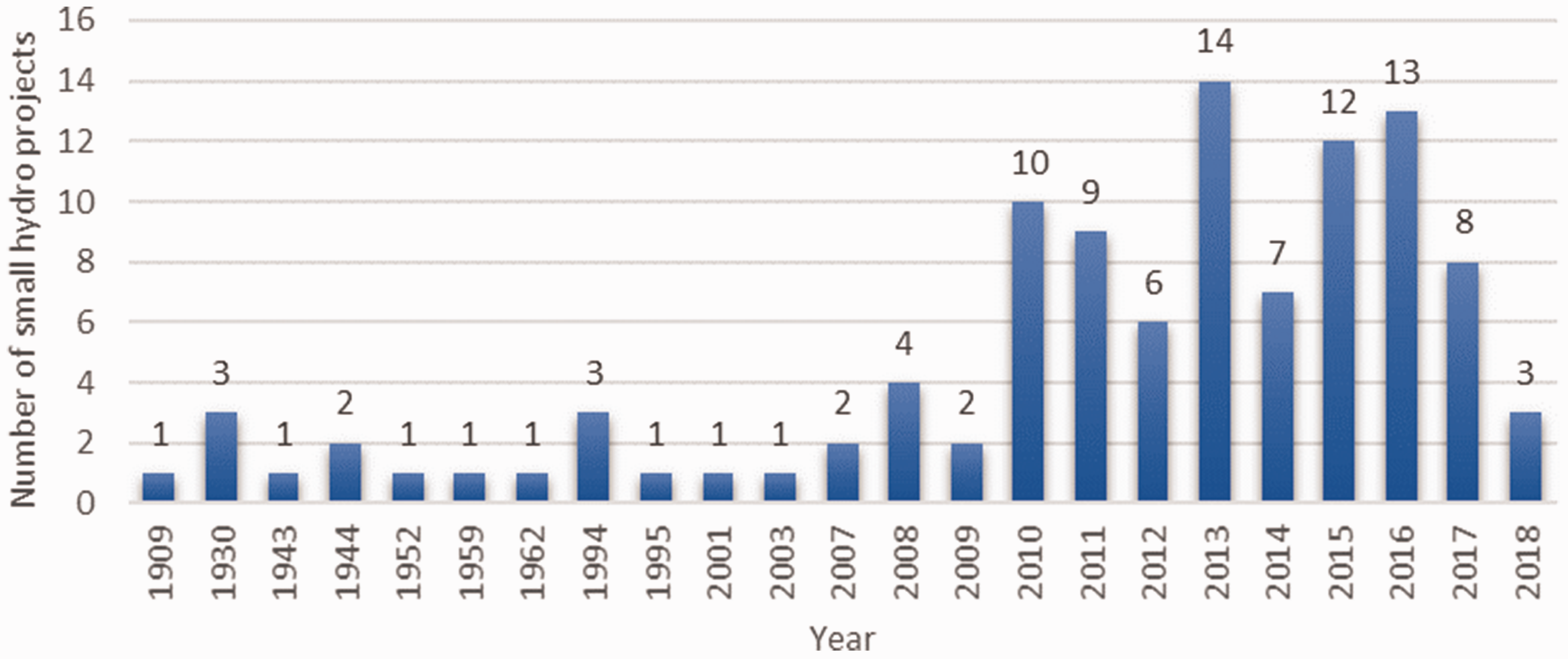
Small hydropower project growth over time.
In 1982, Chile passed the General Electricity Law, which redesigned the electricity system according to a market logic, creating separate markets for generation, transmission, and distribution (ENDESA, 1993). In this design, electricity can be sold via three markets: a spot market, an unregulated market for consumers of 2 megawatts or more, and a regulated market for distributing electricity to households and small consumers, which operates according to a node price (Bauer, 2009; Rudnick, 1998a). Generators have two main options to commercialize their electricity with different correspondent prices. Renewable energy generators can decide to sell at the node price, while larger generators cannot. The first option is sale through the “spot market” 11 and via individual contract, either with a free (unregulated) client or an auction with individual (regulated) clients. 12 In the case of regulated clients, generators offer their electricity at varying prices in the auction where they compete to get supply contracts. This results in a final price for electricity that will begin to take effect a few years after the auction occurs. That, combined with legal regulations and calculations, sets the second price, the node price. 13 The node price determines the price everyday people in Chile pay for electricity in their homes (see Figure 4).
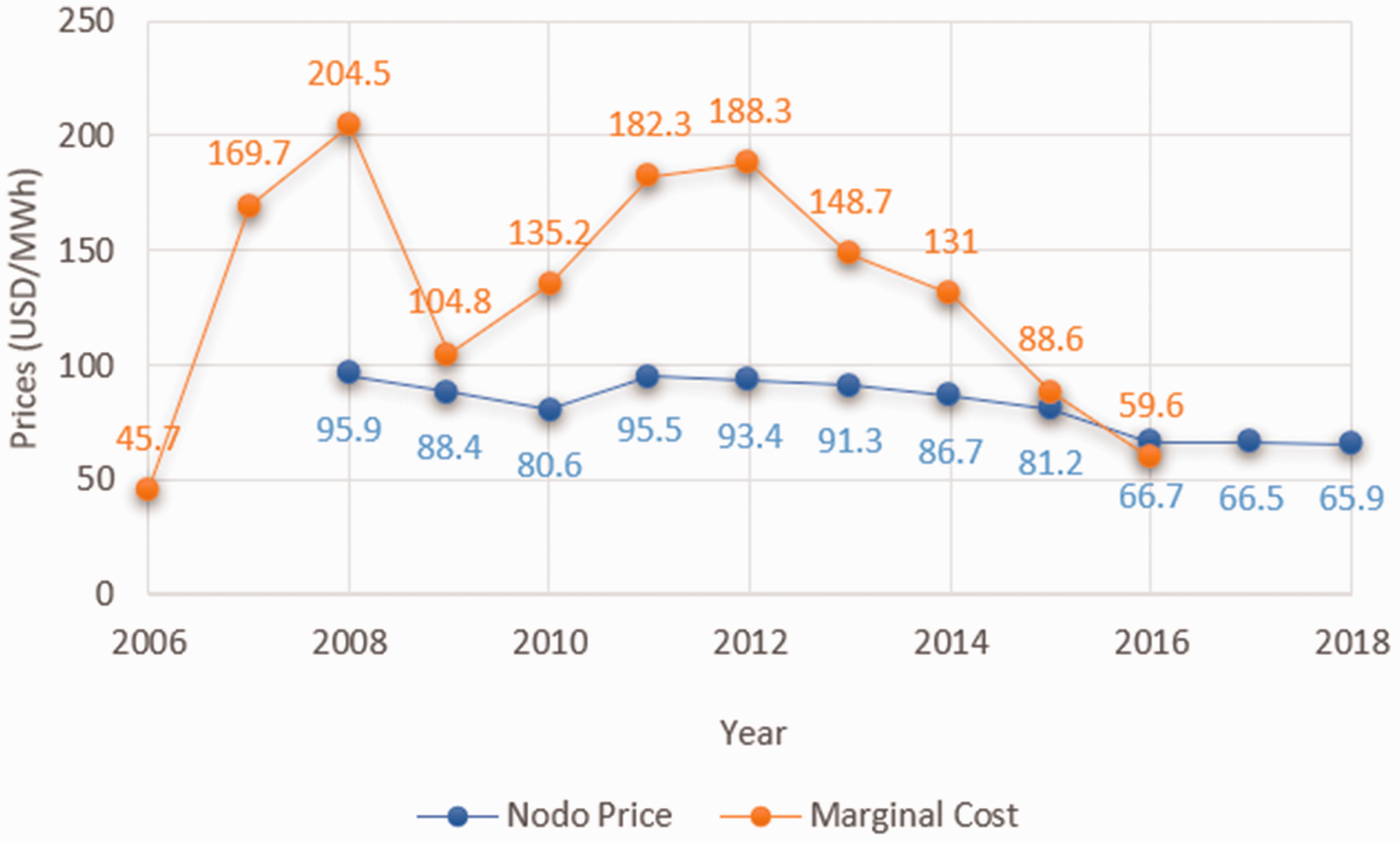
Node price and marginal cost of generating electricity. Source: Adapted from CNE (2019).
In 2004, the “Short Law I” revised the General Electricity Law to allow renewable energy generators producing under 9 megawatt grid access to distribution lines and the right to sell at either spot or node prices (Bauer, 2009). The law also exempted renewable energy producers under 9 megawatts from paying transmission fees and provided reduced fees for those between 9 and 20 megawatts. In 2008, the Nonconventional Renewable Energy Law (Law 20.257) was introduced. 14 The law mandates a renewable energy quota as part of all electricity sales and requires that a minimum 10% of energy withdrawals for distribution and large client sales comes from nonconventional renewable energy generation (Barroso et al., 2010). In 2013, the quota for renewable energy was raised to 20% by 2020 (Law 20.698). In this system, a scenario emerged where the state holds little control in determining electricity price, as the rapid entry of many renewable energy generators led to a decline in electricity price.
Chile’s experience shows that use of an auction mechanism can lower electricity price while also creating difficulties for planning. Auctions consist in a sale of a set amount of electricity within an established future timeframe (Gatica, 2017; Leyton, 2014). In 2012, the average price was $130 US dollars per megawatt hour; in 2015 it reached $79.50; and in 2017 price dropped again to $32.50 per megawatt hour (CNE, 2019). With this drastic drop, a number of projects awarded auction contracts pulled out. Small hydro’s future hangs in the balance, since the costs of constructing are high, and turn around on investment is slower than other renewable energy generators. These institutional changes are relevant for the water–energy nexus, because they change the economic conditions for hydropower. Next, we turn to how stalled projects relate to different Chilean institutions operating in Santiago and in Mapuche territory of southern Chile.
Surprises in small hydropower development: Tracing stalled projects
In the following sections, we discuss how small hydro growth is stalled via institutional rules being enacted in territories (Table 1). We also explain how capital finds new ways to profit via the water market’s interactions with environmental and energy institutions. The sections are structured to reflect the main permissions for hydropower development: water, electricity, and environment. Sections “Challenges in abstracting water rights for small hydro” and “Difficulties of connection to the grid: Transmission and distribution complications”, based primarily on institutional research, describe water and energy management in Santiago and hydropower development in central to southern Chile. Toward the end of sections “Difficulties of connection to the grid: Transmission and distribution complications” and in “Gaining environmental approval and securing funding amidst growing conflicts: Florín Case”, we forefront ethnographic data in the Puelwillimapu Territory in the Wenuleufu watershed (known as Wenuleufu in Mapuche Territory and the Bueno River in Chilean cartography) in the Ríos region. While all sectoral permissions can lead to stalled projects, the environmental assessment is the main institutional arena where conflicts are meted out. In the “Gaining environmental approval and securing funding amidst growing conflicts: Florín Case” section we explain how the different permissions interact with social conflict to delay projects for many years, ultimately leading a company in southern Chile to renounce their water rights.
Small hydropower development phases and unforeseen issues.

Challenges in abstracting water rights for small hydro
Creating market conditions for small hydro’s non-consumptive water rights is complicated by institutional rules and physical geography. Critically, how water is abstracted from river to right depends on what the project developer decides to sell: electricity through a finished hydropower project or a paper project (approved studies with the water right). Either way, price for non-consumptive water rights is highly dispersed (Cristi et al., 2013). Influential variables for price include whether the right is active, volume of water, location of the right, relief change between intake and restitution points, and distance from existing transmission and distribution lines (Kelly, 2018; Kelly et al., 2017). 15 We add that price is also influenced by environmental permissions and engineering studies as well as the non-use tariff (patente por no uso). 16
On the one hand, the written legal rules and private developers’ techniques for calculating water rights from afar result in a growing uncertainty for small hydro projects. On the other hand, some developers are not concerned with these issues, since they sell the water rights as part of paper projects with studies and permits. Triangulating interviews with the private sector and government officials, we confirmed that water rights are often sold as a bundle of rights that include other aspects of small hydro development like engineering and financial studies. 17 Specifically, officials confirmed a market exists for water rights with approved environmental impact studies (ibid). Information for this market is not widely available but shared between known actors in the industry, demonstrating how institutions work in practice.
Institutionally, if they do not own an existing right, project developers must take the following steps to create a non-consumptive water right. In a water rights solicitation (i.e. application), private actors often use remote geographic information systems technology to identify the points of diversion and restitution from the waterway, then use hydrological formulas from representative streams to estimate available water quantity for the water right (Tello, 2011), often with errors in calculations. The future water rights holder sends a solicitation to the DGA, where they publish and distribute the solicitation for possible claims by third parties. The DGA realizes an inspection of the land and then they create a technical report to evaluate the resource availability. Finally, they issue a resolution, approving or rejecting the solicitation. The DGA only considers water availability (both legal and hydrological) in its water rights concession.
After conducting preliminary engineering studies, the water rights holder must conduct engineering studies (Estudios de Prefactibilidad) in the proposed site and then a secondary study with the DGA to gain permission for building a water intake infrastructure in a waterway. For the intake, the DGA grants a separate permission: the permission averages four years for larger infrastructure installation diverting more than 2 m3/s (obra mayor), while a permission for a minor infrastructural installation (obra menor) is granted regionally and averages two years (Interview 25 July 2016). When the water rights solicitor makes their first site visit, they must calculate the river levels and the height of the fall for the hydropower project, then they can estimate potential energy generation (Tello, 2011). However, unfit geological conditions among other factors often require that new geographic coordinates for restitution and diversion points be submitted. If points are changed, a transfer (traslado) must be filed with the DGA to change rights characteristics like water quantity, ecological flow left in the river, etc. 18 While a project is delayed, the costs related to the non-use of the water rights increase, creating a debt that can lead a developer to ultimately cancel a project.
In 2014, the Ministry of Energy created a Plan for 100 Mini Hydro Projects within their Project Development Unit to reflect the government’s (2014–18) stated commitment to build 100 small hydro projects. When we interviewed the coordinator for the plan, they explained that they met with the DGA, other government agencies, and project developers to facilitate project development of more viable projects. In practice, acquiring and abstracting the water rights takes between 2 and 10 years. 19 When a third party requests a water right from the DGA, they explained, many times the DGA can come back and say that only half the quantity of water is available. When you begin the preliminary engineering studies, “then you find out you need to move the uptake one kilometer. That means you have to wait two more years in the DGA.” 20 During the interview, the employee explained the long list of possible small hydro projects they were aware of in central to southern Chile, confirming a much smaller percentage of projects are built than started.
Since there are often issues abstracting the water rights from a distance, this creates delays in the regulatory permitting process. Uptake and restitution points are difficult to determine remotely, particularly for small hydro projects involving run-of-river design. Run-of-river designs can involve a lengthy diversion up to a few kilometers, where the electricity is generated out of stream before being returned to the main waterway (Kelly-Richards et al., 2017). Members of the private sector and government officials confirmed that when purchasing a water right, the owner often needs to conduct new hydrological studies and geological analysis for small hydro. All of these extra steps mean more time is spent finalizing the non-consumptive right, raising costs. If the time and costs are too high, the project becomes unviable. As Figure 5 demonstrates, a project’s possibility of being stalled or desisted is determined by interactions across institutions. 21
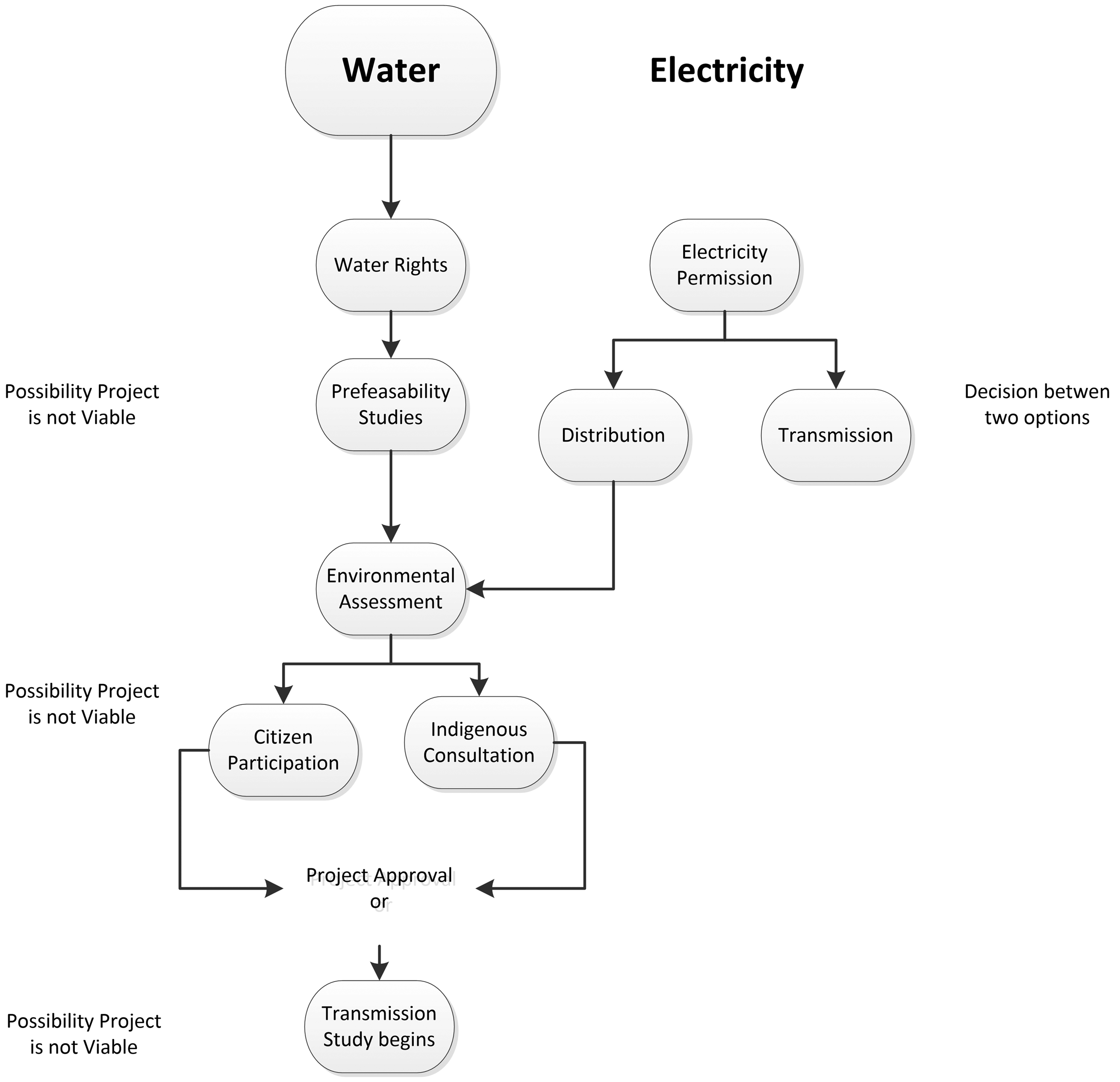
Institutional snags in the small hydropower development process.19
Each of these snags—filing a traslado, needing to redo the preliminary engineering studies, or reapply for the DGA infrastructure permit—can stall a project, yet for actors selling paper projects these concerns are not pressing. If not for the growing conflicts sparked by small hydro’s significant social and ecological impacts (Kelly, 2019), it might be argued that small hydro permissions should be more easily coordinated between agencies to facilitate rapid, cheaper development, for example by further integrating water and energy sectors. Instead, these issues highlight that integration of water and energy should not always be the point. As the next section on the difficulties of electricity grid indicates, the dream of granting unconditional water rights for the development of a green and sustainable electricity grid is not technically or economically feasible.
Difficulties of connection to the grid: Transmission and distribution complications
Grid connection is perhaps the most challenging aspect of small hydro development, yet government officials and industry officials confirm many water rights holders intending to build hydropower projects do not consider this dimension early enough. Connecting a hydropower generator to the electricity grid is determined by existing lines and electricity loads as well as permissions and costs of line construction. Generators must either build their own connection to a transmission or distribution system or pay for entering the existing grid. With large hydropower projects, it is often easier to finance transmission lines, but the costs can be comparatively too high for small hydro projects. With a lowered electricity price there is less profit margin, making transmission/distribution costs difficult to reconcile. 22 Accordingly, some rights holders are at comparative advantage to others due to the proximate geography of the existing grid in relation to their water rights. Whether or not a project has assessed viability of grid connection and begun the administrative process is a key indicator of whether it is a paper project or developed from the start to produce electricity. 23
Choosing between transmission or distribution line connection is arguably one of the most important variables in determining how and when a small hydro project produces profit. Here, the institutional rules of the electricity sector inform small hydro viability. The physical lines for transmission and distribution have different geographies and different technical specifications. Distribution electricity lines with shorter, lower capacity (23 kilowatts or less) are established in the Andean mountain front range. They provide many mountain communities with rural electricity. We learned through ethnographic research that high voltage transmission lines are contentious to gain approval in the Environmental Assessment because of increased social conflict involving the local costs of energy development. In the Ríos region, transmission lines threaten other forms of economic development, such as tourism, and Mapuche-Williche cultural practices (Kelly, 2018).
Often only after acquiring a water right do project developers submit a parallel permit application with the Superintendence of Electricity and Fuels (Figure 5). They submit a study that includes evaluating connection alternatives and associated costs for transmission and distribution (Tello, 2011). When they receive the permit, they have a year to connect to the system or else they must resubmit. To build electricity lines, project developer must obtain concessions for passing through third party property and hold this permit or a connection agreement with the distribution or transmission company (Olivares et al., 2016).
In southern Chile, SAESA, short for Sociedad Austral de Electricidad S.A., is the major distribution actor. When we sat to interview two of their engineers in the city of Osorno, they explained that their distribution system has 43 generators, the majority of which are small hydro. 24 For small generators of 9 megawatts or below who decide to send their electricity through the distribution system, the generators decide when they produce energy. 25 Deciding between transmission and distribution determines costs and timing of the project coming online. Another key variable determining future profits is whether the project sells electricity according to the node price or the marginal cost price of the spot market. Both factors are important for securing additional rounds of investment. In the last two years, the SAESA engineers described, the tendency of many renewable energy generators of less than 9 megawatts is to sell at the node price, which is a more stable price, and at times a more profitable price. All this in a context where spot prices are variable and have gone down in relation to the positive prices of the 2012–2013 period which encouraged the development of several small hydro projects. Whether or not a project can connect to the grid at a profitable price strongly influences outcomes. Next, we describe how water and electricity institutions interact with environmental permissions and project financing.
Gaining environmental approval and securing funding amidst growing conflicts: Florín Case
In the Puelwillimapu territory, 14 hydropower projects entered environmental assessment over the last 10 years, 13 of which are small hydropower (Figure 6). In the biodiverse temperate rainforest of ancestral Mapuche-Williche territory, the four Florín projects we discuss here provoked considerable conflict, despite not yet being built. Overall, the projects proposed to generate 29.34 megawatts via four cascading run-of-river projects; three approved projects in the environmental assessment proposed using 23.2 m3/s of water (EDIC Ambiental, 2013; GEQ, 2009). 26 Along the dirt road that leads to the proposed site for the Florín projects, considerable native forest was cut a few years ago as initial efforts began to widen the access road. During ethnographic research we observed local Mapuche leaders organize tirelessly against the projects, voicing the catastrophic impact of the projects on their spiritual practices and territorial wellbeing. However, 15 years after the projects sent paperwork to the Environmental Assessment agency (SEIA), the water rights for the project were renounced in 2020, marking its end as a project.
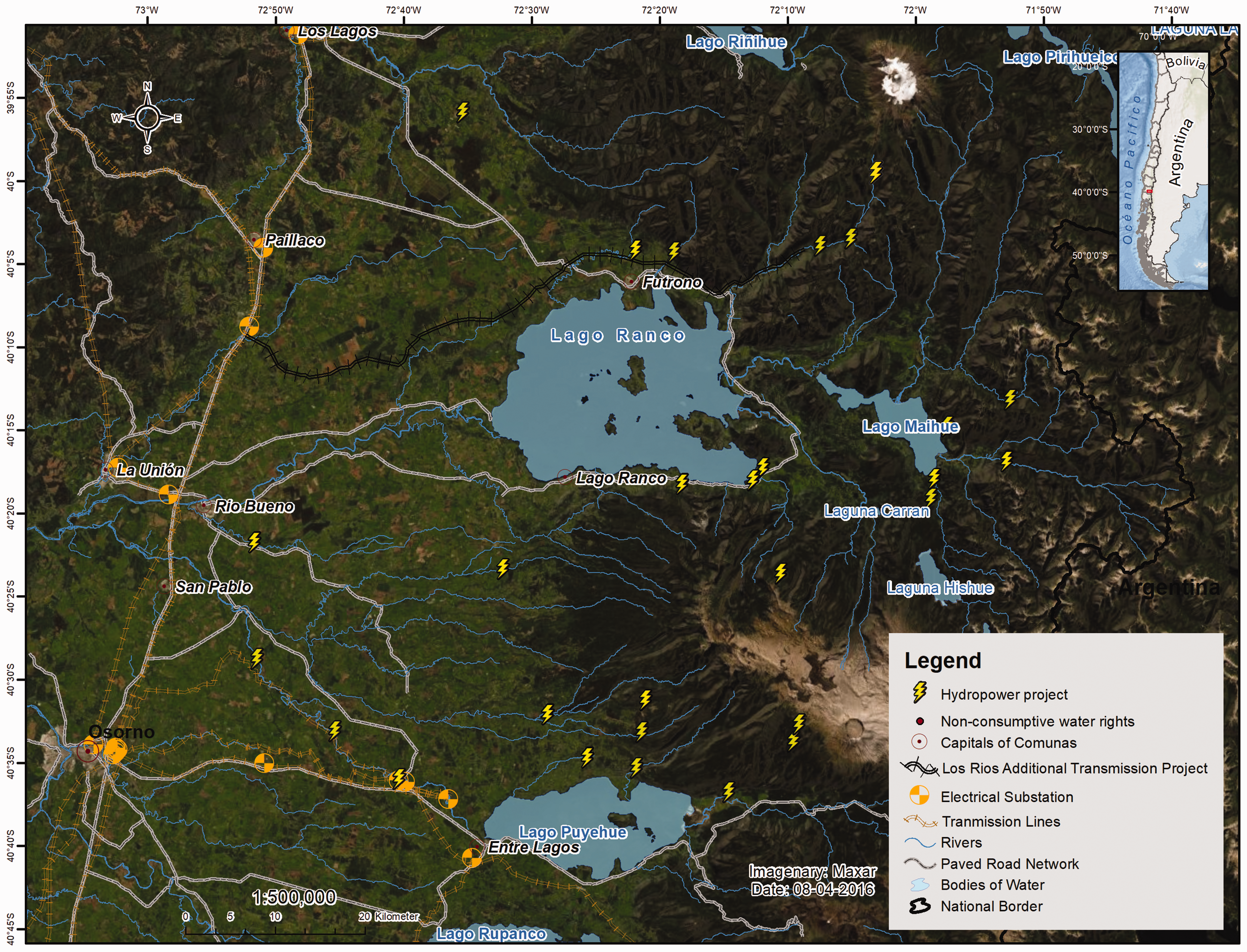
Map of non-consumptive water rights, potential hydropower projects, and proposed transmission line in Puelwillimapu Territory.25
During collaborative research, local Mapuche-Williche leaders asked for us to create a map of the non-consumptive water rights (see red dots in Figure 6). 27 Using government data sets, we brought a version of the map in Google Earth on a laptop where they clicked on red points to see who owned the water rights. Many of the rights further out are in steep mountain ravines that seemed possible from a computer in Santiago, but are not viable projects in Mapuche territory. As the dots indicate, the quantity of theoretical projects is fantastically large. This same map most likely fed the development desires of entrepreneurs looking to build many small hydro projects.
Due to the lack of transparent information, it is impossible to say if the Florín projects began as paper projects. According to the paper trail in the Environmental Assessment agency, in 2004 the private company Sociedad Generadora Eléctrica Rhomaya Limitada submitted a project for environmental assessment that would ultimately become Florín 1 (GEQ, 2009). 28 For unknown reasons, the project was then sold to another company, Sociedad Anónima Empresa Eléctrica Florin. Then in 2009, the new owners presented another study for environmental assessment, requesting to amplify the existing project from 4.8 to 9 megawatts (GEQ, 2009). In 2011, they submitted Florín 4, and in 2012, they submitted Florín 2 and 3 for review. Florín 1 reports a theoretical 22 million US dollar investment and Florín 2 and 3 report a 53.7 million US dollar investment. For Florín 2 and 3, the Environmental Assessment agency required the company to carry out an Environmental Impact Study that included an Indigenous Consultation 29 as a result of appeals (EDIC Ambiental, 2013). Ultimately, in July 2016 the projects gained environmental approval (ibid). It is difficult to say what combination of factors besides the obvious lack of grid connection led the Florín projects to stall for so many years before cancelation.
Efforts to build the desired transmission line, a necessary infrastructure to go forward with construction, stoked significant conflict. In the Puelwillimapu territory, existing distribution lines for electricity in the territory cannot accommodate additional generation. Four small hydro projects generating over 4 megawatts currently use the lines. In 2016, Florín business associates among others formed a private association, STAR SPA, to build the STAR high voltage transmission line with a converter located next to the Florín projects (Figure 6; EDIC Ambiental, 2017). In August 2017, STAR’s high voltage transmission line entered the environmental assessment. An alliance organically formed between the Alianza Territorial Puelwillimapu, an alliance of ancestral Mapuche-Williche leaders who we collaborated with as researchers, and an incipient civil society movement in Futrono, the Movimiento Futrono Sin Torres (Movement for a Futrono Without Towers). We observed local organizing in response to the perceived unjust functioning of water and environmental institutions to involve protests, education, and cultural events, resulting in more than 3000 “Citizen Participation” observations for the environmental assessment (ibid). In May 2019, STAR SPA company publicly removed its project from the environmental assessment.
Beyond these factors we review in the Florín cases, stalled projects are also influenced by investment practices. Interviews with private and government actors confirmed these delays can hinder securing additional rounds of funding. As one renewable energy developer explained: Solar is the gold standard for renewable energy in terms of being able to predict how much it will cost to build, and when it will provide return on investment.
30
Small hydro is much more variable in its costs and timing. […] Because it is unpredictable, it makes it a riskier project venture to finance.
Similarly, a Ministry of Energy official observed: “When you begin to look at how much time a solar project takes compared with small hydropower […] Solar you can build in three years, but small hydropower, the average we have observed is eight years.” 31 With the lower price of electricity, there is less room for miscalculations. Over the last 15 years, developers could gain earlier stages of project funding by loan credit and subsidy programs through CORFO (Chilean Economic Development Agency), who secured support from outside actors like the German Bank KfW. 32 Today, similar opportunities are less plentiful. More recently, a bank official explained, project developers are experiencing difficulty gaining later rounds of project financing as they wait for permissions like water rights and environmental assessments. 33 For those working with Banco BICE, which funded 30 small hydro projects at the time of the interview, financing came from roughly 50% domestic investors and 50% internationally, principally from France, Italy, Spain, and Norway. As the price of electricity dropped, turn around on investment slowed from its earlier standard of three years return (ibid). It became common for projects to begin but later be deemed unviable due to a combination of unforeseen institutional outcomes.
Discussion
Empirically, Chile’s renewable energy transition creates institutional surprises that are not conveyed by official narratives. Projects are stalling for a number of reasons related to the imposition of Chile’s neoliberal, market institutions in territories. Small hydropower’s haphazard growth starkly contrasts the Chilean government’s neat state goal of building 100 small hydro projects from 2014 to 2018. Yet capital finds a way to create value. In this paradoxical outcome, some entrepreneurs use the water market and the environmental assessment to profit, ultimately creating more stalled projects. This unforeseen use of institutions reflects how water and environmental law are engaged in a market system.
Ingrained inequalities in water law affect energy development and environmental impact assessments, provoking conflicts across territories. Issues commodifying water thus transfer to other sectors. Difficulties abstracting water for hydropower ultimately led to unforeseen market activity, demonstrating that rights are not being allocated based on scarcity. Since non-consumptive water rights only include productive uses like hydropower and aquaculture, Mapuche-Williche people and other local actors cannot own these rights for other uses. During project development water rights are legally protected as in-use, often for long extents of a river. This water is unavailable for other local users. Far from recent calls to decolonize water in legal and management arrangements (Wilson and Inkster, 2018), water’s continued institutional treatment as a private good in Chile prioritizes economic development interests over Indigenous ways of knowing and relating to water.
Environmental law is also perceived to be weak, leading social conflicts to create new informal mechanisms to halt projects, marking demands from Mapuche people and civil society. Chile’s institutional structure largely subsumes Indigenous rights within environmental governance, forcing Indigenous people to engage these inequities in the water–energy nexus through environmental impact assessment. When water rights are constituted, local actors must oppose projects through administrative channels in environmental law and through informal avenues like protests. Mapuche-Williche leaders, civil society actors, and support staff like lawyers spend countless hours opposing hydropower projects, even though some projects are not viable. One recurring social impact of hydropower development is sewing division among Indigenous communities (Kelly, 2019; Maher, 2019). In this context, a seemingly sustainable response to climate change, like renewable energy, repeats a tendency of mainstream climate responses to pose environmental injustices for Indigenous people (Whyte, 2018).
An overarching efficiency issue in Chile’s water–energy nexus is related to the fantasy that all water can be commodified. Empirically, we find that a considerable amount of water rights destined to be used to build small hydro projects are not viable for energy production. The challenges for abstracting water rights are different for small hydro, particularly given the quantity of projects being developed. From a private sector perspective, hydropower development is inefficient because there are many setbacks and difficulties to development. For local actors, it is both inequitable and inefficient that they cannot substantially participate in territorial planning. Ironically, speculators profit from inefficiency. Ostensibly they began selling paper projects to recover their investment or avoid losing their money entirely. However, when developing paper projects, there is an incentive to conduct quick and ad hoc studies to gain approval, without considering the repercussions. Chilean government officials review many permits for water, electricity, and environmental assessments, only some of which are viable.
This case also demonstrates the importance of price in influencing market management of the water–energy nexus. For small hydro, both water rights and electricity price determine if a project is viable, but electricity is more influential. When electricity price was high and stable, this stoked water rights purchases. When electricity spot price then dropped due to increased renewable energy project development, this led to stalled small hydropower. Here we see that for non-consumptive rights, water’s price is informed by various use values, such as the capacity to commodify electricity, the tariff for non-use, and the permits and studies for an economic development project.
Conclusion
In this article, we forefront institutional surprises of the water–energy nexus as an analytic to make sense of the stalled projects shadowing the small hydro boom in Chile. Using an institutional and ethnographic approach, we have sought to contribute to politicizing nexus studies by analyzing findings in terms of inequities and inefficiencies. By tracing water–energy interactions across institutions, we problematize the push in nexus scholarship to further integrate water and energy systems. The main institutional surprises we discuss are that many small hydropower projects are not viable and that capital is finding a new way to produce value by selling paper projects. Institutional problems associated with stalling small hydro include securing water rights, electricity grid connection, environmental approval, and project financing. While the rule of law shapes actions in resource management, conflicts involving Indigenous rights and environmental issues are challenging how institutions function in Chile.
In describing the haphazard development of small hydropower central to southern Chile, we have also sought to bring critical thought to water–energy nexus literature. Specifically, by demonstrating that fantastical materialism (Wilson and Bayón, 2017) can also animate the water–energy nexus. Fantastical materialism is evident in the unruly outcomes of ambitious economic infrastructure undertakings, and in the novel ways that capital can reroute to produce value midstream (ibid). Here, stalled small hydropower projects are often sold as paper projects, which are water rights sold as a bundle with sectoral permits like environmental impact studies. Speculators selling these paper projects benefit, while costs are distributed among actors including government officials, local water users, and members of the Mapuche Pueblo.
Theoretically, this case demonstrates that the water–energy nexus will not necessarily become more sustainable with further integration of water and energy systems. Although in the Chilean case electricity was institutionally designed to dominate water, manipulations of the water market create a more frantic atmosphere for project development in the energy sector. A comprehensive political response should include reforming institutions to increase equity and inclusivity in renewable energy development. As our paper demonstrates, this would include reforming water, energy, and environmental law. False expectations about markets’ ability to sustainably build hydropower can lead to diverse material outcomes, many negative.
Bringing a water–energy nexus perspective to understand how water is commodified helps to explain how these issues with abstraction are influenced by energy and environmental law. And, in turn, how difficulties abstracting water rights to produce electricity for run-of-river small hydropower impede electricity generation. In Chile, neoliberal environmental policies are confounded by siloed evolution of resource management institutions, despite these institutions interacting. The rules created in Chile for managing water and energy in markets were made with large reservoir hydropower in mind (Bauer, 2009). With small hydropower’s quick haphazard growth, the rules are both inadequate to diminish conflicts and burdensome to efficiently develop projects. Overall, this research questions whether water rights should be granted unconditionally as is currently dictated in Chilean law. Stalled small hydropower projects indicate limits to water’s commodification, in particular for new water uses with different technologies that provoke unforeseen social responses.
Conclusively, this study questions the simplified narrative of a nation state’s ability to predictably guide the market-based transition to renewable energy. The transition does not play out on a blank canvas, but in diverse geographies governed by complex legal rules which were often written with other forms of economic development and resource governance. For small hydropower, a vision of a productive territory for the transition to renewable energy is imposed over Mapuche-Williche territory, allowing influential actors with the desire to build clean hydropower to make territorial decisions. The logic of renewable energy to mitigate climate change at the global scale permeates and affects territories in unforeseen ways. The phenomenon of stalled small hydropower suggests that using markets to build hydropower is more difficult to sustainably and equitably manage than anticipated.
Highlights
Advances scholarship on the water–energy nexus by analyzing institutional surprises in terms of inequity and inefficiency. Demonstrates how small hydropower projects are stalling throughout Chile in relation to water, energy, and environmental law. Describes an unforeseen use of the water market in Chile where paper projects (approved environmental assessments) are sold with water rights. Questions the limits of commodifying water for new technologies like small hydropower. Finds that institutional contexts and social conflicts in Chile’s neoliberal model limit small hydropower’s potential to be developed sustainably and equitably.
Footnotes
Acknowledgements
We are grateful to the Mapuche-Williche leaders and communities who welcomed us in their territory and participated in collaborative research. We also thank those across sectors who took the time to participate in our interviews. This paper came from an interest in bringing water markets down to earth, following the work of water scholars and mentors for us, Dr. Carl Bauer and Dr. Rodrigo Fuster. The first author thanks members of her dissertation committee who reviewed an earlier version of this work: Dr. Carl Bauer (advisor) and Drs. Diana Liverman, Jeffrey Bannister, and Sallie Marston. She is also grateful to Drs. Laura Ogden and Manuel Tironi, who have mentored her as a postdoctoral researcher. This paper benefited from conversations and edits from Carl Bauer, Lily House-Peters, Lucero Radonic, Grant Gutierrez, Marissa Isaak and Surabhi Karambelkar.
Declaration of conflicting interests
The author(s) declared no potential conflicts of interest with respect to the research, authorship, and/or publication of this article.
Funding
The author(s) disclosed receipt of the following financial support for the research, authorship, and/or publication of this article: Initial research by the first author was funded by Fulbright Scholarship, the Inter-American Grassroots Development Fellowship, PEO Scholars, Conference for Latin Americanist Geographers, Association of Pacific Coast Geographers, and Carson Scholars and CLIMAS at the University of Arizona. Follow-up research and writing were funded by the Arthur L. Irving Institute for Energy and Society at Dartmouth College; Centro de Investigación para la Gestión Integrada del Riesgo de Desastres in Santiago de Chile, and the Chilean government (ANID) through the Fondecyt Postdoctoral program (project # 3190867). The second author thanks the Heidelberg Center for Latin America for the 2019/2020 Governance of Risk and Resource Master’s Program Funding Grant.
