




Abstract
This article examines the generation of digital outer space natures in the space exploration game, No Man’s Sky. Using procedural generation, No Man’s Sky offers nearly infinite planets, flora, and fauna on the fly. With the rapid development of gaming technology and tools, game developers and others are attempting to diversify the representation of various forms of nature in gaming content and to expand the use of games in behavioral change, education, conservation, and other fields. Many scholars argue that games offer promising ways for various publics to understand their place and their interconnectedness with microbes, ecosystems, planet Earth, and beyond. We examine how No Man’s Sky struggled to coproduce digital outer space natures at the two scalar extremes of the vast expanse of outer space and of the embodied player relating within complex biomes. Our results from an in-depth, qualitative analysis of the initial version of the game, of player world-building experiences in No Man’s Sky, and of subsequent developer modifications to the game demonstrate that nonscalability theory is useful for studying what digital outer space natures do in games. We also argue that nonscalability theory would benefit from a more robust engagement with the digital. No Man’s Sky was initially scalable to such an extreme that it made players into objects without an origin story, broader purpose or way to build meaningful relations in the game. For a brief period, this game undermined players’ interplanetary colonial imaginaries. Subsequent updates to the game introduced a limited scope of nonscalability, but only to the extent of satisfying gamers’ desires to become more impactful agents of exploration. We see great potential for analyzing the role of innovations in computing and game design in linking multiscalar digital, outer, and earth spaces, which as other scholars have shown, bear significantly on our understanding of multiple worlds and natures.
Introduction
Promises of infinite exploration in a new digital gaming universe titillated many in the computer gaming community ahead of the release of the open world game, No Man’s Sky (NMS) (Hello Games, 2016a). Developers of NMS aspired to satisfy gamers' voracious demands for complex new landscapes and features by automating labor-intensive game environment design (Tach, 2015). Through procedural generation, NMS would offer an impressively scalable game terrain with nearly infinite planets, flora, fauna, atmospheres, and other components of navigable worlds on the fly using a set of algorithms. The premise of the game involves players crash-landing their spaceship on a distant planet. Before traveling to some of the game’s 18 quintillion other planets, players must explore the landscape to collect resources necessary for repairing their spaceship. Advertisements for the game displayed complex exoplanetary landscapes teeming with diverse terrestrial and aquatic wildlife. 1 Upon NMS’ release in 2016, however, game critics and the broader gaming community expressed profound disappointment and outrage (Caldwell, 2017). Sony had promoted NMS with its other major titles of the year—a first for an independent game—which increased pressure on the game’s development team by expanding media coverage and by advertising features absent from the initial release (Hello Games, 2016a; Khatchadourain, 2015; Parkin, 2014). Developers often under-deliver to some extent, but many players argued NMS’ failures were unparalleled (Caldwell, 2017).
We understand NMS as a powerful example of contemporary technological, cultural, and political innovation that informs imaginaries of interplanetary futures. Political geographers and others in related fields have contributed extensively to discussions of coloniality, imperialism, and frontier imaginaries shaping outer space geopolitics (see Dunnett, 2019; Kleinberg, 2007; Leib, 2015; Ormrod and Dickens, 2016; Redfield, 2002; Sage, 2008; Sammler and Lynch, 2019). Geographers have most extensively published works on outer space in the journal Geopolitics (some exceptions include Dunnett et al., 2019; Kopack, 2019; MacDonald, 2007). To a limited extent, select political geographers, science, technology, and society (STS), and environmental humanities scholars have focused on various outer space environments and ideas of nature (Messeri, 2016; Olson, 2018), the “environmental geopolitics of outer space” (see Klinger, 2019), and the ethics of contemporary co-constitutive earthbound and outer space worlding (see Kearnes and van Dooren, 2017; Saperstein, 2020).
Rather than attempting to expand work on outer space geopolitics, our goal is to encourage political ecologists to study interplanetary political ecologies. This interdisciplinary field has largely been silent on discussions of outer space natures. We note, following feminist STS scholarship (see Haraway, 1989; Messeri, 2016; Olson, 2018; Shaw, 2004), that preparing for interplanetary existence involves cultural and symbolic work through science fiction literature and other media, including digital games. The return of popular desires for interplanetary exploration has brought a resurgence of paternalistic and colonizing tropes critiqued decades ago by feminist scholars. For example, Carolyn Merchant (1980, 1995, 2006) and Donna Haraway (1989) demonstrated the specific patriarchal and power-laden features of frontier desires and the gendered and racialized assumptions within scientific writings about discovering nature’s secrets on and beyond earth. According to Haraway (1989, 136–137): … the wilderness of Africa is coded as dense, damp, bodily, full of sensuous creatures who touch intimately and intensely. In contrast, the extraterrestrial is coded to be fully general; it is about escape from the bounded globe into an anti-ecosystem called, simply, space. Space is not about “man’s” origins on earth but about “his” future, the two key allochronic times of salvation history … Space and the tropics are both utopian topical figures in western imaginations, and their opposed properties dialectically signify origins and ends for the creature whose mundane life is outside both: civilized man. Space and the tropics are “allotopic”; i.e., they are elsewhere,” the place to which the traveler goes to find something dangerous and sacred.
Developers of NMS promised players intimate encounters with exotic creatures and an escape into a vast universe, while also asking players to form a relationship with that digital universe. For game studies scholars such as Alenda Chang (2019: 90–91), games offer promising ways for various publics to understand their place and their interconnectedness with microbes, ecosystems, planet Earth and beyond: Although games inevitably participate in flows of material and capital and so-called attention economies that place them squarely within the ongoing debate over local, as opposed to global, modes of thinking and living, games, especially digital ones, can obviate the perceived choice through multiscalar play. The local and the global are, after all, only imagined extremes, beyond which lie countless microorganisms, elementary particles, and most of the known universe. If we could … escape the anthropomorphic drag of the local-global dualism, perhaps our Earth-friendly bumper stickers would urge us to “think galactically, act microscopically.”
We strengthen our understanding of multiscalar relationality through Anna Tsing’s (2019) concepts of scalability and nonscalability. Tsing (2019: 143) defines scalability as “the ability to expand—and expand, and expand—without rethinking basic elements.” We aim to “notice” what Tsing (2019: 147), refers to as “nonscalable phenomena” within broader legacies of persistent capitalist, patriarchal and colonial logics underpinning popular desires for conquering “new world”[s]. Tsing (2019: 148) argues: European sugarcane plantations of the New World … gave us the equivalent of pixels for the land. But unlike pixels these plantations did not come into being through an already developed aesthetics of scalability. Instead they stumbled into history and only afterward became a model for further scalable designs. Attention to their stumbling—that is, the contingencies and conjunctures that informed their design—is the ‘nonscalable’ approach I take to seeing where their plans failed to meet their own expectations … If the world is still diverse and dynamic, it is because scalability never fulfills its own promises … Instead of taking scalability for granted as a necessary tool of progress, nonscalability theory attends to the work of contingency and failure.
The concepts of scalability and nonscalability help us to understand what the built game environment, developers, algorithms, code, and players coproduce, particularly in terms of embodied relationships with DOSNs. Players experience scalability and nonscalability in NMS through their attempts at world building: the practices that coproduce game space as players go about understanding their role in a game’s narrative and their physical, social, cultural, and political relationship to the gaming environment, thereby establishing a sense of place and belonging. Specifically, we found that NMS was initially so scalable that players became sugarcane-like scalable objects with no origin story and no broader narrative purpose or way to build meaningful relations in the game. This kind of scalability project prevented effective world building. For a brief period, this colonial exploration game undermined players’ interplanetary colonial imaginaries, rendering endless discovery and resource extraction as so boring that many players stopped playing. Subsequent NMS updates introduced a limited scope of nonscalability, but only to the extent of satisfying gamers’ desires to become impactful agents of exploration. Our analysis also demonstrates that Tsing’s nonscalability theory would benefit from a more robust engagement with the digital. Tsing contrasts the presumed “aesthetics of scalability” of the digital pixel with the messier attempts to render earth-bound sugar cane clones into scalable plantations. Digital natures consist of much more than a simple, binary, discrete, pixel structure.
We conducted three phases of empirical analysis. First, we examined the structure and design of NMS through document analysis of promotional material and of articles about NMS for gaming communities and broader audiences (e.g., Khatchadourain, 2015; Peckham, 2016, and others). In our second phase, we played through the game to contextualize our document analysis and further explore its production of DOSNs. We also asked six gamers to play the game and record their experiences in a digital diary. We interviewed them before and after their playthrough concerning their expectations and impact on game play as well as how they coproduced DOSNs. Our third research phase examined which aspects of the game the developers changed and whether and how they addressed nonscalability. We conducted a document analysis of the patch notes from each of the NMS updates released between August 2017 and November 2019 and we analyzed the implementation of those updates with a further 20 hours of play.
Drawing on nonscalability theory, we contextualize our analysis within two areas of scholarship: (1) feminist digital geographies (extending this to digital natures) and (2) digital games studies. The first area of scholarship situates our feminist approach to studying games and digital natures and the second contextualizes the study of games as a space where DOSNs are coproduced. We then detail our methods further, and present and discuss our findings. We conclude with the implications of our analysis, which extends the fairly narrow treatment of nature in digital natures political ecology scholarship to include DOSNs, and we call for further feminist scholarship on digital natures that draws from game studies and other approaches.
Feminist digital geographies and digital natures
Feminist geographers critically analyze many aspects of digital technology. Sarah Elwood and Agnieszka Leszczynski (2018) examine power structures, violence, and social difference in and through digital spaces in their overview of feminist engagements with digital technologies and geographies. They question the assumptions that enable or complicate affective digital encounters and add crucial methodological insights, which we engage in the subsequent section of this article (Leszczynski, 2018). Feminist theory invites us to examine world-building failures from a multitude of positionalities and perspectives and to interrogate the power dynamics, social differences, and identity issues involved in these encounters (see Downhour, 2016; Gigliotti, 2016; Nelson, 2017; Tsing, 2019; Wirman, 2014). The robust and dynamic field of feminist digital geographies, however, has not yet engaged extensively with debates concerning digital natures (see Nelson, 2017). A new feminist digital natures research agenda could focus specifically on encounters with, assumptions about, and coproduction of variously defined digital “naturecultures” (see Haraway, 2016) on and beyond Earth.
We see DOSNs as key sites of emerging feminist political ecologies of linked fears about climate crisis and hopes invested in making humans interplanetary (see Olson and Messeri, 2015). In the coming decades, far more people are likely to experience novel forms of place making in digital outer space than on the elite space flights imagined by wealthy space exploration entrepreneurs. Recent work by political geographers demonstrates that desires for material investments in space exploration produce contested environmental geopolitics involving toxic geographies of rocket launch sites and falling debris in vulnerable environments and communities (Klinger, 2019; Kopack, 2019). The colonial logics and desires in the scientific and political cultures of space exploration merit sustained critical attention (see Cosgrove, 1994; Dittmer, 2007; Messeri, 2016). Political ecologists have largely ignored outer space natures, with some preferring instead to study digital natures, focusing primarily on conservation and social media (Büscher, 2016; Büscher et al., 2017).
Only a few political ecologists study digital games (see Sandbrook et al., 2015). One example is Robert Fletcher’s (2017) analysis of two children’s digital conservation games alongside his experiences leading a group of US-based university students on a program in the southern Peruvian Amazon. He aimed to understand the connections, tensions, and divergences between digital tropical rainforests and “direct encounters” in neotropical rainforests (2017: 160). Digital games and other media are often celebrated for their potential to help broader publics connect with various natures without physically trampling such natures or increasing ecotourism-linked resource consumption. Such games and media present rainforests as pleasant, “romanticized” or “Disney-like” in stark contrast with forests full of “inescapable and sweltering heat,” and the “incessant attack by mosquitos and other biting insects” experienced by Fletcher’s (2017: 157) students. He doubts conservation games can achieve ostensibly positive environmental and social change, based on the limited kinds of individual, consumer-centered solutions to environmental degradation narrated in these games, such as encouraging awareness, charitable giving, and purchasing various eco-certified products. Beyond how specific games narrate normative arguments about saving nature, we draw from games studies scholarship for a more robust understanding of the kinds of digital natures that digital games coproduce at multiple scales.
Understanding digital game encounters
Playing games is a productive practice in which games and players reinvent spaces to perpetuate particular narratives or gaming objectives (Boellstorff, 2008; Rutherford and Bose, 2013). Players are active agents in game content (Aber, 2008; Ash, 2009, 2015; Shaw and Warf, 2009; Thrift, 2000). Game studies scholar Ian Bogost (2008: 121) argues video games, “create new possibility spaces” for exploring the material world processes they represent, enabling exploration of “possibility spaces through play,” in which the player encounters the game’s meanings (see also Fernández-Vara, 2011). Geographer Daniel Bos (2018: 62) argues that play is “a complex event … conditioned by the spatial context, practices and sociotechnical relations,” including the social relations in many players’ family rooms and bedrooms where they connect with game spaces, and extending these physical space engagements via mobile gaming apps.
Game mechanics are key to understanding possibility spaces of play. Miguel Sicart (2008) defines game mechanics as “methods invoked by agents, designed for interaction with the game state.” As such, they are available both to the player through jumping, running, and other actions, or to other non-player elements such as gravitational effects. Game mechanics are designed to facilitate the gameplay towards developers’ goals. Players, however, often use a game’s mechanics to ignore the game’s goals and engage in activities outside the game story, such as mining mineral towers to make caves in the context of NMS. As Stephanie Rutherford and Pablo Bose (2013: 5) elaborate, “while the game designer may intend a particular understanding of the world, the player might have oppositional, subversive or rogue readings.” It is a game’s level of abstraction—overlap between the rules of a game and the game world, and the ways that players can interact with the visually rendered content—at different scales that shapes the scope of what players can do in terms of subversive or rogue engagement with game mechanics (Fernández-Vara, 2011). According to Fernández-Vara (2011: 137), “choosing the right level of abstraction is a fundamental tool to establish how much room the player has to fail and experiment.” Players’ probing of the possibility space to determine correct actions “produces an experience of back-and-forth, of fine-tuning one’s behavior in relation to an environment” (Driessen et al, 2014: 93).
Games are most scalable along the trajectory of their stories. There are various opportunities for nonscalibility to arise, sometimes within the story but also as players play outside the scope of these trajectories, and when game mechanics, bugs, glitches, and levels of abstraction cause failures in world building. As Tsing (2019: 148) argues, “nonscalability theory attends to the work of contingency and failure.” Player exploration of the level of abstraction and game mechanics is essential for world building and this is how players encounter scalability and nonscalability. Developers want as many players as possible to be able to world build so as to enjoy and play through the game’s storyline effectively. NMS developers promised unprecedented scalability, which we argue they achieved to a fault because of how scalability prevents world building. We examine which aspects of DOSN coproduction and world building—despite their assumed scalability in NMS—are in fact scalable and which are not, and their implications for interplanetary scalability projects.
Methods: Researching DOSNs in digital games
We conducted an in-depth, qualitative analysis of the initial version of NMS and subsequent developer modifications to the game. Oona Morrow and colleagues (2015) highlight how research in/of digital space raises questions about the tendency for researchers to place greater weight on face-to-face interactions. Standard research methods such as document analysis, interviews, and participant observation are valuable for studying digital spaces, but how to do so requires sustained critical epistemological reflection (Leszczynski, 2018). Rather, as a site of ethnographic research, digital space is less about physical location than the coproduction of place as a set of encounters, interactions, communications, events, and networks that contribute to a particular phenomenon or community (Bos, 2018; Crang and Haji Bin Mohamed, 2016; Lenihan and Kelly-Holmes, 2016; Massey, 2005). Contemporary geography of games, game studies, and feminist digital geographies scholarship highlights nuanced productive relations in and with digital spaces and furthers debates regarding the problematic binaries of virtual/real and virtual/material spaces (Boellstorff, 2008; Hine, 2000; Morrow et al., 2015). We agree with this extensive scholarship that experiences, relationships, and encounters are no less “real” for being manifested in digital space, and that digital spaces coproduce particular kinds of interaction, communication, and world building (Boellstorff, 2008; Graham et al., 2014; Haraway, 2004). We, therefore, use the term digital to articulate the technical structure of the NMS game space through specific software and algorithms that require careful consideration through textual analysis and observing what happens within/through the spaces themselves (Fernández-Vara, 2019).
Our analysis occurred in three phases. The first began in 2016 and focused on the structure and design of NMS. We conducted a qualitative document analysis of 23 gaming community articles in addition to NMS’ promotional materials, including published interviews with the game’s lead developers. Our textual analysis of these materials focused on developer narratives regarding their personal experiences, and understandings of nature and of outer space, as well as references to technical design choices regarding game physics and assumptions written into the game’s algorithms, noting what developers explained with great detail (coded as new and interesting from the developers’ perspectives) compared with game features with little to no explanation (coded as routine or obvious from the developers’ perspectives). Emma—who identifies as a gamer—then played NMS for 30 hours to systematically assess the procedurally-generated environments within the game and “what the technologies themselves are doing” (Rose, 2016: 291). 2 Emma generated screenshots of planetary landscapes, game stages, instructions, and dashboard content, noting the level of detail provided at different spatial scales. Each NMS playthrough varies greatly depending on the choices and preferences of the player due to the game’s structure. Emma played on “normal” mode (if she died, she would return to her last save point, with any progress made since that point being lost). 3 We were interested in world building within NMS and as such, approached the game from an exploratory perspective, driven primarily by curiosity and attention to the depth of player–environment interactions. When given choices, Emma chose the options which seemed likely to foster positive or neutral relationships with non-player characters (NPCs). We focused on five formal game elements: (1) abstraction, (2) values and procedural rhetoric, (3) representation and identity, (4) the relationship between the rules and the fictional world, and (5) the gap between the player and the game (see Table 1) (Fernández-Vara, 2019). We concluded our first phase by reexamining NMS promotional materials, gaming community forum articles and developer interviews to elaborate aspects of NMS that were insufficiently described.
Research phases, formal elements, methods, and questions.
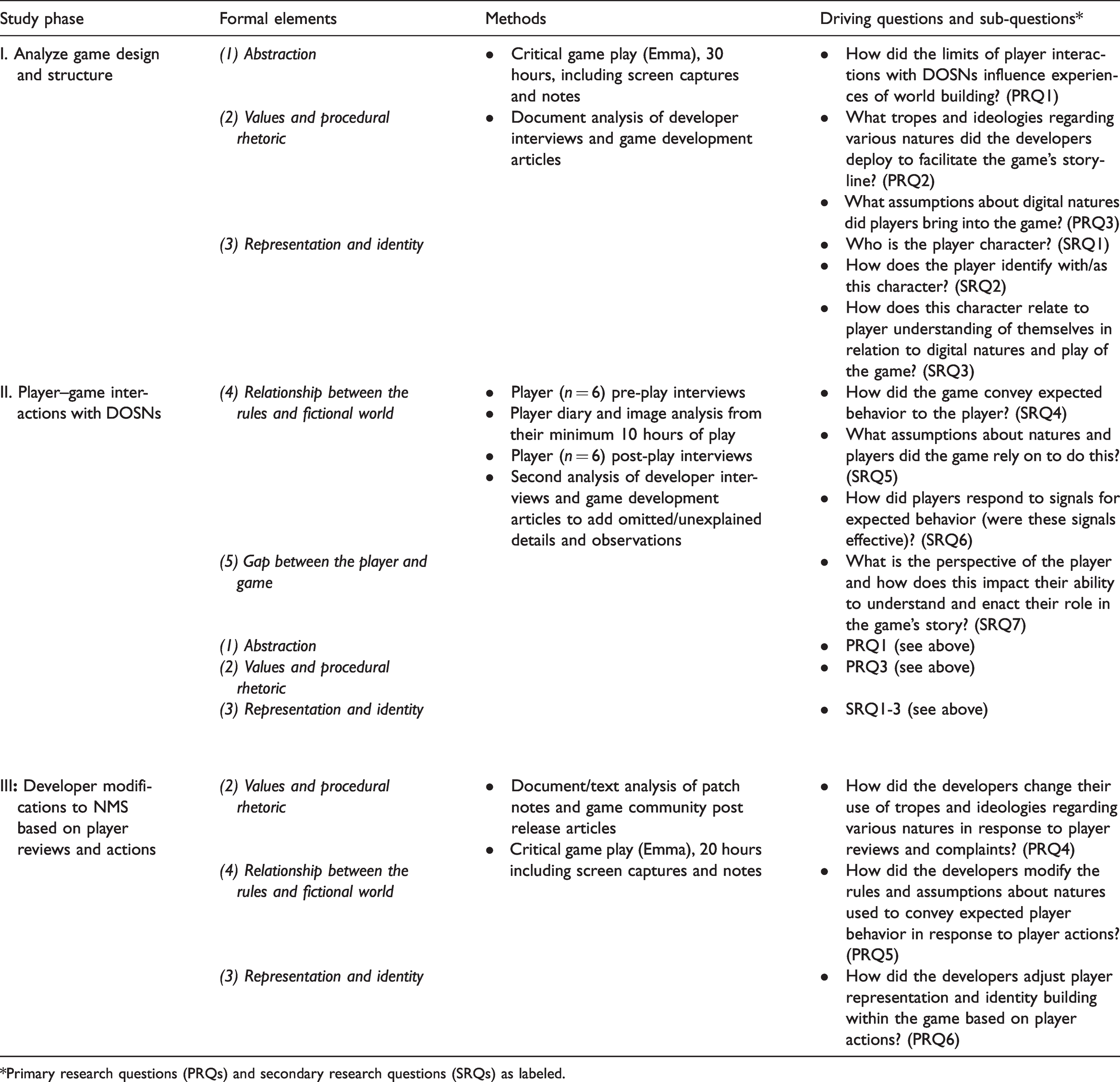
*Primary research questions (PRQs) and secondary research questions (SRQs) as labeled.
Our second research phase examined player interactions within the game. We recruited six adult self-identified gamers who play digital games regularly and are actively involved in gaming communities to play at least 10 hours of NMS and to record their reactions and experiences in text- and image-based digital journals. 4 Their ages ranged from 18 to 30 years, they had completed at least some higher education, and the racial and gender diversity of the group broadly reflected that of the larger gaming community. They primarily played action–adventure games, real-time and turn-based strategy games, and massively multiplayer online games (MMOs). We conducted 30- to 90-minute semi-structured interviews with each participant before and after game play, asking what they had heard about the initial release of NMS, what they expected to experience, and what they actually experienced. We analyzed the resulting interview transcripts and player-created text and images regarding DOSNs iteratively in the context of our structural analysis of NMS. We noted convergences and divergences regarding player expectations of DOSNs, their experiences of and responses to DOSNs that scaled with relative ease, and nonscalable encounters that challenged their world-building capabilities. The results of this phase revealed world building failures at the two scalar extremes of the vast expanse of outer space and the individual, embodied player relating within complex biomes.
Our third research phase focused on how the developers changed the game to improve world building, and whether and how they addressed nonscalability. We conducted a document analysis of the patch notes from each NMS update released between August 2017 and November 2019. Emma played through these updates for a further 20 hours, recording screenshots of different planetary landscapes, game stages and instructions, and dashboard content, noting the level of detail provided at different scales of the game. Our results demonstrate the importance of both gamers’ and game developers’ assumptions and strategies regarding ecological processes, game physics, and issues of embodiment at different DOSN scales.
Findings: Being disembodied in nearly-infinite DOSNs
As a small British indie game development company founded in 2008, Hello Games released its first game, Joe Danger, in 2013 as a side-scrolling game with platform and racing components, in which the player plays as the daredevil titular character (Hello Games, 2013). Their most recent game, The Last Campfire (Hello Games, 2020) is a puzzle game in which the player is a small sack-like creature lost between worlds who must help other lost souls to move on while searching for a way back to its own world (Barbosa, 2020; Watts, 2020). This game offers a vibrant world similar to that of NMS, but with a smaller narrative scope that provides emotional depth, a clear goal, and beautiful, surreal aesthetics celebrated in recent game reviews (Ibid.). In contrast with Hello Games’ other titles, NMS is significantly larger in narrative scope, ambition, and technical complexity due to its use of procedural generation and the stress that Sony’s promotion fomented.
The universe-sized NMS game space does not require each game element to be stored on a player’s computer for processing through the computer’s memory and graphics processing unit. Instead, game elements are generated using a “seed” (pseudorandom number) upon launching the game. According to Khatchadourain (2015), The seed defines the over-all structure of the galaxy, and the random numbers spawned from it serve as digital markers for stars. The process is then repeated: each star’s number becomes a seed that defines its orbiting planets, and the planetary numbers are used as seeds to define the qualities of planetary terrain, atmosphere, and ecology … the system combines entropy and structure: if two players begin with the same seed and the same formulas, they will experience identical environments.
Procedural generation could, therefore, technically cocreate nearly infinite DOSNs. In the initial NMS release, players could only experience the game through a first-person perspective, without any sense of or reference to one’s digital body. Players lacked an explicit origin or contextualizing story other than having crash landed their ship and pursuing three basic categories of activities: resource extraction, navigating to other planets, and discovering and naming flora and fauna. Players being from nowhere, without a body and with no larger purpose at scalar extremes—unable to world build—meant that they quickly stopped playing the game. Both nonscalability and scalability can contribute to successful and unsuccessful world building. We read players' experiences of world building in NMS for scalability and nonscalability and illustrate how these concepts map unevenly to each other.
Frontier narratives in quasi-infinite DOSNs
Sean Murray, the lead developer of NMS, drew from his childhood experiences in the Australian outback as he designed the game to make players feel alone and insignificant (Hall, 2017). He and his colleagues also invoked emotive frontier imaginaries and enduring settler–colonial desires for outer space exploration. The online game description (Hello Games, 2019a) invokes a limitless frontier: A truly open universe: If you can see it, you can go there. You can fly seamlessly from the surface of a planet to another, and every star in the sky is a sun that you can visit … Exploration is seeing things that no-one else has ever seen before. Every creature, geological formation, plant and spaceship is unique … Survive on a dangerous frontier: You are alone and vulnerable, and will face threats everywhere, from deep space to thick forests, barren deserts to dark oceans.
Players were drawn to these discovery narratives, but during actual play, the structure of the game confronted their desires. The promise to “explore uncharted solar systems and catalogue unique new forms of life … never before encountered” rang hollow when players found “the same” flora and fauna on planets with vastly different ecosystems. Participants expected to encounter completely different species of flora and fauna on a planet with icy tundra and on a different planet with tropical forests. To their disappointment, these life forms seemed to be “the same” but with different names (see Figures 1, 2, 3(a), and 3(b)). Julian explained:
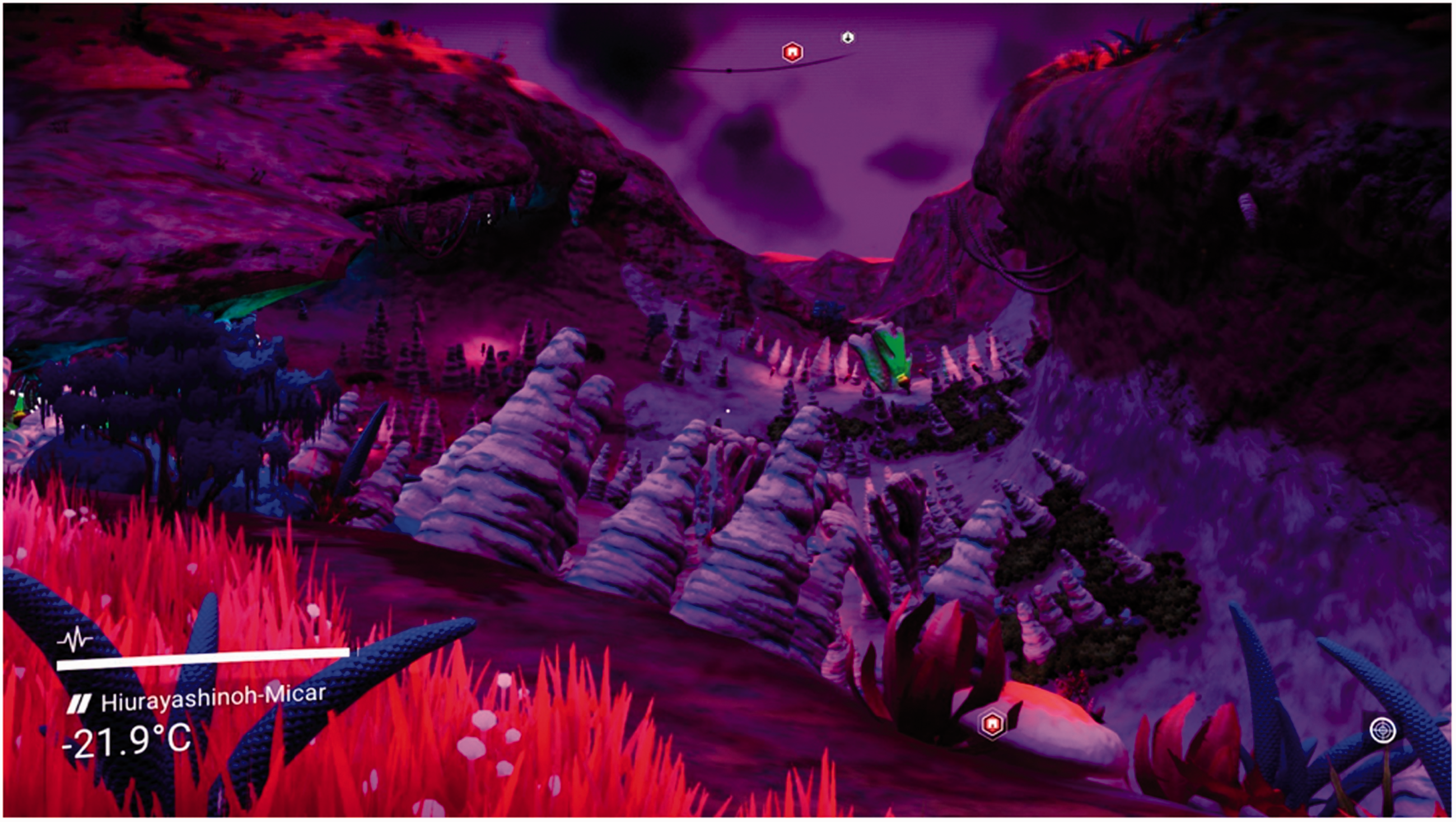
Screen capture of glowing flowers on a planet explored by Emma (Hello Games, 2016a, Fair Use).
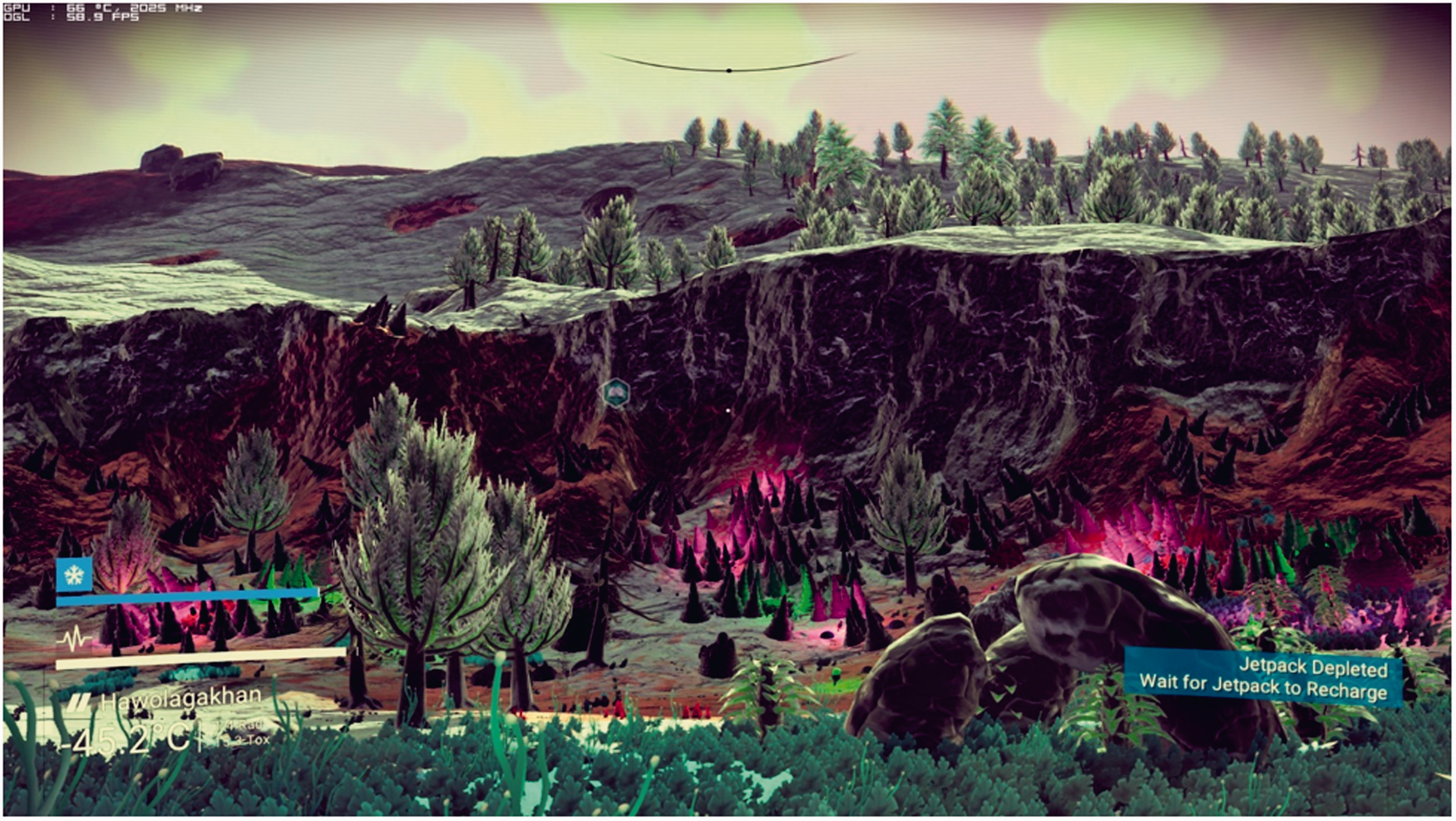
Screen capture of glowing flowers on a planet explored by Julian (Hello Games, 2016a, Fair Use).
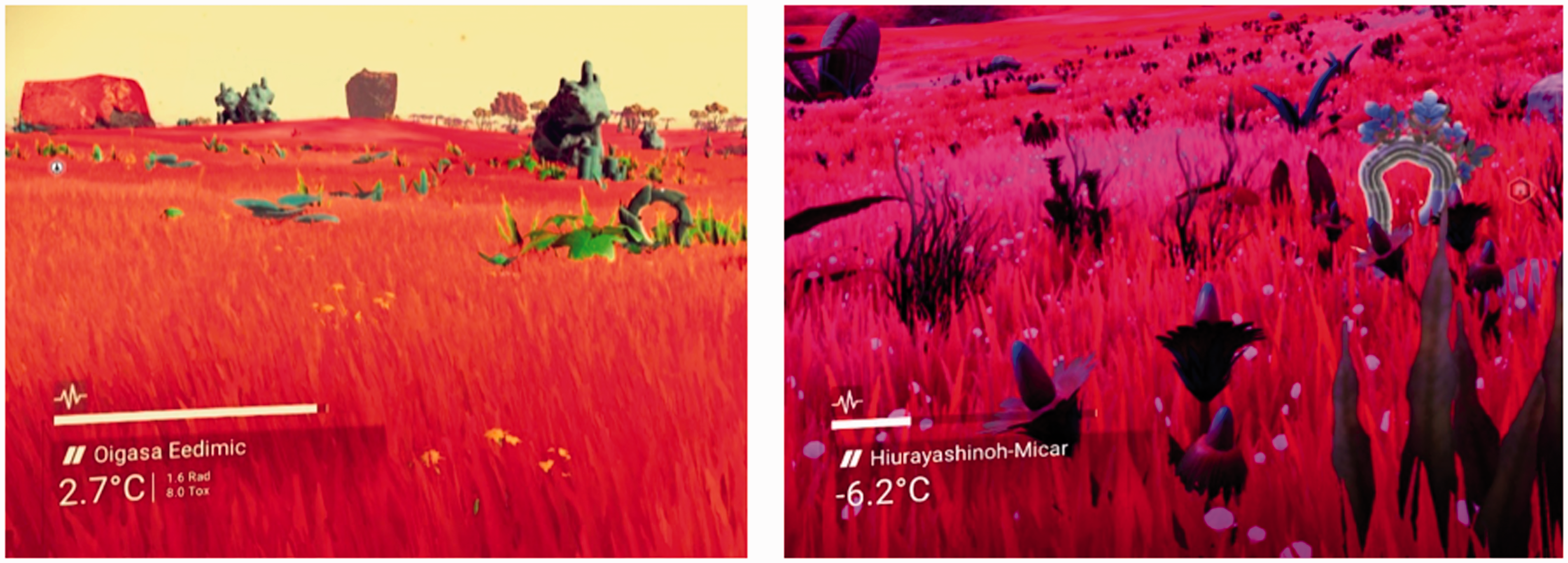
(a) Screen capture of a plant (upper right) on a toxic planet explored by Jake. (b) Screen capture of “the same” plant (upper right) on a planet explored by Emma (Hello Games, 2016a, Fair Use).
The jungle world was probably the best because there was the most teeming amounts of life everywhere. And yet, it still had caves and in the caves, there was still these pink or green or yellow flowers that gave off light and as you destroyed them they still gave you the same resource, atrium … There was this one bloody plant, that looked like this large fiddlehead that would always whip you as you walked by it on every single planet. It was always the same green, but it always had a different name. Even on the snowy Hoth world, there would still be this whip-like thing that would just get you as you walked by … Everywhere I went, I got my platinum from the same blue flower, I got my [Thamium] from the same red flower. 5
Val agreed: “it was just all the same … Even if they were different they were still the same.” Jessica explained, “the planets were all very, very similar. Even the climates … they all kind of reminded me of neon Dr. Seuss.” Several participants also lamented the fact that every planet consisted of only a single climate and a couple of ecosystems. No participant encountered a planet containing both frozen landscapes and humid jungles.
Though technically unique in NMS, every creature derives from the same set of base templates, which might—as is the case on Earth—lead to subtle differences that are not apparent to most players. The resulting game ecosystems contained life forms that originated with the same few hundred “ancestors” or base archetypes (Duncan, 2015). The mathematics and algorithms used to build NMS were based upon concepts in astrophysics, meteorology, geomorphology, and plant genetics (Khatchadourain, 2015; Morin, 2016). The scope of NMS is what makes its use of procedural generation unique. Not only has it managed to prevent a devolution into chaos—common in uses of procedural generation—but the player can explore everything generated (Chang, 2019; Fernández-Vara, 2019; Khatchadourain, 2015; Peckham, 2016). To do this, the artists created basic architecture for all elements of the game based on mathematical theories such as Astrid Lindenmayer’s (1968a, 1968b) L-systems Theory (Khatchadourain, 2015; Morin, 2016; Warren, 2015). The algorithms randomly mutate the architecture based on a set of rules (i.e., trees must have a trunk, branches, and leaves, and animals must have skeletons) to create new flora, fauna, atmospheres, and planetary climates (Khatchadourain, 2015; Tach, 2015).
Earth physics also informed the algorithm that generated the game’s planets. Planets positioned closest to their sun had hot, arid landscapes. Planets further away from their suns had frozen or tundra-like landscapes and those positioned between these extremes were most likely to support abundant life (Wiltshire, 2015). These programmed instructions extended to moisture content and sky color, depending on the particles in the atmosphere and the type of star at the center of each solar system, with wildlife tailored to these guiding planetary attributes (Wiltshire, 2015). Planets programmed with a “hostile” environment featured fauna with “hostile” spikes and horns (Duncan, 2015). Such ecosystem detail largely went unnoticed by players in our study and by many of those posting NMS reviews in gaming forums.
Players were willing to have their desires for an interplanetary existence confronted in limited ways, and they held contradictory expectations of DOSNs. For example, participants expected species, ecosystem, and landscape variation to be displayed as variations in color, regardless of whether such color combinations violated principles of the physics of visible light. The algorithms that generate the colors of the planets and their environments in NMS rely on principles of the physics of light refraction. Artists and programmers considered which gases and particles reflect or emit which wavelengths in order to make planet atmospheres with different colors (Morin, 2016). The planets and their flora and fauna have color palettes with allowable variations in hue, tint, and shade (Duncan, 2015). The algorithms that make them include rules for understanding basic color theory so that procedurally generated planets have flora and fauna that cohere with the local environment in ways that appeal to gamers (Duncan, 2015; Tach, 2015). Changing the color of a digital landscape can fascinate and excite players while allowing them to easily reproduce relationships with others through familiar categories. Eddie explained: I feel like plants are kind of like this universal thing. Like, grass is grass. You can make grass purple, but it’s still really its grass … Beyond them being different colors … there’s not a whole lot you can do. If a planet supports life, that’s what we think life is going to look like.
By providing a minimal storyline, developers of the game also assumed incorrectly that players’ desires for exploration and discovery of exotic outer space worlds would be sufficient to sustain their interest. The promise of an endless frontier became boring. Julian felt like “a bystander in a functioning system that would go on playing itself without you” noting that in MMOs: You can have a direct impact on what is going on around you even though the game itself is enormous and can take a ton of time. [NMS is] just too big and the player doesn’t have enough impact on where they are or on the settings. I don’t know, once I left a planet there was no point to ever go back to it even though I had named everything on there.
The game’s developers also translated player time into game time for space travel and resource extraction poorly. These actions advance a game’s storyline or broader purpose. In the contemporary gaming market, players can access more content—within quite specific gaming genres—than they can feasibly experience in a long lifetime. On the Steam platform alone, which distributes more than 30,000 games, there were over 8,000 games released in 2019 at an average of 176 games per week (Galyonkin, 2019; Meer, 2019). With abundant content availability, players develop preferences regarding the kinds of affordable gaming experiences worthy of their time. NMS was the first game to offer endless content within a single game, but its developers failed to consider rapidly changing player preferences regarding time-worthy play. Regarding travel time, Petra explained her experience: “ … So, you see something and it’s … 10 minutes away, and you’re like ‘oh cool, 10 minutes in the game, that’s nothing, right?’ No. No, they mean 10 real minutes” (emphasis hers). NMS provides a shortened sense of the time required to travel vast distances between planets in players’ quests for ever more frontier discovery, but not short enough. This is a key temporal scalability issue in that NMS devalues the player’s time, which is also a way of impeding world building.
In digital games, resource extraction often facilitates a player’s progression through the game’s story. Natural resources serve as raw material for crafting and upgrading tools, buildings, modes of transportation such as spaceships, and other strategic items, allowing players to expand their capabilities. Players refer to the process of repeating actions to progress in a game as “grinding.” Julian complained: … you go to a planetary system [and] you scan the planets. You see what has the mineral that you need. You go down and you get the mineral. Maybe there’s other minerals or elements that will sell on the auction house but that’s it. That’s the entire game … You might not be able to do it in one planetary system, but when you do get to the center there’s no ending. It just sticks you back on another world, somewhere else and says alright, start over. There’s no point. There’s no end game.
Nonscalability and interplanetary digital bodies
World-building failures in NMS also occurred at the level of the body. Until the 2018 release of the NMS NEXT update (1.5) the game did not give the player an avatar: a digital body that the player chooses or creates to represent them in the game. Players experienced the game in first-person perspective with the computer screen serving as the player’s eyes. Thus, a player never saw their in-game body, with their in-game identity entirely up to the player’s imagination. Players relied on other game elements to locate and contextualize themselves within the game, especially players’ interactions with the game’s digital environment.
Participants in our study complained that the NMS game environment did not operate according to consistent applications of physics. They were most concerned about gravity not being universally applicable. For example, Julian remarked: When there were big pillars of like the blue [heridium] or gold or copper, and then you cut just the bottom out, the whole thing would just stay floating in the air. There was no gravity and yet if I jumped into the air with my jetpack, gravity would always bring me right back down … it was a little janky with gravity (see Figure 4). Screen capture of a mined heridium tower with a floating piece (upper center) by Emma (Fair Use).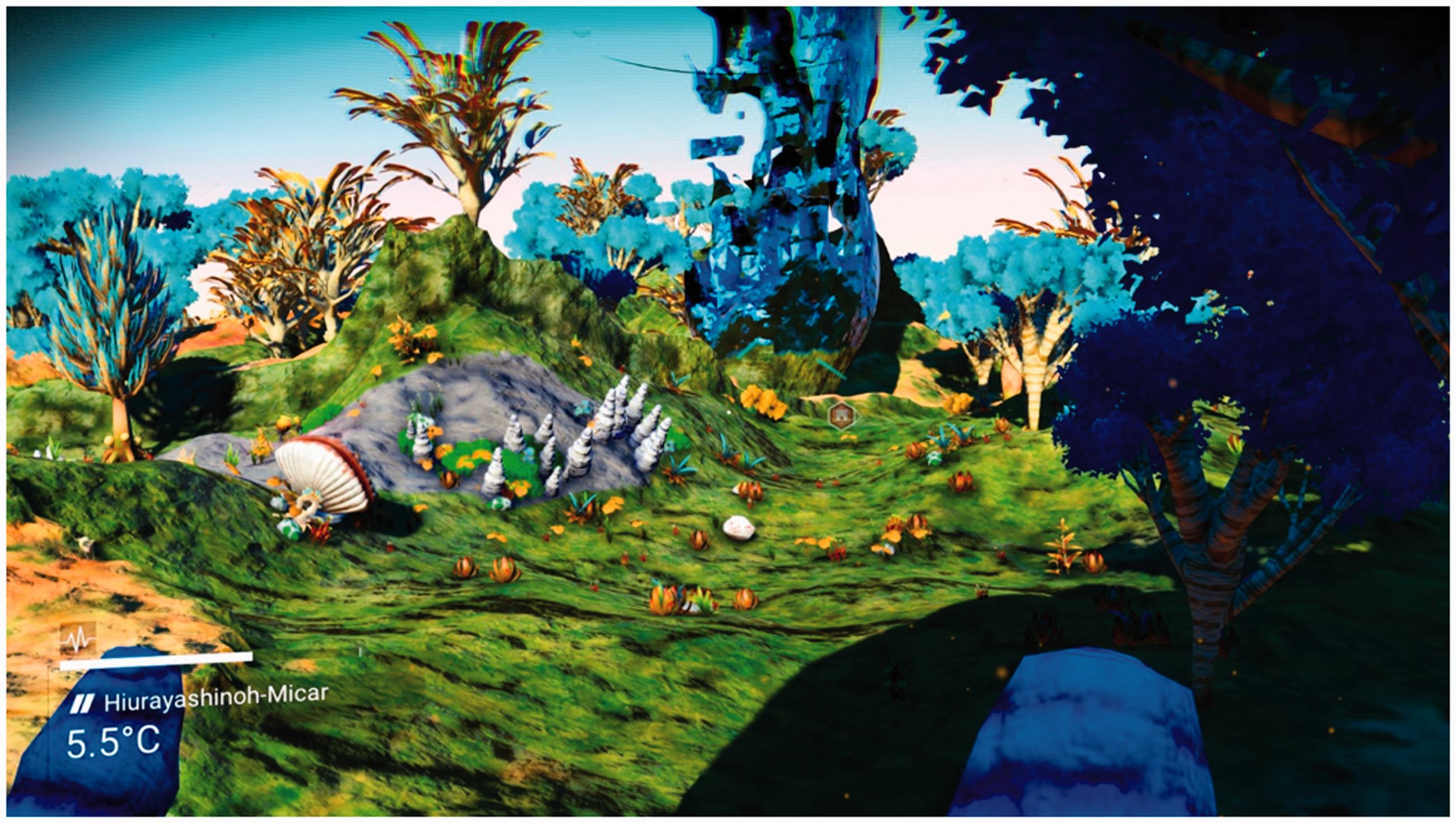
Physics in online games are controlled by a set of mathematical equations that determine how objects interact with each other (Eberly, 2004). The more complex the movement of objects the more complex the mathematics required to define how those objects relate and interact (Eberly, 2004). Game physics govern how objects move, gravity, friction, and what happens when objects collide (Eberly, 2004; Millington, 2007). The game must specify which object is being acted upon and the requisite inputs for physics calculations (Millington, 2007). If a player throws a ball, the physics engine will calculate the gravity, force, and velocity only if it can identify the object and its necessary attributes such as its mass. In most games, the physics engine applies calculations within a skybox: a cube that contains the illustration of the game within which the player plays (Morin, 2016). Players always view the game environment through the skybox, moving between skyboxes to simulate changes such as day and night. Physics engines in skyboxes require a significant part of the landscape to be pre-generated in order to perform calculations such as water flow (Khatchadourain, 2015). NMS cannot operate in this way because the player must be able to move between billions of environments created on the fly requiring equally nimble game physics (Morin, 2016). These rules and algorithms must jointly navigate the problems that arise from the procedural generation of the game elements (Hall, 2017; Khatchadourain, 2015; Morin, 2016; Whittaker, 2015). The sheer scope of NMS required considerable innovation to calculate and render physics within the game, yet participants in our study experienced the physics as incomplete or incongruous.
Some of the physics and gravity issues occurred because players did not have an avatar to illustrate their relationship to game environments, and they had trouble understanding how their body related to, and could interact with what was around them in the initial game release. The lack of an avatar also left players without a distinct way of knowing themselves in the game. In an interview in The Atlantic (Morin, 2016) NMS lead developer, Sean Murray, stated: In most games, you begin by choosing a character … but that might be before you decide how you really want to play. We want to let people have their imagination. They can be whoever they want to be. They might be an alien if that’s what they want to believe. I quite like that.
‘Fixing’ DOSNs nonscalability
The world-building failures of NMS at the scalar extremes of a vast outer space frontier and of player bodies embedded in complex ecosystems, guides our analysis of game developers’ chosen improvements to NMS’ game physics, embodiment, and ecosystem generation. By selectively ‘fixing’ problems and by specifying elements previously left to the player’s imagination, the game’s developers improved players’ world building while also curtailing other nonscalable possibilities for co-generated DOSNs. Player desires for and assumptions about DOSNs confronted the limitations of a procedurally-generated universe. For example, the Pathfinder (1.2) update enabled players to co-build communities in NMS, increasing the potential for nonscalable encounters that facilitate world building (Hello Games, 2016b). When NMS developers announced plans for the Atlas Rises update (1.3) in August 2017, players realized the update would use a new “seed,” which would not remove player-generated content but would rebuild the entire universe (e.g., planet locations and characteristics) (Hello Games, 2017). Archaeologist, Andrew Reinhard (2017, 2018), studied the Legacy Hub, the abandoned original home of the Galactic Hub, a player-built community in NMS with its own government, laws, capital planet, and economic and social structure. The Hub player community hosted events to celebrate their many creations and made plans for the looming “end of the world” update (Reinhard, 2017, 2018). The entire Hub moved to a new star system abandoning the player-made content on the Legacy Hub (Jackson, 2017). The Hub’s capital planet transformed from a tropical paradise into a frozen wasteland, and the Hub’s community mourned their co-created places and the extinction of fauna in the digital landscape, yet that remained in their records of prior discoveries (Reinhard, 2017). The story of the Galactic Hub is a story of a digital culture living a nonscalable digital interplanetary existence in a broader context of ongoing extinction debates in the Anthropocene.
The July 2018 NEXT update (1.5) added the choice of first-person or third-person player view and appearance customization, including choice of “race.” In his review of this update, Justin Clark (2018) notes, “the third-person camera not only grants the game a sense of scale, but also gives you a better understanding of exactly who you are in the universe.” This change improved world building by contextualizing the player within the game DOSNs and story. The developers added hazardous flora, improvements to animal behavior algorithms, and unique resources and weather phenomena based on planetary biomes, which developers claimed, “is more diverse than ever with colour palette variety, dense forests and large trees … ” (Hello Games, 2018a). The update added multiplayer capabilities and the chance to “excavate buried ruins … to unearth locked ancient treasures” (Hello Games, 2018a). The November 2018 Visions update (1.75) produced new lifeform categories such as “strange alien rock creatures” and a more “diverse set of science fiction aesthetics” (Hello Games, 2018b). The updates diversified the DOSNs while retaining the scalability of the algorithms, which improved world building within a sustained narrative of colonial encounters with others.
According to the developers, the August 2019 Beyond update (2.0) was the largest since the game’s initial release (Hello Games, 2019b). It included NMS Virtual Reality (VR), which provides further embodied connection for players in co-generated DOSNs (Hello Games, 2019b). Players can participate in an in-game social hub, visit each other’s bases and embark on joint missions as they enjoy new technologies, recipes, planetary charts, and a galaxy map “added to alleviate grinding” (Hello Games, 2019b). Creatures can be tamed with bait, some can be ridden, and others “peacefully harvested” for products (Hello Games, 2019b). Industrial bases extract resources while the player is offline and run on “fueled biogenerators, or self-sustaining solar panels” (Hello Games, 2019b). Through these updates, the developers introduced nonscalability in ways that ensured successful world building by taking on some of the labor of the resource “grind,” enabling team play and allowing players to build a home base and more meaningful relationships with each other and with NPCs. Recent reviews of the game are largely positive. 6 These updates and subsequent player and reviewer responses address some of the more popular player feedback and concerns by adding more nuance and complexity, but they do not change the fundamental frontier narrative of NMS. By adding more opportunities for diverse encounters, yet refusing to change the core premises of the game, the developers are attempting to rectify player desires for successful world building through nonscalable phenomena and relations within a digital game project that insists on the scalability of DOSNs more broadly. Finally, in our review of the developer updates to NMS we did not find examples of world-building failures resulting from scalability or nonscalability. Again, we—and other players—may not have noticed these.
Discussion
Compelling games make space for nonscalability through successful world building where the player feels like they can transform worlds and be transformed through meaningful and purposeful relationships. The game’s nearly infinite DOSNs undermine players’ ability to transform worlds relationally (e.g., nonscalability). The NMS algorithms operate in the same way for a single planet as they do for a universe of 4 quintillion planets. In the initial release of NMS, players became modularized components of a scalable system. They were insignificant, “abstract labor” (Tsing, 2019: 156) reproducing narratives of expansion and “growth” (until updates allowed for multiplayer community formation and improved world building). Tsing (2019: 145) argues that “scalability is possible only if project elements do not form transformative relationships that might change the project as elements are added … Scalability projects banish meaningful diversity, which is to say, diversity that might change things.” Developers and players require some scalability to enable them to satisfy their desires for exploration, resource discovery, and extraction, yet NMS also illustrates how to render colonial tropes of discovery and extraction as boring (offering a brief opportunity for some players to question the desirability of such colonizing tropes).
While Tsing’s (2019) discussion of nonscalability draws from the material and critical history of earthbound colonial sugar cane plantations, scalability, and nonscalability are also useful concepts for studying what DOSNs do in digital games. Tsing describes the aesthetics of scalability by referencing scalable pixels. Pixels, however, are only the visual representation of a digital environment, and do not encapsulate the entirely of the digital realm where digital natures are proliferating. We argue that nonscalability theory would benefit from a more robust engagement with the digital. NMS initially flopped because it was too scalable and because it challenged players’ expectations about interplanetary existence to such an extent that they were not able to engage in world building until the developers updated the game and introduced limited forms of nonscalability.
Players having avatars and a sense of digital embodiment is essential for nonscalability and world building. Feminist geographers, feminist political ecologists, and others note the centrality of the body in place making (Gururani, 2002; Harcourt and Nelson, 2015; Longhurst, 1995; Nightingale, 2011; Rose, 1995; Sundberg, 2004) which we argue extends to digital bodies co-creating DOSNs. The generalness of outer space or interplanetary existence became both meaningless and boring without the specificity and perceived relevance of the embodied individual in NMS. World building in digital games is a project of subject making through particular desires (Boellstorff, 2008). Player disappointment in NMS stemmed largely from world building failures that were a combination of player expectations of and desires for outer space natures, the application of game mechanics, and the extreme scalability of NMS. Nonscalability theory is an anti-colonial theory. In studying DOSN nonscalability in NMS, it is not our aim to declare this game as good or bad by highlighting the coloniality of NMS. Rather, coloniality is the context of much of the gaming industry (see Byrd, 2018), of many outer space exploration projects, and of Tsing’s argument about scalability and nonscalability. We are most interested in what procedurally-generated DOSNs do in terms of the digital “naturecultures” (Haraway, 2016) that emerge during play.
Conclusion
There are several promising implications of our analysis. We extend the fairly narrow treatment of nature in digital natures political ecology scholarship to include DOSNs, and we call for further feminist scholarship on digital natures that draws from game studies and other approaches. What has changed since the feminist interventions of Merchant, Haraway, and others is the substantial role that digital natures play in emerging understandings of environmental politics and more-than-human worlds. We agree with Chang (2019: 144) that, “As Tsing [2013, 33] cautions, and games effectively teach us, ‘we might not always be in charge. We might get to know other-than-human worlds in which we participate, but in which we don’t make the rules’.” Chang (2020) is hopeful that projects such as NMS, “demonstrate the potential for media to provide the intellectual and aesthetic interface between widely separated scales of activity and domains of knowledge” (p. 103), and “in the place of action, speed, and god’s-eye surveillance, games may also invite you to feel small, do little, and take your time doing so” (p. 71). We are disappointed, but not surprised by the choices made by NMS developers in their modifications to the game. We see the intersections of DOSNs co-produced in games as sites of troublesome and hopeful forms of “sf” for thinking and relating.
We also see an urgent need to trouble scalability projects such as NMS and contemporary space exploration projects through a feminist digital natures lens. We are interested in the emerging role of procedural generation in game design in the context of the contemporary space race. We are intrigued by the work of feminist STS scholars and political geographers that have elaborated how the Earth is a basis for imagining potential interplanetary human futures. We do not treat digital space as fully imaginary and Earth space as entirely material or non-imaginary. Geographers, STS, and other scholars have done extensive research on the material dependencies of digital space (see Chang, 2019; Starosielski, 2015) and of how Western scientists and others imagined the earth as a globe before photographs of earth from space were possible (see Cosgrove, 1994, 2003) and the impacts of these photographs on environmental thinking and action (Jasanoff, 2001). Our findings compliment the work of Messeri (2016) and Olson (2018), to illustrate some of the different expectations of what emerging outer space natures might become, as both extreme environments and as potentially knowable and livable places.
As for the limitations of this study, we did not ask how players saw their existence as interplanetary and we did not ask scientists working with NASA, SpaceX, or others to play NMS, but we think these kinds of questions are worth pursuing. Our analysis across multiple NMS updates reminds us that longitudinal digital research methods are also an area where a feminist digital natures approach would offer unique insights. We would have preferred to follow our participants longitudinally along with the game’s updates, to learn more about participant personal stories and experiences with the updated game versions, but this was not possible as ours was not a longitudinal study at the outset (given the initial flop, it was not clear that NMS would persist through as many updates and as it has). As feminist political ecologists, we also see VR technology as a fruitful future area of research on digital embodiment and digital natures. By way of concluding, we see great potential for analyzing the role of innovations in computing and game design in linking digital, outer, and earth spaces, which as other scholars have shown, bear significantly on our understanding of multiple worlds and natures.
Highlights
A feminist digital natures approach can inform debates about interplanetary futures. Digital games such as NMS coproduce DOSNs. Digital natures exhibit nonscalability despite their assumed scalability.
Footnotes
Acknowledgements
The authors thank Lesley-Ann Dupigny-Giroux, Brandon Ogbunugafor, Natalie Koch and Harlan Morehouse for feedback on earlier versions of this article. We also thank Pablo Bose for introducing us to this game and providing a copy for initial playtesting. We would also like to thank the player participants for their time and insights and the anonymous reviewers for their detailed and thorough feedback.
Declaration of conflicting interests
The author(s) declared no potential conflicts of interest with respect to the research, authorship, and/or publication of this article.
Funding
The authors disclosed receipt of the following financial support for the research, authorship, and/or publication of this article: Emma Tait received a College of Arts and Sciences (CAS) Academic Programs for Learning and Engagement (APLE) award (University of Vermont) to purchase copies of NMS for the research participants to play.
