




Abstract
We argue in this paper that what separates permissible from perverse acts of killing, or sex with, an animal is a matter of material and symbolic space. We focus on interspecies sex –which is often, but not always, bound up with killing –to argue that what separates permissible from perverse acts of interspecies sex in India, or husbandry from bestiality, is where it occurs geographically in proximity to an upper-caste, anthropatriarchal imaginary of a Hindu nation. We argue that the state-sanctioned abattoir and its breeding facility are spaces of normalized exception, in which anthropatriarchal violences are relatively permissible, and on the same grounds as in the “human” space of the home. We trace interspecies sexual contact across spheres of bestiality, animal husbandry, petkeeping, and population control. We conclude with a queer bestial ethics of avowal, one that dispenses with anthopatriarchal innocence towards a more capacious embrace of the panspecies desire for touch and thriving.
Introduction
On 8 May 2020, seven Muslim homes in Faridpur Kadi village in Uttar Pradesh were pillaged by police, just as the daily Ramadan fast was being broken. Police assaulted the villagers, overturned food, and destroyed property. Several men were beaten, and three were detained at the police station in nearby Bignor. The next morning the village sarpanch, Iqbal, went to the police thaana to retrieve the detained men. No charges had been filed, but when pressed to state the reason for the raid the police told Iqbal that they “came to the village on the basis of suspicion. They had been informed that a cow had been slaughtered” (Khan and Kashyap, 2020).
On 25 July 2018, a goat farmer named Aslup Khan living in the Mewat region of Haryana, came upon three local men taking turns penetrating one of his goats while five others watched. The men smashed the goat’s head against a wall and absconded (Dhankar, 2018). A group of villagers caught some of the men the following day and beat them; Khan, for his part, filed charges. But the matter did not rest there. The story of the “pregnant goat gang-raped by eight Muslim men,” as one headline had it (Meyjes, 2018), took on a global life of its own, propelled by the goat’s pregnancy, no doubt, and that the incident occurred in the only post-Partition Muslim majority region of Haryana state. #justiceforgoat trended, along with claims about the poverty, perversity, aimlessness, and backwardness of the men involved.
These two disparate narratives are united by a puzzle. In the first case, police justified their assault on the villagers by claiming a cow had been slaughtered. In a country in which approximately 39 million cattle are slaughtered each year for food and byproducts—around 170,000 per day—what could such an utterance mean? 1 What renders it sensible as a call to action? In the second case, both legal and vigilante procedures of redress were set in motion because a goat had been sexually violated. That goat was the property of a farmer, and her pregnancy—that which rendered her a uniquely sympathetic female subject to the public—was likely the result of artificial, or forced, insemination in the first place: a practice that over 500 million farm animals undergo in India every year. 2 What rendered this act of sexualized violence outrageous?
Anthropologist Timothy Pachirat begins his book, Every Twelve Seconds, with a similar question (Pachirat, 2013: 1–3). In Omaha, Nebraska, in 2004, six cattle escaped from a slaughterhouse holding pen, one of which—a cream-colored cow, as Pachirat describes her—could not be corralled. As she fled down an alleyway that led only to another slaughterhouse, she was trapped and then shot by city police, several times, as breaking workers from the second slaughterhouse watched in horror. This puzzle in Omaha sets up Pachirat’s book: how do we explain the anger that slaughterhouse workers felt at the killing of this single cow? What made this killing a minor American scandal? Pachirat’s answer is that the killing violated a central precept of modern industrialized slaughter in America: the requirement for opacity, such that no animal is “killed” all at once, but in pieces and fragments, all separable by space and a radically dispersed human agency.
Likewise, we argue in this paper that what separates permissible from perverse acts of killing, or sex with, an animal is a matter of material and symbolic space. 3 We focus here on interspecies sex—which is often, but hardly always, bound up with killing—to argue that what separates permissible from perverse acts of interspecies sex in India, or husbandry from bestiality, is where it occurs geographically in proximity to an upper-caste, anthropatriarchal imaginary of a Hindu nation. Our analysis is indebted to Gabriel Rosenberg’s (2017) “How Meat Changed Sex,” in which he argues that what separates animal husbandry from bestiality in America is not the acts themselves, but the animal’s relation to capital. 4 Capital is central to the story we tell here, too, in its uneven but consistent relationship to caste and communalism.
Also central to our narrative is a queer feminist analysis that emphasizes the inextricable workings of dehumanization, feminization, and e/masculation in India. Too often progressive Indians, including feminist queers like us, will respond to the casteist and communal scenes with which we opened this paper with a straightforward resolve: Let us eat more meat! Screw (pardon the pun) the animal! But among our arguments is that those opening acts of casteist and communal violence are generated precisely through the legitimation and intensification of animal agriculture, and the normalization of killing and interspecies sex in the meat and dairy industries. The Indian state since Nehru has carved out for itself a sphere of permissible killing and of interspecies sex, in the name of modernity and progress. There is nothing surprising there. What is important is something that feminists know well: that the carving out of a sphere of permissible and licit violence, via discourses of paternalism and nation, necessitates a sphere of illicit or perverse violence that then justifies its own vigilantism—also in the language of paternalism and nation.
We argue that the state-sanctioned abattoir and its breeding facility are like the home: spaces of normalized exception, in which anthropatriarchal violences are relatively permissible, and on the same grounds. 5 In both the state-sanctioned abattoir and the home, permissible violence, which therefore must not be named as violence, is imagined as: reproductive, Hindu national, symbolically central, natural or inevitable, and private. 6 For both, their constitutive sphere of perverse violence, which justifies their own existence as permissible and therefore must always be made to appear as violence, is imagined as: unproductive, anti-national, at a spatial remove, unnatural or coercive, and available to surveillance. 7 It is not incidental that Hindu upper-caste mobs commit lynchings of Dalits and Muslims in India over two perceived slights: the eating of (Hindu) cows, and elopement with (Hindu) women 8 . This coincidence that is not one is easily explained: both are violations—neither of cows nor of women—but of the sphere of permissible violence that is at the heart of Hindutva. To root out violence that cloaks itself as a moral response to perversity, it is the sphere of the permissible that must be undone.
To be clear, our approach to the acts that fall under the rubric of “animal sexual abuse (ASA),” is not to say, well, they are not that different from this or that practice, so it is foolish to take them seriously. Nor is ours a cynical practice of analysis that is content to point out the contradictions and unwitting complicities of those who attempt to speak from and for an ethical otherwise (Dave, 2017). We are each aligned unequivocally with the dismantling of human supremacy in ideology and practice. Our argument is simply that this effort in India begins with how human supremacy is instrumentalized by Hindu nationalism, such that animals become mere symbols among warring human factions, rather than subjects—even desiring ones—in their own right.
Bestiality: The unheard rape
In 2018, a group of Indian student-activists released a film directed by Pratik Rajankar (2018) about what they termed ASA. Bestiality: The Unheard Rape, in its 22 short but effective minutes, details six recent cases of ASA which were prosecuted by Mumbai-area NGOs. The film begins abruptly, with two middle-aged women sitting on a bed, facing the camera. One, petting a healthy white lapcat, says repeatedly, “she stopped walking. She just stopped walking.” She is referring to a street dog named Ruby who used to walk with a “swagger,” but whose spine was injured after being sexually abused. We see images of Ruby on a street, the fur shaved on her back end, evident injuries on her legs, attempting to walk, but she seems to have little control of what her back legs are doing—they follow her at an odd angle and every now and then collapse.
The film cuts to a female voiceover, accompanied first by the title screen and then by images of domestic animals. The narrator reads, Animal sexual abuse, often referred to as bestiality, is the sexual molestation of an animal by a human. This kind of animal abuse includes a wide range of behaviors such as vaginal, anal, or oral penetration; fondling; oral-genital contact; penetration using an object; and killing or injuring an animal for sexual gratification.
The second section of the film focuses on a narrative by Rinky Karmakar, a young activist with Save Our Strays. She’s sitting in a park in a red kurta on a sunny day. She is professional and resolute. Karmakar explains that ASA occurs in “secluded places, slums, and areas where the population is really dense.” As to why it occurs, she surmises: “Sexual frustration. Perverts to release their frustration.” Animal lovers, she says, “have kept vigil, trying to trap these people.” What disturbs Karmakar is that ASA preys upon trust and naivete. It is the friendly dogs that are usually victimized, she says. “They don’t mind if humans touch them, and they don’t know what is wrong and what is right.”
The film’s third section then centers on an assault that occurred in Vartak Nagar, a neighborhood north of Mumbai in Thane. A young female activist, Aditi, sits on the edge of her bed flanked by two lazing dogs. She describes receiving a call one night that a society watchman had sexually abused a neighborhood dog. As she talks, we see CCTV footage of the watchman taking the dog into a room and emerging nervously several minutes later. By the time Aditi arrived, accompanied by a policeman, a mob had begun to form. She explains their anger: “Today he is a raping a female dog … tomorrow, what if it’s a four-year old girl walking there, you know, or a boy?” The police took the watchman to the local thaana where Aditi and witnesses filed a first information report, or FIR, under Section 377 of the Indian Penal Code, also known as the anti-sodomy statute. The watchman was kept in police custody while the investigation was carried out; the dog, in the custody of the NGO. Ultimately there was not enough forensic evidence, and the watchman was set free.
The fourth section of the film focuses on Meet Asher, who is as an Officer of the Animal Welfare Board of India (AWBI) and an emergency responder for PETA. He speaks in hyperarticulate, staccato bursts, and is filmed standing outdoors in front of a stone wall. He narrates two recent cases of human sexual assault of dogs, one of which, like the case in Vartak Nagar, turned on CCTV coverage of a night watchman (rikshaw driver by day). But Asher reminds us, ASA is not limited to urban or suburban life. Large animals, particularly cows and buffalo, are common targets, particularly among those who work in tabela, or dairy farms. “The workers there,” Asher says, “usually come from different parts of India not native to that particular place. Because of a lack of family, they use animals for sexual pleasure.” As he speaks, we see grainy video of a man penetrating a buffalo in a pen. She kicks and resists, and the man backs away, appearing to buckle up his pants. But then he suddenly changes direction and begins again.
The fifth and penultimate part of the film centers on Shakuntala Majumdar, a longtime and well-known animal activist in Mumbai. Like Asher, she argues that dairy workers specifically, and migrant workers in general, make up the bulk of ASA offenders who are anyway “violent offenders, sex offenders, and the sexually abused.” 9 These men, Majumdar says, are “away from their families for a very long time… So I guess they have to go to somebody to fulfill their desires, and the animals are the least expensive, economical, and affordable means of satiating their lust.” Later, when talking about truck drivers who keep animals as sexual slaves, she says, “they are traveling, so obviously they cannot go to a prostitute or make out with anybody.” Interestingly, Majumdar anticipates the connection of bestiality with animal husbandry, but seems to pardon the latter as a sphere of permissible, ordinary violence that has only the consequence of being misappropriated for the perverse. “See,” Majumdar explains, “our animals are regularly artificially inseminated. They are used to being manhandled. And that is why they are accepting the act also. They think it is done, it is a done thing.” Like Karmakar, Majumdar laments the exploitation of animals made trusting and docile by human intervention. Ironically, the human interventions that render animals trusting and docile, and thus vulnerable to sexual abuse in this schema, are in the first place sexual in nature: street dog sterilization and livestock insemination.
Bestiality: The Unheard Rape is implicitly and at times explicitly premised on the distinction between permissible and perverse interspecies sex in India—that is, husbandry and paternalism from rape. The field of permissible interspecies sex includes animal husbandry and population control of pets and strays—one of which reproduces in the name of economy and nation, and the other which stanches reproduction in the name of the social. That sphere of permissible interspecies sex is bound up with a sphere of permissible sex in general, which in this schema is the home and the brothel, with the appropriate objects of wife and prostitute, both of whom are deemed in effect incapable of being raped by virtue of having “already consented” to belonging to the sphere of permissible violence. (We will have more to say about nonconsent and “innocence” below.) The field of perverse interspecies sex is defined by ASA discourse precisely by its distance from the sphere of the permissible. ASA occurs in secluded spaces, slums, and by those who come from “different parts of India.” The narrators, in contrast, stand in the sun or invite us, unselfconsciously, into a sphere of easy domesticity. Precisely because of the distance of ASA, symbolic and real, from the permissible, the sphere of the perverse demands surveillance—CCTV plays a heroic role in the film, as do those who lay in wait for offenders—which only reinforces the autonomy and deserved opacity of the sphere of permissible violence. The sphere of permissible violence is rendered as self-surveilling. The sphere of the perverse, on the other hand, must be surveilled from without precisely because it violates the geographies of permissibility. But this is how the perverse is rent from the permissible in cultural terms, and that, according to one 22-min film. How does law conceive the separation?
The unnatural, the nonconsenting, and the innocent
Section 377 of the Indian Penal Code of 1860, a remnant of British colonial governance, reads, “Whoever voluntarily has carnal intercourse against the order of nature with any man, woman, or animal, shall be punished with imprisonment for life …” In India as elsewhere in the British Commonwealth and beyond, sodomy laws perform this “double duty” (Rosenberg, 2017: 481) of criminalizing both homo sex and interspecies sex. If, as Colleen Boggs (2013: 106) argues, the advent of bestiality as a crime in America was a “founding moment for the criminalization of gays,” the braiding of sodomy and bestiality works the other way, too: as sodomy laws have been reformed in the last quarter century around the world to legalize same-sex sex, an inadvertent consequence has been the legalization of bestiality.
One of the barriers to the repeal of S.377 in India is that it is the only existing law with which to prosecute child sexual assault and sexual crimes between adults of the same-sex, including of trans people. 10 Sections 375 and 376 of the Indian Penal Code criminalize rape, but they are gender-specific statutes that only recognize cis women as perpetrators and cis women as victims. (They also do not recognize marital rape, an issue we will return to.) Because of this lacuna, queer activists petitioned only for a “reading down” of the statute in order to decriminalize same-sex sex among consenting adults, while retaining the rest as sex crimes.
In March 2000, a recommendation was made by the Law Commission of India to make S.375 gender neutral, which would allow for a striking of S.377 in its entirety. Aware that this left bestiality unaddressed, the Commission stated, “The only content left in Section 377 is having voluntary carnal intercourse with any animal. We may leave such persons to their just desserts” (Law Commission of India, 2000: 35, emphasis ours)—a sentiment that reveals how interspecies sex outside of husbandry and paternalism is either exaggerated or dismissed as sexual depravity, leaving the animal, as ever, an absent referent.
In over 150 years of the existence of S.377, only one case of bestiality has made it to the official records. That was Khandu v Emperor, 1935, in which Khandu was arrested but later found not guilty of inserting his penis into the nostril of a bull. The case reached the courts because the police followed the logic laid down in the 1925 case of Khanu v Emperor which clarified that an unnatural act under 377 is penetration of an orifice that does not lead to procreation. 11 This of course is important for our story. What is also key is the irrelevance of consent to the statute: nobody cared whether the bull minded or did not mind having a penis in his nose. This might sound either flippant or ridiculous or both, but it addresses a presumption at the heart of sodomy law, human and bestial: one cannot consent to an unnatural (penetrative but non-procreative, non-conjugal) act, because it is by un/nature irrational (Bhaskaran, 2005). 12 Both actors of an unnatural act, in the Judeo-Christian moralism of sodomy law, are co-conspirators rather than perpetrator and victim (Rosenberg, 2017: 479). 13
Nevertheless, 70% of animal sexual assault cases are filed in India under what remains of S. 377. In 2018, in the celebrated Navtej Johar decision, the Supreme Court of India carved out a sphere of sodimitic permissibility: that between consenting adults, in private. Bestiality and other non-consensual sodimitic sex remain criminalized, but it was not always clear to animal rights activists that this would be so. A week before the Navtej judgment was announced, PETA petitioned the Ministry of Home Affairs seeking to retain the criminalization of bestiality. As Rosenberg (2017: 481) shows for America, efforts by animal welfare groups to recriminalize bestiality in the face of overturned sodomy law have largely sought to reframe the problem from one of zoophilia/bestiality toward animal sexual assault. PETA, interestingly, did not take this approach. Perhaps playing overly safely in India, where animal neglect and abuse might appear by Western standards ubiquitous, PETA emphasized instead the spectacle of sexual perversity, resorting to the argument in which abusers “may move on to unleashing their cruelty on humans,” and where criminalization will protect “our beloved citizens” (Valliyate, 2018).
Local Indian animal organizations, such as the ones featured in the film, have approached the problem differently, focusing on the uniquely violent nature of ASA. What renders ASA uniquely violent for them—never merely zoophilic, never merely a harbinger, and always coercive— is the belief that animals cannot speak and therefore cannot consent to sex with humans. Numbers regarding animal sexual assault are hard to come by. The National Crime Records Bureau doesn’t keep statistics related to criminal acts against animals (animals are, in other words, not a class of victims). And yet organizations including Voice of Stray Dogs (VoSD), the Federation of Indian Animal Protection Organizations (FIAPO), All Creatures Great and Small (ACGS), and independent researchers, have been collecting media reports, conducting interviews, and generating databases of ASA cases in India since 2014. 14 They are, many of them, predictably horrific—there are rapes of puppies, calves, dogs, monkeys, and goats. There are disembowelments, rods and screwdrivers, and sometimes simply male organs. The cases, also predictably, generate salacious media attention—there are migrants and minorities, college boys and layabouts. 15 It is, of course, partly the brutal nature of some of these cases that attract outrage and attention. But for animal activists, what unites all of these cases, regardless of the means or intent of intercourse, is this: “[ASA] is simply wrong because of the issue of consent. Animals can’t give consent to what people do to them.” 16
This is the crux of contemporary transnational formulations of interspecies sexual assault: that bestiality is by definition sexual coercion (Adams, 1995); or, as Rosenberg (2017: 482) puts it, that “nonabusive sex with animals is impossible.” As to why, Piers Beirne (2001: 50) a criminologist of interspecies sexual assault, argues, “Bestiality involves sexual coercion because animals are incapable of saying yes or no to humans in forms that humans can readily understand.” He adds, “For consent to be present, both participants must be conscious, informed, and positive in their desires” (Beirne, 2001: 50). Indeed, Bestiality: The Unheard Rape, ends with these words: “Let’s keep this conversation going on behalf of all the four-legged victims who cannot speak for themselves.”
Are animals incapable of being positive in their desires? Are they incapable of saying yes and no in ways that humans can readily understand? The documentary, Zoo, about zoophilia, centers on a horse, Strut, who fucks a man with gusto, and then so clearly enjoys being fellated by a mare that animal welfare workers castrate Strut, lest his sexuality again lead him astray: Strut’s were, until his forced castration, positive and precise desires. 17 And although we didn’t mention this at the time, Bestiality: The Unheard Rape opens with a voluble rejection: the healthy white cat sitting on the speaker’s lap is mewing with decisiveness, straining visibly to free herself from her cozy human gaol. The speaker only tightens her adoring grip, a clear response to the cat’s clear speech, and the animal intensifies her straining and mewing until she is finally freed. Our point is not to cast aspersions on cat moms. It is simply to point out that of course animals speak, and do so in ways humans can clearly understand; but as with all subalterns who cannot speak, the problem is only with those who cannot or will not hear them (Derrida, 2011; Spivak, 1988). 18
The casting of animals as innocent is never an innocent gesture: it constitutively produces the sphere of permissible violence against both animal and human subjects. 19 Innocence is construed in two main ways within Hindu anthropatriarchy. The first kind of innocence we’ll call innocent but consenting. This is what morally constitutes the sphere of permissible violence, where refusal is unthinkable. 20 The second kind of innocence we’ll call innocent and nonconsenting. This is what morally constitutes the sphere of perverse violence, where refusal is inutterable. Please see Table 1.
Many of those who argue on behalf of ASA innocently produce this second kind of innocence, innocent and nonconsenting. Here, innocence is conflated with speechlessness (in which “no” is inutterable, either because it is physically unsayable or culturally unhearable, or both), which in turn is conflated with a lack of physical and sexual agency which renders the non/subject docile even if nonconsenting. The innocent-but-nonconsenting non/subject is defined strictly by her distance in space from the sphere of permissible violence, which is to say, not by any inherent quality of her own. She has usually been forcibly wrested from that sphere (a perversity) which, in turn, justifies its own permissible violence: avenging the raping of cows, the killing of pregnant elephants, or the elopement of women. 21
In the sphere of permissible violence animals or women are variously construed as innocent but consenting, where refusal is unthinkable. “Consent” is imagined through the language of sacrifice and “patriotic motherhood” (Hansen, 1999: 98)—as well as, often, a biological predisposition to be worked, killed, penetrated, or all three (Adams, 2015 [1990]; Dave, 2019; Hochschild, 2012; Martin, 2001). Refusal is unthinkable because of those predispositions, in which refusal to be worked, killed, or penetrated would constitute a breach of subjectivity, and thus of the innocence bestowed by virtue of that subjectivity. This kind of innocence is defined by proximity to the sphere of permissible violence: that is, by originally being where one is supposed to be.
For both figures of innocence, innocence is not protective. On the contrary, innocence carves out an opaque sphere of permissible violence precisely on the grounds that the innocent non/subject needs protection and cannot speak for themselves (see Ticktin, 2017). Insofar as innocence is determined as an inability to consent (whether because refusal is unthinkable or unutterable), innocence marks an absence of reason (Heidegger, 2001 [1983]) and an absence of a desiring interiority (Rosenberg, 2017): in other words, a deficit of personhood—the basis of killability/rapability itself. Innocence prepares the body for violence by constructing it as less than human. And innocence prepares the body politic for violence by constructing it as the guardian of that innocence. 22
The agricultural (and marital) exception 23
India wrested its own independence from the guardianship of British Empire in 1947, owing much to the nonviolent revolution led by Mahatma Gandhi. The first prime minister of the new nation, Jawaharlal Nehru was a friend and comrade of Gandhi and influenced by his philosophy of ahimsa, or non-injury. As Florence Burgat (2004) has noted, Gandhi’s conceptualization of ahimsa—particularly toward animals—was a lifelong struggle of resolving both personal and national contradictions. The interdiction against killing for Gandhi was nearly absolute. 24 But the problem of “harm” more generally—such as that required for animal husbandry—had to be balanced against the nation’s need for cheap and high quality milk, even though he remained deeply conflicted about dairy in his own life and experimented with abstention (Gandhi, 2016 [1927]; see also Roy, 2010). His compromise was to promote dairy in the national interest, so long as cows were sent to shelters, or gaushalas, rather than to the “butcher’s knife” to be slaughtered when gone dry. Gandhi’s butcher figure (kasai) is explicitly Muslim, and however much he protested communal violence as a means to protect cows, the effects of his so-called compromise was one in which Hindus reap the fruit of bovine labor so long as the cow is ultimately protected from Muslim men. 25
Nehru, too, had his compromise, though his was considerably more liberal than Gandhi’s. A self-avowed “animal lover” like most of his dynastic descendants, Nehru considered it a point of pride to pass a Prevention of Cruelty Against Animals Act (PCA). As Naisargi details elsewhere (Dave, 2014; see also Krishna and Gandhi, 2005) the bill was first drafted by Member of Parliament Rukmini Devi Arundale, a legendary beauty and Bharatanatyam dancer, theosophist, and animal activist so uncompromising she would rather go unwashed and with feet unshod than use soap or sandals made from animals. Nehru asked Arundale if she would allow him to sponsor the bill because the issue was so dear to his heart. Arundale acquiesced, but was surprised by what he introduced. Arundale drafted the bill to curtail animal experimentation and slaughter for food. Nehru’s version—the one that passed in 1960 and is still in effect—made animal experimentation and slaughter for food the two exceptions to cruelty law. 26 The PCA thus essentially defines cruelty—and we’re paraphrasing here—as “that which is wrong if it does not contribute to the accumulation of capital.” The PCA itself is pretty lousy in that regard, too: that which does manage to constitute cruelty, or “unnecessary suffering,” brings in only a Rs. 50 fine. 27
The Constitution of India demonstrates a similar ambivalence between wanting to claim a founding Hindu principle of non-injury along with the imperative for economic progress. As Yamini Narayanan (2018: 26) explains, Article 51A directs Indians to “cherish the ideals” that drove the Independence movement, citing as examples Hindu anti-cow slaughter agitations and the 1857 revolt which, long story very short, began as a revolt against invisible beef. The Directive Principles in Article 48 of the Constitution nevertheless prescribes that the State “organize agricultural and animal husbandry on modern and scientific lines and take steps for preserving and improving the breeds and prohibiting the slaughter of cows and calves …” Narayanan (2018) argues that these two articles are in contradiction (and that Article 48 is in self-contradiction). But we might say instead that one necessitates the other. In exceptionalizing interspecies sex for the purpose of scientific breeding, and exceptionalizing, if meekly (“take steps to”), the mass killing that is the only logical outcome of intensive breeding, the Constitution requires a sphere of exceptionally perverse violence—the kind that fuels Hindu revolts, vigilantism, and rebellions (Adcock, 2019). What Rosenberg (2017: 475) finds implicit in American law is more explicit here: legal structures dedicated to exceptionalizing meat animals reveal “the urge to disavow meat as the fruit of bestial coupling.”
Before we get to the part of the paper where we justify calling artificial insemination “interspecies sex,” or better yet, “bestial coupling,” we might point out an obvious but important parallel to the agricultural exception: the exception of marital rape. 28 As Krina Patel (2019) details, Sections 375 and 376—those pertaining to the rape of cis women—have undergone only three amendments since 1860, none of which managed to criminalize “marital rape.” The 1983 amendments recognized the rape of a woman by her husband if they were separated and living apart. The 2013 amendments were sparked by the 2012 Delhi gang rape. 29 The Chief Justice of India, Late J.S. Verma, called for a committee to make recommendations to modernize Indian rape law. Among their recommendations was to repeal the marital rape exception, as it “suggests women are property.” Despite other changes to both sections, the marital rape exception held, reading: “Exception 2: Sexual intercourse or sexual acts by a man with his own wife, the wife not being under fifteen years of age, is not rape.” (In 2017, the age of marital rapability was raised to 18.) It is perhaps too glaring to point out: the home is the space of permissible violence (which must therefore not be named as violence) (Menon, 2012); and “consent” to sex acts is construed as having consented to be in one’s proper sphere (Patel, 2019: 1525). Patel (2019: 1526) notes that there are no marital exceptions for “lesser sexual crimes” committed by a man against a woman, such as voyeurism, or the intent to outrage modesty. But again, this shows not a contradiction but only the co-constitutive nature of permissible and perverse violence, where the latter demonstrates the paternal humanity of a society that requires the former.
The ABCs of AI
In 2001 the Government of India enacted a national policy requiring the sterilization of street dogs. This is called ABC, or Animal Birth Control. (“Pet dogs” are a separate category, in which owners are held accountable for “responsible breeding and sterilization.”) 30 As far back as 1933, Gandhi himself was a proponent of animal sterilization (Burgat, 2004: 225, fn. 6) as it aligned with his ahimsa-compromise: a bit of coercion here protects the animal from electrocution, the common method of stray dog culling through even the 1990s. The 2001 judgment was hailed as a victory by animal welfare activists in India, who had fought to institute sterilization as a humane alternative to starvation and municipal killing, the common lot of street dogs who are nevertheless companions of those humans they share the streets with.
Animal sterilization is, however you slice it, “fully legal contact” with an animal’s genitals (Rosenberg, 2017: 492). And anyone who has been there knows there is nothing consensual about it. Animal welfare NGOs like Welfare for Stray Dogs (which Naisargi is a friend of and has worked closely with) send a van around a select area of the city, capture unsterilized animals either by dart (a high-skill job) or a catch-pole, and drive them squealing in a freshly vomit- and shit-strewn vehicle to a shelter where they await surgery. It is not only the animals who do not consent. I’ve watched a woman collapse next to the van, sobbing, pleading for assurance that her dog would be returned unharmed. I’ve seen men hide and shoo their dogs away when the NGO workers approached. There was one beloved dog, with especially plump testicles, to whom nobody could get near. Naisargi asked Abodh, the founder of WSD, if there remains a collective trauma from the forced sterilizations of the Emergency era. “Don’t overthink it,” he said. “They just believe animals have a right to have sex if they want to.” 31
The Animal Welfare Board of India put out an over 80-page guide to best ABC practices (Nagar and AWBI, 2009). The writers, perhaps testicularly-friendly, stress the need for a “female-centered approach.” One unsterilized bitch, they say, can birth up to 20 pups a year (Nagar and AWBI, 2009: 5). And anyway, unneutered males can “protect territory” more effectively, guarding it from migrant dogs and the threat of rabies (Nagar and AWBI, 2009: 5). Furthermore, the postoperative complications of castration are greater and, well, um, molestation is “better tolerated” by females (Nagar and AWBI, 2009: 6). (Is there such a thing as canine anthropatriarchy?) In any case, once captured, male and female alike are subject to efficient but thorough sexual handling—testicles are plopped into one jar of formaldehyde, ovaries into another. They are counted, and in exchange, the clinic receives a modest bounty from the municipality for bringing the city closer to a stray-free future. 32
While the reproduction of stray animals is stanched, requiring a tacit exception to the prohibition of sexual contact with animals, “unfree” animals—that is, livestock—are actively reproduced through artificial insemination. 33 Yamini Narayanan (2018), in her 2018 “Cow Protection and Bovine Frozen-Semen Farms in India,” lays the groundwork for understanding animal husbandry as interspecies sex of the permissible kind (Narayanan, 2019: 200). 34 Under what she calls Hindu anthropatriarchy (Narayanan, 2019: 196)—the ownership of female (animal and human) bodies as property, requiring sanctuary from the predatory Muslim male—much is made, volubly and violently, about so-called cow protection. Though as Narayanan (2018) points out, cow protection focuses obsessively on the end of bovine life, leaving not only life itself but its “first industrial act”—semen extraction and artificial insemination—a normalized exception to so-called protection. (Innocence, as we argued earlier, is not meant to be protective; it is only priming for violence.)
Artificial insemination has been a focus of Indian animal husbandry since the White Revolution which began in the 1960s through initiatives by Verghese Kurien (Kurien and Salvi, 2012 [2005]). 35 Kurien believed his revolution would not only bring high-quality milk to the masses, but would make India truly independent through autonomy from structurally uneven trade policies. Key to his plan was the crossbreeding of desi cows with productive foreign studs to produce high-yielding hybrids. His maximalist vision bore fruit. India has the largest number of bovines in the world (Narayanan, 2018: 8). It is the world’s leading producer of milk, and the second largest exporter of beef, to the tune of 2.4 million tons per annum. At least 80% of all of these female bovines are artificially inseminated; and there are bulls enough to produce 100 million of what the National Dairy Development Board (2017) calls “frozen semen straws”—each of which can impregnate between 40 to 100 cows.
Narayanan (2018) has done extensive research in frozen semen farms in Maharashtra and Andhra Pradesh, and describes the high bio-security regimes required to facilitate semen extraction (see also Gillespie, 2014). Raw semen, unlike raw milk, can’t be treated, which demands that bull studs are kept in prime physical health. Bull studs are confined from the age of around 18 months for an average of 10 years when their semen quality drops and they are sold for slaughter. They are brought out of their pens twice a day to “provide service,” which means mounting a “dummy cow,” who is actually a real bull with female pheromones slathered over its rear end, until erect and ready to ejaculate. A human worker must anticipate the moment of ejaculation and meet the bull’s penis with a temperature controlled artificial vagina, which is then delivered to the lab and prepared for distribution (Murray, 2020). Underperforming bulls, or injured ones who cannot mount the dummy, are subject instead to electro-ejaculation: electric shocks of up to 24 V administered through the rectum to generate a genuinely artificial, and painful, ejaculation (Gillespie, 2014; Narayanan, 2018).
On the other side of the semen exchange, cows are kept in less healthful conditions in mega-dairies or gaushalas—cow shelters in name, though they usually serve as dairies as well. 36 Gaushalas without bulls purchase semen from the state’s Animal Husbandry department and inseminate cows manually, a process that involves palpating the uterus through the rectum, manually removing dung from said rectum, handling vaginal lips, and inserting a gun into the vagina. When actual bulls are present, as Narayanan (2019: 210) again describes, they are usually given free-ish reign to choose a chained cow in estrus, a process that gives the impression of “keeping it natural.” 37 All of these procedures, even when forced upon ill or immobilized cows are considered by gaushala managers a “virtuous service,” that enables cows to achieve their destiny as mothers (Narayanan, 2019: 210). Asked whether a sick cow should be repeatedly impregnated, a manager told Narayanan, “Oh, she can handle it! Cow is a mother, and mothers can sacrifice anything for their children!” (2019: 196). Of course the flipside to this manufactured maternal consent is martial masculine imperative: “If anyone looks at my gaumata with bad intentions,” says a gau-rakshak to Narayanan, “it will not take me long to kill him” (Narayanan, 2019: 2134).
Kindly look back to Table 1.
Regimes of Hindu anthropatriarchal innocence.
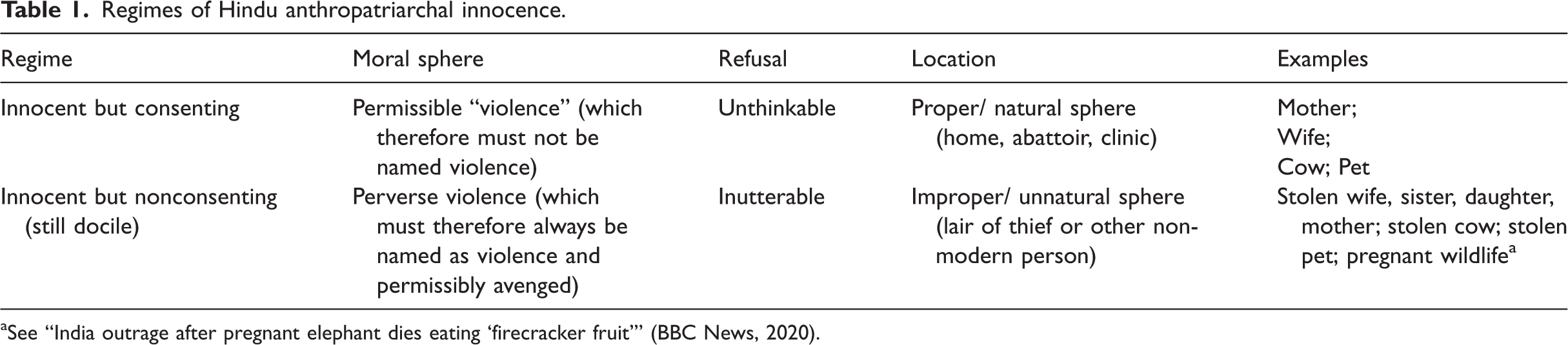
aSee “India outrage after pregnant elephant dies eating ‘firecracker fruit’” (BBC News, 2020).
Not all kinship metaphors, however, are in service of this virile Hindu militancy. Dr Laura Murray, an anthropologist from NYU, conducts who conducts fieldwork in western India on bovine breeding and care. One of her dissertation chapters on buffalo breeding begins with a kinship metaphor that is intended as a joke among women (Murray, 2020). Pinky, a junior scientist in a cloning lab, calls the buffalos she clones beecha, or child. When asked what she means Pinky laughs, and dismisses it as a silly joke about being an overworked woman who will never have children of her own. But Murray (2020: 1) sees something else in the beecha joke, too: recognition of the intimate “overlap of human and animal lives.”
Artificial insemination, Murray (2020: 14) says, is viewed as the modern solution to “backward” rural breeding practices. But as her exquisite ethnography illustrates, the techniques of this ostensibly modernized breeding are, despite its precision, raw and tactile—sexual. And perhaps only artificial because the cleavage insists on that designation. She describes how the farmer recognizes the animal in heat, rectally palpates the uterus, and manually inseminates their cow. “The animal must trust their keeper,” Murray (2020: 15) writes, “allow them to get close, and must know their touch and voice.” Though this is an uneven relationship between human and capital, there is in this “artificial” sex a “corporeal contiguity of a profoundly intimate kind.” The intimacy is such, Murray (2020: 15–16) says, that “there is often something strange, something awkward in the event—perhaps even illicit—but always unspoken.”
This resonates with what Rosenberg (2017) writes regarding the cleavage that rents husbandry from bestiality. After drawing on Alex Blanchette’s (2020) descriptions of sow insemination, Rosenberg (2017: 485) writes, “Humans go to elaborate and contradictory lengths to disavow these practices as sex, even as some workers explicitly recognize it as such.” There are many examples of explicit recognition: Kathryn Gillespie (2014: 1331) writes about cattle; Temple Grandin’s instructions for breeding sow is called, “How to make a pig fall in love” (hint: sometimes you have to play with a boar’s anus just right) (Johnson and Grandin, 2006). 38 But what Murray (2020) finds especially revealing of the truth of interspecies corporeal intimacy lies less in what is acknowledged than in what cannot be uttered.
She describes an embryo transfer procedure conducted by a technician named Patil: To complete the transfer, Patil first reached one hand into the cow’s rectum and methodically emptied it of dung. He did this quickly and without expression despite the indignity of the splat, splat, splat. Here, the collision of the enteric and the intellectual, the scientific and the beastly was managed through expression and gaze: If none of us laughed or otherwise acknowledged that my camera was covered in drool and Patil was up to his shoulder in shit, we remained in the temples of science, in the sterile realm of biotech, on a train rushing toward the future.
In both the joke that makes Pinky laugh, and in the non-joke that Patil’s friends must not laugh at, we find the same thing: a “vocalization of that which is excluded from social life … intimacies beyond the sayable” (Murray, 2020: 30).
On interspecies erotics
Radhika Govindrajan (2018) concludes her Animal Intimacies with a chapter, “The Bear Who Loved a Woman.” And it, like Murray’s (2020) chapter, begins with a joke. A young woman named Mohini, known for her libidinous humor, says to Govindrajan, patting her cheek, “Watch out for the bhalu (bear). I’m sure he would love a city girl to do his work (kaam) with” (Govindrajan, 2018: 146). Govindrajan begins asking around among other women in Kumaon, who tell her, if at first reluctantly, of all the erotic configurations of woman and bear. Bears, she is told, are like men, only better: they are inexhaustible, and have a particular fondness for licking the soles of women’s feet. They are so virile that women might die from the sex, but that is not enough to stop the bear: he will keep on with her corpse. Bears can impregnate their women lovers. Their penises are rumored to be terribly large, though the hirsuteness of those members is a matter of some dispute. Govindrajan (2018: 152) points out that these are not tellings about sexual assault, rape, or the perverse nature of bestiality (or, for that matter, interspecies necrophilia). Insofar as they are a commentary on violence, it is not the kind that inheres in the erotically semi/non-consensual act of being taken by a bear and semi/non-consensually shagged. What these stories of interspecies sex—and the desire for it—speak to is, in part, the violence of (human) male control over female sexuality. The tellers posit themselves as “desiring subjects,” thus “mounting a radical critique of rigid notions of sexual purity and control” (Govindrajan, 2018: 170).
Govindrajan’s (2018) story on stories reminds Naisargi of a conversation she had and recently revisited with Savitri (a pseudonym), then an employee of a women’s NGO in Delhi. Savitri had returned from a meeting with rural women on feminist sexual education. They had formed small groups and listed all of the sexual acts they could come up with, but without specifying gender. In other words, each act had to be precise: which body part, and where and how. One group came back with 150, all recorded on a white board to general hilarity: toe in vagina, penis in armpit, dog tongue on vulva. Someone erupted in laughter at the last one and mock finger-wagged, “no, only consensual acts!” Another replied, hum kilaathe hain, pilaathe hain. Esse hi thode kerthe hain! (We wine them, we dine them. It’s not like we do it “just like that!”) Others, all still laughing, agreed: you get them in the mood; it’s romantic; you can tell they like it by how they wag their tail.
What we are brought to in both of these stories is what Govindrajan (2018: 171) calls an imaginary of “another, radical, world in which norms separating the human from the animal are undone, and the shared tug of animal desire becomes a node of relatedness between human and animal.” That shared tug is premised on another thing shared, but which must always be insisted upon: a positive sexual desire, a wanting, an erotic capaciousness that is not limited to innocence and its priming for violence. In recognizing that the bear wants, and the woman wants, and the dog wants too, we produce a queer outside to the permissible, where the perverse is pleasure after all.
Queer bestial avowals
In 2017 Sujatro Ghosh, a queer, feminist, and at the time Delhi-based artist, created a series of well-traveled photographs called “The Cow Mask Project” (Pandey, 2017). He photographed women in public and private locations in India, in everyday clothes doing everyday things such as visiting tourist attractions, buying groceries, and even making out—but with their heads covered by rubber cow masks. The provocation was that cows are safer in India than women. His was also a rejection of the violence meted out by upper-caste Hindus against Dalits and Muslims in defense of the cow.
If it wasn’t already clear in all the twists of this paper, let us be clear here: cow protection does not protect cows, nor is meant to, nor does it want to. Cow protection, like the protection of Hindu women, is but a sphere of permissible violence that necessitates a perverse other that can be permissibly avenged. That is its purpose. The militant protection of any class on the grounds of its innocence is only the establishment of a sphere of permissible violence—and we hold that this includes animal activism that grounds itself on the fiction of innocence. The ethics that such an anthropatriarchal regime calls for is therefore precisely not a recasting of spheres such that what is now permissible becomes perverse (non-innocent) and what is now perverse becomes permissible (innocent). We have tried to argue that they are the same thing: each constitutes and necessitates the other. And so instead of an ethic of disavowal, where we eat animals to avenge the deaths of human persons, or vigilante mobs kill human persons to avenge the deaths of animals, we gesture toward a queer bestial ethics of avowal: one that dispenses with innocence and embraces desire, including the pan-species desire to touch and be touched. 39
Aniket Jaaware, in his posthumously published Practicing Caste, argues that the prohibition on touch between castes—which manifests clearly in the realm of sex—is but a radical denial of the personhood of the other (Jaaware and Rao, 2018). She who cannot be touched is less than human. If prohibitions on touch are the ground of Hindu anthropatriarchal violence, then its undoing lies not in increased prohibition on who can touch who, but in exposing and being exposed. And that which demands exposure above all, we believe, is the sphere of Hindu anthropatriarchal permissible violence: the home and the state-sanctioned abattoir. Only then does the distinction between permissible and perverse collapse, leaving in its stead a queer bestial ethic that avows human and animal relational autonomy, desire, and capacity for expression.
Highlights
What separates permissible from perverse acts of interspecies sex is a matter of space, material, and symbolic. Innocence is assigned to certain human and animal subjects not to protect, but to create a sphere of permissible violence. What separates bestiality from husbandry in India is where it occurs in proximity to an imaginary of a Hindu nation.
Footnotes
Author’s Note
Alok Hisarwala Gupta is now an Independent Researcher.
Declaration of conflicting interests
The author(s) declared no potential conflicts of interest with respect to the research, authorship, and/or publication of this article.
Funding
The author(s) disclosed receipt of the following financial support for the research, authorship, and/or publication of this article: This research was funded the Social Sciences and Humanities Research Council, and the Jackman Humanities Institute at the University of Toronto.