



Abstract
Despite a decades long push to develop what is seen as the vast untapped hydropower potential of the Indian Himalayas, hydropower capacity addition has been delayed and become increasingly expensive in India. Policy documents cite “poor” geology as a major reason for these delays. As hydropower in the form of run-of-river projects expand into the Himalayas, their construction activities encounter poor geology more frequently. This paper analyses hydropower development as an assemblage and examines how risk, especially geological risk, is negotiated to allow hydropower development to continue in the Indian Himalayas. We show how the category of “geological surprises” emerges as an institutional response to the problems of run-of-river based hydropower development in a seismically vulnerable landscape. We further show how “geological surprises” act as a boundary object between hydropower policy, project development, infrastructural finance, and hydropower knowledge, allowing for cooperation and negotiation, to allow hydropower development to continue in the geologically complex Himalayas.
Introduction
In December 2009, a tunnel boring machine excavating a 12 km long tunnel through the Himalayas became trapped. Investigations suggest it became stuck after encountering a fault zone which caused a rock slip and flooded the tunnel with groundwater (Brandl et al., 2010). This tunnel, and several more like it, are part of the hydropower project infrastructure being constructed in the Indian Himalayas. The tunnel was being excavated for a 520 megawatt (MW) run-of-river project in the state of Uttarakhand. By February 2020, this project had been delayed by 93 months and cost nearly double its original cost (CEA, 2020a). Commenting on these delays and rising costs, its General Manager blamed the mountains themselves, noting that “In hydro projects, geological surprises are quite common. You cannot foresee such things. This has been one of the important reasons which has contributed to the delay” (Press Trust of India, 2016).
While India boasts the sixth largest hydropower capacity in the world, its experience with hydropower development has been checkered. Despite a decades long policy push to develop hydropower, especially through private developers, hydropower capacity has been slow to expand. At the national level, hydropower declined from 50% of total capacity in the 1960s to 13% recently. Hydropower is also increasingly delayed and expensive, which has made its sale to electricity distribution utilities more difficult, prompting the most recent round of government attempts to reduce hydroelectricity rates (Ministry of Power, 2019).
Why is hydropower delayed and expensive in India? Government documents cite “poor” geology as a major problem (CEA, 2019a), with nearly half of all projects delayed on this account. Since the 1990s, hydropower capacity development has moved to the Indian Himalayas, a seismically vulnerable region holding the country's untapped hydropower potential. These projects have mostly been of the run-of-river (RoR) variety. RoR projects do not impound large volumes of water and, in the Himalayas, often involve the excavation of tunnels through the mountains. Government documents claim that “poor” geology in the form of sheared and faulted rock formations make project construction challenging, and can also result in “geological surprises”, an ambiguous term “used to identify the problematic sectors of the geological conditions of the project site” (CAG, 2013:85), that result in damage and delays. As is well documented, hydropower construction has also resulted in harm to local residents, who experience the drying of water sources, cracks in houses and even land subsidence as a result of the construction activities for these projects (Chopra, 2014; Himdhara, 2019; Matu Jan Sangthan, 2019; SANDRP, 2013). However, while expensive, delayed, and difficult to construct, hydropower projects are still being constructed in the Himalayas. This paper investigates the persistence of hydropower projects in the Indian Himalayas.
Hydropower is not a new source of energy and has been extensively studied in geography and political ecology. Critical scholars have studied the production of narratives (of modernity, nationalism, development, and, more recently, clean energy) used to justify projects (Desbiens, 2013; Harris and Alatout, 2010; Huber and Joshi, 2015; Kaika, 2006), as well the conflicts that emerge over the unequal distribution of benefits and costs associated with such projects (Baird and Quastel, 2015; Bratman, 2015; Finley-Brook and Thomas, 2010; Lord, 2016; Menon, 2019; Sneddon and Fox, 2008). However, as the urgency to reduce greenhouse gas emissions moves international consensus away from fossil fuels and towards renewable sources, hydropower is witnessing a resurgence as a clean energy source that would allow (developing) countries to meet their growing energy demands as well as provide flexibility to the grid for the integration of intermittent wind and solar capacity. This resurgence has resulted in changes in hydropower policies, actors, and practices that require renewed attention (Ahlers et al., 2017). While energy geographers have advocated for attention to the spatial logics and distributive impacts of low carbon energy transitions (Baka, 2016; Bridge et al., 2013; Huber and McCarthy, 2017; Knuth, 2018), with some exceptions (Ahlers et al., 2017; Finley-Brook, 2017; Kelly-Richards et al., 2017), this literature is yet to critically examine the evolving role of hydropower in low-carbon energy futures, particularly in India 1 . According to the International Renewable Energy Agency, another 850 GW of hydropower capacity is required by 2050 to meet the Paris Agreement target (IRENA, 2020). India is committed to having 40% of its installed electricity capacity based on non-fossil fuel energy resources by 2030 under the Paris Agreement (UNFCCC, 2015), which could result in significant hydropower capacity addition.
In this paper, we characterize hydropower projects as assemblages to examine the heterogenous configuration of human and non-human elements that are brought together in the making of dams in the Himalayas. Using assemblages, we examine two key shifts in hydropower development in India. First, the growing popularity of RoR projects: because RoR projects do not create large reservoirs they are positioned by governments and promoters as being less environmentally and socially destructive. Second, because of the expansion of dam building in India in the form of RoR projects into the Himalayas, project developers had to contend with a new set of challenges and risks that the region's terrain and geology presented. In this paper, we examine the emergence of “geological surprises” as a policy response.
The paper proceeds as follows: we review the literature on hydropower projects and develop our conceptual framework by bringing together literatures on assemblages and boundary objects in the next section. Study site and research methods describes the research methods and study area. The main empirical section of the paper examines the genealogy of the hydropower assemblage in India through three key moments during which it was reassembled: From reservoirs to run-of-river provides a history of hydropower development in India, the opposition that it faced, and the emergence of RoR as a way to address these challenges. Encountering geology follows the hydropower assemblage as it expands into the Himalayas and encounters the region's geology, a problem that is quite literally of Himalayan proportions. Negotiating geological surprises examines how the problem of “geological surprises” comes to be negotiated. Finally, the empirical and theoretical significance of our work is discussed in the concluding section.
(Re)assembling hydropower
Scholars studying hydropower development in the Himalayas have shown that governments and developers sell a vision of hydropower-driven national development (Lord, 2016) as simultaneously necessary, inevitable, entirely technical, and expert driven (Huber and Joshi, 2015). However, the increasing pace of hydropower development in the Himalayas has brought renewed attention to the multiple geohazards (landslides, glacial lake outbursts, earthquakes, etc.) taking place in the mountains and their interactions with Himalayan hydropower development. Complicating these visions and discourses, geographers have highlighted the colonial roots of geological knowledge (Gergan, 2019) and its continued entanglements with the postcolonial state's modernizing projects, wherein knowledge is seen as the exclusive authority of the experts, which allows for the downplaying of risks associated with hydropower, the marginalization of indigenous knowledges, and the depoliticization of such projects (Gergan, 2017; Huber, 2019). In doing so they have highlighted the “socially organized denial” of uncertainty around hydropower construction in geologically complex landscapes (Butler and Rest, 2017: 19). Furthermore, these geohazards continue to rage across the Himalayas, as seen most recently in the February 2021 floods in Uttarakhand, with devastating impacts.
We draw on this literature and extend it in two ways. First, while these scholars have generatively and persuasively demonstrated that uncertainty around projects are subject to “strategic ignorance” (Lord, 2018a) or “socially organized denial” which allows for the state and developers to evade culpability in the creation of disasters (Gergan, 2020), less attention has been paid to the processes and mechanisms by which hydropower projects themselves are insulated from risk and how these risks are internalized. Projects encounter the complex mountain geology during project construction, and the mitigation and repair of geological risks require funds. It is only through the internalization of risks that the projects are rendered possible. Careful attention to this process can help understand how states continue to promote these projects in the face of obvious risks to both humans and the environment.
Second, state functionaries are sometimes critical of hydropower projects indicating that the experience of geohazards could slow down hydropower development, and that such criticism is “inviting diverse actors to question hegemonic centralized projects” (Gergan, 2020: 102175). What remains to be explained then is how hydropower projects persist even when faced with such criticism, not just from local populations and social movements, but from the ranks of geologists and energy officials. By examining the processes through which risks, and the costs they bring, are internalized, we draw attention away from the dam site and towards the institutional configuration that enable these projects (Webber and Han, 2017). Hydropower projects enroll actors far beyond the dam site. In India, hydropower costs are paid for by the state government-run electricity distribution companies and are adjudicated upon by the state electricity regulatory commissions, and thus, hydropower development enrolls these actors as well. We bring these actors and their role in hydropower projects to the discussion of the persistence of hydropower in the Himalayas.
Following scholars of infrastructure (Barry, 2020; Carse, 2014; Graham and Thrift, 2007), we take hydropower projects as precarious achievements that require constant work, both material and discursive, to persist (Lord, 2018b). To understand risks to hydropower and their institutional mediation in the Indian Himalayas, this paper approaches hydropower projects as assemblages (Gutierrez et al., 2019; Lord et al., 2020; Sneddon, 2015; Webber and Han, 2017). Assemblages are arrangements of seemingly disparate elements, both human and non-human, which interact to create a phenomenon. Instead of seeing social formations as a logical/biological whole with components playing an ordered part, assemblage encourages focus on the contingent nature of the arrangement of components, their interaction, their transformations, and effects (Delanda, 2016). This is particularly useful in studying hydropower development, where the configuration of elements is rarely stable, resulting in different outcomes, in different parts of the world and in different projects within the same area (Gutierrez et al., 2019). Importantly for our paper, assemblage allows us to think of hydropower projects as complex networks of humans and non-humans that result in unique configurations that are provisional, non-linear, and emergent (Anderson and McFarlane, 2011; Bennett, 2010). Geology is both the basis of and a threat to Himalayan hydropower, and impacts its construction, project costs, and the price of the electricity that is eventually produced. It is to account for these more-than-human forces and this heterogenous cast of characters that we use assemblage as a framework for our analysis of hydropower development, geological risk, and its mediation.
Second, assemblages are unstable, partial wholes, and are in a continuous process of becoming; the durability of an assemblage requires ongoing work (Anderson and McFarlane, 2011). The emphasis on the processes of bringing together diverse element and forging relations makes assemblage particularly suited to the analysis of hydropower projects, as it allows us to move beyond questions of whether a project is built to consider questions of process: What are the processes through which Himalayan hydropower projects persist in the Himalayas? What are the processes through which geological risk is defined and mediated? Here we draw on Tania Li's concept of reassembling or “grafting new elements onto the assemblage, reworking existing elements for new purposes and transposing the meanings of key terms” (2007: 284). This reworking can be seen in the way community forest management was recrafted to bring it in line with neoliberal concerns, and it can be seen in hydropower's recent rebranding as a renewable energy source (Ahlers et al., 2015). Hydropower assemblages, we argue, reassemble in response to threats to hydropower development. Specifically, we show that RoR projects and “geological surprises” function to reassemble hydropower assemblages to mitigate the threats to its development and thus, perpetuate hydropower expansion.
We build on previous work that has approached hydropower projects as assemblages (Crow-Miller et al., 2017; Gutierrez et al., 2019; Sneddon, 2015; Webber and Han, 2017). Webber and Han (2017) describe the Chinese Water Machine, the network of actors involved in Chinese hydropower development, as an assemblage of institutions nested within larger socioenvironmental assemblages. They demonstrate the work of building durable connections between international and national actors for hydropower development in China and, more recently, in African countries (Han and Webber, 2020; Webber and Han, 2017). However, their hydropower assemblages focus only on the interaction between institutional entities to argue that the assemblage sets the standards for interactions between members (Webber and Han, 2017: 1454). In this paper we focus on the interactions between the institutional actors and biophysical processes to reveal the unstable nature of assemblages and the work required to make them durable. In this, we follow Mitchell (2002) and Sneddon (2015) in undertaking a more-than-human examination of hydropower development: we take a genealogical assemblage approach (Robbins and Marks, 2010) to hydropower development which pays attention to the contingent nature of hydropower development and focuses on the work required over time to maintain the assemblage and to move it toward certain outcomes. Extending these approaches, we broaden the assemblage to include local residents, social movements, multiple state entities, and biophysical processes.
Assemblage approaches have been criticized for a perceived flattening of power relations and a lack of attention to hierarchical social structures (Appadurai, 2015; Brenner et al., 2011; Kinkaid, 2020). However, assemblages allow for the ‘unveiling’ of the practices and historical processes that result in the hierarchical power relations (Farías, 2011) through a framework that distributes agency across humans and nonhumans (McFarlane, 2011a). By using assemblage as a framework, we are not suggesting that geology explains the entire trajectory of hydropower development or even that geology has some unique agency in hydropower assemblages. Instead, we seek “making this issue of power and agency a question, instead of an answer known in advance” (Mitchell, 2002: 53) and examine the role of heterogenous elements in the creation of hydropower policy. In the case of Himalayas, the geological complexity poses risks for hydropower construction, but the construction also impacts residents. Thus, both the projects and the residents face geological risks. However, it is only the risks faced by the projects that becomes important and only at a certain point in time. In attending to controversies in the construction of the Baku-Tbilisi-Ceyhan pipeline, Barry (2013) observes that, “materials acquire more-than-local political agency only occasionally, not in general” (152). Barry demonstrates that the agency acquired by materials (in his case the pipeline coating material, in our case the materials of the mountains) is contingent upon certain events coming together. Similarly, Latour distinguishes between “matters of fact” and “matters of concern” (2004), such that “matters of facts” are the taken-for-granted, established objects that seem stable (p. 232), but are transformed into “matters of concern” through controversies and significant events. In this paper, we develop these observations to explore when and how the geology of the mountains mobilizes an institutional response in the form of “geological surprises”.
“Geological surprises” hold the hydropower assemblage together as hydropower development expands into the Himalayas. While part of the process of keeping the assemblage together, “geological surprises” are also ambiguous, lacking a clear definition even as they are used by hydropower companies and in government documents frequently. To understand further the role of “geological surprises” in the maintenance of the assemblage, we draw on the concept of boundary objects, which are “those scientific objects which both inhabit several intersecting social worlds…and satisfy the informational requirements of each of them. Boundary objects are objects which are both plastic enough to adapt to local needs and the constraints of the several parties employing them, yet robust enough to maintain a common identity across sites” (Star and Griesemer, 1989: 393). Unlike black boxes, which are stable, settled items, such that their use is unchallenged (Fujimura, 1992; Hinchliffc, 1996), boundary objects are less concrete, amenable to multiple translations, but allow for the pursuit of some common goal (Goldman, 2011; Star, 2010). Boundary objects have been used in geography to analyze conservation corridors (Goldman, 2011), urban resilience (Meerow and Newell, 2019), the role of science in policymaking (Baka et al., 2019), ‘rights of nature’ legislations (Kinkaid, 2019), amongst others. We argue that “geological surprises” enable coordination across the realms of policymaking, hydropower development and scientific knowledge production to enable hydropower development. Its strength lies in its ambiguity, which allows for it to be differently interpreted not just by the different actors in the assemblage, but across time in different situations. We argue that “geological surprises” as a boundary object provide the necessary flexibility to be put to work to maintain the hydropower assemblage. We examine the work done to simultaneously restrict who can use “geological surprises” as well as to keep the term itself ambiguous enough to support hydropower development.
Study site and research methods
This research relies on a mixed methods approach, based on an analysis of policy documents and interviews. The first author carried out data collection and interviews in the state of Uttarakhand in the Indian Himalayas during the summer of 2019 (Figure 1). Uttarakhand has the third highest hydropower potential and the second highest installed hydro-based generation capacity in India at 3756 MW (Standing Committee on Energy, 2019). Despite the hydropower momentum in Uttarakhand, this region has received relatively less attention in hydropower scholarship in South Asia as compared to hydropower projects in Nepal and in the northeastern states of India.
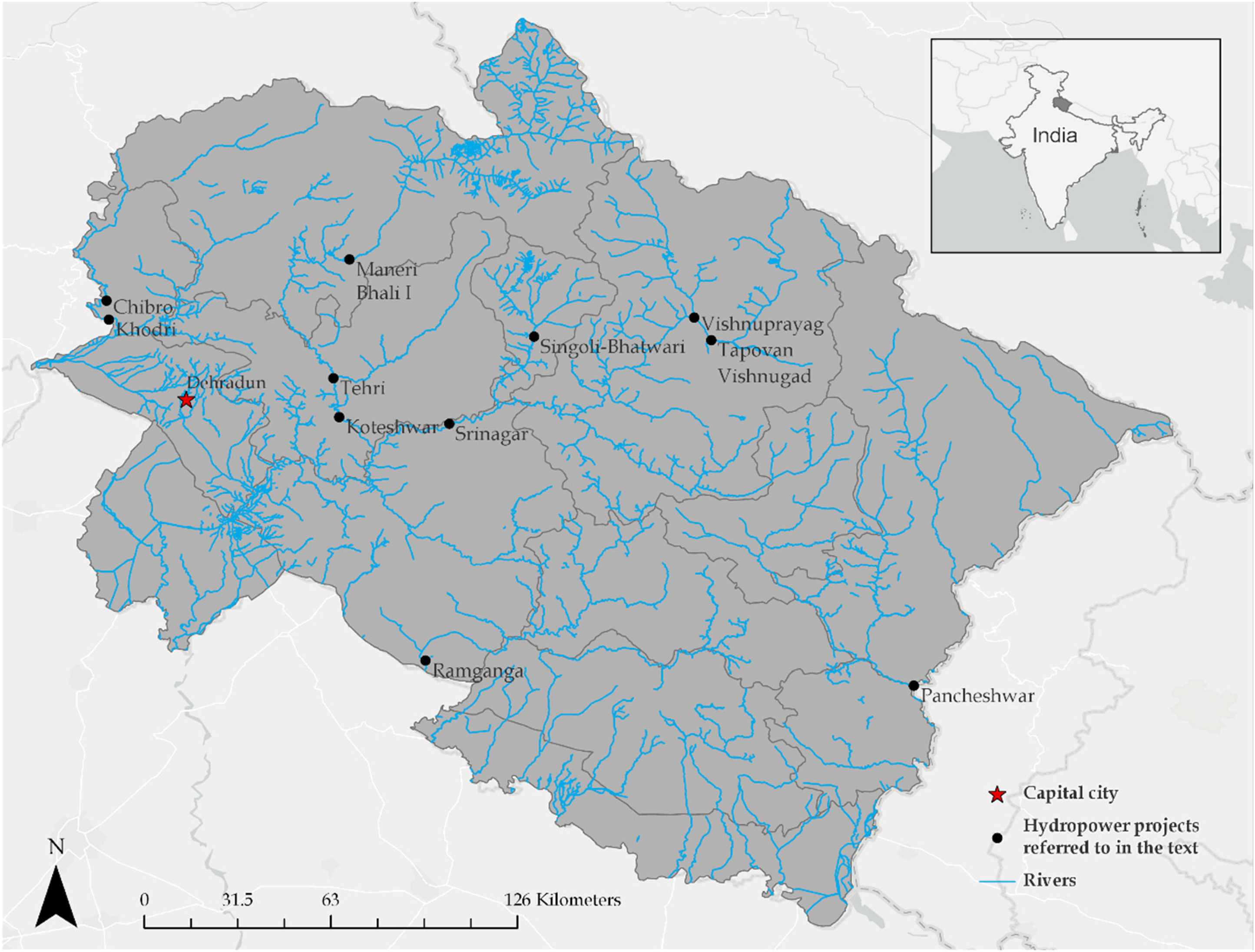
Uttarakhand and hydropower projects. Source: Authors’ map.
In this paper, we analyze policy documents and reports of India's Ministry of Power, Parliamentary Committee on Energy, the Central Electricity Authority, and orders of the state electricity regulatory commissions. We are interested in the origins of “geological surprises” as a policy response as well as the representations around it. These government documents serve both as a collection of government and project developer discourses around geological risk and hydropower, and a source of project cost and delays data (Bowen, 2009). These documents from different government agencies provide a disaggregated view of the state and track the journey of “geological surprises” across these agencies.
Table 1 provides a snapshot of the data collected for projects in Uttarakhand. It gives the name, ownership (central government, state government, or private), size (in terms of MW) and type for under-construction projects. It also provides information on delay and increase in costs. As can be read from the table, six of the seven projects under-construction in the state are RoR, and almost all the projects are delayed and expensive. The table also highlights the differences in the heights of the diversion structures (‘barrage’) for projects labelled RoR, the length of the head race tunnel 2 and the type of powerhouse (surface or underground), to give a sense of the tunnelling, blasting, and construction work that will take place for these projects.
Details of under-construction projects in Uttarakhand.
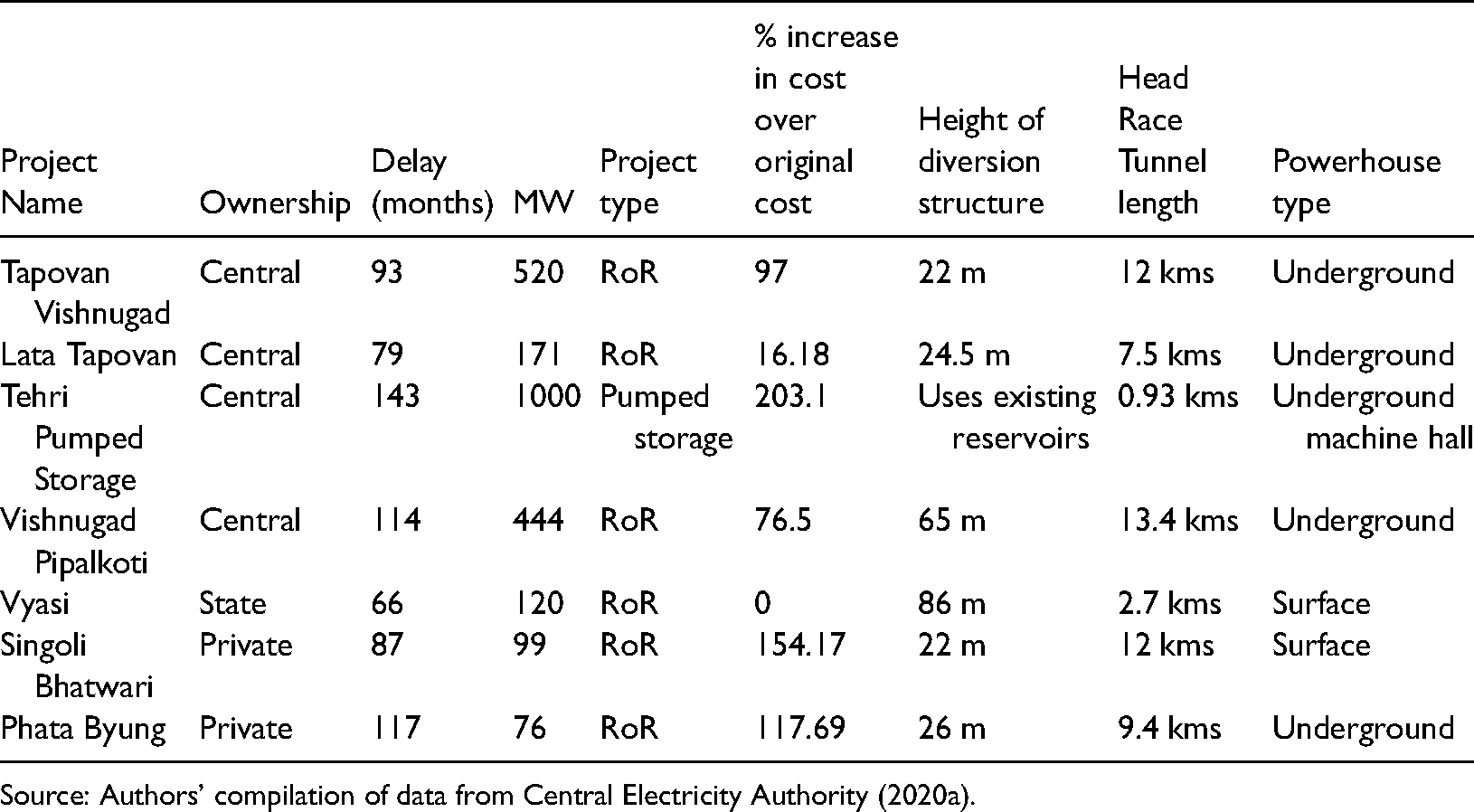
Source: Authors’ compilation of data from Central Electricity Authority (2020a).
To understand the views of hydropower stakeholders on hydropower construction in the Himalayas, the first author conducted a total of 24 semi-structured interviews (Lewis-Beck et al., 2004) with hydropower company officials (n = 7), government officials (n = 3), geoscientists and hydrologists (n = 6), and civil society activists (n = 8) in Uttarakhand. Interview respondents were selected using snowball sampling (Biernacki and Waldorf, 1981) using the first authors’ professional network as a starting point. The interviews focused on the construction and operation of hydropower projects in the geologically complex Himalayan landscape. Finally, the documents and interviews were supplemented with the analysis of newspaper articles from Indian news agencies.
From reservoirs to run-of-river
Hydropower was central to the state-led modernization project that India embarked upon post-independence. The decades after independence saw the construction of large multi-purpose projects, such as the Hirakud, Nagarjuna Sagar and Bhakra Nangal projects, capable of providing irrigation, flood control as well as electricity. The electricity sector at this time was composed of State Electricity Boards (SEBs), which were vertically integrated government entities responsible for generation (including hydro-based), transmission and distribution in their jurisdictions. Hydropower projects were built and operated by government departments and public sector enterprises run by the state water bureaucracy (Karambelkar, 2017). By the early 1990s, the SEBs controlled 70% of the country's generation capacity and almost all the distribution (Dubash and Rajan, 2002).
From the 1980s onward, the forcible displacement of people and environmental degradation because of large reservoir-based hydropower projects became increasingly controversial. By one estimate around 40 million people have been displaced by hydropower projects since independence in 1947 (D’Souza, 2008). Peoples’ movements, such as the Narmada Bachao Andolan in central India, brought to the fore issues of large-scale displacement, inadequate rehabilitation, as we all the impact on livelihoods and cultures (Baviskar, 2004; Mehta, 2009). These movements also drew attention to the devastating impacts on the ecology of the region (World Commission on Dams, 2000). Organized movements led to the withdrawal of the World Bank from large projects such as Sardar Sarovar in India and the Arun III in Nepal. Importantly, organized social movements resulted in changes in the relations between the government, project developers, social movements and project affected persons, as well as changes to the rehabilitation and compensation regimes in the country (Baviskar, 2019).
The 1990s marked the beginning of reforms in the electricity sector in India, which envisaged a move towards a market-based system of electricity provision, with private developers bringing the necessary capital and competition to provide electricity services to consumers. Reforms began with the opening of the generation segment to private developers. In the beginning of the reform, several incentives were provided for the private industry to take up hydropower projects (Prayas (Energy Group), 2017): governments promised completed preliminary works, guaranteed purchase of electricity generated and 100% foreign equity in the project. However, by the mid-1990s, the lack of interest by private developers in hydropower led the Indian government to establish a committee to suggest a path forward. The Sambamurti Committee suggested reducing the financial risk for private developers (Ministry of Power, 1997). In the 1998 hydro policy that followed, the government provided incentives, including exempting hydropower projects from competitive bidding for rates, simplifying clearance processes and providing government support for land acquisition. These efforts have been supplemented by subsequent hydropower and national electricity policies. While reforms were able to attract private developers to the thermal generation sector (where private projects account for 38% of capacity), they have not been successful in the hydropower sector (where they account for 7%) (CEA, 2020b).
Thus, in the 1990s, there was mass resistance to large reservoir-based projects at the same time as the government was trying to bring in private investment into the hydropower sector. The Sambamurti Committee also felt that the long gestation period and the many uncertainties associated with large projects was inhibiting private participation. It recommended involving the private sector in less expensive, less risky Run of the River (RoR) projects, beginning with those involving minimum underground work and proceeding to those with major underground construction (Ministry of Power, 1997: 44). Unlike reservoir projects which hold vast amounts of water through the creation of an artificial lake, RoR projects are expected to hold little to no water. They may have a diversion barrage to divert the river water into tunnels or channels from where it is carried to the powerhouse. RoR utilizes the gradient of the mountain to create an elevation drop (referred to as the ‘head’) to run the turbines. After electricity generation, the water is released back into the river. As the project does not hold water, there is minimal land submergence.
RoR schemes were held to be relatively inexpensive and appeared to solve the twin problems of displacement and environmental damage typically associated with reservoir-based schemes and were subsequently positioned as a viable choice of project for private developers. The effect of these changes was the grafting of RoR projects into the hydropower assemblage, representing a reassembling of the assemblage.
In 2003, the Government of India launched the 50,000 MW hydropower initiative, wherein 110 of the 133 projects in the Himalayas were RoR (CEA, n.d.). In India, RoR schemes are divided into two categories: RoR and RoR with pondage. Currently, these together account for 20 GW of India's 45 GW capacity. Since 2011, 89% of hydropower projects added in the country have been RoR, most of them with pondage (CEA, 2019b). When asked about the increasing number of RoR projects, a hydropower official commented: “Earlier we were doing reservoir, but the drawback is the huge submergence and huge R&R [Rehabilitation & Resettlement]. So, if you take example of Tehri dam, started in 1989 and it took 20 years to get done. Lots of funds were given to R&R and local public, but R&R has not been settled even to date. There are other reservoir projects, like Srinagar, where we have settled out of it, but some villagers they are continuously demanding R&R… So, the government decided to support RoR” (Interview D1, June 10, 2019).
Since much of peninsular India's hydropower capacity was in the process of development, the government and project developers looked to the Himalayas for sites for hydropower development. Himalayan rivers, with their year-round flow and higher head, were considered particularly suited for RoR projects. From the 1990s onwards, the Himalayan states signed several MoUs (Memorandum of Understanding) with companies for the development of hydropower capacity in the mountains (Dharmadhikary, 2008). In the last two decades, Himalayan hydropower surpassed similar construction in the rest of the country (see Figure 2). Since 2007, 82% of the hydropower capacity added in India has been in the Indian Himalayas, with many more projects in the pipeline. It is estimated that if all the hydropower projects planned in the Indian Himalayas were constructed, the region would have the highest dam density in the world (Grumbine and Pandit, 2013).
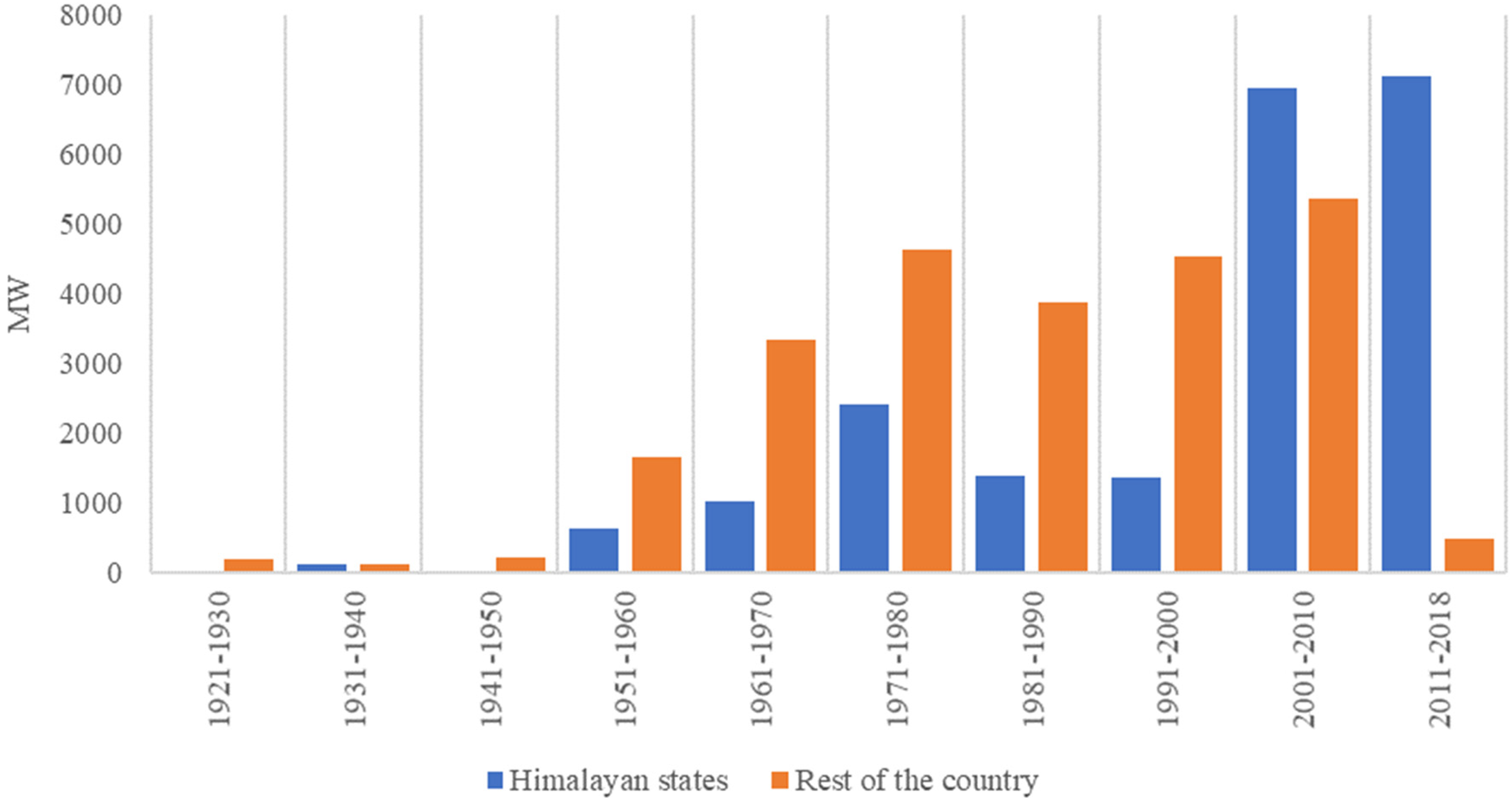
Hydropower capacity addition by location. Source: Authors’ analysis based on data from Standing Committee on Energy’s report on Hydro Power (2019).
As hydropower projects moved to the Himalayas in the form of RoR projects, activists also began highlighting the many problems with such projects. First, while RoR conjures up images of a small diversion dam and a free-flowing river, it does not signify one kind of project (Vagholikar and Das, 2010). Many RoR projects have large reservoirs as well as tunnels stretching for kilometers inside the mountains, with significant environmental and submergence impacts. In addition, many RoR projects are proposed to be developed in a cascade, such that the river flows through tunnels for most of its length (Roy, 2008). Second, the construction impacts of RoR projects are significant. Much of the construction for RoR projects, such as the powerhouse and diversion tunnels, is underground. Given the rock characteristics of the Himalayas, most of the excavation and tunneling work in the mountains is done using explosives. The construction impacts are significant and include adverse impact on the local air, water and noise quality, cracks in villages as a result of tunneling and blasting, and problems with disposal of muck generated from excavation activities (Kumar and Katoch, 2017). As hydropower projects moved to the Himalayas, their encounters with the region's geology also became more frequent.
Encountering geology
The Himalayas are a young, tectonically active mountain range, where earthquakes and landslides are commonplace. Formed as a result of the collision of the Indian continental plate with the Eurasian continental plate around 60 million years ago, these mountains consist of distinct terrains divided by thrust faults which are tectonically active (Valdiya, 2002). As a result of continued plate movements, the Himalayas continue to gain height, which has resulted in weak and vulnerable slopes (Sati et al., 2011). For example, most of Uttarakhand is in a high-risk seismic zone (Figure 3) and prone to landslides (Figure 4). Many studies have noted that a large earthquake is overdue in the Himalayas (Bilham et al., 2001), and questions around dam design and seismicity have been raised in the case Himalayan projects, such as the Tehri reservoir project (Gaur, 1993).
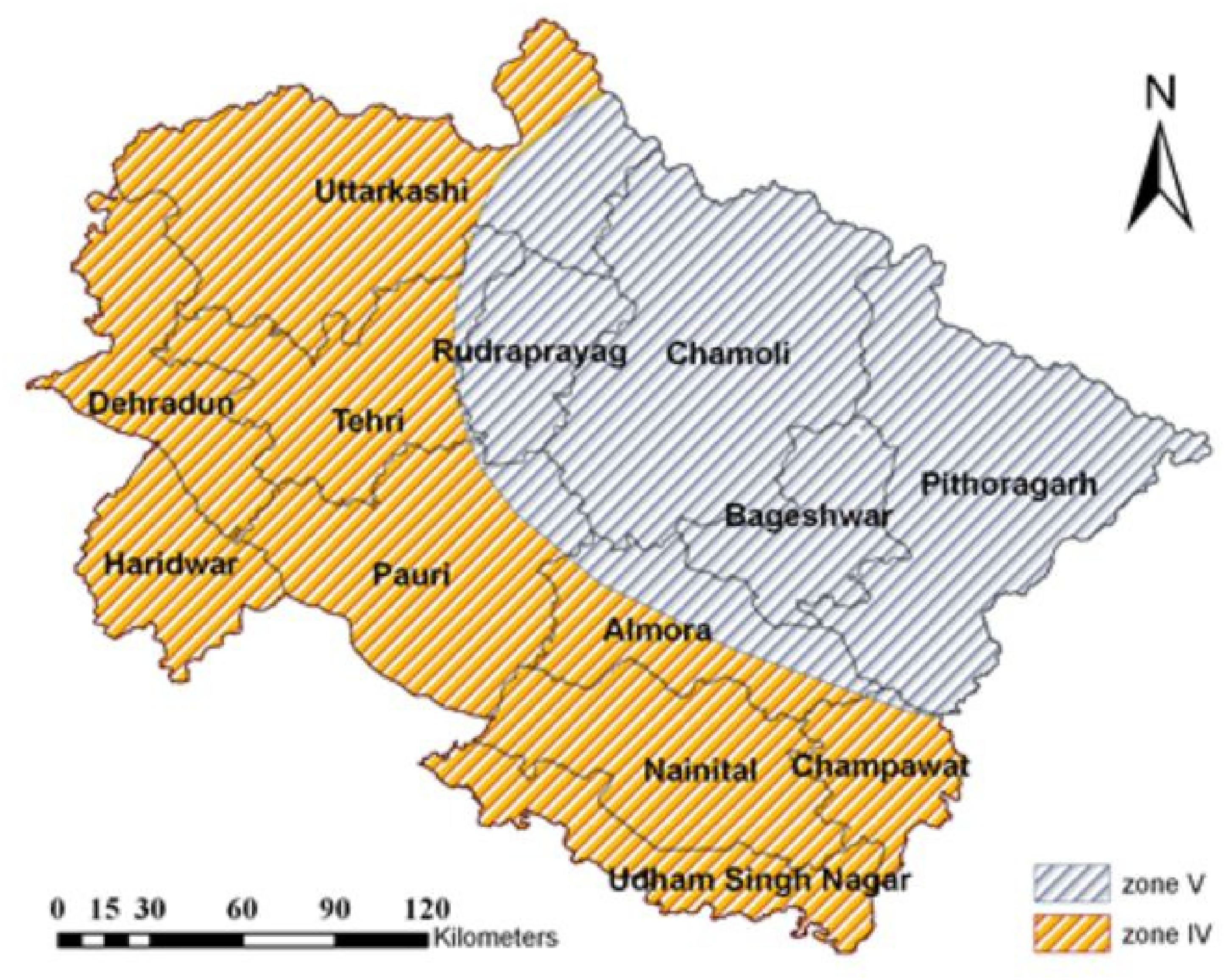
Uttarakhand earthquake zonation. Source: Disaster Mitigation and Management Center (n.d.). Note: Zone V is the most seismically active zone in the Government of India’s classification and denotes the Very High Damage Risk Zone, while Zone IV denotes the High Damage Risk Zone.

Uttarakhand landslide zonation. Source: Disaster Mitigation and Management Center (n.d.). Note: Red represents the area with a severe to very high risk of landslides; pink represents an area with a high risk of landslides.
However, large earthquakes are not the only risks in the mountains. Schwanghart et al. (2018) examined the damage to hydropower projects in Nepal resulting from the 2015 earthquake and estimated that 25% of all exiting, under-construction and planned hydropower projects in the Himalayas are at risk of severe damage due to earthquake-induced landslides. Concerns have also been raised regarding project siting, which appear to not take the seismicity of the region into consideration (Valdiya, 2014). Glacial lake outbursts, flooding and rain-induced landslides are also a recurring concern, especially during the monsoon season (Rana et al., 2013). In 2013, flash floods resulted in landslides in Uttarakhand, killing 6000 (Chopra, 2014). The Supreme Court appointed expert committee found that hydropower projects aggravated the impact of the floods (Supreme Court Expert Body, 2014). In February 2021, flash floods hit Uttarakhand again, killing nearly 100 and severely damaging the Rishiganga and Tapovan Vishnugad hydropower projects (Pardikar, 2021). These projects had been granted environmental clearances and their construction was allowed to proceed even though government appointed expert committees had warned against the siting of these projects (Mashal and Kumar, 2021). It is in this context that scholars and activists have said that hydropower projects increase the hazard potential in these vulnerable landscapes, by constructing disasters (Thakkar, 2015) and creating hazardscapes (Huber, 2019).
In addition to these regional level events, projects face issues during construction, particularly during tunnelling, in the form of roof collapse and flooding (Goel and Singh, 2017). Project developers attribute these to unanticipated geological formations, like shear zones, encountered in the construction process. To avoid such project setbacks, in India, project developers are expected to carry out topographical surveys, surface and sub-surface investigations (CEA, 2005). The geotechnical investigation for hydropower projects is appraised by the Geological Survey of India (GSI, 2012). Geological problems are routinely encountered nonetheless and are managed through engineering treatments, usually by installing support structures, or through changes in design (Sharma and Tiwari, 2012), which increase the project cost
While continuing encounters with “geological surprises” may point to limits in understanding Himalayan geology, these problems are not new. Both the Ramganga project (198 MW) and the Maneri Bhali I (90 MW) project in Uttarakhand experienced huge increases in time and project cost due to tunnel collapses in the 1960s and 70 s (Gandhi, 1976; Kala, 1974). Similar tunneling problems were faced in the Yamuna hydropower project in the 1980s (Jethwa et al., 1980). However, while geology had affected projects in the Himalayas before, it was only in the 1990s that geology attained particular significance.
Strata and surprises
At the same time projects were moving to the Himalayas, India was undertaking electricity sector reforms. Prior to the reforms, increases in project costs would be absorbed in the cost estimate revisions that public-sector companies undertook from time to time (Ministry of Power, 1997). For the private sector, however, a new architecture needed to be put in place which would allow private developers to evaluate and invest in projects based on risks and returns. However, there was lukewarm interest from the private sector in the 1990s. The government introduced policies to reduce financial risks, seen as the main roadblock to private participation. One of the risks identified was geological risk in the geologically complex Himalayas (Ministry of Power, 1997).
In its hydro power policy of 1998, the Indian government explicitly stated that geological risks were resulting in cost increases and that an institutional mechanism was needed to compensate developers for these ‘eventualities’. “During the implementation of hydro power projects specially underground power stations, there is a likelihood of coming across geological surprises which are not anticipated at the time of preparation of Detailed Project Report. This results in increase in capital cost The developer would need to be compensated for this kind of eventualities… In such cases, the developer will be allowed to submit his proposal for the enhanced cost to the Government. Expert Committee would be constituted at the State and Central level who would evaluate and recommend the cost increases for acceptance by the Government” (Ministry of Power, 1998: 17).
This policy instrument accomplishes three tasks. First, it identifies “geological surprises” as a kind of geological risk that cannot be known despite the detailed investigations undertaken by the experts and project developers. It turns project geology from a matter of proper prior investigation to something that needs to be managed, a technical challenge. Second, it identifies “geological surprises” as a risk for project developers only, with no other impacts, such as risk to local communities, considered. Third, it provides a mechanism for compensation for the increase in costs to the project because of “geological surprises”. In Nepal, Butler and Rest (2017) find that natural events are rendered calculable financial risks by hydropower developers. In contrast, “geological surprises” are a case of risks seen as beyond calculation, but not beyond compensation. It therefore provides a means of compensating hydropower developers for the uncertain 3 , providing developers with enormous latitude to claim compensation for rising costs associated with construction.
In the space between the need to tap the hydropower potential of the Himalayas, promotion of RoR technology and economic reforms to the sector, geology acquired “more than local agency” (Barry, 2013), capable of affecting policy change. The geology was proving to be unruly (for developers) and needed to be managed through institutional arrangements, so that hydropower project development could continue in the mountains, through private developers, in the ‘socially acceptable’ form of RoR projects. “Geological surprises” came to be used for this purpose, and it reassembled the assemblage once again by reworking mountain geology as a “surprise” for projects that requires compensation. Krishnan et al. (2015) write that thinking with the unruliness of nature forces one to consider how nature “not only resists human intentions but actively reshapes them” (p. 5). “Geological surprises” emerge as response to such unruly environments, but also seek to enroll the unruly mountains in uneven ways into the assemblage.
Today, “geological surprises” are invoked as a reason for delays in hydropower projects in India, particularly in the Himalayas, in a wide assortment of places: policy documents (GSI, 2012), engineering conferences and papers (Indian Society of Engineering Geology, 2015), consultancy reports (Project Management Institute and KPMG, 2019; PwC, 2017), project developer documents (Ministry of Statistics and Programme Implementation, 2020; THDCIL, 2019), and reference documents of international financial agencies (Ramanathan and Abeygunawardena, 2007; Rex et al., 2014). In the hydropower assemblage, “geological surprises” play the part of a boundary object, moving from the world of engineering geology to inhabit the intersecting spaces between hydropower policy, project development, infrastructural finance, and hydropower knowledge. It is useful since it enables (partial) responses to the lack of private participation, delays and increasing costs in current projects and the continuing encounters with geological complexity in the mountains.
Negotiating geological surprises
As boundary objects, “geological surprises” are necessarily ambiguous, allowing cooperation in the absence of consensus (Star, 2010); boundary objects are always fuzzy, providing a ‘wider margin for negotiation’ (Fujimura, 1992: 175). While widely used, “geological surprises” have no official definition, and function without a consensus on what they mean or how they are to be established. For example, as per India's Ministry of Power, geological surprises include a whole host of factors: “Geological surprises resulting from weak geology in the Young Himalayan region, lack of technology to deal with weak geology, lack of major contractors with expertise in hydropower sector, natural calamities like landslides, hill slope collapses, road blocks, flood, and cloud bursts etc. are a cause of severe setbacks in construction schedules” (Standing Committee on Energy, 2019: 27).
While “geological surprises” in this categorization does not include earthquakes, in other government documents they are distinguished from ‘natural calamities’ like floods as well (CERC, 2010). However, this also means that it is not always clear if a geological challenge is truly a surprise. This has brought the geo-technical investigations undertaken by hydropower companies under scrutiny. For example, in its performance audit of central sector public sector companies, the Comptroller and Auditor General of India (CAG), the government audit institution, found that the National Hydro Development Corporation (NHPC) did not focus adequately on survey and investigation for its projects. It highlighted: “Although NHPC was incorporated in November 1975, it did not have any in-house guidelines up to December 2006 for survey and investigation. No norms for drilling holes along the head race tunnel were prescribed… Insufficient drilling in terms of number as well as depth of the holes resulted in NHPC encountering 58 ‘geological surprises’ during the execution of three projects” (CAG, 2013: 29).
For “geological surprises” to continue being useful to hydropower development, attempts have been made to stabilize them to fix the larger assemblage. Policymakers and project developers acknowledge that the Himalayas pose unique challenges for hydropower construction. Indeed, the maps shown in Figures 3 and 4 are from government websites. What is of interest is how decisions are made around risks emanating from this complex landscape and who they ought to count for. This, as we show, is not achieved by fixing the meaning of “geological surprises”, but rather by fixing who can use it, when and for what kind of outcome. In this section, we look at two instances of negotiations and fixing around “geological surprises”: around who can invoke them and who can adjudicate them.
Whose geological surprises are these?
Citizen groups and residents in the Himalayas have been concerned about the impacts of drilling and blasting from the construction of RoR project and their associated infrastructure. For example, in 2007, the residents of the Chayeen village in Uttarakhand reported water leakage, ground subsidence and cracks in houses near the tunnel of the 400 MW Vishnuprayag project. It was reported that the slope failure left twenty-five households without homes (Agrawal, 2013; Supreme Court Expert Body, 2014). Similar impacts have been experienced across the Himalayan belt (Bhutia et al., 2016; Himdhara, 2019; Vagholikar and Das, 2010). The protests by citizen groups as a result of these impacts pose a threat to RoR projects, which, in their relationship with mountain geology, were proving to be a technical challenge, and now, because of these impacts, were proving to be socially difficult as well. It is in the interest of both the policymakers and project developers that “geological surprises” is leveraged only by the project developers to reduce their risk, both geological and financial.
As scholars have shown, the risks to residents from hydropower development in these vulnerable landscapes is diminished and their claims denied (Butler and Rest, 2017; Huber, 2019). This is seen in Uttarakhand as well, where hydropower developers argue that their methods are suited to the geology of the mountains and that the impacts seen by the villagers are unrelated to the construction practices and are a result of natural phenomenon. For example, when asked about the increased risk of landslides and land subsidence because of construction activities, a hydropower official responded: “There are studies on everything for what will happen if the project is made. Projects will not get made is the studies do not conclude that they are safe. And now we have to do meetings with the local community and gram panchayat [village council], they are also stakeholders now” (Interview D4, June 18, 2019).
If claims are accepted, it is usually after a protracted local protest or court case, such as in the case of the Singoli Bhatwari project (Prashant, 2009). In addition, civil society activists point out that not only are such cases few and far between, but the promised compensation is not always received (Interview B2, activist, May 30, 2019). It is important to note here that while the authorities placate the protestors by providing some compensation through the hydropower developers, this is without any formal recognition of fault, which forces residents to have find different avenues for asserting their rights in the future.
How surprising are geological surprises?
This lack consensus on what counts as “geological surprises” and for whom is also seen in the case of the sale of hydroelectricity to state government-run electricity utilities, the financially burdened electricity distribution companies that supply electricity to a majority of Indians.
In India, electricity produced from generation stations, including hydropower projects, is usually sold through 10–25 year contracts signed between the generators and electricity distribution companies. While electricity distribution companies now undertake bidding to find the lowest cost electricity supplier for thermal generation stations, to encourage hydropower development, hydropower projects are exempt from this kind of competitive bidding. Thus, hydropower projects continue to sign regulated rate of return contracts with distribution companies, which are known as ‘cost-plus’ contracts in India. Under the terms of these contracts, the developer submits information on expenditures to electricity regulatory commissions, which determines whether they are ‘prudent’ or not, and then determines the cost of electricity to be paid by the distribution company. The cost of electricity paid to the developer is to cover all prudent costs and include a fixed rate of profit. However, electricity distribution companies, who are burdened with the costs of “geological surprises” regularly contest the legitimacy of such surprises as well as the prudency of related expenditure.
In the absence of methods to determine surprises, it has fallen on the state electricity regulatory commissions to adjudicate whether a particular event qualifies as a “surprise”. However, regulations differ amongst commissions and most expenditure for “geological surprises” is passed on to the utilities and, ultimately, through to consumers. As of 2020, 16 of the 25 central government hydropower projects commissioned since 2000 have claimed compensation for increased costs due to “poor” geology and “geological surprises”. The Central Electricity Regulatory Commission (CERC), the regulator for central government projects, has established guidelines for hydropower projects to appoint independent agencies to vet their expenditures (CERC, 2010). However, CERC's decisions in many cases are based on government reports as well. For instance, in the case of both Pare (110 MW) and Koteshwar (400 MW) projects, the commission approved the increase in costs in such a manner (CERC, 2018, 2020). “Geological surprises” have become more concerning since their inclusion as a Force Majeure (Act of God) event in the latest CERC regulations (2019), and it is expected that hydropower companies will find it easier to receive compensation for such events (Interview B6, activist).
Conclusion
In this paper, we provide a genealogical account of how “geological surprises” have worked as a boundary object within the hydropower assemblage in the Himalayas and has allowed construction to continue despite well documented risks to humans and the environment. Analyzing hydropower through the concept of assemblage also allows us to understand why hydropower development persists in the Himalayas despite repeated financial failures and geological disasters. In our framework, we bring together assemblage approach with boundary objects. The assemblage approach opens up the machine of hydropower development to reveal the contingent nature of its policies, the processes that bring together various human and non-human elements and the changing relations between these elements. Boundary objects provides a means of accounting for the role “geological surprises”, which are flexible enough to provide projects with a guarantee of cost recovery and rigid enough to exclude the claims made by residents.
Our research advances scholarship on the political ecology of hydropower. It contributes to the emerging scholarship around earth sciences in political ecology and science and technology studies. We approach hydropower infrastructure not only as an important water infrastructure, but also as an important geological intervention. In doing so, our research explores the negotiation around geological risk that must be undertaken for projects to be constructed. Furthermore, our research links the worlds of policy and practice to show how the state, project developers and residents contend with the geology of the area, and the uncertain outcomes that result from these relations. While we provide a conceptual framework for using assemblages and boundary objects to investigate hydropower processes, there remain avenues for future research. Hydropower projects are affected by the ‘tangled temporalities’ of the Himalayas (Lord et al., 2020), such that their construction and functioning shapes and is shaped by the rhythms of biophysical processes even as they repattern memories and create imaginaries through the deferral of hydropower's promised prosperity (Lord, 2018b). The inclusion of “geological surprises” under Force Majeure as re-writing of the temporalities of these surprises on paper and its consequences for hydropower development in the Himalayas can be a promising avenue for future work. Additionally, because assemblages allow us to consider the unsettled nature of outcomes, they provide room to consider alternatives to their present configurations (McFarlane, 2011b) and encourage thinking of alternative assemblages of people, rivers, and geology. For example, micro-hydropower projects are flexible, considered better suited to the landscape, and are usually community driven (Lord, 2018a; Phadke, 2005; Sati, 2015). These micro-hydropower projects are also being implemented in the Himalayas and could be considered an example of “technological reclamation” (Phadke, 2011: 245), a process through which technological artefacts and their imaginaries are reconstituted through the efforts of communities and social movements. Here, comparative work can improve our understanding of how these alternative assemblages emerge and how risks, geological or otherwise, come to be construed within them.
The appeal of RoR projects emerged as an effect of encounters between the mountains, rivers, the government, the project developers, and those affected by the projects. RoR is promoted by the government as environmentally benign and socially acceptable in response to this widespread disenchantment with reservoir-based projects. As hydropower development move to the Himalayas, the construction needs of these projects result in renewed concerns around the geology of the area. The circumstances – promotion of RoR, electricity sector reforms and the need to tap Himalayan hydropower – allowed geology to acquire unique agency, such that its institutional mediation became necessary to continue hydropower construction in the Himalayas. It is managed by the government and policymakers through the label of “geological surprises”, that function as a boundary object between hydropower policy, project development, infrastructural finance, and hydropower knowledge. “Geological surprises” cast the geology as outside the control of the project developer, making it valid grounds for compensation and shifting the risk away from developers.
Constructing dams in the Himalayas is ‘risky’ for all parties involved. Policymakers seeking to encourage dam construction attempt to institutionalize the associated risks through “geological surprises”, but this has resulted in rising costs that worry electricity utilities, who are forced to bear the high-cost burden. They demand more accountability from developers. Like these utilities, residents affected by the hydropower construction too demand more accountability. The logic of RoR projects was intended to avoid the traditional sources of opposition to reservoir-based projects in the country, around displacement and environmental degradation. Even as attempts have been made to fix the uses of “geological surprises”, its invocation has not gone uncontested. Yet unlike past controversies over dams and hydropower that emerged around questions of water—its spread, distribution and availability—the controversy has now moved underground, to questions of rocks and fractures, and their uncertain relationship with hydropower development.
Highlights
Hydropower assemblages reassemble in response to risks to hydropower development.
Addressing geological risk becomes important when hydropower development needs to be encouraged through private developers in the geologically complex Himalayas.
The category of “geological surprises” is a policy response aimed at shifting the risk away from project developers onto residents and electricity consumers.
Contestations over “geological surprises” occur at multiple levels, from the dam site to within the state.
Using an assemblage approach in combination with boundary objects provides a productive way to examine policy evolution facilitating renewable energy transitions.
Footnotes
Acknowledgements
We would like to thank the two anonymous reviewers for their careful reading and generous feedback on this paper. We would also like to thank Anthony Levenda, Kirby Calvert, Karl Zimmerer, Brian King, Kushank Bajaj, Ann Josey and Karan Misquitta for their helpful feedback. Seamus Gibbons and Harman Singh provided excellent research assistance.
Declaration of conflicting interests
The author(s) declared no potential conflicts of interest with respect to the research, authorship, and/or publication of this article.
Funding
The author(s) disclosed receipt of the following financial support for the research, authorship, and/or publication of this article: This work was supported by the Center for Landscape Dynamics Graduate Research Award, the EMS Centennial Graduate Research Travel Award, the EESI Fogel Award from the Pennsylvania State University, and the Energy and Environment Specialty Group of the AAG Dissertation Data & Field Work Award.
