



Abstract
While water consumption and water conservation have been issues in the discussion of sustainable tourism for many years, the residual part of the water cycle, the management of wastewater, lacks attention in tourism and planning research. This study addresses the wastewater challenges in Danish second home tourism. More than 200,000 second homes represent an important touristic resource both for owners and for short-term renters, and increasingly, the accommodation capacity is used over the whole year. Data from the building and housing register (BBR) show that only 54% of second homes are connected to public sewage and purification utilities. The remaining second homes rely on individual solutions such as septic tanks. A substantial regional variance can be partly explained by differences in the spatial layout and location of second homes, but mainly the dissimilar priorities in the responsible municipalities are the result of systemic factors following semi-privatized governance structures. The intensified use of second homes, rising ground water levels, more frequent climate incidences and EU and national quality obligations for the environmental standards of waterways and seas are and will in the future be challenges for the municipal wastewater management. A mobilization of second home owners and users to support updated wastewater infrastructures is hampered by the principles laid down in the governance structures.
Introduction
Toilets are not exactly a type of touristic facility that creates an intense endeavour in tourism research and planning studies. Toilets and the totality of sewage systems and water infrastructures are regarded as rather self-evident and ubiquitous, hidden under the ground or behind closed doors. Nonetheless, the management of water, including both fresh and foul waters, is of critical importance in an environmental perspective (Gössling et al., 2012). Increasingly, destinations and tourism enterprises must justify the totality of their implications on the environment and explain their performance to their customers and other stakeholders in terms of proactive mitigating and adaption. Consequently, the total water footprint comes into stronger consideration.
For several decades, the idea of sustainable tourism has included a variety of strategies and practices related to water saving and conservation (McLennan et al., 2017). In terms of addressing the problems, measures to limit the overuse of water reserves are fairly widespread and are generally well accepted by tourism providers and guests (Antonova et al. 2021; Han et al., 2018). However, oddly enough, as soon as the substances go down the drain, the tourists’ attention to water flows (no matter how reduced in amounts) is lost. The water sector is complex, and water reuse, transportation and piping are pricy and have in their own respect adverse negative environmental impacts (Oxford Analytics, 2019), for example, in terms of energy consumption for pumping (Becken and McLennan, 2017). The hidden flow of the underground black and grey water is not yet in any comparable way represented in tourism research and strategic and planning agendas for tourism (Agyeiwaah et al., 2017).
The purpose of this article is to uncover details about the sewage challenges in second home areas, with Denmark as a case. Regional disparity and variance related to the properties are used to explain the nature of the challenges. The sustainable management of water resources is seen as a critical element in the pursuing of environmental goals they are stated and confirmed in EU and national policies. Based on governance theory and implementation in the Danish water sector, the article aims at discussing the paradoxes of sewage management in tourism.
There are more than 200,000 individually owned second homes in Denmark, located mainly in or in the vicinity of the coastal zones. Outside the larger cities, the second homes represent a major holiday accommodation source for the Danes and their families, who own them, but also for tourists who can rent them on the commercial renting and sharing market. In 2019, 36.9% of all tourism bednights in Denmark were undertaken in the second homes (www.Statistikbanken.dk). From 2010 to 2019, the number of bednights in second homes increased by 38.7%.
The findings reported in this article are a part of a major research program about second homes in a UN Sustainable Development Goals (SDGs) perspective. There is an emphasis on environmental implications, prospects and planning challenges, and water issues are mentioned in SDG#6 ‘Clean water and sanitation for all’, and in SDG#14 ‘Conserve and sustainably use the oceans, seas and marine resources for sustainable development’. However, as a consequence of the complexity, water management emerges also in other SDGs, for example, connected to social and health implications. The sustainable organization and operations of wastewater are obviously a part of these comprehensive water challenges. The article examines the nature of the water trouble in second home areas, and it outlines the investment, planning and governance modes and deficits. The sewage system is a part of a comprehensive public planning and management organism, which during the past decade has been (semi-)privatized as a part of a neo-liberal governance transition for utilities in Denmark (Jensen et al., 2016). A contribution of this article is the discussion of the local governance mechanisms and their alignment and misalignment with the overall principles in the SDGs.
While framed in a context of second home tourism in Denmark, we are confident that deep insights in critical environmental challenges will be beneficial to a wider audience of researchers and practitioners in coastal tourism. The situation and the lack of attention in academic research to the full water cycle in tourism are not unique for Denmark (Kondo et al., 2012), and other countries with significant numbers of individual second homes may experience similar environmental phenomena in touristic developments in or close to nature areas (Slätmo et al., 2019; Tyrväinen et al., 2014). Climate issues such as flooding and storms counteract negatively with infrastructures for sustainable sewage management, thus adding to the complexity and costs of the sustainability in coastal areas that are popular for tourism (Gössling et al., 2015).
Literature review
Tourism and water are immensely multifaceted phenomena, and the assessment depends on the specific geographical, social and economic contexts (Gössling et al., 2015). The literature of relevance for this article comprises four distinctive aspects. The conceptualization includes the water cycle and water footprints, the water tourism servicescape, the attitudes and stakeholder conflicts, and the policy and governance of water cycles.
The water cycle can be described as a flow between repositories of water with different qualities. The ‘blue water’ resource is surface and groundwater, which is a basic resource for any purpose both drinking water and irrigation. Potable water may, as in Denmark, be extracted directly from the groundwater to the taps. Potable water is in many destinations reclaimed through a treatment of blue water resources, such as purification or desalination. ‘Sewage water’ is water that has been contaminated though human use. ‘Grey water’ is only slightly polluted, for example, in the case of surface flows from roofs and terraces after rainfalls. However, water from showers and washing can potentially also be reused, for example, for irrigation or in toilet flushing after only a filtration. Black household water contains faecal bacteria. The cycle is completed, when the sewage (grey and black water) is, through natural/biological processes or through chemical purification, recycled back to blue resources.
However, the resilience of the systems can be affected by many factors. Climatic incidences, such as thermal extremes, flooding, morphological alterations, etc., can change fresh water supply opportunities and the possibility to discard sustainably of the sewage (Grizzetti et al., 2015). Such critical events are well known in popular tourism destinations reported to struggle with water scarcity and low potable drinking water quality (Silva and Mattos, 2020; Tortella and Tirado, 2011). Serious water shortage can be engraved by a general tendency for increased water consumption, for example, in connection with water-based leisure activities, pools, spas etc., but also as an effect of higher standards regarding hygiene and cleaning (Hadjikakou et al., 2012). Gössling et al. (2012) address the use of water by tourists, and they demonstrate an uncertainty and lack of sufficient documentation of the water consumption. The blue water will become grey or black water, needed to be recycled, but studies that specifically and distinctly connect the two parts of the water cycle are generally lacking. Hence, the tourism-related research literature dedicated to wastewater is not in any sense systematic on the parts of the sewage water cycle, and the link between touristic behaviours and the management standards of water on the one hand and pollution of water resources with nutrients on the other polluters are not often well clarified (Silva and Mattos, 2020; Sun and Hsu, 2019). Post-Covid-19 studies suggest that the presence of fewer tourists in water constrained destinations has had a clear positive impact on the coastal water quality. Such findings illuminate perhaps deficiencies in the predominant water management systems (Lama and Rai, 2021).
Imbalances in the touristic pressure and the mitigating and adaption endeavours are found to result in natural resources depletion, and the situation can lead to tourism compromising its own foundation, for example, if the bathing water is contaminated. The EU bathing water quality report (European Environment Agency, 2021) is not conclusive in terms of the counterproductive impacts of tourism on the water quality, but it is helpful to determine stressors such as the oversupply and dilution of nutrients combined with insufficient wastewater treatment. The protection of aquatic ecosystems can be controversial in some locations close to popular tourism concentrations, but tourists are typically not alone to be responsible for the water quality problems.
The tourism literature celebrates the technology that increases the service standards vis-à-vis tourists, and water closets and sewage systems were, in a long historical perspective, innovations that helped not only citizens live better and healthier lives, but also facilitated the expansion of tourism (Hjalager, 2015). Wastewater systems with under-ground piping to water utilities offer very high convenience, and nowadays the principles, technologies and efficiency of the systems are taken for granted. However, some eco-lodges rebel against the common norms for the water servicescapes and provide non-water-based toilet system or flushing with grey water. Strong-minded eco-conscious facilities may also reclaim water or extend the water cycles on private grounds to composting and irrigation. While such dark-green tourism enterprises do demonstrate appealing radical solutions, the technologies are sometimes received with scepticism by tourists, who tend to see this as a return to old times, or they find that such solutions belong to the global south or destinations with very particular water challenges (Erdem and Tetik, 2013). Traditional water services are so much a part of the ubiquitous infrastructure, and alternatives appear to be difficult to grasp and accept, not to say to implement (Firdaus et al., 2020; Liu et al., 2018).
Gössling et al. (2015) demonstrate some obvious social aspects of tourism water consumption. In more luxurious tourism facilities, a non-proportional water consumption takes place, not only by tourists themselves (showers, spas, toilet flushing, etc.) but also to provide services, such as in kitchens, laundries, for cleaning, etc. (Totella and Trado, 2011). Becken and McLelland (2017) suggest that there are also cultural matters in play, when it comes to tourists’ attitudes to water resources. Much emphasis in the tourism literature is dedicated to tourists’ environmental awareness and their attention to the importance of water savings (Mclennan et al., 2017; Rodriguez-Sanchez et al., 2020). The attitudes and behaviours related to the water use and discarding are matters of increasing research focus, including the link to SMART technologies and increased transparencies in the urban infrastructures (Dyhr Ulrich et al., 2022). Tourism businesses have a high responsiveness of the cost savings to be obtained if customers can be more conscious about water consumption (Gattringer et al., 2016; Warren and Becken, 2017). Hotels and resorts are foci of this research (Gössling et al., 2015). Second homes and their owners and users are covered much more scarcely in research, although Morote et al. (2016) investigate the situation of private holiday property in Alicante. They register a fairly significant decrease in water consumption per capita after the authorities’ launch of economic incentives to save water. They also find that income differences determine the use of water, and presumably subsequently the pressure on the sewage systems.
Sustainably governed destinations have to some extent become marketable commodities. Place-branding approaches contain a portfolio of arguments and narratives, and sometimes branding includes environmental issues (El Sakka, 2016; Lee and Xue, 2020; Machado, 2020). Sustainability is understood as a key competitive advantage, and tourists contribute to the maintenance of natural assets (Cavalcante et al., 2021). Specificities about water quality and the management of water issues are, however, often given a low priority, as this can be seen as signifiers of trouble and potential inconveniences for the tourists (Dodds and Holmes, 2020; Wang et al., 2020). The paradox of ‘eco’-labels is that facilities may appear to be uncomfortable and cheap, thus compromising the business purpose (Lehman, 2011). Hence, the branding literature does not seem to include water management as a destination sales argument to any significant degree, and most often the ideas about good water quality is formulated narrowly and symbolically as, for example, ‘blue lagoons’, ‘white beaches’, etc. It suggests that concise communication about sewage matters may be difficult (Azarmi et al., 2019).
Cole (2014) raises the attention to the already existing and potentially increasing conflicts and inconsistencies in water management governance. What are the costs of insufficient water provision and treatment, and who will pay the bill for improvements? There are many stakeholders in the water sector apart from the tourists and providers of tourism services, namely the local residents, other industries and a range of business actors in the area, for example, agriculture, found to be counteractive for the bathing water qualities (European Environmental Agency, 2021). In addition, the governments – local or national depending on the jurisdiction – are key actors in the water sector performance (Gössling et al., 2018). Cole (2014) mentions that water planning and governance can lead to social inequality and human rights controversies, in terms of both where and how fresh water is acquired and how wastewater is disposed with. Around the world there are examples of intense power struggles regarding water, where new or changed practices – connected to increased tourism – can make prior economic forms obsolete or change living conditions and life styles of many residents.
Second homes are objects of spatial regulation, and such regulations may to a greater or lesser extend address the management of the water resources and the water cycle (Hall, 2015; Persson, 2015). Referring to the SDGs, the interlinkages between planning themes are critical if sustainable solutions are to be invented and implemented. As suggested in the literature above, the governance is key to the understanding of the futures of the water footprints in tourism. In Europe, the planning for waters is governed under the European Water Framework Directive, but implementation takes place under the national, regional and local governments with a considerable discretion in governance formats (Pavón et al., 2018; Pellegrini et al., 2019).
Based on the conceptual work of governance paradigms by Pollitt and Bouchaert (2017), Gluc (2018) discusses the wastewater case of Poland in the context of the Post-NPM (New Public Management) approach or a Neo-Weberian model, and hybrids of these. Also, in Denmark, the underlying governance principles appear to be critically important for the understanding of the challenges in the water sector. Across Europe, the transitions of utilities over the past two decades have led to a decentralization, and strategies and economic responsibilities are outsourced to local governments or to (semi)private entities or partnerships. Business logics and profit-making targets are introduced together with service standards and freer choice for consumers. NPM has a focus on the economic feasibility, and water users are customers who by definition want the best possible services at the lowest possible price. The New Public Governance paradigm comprises a stronger democratic ingredient than NPM. The involvement of the citizens and the ensuring of a transparency of the governance facilitate the planning and implementing of solutions that are not only economically, but also socially feasible. Thus, water users are not only customers, but become also partners in the sustainable planning and prioritizing of environmental investments. Lund (2018) addresses the governance of climate enforced water solutions in urban environments, and her observation in the case of Denmark is that the establishment of a network based system increased the inflow of ideas and user response, and the involving style can also add to the tolerance and mitigate tensions between different user groups. Jensen et al. (2016) characterize the reforms of the Danish wastewater systems in recent years and they point to the dilemmas of handling the national performance indicators (such as the water standards of waterways) together with economic benchmarks in the local decision making in the municipalities. The national frameworks and performance criteria are de facto interpreted in the local context, compromising the ideas about homogeneous service standards and price levels across the country.
This literature review has raised the attention to a variety of essential factors regarding the water cycle in tourism. As observed, research tends to have a distinct focus on water supply and the challenges of scarcity and the contamination of fresh water. Although the water consumption is clearly synchronous to the wastewater outputs, the extant literature is more marginal on the grey and black side of the tourism water cycle. The situation in second home areas is a matter of significant knowledge gaps, attributed by Back (2020), Hall (2015) and Hall and Müller (2018) to the fact that the second home population is non-permanent, mobile and ‘invisible’. They are property owners, but seldom citizens with the duties and privileges, including the commitment to planning and development of the local areas. Researchers have highlighted various environmental impacts of second home lifestyle in the Nordic context (Xue et al., 2020), but they omit wastewater management as a particular issue.
The contribution of this article is to move forward towards a closure of this research gap, using the Danish second home sector and its governance as a case. The subsequent sections of the article will map the environmental wastewater challenges for the second home areas. It will outline and discuss the environmental implications and the governance choices to be made and the room of manoeuvring for water actors. Evidence from Denmark may, even if there are dissimilarities to second home properties and location factors in other countries, be a good starting point for wider scholarly inquiries into environmental and planning in a sector that has hitherto gone under the research radar regarding sustainable tourism.
Methodology
The source for the study is systematic property data for all second homes in Denmark, retrieved from the Danish Building Register (BBR), supplemented with information from the tax registrations and cadastre. The data offer full coverage of all second homes, and accordingly, there are no sampling issues in the study. The large number of units in the data set nationwide provides this research with the opportunity to undertake detailed quantitative analyses. Data are the most recent, updated and retrieved ultimo 2020, and they are generally considered as having a good quality and accuracy.
Second homes are subject to special regulation in the Danish planning law, and they have a specific category in the building register. For that reason, there is no difficulty in creating for the study a very consistent dataset. There are other tourism accommodation forms, such as holiday resorts, but they are not included in this study. Yet, through the validation of the data, some properties have been excluded from the gross data set. They contain, for example, second homes with extraordinarily large or small land sites. The majority of second homes excluded from this data set are, though, singular second home units located blended into urban areas and rural space, where other practices are in operation regarding wastewater.
Accordingly, the study concentrates on second homes in areas that are dedicated to the purpose, that is, with a planning category ‘second home zones’. Danish planning authorities name the zones ‘summer cottage areas’, but we maintain the standard term mostly used in the research literature. The zones constitute the absolute dominant type of location in Denmark for second homes. Thus, a number of approximately 185,000 second homes are available in the data set. Even if there is a variance on many parameters, these properties in the data set are what can be considered the ‘normal’ type of second homes. The amount must be considered adequate for a very robust analysis.
The variables chosen for this article contain data about the specific locality (municipality) of the single property by address coordinates. To each property, data are connected regarding the wastewater treatment solution. The data offer very detailed information. When collapsed in workable categories, wastewater handling comes in the following forms:
Properties that are connected to a public wastewater treatment utility Properties that have individual septic tanks Properties that have a collection in an accumulator tank, to be emptied regularly.
Within the first two groups, there are subdivisions, which offer further possibilities to investigate the quality of the wastewater treatment. For example, the properties connected to the public under-earth piping grid, can be either allowed to supply both waste and surface (rain) water into the system, or wastewater and surface waters are handled in two different pipe systems, or as the last version where the surface water is handled on own land site, while only wastewater from the household is directed to the treatment utility. Individual septic tanks come in different purification levels, mainly as an effect of when the tank was established, newer versions found to be more efficient than older ones. There are four classes of purification standards (Miljøstyrelsen, 2018).
Analyses are undertaken by combining data about the wastewater treatment forms with information about the size of the houses and the land plots. In addition, we can undertake regional analyses by grouping the municipalities according to tourism characteristics. The concern is to address expressions of environmental risks related to particularly the building density of the areas, critical for the risks in connection of the overflow and harmful accumulation on the land sites of non- or under-treated sewage. In the proceeding sections, factors connected to the age of the building and the economic value represented are also analysed.
The second home properties have been categorized by municipalities and also in aggregated groups of regions. This categorization has been established through an iterative process, and it is based on the 78 municipalities (out of 98) that have dedicated second home zones. A first test was undertaken on the 78 municipalities alone. Then, supplementing prior knowledge about the Danish tourism landscape, a regional division in five groups was established. The groups are:
The Copenhagen metropolitan area: Second homes in fair driving distance from the population agglomeration in Copenhagen, and with a tradition for tourism where the owners tend to commute from the second home during a long summer period. Zeeland and Falster: Longer distances from Copenhagen, typically lower social tier second homes. Funen, the south islands and Bornholm. An area where second homes are more rarely found and a less recognized vacation resource. Jutland’s west coast: Regarded as a major holiday area for Danes and on the renting market. The west coast contains large nature areas and wide outdoor opportunities for tourists. Rest of Jutland. Areas of high variety, some located in the vicinity of larger cities, with weekend and holiday use combined. The east coast is characterized by attractive pockets of nature values and many outdoor recreational opportunities.
Other studies of the second home sector have supported the final categorization (Skak and Bloze, 2017; VisitDenmark, 2021). Socio-economic variables are not used in our clustering process.
In order to acquire more specific exemplary information about the strategies and planning of future investments in the second homes areas, wastewater strategic plans have been examined for six specific municipalities. They are selected across the country in the different categories as shown above. Follow-up interviews were undertaken with the persons responsible for the water sector in the municipality and with a chief executive of each of the six water utility cooperatives, the semi-privatized companies that are responsible for detailed planning, implementation and operations. The questions raised were about the prioritization for the developments of wastewater handling specifically for second home areas. Details were extracted with the assistance of the interviewees about the environmental status of different localities and the assessed urgency of action. Furthermore, the interviews gave an opportunity to acquire knowledge about the collaboration with owners of the second homes and their associations, and about these stakeholders’ response to any experienced water inconveniences and planned expanded piping. Detailed notes were taken from these interviews and used for exemplary cases in the analysis below. Findings from the study have been discussed with and confirmed by the municipal officers.
The Danish second home sector
The second homes are – socially and economically, as remarked in the introduction – of major importance in Danish tourism. They are the dominant accommodation in rural and coastal tourism. While second homes have been a known property format for more than 100 years, the major boom in the establishment of new second homes took places in the 1960s and the 1970s (Hjalager et al., 2011). Since then, there has been a gradual growth in the number of second homes at a more modest pace. Much of the infrastructure – roads, electricity, water supplies and wastewater systems – date back to the booming period. It is recognized by the municipalities that much of the technical infrastructure is in a stage where it needs replacement or modernization.
The use of the second homes as a seasonal refuge to compensate for constrained and stressful urban life has been the prevalent assumption (Tress, 2007). Many second homes are small, simply equipped and make the best possible out of the location in natural and green environments. They were built for use mainly during the summer, where outdoor activities could compensate for the, compared to permanent residents, lower housing standards. Over time, the newly established second homes have become larger, with better energy economy, and often supplied with a range of facilities such as washing machines, dishwashers, spas, hot tubs, pools, etc. (Hjalager et al., 2022). Better standards stimulate the use of the second home in off-season periods.
The intensification of the use of the second homes has several reasons. The houses are not for use for the full year, but permission to permanent residence can be given to retirees. The full-year license cannot be transferred to others, and around 10% of the second homes have this status, the proportion being stable at this level. The second homes are owned by private families, and there is a maximum to how many second homes a person can possess. The second homes can only under very special circumstances be owned foreign citizens and corporate bodies. The property type is for these reasons not included in traditional commercial business models. However, renting and sharing is widespread, and around 25% of the second homes are offered for rent on various platforms. By renting the house, an owner may create a possibility to invest in more built space than otherwise doable, or in refurbishments and facilities (Skak and Bloze, 2017). Accordingly, there is a clear incentive to raise the standards of the second homes. During the Covid-19 pandemic, the second homes were intensively used in connection with social distancing, and the prices have gone up as a result of the Danish populations’ search for alternatives to vacationing abroad (Hjalager et al., 2022).
The dynamic changes of the standards and the use of the second homes put a new emphasis on the environmental situation. The question about energy consumption and energy isolation have been addressed to some extent (Andersen et al., 2008), but the water footprints are, so far, unattended in any systematic documentation of the Danish second home sector.
Present situation for sewage treatment of second homes
For the 185,238 second homes included in this study, there are detailed information available about the exact mode of wastewater treatment. The overview is presented in Table 1.
Wastewater treatment in second homes in Denmark, 2020.

Source: BBR.
Purification classes: S: nitrification, O: organic material, P: phosphorous.
It can be observed that 54.1% of all second home properties are located in areas where they are connected via underground piping to public wastewater utilities. The majority of these can let their household sewage go into the pipes, while water from roofs and other surfaces must be handled individually on own land site. This is normally considered a feasible solution in the case of small houses, large land sites and, in some cases, private drains to lead the surface water away from the houses. Planning for second home areas normally prescribes this solution in order to avoid large and fluctuating amounts of grey surface water in treatment plants and risks of overflow to the recipients (the waterways or the sea) with a threat of contaminated water.
A large minority (43.3%) has underground septic tanks on their own land sites. Over the years, there has been technical developments in this commodity, and modern variants are usually able to ensure a higher rinsing effect than the older versions. Still, many individual wastewater treatment facilities deliver only modest levels of purification, as the table shows. In connection with rebuilding or extensions of the houses, the building authorities will normally require the upgrading of the septic tank solutions. In many second home areas with no piping and connection to the public treatment facilities, the second home owners are required to, on for example a yearly base, get sediments removed through professional slurry suction.
Very few second homes have no or rudimentary wastewater handling. Contamination from such houses may be discovered by annual waterway inspections, and owners are then required to upgrade. There is also a small minority of second homes with closed accumulation tanks, which will have to be emptied by slurry suction at a very regular base. This is considered an inconvenient solution required in areas without connection to public wastewater utilities and where the ground water stands very high, and where there is a risk of widespread pollution.
In Denmark, only urbanized zones and villages have systematically piped sewage facilities. Individual wastewater treatment solutions have been and are still considered feasible – financially and environmentally – for rural areas and in districts with dispersed habitation and infrequent use, and second home zones are included in this thinking, even if the utilization patterns have changed in recent years. The monitoring of the individual facilities takes place through regular tests of the water quality in the recipient waters. Incidences of contamination are fed into the water sector planning system, and the sources of contamination are tracked and required in order to take action. Nevertheless, the representatives from the municipalities and utility corporations consider the generally low level of connection to the public water treatment utilities as not satisfactory. They reflect on the intensified use of second homes, and they refer to the complaints that they get from owners and renters. Raising ground water levels combined with hard rain showers can create sanitary problem in some areas with septic tanks, problems that may under extraordinary circumstances rise to the surface, with foul waters on the lawns and in the houses. Incidences of contaminated bathing water in the vicinity of the second homes are also causes for worry in regard to the touristic reputation.
The regional variety in the wastewater solutions
Table 1 illustrates the situation for second homes in Denmark as such. However, there are very distinct regional differences in the level of connection to public sewage utilities. Several municipality have (close to) 100% of the second homes connected (e.g. Nordfyn, Kolding and Guldborgsund), while others are very low (Kerteminde, Syddjurs and Ringkøbing-Skjern). The map (Figure 1) illustrates the variety across the country by municipality. A tendency is that the individual solutions are more prevalent in the western part of the country, but the picture is ambiguous.

The percentage of second homes connected to public wastewater treatment utilities, by municipality, 2020.
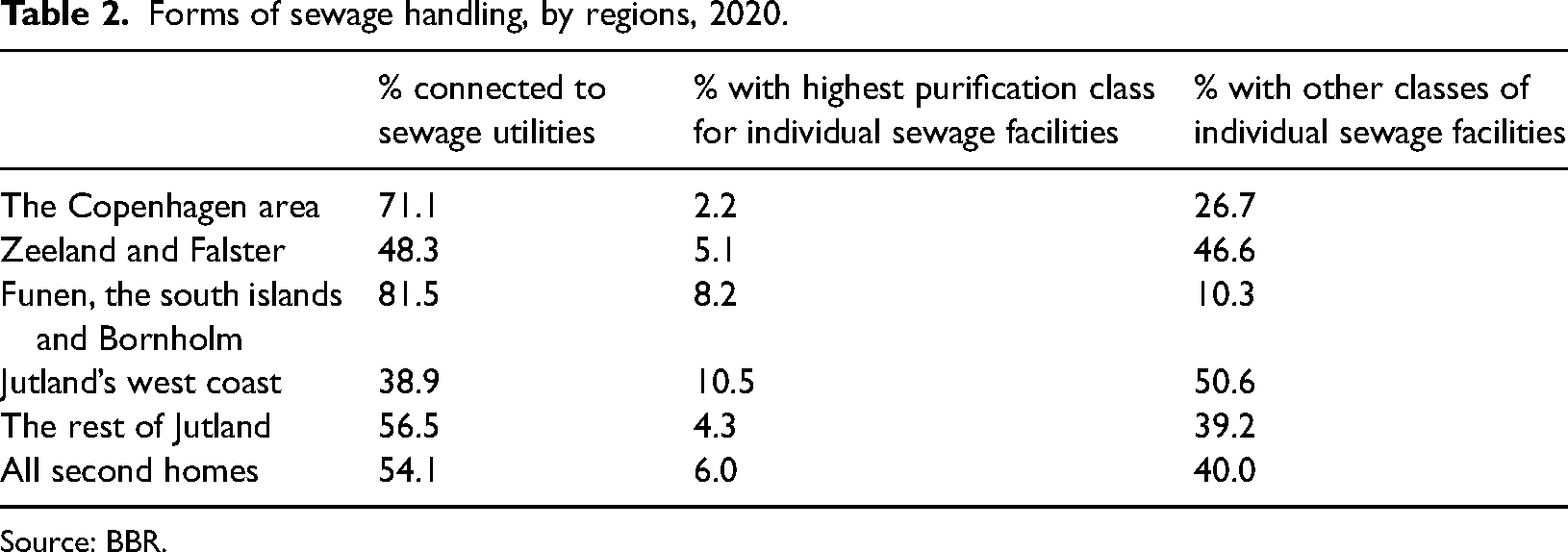
How can the observed regional variation then be understood? As a supplement to the map, data is aggregated in groups of municipalities (Table 2). This aggregation confirms that the connection to the public sewage systems is actually lower in the West Coast destinations. These areas are characterized by having, on average, larger land sites to each second home, in contrast to for example the areas in the vicinity of Copenhagen. This is a feature of some importance, as when the land sites are large, distance can be created for the diffusion pipes and nozzles of the septic systems. Another issue is that the dune landscapes are not areas of ground water harvesting, which also generates a more relaxed attitude by the environmental authorities. However, also such areas are experiencing higher groundwater and the flooding risks. The second homes on the West Coast are on average bigger, and there is a considerable building and expansion activity as there are favourable possibilities for the owners to ensure an additional income from renting. This raises more prevalent discussions in the municipalities and the water companies about the urgency of ensuring that more second homes are connected the public sewage systems.
Forms of sewage handling, by regions, 2020.
Source: BBR.
According to Table 2, the islands are above average in terms of connection to the public sewage systems. The high proportion is affected by the fact that the large second home area Marielyst in Guldborgsund Municipality had, from its first planning, layout, and implementation in 1970s, for the standard of that time a comprehensive underground wastewater piping system with connection to the public sewage utility.
When comparing Figure 1 and Table 2, it can be concluded that regional variety can neither be fully explained by the general regional features of tourism, nor of the characteristics of the landscapes and environmental robustness. What is seen here is a significant municipal discretion in the planning and implementation of the wastewater systems. The governance principles will be a matter of further discussion below.
Critical factors
While the wastewater footprint in tourism has gone under the radar some time, the critical factors are increasingly being discussed and debated openly, and there is a mobilization by second home owners and renters who react on the experienced inconveniences and inconsistencies with the environmental goals (Hjalager, 2020).
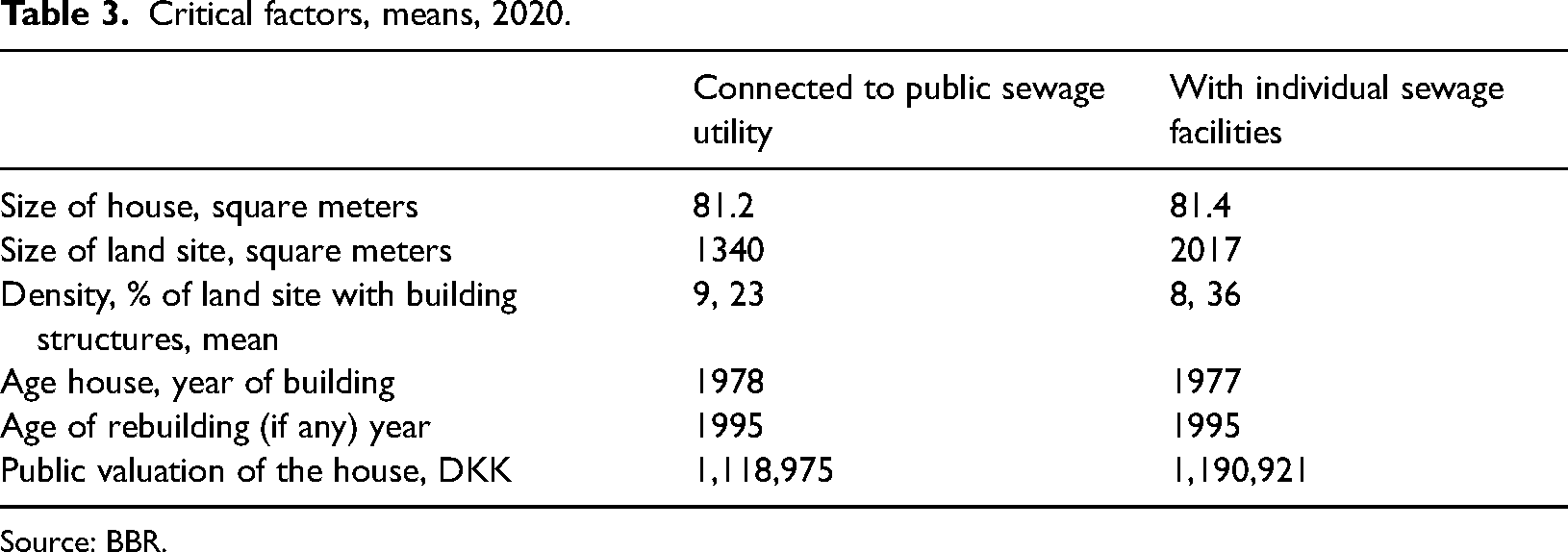
In order to scrutinize the data for critical factors, a further analysis has been undertaken, the units being the single second home, regardless of spatial location in the country. Table 3 provides some important means that support the notions of the importance of the local governance decision in the sewage situation.
Critical factors, means, 2020.
Source: BBR.
The table demonstrates that the differences in the second homes connected to public sewage systems or not mainly lie in the land size of the single properties. Lager properties can, as mentioned above, better than smaller accommodate for the space needed for well-functioning septic tanks. This is actually reversibly reflected in the density measures, where houses with a connection to public wastewater treatment enjoy a liability to cover a larger proportion of their land sites with building capacity without immediately compromising the environment.
However, the average sizes in the two categories are identical. Larger houses, for example, much used for renting and with a larger water consumption, are not more frequently on public sewage systems.
It is very remarkable to see that the data do not document any ongoing modernization process, expressed by new second home being more frequently connected to public infrastructures than those houses that were built years back. This suggests that much of the building and rebuilding takes place in old second home zones, which were not originally connected to sewage systems. An important complicating factor for the modernization is that an investment in sewage piping it will have to include all houses in confined areas in order to become economically sustainable. The municipalities carefully assess the feasibility of such projects.
Public valuation is an indicator for the variance in the potential sales prices. As it appears, connections to the public sewage systems do not relate positively with the value assessment, rather the contrary. Below we shall get deeper into the economic aspects, which may as it stands discourage owners as well as planning authorities – the municipalities – from engaging intensely into sewage systems modifications and investments. The willingness to contribute a more sustainable future for the second home areas is ambiguous.
The governance of and prioritizing in wastewater systems
The Danish governance of water provision and sanitation is a multi-level system with policy and strategy setting at the national level, and planning, implementation and monitoring at the municipal level (Vandplanlægningsloven, 2013; Vandsektorlov, 2009). The EU water directive and environmental benchmarks are main focus points for the overall quality of the waters in Denmark. In recent decades, the water systems are settled in governance arrangements bound to the local place, the municipality (Jensen et al., 2016). In this article, the focus is on policy and governance systems at the municipality level, while the rationales at EU and national levels are not addressed in any detail. The decentralized system allows for differences in the handling of the specific challenges, and a closer relationship to whoever may be key stakeholders. A main observation here is that the difference in the level of sewage piping and connection of second home areas to the public utilities is partly a result of the legitimate political variance of service levels in the Danish municipalities.
At the local level, the municipalities are obliged to establish a unit in the municipality’s environmental and technical administration that undertakes the development of comprehensive overall strategies for the wastewater system. The strategies should reflect the environmental situation, urban development plans, particular climate related challenges, such a flooding risks, overflow handling and the economic situation of the specific municipality, etc. The operation of the wastewater is outsourced to a quasi-private, non-profit company, owned by the municipality. The municipal water strategies, to be approved by the municipality board, are to be implemented by the water company, but the specific implementation is a matter of ongoing negotiation between the political level of the municipality and the water company. Comprehensively, the type of governance is highly inspired by New Public Management or close hybrids hereof.
Before the governance transition during the past decade, strategic wastewater plans used to contain specific indications the range of sewage piping projects and the number of second homes expected to be covered in specific years to come. This is no longer the case. In order to obtain a higher flexibility of operation and a possibility to react fast on emerging and urgent wastewater problems, the investment plans detailing and thereby a public transparency have been reduced. For a number of years, the municipality of Odsherred wanted to ensure sewage piping for annually 800 second homes, and this was a ‘promise’ to the second home owners. However, these years, the ‘estimate’ is reduced to 400 houses annually, which will lead to a postponement of the final modernization of the sewage system until around 2070. Reasons given are that the sewage plants needed modernization first and that the renewal of the underground infrastructures, for example, the separation of black and surface wastewater in the towns, was to be given higher priority. Other municipalities interviewed for this project describe similar oscillated planning procedures, and the constant rescheduling of piping projects is also seen here.
The financial governance of the wastewater corporations is fairly rigid. They can borrow money to undertake investments, but only within the frameworks settled by the national Ministry of Finance. Hence, the companies are components in the overall public expenses policies and ceilings. In addition, the local tariff dimensions and structures must also be politically approved in central government bodies, as the payment should include ‘fairness’ for costumers. The water and sewage prices are carefully monitored and benchmarked nationally. The low prioritization of second homes may reflect the fact that the houses are not used the full year, and their contribution to the companies’ finances is relatively lower than other properties, and return-of-investment is, therefore, expected to be slower. Interviewees from the municipalities remark that they are aware of the aging septic tanks that should be renewed, but some of these private investments still have a remaining investment value for the owners. Such social considerations are also a part of the prioritizing process. One of the municipalities, Hjørring, recognizes that second home owners are not necessarily affluent, and putting a pressure on them to undertake the required co-financing of the piping may lead to the involuntary selling of property, resulting in other pressures on the sewage systems by the moving in of new and more water consuming categories of owners. These are some of the subtle paradoxes in the art of making progress for the sewage systems towards higher degrees of sustainability.
Sewage matters have not been on the top of the head for second home owners, but problems arising are overflow, technical and practical inconveniences, unhygienic spills in areas without connections to public sewage facilities, and higher costs for individual sewage handling on each land site. Such troubles increasingly mobilize the second home owners, who are, according to the municipal planning officers interviewed for this study, often divided in three groups: First, those who (mainly for financial reasons) want to keep things as they are. Second, those who see the substandard sewage infrastructures as compromising the value of their investment and the possibility to put the house on the renting market. Third, people with an environmental agenda, a group that can be overlapping with the second group. The municipalities do not provide any documentation for these perceptions.
There is in the Danish planning systems an underlying tradition for involvement and co-creation, and the practice is manifested in different ways in the interviewed municipalities. Ringkøbing-Skjern water company, for example, maintains an extensive website that informs second home owners about small and big water issues. In other municipalities, the second home areas’ property owner associations are invited to participate in planning events and strategy discussions. In more recent years, the second home owners are encouraged to establish ‘climate communities’ that can address a variety of issues, such as sewage handling, flooding, diking, ditching, etc. Such communities do not have any formal power, but may, if cleverly organized and facilitated, become additional pressures on the municipal and national decision makers in terms of handling the sewage issues in second home areas. It is interesting to see that some municipalities encourage the establishment of climate communities, in spite of the fact that such entities are not included any legal frameworks, and in spite of the fact they are not really compatible with the systemic structures established.
Discussion
The contribution of this article lies in the insight into aspects of the environmental implications of tourism. While water consumption is relatively well covered in the literature, the sustainable discarding of the wastewater from touristic activities is much less accounted for. The water footprint of the individually owned second homes located in low density areas is in less focus than sewage flows from property in urbanized zones, for example, hotel or resort districts. However, in the case of Denmark, this tourism accommodation type accounts for a high proportion of all touristic bednights, and the environmental effects are meaningful to be considered and planned for.
This study demonstrates a situation where half of the 185,000 investigated second homes in Denmark are supplied with individual solutions for wastewater treatment, which are, under some circumstances, substandard compared to the connection to public wastewater utilities. The data show a high variance across municipalities and regions, a situation that can be ascribed mainly to the discrepancy in political attention to the issue, and less to the variation in the environmental carrying capacity in the specific localities. There is an increasing mobilization of second home owners who want to see improvements in the infrastructure. However, the governance models and the legal structures supporting them are not uniformly accommodating for the particular problems in second home areas, and investments in the upgrading of underground piping to public sewage utilities are often seen to be postponed.
The transition of governance models in Denmark has had the unattended side effect that environmental problems in second home areas have been left more into the dark. Or to put differently and more sharply, the prioritization of economic efficiency over environmentally efficient public wastewater utility system seems to be the reason why sewage systems in Danish second home areas are improving relatively slowly. Consequently, there is a risk that SDGs # 6 and # 14 will not get the priority they should have ideally. In any case, there is reason for discussing the balancing of economic efficiency versus environmental efficiency, and the second home second raises a more general focus on the contribution of tourism to environmental problems as well as to their solutions.
The role of the bottom-up organized climate communities is not unmistakably determined in the law. Such institutions are voluntary and depend on the possibilities to successfully mobilize the second home owners and users. Some environmentally concerned second home owners may worry that controversies and disagreements in the climate communities could lead to further postponements of environmental action. As Danish coastal tourism depends on the second homes, and as local economies and jobs rely on the intensive commercial renting, the place for wastewater in the municipal strategies, may, if a higher transparency on the issues is ensured, be a reality in the near future. Climate communities are novel in the political stakeholder spectrum, and further and future research will reveal whether they can become of any importance for the handling of water footprints.
This article can be criticized for not taking into account all touristic facilities, but only second homes in dedicated zones, and addressing the lifestyle changes towards multilocal living space preferences. Further studies can widen the perspective. Another issue is that there is a need to enhance the understanding of what constitutes the best and most innovative wastewater treatment technologies. We imply fairly persistently that the connection to the municipal sewage treatment plants as the most optimal solution. However, research literature embraces the situation in the global south seriously and discusses eco-friendly wastewater cycles, which contain composting and recycling in much wider cycles (Firdaus et al., 2020; Sang, 2017). Such systems may under some (new) governance regimes be discussed not only for small eccentric eco-lodges or developing countries, but also for other spatial and socio-economic features as those found in Denmark.
Conclusion
In the international tourism literature, there are not similar studies that can confirm the Danish situation. The study is a first of its kind, and it raises the attention to a SDG topic that has hitherto received little research interest. Over the past years, the second homes have become more popular for vacations and as resides for work, events and relaxation off-season, and as investment objects. All of these factors – enhanced by the Covid-19 pandemic – contribute to putting pressure on the existing infrastructures. A continuation of this trend will, together with climate related water incidences, probably increase the need for policy attention to the wastewater problems. The governance structures are not entirely geared to the spectrum of problems in second home areas, and the tariff and co-financing of investments are not fully in concordance with emerging threats to the environment. There are problems to be solved in the comprehensive water cycle, and the municipalities and water companies do not have a clear incentive to give a priority to the second home areas. A national intervention with legal adjustments is needed.
It is an implied – and not quite unreasonable according to the water authorities – assumption in this article that connecting Danish second homes to the public sewage system via underground piping is the most environmentally sound solution. However, when looking at experience from other countries, are there better options? The amounts of sewage produced go quite directly in parallel with the fresh water consumption. Policies for water saving and protection as a strategy may, therefore, also be translated into a decreased pressure on the wastewater infrastructure, no matter whether individual or public systems. Incentives mentioned in the paramount literature on the topic include, for example, water-saving aggregates on water taps, low toilet flush, rainwater collection for irrigation, etc. (McLennan et al., 2017). However, also the pricing of water is an instrument discussed, but by mainly addressing hotel owners’ incentives to invest in water savings both in connection with tourists’ use of water, but also in back-stage operations (Sun and Hsu, 2019). Wider, the information instruments and water awareness programs may raise the tourists’ perceptions and norms of water issues (Rodriguez-Sanchez et al., 2020). However, such softer and attitude changing measures are not clearly discussed, and not at all massively implemented, in connection with second home areas. The second homes are properties with a very fragmented user and owner structure (Hall and Müller, 2018), factors that can explain the slow progression into more sustainable solutions along these lines.
As a result of New Public Management/Governance transitions, the consumers in Denmark and elsewhere may have achieved more efficient and cheaper water and wastewater services (Jensen et al., 2016; Lund, 2018). However, as illustrated by this study, a side effect is that wastewater has moved somewhat away from the environmental and societal goals, as economic efficiency and the benchmarking of services and tariffs have received prominence. The coordination with other sectoral policies is coved in ‘planning buzz-words’, rather than in specific development plans. Relating the wastewater sector to the SDGs remains to be specified. Planning documents for second home areas are typically vague on the prospects for the modernization of the wastewater systems, reflecting that the sequence of investments may be rescheduled or postponed many times, before the caterpillars will get into action.
Can climate communities, second home property owner associations or other constellations of stakeholders in the second home sector ensure a more rapid progression of the development of sustainable wastewater management? Priority setting is de facto centralized to a significant degree in the municipality in collaboration with the semi-public water companies. The involvement of property owners takes place mainly as information campaigns prior to specific underground piping activities, preparing the second homeowners for inconvenience and costs. In the planning phase, the involvement and co-creation with the second home owners and users depend on their own mobilization power and organization skills, not on participatory and inclusive planning action in the hands of the municipalities. The wastewater sector remains in a mainly New Public Management era, and ideas of well tested participatory practices. The suggested more from New Public Management to New Public Governance is still not strongly affecting the strategizing, planning and implementation of wastewater system in this case.
The study raises a number of additional questions for future research about the touristic water footprints. Comparing the Danish second home sector with similar sectors in other countries may result in new perspectives, for example, related to the planning and governance models. The activation of more knowledge about potentially determining properties, such as spatial density, underground water carrying capacities, ownership modes, etc., is also needed (Hall and Müller, 2018; Slätmo et al., 2019).
Highlights
In the economically and recreationally important second home sector in Denmark, only 54.1% of the houses are connected to public sewage utilities, and the remaining rely on presumably environmentally less sustainable individual septic tanks.
There is a significant regional disparity, which is not only the result of environmentally different carrying capacities, but also of a variation in investment decisions taken by local authorities.
The New Public Management ideology, implemented in the water sector over the past decade, tends to hamper a rapid improvement of the sewage facilities, no matter that rising water levels and intensified use of second homes are often not in concordance with the existing standards of the infrastructure.
Measures are suggested by local authorities for a stronger involvement of owners and users of second homes in addressing the improvement of water footprints, but governance structures are still contradicting this ambition.
The wastewater sector is a key element in the future SGD discussions in tourism.
Footnotes
Declaration of conflicting interests
The author(s) declared no potential conflicts of interest with respect to the research, authorship and/or publication of this article.
Funding
The author(s) disclosed receipt of the following financial support for the research, authorship and/or publication of this article: This work was supported by the Realdania.
