



Abstract
This article is underpinned by the hypothesis that if Australia is to reassess and improve its relationship to and use of rivers and river systems, then more holistic ways of understanding rivers, and strategies for representing and communicating this understanding, must be developed and brought together. Held over two days in August 2019 at the Lismore campus of Southern Cross University, ‘Speaking With the River’ was an interdisciplinary symposium exploring the capacities of creative research practice to develop new understandings of rivers and river systems as simultaneously environmental, cultural, historical and economic phenomena. In this article, we bring together the voices and disciplinary insights from the symposium and the rivers of Northern New South Wales, and we reflect on the way that riverine language ran throughout our discussions and ideas, providing a connective model of confluences and conjunctions for the interdisciplinary enterprise we were engaged in. This article presents perspectives on rivers and river systems from law, history, art and science, exploring common ground and common purposes. Developing a legal framework for recognising the rights and ‘voices’ of rivers, that is informed by Indigenous knowledges, historical contexts, and scientific understanding, and that employs artistic innovation in representation and translation, is to us the ultimate goal of such an enquiry. While this paper does not undertake the formal steps of developing this framework, it provides the necessary background and instantiates its elements and working methods within the context of the Richmond River in Northern New South Wales.
We begin with this map (Figure 1) to focus our attention on the Richmond River, which rises on the southern slopes of a mountain range, flowing southeast and northeast with 12 tributaries that flow for 237 km to reach its mouth in the ocean. Void of towns and human structures we can see the river differently, as an active contributor in our understanding, rather than just being subject to it. While we cannot ‘write like a river’ as James Scott (2021) suggests, we foreground the Richmond River for its capacity to materially and symbolically shape our shared life and acknowledge its presence in this paper. The map exposes the large catchment area flowing into the Richmond River that regularly overflows into 1000 square metre floodplain on which we have built our homes and farms. They call it flooding, but as Toni Morrison reminds us, ‘it is remembering. Remembering where it used to be’ (1995: 99). In February 2022, catastrophic flooding engulfed the region, overtopping historical flood levels by a full two metres. It is a climate emergency unfolding in real-time as we write.
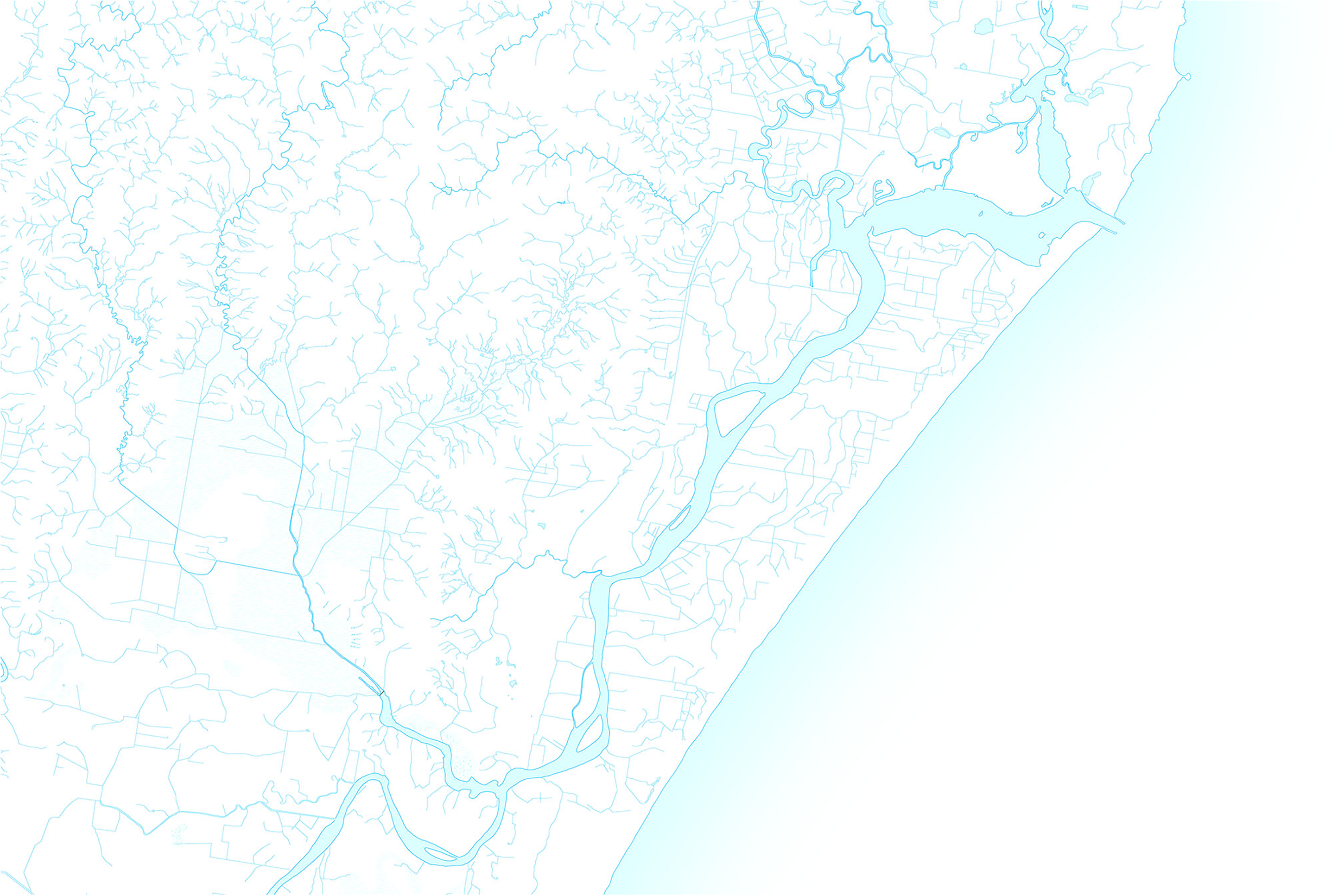
Fluencies (detail, Richmond River) Rob Garbutt (2021).
Introduction
‘Speaking With the River’ was an interdisciplinary symposium held in 2019, designed to develop new understandings of rivers and river systems as simultaneously environmental, cultural, historical and economic phenomena, and with the power to express themselves. An exhibition with the same name followed in 2021, held at the Northern Rivers Community Gallery in Ballina, NSW. Featuring artists, historians, environmental scientists and scholars of environmental jurisprudence, the symposium sought to concatenate these different perspectives in producing a new understanding of rivers designed to counter narrowly instrumentalist approaches.
Speaking with a river requires us to listen in a meaningful way, and responding to what it is telling us can be limited from the perspective of our own disciplines and experiences. Moving outside the comfort and relative certainty of our own knowledge to give attention to the river as an active participant, and trying to narrate from the perspective it brings, takes us on a different course. Scholarship in the environmental humanities has represented and encouraged a ‘new conceptual umbrella’ for interdisciplinary scholarship that broadens our conversations with each other around significant environmental issues and encompasses the more-than-human as well (Rose et al., 2012; Bergthaller et al., 2014). In this article, we bring together the voices and disciplinary insights from the symposium and the rivers of Northern New South Wales, and we reflect on the way that riverine language ran throughout our discussions and ideas, providing a connective model of confluences and conjunctions for the interdisciplinary enterprise we were engaged in.
Rivers connect people and place, livelihoods and recreation, culture and ecosystems over space and time. In the Northern Rivers they define a sense of place co-evolving with society. The Northern Rivers region encompasses the catchments of the Clarence, Evans, Richmond, Brunswick and Tweed Rivers in New South Wales, Australia. The water systems and fertile valleys have co-existed and mutually constituted human societies for thousands of years. ‘Cultivating Arts of Attentiveness’, as van Dooren, Kirskey and Münster suggest, ‘paying attention to others and meaningfully responding’ can bring into focus the entangled relationships we have with others, ‘different forms of life caught up in diverse relationships of knowing and living together’ (2016). We are deeply entangled in these rivers, subject to the history that they shape and the consequences of trying to command them and seek stability, which they are so far unwilling to provide. The voice of the river can be registered in multiple ways; through sound, the expansion and contraction of its presence, the trouble and the goodness of the sediment it moves, where it flows, in its rights to life, through the ways we measure its health. As Nyangbul historian Marcus Ferguson urges us: Always talk to Country. Always talk to Water. Remember – everything has a spirit. From fire to water to everything (Ferguson, 2021).
Over 30 years, and across 26 reports, the Richmond River system has consistently been classified as stressed and degraded (Burke, 2018), with a 2018 NSW Government report noting its catchment was in ‘worse ecological health than most estuaries in NSW’ (Marine Estate Management Authority, 2018). Colonial-era drainage of wetlands has caused significant acid-sulphate soil problems, and depletion of riparian zones and nutrient runoff from agriculture and horticulture have caused excessive sediment in the river, often resulting in low oxygen levels and fish kills (ibid). Similar impacts and forces are exerted upon rivers and wetlands across Australia, and this comes on the back of many years of controversy and conflict between Indigenous peoples, environmental managers, irrigators and farmers, fishers, local councils, and State and Federal governments, with the core of the conflict being the ‘work’ that rivers are asked to perform for very different groups of people (Goodall, 2018). Goodall highlights that the health or functionality of a river looks different depending on who is doing the looking. The divergence in value systems invested in Australia's rivers, and the divergent economic and social power wielded by the actors who make this investment, together bring Australia's waterways to their current parlous state.
This paper proposes a specific interdisciplinary response to this situation. It presents perspectives on rivers and river systems from law, history, art and science, exploring common ground and common purposes. Developing a legal framework for recognising the rights and ‘voices’ of rivers, that is informed by Indigenous knowledges, historical contexts, and scientific understanding, and that employs artistic innovation in representation and translation, is to us the ultimate goal of such an enquiry. While this paper does not undertake the formal steps of developing this framework, it provides the necessary background and instantiates its elements and working methods within the context of the Richmond River in Northern New South Wales.
Confluence and interdisciplinarity
To speak of an interdisciplinary concatenation of scholarly approaches conjures confluence as a metaphor, of flowing together. And, intuitively, this makes immediate sense. Speaking with the river demands interdisciplinary voices that could be understood as deriving from the river as an ‘envirotechnical landscape’, that is, as a landscape that is neither purely natural nor solely a socio-culturally constructed space (Pritchard, 2011: 1). Or we might say that the river is best viewed as a hybrid landscape, an expression of ‘naturecultures’, and this hybrid object necessitates a range of languages and ways of understanding in order to speak with any sense or fidelity (Haraway, 2003: 1).
Speaking with the river through an interdisciplinary frame is not a panacaea for developing sustainable relations. That is, it is all too easy to approach interdisciplinarity in the mode of anthropocentric mastery, of collecting together points of view in order to somehow more completely dominate and possess, which has not served the world or humanity well. Our project instead, as Astrida Neimanis proposes, is to counter human mastery and hubris that has its roots in colonialism and patriarchy: we attempt to ‘cultivate a much-needed epistemology of unknowability’ (2017: 58), that is, to accept with humility that control of the world around us through complete knowledge of it is impossible and as often as not leads to consequences beyond our control. To speak with the river is to learn from it that while it appears to be neatly contained, with a change of weather it quickly overflows its banks, cuts new channels, refuses to be constrained. As we ponder its existence we recognise that the river speaks more often without us and across aeons, and we are caught by speech that is barely audible at the spatio-temporal resolution of human sensing. With this in mind, in our speaking with, we attempt to formulate an interdisciplinary encounter that brings us together with the river using an approach, which for this moment we explore through the work of confluence.
We approach confluence as a concept for thinking through collaboration between disciplines and between entities situated in a particular place that shapes our river-thinking. As with all confluences, the phenomenon is hydrological, ecological, meteorological, geological and geographical, as well as cultural.
The authors of this paper live in the Northern Rivers region of NSW. The rivers give the region its name, they have defined its history and industries, shaped its culture and architecture, provide food and floods. Our university campus is situated in Lismore in northern NSW, Australia, at the confluence of the Wilsons River and Leycester Creek, which in turn flow into the Richmond River. This converging network of streams is particularly active in our semi-tropical wet season that on occasions feels the flick of the tail of the south-east Asian monsoons. When it rains these creeks cascade down the slopes of the once enormous Tweed shield volcano that spread its lavas across 3900 square kilometres (Solomon, 1959: 23) during three million years of activity between 23 and 20 million years ago (Ewart et al., 1987: 1). Once up to 2 km high at its summit, the volcano has been eroded to half its original height in some places (Solomon, 1964) by a consistently wet climate since it first formed. Water found its way into weak points in the flows of basalt and rhyolite to form steep valleys, some with sheer cliffs, then rolling hills and finally alluvial plains, all of which has created a diverse range of ecosystems through the catchment supporting rainforests and sclerophyll plant communities. In Lismore, at the ultimate confluence of those thousands of creeks, the river regularly overflows its banks, including the levee built to contain and separate it from the city streets and businesses.
Living and researching at the southern extremity of this ancient volcanic slope give us a specific sense of confluence as a way of thinking about interdisciplinary work. The caldera where the dense network of creeks comes together into one river gives the confluence in this paper its shape. At the headwaters of the network, steep amphitheatre-headed valleys constitute each major creek – a clearly demarcated tributary to the fan-like structure that comes together at a particular point, but until then a distinct entity. Yet, as Neimanis writes, ‘differentiation balances water's capacity for confluence’ and so ‘tempers the romantic overtones of water's relational logics’ (2017: 54). Ridges, zones of resistance to water's erosive powers, are key. A drop of water, depending where it falls, can follow paths to the ocean that differ by hundreds of kilometres. This product of a dendritic network of creeks, generates in each flowing branch a specific habitat, as too is each confluence (Grant et al., 2007: 165). And this habitat diversity yields around the Tweed volcano caldera, a complex web of biodiversity hotspots that have been recognised as the World Heritage listed Gondwana Rainforests of Australia.
Garbutt's work ‘Cut and Dry (Plan)’ illustrates this topographical network in an intriguing fashion. Part of the /kriːk/ exhibition held in the leadup to the symposium, this work highlights the form of the Wilsons River using aerial survey images. Picked off its surrounding topography the river's form, emerging within a precariously thin dark green riparian zone, is a thing in itself, open for aesthetic contemplation and floating upon the white space of the agro-colonial, cadastral grid. Yet at the same time we know its form is a function of forces beyond its banks, and that the river is in constant interplay with the land and lives around it; the river breeds habitats, distributing life where it flows (Figure 2).
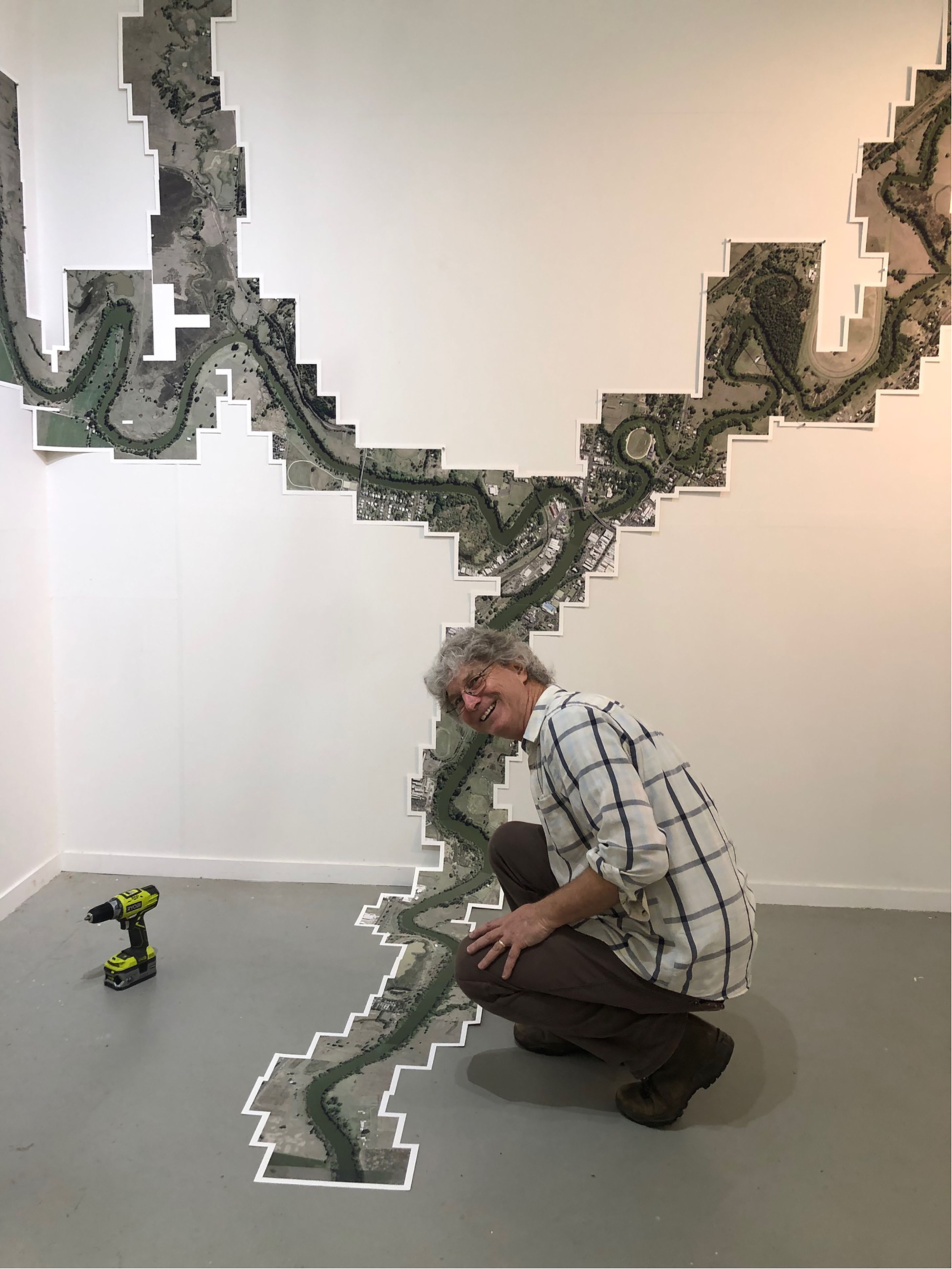
Rob Garbutt Cut and dry (plan) 2019, digital print on Hahnemühle Bamboo, 4.84 m × 5.48 m. Installation image courtesy Fiona Fell.
Each habitat nurtures a particular comportment towards life and non-life, a different set of knowledge and ways of being. Each generates particular expressions and values, its own language of flourishing and silence. As scholars we appreciate the value of these habitats, this disciplinary differentiation of knowledge that enables a specific focus on the world about us. We approach interdisciplinarity in this way because we want to emphasise the lived experience of disciplinarity and the complexity of inhabiting its dendritic nodes. This is about more than ways of head-bound cognition; we want to emphasise the habitation, the daily habits, the routines that we embody before thought even gets underway (Petitmengin, 2007), or more correctly the ways in which thought is a cognitive and embodied process. As scholars we put our bodies on the line: slipping down a bank to find an ideal location for a hydrophone recording and feeling in the fall the depth of the alluvial flood plain, sampling river sediments in a dinghy in the intense heat of the summer sun and feeling the counterintuitive upriver tidal surge, spending days in an archive to imbibe words that give historical life to a now drained swamp, sifting the words of a legal determination that gives a river on the other side of the Tasman standing, in law, as a person. Disciplines are habitats, all separated and reproducing through a range of mechanisms, all formed initially as gullies carved in apparently undifferentiated rock. Each habitat of mind brings strengths to the fore, has its purposes and ways, its values, throwing away junk that is rich pickings for others. In each a certain form of life is more comfortable than another, certain habits are supported as orthodox and useful.
Yet while confluence requires differentiation, this differentiation does not remain isolated and self-referential. The relational quality of water, the openness of habitats to external influences demands dynamism and exchange. At each confluence, a new habitat is formed, though not singular, again differentiated in its eddies and whorls. In this interdisciplinary confluence, we are reminded by Astrida Neimanis (who learns from Spivak's account of farmers on the floodplains of Bangladesh) that to inhabit this particular site in a way that counters ‘control-oriented knowledge’ and instead ‘engages in a more humble learning-with-the-water, learning-with-the-land’ requires, first, silence not speech. We are reminded that ‘more speech (read: more control) does not generate better knowledge’ (Neimanis, 2017: 61). Speaking well with the river in an interdisciplinary setting, humbly learning with the river and each other, paradoxically sits us down to listen to ‘babbles in languages we do not fully comprehend’ (Neimanis, 2017: 63). Through listening to the river we seek to tune our bodies, accept the impossibility and undesirability of total knowledge and control, and open ourselves to the possibility of speaking with the river in an uncertain language, uncertain in that it acknowledges the unknowability of what is beyond us and of which we are a part.
Knowing and unknowing: Swampscapes to the sea
As one leaves Lismore and travels south, the Wilsons River opens into floodplains that, having joined with the longer Richmond River, stretch to the Pacific Ocean at Ballina. The first Europeans to the North Coast quickly found that behind the dense forested riparian zone, stretched a vast and fecund system of wetlands. The first colonial surveyor to the area, Clement Hodgkinson, described the typical scene of each river north of Sydney: These borders of alluvial brushland on the banks of the river, are generally half a mile, or a mile wide, and are then backed by extensive swamps of many thousand acres in extent, whose verdant sea, of high waving reeds and sedge, stretches away to the base of the distant forest ranges. (Hodgkinson, 1845: 9)
From the moment of colonial settlement, these unpredictable swampscapes were imagined and then engineered into spaces of containment. In many ways what the current state of Australia's rivers represents is a crisis of understanding, 200 years of failure to appreciate swamps and river systems in their fullness and richness as multi-dimensional eco-cultural phenomena, a simplification of riverine complexity akin to the separation of humans and nonhumans that Bruno Latour describes as ‘purification’ and attributes to modernity (1993: 10). Building on Latour's insights, Jessica Weir notes that the ‘modern’ conception of nature as resource, imposed upon Australia's environmental forms during the settler-colonial period, renders a given river as an ‘externally constituted water resource that is moved and allocated by human ingenuity through engineering works’ (Weir, 2009: 9). In contrast to this she outlines Indigenous perspectives that ‘describe how respecting and understanding the life and agency of the river country is important for the continuation of all life’ (2009: 13). She quotes Indigenous academic Steve Kinnane who argues that a concept of Country does include land as a resource for human use but ‘in a way that is restricted by overarching spiritual and cultural imperatives’, and goes on to argue that ‘the concept of country does not allow for a separation of people, land and waters’ (Kinnane, in Weir, 2009: 13).
Flowing out of Widjabul Wyabul country of the Bundjalung Nation, in its lower reaches the Richmond moves into the country of the Nyangbul people. An early colonial observer of the region declared that the Clarence and Richmond rivers had ‘possibly more swamps, creeks, and marches [sic] than all the other rivers of the east coast of Australia put together’ (Queenslander, 21 October 1876, 14). He regarded swamps with dread, as places oozing with potential disease. Neither strictly land nor water, but both land and water, the lack of permanence and definition has been problematic within western perceptions of wetlands. The idea of instability, where in places ‘there is no bottom’, resonates with a long history of seeing swamps as ‘unfaithful ground’ and ‘useless’ (Di Palma, 2014). They were feared as contaminated and contaminating places, their unknowability was precisely their danger.
Indigenous conceptions of wetlands are very different. The distinctions between land and water are not absolute but instead viewed as entwined cultural phenomena whose characteristics are determined both by the sacred past and current lives. The work of Yaegl artist Frances Belle Parker is a rich example of this understanding. Parker's work across painting, installation, public art and commercial design has featured in major forums including winning the Blake Prize in 2000. She grew up in Maclean NSW on Biirinba, the Clarence River, and a great deal of her work reflects on the significance of the river and the islands within it, both for her and her family and for all the Indigenous groups whose country the Clarence flows through – the Bundjalung, Yaegl and Gumbaynggirr peoples. As in the painting below, Biirrinba Ngarrangiya, her work frequently mixes perspectives on country – a classical view of the land from the ground, and an aerial perspective that invokes mapping processes as well as Indigenous knowledge of landforms as if seen from the air.
One of the recurring motifs in Parker's work is the shape of Ulgundahi Island near Maclean, an island in the river where her Mother's family lived. Now Heritage-listed and owned by the Yaegl Local Aboriginal Land Council, in 1904 the island was gazetted as an Aboriginal Reserve and Mission and many Yaegl families were forcibly relocated there. The name of the island, Ulgundahi, translates as ‘shape of an ear’, a clear signal of the way Yaegl relations with country incorporates aerial perspectives and knowledges; appropriately, the title of the work below translates as ‘Clarence River Deep Listening’. Parker uses Ulgundahi as an adaptable figure for reflecting on both Indigenous dispossession as well as the strength of family and connection to place; the strength of her Nan who daily rowed the waters of the Clarence to take kids to school and men to the cane fields, and to go to work as a domestic in the houses of the very landowners responsible for her family's dispossession. The island, though, is also a form within the river, in dialogue with the river, sometimes an ear, sometimes a kidney, sometimes an ovary, always changing shape as the forces of erosion and deposition massage its borders (Museums & Galleries NSW, 2014). Most importantly, the interaction between Birrinba and Ulgundahi signal Parker's sense of reciprocity with the river and Indigenous cultural connection to environmental forms: ‘I paint what I am most familiar with, my river, my Biirrinba. I see the river as a life-giving vein that pumps through our body enabling us to be. When the river is healthy and flowing, so are its people’ (Parker, 2019) (Figures 3 and 4).
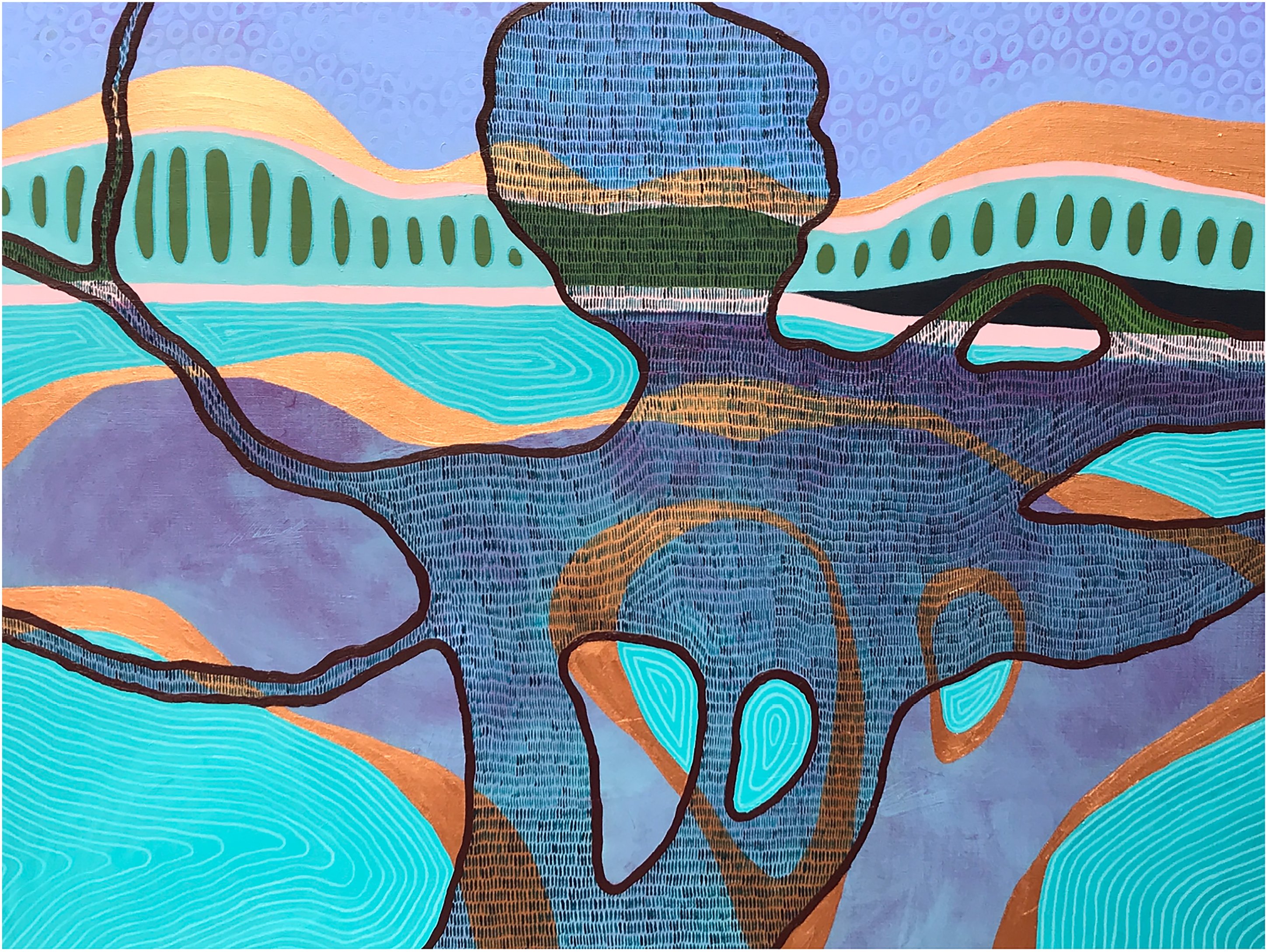
Frances Belle Parker Biirrinba Ngarrangiya (clarence river deep listening) (2019). Acrylic on linen, 100 × 120 cm.
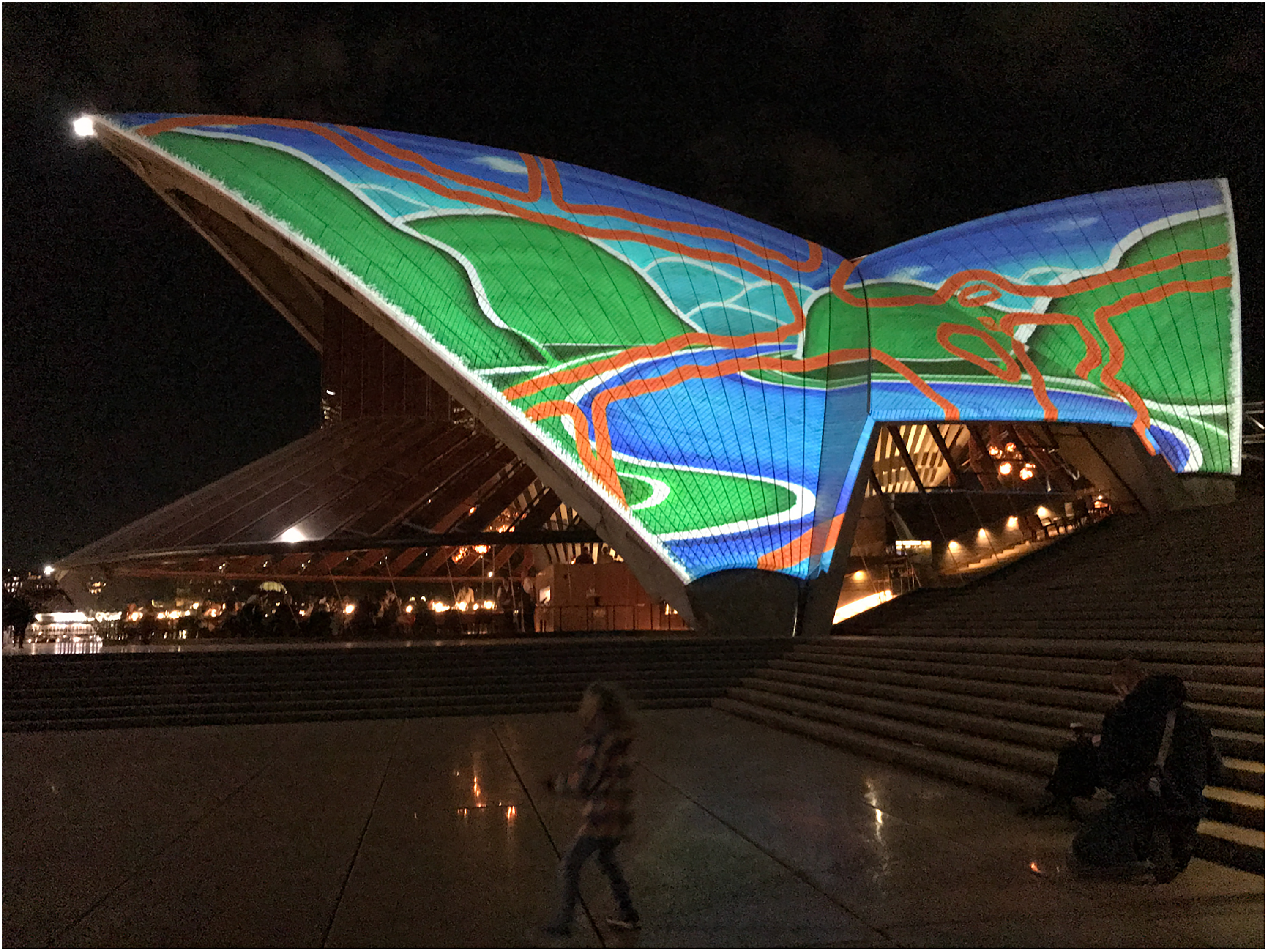
Frances Belle Parker Mapping Biirinba (2010), part of the ‘Badu Gili’ night-time projection programme at the Sydney Opera House, curated by Rhoda Roberts.
The largest of the Richmond River wetlands, and one of the largest north of Sydney, was the Tuckean Swamp. As a vast water place within this landscape, often teeming with life, the Tuckean was a significant place to each of the clan groups of the region. Ridgelines were important travelling routes, from which people went down into water places to access food, medicine and maintain cultural places. They camped above the swamps, away from the insects and terror of snakes. The Moonem ridge and plateau country ringing the Tuckean from southeast to the northwest had many camp sites, middens and places of significance. Nyangbul historian Marcus Ferguson provides this as evidence of the ‘high cultural sensitivity’ of the whole Tuckean Swamp area: ‘It's a dead set indicator of what went on in that place’ (Ferguson, in Kijas, 2019).
The Tuckean's history since the arrival of Europeans is a global story – of the settler-colonial drive to bring order and demarcation to a place of exuberant chaos and fluctuation; of the need to vanquish the original owners; of colonial land policy that promised an independent livelihood to families in a place deeply unsuited to farming; of an early large-scale drainage system installed through ignorance of the environmental consequences and costs; and of the 1960s optimism and enthusiasm for heroic engineering feats that might at last bring predictability, knowability and control over an intransigent environment. Its history is also set firmly within its locale of the New South Wales North Coast; its geography and seasons, its local politics, the general lack of interest until more recent times in regional and semi-tropical histories and a lag in government funding. Here the stories of individuals, families and communities reside between local, national and global contexts.
As we grapple with unknowing, both in the sense of living with and as a part of the natural world, and living within the Anthropocene where an unceasing demand for energy and growth has forever changed the human future, one of the largest issues faced is that of grief for what is lost. We have a term for this now, solastalgia, an emotional distress caused by environmental change. Addressing and learning from this grief, involving competing and contested groupings and individual stakeholders, is one of the many challenges in speaking with the river. Indeed, it calls for a way of seeking legal redress for the wrong-headedness of human civilisation's impacts on the more-than-human world. In essence, it asks that natural phenomena such as rivers and the systems they incorporate, be given legal personhood, in order that in some way they can ‘speak’ in a context that can have real positive effect upon the world.
Lawscapes and landscapes: The legal personhood of the river
Further building upon Latour's (1993) insights, we note that if the very notion of the river is a modern construct that separates the human from the non-human world, then one of the most crucial questions to ask is how this artefact of separation has been articulated within the political and legal structures that shape human activities and lives. After all, the non-human world is constantly reconstituted within a comprehensive and all-encompassing legal cosmology, for which any observable thing, any object, any landscape, is always, inherently, and inevitably a ‘lawscape’, as noted by Nicole Graham (2011). For Graham, the relationship ‘between the abstractness of property law and the physical materiality of place’ (Graham, 2011: xiii) highlights the agentic power of law, particularly of property law regimes, and its capacity to define the boundaries of the observable by virtue of its normative authority in determining individual and collective behaviour. The legal definition of the natural world not only perpetuates, and further solidifies, a separation between the human and the non-human, but also determines the fate of the non-human by leveraging the collective efforts of the human (Harari, 2011).
The ‘lawscape’ that the common law imagines for the river is an undeveloped, theoretically nascent, largely peripheral one. The river as an abstract legal entity subsists in a twilight zone, caught between the law's familiarity with land – which is viewed as fixed, stable and tangible – and the ethereal, running nature of water – which slips through human fingers and proves difficult to capture. Equally, the amorphous quality of wetlands – like the Tuckean Swamp – which are neither land nor water demand legal resolution, such that their subsequent draining and ‘improvement’ places the law on firmer, familiar ground. In these murky, porous contexts, the legal river lies at the cusp of jurisdiction, with an almost obsessive concern about locating boundaries, whether through fictions such as the medium filum rule for non-tidal rivers, or the algorithmic alchemy of fixing the mean high-water mark for tidal rivers. To the extent that the law accommodates the non-human world in riverine demarcation, it is to give a nod (or not) to the forces of erosion, accretion and avulsion through doctrinal imprimatur.
As we have noted, to the extent that the river is perceived as an infinite natural resource, the law has been ready and willing to exploit it, with rules around riparian rights, the prior appropriation doctrine, or the ultimate abstraction, the splitting of water from place through the creation of separable, alienable water rights – so disastrous in Australian conditions and so controversial in the Murray-Darling Basin – that facilitate its boundless economic use. Boundaries and exploitation, the twin bases of common law's pre-occupation with the river. As Carol Rose observes, the law has proven stunted in its conceptualisation of the river, hemmed in by the centrality of land to property thinking: But why is land – immovable, enduring land the symbol for property? Why not say, water? If water were our chief symbol for property, we might think of property rights – and other rights – in a quite different way. We might think of rights as literally and figuratively more fluid and less fenced-in … as entailing less of the Blackstonian power of exclusion, and more of the qualities of flexibility, reasonableness and moderation, attentiveness to others and co-operative solutions to common problems (1996: 351).
Rose's observation and urge to flip the legal focus from fixity to fluidity were prescient: in 2017, a veritable flood of legislative and judicial initiatives around the world ‘appeared to signal a tipping point in the global acceptance of a new evolving legal status for nature’ (Clark et al., 2019: 787). In Aotearoa New Zealand the Te Awa Tupua (Whanganui Claims Settlement) Act 2017 (N.Z.) formally granted legal personhood to the Whanganui River (O’Donnell and Macpherson, 2019), while the High Court of Uttarakhand in India equally declared the Ganges and Yamuna rivers and their tributaries (as well as their glaciers, lakes, air, meadows, dales, jungles, forests, wetlands, grasslands, springs and waterfalls) legal persons (O’Donnell, 2018). In the same year, the Constitutional Court of Colombia argued that Constitutionally-enshrined biocultural rights were better served by the recognition of the Atrato river as a legal entity, and thus recognised the river as a subject of rights to be represented by a ‘commission of guardians of the Atrato river’, composed of both a representative of the Colombian government and a representative nominated by the local Indigenous and Afro-Colombian communities. And while litigation in the name of the Colorado River Ecosystem initiated by the NGO Deep Green Resistance in the U.S. District Court in Denver, Colorado, proved unsuccessful, the Australian State of Victoria passed the Yarra River Protection (Wilip-gin Birrarung murron) Act 2017 (Vic), declaring the Yarra River (or Birrarung in the Woi-wurrung language) ‘one living and integrated natural entity’ (Clark et al., 2019). Although 2017 appears to be such a momentous year for this legal confluence of similar initiatives around the world, the momentum continues to the present day, with, for example, a growing number of rivers being cast as legal subjects of rights in Colombia, and the Supreme Court of Bangladesh recognising, in 2019, first the Turag river and then all Bangladeshi rivers, as both living entities and legal persons (Islam and O'Donnell, 2020).
While rivers seem to have captured the legal imagination of judges, legislators and activists alike across the planet, the recent explosion of claims and declarations about rivers as living and legal entities is, in fact, neither limited to rivers, nor is it this recent. Almost 50 years ago, Professor Christopher Stone famously concluded a property law lecture at the University of Southern California by asking whether trees ‘should have standing’, only to be met with silence by most theoreticians and practitioners alike (Stone, 1972). That notwithstanding, Stone's argument challenged a host of normative assumptions about the non-human world, and was followed, over two decades later, by eco-theologian and self-described ‘earth scholar’ Thomas Berry first, and by South-African activist and environmental lawyer Cormac Cullinan immediately after, who articulated a novel ‘Earth Jurisprudence’, a ‘philosophy of law and human governance … based on the idea that humans are only one part of a wider community of beings and that the welfare of each member of that community is dependent on the welfare of the Earth as a whole’. From this perspective, Cullinan concluded, ‘human societies will only be viable and flourish if they regulate themselves as part of this wider Earth community and do so in a way that is consistent with the fundamental laws or principles that govern how the Universe functions’ (Cullinan, 2011: 13).
The legal world, this time, answered the invitation to include Nature, both as a whole and as its individual components, within the realm of legal subjects. Following the work of the Community Environmental Legal Defense Fund in the United States, which included local ecosystems as legal subjects within municipal ordinances as early as 2006, the Ecuadorian Constitution of 2008 was the first legal document to officially and unequivocally grant Nature intrinsic rights. The Ecuadorian example was promptly followed by the Plurinational State of Bolivia – first in its 2009 Constitution, and then with two dedicated pieces of legislation in 2010 and 2011 – and then, not long thereafter, by a host of initiatives that seem to have been growing exponentially ever since. David Boyd, UN Special Rapporteur on human rights and the environment, has described the global emergence of rights of nature legislation and judicial decisions ‘a legal revolution that could save the world’ (Boyd, 2017).
While a nuanced analysis of the emergence of an ‘ecological jurisprudence’ (Pelizzon, 2014) is beyond the scope of this paper, it is important to note that rivers are particularly emblematic of the ontological shift that underpins the emergence of rights of nature initiatives around the world. After all, as Justice Douglas articulated in 1972, ‘[t]he river … is the living symbol of all the life it sustains or nourishes …. The river as plaintiff speaks for the ecological unit of life that is part of it. Those people who have a meaningful relation to that body of water … must be able to speak for the values which the river represents, and which are threatened with destruction’ (Douglas, in case: Sierra Club vs Morton, 1972). In the present day, where the scale of destruction appears to have grown well beyond the capacity of rivers to sustain themselves, the sentiment remains the same. Although ‘we have desecrated [our rivers] in every conceivable way’, they remain ‘the arteries of the earth, and lifelines for humanity and millions of other animals and plants. It's no wonder they have been venerated, considered as ancestors or mothers, and held up as sacred symbols’ (Margil, 2017).
It is this almost tactile awareness of interconnectedness that aligns an emerging ecological jurisprudence with First Law, as a recent proposal of recognising a river not only as a living and, or, legal entity, but as a veritable ‘ancestral’ person shows (Martuwarra RiverOfLife et al., 2020). Once legally reconceived as more than objects, thus, rivers become participants in an extended and ongoing legal and inter-normative dialogue with the more-than-human world, upending the artificial boundaries between ‘nature’ and ‘culture’ that have, over the past few centuries, contributed to the atomistic fragmentation experienced by Western societies (Descola, 2013).
Creative acts: Speaking with the river requires river listening
In their exploration of the Indo-European roots of the name of the Danube River, artists and researchers Maya and Reuben Fowkes identify how the modern conception and exploitation of the river obscures an older and more holistic view, noting that the ancient name of the river ‘bore the meaning of primeval cosmic river’ (Fowkes and Fowkes, 2016: 1). Prior to the modern forces that have rendered the river as ‘an accessory of imperialist aggrandisement, a component of the nationalist imaginary and a subject of modernist rationality’ (2016: 2), the Danube was venerated both for its local life-giving power and for its broader connection to ‘planetary processes that reach beyond human history and concerns’ (2016: 1). This ancient European conception and understanding of rivers is clearly cognate with both Australian Indigenous conceptions of rivers and with the recent determinations of legal personhood for rivers, a confluence of culture and spirituality bridging thousands of years of human association with rivers and river systems.
To acknowledge rivers as legal agents is to ascribe them a voice, to acknowledge that a dialogue or multi-lateral conversation is under way within a specific legal context – but it is also to seek to speak for them, to interpret their states and signs through whatever practices of sampling, observation, measuring, record-keeping, legal argument, story-telling, ancestral dreaming and imagining we can formulate. Teasing out the unknowability of river voices is a necessarily interdisciplinary process and necessarily requires a complex and reflexive act of translation – and the fact that this act of translation is always partial, provisional and temporary and involves a leap into a kind of cross-phenomenal ventriloquism, is no argument for not doing it. Speaking with the river is a conversation that is both ongoing and that starts again in every halting moment, it is (im)possible in Jacques Derrida's sense – it cannot be done and we must do it (Derrida, 2005).
It is also a conversation that occurs with a great deal of cross-talk. The Fowkes’ inclusion of ‘the nationalist imaginary’ in the list of forces that have brought the Danube to its current state is apposite. Jessica Weir likewise notes how the exploitation of the Murray-Darling waters has linked the region's productivity to national imaginaries, the Murray-Darling basin as the ‘food basket’ of Australia (Weir, 2009: 31). Similar settler-colonial narratives have driven the conversion of the Tuckean from ‘useless’ swampland to productive farmland (Kijas, 2019: 27). As we noted earlier, the audibility and spatio-temporal reproducibility of river voices is difficult. The voices that link economic rationalist arguments about rivers as resources, to cultural and ideological narratives that feed concepts of national identity, are very loud and immediate and frequently drown out ways of speaking that are quieter and slower, that do not operate according to the exigencies of election cycles and seasonal cropping.
National imaginaries, however, are underpinned by systems of representation and material memory (Cooke and Reichelt-Brushett, 2015: 11). Imaginaries are rooted in images – by which we mean images not as purely visual phenomena but as figures and configurations of meaning wrought through sensual and cognitive experience – and concomitantly can be countered by image and sound strategies that setup and promulgate new ways of sensing, feeling and knowing (Cooke, 2017). The Fowkes’ interdisciplinary ‘River School’ for example, is premised on this observation. A multi-year curatorial programme with artists and environmental scientists from the Central European University, the project draws attention to the forces modernity has brought to bear on the river, using multiple strategies such as public performance, media art and social media interventions to ‘evade the tendency to objectify and instrumentalise the river's flows’ (Fowkes and Fowkes, 2016: 2).
New imaginaries for rivers are required. In Australia, one of the most prominent and promising initiatives in this vein lies at the confluence of the scientific fields of bioacoustics and ecoacoustics, and the musical field of acoustic ecology. Bioacoustics is a field of study concerned with the use of sound by animals, including humans. It investigates sonic communication within and across species for a range of purposes, and investigates the effect of the transmissive medium on sonic communication (Laiolo, 2010: 1635). Ecoacoustics is a related field looking at the acoustic qualities and sonic behaviours of animals in different environments – terrestrial, freshwater and marine – to determine habitat health and biodiversity (Farina, 2018). As Bernard Krause, one of the field's founding researchers explains, ‘It is based on the premise that every location on Earth has a unique acoustical bio-spectrum (assuming the presence of biological life) that provides information as to the dynamics of the ecosystem in that place’ (Krause, 1987: 15). As the spectrogram below demonstrates, ecoacoustics investigates the interrelationships between sonic emitters in a soundscape, identifying the spectral signatures of four specific sound sources that intermingle and can, in turn, drive animal behaviour:
- Biophonic sound, produced by organisms. - Geophonic sound, produced by atmospheric and geological phenomena. - Anthropophonic sound, produced by humans. - Technophonic sound, produced by industrial infrastructure (Pijanowski et al., 2011) (Figure 5).
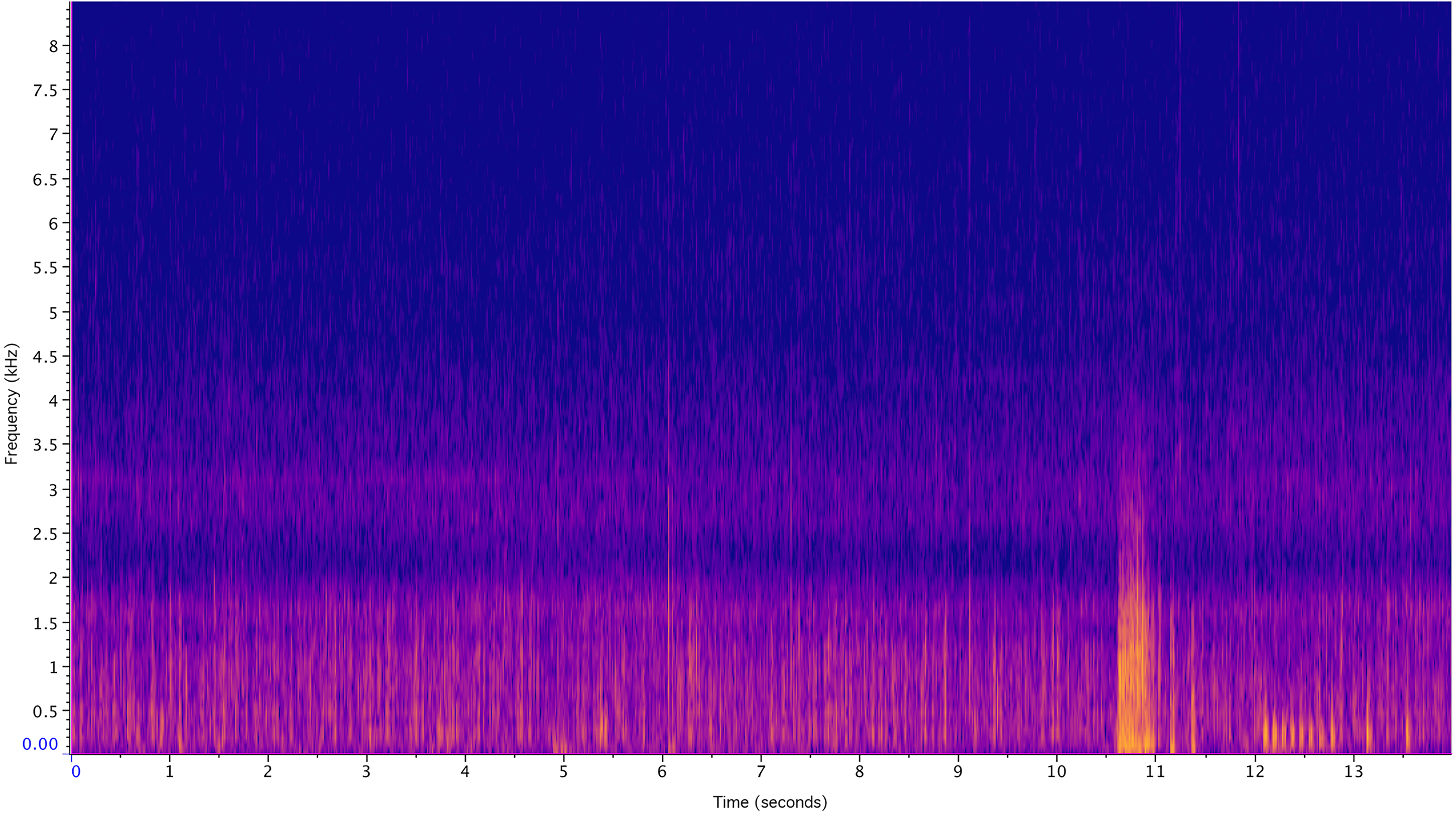
Spectrogram from a hydrophone recording at the downstream entrance to the Tuckean Swamp near the Baggotville Barrage, northern NSW. Distinct bands of communication between species can be discerned, including a distinctly quiet zone centred around 2165 kHz. The bright areas between 10.5 and 13.5 seconds are the grunts and drumming of fish. (Recorded by Rob Garbutt, 23 January 2020 using Aquarian Audio H2a hydrophones; spectrogram created from Raven Lite.).
Finally, the field of acoustic ecology reflects these same impulses to investigate the sonic qualities of our environments and the influence of anthropophony on animal behaviour, but it does so within the discipline of musical composition and sound art. It uses environmental recordings and electroacoustic composition to draw attention to the sonic environment and our impact upon it. In his founding 1977 text on the subject, The Tuning of the World, Canadian composer R. Murray Schafer outlined a theory of the soundscape in which the world could be understood as a ‘macrocosmic musical composition’ (Shafer, 1994: 5), a composition that we all have the capacity to contribute to, learn from, and change.
The work of sound artist Leah Barclay draws these fields together, using hydrophone recordings of riverine environments, and a community engagement strategy involving citizen science workshops and activities, to enhance public knowledge of the biological and acoustic life of rivers around the world. Funded as part of the Synapse art/science initiative by the Australian Network for Art and Technology, ‘River Listening’ was an interdisciplinary project bringing community members together with freshwater ecologists from the Australian Rivers Institute at Griffith University to explore the soundscapes of the Brisbane, Mary, Noosa and Logan rivers in Queensland (Barclay, 2017: 148–149). In this and other projects, Barclay orchestrates activities such as citizen science workshops, sound walks, and field-recording sessions to engage community members in monitoring river soundscapes over time, broadening awareness and understanding of the biodiversity of riverine environments and how they are affected by anthropogenic activity. At the same time, the recordings and their analysis by citizen scientists feed both scientific activities examining river health, and musical and sound compositions that circulate within gallery and festival contexts. Together, these multiple activities and outcomes represent Barclay's ‘Sonic Ecologies’ framework, which employs ‘(1) site-specific subject matter, (2) multi-platform dissemination, (3) community education and engagement tools, (4) interdisciplinary partnerships and collaborations, and (5) long-term strategic vision’, to foster both lasting and meaningful awareness of environmental change, and changes in behaviour that may ameliorate our effects on riverine and other environments (Barclay, 2013: 30).
Media artist Grayson Cooke and environmental scientist Amanda Reichelt-Brushett are working on a visual project that employs a similar interdisciplinary framework. For over 16 months, spanning from August 2012 to December 2013, Reichelt-Brushett worked with environmental managers from Rous County Council (who manage the region's water supply, flood mitigation and weed biosecurity) to monitor a range of water quality indicators on a weekly basis across five sites on the Richmond River. As noted above, the Richmond is a degraded river system, with large volumes of suspended sediment flushed downstream during periods of high rainfall. Measurements of turbidity, dissolved oxygen, pH, electrical conductivity and temperature were combined with suspended sediment samples to capture snapshots of inter-related phenomena acting in the river over time. High rainfall events result in blooms of dark brown clay sediment through the system, and a concomitant reduction in dissolved oxygen, one of the factors that cause fish kills in our waterways.
The image below uses information visualisation to figure out this water quality data in a dynamic fashion. Using photographs of the weekly filtered water samples, parameters of scale and opacity are used to translate the data into visual form. The mandala-like arrangement is an aesthetic choice yet reflects the round filter papers used for determining the total suspended sediment load in water quality assessment. The variances in scale of the circles in the mandala, however, reflect real and dramatic change. In the image we see the whole river system pulse with brown clay and soils during high rainfall events, and we can divine the ripple effects of this sediment load through looking at measures of acidity and dissolved oxygen (Figure 6).
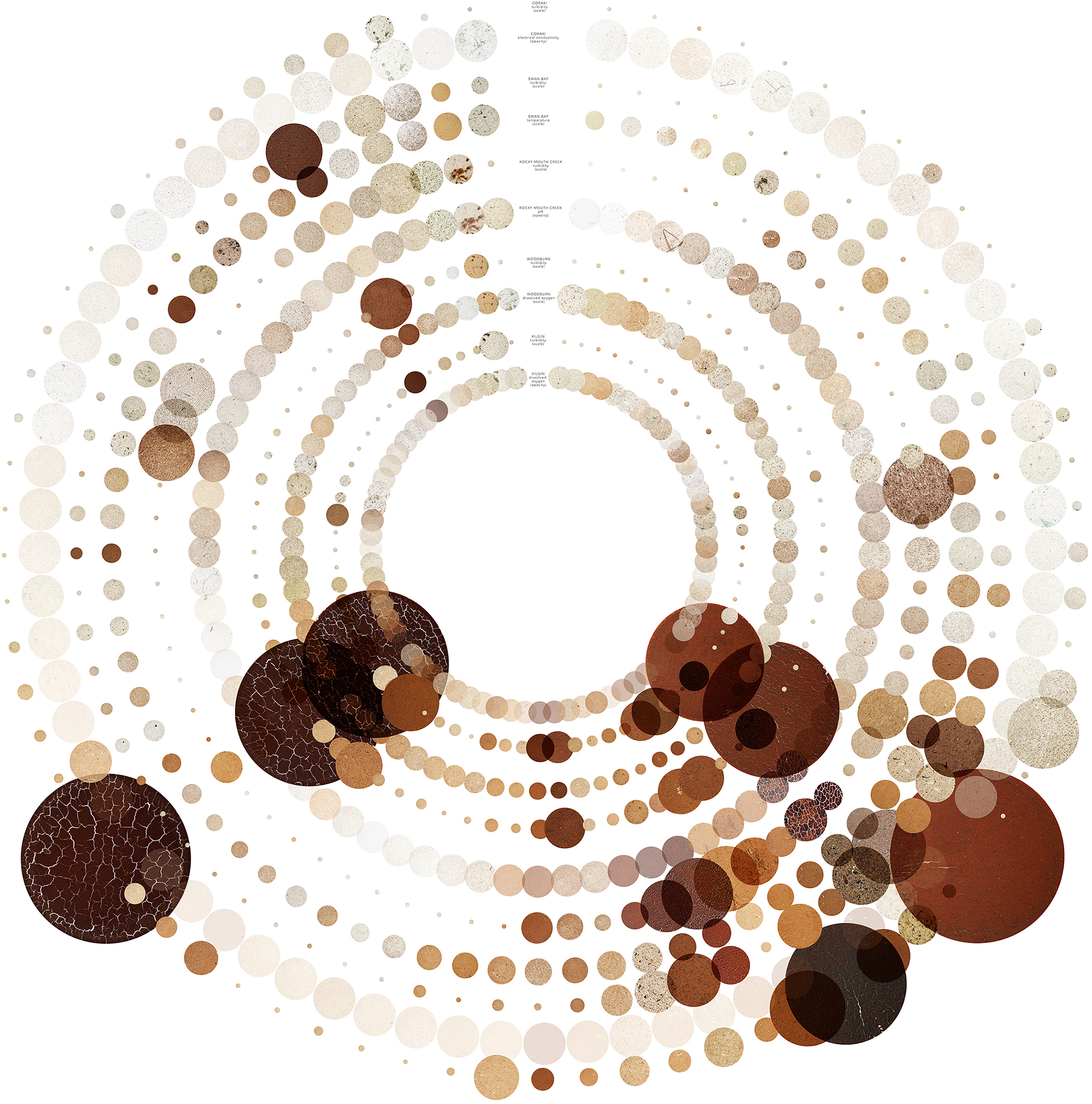
Grayson Cooke and Amanda Reichelt-Brushett In Suspension (detail) (2021).
The projects of Barclay and Cooke and Reichelt-Brushett speak with the river using different figures but in similar ways. They divine insight into the state of Australia's waterways through chemical and biological, visual and acoustic indicators, and they translate these insights into unique expressions that resonate in scientific, artistic and community contexts. To some extent the river becomes ‘knowable’ through these processes, as it must if we are to look honestly and with clear sight at the state of the country, learn from past mistakes, and provide a solid evidence base for decisions that prioritise river health. But at the same time each of these expressions is partial, local, a series of snapshots in space and time; rivers are poly-vocal, and it is vital that decision-making regarding rivers is mindful of the complexity that transpires when all their voices are acknowledged.
Conclusion
The river exceeds us. Rivers exceed us. Their powers of terraforming are slower than ours but they have exerted them for millions of years. Right now, as ever, the Clarence River is running with quartz sediment from granite high up in the Great Dividing Range. This sediment makes its way downriver to the mouth and joins other sediments shifting north along the coast through a phenomenon called ‘longshore transport’ (Lees, 2006: 83). Over the last 750,000 years this flow of sand has built the largest sand island in the world, K’Gari/Fraser Island, a unique sub-tropical haven and home for the Butjulla people for over 5000 years. Through the river the mountains move to the sea. This is how the river speaks; by moving mountains, by building islands, by flooding lands, by crafting habitats that support untold species – and by snuffing out animal life when oxygen levels plummet because of bacterial blooms.
How to respond to a voice of such richness, such immensity? How to do justice to its thundering utterance? In this paper we have navigated again the disciplinary streams of the ‘Speaking With the River’ symposium in 2019, and we propose them here, under the figures of confluence and interdisciplinarity, as ways of helping address the state of Australia's waterways. The combination of new ways of imaging and sounding the river in artistic, historical and scientific contexts, and new legislation for recognising rivers as holders of legal rights, that in turn reflect and engage Indigenous knowledges and practices that limit extractivist impulses within spiritual and cultural bounds, seems to us enormously fruitful as a framework for changing how Australia's rivers and river systems are understood and, in turn, valued. We offer these insights, these artworks and stories, as a humble collection of pointers in the enterprise of finding better ways of being in the world, as human beings individually and as a species with the capacity to act at global scale. It is only if we cohere our actions at this global scale that we can hope to find sustainable ways of interacting with the nonhuman world.
Highlights
If Australia is to improve its use of rivers and river systems, then more holistic ways of understanding them must be developed.
The riverine concept of ‘confluence’ can be explored to represent the interdisciplinary enquiry and language that is required.
The confluence of art, science, Indigenous knowledges and environmental jurisprudence is a fruitful model from which to work.
Footnotes
Declaration of conflicting interests
The authors declared no potential conflicts of interest with respect to the research, authorship, and/or publication of this article.
Funding
The authors received no financial support for the research, authorship, and/or publication of this article.

Cases
Corte Constitucional, Decision T-622 10/11/2016 (Colombia).
Human Rights and Peace for Bangladesh v Government of Bangladesh and others (2016).
HCD (Writ Petition No. 13989 of 2016, judgement declared on 3 February 2019.
Lalit Miglani v State of Uttarakhand & others (March 30 2017) MCC 139/2017 (India).
Mohd. Salim v. State of Uttarakhand & Others, (March 20 2017) Uttarakhand H.C. 126 (India).
Sierra Club v Morton 405 US 727, 743 (1972).
Legislation
Constitucion del Estado Plurnacional de Bolivia, 2008.
Ley De Derechos De La Madre Tierra, Ley N 71, 21 de diciembre de 2010.
Ley marco De La Madre Tierra y Desarrollo Integral Para Vivir Bien, Ley N 300, 15 de Octubre de 2012.
Yarra River Protection (Wilip-gin Birrarung murron) Act 2017 (Vic.).
Te Urewera Act 2014 (N.Z.).