



Abstract
Miärralándda (Miärra: ocean or sea; lándda: land) is an Ume Sámi term that embodies the porosity between land and sea—worlds that merge into one inseparable reality. In this paper, we approach Miärralándda as a ‘figuration’ with the potential to disrupt the ongoing processes of land and sea extraction in the traditional territory of the Ume Sámi people, which are often masked as sustainable development. This land is simultaneously Sápmi and Helgeland, a region where colonisation has fragmented Ume Sámi settlements, language, legal frameworks, and practices on the Norwegian side of Sápmi. Colonial governance has enacted a division of land, sea, and people into discrete entities, rendering them colonisable resources appropriated through technological innovation. Within this political landscape, the stories of loss and grief from Miärralándda, as narrated by the Sámi people, confront neoliberal fantasies of sustainability. In this paper, we write with Miärralándda, revisiting the story of Anna Tomasdotter (1751–1833), born into a reindeer herding family in the region; attuning to the farmed salmon confined to tanks on Helgeland's islands; and journeying with the reindeer whose migration paths are severed by wind energy infrastructure built under the guise of sustainability. We argue that despite suppression, violation, and suffocation, the stories of Miärralándda persist and can be awakened through storytelling.
Preface
“…our relationship with land cannot heal until we hear its stories. But who will tell them?” (Kimmerer, 2013: 9)
On the Norwegian reality show Oppsynsmannen, 1 famous comedian Bård Tufte Johansen travels across Norway to visit wind energy infrastructure sites, land-based salmon farming facilities, and data centres. He travels not for fun or for comedy, but to address growing concern about the diminishment of Norway's natural environments to make space for the technological advancements that are often associated with the promise of sustainability. One of the episodes is set on Lille Indre Rosøy—a small island in Rødøya in Helgeland, Northern Norway, where this paper is focused. A large Norwegian land-based salmon breeding company, Gigante Salmon, has bought the island for the purpose of building one of their land-based salmon farming facilities on it. In the episode, the manager of the company guides Johansen through the construction site, showcasing the scattered island that has been partly transformed with heavy machinery to serve as a farm for hybrid fish— artificially bred Atlantic salmon raised in captivity—that will live their lives in tanks on land. On this island, progress narratives meet alternative stories of the past, present, and future. Some of them are less heard or listened to, but they nevertheless exist in dormant reciprocity (Kramvig and Verran, 2019). This island—together with the land, the Norwegian sea, and other islands—once was, and still is, Miärralándda.
Miärralándda
Miärralándda found us as two authors of this paper approximately two years after our first journey together in this region. An Ume Sámi artist, Katarina Barruk, had launched her record Ruhttuo (coniferous forest) and started touring in 2023. 2 The opening track of her album carries the name Miärralándda. Miärralándda (Miärra: ocean or sea; lándda: land) is an Ume Sámi word that captures the porosity of the land and the sea—worlds that become one, inseparable. As an Ume Sámi figuration, Miärralándda is part of Sámi ontology that, akin to other Indigenous ontologies, has developed outside European science and as such has ‘never had a nature–culture dualism, never truly differentiated “culture” and “nature”’ (Jones and Hoskins, 2016: 78–9; see also Finbog, 2023). Thus, the Ume Sámi people are part of Miärralándda, and Miärralándda is them. 3 In her records and concerts, Barruk insists on using the Ume Sámi language to invite her audience into her universe, where Ume Sámi is the norm, highly topical, and alive. Ume Sámi is one of the nine Sámi languages spoken in Sweden, Finland, and Norway. Although it was the first Sámi language used extensively in writing in the eighteenth and nineteenth centuries, it was defined as extinct in 1995 on the Norwegian side of the border. Katarina is one of around 20 Ume Sámi speakers on the Swedish side, fighting through art—her music—to keep the language and the stories embedded within it alive. In Katarina's music, Miärralándda becomes part of a battle against the disappearance of the language and everything it is connected to. Each vuöllie/joik and each song sung in Ume Sámi can be seen as striving to ensure that the stories embedded in the land, the sea, and the language are not forgotten.
One of Katarina's concerts in 2023 took place on Træna (Figure 1), an assemblage of islands wherein we formed a connection through research. Consisting of 477 islands, islets, and skerries and situated approximately 33 nautical miles off the mainland in the Helgeland region, Træna is a historically significant archipelago with evidence of human settlement dating back thousands of years. Most of the islands are very small and surrounded by the open Norwegian Sea.

Map of Træna municipality. Store norske leksikon. License: CC BY NC 4.0.
The main island of Træna, Husøya, serves as the cultural and administrative heart of the archipelago. The fishing and tourism industries work as the main drivers for the maintenance of life on this remote island that is increasingly vulnerable to the unpredictable and intense weather conditions on the harsh, open sea: when the wind comes from the west, there is no shelter provided by the surrounding islands. This connection between life on the land and in the sea brings us to the figuration of Miärralándda, even if it has been a dormant concept for a long time for those outside Ume Sámi communities.
One of us was there the day Barruk held her concert on the island of Husøya. Britt listened to how Barruk spoke about walking the paths of the island, and moving between the different islands across water, to learn about them. This happened through a sensory experience. Barruk talked about the strange sense of freedom this movement gave her, and described the fragments of memories that took her to the places that she wanted to share with the audience during the concert. Through her compositions and the performances of traditional vuöllie (Ume Sámi word for joik, a traditional Sami vocal art), Barruk invited the audience into her state of mind in those places. Britt felt strongly that Miärralándda spoke to the memories of her own fragmented Sámi heritage and gave it a body to live in. Later, Britt discussed Katarina and the album's vuöllie with Tarja, during a late dinner at a local restaurant in Mussere/Mosjøen, an industrial town hosting one of the central aluminium plants in Europe. We had just had a gathering with local Sámi herders, tourism and cultural industry actors, at the Sámi cultural centre, Sijti Jarnge, in Aaborte/Hattfjelldal, a municipality significant for the Southern Sámi. Miärralándda started to travel into our discussion about the meaning of our research in these lands and the Norwegian sea.
Tarja listened to Barruk's performance of Miärralándda on her way back home to the north. Captured by the soundscape that Miärralándda was creating through her headphones, the deep melody and rhythm of the vuöllie reached out to her, regardless of her inability to understand the Ume Sámi lyrics. Somehow, it did not matter. The door had been opened. Threads leading to Miärralándda had strengthened and become embedded with deeper meaning. When Barruk's tour reached Tarja's hometown, she went to see her perform. Barruk started the concert with Miärralándda. After the concert, we came together and realised that our journeys in this region needed Barruk's guidance to envision the ontological difference embedded in what was not only Miärralándda and not only Helgeland (De la Cadena & Blaser, 2018). We relistened together to Ruhttuo, and each track on the record became for us an attempt to ensure that the stories embedded in this language, the land/sea, and the practices unfamiliar to us are not forgotten.
In this paper, we write about two worlds (Miärralándda and Helgeland) that are, in fact, facets of the same reality. We thus write against the assumption that a past existed that has now been superseded by a new reality. Instead, we propose that two worlds coexist in the present, such that Miärralándda continues to be Helgeland while Helgeland is, and will continue to be, Miärralándda. Thus, with Miärralándda as our ontoepistemological harbour, we swim deeper into a porous seascape that is ontologically multiple: the processes of colonisation have shattered the Ume Sámi settlements, language, legal concepts, and practices on the Norwegian side of Sápmi, and Helgeland is considered by the majority of the population to be Norwegian territory. Here, multiple international and national companies invest in and transform the Sámi Miärralándda. ‘Stories of progress’ materialise as new land-based salmon farms (iLaks.no, 2023), offshore wind turbines in the Norwegian Sea (NFK, 2023; NRK, 2023), and onshore wind turbines in the Sámi reindeer herding districts (Fjellheim 2023). In these stories, the governing body cuts the land/sea/people into different entities, enacting them as colonisable resources, and then appropriates them through technological innovations. It is in this political landscape that the stories of loss and grief in Miärralándda, as narrated by the Sámi people, meet neoliberal fantasies of sustainability. No matter how suppressed, violated, or suffocated, the stories from Miärralándda persist, and they, we argue, can be awakened through storytelling.
The way the story is written
We aim to write with Miärralándda whilst addressing the wounds that have led to the violation and ignorance of the relationality embedded in it. Miärralándda guides us as two scholars, friends, and travellers who met in a fluid landscape of Indigenous and feminist posthumanist ontoepistemologies (Alfred, 2023; Braidotti, 2021; Fjellheim, 2023; Guttorm et al., 2019; Haraway, 2016; Ingersoll, 2016; Neimanis, 2017). Through a gradual process, our writing has been woven out of ethnographic material and an awareness that emerged through our movement with the land and sea and encounters with people in the Ume Sámi region between 2022 and 2025; historical traces through which we have come to know glimpses of the life of a character central to this story, Anna, whom we will soon introduce; and media accounts of Helgeland's process of becoming a centre of techno-industrial development, which has had implications that we will discuss in detail.
Our ethnographic work is grounded in sustained engagement and dialogue with local entrepreneurs, residents, and visitors in Helgeland through two ongoing research projects. 4 Through this engagement, we have come to understand the region as an Ume Sámi sea-landscape. Britt's long-standing work of researching and reclaiming Sámi traditional knowledge, although not previously situated in the Ume Sámi area, is fundamental to our work. Tarja's ethnographic work on mobilities in the North, and on how our relations to land and sea are constituted through movement, is central in guiding our collaboration: it foregrounds movement as an analytical category and a methodological orientation, forming a central element in our understanding of Miärralándda and of the technological and colonial processes that have shaped it. In our encounters with people, the use of formal methods such as recorded interviews has not proven appropriate. The presence of a recorder would have interrupted the sense of trust and reciprocity that emerged between us and those who invited us into their storytelling. Instead, we have sought to attune to these moments as they unfolded—listening, walking, and pausing together—allowing stories to be shared on their own terms. Historical sources also play a central role in our material, as exemplified by the meaning of the story of Anna Tomasdotter to our paper, soon to be introduced.
To tell the story that emerges from Miärralándda is to step into the slow distance of storytelling. Much of the Ume Sámi presence here lies in shadow, yet stories from the past—those that carry us into the present—are the threads by which this presence can be reawakened. We aim to contribute to this reawakening, responding to Kimmerer's (2013) crucial question with which we started this paper: who will tell the stories that are needed for our relationship with land, and water, 5 to heal? We begin with the story of Anna Tomasdotter (1751–1833), born to a reindeer herding family in this region during a time when the colonisation of the Sámi was unfolding viciously. Her life story has so far remained widely unknown. We approach this story as one that does not name the consequences of the ongoing colonisation in linear terms—and this omission is no oversight. Its value lies in how it moves differently: through fragments of a story made accessible to us by those who once wrote them down. Her story, marked by personal loss and the fracture in the meaning of movement between the land and the sea caused by the loss of her reindeer, followed by the erosion of her economic and political agency, intertwines with the fissures made by nation–state policies. These cuts ruptured Miärralándda and cast the Ume Sámi presence in Helgeland into deeper shadow.
In addition to engaging with written records of Anna Tomasdotter, we have had the privilege of getting to know and speaking with some of her descendants, who have settled on the islands we have come to know well. Among them is the duojár and storyteller Jørn Magnus Rivojen, who plays a significant role in establishing institutions and organising events that highlight the presence of the Ume Sámi in the region. We acknowledge that both storytellers—Jonas Nensén, who wrote down Anna's story at the turn of the eighteenth century, and Jørn Magnus Rivojen—are interpreters of events that ‘after all, are stories known directly only to those who experience them and interpret them to others, who in turn make their own interpretations of what they hear’ (Cruikshank, 1998: 2). We approach this quality of stories with respect and openness, as well as with honesty towards our insufficiency as storytellers.
From the very beginning, we have sought to make our positions as writers and ethnographers transparent. Our research is shaped by our different relationships to Miärralándda. Britt is a descendant of sea-Sámis in Orjješ-Ráisa/Sørreisa who suffered under the weight of colonialism, making academic work a part of a practice of recalling and reclaiming her Sámi heritage. Tarja is a non-Indigenous scholar born and raised in Rovaniemi, on the southern edge of Sápmi on the Finnish side, where Sámi presence and histories were largely absent from the Finnish school curriculum. Later in life, she actively took up a commitment to work in solidarity with decolonial ways of knowing and being, a commitment that continues to guide her scholarly practice. These differing standpoints attune us to the situatedness of knowledge and to the ongoing ethical work of researching in Indigenous territories. Vizenor (2008) reminds us that identity is a responsibility: not a matter of fractions or quantum, but of how people live their responsibilities toward peers, families, and communities. Our collaboration is therefore grounded less in identity labels and more in relational accountability—to place, to histories of dispossession, and to the communities whose lands and waters we write with.
In addition, Britt has Norwegian in-laws in the region, and she has been visiting different communities since 2000. Since 2022, the two of us have travelled in the region together and apart. Through repeated returns together, our attunement deepened, and what emerged to us as Miärralándda yielded traces—provisional pathways for thinking—yet necessarily withheld as much as it revealed. This process, we believe, would have been impossible without each other. Tarja's presence on these joint journeys allowed perspectives and questions to surface that Britt's longer history and attachment to the area would not, on their own, have made possible. Conversely, Britt's company enabled Tarja's relationship with this complex sea–landscape to take shape in ways that might have taken years without our shared experiences. Tarja's subsequent independent journeys deepened her understanding of Miärralándda by placing her in the vulnerable position of asking questions of Miärralándda that acknowledged her outsiderness. Even so, her process of swimming deeper did not begin from the furthest shore: it was already grounded in what we had learned together. Tarja's accounts of these solo journeys prompted Britt to think otherwise about the relations in Miärralándda/Helgeland. Together, we grew attentive to the processes of infrastructuring within Miärralándda that stretch across temporalities, moving beyond the contemporary. Thus, the notions of outsiderness and distance become soft-edged rather than participating in a hard dichotomy; entwined with the possibility of return, they render us, as ethnographers, swimmers in a sea with pluriversal meanings rather than single-minded, purposive subjects seeking answers.
Miärralándda as a figuration
We see potential in calling Miärralándda a ‘figuration.’ A concept central to feminist thinkers Donna Haraway (Haraway, 2016, 2008, 1988, 1991, 1997) and Rosi Braidotti (Braidotti, 1994, 2021), figuration is a tool or a technique for envisioning the world otherwise, applying to both theory and practice (Neimanis, 2017; Thiele, 2021). In this way, figuration becomes a way of expressing feminist knowledge that is not confined by the hierarchies and power structures embedded in dominant scientific discourses (Braidotti, 1994: 75). Neimanis (2017) describes ‘bodies of water’ as a figuration, ‘an embodied concept’ that provides space for imagining and living otherwise whilst fundamentally staying ‘grounded in our material reality’ (Neimanis, 2017: 5). A figuration can thus be thought of as an idea that is deeply embedded in the very world that it aims to open up, making it an embodied concept or, in the valuable words of others, a material–semiotic knot (Haraway, 2008: 4–5) or a living map (Braidotti, 2014: 179). The account of such a figuration reinforces the necessity of situating (any) research that deals with the concept of a landscape firmly within the stories, including those of struggle, that arise from said landscape. This line of inquiry situates landscapes as archives of the past that, instead of being static, are living and vibrant, containing multiple temporalities (Figure 2).
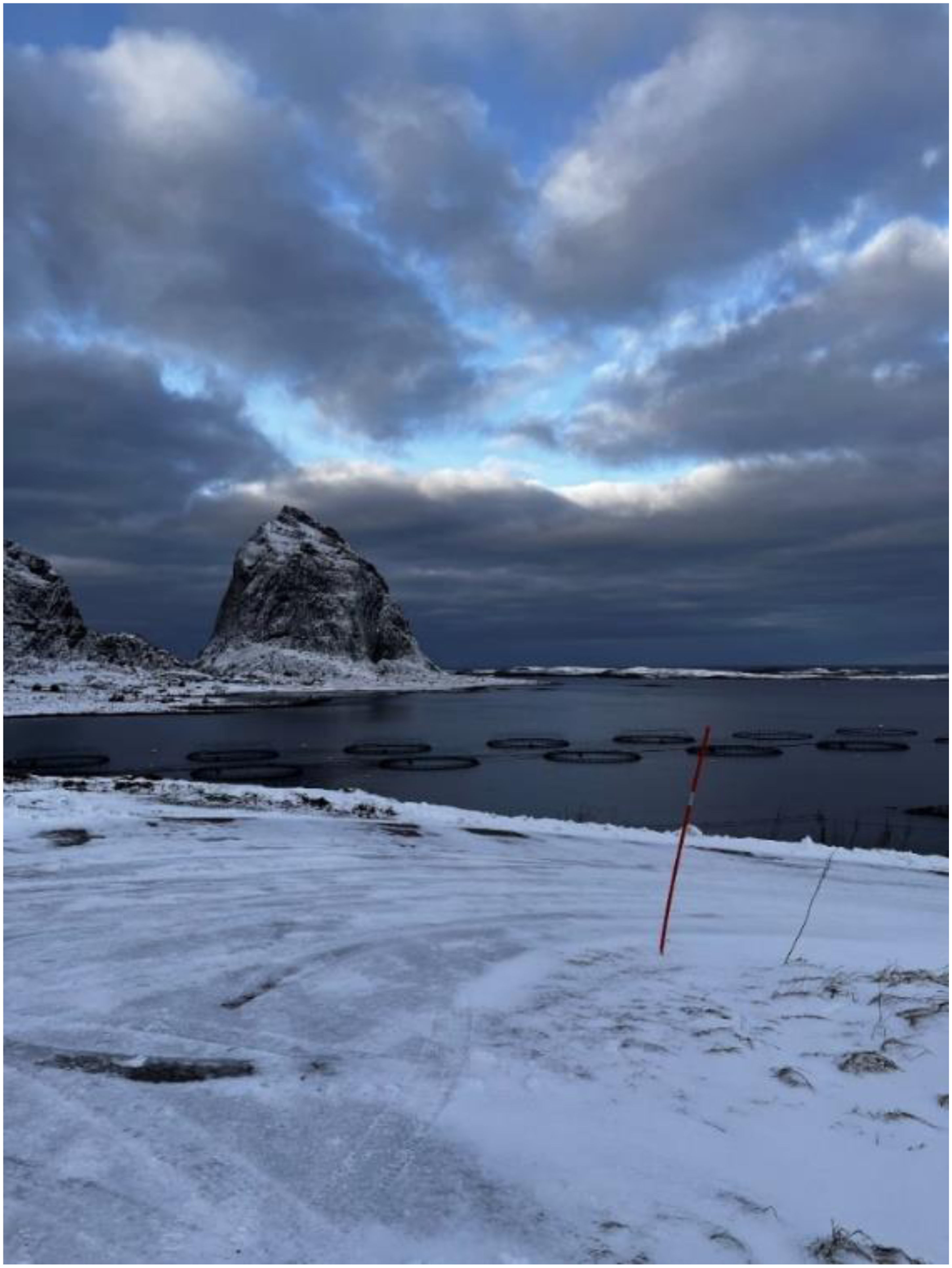
Open salmon net pens on the waters of Husøya, Træna’s main island, documented on an evening walk in winter, February 2023. Photo credit: Tarja Salmela.
Miärralándda, as a figuration, is always situated and never arbitrary, fixed in a landscape of different temporalities and arising ‘in response to a particular contemporary question or problem’ (Neimanis, 2017: 5; Haraway, 1988). It calls us to consider how the sea, land, and mountains are all one, ‘as if married to each other,’ as narrated by Ánne Márjá, one of the Sámi storytellers who lived through the forced migration imposed by the Norwegian government from 1918 onward and whose life has become part of Elin Labba's (2022) book about the forced relocations of Sámi in Sweden: ‘Closing her eyes, she [Ánne Márjá] feels them within her. “The sea encircles the mountains and meets the next arm of the sea. We’re surrounded by mountain peaks and sea. I’ve run about everywhere in these mountains. I know them well.”’ (Labba, 2022: 29). This sense of relationality is deeply connected to a corporeal knowledge of the landscape wherein Ánne Márjá can be seen to become-with this specific land, sea, and mountain range. Ánne Márjá becomes Miärralándda. This type of understanding of a landscape suggests that while there is an inseparability among the agents that form a Sámi landscape, they are nevertheless particular. Miärralándda thus emerges as a figuration that is situated in and comes into existence through the material–semiotic relations actively practiced with(in) it, such as the practices of reindeer herding, fishing, and speaking and writing in the Ume Sámi language.
With this acknowledgement, braiding the story between what we have called two worlds becomes possible— Anna Tomasdotter is drawn toward the more recent transformations in what was Miärralándda for the Ume Sámi and Helgeland for the Norwegian settlers. These changes carve deeper cuts between land and sea, incisions into the fabric of the relations that shape Miärralándda. In the colonisation of the reindeer's grazing land and migration routes, as well as in the salmon's body, bound as it is to life in water-on-land, we trace the threads that bring Anna—and Miärralándda—into the present. These threads are akin to what Robin Wall Kimmerer (2013) reminds us is the nature of a braid: it gains its strength from the integrity of each strand, woven together in reciprocity. We braid together past, present, and future—not to collapse them into one, but to let each strengthen the others. This weaving is itself an act of reciprocity: a way of carrying forward the presence of those whose lives have been shadowed, offering their stories as gifts to the time yet to come. We write with two worlds, yet one reality: the porous boundary between Miärralándda and Helgeland.
The Sámi seascape
Tim Ingold (2018) has illuminated the Sámi conception of home as being closely related to the realm of movement and active usage, as noted by Tervaniemi and Magga (2018). For the Sámi, home is not a fixed point but a network of paths and trails; one is always at home, at the centre of a world with no boundaries, while traversing these routes. However, the imposition of Western colonial boundaries has transformed the Sámi homeland—known as Sápmi in northern Sámi or Sábmie in Ume Sámi—into a territory demarcated by national borders. These borders are under negotiation to this day. The border treaty of 1751, Lappecodicil, was established to confirm the Sámi's ancient right to move with the reindeer, crossing these borders as has been done since time immemorial, including the new national border that cut through Sápmi. However, as Sápmi is diverse, these treaty regulations had different effects in different areas. The treaty-imposed citizenship was based on the location in which the nomadic Sámis dwelled during winter. As the Ume Sámi siida 6 were on the Swedish territory during winter, the Sámi in this region became Swedish citizens. At the same time, further north, in Finnmárku/Finnmark, the Sámi had both summer and winter pasture on the Norwegian side of the border and were thereby offered Norwegian citizenship. Furthermore, in the Helgeland/Ume Sámi area, the regulation of reindeer herding crossing national borders was introduced, resulting in both fees and grazing land allocations. Meanwhile, Norwegian settlers in the Helgeland region were granted land rights, leading to the establishment of private estates.
Hermanstrand (2021: 274) argues that in this region, during the period 1690–1800, the Norwegian authorities’ ability to promote their views and interests expanded and strengthened, paralleling the Swedish state's eventual claim of ownership over the tax lands. Sámi actors’ room for manoeuvre diminished following the clarification of sovereignty after 1751 and the growth of the farming population. In many cases, nobles or local governors (lensherrer) managed the distribution of land on behalf of the king. This practice occurred as part of the colonisation and settlement of areas that had traditionally been gæsso dálloe—home during summer for the Sámi and the reindeer (Truth and Reconciliation Report, 2023). The nation–state policies that enacted divisions and assigned citizenships—processes of categorisation—led to ‘a centuries-long discontinuous process in which colonial oppressors, step by painful step, deprived the Sámi of rights allocated to other citizens’ (Buhre and Bjork, 2021: 229) (Figure 3).
The formal delineation of their homeland had the aim of estranging the Sámi from their history, as Tervaniemi and Magga (2018) note, abstracting the land into a two-dimensional plane, much like a cartographic representation. Yet, for the Sámi, the land is a rich tapestry of diverse surfaces—forests, rocks, swamps, and more—that together form the ‘surface of all surfaces’ (Ingold, 2018: 113). The new abstraction conflicts with Indigenous perceptions of landscape that defy Western categorisations, which is why the concept of landscape has been pivotal in Sámi and northern scholarship. Philosopher Jakob Meløe (1988), drawing inspiration from Wittgenstein, explored the formation of landscapes through various practices and concepts. Meløe posited that a landscape is intimately known by those who inhabit it and any external description is inherently foreign. Furthermore, the translation of Sámi words for ‘nature’ into English is not straightforward: concepts like ‘luondu’ and ‘meahcci’ 7 encompass the embodied nature of individuals and the familiar land, complete with its stories and the resources vital for subsistence economies (Kramvig, 2005; Østmo and Law, 2018; Schanche, 2002). Sara (2011) emphasised the interconnectedness of the animals, land, and sacred sites within the sïjdda/siida, advocating for respect towards all beings and their autonomy.

This map, with both Ume Sámi and Norwegian place/mountain and lake/river names from both Norwegian and Swedish territory, makes evident the density and lines of movements in the Ume Sámi landscape. Map by Trygve Wiklund Skavhaug / Nord University.
The practices of reindeer herders create a reality that is both contingent and uncertain (Law and Joks, 2019). Within this reality, there are powerful entities in ‘luondu’ that command reverence. Nils Oskal (1995) contended that reindeer should be treated with respect, not merely as resources for human exploitation. The concept of ‘boazolihkku’—though not directly translatable—refers to a kind of ‘reindeer luck.’ Reindeer luck encapsulates the ethos of living honourably with the reindeer, the land, and one's community, and it is rooted in the relationality among subjects that together form an assemblage greater than the sum of its parts. As political theorist Jane Bennett has taught us, ‘an actant never really acts alone. Its efficacy or agency always depends on the collaboration, cooperation, or interactive interference of many bodies and forces’ (Bennett, 2010: 21). A reindeer herder is nothing without her reindeer, and the reindeer's existence in the world is intimately tied to the animal's human companion. In this assemblage, humans are never autonomous but are ‘vital materialities’ (Bennett, 2010: 21) existing in relation with the reindeer.
This relationality is further exemplified in the siida system, as described by Sara (2011). Siida is a complex social structure that includes individuals, husbandry units, collective herding, territories, resources, infrastructure, and nomadic movements, all of which necessitate a harmonious relationship with the environment and its diverse inhabitants (Gaup Eira et al., 2016; Kramvig, 2023). These Sámi concepts and ways of living in the landscape—and doing so collectively—challenge individualism and conflict with many Western notions about how humans should interact with ‘nature.’ We will next delve into a more detailed discussion of the encounter between Sámi understandings of the landscape and the Western narratives of progress that shape Miärralándda.
Bodies, land, and sea in between two worlds
Anna Tomasdotter and Miärralándda
Anna's story found us after visiting Jørn Magnus Rivojen in Helgeland in the summer of 2023. Rivojen is among the many people related to Anna through kinship in the traditional Ume Sámi area, as well as on the islands in Helgeland, including Træna. Anna's narrative provides a rare glimpse into the daily life of the Sámi community, offering a valuable female perspective to a historical tradition that predominantly documented male lives (Hermanstrand 2021; Westman Kuhmunen, 2015). Anna's story was recorded by Jonas Nensén (n.d.), whose report is highly regarded by the Ume Sámi community and historians alike. 8 Anna Tomasdotter 9 hailed from a nomadic reindeer herding community that migrated between the summer lands near Aagkelejaevrie/Akersvatnet and the winter areas around Suorssá/Sorsele or Liksjoe/Lycksele on the Swedish side of the border. When Anna married the widower and reindeer herder Lars Johansson from Ranbyn, Sweden—after three years of proposals—her mother saw the advantage of having a son-in-law who lived at Stoerevaerie, a strategic location on the reindeer migration route. They were wed in Hemnes church in Norway when Anna was twenty. As a wedding gift, her father bestowed upon her six fishing nets, one fishing seine, and six reindeer to enhance her ‘lykko raunets’ 10 —her reindeer luck. These gifts underlined her abilities both at sea, as an adept fisherwoman, and in the mountains, as a skilled herder. These were not only the personal abilities of Anna—they reflect more broadly the livelihood of the nomadic Sámi in the region, combining reindeer herding and fishing practices, fostering an intimate connection to both the land and the sea.
Anna identified herself as part of the ‘tevve(n) saemieh’ community, but she also talked about her relationship with the ‘duvven saemieh’—the sea Sámis, who live by the sea or, when translated literally, far from the mountain. This distinction between the mountain Sámi and the sea Sámi is not just geographical; it is also linguistic and cultural, as the two groups have historically developed unique dialects, traditions, and ways of life shaped by their respective environments. The use of these terms—‘tevve(n) saemieh’ and ‘duvven saemieh’—illustrates how language is embedded in geography. It reflects how Sámi communities perceive and articulate their relationship with the land, sea, and mountains, as well as their interactions with neighbouring groups. These linguistic markers serve to maintain a sense of both community and diversity within the broader Sámi network, even as they share a common heritage.
Around 1720, there were eleven redistricted sea Sámi households in the municipality of Rávddá. 11 These families subsisted on small-scale farming, fishing, hunting, and handicrafts; a lifestyle called duedtie in the Southern Sámi language that reflects a holistic Sami religion where the sacred is part of everyday life and permeates all of existence. By the 1800s, these Sámis were no longer recognised as such but were recorded as Norwegian in official documents. Anna Tomasdotter recounted the immigration of impoverished Sámis from Umeå Lappmark in Sweden, attributing their poverty to the encroachment of settlers. When she moved to Stoerevaerie/Norra Storfjället in 1769 upon her marriage, only her parents continued reindeer herding in the Heäjmmanássja/Hemnes parish; the other herders had vanished, leaving their offspring destitute (Hermanstrand 2021: 122).
Norstedt (2011: 50–51) documents that, during the eighteenth century, the forest Sámi community of Umbyn dissolved as settlers claimed Sámi lands. The Sámis either relinquished their tax lands and moved south or became farmers, but the broader trend from 1690 to 1800 was one of Norwegian and Swedish territorial expansion, met with Sámi resistance. Legal records from 1785 reveal herders’ complaints about settlers killing reindeer and displacing Sámi people from their lands. These include Morten Pedersson Kioks, who claimed that a Norwegian settler had shot 250 reindeer dead, and Anders Einarsson Kierringfjeld, who claimed that between 300–400 female reindeer had been driven out of what he considered to be his traditional land (Hermanstrand, 2021).
During this period, Anna was in her 30 s. The same night that Anna's husband passed away, a wolverine killed a black reindeer bull and a calf. Westman Kuhmunen (2015) marks this event as the beginning of a challenging period for Anna, who had settled on the Norwegian side of the border with her son and daughter-in-law. After her son's death some years later, Anna lost her property and reindeer in the distribution of the inheritance (Westman Kuhmunen, 2015: 79). 12 Deprived of her reindeer, Anna also lost the purpose for which she moved between the mountain, the forest, and the sea. This loss, while not strictly causally related, nevertheless resonates with the broader legal transformations of the time, when cross-border reindeer herding was increasingly circumscribed by treaties negotiated among the Nordic states. In 1964, a new commission concluded that the Swedish Sámi siidas south of Torneträsk were no longer in need of summer pasture in the Nordland County where Helgeland is situated (Ravna, 2020). This change began the period wherein the connections in Miärralándda were cut. It is a story of displacement: the destruction of the connection of the Ume Sámi to the sea.
Industrial stories of progress: Cutting the sea and the land
Today, Anna's Miärralándda is known as Helgeland. The region has become increasingly popular with both national and international investors, with harbours serving growing numbers of tourists arriving on cruise ships and onshore salmon farms being built at a steady pace. In addition, wind energy infrastructure has sprung up in the landscape along key areas and routes that have been central for Sámi reindeer herding for centuries. For example, the migration routes in the Jillen Njaarke's reindeer husbandry area have been disrupted by the Øyfjellet wind energy infrastructure (Figures 4 and 5; Fjellheim, 2022). The winter pastures that the reindeer are moved into two times a year are marked on the map in Figure 4 with blue stripes, showing that a large section of the ancestral migration route that does not cross the water has been intercepted by the wind energy infrastructure, interrupting access to one of the Jillen Njaarke's winter pastures. The license to construct this wind energy plant was issued by the Ministry of Petroleum and Energy on the condition that the company, Eolus Vind, would reach an agreement with the Jillen Njaarke concerning measures that would safeguard the migration route (Fjellheim, 2022). However, when the company started to construct the road in 2020, no agreement had been reached. Fjellheim (2022, n.p.) recounts how ‘the first spring migration through the construction site became a nightmare for both reindeer and herders’ as the two-month journey was compressed into three days, forcing them to chase the herd and subject vulnerable pregnant females to unnecessary stress. The unnatural rhythm of movement forced onto the reindeer and herders was a stranger's intrusion not only into space but also into a web of relations (Figures 4 and 5).
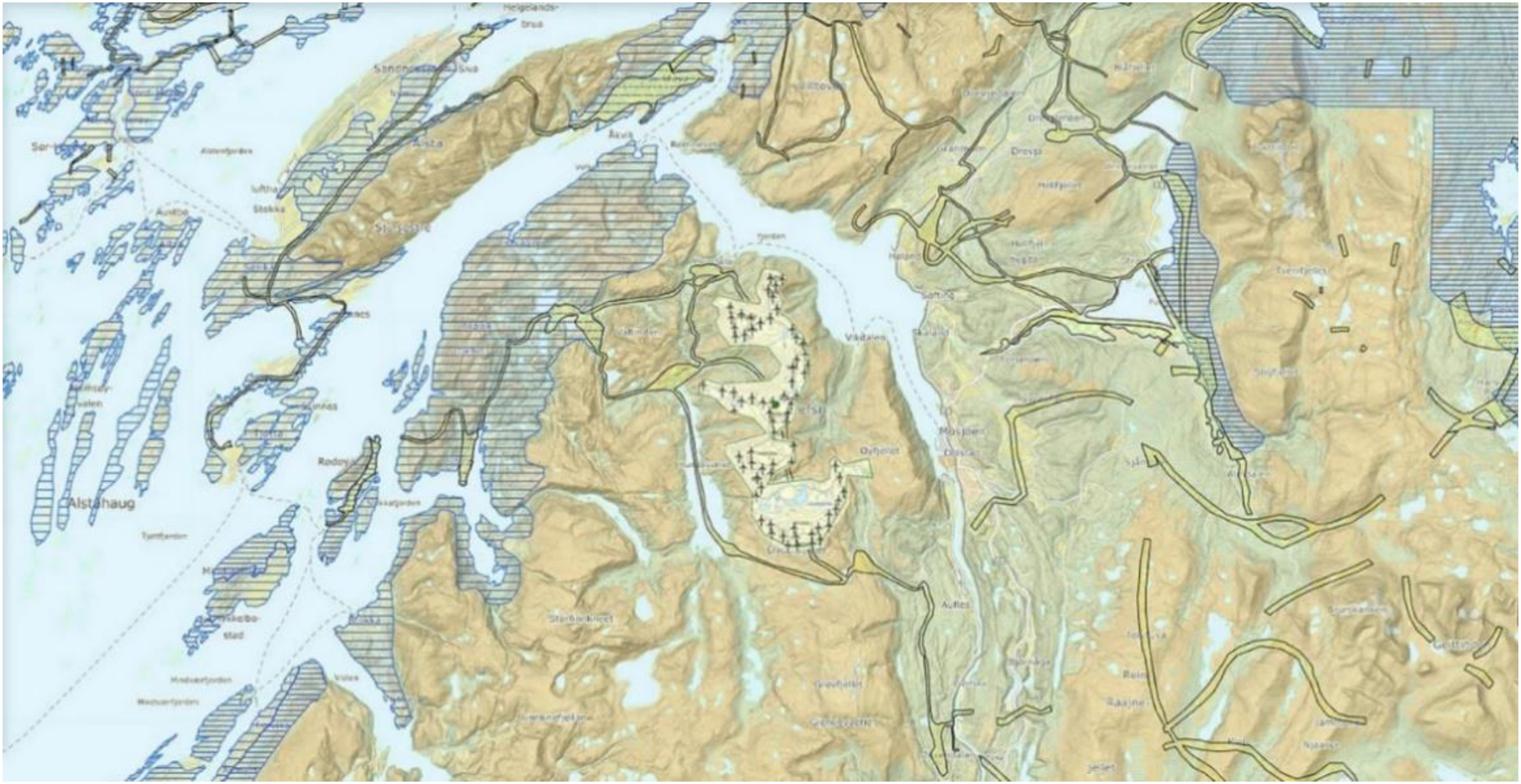
The Jillen Njaarke reindeer migration routes (in yellow) that the Øyfjellet wind energy infrastructure violates. Illustration by Ságat, photo: NVE. Published in February 2024 in https://www.sagat.no/oyfjellet-rettssaken-er-endelig-berammet/19.43068.
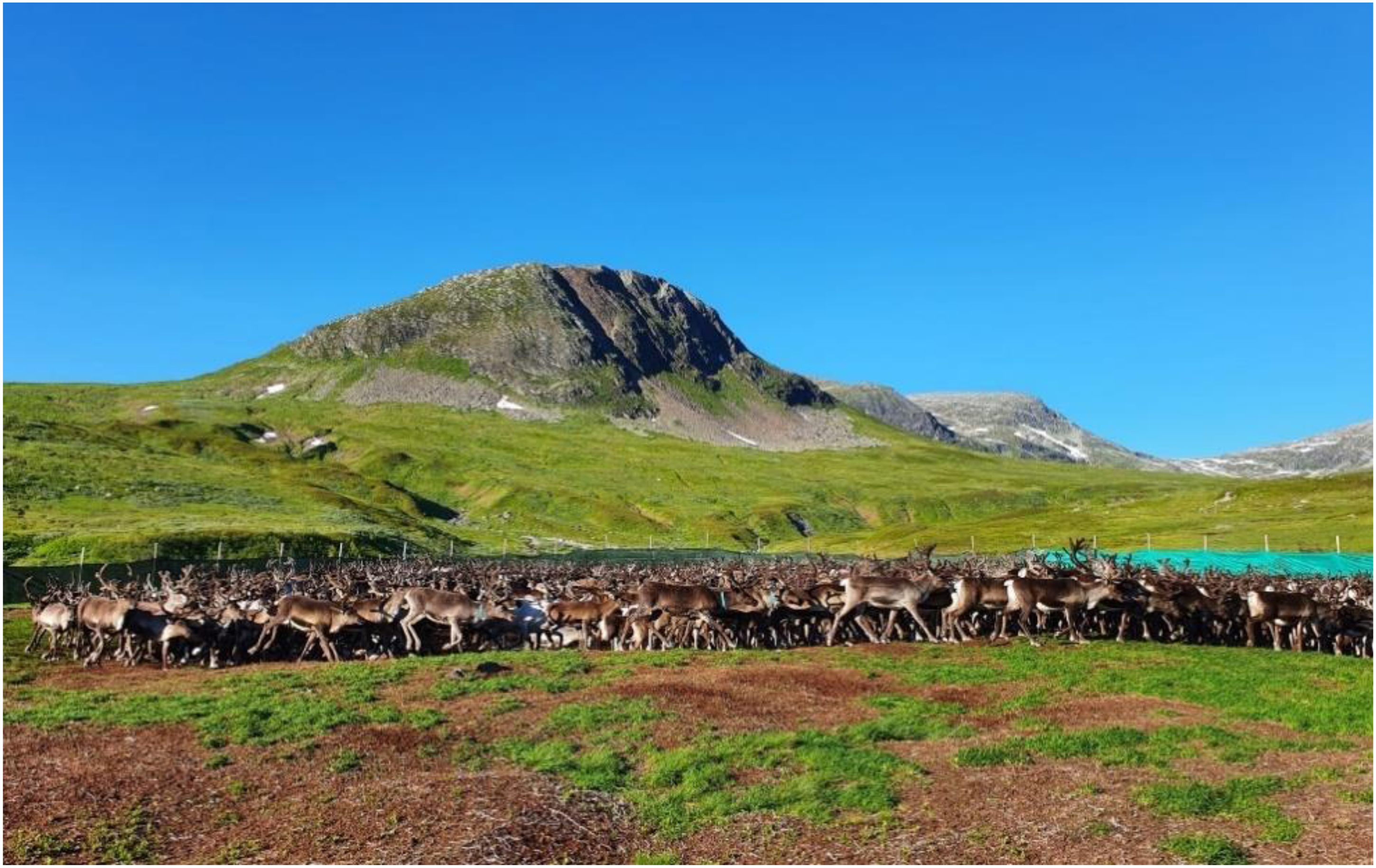
Reindeer in the pasture by the mountain Loevesgaejsie, situated at the ancestral migration route of the Jillen Njaarke, interrupted by the Øyfjellet windmill energy plant project. Photo: Ole-Henrik Kappfjell.
Here, the logic of Western sustainability—wind farms as part of the ‘green transition’ and Norway's commitments under the Paris Agreement and EU renewable energy goals (Fjellheim, 2022, 2023)—collides with Sámi understandings of the land, the sea, and their inhabitants as fundamentally interconnected. Reindeer husbandry cannot thrive without these reciprocal relations. In this case, sustainability defined by the state severed not only practical routes but also the ways Miärralándda is known and experienced. The land—the landscape—of Sámi reindeer herders as they came to know it through their practices (Meløe, 1988) is no longer theirs: it is to be used for the ‘greater good,’ as defined by neoliberal forces for whom the understanding of who ‘we’ are differs from the other, marginalised actors involved. As Brown et al. (2019: 55) remind us, appropriating land and territorialising property in landscapes characterised by multispecies freedom of movement detaches land ‘from other ecological and social entities with which it is networked, concealing and naturalizing the power relations imbued therein.’
When we extend these considerations to the sea, further examples of Miärralándda's transformation emerge. Today, the Nordland County has become a hub for intensive salmon farming. Aquaculture began as small-scale 13 and attentive to salmon welfare, facilitating the development of many coastal communities (Rybråten et al., 2018). Many locals have invested in salmon farming companies, which have in turn provided employment opportunities for small coastal communities, making aquaculture a key industry in Nordland. Salmon farming has since expanded into an international industry that now resembles intensive animal agriculture. Farmed salmon are deprived of their instinctual migrations across ocean distances, confined to nets and tanks in the name of sustainability. As Probyn (2014) observes, migration is the salmon's way of ‘homing,’ an embodied knowledge that has, through farming practices, been severed. Open-net pens, which can each contain hundreds of thousands of fish, create high densities prone to parasites and disease. Sea lice, bacterial infections, and toxic plankton blooms compromise fish health (Martin et al., 2021), while escapees from such pens threaten wild salmon populations through interbreeding and genetic weakening (Lien & Law, 2016; Roberge et al., 2008). Land-based aquaculture has been introduced as a technological solution, with recirculating systems that tightly control lighting, temperature, and disease (Martin et al., 2021). Yet these infrastructures cause further fissures in Miärralándda, binding salmon ever more tightly to the category of ‘biomass’, a classification that erases their sentience. Their instinctual migrations are erased for the sake of capital turnover, while the semi-natural waters of sea pens are transfigured into the wholly artificial environments of land-based tanks, for the ostensible purpose of protecting wild populations.
Despite oceanic aquaculture (open-net pens) providing a semi-natural environment, both these and terrestrial infrastructures eliminate the salmon's instinctual migrations and embodied knowledge of journeying in Miärralándda. This destruction is a situated manifestation of what Lien (2015; Law & Lien, 2012) describes as Atlantic salmon becoming alien in their watersheds of origin. The production of ‘alien’ fish destabilises the identification of salmon as part of Miärralándda. Yet as descendants of broodstock caught along the Norwegian coastline in the 1980s and 1990s (Lien, 2015: 149), farmed salmon remain connected to their ancestors, emerging as ‘not completely alien.’ As Lien (2015: 150) writes: ‘Neither quite domesticated nor completely wild, it [Atlantic salmon] upsets the ordering binary of “nature” and “culture” that domestication otherwise sustains.’ This perspective confirms that farmed salmon, like many other fish, are what Todd (2014: 218) calls ‘slippery beings’ in their ability to exist simultaneously as different entities. Todd points in particular to Indigenous understandings of fish-as-beings, where human and fish lives are bound together within layered political and social terrains that shape community life.
In Helgeland, as in other parts of the world, the rapid expansion of salmon farming has created division, with both support and resistance being actively mobilised. These reconfigurations are already impacting island communities in novel ways, the full effects of which we cannot yet fully understand. As the mayor of Træna, Trond Vegar Sletten, remarked in March 2024: ‘We wish to be a strong society. We who live here have a belief in the future. But then we also must make difficult decisions based on available knowledge.’ 14 Within this paradigm, ‘trust in the system’ evolves into a lexicon for investors, encapsulating their mode of engagement with the corporeal existence of salmon. The new facilities are not only infrastructuring the lives of salmon but also reconfiguring the land, sea, and humans through technology—bringing fish onto land to better control the production of biomass.
Whilst the livelihood of nomadic Sámi in the region where Anna lived often combined reindeer herding and fishing, fostering intimate connections between the land and sea, farmed salmon raised in nets and tanks now form another kind of human–fish relation. This change does not make them entirely alien to the life that once was. Following the logic of two worlds being one reality, Miärralándda is braided into these ‘new’ relations, even as they serve as reminders of and disruptions to the logic of progress that drives the evolution of aquaculture practices. Regardless of the level of alienation from the ‘natural’ life of salmon, the farmed salmon—together with migrating reindeer—raise the question of multispecies justice through the lens of movement that characterises Miärralándda both practically and conceptually. Blocked migration paths (for salmon) and cut migration routes (for reindeer) both represent violations of the very relations through which Miärralándda comes into existence.
A new beginning
Gan et al. (2017) have argued that ‘as humans reshape the landscape, [they] forget what was there before’ (6). This phenomenon is a process through which ‘our newly shaped and ruined landscapes become the new reality’ (6). Such forgetting remakes landscapes by privileging certain narratives over others. This new reality might be oblivious to the past, yet the past persists, remaining in place: ‘The winds of the Anthropocene carry ghosts—the vestiges and signs of past ways of life still charged in the present’ (Gan et al., 2017: 1). But what should be done with a past that is persistently present? Kramvig and Verran (2019: 167) wrote: ‘We argue that there is a need to think differently about the past, and that there is a need to accept that the past remains in place.’
In this narrative, Anna Tomasdotter, the hybrid Atlantic salmon bred in nets or tanks, and the reindeer whose paths have been severed by ‘green’ infrastructure have all emerged as storytellers. They compel us not to forget, but to remember. They have guided us to Miärralándda, which has become both a linguistic and material expression of Ume Sámi relationships with the land and sea. Miärralándda is thus simultaneously a powerful word and more than just a word, embodying the fundamental relationality of life's core elements and situated in relation to the meanings that one bestows upon it. These meanings spring from a tangible, corporeal relationship with Miärralándda, and since the Ume Sámi existence is interlaced with movement between significant places, Miärralándda is indissolubly tied to these movements through time and space. Therefore, Miärralándda represents both a nexus of living materialities (the land and the sea) and the movement that weaves these materialities together. Consequently, the mourning of and longing for Miärralándda also signify a yearning for movement, or for the liberty to engage in this movement—a yearning that is inherently more-than-human.
As an intrinsically relational concept, Miärralándda has prompted us to envision the Ume Sámi region as comprised of watery and earthly bodies. In this story, Miärralándda has emerged as a figuration in response to the transformation of the Ume Sámi sea-landscape into spaces of appropriation. It also responds to the consideration of non-human entities as integral to these appropriated spaces, to how they exist within the dynamics of movement and its interruption. Both the reindeer and the farmed salmon, in their respective ways, inhabit Miärralándda. Their movements are constrained, their quests for mobility ensnared by the materialities and ideologies of sustainability and green colonialism. However, Helgeland continues to be Miärralándda despite its silencing in these processes of industrialisation.
This recognition has political implications: by writing Miärralándda as present and doing so in collaboration with those fighting to keep the Ume Sámi language and culture alive, like Katarina Barruk, we join the struggle against the silencing of voices emerging from Miärralándda. As much as Miärralándda arises from the specificity of the Ume Sámi seascape, it also gestures toward a broader methodological and conceptual contribution. Attending to Miärralándda as a figuration demonstrates how place-based, Indigenous concepts can make visible multiplicities—heterogenous worldings forming a pluriverse, as suggested by De la Cadena and Blaser (2018)—and how they may re-articulate land- and seascapes as living archives of relational presence. Thus, while rooted in the Ume Sámi struggle to keep language, culture, and landscape alive, this approach has resonance elsewhere: it offers a way of recognising ontological difference and of resisting the reduction of worlds to appropriable resources. In this sense, Miärralándda is not only a contribution to sustaining Ume Sámi worlds but also an invitation to engage with other situated multiplicities across contexts of dispossession, interruption, and renewal.
Footnotes
Acknowledgements
We would like to thank Katarina Barruk, Jørn Magnus Rivojen and Elin-Anne Labba for guiding us to Miärralándda, and the sea and islands of Helgeland and Træna for welcoming our visits through the past years. Our gratitude also goes to the three anonymous reviewers, and to the friends and colleagues who have accompanied this work with their readings and reflections.
Author contributions
The article is the outcome of a collective process undertaken by the two authors, with both taking part in all the stages of the production of the manuscript.
Declaration of conflicting interests
The authors declared no potential conflicts of interest with respect to the research, authorship, and/or publication of this article.
Ethical considerations
This article has been written in consultation with residents, visitors, entrepreneurs and Ume Sámi knowledge holders in Helgeland. As no data has been produced through direct participant interventions, informed consent for information published in this article has not been obtained. The methodologies of the two projects associated with this paper have been approved by the Norwegian Agency for Shared Services in Education and Research (SIKT).
Funding
The authors disclosed receipt of the following financial support for the research, authorship, and/or publication of this article: This paper is associated with projects Traveling Post-Corona: Revisiting Hosts and Guests (2022–2025), funded and led by UiT The Arctic University of Norway, and SAMIKUN (2023–2026), funded by Regionale Forskningsfond Nord-Norge and led by Nord University.
Highlights
Miärralándda as a figuration represents the inseparable connection between land and sea in Ume Sámi culture Ume Sámi communities and practices have been fragmented due to colonial governance in Sápmi and Helgeland Miärralándda as a figuration critiques and disrupts resource extraction in Ume Sámi landscape, often misrepresented as sustainable development A counter-narrative to sustainability can be formed through attuning to the stories arising from Sápmi, challenging neoliberal sustainability models, and exposing the effects of colonial and technological exploitation Despite historical suppression, Miärralándda's stories persist and can be revived through storytelling
