




Abstract
Venice is one of the most iconic cities in the world; its peculiarities can all be linked back to its position within the largest tidal wetland in the Mediteranean. Yet, despite a long history of debates over preservation, conservation and restoration in the lagoon, this dynamic socio-natural waterscape has become mired in negative discourse and stuck in a state of managed decline. This paper argues that efforts to ‘save’ the city and its history have often accelerated this decline by severing the relational processes which co-produce the lagoon. We suggest that a pragmatic approach to ecological restoration requires engagement with the waterscape's collective roots, and that socio-ecological recovery will involve a pragmatic attention to the stories that are generated with and through local practices of dwelling with and caring for this ecology. We propose that the relative richness of situated socio-natural storying is entangled with, and reflective of, the ‘well-being’ of socio-ecological relations – and that, as such, their renewal might be understood as re-story-ation. The article presents data from a community mapping workshop, undertaken in 2023 as part of the EU WaterLANDS project. The results reveal deep, reciprocal connections between the lagoon, its city and their citizens. We illustrate how stories of refuge, origins, identity – generated with and through embodied engagement – shape socio-ecological relations in the Venetian lagoon. Yet we also demonstrate how stories are warped by nostalgia and solastalgia, serving to forestall meaningful change. The Venetian case resonates with broader (eco)systemic crises at multiple scales. We demonstrate that re-story-ation offers not only a lens to understand collective stasis in the face of ecological degradation, but a means to restore a socio-ecological system by (re)connecting community and commons in the present tense.
Keywords
Introduction
It may surprise the casual visitor, but Venice is an inherently muddy place. While the tenuous timber settlements of the fifth century have matured into a city of brick, stone and glass, the serpentine streets of this improbable city still reflect the geomorphological contours of the largest tidal wetland in the Mediterranean. Yet as muddy places disappear globally at an alarming rate, with them goes essential water filtration, storage and supply; flood and storm protection and micro-climate stabilisation (Brander et al., 2006; Gedan et al., 2009). Long maligned as ‘unproductive land’ by the capitalist gaze, wetlands – not quite land, not quite water – challenge modernist classifications and cartographies, shapeshifting with the seasons, currents and tides. Increasingly these interstitial spaces are drying up, being drained, eroded, polluted or lost to warming seas (Fluet-Chouinard et al., 2023). As the pressures of the Anthropocene reveal the limitations of modernist categories, wetlands such as the Venetian Lagoon are emerging as critical zones for both local and global climate concerns (Salimi et al., 2021), and as spaces of existential repair.
Venice has long served as a site for the projection of modernist anxieties, its morphological peculiarities rendering dominant logics strange. The city's unique urban geography has co-evolved with and through sedimented minerals, histories, memories, practices, and processes which, over centuries, have muddied together to co-produce one of the most powerful and enduring republics of all time (D’Alpaos, 2010; Vianello, 2022). Venice can only be understood in the context of its lagoon. This complex socio-natural system is the result of more than a thousand years of interwoven ecological processes and careful, consistent management (Luzzini, 2023). Without incremental intervention, the lagoon would have either dried up or been flooded by the sea at various points in the last millennium (Ravera, 2000; Vianello, 2021). As a waterscape, the city and its lagoon have co-emerged through relational processes which link the material, representational and symbolic through communal action, myth-making and storytelling (Muir, 1981; Rosand, 2001; Beggiora and Iovino, 2021). Yet Venice's more recent relationships with global mass tourism, extractive industries, environmental pollution, urbanisation and, as we will argue in this paper, the weight of its own omnipresent past, have troubled the equilibrium of this socio-natural system. Major indicators of a hydro-social cyle of decline include significant reductions of the lagoon's saltmarsh habitat (diminished by more than 70% 1911–2002: Roner et al., 2016), and contemporary depopulation of the lagoon (reduced by more than 65% 1951–2023: Comune di Venezia, 2024b).
Saltmarsh is key to Venice's environmental health. These habitats are the “lungs of the lagoon”, filtering and nourishing the circulating waters (Bonometto, 2003:44). These lungs are fed by ghebi [small creeks], which act like capillaries, while chiari [salt pans] adjust the salinity gradient of the water and replenish sediment quotas (see Figure 1; Bonometto et al., 2019). The saltmarsh harbours endemic species, serving as a nursery for fish, supporting plants and shellfish through its moderation of the water composition, and therefore sustaining local livelihoods and cuisines. Saltmarsh also slows down currents and mitigates wave energy (Barausse et al., 2015) – factors which reduce Venice's vulnerability to acqua alta [chronic flooding, literally: ‘high water’] and protect the historic city's foundations (Cavaleri et al., 2020) 1 – whilst also functioning as a highly effective carbon sink (Duarte, 2017; Mason et al., 2023). Erosion of Venice's marshlands continues to be exacerbated by mainland industrialisation (Beretta and Terrenghi, 2017); moto ondoso [boat wakes] from water traffic travelling at speed; deep dredging to accommodate ships and the ‘depression wakes’ of large vessels within the shallow lagoon (Scarpa et al., 2019; Tommasini et al., 2019). Unchecked, these stressors undermine the integrity of the lagoon; many of the critical thresholds to reverse chronic damage have been exceeded (Tosi et al., 2024).
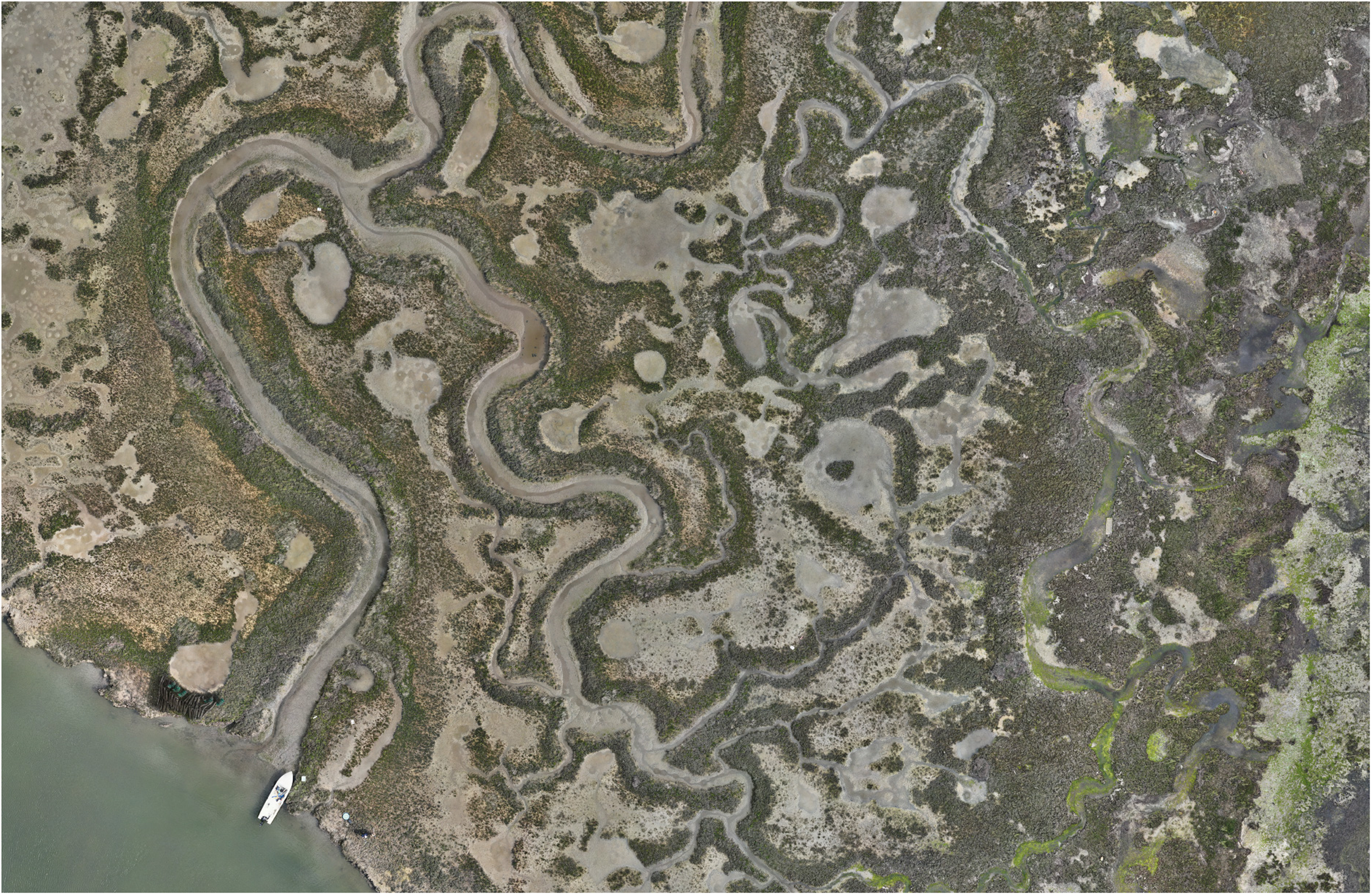
Aerial view of Venetian saltmarsh (drone survey at low tide, 14.05.2024; 45.320845, 12.219546) illustrating the internal networks of meandering ghebi [small creeks which allow the water to circulate within the marsh] and chiari [the small pools which filter the waters to mediate salinity gradients and sediment quotas]. The edge of a navigable canal and a small boat are visible in the bottom left corner. 159 × 103 mm (300 × 300 DPI).
The Venetian case resonates with broader (eco)systemic crises at multiple scales: as with Anthropocene narratives concerning impending apocalypse, an increasing weight of technical evidence has failed to translate anxiety into collective action (Colebrook, 2011). Although the Venetian Lagoon is highly degraded, it remains a complex socio-natural system; communal action remains integral to its ecological vitality (Luzzini, 2023). In this paper, we argue that meaningful restoration therefore requires serious engagement with these collective roots – beyond the quantitative indicators which have induced increasingly technoscientific knowledge-stories yet done little to rally collective action for change. Navigating these troubled waters requires critical shifts in prevailing narratives, ongoing practices and lagoon management to address harmful activities whilst implementing forms of active repair.
This paper presents results generated through community-based empirical research in the Venetian Lagoon. The findings illustrate both the importance of story as a vital component of the relationships which co-produce the Venice's waterscape and the pressing need to re-story ecological relations in the face of decline. In foregrounding such relations, three aspects of significance emerge from the Venetian mud as vital concerns for ecological re-story-ation: embodiment, solastalgia and institutional (dis)engagement. Through this attention to everyday stories, we highlight the ways in which standard modes of ecological restoration have fallen short. To date, large-scale, technoscientific approaches to the ecological restoration of the lagoon have not only excluded local voices and practices but actively driven community disengagement and abandonment, which has, in turn, accelerated patterns of deterioration. Embodiment requires being-in-the-world as part of the waterscape. The richness of such experiential knowledge is discussed in the first part of the empirical analysis. This is followed by an examination of the loss and grief that often accompanied participant memories in the context of wider themes of ‘ecological grief’, solastalgia and nostalgia. This section illustrates that storying does contain potential pitfalls: the possibility to wallow in loss that risks foreclosing restorative practices and new socio-natural relations. The third section discusses participant perceptions and experiences of current ecological restoration activities. We suggest that the inability to adequately address socio-ecological decline to date has intensified the lure of nostalgia, and that this is underpinned by overly complicated matrices of power that systematically disempower community involvement in restoration practices. As such, we suggest that localised storying may act as both measure (assessment) of socio-ecological vitality, as well as a means (process) of reconcilliation and repair. We define this process as ‘re-story-ation’, and develop this conceptual framework throughout the article. The article concludes by assessing the implications of the research for ecological restoration practices in the Venetian Lagoon, and current academic debates, with a particular focus on re-story-ation.
Literature Review: The pragmatic importance of story
In the last decade, ecological restoration has rapidly ascended policy agendas, yet the field remains marked by debate and evolving perspectives. Defined as “the process of assisting the recovery of an ecosystem that has been degraded, damaged or destroyed” (SER, 2004:3), a key tension exists between the historical fidelity 2 implied by the term ‘restoration’ and functional approaches which prioritise ecosystem processes and resilience in the context of a changing climate (Suding, 2011). These debates extend to the role and extent of human intervention (Hobbs and Cramer, 2008). As such, while the movement began as a branch of applied ecology, there remains significant scope for engagement from the social sciences and humanities (Halle, 2007; Wortley et al., 2013).
A growing body of research engages with the social, political and ethical dimensions of ecological restoration (e.g., Hodge and McNally, 2000; Gonzalo-Turpin et al., 2008; Crowley et al., 2020), notably within this journal (e.g., Lockhart and Rea, 2019; Hirsch, 2020; Hurst et al., 2022; Huff and Brock, 2023a). This work illustrates that ecological restoration involes a dynamic interplay between science, philosophy and practice that is as much about the political negotiation of values and meaning as it is about ecological techniques (Light and Higgs, 1996). Political ecology has long acknowledged the need to wield the intellectual ‘hatchet’ to desconstruct flawed accounts of environmental change, whilst also nurturing the ‘seed’ of possibility to sow new futures (see Robbins, 2011). Thus, while the appropriation of ecological restoration as both a means and ends by capitalist logics has been subject to important critique (e.g., Huff and Brock, 2023b), this does not mean that the field is incapable of offering meaningful opportunities for healing and repair.
Usher (2023) suggests a pragmatic and ethically-reflexive approach to ecological restoration that has provided the foundation for this research. Pragmatism is a philosophical tradition deeply concerned with the relationship between humans and their environment, and which seeks to judge ideas and values by their practical consequences, rather than universal principles and theoretical absolutes (Hickman and Alexander, 1998). Usher's pragmatist agenda synthesises a growing area of research which understands ecological restoration as necessarily plural, context-specific, continuously negotiated and fundamentally iterative processes (also Hertog and Turnhout, 2018). Rather than being driven by rigid adherence to historic baselines or narrow economic valuations of ‘success’, such an agenda not only engages with communities but reworks socio-natural relations – so ecological restoration is best understood as experiments in the (re)making of worlds.
While the literature highlights the importance of community engagement in the efficacy of ecological restoration, there is less consensus as to how this is best achieved (and sustained) in practice (Higgs, 2005; Boyer et al., 2019). Humans are narrative creatures and it is well established that dominant narratives shape (and are shaped by) discourse and worldly possibilities (Smith, 2010). Stories themselves are an implicit part of the relational socio-ecological processes which co-evolve with, and through, waterscapes (Swyngedouw, 1999:446–448). We suggest, therefore, that an attention to the stories told about both individual and collective care for ecology offers critical insight into the meanings and values embedded within worlding practices. To date, the literature on ecological restoration has overlooked the role of local socio-natural ‘storying’ (which often emerges through community engagement) as a situated practice entangled with, and potentially reflective of, the ‘well-being’ of socio-ecological relations.
According to Haraway (2016), “[g]ood stories reach into rich pasts to sustain thick presents to keep the story going for those who come after” (p.125). Yet the convergence of prevailing knowledge-stories around existential threats, while salient, serves to rupture trust in the temporal links between past, present and future – the result has been well-documented collective stasis. Pohl and Swyngedouw (2023:2) describe this as a “post-political” paradox whereby a “generalised consensus” agrees that the environmental situation is both pressing and serious, yet collective reticence to act ends up foreclosing any radical change.
The role of embodiment remains conspicuously absent in standard analysis of socio-ecological worlding practices. Wetlands, in particular, have distinctive material qualities; muddy engagement is an intensely sensory experience (Scapin and Smith, 2025). While ecological restoration literatures acknowledge that embodiment plays a key role in fostering a generalised ‘connection with nature’ (Furness, 2021), this tends to focus on visual and acoustic engagement (e.g., Znidersic and Watson, 2022; Wang and Yu, 2023). Feminist new materialism offers much more situated investigations of these sensory, affective and tactile qualities, and their entanglements with both story and worlding (e.g., Taguchi and Postila, 2023), and this paper is situated at the intersection of these two fields. We contend that if a healthy (eco)system is characterised by resilience through diversity, healthy socio-natural worlds are characterised by a plurality of stories, and that these are (at least in part) generated with and through through embodied practice. As such, as socio-ecological conditions degrade, so do the diverse stories that depend upon them, and vice versa. Thus, socio-ecological recovery might be expected to both require and generate diverse and resonant stories which co-emerge with everyday, embodied practice.
This paper suggests that ‘re-story-ation’ offers not only a lens to understand collective stasis in the face of ecological degradation, but a means to restore a socio-ecological system which has been hollowed out by extractive industries and exclusionary knowledge-stories. The term ‘re-story-ation’ is often attributed to Nabhan (1991:4), but an agreed definition has yet to emerge. We understand the concept to describe the drive for new stories which make new forms of relation with (and therefore care for) socio-natural worlds possible – in other words: the ‘seed’ from which pragmatic ecological restoration practices sprout. To date, the call for ecological re-story-ation has been led by Indigenous scholars (e.g., Kimmerer, 2013; Yates et al., 2023), and been predominantly concerned with environmental governance in (post)colonial contexts (e.g., Rodriguez, 2022; Baker et al., 2024) and challenging Anthropocene narratives (e.g., Kalita, 2023; Riley, 2023). We argue that ecological re-story-ation creates space for the pragmatic acceptance of messy, nuanced worlds and is therefore a vital component for ecological restoration that is able to endure with and through the inconsistencies that emerge in the muddy waters between ideas and practice (c.f. Stengers, 2011:39–42). In this paper, we develop this conceptual framework through empirical research in the Venetian Lagoon.
Methodology
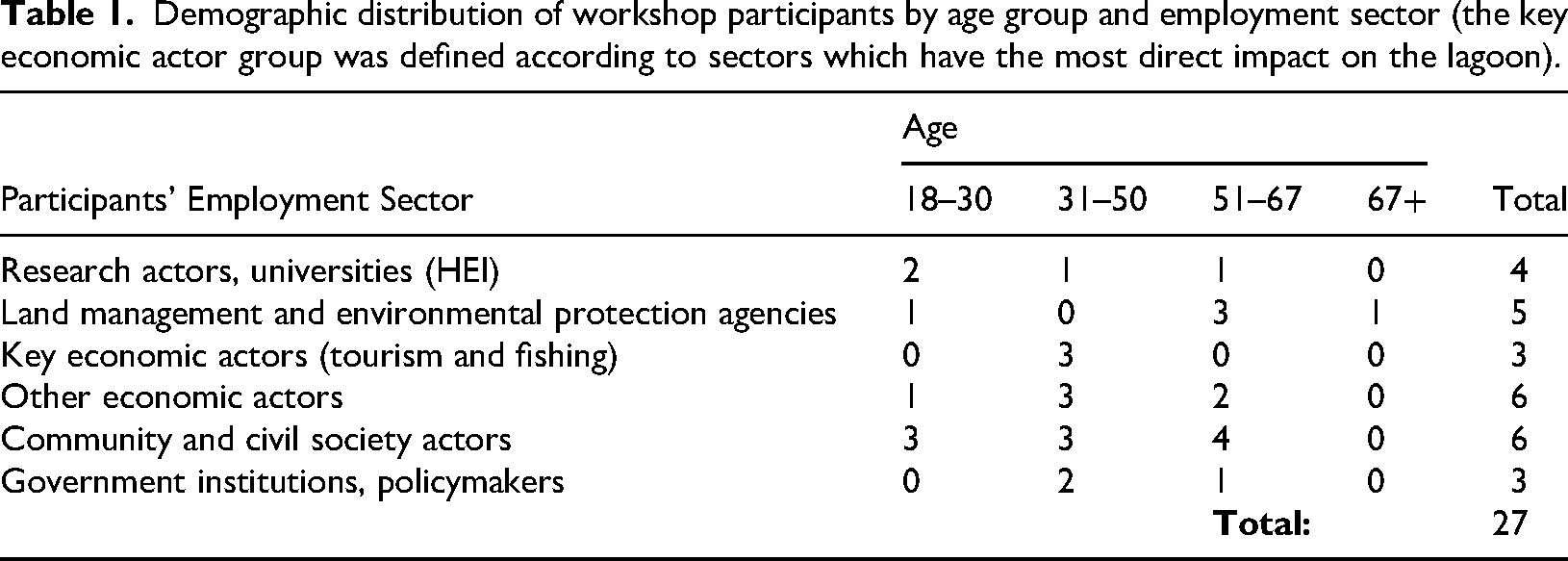
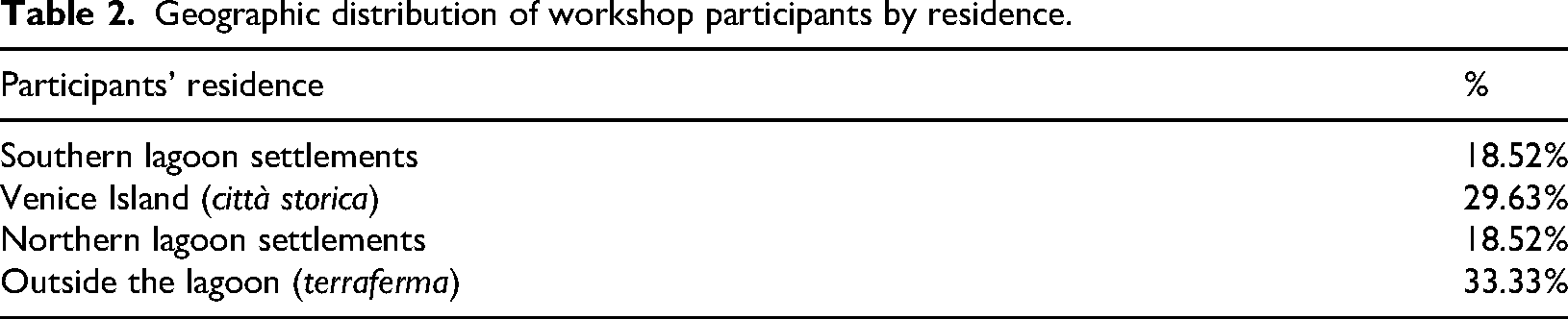
Establishing such a framework, or orientation, was not the motivation behind the community workshop which underpins the empirical data presented in this article. Rather, the workshop was designed to distill the values sedimented within the Venetian waterscape in order to locate pathways for ecological restoration that don’t exclude or ignore the human (and the storied environments they animate) in efforts to restore the more-than-human (Fox and Cundill, 2018). The event took place on the 16th June 2023, and formed part of more than a decade of community-led research undertaken by a local NGO in the Venetian Lagoon. This work has recently been bolstered by the EU WaterLANDS project (2021–2026) that aims to empower environmental stewards through work with community groups. Selected participants (31 in total, see Tables 1 and 2) represented a range of ages, backgrounds and occupations of those living and working across the lagoon. The workshop used focus-group participative mapping exercises (Lydon, 2003), and asked participants to express both individual and collective values as they identified places they felt held significant meaning (c.f. Flood et al., 2022). Design was predicated on the understanding that restoration should be based not only in technical knowledge, but also other forms of knowledge (including the tacit) that science contributes to but does not define. The retelling of significant events, memories, and observations was encouraged throughout the exercise, and the results have been shared as a community repository in the form of a StoryMap (We are here Venice, 2024).
Demographic distribution of workshop participants by age group and employment sector (the key economic actor group was defined according to sectors which have the most direct impact on the lagoon).
Geographic distribution of workshop participants by residence.
The data takes the form of stories. These offer insight beyond metric analyses: the selective inclusion of content, narrative structure and choice of language convey meaning and affect, as well as facts (Earthy and Cronin, 2008; Riessman, 2005). The critical importance of both this process of storytelling and the stories themselves became clear through the workshop exercise. So much so, that story evolved from a methodological approach to an area for critical reflection. The results evidence both the deep and ongoing connections between the city, its citizens and their lagoon, and key challenges for ecological restoration.
Embodiment in the Venetian Waterscape
In spite (or perhaps because) of the overwhelming increase in tourism numbers, the idea of refuge is powerful in localised relations to Venice. It is mythologised that early settlers sought refuge in the labyrinthine waterways of the saltmarsh as they fled Attila the Hun in 421 AD, and contemporary residents still see the lagoon as a space of refuge. This underpinned core values for workshop participants. One participant's family arrived in the lagoon as refugees from Istria, where they found a new home after World War II on Campalto island (see Figure 2, A1). Others discussed visiting the tranquil waterscape for respite from the intensity of city life. One participant shared a memory of the solace provided by the lagoon during a period of adolescent crisis, linked to Mesole, the small island where they grew up: “I took my bicycle during rest hours in the summer, while everyone was sleeping, and… I went along the only road there is, and I observed all the animals: black-winged stilts, little egrets […] then I looked at the water that flowed according to the tides and I was fascinated by the flow of the water, by the algae that looked like hair… and it was my refuge.” [A2]
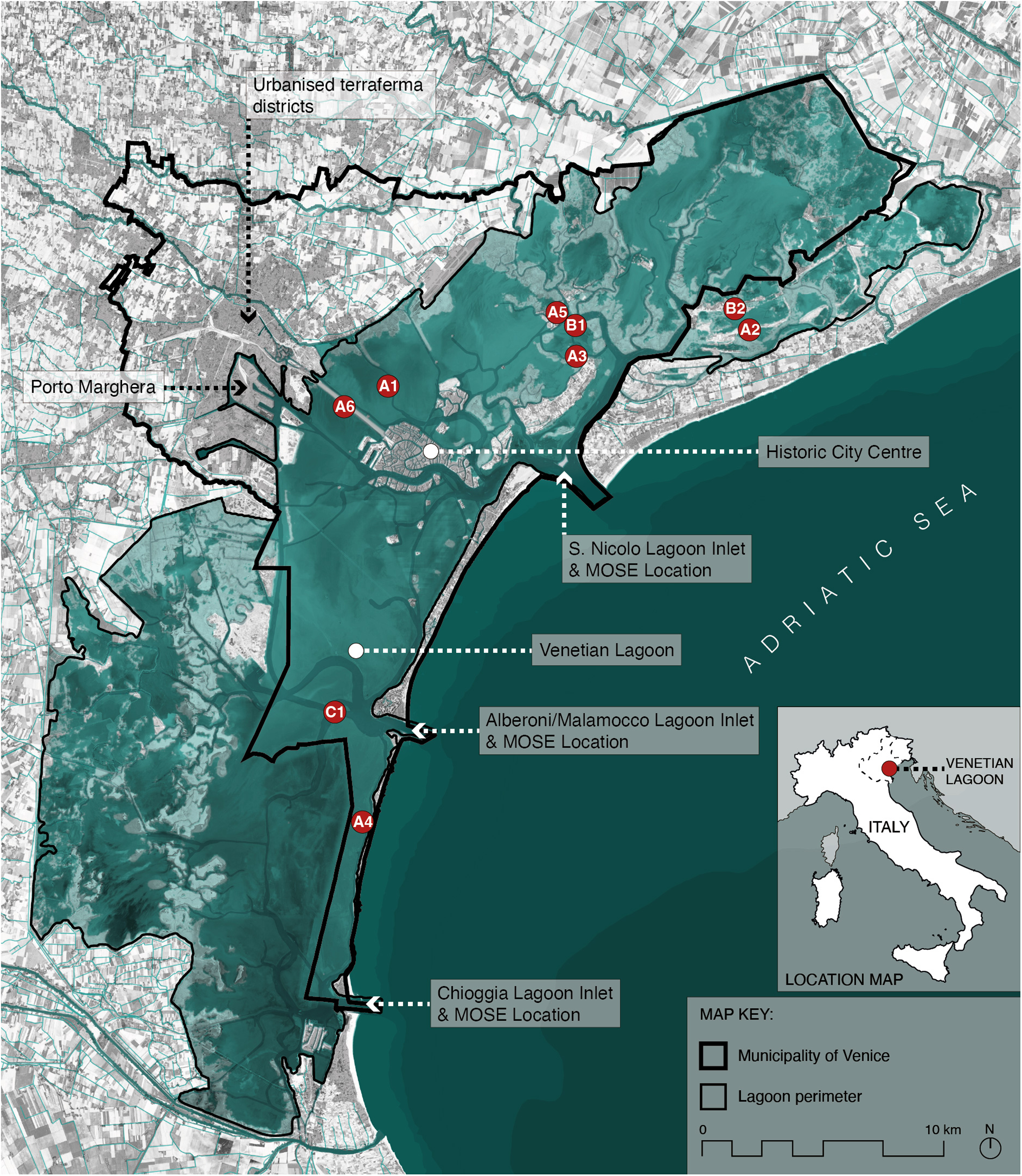
The map depicts the Venetian Lagoon. Key areas are marked, and areas related to the data included as part of this article are referenced by number and letter both in text and on the map (e.g. [A2] as associated with the quote above).
Another stated simply: “I like the water, I like the open space, I need to see the horizon of this open expanse of water. … It gives me space to breathe.”
These stories illustrate the ongoing importance of the lagoon as a space of refuge and reflect the well-evidenced psychological benefits associated with connections to natural environments (Capaldi et al., 2014). Spatial engagement is fundamental to a sense of personhood (Strathern and Stewart, 2011); important experiences are integrated through relationships between the body and external world (Fried, 1963). Fishing, crabbing or playing in the mud and saltwater appeared in multiple participants’ formative memories. Places become more meaningful when they are associated with important milestones and experiences of personal growth (Scannell and Gifford, 2010). One participant described learning a fishing technique ‘busi da Gò’
3
from their father in the mudlflats: “You had to put your arm in the mud completely, and for a child you don't know what you'll find… but after I got used to it, all the holes were mine! But [this practice] gives you the feeling of your origins – the muddy material, in some way, immediately puts you in connection with the rest of the environment. For a Venetian you understand your origins; where you come from; what you are made of. You are made of this lagoon”. [A3]
In this quote, the cultural knowledge of catching fish in the mudflats is passed down by the participant's father and learned through embodied practice (c.f. Ingold, 2021b). Here, the potent mix of bodily sensations and visual restriction, reaching into the unknown, stimulated a strong relationship with the mudflat and its more-than-human inhabitants, whilst also providing a sense of connection with their father and the imagined others who have engaged with this practice in the past. Multiple participants stressed the importance of spending time in the lagoon from a young age to become familiar with the waterscape. One participant described learning to swim near Pellestrina as a child: “[M]y father took me and threw me [into the water]… when I came up I remember that there was mud beneath my feet, the salt in my mouth and this crazy orange of the evening sunset sky.” [A4]
These kinds of embodied relationships with the waterscape were recognised by participants as fundamental to their personal and collective identity, providing a sense of belonging. One participant described an area near Mazzorbo [A5] where “we raised our children in the mud; [this is] where I live my present.” It is in the mudflats, with dense atmospheres of briny humidity, where the participant feels most ‘present’ – with themselves and others. Several participants even compared spending time in the lagoon with breathing – a vital process by which the thick, salt-laden air of the waterscape is taken into and metabolised as a part of the body itself: “You are made of this lagoon… As they say: ‘it puts salt in your blood, and when you cross the Ponte della Libertà [Bridge of Freedom], we breathe differently’. And it's exactly that you understand where you came from and what you are made from.”
The Ponte della Libertà (see Figure 2, A6) is the road bridge which has connected the historic city with the terraferma [mainland, literally: ‘firm ground’] since 1933. Venetian identity (for those dwelling within the lagoon) is often defined in opposition to the inhabitants of the terraferma. While a third of the workshop participants (see Table 2) were residents of the terraferma, participants concluded that the majority of those living beyond the marshes lack the formative embodied knowledge to fully understand life in the lagoon. The spatial expanse of the water, and the ability to traverse its calm surface independently in small boats, was related to a sense of “freedom” by participants, and was often contrasted with the crowded streets of the historic city. Venetian rowing [voga] is a practice intimately tied with historic inhabitation of the lagoon. The shallow meandering channels (many less than a metre deep) were impenetrable to large ships and only navigable by those with local knowledge, and therefore protected the Venetian Republic (697–1797) from invasion. Participants felt that continuing these rowing practices was not only critical to sustaining socio-cultural connections with the lagoon, but strongly correlated with its overall habitability. One participant compared the significance of Venetian rowing with the lagoon's saltmarsh habitat, suggesting that Venetian rowing serves as a socio-cultural “bioindicator” for the health of the lagoon: “It's not that we
Rowing is severely impacted by increased motorboat traffic in the lagoon, with larger, faster (often tourism-related) boats causing large waves that are perilous for traditional rowers, who risk capsizing. Venetian rowing is an integral part of various ceremonial events (e.g., Festa del Redentore), as well as numerous regattas throughout the lagoon each year (e.g., Vogalonga). While not all who participate in these events are resident within the lagoon, learning and practicing voga requires significant time spent ‘dwelling’ in the locality. According to Ingold (2021a), dwelling is a form of mutual worlding whereby the human and other-than-human co-emerge through the rhythmic flows of time and movement that characterise the act of living. Participants stressed that it was not the type of boat, but the “slowness” of small boats which allows for valued relationships with the lagoon to form. Multiple participants emphasised the temporality of life with(in) the lagoon, arguing that it is this slower pace which allows for the “fundamental” art of noticing details, memory-making, embodied experimentation and response-able practices. As one participant put it: “slowness [means], thinking twice about doing things, […] thinking about the consequences of what you do and the necessity of what you do”. This slowness invites a reorientation of a participant's relationship with their environment: “[I]n general there is a bit […] of having to accept that not everything can depend on you, that you cannot choose everything, you cannot have control, but you have to coexist “[T]his freedom that I feel in Venice is different, and I notice it in Venetians and venezianità [Venetian-ness]: the value of spontaneity […] it's linked precisely to the relationship with the sea.”
Participants linked the atmospheric unpredicatability of life in the lagoon with themes of slowness and refuge, in consensus with Scappettone (2014:19): “If Venice seems at first glance a museum, what it places on display is the continuous work of tempo – which can be translated as both ‘time’ and ‘weather’ – on the precarious reality of all human construction.” Flood et al. (2021) highlight that “values are shaped by the ways people perceive, depend on, and interact with ecosystems” (p.1) and are “often expressed in terms of sensory experiences” (p.3). Life on the watery plains is characterised by a distinct sensory experience, defined by the ebb and flow of the tides, and the kaleidoscope of shifting reflections that alter perceptions of streetscapes and living spaces. Familiar passages can be rendered strange by thick sea fog, which frequently reduces visibility to a few metres in the winter. Faster boats are forced to slow down or do not venture out at all, creating sensations of seclusion: “in the lagoon in November… [it feels as though] there is no one else.” Participants felt this fosters opportunities to (re)connect with themselves and the more-than-human through the absence of (human) others.
Such stories correlate with wider feminist and new materialist discourses, which examine connections between (multi-species) communities and commons. The stories shared during the workshop are part of ongoing processes of mutual worlding in which experiences, meanings and practices become sedimented with and through the rhythmic ebb and flow of the socio-natural world (Alaimo, 2010; Haraway, 2010). As such, the workshop data not only illustrates specific historical-geographical relationships between the city, its citizens and the lagoon, but the values embedded within these relations. The values expressed were linked to the lagoon as a space of refuge, and a relational place which provides a sense of personal and collective identity. It is notable that although a significant proportion of the participants generate livelihoods from/with the lagoon, the values expressed during the workshop were almost exclusively emotional, psychological and social, rather than economic, and many related to embodied experience. Humans understand ecosystems through active engagement with them (Minteer and Collins, 2005); above all, participants valued the relational way of being that emerges through access to, and immersion within, the waterscape. The ability to participate in slow rowing (safely) indicates not only the continued ability to build and maintain connections with the lagoon and its history in the present, but the relative presence/absence of destructive practices (i.e., water traffic that generates motondoso) which both impede rowing practices and accelerate hydro-ecological decline.
The Restless Ghosts of Disenfranchised Grief
The accounts shared during the workshop were often tinged with a sense of loss: recounting stories of meaningful places connected with significant memories was often compared with these places as they are today. In the last fifty years, Venice has undergone rapid changes that have physically eroded or limited access to places within the waterscape, significantly altering the socio-ecological fabric of the lagoon. Many of the participants have witnessed these changes first hand. Places celebrated in their stories had almost all been severely impacted by overtourism (through privatisation, crowding and depopulation) and the erosion and ecological degradation associated with increasing shipping traffic: “[M]aking hotels out of the privatized islands means that this whole area is no longer available. It means that the slow rowing, watching the sunset from the lagoon in the evening, bringing friends to discover these things – all of these things have been wiped out by […] a human-made system that has upset what used to be my home.”
While visitors have always been a component of Venetian culture (De Maria, 2010), contemporary overtourism is distinguished by its scale and impact (Innerhofer et al., 2019). Despite well documented critique, the tourist load continues to increase year on year (3.9 million visited the lagoon in 2023: Comune di Venezia, 2023) and there is little consensus as to what to do about the issues (see Bertocchi and Camatti, 2022). While tourists are largely concentrated within the historic city, initiatives to spread the tourist load more evenly throughout the lagoon (see Comune di Venezia, 2017) mean trips to visit the other islands are increasing in popularity, as is the hire of leisure boats, impacting daily life: “[T]he island of Burano has become practically unliveable… because thousands of boats are continuously passing by […]. [My] anger takes over because the istiutizioni don’t do anything to stop this. But not in the sense of not letting them come, but in the sense of just managing the traffic. […large boats] come down a ghebo
4
– boats that are twenty meters long. [… they] should not enter the lagoon […] they are slowly destroying the road they travel on because there is no kind of protection”. [B1]
Burano is located in the northern lagoon. This area has retained much of its saltmarsh habitat and used to be a relatively quiet area (Bonometto, 2003), yet has become a popular destination in recent years (Re, 2015:6). Participants described the crowds of tourists as “suffocating” and decried the disturbance of the lagoon as a space of refuge. Moreover, the destructive behaviour of visitors, usually through ignorance, in the context of the ‘fragility’ of the lagoon was a cause of significant concern.
These stories are consistent with the wider literature on ‘ecological grief’ (Benham and Hoerst, 2024). The perceived ‘loss’ of valued places, former lifeways and opportunities for the future generated a variety of responses from participants. Places which participants felt to be changing significantly from those they remember were associated with an emotional distress that has been termed solastalgia. This is a feeling distinct from nostalgia (i.e., the homesickness experienced by individuals separated from loved people or places) in that this form of distress is the result of perceived changes to an environment or place whilst individuals are still in direct connection with it (Albrecht et al., 2007). While this phenomenon has largely been explored in the context of climate change (e.g., Albrecht, 2010; Phillips and Murphy, 2021), the participant quoted above states that the current system has “upset what used to be my home”, describing an uncanny feeling of disconnection with a place that was familiar, a refuge and source of solace and belonging – of homelessness whilst still being ‘at home’.
Ecological grief can be associated with globalised processes of environmental degradation (Head, 2016). Yet this emotional response is intensified when places are linked to (traditional) ecological knowledge and personal memories, particularly those connected with childhood or other significant, often sensory, experiences (Cunsolo and Ellis, 2018). Given the profound connections between community members and the waterscape, and the importance given by participants to embodied experiences within the lagoon in order to build these connections, it makes sense that these perceived losses are felt so viscerally. Indeed, the depopulation of the lagoon was felt to be irreversible, and even existential: “If you depopulate an island like Burano, then you never repopulate it again… [this] means that we have lost it and it becomes a stain of a thousand colours in the middle of the lagoon… every time I read this data […] it hurts me, because you see your city, in fact your origins, slowly crumbling”.
This account is testimony not only to the deep connections felt by this participant in relation to Burano, but to sense of shared history with those who have come before, and daily practices involved in living with(in) the lagoon. Participants agreed that the very existence of Venice and its lagoon is dependent on keeping them “alive”: the city and its lagoon can only properly exist as part of reciprocal socio-ecological relations (and the practices and stories these generate). The fear expressed is not of literal death, but an acknowledgement that without Venetians, there can be no Venice; without Venice there can no longer be venezianità.
From Solastalgia to Enjoyment
While the group as a whole reported different responses to these emotional experiences, some linked the pain of place-based grief to patterns of avoidance. One participant explicitly linked their reason to avoid the family home in Lio Piccolo with nostalgia: “I am nostalgic for that place, and I frequent it very little. There were strong ties with my grandparents who are no longer with us, so I tend not to go to those places anymore… I feel a strong sense of nostalgia”. [B2]
Others similarly explained that the pain of seeing such great changes to the material, social or ecological fabric of places led them to actively avoid certain locations. At its most extreme, this kind of avoidance, even abandonment, likely contributes to contemporary depopulation trends and diminishes the (re)generation of stories and situated practices, and therefore depletes the richness of the socio-natural worlds these bring into being.
Albrecht (2005:11) argues that solastalgia, and the very real emotional pain associated with it, is not located in the past, but is an embodied experience of loss in the present which “manifest[s] in a feeling of dislocation; of being undermined by forces that destroy the potential for solace to be derived in the present”. This ‘present tense’ reading of this place-based form of grief was supported by participants’ accounts. When asked to associate shared stories with past, present or future temporalities, participants often chose to relate memories laced with grief or loss to the present in order to signify their ongoing resonance in their lives. Some participants, like the quote above, preferred the pain of an actual disconnection in the present to make space for a retreat to the (idealised) past. In this way, memories remain rose-tinted within the fantasy realm of nostalgia (Fried, 1963). Another participant summed up the allure of nostalgia succinctly: “The past makes me feel good because I don't like the present.”
The perceived gap between places remembered in the past and their condition in the present can grow over time. Negative aspects can be forgotten or left out of stories, which change with each retelling (Yamashiro and Roediger, 2019). A reluctance amongst certain participants to move beyond negative comparisons with past conditions recurred throughout the workshop, but was particularly pertinent during discussions about potential futures in the lagoon. Memory can serve as a motivation to improve the conditions of a place or community – as proof of its possibility – but if grief remains unprocessed or disenfranchised, it can foreclose attempts to progress (Butler, 2020b). 5 The result is a paradoxical paralysis, whereby the inability to move beyond the grief triggered by ongoing socio-ecological degradation inhibits attempts to address the decline. Whilst stuck in this process, the situation further deteriorates, as does the associated emotional pain.
Pohl and Swyngedouw (2023) examine this paradox in relation to climate change; through an investigation of Lacanian ‘enjoyment’ [jouissance] as a political factor in the current ‘deadlock’ between knowledge and action. Enjoyment, in this psychoanalytical sense of the word, involves an insatiable and often anxiety-ridden search for wholeness known as ‘the Thing’ (also Lacan, 1992); a spectral presence that drives desire in its absence. Pohl and Swyngedouw (2023:3) argue that this is not only an individual, but a collective drive, and that when it is inevitably impossible to obtain the Thing, enjoyment is obtained in the symbolic or imaginary registers. “[T]o preserve their [abstract] possibility for enjoyment, the subject clings to loss and the suffering it entails”. This “fuels the prevalence of nostalgia as a mode of relation to our origins” (McGowan, 2017:39).
Read in this light, participants’ attachment to lamenting loss can be seen as a form of ‘imaginary enjoyment’ that keeps the subject rooted in the symbolic registers of (Venetian) identity. The existential register is a key indicator that the speaker is operating in the imaginary and symbolic realms with the threat not physical, but emotional and psychological. Another core component of ‘imaginary enjoyment’ is the sense that enjoyment has not only been ‘lost’, but been ‘stolen’ by “an Other whose very enjoyment stands as the fulcrum of what is presumably lost” (Ibid., p.6; also Žižek, 1993:203). In the Venetian case, the city and its lagoon are seen as being stolen by privatisation, (ecological) degradation and the tourist hoards, who erode the Real Venice through their enjoyment of its ‘short-term’ facsimile (Salerno and Russo, 2022), “destroying the road they travel on” through their consumption (as stated by the participant quoted earlier). If a feeling of connection with the waterscape is a critical component of Venetian identity, lamenting its loss and destruction appears to be a key facet of Venetian political subjectivity.
What Real city could possibly compare with La Serenissima Repubblica [The Most Serene Republic] or the places connected with childhood memories, uncomplicated by adult concerns? Venice is a city constructed as much from myth as brick and mortar. 6 Yet what was once an epic story of collective strength, communal spirit and stability has become a tragedy of fragility, desertion and decline. Today, the Death of Venice is the city's most prominent myth (Plant, 2002; Settis, 2016). This story is well-evidenced through a variety of metrics and has become a “well-rehearsed prophecy” (Smith and Da Mosto, 2020:5), used to stimulate tourism ('see it while you can!’) and emergency funding for public works and conservation. Yet, like more generalised Anthropocene narratives, this prevailing story results in protracted grieving – the ongoing yet never quite complete ‘death’ of the city – that overshadows other (perhaps more agentic) interpretations of change. One participant addressed the narratives of frailty directly: “we must think of Venice, not always as an old lady to be safeguarded, to be saved, but as a young, alive person who must have the desire to do and fight…. A strong Venice.” For Tsing (2015:18), “If we end the story with decay, we abandon all hope”. Arriving at this ‘young Venice’ involves reckoning with death as the part of life that allows for return and rebirth in ecological cycles (Rose, 2006).
Moving beyond the pull of nostalgia and ‘imaginary enjoyment’ involves a (re)acquaintance with the Real through the associated stages of grieving (Pohl and Swyngedouw, 2023:7). The answer to the Death of Venice is, therefore, to let (the imaginary) Venice die – to make space for enjoyment of the Real (McGowan, 2004), and restor(y)ing the city and its lagoon in the present tense. Venice might then be reborn through careful cultivation of the material, representational and symbolic nutrients sedimented in the lagoon. Just as saltmarsh is able to shift within the dynamic system, gaining and losing sediments as part of the tidal cycle – even coping with rising sea levels through vertical accretion (Fagherazzi et al., 2020) – grief and mourning have a creative capacity to bring to light and (re)make valued connections with (more-than-human) others (Butler, 2020a; Cunsolo and Ellis, 2018).
The physical act of ‘doing’ is integral to generating and sustaining relations (Rishbeth and Powell, 2013). If, through ecological repair practices, “we regenerate old ways or create new ones that bring us closer to natural processes and to one another” (Higgs, 2003:2), then active engagement in these processes also offers a means for re-story-ation: a way for community members to process loss and (re)create connections with their waterscape. In this sense, ecological restoration is not a means to restore the lagoon to a prior state, but to heal the socio-ecological relations between community and commons.
Refracting Restoration through Collective Values for Revival
Participant accounts highlighted the disconnection between knowledge and action that define wider sustainability, climate change and Anthropocene narratives. Venice is drowning in discourse, 7 yet this has served to cement the Death of Venice story rather than address the causes of decline. The “decay of the city's civic heart” through depopulation has been a subject of significant concern since the 1960s (Plant, 2002:360). The resident population of the lagoon has since halved (Comune di Venezia, 2024b). While diffuse factors such as global sea level rise, climate change and the rise of mass tourism play their part in the socio-ecological degradation of the lagoon, many of the stress factors are local and specific (Molinaroli et al., 2009), linked to harmful development practices and traffic. So while mounting hydrological, ecological and bathymetric analyses do illustrate the deterioration of the lagoon, many critical eco-morphological systems are still functional and could recover with appropriate action (Bonometto, 2008:7). Yet prevailing discourses of urgency – much like those surrounding planetary (eco)systemic crises – stimulate a paradoxical push towards simultaneous stasis and over-action that favours large-scale ‘solutions’ that cannot account for the complexity of the socio-ecological system (Colebrook, 2023).
Participants remarked on a pervasive mix of “stasis” and “resignation” that has stalled what they feel to be any kind of meaningful response from key institutional actors and policymakers. One explained their frustration: “There is this recognition of the situation that exists and recognition of all the negative aspects that are there, and that's it…”. Participants expressed frustration with the “timeless” image Venice, largely promoted via tourism, and the weight of international attention that prioritises the preservation of (globalised) ‘cultural heritage’ over the challenges faced by those who live with and care for the city and its lagoon. Participants identified this “stasis” to be one of the main anthropogenic stress factors on the lagoon and cited the resulting “disengagement of many citizens” as a huge barrier for meaningful change. This disengagement is more passive than the active abandonment described in the previous section, yet, as Settis (2016:61) explains: the “paradox of conservation is that nothing can ever be truly preserved nor handed down if it remains static or stagnant”. Albrecht et al. (2007:S95) note that the negative experiences of those who are exposed to environmental change are “exacerbated by a sense of powerlessness or lack of control over the unfolding change process”. As such, the exclusion of the local community (and their storying) actively stimulates the ‘imaginary enjoyment’ through nostalgia described above by foreclosing attempts for participants to engage (positively) with change in the present tense.
In lieu of a holistic approach to the dynamic, co-emergent processes which determine the equilibrium of the lagoon, efforts to address Venice's challenges have remained segmented by institutional structures and disciplinary boundaries. Depopulation and overtourism discussions continue to be dominated by urban planning and economic analyses; cultural heritage is led by private, often internationally orientated institutions (e.g., UNESCO), and the deterioration of the lagoon falls within the remit of the Provveditorato (the interregional body for public works which answers to the Ministry for Infrastructure in Rome). The result has been institutionally disjointed efforts across scales of governance that have often exacerbated complex issues by focusing on piecemeal symptoms of decline, rather than its causes. The exclusion of local voices, stories and expertise has impeded innovation (Munaretto and Huitema, 2012).
Participants described an institutional “rubber wall” blocking efforts of smaller authorities and citizens’ collectives to enact change. Key institutional actors have blamed a lack of funding and an inability to reach decisions through consensus in the bureaucratic web of power. The overly complicated matrix of governance was itself introduced by special legislation designed to ‘safeguard’ the city. The Special Laws for Venice (1973,1984 and 1991) formalise national involvement in Venice in response to the city's socio-ecological decline by securing additional funding for maintenance and restoration. Zanardi (2020:14) illustrates that the “excessive [building] restoration” stimulated by the Special Law 1973 provoked a “forced exodus” of Venetian residents due to rising rents, while repeated relaxations in regional housing regulations paved the way for the ‘Airbnb phenomenon’ which has further accelerated depopulation trends (Bertocchi and Visentin, 2019:6–7). One participant describes their frustration at private landlords refusing to rent to residents: “[O]n the one hand, I see the posters ‘The population of Venice is decreasing. There are fewer and fewer of us’ etc. And on the other hand, I, who would like to come, can't.”
Saltmarsh restoration in the Venetian lagoon falls under the remit of the interregional Provveditorato, and takes the form of engineering works that use morphological (re)construction to influence the hydrodynamics of the lagoon. Much of this activity has been directed towards cordoning off and infilling new ‘artificial saltmarshes’. 8 These areas tend to have limited similarities with naturally-occuring saltmarsh – either due to incomplete vegetal colonisation or the absence of vital internal water networks (i.e., ghebi and chiari, see Figure 1; Bonometto, 2003; 2008) – and have been subject to significant critique from local experts. While the scale of these efforts to ‘rebalance’ the lagoon is impressive, this approach fails to take into account the relations between isolated morphological elements or effect changes in lagoon management. This is highly problematic within such a dynamic system of eco-hydromorphological processes (Bonometto, 2003:7), and these interventions have been subject to limited regulation and monitoring to understand the long-term impacts (Bonometto, 2008:14–19). Deprived of a connection to community groups or practices, these works are instead driven by sediment availability, which is procured through routine maintenance (dredging) of shipping channels (undertaken by the North Adriatic Port Authority), rather than a holistic plan for the lagoon. Some relatively small pilot projects, funded by EU grants, have introduced innovative ecological research, and some of these engaged local fishermen as participants and practitioners, yet these have failed to establish a legacy beyond the time-frame of the EU-funded works. Workshop participants who took part in these projects reported experiences to be positive and fulfilling, but stated that they have struggled to continue with the practices without support.
The Comune di Venezia [Venice Municipality] has included not only lagoon settlements, but areas of the mainland since 1926, see Figure 2. In the last century, expansions of the urbanised terraferma have dramatically contrasted with the depopulation of the waterscape, shifting the focus of the local administration beyond the lagoon. Today, only 30% of the municipal population reside within the marshes (Comune di Venezia, 2024a). This shift has shaped the local policy agenda – many feel to the detriment of the lagoon. Calls to reorganise Venice's local political structure and re-articulate the differentiation between laguna and terraferma authorities have resulted in five (unsuccessful) referendums in 1979, 1989, 1994, 2003 and 2019. The last two failed to reach the stipulated quorum for voter turn-out (50%+1).
Workshop participants decried the absence of a responsive administrative system which values the knowledge and embodied practices of those who live with(in) the lagoon, and which has the power to police damaging activities. While little is done to curb speeding water traffic in the lagoon, overly prescriptive fishing regulations have made it increasingly difficult to continue traditional practices. A participant shared their frustration at the cumbersome bureaucracy which inhibits young people from undertaking internships during school holidays: “these opportunities should be supported, with respect to the rules, but the processes must be accelerated.” Another participant explained how standardised regulations inhibit the intergenerational transmission of knowledge. Although fishing in the lagoon is completely different to large-scale industrial practices in the open seas, the strict legislations still require them to register every member of the ‘crew’. This participant risks their livelihood (their small boat may be seized) for allowing their elderly father to maintain his lifelong connection with the waterscape – “he doesn’t want to die in the house” – or bringing their son to learn the trade. Relatively small, yet locally informed, regulatory changes could have a significant impact on lagoon traffic and the ability to sustain socio-cultural traditions.
In lieu of addressing the very real barriers to continuing socio-cultural practices, administrations have tended to favour techno-scientific responses to Venice's challenges in the form of large-scale ‘solutions’. The latter is best illustrated by the MOSE system of retractable flood barriers (see Figure 2), which was conceived in 1976 and should be fully operational by 2025 (Pietrobelli, 2024). The project was designed to address acqua alta in the historic city – and absorbed an outsize amount of the public funding assigned to maintain the city through the Special Laws Venice (Settis, 2016:171; Vianello, 2021:109–111). The rigidly engineered ‘solution’ went ahead despite a negative Environmental Impact Assessment, a corruption scandal and widespread opposition from local experts, community groups and fishermen (Danella, 2024). Workshop participants noted changes caused by the works – “already with MOSE, it is no longer the same lagoon” – and expressed concerns for how the installations will accelerate degradation of the saltmarsh in years to come. One participant remarked that “MOSE has completely changed how I feel [about the lagoon],” and described feeling “nervous” when visiting areas where they have already seen significant changes [C1].
The group discussed the frequent misrepresentation of the lagoon as a flat, monotonous expanse, and how this can only be overcome with time and careful attention, observing the waterscape's peculiar characteristics. The sharing of knowledge, socio-cultural practices and learning through embodied interaction with the more-than-human generates new (personal and collective) stories of connection and meaning that contrast with flattened narratives of loss and frailty. Participants stressed the many anthropogenic factors which drive erosive processes in the lagoon, and that changes to behaviour are a critical component to reestabilish a sustainable equilibrium. Getting to know the lagoon involves supporting individuals, families, schools and community groups to spend time with(in) it. As one participant summarised: “[I]f people don't know, how do they care? It's a bit like if you don't name things, you don't know that they exist”. Participants concluded that this will be vital to address the current climate of (in)action, helping people to understand the (positive and/or negative) impacts of their behaviours so that future generations are able to continue to live-with and care for the lagoon.
The group discussed which stakeholders would be best placed to implement these activities, and highlighted the need to bring diverse groups together to exchange expertise and experience; to build a solid basis of shared knowledge that includes, but is not limited to, scientific analyses. The disjointed management of the lagoon currently makes this very challenging. Lots of situated knowledge is lost between isolated initiatives and participants have found this frustrating as it impedes creative experimentation as a means to innovate. One participant summarised: “I can save the saltmarsh too, but if the day after tomorrow there is no one there to take care of it… it's a problem.” Higgs (2005) notes that durable restoration projects usually enjoy support from local communities in tandem with effective policies, appropriate legislation, long-term financing, alongside a range of intangible factors that ultimately contribute to transforming transitory initiatives into longstanding practices. While there are many initiatives in the Venetian Lagoon, their fragmentation (across actors and objectives) and prioritisation of techno-managerialism results in conflict, rather than confluence. The participants aren’t looking to Venice's administration for a story of salvation but a consistent commitment to listen and act.
Conclusion
This article argues that the richness of situated storying is both reflected in, and a reflection of, the relative health of Venetian socio-ecological worlds. These stories emerge through reciprocal relationships with place and the more-than-human. We have illustrated how embodied engagement with the Venetian waterscape has woven a complex tapestry of localised storying and meaning-making practices that is critical to making contemporary management work. We outlined how the socio-ecological relations that sustain the ‘health’ of the Venetian lagoon have deteriorated (through pollution, erosion and depopulation), and showed how this cycle of decline has been reinforced by (scientifically-backed) narratives of decay and frailty. These knowledge-stories not only reflect ongoing trends, but cement them, by feeding the Death of Venice myth. The institutional reluctance to engage with localised storying has served to further flatten prevailing discourses, and this has excluded alternative interpretations. We therefore argue that ecological restoration requires ecological re-story-ation to stimulate plural, nuanced and creative responses to the past, present and future of the lagoon. This attention to storying invites the inclusion of everyday embodied experiences in ways that traditional modes of ecological restoration have often overlooked, and this presents a significant area for future research. In sum: we suggest that re-story-ation involves both the consideration of existing socio-ecological stories, as well as an understanding that new, plural and diverse stories often emerge through embodied practices. Re-story-ation, then, supports the call to empower local communities as environmental stewards, rather than participants, or merely spectators.
This empirical work sought to understand the local values sedimented in the Venetian lagoon and locate new pathways for ecological restoration consistent with these priorities. Participants expressed deep connections with the Venetian waterscape, stressing the value of the lagoon as a space of ‘refuge’, and as a relational place to (re)connect with (more-than-human) others. Participants also provided a response to Usher's (2023) call for socio-cultural ‘benchmarks’ to guide ecological restoration practice. They suggested that traditional rowing practices serves as a socio-cultural indicator for the health of the lagoon. The slow speed of small boats creates a distinct temporal relationship with the waterscape that allows rowers to form attentive, embodied relationships, while the ability to practice voga (safely) is indicative of a relative absence of dangerous wave generation that also causes saltmarsh erosion. These stories revealed the importance of considering embodiment in ecological restoration debates and practices.
Analysis of participants’ storying speaks to wider themes of ecological grief, solastalgia and nostalgia. Whilst participants’ reactions to the pain of witnessing socio-ecological decline varied, those who favoured avoidance (of solastalgic pain and grief in the present) also expressed the lure of nostalgia (i.e., the idealised past). We suggest this is linked to the pervasive ‘stasis’ that forecloses alternative futures for the lagoon, and that this, in turn, forms a cycle of decline and abandonment.
The analysis also outlined the institutional estrangement that has resulted from the complicated and disjointed matrix of governance, which has effectively excluded local community participation in addressing current challenges. There is a recognised need to refract the temporality of interventions beyond both idealised, unattainable pasts and away from rigid, future-orientated ‘fixes’. Instead, a pragmatic approach which favours small, consistent activities in the present is better suited to engage the local community and encourage re-story-ation. Pragmatism may not be a revolutionary philosophy, but even “in the midst of all we cannot choose, we also make choices” (Rose, 2017:61). Participants were pragmatic in their appraisals and clear that action is needed to allow stories of the lagoon to keep unfolding.
Although the lagoon was either a source of, or connected to, the livelihoods of a significant proportion of the workshop participants, their accounts expressed emotional, psychological and embodied values, rather than economic. In our view, this does not mean more mainstream instrumental analyses (e.g., technical indicators and ecosystems services frameworks) have no place, but that these must be carefully balanced with concern for localised (knowledge-)stories that themselves make critical sense of experiences of environmental change. As argued by Usher (2023) and evidenced by this research, ecological restoration has the potential to not only repair an ecosystem, but relationships with it.
Highlights
Through empirical research in the Venetian lagoon, we suggest that socio-ecological recovery requires an attention to the stories that are generated with and through both individual and collective practices of dwelling with and caring for ecology.
Data derived from a community mapping workshop highlights the deep reciprocal relationships between the lagoon, its city and their citizens through stories of embodied interaction.
Participant accounts also indicated place-based forms of grief that we identify as solastalgia.
We suggest that participants’ perceived lack of agency to address the ongoing socio-ecological degradation of the lagoon stimulates nostalgic ways of relating to it, and therefore forecloses action to address the decline in a feedback loop that serves to stall efforts for collective action.
Building on Usher's (2023) pragmatist agenda for ecological restoration, the paper presents ‘re-story-ation’ as a critical component to move beyond prevailing narratives of decline and renew connections between community and commons.
Footnotes
Acknowledgements
The authors wish to thank the workshop participants for their invaluable contribution to this research. We must also acknowledge the important contribution of Viviana Sophie Angelina Cescati (WahV intern) for her assistance in the transcription and translation of the audio recordings. We thank our colleagues at We are here Venice and partners in the WaterLANDS project for making this research possible. We would like to acknowledge the contributions of time, thought and energy from Jane da Mosto and Siddharth Unnithan Kumar – thank you for the insightful comments and critique which helped us to cultivate this labour of love. We would also like to express our gratitude to the reviewers whose instructive guidance has been invaluable in the development of this manuscript.
Ethical approval and participant consent statement
As assessed by the academic coordinating organisation of WaterLANDS (University College Dublin), this research does not hold any ethical considerations, and is deemed exempt from formal ethical approval, owing to the anonymised and collective nature of the data collection format and the low-risk nature of topics being discussed.
Consent to participate
Workshop participants attending the event on 16.06.2023 were made aware of the aims and scope of the research, and the limitations in use of any opinions expressed. The data collected during the event took the form of audio recordings of the group discussions, and photographs of the maps the participants co-created. Participants verbally confirmed their consent to attend, participate, and be recorded, following a description of the data sought by the lead researchers – solely for post-event transcription – the workshop began by signing a participation confirmation sheet, which included details about the group exercise and its purpose. Participants were made aware that they were free to stop or withdraw consent at any time. Written consent was not required, as participant personal details were not collected, individuals are not identifiable, and individual statements or expressions cannot be attributed to participants. Only broad demographic data (employment sector, age and residential zone) were collected.
Consent for publication
It is not possible to identify individual participants from the data used for publication. As such, additional participant consent is not required for the data to be used in publication.
Author contribution statements
 . Reviewed, revised and agreed on all versions of the article.
Funding
The authors disclosed receipt of the following financial support for the research, authorship, and/or publication of this article: This work was supported by the HORIZON EUROPE Climate, Energy and Mobility, (grant number 101036484). This project has received funding from the European Union’s Horizon 2020 research and innovation programme under Grant Agreement No. 101036484 (WaterLANDS).
Declaration of conflicting interests
The authors declared no potential conflicts of interest with respect to the research, authorship, and/or publication of this article.