




Abstract
Beavers have emerged as the flagship species for rewilding in Britain. Absent from the landscape since the sixteenth century, legal and illegal releases across the British countryside have driven rapid increases in their population and range and, with this proliferation, it is widely anticipated that beavers will soon colonise British cities, including London. A growing population now borders the city and is expected to expand and establish in London's waterways in the not-too-distant future. In anticipation of this re-beavered urban future, a cohort of urban rewilders seeks to prepare Londoners to welcome the rodent's imminent return by reintroducing beavers to the city. At Paradise Fields in Ealing, west London, they have designed and staged a high-profile experiment in how to live well with a family of reintroduced beavers in an urban environment called the Ealing Beaver Project. In this paper, we argue that this evidences a new type of prefigurative urban ecological politics that leverages encounters with urban wildlife to forge new (re)wilded (human and nonhuman) citizens and to experiment with new forms of urban wildlife management. In doing so it also prefigures what we term 'municipal wildness', whereby the wild is positioned as a universal public good delivered via collaboration between the local state and civil society. Prefigurative urban ecological politics describes political programmes that summon the future to anticipate and nurture desired configurations of urban socio-ecological relations in the present. The paper develops a conceptual framework for studying this new mode of urban rewilding and then deploys it to critically analyse beaver reintroduction in London.
Beavers are back!
We’re standing in the car park of Westway Cross Retail Park in Ealing, west London on a chilly, early spring morning, receiving curious looks from people queueing in their cars at a McDonald's drive-through. Traffic dominates the soundscape as buses whizz past on the adjacent Greenford Road. We stand out against this urban backdrop in our walking boots and raincoats, with binoculars dangling round our necks. The eyes of parked commuters eating breakfast behind the wheel follow us as we look around, searching for our interlocutors from Citizen Zoo, an urban rewilding NGO based in London. In the far corner of the site, a subway dips underground (Figure 1). We’re greeted there by one of Citizen Zoo's co-founders, Elliot Newton, who guides us through a heavily reinforced gate into a subway tunnel adorned with murals of wildlife. The tunnel acts as a portal, transporting us from the concrete car park into Paradise Fields, a ten-hectare marshy woodland, rich in wildlife. Veering off the main footpath, we push through some reeds and emerge onto a viewing platform that overlooks a peaceful lagoon, glistening in the morning sun. A young couple are quietly enjoying a spliff and a Cetti's warbler calls from the reedbed. This unlikely urban refuge was once overgrown, inaccessible, and a getaway route for shoplifters. It's now home to a growing family of beavers (Castor fiber) and is the site of the Ealing Beaver Project.
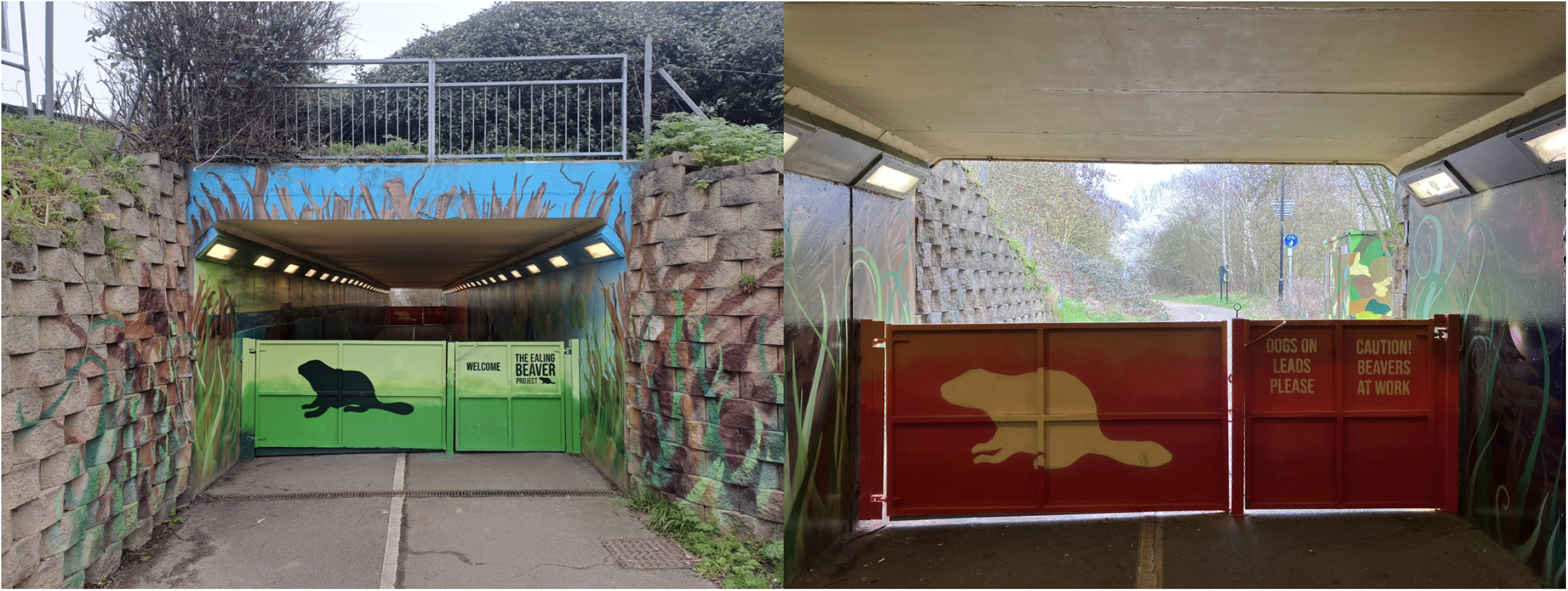
“Beaver gates” at either side of the underpass leading into and out of paradise fields. Source: Elliot Newton.
Beavers have emerged as the flagship species for rewilding in Britain, a relatively new but contentiousness approach to nature conservation that shifts the focus from the preservation of existing species composition to the restoration of ecological processes at scale (Blythe and Jepson, 2020; Gammon, 2018; Jørgensen, 2015; Lorimer et al., 2015; Pettorelli et al., 2019; Thomas, 2022). Beavers are charismatic animals with wide appeal. They are known as “ecosystem engineers” (Jones et al., 1994) that build dams, modify river catchments, and create wetlands that retain water in the landscape. They’re also considered “keystone species” (Paine, 1969) whose herbivory enhances biodiversity (Brazier et al., 2021; Law et al., 2017). Beavers were once central drivers of landscape processes in Britain, including in the part of the Thames valley that is now London, but were extinct by the sixteenth century due to hunting pressures and the incompatibility between their ecosystem engineering and modern forms of land management (Coles, 2006). This decline exemplified the general trend across their entire Eurasian range. But beavers have been making a slow and steady comeback in the twenty-first century, aided by conservationists who espouse the plethora of benefits they bring to ecosystems (Halley et al., 2012; Lorimer, 2025). In cash-strapped conservation circles, beavers have become a one-stop-shop for meeting the ecological needs of the contemporary polycrisis. Beaver dams and wetlands lower peak flows during heavy rainfall, reducing the chance of flash flooding downstream (Puttock et al., 2020), and the sediments in beaver ponds and vegetation in beaver meadows contribute to the sequestration of atmospheric carbon (Hallberg et al., 2026; Wohl, 2013). Flood prevention, biodiversity enhancement, habitat creation, and carbon sequestration have all been linked to the humble beaver (Brazier et al., 2021).
Legal and illegal releases 1 across the British countryside have driven rapid increases in their population and range (Matthews and Kendall, 2023; see Crowley et al., 2017) and, with this proliferation, it is widely anticipated that beavers will urbanise, eventually populating towns and cities, as they have elsewhere in Europe (Ciach et al., 2023). As of 2025, free-roaming beavers had been sighted in cities including Bristol, Wolverhampton, and Canterbury, and recent surveys suggest that the county of Kent, to the south-east of London, is home to hundreds of wild beavers (Austin, 2024). This growing population is expected to expand and establish in London's waterways in the not-too-distant future.
In anticipation of this re-beavered urban future, a cohort of urban rewilders are seeking to prepare Londoners to welcome the rodent's imminent return. At Paradise Fields, they have co-designed and staged a high-profile experiment in how to live well with beavers in an urban environment as part of a licensed urban beaver reintroduction project. The Ealing Beaver Project—a partnership between Citizen Zoo, Ealing Wildlife Group, Friends of Horsenden, and Ealing Council, supported by the Beaver Trust—was designed to “proactively” show the benefits of urban beavers, “rather than being reactive” to their arrival, according to Elliot. “When beavers show up naturally, which will happen in the next few years, we're [going to be] more prepared for it,” he told us. Nadya Mirochnitchenko, the Ealing Beaver Project's resident ecologist, explained that their aim is to demonstrate “that we can manage [beavers] when they arrive.” The project, which has been an affirmative and speculative endeavour from the outset, explicitly aims to prefigure the re-beavering of the city by making wild urban citizens (human and beaver) that are capable of coexistence. The project has an explicit political agenda to widen access to beaver encounters and is underpinned by a commitment to community involvement and public deliberation. As Elliot puts it: “We want these to be seen as the people's beavers. A lot of beaver reintroductions are like, you know, aristocrats […], like a billionaire who's just put beavers on their land… Probably good ecological benefits but no real social benefits.”
From the outset, the Ealing Beaver Project was a collaborative endeavour grounded in local ecological knowledge and decades of community-building in relation to the management of public green space in the Borough led by the current park ranger at Paradise Fields, Jon Staples. The organising team secured access to Paradise Fields and, after receiving a license from Natural England in January 2023, introduced a family of beavers translocated from Scotland in October 2023. Prior to release, key members of the organising team worked hard to prepare suitable habitat, control public access, and construct a perimeter fence to prevent escape. They have since mobilised the allure of encountering beavers via a programme of public outreach and education activities that involve the local community in the project's management, including making a film entitled Beavers in Paradise from which we take the title of our paper. The Ealing Beaver Project has shifted rewilding into the ambit of the local state and community groups, reconfiguring it as a public good delivered via municipal action and volunteer networks. The project now serves as an iconic case study in the wider visions of a network of actors and organisations seeking to rewild London (e.g., the London Mayor's Rewilding London fund, the London Rewilding Taskforce (and Action Group), and the National Park City; see Turnbull et al., 2025), and has emerged as a kind of “urban Knepp” 2 due to its significance as a flagship site for urban rewilding in Britain. In doing so it has helped establish urban rewilding as a viable and widespread mode of contemporary nature recovery, cultivating popular, political, and financial support. The project has generated immense attention, even featuring in Sir David Attenborough's 2026 wildlife documentary, Wild London (Figure 2).

A post from the London Mayor Sadiq Khan's Instagram page with some stills from Wild London, Sir David Attenborough's 2026 BBC wildlife documentary, which explores London's wildlife. Source: Instagram.
In this paper, we argue that the Ealing Beaver Project evidences a new type of urban ecological politics that leverages encounters with urban wildlife to forge new (re)wilded (human and nonhuman) citizens and to experiment with new forms of urban wildlife management. We take the example of the re-beavering of Paradise Fields as indicative of what we term prefigurative urban ecological politics, which we define as political programmes that summon the future to anticipate and nurture desired configurations of urban socio-ecological relations in the present.
This paper, then, has three aims. In the section that follows, we develop our conceptual framework, engaging with recent work in geography on the future. We expand existing analyses of prefiguration through an engagement with concepts from more-than-human geography and urban political ecology to develop a theorisation of prefigurative urban ecological politics. Second, we deploy and develop this conceptual framework to analyse beaver reintroduction in London. We examine the staging of the beaver reintroduction at Paradise Fields, documenting how it became a refuge for socio-ecological experimentation. We then follow the choreography of human-animal-ecological interactions at the site through which new types of human and animal subjects are forged. And we examine how the mode of urban ecological prefiguration exemplified at Paradise Fields is designed to do political work elsewhere in London and beyond, helping to institute a form of municipal wildness. Third, in the subsequent discussion, we critically evaluate the political ecology of this initiative captured in its claim to provide “the people's beavers.” The conclusion outlines priorities for future research to help the Ealing Beaver Project become a model for prefigurative urban ecological politics elsewhere.
Geographies of the future: Towards prefigurative urban ecological politics
Geographical research on “the future” has proliferated since the 2010s (Anderson, 2010; Anderson and Adey, 2012; Amoore, 2011; Kraftl, 2013). A prominent strand has focused on how, under post-9/11 neoliberalism, “the future is increasingly being cast as unpredictable and dangerous, [and a] reason to fashion new ways of managing hazard and risk” in the present (Amin, 2013, 140). Ben Anderson's (2010, 2017) influential work on “anticipation” examines how future emergencies are “known and rendered actionable” to foreclose or restrict certain ways of life (2010, 778). This analysis focuses on how crisis-ridden futures are summoned to shut down political deliberation and transformation, arguing that imminent threats warrant emergency management (Caduff, 2015). The risks posed by unruly future ecologies feature prominently here, most obviously in relation to climate change (Wilson and Swyngedouw, 2016) and zoonotic disease (Gandy, 2022a). Comparable work has traced how the present policy focus on building “resilience” against future environmental risks secures the status quo, while foreclosing trajectories of political and ecological transformation towards more just, sustainable futures (Grove, 2018; Pelling, 2010).
Other geographical work on the future critically analyses the “bright green” techno-optimism of ecomodernism—an environmental philosophy promoting the technocratic management of ecosystems as the most efficient way of conserving nature and improving human wellbeing (Asafu-Adjaye et al., 2015). This literature traces the problems with interventions that promise “magic bullet” technological solutions (Guthman, 2024) without acknowledging the unequal distributions of benefits and impacts, nor the harms caused by capitalist models of resource extraction. Geographers have examined how the promissory narratives of technologies like renewable energy (Goldstein, 2018), alternative proteins (Guthman and Biltekoff, 2021), or geoengineering (Buck, 2019) may help deter or defer systemic change in the present (McLaren, 2016). This critique extends to work on the deployment of beavers as Nature-based Solutions for conservation (Welden, 2023).
While these strands of geographical engagement are important for our analysis, they do not exhaust the political potential of the future, nor fully capture the type of futuring underway at Paradise Fields. Instead, we turn to more affirmative accounts of the future, starting with prefigurative politics, defined by its originator, the political scientist Carl Boggs (1977, 2), as: “the embodiment, within the ongoing political practice of a movement, of those forms of social relations, decision-making, culture and human experience that are the ultimate goal.” 3 Geographers Craig Jeffrey and Jane Dyson explain how prefigurative politics involves “directing effort into performing now” a vision of “a ‘better world’ to come” (2021, 643). They note prefigurative politics can comprise “any instance in which people try to model the future in the present” (Ibid, 644). Progressive forms of prefigurative politics arise when these worlds are “more inclusive, sustainable, and equitable” (Ibid, 645). In contrast to the approaches detailed above, here the future is both welcomed and summoned to disrupt and transform the status quo.
A rich and growing literature in geography now traces manifestations of prefigurative politics across a range of environmental and ecological examples like alternative food networks, ; llages, and environmental protest camps (Lajarthe and Laigle, 2024; Pickerill et al., 2024; Schwab and Roysen, 2022). Existing scholarship has focused on the human dimensions and protagonists, with limited work tracing situations in which nonhumans (like beavers and their ecologies) are central players in imagining and enacting futures. 4 We thus supplement existing work on prefiguration with key concepts from more-than-human geography to provide a model of prefigurative ecological politics attentive to human and other-than-human agencies, experiences, and worlds.
Work on the geographies of prefiguration suggests that examples often emerge from within institutionalised “spaces of relative protection” (Jeffrey and Dyson, 2021, 651); from refugia that are politically, economically, and territorially buffered from wider trends and pressures. Well-known examples include manifestations of the urban commons in ecocommunities (Pickerill, 2025), squats, and protest camps (Chatterton and Pickerill, 2010; Vasudevan, 2017). Together, these provide staging locations or demonstration sites for imagining and enacting alternative realities. For Jeffrey and Dyson prefiguration is an inherently geographical practice; both “spatial and performative” (2021, 643), involving “people enact[ing] a vision of change – through organisation, design, architecture, practices, bodies, or something as simple as a gesture or demeanour – and promot[ing] this as indicative of an imminent or more distant ‘future’” (2021, 643).
Refugia enable creative and transgressive practices of “collective experimentation” (Yates, 2015, 1), or “productive improvisation” (Jeffrey and Dyson, 2021, 641), to pilot alternative forms of social, political, economic or, in our case, socio-ecological organisation. They offer spaces to try things out, and to sometimes fail. Geographers have noted how urban wilds—especially post-agricultural, post-industrial locations like Paradise Fields—often escape the attention of mainstream conservation, yet have served as generative locations for experiments in alternative forms of human-nature interaction (Gandy, 2022b). They suggest that the cosmopolitan natures of urban societies and ecologies can enable city parks, gardens, brownfield sites, and other locations to express novel “cosmopolitical” (Hinchliffe et al., 2005) ecological formations and “minoritarian” (Barua, 2023) forms of ecological knowledge and citizenship marginalised from mainstream environmentalism (Fry, 2023a). Others, however, have cautioned that a discourse of urban experimentation (e.g., in relation to climate change adaptation) has also gained popularity amongst powerful majoritarian actors in the city seeking to secure status quo models of property and capitalist political economy (Bulkeley, 2023; Evans, 2011).
Luke Yates notes how this collective experimentation is often geared towards “the imagining, production and circulation of political meanings, the creating of new and future-oriented social norms or ‘conduct’” (2015, 1). In Foucauldian terms, this involves shaping new types of subject through acts of governmentality targeting the “conduct of conduct” (Foucault, 2007). In our case, these involve forms of “environmentality” (Fletcher, 2017; Luke, 1999) in which knowledge about nature and appropriate forms of environmental interaction are mobilised to govern behaviour to forge new types of urban citizens. Scholars have critically examined the practices of environmental subject formation associated with both state control (Agrawal, 2005; Li, 2007) and market environmentalism (Fletcher, 2010). While this critique is important for our analysis, the forms of environmentality we examine below relate more to the citizen-making activities of civil society organisations, and centre on practices associated with volunteering, recreation, and citizen science that have been examined by others (Gabrys, 2022; Lorimer, 2010; Rutherford, 2011).
We extend this established literature on environmental citizenship to explore the more-than-human and more-than-representational dimensions of environmentality, paying close attention to the embodied and affective interactions through which subjects are made and remade (Latham and McCormack, 2004). We are interested in how urban refugia are shaped and their “affective atmospheres” staged, transgressed, and resisted. Affective atmospheres are the “mood, feeling, ambience, [or] tone” of place that is felt collectively between bodies of different kinds (Anderson, 2009, 78; see Anderson, 2014; McCormack, 2008). Our analysis requires symmetrical attention to the making of nonhuman subjects—here, urban beavers. Pushing Foucauldian analysis beyond the human, we are interested in how urban rewilders “choreograph” (McCormack, 2014) human, animal, and plant bodies, alongside ecological processes to normalise novel modes of multispecies coexistence in the city.
Coexistence with urban beavers does not merely entail humans tolerating or even accepting the presence of urban beavers and their apparently negative impacts like flooding, tree damage, and the production of messy ecological aesthetics (Frank, 2016; Glikman et al., 2021). Conservation researchers have shown how “[f]ocusing on conflict can be a constraint in achieving conservation-related goals, as attention is centered on reducing negative interactions rather than on increasing positive behaviors toward wildlife” (Frank, 2016, 739). Instead, then, we understand coexistence as a long-term “coadaptive process through which sustainable human–wildlife interactions […] are fostered” continually over time (Auster et al., 2026, 1). This requires constant renewal of coexistence between people and beavers, from the early planning and implementation phases of a given reintroduction project through a transition into the long-term maintenance of coexistence (Ibid). Here, the goal is for beavers to move “from being considered new and reintroduced to a species that is familiar and considered wild” (Ibid., 3)—a shift to being a self-sustaining, rather than a managed, population (Marino et al., 2024). This involves creating new routines and habits, raising thorny questions about the “habituation” of wild animals (Doney et al., 2025; see also Arregui, 2023; Zinn et al., 2008).
If prefigurative experiments are to impact wider society, they must come with what Yates (2015, 1) calls “movement infrastructure,” or the potential for “the diffusion and contamination of ideas, messages and goals to wider networks and constituencies.” To understand such movement infrastructure, we must pay attention to the practices through which the beavers at Paradise Fields are used to enrol other actors into collaborative networks in support of urban rewilding elsewhere. We draw on analysis of how conservationists deploy charismatic flagship species to enchant and engage urban publics, but also to bridge epistemic and political differences, to galvanise a wider prefiguration of urban conservation governance (Barua, 2017; Lorimer, 2007). We explore how mediated encounters with beavers extend the geographic and political reach of urban rewilding beyond the refuge of Paradise Fields to begin to enact the futures prefigured at this site elsewhere. This is a kind of “distributed prefiguration,” which, unlike many prefigurative projects analysed in the literature, is not confined to a bounded organisational space (Chertkovskaya et al., 2024).
Prefigurative politics is commonly associated with the ideology and practices of autonomist, non-hierarchical social movements working independently of the state, but here we align with research that has instead focused on social action that aims to reimagine, reorient, and remake the state (Cooper, 2017; Ribera-Almandoz et al., 2020; Tattersall and Iveson, 2024; Thorpe, 2023). These accounts reflect broader relational understandings of the state, which characterises it not as an ideologically unified and operationally coherent formation that is inevitably captured by capital, but instead as heterogeneous, processual, and constantly being remade by sociopolitical contestation (Angel, 2017; Harrison, 2023; Jessop, 2007). The indeterminacy of the state, and its inherent diversity of political projects and rationalities, creates openings for civil society to inflect “state practices with their interests, aspirations and values” (Baker and McGuirk, 2021, 1352).
Our intention is to avoid what James Angel and Alex Loftus term the “overly capitalocentric account[s]” that predominate in urban political ecology, which “reduce the state to a monad within the capitalist production of nature” (Angel and Loftus, 2019, 211). As Baker and McGuirk warn, there is a danger that these accounts render civil society as “co-opted and subjugated” and don’t account for how state-civil society collaborations expand the purview and operations of local government (2021, 1344). In contrast, Davina Cooper's work on prefiguring the state brings attention to how organisations have acted “as if” the state was otherwise, and in doing so “not only redefined the state but reassembled, practically and imaginatively, those elements deemed part of it” (Cooper, 2017, 350; Cooper, 2020). Drawing from this literature, we explore how Paradise Fields is embedded within a wider political project that actively positions wildness as a public good cultivated and protected by an alliance of the local state, NGOs, community groups, and volunteers (Turnbull et al., 2025).
In summary, our model of prefigurative urban ecological politics: (a) describes a transformative orientation towards the future; (b) is emergent from experiments within sheltered refugia; (c) involves collective improvisation to shape environmental subjects; and (d) reworks the purview and actions of the local state. We deploy and develop this framework in the following analysis.
Methodology
We employed a mixed methods approach involving a combination of multispecies participant observation, interviews, oral histories, archival research, and discourse analysis. Participant observation materials were generated by Turnbull and Fry between February 2024 and June 2025 during numerous site visits. Initially, we visited Paradise Fields as part of a group tour led by Elliot to familiarise ourselves with the site, its history, and beaver ecologies. We were accompanied by interested members of the public who had signed up for a “Beaver Safari” offered by Citizen Zoo for a small fee. We then conducted go-along interviews with the former and current site managers who worked as park rangers for Ealing Council, and Dr Sean McCormack—veterinarian, naturalist, broadcaster, and founder of the Ealing Wildlife Group. We were shown how the site is monitored using camera traps, acoustic monitors, and other digital ecological methods (see Turnbull et al., 2023). We also conducted a perimeter fence check to ensure there were no holes through which beavers could escape; a task carried out by a team of volunteers every morning.
Following this, we visited the site periodically at different times of day throughout the year. Our intention was to encounter urban beavers and to observe how people interacted with them (or not). We timed our visits to coincide with beavers’ rhythms, usually visiting at dusk, from early evening into the night, when beavers are most active. We also aimed to get a sense of the site's changing atmospheres as the seasons shifted, and to become immersed in the broader socio-ecological context of Paradise Fields longitudinally. Our visits often involved casual interactions with members of the public; especially those intrigued by our use of binoculars and our intense pointing and staring into bushes or out over the lagoon.
While we were primarily engaged with our human interlocutors, we infused our fieldwork with methodological approaches attuned to nonhuman agency in alignment with our commitments to the project of more-than-human geography (Hodgetts and Lorimer, 2014; Lorimer and Hodgetts, 2024; Whatmore, 2022, 2006). We generated research materials—field notes, photographs, and videos—attentive to the embodied and affective experiences of both humans and beavers as they encounter each other anew in this site and become the subjects of the prefiguration of urban wilds. Prior to our visits, we familiarised ourselves with expert knowledge on beaver ecology in the literature (e.g., Campbell-Palmer et al., 2016) and worked with urban beaver experts in European cities to ensure informed observations and to build rapport with our interlocutors. On site, we learned to be affected (Despret, 2004; Lorimer, 2008) by beavers, their traces in the landscape, and the broader ecological changes their activities inaugurated. This occurred in correspondence with our interlocutors who narrated the site and its fluctuations over time.
Supplementing participant observation, we conducted a series of semi-structured interviews with: Citizen Zoo's founders, urban rewilding officers, and volunteer team; Ealing Council's Park rangers; beaver ecologists; and other (urban) rewilding specialists, including members of the London Rewilding Taskforce. 5 We also researched the site's history using online archives from Ealing Council and local history groups, as well as the personal archives of a local resident and former site manager. Finally, we conducted discourse analysis of the project's online media coverage in local, national, and international outlets. We remain in conversation with Citizen Zoo as we follow the project's development.
Making paradise
A brief history
Paradise Fields is part of Horsenden Hill, a wide, open space in the London Borough of Ealing (Figure 3(a)) that contains a nature reserve, community farm, public woodland, wetlands, golf courses, footpaths, and cycleways. Martin Smith is a retired Senior Park Ranger at Ealing Council and lifelong resident of Ealing previously responsible for the maintenance of Horsenden Hill. Upon retirement, he became the Chair of The Friends of Horsenden, a local volunteer group that manages and maintains Paradise Fields as a nature reserve in collaboration with Ealing Council. A well-versed local historian, he offered us a brief history of Paradise Fields, explaining how the site was “just another set of farmers’ fields” until the Grand Union Canal cut through it in 1801. From 1900, Paradise Fields was owned by Rockware Glass, which dumped its slag where the beaver enclosure is today. Eventually, Horsenden Hill, encompassing 254 acres, was bought by Ealing, Wembley, and Middlesex County Council in 1933 and converted to public parkland. Ealing Council received a 999-year lease and has managed the site ever since. 6 Today, 100-hectares of Horsenden Hill constitute Ealing's largest nature conservation area.
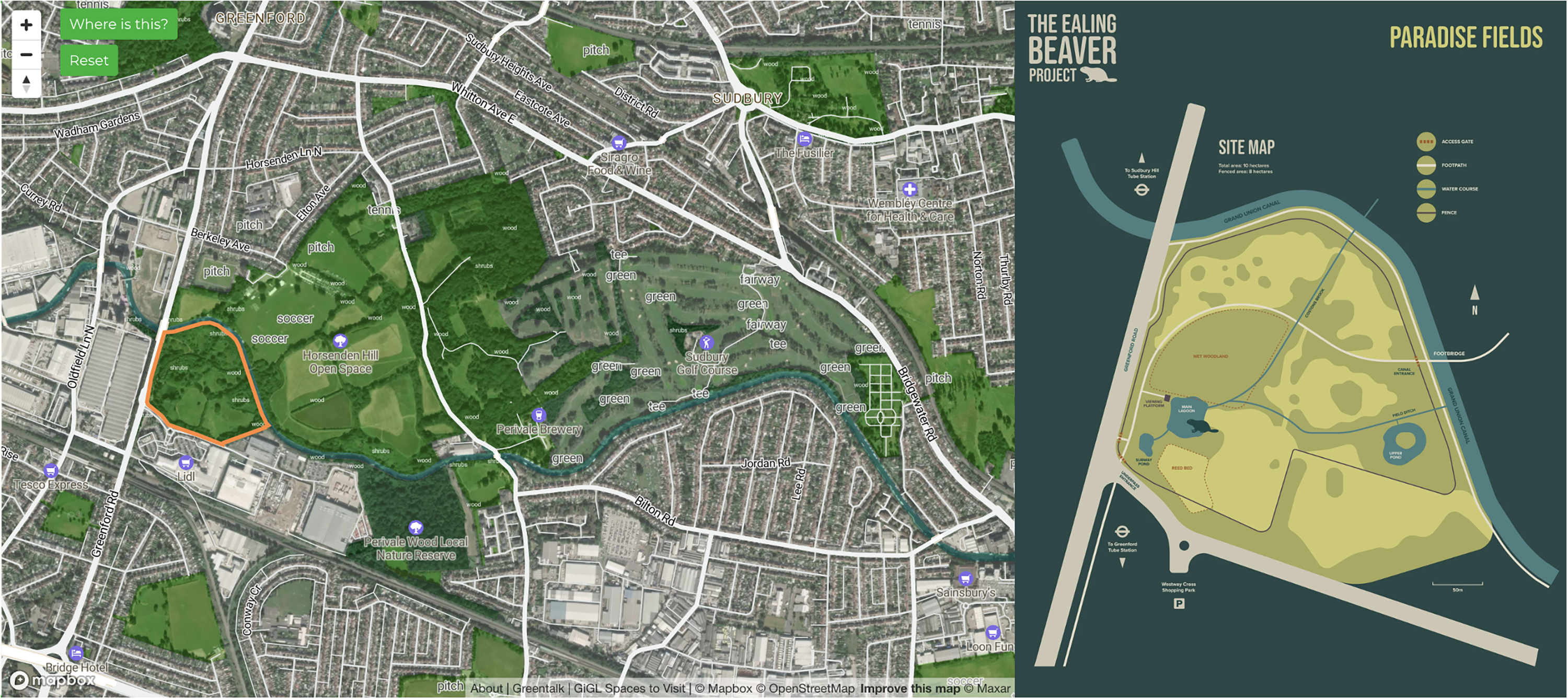
a) Left: map of Horsenden Hill with paradise fields circled in the bottom left. Source: Mapbox; OpenStreetMap; goparks. London. b) Right: Map of The Ealing Beaver Project at Paradise Fields.
In the 1980s, Westway Cross Retail Park was developed to the south of Paradise Fields, and the multinational technology company, IBM, moved onto the site. At the turn of the millennium, IBM converted the site into a wetland when they discovered the Bollo Brook (a buried stream) running beneath it which prevented development. This landscaping work produced ponds, including a permanent large lagoon, designed for flood mitigation. Hedges were planted to enclose the site from the retail park and its customers. The work was completed in 2000, and the site was managed until 2012 when access was restricted and the site was left unmanaged and became overgrown. There is uncertainty about the present-day ownership. Martin is unsure whether IBM sold the site or whether it is administered by a land manager on their behalf, while Jon noted that part of the site is managed by a land agent.
Jon explained that the conversion of this post-agricultural, post-industrial land into a publicly accessible conservation area involved blending aspects of the landscape's agricultural history—such as its field ditch, hedges, and hayfield systems—with new, contemporary ideas for managing land from multiple disciplines including conservation grazing, regenerative agriculture, permaculture, conservation, woodland management, and rewilding. He cited the appearance of the brown hairstreak butterfly as an example of the kinds of resurgence this blended approach can produce, a species which established in Ealing following management decisions regarding historic hedging. In recent years, an increase in tree cover and scrub occurred due to succession, which caused a decline in open water. Jon told us that “succession is difficult to manage […] with human intervention alone,” so the choice to introduce beavers was driven in part to control succession and to reduce tree cover. Paradise Fields thus emerged from this history of agricultural and amenity management, enclosure and, later, a hands-off approach to management as an unlikely refuge for wildlife in west London's dense urban fabric.
Citizen Zoo was founded in 2016 by Lucas Ruzo and Elliot Newton, with the aim of getting citizens involved in rewilding. They started the London Beaver Working Group in November 2020 with support from the Beaver Trust. Their original aim was to support underfunded conservation organisations by training members of the public in key conservation practices, moving this work out of conventional conservation spaces like zoos and into the public realm. Initially, their rewilding recruits were affectionately known as “Citizen Keepers”—a play on “zookeepers”—and their funding came from the Cambridge Social Ventures programme at the Centre for Social Innovation at the University of Cambridge's Judge Business School, and later from funders including the Lund Trust and the Mayor of London. Over time, their focus has gravitated towards London where they can capitalise on widespread support for conservation (including rewilding) and can mobilise a large and diverse public for involvement in its initiatives. As such, they are now frequently referred to as an urban rewilding NGO. As of 2025, they employ over 10 staff, including three “Urban Rewilding Officers” and an “urban beaver officer,” and have a large team of volunteers called “Wild Guardians.” They are funded by a range of organisations, as well as through public donations and memberships.
After deciding on beavers as their flagship species, Citizen Zoo needed a reintroduction site. Several sites were identified with help from the Beaver Trust, many with “better” beaver habitat than the site in Ealing, according to Elliot. While Paradise Fields was a suitable scale for an expanding beaver family, had the correct habitat, year-round water, and lots of willow trees for feeding, it was, ultimately, the social and political landscape that made it the perfect site. Since the early 2000s, the Ealing park rangers have worked tirelessly to involve the local community in managing the Borough's parks. Jon took over Horsenden in 2016 and quickly recognised the need for further community engagement. Building on the work of his predecessors in the post, Jon sought to revitalise the Friends of Horsenden community group which had dwindled in the early 2000s. This involved cultivating several self-sustaining community projects including a community garden and shop, a brewery, bakery, and a restored working farm. Jon explained that this “experience, precedent, [and] community acceptance” was crucial for gaining “implicit ‘permission’ and confidence […] to consider enclosing another area of a public park” for the Ealing Beaver Project. On top of this, the park rangers also had vast knowledge of the local environment and have long been involved in projects to improve the Borough's water courses and in flood mitigation. This long-term experience fed into the decision to introduce beavers to Paradise Fields (Figure 3(b)).
Supplementing Jon's community embeddedness and local environmental knowledge, Sean—the Project Lead with Elliot, and license holder for the beaver reintroduction—is also deeply rooted in the local politics and community of Ealing, where he has worked with Ealing Council for years. Sean founded the Ealing Wildlife Group, which collaborates with the local community on a range of urban nature projects. His embeddedness in place, reputation with locals, and experience liaising with, and lobbying, the council on urban nature concerns meant the social fabric was already woven at Paradise Fields. With an already well-established network of residents, friends groups, and park staff with relevant experience, the Ealing Beaver Project could hit the ground running.
As such, after a successful public consultation in February 2022, the Project received license approval from Natural England in January 2023. It then secured funding from Ealing Council and the London Mayor's Rewild London Fund in February 2023, 7 after which construction of the site began in August 2023, beginning with a 1.2 km perimeter fence around the eight-hectare enclosure (to comply with beaver reintroduction license requirements). In September 2023, the Beaver Trust translocated a family of five beavers from Scotland, which were eventually released on October 11th. Having set the scene for the reintroduction, the next section explores how the site was designed to stage human-beaver encounters to enable prefigurative urban ecological politics.
Staging encounters
As we walk from the McDonald's car park through the reinforced “beaver gates,” under the brightly decorated subway and into Paradise Fields, we’re immediately in beaver territory. Unlike other beaver release sites in the UK, public access is unrestricted, and beavers and humans are left to intermingle freely within the enclosure. Here we are greeted by Martin and the current park ranger, Jon. Martin and Jon played a fundamental role in the conversion of Paradise Fields into a beaver enclosure. Through vernacular forms of landscape design, undertaken with a sensibility to the mobilities and predilections of both beavers and people, they were tasked with staging convivial encounters and preventing negative ones. Jon visualised and designed the initial enclosure layout based on his experience observing how animals and humans use space together at an urban livestock enclosure in London. The initial design was then re-negotiated following input from Róisín Campbell-Palmer from the Beaver Trust, discussions regarding public access with Natural England, and technical input from an agricultural fencing contractor. The biggest challenge, according to Sean, was managing “the public with the beavers’ welfare in mind, but also with the success of the project in mind.”
Here, we draw on the recent work of Zuhri James on ecological restoration in east London, for whom “staging” describes the processes through which ecologies are “aesthetically arranged and orchestrated” (2025, 16) to achieve particular goals. Geographers, especially those influenced by urban political ecology like James, have demonstrated that urban natures are often staged with the goal of capital accumulation in mind, enacting a “rareified politico-economic [agenda]” (Ibid, 16) disconnected from the concerns of ordinary citizens. Yet as we argue below the staging of ecologies in London is not always “unilaterally dictated by the exigencies of capitalist urbanisation” (Ibid, 16). Indeed, staging does not necessarily “[uncontestedly exacerbate] existing axes of domination” but “can also be interrupted by other countervailing formations” (Ibid, 16). The kinds of staged encounters we’re interested in at Paradise Fields are geared towards the prefiguration of human-beaver coexistence rather than the capitalist valorisation of urban space. Thus, initial work involved making the site accessible to the public, removing dense vegetation, and clearing walkways previously blocked by overgrowth to provide a suitable stage upon which convivial encounters could emerge.
Before becoming a park ranger, Jon studied fine art at college and attributes his park management style to a combination of his artistic background and the technical experience he gained from previous careers in farm work and outdoor expedition leading. At the beginning of the project, he visualised how people would move through the site to decide where to place fences and footpaths. As we walked, he explained his arrangement of the site with the gestures and motions of a theatrical director. He drew attention to how “dead hedges” and other subtle landscape nudges were constructed to block off routes to sensitive beaver habitat and to secure beaver sanctuaries and shelter places (Figure 4). “I utilise my creative background for problem solving,” Jon explained, “but the techniques I use are rooted in practical cost-effective solutions.” “People will follow the path of least resistance,” he continued, “so if you make a route appear tangled and blocked with vegetation, people will avoid it.” Such vernacular forms of landscape design were essential for staging the kinds of human-beaver encounters desired by the Ealing Beaver Project—those that could lead to public excitement, engagement, and coexistence with urban wildlife. For the most part, such interventions were designed to work on people as much as on beavers; to mould a particular type of “wilded urban subject” willing and able to share public green space with other species. Jon was keen to remind us, however, that despite its creative impulse, such work was physically demanding.
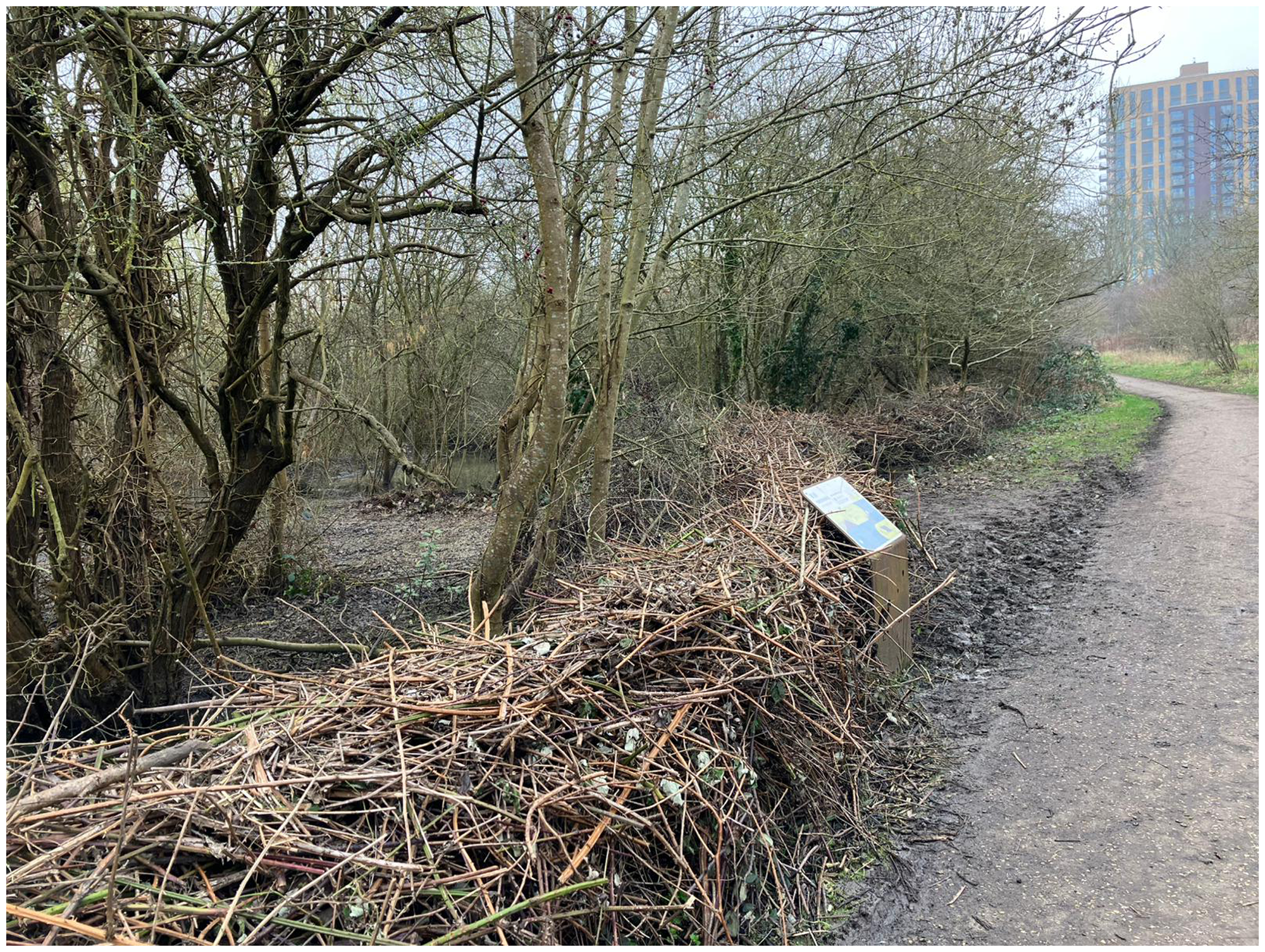
A “dead hedge” to choreograph public use of the space. Source: Elliot Newton.
Now the stage was set, the site was opened to the public and visitors and volunteers began interacting with the family of newly urban beavers. The next section explores the new wild urban citizens (both human and beaver) that emerged from these interactions.
Shaping wild citizens: Choreography and (over)habituation
After the beavers were first introduced to Paradise Fields, the site remained closed to the public for a month so the animals could explore the enclosure and become used to their surroundings without human disturbance. This allowed them to acquire knowledge of the area's resources and the site's sound- and smell-scapes, which would become important factors when deciding where to build their lodge. In this section, we explore how prefiguring urban wilds involved choreographing human-beaver encounters to ensure both humans and beavers conducted themselves in accordance with a particular version of urban (re)wilding.
Habituating beavers, habituating humans
The organisers were nervous as they opened the gates to Paradise Fields for the first time. How would the beavers react to people, and vice versa? Their trepidation was soon relieved when the beavers appeared to cope well. Through Jon's careful staging of the site, he was able to choreograph footfall to areas where people can reliably see beavers. In this way, project staff attempted to make human behaviour predictable for beavers and the animals quickly became habituated to anthropogenic rhythms, knowing where they could expect encounters and at what time of day. According to the Ealing Beaver Project's ecologist, Nadya, “the beavers will be fine […], it's the people we’re more worried about.” Indeed, choreographing human uses of the site has been more of a priority; to “shape human behaviour around the beavers, [while] the beavers are free to do whatever they want” (Nadya). Because the site is completely publicly accessible, management has involved “gradually deter[ring] access to [sensitive beaver habitats] in low tech ways” (Sean).
As noted above, existing analyses of this type of urban green space governance are critical of its “top-down” approach. These critics argue that “ecological approaches to urban design [insidiously] work to foster certain bodily rhythms and motions” (James, 2025, 11) and enact forms of “environmental-behavioural control” (Krivý, 2016, 8).” Yet the landscape interventions conducted by the Ealing Beaver Project differ in subtle ways from this model. What is being choreographed is a careful dance between human and other-than-human uses of public space via a series of invitations, rather than commands. For example, to prevent disturbance at a beaver feeding spot—and without restricting public access—a number of “cues to care” (Nassauer, 1995, 161) have been incorporated into the landscape. For instance, a rope barrier suggests a viewing area that should not be crossed. Sean explained how this simple staging technology allows beavers to sense that “there's people there, but they don’t seem to be coming any further than that point.” Equally, he suggested that “it says to people, ‘this is how to be responsible […] and how to give the beavers some distance’.”
With wild beavers in situ, the landscape is in flux to a greater degree than park goers are used to in Britain. Beavers are highly active on a near-daily basis, quickly coppicing and felling trees and moving vast amounts of materials around the site. When first introduced, the beavers were quick to begin feeding and damming, felling several trees over the course of several months. Beavered landscapes are notably unkempt and messy compared to the manicured parks the British public expects, and the aesthetics of these wilded landscapes is contentious in discussions of how public parks and private gardens are maintained in Britain (Turnbull et al., 2025). Managing public perceptions of landscape aesthetics to anticipate this mess has thus been important for the Ealing Beaver Project. Making visitors accustomed to such landscape changes involves habituating them to the wider milieu of beavers, rather than just to corporeal encounters. As such, the Ealing Beaver Project invests in public education and signage explaining and contextualising beavers’ impacts on the park's ecosystem to forge their desired environmental subjects (see Rutherford, 2011). Signage provides information about beavers’ habitat requirements and their ecological impacts, again constituting “cues to care”—prompts that inform park users that the unkempt and messy aesthetics are deliberate and intentional rather than a sign of neglect (Turnbull et al., 2025). Martin thought this was helping park users understand that “felling trees is sometimes good for ecology.” The Project thus performs an environmentality geared towards the production of wilded urban citizens capable of coexistence with wild beavers; citizens that are open to compromise and negotiation to enable urban (re)wilding (see Wilson, 2024).
Over-habituation and the authenticity of urban wilds
On one excursion, we were accompanied by a friend to whom we’d promised a beaver encounter. Approaching the site, we downgraded the promise to a possibility: “you do know these are wild animals, right? We might not see them, or just catch a tiny glimpse.” We chaperoned our friend to the rope barrier mentioned above and peered across the beaver-created lagoon, a spot chosen because beavers can reliably be seen swimming or sitting on the bank chewing branches—though, you often must wait patiently. To our surprise, however, two beavers were immediately visible three metres away, feeding on vegetation, unbothered by our presence. After quietly watching for a while, shocked at our luck, we walked round to a viewing platform on the other side of the lagoon where we met a young couple doing a sunset photoshoot. We immediately heard gnawing in the reeds next to them. Looking down, a beaver was less than a metre away, chewing on willow, unfazed. It was about 50 cm from a platform that receives regular footfall—the closest either of us had been to a “wild” beaver.
While thrilling, such casual encounters are not desired by the Ealing Beaver Project for whom the beavers’ wildness remains an important factor in their prefiguration of urban wilds. They worry that the wild beavers will lose their fear of people. A classic sign that a beaver has been spooked involves it slapping its tail loudly on the water's surface and then diving under. Nadya mentioned she hadn’t heard a “tail slap” in a while, which suggested the beavers had gotten used to encountering people. Camera trap footage showed beavers chewing away casually as fireworks exploded in the background, set off by locals on bonfire night. For the Ealing Beaver Project, such observations are met with ambivalence or lament, indicative of the over-habituation of beavers to people. They are concerned that habituation compromises their wildness, which they fear will shift the wild urban atmosphere they aim to prefigure. Their anxiety corresponds with widespread negative perceptions of habituation amongst conservationists (Doney et al., 2025; Wieczorek Hudenko, 2012).
Feeding was once a key concern at Paradise Fields. Occasionally, people left apples (or rice and bread) near where beavers frequently enter and exit the lagoon. Each time it was discovered, the organisers quickly removed it to prevent the beavers from eating it: “We definitely don’t want to get to the point of habituation where they’re like street pigeons walking up to people for food. […] We have to demonstrate that these are still wild animals,” Sean told us. “Although they’re behind a fence and we’re restricting them in some ways,” he continued, “we still want them to maintain an element of mystery—an element of being wild.”
The authenticity of the urban wild prefigured here is indexed to romantic visions of wilderness, where natural spaces are separate from humans and which feral animals (like pigeons) compromise. This has been much critiqued by academics (see Cronon, 1996), but remains a popular sensibility (Castree, 2005). Such a vision requires beavers in the heart of the megacity to behave as if they rarely encounter people. The reality, however, is that beavers are constantly meeting people; sensing the sounds and smells of the busy urban environment (see Barua and Sinha, 2017; Blumstein, 2014).
Nevertheless, the Ealing Beaver Project continues its attempt at staging a wild urban atmosphere. Approaching the lagoon one evening to see if we could see the beavers, we noticed a group of people gathered near the water, peering out intently. They were on an official “Ealing Beaver Project Safari,” where the public pays for a guided tour of the enclosure. We were chatting casually as we approached. Upon hearing our voices, a member of the group shushed us intensely—an action that suggested we were ruining their chances of encountering a beaver; that we were rupturing their experience of this wild urban atmosphere. The group was dressed in outdoor gear and several people had cameras with long lenses for photographing wildlife. The beavers were comfortably moving back and forth across the lagoon, and on previous visits were rarely perturbed by our conversations. Their insistence on quietness seemed to be a performance of an imaginary situation in which encountering beavers was impossible without silence; suggestive that their encounters were precarious, rare, difficult to achieve—as if the beavers could be spooked at any moment, fleeing back to their lodge. Shushing us preserved the idea of wildness rather than acknowledging their habituated enmeshment into this new urban wild where encounters are part of their everyday existence.
The Ealing Beaver Project remains invested in this performance of beaver wildness for cultural, political, and economic reasons. Part of the project's income stream is derived from the safaris. The performance of wildness, moreover, is crucial at this stage in the project's development. The more spectacular the encounters on offer, the more Citizen Zoo is able to leverage the financial resources and public support to ensure the site becomes a flagship for urban rewilding elsewhere in London and beyond. Yet the ideal urban wild is always incomplete, never fully performed. While people's use of the site is choreographed in certain ways, the form of environmentality in operation is more of an invitational gesture than a top-down shaping of urban subjects by a powerful actor. That the beavers themselves do not always “play ball” is evidence that they don’t always accede to the staging of ecologies at Paradise Fields. Among project staff, there is a pragmatic humility about what is achievable in the city. In the next section, we explore the political economy underpinning this prefiguration of urban wilds.
Prefiguring a municipal wildness
Beavers beyond paradise
In a significant public relations coup, it was the Mayor of London, Sadiq Khan, who lifted the door on the box to release the beavers into Paradise Fields. As the beavers made their way towards the lagoon they were soundtracked by the incessant clicks of journalists’ cameras, as the throng of photographers sought to capture this landmark event for biodiversity in the capital. Speaking from the site, Khan told the media that “I am proud that we are turning London into a wildlife haven… We as a city have been de-wilding our city. And we’re going to rewild our city. More greenery, more beavers.” Khan has become a public champion of rewilding, demanding that the national government do more to further this model of conservation. The Greater London Authority—the devolved regional governance body of Greater London that he leads—has invested over £2.4 million in rewilding projects in the city through its Rewild London Fund (Turnbull et al., 2025).
As we explained earlier, much of the literature on prefigurative politics focuses on the ideologies of autonomist projects, where withdrawal from the state is central. In contrast, the Ealing Beaver Project can be considered an example of what Tattersall and Iveson (2024) have termed “pragmatic” or “strategic” prefiguration, whereby prefiguration is used by social movements in combination with an array of other tactics and initiatives to “leverage broader forms of change from the state” (Tattersall and Iveson, 2024, 432; Ribera-Almandoz et al., 2020). The endorsement and resourcing of urban rewilding by the Greater London Authority (GLA) was not spontaneous. Instead, the Ealing Beaver Project is part of a broader but discernibly coherent political project that works to centre rewilding within municipal governance and funding within the city (Turnbull et al., 2025). These political dimensions, however, are fundamentally reliant on the practical local decisions described above, without which, a project like this cannot succeed.
Citizen Zoo is one node in a “movement infrastructure” of conservation organisations, wealthy philanthropists, community groups, and others aiming to promote rewilding as an innovative way of addressing the biodiversity crisis by enhancing the city's ecology. They are operating at a particular conjuncture, where, globally, municipal governments are aspiring to a sustainable city ideal (Angelo and Wachsmuth, 2020). These actors are positioning rewilding (one of many possible urban environmentalist approaches) as the mode of sustainable urbanism that should receive institutional recognition. As a philanthropist supporter put it to us, “it's about raising the bar for what a green city can be.” This has involved extensive strategic networking and the building of alliances with political figures and officials at the city and council level, forging ties with funders and philanthropists, and strategically attracting media attention. This strategic networking is premised on a prefigurative performance of urban rewilding as a viable, exciting, and necessary urban policy.
The Ealing Beaver Project does significant political work for this wider agenda. As a refuge, it functions as a site within the city but buffered from it, one that allows for a real, in-situ experience of what a wild city might be. In this sense it partly operates as a spectacle; as a staging of a particular idea of human-nature relations, and so the occlusion of others, that shapes action and understanding for political ends (Davis, 1997; Igoe, 2010; Searle, 2021). The enclosure leverages the charisma of a species that has become emblematic of rewilding globally alongside a choreographed wild urban atmosphere that coheres with the rewilding advocates’ visions for the city's future. The experience of being in the enclosure has an affective, experiential power, which has significant political valence. This was most keenly observed at the release, but the Ealing Beaver Project has an enduring salience in rewilding discourse. Khan and other high-profile proponents of urban rewilding, such as the philanthropist and financier Ben Goldsmith, regularly highlight its success, as do Citizen Zoo and other conservation organisations. According to Elliot, “rewilding has an inbuilt narrative of hope and excitement,” and the spectacle of the urban beaver can “open doors” when it comes to financial and public support. Paradise Fields operates as an exemplar of a successfully bold and radical conservation intervention. Here the grounded, everyday prefiguration of urban coexistence dovetails with a more demonstrative, strategic networking and alliance-making; a political strategy that encompasses both the incubation of imagined futures and the petitioning for their wider adoption.
While prefigurative politics is both championed and criticised for its focus on small-scale political action (De Smet, 2014; Swain, 2019; Van de Sande, 2015), the Ealing Beaver Project has had national ambitions built into its prefigurative approach from the outset. It advocates for a future of “beavers without borders,” leveraging their success at Paradise Fields to push for wild releases in other London boroughs, such as the Yeading Brook in the Crane Valley, west London. As well as this, they aim to demonstrate to other London boroughs (and other British cities) that multispecies coexistence is desirable, possible, and achievable. They also prefigure London as hospitable to new arrivals beyond beavers. For instance, Citizen Zoo has launched the London White Stork Working Group to assess the potential of reintroducing white storks—a species that has recently returned to Britain—into London. The model developed at the Ealing Beaver Project is now being actively replicated in Croydon, south London, where Citizen Zoo have, as of 2026, started working with Croydon Council and the public to determine the feasibility of releasing beavers into the Borough.
Instituting municipal wildness
The political and financial support that the GLA has provided to urban rewilding, and its adoption into the broader environmental agenda of the municipal government, is a significant success for the rewilding movement. In rural areas rewilding is unpopular amongst many communities whose livelihoods are tied to farming, forestry, and other land-uses (Fry, 2023b; Holmes et al., 2024). The term “rewilding” is rarely used by governments as a framing for their conservation projects, and is usually used more enthusiastically by NGOs, community organisations, and private landowners. To have a movement that is considered a more radical, challenging, and contentious form of conservation endorsed and promoted by a state body is a significant reorientation for how rewilding is imagined and delivered, one that underscores the gravity of the biodiversity crisis, and the city as a site to respond to it.
This change can be partly explained by the alliance-building described above, but this was preceded by the more grounded prefigurative politics undertaken at the site. This political reorientation is not just lobbied for, but also prefiguratively enacted in practice. From the outset the Ealing Beaver Project has been co-designed with and alongside staff members from Ealing Council and benefits from long-term, convivial relations cultivated between park rangers and the local community. For example, in his day-to-day work Jon has more contact with volunteer-colleagues than with council-colleagues, many of which he interacts with via a WhatsApp group in which community members coordinate and plan daily management of the site. As noted above, other reintroduction sites in London were considered, but as Elliot puts it, “the great political traction and relationship […] fostered with the Council” made Paradise Fields the obvious choice: “The political will was already there.” This is a discernible pattern in other urban rewilding projects we have encountered: urban rewilders build relationships with amenable and supportive council environmental officers, or green space management team members, and through these collaborations launch and implement projects together. These same council staff members themselves are often deeply embedded in their communities, with long histories of collaboration with associations, volunteers, and other institutions. Urban rewilding was born through the political prefiguring of a novel form of local statecraft: the cultivation and delivery of what we term a municipal urban wild.
The actualisation of the ecological futures at Paradise Fields are an assertion of how urban rewilding is reimagined as a universal public good delivered through municipal-NGO-community collaboration. As Davina Cooper, in her work on prefiguration of the state, asserts: “it is repeatedly at the level of municipal statehood where radical exercises of governmental agency and initiative emerge,” and it is often from within municipal authorities that we find “state-enacting efforts” that “reimagine what statehood could mean” (Cooper, 2017, 341–2). In her terms, Citizen Zoo and allies within Ealing Council acted “as if” the institutions overseeing biodiversity protection in London were otherwise, and in doing so took “the meanings, conditions and legitimacy [they] seek as if they already existed” (Cooper, 2020, 908).
Cooper adopts a relational conception of the state, which positions it as an ongoing site of contestation, where “[d]iverse, sometimes contradictory, political projects are differentially assembled” by social action (Baker and McGuirk, 2021, 1341). This conception of the state chimes with how our interlocutors encounter their local authorities, as variegated and mutable. Ealing Council, like other councils in London, is simultaneously pursuing an entrepreneurial approach focused on a real estate speculative model, but has openings and fissures where social action is institutionalised. Friends of Horsenden and the Ealing Wildlife Group have for years had embedded, ongoing dialogue and collaboration with staff responsible for green spaces and environmental management, whilst critiquing more ecologically harmful projects. As Sean put it: “When you collaborate and get into bed with them on a massive project like this that has London-wide and even national status, [it's] sometimes uncomfortable bedfellows, because you're like, ‘Yay we’re collaborating… But, like… don’t use beavers as greenwash politically when you're trampling over a lot of our existing wildlife and green space for profit.” The council exists as complex and contested, both overseer of ecological damage through large-scale development, but also as a site where spaces for nature recovery can be initiated. The Ealing Beaver Project was able to institute a project of municipal wildness by steering and re-working the ambit of local government, achieved via an ongoing embedded form of social engagement.
The people's beavers?
Citizen Zoo and their partners are anticipating the arrival of beavers in an affirmative rather than an oppressive mode (cf. Anderson, 2010), prefiguring future socioecologies and municipal wilds grounded in an ethic of community social action. In this section, we characterise municipal wildness as an aspirant public good and exemplar of wider shifts in municipal statecraft. We then critically evaluate the transformative potential of the project, firstly by describing its exclusions of other naturecultures, and secondly by assessing the relationship between the broader urban rewilding project and the speculative real estate model of urban development so influential in the capital.
The future imagined at the Ealing Beaver Project does not encompass a wholesale structural critique of the capitalist city (cf. Swyngedouw, 2025), but it is premised on a universalist notion of wild nature as a public good, which should be accessible to all. Across our research there was consistent affirmation by participants that this future wild is, as Elliot put it, “not just for the rich,” and that it must be premised on “access to [wild] nature into and across the social spectrum.” Wildness as public good, delivered via municipal collaboration and universally accessible on public land, stands in stark contrast to rural rewilding, which “primarily happens on large estates, owned by wealthy private individuals who receive substantial public money [and] tax incentives” (Soares and Lorimer, 2025, 20). If these are the “people's beavers” we might consider them as emergent through a residual social democratic impulse still enduring in Labour Party-run councils in London—a socialised wildness that is coordinated and delivered by the local state in collaboration with community groups.
The prefigurative politics of the Ealing Beaver Project can be compared with the novel forms of municipal statecraft and experimentation occurring in European urban local governments over the last decade. These have included “putatively progressive,” if not “radical,” approaches to municipal service delivery and economic policy, often in collaboration with civil society groups (McGuirk et al., 2022; Thompson, 2023, 606). As neoliberal policies have become increasingly discredited post-2008 financial crisis, many local authorities are pursuing more interventionist approaches to sustainable development (Thompson et al., 2020), often emergent through social innovation and experimentation outside of growth-oriented logics (Thompson, 2019). Whilst most studies of municipal statecraft have focused on urban economies and public service provision, our account describes how local statecraft is also reshaping urban nature conservation. In doing so, it underlines how the urban itself, as “a key spatiality and imaginary for democratic politics,” can reorientate rewilding (Beveridge and Cochrane, 2023, 791).
As we have observed elsewhere, however, there is a danger that the aesthetics and embodied experience of the wild proffered in urban rewilding initiatives will cater to richer, whiter publics, and fail to include, or imagine, other naturecultures in the capital (Turnbull et al., 2025). At Paradise Fields, the complexities of realising a universally accessible wild were apparent. For example, when the team began managing the site, alongside the extensive overgrown vegetation they also removed an elaborate encampment used as a gathering site where people socialised, drank alcohol, and took drugs (according to the park rangers). Such instances of eviction evidence how the prefiguring of certain futures forecloses others, and that articulations of a public good are not without exclusions.
Urban green spaces are often host to marginalised and illicit activities, and “may serve as important spaces of freedom in cities”—“one person's (or group's) greening… may translate as someone else's sense of risk or exclusion” (Draus et al., 2021, 323). These same activities can cause a sense of danger and insecurity for other groups who use the space. One member of staff stressed to us that before the reintroduction many “always thought of [the site] as this shady, dark place where nefarious things happen, and they were afraid to go out there.” Transforming the site into a demonstration of coexistence with wildness meant ensuring it was accessible to a wider array of London residents, but inherent within this was a marginalisation of different experiences of urban nature—ones our interlocutors deemed necessary. Furthermore, the enclosure in Paradise Fields does not prefigure the conflicts that have arisen in other European cities where populations of free-roaming beavers build dams that shift drainage patterns and damage trees and other public and private property. Nor does it expose citizens to the negative impacts of city life for beavers themselves, such as deaths from road traffic or boat collisions.
The transformative potential of municipal wildness may be curtailed by what we see as municipal rewilding's ambivalence towards some of the socioecological impacts of urban development. State-civic collaboration in municipal statecraft is itself a reaction to the fiscal constraints of “austerity urbanism” (Peck, 2012; see Ernwein, 2025; Smith et al., 2025), and as municipal budgets remain depleted these initiatives are dependent on donor financing. As Matt Thompson (2023, 608) argues, the increased role of philanthropic capital in these projects “constitute[s] an emerging non-profit industrial complex exercising increasing power over urban governance; portending the professional-managerialisation” of progressive statecraft. The Mayor's Rewild London Fund includes finance from Amazon's Right Now Climate Fund, underlining the pertinence of this critique, and potentially jeopardising a more critical positioning towards threats to biodiversity in the capital.
As urban geographers have demonstrated, London can be considered a “speculative city,” where the capture of land-values has become a dominant objective of coalitions of state actors, investors and real estate developers (Beswick and Penny, 2018; Horton and Penny, 2024). The resulting intensification of housing, commercial, and infrastructural projects undertaken through speculative real estate models has resulted in significant land-use change, threatening green space and wildlife havens in the capital (London Wildlife Trust, 2015; CPRE London, 2022). Thus far, more activist-oriented mobilisation by community groups has centred wilding in their campaigns to prevent urban developments from ecologically degrading land, and advocated for a shift to community management and/or ownership (Turnbull et al., 2025). This oppositional mode, premised on the notion of an urban commons, is not common to initiatives funded by, and delivered in collaboration with, local government.
The speculative city is deeply implicated in entrenching or exacerbating social and economic inequalities (Raco and Brill, 2022). According to a report by Ealing Council, “[h]ousing in Ealing has been consistently more unaffordable than the London average for the last two decades” (Ealing Council, 2022, 9), and “71% of neighbourhoods across the borough fall within the top 20% most deprived nationally for barriers to housing” (Ealing Council, 2022, np; see Ministry of Housing, Communities & Local Government, 2019). The absence of critique of the land-use change and societal effects of speculative real estate development renders the politics of rewilding as “plastic”—able to shift and be adopted by different interest groups (Jørgensen, 2015). As we have described elsewhere, landowners and real estate consultants in London are beginning to frame their own biodiversity initiatives as “urban rewilding.” The politics prefigured at the Ealing Beaver Project are premised on a radical reworking of the ambit of state-civil society action on the biodiversity crisis, but its ambivalence risks naturalising the political-economic status-quo in the city.
Conclusions
This paper has described and affirmed a novel way for geographers to engage with environmental futures, offering an original conceptual framework regarding prefigurative urban ecological politics. We illustrated this model through empirical work on beaver reintroduction in London, following a small group of conservationists working with the state to deliver what we term “municipal wilding.” Anticipating the self-willed urbanisation of these rodents, and channelling wider public enthusiasm for rewilding, they strategically deployed beavers as a flagship species. Enclosed in a sheltered urban ecological refuge, these beavers are enrolled in multispecies experiments in subject formation. They are the charismatic ambassadors of an urban rewilding park inaugurated to forge new urban citizens and to inspire and legitimate similar projects elsewhere.
Given the ambivalence of municipal wilding to speculative entrepreneurialism, we acknowledge that in engaging the future, critical geographers should remain vigilant about invocations of environmental crisis, and sceptical about simplistic claims to salvation through green technologies. But we suggest there is also scope for geographers to nurture more transformative futures into existence. Citizen Zoo is attempting to produce a more-than-human public good—an accessible wilded park, rich in biodiversity in the heart of London—no mean feat! This is a pragmatic experiment, rooted in trial, error, and compromise. It isn’t perfect: paradise with politics will always be partial. But nor is it utopian. Instead, it offers cautious grounds for hope and optimism.
Urban wilds and urban naturalists have long featured as degraded and inferior when compared to their rural cousins. Too feral and fragmented to be authentic, too cosmopolitan to serve as national natures or natural naturalists (Hinchliffe and Whatmore, 2006), and too futuristic to be trusted with natural heritage (Zeiderman and Dawson, 2022). The story of Paradise Fields and the efforts of all those involved in the Ealing Beaver Project provide a powerful corrective to this stigma. In the UK at least, ambitious urban conservationists are pioneering a new political ecology of wilding that is working with diverse publics and municipal authorities to deliver rewilding outside of the private and sometimes exclusive estates that characterise flagship rural projects. Citizen Zoo hopes their urban rewilding projects can impact rewilding in rural areas, too. They aim to broaden the demographic of citizens who have a stake in the future of the UK wilds, building urban publics with a growing interest in landscapes outside the margins of the city.
The urban wilds prefigured by the Ealing Beaver Project evidence Gandy's (2022b, 194) claim that cities sit at the “forefront of the development of new ecological imaginaries,” showing “the significance of the urban arena as an experimental field within which new conceptualizations of nature, biodiversity, and the human subject are taking shape.” But many challenges remain to this invigoration of urban ecological politics that merit future research. First, who counts as an appropriate wild(ed) citizen (both human and nonhuman) and gets to experiment in and with the wild are important concerns (Bulkeley, 2023). We traced how this category is not always as inclusive or open as might be desired. Second, research could trace who benefits from the emerging role of cities as avant-garde “laboratories for the exploration of future natures” (Gandy, 2022b, 36). For example, does the emergence of messy urban wild spaces—even through municipal means—have the same impact on property prices as do other more traditional forms of urban greening? We shouldn’t necessarily assume green gentrification, but remain open to the possibility of it. Third, how applicable are the methods developed with beavers for prefiguring the arrival of more contentious, but ecologically vital, species like wolves. Recent experiences in other European cities suggest that coexistence is possible, but there is a deep-seated antipathy amongst the British public towards wolves (Gow, 2020). We suggest there is much to be gained from comparative research and the type of international collaboration that has been so crucial to the successful reintroduction of beavers to the UK.
Footnotes
Highlights
Acknowledgements
The authors would like to thank everyone involved in the Ealing Beaver Project both for their generosity in engaging with our research and for their fantastic work in London. Special thanks go to Elliot Newton for his ongoing support and collaborative ethos, to Jon Staples for touring us round the site and for his thorough engagement and generous feedback on our paper, to Sean McCormack for his insights into the lives of the Ealing beavers, to Nadya Mirochnitchenko for sharing her expertise on beaver ecology, and to Martin Smith for providing personal archival documents and photographs for us to work with. Thanks also to two anonymous peer reviewers whose advice clarified key insights of the paper. This work was undertaken as part of the ‘Rewilding The City’ project, funded through the Leverhulme Centre for Nature Recovery at the University of Oxford. The work of the Leverhulme Centre for Nature Recovery is made possible thanks to the generous support of the Leverhulme Trust (Grant no. RC-2021-076). Tom also received support from the European Research Council Horizon 2020 Starting Grant, Urban Ecologies (uEcologies, Grant No. 239759) and a British Academy Postdoctoral Fellowship (Grant No. PFOS22\220789).

Funding
The authors disclosed receipt of the following financial support for the research, authorship, and/or publication of this article: This work was supported by the H2020 European Research Council (uEcologies, Grant No. 239759), the British Academy (Grant No. PFOS22\220789), and the Leverhulme Trust (Leverhulme Centre for Nature Recovery, Grant No. RC-2021-076).
Declaration of conflicting interests
The authors declared no potential conflicts of interest with respect to the research, authorship, and/or publication of this article.
Data availability statement
For reasons of ethics and privacy, data are not shared.