



Abstract
Entrepreneurship, even social entrepreneurship, is not unequivocally good despite perceptions otherwise. This article puts forth a case for incorporating dark side theory into entrepreneurship education as a means of challenging this narrative. This article draws on Dart et al.’s ethical frames for social enterprise to supply students with a rubric to define, frame, and legitimize social enterprises. This article leverages Talmage et al.’s dark social enterprise typology and Talmage and Gassert’s exercise to critically analyze the social and economic intentions, processes, and impacts of various enterprises. Examples are provided throughout the article to illuminate how entrepreneurial intentions are linked to enterprise processes and impacts. The article aims to both broaden and deepen students’ critical perspectives on social enterprises, so that aspiring entrepreneurs are deterred from going dark side. This article concludes with essential questions concerning dark side theory’s role in entrepreneurship and social entrepreneurship education.
Keywords
Introduction
Social entrepreneurship, in its combination of two broad opaque terms, connotes positivity and good; however, social entrepreneurship does not unilaterally guarantee positive economic and social impacts. Despite the best intentions of social entrepreneurs, harm can result, and unjust power structures can be reified. Dark side theory gives students and instructors a language to discuss enterprise ethics, challenging perceptions that entrepreneurship and social entrepreneurship are unequivocally positive (Berglund et al., 2020; Talmage et al., 2019; Talmage & Gassert, 2020; Tedmanson et al., 2012).
Dark side theory, as an approach, is relatively nascent in entrepreneurship education and scholarship; however, it is gaining traction (Berglund et al., 2020; Talmage et al., 2019; Talmage & Gassert, 2020; Wright & Zahra, 2011). Dark side theory is a language that embraces critical perspectives regarding entrepreneurs’ characteristics, intentions, processes, and impacts, among other dimensions (Talmage et al., 2019; Talmage & Gassert, 2020). Three learning objectives are offered and linked to the case made for dark side theory in this piece:
Students will define and describe enterprises as (or not as) social enterprises using critical perspectives on entrepreneurship.
Students will apply ethical frames to legitimize social enterprises as tools for value creation.
Students will leverage dark side theory as a pedagogical device to interpret evidence of (social) enterprise success, failure, and harm.
This article puts forth dark side theory as a complementary instructional tool for defining, framing, and legitimizing social enterprises, specifically in terms of the morals and ethics of social enterprises. The article outlines how the language of dark side theory may be included in courses that cover social enterprises. Additionally, course tools and examples geared towards the teaching of existing social enterprise forms and enterprise ethics are provided. Finally, questions are offered up regarding the future integration of dark side theory in entrepreneurship education.
Why Dark Side Theory
As with many frameworks, the existing language and structures are too narrow, exclusive, and sometimes flat out incorrect. Consequently, definitions are eventually expanded, outdated theories are replaced, previously neglected theories are brought to the forefront, and new scholars are brought into the fold. Such is the nature of the development of a field, and entrepreneurship is no exception to these growing fits (Anderson, 2015; Tedmanson et al., 2012).
Not long ago, entrepreneurship appeared inexorably linked to pure economic motives, and the entrepreneur was assumed to be the driver of economic development. Today, this paradigm is reductive (see Anderson, 2015; C. Jones & Spicer, 2009), especially because social impetuses also drive entrepreneurship (Anderson, 2015; Anderson et al., 2012). Furthermore, the entrepreneur serves as an agent of social change, not just an economic market driver (Berglund & Skoglund, 2015)—whence the rise of social entrepreneurship. Still, entrepreneurship, invoked as social or not, has maintained the prestige that the economic or social impact of entrepreneurs is inherently—even strictly—positive. This aura has not gone without criticism (e.g., Johnsen & Sørensen, 2017; Tedmanson et al., 2012).
Dark side theory is part of the next evolution of critical perspectives on entrepreneurship (Berglund et al., 2020). 1 Specifically, dark side theory provides a language to examine entrepreneurship through ethical and moral lenses and to critically evaluate entrepreneurial intentions, processes, power dynamics, and harms (Talmage & Gassert, 2020). Dark side theory is a critical approach through which the heroic entrepreneur is deconstructed and the rose-colored glasses are removed, so that all economic, social, cultural, political, and environmental impacts—whether they be positive or negative—are laid bare (Talmage et al., 2019; Zahra & Wright, 2016). In particular, dark side theory does not overlook how individualism and economic self-interest underlie entrepreneurial activity (Anderson, 2015; Tedmanson et al., 2012), and negative social impacts are not cast aside as externalities. Dark side theory also aligns with critical perspectives that reject the notion that more entrepreneurship always leads to societal improvement (e.g., Ericsson, 2020). In short, dark side theory questions who innovation serves, and who is left behind, especially when economic and social equilibriums are substantially shifted (Talmage et al., 2019; Talmage & Gassert, 2020; Wright & Zahra, 2011).
Unsettling Social Entrepreneurship and Social Enterprise
In their special issue in Entrepreneurship Education & Pedagogy, Berglund et al. (2020) called for entrepreneurship education to be unsettled, putting forth a compendium of articles focused on enhancing critical perspectives on entrepreneurship. Social entrepreneurship deserves similar unsettling. Social entrepreneurship’s expressions (i.e., social entrepreneurs and social enterprises) can often mirror the top-down, orthodox forms of economic entrepreneurship traditionally taught entrepreneurship and economics classrooms and found in the literature (Dey & Steyaert, 2012; Light, 2008). Social entrepreneurship and social enterprise scholarship, too, require pattern breaking to better inform education and pedagogy. After all, social entrepreneurship emphasizes leveraging pattern-breaking ideas to (positively) shift unjust social equilibriums (Light, 2008; Martin & Osberg, 2007; 2015; Stumbitz, 2013).
Dark side theory helps students, especially students new to the field of social entrepreneurship, challenge their pre-conceived notions about the field (Berglund et al., 2020; Talmage & Gassert, 2020). In particular, dark side theory supplies a vocabulary for interrogating the morality and ethics of enterprises (e.g., Banerjee et al., 2012; Landau et al., 2010; Marks, 1996; Meier et al., 2007; Osborn, 1967; Talmage et al., 2019; Talmage & Gassert, 2020; Tavella, 2017). Furthermore, dark side theory does not dichotomize nor strictly categorize enterprises, but rather explores the nuances of enterprises across spectrums of economic and social good/bad (Talmage & Gassert, 2020).
For example, despite positive economic and social intentions, enterprises can fail. Failure is not only the failure of a venture to achieve economic viability, but also the failure of a venture to meet set expectations or goals (McKenzie & Sud, 2008; Seckler et al., 2017; Ucbasaran et al., 2013). Failure can be construed as a failure to create good for all communities or individuals through new innovations (Komlos, 2015; Swann, 2014). Despite good entrepreneurial intentions and/or aims to do good for all, substantial harm may still be inflicted upon individuals and communities, especially those already marginalized (Dacin, 2013; Komlos, 2015; Nicholls et al., 2015; Phills et al., 2008; Seremani, 2013; Swann, 2014). Thus, the concept of failure appears more important than ever to be included in entrepreneurship education when exploring entrepreneurial intentions, processes, and impacts (Tesfayohannes & Driscoll, 2010).
Economic, environmental, and social failures may be intentional or unintentional. For example, Canales (2013) describes drug cartels as dark social enterprises, because of their ethical and moral codes along with their recruiting practices. Abdukadirov (2010) categorizes terrorist organizations as dark social enterprises because of their structures, not-for-profit aims, decision-making processes, and social returns. Outlaw heroes, noble saboteurs, and social bandits like Robin Hood engage in harm in the name of social good. Moreover, social crises (i.e., opioid abuse, vaping lung disease, among others) have resulted from dark social practices, and some of those crises are the result of what began as good intentions in the pharmaceutical and vice markets (Talmage & Gassert, 2020). Also, charitable groups may engage in voluntourism, which, despite “good” intentions, undermine the cultural capital and well-being of communities (Ashdown et al., 2020). Thus, intentions and processes should be examined to the same extent as outcomes when analyzing the ethics and morals of enterprises (Anderson, 2015; Fassin, 2005).
The aforementioned examples, inspired Talmage et al. (2019), expand the defining and framing of social enterprises. Adapting their typology, enterprises can be sorted into four areas: (1) traditionally taught enterprises (positive economic, positive social); (2) taboo enterprises (positive economic, negative social); (3) dark enterprises (negative economic, negative social); and, (4) alternative enterprises (negative economic, positive social). Table 1 showcases examples of these four enterprise types with descriptions to go along with each area. More examples are available in Talmage et al. (2019) as well as Talmage and Gassert (2020) classroom application of the original mapping exercise.
Enterprise Types From Talmage et al.’s (2019) and Talmage and Gassert’s (2020) Work.

Talmage et al.’s (2019) study asked individuals rate the perceived economic or social impacts of enterprises as light or dark (in accordance with Table 1). Talmage and Gassert (2020) classroom approach had similar aims, though it aimed to provoke in-class discussions to deepen critical perspectives on enterprises’ impacts. Overall, this dark side theory approach showcases dark side theory’s potential for enhancing entrepreneurship education and social entrepreneurship education in terms of bolstering critical perspectives on entrepreneurship and social entrepreneurship in educational settings (Berglund et al., 2020).
While this mapping approach appears narrow and relies on individual perceptions, it can be leveraged to explore enterprises beyond their facades. Students can examine a traditionally taught enterprise and identify aspects (i.e., intentions, processes, and impacts) that may actually fall into the taboo, dark, or alternative realms. Students can also be challenged to explore articles about specific enterprises in these regards as well. The mapping approach is a helpful tool, but tools are more effective when they are used properly and in conjunction with other tools. Thus, this article offers up dark side theory as a complementary educational tool for social entrepreneurship education, specifically in regards to defining, legitimizing, and ethically framing social enterprises.
Towards Ethical Frames: A Short Dark Side Theory Exercise
A learning objective for a social entrepreneurship/enterprise course may be as such: Students will define and describe enterprises as (or not as) social enterprises using critical perspectives on entrepreneurship. Before diving into more rigorous frameworks like Dart et al.’s (2010) approach (discussed later), students can leverage dark side theory to rudimentarily frame and define enterprises in terms of social and economic intentions, processes, and impacts. After exposure to light, dark, and gray categories (e.g., Talmage et al., 2019; Talmage & Gassert, 2020), students can be ask to explore industries like those found in Table 2 to debate in classes their relative economic and social intentions, processes, and impacts.
Industries With Dark, Light, and Gray Enterprise Examples.
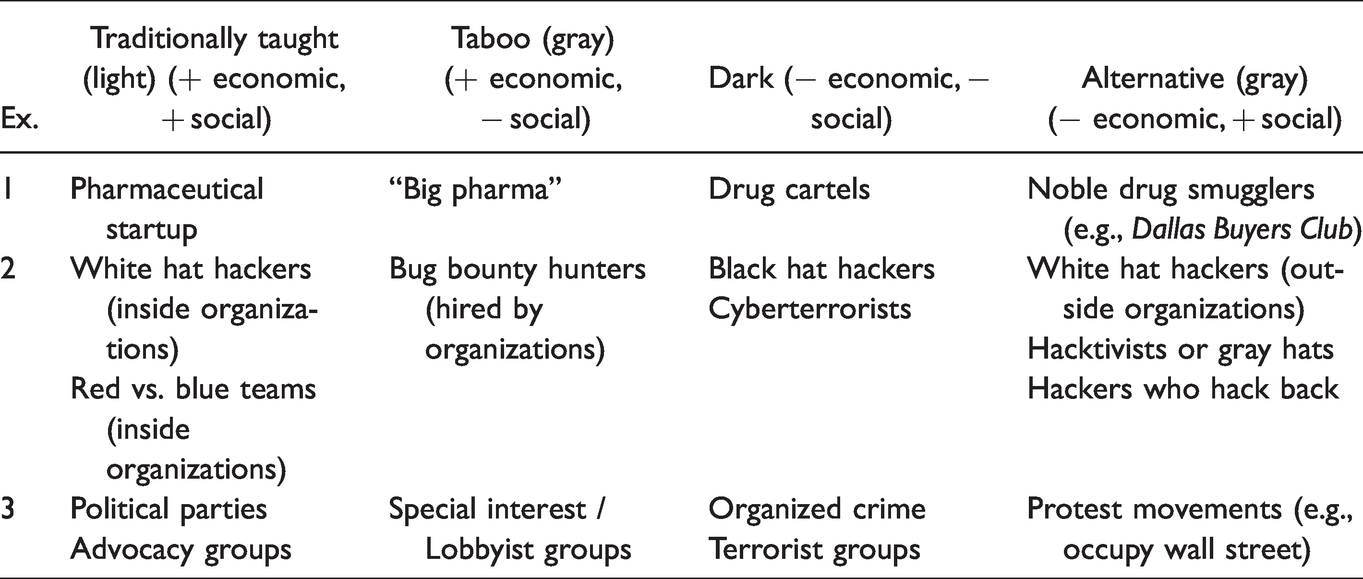
Table 2 serves as an example of how players in the pharmaceutical, hacking, and lobbying industries may be classified based enterprises’ social and economic intentions, processes, and outcomes. While the examples shown in Table 2 are not traditionally seen as social enterprises, they can act in social enterprising fashions. Students will likely differ in how they think about these enterprises, but the discrepancies will provoke compelling discussions to address questions like: When are drug cartels, organized crime, or black hat hackers possibly good; why are large pharmaceutical corporations critiqued heavily; and, is it okay to do harm in the name of good? These initial discussions help students decide for themselves how they will frame enterprises as social (or not social) enterprises based on entrepreneurial intentions linked to processes and linked to economic and social impacts. This particular tool and examples expand students’ perceptions of what constitutes entrepreneurship and enterprise, and in particular, they compel students to consider a broad range of moral, legal, and ethical factors related to entrepreneurial intentions, processes, and outcomes. For further emphasis, the three examples will be discussed and connected to dark side theory.
Examples like pharmaceuticals, hacking, and political organizations provide entry points for students to discuss light-dark-gray versions of enterprises. Dark-light-gray language is accessible, and the examples are easy to research for students. But, dark side theory can go further; it can be used to help students define, frame, and legitimize social enterprises as well. Specifically, it helps students explore and debate value creation, purpose, strategy, and signaling.
Enhancing the Ethical Framing of Social Enterprise Using Dark Side Theory
Social enterprise requires comprehension of social and economic intentions, processes, and outcomes. Another learning objective in social entrepreneurship/enterprise courses may be: Students will apply ethical frames to legitimize social enterprises as tools for value creation. Dart (2004) presents pragmatic, moral, and cognitive legitimacies for social enterprise. Social enterprise creates real (and realized) economic and social value for communities (pragmatic), can be a preferred model that pushes enterprises beyond economics (moral), and changes minds and culture(s) (cognitive). Dart (2004) shows how social enterprise blurs the distinctions between for-profit and non-profit structures. Similarly, Fruchterman (2011) offers students four social enterprise structures (for-profit, for-profit with a social overlay, hybrid, and nonprofit with a mission-related enterprise) to weigh regarding social impact. These pieces introduce social enterprise forms and prime students to critique the ethics and morals of different enterprise forms from a high overview level.
Diving deeper, Dart et al. (2010) recognized “meaningful difficulties” (p. 186) in defining, framing, and legitimizing social enterprise. They supply five ethical frames to categorize and legitimize social enterprises (see Table 3). While these ethical frames have limitations both in their broadness and specificity (Dart et al., 2010), the frames are useful because they are expansive and do not relegate definitions of social enterprise to groups with social missions plus earned income strategies or for-profit businesses with social overlays.
Dart et al.’s (2010) Five Ethical Frames for Social Enterprise.
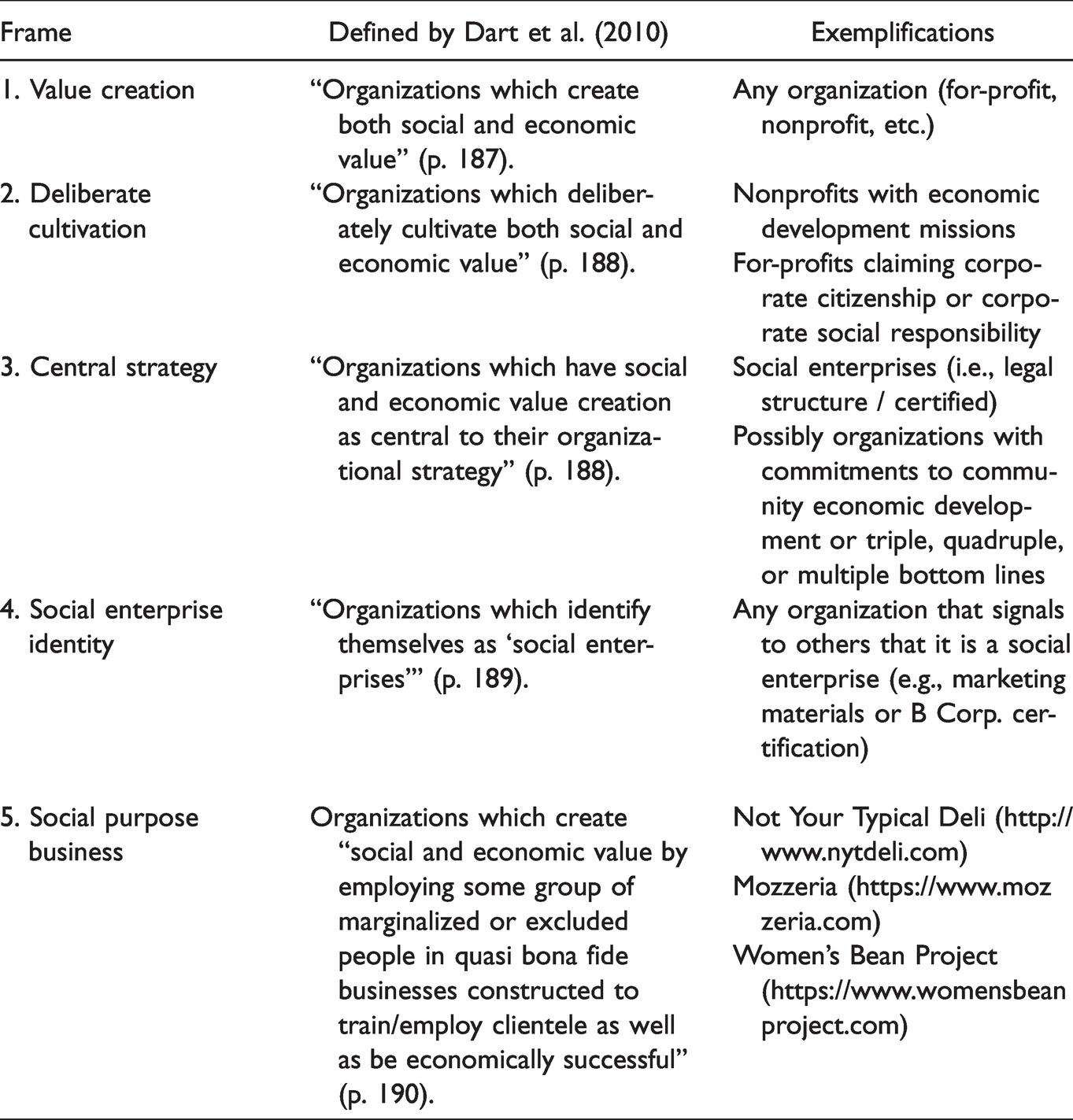
Much like Dart, et al.’s aforementioned exercise and Talmage and Gassert (2020) classroom exercise, students can be presented with enterprises to categorize. This process can help students reach the two aforementioned learning objectives put forth thus far regarding defining, describing, framing, and legitimizing social enterprises. Looking back to dark side theory, Dart et al.’s (2010) frames and the presented exemplifications appear directionally positive regarding social and economic intentions and processes, but are not apparently explicit regarding social and economic impacts. Additionally, users of the frames for categorization may be tempted to see frames as checkboxes, whereas users peruse organizational intentions, processes, and outcomes for the mere presences of the definitions supplied. In response to these issues, these five frames can be infused with the dark-gray-light language of dark side theory to broaden conceptualizations of and connect intentions, processes, and impacts together. Thus, dark side theory pushes students to look beyond traditionally taught frames of enterprises.
Employing Dart et al.’s (2010) framework, students may find that fourth sector enterprises (e.g., community corporations, L3Cs, benefit corporations, etc.) are generally explicit regarding their intended social and economic value creation and how they deliberately create value (i.e., Dart et al.’s [2010] first and second frames, respectfully). Incorporation or certification as a fourth sector enterprise firm also signals a social enterprise identity to others, which reflects Dart et al.’s (2010) fourth frame. Still, fourth sector enterprise forms vary in their core strategies (i.e., Dart et al.’s [2010] third frame) and, relatedly, in how specifically they state whom they intend to benefit (i.e., Dart et al.’s [2010] fifth frame). For example, fourth sector enterprises may be mandated by law or certifying bodies to provide annual reports on their benefits to the public with varying accountability structures and outline their public benefit in their governing documents (Esposito, 2012; Gupta, 2011; Reiser, 2011). Granted, students must recognize such social enterprise structures prior to using the framework.
To enhance Dart et al.’s (2010) approach, the dark-gray-light rubric found in Table 4 was constructed. This rubric can work as a starting point for enhancing the defining, ethical framing, and legitimizing social enterprise. The rubric couples a new learning objective building on the previous two mentioned: Students will leverage dark side theory as a pedagogical device to interpret evidence of (social) enterprise success, failure, and harm. This learning objective speaks to the disconnect that can occur between intentions, processes, and impacts allowing students to bolster their critical perspectives on social entrepreneurship.
Rubric Using Dart et al.’s (2010) Frames Infused With Dark-Gray-Light Language.
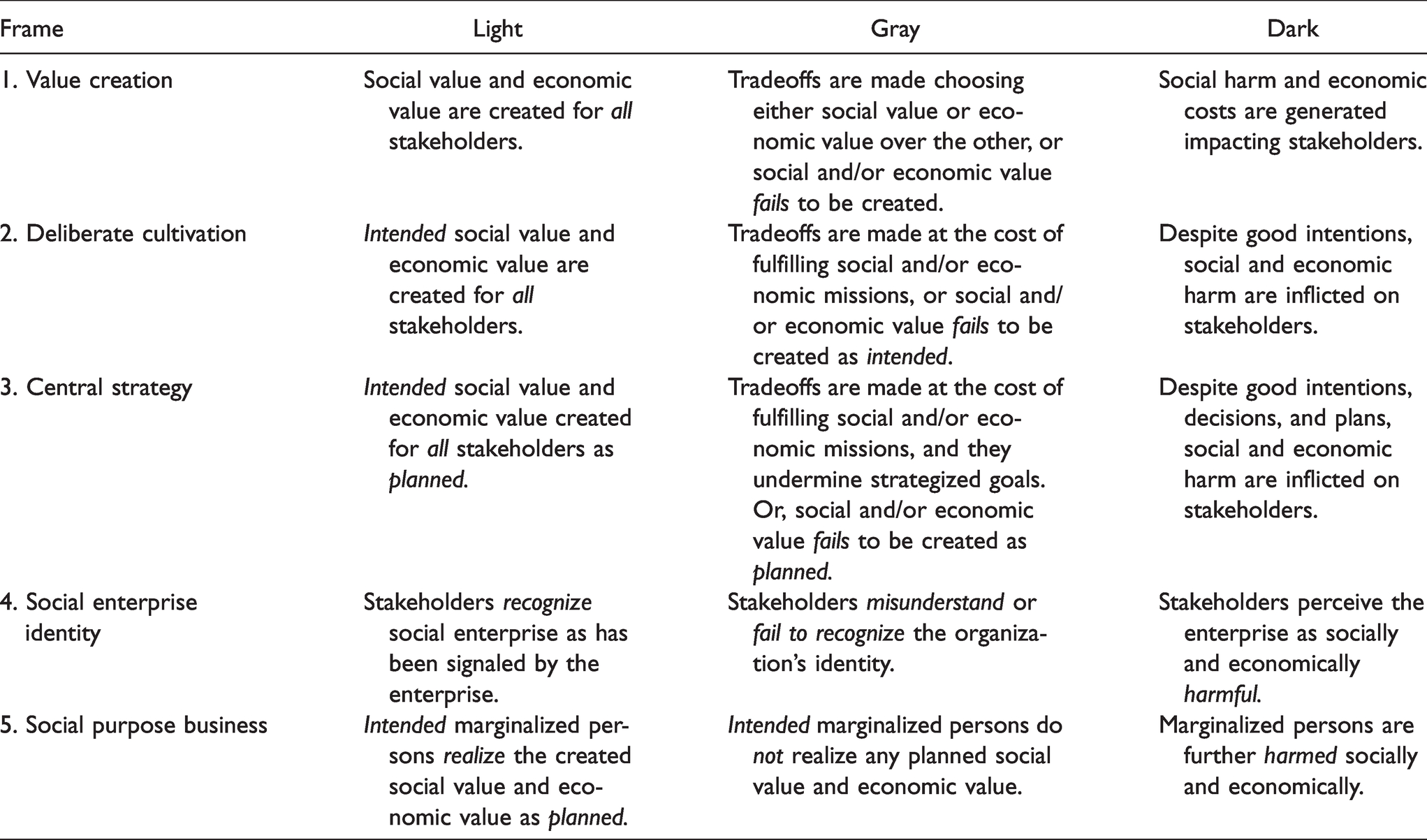
To enhance the previously posited approach, students can be presented with enterprises to again categorize. Students can investigate governing documents of various organizations and use news articles to evaluate such organizations employing the rubric. It also may be interesting to showcase the stories of enterprises over time as well. One example could include the story of Purdue Pharmaceuticals and Oxycotin (M. R. Jones et al., 2018). The drug was aimed to reduce pain for those in need, but the marketing strategy for the drug was riddled with questionable practices. As a second example, JUUL, an American electronic cigarette/vaping company, created a product that was touted as a smoking alternative and cessation aid. However, their products became a substance of choice among many underage users who may have never smoked cigarettes in the first place (Huang et al., 2019). Furthermore, stories of charitable work by gangs and mob organizations acting substitutes for more legal and ethical enterprise forms may also be useful for discussions on the morals and ethics of enterprises, such as the “philanthropic work” of Pablo Escobar (Cohen, 2014).
Students can dive deeper in their examinations of social enterprises using Table 4. For example, TOMS, a well-known enterprise by students, has received substantial critique for its lack of systematicity in addressing poverty in its shoe distribution program (Taub, 2015). TOMS provides shoes, which have demonstrated little impact on helping improve schoolchildren’s well-being and also patronize the needs of the poor (Taub, 2015). Such failures by an organization that appears to identify as a social enterprise would appear to be gray (if not dark) along the second to fourth rows/frames on the rubric (see Table 4) regarding these perceived impacts. Students may provide discussions in-class or in their assignments regarding which location within the rubric best fits the impacts of TOMS on its intended stakeholders.
Table 4 works as a primer for students as they learn about enterprise and social enterprise structures, and it does so without casting favoritism towards select governance structures or certifications. The broad nature of the categories allows students to apply this typography to many enterprises, including non-traditionally-taught nonprofits, not-for-profits, for-profits, illegal, and underground forms of enterprise. This rubric also allows students to see how enterprises can change (i.e., succeed or fail) over time in their intentions, processes, and impacts. Furthermore, this rubric reinforces that social and economic value are equally critical to the success (and failure) of social enterprise as a human-created phenomenon.
What this rubric does not do is establish a threshold for sufficient social or economic activity, which Dart et al. (2010) desired and certifications and governance structures aim to delineate. These notes fall in line with Fruchterman’s (2011) lament of a lack of a perfect governance model for social enterprise, specifically citing issues with taxation, ownership, financial management, and balancing social and economic missions. Given these limitations, dark side theory can help add to social entrepreneurship education to aid in the quest to define, describe, legitimize, and ethically frame social enterprises for students and society at large.
Why Dark Side Theory for Social Entrepreneurship Education
Social entrepreneurship is a unique field, and social enterprises are unique phenomena; however, the conceptualizations and teaching of both deserve critique. Dark side theory broadens the toolkits of educators to teach about social entrepreneurship and typify social enterprises. These notions may be especially important given the heralding of business as the solution to large social and economic problems (Giridharadas, 2019). Tedmanson et al. (2012) write of a societal need to “champion new ways to relocate business within society, not continue to reify business as social life” (Tedmanson et al., 2012, p. 532). Consistently, Dart (2004) aptly noted: Social enterprise is likely to continue its evolution away from forms that focus on broad frame-breaking and innovation to an operational definition more narrowly focused on market-based solutions and businesslike models because of the broader validity of the promarket ideological notions of the wider social environment. (p. 412)
In building their own enterprises, students may be tempted to choose particular enterprise structures to launch because of their perceived profitability (as opposed to viability) thus limiting their potential to serve dual missions (Ridley-Duff & Bull, 2011). These notions are not supplied to discourage entrepreneurship behavior, but to give students a language to reflect before launching their enterprises. Considering these notions, an impetus is clear: How can entrepreneurs (current and aspiring) be guided away from forfeiting social missions, or worse, going dark side?
As noted at this article’s outset, dark-gray-light language is a useful introduction to critical entrepreneurship perspectives. Students especially can hold narrow preconceived definitions of entrepreneurship, which assume entrepreneurship is inherently positive, socially and economically. Dark side theory approaches push students to consider ethics and morals in their evaluations of entrepreneurial intentions, processes, and outcomes (Talmage & Gassert, 2020). Students must recognize that intentions, processes, and impacts are inextricably linked, and they should be able to discuss those connections.
Students need a vocabulary for such considerations, and students journeying into the field of social entrepreneurship require greater levels of critical thinking and analytical skills to critique a newer, but very positively-viewed, field. Students need a language to define, frame, and legitimize social enterprise. Students will need to learn to look beyond traditional enterprise forms to see enterprise forms that are darker and grayer in their economic and social intentions, processes, and impacts. Students should recognize traditional social enterprise structures, but also examine and critique emergent fourth sector and nontraditional structures as well.
Many questions still need exploring in regards to dark side theory that this article does not answer. The examples used in this article are not all encompassing of the many typologies of enterprise that exist and the legal structures that exist. Of course, enterprises can be more nuanced and do not fall into the light, gray, or dark categories laid out in this work. This article, its resources, tools, and examples do not take into account how perceptions of enterprises and industries change over time as well. They also do not take into account demographic and cultural differences in perceptions. Moreover, this article did not draw on the breadth of literature regarding corruption. The article also does not suggest proper methods to analyze the intentions, processes, and impacts nor the personal responsibilities of individual entrepreneurs.
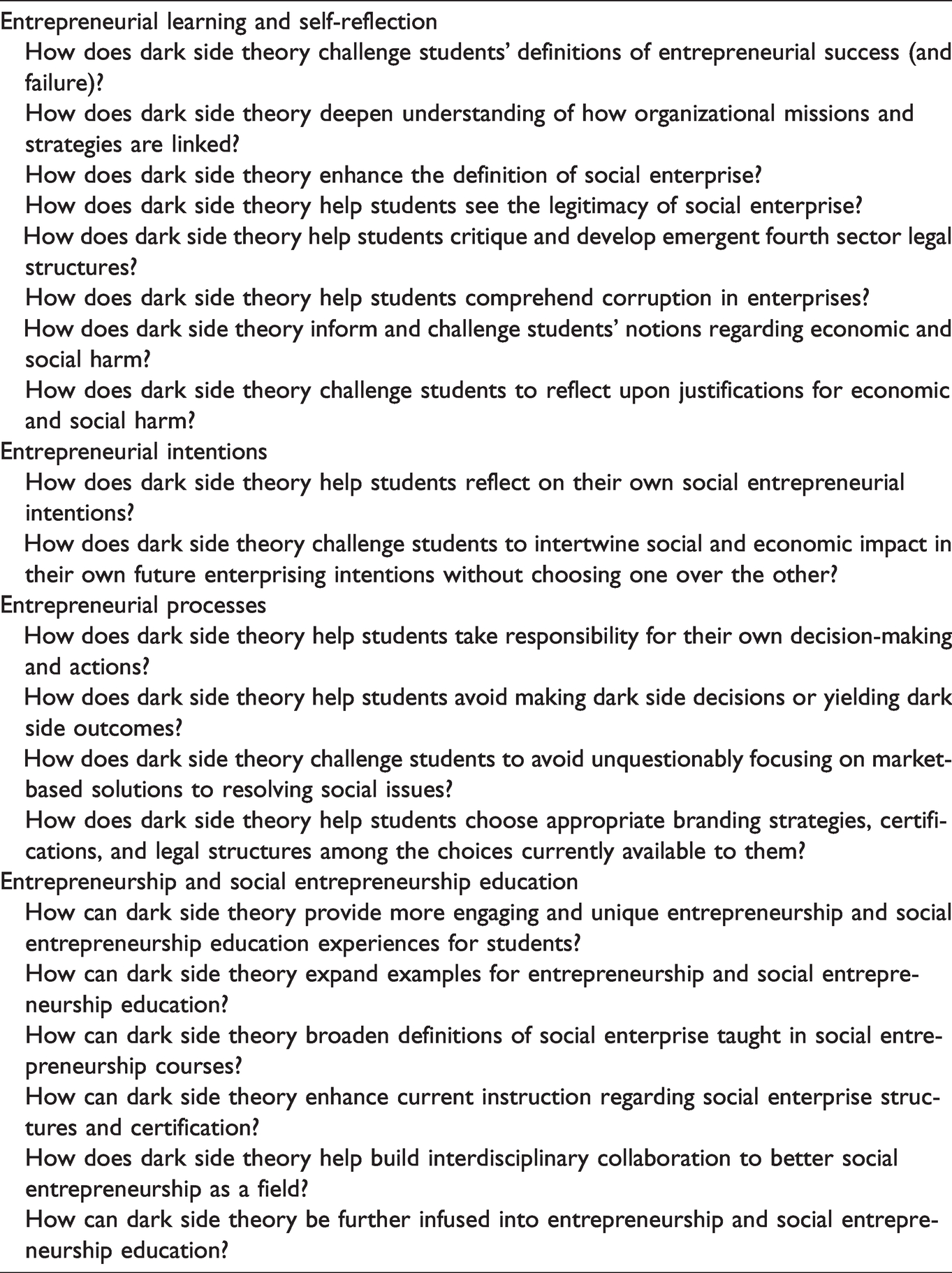
The infusion of dark side theory into entrepreneurship education and social entrepreneurship education is fairly new and requires more research. Dark side theory serves as one critical perspective tool among many to be utilized. The nascent infusion of dark side theory offers many questions to scholars and instructors that this article could not fully address. Table 5 provides a list of twenty questions separated into four themes for future research and discussion.
Future Questions for Dark Side Theory and Entrepreneurship Education.
Conclusion
Critical perspectives allow students to broaden their definitions, and dark side theory is one avenue for such broadening. This article provided resources to use dark side theory to broaden students’ perspectives, but many more resources are needed, especially in terms of learning innovations and exercises. To summarize, intentions, processes, and impacts must all be considered when defining and analyzing social enterprises, especially in (social) entrepreneurship courses. Society needs help to prevent individuals and their enterprises from going dark side. Entrepreneurship education, specifically social entrepreneurship education, can be one opportunity to cultivate critical thinking aimed at preventing dark side shifts and promoting light side practices that push the boundaries of the for-profit business paradigm that has failed to rectify many of the very large social and environmental problems it created.
Footnotes
Declaration of Conflicting Interests
The author(s) declared no potential conflicts of interest with respect to the research, authorship, and/or publication of this article.
Funding
The author(s) received no financial support for the research, authorship, and/or publication of this article.
