



Abstract
A growing need to address societal challenges has driven political and institutional emphasis on developing entrepreneurial competence across disciplines. This study explores how educators from various fields engage with the process of embedding entrepreneurship into their teaching—an approach known as Embedded Entrepreneurship Education (EEE). Drawing on empirical data from the Norwegian University of Science and Technology, we propose a model that captures core aspects of educators’ process: personal identification, recognition of relevance, development of entrepreneurship education competence, and implementation of entrepreneurial elements. The need to overcome institutional barriers pervades the process. The model is based on a qualitative case study comprising eight focus-group interviews (N = 44), pre-course assignments from participants in a train-the-trainer course (N = 18), and post-course focus-group interviews (N = 10). We discuss the findings primarily through the lens of the Communities of Practice theory and extend it by introducing the concept of provisional communities, capturing the emergent, cross-disciplinary spaces in which educators experiment with new practices and provisional professional identities.
Keywords
Introduction
There is an increased focus on entrepreneurial competence as a key to addressing the grand challenges of our time (Markman et al., 2019). This has entailed a political emphasis on developing entrepreneurial competence across disciplines (Gibb et al., 2013; Neergard et al., 2020; OECD, 2022; Seikkula-Leino et al., 2021). Developing this competence is not limited to enhancing students’ venture creation capabilities, but more broadly, their ability to identify problems, generate opportunities, and put new solutions into practice (Bacigalupo et al., 2016) in existing organizations or communities (Bell, 2021; Fellnhofer, 2019; Hägg & Kurczewska, 2022).
However, a question arises as to how entrepreneurship can best be taught to students from disciplines that are not primarily about entrepreneurship, and who should teach them (Crişan et al., 2023). While entrepreneurship experts can offer guest lectures or offer entrepreneurship courses for students across disciplines, it can be argued that a more sustainable way is for educators from different disciplines to integrate entrepreneurial elements into their teaching in existing programs and courses, as they know the language, practice, and norms of their fields (Jin & Roald, 2025a). The latter alternative has been conceptualized as “embedded entrepreneurship education” (EEE) (Crişan et al., 2023).
In this paper, EEE refers to any attempt, small or large, to integrate or embed—two terms that we will use interchangeably—entrepreneurship/entrepreneurial elements into teaching in disciplines that are not primarily about entrepreneurship. Two illustrative examples of EEE could be: (1) a social work educator challenging students to collaborate with a local prison to develop strategies for enabling inmates to contribute to society while incarcerated, and (2) a logistics educator encouraging students to design solutions that minimize waste during relocation processes.
A growing number of studies focusing on EEE, together with the literature review of Crişan et al. (2023) has contributed to establishing EEE as a distinct scholarly area. Crişan et al. (2023) provided an important and comprehensive overview of the contexts, interventions, and outcomes of EEE programs, and mechanisms that explain the outcomes associated with different approaches to the delivery of EEE in different contexts. There is, however, a gap in the literature when it comes to understanding the educators’ process of embedding entrepreneurship into teaching in different disciplines. If universities are to follow up the political vision of disseminating entrepreneurship to students across disciplines (e.g., European Commission, 2014, 2020; OECD, 2022), we need knowledge about what it implies for educators across disciplines to embed entrepreneurship into their teaching. In this study, we therefore ask: What can the process of embedding entrepreneurship into different disciplines look like for educators?
This research question is explored through a case study at the Norwegian University of Science and Technology, drawing on three different qualitative data sources involving a total of 72 educators. The study contributes important insights for university administrators in charge of processes that seek to enhance the level of entrepreneurial competence among students across disciplines. Further, it offers valuable knowledge for designers of train-the-trainer courses, and for policymakers who seek to organize and provide guidance for educational development processes that aim to develop entrepreneurial competence among students from different disciplines. The study can also help educators understand their own process of embedding entrepreneurial elements into their disciplinary teaching. Finally, it advances the theory of Communities of Practice (CoP) within the EEE context by adding the concept of ‘provisional communities’ as a novel analytical lens.
Literature Review
Crişan et al. (2023) show in their literature review that several studies have examined how EEE can be implemented in specific educational institutions or countries (e.g., Antal et al., 2014; Hoppe, 2016; Leffler & Falk-Lundqvist, 2014), and that research has investigated the use of specific teaching practices and pedagogical models in different disciplines (e.g., Bosman et al., 2019; Costello, 2017). Furthermore, recent research has identified barriers to educators’ identification with entrepreneurship, which influences their intention to integrate, or readiness for integrating entrepreneurial elements into their disciplinary teaching (Neergård & Roald, 2025).
Another recent study has emphasized the identity work of teachers from different disciplines while going through an entrepreneurial training camp (Peura & Hytti, 2023). Moreover, role identities related to being an entrepreneurship educator (Wraae et al., 2022) and the process of becoming an entrepreneurship educator (Hannon, 2018; Jones, 2020) within dedicated entrepreneurship education have been explored in research. Despite these contributions, what remains underexplored is how educators engage in the cognitive and social processes involved in integrating entrepreneurial elements into their existing disciplinary teaching practices.
To explore this gap and understand the educators’ process, this study primarily draws on the theoretical lens of Communities of Practice (CoP) (Wenger, 1998), complemented by the concept of provisional selves (Ibarra, 1999), and by Illeris’ (2009) concept of competence development. The CoP theory conceptualizes learning as a socially situated process where individuals develop knowledge, skills, and identity through participation in a community engaged in a shared domain of interest. This perspective shifts the focus from individual acquisition of knowledge to participation in collective meaning-making and identity negotiation (Wenger, 1998). According to Wenger (1998), learning is situated in a given community that shares practices, language, norms, and values. Identity is a core aspect of the learning process and rather than being seen as a static entity, it is emergent and negotiated through engagement with others in a specific community (Wenger, 1998).
For educators, this means that embedding entrepreneurial elements into their teaching involves more than adopting new pedagogical tools or theoretical concepts: it requires reconfiguring their professional identity to include entrepreneurial values, language, and practices. These identity and sensemaking (Peura & Hytti, 2023) processes are shaped by interactions with peers, institutional norms, and disciplinary cultures, all of which influence what is seen as legitimate forms of knowledge and practice (Wenger, 1998). The concept of provisional selves (Ibarra, 1999) complements the CoP lens by capturing how educators experience and negotiate evolving professional identities while experimenting with new teaching approaches.
This negotiation process is facilitated through “boundary objects” (Wenger, 1998, p. 105), which can be “artifacts, documents, terms, concepts, and other forms of reification around which communities of practice can organize their interconnections.” Examples of such boundary objects include teaching resources shared in a train-the-trainer course that are discussed and negotiated by the educators to make them meaningful within their own disciplinary frameworks. This process requires that individuals take the role of “brokers” between different communities of practice, which implies a process of “translation, coordination, and alignment between perspectives in which individuals use their ‘multi-membership’ to transfer some elements of one practice into another” (Wenger, 1998, p. 109). Through this interaction, educators can begin to co-construct a hybrid language and practice that bridges disciplinary and entrepreneurial domains (Peura & Hytti, 2023).
Illeris’ (2009) theory of learning and competence development can also complement Communities of Practice (CoP) theory as it combines cognitive, affective, and social aspects of learning. According to Illeris (2009), competence development involves three dimensions: content, incentive, and interaction. Content refers to an individual’s knowledge and skills, but also “opinions, insight, meaning, attitudes, values, ways of behavior, methods, strategies, etc.” (Illeris, 2009, p. 10). The incentive dimension encompasses the person’s motivation, emotions, and volition—the willingness to engage in processes of learning and development (Illeris, 2009, p. 10). These two dimensions mutually influence one another. Finally, the interaction dimension revolves around how the individual makes sense of what they learn in interaction with other learners and the environment (Illeris, 2009, p. 11).
Methodology
Description of the Case University
This is a case study that focuses on a contemporary phenomenon (i.e., embedded entrepreneurship education) within its real-life context (Yin, 2019), in this case, the Norwegian University of Science and Technology (NTNU). This is a multidisciplinary university with nine faculties, 52 departments, and approximately 43,500 students (NTNU, 2026). NTNU constitutes an interesting case due to its explicit intention to integrate entrepreneurship across different disciplines. This intention was articulated, for example, in the guidelines for the design of study programs that were in force at the time of data collection in this study, where it was required to describe “… in what way innovation and entrepreneurship are integrated into the study program” (NTNU, 2021, p. 11, our translation).
However, there is a gap between the intended integration of entrepreneurial elements and their actual representation in course descriptions. A report shows that only 5% of the 7,577 courses at NTNU include the words entrepreneur, entrepreneurship, or entrepreneurial in their course descriptions (Aadland & Neergård, 2022). This reveals a challenge in translating policy into educational practice, making NTNU a relevant case for studying the process of embedding entrepreneurship in teaching across different disciplines.
The Three Data Sources
To understand the process that educators undergo to integrate entrepreneurial elements into teaching in their disciplines, we combined three qualitative data sources (hereafter referred to as sources A, B, and C), each illuminating different stages of this process. Given the gap between policy and practice mentioned above, we consider it important to explore this process from a stage where educators might not have any interest, intention, or knowledge regarding entrepreneurship, via a stage where they intend to learn about entrepreneurship, to a stage where they start experimenting with the implementation of entrepreneurial elements in their teaching. We have therefore used a triangulation of methods—another defining characteristic of a case study (Yin, 2019).
The 44 Participants Represented in the Focus-Group Interviews in Source A, Sorted by Faculty, Role, Gender, and Department

Sources B and C consist of 28 participants recruited from an interdisciplinary 20-hr train-the-trainer course in entrepreneurship offered at the Norwegian University of Science and Technology by SFU Engage, the center in which the two authors are employed. This 20-hr course (hereafter referred to as “the course”) is one of several elective modules available to educators as part of the university’s mandatory professional development program in higher education pedagogy. The course aims to empower university teachers to integrate entrepreneurial elements into their teaching practice. A detailed description of the course design and activities is provided by Jin and Roald (2025a). The educators in sources B and C thus represent educators from different disciplines who have actively sought to learn more about entrepreneurship, although their motivations may vary.
The 18 Participants Represented in the Pre-Course Assignments, Sorted by Department and Gender

The 10 Participants in the Two Focus-Group Interviews, Sorted by Department, Gender, Whether They Participated in Interview One or Two, and How Many Months Had Passed Between the Course and the Interview

The educators in these groups represent another stage of the process of integrating entrepreneurship into teaching across disciplines, as they have learned about entrepreneurship and tested entrepreneurial elements in their teaching.
Triangulation and Complementarity
In addition to shedding light on different parts of the process of embedding entrepreneurship into teaching in different disciplines, the three data sources provide triangulation by virtue of their differing natures. The pre-course assignments represent a different source of information than the focus-group interviews by being written by the participants while they are in their own space, without any influence from other participants or the researchers, which is an inherent feature of focus-group interviews. As such, they can provide more “raw” descriptions of participants’ experiences or thoughts than if one is directly influenced by the social interplay (Kvale & Brinkmann, 2010) that characterizes focus-group interviews. A limitation, on the other hand, is that the researcher cannot ask for elaboration or clarification and hence more of the analysis is left to the researcher’s interpretation.
The social interplay in the focus-group interviews implies that participants can influence each other’s thinking and statements (Morgan, 1997). On the positive side, this means that the utterances of one participant can make another remember situations from their own practice that would not have come to the fore in individual interviews. On the negative side, the interplay can lead to polarization (Abrams et al., 1990): expressing opinions that align more closely with others in the group than one might have done, for example, in a pre-course assignment, to fit in with the group.
This can, however, be prevented by creating an environment of trust and psychological safety (Edmondson, 2019) in the group. We tried to achieve this by explicitly stating that every opinion would be of interest, by letting all participants introduce themselves and share their initial thoughts on the subject in the beginning of each focus-group interview, and by responding in an accepting and confirming way to all statements that emerged (Roald, Schruijer, et al., 2024). The focus-group interviews were carried out online, and we followed the recommendations of Willemsen et al. (2022) and Roald, Schruijer, et al. (2024), to stimulate a constructive group climate, so that the interpersonal dynamics—which is the core characteristic of this methodology (Parker & Tritter, 2006)—could unfold.
As the data are combined from two different projects, two different applications were sent to Sikt–Norwegian Agency for Shared Services in Education and Research. Sikt acts as the Data Protection Officer for Norwegian research institutions, ensuring that the processing of personal data complies with the General Data Protection Regulation (GDPR) and Norwegian privacy legislation. The applications included project descriptions, plans for data collection, processing and storage, and interview guides. The two projects were approved, receiving the approval numbers 126893 (source A) on September 19th, 2022, and 535509 (source B and C) on September, 21st, 2024. When the projects were approved, an information letter and a consent form was distributed to the participants. Informed consent was obtained from all 72 participants.
For source A, informed consent was obtained verbally. Before the Microsoft Teams recording/transcription was activated, the interviewer reminded the participants of the verbal consent procedure, as well as what participation entailed and their rights. They had also received this information via email prior to the interviews. The participants then gave their verbal consent once the recording/transcription had started. The reason for using verbal consent was to avoid a substantial amount of administrative work via email prior to the interviews, because the eight online interviews involved many participants.
For sources B and C, written consent was obtained from all participants prior to the use of the pre-assignments (source B) and prior to the focus-group interviews (source C).
Data Analysis
The data have been analyzed using an adjusted version of the systematic text condensation (STC) procedure suggested by Malterud (2012). In line with Malterud’s (2012, p. 796) description of the first step in systematic text condensation, we began by searching for a total impression of the material. This open-minded reading serves to bracket pre-existing assumptions and allows tentative themes to emerge from the data as a whole, ensuring that subsequent analytical steps are grounded in participants’ expressions rather than predetermined categories (Malterud, 2012).
Based on the research question, we discussed our immediate impressions from the first individual reading and considered how these initial reflections might point toward preliminary thematic patterns. This step allowed us to surface early analytical impressions while remaining attentive to the risk of premature closure. We then moved to a more systematic level of analysis. In line with Malterud’s (2012, p. 797) second step in systematic text condensation, we identified and sorted meaning units across the dataset. Meaning units—defined by Malterud (2012, p. 797) as “text fragments containing some information about the research question”—were located through a careful, iterative reading of the material in NVivo.
Working inductively in the coding process is essential in systematic text condensation because it prevents the premature imposition of preconceived categories and ensures that themes emerge organically from participants’ own expressions (Malterud, 2012). Such data-near coding enhances the credibility and transparency of the analysis by grounding interpretations in the data material, while also allowing unexpected patterns to surface (Malterud, 2012). To stay as close to the empirical data as possible, we challenged Malterud’s procedure by using the paraphrasing technique described by Roald, Krogstie, et al. (2024). Paraphrasing is used in counselling conversations to help clients make sense of their experiences in new ways (Ivey et al., 2018). However, in the analysis context, the purpose is rather to condense (Malterud, 2012) the data. Containing entire sentences, rather than merely one word, the paraphrases allow for more nuances and for staying as close to the participants’ utterances as possible. See Figure 1 for an example of a paraphrase based on an extract from one of the focus-group interviews in source B. An example of condensation of the data by the use of the paraphrasing technique described in Roald, Krogstie, et al. (2024)
While Malterud (2012, p. 799) suggests that one ends up with three to six code groups as a result of the identifying and sorting meaning units phase, we ended up with 106 paraphrases.
To further condense the data, we printed, cut, and physically sorted the 106 paraphrases into overarching themes on a big table, continuously discussing and challenging each other’s analytical ideas, ending up with 14 themes. These were then further condensed into five themes that were organized into an early version of the process model. The process of “synthesizing,” which is Malterud’s (2012, p. 800) fourth phase, implies reconstructing “a story about the phenomenon grounded in the empirical data as an analytic text presenting the most salient content and meaning.” This phase was, for us, an iterative (Malterud, 2012, p. 798) process of writing, reading, re-writing, and re-reading. Here, some themes were combined, some were added and some were removed, to ensure coherence between the names of the themes and the selected quotes. We ended up with the five themes that constitute the process model presented in the next section.
Findings
The findings of the study are presented as a process model that contains the following elements: personal identification, recognition of relevance, development of entrepreneurship education competence, and implementation of entrepreneurial elements. The need to overcome institutional barriers pervades the process. The model is visualized in Figure 2 below. In the following, these five themes are presented with quotes from the data. Visualization of the process of embedding entrepreneurship into teaching in different disciplines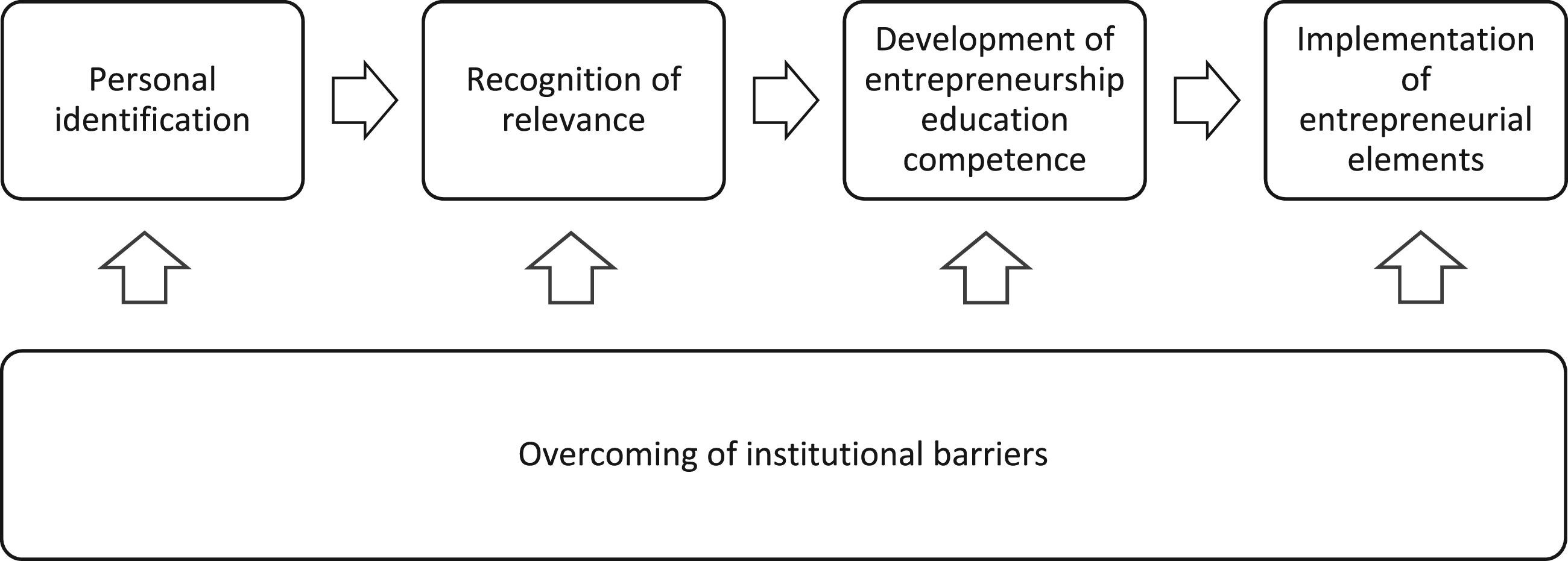
Phase 1: Personal Identification
This phase involves reflecting upon how, and to what extent, one can personally relate to and identify with entrepreneurship in some way or another. An educator from the Department of Social Work emphasizes in source B the importance of identifying with entrepreneurship oneself, thus being a role model for the students: We can't expect our students to be forward-thinking if we can't do it ourselves. So this is something we have to do throughout their education. We can't just teach them: We need to involve them in these processes. We have to be good examples and have good collaboration with the field of practice, for instance, to come up with real issues. (B)
However, for many educators, entrepreneurship is, at first glance, associated with something that the participants do not identify with. A perspective that might hinder personal identification for educators is the idea that entrepreneurship is a capitalist concept that is primarily and solely about profit. This comes to the fore, for instance, in one of the reflective logs in source B written by an educator from the Department of Neuromedicine and Movement Science: Perhaps more people think like me, namely that entrepreneurship is about profit, but then it is important to remember that entrepreneurship can have different purposes, where creating equal services and/or strengthening vulnerable groups can be some of them. (B)
In this quote, the educator both highlights an aspect that can hinder identification with entrepreneurship while at the same time emphasizing a dimension of entrepreneurship that makes it easier to identify with the term.
Another aspect that makes people hesitant to identify with entrepreneurship is that they associate it with specific groups in society and specific disciplines, and therefore, it is distant from their personal identity. As expressed by an educator from the Department of Public Health and Nursing: When I got this request (to participate in the study), I thought: ‘whoa, what does this have to do with me?’.
Interestingly, educators also show how they can both identify with and not identify with entrepreneurship, in the same focus-group interview. For instance, an educator from the Department of Language and Literature reflects in source A on how her associations with profit and capitalism hinder her in identifying with entrepreneurship. However, she reflects on whether entrepreneurship can also be linked to trying new things in her teaching, which might again make it easier to identify with the concept: Now that I reflect upon it (…) I think we are actually doing entrepreneurship - maybe if I look away from the economic part, or the economic value – all the time, while further developing our teaching.
Summarized, educators express feelings and associations with entrepreneurship that may hinder or enhance their identification with the concept, whether they have no knowledge, are about to participate in the entrepreneurship education course, or have already been through the course.
Phase 2: Recognition of Relevance
This phase implies recognizing the relevance of entrepreneurship in one’s own disciplinary field. An educator from the Department of Public Health and Nursing in source C emphasizes that small changes can have a great impact, and highlights the importance of teaching students to look for solutions to “small” problems in their work environments: If a patient is lying in bed and has difficulty getting out of bed, then you can tie a ribbon on the bed, and then the patient can pull her- or himself up with that ribbon (…) If you tie that band in a new way on the bed so that the patient who has, for example, paralysis in the left hand, still manages (…) to pull himself up anyway with the help of that band, then you've sort of made an innovation or (…) yes, so I'm very keen to sort of (…) get them to think a little bit: “What can I do in my surroundings? What is missing here? What are the needs? What are the problems that I face in my workday, in my everyday life, and how can I solve them and try to look at them with new ideas, or use the knowledge that I have, or talk to the people that I work with?” or so. (C)
In source B, one of the educators from the Department of Industrial Economics and Technology Management reflects on the relevance of entrepreneurship in her context in the following way: In my context, I think that entrepreneurship can be about trying new teaching methods and tools, enabling students to explore the field with curiosity and a critical view of the challenges in the field that they can help to find solutions for or rethink. (B)
In source A, one of the educators from the Department of Biomedical Laboratory Science advocates for interdisciplinary collaboration and exemplifies its potential impact by the COVID-19 tests that were developed at NTNU because bioengineers and computer engineers managed to collaborate efficiently. Currently, students from these disciplines are given specific tasks from hospital laboratories that they have been challenged to solve together. She states: We don't think that everyone becomes an entrepreneur, but it can happen that in working life you see an innovative solution to perhaps do things differently. And everything can be improved! So, I think, the more people who can do this, the better! (A)
Summarized, this phase shows how educators see the relevance of entrepreneurship in their disciplinary area.
Phase 3: Development of Entrepreneurship Education Competence
In this phase, the educators develop competence within entrepreneurship education. In the interviews in source C, the educators were asked to share their most important take-aways from the course in entrepreneurship education and reflect on the value of developing entrepreneurship education competence. An educator from the Department of Mechanical and Industrial Engineering in source C says that simply getting to know about the entrepreneurial “ecosystem” at the university is important, as this enables them to support their students and point them in the right direction if they have good ideas: There is actually an environment here that I was not aware existed at NTNU, which was kind of the most fundamental thing for me, as it was simply a good way to get an overview of what exists (…). Yes, that there are opportunities for professional support for students with (…) who have good ideas and want to go a little further in making a serious commitment to it (…). The most important thing for me is really that (…) simply that now I know that it exists and who you can contact and where it is, and so on. (C)
Another educator in source C, from the Department of Neuromedicine and Movement Science, remarks how attending the train-the-trainer course has changed his understanding of education as such. More specifically, learning about pitching made him aware of its potential value in his own field, both in education and clinical practice: My whole idea about education has changed a little during the course. Because I discovered that entrepreneurship, as a way of thinking, was just as relevant in my professional practice. In that sense, it was just a wake-up call, and it probably influenced my teaching afterwards (…). I really like pitching. The fact that you have to convey a message in a short time, while at the same time making it seem plausible and wise to do. Pitching an idea to patients is also what people do in clinical everyday life. (C)
In source B, one of the educators from the Department of Public Health and Nursing writes that she is already involved in an innovation project in a high school that aims to stimulate an entrepreneurial mindset among the students in vocational training to be able to develop the future healthcare system. Here, they collaborate with local employers, businesses and other stakeholders. However, in spite of already being involved in a project that is “up and running,” she shares that: We need more knowledge about entrepreneurship, and not least, we need to dare to think in new and ambitious ways. It's exciting, but also scary. (B)
In other words, although she engages in an entrepreneurship project in her teaching she expresses that she needs to develop her entrepreneurship education competence, not only in terms of acquiring more knowledge but also in terms of developing a new way of thinking.
In this phase, educators also reflect upon what they already do in their teaching and how this can or cannot relate to embedded entrepreneurship education, thus reflecting upon whether they might already have developed entrepreneurship education competence. For instance, an educator from the Department of Teacher Education writes in source B about a task that she has been giving her students, reflecting on its potential relationship with entrepreneurship education, and the value of entrepreneurial competence within her context. She describes how she hung up three posters in different corners of the classroom, saying “yes,” “no,” and “don’t know.” Then she read different statements out loud to which the students needed to form an opinion regarding them and go to the “yes,” “no,” and “don’t know” corners of the room. Then they had to argue for their choices vis-à-vis each other, with the option to change their opinions and move to a different corner. The purpose of the exercise was to make the students more aware of their own choices, and make them practice both their listening and disagreeing skills, while also sharing with them an exercise that they could use with their future high school students. The educator goes on to reflect on this exercise in relation to entrepreneurship, writing: Not sure if this exercise can be linked to entrepreneurship. I'm probably still thinking too traditionally about this. So, I am looking forward to gaining more knowledge about the topic. (B)
While this educator is about to further develop her competence within entrepreneurship education by attending the course, she seems eager to learn more, while also reflecting on what entrepreneurship education competence can be, and whether she might already have developed such competence before attending the course.
Summarized, this phase involves learning about entrepreneurship education and reflecting on what this competence means in one’s disciplinary context.
Phase 4: Implementation of Entrepreneurial Elements
This phase implies actually implementing entrepreneurial elements into one’s teaching. In the data, we find accounts of what educators themselves regard as implementation of entrepreneurial elements in their teaching, whether they have been through the course or not. One of the educators in source C, from the Department of Materials Science and Engineering, is particularly interested in implementing pitching in his teaching, using this in relation to having the students work on resolving real-life challenges. He tells about an innovation project he is already involved in but that he has altered as a consequence of his participation in the course: We changed it a bit, and then I happened to come across an announcement from (a Norwegian funding organization) where they called for project applications on various things related to the use of plastic, and announced six topics. This call was given to the students, and we kind of started the semester with it. They chose a project, and they pitched it in the classroom and got feedback on the pitching.
He enthusiastically reports that seven applications were written based on these ideas, and sent to the funding organization. None were funded, but that was not the main purpose. Instead, he focuses on the value of the process: We came up with seven very good ideas! So it was quite fun! Learning a technique like that, kind of, and being able to use it, as a component of an innovation project – that was valuable, I think. (C)
In source C, an educator from the Department of Mental Health reflects on how the course and especially the focus on design thinking inspired her to think in new ways about her own teaching: Good education and good entrepreneurship have a lot in common! It was very interesting to see these ‘Energizer Bunnies’, the very motivated students at the NTNU School of Entrepreneurship, and there the key word I noticed was ‘social motivation’. And that's what I want to address in my own teaching, because I see that my students are very socially motivated, and I want more straightforward use of peer assessment and then have them start with each other's definitions of ‘what is good teaching?’ (…) So I've borrowed a book and read about design thinking. (C)
An educator from the Department of Biological Sciences writes in source B about an innovation camp that he had been involved in before participating in the course. All the first-year students attend a two-day innovation camp, where they generate new ideas, present them, and get them evaluated by representatives from the local municipality. In the third year, they establish student companies, mentored on the entrepreneurship part by students from a dedicated entrepreneurship program and by employees from their own department on the technical part. Students can then choose to pursue their own business idea instead of writing a bachelor’s thesis. The educator mentions awards that have been granted to several of these student companies. This is, thus, another example of how entrepreneurship is integrated in the teaching in a discipline that is not primarily about entrepreneurship.
Summarized, the quotes in this phase show how educators across disciplines implement entrepreneurial elements into their teaching in different disciplines.
A Pervading Dimension: Overcoming of Institutional Barriers
To embed entrepreneurial elements into teaching in different disciplines, the analysis shows that educators need to overcome different institutional barriers that can be linked to the local culture of their department, the culture of their discipline, the particular university culture, or the general academic culture. For several participants, an experienced barrier is the feeling that if entrepreneurship is to be integrated in a program or a course, something else must be left out. In addition, it implies that entrepreneurship must be “pitched” to key persons in the educational context, which seems like another barrier. As expressed by a participant in source C from the Department of Public Health and Nursing: Space is tight (…) where can you chip in a theme? (…) It’s the course coordinator who sits in her or his own little corner and decides what should be included. How should I teach within the learning objectives in my area? And then it's kind of like getting in there and selling ideas and opportunities and so on. It’s demanding! And who's going to do that? (C)
This is supported by an educator from the Department of Psychology in source C who adds the student perspective by emphasizing that even six years of training does not, for many of the students, seem to feel sufficient. This can be seen as a barrier to bringing in even more topics that are “quite far” from his “field of expertise”: What is less important here than entrepreneurship? And that’s quite far from our field of expertise (…). Service development is absolutely something to think about, so we could focus on that, in a way: How we can think and innovate in the services we offer. But for many of our students, it’s not necessarily interesting. They want to learn the subject first and then, kind of, think about innovation because they feel so unprepared and that even a six-year study program is not enough. (C)
Another barrier related to time constraints is the educators’ experience of having too much to do already. Adding yet another task therefore seems difficult. As expressed by an educator in source C from the Department of Public Health and Nursing: What should be prioritized? Good research or teaching? It’s often one at the expense of the other. (C)
An educator from the Department of Language and Literature adds to this perspective by showing how developing something new requires more time than he would have in a period of much teaching: I don't think I would have been able to do it if I hadn't already had a period where I had some slack at work. Then I would have had a regular semester with full teaching, and that hadn't been possible. It's never possible to do anything out of the ordinary! (C)
In addition, he highlights that a barrier to implementing entrepreneurship in particular and new ideas in general into teaching is the feeling of being “alone” at work: I feel quite alone at work, because there aren't many others who are interested in what I'm working on. (C)
Another aspect that adds to the time-related barrier is an experience of being individually responsible for preventing work overload. According to a participant in source C from the Department of Social Work: You are also overworked in your job. It's clearly a huge challenge. These are things you have to manage yourself in this world, so you have to fight to have less to do. (C)
Finally, entrepreneurship, with its focus on finding solutions and solving problems, can be seen as a contrast to the critical thinking that is a crucial learning outcome for university students across disciplines. The participants in one of the focus groups in source C reflected upon the fact that the ability to think critically does not necessarily involve finding solutions, but rather, seeing phenomena from different angles and perspectives. Therefore, the emphasis on critical thinking can be seen as a barrier to embedding entrepreneurial elements into one's teaching. An educator from the Department of Teacher Education uses the words “convergent versus divergent” about this dichotomy: Critical thinking versus problem solving, which several of you have mentioned … it's a bit like … convergent versus divergent, right? (C)
Yet another barrier related to the organizational culture at the university is an experienced contrast between the institutional aim at integrating entrepreneurship into the various disciplines, and the bureaucratic processes that might stand in the way of actually doing it. As expressed by an educator in source A from the Department of Language and Literature: I sometimes see that NTNU's institutional framework and procedures are actually at odds with innovation and new thinking, because changing compulsory activities, changing exams, changing … these things are very long procedures at NTNU. You can't just change a course description. It often takes almost two years until you feel that “now I can really introduce something new”. (A)
Summarized, the quotes in this theme show barriers related to both specific disciplinary cultures and different aspects of the university culture and structure in general. In the following, these findings are discussed in relation to theory and previous research.
Discussion
This study indicates that the process of embedding entrepreneurship into teaching in different disciplines requires personal identification with entrepreneurship (phase 1) and recognition of relevance of entrepreneurship within one’s discipline (phase 2). Furthermore, the findings suggest that one must develop competence in entrepreneurship education (phase 3) to implement entrepreneurial elements into one’s teaching (phase 4). However, various institutional barriers must be overcome (the pervading dimension) to realize this implementation. The process model is like any model a construction that represents a rigid simplification of the complex, social reality (Berger & Luckmann, 1966) that it aims to explain. While it illuminates the core progression identified in our study, we acknowledge that the phases can be more fluid and interconnected than shown, and that competence development is not confined to a single phase. These and other limitations will be further highlighted in the last part of the article. The model below is created as a starting point for discussing the findings through the lens of the CoP theory (Figure 3). The process of embedding entrepreneurial elements into teaching in different disciplines, understood through the lens of the theory of Communities of Practice (CoP)
This model implies that the educators start the process in their own discipline (the circle to the left). Beginning to interact with entrepreneurial concepts and ideas—for example, in a train-the-trainer course, in a focus-group interview about entrepreneurship and innovation (source A), or in a focus-group interview about experiences from the course (source C)—implies, according to the model, interacting with the community of practice of EEE (the central circle). However, the educators are still embedded in their own disciplinary community—they do not leave the one to “enter” the other—hence the two-way arrow between the left and the central circle. The merged zone between the left and central circles—Zone A—indicates a social space where meaning and identity is negotiated (Peura & Hytti, 2023). One could say that the educators experiment with “provisional selves” (Ibarra, 1999) as they negotiate temporary identities. One example from the data is when an educator reflects on the necessity of being an entrepreneurial role model for their students, or when another shifts between identifying and not identifying with entrepreneurship within the same interview, exploring whether entrepreneurship can also be about teaching development.
Boundary Objects and Competence Development
Relevance for teaching in one’s own discipline (phase 2) is also negotiated in zone A, often facilitated by “boundary objects” (Wenger, 1998, p. 105). For instance, when an educator learns about pitching as a tool to convey ideas in their teaching, this can be understood as a boundary object that is, after implementation into their teaching, perceived as just as relevant in their discipline as in entrepreneurship education, thus serving a dual purpose both within the disciplinary community (circle to the left) and the community of dedicated entrepreneurship education (circle to the right).
This shows how “acknowledgement of relevance” (phase 2) is intertwined with “competence development” (phase 3), as it relates to educators’ understanding of concepts and theories as highlighted in Illeris’ (2009) content dimension of competence development. Additionally the individual’s sensemaking related to these concepts happens in interaction with other learners and the environment, which can be understood through the lens of Illeris’ (2009) interaction dimension of competence development.
The competence development thus unfolds in a back-and-forth movement (indicated by the two-way arrow) between the educators’ disciplinary community and the EEE community. The educators start with their pre-existing knowledge and teaching practice situated in their own disciplinary community, then develop their competence through meaning/identity/relevance negotiation in zone A—in the intersection between the community of EEE and their own disciplinary community. They subsequently re-engage with their own disciplinary community where they apply the new knowledge and understanding, then return to the EEE community where they share their experience, which can, next, nurture the development of the EEE community as such.
The Function of the Disciplinary Communities
It seems that some of the educators in this study are situated in disciplinary communities where entrepreneurship is somehow an integral part of the norms, practices, and language of the discipline (Wenger, 1998). They are involved in teaching practices aimed at enhancing entrepreneurial competence for students before joining the course. In such cases, the function of the EEE community, and the validity of the process model, can be questioned. Could the entrepreneurial teaching practice (phase 4), as well as the competence development (phase 3), have occurred without any contact with the EEE community?
For these educators, one can imagine that the process of identification with the entrepreneurship concept (phase 1) and the acknowledgement of relevance (phase 2) are more tacit and integrated than the process model indicates. Possibly, less negotiation and meaning-making is required—as this brokering (Wenger, 1998) has already been done by other educators before them, such that the integration of entrepreneurial elements seems like an obvious part of the teaching. This also implies that the institutional barriers found in this study are less salient in some disciplinary communities than others—when entrepreneurial practices are already embedded.
On the other hand, some of the educators in this study report that they do not identify with entrepreneurship at all, or that they “feel alone.” This could be due to them being part of disciplinary communities where no one talks about entrepreneurship or incorporates entrepreneurship-related activities into their teaching. Here, the road to integrating entrepreneurship is probably more “long and winding” than in the above case. One can imagine educators identifying with entrepreneurship (phase 1), seeing its relevance to their disciplinary teaching (phase 2), and feeling competent enough to bring entrepreneurship to their students (phase 3), but the lack of support from the disciplinary community hinders the implementation of entrepreneurial elements in their teaching (phase 4). They are left alone with the brokering (Wenger, 1998) that needs to be done to embed entrepreneurship into their own disciplinary community.
The Function of the Dedicated Entrepreneurship Community
We have extended the model in Figure 3 to also include the dedicated entrepreneurship education community of practice, which consists of scholars, researchers, and educators working with entrepreneurship education in practice, theory, and research. The model suggests that the dedicated entrepreneurship education community (the circle to the right) plays a crucial role in the process of integrating entrepreneurial elements into teaching in different disciplines, and that this community of practice both influences and is influenced by the EEE community, as indicated by the bidirectional arrow between the circles.
By sharing their knowledge and applying their expertise, entrepreneurship experts facilitate the development of entrepreneurship education competence among educators from different fields, thus nurturing and supporting the growth of the EEE community. They contribute to the negotiation of meaning around entrepreneurial concepts and methods, as found by Peura and Hytti (2023). In this sense, they can function as brokers (Wenger, 1998) between their own disciplinary community and the EEE community—just as educators from different disciplines can function as brokers between the EEE community and their respective disciplinary communities.
On the other hand, as indicated by the bidirectional arrow between the central and the right circle, the community of dedicated entrepreneurship education can be influenced by the ongoing negotiation of meaning and identity that takes place in the EEE community. When the value and applicability of entrepreneurial elements are tested and negotiated, this can, in turn, affect how these are understood within the dedicated entrepreneurship education community. As observed by Crişan et al. (2023), EEE requires educators to adapt content to their disciplinary context, often without a clear “roadmap.” One can imagine that such a roadmap will become clearer as the EEE community grows and more and more experience is shared, discussed, and made sense of. However, such roadmaps may differ from discipline to discipline: EEE can manifest itself in different ways in social work and chemistry, for instance.
The Provisionality of the EEE Community
Another interesting aspect of the process of integrating entrepreneurial elements into teaching across different disciplines, viewed through the lens of the theory of Communities of Practice (CoP), is that the primary communities of practice of both the educators from different disciplines and the entrepreneurship experts are their own disciplinary communities (the circles to the left and right). This is where they “live their everyday lives” and “know the drill” in terms of mastering the language, norms, values, and practices of the community. In this respect, the EEE community is not an “end state” for either of these groups. For this reason, the circle in the middle is framed by a dotted line to signal its fundamental difference from other CoPs as defined by Wenger (1998).
Here, we borrow from Ibarra’s (1999) concept of “provisional selves,” suggesting that the EEE community is a “provisional community” in that it serves primarily as a site of transformation. It is a setting in which educators experiment with provisional selves and negotiate meaning and identity on their way to embedding entrepreneurial elements into their teaching. This happens in interaction with their own disciplinary communities, with peers from other disciplines, and with entrepreneurship experts from the dedicated entrepreneurship education community.
The provisionality does not mean that the EEE community is provisional or temporary in itself, but rather that, for each individual educator, the EEE community has a provisional function. It is within their own disciplinary community that entrepreneurial practices are implemented, evaluated, further developed, and refined—developments that can, in turn, influence the norms and practices of the disciplinary community.
The Importance of Institutional Support
This study reveals institutional barriers stemming not only from structural aspects, such as time constraints but also from cultural dimensions. One example is the clash between convergent and divergent logics: while entrepreneurship aims to create solutions (converging), academic discourses often focus on discussing problems from different perspectives (diverging). This is consistent with the findings of Peura and Hytti (2023, p. 558), who note that “the academic abilities of being analytical and careful are mostly considered hindrances to being entrepreneurial.” Again, this example illustrates the need for brokering between communities (Wenger, 1998, p. 109) to support the process of integrating entrepreneurial elements into teaching across different disciplines.
This echoes Crişan et al.’s (2023) conclusion that successful EEE implementation depends not only on individual initiative but also on organizational and systemic support. They emphasize that EEE operates through mechanisms at multiple levels—individual, team-based, organizational, and multi-organizational. In a similar vein, our findings suggest that educators’ identity work (individual mechanism) must be supported by institutional structures (organizational mechanism) to sustain change over time.
In other words, if embedded entrepreneurship is to be sustained over time, educators need institutional support, not only to reflect on specific teaching interventions as a way of negotiating meaning and identity but also to challenge norms within their own disciplinary community of practice. This is indicated by the arrow moving from the “institutional support” box at the top of the model to zone A. Such support could be manifested as institutional incentives for educators from different disciplines to allocate time and prioritize the planning and implementation of entrepreneurial elements in their teaching, or to participate in a train-the-trainer course.
Similarly, institutional support can enhance the growth of the EEE community by stimulating knowledge and competence development in practice and research, as indicated by the arrow pointing from the box at the top of the model to zone B. By allocating time and financial resources to organize train-the-trainer courses, follow-up events, and mentor programs, or to carry out research on EEE, entrepreneurship experts can dedicate time and capacity to enhance and nurture the EEE community.
Contributions, Implications, Limitations, and Suggestions for Further Research
This study makes a significant contribution to the scholarly field of EEE by addressing a gap in our understanding of the process of embedding entrepreneurial elements into teaching across different disciplines. It contributes to refining the theory of Communities of Practice theory within the EEE field by introducing the concept of provisional communities. Furthermore, it offers important insights for educators who design and arrange train-the-trainer courses in entrepreneurship education. Adding to the research of Peura and Hytti (2023), it underscores the importance of identity negotiation in the process of integrating entrepreneurial elements into teaching in different disciplines.
The study indicates that higher education institutions should support the provisional community of EEE—where educators can share experiences and co-develop practices—by recognizing and rewarding identity, meaning, and relevance negotiation as integral components of professional development. For educators aiming to embed entrepreneurship into their teaching, this study may raise awareness of their own developmental trajectories, as well as of potential barriers they may face and strategies for overcoming them.
A strength of this study is the comprehensive data material, which includes multiple data sources and a large number of educators both involved in and not involved in EEE. This provides a bird’s-eye perspective on the challenges and enablers in educators’ process of embedding entrepreneurship across disciplines at the case university. However, the study has several limitations. First, although the sampling strategy has its advantages, the process model is not based on a longitudinal study in which specific educators are followed “from A to Z” through the process of embedding entrepreneurship into their teaching. Longitudinal research could follow an interdisciplinary group of educators from not identifying with entrepreneurship to implementing entrepreneurship in their teaching—in other words, from entrepreneurial outsiders to entrepreneurial insiders (Jin & Roald, 2025b)—to further investigate the value of the process model.
Second, this is a single-case study. The results are not, therefore, generalizable, but they may be transferable (Tracy, 2010) to other universities with similar strategies. While the approach provides rich, contextualized insights, the findings are inherently tied to the institutional culture and strategic priorities of the case university. The case university explicitly aims to develop entrepreneurial competence among students across disciplines (NTNU, 2021). For other universities that do not currently have—but wish to develop—strategies for embedding entrepreneurship across disciplines, it is particularly important to recognize the need to give educators space to discuss and make sense of entrepreneurship both in relation to their personal and professional identities and in relation to their disciplinary teaching and culture.
Future research could involve comparative studies across different universities, including those with long-standing formal communities for entrepreneurship education, to explore how different institutional cultures and structures shape the formation of EEE communities, how educators’ identities evolve over time, and how disciplinary communities are influenced by entrepreneurial teaching practices. Additionally, while this study concentrates on educators’ perspectives on integrating entrepreneurial elements into teaching across different disciplines, future studies could fruitfully compare educators’ and students’ perceptions or approaches to this phenomenon. To study the impact of EEE, research should also focus on students’ entrepreneurial competence development over time. Moreover, it would be worthwhile to longitudinally investigate how entrepreneurial competence is applied by students in working life over time.
Third, as noted in the discussion, the process model that constitutes the findings of this study may not apply to all educators in all contexts. There may be both individual and disciplinary variations that are not captured by the model. The model represents a conscious, reflective pathway to EEE adoption, particularly for educators for whom entrepreneurial concepts are new or initially dissonant with their disciplinary identity. Therefore, it may not fully capture the experiences of educators who integrate entrepreneurial elements tacitly, without formal training or explicit reflection on the underlying concepts. These individuals might bypass the phases of personal identification or formal competence development, as entrepreneurship is already a legitimate part of their teaching repertoire. Future longitudinal research could deliberately sample such educators to map and compare this more tacit pathway of EEE integration with the conscious, reflective pathway that is also identified in our study.
Finally, it may be objected that a 20-hr train-the-trainer course and some focus-group interviews are “weak expressions” of a community of practice (CoP)—too weak to even claim that an embedded entrepreneurship education CoP exists at the case university. However, the EEE community of practice also connects to the wider EEE community, with its associated research and theory development, as well as practical guidelines and tools such as the EntreComp (entrepreneurship competence) framework (Bacigalupo et al., 2016) and HEInnovate (HEInnovate, 2025), a “self-assessment tool for higher education institutions (HEIs) wishing to explore their entrepreneurial and innovative potential.” All these elements contribute to the development of the language, norms, and practices of the community. Communities of practice develop their shared repertoire—including language, norms, and practices—through interaction but also by drawing on external resources such as research, tools, and institutional frameworks (Wenger, 1998).
Conclusion
This study shows that for entrepreneurial elements to be implemented in teaching across different disciplines, educators must first go through a phase of personal identification, followed by recognizing the relevance of entrepreneurship to their discipline. They must then develop competence in entrepreneurship education. The need to overcome institutional barriers permeates the entire process. By supporting educators through this process, higher education institutions can ultimately empower students from all disciplines to collaboratively implement solutions to societal challenges and contribute to making the world a better place.
Footnotes
Acknowledgments
We would like to express our gratitude to our colleague Gunn-Berit Neergård, who participated in the data gathering in “source A” in this study. We would also like to thank all the participants in the study, and everyone who has given us feedback on the manuscript, including the reviewers of the ACERE conference, 2024.

Ethical Considerations
Ethical approval and informed consent have been obtained for all the three data sources in this study by Sikt, the Norwegian research ethics committee, as also declared in the manuscript (in an anonymized version). For data source A, the approval number is 126893, and the approval was granted on September 19th, 2022. Here, the informed consent was obtained verbally. Before the Microsoft Teams recording/transcription was activated, the interviewer reminded the participants of the verbal consent procedure, as well as what participation entailed and their rights. They had also received this information via email prior to the interviews. The participants then gave their verbal consent once the recording/transcription had started. The reason for using verbal consent was to avoid a substantial amount of administrative work via email prior to the interviews, as the eight online interviews involved a large group of participants. For data sources B and C, the approval number is 535509, and the approval was granted on September 21, 2024. Here, the written consent was obtained from all participants prior to the use of the pre-assignments (source B) and prior to the focus-group interviews (source C).
Funding
The authors disclosed receipt of the following financial support for the research, authorship, and/or publication of this article: The study is partly funded by the Vice-Rector for Innovation at the Norwegian University of Science and Technology.
Declaration of Conflicting Interests
The authors declared no potential conflicts of interest with respect to the research, authorship, and/or publication of this article.
Data Availability Statement
Due to the exceptionally large volume of data generated in this study, it is not feasible to make the full dataset publicly available. The dataset includes extensive qualitative material that would require substantial resources to anonymize and curate for external use. Moreover, sharing the raw data poses a risk to participant anonymity, as the dataset contains information that could potentially lead to re-identification, even after standard anonymization procedures. For these reasons, and in accordance with ethical guidelines and data protection regulations, the data cannot be shared publicly. Researchers interested in specific aspects of the data are welcome to contact the author to discuss potential access under controlled conditions.
Use of Artificial Intelligence (AI) Assisted Technologies
The AI-program Copilot has been used to initiate the writing process in some parts of the manuscript and to support language editing. However, the final, submitted text is entirely the work of the authors.
Identifying Information
All identifying information that has been anonymized in previous versions of the manuscript has now been de-anonymized.