



Abstract
Background
Some of the measures in value-based purchasing programs may be flawed due to inadequate risk adjustment. The purpose of this study was to examine the effect of the surgical casemix on surgical site infection rates using combined colectomy–hepatectomy resections as a test case.
Methods
We identified all adult patients undergoing elective colon surgery (2007–2013) in the National Inpatient Sample. We defined patients with a concurrent liver resection as “multivisceral resections.” Cases from each hospital were pooled by hospital identifier. The association between surgical site infection rate and the proportion of multivisceral resections performed was compared statistically. Findings were further tested for independence against hospital-level characteristics similar to risk-adjusted surgical site infection rate reporting.
Results
We identified 1014 hospitals performing 127,646 colon surgeries including 1168 (0.9%) multivisceral resections. The overall surgical site infection rate for multivisceral resection was 11.3% versus 1.6% for colectomy-only resections (p < 0.001). Simple linear regression demonstrated a 2.3% increase in a hospital’s surgical site infection rate for each 1% increase in the proportion of multivisceral resections performed. Multivariable linear regression demonstrated a preserved association.
Conclusion
A hospital’s rate of surgical site infections is positively associated with the proportion of multivisceral resections performed. Value-based purchasing programs should assess readily available data for further risk-adjustment inclusion.
Keywords
Introduction
Value-based purchasing (VBP) is a pay-for-performance approach to improve the quality of care while reining in escalating healthcare costs. 1 In a recent example, starting in 2016, the Centers for Medicare and Medicaid Services includes hospital performance on the National Healthcare Safety Network-defined (NHSN) surgical site infection (SSI) measures for colectomies and hysterectomies in their Hospital-Acquired Condition Reduction Program, which imposes financial penalties on hospitals that fall in the bottom quartile. 2
Despite the heterogeneity of patient populations at individual hospitals, the limited procedure- and patient-specific variables collected by NHSN inhibit risk adjustment in SSI rate comparison models. 3 Moreover, combined surgical procedures are at higher risk for SSIs, 4 and their hospital-specific prevalence may exacerbate this previously recognized vulnerability in rating hospitals based on NHSN aggregated data.
VBP may bias quality metrics against hospitals performing more complex surgeries and ultimately incentivize health system decision-makers to avoid higher risk operations. The purpose of this study was to examine the effect of complex surgical casemix on SSI rates using combined colectomy–hepatectomy resections as a test case. We hypothesized that the hospital-level SSI rate would be positively associated with the proportion of colectomy–hepatectomy cases performed.
Methods
Study population
We identified all adult patients undergoing elective colon surgery from 1 January 2007 to 31 December 2013 in the Agency for Healthcare Research and Quality’s Healthcare Utilization Project’s National Inpatient Sample (NIS) using International Classification of Diseases, 9th Revision (ICD-9) codes. Due to the comparative nature of this study, population weighting of NIS data was not necessary. The use of the National Inpatient Sample for this study was reviewed by the Johns Hopkins Medicine Institutional Review Board and deemed exempt from further review.
Variable definitions
We defined “colon surgery” using NHSN SSI surveillance guidelines ICD-9 inclusion criteria (17.31–6, 17.39, 45.03, 45.26, 45.41, 45.49, 45.52, 45.71–6, 45.79, 45.81, 45.83, 45.92–5, 46.03, 46.04, 46.10, 46.11, 46.13, 46.14, 46.43, 46.52, 46.75, 46.76, and 46.94; all rectal procedures excluded), 5 and we defined patients with a concurrent liver resection (ICD-9 50.2 or 50.3) as “multivisceral resections.” SSIs were identified via ICD-9 codes as previously reported. 6
Creating hospital-level aggregate data
Cases from each hospital were pooled by American Hospital Association identifier. We excluded hospitals with zero reported SSIs and those performing less than historically defined low-volume thresholds (less than 12 colectomies for study period) to avoid inappropriately biasing the comparison population.7,8
Statistical analysis
The median SSI rate among hospitals performing zero combined resections was compared statistically to hospitals performing the highest volume quartile of multivisceral resections using Mann-Whitney two-sample statistic. We compared the association among volume quartiles of multivisceral resections using Kruskal-Wallis one-way analysis of variance. Findings were further tested for independence with multivariable linear regression against hospital-level characteristics in a manner that mirrored the methodology used to model the NHSN standardized infection ratio (SIR) used to stratify hospital performance by the Hospital-Acquired Condition Reduction Program. 9 We performed a sensitivity analysis excluding hospitals with zero combined procedures given that not performing multivisceral resections may suggest an inherently different safety and quality environment. A p value of less than 0.05 was considered significant. All analyses were performed using Stata® 14.2 (StataCorp, College Station, TX).
Results
We identified 1014 hospitals performing 127,646 colon surgeries including 1168 (0.9%) multivisceral resections. The SSI rate in colectomy-only cases was 1.6% versus 11.3% in multivisceral resections (p < 0.001). However, when plotting by hospital SSI rates and multivisceral resection proportion quartile (Figure 1), we identified a u-shape relationship with those hospitals that only performed colectomies having substantially higher SSI rates than any quartile with multivisceral resection cases. SSI rate was significantly associated with the proportion of multivisceral resection cases. The median SSI rate in hospitals performing multivisceral resections was 2.2% versus 11.4% in hospitals never performing them (p < 0.001). Since hospitals performing zero multivisceral resections had five-fold higher SSI rates, we performed the rest of the analysis excluding this group of 16 hospitals to eliminate a potentially unmeasurable factor explaining the drastic reporting difference in these outlier hospitals.
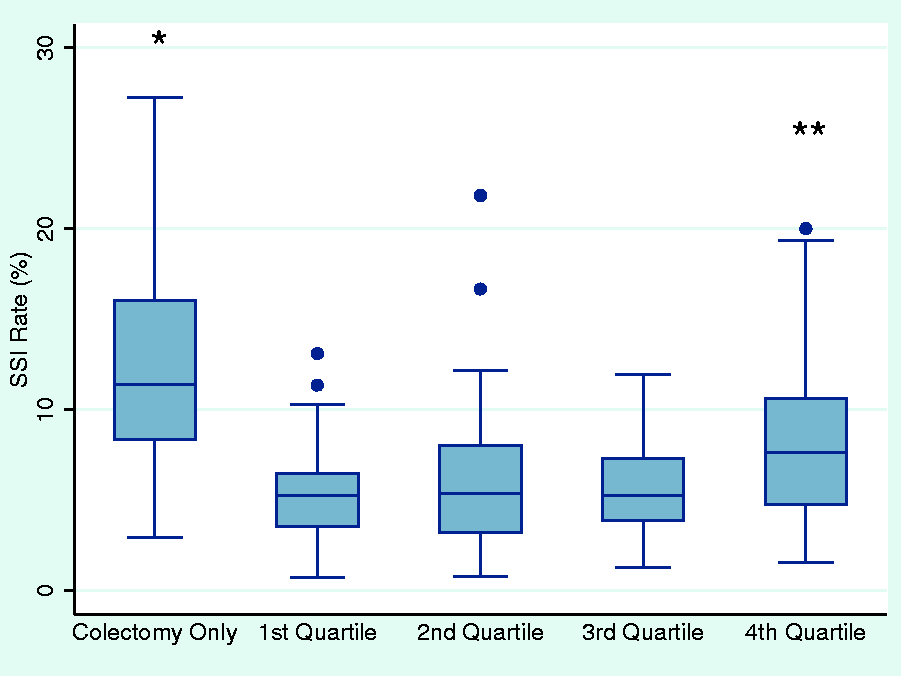
Hospital SSI rate versus proportion of colon surgeries performed with synchronous liver resection (16 hospitals with zero complex colon surgeries; approximately 82 hospitals per quartile) (National Inpatient Sample, 2007–2013). *Difference in SSI rate (p < 0.001) comparing hospitals performing no synchronous colon–liver resections with those in the highest volume quartile of synchronous colon–liver resections. **Difference in SSI rate (p < 0.001) comparing hospitals performing the lowest volume quartile of synchronous colon–liver resections versus those in the highest.
Simple linear regression demonstrated a 2.3% increase in a hospital’s SSI rate for each 1% increase in the proportion of multivisceral resections performed (Figure 2). Multivariable linear regression demonstrated a preserved association when controlling for other hospital- and patient-level predictors (Table 1). Examining hospitals by proportion of multivisceral resections quartile shows that institutions performing the most multivisceral resections had significantly higher SSI rates (p < 0.001, Figure 1).
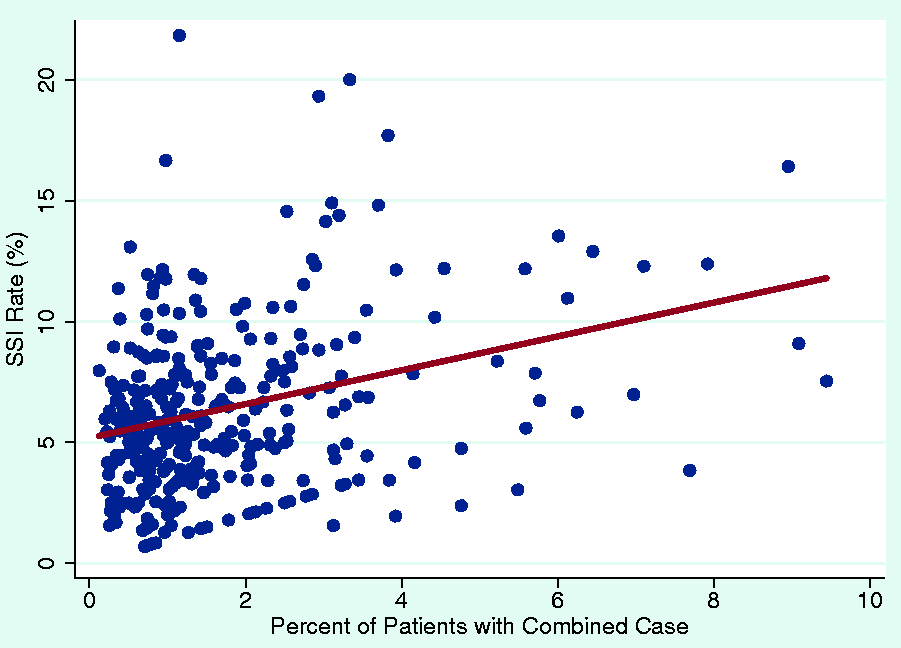
Hospital-level SSI rate versus proportion of colon surgeries performed with synchronous liver resection (excluding hospitals that performed zero complex colon surgeries) (National Inpatient Sample, 2007–2013). Note: Volume-weighted linear regression overlay (red) of SSI rate on proportion of synchronous resections for 329 hospitals performing at least one combined colon–liver resection.
Multivariable linear regression of hospital-level surgical site infection rates on proportion of colon surgeries performed with synchronous liver resection (n = 329 hospitals; National Inpatient Sample, 2007–2013).

Discussion
The purpose of this study was to identify if an association exists between surgical complexity and SSI rates that may have health policy implications and affect healthcare decision-maker incentives. We used combined liver–colon surgical resections as an example of complex surgery that is readily identifiable in administrative data but not currently used in the NHSN risk-adjustment models. We demonstrated that this form of surgical complexity and casemix varies by hospital and that the proportion of these surgeries performed is associated with increasing SSI rates in an incremental manner. When comparing the potential contribution of complexity to SSI rates, we demonstrated that the proportion of synchronous liver resections in colon surgery contributed more to predicting an institution’s SSI rate than any other variable tested. Because NHSN’s SIR standardization method does not incorporate a similar variable, VBP programs may unfairly penalize hospitals performing combined liver–colon resections and potentially other complex surgical procedures as well.
NHSN-based comparisons of SSIs among hospitals can result in substantial financial penalties and reputational harm. 2 Although SSIs measured through NHSN are often described as “risk adjusted,” the risk adjustment is limited to select, easily available variables such as procedure category (e.g. colectomy versus hysterectomy) and a handful of diagnostic codes (e.g. diabetes). In comparison, even some of the most simplified risk assessment tools used in clinical practice recognize highly influential risk factors excluded from current SSI reporting (e.g. smoking, single versus multiple procedures).10,11 The existing literature supports a notion that surgical complexity may contribute to higher SSI rates.
Our findings suggest that current SSI reporting challenges the fairness of hospital-to-hospital comparability. VBP payments may unintentionally dissuade hospitals from providing complex surgical procedures to patients with specialized needs. Under current financial penalties with limited adjustment of public SSI reporting, healthcare decision-makers are incentivized to limit access to care and avoid offering high-risk surgeries that current clinical guidelines routinely support as standard of care. 12 Patients needing a multivisceral resection may be led to select a hospital with a better reported SSI rate performance over a high-volume center that may produce better short- and long-term outcomes for their specific care needs. 13 SSI pay-for-performance policies would benefit from a more nuanced approach that appreciates the differences in procedural complexity between types of colectomies, incorporates casemix adjustment and/or excludes unique, high-complexity procedure types such as multivisceral resections. Importantly, such an improvement on existing adjustment models would require little more than an additional procedure code transferred to standard NHSN reporting forms without the need for interpretation, additional chart abstracting, or complex analyses.
Our study is not without limitations. First, we used administrative data to identify SSIs which inherently limit SSI event ascertainment and do not perfectly mirror SSIs captured through NHSN practices. For example, we found a median SSI rate among hospitals performing multivisceral resections to be 2.3% while predicted SSI rates following such surgery in clinical databases is typically 15–25%. 4 However, the rates we report are consistent with those seen in previous NIS-based investigations documenting only inpatient occurrences. 14 One reason for this reduced SSI rate may be a bias in administrative data to capture only the most clinically significant SSIs. 15 This under-coding is inherent to the NIS, and likely not differential by hospital. Another limitation of using administrative data is that the NIS only captures inpatient SSIs while NHSN includes post-discharge SSIs as well. We consider it biologically plausible to assume that post-discharge rates of SSIs are likely to be proportionately similar between hospitals compared to their inpatient rates. In other words, the magnitude of a hospital’s total SSI rate will certainly be higher when incorporating post-discharge events, but it is unlikely that the relative increase compared to inpatient rates would be different by hospital.
Second, we used narrow inclusion criteria for our definition of “multivisceral resection” and use of these cases to discuss “surgical complexity.” While there is little debate that combined liver–colon resections are “multivisceral” and “complex,” these findings may not extrapolate to other complex surgical procedures. The significance and impact of this work are not to suggest that all surgical complexity requires special consideration in VBP programs, but instead our findings are meant to spur further inquiry to a high-impact and relatively low-effort gap in current SSI and other outcome-based risk-adjustment models. It is likely that including other combined resections would increase the effect size difference observed due to the increased complexity and uncommon nature of other organ involvement. For similar reasons to improve the homogeneity of the surgical population for comparison purposes, we also excluded emergency cases while the NHSN data include these cases. These findings highlight that current risk adjustment is inadequate and risks discrediting a payment model that is well founded but may be ineffectively implemented. 16 We more effectively demonstrated this vulnerability using combined liver–colon procedures as a test case, but further analytic work should be performed before comprehensively addressing refinements to existing risk models.
Third, this study was not designed to test the causality of case complexity and increased SSIs. Prior clinically oriented work has already demonstrated this association and provided evidence for causality. 4 Our intention was not to prove causality but to demonstrate the concerning relationship between the number of complex cases performed and an institution’s SSI rate. Given prior work suggesting causality, re-demonstrating this trend through a hospital-level analysis suggests that hospitals performing the most complex surgery may be unfairly penalized for their willingness to take on the toughest surgical cases.
Importantly, none of the limitations outlined above affect our principal conclusion that inter-hospital comparison of SSIs is inherently unfair when surgical complexity is not accounted for. While these limitations should be evaluated further through additional analyses including the use of currently unavailable NHSN data, we believe that our analysis demonstrates a potential flaw in current VBP practices.
Pay-for-performance programs that include SSIs would benefit from a more nuanced approach that appreciates the differences in procedural complexity between types of colectomies, incorporates casemix adjustment and/or excludes unique, high-complexity procedure types such as multivisceral resections. Importantly, such an improvement to existing risk-adjustment models would require little more than an additional procedure code transferred to standard NHSN reporting forms without the need for interpretation, additional chart abstraction, or complex analyses.
Conclusions
A hospital’s rate of SSIs is positively associated with the proportion of multivisceral resections performed. Current financial incentives for SSIs do not adjust for surgical complexity even though procedural codes distinguishing cases by complexity are easy to obtain. VBP programs should assess the addition of readily available data for improving risk-adjustment models.
Footnotes
Declaration of conflicting interests
The author(s) declared the following potential conflicts of interest with respect to the research, authorship, and/or publication of this article: Pronovost reports consultancy fees from the Association for Professionals in Infection Control and Epidemiology, Inc., grant or contract support from the Agency for Healthcare Research & Quality, National Institutes of Health, Robert Wood Johnson Foundation, Patient Centered Outcomes Research Institute, and The Commonwealth Fund, honoraria from various hospitals and the Leigh Bureau (Somerville, NJ), and royalties from his book, Safe Patients Smart Hospitals. Haut was the paid author of a paper commissioned by the National Academies of Medicine titled “Military Trauma Care’s Learning Health System: The Importance of Data Driven Decision Making” which was used to support the report titled “A National Trauma Care System: Integrating Military and Civilian Trauma Systems to Achieve Zero Preventable Deaths After Injury.”
Funding
The author(s) disclosed receipt of the following financial support for the research, authorship, and/or publication of this article: Preparation of this manuscript was performed while ILL received salary support from a National Institutes of Health National Cancer Institute T32 training grant (T32CA126607). JA receives salary support from The Leapfrog Group and an AHRQ ACTION III project titled “Quality Safety Review System (QSRS) Pilot Test in Hospitals.” EH receives salary support from a AHRQ R01 grant award entitled “Individidualized Performance Feedback on Venous Thromboembolism Prevention Practice” (5R01HS024547) and a National Institutes of Health National Heart, Lung, and Blood Institute R21 grant award entitled “Analysis of the impact of missed doses of venous thromboembolism prophylaxis” (1R21HL129028). EH is primary investigator of two contracts from the Patient-Centered Outcomes Research Institute (PCORI) titled “Preventing Venous Thromboembolism: Empowering Patients and Enabling Patient-Centered Care via Health Information Technology” (CE-12–11-4489) and “Preventing Venous Thromboembolism (VTE): Engaging Patients to Reduce Preventable Harm from Missed/Refused Doses of VTE Prophylaxis” (DI-1603–34596).