



Abstract
This article draws on an evaluation of the effectiveness of the Nurturing Attachments group work program provided by AdoptionPlus for adoptive families in England. Twenty-nine adoptive families participated in a longitudinal quantitative study, completing questionnaires and validated measures before and after group attendance. The Nurturing Attachments program, informed by Dyadic Developmental Psychotherapy, was developed to help foster and adoptive parents strengthen their relationships with the child and support children who had experienced developmental traumas. Most parents were caring for children who were late placed and who had complex and overlapping difficulties. Post-training, parents reported increased confidence in their own parenting and statistically significant positive changes in self-efficacy and in their capacity for reflective functioning. However, unexpectedly, adoptive parents identified more children as having greater emotional and peer difficulties and fewer with symptoms of conduct disorders. This article focuses on the relationship between perceptions of adopted children’s behavior and parental reflective functioning (PRF) and self-efficacy. It explores whether improved reflective functioning, particularly curiosity, led to a better understanding of their child’s behaviors and thus an increased recognition of emotional distress. Recommendations for supporting adoptive parents, including the importance of supporting PRF, within a wraparound package of support during childhood and adolescence are made.
In 2018, 3,820 children were adopted from care in England (Department for Education [DfE], 2018). The majority of these children were taken into care due to maltreatment and exposure to domestic violence and experienced two or more foster placements prior to adoption (Selwyn et al., 2015). Complex or developmental trauma can result from these damaging early experiences (van der Kolk, 2005), the impact of which can detrimentally affect children’s emotional regulation, their sense of self, and their ability to form secure attachments (Hewitt, Gurney-Smith, & Golding, 2018; Ibrahim, Cosgrave, & Woolgar, 2018; McCrory, De Brito, & Viding, 2010; Tarren-Sweeney, 2013a), with concomitant risks of psychological and relationship difficulties. Parenting needs to be adapted to the needs of the child to counter this impact and to increase the child’s security of attachment (Dozier & Rutter, 2016). Parental commitment, sensitivity, nurture, and the ability to take into account the attachment needs of the child are all seen as important characteristics of successfully parenting adopted children (Dance & Rushton, 2005). Sensitive parenting is thought to increase feelings of safety and connectedness, which is important for children who have experienced developmental trauma or instability earlier in life. Addressing the impact of developmental trauma is crucial, both for the child and their adoptive parents, to improve immediate and long-term well-being (Cook et al., 2005).
The challenge to felt security that adopted children experience stemming from adverse early life experiences and multiple losses should not be underestimated. Increases in security will be influenced by many factors such as the management of transitions from foster to adoptive placement, the child’s experience of parenting (both pre- and post-adoption), and the child’s degree of neurodevelopmental difficulty. Adoptive parents need to parent these children in a way that will help the children heal from their trauma. Therapeutic parenting, informed by Dyadic Developmental Psychotherapy and Practice (DDP; Hughes, 2017), combines ordinary parenting, including love and nurture, behavioral support, and guidance, with parenting behaviors aimed at emotionally connecting with their children. The aim is to increase feelings of security for the children and to provide them with a home environment within which healing can occur (Golding, 2008, 2017).
However, adoptive parents may be vulnerable to experiences of blocked care and compassion fatigue (Hughes & Baylin, 2012), depression, and feeling emotionally overwhelmed by the enormity of the task that they have undertaken. Risk of adoption breakdown is relatively low at 3.2%, but about a third of adoptive parents struggle with children’s challenging behavior and mistrust from their children, which can become particularly pronounced during the teenage years (Selwyn et al., 2015). Being an adopted teenager presents one of the biggest risks for breakdown (Palacios, Rolock, Selwyn, & Barbosa-Duchane, 2019). It is essential that parents have ongoing support to develop their parenting skills, alongside targeted help for the children, during their adoption journey. Increased reflective functioning and parental self-efficacy, developed through engagement with a group work program, may contribute to increased placement stability for adopted children.
Previous studies have demonstrated that the Nurturing Attachments intervention, which aims to increase reflective functioning and parental self-efficacy, is of clinical benefit with foster carers, but it has not been applied solely to an adoptive carer population until now. This article adds to the evidence on the impact of the program on adoptive parents, in particular focusing on the impact of increased reflective functioning on perceptions of children’s behavior. The research contributes toward improving the support available to adoptive parents.
Reflective functioning and parental mentalizing
Reflective functioning or mentalizing refers to an individual’s ability to hold others’ minds in mind (Bateman & Fonagy, 2012; Luyten, Fonagy, Lowyck, &Vermote, 2012). This capacity allows individuals to perceive both the self and others in terms of mental states, thereby making them meaningful, understandable, and predictable. The capacity for reflective functioning is therefore believed to be key to our ability to navigate the social world (Luyten et al., 2012) and its lack to lie behind impairments in parenting. Parental reflective functioning (PRF), or parental mentalizing, refers to a parent’s capacity to reflect on both their own and their child’s internal mental experiences (Cooper & Redfern, 2016; Luyten, Nijssens, Fonagy, & Mayes, 2017), and how these might influence behaviors (Redfern, Wood, Lassri, & Cirasolla, 2018). PRF is thought to be important in helping children develop their own mentalizing skills, which in turn facilitates emotional self-regulation, the development of a sense of agency, and secure attachment (Cooper & Redfern, 2016; Fonagy, Luyten, & Allison, 2002; Luyten et al., 2017) areas that maltreated children often struggle with. It may be a mechanism which explains associations between attachment, challenging behavior, and placement stability (Redfern et al., 2018).
PRF can range from being deficient (limited, concrete, and stimulus-bound reflective functioning) to excessive (undue certainty, distorted, and intrusive reflective functioning). Impairments in PRF are associated with insecure attachment in children and disrupted maternal behavior, for example, caregivers being overly certain about their child’s mental states, making malevolent attributions and being unable to enter into the child’s internal world (Luyten et al., 2017). Conversely, recognizing the opacity of mental states and showing a genuine interest and curiosity in the internal world of the child are considered to be the hallmarks of genuine PRF (Luyten et al., 2017). In a review of studies, Camoirano (2017) found that PRF was associated with the quality of caregiving and the children’s level of attachment security and that maternal mentalization promoted the children’s capacity for emotional regulation. Less is known about the impact on paternal caregiving.
There is some evidence that foster carers are particularly vulnerable to breakdowns in mentalizing, relating to both the carers’ past experiences and the challenges presented by the child (Hannah & Woolgar, 2018; Ottaway & Selwyn, 2017). Foster carers can be challenged by parenting children with insecure attachments, leading toward a tendency for hypermentalizing (Bernier & Dozier, 2003). It is likely that the same difficulties will affect adoptive parents who face similar behavioral challenges. Conversely, high levels of reflective functioning in foster and adoptive parents might increase resilience to the challenging and rejecting behaviors of the children and reduce the risk of blocked care that can threaten placement stability (Bateman & Fonagy, 2012; Redfern et al., 2018).
There is a growing interest in the impact of interventions aimed at strengthening mind-mindedness and PRF in foster carers. Recently, preliminary findings of an evaluation of a mentalization-based family therapy service with adoptive parents reported a positive impact on parental efficacy but not on parental mentalization (Midgley, Alayza, Lawrence, & Bellew, 2018). There is some evidence that a group-based psychoeducation intervention with foster/adoptive parents who were parenting young children (mean age 5 years 5 months) was successful in increasing mentalization scores (Bammens, Adkins, & Badger, 2015).
This article aims to explore whether the Nurturing Attachments group work program, designed to provide support and guidance to parents and carers of children who have experienced developmental trauma and attachment difficulties, influenced parental mentalization and PRF.
Nurturing Attachments group work program
The Nurturing Attachments program, informed by the DDP model, is an 18-session group work program that has its foundation in an understanding of child development and the impact of developmental trauma on children. The program includes an understanding of how attachment and intersubjective relationships form, so that children can experience attachment security and are able to enter into reciprocal relationships. Parents are introduced to the theoretical foundations of the parenting ideas that they will explore, through the “House Model of Parenting.”
Within the “House Model of Parenting,” there is a focus on providing secure foundations with close attention given to the parent–child relationship. The aim is to help children experience increased security by reducing their fears and lack of trust in parents. It is hoped that this will impact positively on the children’s behavior, although this is not a primary aim. In particular, parents are encouraged to understand the internal experiences underlying children’s behavior. Such understanding informs a slowing down in parenting within which parents are encouraged to emotionally connect with the children alongside providing empathic behavioral support (Golding, 2017). Within the Nurturing Attachments program, parents are enabled to develop these skills matched to the emotional, relationship, and behavioral needs of the children. In order to do this, parents are introduced to the concepts of reflective functioning, mentalization (mind-minded parenting), and emotional regulation, which facilitate more open and engaged emotional connection with their children. This rests on the premise that security is increased for developmentally traumatized children when parents are able to emotionally connect with them and their internal experience of thoughts, feelings, worries, and beliefs. The child discovers that their internal experience is accepted without conditions, providing them with the unconditional love missed in their earlier experiences.
Emotionally connecting with the child is helped when parents implement the PACE attitude: a way of being which demonstrates a playful joy (P) in the relationship with the child, is curious (C) about the child’s internal world, and communicates this understanding through acceptance (A) and empathy (E) (Golding & Hughes, 2012; Hughes, Golding, & Hudson, 2019). Parents are also encouraged to notice and repair ruptures to the relationship when their PACE attitude is inevitably challenged during day-to-day parenting. At these times, the parents may become more defensive thus reducing the emotional connection with their child. Restoring the emotional connection helps the children to recognize that the relationship is valued, increasing their feelings of security with their parents. Finally, parents are helped to combine PACE with empathic behavioral support, guiding and encouraging prosocial behaviors within the child while ensuring that emotional connection is maintained. Thus, parents are encouraged to support positive behaviors but within the much broader context of building children’s trust and security and enhancing their development, such that discipline is informed by empathy and connection.
In order to parent with an attitude of PACE, parents need good reflective functioning. Throughout the program group members are encouraged to reflect on their parenting of their child/ren, utilizing reflective diaries and within session reflections guided by the group facilitators. They are asked to reflect on the impact that the child is having upon them as well as the underlying reasons for the behaviors that their child is displaying. This increases self-understanding, as well as understanding of the child. As parents become more understanding of their own internal experience of fears, doubts, worries, and hopes, they may be better able to regulate this emotional experience. It is hoped that they will be able to focus on their child’s internal experience, supporting the child to emotionally regulate and to better make sense of their own behaviors. This can strengthen the relationship between child and parent with a positive benefit on behavior. Parents are also guided to attend to their own self-care and social support, in the belief that this will further enhance the emotional regulation parents need for therapeutic parenting utilizing a PACE attitude, enhanced by effective reflective functioning.
Previous research
Some small-scale evaluations (Golding & Picken, 2004; Gurney-Smith, Granger, Randle, & Fletcher, 2010; Laybourne, Andersen, & Sands, 2008) have been undertaken of the Fostering Attachments program, the precursor to Nurturing Attachments. The standardized measures used in some of these evaluations showed some small statistically significant differences after receiving the program, although sample numbers were small and it is likely that there was insufficient power to detect change. The qualitative accounts of participants consistently described high levels of satisfaction, increased understanding of difficulties, greater mentalization, and lower parental stress. One larger evaluation (Wassall, 2011), using an intervention versus waiting list comparison group, found that carers’ sense of competence and confidence improved immediately after and 8 months following the program, with self-efficacy increased at follow-up. However, other outcome measures such as parents’ capacity for mentalization, their stress levels, children’s emotional and behavioral difficulties, and relational security showed no improvement.
Based on this body of research, the Nurturing Attachments program is categorized as research-based in a review of post-adoption support interventions (Stock, Spielhofer, & Gieve, 2016). However, a systematic review (Kerr & Cossar, 2014) of attachment interventions (including Nurturing Attachments) with foster and adoptive parents found that the evaluations were generally of poor methodological quality and that some measures had been scored differently by evaluators making comparison between study findings difficult. Overall, Kerr and Cossar (2014) concluded that, while the Nurturing Attachments program showed some promise, the quality of the evidence base was currently too limited to make conclusions regarding the program’s efficacy. Nevertheless, the program is regularly commissioned by local authorities and remains popular with carers.
An opportunity arose to test the effectiveness of the program when the DfE provided funding for the Nurturing Attachments program to be delivered in four English regions to adoptive parents. A small grant was provided for evaluation and this article draws upon those findings.
Method
The program was delivered in three modules of six 3-hr sessions occurring weekly during term time. The trainers were experienced adoption social workers, therapists, or clinical psychologists; all were trained by the author of the program to ensure consistency in content delivery. The evaluation used a pre-/post-method with questionnaires completed by parents before and after the training program had been completed. Ethical approval for the study was granted by the School for Policy Studies, University of Bristol.
Aims
The evaluation aimed to examine whether the program: increased parents’ reflective functioning; affected parents’ sense of self-efficacy and improved their well-being; improved communication within the family; and changed parents’ reports of closeness and conflict with their child.
Sampling
A total of 79 parents applied for a place on the training program, which was advertised via adoption managers from the four areas, through social media and advertised on the Adoption U.K. website. On a “first come first served” basis, 67 parents were allocated a place in a group geographically nearest to them. Due to withdrawals before (16 parents) and during (3 parents) the program, 48 parents (representing 44 families) completed the program. All the families were given information about the evaluation and 34 families (77%) gave written consent. Two families did not complete the training and a further three families did not return the questionnaires at the end of the training program. Therefore, the final sample was 29 families representing 71% of the families who had completed the program. These same 29 families were invited to participate in a follow-up 7–8 months after the end of the program and 18 families (62%) completed the post-training questionnaires again (Time 3)—the implications of this relatively small sample are discussed later. Additionally, eight of the parents were randomly selected to participate in a qualitative analysis of their experience upon completion of the program; the findings of these interviews are reported elsewhere (Hewitt et al., 2018).
Previous studies have been limited by the absence of a matched control group and it was hoped that the methodology for this evaluation would include one, but additional funding for a control group only became available after the training groups had started. Parents on the waiting list were contacted and 12 agreed to participate. Unfortunately, because parents had not been randomly allocated to either the training or control group, the waiting list parents and their children were significantly different from those undertaking training: Their children were younger and had been in placement for a shorter time. Therefore, no meaningful comparative analysis could be conducted.
Measures
To begin the evaluation, a logic model was created, which informed the choice of measures to assess parent and child well-being and family functioning (Figure 1). To measure whether parents achieved their own goals and valued the training, two tools were used: Goal-based Outcomes (Law & Jacob, 2015) and the Group Session Rating Scales (Duncan & Miller, 2007). Score 15 (Stratton et al., 2014) measured changes in family communication, the Assessment Checklists short form (Tarren-Sweeney, 2013b) measured child mental health, and the Warwick-Edinburgh Mental Well-Being Scale measured parental well-being. The focus of this article is on the results from three additional measures, described in greater detail below.
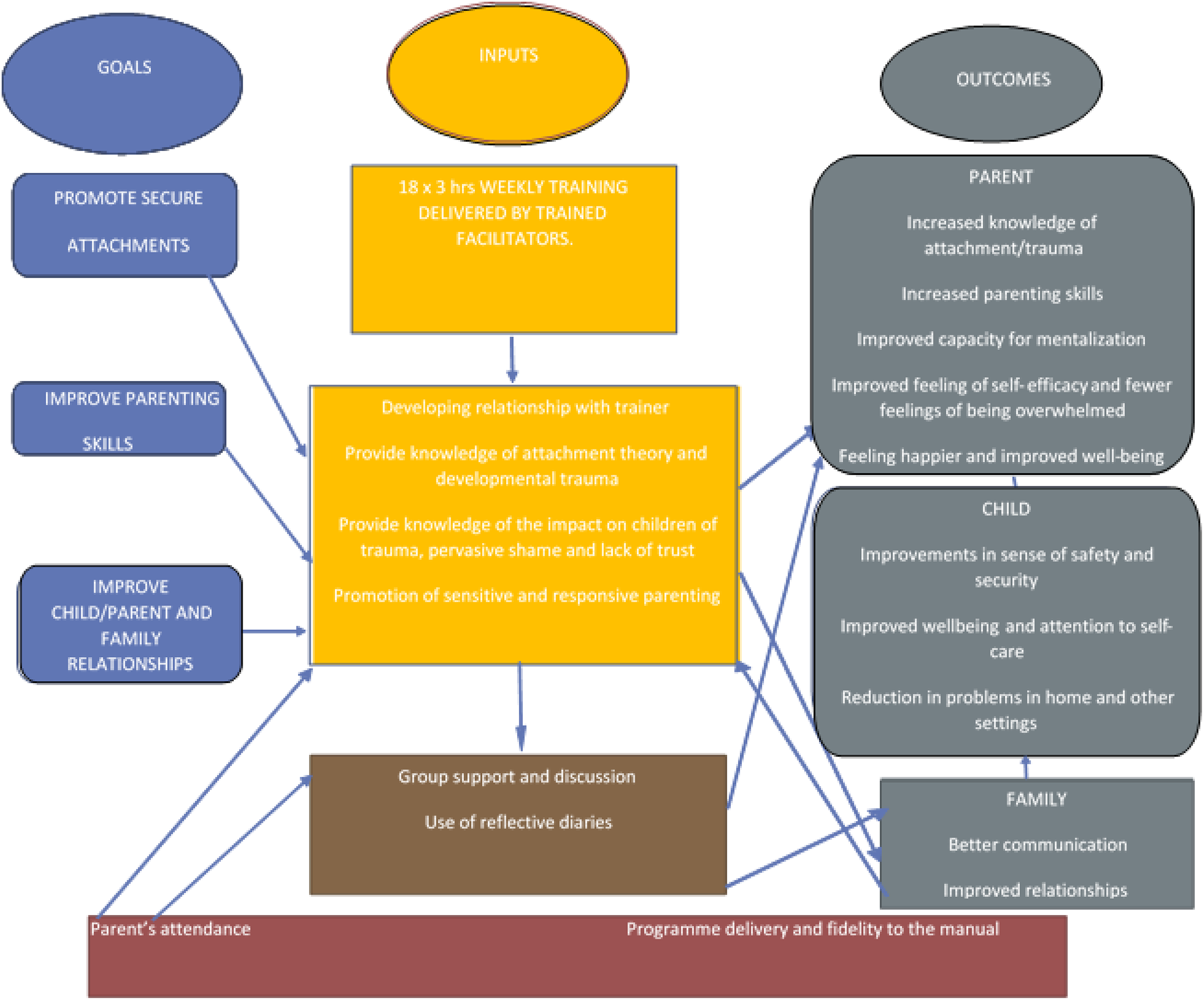
Logic model.
The Strengths and Difficulties Questionnaire (SDQ)
The SDQ is a widely used screening measure of common emotional and behavioral problems (Goodman & Goodman, 2011, 2012). It is highly predictive of psychiatric disorders. It has 25 items that produce a total score which can be divided into five subscales: (1) emotions, (2) conduct, (3) hyperactivity/inattention, (4) peer relationship problems, and (5) pro-social behavior. Internal validity was very good with a Cronbach’s α of .794.
Parental Reflective Functioning Questionnaire (PRFQ)
The PRFQ is designed to assess PRF and asks parents whether they agree or not, on a 7-point scale, with a set of statements (Luyten et al., 2017). The PRFQ contains 18 items and produces a total score and three dimensions of reflective functioning. Each dimension has 6 items and a mean score for each.
Mentalizing
This domain measures the parent’s ability to enter the child’s subjective world. An example statement is, “My child cries around strangers to embarrass me.” Cronbach’s α = .617.
Certainty about mental states
This domain measures the tendency of parents to be overly certain or completely uncertain about the mental states of their child. Example statements are, “I always know what my child wants” and “I believe there is no point in trying to guess what my child is feeling.” Cronbach’s α = .860.
Interest and curiosity in mental states
This domain quantifies the degree of interest a parent has in their child’s mental states and can range from a total lack of interest to intrusive hypermentalizing. An example statement is “I like to think about the reasons behind the way my child behaves and feels.” Cronbach’s α = .676.
Brief Parental Self-Efficacy Questionnaire (BPSES)
The BPSES is a 5-item scale that asks parents how much they agree or disagree with five statements (Woolgar et al., 2013). An example statement is, “Even though I may not always manage it, I know what I need to do with my child.” It has a single dimension that assesses parental confidence in their ability to parent their child. It has a minimum score of 5 and maximum of 25. The scale had a high level of internal consistency, as determined by a Cronbach’s α of .752.
Procedure and data analysis
The measures were inserted into a questionnaire that also contained demographic questions about the parents and children, including the age of the children and age at adoption. The questionnaire was posted to parents before the training began (Time 1), immediately following the end of the training program (Time 2), and again 7–8 months later (Time 3). Analysis was conducted in SPSSv24 using frequencies, paired t tests to examine change and Pearson or Spearman to examine correlation coefficients. Effect sizes were calculated using Cohen’s d.
Results
The majority (93%) of the parents who had attended the program were White: Two parents (6%) were of minority ethnicity. Most parents (70%) were married, 20% were single parents, and 10% were cohabiting. Parents were caring for 49 adopted children: 25 boys and 24 girls. Seventeen parents had more than one adopted child and 12 parents were caring for a single child. Forty-four (90%) children were White British and 5 (10%) were of minority ethnicity. Twenty-three percent of the children had been 4 years or older at entry to care.
At the time their parents began the program, the children were aged between 18 months and 17 years old (mean 8 years, SD = 3.57). One child was under 2 years old at the start of the training program and therefore was outside the age range of some of the chosen questionnaire measures. Importantly, the children were adopted, on average, at older ages (mean 52 months) than the national averages (mean 40 months; DfE, 2017). The children had also experienced more delay between entry to care and their adoption order: The average time between entry to care and the making of the adoption order was 32 months (SD = 12.70), compared with the national average of 24 months (DfE, 2017). Research (e.g., Palacios et al., 2019) has consistently found that being older at entry to care or at placement increases the risk of emotional and behavioral difficulties and the risk of disruption.
The experience and impact of the Nurturing Attachments program
Due to the relatively small number of questionnaires returned at Time 3, the following section focuses primarily on changes at Time 1 and Time 2. Nonetheless, having a longer term follow-up is a strength of this study and tentative findings are presented later.
PRF (n = 48)
Parents competed the PRFQ on each child before and after training. A paired-samples t test was used to determine whether there was a statistically significant mean difference in scores over time. The assumption of normality was not violated, as assessed by the Shapiro–Wilks’s test (p = .306). Post-training, there was an increase of 0.64 (95% CI [0.240, 1.045]) in the total score on this measure (Table 1).
Parental reflective functioning scores pre-/post-training n = 48.
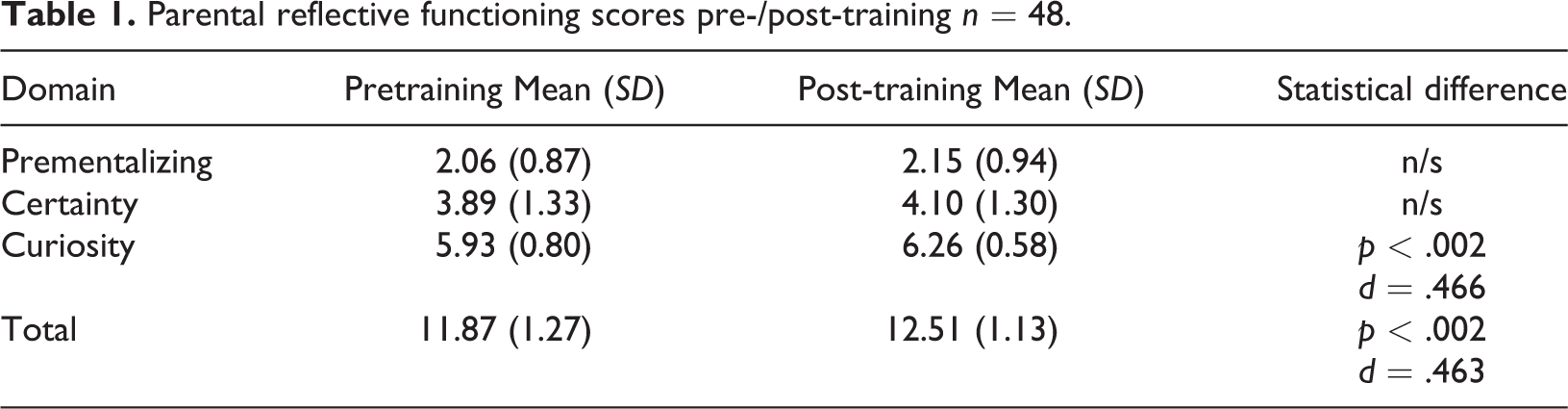
The total PRFQ score was significantly higher post-training compared with pretraining with Cohen’s d showing the change to have a small effect size. The change in total score was mainly due to a positive change in the interest and curiosity in the child’s mental states.
In the free-text comments, parents commented on how they were more aware of their child’s feelings and behaviors. For example, parents wrote that the training had enabled them to: “see my son’s behaviour through fresh eyes” … “feel more connected to our children.”
The Brief Parental Self-Efficacy Scale (n = 29)
Pretraining, the mean score for parents was 18.41 (SD = 2.93); there was a statistically significant increase to 20.21 (SD = 2.83) post-training, t(28) = 3.176, p = .002. Parents were feeling more effective in their parenting following attendance at the group and had a higher level of confidence in their parenting. There was a moderate effect size (d = .743). Parents wrote: “[I have] more empathy and feel more confident”…“It has completely changed the way I parent my children.”
The children’s strengths and difficulties (n = 48)
Parents completed the SDQ in respect of 48 children. Pretraining 55% of the children had total scores that were in the high or very high category in comparison with about 13% of the general child population (Office for National Statistics, 2016). When taking account of sibling groups, only seven parents were not caring for an adoptive child with a high or very high score on the SDQ. Sixty-one percent of parents reported that the child’s difficulties had a high or very high detrimental impact on their family life. Surprisingly, the total scores increased post-training, especially scores in the domains of emotional distress and peer problems (Figure 2).
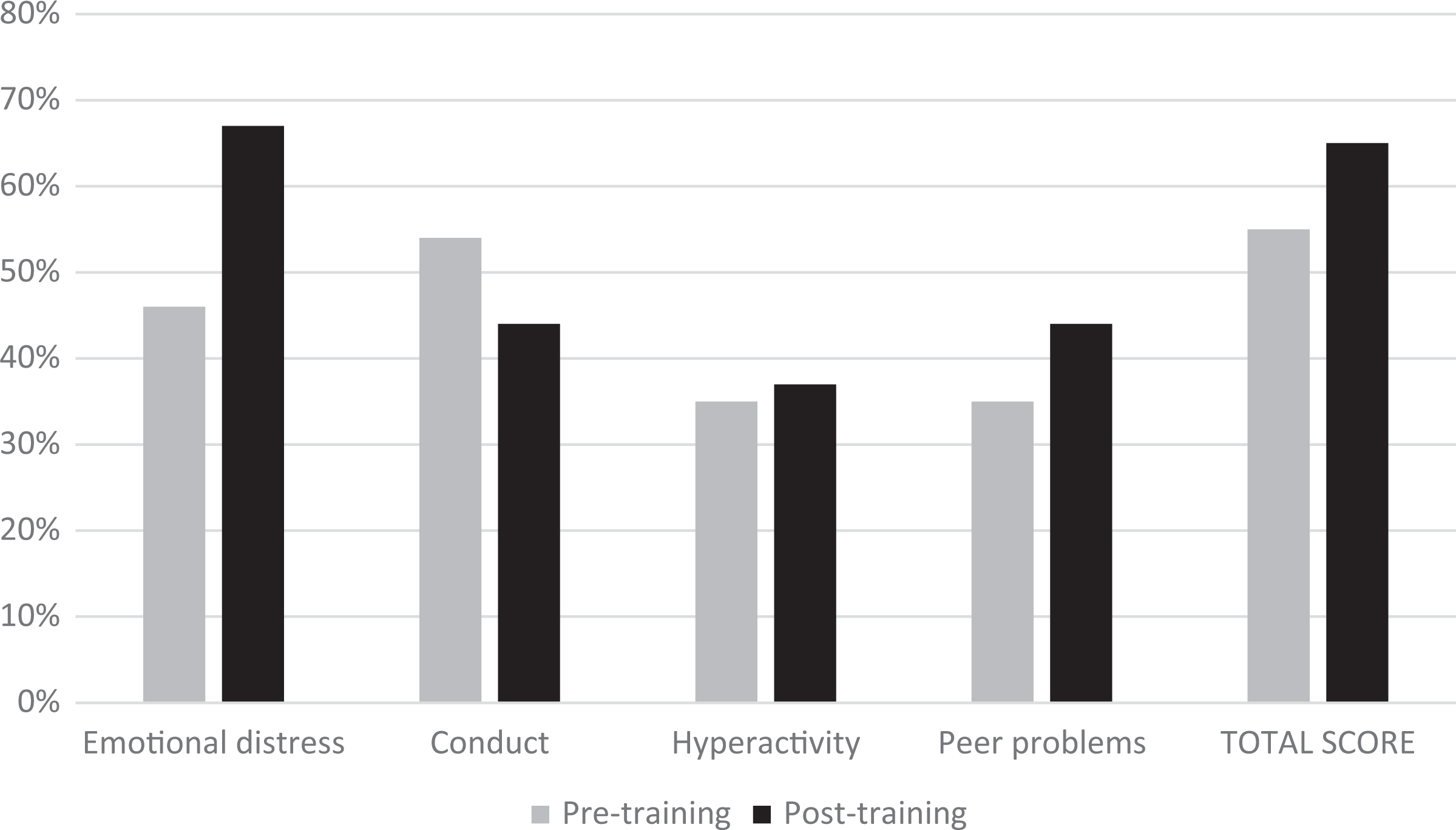
Proportion of children with high scores on the SDQ by domain of difficulty (n = 48).
Ratings of symptoms of hyperactivity remained similar, but symptoms of conduct problems decreased. There was no significant change in parental reports of the impact on their family life of the child’s behaviors. Participants reported that the detrimental impact of their children’s behavior on family life remained high, although in response to a question that asked, “Since coming to the group have the child’s difficulties got better, stayed the same, got worse?” 45% of the children were reported as having improved. Attending the training program appeared to help parents cope better with the impact of the children’s challenging behavior and emotional distress with 77% indicating that the group had helped “a great deal.” Text comments included: “Calmer household…Helped me understand my son better” and another parent wrote: “100% impact. I can cope, notice changes and support my son.”
Follow-Up—Time 3
A follow-up was conducted 7–8 months after the training had ended. Twenty-nine families were invited to participate in the follow-up and 18 (62%) parents who were parenting 29 adopted children returned the questionnaire. There was a tendency for families with most difficulty preintervention to have returned questionnaires and those with fewer difficulties not to respond. Therefore, conclusions can only be tentative.
The follow-up results suggest that the adopted children had high levels of difficulties that continued, despite the parents being supported to adopt a therapeutic parenting model. Examining the total SDQ scores for the 29 children: Thirteen (45%) children’s scores were in the “very high” category at each of the three time points. Five (17%) children’s scores had deteriorated immediately after the training finished but by Time 3 had reverted back to where they were at Time 1 to either “slightly raised” or “close to average.” Four (14%) children’s scores had improved placing them in the “slightly raised” or “close to average” bandings. Four (14%) children’s scores had deteriorated and were in the “high” or “very high” banding. Three (10%) children had “close to average” scores at each of the three time points.
Examining scores on the PRFQ, there was no statistically significant change between Time 2 and Time 3. At Time 3, parents recorded some improvement in reflective functioning for 20 children, but reflective functioning decreased in respect of 6 children: Five of these children were a child in a sibling group. There was no correlation between the parent’s PRFQ score and their child’s SDQ score at any of the time points. The BPSES scores also decreased for five parents (two of the five also reported lower PRF scores), rose for eight, and remained the same as at Time 1 for the remaining five parents.
When the follow-up results were considered overall, it was apparent that those who responded at Time 3 divided into three groups: a group of six parents who reported continued difficulties, with these difficulties being the same or worse compared with when they began the intervention; nine families who reported some continuing small improvements; and three families who had sustained the gains made at the end of the intervention but had not improved further.
Discussion
Although the questionnaire return rate was good, the study involved a small sample of only 29 families (71% of families who completed the training program); 18 of these families (62% of families who completed the training program) also completed the questionnaires at Time 3. There was no control group, and therefore, firm conclusions attributing change to the group intervention cannot be made. However, some findings replicate a previous study (Wassall, 2011) where a waiting list comparison was used. Compared with the waiting list respondents, group members reported increases in their sense of competence and confidence immediately after and 8 months following the program, with self-efficacy increased at follow-up. This adds support to the conclusion that the intervention does lead to increased self-efficacy in the parents.
The results of the questionnaires demonstrated that over four fifths of the parents found the group to be of value and to be effective, with a statistically significant positive impact on self-efficacy and reflective parenting. However, as with previous evaluations, parenting the children remained challenging. The children had many long-standing, complex, and overlapping difficulties and it is unsurprising that the training on its own did not result in significant behavioral change in the children. It is therefore of interest that the majority of parents reported finding the intervention supportive and as having a positive impact on themselves and their families. Possible explanations for these findings are considered below.
The children’s high scores on the SDQ before training began were not unexpected especially as the children were older on average at the time they were adopted and experienced more delay than most adopted children. However, it was not expected that scores would rise post-training—from 55% to 65% of the children’s scores being in the high or very high bandings. There are three possible reasons why this change in parental reports occurred. First, it is possible that, without a child specific intervention and as children grew older, their difficulties became more pronounced and their behavior deteriorated. This is unlikely, however, given that there was only 7 months between the SDQ completion at Time 1 and Time 2.
Second, paradoxically, it may be that the changes in parenting style caused some children’s behavior to deteriorate. A few parents commented that their new focus on parenting with PACE had resulted in children finding the new style unsettling. For example, one parent wrote: What I’ve learnt on the course has helped me be much happier and to deal with behaviour more positively. This has freaked him [child] out as he can’t cope with happy fun or love. This has resulted in a major increase in behaviour.
The ability to mentalize has been explored in previous studies of the program via parental descriptions rated for mind-mindedness. A study by Wassall (2011) found no changes in ability to mentalize pre- and postgroup. As a response to that finding, changes were made to the delivery of the program to pay more attention to the parents’ reflective functioning (Golding, 2014). In particular, group facilitators were advised to actively encourage the group members to use reflective diaries, to spend time at the beginning of each session exploring these reflections, and to explicitly model reflection during the delivery of the program. It is therefore of interest that a statistically significant increase was seen in parents’ curiosity and interest in their child’s mental states. Further research is needed to explore whether changes in mentalization are consistently found with the revised delivery of the program.
An improved mentalization ability might lead to increased understanding of the emotional distress underlying children’s behavior, including understanding why the children’s behavior was—and might continue to be—challenging. Curiosity is one of the key components of the attitude of PACE, so it was pleasing to see the scores in this area of the PRFQ increase. It is likely that greater understanding would lead to a greater sense of parental self-efficacy. It might help explain why parents can find an intervention to be supportive and helpful, despite challenges from the children remaining.
Clinical experience suggests that children are variable in their responses to a parent holding the attitude of PACE (Golding, 2017). Some children are open to it immediately and their parents report changes in how close they feel to their children and how their children become calmer. As found in the study, others report the child struggling with the change in parental attitude, experiencing distrust and a sense of “weirdness” about this. These parents need continuing support to maintain the PACE attitude, so that the child can become more comfortable with it over time. Adoptive parents who lack support and who are unable to modify their initial expectations can become more fixed in wanting to mold their child (Moyer & Goldberg, 2017). Those parents who are most disappointed in their child may struggle to maintain the attitude of acceptance of the child’s internal experience, leading to an increase in behavioral challenges from the child and increasing parental stress. These parents need support beyond the group intervention to find ways to implement a PACE attitude fine-tuned to the needs of their individual child and the impact of the child upon the parent. Support is especially needed at times of increased stress when the mentalization of the parent is likely to be most challenged. It has been shown that when stress triggers an adult’s own childhood attachment history that the capacity to mentalize is disrupted (Nolte et al., 2013). Future research should consider the use of adult attachment measures alongside measures of PRF.
Thus, individual responses by children, parental ability to implement the attitude of PACE with or without additional support, alongside the neurodevelopmental challenges that many of these children experience, are likely to mean the impact of the group intervention upon the child’s behavior will be variable, as evidenced in the follow-up data. The variability of responses to the group intervention highlights the importance of individual support for children and parents as well as group support for parents.
The variability of responses is highlighted by results from the follow-up group that revealed that many of the families continued to care for children demonstrating a high level of difficulties. Some of the parents who responded reported reduced feelings of parental self-efficacy and well-being. It may be that these parents faced additional stressors during the follow-up period such as financial problems or a bereavement, or the child’s behaviors may have become more challenging, due to a change of school. PRF decreased for six children. Five of these children were part of sibling groups, perhaps reflecting the increased challenges of caring for more than one child with developmental trauma. It is likely that some parents will need more support to embed the ideas explored within the group into their daily parenting, due to individual differences between parents in terms of how easily they embrace and feel comfortable with different parenting approaches, and their willingness to adopt these within their own parenting style.
It is also important to consider the differences between the children who are the focus of this parenting. Some children will have difficulties beyond the aims of the program. For example, a child with global learning difficulty may benefit from different parenting approaches. Unresolved trauma in the children may affect their experience of being parented, especially in the absence of any child-focused intervention. A parenting program, even when beneficial, is likely to need supplementing with other interventions given the range and depth of the challenges met when parenting children with developmental trauma. Further study would be helpful to enable group and individual interventions to be more tailored to the specific needs of the child and their parents.
Conclusions
The changes reported in the capacity of parents to be curious and interested in their child’s mental state provide evidence that parents thought about their child’s behavior differently. The differing perception of the children, which appeared to move from a focus on behavior to one on internal and relationship experience, may be a reflection of increasing feelings of empathy toward the children. New perceptions may make dealing with the challenges of adoption more tolerable. Additionally, experiencing fewer conduct difficulties and understanding behaviors as an expression of the emotional distress of the children, linked to past experiences, might reduce feelings of failure for the parents. This would explain the increase in confidence and parental self-efficacy that many parents reported following their participation at the Nurturing Attachments group.
However, additional research is needed using larger sample sizes, with randomised controlled trials and/or quasi experimental methodologies. Future research is needed to explore the relationship between mentalization, adult’s own attachment style, perceptions of children’s behaviors, and the quality of the parent/child relationship. This study does demonstrate that the Nurturing Attachments group work intervention can be a useful intervention that should be offered to adoptive families, but the program is not to be viewed as a “quick fix” for adoptive families. Many of these parents will need ongoing support in order to maintain DDP-informed parenting, especially through periods of increased stress. The Nurturing Attachments program is a useful intervention to support adopted parents but is unlikely to meet all the support needs of families caring for this population of children.
Footnotes
Declaration of conflicting interests
The author(s) declared the following potential conflicts of interest with respect to the research, authorship, and/or publication of this article: Kim Golding is the author of the Nurturing Attachments program and training resource.
Funding
The author(s) disclosed receipt of the following financial support for the research, authorship, and/or publication of this article: This work was supported by the Department for Education.
