



Abstract
Foster youth face high risks and poor outcomes after aging out of care resulting in great economic and human costs to society. The purpose of the study was to describe life experiences of children aging out of the foster care system from the perspectives of adults who have successfully navigated this transition. Their life experiences during this period provided meaningful information for this study which helped to identify themes. Their perceptions of the periods during and after their transitions were explored to investigate supportive relationships, education, and workplace stability. Phenomenology was used to describe the experiences of nine young adults who had aged out of foster care. Participant ages ranged from 20 to 25 years old. Audiotaped semi-structured interviews were conducted for the study. Data analysis was ongoing throughout data collection. Four themes were identified: (1) “Facing a transition”; (2) “Depending on adults for help”; (3) “Making a difference for others”; and (4) “Moving forward with my life.” These four themes highlighted the participants’ experiences as they aged out of foster care. This study contributes to our understanding of the life experiences of former foster youth who are successful after the transition out of foster care. Recommendations for practice and research are identified.
Introduction
Caring for youth at high risk for poor outcomes as they age out of foster care can induce great economic and human costs to systems and individuals who are leaving care before, during and after exiting care (Ahrens et al., 2011; Courtney & Dworsky, 2006; Courtney et al., 2005; Dworsky & Courtney, 2010; Hokanson et al., 2018, 2019; Oldmixon, 2007; Verulava et al., 2020). Foster children often experience a poor transition into adulthood.
Prior research and evidence suggest that poverty, early parenthood, and homelessness are among the risks common to this population (Ahrens et al., 2011; Haggman-Laitila et al., 2019; Osgood et al., 2010; Stott, 2013). Despite great economic investment each year by systems, institutions, and other entities within the United States, poor outcomes persist with former foster youth. The situation requires attention and intervention to improve these outcomes for young adults aging out of foster care. Quality of life for this population of youth continues to be problematic. On any given day, approximately 397,000 children live in foster care within the United States (USDHHS, 2012, 2014, 2019); more than 200,000 of this population are between 12 and 20 years of age. Aging out of the foster care system at the age of 21, also known as emancipation, is the goal for approximately 20,000 children annually. Frequently, the day these foster youth turn 21, they are expected to live and function independently as adults. Consequently, the goal of independent living is prevalent among these youth, and ensuring this goal is successfully reached is vital.
With greater knowledge and additional research surrounding the experiences and factors contributing to their successful transition into adulthood, programs can be designed with a focus on such positive predictors and the most cost-effective use of the resources available to support these young adults. The next section will highlight past research that has documented the common outcomes for former foster youth which help to build a foundation to document the current common trajectory of many former foster youth. As a result of this foundational work, future work can build on this work to help support programs to strengthen the transition period as foster youth are aging out of care.
Presenting the current research
Instability has often been noted as a root cause for problems during and after aging out of care (Ahrens et al., 2011; Courtney et al., 2001). Frequent moves while in care, lack of education, and lack of meaningful connections with others have been noted in multiple studies (Ahrens et al., 2011; Courtney et al., 2001). Frequent moves while in foster care may disrupt their connections to family, friends, school, and to society as a whole (Courtney et al., 2001; Koh et al., 2014). Due to the life disruptions of foster care and its long-term impact on normal development, many of these youth do not successfully transition into independent adulthood.
There are many economic costs to society from youth who do not successfully age out of foster care. Costs for supporting youth aging out of foster care have been reported at billions of dollars annually (The Annie E. Casey Foundation, 2013). Yet, little remains known about factors contributing to successful outcomes for this population (Courtney et al., 2001; USDHHS, 2014). Consequently, their reliance on financial public assistance is common (Courtney et al., 2001, 2004, 2005; Oldmixon, 2007).
In addition to the financial costs that accrue as youth age out of foster care, various human costs take a toll on this vulnerable population. Interpersonal and life-success skills are often lacking (Ahrens et al., 2011; Courtney & Dworsky, 2006; Courtney et al., 2001; Dworsky & Courtney, 2010; Hedenstrom, 2007; Hokanson et al., 2018, 2019), resulting in difficulty connecting and relating to other people.
The completion of a basic high school education is important for positive youth development and is an expectation of adolescents (Arnett & Tanner, 2006). Lack of this basic education is often associated with poor outcomes in adulthood for foster youth including incarceration (Courtney et al., 2001; Lee et al., 2012; Ryan et al., 2007). Completing a high school or higher educational level reportedly leads to improved academic success for foster care youth (Dworsky & Perez, 2009; Merdinger et al., 2005). Education has been identified as a factor of positive development for both foster care youth and adolescents who have never been exposed to such care. Being in foster care often includes frequent moves, disruption in relationships, and instability which can result in educational difficulties and delays which can result in inability for those in care to obtain a high school diploma prior to leaving care (Courtney et al., 2001; Dworksy & Perez, 2009; Merdinger et al., 2005).
Research studies have investigated situations wherein foster care youth have aged out of this care system with frequently poor outcomes (Ahrens et al., 2011; Harder et al., 2020; Hernandez & Lee, 2020; Hokanson et al., 2018, 2019; Osgood et al., 2010; Stott, 2013). Therefore, the factors that collectively constitute successfully aging out of foster care remain unknown. With thousands of young lives at risk for poor outcomes on an annual basis, research and additional support are needed to improve the transition from foster care into adulthood.
Findings of the Midwest Longitudinal Study indicated that youth who voluntarily remain in foster care until the age of 21 are more likely to have a higher quality of life after exiting care through more positive outcomes in areas including of employment and economic stability than those who are aged out at 18 years of age (Courtney et al., 2009, 2011, 2013; Dworsky & Courtney, 2010). Compared with young adults 19 years of age who have never been exposed to foster care, foster youth were found to be twice as likely to experience poor outcomes, even after remaining in care past the age of 18 on a voluntary basis, and three times as likely to experience poor outcomes after leaving care before 19 years of age (Courtney & Dworsky, 2006).
Connections with others
Relationships with significant others, family, and friends perceived to be supportive have had a positive impact on the future success of foster care youth (Avery, 2010; Courtney et al., 2005; Daining & DePanfilis, 2007; Koh et al., 2014; Narendorf et al., 2019; Packard & Benuto, 2020). Even one supportive mentor can impact outcomes for this population of youth. Ahrens et al. (2008) conducted a national longitudinal study of youth who had been in foster care (n = 310). Those who had been mentored exhibited positive outcomes as adults including high self-esteem and good general health. A successful transition for these youth into independent adulthood was associated with the supportive adults implementing the independent living programs and connections with other supportive adults.
However, inherent challenges limit the ability of foster care youth to access positive relationships. As a result of problems in parental figures and primary caregivers, foster care youth often lack positive role models within the home (Courtney et al., 2007). The need for connections with adults among populations of foster care youth was confirmed in a study of 29 young adults aging out of care (Samuels, 2008). The study confirmed the importance of positive relationships with adults, including caseworkers, parents, and other supportive adults, during the period of aging out of foster care.
In a qualitative study of 52 foster youth and 18 mentors, mentoring programs were found to promote positive outcomes for youth aging out of foster care (Osterling & Hines, 2006). The areas of exploration in the research included relationships, education, and the ability to perform basic life skills. The researchers recommended early mentoring prior to the aging out process to support foster care youth.
The importance of connectedness among populations of foster youth cannot be overstated (Collins, 2019; Courtney et al., 2001, 2005, 2007; Rome & Raskin, 2019). Those with positive relationships and connections to society, such as school or work, tend to experience better education and employment outcomes than unconnected youth (Courtney & Dworsky, 2006). Foster care children unable to become self-sufficient frequently experience homelessness, incarceration, unemployment, and lack the financial support and other resources needed for survival (Courtney et al., 2001; English et al., 2006; Oldmixon, 2007; Reilly, 2003; Wertheimer, 2002). Reliance upon financial public assistance is common within this population (Courtney et al., 2001, 2005; Oldmixon, 2007). It is unclear whether foster care, other existing risk factors, or a combination of factors are at the root of the vulnerability of foster youth to negative outcomes.
Building on current research
Known poor social and economic outcomes in former foster youth who have aged out of care requires attention and research to improve these outcomes for young adults aging out of foster care. With greater knowledge surrounding the experiences and factors contributing to their successful transition into adulthood, programs can be designed with a focus on a positive transitional outcome and the most cost-effective use of the resources available to support these young adults.
What are the key characteristics of former foster youth who have been successful as defined by attainment of a basic education (high school or GED), economic self-sufficiency, and social support via connections and relationships with others? What are the factors that influence those who can complete a high school education or higher as well as become functioning adults? Further analysis of the life experiences of children aging out of the foster care system from the perspectives of adults who have successfully navigated this transition can help identify these key attributes. Factors influencing a successful transition from foster care into independent adulthood were investigated, and their successful experiences were explored along with the factors associated with those successes.
Method
Sample and setting
This is a qualitative study that used purposive sampling to gather data related to the personal experiences of adults who have successfully aged out of foster care. The participants in this study were recruited from the southeastern region of the United States and were all adults who had aged out of foster care as youth. A total of nine participants (eight female and one male) were included in this study. Three participants were between 19 and 21 and six participants were between 22 and 25 years old. Six participants were African American while three participants were Caucasian. Three participants had aged out of care within the last 2 years while six participants had aged out of care between 2 and 5 years prior to the study. All had completed a high school education or GED, seven had attended college, and one had completed a college degree at the time of the study. Seven were employed at least part time, and two were actively seeking employment.
The following two strategies were employed for the sample recruitment in this study: (a) personal contact with the caseworkers of foster youth, and (b) snowballing. Inclusion and exclusion criteria were used to select a specific group of adults to participate in this study who were former foster youth and who had successfully aged out of foster care. The inclusion criteria included (a) background as a youth living in foster care for a minimum of 6 consecutive months prior to aging out of foster care, (b) currently over 18 years of age, and (c) successfully aged out of the foster care system. Successfully aging out of the foster care system is defined as (a) graduating from high school or completing a GED, (b) currently living independently, and (c) currently employed, actively seeking employment, or attending technical school or college. The inclusion criteria were based on discussion with other researchers who participated in the research design for the study. Some of the characteristics this study used to define success have also been used in other studies to determine success or positive transition to adulthood in this population. All participants were required to be fluent speakers of the English language. Adults with significant developmental or cognitive impairment and not living independently were excluded from the study, as were those incarcerated or living within any institution. Adults with major psychiatric illnesses that impair their ability to complete questionnaires or an interview were excluded.
Procedures
The protection of human subjects was maintained throughout this study. Methods included obtaining approval for the study from the Institutional Review Board of Georgia State University (Hedenstrom, 2014). Informed consent was obtained from all participants and identification numbers and pseudonyms were assigned during the study and in this summary to maintain their confidentiality throughout the research process.
Former foster youth will provide specific, detailed, and firsthand information on the experiences as children who have aged out of foster care. Because of the familiarity and common life experiences of youth who have lived these experiences, their personal knowledge is invaluable to this study. Narrative experiences and stories are key aspects of study employing phenomenology (Benner, 1994). Such experiences can identify strengths and weaknesses of our social systems and the processes intended to support foster youth. The perceptions of this population are crucial in unraveling the mystery of factors associated with their successful transition into independent adulthood.
Data collection
Each interview session was audio recorded, and to support the principles of phenomenology, a process involving open-ended questions was implemented to document the lived experiences of the participants.
The interview tool was based on review of prior research in the literature of aging out of care to explore outcomes of education, connections with other adults, and current living situation and employment questions. The tool was developed with other researchers who had expertise in qualitative research and the population being studied.
Phenomenology provides the philosophical perspective and method for this study. The life experiences of former foster youth represent the phenomenon under analysis; consequently, former foster youth will comprise the sample selected for participation. Phenomenology was chosen as the philosophical framework upon which to guide this study because there is a need to identify factors associated with successful aging out of foster care. A phenomenological approach will provide a framework from which commonalities and themes associated with this successful transition can be determined (Speziale & Carpenter, 2007). The perceptions of the sample were crucial in outlining themes and common meanings having a potentially positive impact on the future success of this vulnerable group.
The following query is an example of the open-ended questions posed in the study interviews: “Tell me about the experiences you had with aging out of the foster-care system.” This question spurred the participants to recall experiences meaningful to them and describe the situations within the context of their lives prior to aging out of foster care. The open-ended approach of the interviews allowed the participants to “walk” me through their experiences. It also enabled them to reflect upon the details of the most meaningful experiences, which were most commonly the seemingly insignificant daily experiences often taken for granted. Whether it involved a life event, such as speaking at a conference, or simply the desire to open a group home, the interviewees recalled rich and important experiences that were meaningful to them as they participated in the interview process. They described their experiences as if they were reliving them so they could be understood. Prompts were used by the researcher during the interviews to further explore the details surrounding the stories recounted and to reveal additional context and meaning. The interviews with adults who had successfully aged out of foster care as youth allowed for a broader understanding of the topic of interest, and this method was consistent with the phenomenological approach described by Benner (1994). The interview and interview questions facilitated the exploration of their experiences as young adults aging out of foster care (Arnett, 2007; Arnett & Tanner, 2006).
Qualitative data analysis
Overview
Data analysis began with the interview of the first participant and continued throughout the research process. The interview tapes were transcribed verbatim and checked for accuracy by audibly comparing the transcripts with the tapes. Analysis was not a linear process. The first level of analysis was completed after each interview was transcribed. Moving back and forth between the transcripts was required because analysis was ongoing between each interview and throughout the research process. This constant-comparative method strengthened the analysis and provided a more thorough review of the data. The transcript was subsequently summarized, coded, and compared to previous interviews. Earlier interviews were again reviewed throughout the process as new sessions were conducted.
After the interviews were transcribed, the data were analyzed using a constant-comparative method (Lincoln & Guba, 1985; Speziale & Carpenter, 2007). This approach provided a means of moving from the interview data to analysis and back through the process, allowing for interpretation of the meaning of the shared experiences (Diekelmann & Allen, 1989; Minick, 1992).
Process
Multiple levels of data analysis were completed in this study using the method described by Diekelmann and Allen (1989). The first level was to review the interview transcripts and field notes including any relevant information related to the setting, content, and nonverbal communication. The experiences and meanings expressed during each interview session were summarized in a narrative fashion. In addition to this individual analysis, a comparison was conducted with at least one other research team member for each transcript. The subsequent summary was shared among the team members.
The quality of the overall research process and data analysis was a result of the constant focus on the transcripts, which was a manifestation of the iterative constant-comparative method of analysis. The interview transcripts were read multiple times due to the need to return to the data throughout the research process. The duplicate review of the transcripts assisted in highlighting areas of improvement for subsequent interviews. For example, one participant described helping others as a facet of her life journey. In later interviews, this emerged as a common theme excluded from the original interview guide. Ongoing refinement of the interview process and questions was an outcome of this duplicative review of the transcripts.
The second level of analysis in this study consisted of a line-by-line review of the interview transcripts. Quotes and specific highlighted excerpts were coded during this phase. The third level of analysis involved a review of each code throughout all transcripts for further analysis and comparison. These codes were reviewed during other phases of the data analysis, as needed, and when the themes were reviewed and refined. The fourth level of analysis involved collapsing the codes into categories through the identification of patterns and common concepts from within the codes. The codes were constantly reviewed as new data were collected.
The fifth level of analysis involved comparison of the categories across interviews. This level of analysis involved collapsing of the categories into themes and then identifying a label for meanings that the raw data suggested. The themes were supported by examples to highlight and elucidate the meaning of the text. Common meanings were identified during the study through this approach and the use of exemplars (Crist & Tanner, 2003). The sixth level of analysis involved documentation of the analysis.
This process represented the constant-comparative method that began with the first interview and continued throughout the research. This was a thematic analysis involving a constant method of data review. Put simply, the effective analysis in this phenomenology study required constant-comparative methods including repetitive review of the data to understand the text and its inherent meanings (Benner, 1994).
Themes
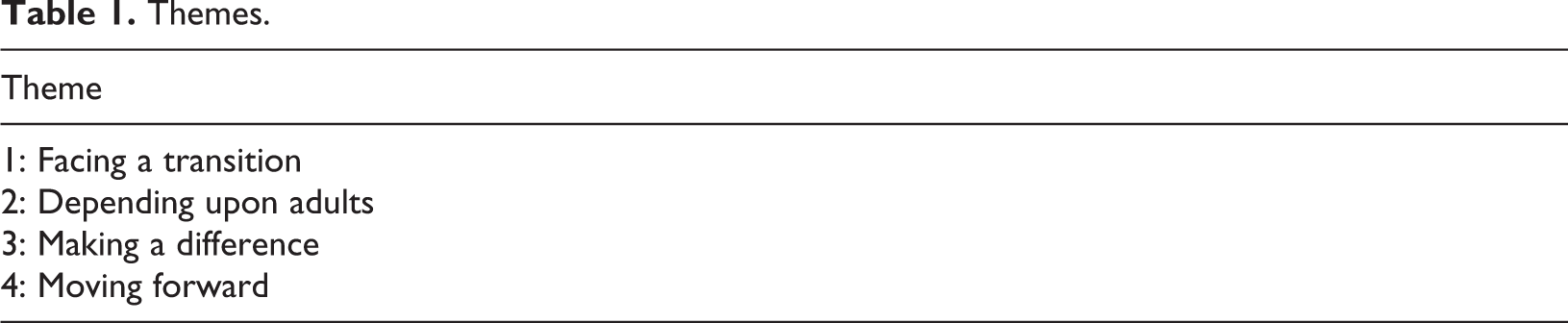
The data revealed four themes that outline the process by which the participants progressed as they aged out of care and became independent adults as shown in Table 1.
Themes.
Theme 1: Facing a transition
Theme 1: Facing a transition described how former foster youth felt during the period immediately following aging out of care. Seven of the participants felt the abruptness of leaving foster care, which introduced difficulty for them during this period. They felt the transition required a sudden change with limited support from others. Two had a smoother transition that seemed to be associated with kinship care which is foster care with biological relatives. The support from their relatives served as their foster parents and was consistent before, during, and after the transition of aging out of foster care.
Abrupt transition
Six of the study participants felt a lonely, abrupt transition. One participant shared: “When you turn 18, you don’t have any type of support anymore. You are basically on your own.” These youth were unprepared for the harsh reality of the sudden requirement to function as independent adults. They felt that support services were “being pulled out all at once.” They feared for basic needs of survival. They were homeless; jobless; and in many cases, worried about securing their next meal during the initial phase of the transition between foster care and independent living. The sudden abrupt feeling of “the odds being against me” and “it (aging out of care) was very abrupt…One day you are in, and the next day you are just, gone.” manifested from being suddenly alone and independent upon exiting foster care.
As a result of this sudden transition, most felt ill prepared for life tasks including managing money, paying bills, and finding a job. One participant described “falling flat on her face” after feeling “pushed off of the cliff” into sudden adulthood.
One of the failures of this abrupt and lonely transition manifested in the experience of homelessness. A brief period of homelessness during the immediate period of aging out of foster care was an outcome for three of the participants in this study. Despite their later success, the abrupt nature of aging out of foster care resulted in homelessness shortly after leaving care. The shock of the sudden transition was expressed by six of the participants and further described as highly stressful and challenging.
Uneven transition
David recounted an experience that differed from the other study participants in that he had an uneven transition. David found his own foster family just prior to aging out of care and struggled with some tasks during the transition to adulthood. For example, David had difficulty completing college applications, finding transportation, and paying for college expenses.
David had an uneven transition, because he was in multiple foster family and group home placements until 16 years of age.
Smooth transition
Two of the participants in this study did not feel an abrupt transition when aging out of foster care because they were in kinship care. Kinship care allowed them to be parented by biological relatives and supported by these relatives during and after aging out of care. These relatives provided ongoing support in both emotional and financial ways.
Theme 2: Depending upon adults
Theme 2: Depending on adults described how the participants in this study received help during the process of aging out of foster care from either a former caseworker or foster parent.
Depending on adults was common in this sample. “A shoulder to lean on” during the transition period was noted by the participants. In some cases, the adult offered support, while in others the foster youth sought support. In all situations, the adults who provided support to these former foster youth recognized the need for help and actively supported the foster youth during the transition of aging out of care.
Ellen and Carla received foster care within kinship situations that provided consistent adult support following aging out of care. The adults were “a shoulder to lean on” during trying times as the foster youth progressed through the uncertain period of leaving care to enter self-sufficiency.
Although Fran lived within a group foster home, rather than family foster care, she was assigned a group home caseworker who provided her with support. She described the caseworker in the following interview excerpt: “But I can say that she [her caseworker] has helped me basically through everything. She [has] been there, for the most part…every step of the way.” Fran also referred to the caseworker as someone she could count on now to listen and support her after aging out of foster care. One other participant spoke of her caseworkers as “I have grown up under their wings” and looked to them after her initial period of feeling alone while aging out of foster care. Another participant highlighted that soon after eviction from her apartment, she contacted her former caseworker who offered her a job helping others still in foster care. Anna described this relationship in the following interview excerpt: “She [her caseworker] was also motivational. Just having that, she was the only consistent thing to this day, you know, that never changed.” Hanna relied on adults too: “I made sure I at least had one person that I could talk to (after leaving care), no matter what, and let them know how I am feeling.”
David also expressed how he often felt he and his brother were “disposable kids” that could be “given back” when foster parents were tired of being parents. When David was in the 10th grade and close to aging out of care, he embarked on a personal mission to “find a family.” He found a family within the community where he lived and asked them to be his foster family. They agreed and, to this day, he remains a part of their lives. David who had sought his own foster parents as a teen and had worked to preserve his adult foster parent connections, viewed himself as “one of the lucky few” with foster parents he could approach during the transition into adulthood. David worked to maintain a relationship with the family he found after leaving for college. He spoke of the relief it was to have a relationship with his last set of foster parents throughout his adulthood.
Iris also spoke of her former foster mother who she said she worked to preserve a connection with. Iris shared “I worked on keeping the relationship with people who I love and who cared about me. The people I felt cared about me, their opinions mattered the most.” As she aged out of care, she maintained a connection reconnected with her foster mother and maintained that relationship.
Theme 3: Making a difference
Theme 3: Making a difference reveals the importance of helping others to find meaning in life—helping others reach success as adults. For the participants in this study, making a difference was preventing others from suffering the difficulties they experienced as a youth aging out of foster care. Eight of the nine former foster youth subsequently after aging out of foster care, felt a strong desire to help others avoid the related difficulties they experienced. Some of the participants wanted to prevent their current or future children from experiencing the trauma and pain they had endured. Others desired to support those in foster care and help them along the path they journeyed.
Several participants highlighted activities they participated in specifically that helped current foster care youth. They provided examples of mentoring and fundraising for organizations that support foster children.
One participant really stressed she wanted to help others avoid the heartaches she faced in care and aging out of care: “So if I can, if I went through it [foster-care struggles], and I am going to prevent somebody else to go through [difficult transition out of foster care], then it is worth it, you know.” Eight of the nine spoke of consistent strong involvement in helping current foster care youth through volunteer work.
Betty exhibited the strongest desire and plan to help others in foster care. Much of her interview focused on her desire to start a group foster home for teen girls. Betty wanted to eliminate the label of “foster children.” Her dream was that each girl in her future group home would have their own room, rather than sharing a room. Betty explained, “The girls will go to college, and they will graduate from high school.”
Two participated in organized efforts to support current foster youth after they had aged out of care. Anna: “I do trainings [foster-care youth] and different things that pulled me through, also. I am going to prevent somebody else [to have difficult transition out of foster care]—at least one other person and my child—then it is worth it.” In addition, through a statewide youth foster care empowerment group that provided support to current foster youth, a participant Fran was a leader in this group who highlighted: “We work on making things better for foster youth.”
All the participants who stated these goals of helping others also described the help and meaning it brought to their lives and their past suffering. Helping others served a purpose for the difficulties they had endured while in foster care.
Theme 4: Moving forward
Theme 4: Moving forward addressed how former foster youth were able to envision a brighter future than they had previously experienced. Moving forward with life was a theme including completing at least a basic education (GED or higher) commonly identified by the participants as a prevalent mind-set as they worked through the process of aging out of foster care. It took working through the lonely feelings and dependence upon adults to reach a place of helping others and envisioning a positive future.
Several participants expressed a desire to enact a brighter tomorrow for both. One stated, “I am moving forward with my life to have a better future. I do not look back.” She is on that path forward and described her current focus on the future for herself and her family. Betty offered: “It (being in foster care and aging out of care) motivated me to move forward with my life and do something different (to help myself and others).”
Ellen enrolled in college on a full scholarship program. Ellen commented, “I am moving ahead with life, and, I always had it [my future] in my head, no matter what happened.” From a young age, Ellen envisioned the path to her future, which was grounded in education as an essential goal. Her determination and vision to move forward with her future helped propel her in this positive direction.
David also continued forward by setting goals and working toward them in a committed manner. He described his philosophy by stating, “To be successful, set your goals. Think about what you want out of life and think about why you want that.” Throughout the interview, David spoke of having a purpose in life and how that helped him reach success. The constant thought of moving forward while in foster care and after leaving care sustained him through to a better life. His advice for others coming from foster care was “Stop looking at yourself [as someone who suffered while living in foster care] and look at where you can be.”
Anna moved forward by providing a better life for her daughter. She was determined to create a positive environment for both herself and her daughter. She described how the challenges of her childhood and young adulthood was a force that helped move her life forward.
Discussion
Youth who age out of care are at increased risk of homelessness and other difficulties during the transition to adulthood when leaving care (Courtney et al., 2001, 2004, 2005). This study interviewed nine adults who had successfully made the transition to adulthood. In this study participants most often had an abrupt transition out of care although were fortunate to have the ability to depend on adults through receiving support, making a difference in the lives of others, and moving forward with their own lives. Overall, those who were successful had attained a high school education and were employed after successfully making the transition to adulthood.
Theme 1: Facing a transition
This theme was consistent with prior literature. Theme 1 (i.e., facing a transition) was the first theme revealed from the interpretation phase of this study. The struggles associated with an abrupt transition were quite painful to the study participants especially during the immediate phase of aging out of care. Prior research documents well the often-abrupt difficult transition that is common for foster youth (Ahrens et al., 2011; Courtney et al., 2011; Harder et al., 2020; Hernandez & Lee, 2020; Hokanson et al., 2018, 2019; Stott, 2013).
Theme 2: Depending on adults
This theme was consistent with prior literature. Of note, those who maintained a connection with at least one caring adult was a common finding in this study. This is also consistent with previous findings where youth who are not connected have a decreased chance of success during the process of aging out of foster care (Ahrens et al., 2008, 2011; Avery, 2010; Courtney et al., 2005; Daining & DePanfilis, 2007; Koh et al., 2014). Youth in foster care who have a mentor have been noted to have positive outcomes (Ahrens et al., 2008). This study supports this earlier work. Further development of mentoring programs is one potential intervention that was highlighted in earlier work as well as the current study.
Theme 3: Making a difference
This theme was a unique finding from this study. As noted above, there are multiple studies noting that mentoring relationships and relationships with adults positively impact a successful transition of those aging out of care although no studies reviewed revealed that helping others and making a difference for other youth in foster care influences success in aging out of care. This finding has not been noted in prior research. We identified that the participants had a strong desire to help others as part of their successful transition out of care. As this was not a finding in a previous study, this area warrants further exploration for the consideration that former foster youth could help themselves by helping others during the time of transition.
Theme 4: Moving forward
This is a finding that has been found in prior studies although it also warrants further exploration. Resilience theory and principles most recently have noted that youth who have aged out of care work to move forward despite their earlier life challenges (Harder et al., 2020; Hernandez & Lee, 2020; Hokanson et al., 2018, 2019; Packard & Benuto, 2020). Additional specific work on what specifics to this work would be helpful to identify program. What are some key resiliency characteristics noted in individuals aging out of care? What can be identified and supported based on the resiliency characteristics? The findings of those who completed their education being successful was consistent with work that highlighted the negative outcomes in those who did not complete education when aging out of care (Courtney et al., 2011, 2013; Dworsky & Courtney, 2010; Dworsky & Perez, 2009).
In summary, two of these themes were not found widely in the literature of former foster youth. Making and difference and moving forward are areas that could be explored in future research to determine if this is consistent in a broader sample. If so, then interventions and programs could be designed to help facilitate this in the foster youth population who are aging out of care.
These results build on prior studies that identify the vulnerable period of transition of foster youth during the period of leaving care to live on their own as adults (Arnett, 2007; Courtney & Dworsky, 2006; Courtney et al., 2005, 2009, 2011). This is a time of great risk that warrants further research to determine why some youth are successful to allow further development of programs and interventions to help strengthen success rates. Findings support the need for programs that support youth during transition out of care to help provide them the best opportunity for their success at this critical point. Specifically, developing life skills, maintaining connections to others, completing education, obtaining employment, and helping others are areas that were noted in this sample to be areas that promoted their success when aging out of care.
Strengths and limitations
This study used foster care youth and their lived experiences to determine factors that contributed to their success when aging out of care as defined in the study. Since it is well noted the frequent poor outcomes in this population, this sample provided personal experiences of their success as defined in the study. Their personal experiences contributed to the strength of the study as well as an experience qualitative research team. Participants were provided the opportunity to review their transcript which also strengthened the analysis.
In addition, the study also had limitations. This is a sample in a single metropolitan area in one state. These results reflect the themes identified with the study participants and as interpreted by the research team. However, initial findings supported the need for connectedness to adults, education, housing, and employment as areas that contributed to their success. This type of study also highlighted a new area not previously noted in that the successful young adults had a strong desire and actions noted to help other foster youth. That was a new finding that warrants further exploration. Two of the participants had experienced kinship care just prior to aging out of care. They had been in foster care in some situations prior to kinship care, but their experiences were not as consistent as others. Additional study of types of foster care settings during aging out of care could be helpful to determine the impact of settings and kinship care on the transition out of foster care.
Conclusion
The purpose of the study was to describe life experiences of children aging out of the foster care system from the perspectives of adults who have successfully navigated this transition. Nine adults who were former foster youth were interviewed about their experiences. Phenomenology was used to interpret the lived experiences of these adults.
Four themes were identified. The first theme was facing a transition which described the initial period of aging out of foster care. Depending on adults was the second theme. The third theme, making a difference highlighted the desire to help others to help avoid current foster care youth from having a difficult transition as they had experienced. Finally, Theme 4 was comprised of data related to moving forward, which demonstrated the ability of the study participants to visualize success and focus on their future. The data obtained from the lived experiences of nine participants provided an understanding of common meanings that seemed to be associated with the success of these young adults during and after aging out of foster care.
Recommendations for practice
The recommendations for practice are to focus on educating others who support and interact with foster youth to identify and communicate sources of support to young adults aging out of care. The goal for practice is to reduce the abrupt transition and promote a smooth transition when aging out of foster care. The importance of caring adults as well as the ability to preserve relationships is a skill that can be taught to youth aging out of care. If caseworkers are aware of needs, such as supportive adults upon whom transitioning youth can depend for help, the caseworkers can help identify adult resources to increase the chance of success for these youth. Strategies might include teaching caseworkers and foster parents how to teach these youth how to depend on adults during this period including how to ask for help from adults.
As part of the aging out process, providing a list of adults willing to assist, such as caseworkers, former foster parents, and other adults such as mentors or teachers, is recommended. As noted earlier, to the participants in this study, this was a key factor in their successful transition out of care.
In summary, the recommendations are to Providing a resource list for strengthening relationships with caring adults. Sources of support might include former foster parents, biological relatives for those who are in kinship care at the time of aging out, and possibly caseworkers and other caring adults. Teaching youth how to ask for help from adults. Work with foster youth prior to them aging out of care on maintaining caring adult relationships that have been important to them in their life. Strengthening skills to prevent an abrupt transition and homelessness to include financial and budgeting skills.
Recommendations for research
Minimal existing research has focused on those who have aged out successfully; consequently, additional study is needed to increase knowledge in this area. More in-depth research on the factors and relationships as well as the desire of these former foster youth to help others among perceived protective factors, such as stable housing and depending upon adults for help, is needed to further investigate these factors for increased success among this population of youth as they transition into independent adulthood.
Future study is needed to continue research with successful youth to help further develop the science for this population. In addition, research will help explore the importance of helping others as a potential factor that might influence success in aging out of foster care. Finally, research will also help develop and test interventions that reduce the abrupt transition of aging out of foster care.
Footnotes
Declaration of conflicting interests
The author(s) declared no potential conflicts of interest with respect to the research, authorship, and/or publication of this article.
Funding
The author(s) disclosed receipt of the following financial support for the research, authorship, and/or publication of this article: The author received a STEPS funding in 2010 from Georgia State University to support partial costs of interview transcription during research.
