



Abstract
Although most youth served in residential group care are adolescents, empirical theories indicate that youth needs vary at different stages of adolescent development. These differences likely impact adolescents’ experiences and, ultimately, responses to treatment; a neglected research topic that may have implications for residential placement and services. This study explored youth experiences in residential care at different stages of adolescence. A descriptive qualitative content analysis from a sample of 103 youths was used to classify open-ended text into categories among early, middle, and late adolescents. Comments showed similarities and differences across developmental stages in six categories—general views on placement, relationships, needs and supports, safety, autonomy and control, and growth and development. Youth in late adolescents were more contemplative about their time in residential care, with comments reflecting a need for more autonomy, while expressing how residential care has helped with future endeavors and goal planning. Middle and early adolescents’ experiences were more varied. Early adolescents focused on relationships outside of care and discussed support needs differently, compared to middle and late adolescents. Our findings suggest that experiences in residential placements differ in important ways across stages of adolescent development.
Introduction
Residential group care (RGC) is a 24-hour care setting that provides for children’s safety and care needs while offering behavioral health treatment, education, and other supports aimed at stabilization, healthy socialization, and skill development (Whittaker et al., 2014). Residential care spans multiple service systems with point-in-time estimates showing about 10% (n = 40,749) of youth in the foster care system (Children and Families Children’s Bureau, 2021) and 27% (n = 55,100) of adjudicated delinquents (Hockenberry & Puzzanchera, 2021) are served in residential care. In 2014, nearly 606,000 adolescents received mental health services in inpatient or residential-based mental health settings (Lipari et al., 2016).
Broadly, adolescents in out-of-home care require their medical and educational needs to be met, to experience a sense of belonging and acceptance (Hill & Watkins, 2003), and to establish meaningful connections (Perry, 2006). That is, their needs are like those of adolescents in general, yet often complicated by complex family circumstances, trauma, and behavioral health challenges. Theories of adolescent development demarcate stages of evolving growth and exploration that manifest in unique developmental needs and ways of perceiving and interacting with the external environment (Muuss et al., 1996; Rice & Dolgin, 2002). Although theories differ in focus, a common feature conceptualizes adolescent development as occurring in early, middle, and late stages.
Based on shared elements across theories, Spano (2004), identified five organizing features of adolescent development – independence, interest and cognitive development, sexuality, physical changes, and ethics and self-directedness—and how each manifest across different stages. Among the key developmental features of early adolescents (approximately 10–14 years of age) is the onset of puberty, accompanied by increased moodiness and feeling expression through actions versus words. Early adolescents tend to be more present focused with a growing capacity for abstract thinking and increased experimentation with rules and expectations. Middle adolescence (approximately 15-16 years of age) is marked by increased self-involvement, fluctuating expectations of self and others, and increased independence and distancing oneself from primary caregivers. During late adolescence (approximately 17–21 years of age), youths’ sense of self-identity becomes more stable, along with greater cognitive reasoning and verbal expression, particularly when communicating emotions. Other characteristics include a greater capacity for decision-making, compromise, expressing concern for others, self-reflection, and future planning. Ethical development, and the acceptance of social institutions and cultural traditions, and self-regulation are also more developed. Despite longstanding recognition of developmental differences across the period of adolescence, there has been limited attention to this topic in the residential care literature.
Jansen (2010) described the juxtaposition of normative developmental experiences of adolescence being cared for in non-normative circumstances:
“Living in out-of-home care provides youth with developmental conditions that deviate from what is common among youth. Nevertheless, they have to relate to the same expectations of what is considered to be normal development. To secure sound development is a primary justification for CPS [Child Protective Services] intervention and a main objective of the professional work that is undertaken with these young people.” (p. 424).
For youth in RGC, normative development is further complicated by trauma and childhood adversities. Indeed, one study found 92% of youth in RGC met criteria for complex trauma (Briggs et al., 2012). Complex and adverse trauma histories that tend to characterize RGC youth populations, increase risks for trauma-related impairments and a myriad of developmental deficits (Leloux-Opmeer et al., 2018).
Developmentally appropriate practices (DAP) are recommended for children’s education and skill development (Meschke et al., 2012). For youth in RGC, DAP with a focus on trauma recovery and attention to detecting and responding to related developmental deficits is likely warranted. Adults such as parents, teachers, and youth workers are essential in promoting healthy development (Resnick, 2000; Salusky, 2014). Yet, resources connecting research to practice are lacking (Meschke et al., 2012). Understanding how adolescents at different stages perceive and experience care in residential settings may have practical relevance for placement decision-making, informing youth worker training, and the specification of DAP treatment approaches and policies.
Experiences of Adolescents in Residential Care
Researchers have turned to qualitative methods to further explore youth outcomes in residential care. These inquiries, largely based on European samples (e.g., Harder et al., 2022; Johansson & Andersson, 2006; McCarthy, 2016; Schofield et al., 2017, Slaato et al., 2022) suggest greater nuance than what has often been portrayed in the literature and policy discourse (e.g., Annie E. Casey, 2010; Dozier, 2014). In their systematic review of 12 peer-reviewed, qualitative studies of youth in residential care, Cameron-Mathiassen et al. (2022) identified themes in the areas of autonomy and control, relationships and support, safety and security, and transitioning from care. The authors note considerable variation in youth experiences but that there was consistency in these variations across studies. They note that their findings imply that “successful residency and outcomes in residential care are connected to the ability of the care home to engage with the young person in a way where it becomes attractive for the young person to engage positively with residential care.” (p. 8). This suggests a need for individualized, developmentally targeted approaches by residential care providers who are prepared to adapt services while identifying common elements to inform cohesive program structures and service arrays. Research identifying common elements of effective RGC (Boel-Studt et al., 2018; Farmer et al., 2017; Harder, 2018), shed light on conditions underlying youth outcomes. Some findings point to potential differences by age (Bundle, 2002) in experiences and needs of youth in RGC. However, little is known about differences in the experiences and outcomes of adolescents in RGC during different developmental periods.
In sum, findings from qualitative investigations add depth to our understanding of youths’ experiences in RGC, while developmental theories and some findings point to potential differences in these experiences and subsequent outcomes. The literature capturing the youth perspective is developing, yet there is a need for research that brings their voices and diverse perspectives to the forefront (Slaato et al., 2022). In response, this study explored adolescents’ perceptions of their experiences in RGC during early, middle, and late adolescence.
Methods
Data for this exploratory analysis were from a statewide study of the quality of RGC. Data were collected from the full population of licensed residential programs and shelters in a southeastern state in the U.S. utilizing the Quality Standards Assessment (QSA; Boel-Studt et al., 2018). Completion of the QSA was overseen by state licensing specialists responsible for inspecting the facilities. Residential care providers received an anonymous link to the online QSA. Providers were responsible for sharing the link with the staff and youth within their programs. Each provider received instructions and a script informing youth about the assessment, how to complete it and ensuring each youth had a private place to complete the QSA using their cell phone or a computer. Youth participation was voluntary and, their responses were kept confidential. Except for the name of the residential program, no other personal identifying information was collected. Youth’s individual responses were not shared with the residential provider or others outside of the research team. State licensing specialists followed up with youth about their participation in the QSA during routine site inspections.
As part of the statewide study, all youth who were placed in a residential program licensed by the XXXX were eligible to complete the QSA to assess their experiences in the residential program or shelter. The QSA includes seven subscales representing different practice domains including—1) Assessment, Admission, and Service Planning, 2) Safe, Positive Living Environment, 3) Monitor & Report Problems, 4) Family, Culture, & Spirituality, 5) Program Elements, 6) Education & Skill Development, 7) Transition & Discharge Planning. Each subscale contains items measuring specific practices and conditions related to each domain (e.g., I feel safe in this program. I helped set the goals in my treatment plan.). Based on their experience, youth are asked to rate each item using a 5-point scale (1 = not at all true, 5 = completely true). The last item in each subscale is open ended asking youth to “Please use this space to add any information you would like to provide about the above statements or your ratings”. Once youth complete each of the subscales, another, separate open-ended item asked youth to “Please use this space to add any further comments you would like to share about your experience in this residential program.”
A total of 348 youth met inclusion criteria (i.e., age nine or older, fourth grade reading level, no significant cognitive impairments) and completed the QSA as part of the statewide study. The current was limited to the subsample of 103 youths ages 10 or older who responded to open-ended items asking about their ratings on quality practices and experiences in the program. All study procedures were reviewed by the XXXX Institutional Review Board.
Analysis
The sample was divided into developmental groups based on Spano’s (2004) review of theories of child development in which adolescence is partitioned into three stages—early adolescence (10–14 years of age), middle adolescence (15-16 years of age) and late adolescence (17–21 years of age). Using a descriptive qualitative content analysis method (Hsieh & Shannon, 2005; Lindgren et al., 2020) open-ended text were classified into categories. First, open-ended responses were separated by adolescent developmental group. The authors then immersed themselves in the data through multiple rounds of reading. Next, using inductive coding, the authors decoded responses and encoded the data (i.e., initial codes). After initial codes emerged, the authors discussed the codes which yielded six primary categories. The categories were refined until complete agreement was reached. General descriptions of categories and a codebook was generated to guide subsequent coding. Nvivo 12 (QRL International, 2018) was utilized for line-by-line coding of the open-ended responses. The second author lead data coding, and the first author reviewed the final coded data for consistency. To capture methodological processes, observations about the data or related the coding process and interpretation and personal reflexivity, both researchers engaged in memo writing throughout data analysis. Memos were referenced during and prior to finalizing data analysis.
Results
Sample Characteristics
Youth Demographic Characteristics.
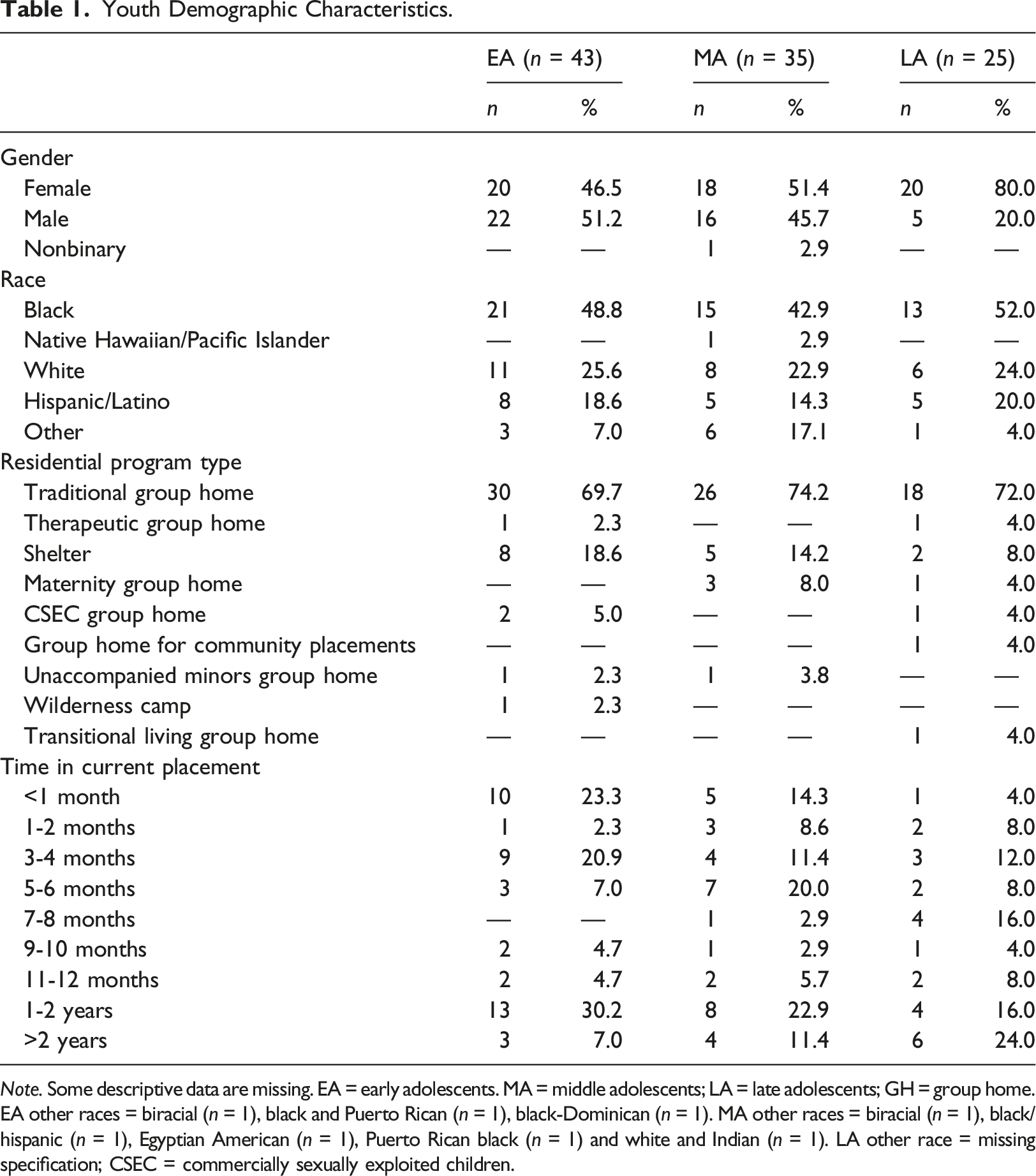
Note. Some descriptive data are missing. EA = early adolescents. MA = middle adolescents; LA = late adolescents; GH = group home. EA other races = biracial (n = 1), black and Puerto Rican (n = 1), black-Dominican (n = 1). MA other races = biracial (n = 1), black/hispanic (n = 1), Egyptian American (n = 1), Puerto Rican black (n = 1) and white and Indian (n = 1). LA other race = missing specification; CSEC = commercially sexually exploited children.
Qualitative Findings
Six categories were found across developmental stages: General views on placement, Relationships, Supports and Needs, Safety, Autonomy and Control, and Personal Growth and Development.
General Views on Placement (74 References)
Many comments reflected youths’ general views on their residential placements. Approximately 37.8% of comments in this category were from EA and the majority (85.0%) were positive statements about their placements. EA frequently described their placements as “the best” group home or placement and described it as “a living heaven” and wanting to stay supported by statements such as “I love the current group home that I am at. I would not like to change group homes. If possible, please keep me here.” (Participant 246, age 13, male, biracial, specialized residential program for commercially sexually exploited children, 3-4 months) and “This is the best group home I have ever been to cause I don’t have to fight for my life or anything. [It] helps me live. I like the staff. I like being here.” (Participant 245, age 13, female, Black, traditional group home, 1-2 years).
Two EA expressed dissatisfaction with their current living arrangement with one youth writing “I would prefer foster care for my long-term plan. I do not want to be in a group home any longer. I need a more personal setting.” (Participant 247, age 13, female, Black, traditional group home, 5-6 months). Still others offered mixed perspectives mentioning certain dislikes (e.g., point card system, long groups) while feeling good about their placements overall.
Approximately 37.8% of the comments in this category were from MA and the majority (78.0%) of their comments were positive. Several youths wrote that they “love” their placement and, like EA, described them as the “best” places they had been. Reasons for their sentiments included feeling safe and supported as exemplified in the following quote: “My discharge plan is to go home but I don’t want to. I want to stay with all the support I have here and age out.” (Participant 48, age 16, male, Black, traditional group home, 1-2 months). A few MA expressed discontent with their placements in simple, direct statements such as “I HATE IT HERE.” (Participant 64, age 15, female, Hispanic/Latina, traditional group home, less than 1 month). Like EA, some MA presented mixed views, identifying pros and cons: “The only reason this is somewhat good is because there is a pool and other kids who understand our situation.” (Participant 77, age 16, female, white, maternity group home for 3-4 months).
About 24.3% of comments in this category were from LA. Consistent with younger youth, the majority (95.0%) were positive comments with shared sentiments about their placements—“cool”, “awesome” and “great”. Elaborating on their views, LA positively described their placements as, “the best group home I have been to since I have been in [foster] care since the age of 12.” (Participant 71, female, age 17, white, traditional group home, 3-4 months). While only one youth commented negatively about their placement, others were more contemplative: “I love [Group Home] but not enough to stay here forever. Being here will change a child’s life. I highly recommend female youth coming to [Group Home] for treatment.” (Participant 16, age 17, female, Black, specialized residential program for commercially sexually exploited children, 7-8 months). In sum, general views on residential placements were positive across developmental groups with a minority of youth expressing dissatisfaction with certain aspects or mixed views.
Relationships (97 References)
Most prevalently, youth wrote about relationships. Across developmental groups, comments referenced relationships with residential care staff with fewer references to other youth in the residential program and family. Comments from EA (33.0%) were brief with frequent mentions of staff being “helpful” and “supportive”. Youth reflected on staff significant role in helping them as exemplified in the quote: “…my house parent is the one who mostly helps me.” (Participant 304, age 14, Male, Hispanic/Latino, traditional group home for boys, over 2 years). Relatively fewer youths mentioned negative interactions with staff, expressing feeling staff did not care about them: “Staff only care about themselves or the people they love. They don’t give two flying flips about what happens to us.” (Participant 115, age 12, male, white, traditional group home, 11-12 months).
EA commented on relations with others more frequently than older youth. This included references to other youth in their program which ranged from making friends to incidents of peer bullying “[child name] picks on me and punched me…” (Participant 292, age 11, male, Black and Puerto Rican, traditional group home, 11-12 months). Youth comments on family reflected challenges in their relationships: “I have to remind my mom to show up to my calls with her on Mondays and Tuesdays.” (Participant 303, age 10, male, white, shelter, less than 1 month) to how the residential program supported their relationships with parents: “[Group Home] …has been there to support me and my mom’s relationship.” (Participant 185, age 14, Black, group home/wilderness camp, 1-2 years).
Approximately 30.9% of references were from MA and of those, 90% focused on staff. Expressions suggested youth felt strong connections with staff: “I love the staff and the owners of this group home. They have helped me come a long way.” (Participant 136, age 15, male, Hispanic/Latino, traditional group home 9-10 months) and “The staff here is very caring. They make us feel like WE CAN DO IT.” (Participant 132, age 15, female, Black and Hispanic, traditional group home, 5-6 months). Several youths mentioned specific staff members with whom they formed a special bond: “[Staff name] is the best staff, and is very caring, and is always there if we need help.” (Participant 90, age 16, female, white, shelter, 5-6 months). Feeling heard and accepted was a common feature of relationships with staff as reflected in quotes: “The house parent helps me calm down and listens to me whenever I have a problem.” (Participant 134, age 15, female, Black, traditional group home, 1-2 years) and “They respect that I’m transgender which is the main issue with people in my life. They actually support [me] which I’m thankful for.” (Participant 31, age 16, transgender female, white, traditional group home, 9-10 months). Speaking on meaningful staff connections, this same youth wrote: “I love [staff member name], she’s made very good connections with all the girls in here. She honestly is like family to me and some others in the home. She’s the family we didn’t have.” Although fewer in frequency, negative comments centered on not feeling respected: “Staff don’t care about me or my beliefs.” (Participant 30, age 16, female, white, traditional group home, 11-12 months).
Nearly 36% of comments on relationship came from LA. Like the other groups, most comments (92.9%) centered on staff and were positive. The need to feel understood and respected consistently emerged as an important part of their relationship with staff and was most salient among LA. Several youths commented on feeling that staff “respect my values” and “they understand” which included feeling that staff accepted them: “I don’t feel pressured to be something else.” (Participant 29, age 17, female, Black, shelter, 1-2 months). Several youths commented that they “loved” staff and viewed them as “family”. Examples include the statements, “I love my dorm parents very much.”. (Participant 2, age 18, female, white, traditional group home, over 2 years) and “They make me feel like family.” (Participant 29, age 17, female, Black, shelter, 1-2 months).
Consistent with EA and MA, LA expressed some discontent with staff focused on not feeling respected or that staff did not care. A few comments focused on specific staff members: “I feel disrespected and unwelcomed by a staff member who continues to treat others poorly. It has been an ongoing problem. Many residents have had major issues with this staff member.” (Participant 17, age 17, female, white, shelter, less than 1 month). Like MA, LA provided few comments on relationships with other youth or family, which was insufficient to generate internally valid descriptions.
Consistently, most youths’ comments focused on their relationships with residential care staff. LA and MA expressed stronger connections with staff and elaborated more on the impact of these relationships. EA also commented positively about their relationships with staff while more often mentioning negative feelings toward staff and referencing relationships with other youth and their parents compared to older youth.
Needs and Supports (57 References)
Youth felt their needs were met in RGC and described types of support they received. Comments from EA (21.1%) focused on residential staff helping youth transition, teaching pro-social skills, providing emotional support, and receiving medical care. Most frequently, EA wrote about educational support and managing stress as exemplified in the following quotes “I used to be in an EBD unit where kids fight other kids. Now I’m not there no more. So yes, they have taught me a lot of stuff about school.” (Participant 245, age 13, female, Black, traditional group home, 1-2 years) and “The counselor helps me when I’m stressed out by helping me vent and work through my frustrations.” (Participant 187, age 14, male, Hispanic/Latino, shelter, less than 1 month). Reflecting on the support they had received, another youth wrote: “Thank you so much for taking care of me and doing everything they can for me. Thank you so much.” (Participant 289, age 11, female, Black, traditional group home, 1-2 years).
Comments from MA (25%) specifically mentioned receiving career planning and support with employment and stress management. Frequently, youth wrote about educational support as explained by one youth in short-term shelter care: I am currently not enrolled in school, as my placement here is temporary (2 weeks or less); however, I do educational enrichment activities daily with staff and that helps me feel good about going back to school when I get placed in my long-term placement. (Participant 76, age 16, female, race unspecified, shelter, less than one month).
Most salient among MA were mentions of emotional support: “The staff have helped me with many obstacles that I have had to overcome.” (Participant 145, age 15, male, biracial, traditional group home, over 2 years). Generally, youth felt that staff “meet my needs” with a few exceptions where youth described specific instances when they did “not receive weekly allowance” or “a voucher for some new clothes”. Another youth indicated “I had to put my own plan after I leave together by myself.” (Participant 30, age 16, female, white, traditional group home, 11-12 months).
Over half (54.4%) of comments in this category were from LA. Like other developmental groups, youth mentioned a variety of supports. LA mostly described how residential staff helped them set goals, and plan for the future: “They are helping me get on track for the aging out process. We do a lot of independent living exercises.” (Participant 9, age 17, female, white, traditional group home, 3-4 months). Another youth wrote: “Being here has helped me come up with a plan for my future and set realistic goals.” (Participant 17, age 17, female, white, shelter, 3-4 months). Other examples of supports were captured in sentiments such as “This group home helps me to do well at the school.” (Participant 22, age 17, female, Hispanic/Latina, traditional group home, 1-2 years) and “They are here for me when I need them. They have given me coping skills to deal with real life problems and how to act when approached.” (Participant 29, age 17, female, Black, shelter 1-2 months).
Overall youth felt their needs were being met with various supports mentioned. However, within groups, there were differences in types of supports with most comments centering on school among EA, emotional supports among MA, and preparation for aging out and independent living among LA.
Safety (20 References)
Youth also commented on safety while in RGC. EA represented nearly half of the comments in this category (45.0%). Compared to older youth, EA views were more varied. Most EA perceptions were affirmative with statement such as “I feel safe” and “Staff take our concerns seriously.” (Participant 244, age 13, female, Black, therapeutic group home, 3-4 months). Others reported feeling safe while noting they observed “holes in the wall” or that while staff make efforts to maintain safety, some youth do not listen. Still another youth described feeling unsafe with a specific staff member, however, because the youth in the group home follow the rules, everyone “stays safe.”
Few MA (20%) wrote on this topic—each reporting they felt safe with one youth noting, “They make sure to be there for us and tell us to be comfortable with letting them know if we feel threatened by anyone in the home.” (Participant 344, age 16, female, white, traditional group home, 9-10 months). LA (35.5%) expressed feeling physically and emotionally safe and a sense of stability. All comments reflected feeling safe, with youth expressing: “this is one of the first group homes that I have ever felt comfortable being in,” (Female, age 17, white, traditional group home, 3-4 months). Although the bulk of comments indicated youth felt safe, this topic was notably more present among EA.
Personal Growth and Development (15 References)
Although less prominent relative to other categories, youth reflected on how being in RGC helped them achieve personal growth and positive change. One-third of the comments in this category were from EA who described coming to RGC as a “life changer” and “what I needed”. In a similar vein, MA (20.0%) wrote about their “growth”, “overcoming obstacles and fears”, and being “grateful for my time” in RGC. Another youth elaborated, “I look forward to continuing to grow and I hope I can make myself and everyone else proud.” (Participant 133, age 15, male, Black, shelter, 5-6 months).
LA (46.7%) most frequently commented on the benefits of their placement. They reflected on their personal growth and positive outlook because of their placements. Reflecting on her time in RGC, one youth wrote: “[Residential facility] has changed me in a good way…I have my life on the right track. If I wouldn’t have come here, I’d be in jail or even worse, dead. I’m very thankful for being court ordered to come here.” (Participant 6, female, age 17, Black, residential program for commercially sexually exploited children, 7-8 months).
Most notably, comments reflected a sense of optimism and hope for the future as exemplified in the following quotes: “I’m excited to start my new journey.” (Participant 2, female, age 19, Black, transitional living group home, 1-2 years) and “they have help[ed] me get back on track and showed me the right path in life.” (Participant 9, female, age 17, Black, shelter 1-2 months).
Autonomy and Control (14 References)
Another set of comments focused on autonomy and management of rules and regulations. A sub-category emerged focused on youths’ sense of involvement in service planning. EA (35.7%) comments on rules and restrictions were minimal, with one youth noting, “We go out sometimes, but we don’t just go wherever we want.” (Participant 185, age 14, female, Black, wilderness camp, 1-2 years). On their service plans, one youth indicated she is “…in check with my service plan.” (Participant 347, age 12, female, white, traditional group home, less than 1 month) while another was opposed to having a plan because “it’s too hard.” (Participant 348, age 11, male, Black and white, traditional group home, 1-2 years).
MA provided another 35.7% of the comments in this category with mixed views on rules and regulations from “we can’t go anywhere” to “the rules are enforced in a good and understanding way.” On their service plans, there was a shared sentiment that they had little involvement or input in developing their plans. Such sentiments were supported by statements like: “I don’t understand my service plan and most of the time its just them deciding for me.” (Participant 140, age 15, female, white, traditional group home, 11-12 months) and “I feel as if my care plan was just randomly thrown together and is in no way specific, personal, or helpful to me.” (Participant 345, age 16, nonbinary, Hispanic/Latino, shelter, less than 1 month).
LA comments (28.6%), like MA, expressed mixed views on rules and regulations. For example, one youth mentioned appreciating the autonomy of keeping her cell phone while another expressed, “[staff] are very protective when it comes down to going to events by myself. I am 17. I need a little bit more freedom.” (Participant 20, age 17, female, Hispanic/Latina, traditional group home, 3-4 months) to wanting staff to step in more to manage other youths’ behaviors: “Sometimes the staff are slow to recognize certain behaviors.” (Participant 24, age 17, female, white, shelter, less than 1 month). They also held similar views on their service plans: “As far as my service plan, I didn’t have a choice in making my goals, but I was able to go over them with my therapist. I was not allowed to request changes be made and was just asked to sign my name stating I agree with them.” (Participant 23, age 17, female, white, therapeutic group home, 3-4 months).
In this category there was agreement among MA and LA on limited involvement or control over their service plans. Additionally, older youth expressed a desire for greater freedom. EA were less concerned with their service plans or with personal freedom and more focused on rules.
Discussion
Drawing upon theories of adolescent development, this study explored youth experiences in RGC during early, middle, and late stages of adolescence. Overall, the findings revealed categories with consistencies with prior qualitative research findings and identified commonalities across developmental groups along with emerging distinctions. Mainly, youth viewed their placements positively across developmental groups. Descriptions of their residential placements as “the best” and youth reporting wanting to stay are in sharp contrast with conclusions drawn from some advocacy driven literature that paints dark images of youth living in oppressive, restrictive, and largely uncaring institutional environments with limited attention to youth needs (Fathallah & Sullivan, 2021). The difference may speak to diversity across RGC settings related to quality, such that sweeping conclusions about all RGC should be avoided, especially when based on results from single investigations. The current study also found not all youth were pleased with their placements with some noting RGC benefited them while desiring more family-like placements.
Relationships were a primary focus across developmental groups, a finding that is consistent with extant literature (Cameron-Mathiassen, 2022; Parry et al., 2022). The residential setting created opportunities for youth, particularly EA, to connect with peers who understood their circumstances. Peers offer a sense of belonging in RGC (Cameron-Mathiassen, 2022). However, EA also reported peer conflict and bullying, an issue that has gained increased attention in the literature in recent years (Mazzone et al., 2018). Like other study findings (e.g., Cameron-Mathiassen, 2022), when EA mentioned family, it was specific to their parents and often in reference to their involvement in services. These findings suggest early adolescents are still largely focused on parental connections and with greater interest in peer relationships. Interestingly, a focus on parents and peers was limited to EA whereas staff relationships were a primary focus across all three groups.
MA and LA referred to their relationships with residential care staff with comments underscoring the importance of these connections. Residential staff served as significant supports, mentors, and pseudo-family; findings that echo prior studies (Cameron-Mathiassen et al., 2022; Parry et al., 2022). LA and MA descriptors of their relationships with staff signaled aspects of those connections that were important to them. For older adolescents feeling heard, understood, accepted, and respected are essential to positive development, particularly during the period of late adolescence and emerging adulthood (Arnett, 2007). Developmentally, later stages of adolescence are marked by a movement away from primary caregivers and the ability to connect with others is especially important with implications for future relationships and identity development (Arnett, 2007; Parry, 2022). That MA and LA often referred to staff as family, suggests a still present need for deeper, familial connections that may otherwise be strained or absent. Thus, for these youth staff filled an important void, providing emotional connections and support for positive development. However, for a smaller subset of MA and EA, staff relations were conflictual and characterized as coercive, unfair, and mistrustful. Henriksen et al. (2008) found adolescents who were interviewed at two time points demonstrated more positive views of RGC staff over time. This may have influenced the current findings, where younger adolescents have often spent less time in out-of-home care, or their residential placements compared to older adolescents.
Youth felt their needs were met with substantial overlap in the types of supports mentioned across groups. Differences emerged where EA focused on concrete forms of support, MA focused on emotional support, and LA described support with preparing for their future. These differences may reflect which forms of support youth felt were most important and calls attention to opportunities to provide support in ways youth perceive as needed or desirable at different periods of development.
Compared to other studies, safety was a topic of relatively less salience, perhaps due to other studies having a specific focus on safety and violence (e.g., Barter, 2003). Reported instances of peer bullying among EA also falls into safety. All age groups noted staff efforts to create a safe environment including encouraging youth to come to them if they felt threatened or unsafe. In the current study, youth offered minimal content to evaluate safety, nor did it surface as a major source of concern.
Within each developmental group were youth who commented on how their experience in RGC had changed their life for the better. LA reflected-on growth, development, and how their time in RGC helped them get their lives on track. The Cameron-Mathiassen et al. (2022) finding that youth “who were satisfied with RGC offered positive narratives of maturing and an evolving capacity to make decisions they believe would enhance their future.” (p. 7), extends to the current findings. LA wrote about staff helping plan for life after RGC including independent living, post-secondary education, and career planning. Such comments were often encompassed within longer text passages that included statements about supportive relationships with staff. Establishing trusting relationships with youth care workers is associated with youth gaining a sense of agency, resiliency, and optimism (Parry et al., 2022; Schofield et al., 2017). Comments among MA and LA differed in that MA expressed experiencing positive changes in themselves, and LA shared both, personal growth, and positive changes on their outlook. These differences may be attributed to MA focusing on their treatment and LA focusing on transitioning from RGC and future planning.
Youth held mixed views on autonomy and control. Across groups, some youth disliked regulatory aspects of the programs. For EA entering a developmental period marked by an increase in experimentation with rules and expectations, point cards and other behavior management methods were negatively appraised. Older adolescents, understandably, desired more freedom. Kelly et al. (2019) found youth in RGC struggled with restrictions including limited access to cell phones, while in the current study a youth commented on her appreciation that she was allowed to keep her cell phone. Both findings suggest the importance of access, however, also reflect that levels of control and restrictiveness vary from program to program. Finding the appropriate balance, is an ongoing challenge and empirical inquiry.
Although EA did not express concern about service plans, this emerged as an issue for MA and LA. This could be considered an issue of limited autonomy that extends to an unmet developmental need. Their description of service planning portrayed their awareness of a process that was happening to them but not with them. Clearly, their limited involvement was relevant to them and, given similar findings from other studies, appears to be a widespread issue (Cameron-Mathiassen et al., 2022).
Overall, the findings support youths’ positive experiences in RGC included having their needs met, making meaningful connections, and accessing a variety of supports. From a developmental perspective, older adolescents’ (middle and late) comments cumulatively spoke to their perception of benefits. Although EA also reflected on benefits, some found navigating the RGC environment more challenging including rules/expectations, peer and staff relations, and dealing with strained parental connections. These limitations may be offset by peer friendships and support from staff. For older adolescents, the need for greater involvement and autonomy surfaced as a limitation. The findings from this study were well-aligned with extant qualitative investigations, while adding developmentally based nuances warranting further examination.
The findings were also in contrast with conclusions from other literature describing a limited outlook for youth in RGC (Fathallah & Sullivan, 2021). On the contrary, in the present study youth comments often took a more optimistic and appreciative tone. So, what should one make of the qualitative differences and similarities? One conclusion that avoids extrapolating beyond the findings across studies, is that residential programs vary in practice and, findings from qualitative investigations can inform how those variations impact youth experiences in ways that may inform future practice and youth outcomes. Such inquiries may yield practicable alternatives that address longstanding concerns about RGC and that offer pathways forward while avoiding the obvious pitfalls of eliminating or dramatically reducing a still widely utilized intervention, that is for some youth described as lifesaving.
A central contribution of this study and others of its kind, is the goal of bringing the perspectives of youth in residential care, a historically marginalized population, to the forefront. Until more recently, the youth voice had been glaringly absent. Indeed, a diverse youth representation was notably lacking from advocacy pushing “rightsizing” or eliminating residential care (e.g., Noonan & Menashi, 2010) that ultimately influenced major federal legislation in the United State in recent years. Yet, the growing literature highlights how recognizing youth as a primary source of knowing, contributes a fuller understanding of residential interventions and their impacts. Importantly, this research added critical complexities to our understanding of how adolescents at different stages experience and perceive their time in residential care. The challenge now is to continue upon this pathway, growing an inclusive and youth-informed knowledge-base and for policymakers and service providers to recognize and embrace these complexities.
Implications
Developmentally appropriate practices (DAP) are proposed for settings serving children and adolescents (Meschke et al., 2012). Except for a guide for training residential staff on developmental approaches to group care (Beker & Maier, 2014), DAP has received little attention in the RGC literature. DAP is consistent with tenets of Positive Youth Development Theory (Catalano et al., 2004) that emphasizes psychosocial development as key to promoting adolescent health and wellbeing (Montgomery et al., 2008) and is highly applicable to high-risk youth in out-of-home care. Although the results from this exploratory study do not provide fully informed guidance on DAP for RGC, they offer initial evidence from which further research and practices may be considered.
The relevance of relationships with RGC staff was firmly supported. The results of this study support the potential usefulness of developmentally informed, relationship-based care training for RGC staff (Kor et al., 2022; Roche et al., 2021). Recognizing younger youth’s focus on parental relationships and prioritization of peer friendships may allow RGC staff to understand and support those connections to include skills training and building in opportunities to support friendships and a positive peer culture.
For older youth, RGC staff were described as mentors, with no comments of familial relationships. It is important to include ways for these youth to find connections and support outside of family, especially when considering the lack of social support for youth aging out of care (Pryce et al., 2017). Preparing older adolescents for success by building connections and independent living skills and providing ways to gain autonomy while in RGC is essential. In the present study, RGC staff were serving in this capacity. Although Harder (2022) found residential care staff were not interested in manualized approaches to mentoring, mentorship training based on best practices and evidence-supported guidelines may help prepare staff and facilitate a recognition of mentoring as a key part of the residential care worker role.
Strengths and Limitations
This study has several strengths in that it explored perspectives of youth during different stages of adolescence and begins to fill the gap in understanding how developmental stage impacts youths’ experiences in RGC. Additionally, this study included a large sample of youth across one state, representing different types of residential facilities. The findings should also be considered in light of the limitations. The exploratory nature of the study does not allow for causal conclusions and limits generalizability. Relatedly, the data were collected from youth in RGC programs located in one state in the southeastern region of the U.S. which limits the cultural perspective. The RGC programs included in the study are in a state that has been part of a large-scale quality initiative. The focus on quality and enhancing residential services may have positively influenced responses in ways that are less representative of youth experiences in RGC outside of the state. To that end, evaluative research examining differences in quality-of-care experiences across localities may yield information on the value of such quality initiatives.
Another limitation further considers the method of data collection. The current study utilized open-ended responses from youth who chose to comment on their experiences. Although much of the findings were consistent with other studies' findings, in some cases, the findings conflicted with other studies that used semi-structured interviews guided by specific questions. In both cases, the nature of data collection procedures and study context could yield biases, thus, supporting the need for research that utilizes multi-methods and replication when possible.
Finally, the QSA items were written to a fourth grade reading level and reviewed by a panel of four young adults with recent experience in residential care. For a youth to complete the QSA they must be 9 years old (for the current study we limited the sample to age to 10 to fit developmental theories), have a fourth grade reading level, and no significant cognitive impairments. The residential care providers and state licensing specialists who are responsible for inspecting the residential programs made these determinations when youth were invited to complete the QSA. That said, it is not possible to guarantee that all youth clearly understood the items, including open-ended questions, that they were responding to. The nature of the study design prioritized youth confidentiality by limiting direct contact with the researchers and thus, also limited the ability to control for this possibility more directly.
Conclusion
This study expanded on prior qualitative research on youths’ experiences in RGC by exploring differences across stages of adolescent development, focusing on youth perspectives, and revealing emerging distinctions. Ensuring the youth perspectives is represented is essential to promoting youth-guided, effective care and is consistent with positive youth development. However, caution must be taken in the pursuit to include the youth voice in research to ensure an approach is taken that allows youth to tell their story and that the story is not imposed or influenced by the nature or aims of the inquiry. Only then can the findings inform practice and policy in ways that yield the greatest potential benefit to youth.
Footnotes
Declaration of Conflicting Interests
The author(s) declared no potential conflicts of interest with respect to the research, authorship, and/or publication of this article.
Funding
The author(s) disclosed receipt of the following financial support for the research, authorship, and/or publication of this article: This work was supported by Florida Department of Children and Family.
