



Abstract
It is evident from the daily lives of cross sections of the urban society that most working women choose to opt for public transportation. Regrettably, during the course of their commute, they are susceptible to verbal, physical, psychological and financial harassment at the hands of their fellow travellers and bus operators. Underreporting ensures that cases of this kind do not surface in mainstream media. In the recent past, to the best of the knowledge of the researcher, very few studies have been conducted around the world on this subject in general, and in India in particular. Hence, the present research assumes significance. In this connection, an attempt has been made to measure the prevalence and nature of harassment suffered by women using public transportation in Chennai city in victimological perspective. A convenience sample of 530 women riding public transportation was identified and data was collected from them using a self-reported questionnaire. The findings revealed that around 35 per cent of all young women have been harassed in one of the forms mentioned above in the last six months. Further results and implications are discussed in the article.
Introduction
Globally, owing to environmental factors, the general populace is largely inclined in favour of public transportation for transit, with women constituting a sizable number. In countries like India, well into the twenty-first century, women continue to be vulnerable to abuse. According to the latest report of the National Crime Records Bureau, India, 338,954 cases were registered under the head ‘Crimes Against Women’ in 2016, around 3 per cent higher than that of the previous year. 1 Women can be victimized on the physical and psychological fronts. As stated earlier, it is plain that most urban working women opt for public transportation to commute mobility. A fallout is that most are harassed by fellow travellers and bus operators during their commute, and the harassment can take verbal, physical, psychological or financial forms. Owing to underreporting, cases of this kind constitute a dark figure. 2 Loukaitou-Sideris 3 argues that 60–80 per cent of sexual abuse cases are not reported to the police because of the fear of subsequent victimization both by the criminal justice system and society. Mazumder and Pokharel 4 aver that such violence has the potential to negatively impact the life of women and create an environment that is hostile to their empowerment. At the outset, according to section 354A of the Indian Penal Code, sexual harassment is defined as ‘any unwelcome touching or other physical contact; asking or demanding sex or any other sexual activity; making remarks which are of a sexual nature; showing pornographic material which may include videos, magazines, books etc’. Astonishingly, as of date, no separate law has been enacted by the legislature to deal with harassment on public transportation. As a consequence, the annual crime statistics present information only on the various forms of harassment against women, with no details pertaining to where the reported incidents actually occurred. The 2012 incident involving Nirbhaya, a young woman, shocked the entire nation. A young girl was gang-raped on a bus in Delhi, the capital of India, and died subsequently. In the aftermath of the incident, the Government of India amended the criminal law the same year, followed by further stringent amendments in 2018. Notwithstanding, no separate, special law has been enacted to deal with harassment on public transportation. It is believed that the number of unreported crimes is often higher than that reported. In the West, national-level Crime Victimization Surveys (CVS) are conducted to determine the dark figure of crime for better policing. In India, however, no such initiative is in place. In the era of digitalization, it takes a minimum of two years for the annual reported crime statistics to be released. Conducting a CVS is a big challenge in the present scenario. Therefore, undertaking research studies in the respective regions in question helps researchers better understand problems of this kind. In light of this, an attempt has been made to survey the prevalence of sexual harassment faced by women on Chennai city’s public transportation system.
A Review of Literature
It is evident from a review of the literature that few studies have dealt with the sexual harassment of women on public transportation. 5 Most studies have focused only on the sexual harassment of school-going girl children, college-going girl students, working women, homemakers and children in general. 6 As stated, only a few studies have been conducted in the area of sexual harassment on public transportation. For instance, in 2011, a study by Jagori, 7 an Indian organization working for the safety of women in public spaces, conducted a baseline survey with 5,010 men and women in collaboration with UN Women. They found that school-and college-going girls aged 15–19 were most vulnerable to sexual harassment in public places, and that two out of three women had reported the same at least 2–5 times in a year. Further, it was found that only 6.6 per cent of the women in question sought legal help. The Jagori study serves as a benchmark in the domain of sexual harassment in public places. This is followed by another study conducted by Joseph et al. 8 who researched women employees (N = 655) using public transportation in the Indian city of Chennai and found that around 50 per cent reported being sexually harassed while travelling. This was followed by a study conducted in Bangladesh by ActionAid which found that 84 per cent of Bangladeshi women had experienced sexual harassment while travelling. 9 A 2014 study conducted in Pakistan of women (N = 230) travelling by public transportation found that around 75 per cent reported being harassed. 10 A major study by Madan and Nalla 11 in Delhi, India, involved 1,387 men and women who availed public transport for transit. They found that 38 per cent of the women, as against the perceived level of 86 per cent, had been sexually harassed, while 79 per cent reported the same while waiting for a bus at a bus stop. Further, it was found that school- and college-going girls were more victimized than working women, and the study concluded that every 3 in 5 women face sexual harassment in their lifetime at least once. An analysis of the forms of harassment included stalking, uncalled-for sexual glances, being shown pornography, name-calling, whistling, asking for sexual favours, touching/rubbing breasts with one’s hands, patting buttocks, sexual comments on clothing and asking for a victim’s mobile phone number.
Theoretical Concepts
The proposed problem can be approached in light of two victimological perspectives. The first is the routine activity theory (RAT) proposed by Cohen and Felson, 12 and the second is the target selection factors proposed by Fattah. 13 In the area of victimological research, the RAT has been supported by research conducted around the world. 14 According to Cohen and Felson, a crime is a result of three major convergence factors, such as a ‘motivated offender’, ‘a suitable target’ and the ‘absence of a capable guardian’. As far as sexual harassment on public transportation is concerned, it is asserted 15 that an overcrowded bus or an empty train might provide the perfect opportunity and motivation for perpetrators to indulge in it. Thus, opportunity coupled with a lack of underreporting of such offenses instigates potential offenders to select potential victims as suitable ‘targets’. In the absence of a capable guardian, sexual harassment is a given. Such harassment is exacerbated by factors like the lack of a proper complaint mechanism, the fact that rank strangers turn out to be perpetrators, and the dearth of an exclusive law dealing with sexual harassment on public transportation – all of which, coming together, equate to the absence of a capable guardian. In continuation with the above, Fattah 16 proposed five target selection factors such as ‘proximity’, ‘attractiveness’, ‘accessibility’, ‘manageability’ and ‘risk’. The perspective discusses how offenders select their targets. To explain the current problem in light of Fattah’s theory, it can be safely asserted that in terms of proximity, an offender would much rather settle for the nearest target than travel a considerable distance to commit a crime. Where distance is a factor and the offender finds himself in an unfamiliar terrain, the advantage clearly lies with the potential target, who feels a relative sense of safety within the confines of a known locale. On public transportation, the fact that offenders are seldom known to their victims helps them gain confidence and commit crimes with impunity (‘proximity’ and ‘accessibility’). Further, the victim’s vulnerability, coupled with an unwillingness on their part to report the offence/s and the associated socio-cultural factors (such drivers as attractiveness and manageability) actively encourage offenders to commit these misdemeanours. In countries like India, it is no easy task for a woman to come forward and lodge a formal complaint of sexual harassment. Even if a victim does complain about an incident, the chief justices take their own time to resolve the case. Official crime statistics from Crime in India substantiate this argument, pointing to the fact that the conviction rate for sexual offences is around only 22 per cent. 17 Consequently, most victims are not inclined to lodge a formal complaint, a factor that enables offenders to stay on top of the situation and continue, undaunted, to commit such offences.
Research Questions
What is the prevalence of sexual harassment on public transportation in Chennai?
How do victims react when harassed?
Is there an association between the basic demographic profile of the respondents and the prevalence of harassment?
Is there a difference between the time of an incident’s occurrence and the perpetrator?
Can the RAT proposed by Felson and Cohen be applied to explain sexual harassment on public transportation?
Method
To obtain answers to the proposed questions, an attempt has been made to study young women using public transportation for transit. A convenience sample of 530 young women in the age group of 18–25 years was identified and a survey conducted. The research design adopted for the present research was exploratory in nature, and a self-administered questionnaire was used to elucidate data from the samples. The research tool consists of 12 items intended to measure the nature and extent of harassment. Based on the literature review and results of the pilot study (N = 55), 10 commonly prevalent forms of harassment were identified. Respondents were given four options, ranging from ‘very often’ (more than 10 times in the last six months), ‘often’ (3–10 times), ‘rarely’ (less than 3 times) and ‘never’. Besides, questions relating to the victims’ reactions, whether a complaint had been lodged, and the perpetrators’ details were also asked. Prior to the commencement of the research, respondents were briefed on its objectives and assured that data collected from them would be kept confidential and only used for research. The researcher’s contact information was provided in case the respondents had concerns that needed to be addressed, and only those who consented (orally) to participate were included in the study. No renumeration was paid to the respondents. In all, 715 respondents were approached, of which 530 women consented to participate in the research. The collected data was classified and entered using the SPSS 21.0 version software. Inferential statistical analysis was applied to find answers to the proposed questions.
Results and Discussion
Table 1 describes the basic demographic background of the respondents. It was found that 47.7 per cent fell into the age group 18–20 and 30.3 per cent fell into the age group 22–25 (mean age = 20.02). It was also noted that a majority (66%) were from urban areas and only 13.6 per cent from rural areas. With respect to the respondents’ income (those of independent earners or of those on the family income), it was found that an almost equal percentage (42.8 and 40.6) were from the middle-income (with earnings per month no greater than ₹25,000) and low-income groups (with earnings per month no greater than ₹10,000). In terms of educational status, around 46 per cent were undergraduates and 28 per cent postgraduates. Students accounted for around 47 per cent and 31.7 per cent reported working in private firms. With regard to the use of public transportation, 61.3 per cent reported taking a bus and 38.7 per cent taking a train (refer to Table 1).
Demographic Details of the Respondents

Respondents were given 10 questions to answer on a four-point scale ranging from ‘very often’ ( >10 times) to ‘never’. It is to be noted that, on average, 30.4 per cent of all respondents reported having faced all forms of abuse, of which around 37 per cent accounted for inappropriate touching, followed by stalking (37.4%), being asked for sexual favours (17%), and inappropriate comments on their physical attributes and attire (14%). A third revealed having had to deal with voyeurism. Of all the 10 forms of abuse, a majority of the respondents reported facing the most problems with inappropriate touching, stalking, staring and lewd comments, which is an alarming finding. The results clearly reveal that almost a third of the young female population using public transportation have invariably faced some form of sexual harassment (refer to Table 2). Notwithstanding this finding, the latest official crime statistics declared that only 129 sexual harassment cases were reported in Chennai city in 2016. As mentioned earlier, Loukaitou-Sideris 18 argues that 60–80 per cent of all sexual abuses cases are not reported to the police because of the fear of subsequent victimization by the criminal justice system and society. The results of the present study are in line with studies conducted in and around India (Joseph, 2009; Jagori, 2011; Arzua et al., n.d.). 19
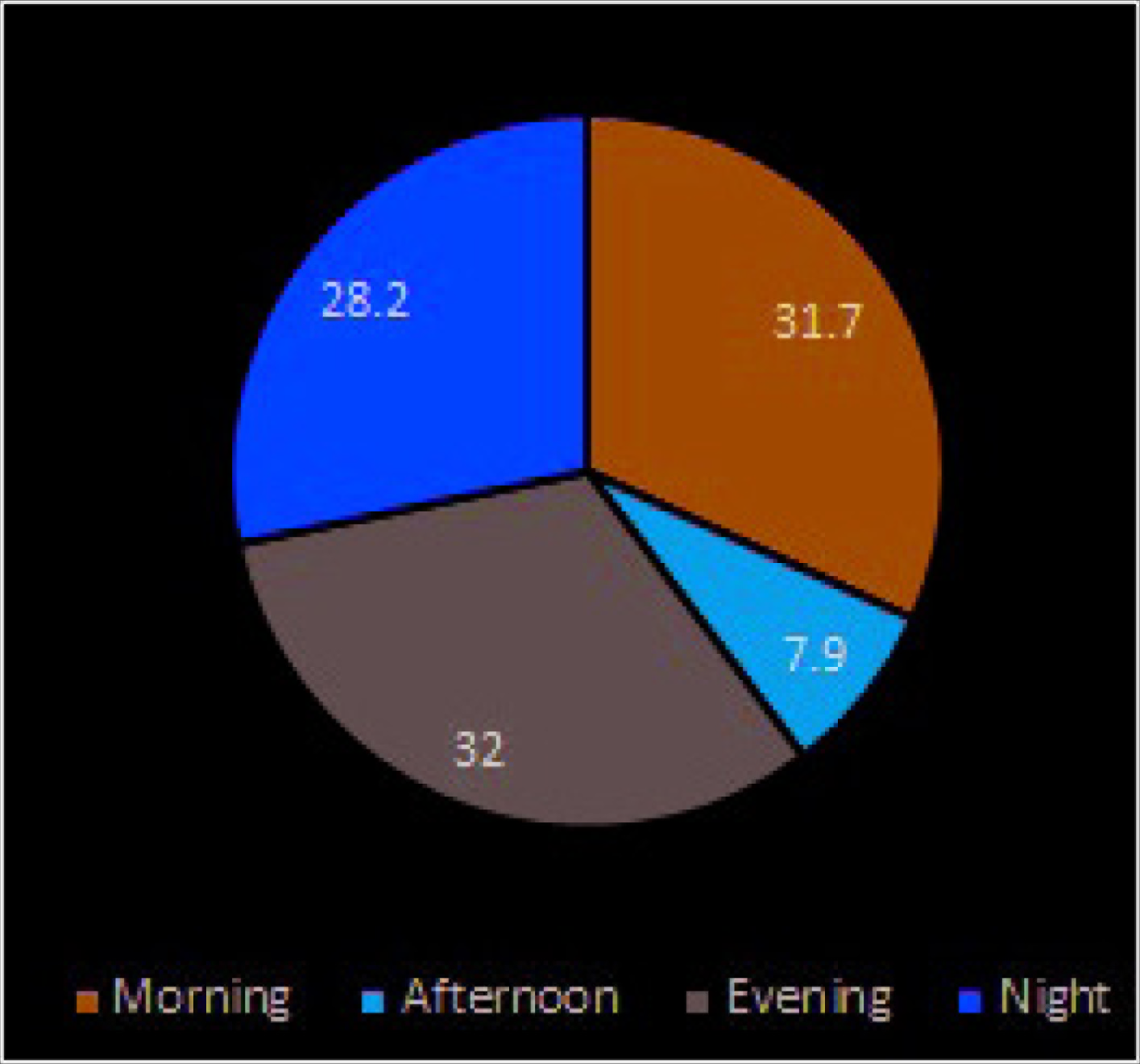
Respondents sexually harassed while using public tranportation were asked to reveal the times the incidents occurred. It was found that an equal percentage (32%) reported that they occurred mostly in the mornings and evenings, followed by night (28.2%; refer to Figure 1). Given that the participants of the present research are young women, including college-going girl students, their travel times are largely restricted to mornings and evenings, when both buses and trains are invariably overcrowded. These conditions create perfect opportunities for offenders to indulge in questionable behaviour. The present research supports the argument (Ceccato, 2017) 20 that an overcrowded bus or an empty train might provide ample scope for perpetrators to sexually harass young women.
Prevalence of Sexual Harassment

Respondents were asked to self-report their emotional feelings at the time the victimization took place. Table 3 indicates that around 70 per cent reported feeling very angry, while 73 per cent said they were scared. Nearly 61 per cent of the respondents reported feeling instant irritation, while roughly half (44.6%) felt humiliated. Therefore, it can be inferred that the incidence of sexual harassment has impacted the lives of young women significanty at a psychological level, causing them to live in a hostile environment and restricting their movements in daily life. 21 Despite this, however, the compulsion to pursue an education or find a job impels these young women to endure the ignominy and move on. Not choosing to study, in detail, the psychological impact of such victimization is one of the limitations of the present research.
How Did You Feel During the Vicimization?

In terms of reactions to the victimization, studies (Jagori, 2011) 22 have shown that the number of incidents reported to the police is an absolute minimum. The present research reveals that only 6.5 per cent of the victims approached the police to lodge a formal complaint. Further, around 12 per cent of the respondents reported having stared back at the offender, while 55.4 per cent walked away. Only 9.2 per cent sought the help of co-passengers (refer to Table 4).
Reaction to Victimization

One of the significant variables of the present research was to ascertain the relationship between the offender and the victim. Table 5 reveals that an overwhelming percentage (67.9) of the respondents’ perpetrators were strangers, followed by relatives (10.9%) and colleagues (10.4%). It is inferred from the present research that three-fourths of all offenders in sexual harassment cases are rank strangers, owing to which only a small number of cases get reported to the police at all. Besides, majority (72.8%) of the respondents expressed that they felt scared during victimization; this being another reason for non-reporting of such offences.
Relationship with the Perpetrator

Responses relating to the demographic status of the respondents and the prevalence of harassment were compared. A majority of the sexually harassed respondents (81%) were in the age group 18–22, demonstrating that irrespective of actual age, there is every chance that young women under the age of 25 are more prone than most to sexual harassment (χ2 = 22.04, p = 0.042). With regard to nativity, it was evident that respondents from urban, semi-urban and rural areas all faced harassment to nearly the same degree, and there is no significant association between their nativity and the prevalence of harassment (χ2 = 62.02, p = 0.124). The economic status of the respondents and the prevalence of harassment was compared. It is inferred from Table 6 that around 86 per cent of all respondents who were sexually harassed belong to the middle- and low-income groups. A chi-square test was applied to establish the relationship between these variables, and it was found that there is a significant association between the two. Therefore, the results can be interpreted to mean that young women from middle- and low-income groups are more likely to be sexually harassed than those from the high-income group (χ2 = 2.14, p = 0.001). With regard to the influence of occupation on the prevalence of sexual harassment, it is proved that unemployed or college-going students are comparatively more prone to such victimization than women working in private organizations (χ2 = 42.47, p = 0.02; refer to Table 6).
Relationship Between Socio-economic Status vs. the Prevalence of Harassment

When respondents were asked about their relationship to the offender, around 68 per cent said that the men were strangers. In terms of the time the incidents occurred, it was found from Table 7 that around 30 per cent of the respondents reported having been harassed, as a general rule, in the mornings, followed by 22.3 per cent in the evenings. A two-tailed t-test was carried out to determine the difference between the variables. The results reveal a significant difference between the time of occurrence and the victims’ relationship with the offender (t = 2.058, p = 0.01). Clearly, time is a major facilitator in offenders sexually harassing young women on public transportation, with almost three-fourths of the victimization taking place during rush hours. Where there is a high probability of both buses and trains being overcrowded, the young women boarding them are preoccupied with getting to college/work or returning home in the quickest possible time. Such being the case, it is quite natural for them to think twice about approaching the police to lodge a complaint, following a misdemeanour. A key factor is that a majority of the offenders (69%) are strangers they probably might not run into again, which makes it easier for them to ignore the men and walk away (24.5% and 55.4%; refer to Table 7). Further, as mentioned earlier, the lack of a proper complaint mechanism, coupled with the unavailability of a special law dealing exclusively with sexual harassment on public transportation, also act as contributory factors in offenders choosing rush hours to commit such offenses.
Relationship with the Offender vs. Time of Occurrence

An attempt has been made to ascertain the relationship between the educational status of the victims and their immediate reaction to the victimization. It is to be noted that only 6.5 per cent of the respondents approached the police to lodge a complaint. In all, it was found that 10.9 per cent of the respondents who walked away were graduates, and the 10.9 per cent who reported the incident to their parents were postgraduates. A similar percentage (9.8) of the respondents with a high school education chose to ignore it. Overall, 93.5 per cent did not report the incident to the police for further action. Further, a t-test was applied to find whether differences existed between the two variables, and a significant difference is found to exist between them at 5 per cent (t = 2.393, p = 0.045; refer to Table 8). Therefore, it can be argued that irrespective of educational status, victims sexually harassed on public transportation are not as likely as other sexually harassed victims to file a complaint at the police station.
Relationship Between the Educational Status of the Victims vs. Their Reactions

As discussed earlier, the RAT proposed by Cohen and Felson can be applied to explain sexual harassment on public transportation. In light of the present research, from the descriptive statistics it can be inferred that travelling by an overcrowded (31.7% in the mornings; 32% in the evenings; and 28.2% in the afternoons) bus or train provided offenders (67.9%) ample opportunities to perpetrate such harassment. Further, underreporting to the police (6.5%), the lack of a proper complaint mechanism, stranger offenders (67.9%) and the non-availability of a special law dealing exclusively with sexual harassment on public transportation have all acted as the absence of a capable guardian (refer to Figure 2). Hence, it can be said that the RAT can be effectively applied to explain the problem of sexual harassment on public transportation.

Further, the five target selection factors proposed by Fattah, 23 including proximity, attractiveness, accessibility, manageability and risk find a place in the present research. As stated earlier, when it comes to Fattah’s proximity factor, the offender settles for the nearest target rather than travel a good distance to commit a crime. In the latter case, where distance is involved for the offender, the target is normally keenly aware of their own familiar surroundings and feels relatively safe. On public transportation, offenders are seldom known to the victim (with strangers accounting for 67.9%) which helps them gain confidence and commit crimes with impunity (‘proximity and accessibility’). Further, the victims’ vulnerability (with 81% in the 18–22 age group and slightly older young women), lack of reporting of such offences (with a 93.5% non-reporting rate) and socio-cultural aspects contribute to Fattah’s attractiveness and manageability factors, enabling offenders to get away with the offences. Therefore, it can be inferred from the findings of the present research that Fattah’s proposed factors need to be studied from an offender’s perspective. Studying the same from a victim’s perspective may not be appropriate to evaluate Fattah’s factors for target selection, and the findings of the present research could explain them only partially.
Conclusions and Implication
The findings have clearly established that one-third of all young women travelling in Chennai city reported having faced some form of sexual harassment in the last six months, with the majority (81%) falling into the age group 18–22. It can, therefore, be concluded with certainty that irrespective of age, there is every chance that young women below the age of 25 are most prone to sexual harassment. Further, those from middle- and low-income groups tend to be sexually harassed far more often than those from the high-income group. The research also found that time plays a major factor in the offenders’ propensity to sexually harass young women on public transportation, with almost three-fourths of the victimization taking place during rush hours, when both buses and trains are overcrowded with young women on their way to college or work or returning home. Finally, it can also be concluded that irrespective of educational status, there are fewer chances of victims sexually harassed on public transportation filing a complaint at the police station, when compared to victims sexually harassed in other circumstances. The present research has also established that the RAT proposed by Felson and Cohen can be applied to explain sexual harassment on public transportation. The five selection factors proposed by Fattah 24 also have a partial application here, in so far as they can be viewed from an offender’s perspective. To reduce the occurrence of such victimization, vulnerable routes may be identified and women constables posted, every day and in shifts, on every Metropolitan Transport Corporation (MTC) city bus to oversee the safe travel of college-goers, working women and elders. Such a practice will also help establish a good working relationship between the general public and the police, and reduce instances of sexual harassment on public transportation. It is further suggested that in the absence of the police, the general public must take responsibility to protect women, who must be encouraged to approach the police to lodge a formal complaint. In the recent past, the image of the police has been gaining traction from the public. The Chennai City Police have introduced mobile applications such as Kavalan and Digicop 2.0 that enable women to lodge a complaint without setting foot in a police station. Utilizing such opportunities will result in a higher reporting rate of such incidents. Further, as discussed earlier, the government must institute a special law addressing sexual harassment on public transportation. Above all, further research needs to be carried out to understand the nature and degree of the actual victimization faced by the victims themselves and the behaviour of offenders, habitual or otherwise.
Footnotes
Declaration of Conflicting Interests
The author declared no potential conflicts of interest with respect to the research, authorship and/or publication of this article.
Funding
The author received no financial support for the research, authorship and/or publication of this article.