




Abstract
Background
Alzheimer's disease (AD) and insulin resistance (IR) share intersecting pathological pathways, with IR increasingly implicated in AD pathogenesis. Systematic bibliometric analyses mapping the evolution of this interdisciplinary field remain limited.
Objective
To quantify global research trends, collaboration networks, knowledge structures, and emerging frontiers in IR-AD research from 2005–2024.
Methods
We analyzed 2676 publications from the Web of Science Core Collection. Using VOSviewer, CiteSpace, and bibliometrix R package, we conducted quantitative analyses and visualized multiple dimensions including annual publications/citations, countries/regions, institutions, journals, authors, references, and keywords.
Results
Annual publications grew steadily, peaking at 267 in 2022. The United States dominated productivity (942 papers, 35.2%) and citations (88,170). The University of Kentucky was the top institution (53 papers), while the Journal of Alzheimer's Disease led in output (214 papers) and co-citations (8046). Keyword analysis revealed three clusters: metabolic dysregulation, molecular pathology, and neuroimmune responses. Emerging frontiers highlight neuroimmune mechanisms, with current hotspots focusing on NLRP3 inflammasome activation, gut-brain axis dysregulation, glucose transporter impairment, and therapeutic repurposing of GLP-1 agonists.
Conclusions
These findings underscore IR-AD as a critical intersection of metabolic and neurodegenerative pathways, advocating for targeted therapies addressing neuroinflammation and cerebral metabolism. By delineating global trends, this study provides a roadmap for future research to bridge translational gaps in AD pathogenesis and treatment.
Introduction
Alzheimer's disease (AD), a progressive neurological condition, 1 is characterized by progressive cognitive decline. 2 Core clinical manifestations include aphasia, agnosia, and neuropsychiatric symptoms 3 such as hallucinations, delusions, and behavioral disturbances, all severely compromising life quality among older adults. 4 The global aging trend drives a continuous rise in AD prevalence. 5 Notwithstanding comprehensive investigations, the definitive pathological mechanisms underlying its occurrence have yet to be fully elucidated. 6 Dominant pathological hypotheses involve amyloid-β (Aβ) plaque deposition, 7 hyperphosphorylated tau protein aggregation, 8 chronic neuroinflammation, 9 and metabolic comorbidities like diabetes. 10 Early studies 11 on posthumous AD brain tissue have detected insulin resistance (IR), alongside diminished expression of multiple glucose transporters in AD neural samples. For these findings, some researchers have referred to AD as “type 3 diabetes”.11,12 Disruptions in cerebral glucose homeostasis may drive neurodegeneration through multiple pathways. Key mechanisms include mitochondrial dysfunction, 13 protein modification errors, redox imbalance, 14 and development of inflammatory conditions, 15 among other mechanisms.
Bibliometric analysis employs interdisciplinary methodologies to quantitatively evaluate research trends, collaborative networks, and knowledge structures within scientific domains.16,17 This approach enables multidimensional analysis of global research outputs, including annual publication patterns, geographical distributions, leading institutions, seminal journals, influential authors, co-citation clusters, and keyword co-occurrence networks. Through databases like Web of Science and analytical tools including VOSviewer, 18 CiteSpace, 19 and Bibliometrix R package, 20 researchers uncover field-specific evolutionary trajectories and emerging frontiers. Despite growing attention to the insulin resistance in Alzheimer's disease (IR-AD) research pathogenesis, systematic bibliometric investigations focused on this subspecialty remain limited. This study analyzes 2005–2024 literature to delineate chronological patterns, collaboration frameworks, and conceptual shifts, thereby informing future development of IR-targeted therapeutic strategies for AD.
Methods
Data source and search strategy
The Web of Science Core Collection (WoSCC) is widely recognized for its comprehensive coverage, systematic methodology, and authoritative status, establishing itself as a primary resource for scientometric analysis and visualization across multiple research disciplines.17,21 Our study retrieved bibliometric data from the Science Citation Index Expanded (SCI-EXPANDED) database within Clarivate Analytics’ WoSCC platform. After identifying relevant title keywords and supplementing them with MeSH subject headings from PubMed, 22 we conducted a comprehensive search through WoSCC using the query format: (TS = (“Alzheimer Disease” OR “Alzheimer Syndrome” OR “Alzheimer-Type Dementia (ATD)” OR “Alzheimer Type Dementia (ATD)” OR “Dementia, Alzheimer-Type (ATD)” OR “Alzheimer's Diseases” OR “Alzheimer Diseases” OR “Alzheimers Diseases” OR “Alzheimer Dementia” OR “Alzheimer Dementias” OR “Dementia, Alzheimer” OR “Alzheimer's Disease” OR “Dementia, Senile” OR “Senile Dementia” OR “Dementia, Alzheimer Type” OR “Alzheimer Type Dementia” OR “Senile Dementia, Alzheimer Type” OR “Alzheimer Type Senile Dementia” OR “Primary Senile Degenerative Dementia” OR “Alzheimer Sclerosis” OR “Sclerosis, Alzheimer” OR “Dementia, Primary Senile Degenerative” OR “Dementia, Presenile” OR “Presenile Dementia” OR “Acute Confusional Senile Dementia” OR “Senile Dementia, Acute Confusional” OR “Alzheimer Disease, Early Onset” OR “Early Onset Alzheimer Disease” OR “Presenile Alzheimer Dementia” OR “Alzheimer Disease, Late Onset” OR “Late Onset Alzheimer Disease” OR “Alzheimer's Disease, Focal Onset” OR “Focal Onset Alzheimer's Disease” OR “Familial Alzheimer Disease (FAD)” OR “Alzheimer Disease, Familial (FAD)” OR “Familial Alzheimer Diseases (FAD)”) AND TS = (“Insulin Resistance” OR “Resistance, Insulin” OR “Insulin Sensitivity” OR “Sensitivity, Insulin”)). We filtered the search results using three criteria: (1) publication dates spanning January 1, 2005 to December 31, 2024; (2) document types limited to articles and reviews; (3) English-language publications. This selection process resulted in 2676 eligible publications, comprising 1660 original research articles and 1016 review articles. All literature search and screening procedures were independently conducted by two investigators on February 2, 2025, with complete agreement in their outcomes. Complete bibliographic records with citation references were downloaded in plain text format. Figure 1 provides a schematic overview of the complete research workflow.
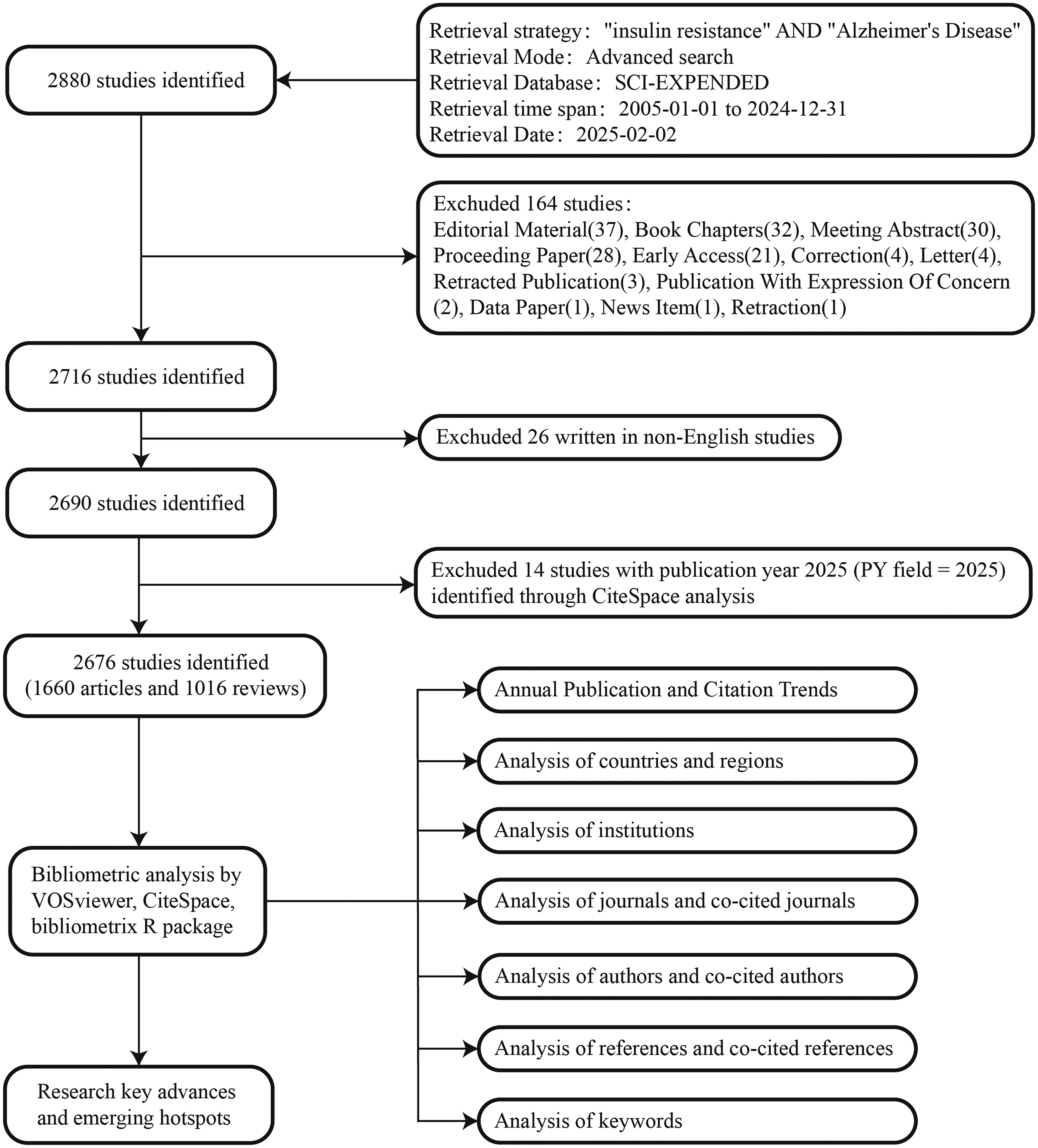
Flowchart illustrating the literature search process and bibliometric analysis.
Bibliometric and visualization analysis
This study employed three analytical tools: VOSviewer v1.6.20, CiteSpace v6.4.R1, and Bibliometrix R package v4.3.2 that running in R v4.4.2 and RStudio v2024.12.0 + 467 for comprehensive data analysis and visualization. VOSviewer, 18 created by van Eck and Waltman, focuses on building and mapping bibliometric networks. In this study, we employed VOSviewer to analyze institutional collaborations, journal co-citations, authorship networks, and keyword clustering, generating density maps and network visualizations. CiteSpace, 19 created by Chaomei Chen, excels in identifying emergent trends and structural dynamics. We utilized CiteSpace for centrality analysis of countries/regions, institutions, co-cited reference cluster detection, keyword burst analysis, and dual-map overlay visualizations of journal distributions. Bibliometrix R package, 20 designed by Aria and Cuccurullo, facilitated annual publication/citation trend analysis by processing publication year and total citation fields. It also calculated journal impact metrics (H-index, G-index) and supported data standardization prior to visualization with RStudio. Prior to analysis of countries and regions, we standardized geopolitical entities by consolidating entries from England, Scotland, Northern Ireland, and Wales into the United Kingdom. For keyword analysis, we unified synonymous terms such as “type 2 diabetes,” “type-2 diabetes mellitus,” and “T2DM” to ensure conceptual consistency. Two researchers conducted independent verification of assessments. Discrepancies underwent third-party revaluation, followed by immediate tripartite consensus.
Results
Basic quantitative information
We analyzed 2676 publications from the SCI-EXPANDED database within WoSCC spanning 2005–2024, obtained through systematic literature search. The dataset comprises 1660 original research articles (62.03%) and 1016 review papers (37.97%). These works involved 12,723 authors from 3063 institutions across 88 countries/regions, published in 687 distinct academic journals. The corpus cited 144,551 references from 10,569 journals.
Annual publication and citation trends
Annual trend analysis of IR-AD research offers intuitive and profound insights into global scientific dynamics. This approach not only reveals evolving engagement within the field but also provides actionable data to guide future studies and resource allocation frameworks. As depicted in Figure 2, annual publication output shows a distinct phased expansion pattern characterized by marked surges in 2009, 2012, 2017, 2019, and 2022, each followed by multi-year intervals of incremental progression. A striking pattern emerges in the annual publication trends: since 2019, annual publication volumes have consistently exceeded 200 articles, reaching a peak of 267 publications in 2022. Citation trends revealed a remarkable spike in total citations for 2007 publications compared to adjacent years, suggesting pioneering significance of research from this period. Three distinct citation peaks emerged in 2012, 2014, and 2017, indicating sustained academic interest in IR-AD research. Since 2020, citation counts have progressively declined each year. This trend stems from the fact that recent publications need time to receive citations.

Annual publication output and cumulative citation trends over time. NP: number of publications; TC: total citations.
Analysis of countries and regions
Our analysis identifies 88 countries and regions contributing to IR-AD research. As shown on Table 1 and Figure 3A, the United States dominates with 942 publications (35.20%) and unparalleled scholarly impact (88,170 total citations), reinforced by its highest centrality (0.31), signifying dual roles as both a knowledge producer and international collaboration hub. China ranks second in productivity (493 publications, 18.42%), though its lower citation metrics (15,912 total citations; 32.27 average citations per publication) suggest a gap between output volume and global influence. Southern European nations exhibit strategic collaborative positioning: Italy and Spain substantiate elevated centrality (0.21 and 0.20, respectively), reflecting their roles as interdisciplinary bridges. The United Kingdom achieves exceptional research quality, with average citations per publication (155.40) surpassing even the USA (93.60), underscoring its capacity for high-impact discoveries. These patterns highlight geographic disparities in research specialization, where quantitative output and qualitative influence diverge across regions.

Analysis of countries/regions and institutions. (A) Chord diagram illustrating country/region collaboration patterns. (B) Academic collaboration networks between institutions.
Top 10 most productive countries and regions.

NP: number of publications; ACP: average citations per publication.
Analysis of institutions
Analyzing publication patterns among research institutions allows us to identify leading contributors and detect organizations conducting cutting-edge investigations in this domain. This analytical approach efficiently locates both authoritative groups shaping the field and teams advancing innovative aspects of IR-AD research. 3063 research institutions have collectively published 2676 publications in the IR-AD field. As indicated in Table 2 and Figure 3B, the University of Kentucky (53 articles) and University of Washington (48 articles) exhibit the highest scholarly productivity among the top 10 contributing institutions within IR-AD research. The National Institute on Aging (NIA) and Universidade Federal do Rio de Janeiro show distinguished scholarly impact in IR-AD research, with total citation counts reaching 6478 (154.24 average citations per publication) and 6415 (164.49 average citations per publication) respectively. In contrast, King Abdulaziz University's 38 publications register comparatively lower citation metrics, attaining 1107 total citations (29.13 average citations per publication). Harvard Medical School (2019.59 average publication year), Huazhong University of Science and Technology (2017.74 average publication year), and University of Barcelona (2017.97 average publication year) exhibit the most recent publication timelines in IR-AD research, underscoring sustained productivity momentum within these institutions. By comparison, Brown University (2014.49 average publication year) and University of Washington (2015.69 average publication year) maintain earlier chronological baselines in IR-AD investigations, achieving academic prominence through foundational research contributions during the field's developmental phase.
Top 10 most productive institutions.

NP: number of publications; ACP: average citations per publication; APY: Average Publication Year.
Analysis of journals and co-cited journals
Our bibliometric analysis identified 2676 publications across 687 journals investigating IR-AD. Guided by Bradford's Law of Scattering, 23 we identified 19 core journals (Table 3) that collectively concentrate research productivity. Among 19 core journals, 18 are located in JCR Q1/Q2 quartiles, indicating generally high-quality publications in this research domain. The Journal of Alzheimer's Disease asserts dominant scholarly leadership with 214 publications, followed distantly by the International Journal of Molecular Sciences (110 articles). The combined output of these top two journals (324 articles) surpasses the aggregate publications from ranks 3 to 9 (294 articles).
The 19 core research productivity journals identified by Bradford's law of scattering.

NP: number of publications; TC: total citations.
To assess academic impact, we employed two bibliometric indicators. The h-index evaluates journal productivity and citation influence by identifying how many publications (h) have each received at least h citations. 24 The g-index complements this assessment by weighing both individual article citations and collective research output. 25 Analysis reveals the Journal of Alzheimer's Disease reveals exceptional performance across these metrics with an h-index of 52, g-index of 94, and 10,176 total citations.
Table 4 identifies the 10 most co-cited journals in IR-AD research from 2005 to 2024. The Journal of Alzheimer's Disease leads with 8046 co-citations, demonstrating its central role in IR-AD studies. The Journal of Biological Chemistry (5979) and Proceedings of the National Academy of Sciences of the United States of America (5470) ranked second and third respectively.
Top 10 co-cited journals.

Dual-map overlay analysis of journals. The journals dual-overlay analysis method, pioneered by Chen and Leydesdorff, illustrates the spatial distribution of citing versus cited journals within scientific landscapes. 26 This visualization technique maps inter-journal citation patterns across disciplinary boundaries through node-link representations in global science maps. 27 Figure 4C presents the journal dual-map overlay in the IR-AD research domain, revealing three primary citation pathways represented by bold connecting lines. The first yellow pathway (z = 9.504074, f = 31,209) demonstrates significant knowledge transfer from the MOLECULAR/BIOLOGY/IMMUNOLOGY cluster to MOLECULAR/BIOLOGY/GENETICS. A second yellow connection (z = 1.7535198, f = 6327) links MOLECULAR/BIOLOGY/IMMUNOLOGY with HEALTH/NURSING/MEDICINE disciplines. The green pathway (z = 2.047762, f = 7262) bridges MEDICINE/MEDICAL/CLINICAL research with MOLECULAR/BIOLOGY/GENETICS. Particularly, the network's finer interconnections show potential for developing into robust conceptual pathways, suggesting three principal developmental trajectories: synergistic integration of disciplines, innovative cross-disciplinary interfaces, and the potential emergence of novel specialized subdivisions within the IR-AD research paradigm.

Analysis of journals and co-cited journals. (A) Co-occurrence network visualization of journals. (B) Co-cited network visualization of journals. (C) Dual-map overlay analysis of journals.
Analysis of authors and co-cited authors
By analyzing publication output, collaboration networks, and co-citation patterns, we can identify key contributors and assess their scientific impact through multidimensional evaluation in IR-AD research. Between 2005 and 2024, a total of 12,723 authors authored 2676 research papers focusing on the IR-AD research. As detailed in Table 5, De Felice, de la Monte, and Craft hold concurrent leadership across number of publications (NP), total citations (TC), and local citations (LC) metrics. This dual excellence in publication productivity and research influence confirms the leadership position maintained by these scholars and their research teams in the IR-AD field. Dr De Felice ranks first in publication count (NP = 32), with 5702 total citations and the highest collaboration network strength (total link strength, TLS = 202), indicating extensive citation and collaborative engagement (Table 5, Figure 5A). Dr Craft achieved the highest citation metrics (TC = 5924; LC = 1381) and served as the central collaborative hub (TLS = 192) within the research network (Figure 5A). Dr de la Monte revealed distinct academic metrics, ranking second in both publication output (NP = 31) and local citations (LC = 1306), while showing limited external collaboration (TLS = 69). The Barone-Butterfield-Perluigi-Di Domenico team showed strong internal collaboration with limited external connections. Similarly, the Camins-Ettcheto-Folch team maintained unique research profiles. Emerging teams have shown increasing activity in recent years, potentially becoming future research hotspots.

Analysis of authors and co-cited authors. (A) Author collaboration network. (B) Co-cited author network.
Top 10 authors and co-cited authors.

NP: number of publications; TC: total citations; LC: local citations; TLS: total link strength.
Analysis of references and co-cited references
Highly cited references. For researchers investigating IR-AD, identifying highly cited works serves as a critical first step when designing impactful studies, enabling them to build upon established knowledge in this developing field. Table 6 identifies the top 10 most globally cited articles among 2676 publications, while Table 7 highlights the 10 most locally cited references from 144,551 cited works.
Top 10 highly cited publications.

TC: total citations: LC: local citations.
Top 10 co-cited references.

LC: Local citations.
Dr Valko's 2007 review, published by The International Journal of Biochemistry & Cell Biology, illustrates striking citation patterns: despite achieving TC = 10,030, its LC = 15 within IR-AD research highlights limited specific influence. This work 28 remains pivotal in redox biology for elucidating ROS/RNS's dual roles in disease pathogenesis and maintaining antioxidant balance. 29 Originating from Slovak Technical University (Slovakia), these findings do not compromise the established geographic research distribution patterns.
Published in 2006 in The Lancet Neurology, Dr Biessels’ systematic review exhibits exceptional academic influence with Total Citations (TC = 1619) and Local Citations (LC = 185). It 30 establishes a significant association between diabetes mellitus and elevated dementia risk that encompassing AD and vascular dementia.
The research article by Dr Talbot (2012, Journal of Clinical Investigation) secured third position in TC rankings (1398 citations) while claiming the top LC position (582 citations). The article 31 substantiates that AD's patients’ brain IR correlates with IGF-1 resistance, IRS-1 dysfunction, and worsening cognitive decline.
The review by Dr Arnold (2018, Nature Reviews Neurology) achieved notable TC impact (970 citations) while holding third position in LC rankings (311 citations). The article 32 explores the link between brain IR in Type 2 diabetes (T2DM) and AD, highlighting overlapping mechanisms and unresolved questions in their shared pathogenesis and treatment.
Co-cited reference cluster analysis. Current academic consensus maintains that citation networks typically emerge when multiple papers concurrently reference shared publications. Systematic examination of such co-citation patterns enables researchers to pinpoint seminal works, trace conceptual developments, and map intellectual linkages across studies. Our bibliometric analysis of 2676 publications revealed 144,551 collective citations, with the top 10 co-cited references (Table 7) demonstrating substantial influence - all exceeding 200 citations and one surpassing 500 citations. Cluster analysis based on authors keywords (Figure 6A) identified 14 thematic groups: #0 glp-1 receptor agonists, #1 neuroinflammation, #2 metabolic syndrome, #3 hyperinsulinemia, #4 high-fat diet, #5 extracellular vesicles, #6 amyloid-beta oligomers, #7 central nervous system, #8 tau phosphorylation, #9 hypertension, #10 growth factor receptors, #11 obesity, #12 gut microbiota, and #13 mouse model. Figure 6A illustrates the temporal migration of research focuses, showing progressive convergence toward two dominant clusters: #0 (glp-1 receptor agonists, Parkinson's disease, semaglutide, type 2 diabetes mellitus, and metformin) and #1 (neuroinflammation, Alzheimer's disease, glucose transporter, brain glucose metabolism, and brain insulin resistance). These two clusters not only represent the largest groupings but also the most chronologically recent developments, as evidenced by the timeline visualization in Figure 6B.

Analysis of co-cited references. (A) Cluster visualization map of 14 co-citation groupings. (B) Timeline visualization of co-citation clusters with thematic labeling. (C) Top 25 co-cited references with the strongest citation bursts.
Co-cited reference emergence analysis. Through meticulous examination of articles exhibiting the highest citation burst strengths, we gain insights into the trajectory of research advancement. This analysis facilitates the identification of pivotal studies that have garnered substantial scholarly attention and pinpoints the temporal occurrence of these citation surges. The co-citation analysis and identification of frequently co-cited works enable researchers to recognize potential collaborators with aligned research interests, thereby enhancing collaborative capacity. Figure 6C lists the 25 co-cited references exhibiting the most intense citation bursts. Among these, the study 31 by Talbot et al. (2012, J Clin Invest) revealed the most pronounced citation burst (strength = 78.04), occurring between 2013 and 2017. Subsequent high-impact bursts included works32,33 by Arnold et al. (2018, Nat Rev Neurol, 63.48) and Kellar et al. (2020, The Lancet Neurol, 55.71). The period around 2012 marked a research zenith,34–51 with concentrated contributions from De Felice, Craft, Moloney, and others (burst strengths 19.87–41.01).
Analysis of keywords
Keyword frequency and clustering analysis. The keywords selected by paper authors typically serve to emphasize core research themes and reflect manuscript content. Those demonstrating high frequency across publications within a specific discipline often represent crucial focus areas in the research field. After excluding the search terms “insulin resistance” and “Alzheimer's disease”, we identified 285 keywords with occurrence frequencies ≥ 5 to establish a co-occurrence network (Figure 7). As depicted in Figure 7A, the keywords form three distinct clusters: Cluster 1 (red) - Metabolic Dysregulation contains 141 terms including “diabetes”, “obesity”, “insulin”, “dementia”, and “cognitive impairment”, encompassing themes related to insulin signaling pathways, glucose metabolism, adipokines, and therapeutic interventions such as antidiabetic medications and lifestyle modifications. Cluster 2 (green) - Molecular Pathology comprises 76 keywords like “amyloid-beta”, “tau”, “hippocampus”, and “insulin signaling”, concentrating on therapeutic targets including BACE1 and GSK3, along with pharmacological approaches targeting amyloid or tau proteins. Cluster 3 (blue) - Neuroimmune Response incorporates 68 terms such as “neurodegeneration”, “neuroinflammation”, “oxidative stress”, and “neuroprotection”, covering neuroprotective strategies, antioxidant therapies, and emerging anti-inflammatory treatments like GLP-1 receptor agonists.

Keyword co-occurrence network. (A) Keyword co-occurrence network is divided into three clusters, color-coded for differentiation. (B) Node colors represent the average publication year of articles containing the keyword.
VOSviewer visualization employs color-coding based on keywords’ average publication year (Figure 7B), where blue hues denote earlier-appearing terms and red indicates more recent entries. The chromatic transition from blue to red illustrates temporal progression in keyword emergence. This pattern suggests that research on Metabolic Dysregulation originated earlier, followed by Molecular Pathology investigations, while Neuroimmune Response studies predominantly represent newer research initiatives.
Keyword emergence analysis. While VOSviewer effectively visualizes keyword co-occurrence patterns, it substantiates limitations in tracking temporal dynamics of keyword prominence. Specifically, it fails to capture temporal parameters such as burst begin/end and strength. To resolve this limitation, we conducted citation burst detection using CiteSpace. As illustrated in Figure 8, keywords with outbreak initiation dates prior to 2019 predominantly cluster within Group 1 and Group 2, whereas those originating after 2019 are primarily situated in Group 3. This outcome aligns with the prior keyword clustering analysis findings.
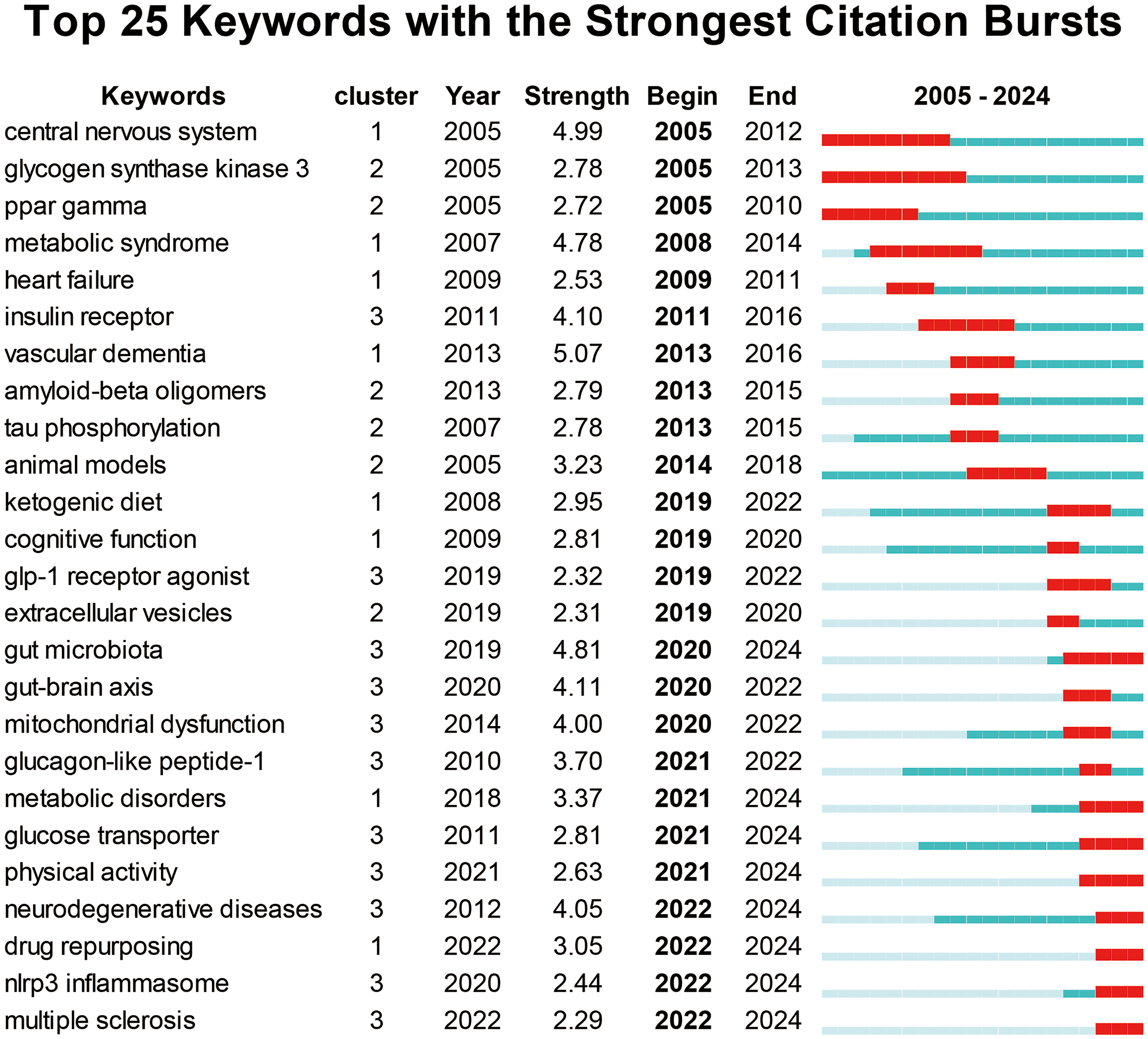
Top 25 keywords with the strongest citation bursts during the period from 2005 to 2024. Cluster annotations reflect Figure 7's thematic association schema.
Within the 2005–2024 timeframe, “vascular dementia” exhibited the strongest burst intensity (Strength = 5.07, 2013–2016), followed by “central nervous system” (Strength = 4.99, 2005–2012) and “gut microbiota” (Strength = 4.81, 2020–2024). The keyword bursts that lasted until 2024 included “gut microbiota”, “metabolic disorders”, “glucose transporter”, “physical activity”, “neurodegenerative diseases”, “drug repurposing”, “NLRP3 inflammasome” and “multiple sclerosis” which represented the hotspots in recent years.
Discussion
This investigation systematically delineates the research landscape of IR-AD through bibliometric analysis of 2676 publications (2005–2024) from the SCI-EXPANDED database within WoSCC, utilizing VOSviewer, CiteSpace, and Bibliometrix R package.
General distribution
Annual publications demonstrate phased growth (Figure 2). These growth patterns align with Thomas Kuhn's paradigm theory, 52 suggesting periodic scientific breakthroughs. The United States maintains unparalleled scholarly influence within this domain, evidenced by its publications, citations, and centrality. Furthermore, half of the top 10 productive institutions originate from American academia, collectively demonstrating the nation's dual role as both a knowledge production powerhouse and a global collaborative nexus (Table 1, Figure 3). Among leading institutions, University of Kentucky leads in productivity while the National Institute on Aging excels in citation impact (Table 2). The Journal of Alzheimer's Disease led with 214 publications and 10,176 total citations (Tables 3 and 4). PLoS One and Neurobiology of Aging appeared on both high-productivity and high co-citation lists. Of particular importance is the observation that 94.7% (18/19) of high-productivity journals and all (10/10) highly co-cited journals maintained Q1/Q2 JCR rankings, signifying their high-quality output characteristics. The journals dual-overlay analysis confirmed interdisciplinary integration between neuroscience, biochemistry, and related disciplines (Figure 4C). Three principal investigators emerge as field leaders (Table 5). Dr De Felice leads in productivity and collaboration. Dr Craft achieves highest citations. Dr de la Monte ranks second in both productivity and local citations. Dr Valko et al.'s seminal 2007 review 28 illustrates a striking dichotomy in citation patterns with an exceptionally high total citations (10,030) versus limited local citations (15) (Table 6). This disparity underscores its foundational role in redox biology rather than direct contributions to AD specific mechanisms.
Hotspots and frontiers
The investigation of IR-AD has evolved through distinct yet interconnected phases since 2005, progressively unraveling metabolic connections, molecular pathways, and therapeutic opportunities. In 2005, Steen et al. proposed AD as a “type 3 diabetes” linked to CNS-specific insulin and IGF-I/II signaling deficiencies. 11 This framework highlighted metabolic dysfunction as a driver of neurodegeneration. In 2008, de la Monte and Wands’ review article supported the “Type 3 Diabetes” concept, emphasizing brain IR and deficiency as central to AD pathobiology. 12 This seminal work linked cerebral insulin deficiency and resistance to neurodegenerative mechanisms that overlap with both type 1 and type 2 diabetes mellitus. In a pivotal study, Craft revealed that IR increases AD risk by elevating Aβ42 and inflammatory cytokines in the brain. 53 De Felice et al. reveal that insulin prevents synaptic damage by inhibiting Aβ oligomer binding, highlighting the neuroprotective role of insulin signaling in AD's pathophysiology. 35 Takeda et al. indicated bidirectional exacerbation between diabetes and AD, mediated by cerebrovascular inflammation and cerebral amyloid angiopathy. 38 Baker et al. found that higher IR in cognitively normal adults with prediabetes or early T2DM was associated with reduced cerebral glucose metabolism in AD vulnerable regions, including frontal, parietotemporal, and cingulate cortices. 39 Talbot et al. identified IRS-1 phosphorylation at serine 616 and 636/639 in AD brains as candidate biomarkers of brain IR. 31 These abnormalities correlated with Aβ oligomers and cognitive decline, independent of amyloid plaques, neurofibrillary tangles, and APOE ε4 status. 31 Bomfim et al. highlighted Aβ oligomer-induced IRS-1 serine phosphorylation via JNK/TNF-α activation. 42 Exendin-4 reversed neuronal IR, reduced amyloid pathology, and improved cognition in AD models, highlighting therapeutic potential. 42 Craft et al. conducted a 4-month trial of intranasal insulin in 104 adults with aMCI/AD. The 20-IU dose improved delayed memory, while both doses preserved caregiver-rated function. 43 FDG-PET revealed insulin groups showed minimized progression of glucose metabolism decline versus placebo. 43 De Felice et al. proposed Aβ oligomers trigger brain IR-AD via TNF-α/JNK pathway activation and IRS-1 inhibition, mirroring diabetic mechanisms. 48 Their model links insulin receptor dysfunction, mitochondrial stress, and inflammation, suggesting GLP-1R agonists as potential therapies. Arnold et al.'s 2018 review emphasized overlapping mechanisms (e.g., brain IR) between T2DM and AD but noted conflicting evidence regarding AD specific pathologies (e.g., Aβ) in diabetic cohorts. 32 Kandimalla et al. reviewed the “Type 3 Diabetes” hypothesis linking AD to IR, highlighting mechanisms like GSK3β-mediated tau phosphorylation. 54 Arnold et al.'s 2018 review emphasized mechanistic overlaps between AD and T2DM, identifying brain IR as a shared feature linked to cognitive decline and neurodegeneration, though causal pathways remain uncertain. 32 Kellar and Craft investigated therapeutic strategies, including intranasal insulin, GLP-1 agonists, and lifestyle modifications, informed by preclinical and clinical studies evaluating their potential to address brain IR-AD and related disorders. 33
Our bibliometric data show different paths for preclinical and clinical research. Preclinical studies drive molecular exploration (Cluster 2: green and Cluster 3: blue, Figure 7A), demonstrating rapid hypothesis evolution beyond traditional frameworks like the amyloid cascade hypothesis. For example, emerging focus on NLRP3 inflammasome (burst strength = 2.44, 2022–2024) and glucose transporter (burst strength = 2.81, 2022–2024) (Figure 8). In contrast, clinical research remains anchored in the metabolic syndrome framework (Cluster 1: red, Figure 7A), prioritizing therapeutic repositioning of existing drugs such as GLP-1 agonists. This conservatism stems from clinical trial restrictions—reflected in the sustained bursts of keywords like drug repurposing (burst strength = 3.05, 2022–2024) and metabolic disorders (burst strength = 3.37, 2021–2024). The delayed adoption of new hypotheses in clinical settings highlights the translational challenges in converting mechanistic discoveries into patient interventions. Future efforts should prioritize bidirectional bench-to-bedside dialogue, particularly in neuroinflammation modulation and cerebral metabolic rescue, to transform mechanistic discoveries into actionable therapies for AD.
Current research hotspots in IR-AD converge on neuroimmune crosstalk, particularly the role of NLRP3 inflammasome activation in bridging metabolic dysfunction, neuroinflammation, and Aβ pathology.55,56 The gut-brain axis has emerged as a pivotal focus, with studies linking gut microbiota dysbiosis to systemic inflammation, insulin signaling impairment, and neurodegeneration, driving exploration of microbial modulation strategies.57–59 Glucose transporter is increasingly recognized as a key mediator of cerebral hypometabolism, 60 while drug repurposing efforts prioritize GLP-1 receptor agonists for their metabolic benefits and potential neuroprotective effects supported by preclinical studies. 61
NLRP3 inflammasome. The NLRP3 inflammasome, a multiprotein complex comprising NLRP3, ASC, and procaspase-1, plays a pivotal role in bridging metabolic dysfunction, neuroinflammation, and Aβ pathology in AD. 62 Activation of this inflammasome involves a two-step mechanism: priming by NF-κB-dependent transcriptional upregulation of NLRP3 and pro-IL-1β, followed by a second signal triggering its assembly via ionic flux, pore-forming toxins, or crystalline/aggregated materials. 63 In AD, Aβ aggregates and tau pathology act as damage-associated molecular patterns, engaging microglial receptors such as P2X7R to initiate NLRP3 activation. 64 This process is amplified by mitochondrial reactive oxygen species (ROS) and oxidized mitochondrial DNA, which are released during mitochondrial stress induced by apoptotic stimuli, further activating NLRP3 and contributing to neuroinflammation and neuronal damage. 65 Activated NLRP3 recruits ASC, which then recruits procaspase-1. This leads to caspase-1-mediated cleavage of pro-IL-1β and pro-IL-18, cytokines that exacerbate neuroinflammation by promoting microglial activation, astrocyte reactivity, and recruitment of peripheral immune cells. 66 The interplay between metabolic stress and NLRP3 activation involves mitochondrial Ca2+ overload and ROS overproduction, which prime NLRP3 inflammasome activation through mitochondrial damage. This process is triggered by Ca2+ mobilization from endoplasmic reticulum stores and extracellular influx, leading to ASC oligomerization and inflammasome assembly. 67 These metabolic stressors synergize with Aβ to destabilize lysosomal membranes, releasing cathepsins (e.g., cathepsin B) that contribute to NLRP3 inflammasome activation. 66 Moreover, Aβ oligomers activate microglial P2X7R signaling, triggering K+ efflux and NLRP3 inflammasome assembly, which impairs Aβ clearance by promoting pyroptotic cell death in phagocytic microglia. 64 This bidirectional relationship between NLRP3-driven neuroinflammation and Aβ accumulation establishes a pathological loop: chronic inflammasome activation accelerates Aβ deposition, while Aβ oligomers induce mitochondrial dysfunction and oxidative stress, further activating NLRP3.68–70 Pharmacological inhibitors like MCC950 selectively bind to the Walker B motif in the NLRP3 NACHT domain, suppressing ATP hydrolysis, inflammasome assembly, and IL-1β maturation, thereby reducing Aβ burden in AD models expressing wild-type NLRP3.71–73 Similarly, targeting upstream regulators such as P2X7R reduces NLRP3 inflammasome activity and neuroinflammation.74,75 Gut-brain axis. The gut-brain axis, a bidirectional communication network integrating neural, endocrine, and immune pathways, plays a critical role in modulating systemic metabolic homeostasis and neurological health. Emerging evidence highlights that gut microbiota dysbiosis contributes to IR through intertwined mechanisms involving chronic inflammation and metabolic endotoxemia.76,77 In IR, microbial-derived lipopolysaccharides from Gram-negative bacteria trigger low-grade systemic inflammation by activating the CD14/TLR4/NF-κB signaling pathway, which promotes serine phosphorylation of insulin receptor substrates and impairs insulin signaling.57,78 Concurrently, dysbiosis may alter the composition of short-chain fatty acids (SCFAs), such as butyrate and propionate. While SCFAs normally enhance intestinal barrier integrity, stimulate GLP-1 secretion, and suppress pro-inflammatory cytokine release, microbial dysbiosis in obesity is associated with increased gut permeability and metabolic endotoxemia, potentially disrupting these protective functions.79,80 These inflammatory cascades further compromise blood-brain barrier permeability, allowing neurotoxic metabolites and circulating lipopolysaccharides to infiltrate the central nervous system.81,82 In AD, gut dysbiosis amplifies neuroinflammation via microglial activation driven by lipopolysaccharides and pro-inflammatory cytokines, accelerating Aβ aggregation and contributing to tau hyperphosphorylation. 83 Reduced SCFA levels diminish neurotrophic support and disrupt synaptic plasticity, impairing cognitive function. Notably, microbial modulation strategies, including probiotics, prebiotics, and dietary interventions, restore gut microbial diversity, suppress TLR4-mediated inflammation, and enhance SCFA production, offering therapeutic potential for neurological disorders by targeting shared inflammatory and metabolic pathways.84–86
Glucose transporter. Glucose transporters (GLUTs), a family of membrane proteins that mediate facilitative diffusion, play pivotal roles in maintaining cellular energy homeostasis by transporting D-glucose across plasma membranes. 87 Among seven identified isoforms, GLUT1 and GLUT3 are critically involved in cerebral metabolism, while the insulin-responsive GLUT4 primarily mediates systemic glucose regulation with minor roles in specific brain regions. 88 In IR, defective GLUT4 translocation due to impaired PI3K/Akt signaling cascades reduces glucose uptake in target tissues, while dysregulated gluconeogenic enzymes exacerbate hyperglycemia by promoting excessive glucose release into circulation.89,90 Mechanistically, chronic mTOR activation induces IRS-1 degradation, creating a vicious cycle of insulin desensitization. 91 Cerebral hypometabolism in AD is observed as a downstream biomarker and correlates with synaptic dysfunction and neurodegeneration. Tau hyperphosphorylation is primarily induced by soluble Aβ42 oligomers, which trigger dysregulation of kinases/phosphatases in a tau-dependent manner. 92 Therapeutic strategies targeting GLUT membrane trafficking and enhancing neuronal glucose uptake via GLUT3 stabilization demonstrate potential to decelerate both IR and neurodegenerative cascades, highlighting the centrality of cerebral glucose transporter dysregulation in these intersecting pathologies.93,94
Drug repurposing. Drug repurposing has emerged as a strategic approach to address unmet therapeutic needs in complex diseases, particularly in metabolic and neurodegenerative disorders. Notably, GLP-1 receptor agonists (GLP-1RAs), originally developed for type 2 diabetes, are prioritized for their metabolic benefits and neuroprotective potential.95,96 These agents enhance insulin sensitivity, reduce systemic inflammation, and mitigate insulin resistance—a key pathophysiological link between metabolic dysfunction and AD.97,98 Preclinical studies demonstrate that GLP-1RAs, such as exenatide and liraglutide, exhibit neuroprotective effects in models of stroke, Parkinson's disease, and Wolfram syndrome by reducing neuroinflammation, enhancing neuronal survival, and ameliorating endoplasmic reticulum stress.99,100 IR is associated with an increased risk of T2DM and impaired fasting glucose in AD, and the duration of T2DM correlates with the density of brain amyloid plaques, suggesting a shared pathological mechanism involving amyloid aggregation in both diseases.101,102 Preclinical studies in AD mouse models further support their translational promise; liraglutide improved cognitive function and reduced cortical amyloid load. 41 Despite mixed outcomes in early human trials, ongoing studies targeting metabolic dysfunction-related AD underscore the potential of repurposed GLP-1RAs to modulate shared pathways between metabolism and neurodegeneration, offering a cost-effective strategy to bridge these interconnected processes.103,104
Our investigation presents three principal constraints. First, the analysis exclusively examined English-language original research articles and reviews indexed in the SCI-EXPANDED database within WoSCC, excluding publications in other languages or formats. Second, the investigation's 20-year timeframe (2005–2024) focused on contemporary trends while overlooking foundational contributions that shaped early-stage IR-AD research development. Third, the citation analysis prioritized seminal works through established citation metrics, potentially undervaluing recent high-impact IR-AD studies that require additional time for scholarly recognition.
Conclusion
Global research output on IR-AD has reached 2676 publications over the past two decades, demonstrating stepwise growth. This upward trajectory reveals sustained breakthroughs in the field, underscoring its enduring scientific significance. The sustained momentum in research output suggests that IR-AD remains a crucial focus in contemporary neuroscience. By integrating scientometric tools, we traced the progression of illuminating the evolution, priorities, and future directions of IR-AD. We identified leading countries/regions, institutions, and scholars, while analyzing major journals and representative literature. Through co-citation analysis, keyword co-occurrence, and burst detection, we determined that neuroimmune response mechanisms currently dominate IR-AD research. Future investigations are expected to focus on NLRP3 inflammasome, gut-brain axis, glucose transporter and drug repurposing. These insights could advance our understanding of IR-AD pathogenesis and inform subsequent translational research, guide research priorities, and shape emerging trends in this field.
Footnotes
Acknowledgements
We would like to thank the researchers who conducted the original studies included in this analysis.

Author contributions
Funding
The authors received no financial support for the research, authorship, and/or publication of this article.
Declaration of conflicting interests
The authors declared no potential conflicts of interest with respect to the research, authorship, and/or publication of this article.
Data availability statement
The data supporting the findings of this study are available within the article.