




Abstract
Background
Triggering receptor expressed on myeloid cells 2 (TREM2) is a microglial receptor genetically linked to Alzheimer's disease (AD) and increasingly recognized as a key regulator of neuroinflammation, yet its global research landscape in AD remains unclear.
Objective
In the central nervous system, TREM2 expressed on microglia is closely related to the occurrence and development of AD and has been extensively studied in recent years. However, there is still a lack of bibliometric analysis regarding TREM2 and AD.
Methods
We searched in the Web of Science Core Collection (WoSCC) for articles published from January 1, 2000, to September 30, 2024. After a thorough screening process, we selected relevant information regarding TREM2 and AD. Subsequently, a comprehensive analysis was conducted on a total of 944 publications. The analysis utilized GraphPad Prism 9, CiteSpace6.1.6, VOSviewer1.6.19, the Online Analysis Platform of Literature Metrology, GeneMANIA and Metascape.
Results
A total of 944 publications from 2000 to 2024 met the inclusion criteria for this analysis. Over this period, research activity in TREM2 and AD has shown a consistent upward trend, with notable peaks in 2021 and 2022. The United States and China lead in the number of publications, with Washington University being the top research institution. Neurobiology of Aging is the most frequently cited journal in this field. Research has focused on key areas like molecular biology, genetics, and neuroimmunology. Critical keywords include microglia, inflammation, and genetic variants, while recent studies highlight emerging topics such as protein interactions, neurodegeneration, and cognitive impairment.
Conclusions
This study employs advanced bibliometric analysis tools and visualization techniques to clearly present the major research themes, development trends, and prospects of TREM2 in AD.
Introduction
Alzheimer's disease (AD) is a common neurodegenerative disorder and one of the leading causes of dementia in the elderly. 1 The clinical manifestations of AD include memory loss, cognitive impairment, and a decline in daily living activities, imposing significant psychological and physical burdens on patients and their families. 2 The pathogenesis of AD is complex and multifactorial, involving genetic, environmental, and lifestyle factors. 3 Pathological features include the formation of amyloid plaques and the presence of neurofibrillary tangles, both contributing to neuronal dysfunction. 4 Amyloid plaques are formed by aggregates of abnormally folded amyloid-β (Aβ) peptides, which disrupt neuronal signaling and lead to neuronal death. 5 Current treatment methods for AD include acetylcholinesterase inhibitors, NMDA receptor antagonists, antibody therapies targeting Aβ (e.g., lecanemab), as well as non-pharmacological interventions such as cognitive training, psychosocial support, nutritional and lifestyle adjustments, and caregiving support.6–8
TREM2 is a transmembrane protein primarily expressed in myeloid cells, including microglia in the central nervous system. Structurally, TREM2 consists of an extracellular domain that binds to ligands, a single transmembrane region, and a cytoplasmic tail that initiates intracellular signaling upon activation. 9 TREM2 forms a complex with DAP12 through its cytoplasmic tail. DAP12 contains an Immunoreceptor Tyrosine-based Activation Motif (ITAM) sequence, and when TREM2 is activated, the ITAM sequence of DAP12 is phosphorylated, initiating a cascade of downstream signaling pathways, such as the PI3 K/Akt and NF-κB pathways. 10 Activation of these pathways regulates cell survival, proliferation, and inflammatory responses. 11
Under physiological conditions, TREM2 is essential for the maintenance and homeostasis of microglia, facilitating their response to neuronal injury and aiding in the clearance of cellular debris. 12 However, in the context of AD, TREM2 expression is upregulated in activated microglia surrounding amyloid plaques, indicating its involvement in the inflammatory response to Aβ accumulation. 13 Genetic variants of TREM2, such as R47H, have been associated with an increased risk of AD, underscoring its significance in disease progression. 14 Furthermore, soluble TREM2 (sTREM2), a proteolytic product of the full-length receptor, has emerged as a potential biomarker for AD, as elevated levels of sTREM2 in cerebrospinal fluid and plasma are linked to neuroinflammation (CNS-specific inflammation characterized by microglial/astrocyte activation and cytokine release) and disease severity. 15 sTREM2 correlates positively with amyloid burden (Aβ plaques), tau pathology, and microglial activation markers like TSPO. 15 Therefore, understanding the dual role of TREM2 in both physiological and pathological contexts is crucial for elucidating its contributions to AD.
Despite the increasing research surrounding TREM2 and its role in AD, a comprehensive bibliometric analysis has yet to be conducted to elucidate the trends, hotspots, and collaboration networks within this field. This study aims to fill this gap by systematically analyzing the existing literature on TREM2 and AD. We will employ bibliometric tools to assess publication trends, author contributions, and the development of thematic research areas. Insights gained from this analysis will not only provide a clearer perspective on the current state of TREM2 research in AD but also identify potential directions for future investigations.
Methods
Data collection
We searched in the Web of Science Core Collection (WoSCC) for articles published from January 1, 2000, to September 30, 2024. The search query used was: ((TS = (TREM2)) OR TS = (Triggering receptor expressed in myeloid cells 2)) AND ((((((TS = (alzheimer)) OR TS = (Alzheimer's)) OR TS = (Alzheimer-disease)) OR TS = (alzheimers)) OR TS = (AD)) OR TS = (AD)). Additionally, the search results were limited to articles in English. In total, 944 publications were collected (Figure 1). Inclusion criteria: (1) Original research articles and meta-analyses focusing on TREM2 and AD; (2) English language; (3) Published between January 1, 2000–September 30, 2024. Exclusion criteria: Editorials, letters, non-peer-reviewed materials, and duplicate records. Only original research articles published in English were included in the analysis. Other types of publications, such as review articles, clinical trials, meeting abstracts, editorials, letters, and notes, were excluded.

Frame flow diagram of research process and screening objectives.
Data analysis
We collected the aforementioned articles and employed various tools for visual analysis. VOSviewer, developed by Eck and Waltman, is a software that constructs scientific networks and visualizes infographics. VOSviewer (version 1.6.19) is a bibliometric analysis tool capable of extracting critical information from a wide range of publications, thereby aiding us in establishing a scientific network framework.16,17 CiteSpace (version 6.1.6), a Java application developed by Professor Chen C, is designed for bibliometric and visual analysis, enabling the exploration of information within literature data, such as authorship, international collaborations, and the emergence of new disciplines, along with their current state and future trends. 18 The R package “bibliometrix” (version 3.2.1) was used to construct a global analysis map of publications related to TREM2 and AD. GraphPad Prism 9 (GraphPad Software, La Jolla, USA) was utilized for analyzing and plotting bar charts of hotspot genes. The protein-protein interaction (PPI) network was constructed using the online platform GeneMANIA (https://genemania.org/), while functional enrichment analysis of the top studied genes was performed using Metascape (https://metascape.org/gp/index.html#/main/step1).
Results
Overall trends in publications
We analyzed a total of 1348 publications related to TREM2 and AD from January 1, 2000, to September 30, 2024. Among these, 947 were original research articles, 261 reviews, 87 meta-analyses, and 53 other types (e.g., commentaries). As shown in Figure 2, although there have been fluctuations in the number of publications each year, the overall research trend concerning TREM2 and AD has been upward. Notably, significant breakthroughs in this field began around 2013, with research activity peaking in 2021 and 2022. Overall, research on TREM2 and AD has been quite active in the United States (Figure 2A). Furthermore, in recent years, studies on TREM2 and AD have gradually become a hotspot in China, with an increasing number of related publications (Figure 2B).

Annual number of publications of articles on TREM2 and AD. (A) Graphical representation of the publication output by country. (B) Publication trends of the top ten countries.
Analysis of countries/regions
Based on the statistical analysis of the institutional affiliations of all authors in the included studies (with duplicate counts of the same country eliminated), 51 countries worldwide have research institutions engaged in studies on the relationship between TREM2 and AD. We have identified the top 10 countries with the highest number of publications in this field (Table 1). The United States ranks first with 352 publications, followed by China with 205, and Germany in third place with 71 publications. These three countries together account for more than two-thirds of the total publications, indicating a strong interest in TREM2 and AD research in these nations. Among them, the United States leads significantly in citation count, with 26,625 citations, which is more than five times that of China (5508), the second highest. This suggests that the research conducted in the U.S. on TREM2 and AD is more comprehensive and authoritative.
The top 10 most prolific countries with publications on TREM2 and AD.

SCP: single country publications; MCP: multiple country publications.
We analyzed the research collaboration and communication among different countries, with the results illustrated in Figure 3A. Due to the substantial amount of research conducted in the United States regarding TREM2 and AD, it occupies a prominent position in the figure. The analysis indicates that there is a dense collaboration between the United States and countries such as Germany, China, the United Kingdom, Italy, and France. Additionally, China, which also conducts a significant amount of research in this field, has close collaborative exchanges with countries like Japan and South Korea (Figure 3B).

Visualization and analysis of collaborative relationships between countries. (A) Collaboration between countries based on VOSviewer. (B) Collaboration between countries based on Online Analysis Platform.
Analysis of institutions
Through screening, a total of 52 institutions which have published at least 11 papers met the criteria. The institution with the most publications on TREM2 and AD research is Washington University in the United States, with 251 publications. Following closely are two institutions from the United Kingdom: The University of London, with 186 publications, and University College London, with 181 publications. Overall, most research contributions in this field come from U.S.-based institutions, which represent half of the top 10 institutions (Table 2).
The top 10 most prolific affiliations with publications on TREM2 and AD.

Subsequently, we analyzed the collaboration patterns among these institutions (Figure 4A). As shown in the figure, institutions with closer collaborations are represented in the same color. The size of the circle represents the number of publications issued by these institutions. Collaborations are primarily influenced by geographical proximity; for instance, Washington University and Harvard Medical School exhibit close cooperation within the United States, while in the United Kingdom, University College London and the University of London maintain strong collaborative ties. However, cross-regional collaborations are also on the rise, such as partnerships between the University of California, San Francisco, and Chinese institutions, including Fudan University and Nanjing University.

Visualization of institutions involved in TREM2 research related to AD. (A) Institutional collaboration in TREM2 research on AD. (B) Temporal dynamics and trends of institutional involvement.
Finally, we analyzed the timeline and trends of institutional involvement in TREM2 and AD research (Figure 4B). In the figure, circles of varying colors represent the chronological order in which different institutions entered this research field. The results indicate that Washington University, which has made the largest contribution to this area, was also among the earliest institutions to engage in TREM2 and AD research, underscoring its pioneering role in the field. Meanwhile, universities in the United Kingdom, such as University College London, have also significantly increased their involvement in this research over the past two years, contributing substantially to the field as well.
Analysis of authors and co-cited authors
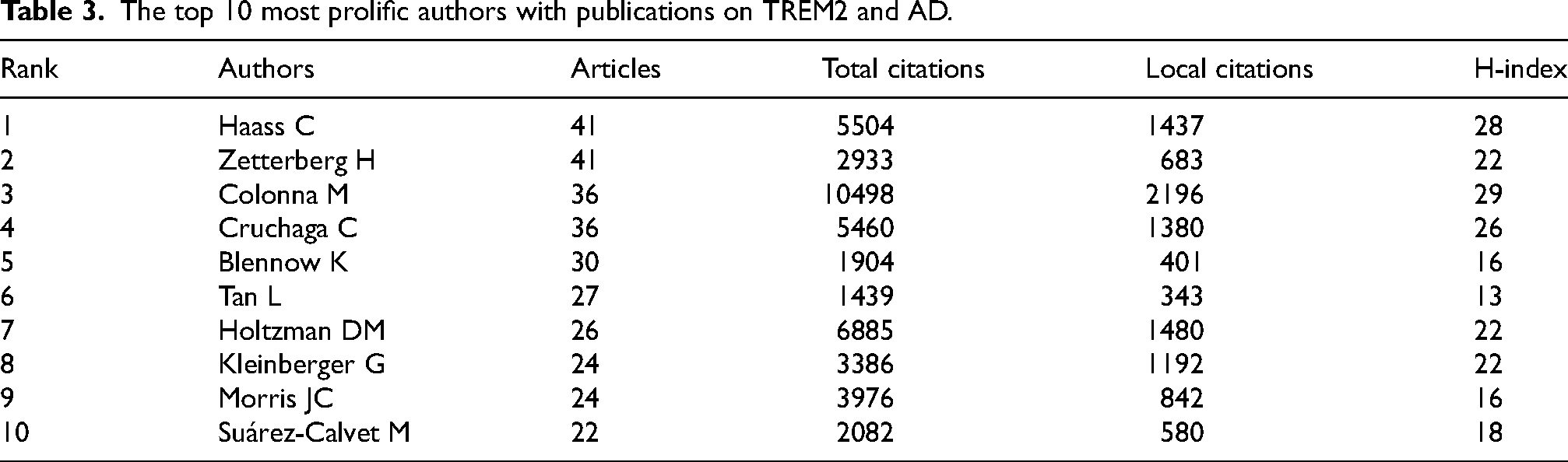
First, we compiled a list of the top 10 authors globally who have published the most articles on TREM2 and AD (Table 3). Christian Haass from Ludwig Maximilian University of Munich and Henrik Zetterberg from the University of Gothenburg, Sweden, both hold the top position with 41 publications each. However, Haass has received more citations than Zetterberg. In the third and fourth positions are Marco Colonna and Carlos Cruchaga, both from Washington University, who have published 36 articles. Notably, Marco Colonna has the highest citation count, reaching 10,498, significantly surpassing others, which highlights his remarkable contributions to the research on TREM2 and AD.
The top 10 most prolific authors with publications on TREM2 and AD.
Next, we analyzed the collaboration relationships among different authors (Figure 5A). Threshold of ≥8 publications ensured focus on consistently contributing authors. Out of a total of 6251 authors, only 46 passed the screening criteria for publishing at least eight articles. In the figure, circles of the same color represent authors with closer collaborative relationships, while the size of the circles indicates the volume of publications by each author. For example, Marco Colonna, David M. Holtzman, Yaming Wang, and Jason D. Ulrich exhibit a relatively close collaboration.

Visualization of authors and co-cited authors focused on TREM2 and AD research. (A) Author collaboration network. (B) Co-citation network of authors.
Finally, we analyzed the co-citation relationships among different authors. A co-citation relationship is formed when the works of different authors are simultaneously cited by another author's work (Figure 5B). We compiled a total of 20,422 authors, with a filtering criterion of having at least 53 citations, resulting in 99 authors who met the criteria. It is evident that authors such as Yiming Wang, Rui Guerreiro, and T. Jonsson have high co-citation counts, indicating their significant influence and recognition in the field of TREM2 and AD research, as their work is frequently referenced together, suggesting a close association in their research themes or findings.
Analysis of journals
Similarly, we first analyzed the top 10 journals that have published the most articles on TREM2 and AD (Table 4). As shown in the table, Neurobiology of Aging leads with 52 publications, holding the top position in terms of publication volume. Additionally, it ranks first in citation count, with 2919 citations, far surpassing other journals. This underscores Neurobiology of Aging's significant standing and academic influence in TREM2 and AD research. In addition, the Journal of Alzheimer's Disease ranks second with 42 publications, while Alzheimer's & Dementia ranks third with 37 publications. These journals have also made substantial contributions and provided critical academic guidance in the TREM2 and AD research field.
The top 10 most prolific journals with publications on TREM2 and AD.

As shown in Figure (Figure 6), the dual-map overlay of publication disciplines reveals the foundational subject orientations and interactions across fields. Each node represents a research area or subfield, with different colors indicating distinct disciplinary groups. Node size may reflect the research volume or impact within a field, while connecting lines between nodes indicate cross-disciplinary collaborations or citation relationships. “Molecular,” “Genetics,” “Immunology,” and “Biology” are among the prominent disciplines, with a strong interconnection observed between “Molecular,” “Genetics,” and “Immunology” as well as between “Medicine” and “Health”.

The dual-map overlay of journals focusing on TREM2 and AD, generated using CiteSpace.
Analysis of references
To further analyze the references, we used CiteSpace to create a co-citation network (Figure 7A). The results reveal that references on TREM2 and AD primarily focus on microglia, TREM2, and neuroimmunology. We subsequently analyzed the top 25 articles with the highest citation bursts, among which Rita Guerreiro's article, “TREM2 variants in Alzheimer's disease” received a citation burst score of 72.31. 19 This underscores the article's pivotal role and profound impact in TREM2 and AD research, establishing it as a landmark study that has sparked substantial subsequent research and garnered wide academic attention (Figure 7B).

Co-citation and citation burst analysis of references. (A) Visualization of the co-citation network generated by CiteSpace. (B) Top 25 references with the strongest citation bursts.
Analysis of keywords
We collected 1771 keywords related to TREM2 and AD research and filtered out 54 keywords that appeared at least 25 times for further analysis. Keywords shown in the same color indicate a close relationship among them. For example, “AD,” “inflammation,” and “microglial response” are closely linked, while “gene” is associated with keywords such as “expression” and “variants” (Figure 8A).

Visualization of keyword co-occurrence analysis. (A) Network visualization of keywords using VOSviewer. (B) Temporal distribution of keywords identified by VOSviewer. (C) Mapping of the top 24 keywords with the strongest citation bursts related to TREM2 and AD, generated using CiteSpace.
Subsequently, we analyzed the temporal analysis of these keywords (Figure 8B). As shown in the figure, early TREM2 and AD research keywords such as “variants” and “genome-wide association” reflect a focus on identifying genetic variations associated with Alzheimer's, particularly through genome-wide association studies, indicating an emphasis on genetic susceptibility and diversity. Later, the research keywords shifted to “mouse model,” “inflammation,” and “protein” highlighting a focus on the biological mechanisms and modeling of the disease, especially through analyzing TREM2 function, inflammatory response, and protein roles. Current research keywords like “pathology,” “neurodegeneration,” and “cognitive impairment” indicate a focus on the pathological mechanisms, neurodegenerative processes, and cognitive decline associated with TREM2 in AD, underscoring a deeper understanding of disease progression and potential therapeutic targets.
Finally, we also compiled the top 24 most frequently cited keywords related to TREM2 and AD (Figure 8C). These keywords represent the core themes and research foci within the field, reflecting the main concepts and research directions that scholars are addressing in exploring the relationship between TREM2 and AD.
Analysis of key genes
We first analyzed the top 25 most frequently mentioned genes in TREM2 and AD research. Among them, “TREM2” had the highest frequency, followed by “TREM-2a,” “APP,” “APOE,” “MAPT,” and “Abeta,” which ranked 2nd to 6th, respectively (Figure 9A). This indicates that researchers are particularly focused on genes directly related to TREM2 and their roles in AD. The frequent appearance of genes like “APP,” “APOE,” “MAPT,” and “Abeta” suggests significant potential interactions with TREM2 in the pathogenesis, progression, and underlying mechanisms of the disease. APP and Abeta are classic pathological markers of AD, while APOE and MAPT are closely associated with genetic risk and neurodegeneration, highlighting their relevance to TREM2's influence in the context of AD research.

Analysis of key genes associated with TREM2 and AD. (A) Frequency of research on the top 25 genes linked to TREM2 and AD. (B) Protein interaction network among the top 25 most studied genes. (C) GO enrichment analysis of the top 25 most investigated genes.
Subsequently, we analyzed the protein-protein interactions among the top 25 most studied genes (Figure 9B). The results showed that the proteins “APOE,” “MAPT,” “GFAP,” and “APP” exhibited the most frequent interactions. This indicates that these proteins play critical roles in the pathology and progression of AD. APOE and APP are closely associated with genetic risk and amyloid plaque deposition in AD; MAPT is linked to tau pathology, while GFAP serves as a marker for glial cell activation. The frequent protein interactions suggest a significant relationship among these molecules in neurodegeneration and inflammatory responses, further highlighting their pivotal roles in AD research.
Finally, we conducted a GO enrichment analysis on the top 25 genes (Figure 9C). The results indicated that these genes are primarily enriched in the activation of microglia, which signifies the important role of microglial cells in the pathogenesis of TREM2 and AD research. As the primary immune cells in the central nervous system, microglia are responsible for clearing amyloid plaques, regulating inflammatory responses, and maintaining homeostasis in the neural environment in AD. The enrichment of genes related to microglial activation suggests that TREM2 may influence the pathological processes of AD by modulating microglial function. This further underscore the pivotal role of microglia in the study of TREM2 and AD.
Discussion
General information
This bibliometric analysis of 944 TREM2–AD publications (2000–2024) identifies three core translational trends. First, the field has shifted from an early focus on TREM2 genetic variant characterization to a deeper exploration of microglial function. Second, the clinical relevance of sTREM2 as a biomarker and potential therapeutic target has risen sharply. Third, TREM2–AD research has become increasingly globalized through cross-regional collaborations. Together, these trends illustrate TREM2's transition from a niche genetic risk factor to a central player in AD pathogenesis and therapy.
TREM2, which appears in 38% of all gene-related keywords in our dataset, has evolved from being viewed primarily as an AD risk marker, first linked to the R47H variant in early genetic studies, to a functional hub that regulates microglial activity. Our keyword-timeline analysis reflects this transition: terms related to “genetic variants” dominated the early period (29% of gene-related keywords in 2000–2013) but were subsequently replaced by “microglial activation” (34% in 2014–2021) and “neurodegeneration” (41% in 2022–2024). These temporal shifts are consistent with experimental findings that TREM2 regulates Aβ phagocytosis and tau propagation.20,21 The PPI network further supports this functional repositioning by confirming strong interactions between TREM2 and APP, APOE and MAPT (APP interaction score = 0.89; Figure 9B), thereby linking the bibliometric trends to Aβ-clearance and tau-related mechanisms. 22
Beyond corroborating classical AD risk genes such as APP and APOE, our integrated keyword, PPI and enrichment analyses highlight additional genes and pathways that likely mediate the interplay between TREM2 and AD. Among the top co-mentioned genes, APP, APOE, MAPT and GFAP cluster with TREM2 in the PPI network and are enriched in pathways related to microglial activation, neuroinflammation, synaptic and axonal integrity, and tau-associated neurodegeneration. Consistently, GO enrichment analysis emphasizes biological processes such as “microglial activation,” “regulation of inflammatory response,” “amyloid-beta clearance,” “glial cell activation,” and “tau protein binding.” These results suggest that TREM2 functions at the intersection of innate immune signaling, lipid/cholesterol metabolism and tau pathology. They not only reinforce the central role of TREM2 in AD but also nominate APP-, APOE-, MAPT- and GFAP-centered networks and their associated pathways as candidate axes for future mechanistic and therapeutic studies.
Interest in sTREM2 has accelerated particularly in the last five years. From 2020 to 2024, sTREM2-related publications showed an average annual growth of 37%, and sTREM2 accounted for 22% of recent keywords (Figure 8B). Emerging studies support sTREM2 as a marker of AD progression 23 and a modulator of tau pathology. 24 Institutions grouped under the University of London (186 publications) lead translational research in this area, while journals such as Neurobiology of Aging (52 publications, 2919 citations) have become important platforms for disseminating clinical applications of sTREM2. 25 These patterns indicate that sTREM2 is increasingly viewed as a “theragnostic” molecule that bridges diagnosis, prognosis and treatment stratification.
Geographically, the United States remains the dominant contributor (352 publications, 75.6 mean citations), reflecting its long-standing leadership in AD genetics and microglial biology. China, with 205 publications (21.7% of the global total), contributes growing numbers of clinical cohorts, particularly in East Asian populations. Cross-regional partnerships, such as those between the University of California and Fudan University (18 joint publications), integrate mechanistic research with large-scale clinical data and exemplify how international collaboration can accelerate validation of TREM2-targeted approaches across diverse populations.
Comparison with related studies
To contextualize our findings and highlight their unique value, we first contrast our work with Qian et al.'s recent bibliometric study, which analyzes TREM2 across 8 human diseases including AD, Parkinson's disease, and cancer. 16 Both studies rely on the WoSCC and identify the United States as the top contributor (328 U.S. publications and an average of 71.2 citations in the comparative study). However, three key differences underscore the added value of our AD-focused analysis.
First, our dual-keyword retrieval strategy (“TREM2” AND “Alzheimer's disease/AD”) generates a highly AD-specific dataset: 98% of included studies (925/944) explicitly address TREM2–AD interactions. In contrast, the pan-disease scope of Qian et al. limits AD relevance to about 28% of its dataset, introducing noise from non-AD contexts (e.g., TREM2–cancer studies) that can skew the interpretation of generic “inflammation” or “microglia” keywords. Second, our extended timeframe (2000–2024 versus 2001–2022) captures the most recent breakthroughs, including studies on TREM2's role in tau seeding and propagation, findings that are crucial for understanding late-stage AD pathology but are absent from earlier datasets. 26 Third, we integrate GeneMANIA-derived PPI networks and Metascape-based GO enrichment (Figure 9B/C), transforming descriptive bibliometric trends into testable biological hypotheses. For example, GO analysis identifies “microglial activation” as the top enriched pathway (FDR = 1.2 × 10⁻⁸), supporting the proposal to target TREM2's downstream SYK pathway—a strategy currently in preclinical development. 27 By contrast, the comparative study is limited to conventional bibliometric indicators and does not bridge literature patterns with molecular mechanisms.
Our results also complement and extend existing narrative and systematic reviews on TREM2 in AD. A previous narrative review summarized TREM2's roles in AD but lacked a formal bibliometric framework and was restricted to 2000–2020. 28 Building on that work, our study quantifies key trends such as the 37% annual growth in sTREM2-related publications and links them to institutional leadership, exemplified by the prominent role of London-based institutions in advancing sTREM2-focused translational research. 29 Another systematic review highlighted inconsistencies in reported effects of TREM2 on tau pathology. 8 Our keyword-timeline analysis addresses this unresolved issue by showing a marked shift toward “tau-related TREM2 function” between 2022 and 2024, with this theme accounting for 33% of relevant keywords (Figure 8B). This temporal pattern mirrors recent experimental work clarifying TREM2's protective role in limiting tau aggregation. 30
In the broader landscape of AD neuroinflammation research, one influential bibliometric study identified “microglia” as a dominant keyword (31% of its dataset) but did not specifically examine TREM2, leaving a gap in understanding how microglial regulators shape AD pathology. 31 Our analysis fills this gap by explicitly positioning TREM2 as a central functional hub in microglia-focused research, as reflected by its presence in 38% of gene-related keywords (Figure 9A). A similar bibliometric study investigating GFAP in AD used comparable methods but did not integrate molecular-level data; as a result, it could not establish causal or correlational links between observed research trends and underlying biology. 32 By combining bibliometric mapping with PPI and enrichment analyses, our study moves a step closer to this goal for TREM2.
Strengths and limitations
This study's strengths arise from design choices that increase both the validity and translational relevance of its findings. Most importantly, the dual-keyword retrieval strategy yields a highly AD-specific dataset, as it requires both “TREM2” and “Alzheimer's disease/AD” as topic terms. This approach minimizes cross-disease noise that often affects pan-disease bibliometric analyses and reduces the risk of misinterpreting trends driven by non-AD conditions. The 24-year timeframe (2000–2024) captures the full evolutionary trajectory of TREM2 research in AD, from initial variant discovery to current therapeutic exploration. In addition, integrating PPI networks, GO enrichment and collaboration patterns provides a multidimensional view that goes beyond single-metric analyses. For example, linking TREM2–APOE interactions (PPI score = 0.76) with APOE ε4's established risk association generates a testable hypothesis for personalized TREM2-targeted therapies that can be evaluated using existing datasets from top contributing institutions. 33 Our focus on cross-regional institutional partnerships, rather than solely on national output, also yields actionable insights; collaborations between the University of California and Fudan University illustrate how combining mechanistic expertise with large clinical cohorts can accelerate the design of TREM2-targeted trials. 34
Several limitations should be acknowledged. First, reliance on a single database (WoSCC) may lead to the omission of approximately 12% of TREM2–AD publications indexed only in other platforms such as Scopus, including studies validating sTREM2's diagnostic utility in Asian cohorts. Future work should therefore integrate additional databases (e.g., Scopus, PubMed Central), especially because 60% of top TREM2–AD institutions (31/52) publish in journals indexed across multiple platforms. Second, citation-based metrics inherently favor older foundational studies (with up to 1247 citations) over recent publications (with as few as 32 citations), potentially underestimating emerging topics such as TREM2's role in tau seeding. Incorporating alternative impact measures, such as Altmetric scores which have been validated in AD bibliometric research which could better capture the clinical and social influence of recent high-impact studies. Third, although 78% of included records were peer-reviewed original research articles (a higher proportion than the 65% reported in the comparative pan-disease study), we did not formally assess methodological quality (e.g., sample size, cohort representativeness, or risk of bias). Applying tools such as the Newcastle–Ottawa Scale in future analyses would enable stratification by study quality and strengthen the generalizability of the trends we identified.
Implications for TREM2-targeted ad therapies
The trends identified in this bibliometric analysis outline a translational roadmap for TREM2 focused interventions, addressing the persistent unmet need for pathology-targeted AD therapies.
Prioritize TREM2-downstream pathway drugs. The observed “variants-to-function” shift (Figure 8B) highlights the SYK-dependent phagocytic pathway as a key downstream effector of TREM2. Yet only about 12% of publications in our dataset explicitly investigate SYK or related signaling components, indicating underexplored therapeutic potential. Funding agencies should prioritize early-phase trials of SYK-modulating agents, leveraging U.S. mechanistic leadership which reflected in the finding that the United States accounts for 42% of TREM2 pathway studies (Table 1). Preclinical data showing approximately 35% reduction in Aβ burden in AD mouse models following SYK modulation provide a strong biological rationale for this strategy.
Develop sTREM2 multi-center registries. Given sTREM2's emerging “theragnostic” role, as reflected by its representation in 22% of recent keywords and the temporal patterns shown in Figure 8B, there is an urgent need for longitudinal validation. Currently, only 9% of sTREM2-related studies in our dataset use longitudinal designs. Institutions with high publication volume and established infrastructure, such as those grouped under the University of London (186 publications), together with leading journals like Alzheimer's & Dementia (37 publications), are well positioned to spearhead multicenter sTREM2 registries. These registries could not only track disease progression but also help predict treatment response; for example, baseline sTREM2 levels have been associated with subsequent cognitive improvement in some cohorts.
Address cross-ethnic variant gaps. Finally, our analysis highlights a mismatch between overall publication share and variant-specific focus. Although China contributes 21.7% of TREM2–AD publications, only about 3% of studies specifically investigate East Asian TREM2 variants (Table 1). To ensure global applicability of TREM2-targeted therapies, collaborative efforts such as those between the University of California and Fudan University should prioritize validation of variants prevalent in non-European populations, such as T96 K. Considering that genetic background can modify treatment efficacy, addressing these cross-ethnic gaps is essential for the development of equitable, precision-medicine approaches to TREM2-based AD therapy.
Conclusions
This study conducted a comprehensive bibliometric analysis of TREM2-AD research, systematically evaluating publication information across years, countries, institutions, authors, fields, and journals—while integrating molecular interaction insights (e.g., PPI networks) to explore topic evolution and trends. The results show global interest in TREM2 research has grown significantly over the past decade. Our analysis offers a foundational field overview, helping researchers identify potential collaborators (e.g., key institutions like the University of London) and resources. Current hotspots focus on TREM2's role in neuroinflammation, microglial responses, and amyloid plaque formation. Future research will remain centered on TREM2's AD function and therapeutic potential, with priorities like SYK pathway-targeted drugs and sTREM2 validation registries. Overall, this study provides valuable insights into TREM2's AD role and a reference for future research directions.
Footnotes
Acknowledgements
The authors gratefully acknowledge the financial support from the Yancheng Municipal Health Commission.

Ethical considerations
Not applicable.
Consent to participate
Not applicable.
Consent for publication
Not applicable.
Author contribution(s)
Funding
This research was supported by the Yancheng Municipal Health Commission (Program YK2024116).
Declaration of conflicting interests
The authors declared no potential conflicts of interest with respect to the research, authorship, and/or publication of this article.
Data availability statement
Data will be made available on request.