



Abstract
Conditional sex transformation systems could improve genetic control strategies against insect pests. Here, we developed and tested CRISPR-based, tetracycline-repressible sex transformation strains in the Australian sheep blowfly, Lucilia cuprina. Using Tet-Off–regulated expression of Cas9 and dCas9, we targeted the sex-determining gene transformer with the goal of converting females into males. Conditional Cas9 expression enabled knockout of a visual marker gene, confirming inducible genome editing. However, strains expressing transformer-targeting sgRNA arrays did not undergo sex transformation. Embryonic microinjection of transformer-targeting sgRNAs into Cas9-expressing embryos produced intersex individuals, indicating that sgRNA expression from the integrated arrays was insufficient to disrupt the sex determination pathway. In contrast, high-level dCas9 expression was associated with developmental delays, reduced body weight, and lethality. These findings establish the first conditional CRISPR expression system in L. cuprina and demonstrate that Cas9 is compatible with inducible gene editing, whereas dCas9 is poorly tolerated at high expression levels.
Introduction
Each year, disease-vectoring insects kill over 700,000 people 1 and agricultural insect pests cost the world’s economy an estimated $220 billion. 2 Broad-spectrum insecticides are widely used for pest control, but can harm nontarget species 3 and lead to the rapid evolution of resistance in target species.4,5 Genetics-based approaches, such as the Sterile Insect Technique (SIT), can be used as more sustainable and ecologically friendly forms of pest control. 6 In SIT programs, insects are reared in factories, sterilized using radiation, and repeatedly released in vast quantities in a target area. Sterilized males mate with wild females, lowering the wild population’s reproductive output and leading to population suppression or elimination. 7 Modeling 8 and large-scale field tests 9 have shown that SIT is more effective if only males are released, and a major focus of SIT programs has been devising methods to eliminate females from the release pool.10,11
One option is to use tetracycline-repressible (Tet-Off) systems to conditionally express a female-lethal gene. These systems work by using a “driver” construct to express tetracycline-controlled transactivator (tTA); tTA binds to tetracycline operator (tetO) sites upstream of an “effector” (female-lethal) gene, activating its expression.12–14 Tetracycline, or a related antibiotic like doxycycline, is used to turn the system off by binding to tTA and preventing effector gene expression. Highly efficient Tet-Off strains that kill females at the embryo or larval stages have been developed in several major insect pests, including the New World Screwworm (Cochliomyia hominivorax)15,16 and Australian sheep blowfly (Lucilia cuprina).17,18
An alternative is sex transformation rather than female lethality-converting genetic females (XX) into functional males. Such a sex transformation system would both solve the problem of sex-sorting and effectively double the rate of male production for SIT. Modeling suggests that sex transformation systems can be more effective than female-killing systems for population suppression, provided that the XX males are sexually competitive. 19
In L.cuprina and C. hominivorax, sexual development is regulated by transformer (tra), which is essential for female development. In both species, transformer (Lctra and Chtra) gene transcripts are sex-specifically spliced with only the female RNA encoding a functional protein.20,21 Splicing is likely autoregulated, as the alternatively spliced first intron contains multiple potential binding sites for the protein complex of TRA and its cofactor TRA2. The longer male transcripts include additional exon(s) that contain multiple in-frame translation stop codons and consequently do not produce a functional TRA protein. TRA also controls the splicing of transcripts from the downstream genes doublesex and fruitless. In female embryos, the Lctra autoregulatory loop is activated by maternally-provided LcTRA. In male embryos, the expression of a Y-linked male-determining factor somehow inhibits the female-mode of splicing of Lctra transcripts. CRISPR/Cas9 has been used to establish a mutant for Lctra. Homozygous mutant XX flies were viable and fully transformed to males.20,22
Knowledge of the sex determination regulatory hierarchy has spurred interest in developing conditional sex transformation systems targeting tra in these species. RNAi lines using the Tet-Off system to knock down Lctra RNA were recently developed in L. cuprina. 23 tTA driver lines were used that expressed tTA in ovaries and early embryos to block establishment of the Lctra autoregulatory splicing loop in female embryos. However, fully transformed (XX) males from these lines died before adulthood, and so could not contribute to population suppression with SIT. To date, no conditional sex transformation system that produces fully-transformed adult XX males has been made in the blowfly or screwworm.
In this study, we evaluate an alternative strategy of conditional Cas9 and dCas9 expression, targeting Lctra in order to trigger female-to-male sex transformation. Cas9 disrupts its target genes by cleaving DNA at target sites and inducing loss-of-function mutations. 24 dCas9, in contrast, knocks down gene expression by binding to the target site without cleaving it, blocking the transcriptional machinery. 25 While Cas9 has been used in diverse insect species, dCas9 has not been tested in L. cuprina or more generally in other insects, and we wished to investigate its potential utility for targeted gene knockdown in blowflies as an alternative to RNAi. An overview of the Tet-Off–regulated CRISPR strategy for targeted disruption or repression of Lctra is shown in Figure 1.

Conditional female-to-male sex conversion strategy evaluated in this study.
We established several two-component transgenic strains by crossing tTA driver lines to Cas9 or dCas9 effector lines carrying multiplex single guide RNA (sgRNA) constructs targeting Lctra. We observed strong conditional activation of Cas9 or dCas9 in embryos, and robust knockout of the DsRedexpress 2 (RFPex) fluorescent marker gene in Cas9-expressing strains. However, we found no evidence of sex transformation. Additional experiments indicated that inefficient processing of sgRNAs in early embryos limited effective targeting of Lctra. In addition, high levels of dCas9 expression were consistently associated with lethal or sub-lethal phenotypes, including reduced body weight and delayed development. Our research suggests that dCas9 is likely toxic to L. cuprina at high doses, and therefore unsuitable for use in a sex transformation system, but that a modified version of the Cas9-based system may be able to achieve efficient, conditional scalable sex transformation.
Materials and Methods
In vitro and in vivo assessment of sgRNAs targeting transformer
sgRNAs targeting Lctra were selected using CRISPOR (http://crispor.tefor.net/) with the L. cuprina ASM2204524v1 genome assembly (GenBank: GCA_022045245.1). sgRNA sequences are listed in Supplementary Table S1. In vitro Cas9 cleavage assays were performed by combining 1 µL of 1 µM Cas9 (Alt-R™ S.p. Cas9 Nuclease V3, Integrated DNA Technologies), 3 µL of 300 nM sgRNA, and 3 µL NEBuffer™ 3.1 (New England Biolabs) in a 27 µL reaction volume. Following two 10-min incubations at 25°C and 37°C, 50 ng template DNA was added, and mixtures were incubated for 1 h at 37°C. 1 µL of 20 µg/µL Proteinase K was added to arrest Cas9 activity before running mixtures on a gel. Two reactions, one with Cas9 and a control without Cas9, were prepared for each sgRNA. Supplementary Table S2 lists primers used to amplify template DNA.
The tra3 sgRNA was further assessed in vivo by microinjecting wild-type (LA07 strain) L. cuprina embryos with a mixture of 125 ng/µL tra3 sgRNA, 250 ng/µL Cas9, 1/20th vol. NEBuffer™ 3.1, and 1/10th vol. Phenol Red dye (Sigma-Aldrich). Microinjections were performed as previously described. 26 Intersex females were identified by screening adult flies under a dissection microscope. Female flies with fully or partially masculinized external genitalia (ovipositors) and otherwise female features (e.g., wide interocular distance) were scored as intersex. DNA was extracted individually from intersex females by homogenizing samples in 500 µL STE buffer (10 mM Tris, 1 mM Ethylenediaminetetraacetic acid [EDTA], 100 mM NaCl, pH 8.0) in a bead mill (HT Mini: OPS Diagnostics) at 3200 RPM for 2 min, then purifying DNA from the homogenate using a DNEasy Blood and Tissue kit (QIAGEN) following the manufacturer’s protocol. Polymerase chain reaction (PCR) was performed on pooled DNA to amplify the region of Lctra encompassing the tra3 sgRNA target site using primers listed in Supplementary Table S2. The online EditCo ICE CRISPR Analysis Tool (https://ice.editco.bio/#/) was used to determine indel rates based on Sanger DNA sequencing data.
Plasmid construction
To construct the plasmids used to assess L. cuprina U6 gene promoters, we followed a similar strategy as for the previously described C. hominivorax U6 promoters. 27 DNA fragments containing approximately 500 bp upstream of the transcription initiation site, followed by two BbsI sites, the sgRNA sequence (targeting Lctra), and about 200 bp of 3′ flanking from the U6 gene were synthesized and cloned into the pUCIDT vector using Golden Gate Assembly (Supplementary Table S3).
To assemble the Cas9 and dCas9 effector plasmids used for germline transformation, component fragments were first excised or amplified from source plasmids using the restriction enzymes or PCR primers listed in Supplementary Table S4. The source plasmid bearing the pBac-attP-RFPex-attP-pBac fragment was derived by cloning the DsRedex2 marker from pB[Lchsp83-DsRedex2] 26 into the pBac2 backbone. 27 The dCas9 fragment was amplified from the source plasmid pAW91.dCas9 (Addgene: #104372). 28 The Cas9-p10polyA and p10polyA fragments were amplified from the IattB-Nos-Cas9-P10-ZsGreen-IattB plasmid (Genbank: PV567588.1). The tetO-Hsp70 fragments originated from the pEF1 plasmid (Genbank: KT749917.1). 17
Next, two rounds of NEBuilder® HiFi DNA Assembly were used to ligate the fragments to form the final effector plasmids, following the manufacturer’s assembly protocol. First, Cas9 or dCas9 effector plasmids lacking sgRNA arrays were assembled by ligating the following fragments: pBac-attP-RFPex-attP-pBac, Cas9-p10polyA, and tetO-Hsp70 (Cas9 effector); pBac-attP-RFPex-attP-pBac, p10polyA, dCas9, and tetO-Hsp70 (dCas9 effector). The sgRNA arrays (tra135, tra246, and ryt) were synthesized by Genscript and incorporated into the Cas9 and dCas9 effector plasmids by linearizing the Cas9/dCas9 plasmids with the restriction enzyme SgrDI and ligating them with PCR-amplified sgRNA array fragments. The final 6 effector plasmids have been deposited with Addgene, accession numbers 246019-246024.
Embryonic microinjections, germline transformation, and fly rearing
The LA07 wild-type strain of L. cuprina was maintained as previously described. 26 For assessment of LccU6 promoter activity, a mix of Cas9 protein (750 ng/µL) or Cas9 plasmid (500 ng/L), U6 promoter plasmid (500 ng/mL), and Lchsp83-ZsGreen plasmid (300 ng/µL) was injected into the posterior end of preblastoderm embryos as described previously. 29 Hatched L1 larvae that showed transient expression of ZsGreen were collected and pooled. Genomic DNA was extracted and PCR and amplicon DNA sequencing performed as previously described. 29 The amplicon sequencing results were analyzed using CRISPResso2. 30
For germline transformation, embryos were injected with 50 ng/µL hyperactive piggyBac mRNA, 350 ng/µL of Lchsp83-hyppBac helper plasmid (sequence deposited at Genbank, accession number PX960800), and 250 ng/µL effector plasmid. Capped and polyadenylated hyperactive piggyBac RNA was synthesized using the HiScribe® T7 ARCA mRNA kit (New England Biolabs) with the Lchsp83-hyppBac plasmid as a template. Surviving G0s were crossed individually to wild-type flies, and G1 offspring were screened at the late embryo or early first instar larval stage for red fluorescence, indicating germline integration of the effector construct. Effector lines were bred to the existing driver lines DR3#6 and DR7#231,32 to establish the two-component sex transformation strains tested in this study. When possible, these strains were bred to homozygosity for both the driver and effector constructs. Strains were maintained on 100 µg/mL tetracycline or 25 µg/mL doxycycline. For the experiments detailed below, flies were tested either on antibiotics (at the aforementioned doses) or off antibiotics (after removing antibiotics from the adult parental diet).
For microinjection experiments with Lctra sgRNAs and established Cas9- or dCas9-expressing strains, the injection mixtures containing 300 mM KCl, 1/20th vol. NEBuffer™ 3.1, 1/10th vol. Phenol Red dye, and the sgRNAs tra2, tra4, and tra6 (200 ng/µL each) were injected into embryos following the earlier microinjection protocol. Flies were reared off tetracycline to ensure that Cas9 or dCas9 were expressed in early embryos. Injected embryos were reared to adulthood along with uninjected controls, and the number of males, females, and intersex flies in each group was recorded as described previously. To verify editing of Lctra in Cas9 strains, DNA was extracted individually from injected intersex females. DNA was also extracted from three males and females from each of the uninjected Cas9 strains and pooled in equimolar quantities to serve as controls. PCR was performed with primers flanking the sgRNA target sites in order to amplify products containing one or more large CRISPR-induced deletions. GST-1 was amplified as a positive control. Sanger sequencing was used to verify editing of Lctra in injected intersex females. To determine whether injected males from the dCas9 strains were XY, DNA was extracted from each male and PCR was performed using Y-linked gene primers. Supplementary Table S2 lists all primers used in this experiment.
To investigate dCas9’s potential toxicity, embryos from the DR7#2 driver strain reared off antibiotics were injected with either the standard injection mixture alone (300 mM KCl, 1/20th vol. NEBuffer™ 3.1, 1/10th vol. Phenol Red dye) or the standard injection mixture plus 600 ng/µL of the dCas9-tra246 effector plasmid. Injected embryos were reared to adulthood as described previously, and the hatch rate, percentage of hatched larvae surviving to the third instar stage, pupation rate, and adult eclosion rate were recorded.
Phenotypic assessment of sex transformation strains
To evaluate RFPex knockout (in Cas9 strains) and knockdown (in dCas9 strains), third-instar (L3) larvae from strains carrying the ryt sgRNA array were screened for RFP intensity using a fluorescence microscope. Upon reaching adulthood, flies were inspected for sex transformation due to Lctra disruption (in all strains) and cuticle discoloration due to yellow (LcY) disruption (in strains carrying the ryt sgRNA array). To evaluate sex transformation, flies were scored as male (short interocular distance and male external genitalia), female (wide interocular distance and female external genitalia), or intersex (intermediate or conflicting sexual phenotype, e.g., masculinized genitalia with female interocular distance). As no intersex flies were ever observed, the adult sex ratio was defined as the proportion of males. The eclosion rate, defined as the proportion of pupae surviving to adulthood, was also recorded for each replicate. To evaluate knockout/knockdown of yellow, adults were inspected for characteristic brown wings and body color. 22 Differences in the mean adult sex ratio and eclosion rate across different experimental groups were statistically analyzed in R (v. 4.4.1) using pairwise t-tests with Benjamini–Hochberg correction for multiple comparisons. The raw data from sex ratio and eclosion rate experiments are provided in Supplementary Table S5.
Additional experiments to measure larval development rates and pupal weight were performed with a subset of sex transformation strains. For each strain, independent colonies containing approximately 120 first-instar larvae were set and reared to adulthood on or off 100 µg/mL tetracycline (N = 3 replicate colonies per condition). To assess delays in larval development, the number of wandering-stage third instar (L3) larvae that emerged from the larval meat diet each day was recorded cumulatively until the last larva had emerged. Larval counts were then converted to proportions (as raw counts could not be directly compared statistically, due to small natural variations in colony size) and charted to visualize larval developmental trajectories. For the pupal weight experiments, up to 50 pupae from each replicate colony were weighed, and the average pupal weight was calculated from these values and plotted. A few strains yielded fewer than 50 pupae per replicate due to low survival rates; this information is reported in Supplementary Table S6. Statistical comparisons of mean pupal weights across experimental groups were performed in R (v. 4.4.1) using pairwise t-tests with Benjamini–Hochberg correction for multiple comparisons.
Proteomic analysis of whole-body tissue extracts from third instar larvae
One-Dimensional Liquid Chromatography Tandem Mass Spectrometry (1D-LC-MS/MS) was used to quantify protein abundance in selected dCas9 and Cas9 strains. Flies from two transgenic strains, DR7#2; Cas9-ryt and DR7#2;dCas9-ryt/+, were reared on or off 25 ug/mL doxycycline. Four replicate samples, each consisting of a pair of third instar larvae, were sampled from each of the four experimental groups. The whole-tissue samples were flash-frozen in liquid nitrogen and stored at −80°C prior to sample preparation for 1D-LC-MS/MS analysis and protein quantification. Details of the analysis are described in SI methods.
RNA extraction and RT-PCR
RNA was extracted from pooled 2–6 h embryos and 24 h (first instar) larvae from sex transformation strains reared on or off tetracycline. To extract RNA, samples (N ≥ 20 individuals per sample) were placed in Trizol™ (Thermo-Fisher) and homogenized in a bead mill for two 60 s cycles at 3200 RPM. RNA was isolated from the homogenized samples following the QIAGEN RNeasy Mini Kit protocol for total RNA extraction from animal tissue. cDNA was synthesized using the SuperScript™ III First-Strand Synthesis SuperMix (Invitrogen) protocol. A control reaction lacking the reverse transcriptase enzyme (SuperScript III) was run alongside each RNA sample. Reverse transcription polymerase chain reaction (RT-PCR) was performed using primer pairs listed in Supplementary Table S2.
Evaluation of indel rates at target sites in Cas9 strains
DNA was isolated (as previously described) from 2- to 6-h-old embryos (N ≥20 individuals per sample), 24-h-old first instar larvae (N ≥10 individuals per sample), and 2-day-old adult flies (N ≥ 5 individuals per sample). PCR was used to amplify regions flanking the target sites of the following sgRNAs: RFPex, yellow, tra2, tra4, tra6, and tra7. PCR primers are listed in Supplementary Table S2. Amplicon sequencing and indel rate determination was performed by Azenta Life Sciences.
Results
Design of conditional sex transformation systems in L. cuprina
An overview of the Tet-Off–regulated CRISPR strategy used to conditionally target Lctra is shown in Figure 1. To implement this approach, we generated a series of Cas9- and dCas9-based effector constructs and crossed them to tTA-expressing driver lines to create two-component conditional sex transformation strains.
We designed six effector constructs (Fig. 2A) carrying Cas9 or dCas9 under the control of the tetO21-Lchsp70 enhancer–promoter used previously. 26 In the absence of tetracycline, tTA binds to tetO sites in the effector and induces expression of Cas9 or dCas9. Effector constructs also carried a constitutively expressed red fluorescent marker gene, RFPex, driven by the Lchsp83 gene promoter for identification of transgenic individuals. A tRNA-based processing strategy 33 was used to express multiple sgRNAs from a single promoter. To identify a suitable L. cuprina RNA polymerase III promoter, we evaluated candidate U6 gene promoters using a transient embryo expression assay previously described for C. hominivorax U6 promoters. 29 The results indicated the LccU6b promoter was the most active in L. cuprina embryos (Supplementary Table S7) and consequently was used in the constructs (Fig. 2A). Each construct contained one of three sgRNA arrays (tra135, tra246, or ryt), consisting of three sgRNAs separated by tRNAs driven by the LccU6b promoter. Endogenous cellular machinery cleaves tRNAs from the precursor transcript, liberating individual sgRNAs. 33

Design of conditional sex transformation systems in Lucilia cuprina.
The ryt array was designed as a functional validation control and includes sgRNAs targeting RFPex, yellow (LcY) and Lctra, previously shown to efficiently disrupt their target genes and produce visible knockout phenotypes in L. cuprina.22,23,29 The sgRNA arrays tra135 and tra246 exclusively expressed sgRNAs targeting Lctra (Fig. 2B). Several sgRNAs were specifically positioned to enhance potential dCas9-mediated transcriptional repression. The sgRNAs tra1 and tra2 target the promoter, where steric hindrance of transcription initiation may be most effective. 34 The sgRNAs tra2, tra4, and tra6 target the coding strand, which may also enhance repression by dCas9. 34 All sgRNAs were first evaluated using in vitro Cas9 cleavage assays, which demonstrated efficient cleavage at all target sites (Supplementary Fig. S1A). One of the sgRNAs, tra3, was further validated in vivo by co-injection with Cas9, yielding an 85% editing rate at the target site in Lctra in intersex females that developed from injected embryos (Supplementary Fig. S1B).
In the related blow fly Lucilia sericata, sex-specific alternative splicing of Lstra transcripts is established early during embryogenesis and then likely maintained through an autoregulatory feedback mechanism. 21 Consequently, with the aim of disrupting the autoregulatory loop early in development before sex is determined, we selected the tTA driver lines DR3#6 and DR7#2 (Fig. 2C) that express tTA under the control of the promoters Lsspt (DR3) and CmCG14427 (DR7), respectively. These promoters from zygotic cellularization genes show moderate 30 or high 31 activity in early embryos. The DR3 driver lines also showed significant expression at later developmental stages and in adult ovaries.30,31 Both drivers carry a constitutively-expressed green fluorescent marker (ZsGreen) driven by the Lchsp83 gene promoter. The driver lines were previously used to establish conditional female lethal strains, with females dying at the larval (DR3) or embryo (DR7) stages.30,31
Establishment of transgenic lines
Effector plasmids were injected into wild-type L. cuprina embryos alongside hyperactive piggyBac transposase mRNA and DNA helper plasmid. We used the hyperactive version of piggyBac because it has been linked to much higher germline transformation rates in insects than conventional piggyBac. 35 However, in our hands, transformation rates with hyperactive piggyBac were low (∼4%). We obtained two Cas9 lines (Cas9-ryt and Cas9-tra246) and four dCas9 lines [dCas9-tra135, dCas9-tra246, and two independent insertions of the dCas9-ryt effector, dubbed dCas9-ryt and dCas9-ryt(2)] from piggyBac injections. These six effector lines were crossed to the driver lines DR3#6 and DR7#2 to establish the final set of 12 two-component (driver/effector) sex transformation strains tested in this study (Fig. 2D).
Two-component sex transformation strains were maintained on 100 µg/mL tetracycline or 25 µg/mL doxycycline to repress Cas9/dCas9 expression. However, flies homozygous for the dCas9-tra246 or dCas9-ryt(2) effector construct and either tTA driver died en masse during the embryo or early larval stages. As flies homozygous for the dCas9-tra246 or dCas9-ryt(2) construct without a driver were viable and easily maintained, it appears that the antibiotic is insufficient to prevent tTA-induced leaky dCas9 expression and associated toxicity. As this was only an issue for one of the two dCas9-ryt effector strains, it appears the position of the effector transgene in the genome influences the level of leaky expression of dCas9. The dCas9-tra246 and dCas9-ryt(2) strains could only be maintained in the hemizygous condition (i.e., homozygous for the driver, heterozygous for the effector). To test whether these strains could be made fully homozygous on a higher dose of antibiotics, we reared a subset of hemizygous flies on 100 µg/mL doxycycline (4x the standard dose) and screened their offspring for dCas9 homozygotes bearing two copies of the RFPex marker. However, we observed nearly complete lethality among larvae homozygous for dCas9 in three of the four strains tested (Supplementary Table S8).
RT-PCR analysis of gene expression in sex transformation strains
We performed RT-PCR to evaluate expression of Cas9 and dCas9 in sex transformation strains reared on and off tetracycline. Both genes were robustly expressed in 2–6 h old embryos and 24 h larvae reared off tetracycline (Fig. 3A, Supplementary Fig. S2A–F). Minimal leaky expression of Cas9 or dCas9 was observed in most strains reared on tetracycline, with the exception of the DR3#6;dCas9-ryt(2)/+ and DR7#2;dCas9-ryt(2)/+ strains, in which tetracycline appeared to be unable to repress dCas9 expression (Supplementary Fig. S2F).

Expression of Cas9/dCas9, sgRNA array transcript, and target genes in embryos and first-instar larvae from sex transformation strains.
To determine whether induced Cas9 and dCas9 expression altered sexual development by disrupting Lctra splicing, we next performed RT-PCR using primers designed to amplify sex-specifically spliced transcripts. As Lctra splicing involves positive autoregulatory feedback, effective disruption should bias transcript profiles to the male splice isoform. 21 However, we did not observe any noticeable shifts in male versus female Lctra transcript expression patterns. Similarly, RT-PCR analysis of dCas9-mediated knockdown of the control genes RFPex and yellow (LcY) showed no reduction in the expression of these genes in flies reared off tetracycline. These results suggested that although Cas9 and dCas9 were expressed at high levels early in development, target gene disruption or repression was not occurring at detectable levels.
We hypothesized that insufficient sgRNA availability during early embryogenesis might be limiting CRISPR activity. To test this, we performed RT-PCR using primers targeting the sgRNA tracer and scaffold regions (Fig. 3B). These primers can use either the uncleaved precursor sgRNA array transcript as a template, or individual, cleaved sgRNAs. In 2–6 h old embryos, we observed amplification of longer products corresponding to unprocessed sgRNA array precursor transcript. By 24 h, only short products were amplified, which may indicate that sgRNA arrays are more efficiently processed at this stage. These results not only confirm that the LccU6b promoter was active early embryos and larvae, but also indicate that sgRNA processing may be delayed relative to Cas9/dCas9 expression. This temporal mismatch likely contributed to the lack of detectable target gene disruption and the absence of sex-transformation phenotypes.
Conditional knockout of RFPex in Cas9-expressing strains
Strains carrying the ryt sgRNA array should express sgRNA targeting the fluorescent marker RFPex if there is sufficient processing of the multiplex primary transcript. To assess the effectiveness of knockout (Cas9) and knockdown (dCas9) of RFPex using our conditional gene expression system, we screened third instar (L3) larvae from strains reared on and off tetracycline or doxycycline (Fig. 4). We observed consistent reductions in red fluorescence in larvae from Cas9 strains reared off antibiotics, regardless of the driver or antibiotic tested. Conversely, larvae from dCas9 strains reared off antibiotics did not display any noticeable reduction in RFPex intensity relative to antibiotic-reared controls. Proteomic analysis of third instar larvae from the DR7#2; Cas9-ryt and DR7#2;dCas9-ryt/+ strains reared on versus off doxycycline confirmed that RFPex was robustly knocked out in Cas9-expressing larvae, which contained 92% less RFPex protein compared with doxycycline-reared controls (p value = 0.00009, Welch’s T-test) (Fig. 4C, Supplementary Table S9). dCas9-expressing larvae, on the other hand, had similar levels of RFPex to controls (p value = 0.8596) (Fig. 4C, Supplementary Table S9).

Conditional expression of Cas9 leads to knock-out of DsRed (RFPex) and loss of red fluorescence in third instar larvae.
Phenotypic evaluation of sex transformation and yellow disruption
Flies were reared to adulthood to be screened for disruption of the target genes Lctra and yellow (LcY). Pupal eclosion rates were recorded prior to screening. All four double homozygous dCas9 strains tested (DR3#6;dCas9-tra135, DR7#2;dCas9-tra135, DR3#6;dCas9-ryt, and DR7#2;dCas9-ryt) displayed complete or partial lethality at the pupal stage when reared off antibiotics (Fig. 5A). This dCas9-associated lethality appeared to be dose-dependent, as the hemizygous dCas9 strains displayed no or smaller reductions in the eclosion rate when reared off antibiotics. Lethality rates were higher in strains reared off tetracycline than off doxycycline, presumably because doxycycline is a more stable molecule 36 and may have been maternally inherited. In contrast, all four double homozygous Cas9 strains had universally high eclosion rates (83–97%) whether on and off antibiotics (Fig. 5A), suggesting that pupal lethality was due to dCas9 expression specifically.

Eclosion rates and adult sex ratios of sex transformation strains reared on or off antibiotics.
To assess whether dCas9 toxicity resulted directly from effector expression, we injected the dCas9-tra246 plasmid into DR7#2 embryos reared off antibiotics, which should induce transient expression of dCas9. No increase in lethality was observed compared to controls that did not receive the dCas9 plasmid (Supplementary Table S10). This result suggests that the high lethality observed in stable dCas9 strains may require sustained high-level expression and/or be influenced by genomic insertion context.
Surviving adults from the dCas9 and Cas9 strains were then screened for sex transformation and body color phenotypes. CRISPR-mediated knockout or knockdown of Lctra should cause partial or complete masculinization, leading to visibly intersex females and/or a male-biased sex ratio in strains reared off antibiotics. However, no intersex females were observed, and no strain deviated strongly from the baseline 50:50 sex ratio (Fig. 5B). Adults from ryt-containing strains, which should produce sgRNA targeting yellow, were screened for brown wing and cuticle discoloration indicative of biallelic disruption of the yellow gene. 22 No adults displaying a brown body mutant phenotype were found. Consistent with these observations, mass spectrometry revealed no statistically significant difference in the amount of YELLOW protein in tissue samples from DR7#2;Cas9-ryt and DR7#2;dCas9-ryt/+ larvae reared on versus off doxycycline (Supplementary Table S9).
dCas9 expression is associated with delayed larval development and reduced body mass
While raising flies for phenotypic screening, we noticed that individuals from homozygous dCas9 strains reared off antibiotics were smaller and slower to develop than antibiotic-reared controls. To investigate these phenotypes more rigorously, we conducted follow-up experiments with a subset of sex transformation strains reared on or off 100 µg/mL tetracycline. Flies homozygous for dCas9 took several days longer on average to reach the third instar larval stage when reared off tetracycline compared to tetracycline-reared controls (Fig. 6A). In contrast, developmental times for hemizygous dCas9 and homozygous Cas9 strains were similar whether reared on or off tetracycline. To determine whether dCas9 expression affected body mass, we recorded the weight of pupae from sex transformation strains reared on or off tetracycline. We found that pupae from homozygous dCas9 strains reared off tetracycline were significantly (∼40%) less heavy on average than pupae from all other groups (Fig. 6B). These data, combined with the high pupal lethality rates observed previously, suggest that dCas9 is toxic to L. cuprina when expressed at high levels, resulting in severe developmental impairments or death.
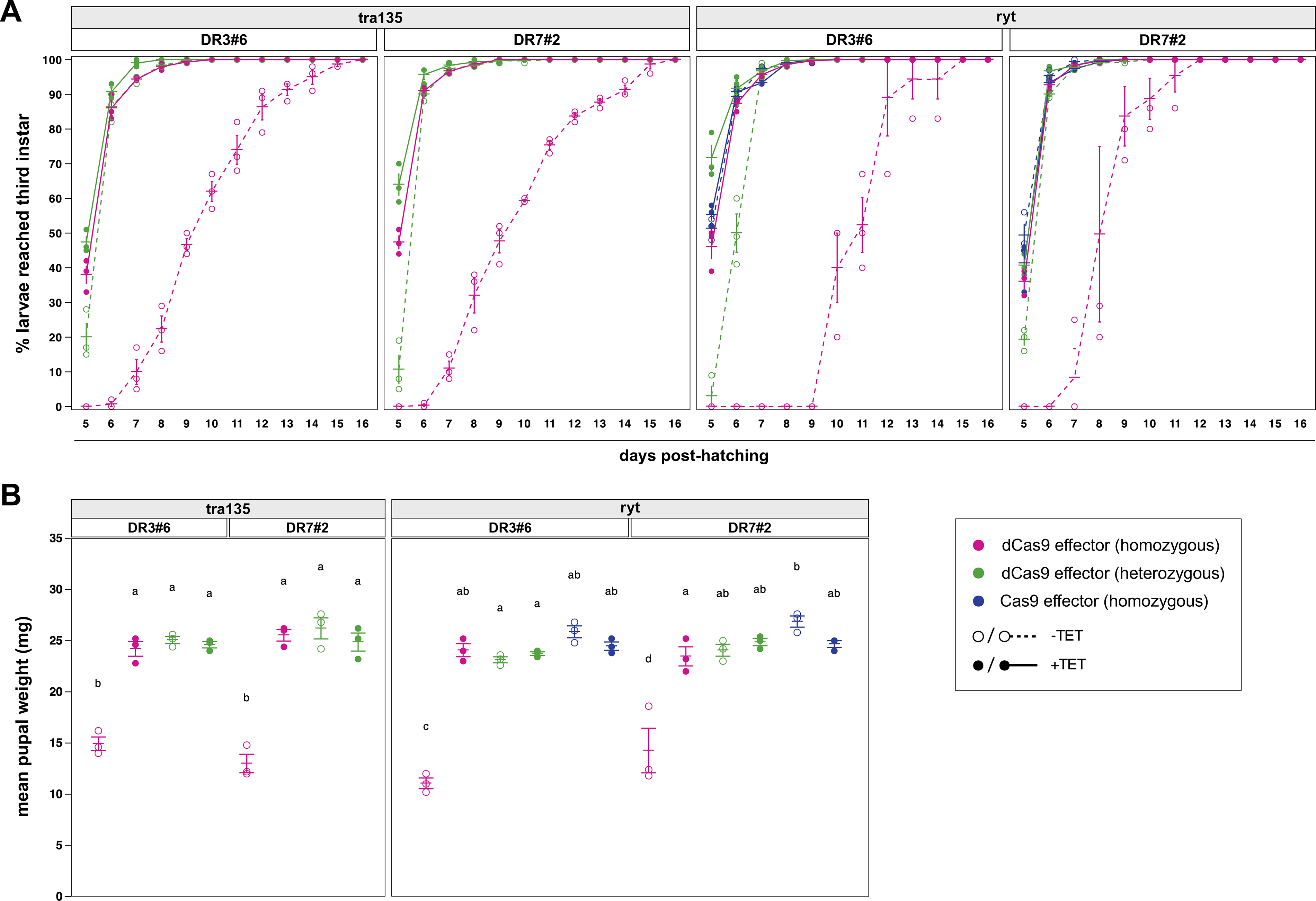
dCas9 expression is associated with delayed larval development and reduced pupal weight.
Evaluation of indel rates in Cas9 strains
The lack of detectable Lctra or yellow disruption in the Cas9 ryt strains was unexpected, given the robust knock-out of RFPex. Notably, the RFPex-targeting sgRNA was in the first position of its sgRNA array, upstream of sgRNAs targeting yellow and Lctra (Fig. 2A). This raised the possibility that an sgRNA’s effectiveness might be influenced by its position in the array. To test this hypothesis, DNA was extracted from Cas9 strains reared on or off tetracycline and indel rates were measured at different sgRNA target sites (Fig. 7A–B, Supplementary Table S11). Indel rates were generally low (<10%) in embryos and first-instar larvae but higher in adults, implying that Cas9 persisted into adulthood and/or that sgRNA expression increased over time. Indel rates were negligible in samples reared on tetracycline, consistent with our RT-PCR data showing minimal leaky expression of Cas9. In all samples, indel rates at sites targeted by the first sgRNA in an array were noticeably higher than sites targeted by the second or third sgRNA. These results indicate a strong positional bias in sgRNA effectiveness within multiplex arrays and provide a mechanistic explanation for the preferential disruption of RFPex relative to downstream targets.
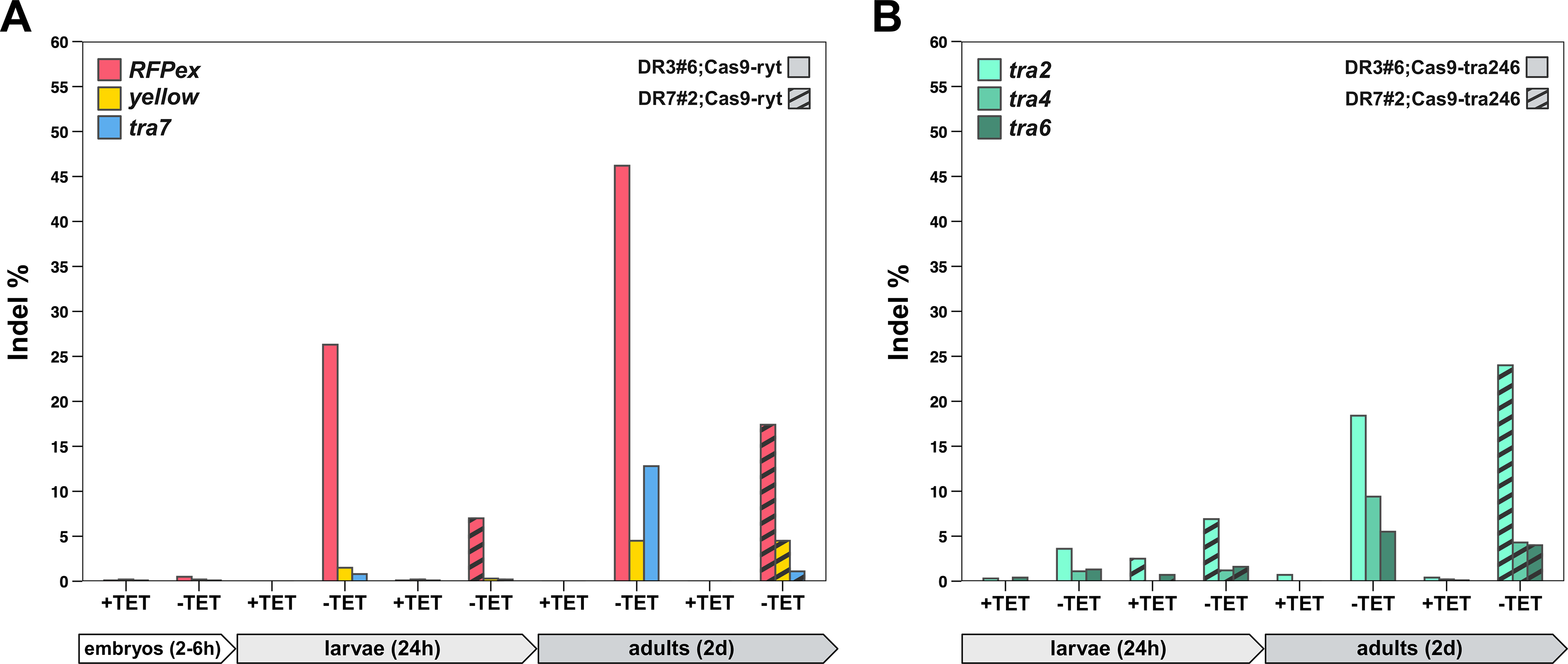
Indel rates at sgRNA target sites in Cas9-expressing strains. Indel rates at
Injection of sgRNAs targeting tra masculinizes Cas9-expressing females
To directly test that the lack of sex transformation in Cas9-expressing flies was due to inadequate sgRNA expression in early embryos, we injected embryos from the DR3#6;Cas9-tra246 and DR7#2;Cas9-tra246 strains with a cocktail of Lctra-targeting sgRNAs (200 ng/µL each of tra2, tra4, and tra6). We also injected embryos from the corresponding hemizygous dCas9 strains (DR3#6;dCas9-tra246/+ and DR7#2;dCas9-tra246/+) with the same sgRNA cocktail to determine whether dCas9 could repress Lctra if flies were provided with external sgRNAs. 16% and 38% of injected females from the DR3#6;Cas9-tra246 and DR7#2;Cas9-tra246 strains, respectively, were identified as intersex based on evaluation of external genitalia (Fig. 8A). No intersex females were observed in injected dCas9 strains or in uninjected controls from the Cas9 or dCas9 strains (Supplementary Table S12). Sex ratios in the injected dCas9 strains appeared male-biased (Supplementary Table S12), suggesting possible female-to-male transformation due to Lctra knockdown. However, molecular genotyping using Y-linked primers confirmed that all phenotypically male flies were XY (Supplementary Fig. S3), indicating that dCas9-mediated sex transformation did not occur. Molecular validation of intersex individuals was performed by PCR amplification and Sanger sequencing of Lctra amplicons. These analyses confirmed CRISPR-induced deletions in Lctra in intersex females from sgRNA-injected embryos (Fig. 8B).
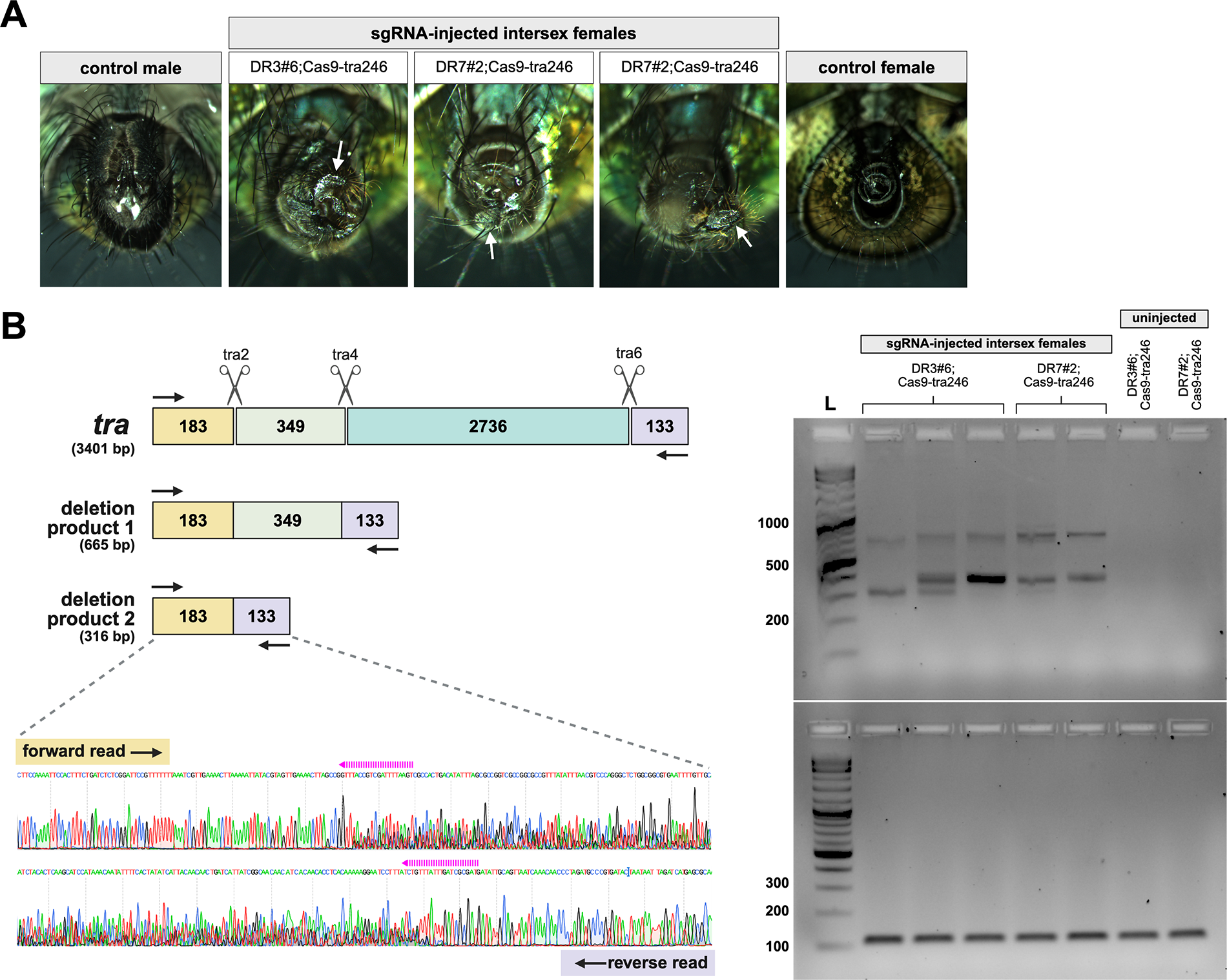
Masculinization of females from Cas9-expressing strains injected with sgRNAs targeting Lctra.
Discussion
Conditional sex transformation strains have the potential to improve SIT and other genetics-based pest control methods. In this study, we report the first conditional expression system for Cas9/dCas9 in a pest insect. More specifically, we lay the groundwork for the development of CRISPR-based sex transformation systems in the blowfly L. cuprina.
Successful gene disruption and sex transformation using our system depends on the robust early expression of Cas9 or dCas9 in flies reared off tetracycline, as well as the efficient expression and processing of sgRNA arrays to liberate individual sgRNAs capable of complexing with the Cas effector protein. Cas9 and dCas9 were indeed expressed at high levels in early embryos using the Lchsp70-tetO enhancer-promoter, as were sgRNA arrays using the constitutive LccU6b promoter. Cas9/dCas9 expression was efficiently repressed in most strains through the addition of tetracycline to the diet, a key requirement for maintaining conditional sex transformation strains in an SIT program. The tTA driver lines used in this study were selected because they had moderate (DR3) or high (DR7) expression in early embryos when Lctra RNA splicing patterns are set. Both were effective when combined with a tTA-inducible Lctra RNAi line. 23 The DR3 line was particularly effective, which was thought to be because tTA was expressed in ovaries in addition to embryos. Presumably, maternal deposition of tTA provided a rapid induction of Lctra double stranded RNA expression in early embryos. Additional promoters that have significant activity in ovaries and embryos such as Lcvasa 31 could be considered for assembly of conditional sex transformation strains. Other conditional expression systems could be evaluated in the future, such as a promoter from a heat shock protein (hsp) gene to induce Cas9/dCas9 expression.37,38 Lucilia cuprina hsp gene promoters were previously isolated and characterized. 39 Ideally, the hsp gene promoter would have very low basal activity at the temperatures used to rear L. cuprina (22–24°C), as high basal activity can provide sufficient Cas9 expression to inactivate the targeted gene. 38 Kandul and colleagues were able to maintain a D. melanogaster hsp70-Cas9 line that expressed a gRNA targeting tra by rearing at 18°C. 38 Rearing at 26°C without heat shock was sufficient to convert most females to males.
One target gene, the fluorescent marker RFPex, was reliably disrupted in all four Cas9 strains tested off tetracycline. Furthermore, third instar larvae showed a clear decrease in fluorescence intensity, suggesting lower levels of RFPex (DsRed) protein. This was confirmed by performing mass spectrometry on protein extracts of larval whole-tissue samples, which revealed a 92% reduction in RFPex protein in Cas9-expressing larvae relative to antibiotic-treated controls. However, despite screening thousands of flies, we never observed disruption of the other two target genes, Lctra and yellow. One possible explanation is that sgRNAs targeting those genes are less efficient than the sgRNA targeting RFPex. However, in vivo studies with L. cuprina indicate that the sgRNAs have comparable CRISPR editing rates (RFPex: 78% 29 ; yellow: 68% 22 ; Lctra (tra3): 85% (Supplementary Fig. S1)). Furthermore, the tra7 sgRNA in the ryt array has previously been reported to reliably masculinize females. 23 Injection of externally-provided Lctra-targeting sgRNAs into Cas9-expressing embryos led to masculinization, showing that Cas9-mediated disruption of Lctra is sufficient to induce sex transformation when sgRNA is not limiting. Together, these findings indicate that the primary constraint in our system was inefficient sgRNA processing and/or availability during embryogenesis.
We found that sgRNAs in the second or third position of the sgRNA array (relative to the promoter) were inefficient (0–13% editing efficiency for all conditions tested), whereas editing efficiency at sites targeted by sgRNAs in the first position of the array were always higher. Some studies have reported lower activity of the terminal sgRNA in multiplex arrays that used tRNA processing.40,41 In contrast, Port and Bullock (2016) found that the position in the sgRNA array had no measurable impact on activity. 33 The sgRNA targeting RFPex occupies the first position of its sgRNA array, which may explain why we saw consistent RFPex knockout phenotypes in flies reared off antibiotics. On the other hand, the sgRNAs tra1 and tra2, which occupy the first positions of the tra135 and tra246 arrays, respectively, target the 5′ UTR (tra1) or promoter (tra2) of Lctra instead of its coding sequence. Mutation of these upstream elements alone would likely not result in masculinization. We used sgRNA arrays because multiplexed sgRNA expression is highly efficient in Drosophila 33 and has the benefit of reducing construct size, which is negatively correlated with germline transformation rates with piggyBac. 42 Our results suggest that CRISPR efficiency may be improved in L. cuprina if sgRNAs are expressed from individual promoters.
While we observed consistent RFPex knockout in Cas9 strains, we found no visible or molecular evidence of knockdown of any target gene in the dCas9 strains. While provision of Lctra gRNAs through microinjection of dCas9 embryos produced more adult males than females, the males were all XY. The male-bias could be simply due to chance as the number of adults that developed from injected embryos was low (N = 39), or it could indicate female lethality. The latter would be consistent with our earlier finding that effective knockdown of Lctra RNA led to female lethality due to hyperactivation of X-linked genes. 23 Although we could not directly compare Cas9 and dCas9 because the effector constructs’ different genomic positions may have influenced their expression, our results suggest that dCas9 is a less potent effector than Cas9 in L. cuprina. Fusing dCas9 to a protein domain that inhibits gene expression in L. cuprina as is commonly done to control expression in human cells 43 could potentially provide more effective inhibition of Lctra expression.
Although the dCas9 lines were homozygous viable, our assessment of the two component dCas9;tTA strains was complicated by pronounced developmental toxicity. Of the eight dCas9;tTA two-component strains, four could not be maintained as double homozygotes on the standard dose of tetracycline due to near-complete lethality at the embryo or larva stage. Other dCas9;tTA strains could be maintained as double homozygotes on standard antibiotic doses without apparent ill effects, but not when tetracycline was omitted from the diet. The strains displayed severe, deleterious phenotypes—ranging from reduced pupal weight to delayed development to 100% lethality at the pupal stage—when reared off antibiotics. None of these phenotypes were observed in any of the double homozygous Cas9;tTA strains. Cas9 and dCas9 overexpression are known to be toxic in D. melanogaster, even in the absence of gRNAs.44,45 However, in our L. cuprina strains, Cas9 appeared to be much more well-tolerated than dCas9. This is difficult to explain, given that the two effectors are nearly identical, with dCas9 differing from Cas9 only by two amino acid substitutions. 25 However, in prokaryotic and eukaryotic in vitro DNA replication models, dCas9 was shown to efficiently block DNA synthesis by stalling replication forks, and to bind target DNA for an estimated >44 h. 46 Numerous studies have shown that stalled replication forks lead to replication stress and associated genomic instability, DNA damage, and cell death.47–49 This could provide an explanation for the toxicity observed with high levels of dCas9 expression in L. cuprina. We note, however, that lethal phenotypes were not observed when we injected a dCas9 expression plasmid into DR7#2 embryos reared off tetracycline (Supplementary Table S10). This may indicate that dCas9 itself is not toxic, and that the lethal phenotypes we observed in our dCas9-expressing strains arose from off-target activation of genes near the dCas9 constructs’ insertion sites. However, it is also possible that the plasmid injection strategy did not induce toxic levels of dCas9 expression. If so, a dCas9 conditional repression system could potentially be established by using gene promoters for tTA expression that have lower activity in embryos than the promoters used here. While it is beyond the scope of this study to investigate possible mechanisms of dCas9-associated lethality, based on our results, researchers considering the use of dCas9 expression systems in insects may wish to exercise caution.
Overall, our findings demonstrate that Tet-Off–regulated Cas9 expression can be robustly implemented in L. cuprina and that CRISPR-mediated disruption of Lctra is sufficient to induce female masculinization when sgRNA availability is optimized. With relatively modest design modifications—such as improved sgRNA expression architectures—this platform has strong potential to enable practical conditional sex transformation systems. Such advances could provide powerful new tools for scalable, male-only production pipelines in SIT programs targeting blowflies and other economically important insect pests.
Data Availability Statement
Proteomic data, including raw mass spectrometry files and databases, are available through ProteomeXchange via the PRIDE database 50 under the project accession PXD071864 [https://www.ebi.ac.uk/pride]. The six effector plasmids have been deposited with Addgene, accession numbers 246019-246024. The sequence of the Lchsp83-hyppBac helper plasmid has been deposited at GenBank, accession number PX960800.
Authors’ Contributions
A.K.: Data curation, formal analysis, funding acquisition, investigation, methodology, visualization, writing—original draft preparation. T.B.: Investigation, methodology, data curation, validation, formal analysis, writing—review and editing. R.N.: Investigation, methodology, data curation, validation, formal analysis, writing—review and editing. O.L.M.: Investigation, methodology, data curation, formal analysis, and writing—review and editing. E.J.B.: Investigation and methodology. M.K.: Supervision and writing—review and editing. M.S.: Conceptualization, funding acquisition, project administration, supervision, and writing—review and editing.
Footnotes
Acknowledgement
We made all LC-MS/MS measurements in the Molecular Education, Technology, and Research Innovation Center (METRIC) at North Carolina State University, which is supported by the State of North Carolina, USA.
Author Disclosure Statement
The authors state that they have no conflicts of interest.
Funding Information
This research was supported by a cooperative agreement between USDA-APHIS and NCSU awarded to M.J.S. (award number AP22IS000000C005) and by the NIFA AFRI Education and Workforce Development Predoctoral Fellowship awarded to A.K. (award number 2023–67011-40404). T.B. and R.N. were supported by an agreement between The Institut Pasteur de Montevideo and NCSU and grants from the IBD (UR-T1227) and from INIA (FTPA N°359). T.B. and R.N. are members of SNI (National Research System, Uruguay) and a NSF grant awarded to MK (award number IOS #2426305).
Supplemental Material
Supplemental Material
Supplemental Material
Supplemental Material
Supplemental Material
Supplemental Material
Supplemental Material
Supplemental Material
Supplemental Material
Supplemental Material
Supplemental Material
Supplemental Material
Supplemental Material
Supplemental Material
References
Supplementary Material
Please find the following supplemental material available below.
For Open Access articles published under a Creative Commons License, all supplemental material carries the same license as the article it is associated with.
For non-Open Access articles published, all supplemental material carries a non-exclusive license, and permission requests for re-use of supplemental material or any part of supplemental material shall be sent directly to the copyright owner as specified in the copyright notice associated with the article.
