




Abstract
Community Brief
Why is this an important issue?
Autistic people often camouflage (or mask) their autistic behaviors as a response to stigma, despite the negative impact of camouflaging on mental health. This study shows that autism-related cues in a situation can impact how autistic people camouflage in that situation. Specifically, in a controlled experiment, we demonstrated that autism-affirming cues can reduce camouflaging efforts, even in a context typically associated with high camouflaging pressure such as the first day of work at a new workplace. In addition, we found that the impact of autism-affirming cues on camouflaging varies substantially from one autistic person to another, even in the exact same context and situations, highlighting the complexity of camouflaging processes and the importance of looking at individual differences within the autistic population.
What was the purpose of this study?
The purpose of this study was to demonstrate how situational cues related to autism and the autistic identity can influence camouflaging efforts among autistic individuals, in an experiment where many other variables were controlled for. We also wanted to see whether the strength of the impact of these cues was different across autistic people, and if the impact was stronger for those who more strongly identify with the autistic community. To the extent that is the case, focusing solely on the “average autistic person” can overlook the diverse range of individual experiences. By demonstrating this variability, we aimed to challenge conventional portrayals of autistic individuals as a homogeneous group and emphasize the importance of considering, as an integral component of research and clinical practice, that autistic people are not all the same.
What did the researchers do?
We first asked autistic adults to suggest a series of autism-affirming and stigmatizing cues. We selected 12 autism-affirming and 12 autism-stigmatizing cues and embedded them in workplace-related situations and asked a different sample of autistic adults to indicate the extent to which they would camouflage their autistic behaviors in each of these 24 situations, presented in random order. We analyzed the data for each participant separately, looking at whether each person indicated less effort to camouflage in situations with autism-affirming (vs. autism-stigmatizing) cues. We also looked at whether strength of identification with the autistic community could explain (at least some of) the individual differences we saw.
What were the results of the study?
Overall, participants indicated they would invest less effort to camouflage their autistic behaviors in situations with autism-affirming (vs. autism-stigmatizing) cues. But when we looked at individual differences, we saw that this was not the case for some participants, showing that each autistic person can interpret and respond to situations differently. Participants who more strongly identified with the autistic community responded with more intensity to autism-affirming (vs. stigmatizing) cues, with a greater reduction in camouflaging in autism-affirming situations.
What do these findings add to what was already known?
Lending support to the call to create autism-affirming environments, this study adds evidence from a controlled study that, like other minoritized groups, autistic people benefit from identity safety cues in their environment. Even in contexts where the pressure to camouflage is strong, such as starting a new job, autistic people indicated less effort to camouflage in situations with autism-affirming cues. But while these cues seemed to contribute to psychological safety overall, their impact differed significantly from one autistic person to another, demonstrating the need to move beyond studies that only focus on the “average” autistic person.
What are potential weaknesses in the study?
The study does not provide information about autistic people in societies and populations different from those studied here. Most of the participants in this study identified as White, and more than half (57%) as women. In addition, the surveys were posted on social media and available only in English. As such, we should not assume, without further study, that the results apply to the experiences of all autistic individuals. The study also focused on responses to autism-affirming and autism-stigmatizing cues in workplace-related situations, so its findings may not apply to how autistic people react to cues in other settings. Finally, the brief verbal descriptions of situations used in the study may not capture the full complexity of real-life experiences. Therefore, these results should be interpreted with caution and not generalized beyond the specific context studied.
How will these findings help autistic adults now or in the future?
The study highlights the potential benefits of using identity safety cues to create autism-affirming environments where camouflaging efforts are reduced and autistic individuals feel safe to express themselves authentically. Even simple changes, such as welcoming sensory accommodation requests, can make spaces, such as workplaces, feel more inclusive, reducing the negative impact of stigma. The study also demonstrates that autistic people differ from each other in their experience and responses to the same situations, urging us to avoid one-size-fits-all approaches and encouraging more research into the autistic diversity.
Introduction
Coping with stigma
Autistic camouflaging, also commonly referred to as masking, is a complex phenomenon encompassing numerous cognitive and behavioral strategies that autistic individuals often use to navigate environments structured around neurotypical norms and expectations.1B2 -6 Camouflaging can be both intentional—where an individual consciously modifies their behavior to enhance social acceptance and mitigate risks of stigma or exclusion—and unintentional, occurring as an automatic response shaped by socialization and environmental expectations.4,7,8
Camouflaging emerges from a dynamic interplay of factors such as social pressures, cultural norms, cognitive resources, interpersonal trauma, and one’s many social identities. For instance, autistic individuals with multiple marginalized identities may face distinct pressures to camouflage, as they navigate overlapping systems of bias and discrimination.9-11 Consequently, the unique intersectionality of one’s race, gender, and other social identities, along with their life experiences, is an important consideration when understanding both the strategies autistic people use and the extent to which they feel compelled to mask their autistic traits.4,9,12B13 -16 Thus, each autistic person may sense varying degrees of pressure to camouflage, even if they experience the same situations within a given environment. Recognizing this diversity is crucial, as examining camouflaging only through an “average” autistic experience can obscure the realities of those most affected, diluting its true impact by privileging majority patterns over meaningful variability.
Camouflaging, while serving a purpose, comes at a cost. It is associated with a number of negative outcomes, including burnout, diminished self-esteem, identity conflict and confusion, depression, anxiety, and suicidality.1,17B18 -21 One way to mitigate these harmful consequences is to foster environments in which autistic people feel safe in being their authentic selves. While broad systemic change addressing stigma toward autism is essential, meaningful progress can also be made by identifying and modifying specific aspects of the environment that may influence camouflaging, shaping spaces where autistic people feel recognized and supported in expressing their true selves.
Identity cues
Extensive research in social psychology22B23 -28 has examined the effects of identity cues, that is, subtle signals within an environment that draw attention to specific social identities such as gender, race, socioeconomic status, religious affiliation, or an individual’s autistic identity as examined in this study. These cues can be conveyed through various means, including physical surroundings, language used, representation of diverse groups, and interpersonal interactions.27B28 -32 More importantly, they also relay information about how social identities are perceived. While stigmatizing cues (or identity threat cues) may indicate that a person’s social identity will be met with bias and prejudice, identity safety cues signal that an individual’s social identities are valued and respected.24,27,33 Environments rich in identity safety cues foster a sense of belonging and psychological safety for people with minoritized social identities, allowing individuals to feel comfortable expressing their authentic selves without fear of prejudice or discrimination.27,30,31 Identity safety cues directed at autistic people (i.e., autism-affirming cues) may, therefore, help create environments that are welcoming and inclusive to autistic people, where they feel less need to engage in camouflaging behaviors.
This study aims to investigate whether identity safety (vs. identity threat) cues that are relevant to autism and autistic identity can influence autistic people’s camouflaging behaviors. Given the complex, dynamic, and interacting forces that shape camouflaging, we used an experimental approach to isolate the effects of autism-affirming and autism-stigmatizing cues on autistic adults’ intentional camouflaging efforts. To increase ecological validity, these cues were embedded in workplace situations, a context where pressures to camouflage are often heightened,1,34,35 rather than presented in isolation. We hypothesized that the efforts to camouflage would be reduced in response to situations featuring autism-affirming cues compared with situations featuring autism-stigmatizing cues (H1).
In designing this study, we were mindful of the wide diversity within the autistic adult population. Affirming and stigmatizing cues may affect each autistic person differently due to various factors, including, but not limited to, racial, ethnic, and cultural backgrounds, disability impact, gender, socioeconomic status, and past experiences. While no single study can account for all factors influencing camouflaging behavior, by assessing the extent of heterogeneity among autistic people in their response to autism affirming and stigmatizing cues, we sought to gauge the sum total of the effects of those factors, both known and unknown, on which participants in our sample differed from each other. We hypothesized to find individual differences in the effect of autism-affirming versus autism-stigmatizing cues on camouflaging efforts (H2).
We anticipated that these individual differences would be partially related to the strength of one’s identification with the autistic community. The Social Identity Theory36,37 suggests that strong identification with a community of individuals who share an identity can heighten sensitivity to cues that stigmatize, or affirm, that identity.38-40 In the case of autistic adults, those who strongly identify with the autistic community may be more attuned to affirming and stigmatizing messages about autism. 41 We hypothesized that the effect of cue type (autism-affirming vs. autism-stigmatizing) on camouflaging efforts would be greater for those who more strongly identify with the Autistic Community (H3).
Methods
Following the preregistered study protocol (https://osf.io/q4kn7), this research was implemented in two phases. In phase 1, we conducted two exploratory, cue-generating surveys with the goal of identifying some of the identity cues that autistic individuals perceive as affirming or stigmatizing. Phase 2 consisted of a within-person experiment to examine the effects of the identity cues identified in phase 1 on autistic adults’ camouflaging efforts. The Highly-Repeated Within-Person42,43 design used in phase 2 allowed us to observe the effects of these identity cues for each individual, as well as assess the individual differences in the direction and magnitude of such effects. Both phases 1 and 2 of this study received IRB exempt status.
Participants
Phase 1 participants (N = 22; 14 participants for the first survey and 8 participants for the second, excluding empty survey submissions) were recruited between November 2022 and January 2023. Phase 2 participants (final N = 135, following the exclusion criteria outlined in the preregistered plan) were recruited between March 2023 and April 2023. Phase 1 surveys and phase 2 experiment were hosted on Qualtrics and distributed on autism-specific social media groups, where participants self-selected to participate. It is possible that some individuals may have participated across exploratory surveys and the experiment, as participant overlap could not be fully ruled out. The inclusion criteria for participation in all surveys were that participants identified as being autistic, on the spectrum, or having autism (with or without a formal diagnosis), and were at least 18 years old. Phase 1 surveys were distributed to a few autistics-only groups on a social media platform. Out of concern for participants’ privacy in this relatively small online community, we did not collect demographic data in this phase. The phase 2 experiment was distributed in various autism-specific groups across social media platforms. In the experiment, 57% of the 135 participants identified as women, 25% as men, 10% as nonbinary, 4% as agender/other, and 3% of participants did not provide gender information. The majority of the participants (84%) identified as White, 4% identified as Black or African American, 4% as more than one race, 2% as Asian, and 7% did not report their race. With regard to age, 44% were between 30 and 49 years, 33% between 18 and 29 years, 20% older than 50 years, and 3% did not provide age. Participants’ demographics are included in Supplementary Table S3 in the Supplementary Materials.
Procedure
Phase 1: Identifying autism-affirming and autism-stigmatizing cues
Social spaces (i.e., physical or virtual environments where individuals interact and navigate social norms, roles, and expectations, such as workplaces, schools, and public settings) are rich with identity cues that signal belonging, status, and group membership. To find identity cues in an environment that are likely perceived by autistic people as autism-affirming or stigmatizing, in phase 1, we developed two exploratory surveys asking autistic adults from autistics-only social media groups what features of a social space make them feel welcomed and accepted as an autistic person, and what features make them feel unwelcomed and stigmatized. The first cue-generating survey consisted of six open-ended questions intended to identify a general, broad range of autism-related cues that autistic individuals may perceive as affirming or stigmatizing (e.g., “Imagine you are entering a place you have never been before, such as a new classroom, store, workspace, or health care clinic. What are some things that, if you saw in this place, would make you feel more welcomed, accepted, and safe as an Autistic person?”). From the responses we obtained, we built a second survey with a mix of rating items and open-ended questions. The second survey aimed to validate some of the identity cues frequently mentioned by participants in the first survey while also exploring new potential cues that may be meaningful to autistic individuals. Both first and second exploratory cue-generating surveys are included in the Supplementary Materials. The data obtained from these two exploratory surveys were used to generate the autism-affirming and autism-stigmatizing scenarios in the hypothesis-testing experiment, in the second phase of this study. For example, “functioning labels” was identified as an autism-stigmatizing cue in phase 1, which was then used to create the following autism-stigmatizing scenario used in phase 2: “You see flyers in common areas that use ‘high functioning’ and ‘low functioning’ when describing individuals diagnosed with autism.” Both authors independently reviewed the survey responses. Cues mentioned by multiple participants or aligned with existing literature on identity threat (e.g., stereotypes) and safety cues (e.g., minority representation 28 ) were prioritized for inclusion in the experiment.
Phase 2: Testing the effect of autism-affirming and autism-stigmatizing cues on camouflaging efforts
To minimize potential contextual confounds, the experiment was designed to test the effect of identity cues on camouflaging efforts within a single setting. The workplace was selected as it is a setting where autistic individuals often feel the need to engage in camouflaging.1,34,35,44 Specifically, the autism-relevant identity cues generated in phase 1 were translated into 12 affirming and 12 stigmatizing cues applicable to workplace situations. These cues were then incorporated into 24 short verbal descriptions of situations of two types: (1) autism-affirming (e.g., “You find that your workplace supports neurodiversity affirming organizations led by Autistic people.”); and (2) autism-stigmatizing (e.g., “You see flyers in common areas that use “high functioning” and “low functioning” when describing individuals diagnosed with autism.”). For the full list of autism-affirming and autism-stigmatizing situation descriptions used in the experiment, see the Supplementary Materials.
Participants read, in random order, each of the 24 short verbal descriptions of situations and rated their camouflaging efforts in each situation. In addition, participants completed a measure of the strength of their identification with the autistic community, adapted from the 4-item identity centrality subscale within the well-established Collective Self-Esteem Scale: Self-Evaluation of One’s Social Identity. 45 This 4-item subscale assesses the degree to which individuals consider their group membership to be an important part of their self-concept (e.g., “Overall, belonging to [group] is an important part of my self-image”), with responses provided on a 1–5 Likert-type scale. Prior research has demonstrated strong psychometric properties for this subscale, including high internal consistency and construct validity. 45 The Identification with the Autistic Community Scale is included in the Supplementary Materials.
Data analysis
The data from the experiment in phase 2 reflect two different levels. On one level are the 24 hypothetical situations, 12 of which were sampled from situations with autism-stigmatizing cues, and the other 12, from those with autism-affirming cues. On the other level are the 135 participants, sampled from the population of autistic individuals on social media platforms. Statistically, the data were considered “clustered” in that each participant’s responses to the 24 situations form a set, all coming from the same participant. We thus analyzed the data using multilevel modeling, in which level 1 is a within-person analysis, and level 2 is a between-subjects analysis. At level 1, for each person, this analysis examined how camouflaging efforts changed according to the cue type: autism-affirming versus autism-stigmatizing. Level 2 examined how the effect of cue type on camouflaging efforts, assessed on level 1, differed across participants. Analyses were performed using the R lme4 package 46 as well as the lmerTest package 47 to obtain Satterthwaite degrees of freedom and associated t-tests. All p-values are based on two-tailed tests. For the specifics of the analysis, see Data Modeling, as well as the R code, included in the Supplementary Materials.
Results
As predicted, a clear effect of cue type on camouflaging efforts was found (ß = 3.26, p < 0.001) such that, on average, camouflaging effort ratings were lower in affirming situations (M = 4.3, SD = 2.7) compared with stigmatizing situations (M = 7.6, SD = 2.6). The within-person analysis indicated that, for 87% of participants, this effect was significant (p < 0.05) and in the direction of less camouflaging efforts in autism-affirming (vs. stigmatizing) situations. In addition, also as predicted, the model that allows the effect of cue type to vary across participants fits the data substantially better than the model that did not,
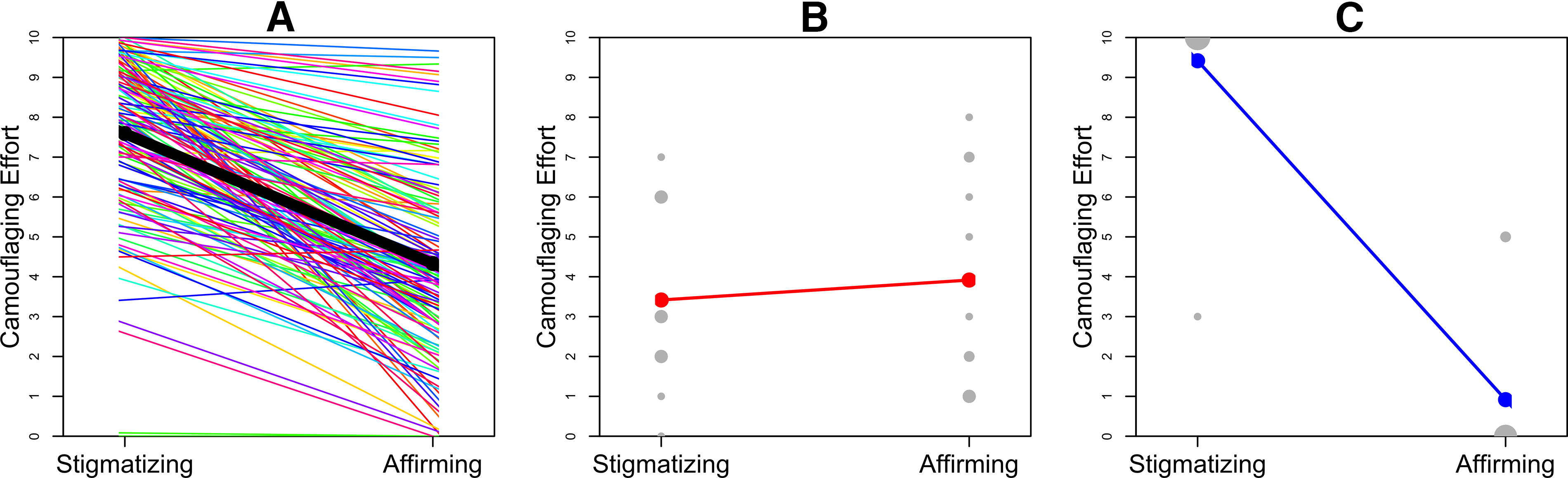
Effect of cue type on camouflaging efforts for each individual. The effect of cue type on camouflaging efforts is not the same for all participants. Panel
We then tested how the strength of identification with the autistic community was related to the observed individual-to-individual differences in the effect of cue type. As illustrated in panel (A) of Figure 2, among people who do not identify strongly as part of an autistic community (low identification group), camouflage efforts did not differ very much between situations with autism-affirming versus autism-stigmatizing identity cues. In contrast, among those who strongly identified with the autistic community (high identification group), the change in camouflage efforts was larger between the two types of cues. Moderation of the effect of cue type by the strength of identification with the autistic community accounted for some of the individual variations
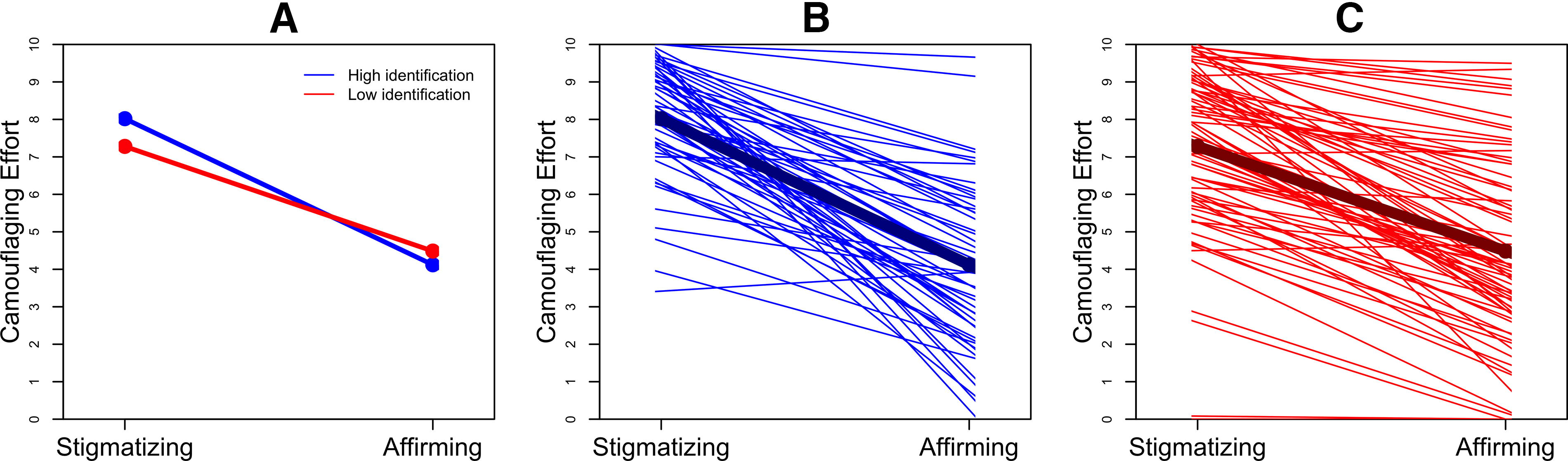
Effect of cue type on camouflaging efforts for participants with high versus low strength of identification with the autistic community. Panel
An important finding from this analysis is that a great deal of individual-to-individual variation remains, as shown by the comparison of models 2 and 4 in Supplementary Table S1, even after taking into account each participant’s strength of identification with the autistic community. The model that allowed the slopes to vary across participants (model 4) resulted in a substantially better fit
Discussion
In the present study, a large majority of autistic people reported significantly less camouflage efforts in autism-affirming situations compared with stigmatizing situations, supporting hypothesis H1. This finding provides support, from a well-controlled within-subject experiment, for the extensive body of research associating autistic camouflaging and stigma.1B2 -4,7,48 Lending credence to the call to create autism-affirming environments, it appears that, much similar to other minoritized groups, autistic people benefit from identity safety cues in their environment. For example, although “camouflaging-inducing” processes are already strong in the context in which the identity-safety cues were presented (i.e., the participants’ first day at a new workplace), it appears that autism-affirming cues counteracted them enough to result in a meaningful reduction in camouflaging. This highlights the potential role that identity safety cues aimed at autistic people may have in cultivating psychological safety and inclusion in an environment, buffering against some of the harmful effects of stigma.
Using the Highly-Repeated Within-Person42,43 design, we also found an unmistakably large diversity among autistic people in their responses to these identity cues, supporting hypothesis H2: while for many participants a great shift was found in camouflaging efforts from situations with stigmatizing cues to situations with affirming cues, this was not the case for every participant. These individual-to-individual differences were highly reliable (i.e., clearly more than chance variations). That is, while the autism-affirming cues examined appear to provide psychological safety for autistic individuals as a group, their impact greatly differed from one person to another, reflecting how each autistic person can process and respond to social environments differently. This evidence of diversity in the effect of these cues across autistic people is an important first step in identifying autistic subgroups that differ from the majority in how they are affected by specific cues. Such differences would be overlooked in traditional research designs that rely solely on results averaged across individuals, highlighting the need for greater caution when making generalized conclusions about the “typical” autistic person.
In support of hypothesis H3, some of the differences across individuals in the effect we observed were related to the strength with which they identified with the autistic community. Those who strongly identified with the autistic community responded with a greater change in camouflaging efforts between situations featuring affirming and those featuring stigmatizing cues. Nevertheless, even after controlling for strength of identification with the autistic community, large and reliable individual differences were observed in the effect of affirming versus stigmatizing identity cues on camouflaging efforts. This underscores the need for further research on the different ways in which autistic people experience and respond to stigma through camouflaging. The observed substantial variability despite the seemingly homogeneous sample (with a majority of participants identifying as White and women) suggests that an even greater variability exists among autistic people globally across cultural, racial, ethnic, socioeconomic, and disability backgrounds.
The present findings demonstrate the relevance of identity safety cues for creating workplace environments that are affirming for, and inclusive of, autistic people. Given that aligning with neurotypical social expectations is often perceived as necessary for individuals to fit in and maintain employment security, many autistic individuals may feel a heightened pressure to camouflage in the workplace. By signaling that autistic ways of being are welcomed and respected, autism-affirming cues can contribute to reshaping workplace norms in ways that reduce stigma-related pressure to camouflage. While implementing a handful of affirming strategies does not, in itself, constitute creating a stigma-free environment, some simple changes, such as welcoming sensory accommodation requests, may help convey the idea of a workplace that is nondiscriminatory toward autistic people. In addition, our study brings to light the necessity of using research methodologies that can document the diversity among autistic individuals, challenging the conventional portrayal of autistic people as one homogeneous group.
Constraints on generality, limitations, and future directions
Most participants identified as White, and the majority (57%) were women. All survey links were posted on social media platforms, and surveys were only available in English. Therefore, the findings presented here should not be assumed to generalize beyond the specific context and population of this study without further empirical investigation. For instance, social media users may interpret certain cues differently from non-social media users. In addition, since the study examined reactions to specific autism-affirming and autism-stigmatizing cues in workplace-related situations, it cannot speak directly to how autistic people respond to different cues, or cues occurring in non-workplace contexts.
Furthermore, we regretfully did not collect data on participants’ employment history, and some individuals may have had limited or no work experience. As a result, some responses may reflect unrealistic expectations or assumptions about workplace dynamics, which should be considered when interpreting the applicability of our findings to real-world workplace settings. It should also be noted that brief verbal descriptions of situations, as utilized in this study, cannot fully capture the intricacies of experiencing real-life situations.
Future research should continue exploring the impact of autism-affirming and autism-stigmatizing cues with a more diverse sample of autistic individuals and across a broader range of social contexts, such as educational institutions, health care settings, and community programs and organizations. We believe that the present findings underscore the importance of understanding the impact of identity safety cues for creating environments where autistic people feel safe to express themselves authentically.
Footnotes

References
Supplementary Material
Please find the following supplemental material available below.
For Open Access articles published under a Creative Commons License, all supplemental material carries the same license as the article it is associated with.
For non-Open Access articles published, all supplemental material carries a non-exclusive license, and permission requests for re-use of supplemental material or any part of supplemental material shall be sent directly to the copyright owner as specified in the copyright notice associated with the article.
