




Abstract
Community Brief
Why is this an important issue?
Loneliness can have a negative impact on a person’s mental and physical health. Autistic adults experience high levels of loneliness compared with non-autistic adults. However, little research has examined autistic adults’ firsthand experiences of loneliness.
What was the purpose of this study?
We aimed to better understand the firsthand experiences of loneliness among autistic adults, given the gap in the existing published literature.
What did the researchers do?
We conducted an online survey involving 203 autistic adults from the United Kingdom. We asked them to define loneliness, and to explain how loneliness affects them, how they cope with loneliness, and if (or how) their experience of loneliness changes over time. An autistic researcher led the analysis using a technique called reflexive thematic analysis, which involves looking for patterns within a dataset.
What were the results of the study?
We found four main themes that describe autistic adults’ experiences of loneliness. First, autistic adults reported feeling tensions between their desire for social connections and the difficulties they experienced in achieving such connections. Second, our participants elaborated on the many and varied barriers to achieving social connections, including disabling sensory environments, a lack of societal understanding and acceptance of autism, and challenges in finding and connecting with similar others. Third, autistic adults emphasized the importance of finding and maintaining meaningful relationships, whether through connecting with others who share similar experiences, or spending time with pets or animals. Autistic adults also tended to report relying heavily on one close person, even though this strategy was accompanied by a fear of losing that person. Finally, our participants discussed the need to come to terms with the reality of the autistic experience of loneliness, through a process of accepting one’s autistic identity and by no longer resisting the autistic experience of loneliness.
What do these findings add to what was already known?
This study highlights that a key aspect of loneliness for autistic adults involves a conflict between their desire for social connections and the barriers they face in realizing these connections. This work expands existing knowledge by emphasizing several crucial aspects of the autistic experience. First, autistic adults discussed the frustration involved in wanting social connections while needing to manage their limited energy for engaging in social connections. Second, autistic adults reported that feelings of not fitting in or not being understood/misunderstood, coupled with a lack of societal understanding and acceptance of autism, underpin loneliness in autistic adults. Third, autistic adults reported that connecting with similar others and accepting one’s autistic differences help lessen loneliness.
What are potential weaknesses in the study?
Our sample may not be representative of the broader autistic population. For example, participants largely identified as White and were able to communicate verbally. Conducting an online survey also excluded individuals without internet access, and likely focused on those with online community connections.
How will these findings help autistic adults now or in the future?
Our findings suggest that the avoidance of social interactions does not necessarily reflect autistic adults’ reluctance to engage, but rather their need to manage social exhaustion to protect their well-being. As such, these findings challenge widely held assumptions about autistic people. The findings also have important clinical implications, in terms of supporting autistic adults who seek support for loneliness.
Background
While loneliness is not an experience unique to autistic people, autistic adults have long shared their lived experiences of the phenomenon. In autobiographies and in other writings, autistic adults explain loneliness as a distressing emotion arising from their unmet desire for social connections. For example, Tammet 1 commented on how autistic people “do want to make friends but find it difficult to do so. The keen sense of isolation was something I felt very deeply and was very painful for me.” Furthermore, Sellin 2 starkly described the toll of such experiences: “It’s like being buried alive. The loneliness of an autistic person is like a great clod of earth weighing down the soul.”
Within the research literature, autistic adults consistently self-report heightened levels of loneliness compared with non-autistic adults.3,4 Loneliness appears to increase from adolescence into adulthood, 5 and may be particularly problematic for older adults.6-8 One in six people in the general population experience loneliness, and loneliness is linked to over 871,000 deaths annually (roughly 100 every hour). 9 Loneliness is also linked to numerous negative mental and physical health outcomes, see Refs.10-12 for systematic reviews on this topic. In autism, loneliness has been suggested to mediate the relationship between autistic traits and mental health concerns. 13
Researchers have not fully established the mechanisms underpinning loneliness in the autistic population. 3 However, several factors have been associated with increased loneliness in autistic adults, including more pronounced autistic characteristics, heightened anxiety and depression, increased lifetime suicidal thoughts or attempts, negative experiences and learned helplessness, a lack of understanding and acceptance of autism, sensory sensitivities, and social camouflaging, and unemployment.3,14 It remains unclear whether these factors are a cause or consequence of loneliness in autistic people.
Qualitative studies have added context to these quantitative comparisons, but have typically examined autistic people’s lived experiences of loneliness as part of broader investigations.3,14 Interviews and open-ended questionnaire data demonstrate that some autistic adults desire social connection, but social interaction can present challenges. These studies also suggest that loneliness is a negative and persistent feeling for autistic adults, not synonymous with being alone. 15 Researchers have begun to explore what might be underpinning the unique autistic experience of loneliness. Such insights emphasize the complex nature of loneliness in autistic adults, suggesting that it concerns not just the quantity of social interactions but also the quality and satisfaction. Most recently, work has also started to explore the coping strategies deployed by autistic people to combat loneliness, and whether these differ from those favored by non-autistic people. Results suggest a large degree of overlap in the strategies of autistic and non-autistic people, with both groups using behavioral distraction (e.g., spending time on hobbies) and instrumental action (e.g., seeking social contact).5,16
Research to date, however, has often examined specific facets (e.g., socialization) associated with loneliness in autistic people. In the present study, we move beyond any one unique aspect of the phenomenon to consider whether a broader range of potential factors might be relevant to autistic people’s loneliness. More specifically, we investigated how autistic adults in the United Kingdom experience and manage loneliness, what (if anything) alleviates their loneliness, and whether their experiences of loneliness change over time. To do so, we adopted an online survey methodology in preference to interviews or focus groups that have an inherent social component.16,17 In this way, we aim to widen our reach to invite a broader range of potential participants, and facilitate the inclusion of a more diverse set of viewpoints.
Method
Community involvement statement
The current study benefited from autistic involvement in several ways. K.G. is an autistic researcher who identified and developed the topic of the research. K.G. designed, conducted, analyzed, and wrote the study with input and supervision from L.C. and A.R. (two non-autistic autism researchers). Six autistic people reviewed and provided feedback on a draft of our online survey. Following data collection, K.G. presented initial themes to a neurodiverse research team that included autistic researchers to gain feedback and insights (see the Data Analysis section).
Design
As part of a broader study of loneliness among autistic adults, we created an online survey to collect data on autistic people’s experiences of loneliness (data presented here) and their views on measures used to evaluate loneliness (data presented elsewhere). 18
Participants
We advertised the research via social media, emails to 159 UK-based organizations or social groups for autistic adults, and via a research center database. We made efforts to include as diverse a group as possible, for example, by contacting Black, Asian, and Minority Ethnic, and Lesbian, Gay, Bisexual, Transgender, Queer/Questioning and other sexual identity groups.
We recruited 203 autistic adults (diagnosed or self-identified) who lived in the United Kingdom. Participants’ ages ranged from 18 to 73 years (mean = 34.7). As per Table 1, most participants were formally diagnosed (predominantly in adulthood), female, and from a White ethnic background. Many participants reported co-occurring conditions, most commonly relating to mental health.
Participant Demographics (n = 203)
In the UK educational system, students are entered for GCSE (General Certificate of Secondary Education) at around the age of 14–16, and they are entered for A/AS levels at around the age of 16–18.
Materials
We developed a bespoke online survey to gather participants’ experiences of loneliness. The survey comprised four parts. In Part 1, participants confirmed that they were eligible for the study (i.e., they were autistic and lived in the United Kingdom) and provided demographic information to characterize the sample. In Part 2, we gave participants an open textbox and asked them to define loneliness. We then showed participants Perlman and Peplau’s definition of loneliness: “loneliness is an unpleasant experience caused by reductions in the quality and quantity of social relationships and the discrepancy between one’s ideal and existing social relationships.” 19 We used this definition as a reference point for participants, especially those who may have found it difficult to articulate their experiences of loneliness. After reviewing the definition, we asked participants what they thought of it (i.e., whether it matched, or differed from, their own definition of loneliness and why). In Part 3, we asked participants to complete and provide their views on widely used and standardized measures of loneliness, and these data are presented elsewhere. 18 Finally, in Part 4, we asked participants a series of open questions regarding how loneliness affects them, how they manage loneliness, what helps them overcome loneliness, and if or how their experience of loneliness has changed over time. A full copy of the survey is available in Supplementary Materials. The number of participants who provided responses to each question is outlined in Table 2.
Number of Participants Who Responded to Each Question
Procedure
We obtained ethical approval via the Department of Psychology and Human Development at the UCL Institute of Education. We administered the survey via Qualtrics, between November 2019 and January 2020 (approximately 6 weeks). Participants were given the opportunity to be entered into a prize draw for a nominal amount of money (£25 gift voucher).
Data analysis
We checked our data for indicators of fraudulent responses, and no indicators suggested cause for concern. 20 Data were analyzed as a whole, across questions, rather than within each question (in line with Braun and Clarke’s approach to reflexive thematic analysis, which emphasizes identifying patterns of meaning across the entire dataset21B22 -24) The first author (K.G.) led the analysis following Braun and Clarke’s six stages. 25 As part of this process, K.G. reflected on her assumptions about the data through a reflexive process. 23 Specifically, K.G. engaged in a bracketing exercise with L.C., where L.C. supportively questioned K.G. about how the initial themes resonated with, or differed from, K.G.’s personal experiences. This exercise ensured that the initial themes were grounded in participants’ narratives and experiences. To further ensure the trustworthiness of the analysis, we followed published good practice recommendations. 26 For example, all authors vetted and agreed on themes and subthemes. We also conducted peer debriefing by presenting initial themes to a neurodiverse group of researchers within the host research center. Notably, autistic researchers in attendance commented that the themes thoughtfully reflected their own experiences of loneliness.
We did not quantify findings, to stay true to the principles of reflexive thematic analysis. However, we wanted to ensure that our themes and subthemes were reflective of our broad and diverse sample, and to ensure that there were no differences in the distribution of the themes across the demographic groups. Therefore, we carefully re-reviewed the data to ensure that there was at least one occurrence of every subtheme (and therefore every theme) across each major demographic characteristic (gender, age, employment status, relationship status, living status, degree of openness around the autism diagnosis, highest level of education). We confirm that this was the case, other than an absence of theme 3.2 for nonbinary participants, likely due to small numbers in that group. As such, we present the themes for the overall group, with no concrete demographic-related patterns to confidently highlight to the reader. We have, however, included age and gender when quoting participants, to provide a broad demographic context. We present quotes verbatim, including any spelling/typographic errors.
Results
We identified four themes across our dataset (see Fig. 1). Although our analysis focused on experiences of loneliness, we acknowledge that a small number of participants reported either an absence of loneliness or difficulty identifying such emotional states (e.g., alexithymia).
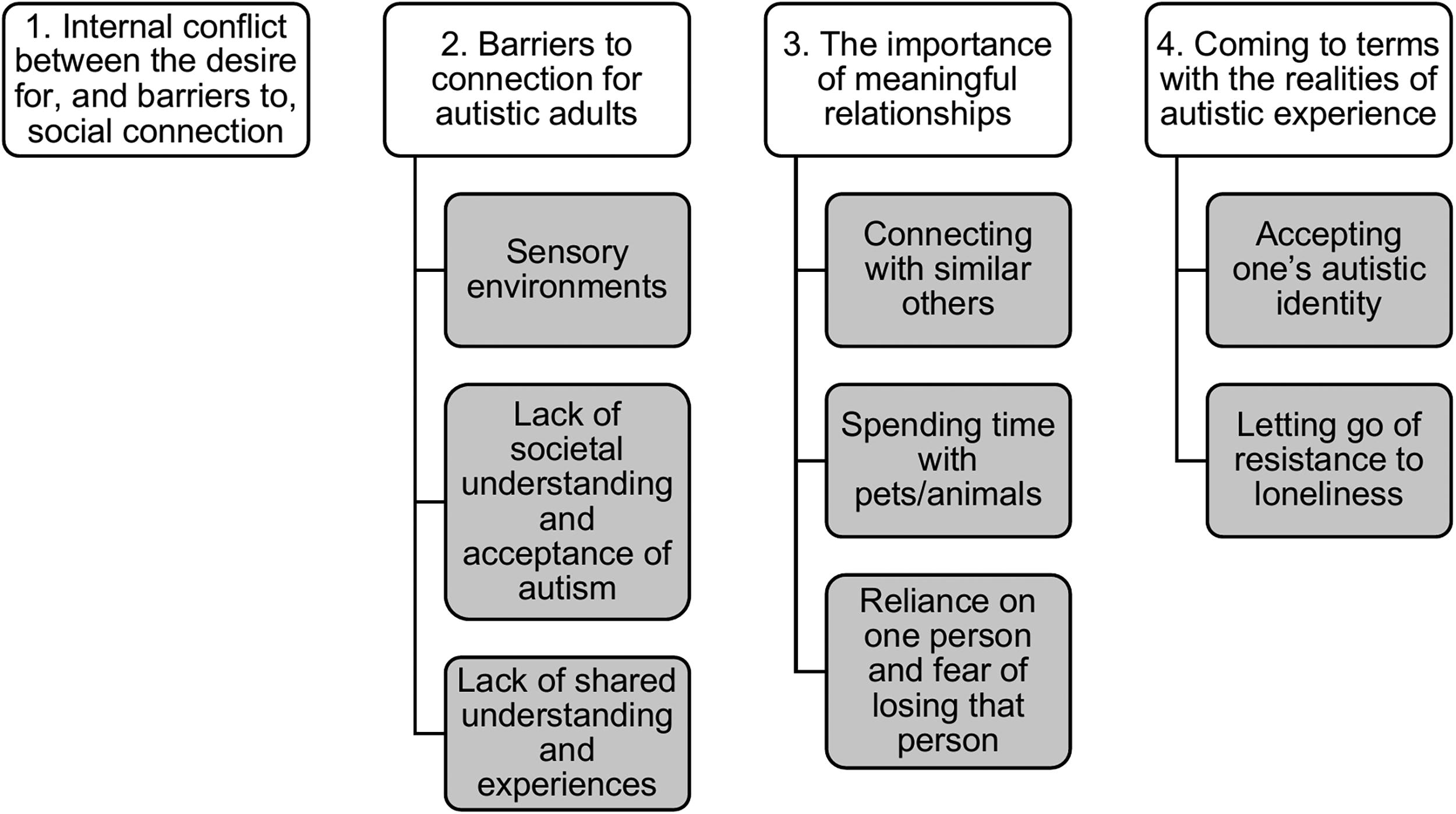
Thematic map.
Theme 1: Internal conflict between the desire for, and barriers to, social connection
Participants described an internal conflict between wanting to connect with others and finding social situations challenging: “we are trapped in a no-win situation: our condition means we get overwhelmed by people and sensory overload, and so we avoid, but then it leads to loneliness, and becomes a vicious circle” (Participant 34, henceforth P34, 46-year-old man). This sentiment was echoed by many, for example, a 57-year-old man stated: “Autistic people are in a double-bind: we find social interaction very difficult and exhausting, but at the same time crave contact with people that understand and identify with our experience. i.e. other autistic people” (P65). Likewise, a 47-year-old woman described struggles with social interactions as “mentally and physically exhausting: painful even” (P19). As a result, autistic adults reported often avoiding social situations in their attempt not to feel lonely. At the same time, they acknowledged that successful social interactions could yield the connection they desired:
Participants described aloneness as a choice, whereas loneliness was an unwanted feeling: “loneliness should not be confused with wanting to be alone and enjoying it” (P60, 59-year-old woman). P179 (19-year-old woman) described the borderline between the two: “[loneliness is] When being alone becomes a burden.” Sometimes, the desire for connection and desire for aloneness conflicted. Participants reported enjoying their own company but wanting some connection with others: “I am happy in my own company, but there are times I wish I had a friend or friend to share my interests with” (P152, 33-year-old woman). Sometimes, aloneness felt necessary to recover from the exhaustion from socializing: “sometimes a “reduction” in quantity is a good thing. I need to be alone quite a lot to recharge” (P28, 22-year-old woman). Participants reported feeling stuck and hopeless about the internal conflict they experienced: “need to socialise/have good friendships but also how social interactions exhaust us… this catch-22 can lead to loneliness” (P32, 23-year-old woman).
Theme 2: Barriers to connection for autistic adults
Autistic adults described various ways in which their longing for connection was difficult to satisfy. First, sensory environments in social situations made interactions difficult for autistic adults: “my severe sensory overload makes socialising stressful, tiring and physical draining” (P62, 56-year-old nonbinary person). Some adults directly linked their challenges with social situations to loneliness: “it [loneliness] is the lifelong failures and difficulties that I have had with making and keeping and managing relationships” (P2, 49-year-old woman). Second, a perceived lack of societal understanding and acceptance of autism made it difficult for autistic adults to feel connected with others:
“In my opinion, being Autistic is like being born in Autistic culture in a family (in my case) where everyone else experiences NT [neurotypical] culture. So you do have a culture, but its spread out and with no set land mass or country. So every day of my life is culture shock. And my culture isn’t respected, its disregarded and seems as a negative medical condition that people would rather not be there. That’s why I’m lonely” (P151, 24-year-old nonbinary person).
Participants explained that the lack of societal understanding and acceptance of autism not only served as a barrier to social connection but also contributed to their feelings of loneliness: “it is the neurotypical expectations that cause much of the loneliness and put up barriers. We need to feel accepted as we are and have the ‘normal’ expectations removed” (P156, 54-year-old woman).
Third, a perceived lack of shared understanding and experiences made it difficult for autistic adults to feel connected with others. For some, this meant feeling different from others: “Not fitting in. Things not clicking emotionally. Being on the outside. Being left out” (P150, 32-year-old woman). For others, it meant feeling not understood/misunderstood: “not feeling able to make contact because you don’t know how to make yourself or your needs understood” (P98, 35-year-old woman). Participants discussed feeling pressured to change themselves to fit to achieve connection with others, which felt lonely: “[I feel lonely when] I feel I have to hide who I am” (P83, 47-year-old woman). They also described feeling tired of having to be someone they are not to achieve connections with others: “The only way to eradicate loneliness is to change the world. I’m sick of people telling me I need to change who I am” (P176, 50-year-old man). Due to a lack of shared understanding between autistic and non-autistic people, autistic adults in this study reported experiencing a paradox where being with others could cause loneliness: “Sometimes I can feel lonelier in a group or a crowd, because I’m not fitting in” (P33, 25-year-old woman). Similarly, P96 (41-year-old woman) shared feeling most lonely “when I feel completely shunned from groups and misunderstood. When people assume I am happy not fitting in, like it suits me to be shunned. I feel isolated when there’s a group of people. That’s when I’m at my most lonely.” The lack of shared experiences made it challenging to feel connected when they had “few people with whom to share your experience of the world” (P65, 57-year-old man). Autistic adults emphasized that sharing experiences was the central part of having connection and commented on its absence: “having no-one who would be there for me in times of joy or in times of difficulty” (P40, 55-year-old woman).
Theme 3: The importance of meaningful relationships
Participants highlighted the importance of having meaningful relationships, which gave them a sense of emotional connectedness and access to people whom they could confide in when needed. Autistic adults emphasized that quality of relationships was more important than the quantity of relationships, stressing the importance of connecting with similar others: “[to cope with loneliness, I] try to go to a club of similar people e.g., a book group, political/environmental group, choir” (P121, 57-year-old woman). Participants reported seeking similar others through their shared interests and a shared autistic identity: “have connected with local autism peer support groups and hoping to find some likeminded people there” (P22, 27-year-old, nonbinary person). This connection was sometimes via social media: “being on social media and being parts of groups where people share experiences and I feel like I’m not the only one who feels like that any more” (P101, 34-year-old woman). Another way that autistic adults built meaningful connections was spending time with pets/animals: “autistic people in particular often get on better with animals than people so they aren’t a second best choice for us” (P184, 60-year-old woman). Participants told us that building these relationships made them less lonely: “I hug my dog or cat, it makes me feel loved and less lonely” (P56, 25-year-old woman). For some autistic adults, meaningful relationships centered on one other person, which emphasized their reliance on one person and fear of losing that person. While having quality relationships provided the connection autistic adults wanted, they also expressed concerns about what would happen when they lose their “one person”: “my mum is the only person I feel I can go to with a problem, but every day I worry about what I will do when she is no longer here” (P22, 27-year-old, nonbinary person). Autistic participants also reported feeling lonely when their “one person” was not available: “having problems with my husband i am lonely. Because he is to me the one and only. When he is not, then i have no one” (P107, 54-year-old woman).
Theme 4: Coming to terms with the realities of autistic experience
For some participants, accepting one’s autistic identity helped them to be “more secure in who I am…I feel less lonely, value alone time, and choose who I connect with more carefully” (P167, 38-year-old nonbinary person). Another participant explained: “I’ve tried for a long time to moderate my behaviours for others so not get rejected, and I’m a bit fed up of doing this as a strategy. I’d rather be alone but more accepting of my autism” (P193, 50-year-old woman).
For some, letting go of resistance to loneliness alleviated the loneliness itself: “I have accepted it is part of life for everyone, just to different degrees of importance” (P61, 67-year-old woman), “I have come to an accommodation with it, accepted it and as a result it is reduced” (P70, 51-year-old man). Accepting loneliness as something they could not change, also lessened feelings of loneliness: “I’ve reconciled myself to it [loneliness]. I don’t really see much prospect of my life getting any better or more fulfilling” (P53, 57-year-old man). Sometimes, acceptance of loneliness developed over time, and was linked to maturity: “It doesn’t make me as unhappy as it used to. I’m older and have less energy, so I’m much more content to be in my sofa on my own every Friday night!” (P7, 44-year-old woman), “I care less about being lonely as I get older” (P38, 40-year-old woman).
Discussion
Our results demonstrate that some autistic adults do desire social relationships with others but face multiple barriers to developing such relationships. These barriers included intolerable sensory environments, a lack of societal understanding and acceptance of autism, and a lack of shared understanding and experiences. Autistic adults appreciated meaningful contact that gave them a sense of emotional connectedness, and access to people who they could confide in when needed. They also reported achieving such relationships by connecting with similar others (e.g., via interest groups or autistic peer support groups) and spending time with pets/animals, thereby demonstrating the value of casual interactions as well as strong relationships with close individuals (although the latter coexisted with a fear of losing that person). Additionally, autistic adults explained that stepping back from social interactions and connecting with themselves helped them cope with the social world. Despite participants expressing a desire for social connections, they noted a tension between wanting to connect, finding it challenging, and needing time/space for themselves. We identified this internal conflict between the desire for and barriers to connection as an important theme in this study, leading autistic adults to experience feelings of helplessness. However, participants reported overcoming such feelings by fostering self-understanding and self-acceptance, or simply accepting loneliness as part of their autistic experience.
We noted several areas of overlap between our findings and those of previous studies,17,27 including (1) how autistic adults struggled to balance their desire for social connections with their limited energy, noting that refraining from social interactions does not necessarily mean they are unwilling to participate socially, (2) reports of feeling disconnected from others (e.g., feeling not fitting in, being not understood/misunderstood) with a lack of societal understanding/acceptance of autism thought to underpin loneliness, and (3) autistic adults recognizing several ways to alleviate loneliness, including connecting with significant/similar others and fostering an acceptance of autistic differences.
An apparent paradox within our findings related to autistic adults desiring social connections with others but equally avoiding social interactions due to exhaustion. This finding aligns with existing work 28 that reported how interacting with non-autistic friends and family members (but not with autistic counterparts) is tiring and negatively impacts autistic people’s ability to complete daily tasks. Such reports may link to autistic burnout, a severe form of exhaustion unique to autistic people. 29 Thus, our results emphasize how essential it is that autistic adults strike a balance between socializing and not socializing to avoid exhaustion while alleviating loneliness. One potential solution involves online support. Autistic adults may benefit from support provided online,30,31 reducing the energy spent on the stressors associated with in-person support (e.g., traveling, small talk). 30 Yet it is important to stress that—whether in person or online—non-autistic interaction partners can do much to accept and understand autistic people’s interaction preferences. 32
Autistic adults’ reported exhaustion from social interactions could also be explained by considering the mechanisms underpinning loneliness. A prominent theory of loneliness 33 explains that individuals who experience loneliness become hypervigilant to social threats, act negatively toward others, receive negative reactions from others, and feel increased loneliness. 33 Thus, a negative cycle develops.33-35 While this theory has not been directly tested with reference to autistic adults, it is possible that autistic processing styles (e.g., monotropism 36 ) intensify hypervigilance for social threats, making them more intense and distressing for autistic people. Here, based on our findings, and drawing on existing models of loneliness, 33 we propose the paradoxical loneliness loop to illustrate the discrepancy between the desires and realities faced by autistic adults (see Fig. 2).
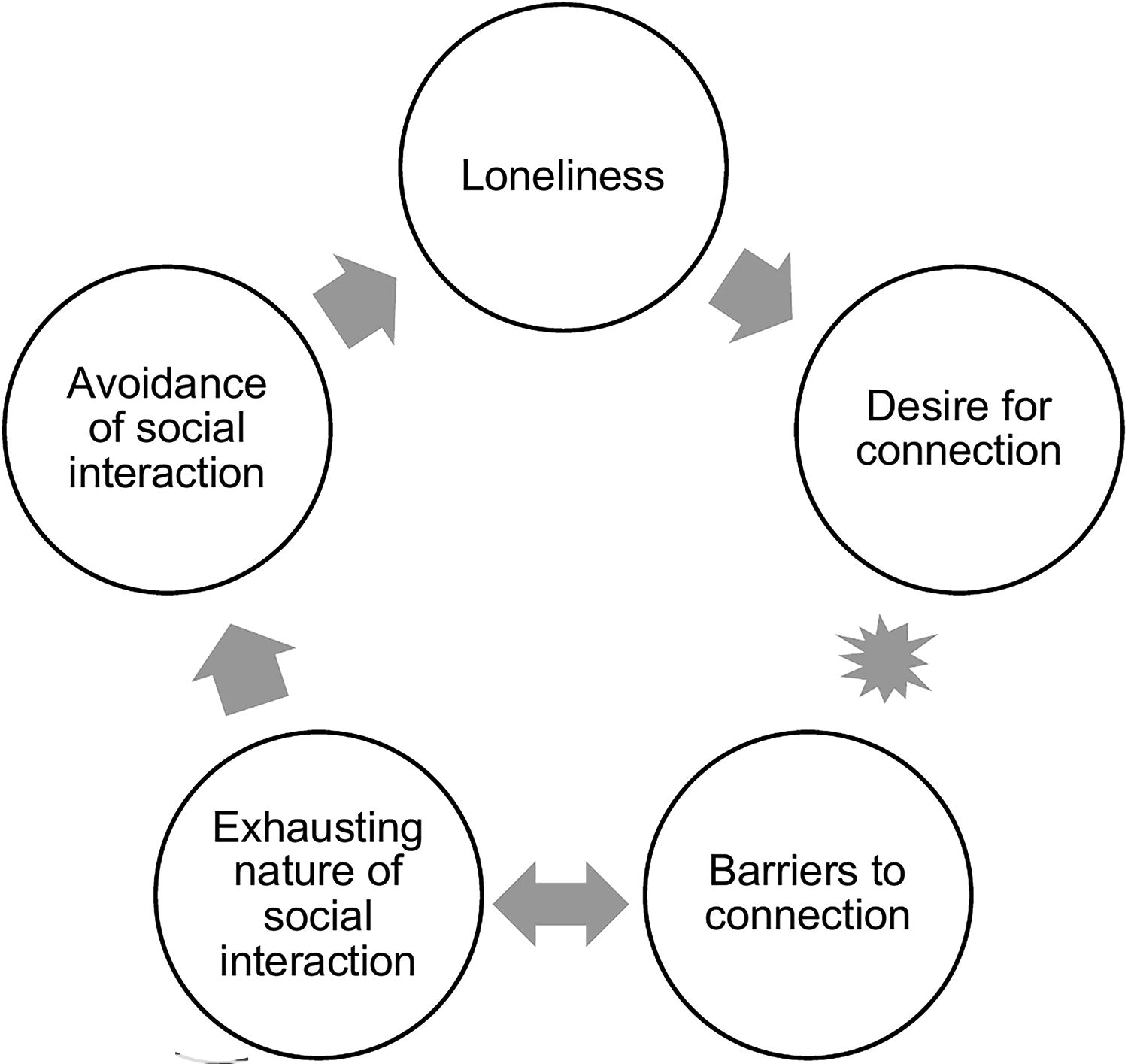
The paradoxical loneliness loop.
Relatedly, lonely individuals are thought to have a negative cognitive bias toward social information. This cognitive bias develops via four stages of social information processing 35 : encoding of cues, interpretation of cues, clarification of goals, and response access and decision. Again, while not directly tested with autistic participants, being autistic likely affects social information processing. For example, when interpreting social cues, the double-empathy problem 37 may make it challenging for autistic people to interpret others’ intentions and vice versa.
Another key insight from our results was that feelings of disconnection from others (e.g., not fitting in, not being understood) and a lack of societal understanding/acceptance of autism underpin loneliness.17,38,39 Disconnection from others has been reported as a factor linked to increased loneliness in other marginalized populations such as immigrants 40 and disabled individuals more broadly. 41 That barriers to social connections for autistic adults are not inherent within the autistic individual, but are linked to their social environments, suggests that solutions to autistic adults’ loneliness need non-autistic people’s cooperation, including community-focused solutions (e.g., shared interest groups) and societal solutions (e.g., greater understanding/acceptance of autism), alongside (or instead of) individual (e.g., counseling) or relationship-focused approaches (e.g., providing more social opportunities). 42 There also needs to be an acknowledgment that, for autistic individuals, incidental contact with acquaintances and strangers (“weak ties”) may yield important benefits, alongside stronger social connections with significant others (“close ties”). 43 Reflecting on the tensions articulated in our findings, those supporting autistic people should also remember that increasing social opportunities may not always solve loneliness in autistic adults, especially as the social world is often designed around the needs of non-autistic people. 28 It can take significant energy for autistic adults to engage in social interactions and sometimes such energy is unavailable after completing necessary daily tasks. 17
A further key insight from our results regards ways to alleviate loneliness, building upon quantitative 5 and preliminary qualitative 16 findings, which suggest that behavioral distraction (e.g., hobbies) and instrumental action (seeking social contact) were key strategies. First, we noted the importance of connecting with significant/similar others. While connecting with others who share similar interests is a long-standing social psychological phenomenon,44-46 and can form part of community-based services such as social prescribing, 47 this outcome also features in several recent studies on the benefit of autistic peer support48,49 as well as in studies examining the importance of interacting with other autistic people. Connecting with other autistic individuals fosters a sense of belonging and authenticity, which also proves crucial in “building resilience to manage day-to-day life, improving well-being, and as a source of happiness.” 28 It is not just about neurotype, however; non-autistic individuals’ acceptance of autistic people and their needs, as well as their inclusive approach to interactions, is important. When these factors exist, cross-neurotype relationships can thrive.32,50
Notably, self-acceptance of autistic differences also alleviated loneliness. This finding aligns with recent studies into psychoeducation for autistic adults. For example, an initial evaluation of “Exploring Being Autistic” 48 (a 10-week autistic-led program to help recently diagnosed/identified autistic adults to understand what being autistic meant to them) reported that autistic adults had positive responses to the autistic-led nature of the program, appreciated the diversities within the group and a sense of belonging it provided, and gained a more positive and practical understanding of autism (e.g., making sense of one’s challenges). These findings align with research showing that connecting with and accepting oneself, including one’s autistic identity, could reduce loneliness in autistic adults.15,39,51
Limitations
Our sample was a nonrepresentative group of autistic adults, characterized predominantly by White individuals, who were highly educated, used spoken language, and lived independently. Previous studies 52 acknowledge this selection bias, which commonly occurs in online autism research. While online surveys could offer a comfortable medium for participants less inclined to discuss sensitive topics such as loneliness in face-to-face settings, 53 it may also selectively reach autistic adults who are engaged in online autism communities and who find connection through such means. Finally, individuals tend to participate in survey studies on topics of personal interest. 54 As a result, our participants may have been those who were more aware of their experiences of loneliness and/or felt lonelier compared with the broader autistic population. We also acknowledge that with our survey method, no follow-up clarification was possible to confirm our understanding of the nuance underpinning participants’ responses. However, the large dataset and converging themes suggest validity of our interpretations.
Conclusion
This study offers language to describe a key autistic experience—internal conflict. This term may help autistic people to articulate their challenges not only in social contexts, but also across work, education, and daily life—where they may want to engage but find it difficult. It may also support clearer communication and shared understanding between autistic and non-autistic individuals. Based on our findings, future research and practice should recognize that loneliness in autistic adults involves more than just a lack of social connection. Instead of indiscriminately increasing social interactions, efforts should focus on the following: (1) Fostering acceptance of one’s own autistic differences, (2) encouraging autistic adults to strategically seek social opportunities with like-minded individuals, (3) implementing accommodations in social settings, such as adjusting sensory environments and offering online social opportunities, and (4) enhancing understanding and acceptance of autism among professionals and society more broadly. We hope that these findings contribute to a deeper understanding of loneliness in autistic adults, offer valuable insights for developing strategies to reduce loneliness in this population, and enhance the understanding of autistic individuals’ experiences from their own perspectives.
Footnotes
Acknowledgements
Authors’ Contributions
K.G.: Conceptualization, methodology, data curation, formal analysis, writing—original draft, writing—review and editing, and project administration. A.R.: Conceptualization, methodology, formal analysis, writing—review and editing, and supervision. L.C.: Conceptualization, methodology, formal analysis, writing—review and editing, and supervision. All authors have read and approved the final article. The article has been submitted solely to Autism in Adulthood.
Author Disclosure Statement
No competing financial interests exist. No specific funding was associated with the present study. Research at the Centre for Research in Autism and Education (CRAE) is supported by Pears Foundation.

References
Supplementary Material
Please find the following supplemental material available below.
For Open Access articles published under a Creative Commons License, all supplemental material carries the same license as the article it is associated with.
For non-Open Access articles published, all supplemental material carries a non-exclusive license, and permission requests for re-use of supplemental material or any part of supplemental material shall be sent directly to the copyright owner as specified in the copyright notice associated with the article.
