




Abstract
Many music therapy practices with autistic people have focused on intervention with autistic children. There are a growing number of studies reporting that many autistic adults experience loneliness and negative mental health outcomes. In Indonesia, support for autistic adults is complicated by the various understandings influenced by traditional and spiritual beliefs and limited acceptance of autism in the general public. Therefore, there is a need for psychosocial support for this age group in a format and style that suits their preferences and needs. This article describes the emerging practice of an online music group with six autistic young women aged 20–24 in Indonesia. This group met weekly for 12 weeks and was facilitated by a qualified music therapist. We identified four themes using reflexive thematic analysis, including “eagerness to connect,” “sharing music and life stories,” “being with people who accept and affirm autistic people,” and “entering a supportive autistic community.” Learnings from this emerging practice suggest that an online music group could support identity formation and solidarity by offering these autistic young women the opportunity to see themselves and become mirrors for their peers. The findings highlight the potential of facilitated online meetings for the autistic community, particularly young adults, to explore their identity and develop a sense of community.
Community Brief
Why was this program developed?
The use of music in and for therapy with autistic children has been widely recognized. However, little is known about how music groups could support autistic young adults, particularly in low- and middle-income regions such as Indonesia.
What does the program do?
We invited young autistic adults in Indonesia to participate in 12 weekly online music group sessions facilitated by a qualified music therapist. During the sessions, the facilitator collaborated with the participants to design the musical and nonmusical experiences they preferred to have and could benefit from.
How did researchers evaluate the program?
Six young autistic women (age 20–24) participated in this online music group. We conducted interviews and focus group discussions within the online group sessions. We also collected field notes and musical artifacts such as songs and lyrics. We analyzed the music, stories, and observations of group interactions captured during the meetings.
What were the early findings?
Themes from our thematic analysis help to explain the motivation of young autistic adults to participate in this online music group: “eagerness to connect,” “sharing music and life stories,” “being with people who accept and affirm autistic people,” and “entering a supportive autistic community.” The findings also reveal the young autistic women’s desire to meet other autistic peers and people who accept them. Through sharing stories and music in facilitated online music group sessions, they displayed their strengths and needs as they formed a supportive autistic community.
What were the weaknesses of this project?
Due to the recruitment challenge during the COVID-19 pandemic, we did not have nonspeaking and autistic young men. Most members of this group included speaking young autistic women who could identify themselves as autistic, had good internet connection, and went to higher education. Autistic young adults who required the presence of a parent or support worker to participate were also ineligible to attend the group sessions.
What are the next steps?
Participants expressed a desire to expand this group program by including autistic young adults from more diverse backgrounds and characteristics, and we would like to do this. We also would like to extend the program by preparing autistic adults to facilitate the sessions.
How will this work help autistic adults now or in the future?
This study may inform how music therapists could support autistic people in their adult life by creating a platform such as an online music group where young autistic adults could safely disclose and explore their autistic identity. It is essential to carefully consider how music therapists position themselves in relation to participants as an ally who respect and accept autistic individuals. The participants reported that the music group helped them identify their needs and highlight their strengths. Support groups using music may help young autistic adults in Indonesia improve their mental well-being by growing solidarity and creating an autistic community together.
Introduction
Music therapy with autistic people
Early medical descriptions of autistic people portrayed connections between music and autism.1–3 Musical inclination in autistic children has encouraged the use of music in therapeutic settings, highlighting its potential in understanding autism better. 4 Since the inception of the music therapy profession, music therapists have primarily focused on supporting autistic children following increasing autism diagnoses in early childhood. 5 The high demand for early interventions6–9 often centered on developing social, emotional, and communication skills.5,10,11 Music therapists support autistic people in various settings, including schools,12,13 family homes,14,15 hospitals, 16 clinics,10,17 and in the community.18,19 Despite the growing demand for music therapy, research has primarily focused on autistic children. Meanwhile, how music therapy could support autistic adults remains underexplored.
Within the limited number of studies with autistic adults, Community Music Therapy (CoMT) approaches 20 are often featured. Stige 21 described CoMT as a health musicking practice in a community that relies on the collaboration between the therapist and participants to promote a change in the society. CoMT approaches, such as community-oriented sensory friendly concerts for autistic people and families 18 and singing groups for autistic adults, 22 aimed to improve autistic people’s well-being. These projects call attention to promoting greater awareness and inclusion as relevant social outcomes in music therapy and autism research.
The broader use of music in social and cultural places23,24 has promoted the understanding of music as a powerful medium for change when people interact with it. In Tucker’s ethnography study in Indonesia, 25 a gamelan group (an Indonesian traditional music ensemble, primarily featuring percussive instruments) comprising autistic students allowed its autistic members to address their sensory needs while amplifying their strengths. The interactive and collaborative processes of playing gamelan resulted in positive social experiences for autistic and non-autistic people, contributing to the development of the school community. Thus, this kind of community music practice may increase participation opportunities for autistic people and shift non-autistic people’s perspectives beyond the notions of symptom reduction in the medical model. 26
The growing acceptance of autism as neurological differences has influenced music therapists’ ways of understanding and working with autistic participants. 27 Consequently, recent music therapy research has attempted to understand what participants perceived as personally meaningful in music therapy.28,29 For example, music therapy participants did not necessarily attend sessions to improve their communication skills, but rather to cultivate their musical interests, personal growth, and meaningful relationships. 29 Similarly, music therapists 30 explored various ways autistic women use music in their everyday lives, rather than for specific therapeutic goals. These initiatives underscore the need for more collaborative research with autistic participants to identify their priorities. We share a similar ethos in this emerging practice.
Situating autism in Indonesia
At the time of this study, Indonesia had an estimated 2.4 million autistic people, 31 although many may remain undiagnosed due to limited diagnostic methods and training, 32 as also observed in other low- and middle-income countries (LMICs). The predominantly medical model in Indonesia views autism as a disorder. 25 The lack of information about autism beyond the medical model in Bahasa Indonesia may contribute to a societal knowledge gap and perpetuate stigma toward autistic people. 33 In addition, various cultural and religious beliefs consider divine plan, karma, or breaching traditional restrictions during pregnancy as possible causes of autism. 34 Disperse understandings of autism stemming from these beliefs may result in varied approaches and types of support, interventions, and services that do not necessarily prioritize autistic people’s well-being and personal goals.
Despite the ratified United Nations Convention on the Rights of Persons with Disability in 2011, the evidence supporting practical application of antidiscriminatory practice in Indonesia is limited. 35 Indonesia’s strong collectivist values that encourage people to conform to established social norms may hinder societal acceptance 36 and individual views of autism promoted by autistic advocates with firsthand experiences. 37 Single attempts by young autistic advocates to introduce a contemporary definition of autism were unsustainable due to the seeming lack of interest in self-advocacy among Indonesian autistic individuals. 38 Claims by some autistic youths of their cure despite the recognition of autism as a lifelong condition illustrated the inconsistencies and tension in viewing autism in Indonesia. 39 Therefore, this study aimed to foreground the voices and lived experiences of Indonesian autistic young adults.
Emerging practice
A collectivist society such as Indonesia often considers family and community groups the primary social support. A highly valued cultural concept, gotong royong (translated as “working together”), reflects the importance of community collaboration in achieving goals. Meanwhile, senasib sepenanggungan (“being in the same boat”) conveys the significance of having a sense of solidarity within a relatable group. With this collective belief and action in the heart of Indonesian society, working in groups aligns with these commonly held cultural values.
In this emerging practice, we conducted the sessions online to comply with social distancing measures during the COVID-19 pandemic, considering both participants’ and researchers’ physical safety. Autistic people and their families have benefited from telehealth and recognized its equivalence to in-person delivery, 40 especially during the COVID-19 pandemic. 41 Although online music therapy with autistic people had been trialed long before the COVID-19 pandemic and showed some positive outcomes in the participant’s engagement and social interaction, 42 online services had received little prior attention.
Incorporating music in group programs can offer various inter- and intrapersonal benefits. Music therapists Davies and Richards 43 suggest that people often come to group therapy because they feel isolated from the world. Group music therapy can benefit its members by working as a team, bringing joy and pleasure, making participants excited about their recognized creativity, and invoking a sense of pride in their creative output. 44 As loneliness in young autistic adults has been associated with serious mental health problems, 45 providing a facilitated group involving activities that are enjoyable and familiar, such as music listening and playing, could potentially support their well-being. Having a facilitator who could help structure and organize the sessions may help participants feel heard and safe to open up, especially in the early phase, when participants do not know each other yet and have often experienced exclusion in their previous social interactions. We applied this rationale to our program, with the intention to support Indonesian autistic people in accessing music as a form of expression in a neuro-affirming and nonjudgmental environment.
Evaluation Methods
Ethics
Ethics approval was provided by the overseeing institution, The University of Melbourne Human Ethics Advisory Group (Ethics ID: 2057139.1). We obtained written consent from all participants. Utilizing purposeful sampling,46,47 we contacted organizations and community groups that potentially accommodate autistic young adults in Indonesia. We also advertised the project on social media and reached out to potential participants identified from websites or online communities. Several parents of autistic young adults contacted us and expressed their interest in participating with their offspring. However, in respecting the autistic adults’ firsthand perspectives and autonomy, we required our participants to attend the sessions without their parents/carers.
Participants
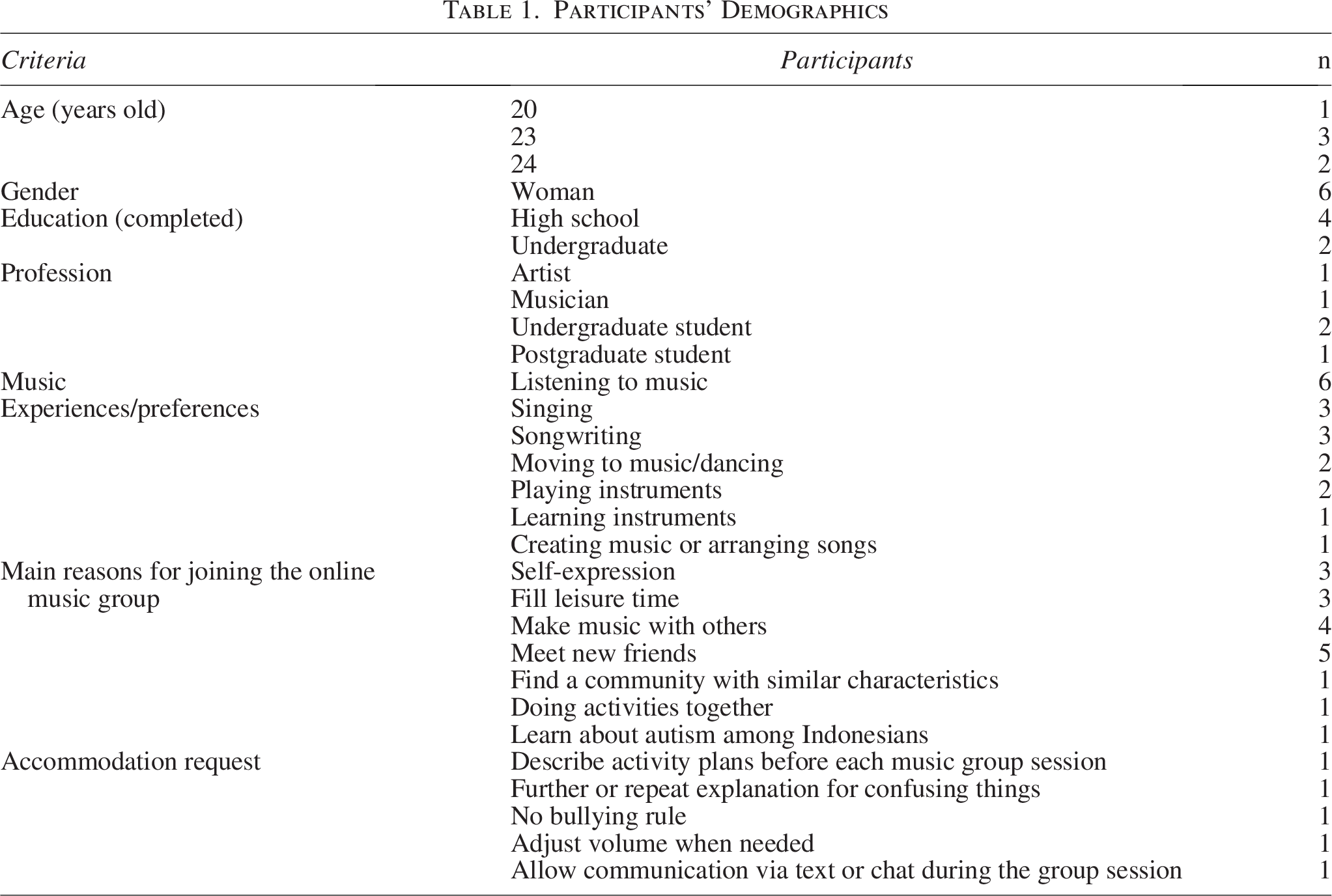
We invited Indonesian young adults aged 18–25 years who either had a diagnosis of autism or self-identified as autistic and were interested in participating in an online music group to join the research project. Although we did not exclude autistic men in the recruitment, six autistic young adults who identified as women aged 20–24 volunteered to participate in the sessions. After receiving participants’ expression of interest and consent to participate in our project, we initiated a conversation by sending them a set of preliminary questions on demography, musical profile, reasons for participation, and specific needs. Subsequently, we contacted each person to introduce them to the project and research process. The key demographic data for the six participants are presented in Table 1. Four participants chose to use their real first names, and two selected pseudonyms for the reporting of research. Therefore, we have not linked names to the data in Table 1 to protect privacy.
Participants’ Demographics
The online music sessions
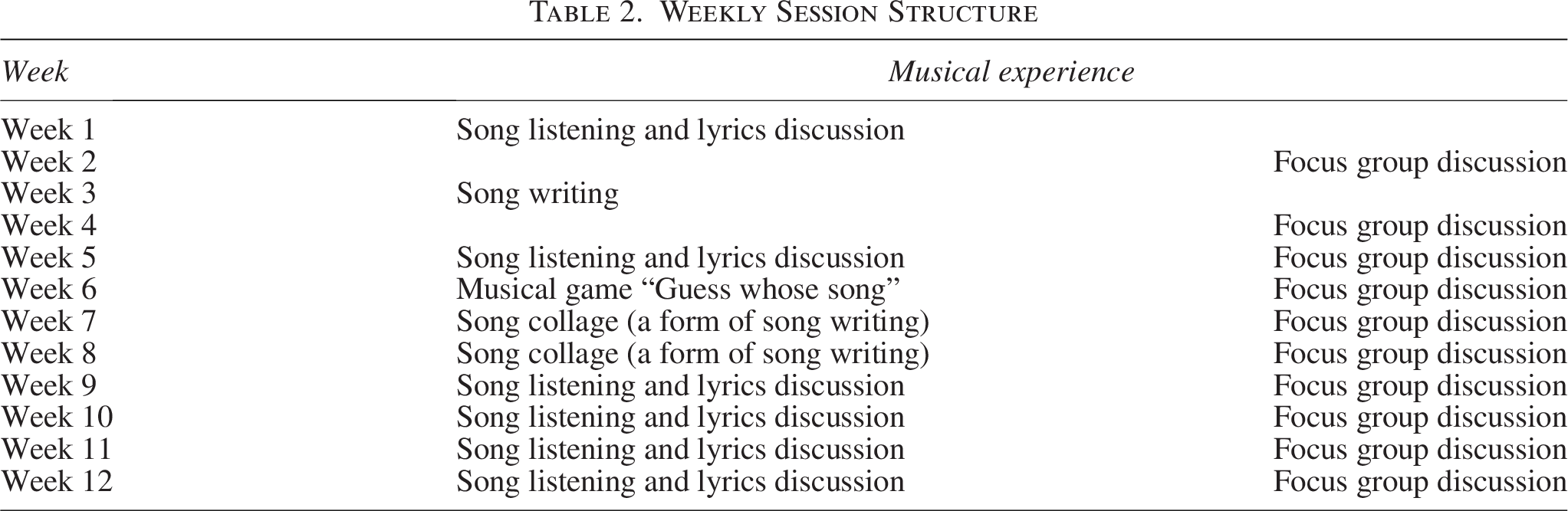
An introductory session for the participants to meet took place in December 2020, followed by 12 music group sessions that took place from January to April 2021, as described in Table 2. Each session lasted for 1.5 hours. The first author, a qualified Indonesian music therapist with experience working with autistic people, facilitated musical experiences (music listening followed by lyrics discussion, group songwriting, and musical games). The facilitator codesigned the weekly sessions with the group, referring to the participant’s selections from the proposed list of musical activities and ideas emerging during the group planning. We present a sample of session structure in the Supplementary Data. Although the facilitator initially introduced a structured format, subsequent sessions evolved into a more flexible form in response to the group’s preferences.
Weekly Session Structure
Data collection and analysis
The conception of this collaborative project draws inspiration from the neurodiversity paradigm. The research team took a constructivist approach to data collection and analysis to acknowledge each participants’ unique experience. 47 Our team comprised four women: an Indonesian non-autistic PhD researcher and qualified music therapist who was the group facilitator; two Australian non-autistic music therapy researchers as supervisors; and an Australian autistic researcher as an advisor. The autistic researcher offered guidance on how to work with autistic individuals and design appropriate questions and strategies. The team viewed the first author’s facilitator–researcher role as a positive factor in the design because it could contribute deep reflections about data collection and analysis processes.
The first author conducted weekly focus group discussions within the music group sessions to co-construct meaning and experience with the participants. She also collected field notes and musical artifacts such as songs and lyrics. At the end of the program, the first author invited the participants for individual interviews. Before the interview, the first author shared a coding summary of the focus group discussions for each participant to read, review, comment on, and make amendments based on their judgment.
We adopted Braun et al.’s 48 six-step thematic analysis process to analyze the data, as it offered a structured and reflexive way to construct meanings and develop understanding of the autistic culture presented by the participants. The steps included the following: Familiarizing ourselves with data, coding, constructing the themes, reviewing themes, defining themes, and creating a report. To start familiarizing with the data, the first author (an Indonesian native speaker) transcribed and translated the focus group discussions and interviews from Bahasa Indonesia into English. The team acknowledged the importance of translating the data into English to facilitate comprehension by the non-Indonesian-speaking researchers during the analysis phase. Guided by the last author, the first author began initial coding of the focus groups’ discussions immediately following data collection, utilizing the research software program NVivo. Furthermore, she continued with focused coding to consolidate implicit meanings and make them become more visible. The first author next created candidate themes from focused coding and constructed them during ongoing supervision meetings with the last author while continuing to explore the possible directions of inquiry. The research team workshopped and reviewed the initial themes, and then revisited each theme to refine its label and achieve clarity. Finally, the research team developed a summative statement from the themes for reporting. The first author communicated the analysis progress with the autistic advisor throughout the process.
Results and Lessons Learned
In this emerging practice, we discovered the young autistic women’s eagerness to participate in the weekly online music group sessions through their active engagement and near-full weekly attendance. Each week the group discussed and planned what musical experience they would like to try together in the subsequent week. Their sharing, in the form of music and stories, portrayed their longing for an autistic community in which they could support each other. Through this sharing process, they learned to know their autistic selves better and foster a sense of pride in their identity. We present below the four themes and their related subthemes from the qualitative analysis, along with exemplary quotes from the participants.
Theme one: Eagerness to connect
These six autistic women expressed their eagerness to join the group, primarily because they wanted to meet other autistic peers. They were curious about other autistic people’s experiences living in Indonesia. They considered their shared experiences and familiarity with the autistic cultures as resources that drew them together in this group. We elaborate three related subthemes identified within this theme below.
Shared understanding of being autistic
Most participants believed that the fact that they all are autistic helped them understand each other’s life experiences despite their differences in traits, diagnosis, and views on autism. All participants’ self-identification as autistic people might have naturally created an initial sense of trust that fostered sharing their life experiences in the group, as Nana described: “I could share easily my experiences with autism with members of this group because we already know what the real problems with autism are like” (Nana). Unlike their interactions with non-autistic people, they had more confidence in their autistic peers, “I feel more comfortable with autistic peers because we learn to understand and be patient with each other… Neurotypical [non-autistic] people would say ‘weird’ but autistic peers may understand better” (Fai).
Previous experiences in social interaction
The participants revealed to the group various autism-related adverse experiences in their social lives, which contributed to difficulties in communicating issues and feelings. Indy reflected, “Talking about these matters is actually quite sensitive. Sometimes I am still not sure how to convey or articulate my experiences. It’s basically very vulnerable. So that’s why I feel nervous” (Indy). Sasori encapsulated her typical social experiences and contrasted them with her experience with this facilitated group:
“This (session) is good, it has a structure, so it’s like knowing what to do. Socialising in real life is very loose, it’s so unclear, basically there’s no guideline, right? Everything is up to us. Whereas here is like we already know, then if we are quiet or there is silence, [the facilitator’s name] will look for more prompts to guide, so no one is silent awkwardness.”
Focusing on the group coherence
Group coherence seemed to be a focal point for the participants. Instead of focusing on their individual preference for a certain group experience, most emphasized creating group unity and harmony. For example, when Sasori noticed the shifting group dynamics over different musical experiences, she would rather prioritize the group’s inclination:
“I observed that the (participants’) level of interest varied. For those who are not interested, it may be a shame because they often ‘zoned out.’ Perhaps the social aspect is stronger in the guessing game and sharing about each other’s favourite songs because it is more personal, playful, and equal for everyone.”
Theme two: Sharing music and life stories
These young women indicated that sharing music and life stories was the most meaningful experience in the group sessions, stating, “In this group we focus on sharing; discussing while making music, but the core is in the sharing” (Indy). Another member described, “Sometimes I think it’s like a sharing session but it’s good to discuss song lyrics because in the end, it becomes a sharing session” (Nana). We describe below five subthemes within this theme.
Bringing the participants’ current states to awareness
The participants’ interpretation of song lyrics shared within the group often seemed to correspond with their personal situation or issues they were thinking about, which they described as mirroring “the things that are really bugging my mind” (Indy). The women appeared to utilize the song lyrics to explore their current thoughts, such as associating the lyrics with their own life experiences as discovering “sometimes the lyrics have something to do with ourselves” (Nana). Some of the song elements, such as the beat, speed, or style, also seemed to help the participants’ express their feelings while becoming more aware and connected to their emotions.
Bridge to emotions and minds
The participants described how they used music to convey their emotions to the group. Personal experiences the participants shared through and alongside the musical sharing might represent what they felt, as exemplified, “If there is a difficulty in expressing emotions, especially for people who do not know each other yet, music can help there… music can be an expression of emotions… For example, the tune that shows enthusiasm” (Nana). The emotions that expressed through song lyrics or other elements of music then might help them convey their thoughts verbally.
Relating to other participants’ characteristics
Participants described how they were able to connect their experience to others in the group. Identifying others’ sentiments toward someone’s experience seemed to provide a stepping stone for the participants to get to know each other. Indy reflected on others’ responses toward her shared poem:
“I think it’s also fascinating that although it was originally a very personal expression, it can be quite relatable to others. That’s nice but also sad because apparently many people also face these issues. But when I listened to others during the [song] writing process, when I heard others said, ‘oh yeah, this one is relatable…,’ that kind of makes me ponder but also makes me more connected, perhaps. Oh, yes, (I am) not alone.”
Associating songs with group members’ identities
Recognizing and being recognized by others seemed to be equally rewarding for the women. For example, Shinta described how during the musical game “Guess whose song,” “It makes me happy because if they can guess my song, it means they know me” (Shinta). When their peers correctly guessed who had selected the song, participants described their joy at being acknowledged and seemed to mutually grow a sense of confidence while getting to know each other.
Starting point into deep discussions
The participants reflected that sharing music could serve as a starting point into deep group discussions:
“Music could support the discussion, as in offering something that can be discussed. For example, talking about togetherness, the one where we wrote a song in the middle session, where we picked lyrics from other songs… so we know how each other feels” (Nana).
At times, the participants realized that the intensity in their shared music somehow led into deeper conversations and created meaningful moments. Indy expressed, “The songs in our sessions tend to be orchestral, trance, like very personal ones. Personal, about oneself, about home, about belonging.” Furthermore, she reflected, “Perhaps that’s why we use music, so it would be easier for us to share because otherwise I don’t know where to start.”
Theme three: Being with people who accept and affirm autistic people
This theme encapsulates what these young autistic women sought while participating in this online music group: acceptance and affirmation for their experiences as autistic people. Interactions with both peers and the facilitator were considered important to the participants. The following subthemes convey the aspects in the group action and interaction that seem to afford and nurture positive participation in the sessions.
Empathizing with autistic people
Most participants were open to non-autistic people joining the group in the future, as long as “those (non-autistic people) who really can accept us” (Nana) and “not biased toward autism conditions” (Nana). Despite agreeing that being with other autistic people made them feel safer and more accepted, they welcomed a non-autistic group facilitator who positioned herself as an ally of autistic people and showed acceptance, as reflected by a participant, “I think you empathise with the position. I don’t feel of being judged” (Indy).
Showing interest in autistic cultures
Autism and its related features were the main topics of conversation that engaged the young women and seemed to foster positive interaction in the sessions. The members appreciated the facilitator’s enthusiasm for discussing issues that matter to them, as conveyed by Indy, “I think I’m actually very happy that there are non-autistic people who are interested in the issue, the neurodiversity issue.” The women deemed that the conversations within the group sessions were rare opportunities, given the stigma around autism and the lack of knowledge about neurodiversity in the Indonesian society.
Encouraging participants to talk
Some participants conveyed their desire to contribute to daily conversations in everyday life, but described how their challenges in finding words often made them hesitant to talk. Lala confessed, “I myself have the potential to be talkative. I want to be chatty but don’t seem to know what to say, what is the precise word,” an occasion that was shared by Fai. Lala later noted that the encouragement she received in this online group contrasted with her daily experience being discouraged from talking, highlighting that her potential was often overlooked due to her different communication style.
Facilitating conversation flow
The participants described how the facilitator not only reassured them to speak in their preferred language but also encouraged them to contribute to the discussion by choosing their most comfortable mode of communication. The facilitator also considered the hectic household environment in such a densely populated city in which most participants live and join the Zoom session from. Distractions during the group session, such as parents’ immediate request to help with household chores, were sometimes inevitable. The participants appreciated the facilitator’s support in helping them focus on the conversation, as described by Lala: “I think it’s useful for like a third party to drive the conversation to a desired direction.”
Theme 4: Entering a supportive autistic community
This theme represents the young women’s perceived benefits of meeting regularly as a group. By interacting with their autistic peers in this group, they seemed to reconsider and start to reshape their autistic identities. We elaborated the related subthemes below.
Needed peer support group
Most participants perceived this online music group as a form of support group,
“In the past, I used to discuss autism only with (my) psychologists because I rarely could discuss it anywhere else… This is like my first support group. So, it feels like a mix, there is joy, there is also curiosity” (Nana).
The participants expressed the need for this kind of support group for autistic people, especially those self-diagnosed and feeling ambivalent about their identity, “I think a lot of people actually question if they are autistic or not. Or maybe they used to be treated for autism, but they (thought they) are cured. Those kinds of questions” (Indy).
Understanding autistic selves better
The group’s constant acknowledgment of each member’s shared experiences seemed to encourage them to continue to reflect on, review, and reconsider their self-image and attitudes. Sasori contemplated how the group’s positive interactions fostered a personal change within herself,
“After attending these meetings, I’ve spent more time thinking, redefining myself, reconnecting with myself. Because so far, I have rarely done self-introspection. (I) always focused on external things. So, it’s like feeling like meeting a new person, that new person is myself. Then I also feel like this is the whole new world. Because it’s like being really listened to, not being judged, then people are welcome. I saw the expression on the group members’ face one by one. There’s no one feeling uncomfortable, thinking that you’re weird.”
Alleviated loneliness
Some participants described discovering shared experiences and the opportunities to talk to peers in the group as alleviating their loneliness. They revealed the absence of peers in their everyday life: “All of this time I never had people I could discuss about these matters with, so I don’t feel alone” (Indy), while others described fantasizing about public figures they could not meet in person as a coping strategy against loneliness. As such, the participants seemed to value the real and mutual interactions that occurred within this group.
Reaffirmed sense of selves
The women reflected on their identities and longing for a society that accepts them as they are. During a collaborative song writing activity entitled “New mirrors for people like us” (see Supplementary Data for lyrics), the concept of “new mirrors” emerged, suggesting each group member’s contribution as an accepting and reflecting “mirror” for others. Along with this developing group connection, the participants seemed to grow a more positive self-identity.
Growing pride
During another song writing activity, the women collectively chose a theme about “encouragement” and “do not give up” in response to their struggles. They selected lyrics from existing songs that matched the chosen theme, and the facilitator helped bring the material together to form a new song. As the participants offered and negotiated the musical elements they would incorporate into the song, the facilitator observed the participants’ emerging sense of group identity they could be proud of. The song title, “Anthem in my heart,” seemed to convey the participants’ growing pride and commitment to partake in this caring community (see Supplementary Data for lyrics).
Discussion
This emerging practice ran during the COVID-19 pandemic. While we originally designed an online method to minimize physical contact, meeting online seemed to be a suitable approach for these autistic young adults due to their communication preferences, familiarity with internet culture, and technological savvy. This finding aligned with broader autism research that describes how autistic people enjoy connecting via internet for social reasons.36,49 Similarly, most autistic women in this project relied on the internet to seek information around autism. Their motivation to connect with other Indonesian autistic individuals seemed to be fueled by various adverse experiences as autistic people. Meanwhile, the only-women participation in this group may reflect the often-overlooked presence of autistic women in Indonesia.
Findings from the reflexive thematic analysis suggest that most participants considered the facilitated sessions to be a support group incorporating musical experiences to connect with other autistic young adults. Echoing findings from studies by Thompson et al. 50 and Low et al., 29 most participants in our study were motivated to join the music group to connect with autistic peers. Venter et al. 51 described music listening as a means for autistic adults in their study to find connection. Kirby and Burland 52 also reported that being involved in shared experiences and sharing similarities in musical preferences helped young autistic people develop interpersonal relationships. Although these rules seemed to apply to the autistic women in this project, they also showed great tolerance in accommodating others’ different music tastes. These findings underscore the young autistic women’s need to socialize with their peers, 53 a similar need found in other young adults, and how facilitated group musical experiences may provide an avenue to attend to this need.
The women in this group were keen to meet other autistic adults because their desire to hear about others’ experiences rarely met with the autism-focused social opportunities in their community. The mix of medical understanding and various traditional beliefs of autism often perpetuates stigma around Indonesian autistic people. 34 Meanwhile, difficulty accessing support services can be a barrier to mental health services faced by Indonesian people. 54 The infrequent avenues for meeting with autistic peers seemed to contribute to their experience of minority stress, a state that has been previously reported among autistic adults in general. 55 Sharing various aspects of autism, including their existing stressors and how they dealt with them, appeared to help them understand how others perceived and navigated the challenges.
Reflections from this emerging practice also accentuate the need for support services that are relevant to autistic adults in a specific cultural setting. Although viewing autism as an integral part of themselves, most of these Indonesian women felt urged to comply with the more widely accepted norms. They wished to attend social behavior classes to understand better and navigate themselves in the non-autistic world. Their appropriation, despite the sense of oppression, may have stemmed from peer pressure and their rooted collectivistic value. Shalit et al. 30 reported a similar conflict with the women in their study who would assign different music according to where they use music. Despite the shifting gender roles in modern days, obedience remains prominent among Indonesian women. 56 This underscores the importance of adopting a culturally sensitive approach when facilitating support groups in collectivistic and patriarchal communities, where resilience may be conceptualized differently and harmony remains highly valued.
In this online music group, the facilitator attempted to create an open and nonjudgmental atmosphere by encouraging the young women to use their preferred communication methods and styles. In contrast to feeling misunderstood and ostracized in daily social life, the group’s verbal, text-based, and musical interactions appeared to help the women express themselves more fully. This snippet affirms that autistic people have expressed their desire to be included and valued in society. 57 Supporting these women in discussing topics that excited them in enjoyable ways demonstrated the non-autistic facilitator’s intention to attune to their needs. This aligns with autistic music therapists’ suggestion for a neuro-affirming music therapy practice that prioritizes autistic people’s needs and experiences.58,59 Echoing Low and colleagues, 29 our finding also challenges the assumption that autistic people participate in music therapy to improve their social communication skills.
The practice of sharing music and life stories in this online music group can contribute positively to their autistic identity and a developing sense of community. In the Indonesian context, the word “sharing” is often associated with telling others about a story or experience. 60 While most participants explained that they would disclose their autism in some appropriate contexts, some of them described their reluctance to be themselves as to prevent further exclusion by their peers, which echoes what is described in the literature on autism and camouflage. 61 When they shared stories and music with their autistic peers in this group, however, they felt more confident that they will be understood. Therefore, meeting as an autistic-only group may be a safer way for autistic young adults to open up and create a supportive community.
During the online music sessions, the women also explored their personal strengths and resources. They worked collaboratively, focusing on their contribution and achievement in the group. Within the lyrics of the songs they wrote together, the women expressed a refusal to be viewed as merely a list of deficits despite acknowledging autism as a disability (see Song Lyrics in Supplementary Data). This finding supports Brownlow and O’Dell 62 who found that joining an online community platform could encourage autistic people to familiarize themselves with the positive characteristics of autism and embrace their unique traits. As proposed by Cooper et al., 63 nurturing this social identification process could improve autistic people’s collective self-esteem and subsequently support their personal self-esteem. Discussing the various aspects of being an autistic identity in this online music group may have been a meaningful way for them to explore, validate, reconnect with, and affirm their sense of autistic identity. 63
Limitations and potential challenges
While unintentional, only speaking autistic young adults volunteered for this research, which was presumably due to the limited presence of nonspeaking autistic people in the social media platforms that the authors accessed to recruit participants. Along with the emergence of autistic-led online community groups following the COVID-19 pandemic, we recommend that future researchers collaborate with autistic people who have a greater diversity of resources and modes of expression, including those who use augmentative and alternative communication.
The participants mostly came from relatively well-resourced families with good internet connectivity and access to education, which may not reflect those in smaller towns and remote areas. Limited diagnostic resources and differing perceptions of autism could hinder recruitment. Therefore, we suggest alternative ways to negotiate autism diagnosis as eligibility criteria, such as encouraging candidates who identify themselves as autistic people, to participate.
The participants’ access to music and previous musical experiences seemed to shape their decision to join the group. A participant was prohibited to access music for religious reasons. The Islamic society often deem music as a distraction from devotion to God and therefore forbids it. 64 Although most of these women had grown up with music and engaged in various musical activities with families in their everyday lives, inequitable access to music may influence how participants use and benefit from music.
Planning for future practice
The participants’ preferences for group sessions may reflect their stage as young adults. While this online music group was limited to autistic individuals for the purposes of the research, the participants hoped to invite more people to join any future programs and were open to non-autistic people who accept autism. Following this project, similar group sessions continued, with some additional autistic young adults joining the program for another 6 months. We are planning to collaborate with a local autistic community group and resume a similar music group in the future.
Since music evidently supported the participants’ interpersonal sharing process in this project, incorporating music experiences in other group programs may support self-awareness and foster interactions among autistic peers in a casual, friendly, and safe way. Some autistic women’s observed shift toward a more positive view of autism likely indicates that participating in groups such as these may provide opportunities for participants to learn from other autistic peers’ experiences and promote confidence in self-advocacy as they navigate themselves in the world often shaped by non-autistic perspectives.
This emerging practice may offer useful insights for music therapists on adopting a collaborative role with autistic young adults. Careful consideration of how music therapists position themselves as an ally who respects and accepts autistic individuals is essential for these young women. By highlighting the participants’ strengths and prioritizing their self-identified needs, this program could expand current music therapy practice that adopts a more socially centered model and focuses on the autistic people’s well-being.
Our findings suggest that music therapists and other community care service providers in Indonesia could give more attention to the mental health of autistic adults and advocate for the community’s well-being. Music support groups could be a venue where the participants’ self-identified need for community well-being is addressed and acknowledged. Stories shared by the autistic women in this group reflect that their engagement in camouflaging and compensatory behaviors may place them at increased risk of mental ill health. We propose community care can contribute to these women’s self-care. However, due to the complexity of local cultural and religious beliefs, it is also essential for service providers to consider local environments and adapt their practice to respond to issues relevant to the local culture.
Conclusion
This article highlights the importance of providing social support for young autistic women in Indonesia through a medium that they are comfortable and familiar with. The emerging practice indicates the potential value of using musical forms of expression to assist autistic young people to explore their autistic identity in a peer-group setting facilitated by a qualified music therapist. To the best of our knowledge, this is the first study that reveals the way music can support the sharing of life stories of young autistic women in a society where collectivism highly influences social interaction in everyday lives. In addition to the predominant medical viewpoint of autism, cultural and religious views can also lead to stigma and discrimination. Through their stories aided by music sharing, the women revealed their longing for acceptance and hope for a supportive autistic community.
This emerging practice also accentuates the importance of group facilitators who show a genuine allyship with autistic people while supporting the group process. Together with the facilitator, the women navigated sensitive topics related to being autistic individuals in Indonesia and the impact of negative perceptions and interactions with non-autistic people. While meeting other autistic young people with similar experiences may have supported these women to explore their identity, an open and accepting facilitator could support the continuity of conversations and the sharing process. Therefore, we consider that facilitated music support groups offer a potentially positive approach in working with autistic people.
Autistic women’s needs and strengths may be hidden or overlooked due to the presence of dominant medical narratives or the focus on uniformity in collectivist cultures. Therefore, acknowledging autistic people’s needs and strengths in a safe space could foster deeper self-awareness, which may lead to greater understanding of their authentic selves. Reflections from this emerging practice support the potential for similar group programs to be considered a culturally relevant music therapy practice, particularly in regions with societal cultures similar to Indonesia.
Footnotes
Authorship Confirmation Statement
M.S. wrote the initial draft of the article. G.T., L.B., and S.M.H. provided feedback, guidance, and edits throughout the first draft and revision process. All authors have reviewed and approved this article submission. This article has been submitted solely to Autism in Adulthood and is not published, in press, or submitted elsewhere.
Supplemental Material
References
Supplementary Material
Please find the following supplemental material available below.
For Open Access articles published under a Creative Commons License, all supplemental material carries the same license as the article it is associated with.
For non-Open Access articles published, all supplemental material carries a non-exclusive license, and permission requests for re-use of supplemental material or any part of supplemental material shall be sent directly to the copyright owner as specified in the copyright notice associated with the article.
