




Abstract
Background:
Media is central in shaping social evaluations of different human groups. Despite prevailing media portrayals harboring detrimental stereotypes of autism, autistic people actively use media as an accessible space for connection, advocacy, and community. Autistic people tend to resonate more with autistic peers, whereas non-autistic people form less favorable impressions of autistic people. No study has directly examined autistic and non-autistic people’s social evaluations of media content produced by autistic people or about autistic lived experiences. Here, we examined neurotype-dependent social evaluation using a novel, ecologically valid task.
Methods:
We compiled autistic-content and non-autistic-content videos from publicly available interviews, vlogs, reality TV, and documentaries. An advisory board of five autistic members vetted the clips. We presented these videos to 73 autistic and 223 non-autistic adults recruited from Prolific. Participants rated and interpreted the videos on three dimensions of social evaluation: connectedness (relatedness, identification), content clarity (understanding of the video), and valanced judgments (enjoyment, discomfort, friendliness, awkwardness). We used mixed factorial analysis of variance to examine differences in ratings by video conditions and participant neurotypes. We examined participants’ video interpretations using reflexive thematic and content analyses, complemented by a generalized linear mixed model to compare group differences quantitatively.
Results:
Autistic and non-autistic adults reported greater relatedness, identification, and understanding of video contents matching their own neurotypes. Autistic adults also reported greater enjoyment and friendliness of autistic-content videos than non-autistic-content videos. Open-text interpretations showed neurotype-dependent patterns: non-autistic adults evaluated autistic-content videos more negatively, while both groups related more to neurotype-matched videos and expressed non-relatedness to mismatched ones.
Conclusions:
These findings highlight the importance of recognizing neurotype-associated differences in evaluating and interpreting media. These differences may arise from divergent social expectations and experiences. They also suggest online spaces may support autistic sociality and well-being.
Community Brief
Why is this an important issue?
Media shapes how people see and understand each other. Many wrongly characterize autistic people as uninterested in social life, yet autistic people use media to connect, advocate, and build community. Research shows autistic and non-autistic people may view the same content differently, with autistic people connecting more to autistic content and non-autistic people forming more negative impressions of autistic people. Researchers need to study how both groups evaluate autistic-content and non-autistic-content media.
What was the purpose of this study?
We examined how autistic and non-autistic adults evaluate videos created by autistic and non-autistic people.
What did the researchers do?
We first collected publicly available videos featuring autistic people and non-autistic people. Five autistic people reviewed and approved the video clips. We then showed the videos to autistic and non-autistic adults. Participants rated how much they connected (relatedness, identification) with the people in the video, how clear the content was (understanding), and their feelings (enjoyment, friendliness, awkwardness, discomfort) toward the videos and people in them. Participants also provided written video interpretations.
What were the results and conclusions of the study?
Both autistic and non-autistic adults understood, related to, and identified with video contents that matched their neurotype (in other words, their type of thinking, understanding, and information processing, such as autistic or non-autistic) more than mismatched ones. Autistic adults also enjoyed autistic-content videos more than non-autistic-content videos and found them more friendly. In the written interpretations, both autistic and non-autistic adults described more specific instances of relatedness to videos that matched their neurotype and perceived videos that did not match their groups more negatively.
What is new or controversial about these findings?
We created a new social evaluation task to examine how autistic and non-autistic adults view media content produced by members of their own and the other neurotype. When watching videos created by autistic and non-autistic individuals, participants connected more with the experiences of people of their own neurotype and viewed them more positively. These findings demonstrate different patterns of engagement with social videos, which may reflect broader differences in social preferences, norms, and expectations between autistic and non-autistic people.
What are potential weaknesses in the study?
The study relies on participants’ self-reports, which may reflect participants’ tendencies to respond in politically correct ways. Differences between videos that we could not fully account for, such as topic, lighting, race, ethnicity, or settings, may influence how participants evaluate them. Participants knew whether the videos included autistic or non-autistic content, which could influence their responses through in-group favoritism.
How will these findings help autistic adults now or in the future?
These findings show that autistic and non-autistic people evaluate media differently. This helps us understand how autistic and non-autistic people experience, connect, and engage with the social world. This perspective shifts focus from individual deficits to differences, informing more inclusive research. The results also suggest that online spaces may be especially helpful for supporting autistic adults’ connection and well-being.
Background
Day-to-day media consumption and creation play a crucial role in social understanding, opinion formation, and decision-making in modern life.1,2 Contrary to historic mischaracterizations of autistic people as lacking social interest, 3 autistic individuals actively engage with media contents, including social media. Their social media use is associated with having closer and higher-quality friendships.4–6 Social media may be particularly valuable to autistic people as an accessible medium of social interaction, community building, information source, and self-help,4,7–11 especially through modern media formats that enable autistic self-presentations (e.g., TikTok and YouTube). Online spaces curated by autistic people for autistic people may thus provide a unique opportunity to experience easily accessible environments where autistic differences are treated as the norm.11,12 Such autistic-made media reflects lived experiences authentically. 13 Meanwhile, media produced predominantly by non-autistic creators routinely influences the general public’s perception of autistic people, substantially contributing to the formation of stereotypes.14–16 Prevailing media portrayals of autistic people are often stigmatizing, 17 which correspond to the increased negative impressions non-autistic people form of autistic compared with non-autistic others.18,19 In contrast, positive and inclusive media representation may help reduce the harmful stigma autistic people face in clinical, professional, educational, and personal settings.20,21 So far, no study has directly examined how autistic and non-autistic individuals evaluate media contents produced by or specifically about autistic people’s daily experiences. Given the importance of media in shaping modern social evaluations of autistic people in potentially positive or detrimental ways, it is critical to enrich our understanding of how autistic and non-autistic audiences evaluate ecologically valid (i.e., reflecting real-world conditions or situations) media contents featuring autistic versus non-autistic lived experiences, interactions, and behaviors.
Experimental findings on social evaluation and impression formation across neurotypes (i.e., the developmental neurocognitive profile that signals how a group tends to process information and behave, e.g., autistic and non-autistic 22 ) demonstrate meaningful differences. These differences appear in social values, norms, and preferences across dimensions of connectedness, clarity (i.e., how clearly information is understood), and valanced judgments (i.e., positive or negative evaluations).18,23–25 Autistic people respond with stronger connectedness, including identification (i.e., seeing themselves in others’ experiences) and empathic relatedness (i.e., feeling a shared sense of belonging or understanding), to autistic-like characters.24,26,27 Furthermore, some autistic-autistic interacting dyads report greater rapport; more accurate information transfer, and clearer communication,23,28–30 more positively valanced judgments (in terms of enjoyment, ease, success, friendliness, and awkwardness ratings)23,30; and more rewarding interactions compared with mixed-neurotype dyads. However, findings regarding rapport and information transfer are mixed and influenced by awareness of neurotype.31,32 Meanwhile, non-autistic people are more likely to form negative first impressions of autistic people, are less motivated to initiate interactions with autistic peers, and are less able to recognize autistic emotional expressions.18,33–35 While both autistic and non-autistic participants rate videos of autistic people completing structured tasks less favorably than non-autistic videos, this does not reduce autistic participants’ interest in potential interaction.19,36 Taken together, emerging evidence suggests that autistic and non-autistic people may hold different social preferences and thus differentially evaluate individuals of the same versus different neurotype in terms of connectedness, communicative clarity, and valanced judgments. These social evaluation patterns identified in structured lab settings might extend to real-world media contents, although no systematic investigation has tested this.
Differences in how autistic and non-autistic people experience social reality may shape their social evaluations of media contents,12,23,24,37,38 stemming from dispositional differences in cognition, communication styles, expectations, and preferences.12,37,38 Theoretical frameworks such as the dialectical misattunement hypothesis 39 and the double empathy problem theory 40 postulate that autistic and non-autistic people possess different social worldviews, which accumulate from reciprocal misalignment across developmental social experiences. This disjuncture can shape differing ways of perceiving, interpreting, and expressing social information.41–43 Some autistic people may thus develop a different set of social norms and predictions, including a preference for direct and literal communication and a high tolerance for parallel dialogue.12,38,44–46 While these may be appropriate within autistic contexts, non-autistic people may evaluate them negatively. 47 Autistic adults may also value certain social attributes differently from non-autistic adults. For example, autistic adults are more likely to perceive awkwardness of oneself and of others as positive or neutral rather than negative. 25 Therefore, autistic people may prefer and find it easier to be in autistic social spaces, including within the digitized media world, due to shared social realities and norms, even when these norms are seen as awkward and negative by neurotypical others.25,47 However, these experiences may also depend on other individual traits and support needs, considering the heterogeneity in autism. 48 Given the significance of media to autistic people and their potentially different social realities, the media world poses an underexplored but meaningful space of expressions of neurodivergence that necessitates further empirical investigation and understanding, particularly into how autistic and non-autistic media contents are experienced and evaluated by autistic versus non-autistic individuals.
Understanding autistic sociality requires context-rich stimuli that reflect autistic people’s everyday worlds. Historically, autistic people have often been characterized as deficient in social abilities, which may further contribute to stigma, harm, and discrimination.20,21,49 Contemporary researchers and autistic advocates have been increasingly highlighting the importance of considering social contexts and autistic perspectives to improve research equity and ecological validity.50–52 Similarly, social evaluation is best understood within contexts that reflect autistic individuals’ own social worlds. 3 Social impressions and evaluations in everyday settings arise from multiple sources of cues (e.g., prosody, facial movement, gaze, pacing, and context). 53 Meanwhile, tightly controlled lab-made stimuli can strip away this ecological complexity, which contributes to neurotype-specific differences in social evaluation. Nevertheless, no study has included social stimuli produced by autistic (versus non-autistic) people embedded in autistic (versus non-autistic) social spaces outside of the lab. Given its real-world impacts and significance, media stimuli enable us to study how autistic and non-autistic people evaluate social contents adhering to ecologically valid norms and communication styles more typical of their own versus others’ neurotype.
Current study
In this study, we investigated autistic and non-autistic adults’ social evaluation of ecologically valid, real-world media contents of autistic and non-autistic people from popular media sites. We asked them to rate and interpret the videos on felt connectedness (i.e., relatedness and identification; Komeda et al. 27 ), perceived content clarity (i.e., understanding; adapted from Crompton et al. 23 ) of the videos, and valanced judgments (i.e., enjoyment, friendliness, awkwardness, discomfort; Crompton et al. 23 ). We predicted that autistic individuals would report greater connectedness to and content clarity of autistic-content compared with non-autistic-content videos.23,27,29,30 We also expected that they would judge the former more positively and less negatively than the latter. 23 Conversely, non-autistic people would connect more to, experience greater content clarity of, and judge non-autistic-content videos more positively and less negatively compared with autistic-content videos.18,23,27
Method
Participants
The Department of Psychology Ethics Review Committee at the Faculty of Arts and Science, University of Toronto, granted ethics approval for this study. We recruited participants through Prolific (https://app.prolific.com; which enables individuals to participate in web-based research for monetary compensation) and directed them to Qualtrics for the study. Participants earned on average 6.33 Great British Pounds (GBP)/hour (depending on individual completion time, approximately 2 hours). Using the Prolific filter for self-reported autism by potential participants, we recruited 100 autistic adults from a US and Canada sex-balanced sample and 300 general-population adults from a representative US general-population sample (stratified across sex, ethnicity, and age to be proportionate to the US population distributions 54 ). We excluded 82 participants: 17 due to incomplete responses (e.g., not watching all the videos or providing incoherent responses) or technical issues, 2 due to unknown identification numbers, 4 due to duplicated identification numbers, and 59 from both the autistic and general-population groups due to not clearly identifying as autistic or non-autistic after identifying as “Maybe autistic—suspicious but not diagnosed” or not responding to the autism diagnosis question on Qualtrics. Other options included self-diagnosis as autistic, diagnosis in childhood, and diagnosis in adulthood, all of which we grouped as autistic participants; those who responded “no” we considered non-autistic participants.
The final sample comprising participants with complete rating data included 73 autistic adults (Mage 33.92 years, SD 12.23, range 20–66; 69.86% European/White; 27 male/man, 27 female/women, 18 gender-diverse, one preferred not to say) and 223 non-autistic adults (Mage 47.48 years, SD 14.98, range 19–82; 64.57% European/White; 114 male/man, 107 woman/female, 2 preferred not to say). See Table 1 for demographic distributions.
Demographics
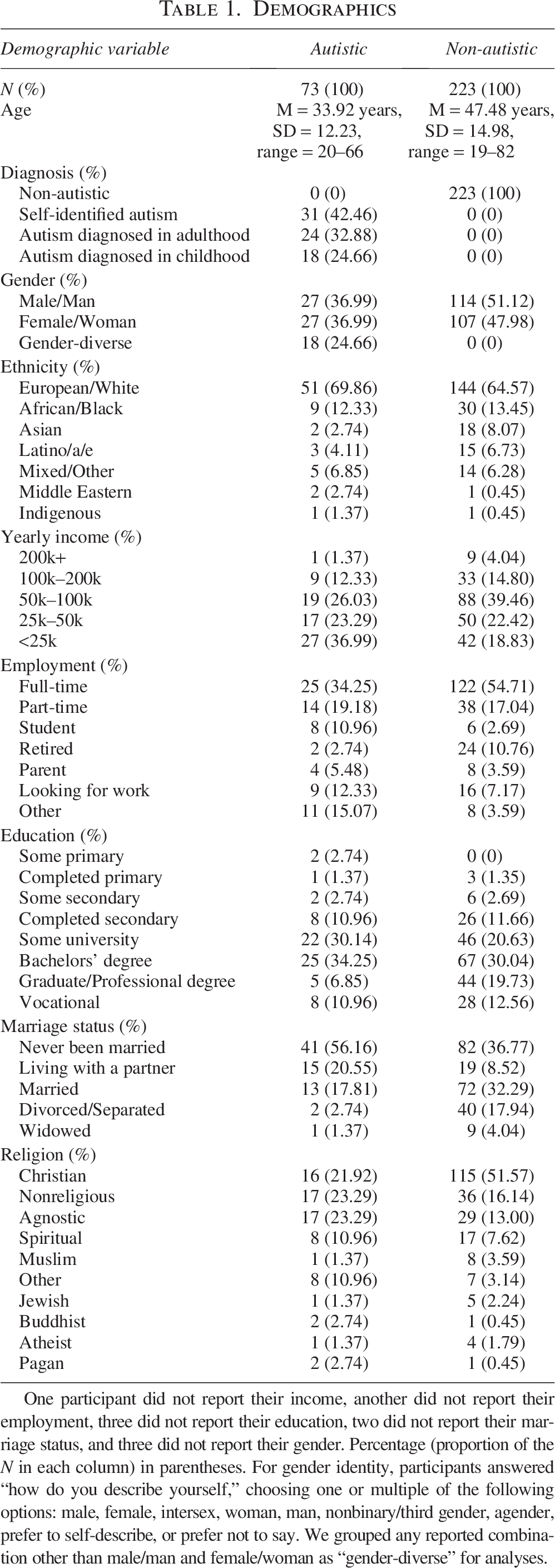
One participant did not report their income, another did not report their employment, three did not report their education, two did not report their marriage status, and three did not report their gender. Percentage (proportion of the N in each column) in parentheses. For gender identity, participants answered “how do you describe yourself,” choosing one or multiple of the following options: male, female, intersex, woman, man, nonbinary/third gender, agender, prefer to self-describe, or prefer not to say. We grouped any reported combination other than male/man and female/woman as “gender-diverse” for analyses.
Stimuli
We compiled neurotype-specific media video clips from TikTok and YouTube that reflect the social perspectives, experiences, and behaviors of autistic and non-autistic people. For autistic-content videos, we chose creators who self-identified as autistic and videos described as featuring autistic people. For non-autistic-content videos, we selected videos of people who did not identify as autistic, and they did not feature autistic people. The selection did not target specific topics but excluded informational videos about autism (e.g., autistic creators primarily explaining what autism is rather than describing their own personal experiences). Whether individuals were autistic or not was explicit from monologues and interactions based on explicit mentions of autism in some of the autistic-content videos. The researchers (autistic and non-autistic) vetted these videos first to be genuine, minimally performative, minimally scripted, and with few visual hindrances (e.g., added illustrations, filters, or stickers). Then, an advisory board of five autistic members further vetted the videos. They met with the researchers across six 1-hour group meetings over 4 months. One advisor did not provide their demographic information; of the four other advisors (age range 23–36 years), two identified as cisgender men and two identified as cisgender women; three were White and one was Asian, and all completed postsecondary education programs. Advisors received 20 Canadian dollars (CAD)/hour for their time (6.4 hours commitment on average). They advised on whether the stimuli were appropriate, easy, and comfortable to follow and did not misrepresent the autism community or reinforce stereotypes. We modified the compilations accordingly. While not all advisors agreed that each video represents their own experience, they deemed the videos to be authentic and inoffensive representations of autistic individuals.
The final compilations used in this study had two conditions (i.e., autistic-content and non-autistic-content, titled accordingly), each including three video subsets: (1) interviews and monologues (henceforth monologues), (2) dyadic conversations and dating interactions (henceforth interactions), and (3) behavior recordings and child–caregiver interactions (henceforth observations). We compiled autistic-content videos first and matched non-autistic-content videos to these in duration. We endeavored to match the demographics of the depicted individuals (by age, sex, gender, race, ethnicity, and sexuality) and topics of discussion, although non-autistic individuals rarely discussed their experiences specifically as non-autistic people. The length of the two video conditions totaled approximately 47 minutes (see Supplementary Fig. S1 for breakdown).
Measures
The autistic advisory board also reviewed the following video-watching response items for item clarity, participant burden, and acceptability.
Video-watching responses
Participants provided seven quantitative ratings for each of the three video subsets for each video-content condition, with one question for each of the following: relatedness, identification, understanding, enjoyment, friendliness, awkwardness, and discomfort (based on Crompton et al. 23 and Komeda et al. 27 ) using a 5-point Likert scale (1, not at all; 5, very much so). Participants also answered five interpretation questions for every subset of each social-content video condition. They described the videos and what the narrators were trying to relay, their enjoyment/liking of the videos, discomforting/upsetting parts, friendliness, awkwardness, relatability of people in the videos, and whether they were able to connect or identify with people in the videos (see Supplementary Data).
Procedure
On Qualtrics, all participants provided informed consent to the study, read instructions, confirmed whether they identify as autistic, reported demographic information, and proceeded to watching the video stimuli. Participants viewed all video clips in a fixed order, first the autistic-content videos, then the non-autistic-content videos. Immediately after each of the three video subsets (i.e., monologues, interactions, and observations) in each video condition, participants provided quantitative ratings and answered open-response interpretations of the video subset. After viewing and responding to all videos, participants completed the individual trait measures. Finally, participants read the debriefing.
Data analyses
Ratings analyses
We used R (version 4.3.2) for quantitative data analysis. 55 For analyses of video ratings, we calculated an aggregate score for each rating question across video subsets, such that there was one sum score per video-content condition. For example, we aggregated participants’ felt relatedness ratings for the autistic monologues, interactions, and observations video clips into one “relatedness score” for the autistic-content video condition. In addition, we z-score standardized total scores for video ratings prior to analyses to make sure the variable distributions were relative to the same benchmark, enabling group comparisons and clearer interpretation of effects. We checked assumptions of data distribution and found no evidence of multicollinearity as variance inflation factor (VIF) values were <3 for all continuous variables. We confirmed normality of residuals through visual inspection of density and Q–Q plots, detected no skewness in any variables (<1 or >1), and used correlation scatterplots of all analyzed variables to confirm linearity.
We examined group differences in ratings of different neurotype-associated video contents. Our main analyses used 2 between (participant neurotype: autistic vs. non-autistic) by 2 within (video content: autistic-content vs. non-autistic-content) mixed analysis of variance (ANOVA) models to analyze differences in ratings of relatedness, identification, understanding, friendliness, enjoyment, awkwardness, and discomfort. We focused the results and interpretation on significant interactions between participant neurotype and video-content type and on the consequent post hoc simple effects. We used the Benjamini–Hochberg method to correct p-values for main effects and interactions and separately for post hoc simple effects (false discovery rate [FDR] at 0.05).
We further examined group differences in key demographic variables to assist with the planning of sensitivity analyses. A Welch two-sample t-test indicated that autistic participants were significantly younger than non-autistic participants, t(148.47) = −7.76, p < 0.001. Accordingly, we added participant age as a nuisance covariate in the ANOVAs to account for its variability between neurotypes as a sensitivity analysis to confirm if the findings of the main analyses hold. Further, a chi-squared test of independence did not find a significant association between autism status and ethnicity, χ2 (6, N = 296) = 6.788, p = 0.341; Fisher’s exact test confirmed this result (p = 0.297). There was a significant association between autism status and gender, χ2 (2, N = 293) = 58.903, p < 0.001; Fisher’s exact test confirmed this result (p < 0.001). However, when gender-diverse participants (only present in the autistic group) were excluded, there were no significant differences in the number of male/men and female/women participants between the autistic and non-autistic groups, χ2 (1, N = 275) = 0.003, p = 0.955. We therefore did not conduct a sensitivity analysis with gender as a nuisance covariate given that no non-autistic participant identified as gender-diverse, which precluded model estimation.
Although our main analysis was to examine overarching cross-neurotype media evaluation, we also assessed whether video subsets showed any moderating effects. We further conducted 2 (participant neurotype: autistic vs. non-autistic) by 2 (video content: autistic-content vs. non-autistic-content) by 3 (video subset: monologues vs. interactions vs. observations) mixed-ANOVAs with post hoc pairwise comparisons to assess any significant three-way interactions particularly for ratings that had significant two-way interactions in our main analyses. Such a three-way interaction would indicate that video subset moderates the participant neurotype by video-content neurotype interaction, our focus of investigation, and requires interpreting findings separately by video subset.
Lastly, since autistic participants included both self-identified and clinically diagnosed autistic adults, we conducted a subsidiary analysis using mixed-ANOVAs with a 2 (participant neurotype: self-identified autistic vs. clinically diagnosed autistic) by 2 (video content: autistic-content vs. non-autistic-content) design to examine differences in ratings of relatedness, identification, understanding, friendliness, enjoyment, awkwardness, and discomfort, to confirm the appropriateness of grouping self-identified and clinically diagnosed autistic adults in our main analyses.
Recommendations based on an empirically derived effect size distribution suggest that Cohen’s d of 0.15, 0.36, and 0.65 be interpreted as small, medium, and large effects for studies in social psychology. 56
Interpretations analyses
Two authors (one autistic and one non-autistic) used a combination of a reflexive thematic analysis57,58 and content analysis59,60 to code the participants’ open-text responses. These analyses aimed to synthesize and interpret participants’ experiences and perceptions of the neurotype-associated video contents. We adopted a reflexive thematic analysis57,58 to acknowledge the researchers’ subjectivities and assumptions in the construction of meaning from participant responses. We began with data familiarization, generating initial codes, and reflectively extracting overarching themes from the codes. Then, we recoded the data iteratively and assigned final codes and themes, resolving disagreements through discussion between the coders. We organized themes into domains. Lastly, we employed a frequency analysis from a content analysis framework.59,60 To examine group-level differences in the frequency of code occurrence by participant neurotype and video-content type, we applied a generalized linear mixed model (GLMM) using logistic regression with random effects to account for individual variability. This mixed-methods approach combining qualitative and quantitative insights synthesizes the nuances of open-text responses with meaningful interpretation of group differences in the frequency of identified codes.
Results
Interactions of individual neurotype and video ratings
The mixed-ANOVAs identified five significant two-way (i.e., participant neurotype by video content) interactions in relatedness (p < 0.001, partial η2 (η2p) = 0.266), identification (p < 0.001, η2p = 0.339), understanding (p = 0.001, η2p = 0.043), enjoyment (p = 0.001, η2p = 0.046), and friendliness (p = 0.001, η2p = 0.044; for detailed statistics see Supplementary Tables S1.1 and S1.2). We report here only the post hoc pairwise effects from significant interactions (Fig. 1). Autistic adults reported greater relatedness to (p < 0.001, absolute Cohen’s d = 1.166) and identification with (p < 0.001, d = 1.396) autistic-content videos than non-autistic-content videos, with large effect sizes. They also reported greater understanding (p = 0.002, d = 0.433), enjoyment (p = 0.002, d = 0.341), and friendliness (p = 0.003, d = 0.391) of autistic-content videos than non-autistic-content videos, with small to moderate effect sizes. Non-autistic adults reported greater relatedness to (p < 0.001, d = 0.364) and identification with (p < 0.001, d = 0.452) non-autistic-content videos than autistic-content videos, with moderate effect sizes. Interestingly, non-autistic adults did not report different understanding, enjoyment, or friendliness of non-autistic-content videos compared with autistic-content videos. Ratings for awkwardness or discomfort showed no significant two-way interactions. Moreover, sensitivity analyses further including age as a covariate did not change the pattern of significant interactions reported above.
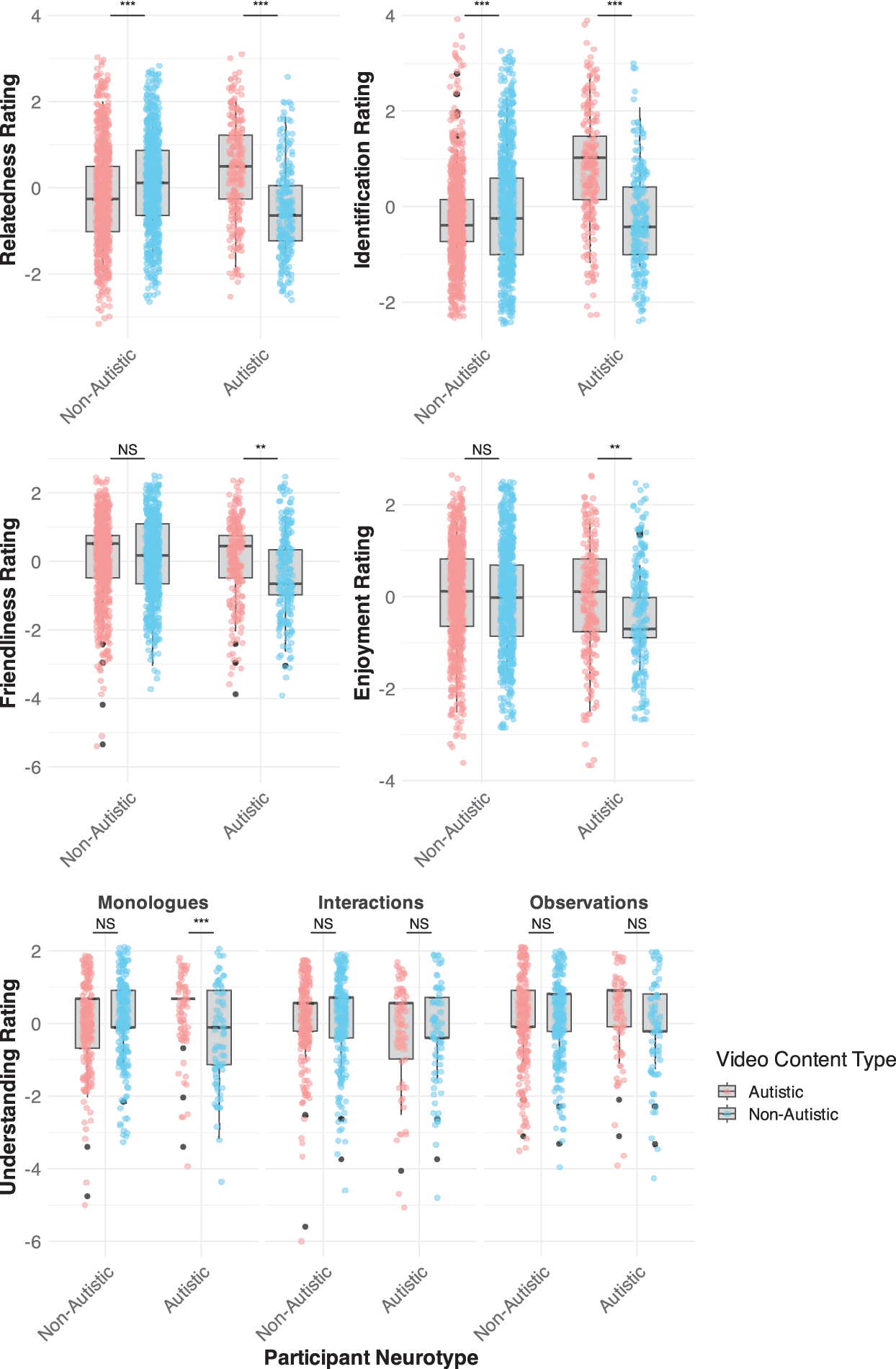
Group differences for significant interactions in ratings of autistic-content and non-autistic-content videos by participant neurotype. NS stands for nonsignificant statistical difference, corresponding to p > 0.05 (corrected using the Benjamini–Hochberg method). For understanding, the three-way interaction of participant neurotype, video content, and video subset is illustrated. ***p < 0.001; **p < 0.01; *p < 0.05.
The additional three-way mixed-ANOVAs involving video subsets echoed the main analyses regarding significant participant neurotype by video-content interactions on the ratings. We found only one significant three-way interaction for understanding (p = 0.001, η2p = 0.027). Autistic adults’ evaluation of the monologues subset seemed to drive differences in their understanding of autistic-content versus non-autistic-content videos (p < 0.001, d = 0.665), where autistic participants understood monologues of their own neurotype better than non-autistic monologues, with a large effect size (for detailed statistics see Supplementary Tables S2.1 and S2.2). Similarly, the significance pattern of interactions remained the same in the sensitivity analyses further including age as a covariate.
In examining differences between self-identified and clinically diagnosed autistic participants, there were no significant main effects of participant neurotype and no interactions between participant neurotype and video-content neurotype across all ratings (all p-values >0.05). These findings indicate that self-identified and clinically diagnosed autistic participants responded similarly, supporting our decision to combine these groups in the main analyses reported above.
Open-text interpretations
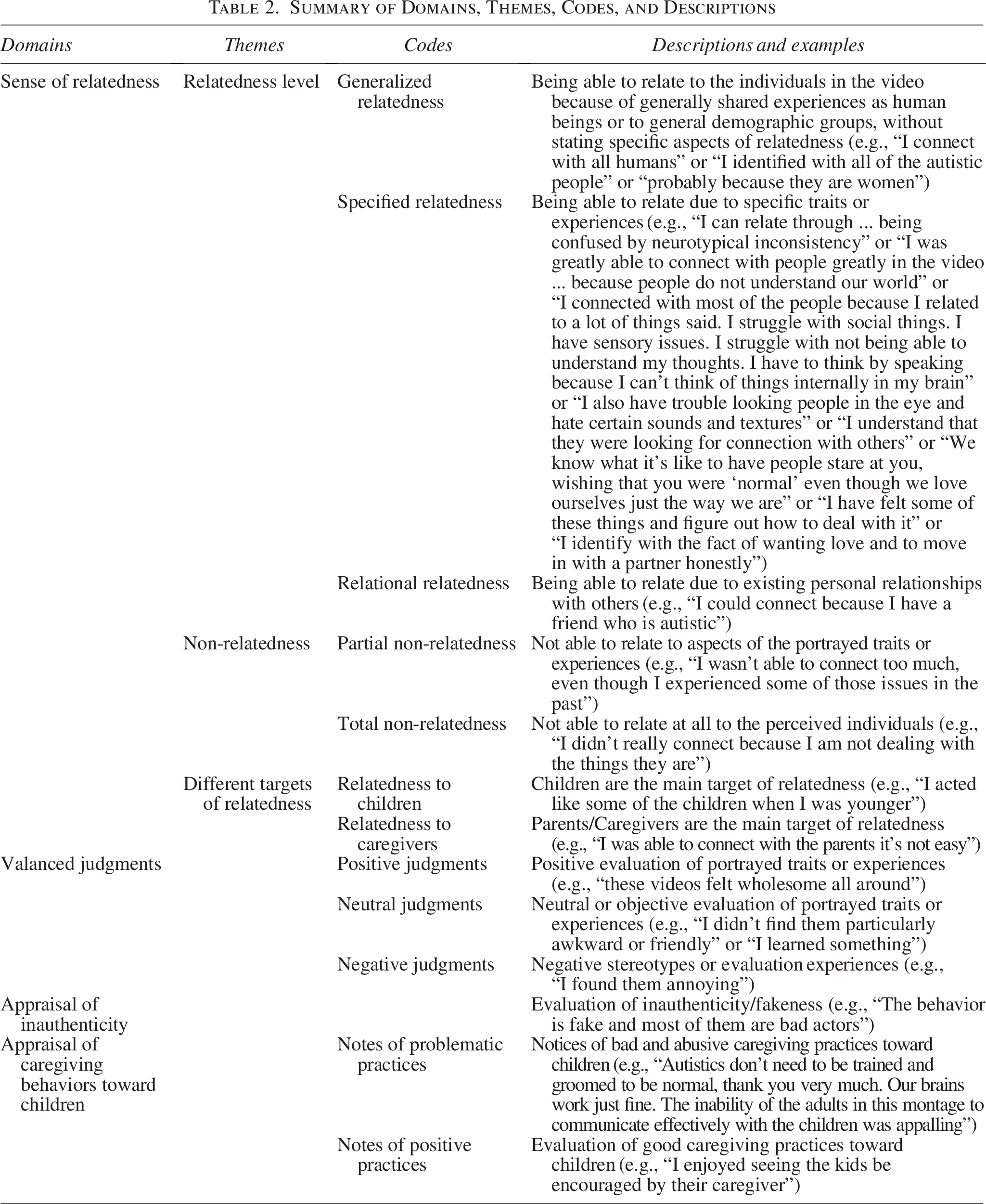
For the open-text responses of participants’ interpretations of video contents, we identified key domains regarding Sense of Relatedness (Codes: Generalized Relatedness, Specified Relatedness, Relational Relatedness, Partial Non-relatedness, Total Non-relatedness, Relatedness to Children, and Relatedness to Caregivers), Valanced Judgments (Positive, Neutral, and Negative), Appraisal of Inauthenticity, and Appraisal of Caregiving Behaviors Toward Children (Notes of Problematic and Positive Practices). See Table 2 for the domains, themes, codes, and definitions.
Summary of Domains, Themes, Codes, and Descriptions
In the GLMM analyses, the interactions between participant neurotype and video content were significant for Specified Relatedness (β = 3.445, SE = 0.614, z = 5.615, p < 0.001), Relatedness to Children (β = 7.126, SE = 1.440, z = 4.950, p < 0.001), Total Non-relatedness (β = −2.605, SE = 0.501, z = −5.195, p < 0.001), and Negative Judgments (β = −1.505, SE = 0.431, z = −3.492 p = 0.001). There were no significant interactions for the other codes. The model for Generalized Relatedness failed to converge and was therefore excluded from further interpretation and visualization. Post hoc pairwise comparisons showed that autistic adults were more likely to report Specified Relatedness to autistic-content than non-autistic-content videos (β = −2.763, SE = 0.560, t = −4.937, p < 0.001), and vice versa for non-autistic adults (β = 0.681, SE = 0.218, t = 3.131, p = 0.003). Autistic adults were more likely to report Total Non-relatedness to non-autistic-content than autistic-content videos (β = 2.405, SE = 0.448, t = 5.363, p < 0.001). Autistic adults were more likely to report Relatedness to Children in autistic-content than non-autistic-content videos (β = −2.437, SE = 0.941, t = −2.589, p = 0.013), and vice versa for non-autistic adults (β = 4.689, SE = 0.914, t = 5.132, p < 0.001). Non-autistic adults were more likely to express Negative Judgments of autistic-content than non-autistic-content videos (β = −1.053, SE = 0.225 t = −4.685, p < 0.001). See Supplementary Tables S3.1 and S3.2 for the full model reports and Figure 2 for the likelihood of code mentions by participant neurotype and video content.
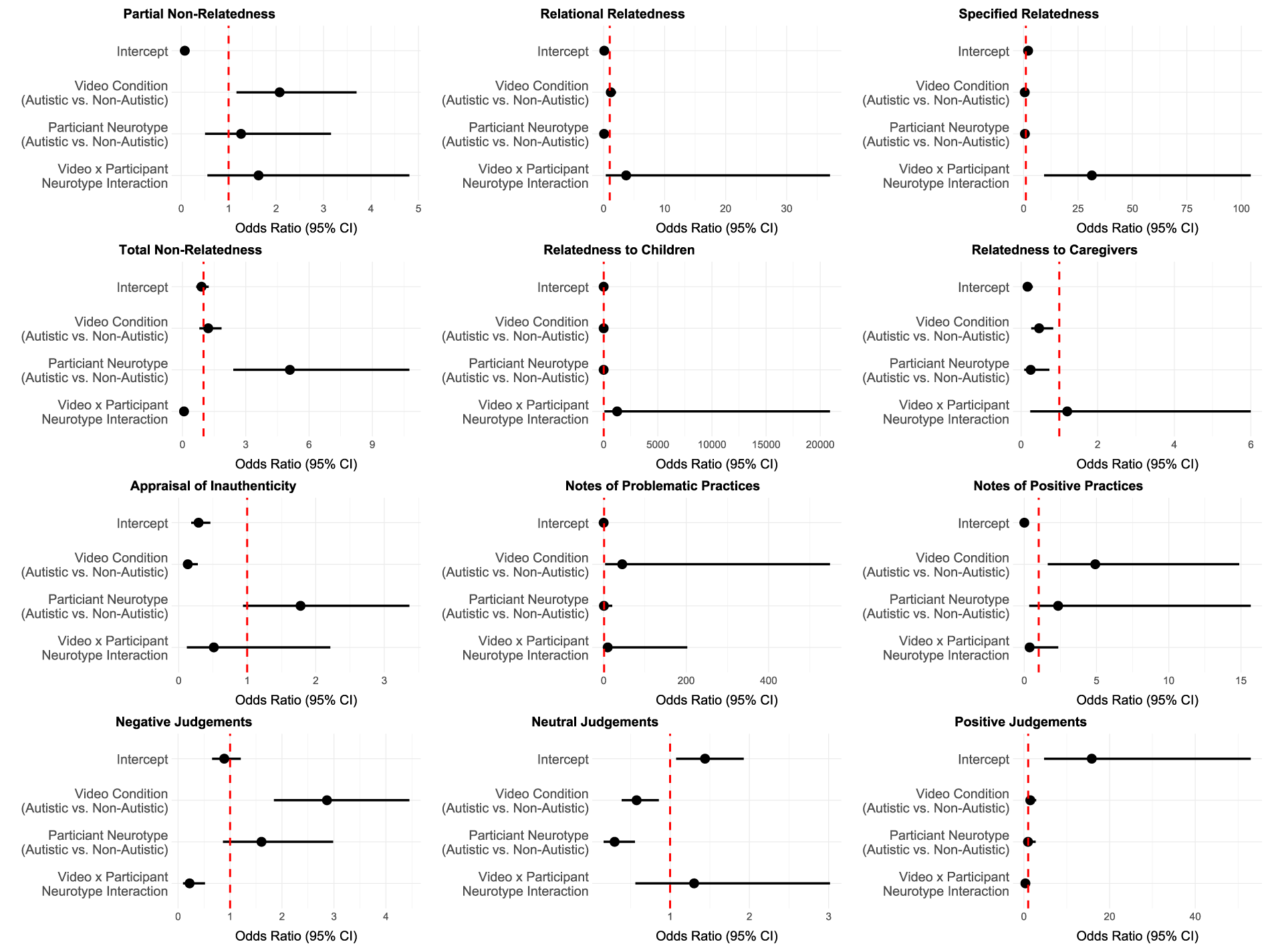
Effects of participant neurotype and video condition on code mention likelihood. Odds ratios (OR) > 1: increases odds of reporting the code; OR < 1: decreases odds of reporting the code. CI, confidence interval.
Qualitatively, autistic adults reported relating specifically to shared difficulty understanding non-autistic people and being understood in return, anxiety, sensory issues, levels of support needs, social goals, and desires (see examples in Table 2). Non-autistic adults reported Relational Relatedness when reacting to both autistic-content and non-autistic-content videos, frequently drawing relatedness from knowing a similar person. Non-autistic adults also frequently reported Generalized Relatedness, such as relating through a shared sense of humanity, while autistic adults reported both Generalized Relatedness and Relational Relatedness to a lesser degree. Moreover, a notable portion of participants mentioned that non-autistic individuals in the videos seemed inauthentic. Last, about a quarter of autistic adults noted problematic practices to autistic children in the videos, and comparatively, non-autistic adults rarely noted any.
Discussion
We used a novel, ecologically valid task to investigate how autistic and non-autistic adults evaluate media contents of individuals who share or differ from their neurotype. Both autistic and non-autistic adults related to and identified more with media contents that matched their own neurotype. Autistic adults also found non-autistic-content videos less enjoyable and less friendly than autistic-content videos. Further, autistic adults better understood, in particular, monologue videos featuring their own neurotype. Open-text video interpretations also reflect neurotype-dependent social evaluation. Non-autistic adults shared more negative evaluations of autistic-content videos. Both autistic and non-autistic adults related more specifically (e.g., to behaviors, experiences, desires) to neurotype-matched contents and expressed more non-relatedness to neurotype-mismatched contents. These within-neurotype preferences of media contents hold implications for understanding contemporary autistic and non-autistic social realities, highlight the importance of autistic media for autistic adults, and point to the need for fostering cross-neurotype engagement for autistic and non-autistic people.
The current findings entail that autistic people may experience a greater sense of connection, attunement, and preference when navigating autistic media, despite its paucity within the broader neurotypical social media world. This is consistent with our predictions, theoretical perspectives, and experimental work construing autistic and non-autistic people as social groups experiencing in-group bias and homophily.25,39,40,61 In this context, autistic people may prefer autistic media because shared social norms and experiences increase ease of connection and understanding, much like other groups who experience greater ease and satisfaction when engaging with similar others. They may also show bias against members of the non-autistic outgroup, reporting fewer positively valanced judgments for them. Notably, these findings run contrary to presumptions of generalized reduced social interests in autistic people.3,37
Interestingly, participants’ open-text social evaluations demonstrated a nuanced pattern regarding generalized and specified relatedness to the media contents. Non-autistic adults often exhibited a broad approach in relating to others through a shared sense of humanity or group membership. In contrast, autistic adults tended to exhibit a specific approach when relating to other autistic people, connecting through concrete similarities. This may reflect the detail-oriented autistic cognitive style, 62 whereby, for autistic people, a sense of relatedness may depend more on tangible, personal experiences than general social categories. Another possibility is that autistic people, as members of a minoritized social group, 63 are more likely to pick out and relate to specific aspects of lived experiences and socialization influenced by minority status and stigma. Altogether, these findings demonstrate the ability of autistic people to connect to and understand autistic media in ways non-autistic people may not.
Furthermore, autistic and non-autistic participants diverged in that non-autistic adults did not report different enjoyment or friendliness ratings between media content neurotypes. This differs from previous findings where non-autistic participants report higher enjoyment and friendliness with non-autistic peers. 30 Although various factors, such as insufficiently representative stimuli and power issues, may influence nonsignificant results, we cautiously discuss a few possible explanations given the intriguing findings. One explanation is that the concept of neurotype is less salient 64 to non-autistic adults as the neuro-majority and thus they find both video conditions similarly enjoyable and friendly. Alternatively, social desirability influenced by political correctness may underlie the comparable ratings reported by non-autistic adults in response to autistic and non-autistic contents. In contrast, autistic adults may be more honest and less influenced by social norms and political correctness compared with non-autistic adults.64–67 They may also have been affected by minority stress in social contexts that stigmatize them 63 and thus rate non-autistic contents less positively. In addition, we did not find an effect for perceived awkwardness. This diverges from previous findings of autistic people being rated as less socially favorable19,25,36 but aligns with those showing that the strongest social evaluation differences arise for positive ratings, whereby autistic participants rated autistic peers more positively while non-autistic participants rated autistic and non-autistic peers similarly. 34 These findings pose an interesting future avenue for exploring implications of social media evaluation on interests in engaging with autistic media contents and individuals online and in person, which may differ by neurotype.25,36
The increased connectedness that autistic people experience with autistic contents suggests that autistic-led online spaces may serve as critical contexts for identity affirmation, self-representation, and community building.11,12,68 Online spaces may particularly suit such purposes by circumventing the sensory, cognitive, and social demands of many offline environments.9,11 In online autistic-led social contexts, autistic norms and communication styles can take precedence, allowing differences often pathologized in offline settings to be treated as ordinary or expected.11,12 However, when promoting engagement with social media and online spaces, it is important to consider the safety concerns and misinformation risks autistic people may face when they consume contents from unreliable or unmonitored sources.69–71 Any future research or supports aiming to utilize autistic-led online media and spaces would require further safeguards to ensure inclusivity and representation, accuracy of information, and safe online interactions.
Greater exposure to autistic-led contents has been proposed as a way to reduce stigma and enhance the well-being of autistic people. 20 Given the currently observed in-group preferences and increased negative open-text evaluation of autistic contents by non-autistic participants, it seems that simply increasing the reach of autistic-made media contents is insufficient to combat biases. Social media recommendation algorithms reinforce users’ existing preferences and biases, 72 potentially resulting in the underrepresentation of autistic-led contents that authentically portray autistic experiences and challenge biases. Thus, while amplifying autistic-led contents may be important to foster autistic communities, increasing visibility may not always be straightforwardly beneficial for reducing biases. Premature amplification of autistic-led contents may expose them to misinterpretation and biased evaluations by non-autistic audiences, reinforcing rather than reducing stigma. Autistic-led autism acceptance advocacy and education contents may address such biases.73,74 Moreover, autistic creators themselves can support this process by strategically using hashtags to classify and share advocacy-related contents in ways that enhance its visibility, although evidence for the effectiveness of such strategies remains limited. 75 Broader systemic and cultural changes toward understanding autism through a neurodiversity lens are ultimately needed. 20
Although evidence of autistic adults connecting more to autistic-content than to non-autistic-content videos (and vice versa for non-autistic adults) may not seem surprising, such results challenge commonly held stigmatizing beliefs that pose autistic people as socially disconnected, unempathetic, and unable (or unwilling) to relate to others.51,76 These results also shed light on the blind spot in research and potential intervention concerning neurotypical individuals’ social evaluation and preferences when engaging with autistic and other neurodivergent groups. Increased shared awareness of how social partners’ neurotypes and lived experiences shape social evaluation can foster more positive cross-neurotype social evaluation and consequent interaction. In addition, our qualitative findings provide insight on the different social signals that autistic people mention when experiencing greater versus lower relatedness, which may inform context-aware supports aimed at designing comfortable social spaces, online and offline, for autistic and non-autistic people.
Limitations and future directions
Many studies on social perception and cognition rely heavily on self-report questionnaires, which are vulnerable to biases. These may be heightened in autistic participants due to their potential hypersensitivity to some social roles and expectations (e.g., in camouflaging: altering their autistic behaviors as a protective coping mechanism to fit in socially77–79 ) and compliance with socially expected responses.80–82 Such biases may have similarly impacted the non-autistic participants, particularly with the rise of autism awareness. Non-autistic participants may avoid appearing prejudiced by mellowing some of the comments provided. Although performance-based measures are often considered more objective, recent work highlights unique strengths of self-reports, such as direct access to thoughts and feelings and greater interpretability. 83 Still, exclusive reliance on self-reports remains limiting; combining them with performance-based metrics can provide a more complete understanding by capturing both first-person perspectives and reciprocal, context-dependent processes.38,84–86
In addition, we did not blind participants to the neurotypes of individuals in videos, since some of them verbally identified as autistic. Explicit knowledge of neurotypes may have influenced participants’ judgments due to preconceptions and the moderating effects that awareness of diagnostic status has on rapport.19,32,87 We matched topics of discussion across neurotype-associated video contents as feasibly as possible, but differences might still have influenced the ratings and interpretations. Autistic individuals discussed their experiences living in a world where they are a minority, while non-autistic individuals rarely did so explicitly, given that their existence as non-autistic is considered the norm.63,88 Future work can address some of these limitations by curating media contents in which creators do not self-identify as autistic to see if the blinding procedure would influence social evaluation ratings.
Other inconsistencies between videos for which we could not fully account (e.g., background sounds, saturation, cinematic effects, lighting) may also have affected the results. The interaction subset may have contained scripted dialogue despite the advisory board’s best efforts to ensure the clips selected appeared natural and authentic. Some participants may have also been familiar with some of the publicly available media, leading to familiarity bias. 89 It is possible that some individuals in the autistic-content videos were not autistic or that some individuals in the non-autistic-content videos were autistic, despite the researchers’ and advisors’ attempts to ensure authentic representation. Moreover, only a subset of autistic and non-autistic people in the population produces media contents, and their experiences may not be representative. 90 Nevertheless, we believe the use of real-world media contents provides novel insights currently unavailable in the literature.
In addition, participants viewed the videos in a fixed order, which may have introduced confounding effects that conflate variances associated with video order with variances associated with video contents. 91 Further, exposure to similar kinds of stimuli over time could affect social judgments through habituation.92,93 In collecting ratings for each video subset instead of each single video clip, we minimized participant burden in an already lengthy study and presented videos as “sets” that mirrored real-world media consumption behavior to capture broad social evaluation patterns of neurotype-associated contents. However, particular videos within each subset may have biased overall ratings and interpretations. Importantly, most of the videos represent speaking individuals who may have relatively lower support needs, similar to our participants. This limits the generalizability of findings to higher-support-needs individuals, such as those with intellectual disabilities or who are minimally/nonspeaking. Future work should further explore media evaluation in these populations. Finally, autistic adults of color, autistic women, and 2SLGBTQ+ autistic people may face complex stigma tied to their multiply marginalized identities,94–96 which could shape how media is socially evaluated in ways not captured in this study. Future research needs to examine how intersectional identities influence cross-neurotype social evaluation. 97
Conclusions
Using a novel, ecologically valid media-viewing paradigm, we found social evaluation patterns demonstrating that autistic adults connect to and prefer autistic media contents more, whereas non-autistic adults better connect to non-autistic media contents. This aligns with theoretical perspectives and empirical findings suggesting important differences in the social realities, norms, and preferences of autistic and non-autistic people and exemplifies the autistic social world as divergent, not deficient. These findings highlight the need to diversify online and offline social spaces and foster cross-neurotype engagement and advocacy to combat stigma. Autistic-led media spaces may provide unique opportunities for affirmation and connection within autistic communities and enhance autistic well-being.
Authors’ Contributions
M.A.: Conceptualization, methodology, software, formal analysis, investigation, writing—original draft, writing—review and editing, and visualization. W.A.: Conceptualization, methodology, software, formal analysis, investigation, and writing—review and editing. J.X.Y.: Formal analysis, writing—review and editing, and visualization. W.A.C.: Conceptualization, writing—review and editing, supervision, and funding acquisition. M.-C.L.: Conceptualization, methodology, resources, writing—review and editing, supervision, and funding acquisition.
The article has been submitted solely to Autism in Adulthood.
Footnotes
Acknowledgments
The authors would like to thank the advisory board members for their important contributions to the validation of our stimuli and research design, the participants for enabling this study, and Dr. Wei Wang for statistical consultation.
Author Disclosure Statement
The authors declare no conflicts of interest. M.-C.L. has received editorial honorarium from SAGE Publications.
Funding Information
This study is supported by funding from the Canadian Institutes of Health Research (GSB-171373; Principal Investigator: M.-C.L.) and the Social Sciences and Humanities Research Council (SSHRC-506547; Principal Investigator: W.A.C.).
Supplemental Material
References
Supplementary Material
Please find the following supplemental material available below.
For Open Access articles published under a Creative Commons License, all supplemental material carries the same license as the article it is associated with.
For non-Open Access articles published, all supplemental material carries a non-exclusive license, and permission requests for re-use of supplemental material or any part of supplemental material shall be sent directly to the copyright owner as specified in the copyright notice associated with the article.
