




Abstract
Background:
Autistic stimming (e.g., repetitive movements or vocalizations) is often misunderstood or pathologized in clinical and public discourse. This study explores how Autistic adults perceive and experience stimming, including its personal meaning, emotional significance, social dimensions, and role in identity. We examine perspectives on both one’s own stimming and stimming observed in others, moving beyond reductive behavioral framings to understand its multidimensional roles in Autistic life. In this study, we explored how Autistic adults perceive and experience stimming in their daily lives.
Methods:
We used a multimodal participatory-qualitative framework to conduct semistructured Zoom interviews with 15 Autistic adults from diverse, intersectional backgrounds. Interviewers shared possible topics in advance and supported multimodal communication during sessions. We analyzed the data using an integrated sequential approach that combined framework analysis with reflexive thematic analysis.
Results:
We identified three primary themes: (1) Identity and Self-Perception of Stimming, which described stimming as central to self-recognition and identity development. (2) Navigating Safety and Trust, which highlighted how participants masked stims as a strategic decision. (3) Stimming as Connection and Communication, which illustrated the relational and communicative dimensions of stimming. Participants described stimming as essential to emotional regulation, cognitive processing, and authentic self-expression. They also reported that their willingness and openness to stim depended on their perceptions of safety and social acceptance. In environments lacking these conditions, participants masked and selectively disclosed their identities.
Conclusions:
Our findings position stimming as a multidimensional expression embedded within Autistic identity and sociality. Based on these insights, we call for interventions, supports, and narratives that affirm stimming’s expressive and relational functions. This study also highlights the value of participatory research methods in capturing the nuanced lived experiences of Autistic people.
Community Brief
Why is this an important issue?
Stimming (e.g., repetitive movements or vocalizations) is a common and meaningful part of Autistic life. Yet, it is often misunderstood or pathologized in research, clinical, educational, and public settings. Because stimming is frequently targeted for reduction or elimination, its positive functions are overlooked. This may contribute to stigma, pressure to mask, and harm to Autistic well-being. Understanding how Autistic adults themselves perceive stimming is critical to shifting away from deficit-based models and toward affirming authentic Autistic expression.
What was the purpose of this study?
The purpose of this study was to explore how Autistic adults experience and make meaning of stimming in their daily lives. We wanted to understand its roles in identity, communication, safety, and relationships, moving beyond narrow behavioral definitions.
What did the researchers do?
We interviewed 15 Autistic adults from many different backgrounds using flexible, conversational Zoom interviews. To make the process accessible, we shared the interview topics ahead of time and encouraged people to communicate in whatever ways worked best for them—speaking, typing in the chat, stimming, gesturing, or using visual tools. Autistic researchers were involved at every stage of the project, including designing the questions, conducting interviews, and helping interpret stories participants shared. After the interviews, the research team looked across the conversations to find patterns and themes in how people described stimming, making sure those interpretations stayed closely connected to participants’ words and experiences.
What were the results and conclusions of the study?
We found that stimming serves multiple, interconnected roles. Participants described stimming as:
Identity and Self-Perception: a vital part of self-expression and self-acceptance. Navigating Safety and Trust: an action shaped by social risk, masking, and the need for safe environments. Connection and Communication: a way to signal emotions, build trust, and create shared language within Autistic and neurodivergent communities.
Overall, participants emphasized that stimming is not just about self-regulation but also about communication, identity, and social belonging.
What is new or controversial about these findings?
This study shows that stimming is not only something Autistic people do privately to cope—it can also be a way of connecting with others, sharing feelings, and communicating. We also found that many Autistic people mask or hide their stimming as a way to stay safe in environments where they worry about judgment, not because they lack social understanding. This challenges old assumptions that Autistic people stim “for no reason” or do not understand social cues. It also pushes back against approaches that try to stop stimming, showing instead that stimming can be meaningful, social, and important for well-being.
What are potential weaknesses in the study?
Our sample mainly included Autistic adults who use spoken language and could sometimes suppress or modify their stimming. As a result, the findings may not fully represent nonspeaking Autistic people, those with higher support needs, or those whose stimming is more constant or less voluntary. Because the study was cross-sectional, it also cannot capture how stimming changes over time.
How will these findings help Autistic adults now or in the future?
By affirming stimming as meaningful communication, these findings support the development of stimming-affirming environments in schools, workplaces, health care, and public life. Instead of suppressing stimming, communities can recognize it as a valid way of expressing identity and emotion. This reframing may reduce stigma, increase acceptance, and promote policies and practices that support Autistic autonomy and inclusion.
Autism is understood as a natural form of neurodevelopmental diversity marked by differences in sensory experiences, communication development, and motor planning. 1 These differences often shape social intuitions, interactional styles, and patterns of adaptation. One of the two core diagnostic criteria for autism includes what the Diagnostic and Statistical Manual (DSM) describes as restricted and repetitive behaviors, 2 sometimes labeled “motor stereotypies,” which range from small, rhythmic movements to more complex, whole-body actions. Autistic communities have long noted that clinical terms such as “restricted” and “repetitive” carry deficit-laden connotations that contribute to stigma. 3 In response, many Autistic people and allies now use the more neutral, community-originated terms “stimming” or “stims” to describe these behaviors, 4 which we adopt throughout this article.
Clinicians and academic researchers have long characterized Autistic stimming as pathological. 2 The DSM-5 codifies this framing within its diagnostic criteria by labeling stimming as “stereotyped or restricted and repetitive motor movements,” reinforcing medicalized interpretations. 2 Because this clinical framing encourages professionals to view stimming as a behavior to reduce or eliminate, researchers have historically overlooked its deeper, more positive roles in Autistic lives. However, both academic and community-based researchers have begun to challenge this narrow perspective. Research that is neurodiversity-affirming centers lived experiences of Autistic people to investigate stimming’s role in emotional regulation, identity, and communication.5–7
Early autism researchers such as Kanner 8 and Ornitz 9 viewed stimming as a maladaptive behavior that required correction or elimination. Delacato 10 similarly characterized stimming as a sign of neurological dysfunction and promoted behavioral interventions in response. These interpretations laid the foundation for widely recognized behavioral intervention models such as Applied Behavior Analysis (ABA), which often target stimming for reduction or elimination. 11 Within this paradigm, professionals largely disregarded the possibility that stimming could be meaningful or adaptive and instead attempted to extinguish it in compliance with neurotypical norms.
In contrast, more recent qualitative research has begun to center Autistic perspectives and affirm the value of stimming. Davidson 12 described a participant who utilized stimming as a way to “quiet the noise in [their] head,” a reflection echoed by many Autistic people who use stimming to manage overwhelming stimuli. Kapp and colleagues 6 further illustrated how stimming supports sensory regulation and helps individuals regain control over their environment and mental state. These newer approaches, which often rely on participatory methodologies, challenge reductionist assumptions and highlight stimming as an adaptive behavior. Rather than treating stimming as something to suppress, researchers increasingly recognize it as a coping mechanism that helps Autistic people navigate an overstimulating world. 13 For example, Tancredi and Abrahamson 14 describe stimming as a form of embodied thinking, while Nolan and McBride 4 frame it as semiosis—an expressive, meaning-generating act. Participants’ narratives similarly illustrated how stimming could scaffold emotional understanding, relational connection, or shared rhythm. These interpretations extend existing research by grounding these theoretical perspectives in lived Autistic experience.
For many Autistic people, stimming plays a central role in identity and self-expression. Bagatell 15 describes stimming as a form of self-expression and deep communication highlighting how shared or interactive stimming can foster Autistic connection, friendship, and community. Autistic advocate Jim Sinclair similarly framed interactive stimming as a core aspect of Autistic socializing, 16 a concept that resonates with Oliver Sacks’ 17 observations of an Autistic family who joyfully engaged in rhythmic, synchronous stimming together.
Autistic people often describe stimming as both a strategy for managing sensory input and as a way to express themselves authentically.18–20 Despite societal pressure to suppress what are deemed “Autistic behaviors,” many Autistic people rely on stimming to remain grounded in their sense of self.4,21 Newer research reframes stimming as a meaningful form of nonspoken communication, expanding beyond its traditional classification as only a self-regulatory behavior. 7 Nwaordu and Charlton 22 argued that stimming plays a vital role in Autistic sociality by signaling emotional states and creating social connection.
Although stimming carries deep personal meaning and functional value, it remains highly stigmatized especially in public spaces. Researchers such as Wiskerke et al. 23 and Charlton et al. 5 documented the social pressures Autistic people face to mask or hide their stims to conform to neurotypical norms. While our discussion here centers on masking as it relates to stimming, participants’ accounts reflect that masking extends far beyond the suppression of visible movements. For many Autistic people, masking involves a wide array of adaptive strategies such as modifying speech patterns, facial expressions, or sensory behaviors to move through environments where stigma or misunderstanding is expected. Recognizing this broader scope of masking situates stimming within a larger constellation of self-protective strategies, each requiring substantial cognitive, emotional, and sensory labor.
Bradley et al. 24 found that Autistic adults felt drained and emotionally exhausted after masking, with some likening the effort to “holding back an itch.” Cassidy et al. 25 and Charlton et al. 5 identified a clear correlation between masking and increased rates of anxiety, depression, and suicidality. Although these data do not directly establish causal harm, participants’ narratives indicated that efforts to suppress stimming can be experienced as distressing and may negatively impact Autistic well-being. Autistic self-advocates have also noted that reducing or redirecting certain forms of stimming, particularly those that are self-injurious, can be appropriate or supportive.26,27 Participants’ accounts of stimming suppression also intersect with broader critiques of behaviorist approaches such as ABA, which have historically targeted stimming for reduction or elimination rather than recognizing its communicative and regulatory functions. Although ABA remains widely implemented, critiques have highlighted that its core practices often target neuronormative behavioral conformity rather than Autistic well-being. McGill’s 28 “Challenging Behaviour(ists)” offers a comprehensive analysis of how behavioral frameworks have historically pathologized Autistic communication and sensory expression, raising concerns about coercion, compliance training, and epistemic harm.
Recent scholarship underscores the need for more nuanced, community-informed understandings of stimming. In a systematic review published in Autism in Adulthood, Collis et al. 29 highlighted how existing research overwhelmingly frames stimming through regulatory or behavioral lenses while rarely attending to Autistic perspectives. Their review notes significant gaps in our understanding of stimming as a complex, multifaceted phenomenon shaped by context, embodiment, identity, and social meaning. This perspective aligns with calls in critical autism and neurodiversity studies to move beyond medicalized framings and ground research in lived experience and relational contexts.
Beyond its role in emotional regulation, scholars have described stimming as a form of cognition and communication. Tancredi and Abrahamson 14 conceptualized stimming as a mode of “thinking-in-motion,” arguing that rhythmic or patterned movements can scaffold attentional shifts and problem solving. Nolan and McBride 4 framed stimming as embodied semiosis—a meaning-making process grounded in gesture, sensory experience, and nonverbal expression. Relatedly, Marocchini and Baldin 30 document how stimming can facilitate rapport and ease of communication, particularly in interactions with children, emphasizing its relational and communicative value. These perspectives further support the need to examine stimming not only as regulation, but also as social, cognitive, and semiotic practice.
Current Study
While prior research has begun to affirm stimming as meaningful, few studies to date have explored the intersection of stimming with identity, communication, and social reciprocity using participatory methods. This study addresses that gap by centering Autistic perspectives and the co-construction of knowledge through collaborative design, analysis, and interpretation. We designed this study to build on the growing body of research that recognizes the complexity and significance of stimming in Autistic life.
Given that many participants in our study referenced experiences with behaviorist approaches, the broader debate surrounding ABA’s aims, assumptions, and impact is directly relevant to understanding the social contexts in which stimming occurs. Together, these bodies of work highlight the need for research that centers Autistic perspectives that examine stimming as a multidimensional, embodied, and relational phenomenon. Through semistructured interviews with Autistic adults, we collected rich narratives about how stimming functions as emotional regulation, self-expression, and social communication.
The current study expands upon our prior quantitative work 7 to elicit deeper, narrative-based insights through semistructured interviews. In designing this study, we sought to elucidate three interrelated dimensions of stimming that were identified as particularly salient in our preliminary work and in Autistic community discourse: (1) its role in shaping identity and self-perception, (2) its relationship to safety and trust, and (3) its functions in connection and communication. These focal areas guided the development of our interview protocol and framed our subsequent analyses, while still allowing for newly constructed themes to surface.
Methods
Participatory research and Autistic voices
To understand stimming from Autistic perspectives, we used a participatory research approach (e.g., AASPIRE). 31 Unlike traditional research models, which often limit community input, participatory methods actively involve Autistic people in all stages of research. Frameworks such as Community-Based Participatory Research (CBPR),32,33 Participatory Action Research (PAR),34–36 and Civic Science37–39 emphasize the value of lived experience and prioritize collaboration with Autistic community members throughout the research process.
Our study formed part of a larger participatory initiative, Research on Autism Driven by Autistic Researchers (RADAR), grounded in Civic Science, CBPR, and PAR principles. RADAR research collaborators participated throughout the research process following the CRediT Taxonomy for authorship. Autistic research collaborators who participated substantively are recognized as full coauthors in alignment with participatory research ethics and neurodiversity-affirming authorship practices. The second author, an Autistic graduate student, founded RADAR. All RADAR collaborators share equal ownership of the project and its outcomes. Autistic collaborators contributed throughout the research process. Our collaborative process not only strengthened the research but also challenged traditional hierarchies in autism research that have historically excluded Autistic voices. 38
The current study followed a clearly defined, replicable five-stage participatory model specific to the RADAR project. Autistic team members held decision-making roles in the following: (1) co-conceptualizing the research study and aims, (2) codesigning the study protocol and interview materials, (3) participant recruitment, (4) coanalyzing transcriptions through iterative coding, theme development, and meaning negotiation; and (5) cowriting and revising the article. This explicit stage structure combined with transparent authorship offers a replicable model that other research teams can adopt when conducting participatory autism research.
Positionality statement
Five authors are Autistic adults with a range of lived experiences and intersectional identities. Our collaborators include Mexican American, Asian, Middle Eastern, Muslim, and White Autistic adults. We represent a range of gender identities, including cisgender men and women, nonbinary and genderfluid individuals, and a transgender woman. All Autistic authors use spoken language at least some of the time, although speech remains unreliable for several. Some collaborators receive housing or vocational support, and only two identify as traditional academics. While some collaborators received an autism diagnosis in childhood, others were identified in adolescence or adulthood. Many of us also live with co-occurring neurodevelopmental, mental health, physical, and chronic conditions. These intersecting positionalities shaped how we conceptualized the study and interpreted our findings. While we do not claim to represent every Autistic experience, we remain committed to reflexivity and accountability in our work.
Influence of reflexivity on interviews and interpretation
Our reflexive commitments were not only conceptual but also methodological. Reflexivity directly shaped how the research team conducted and interpreted the data. Because the research team included Autistic researchers with lived experience of stimming, reflexivity informed how follow-up questions were framed and adjusted during interviews—for example, clarifying language, pacing, and the use of follow-up probes were guided by awareness of sensory and cognitive load, communication preferences, and the nuanced ways Autistic people described their embodied experiences.
Reflexivity also shaped our analytic process. Several interpretations were reconsidered or recontextualized after team discussions about whether our own embodied knowledge was informing meaning-making or whether alternative interpretations better reflected participants’ intentions. At multiple points, Autistic collaborators negotiated meaning together, for instance, distinguishing between stimming as emotion regulation versus stimming as relational signaling, where lived experience helped to challenge or refine initial coding decisions. These reflexive negotiations strengthened the credibility and depth of the analysis by making explicit how our positionalities informed, constrained, and enriched our interpretive choices.
Study background and design
We designed this study using a mixed qualitative approach that integrated both framework analysis 40 and reflexive thematic analysis (RTA) 41 to explore Autistic perspectives and experiences of stimming, particularly its roles in identity, social communication, self-regulation, and emotional expression, based upon our prior survey work. 7 All study procedures were approved by the University of Minnesota IRB (#MOD00057269). Participants completed an electronic consent form before beginning the interview. As a form of process consent, the interview gave participants multiple opportunities to indicate whether they wanted to continue or end the interview and withdraw from the study.
Sampling strategy and accessibility
We intentionally oversampled Autistic people with diverse intersectional identities to capture a wide range of stimming forms and functions across people with variation in lived experiences and identities. We recruited participants from our previous quantitative stimming survey study 7 by inviting those who indicated interest in a follow-up interview related to their survey responses. To support accessibility, we sent interview topics to participants in advance. This allowed participants time to preplan responses, process the content, and preprogram any augmentative and alternative communication (AAC) devices they used, although no participants utilized preprogrammed AAC. Participant details are summarized in Table 1.
Participant Details
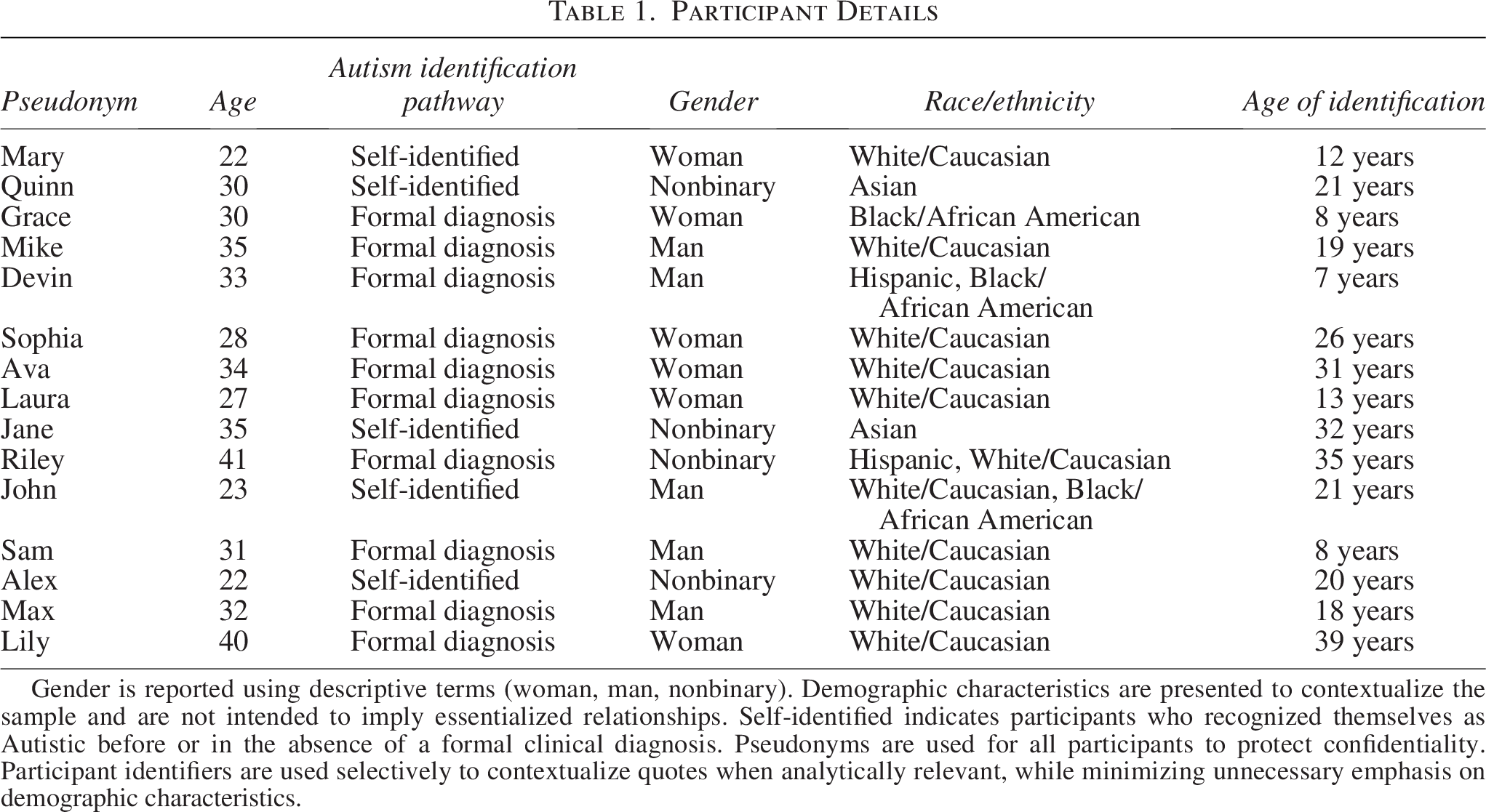
Participant Details
Gender is reported using descriptive terms (woman, man, nonbinary). Demographic characteristics are presented to contextualize the sample and are not intended to imply essentialized relationships. Self-identified indicates participants who recognized themselves as Autistic before or in the absence of a formal clinical diagnosis. Pseudonyms are used for all participants to protect confidentiality. Participant identifiers are used selectively to contextualize quotes when analytically relevant, while minimizing unnecessary emphasis on demographic characteristics.
Additional demographic details and narrative context are described further in the Methods and Results sections. Participants self-reported all demographic information through a checklist that allowed selection of multiple identities. For gender, participants could choose one or more terms (e.g., nonbinary, woman, man, other), which is why some participants are listed with multiple gender identities. For race/ethnicity, the form likewise allowed multiple selections, and several participants indicated more than one racial/ethnic identity. These labels reflect participants’ own selections and are presented verbatim to honor each person’s self-description.
In this study, participants included both formally diagnosed and self-identified Autistic adults (aged 22–41) who participated in semi-structured interviews. We intentionally used inclusive eligibility criteria aligned with neurodiversity-affirming research practices recognizing that many Autistic people face barriers to formal diagnosis due to cost, access, stigma, gendered and racialized bias, or late identification in adulthood. Including self-identified participants acknowledges Autistic self-knowledge as valid and ensures that our study reflects a broader range of Autistic experiences.
Data gathering
Participants who provided informed consent met with the interviewer via Zoom for 60–90 minutes. All interviews were conducted via Zoom by one of the first two authors. Each participant met with only one interviewer. While two researchers conducted interviews across the study, each interview was facilitated by a single interviewer. This approach ensured consistency and minimized potential overload of communicative and cognitive demands associated with interacting with multiple interlocutors simultaneously, particularly important in autism research.
We used semistructured interviews to help facilitate participants’ narratives of stimming from their perspective. While we followed a general topic guide, we also allowed conversations to develop organically. See Supplementary Table S1 in the Supplementary Appendix for the topic guide with optional faciliatory probes. We asked follow-up questions when needed to encourage elaboration.
To promote meaningful participation, we implemented multiple supportive communication strategies. These included giving participants ample time to respond, providing the topic guide to participants before their interviews, repeating or rephrasing probes, checking for confirmation of responses, and inviting multimodal communication (e.g., stimming, gestures, chat box, text-to-speech apps, or visual aids from smartphones).
Data analysis
We used a two-phase qualitative analysis strategy, combining both framework analysis and RTA in a sequential order. This sequential approach allowed the research team to preserve the structure of a priori conceptual domains of identity and self-perception, safety and trust, and connection and communication, 7 while remaining open to insights rooted in lived experience in alignment with our participatory and phenomenological aims.
While these approaches originate from different epistemological traditions—framework analysis from a more structured, realist orientation and RTA from a social constructionist, interpretive paradigm—we used them sequentially to serve different analytic goals. The first phase provided useful scaffolding for organizing the data while the second phase emphasized co-constructed meaning-making, reflexivity, and lived experience, consistent with our participatory and neurodiversity-affirming framework.
In the first phase, we applied framework analysis to organize the data according to domains identified in our prior quantitative study that focused on the emotional, sensory, and social dimensions of stimming. 7 These framework domains served to sensitize early coding by highlighting relevant constructs without limiting the construction of new meanings. See Supplementary Table S2 in the Supplementary Appendix for our analysis guide utilized for the current study. Supplementary Table S2 (Analysis Guide) functioned as a reflexive analytic scaffold during this phase, supporting consistency across coding while allowing inductive meaning-making and team-based interpretation. While the framework domains informed early code development, these were reevaluated inductively during RTA to allow novel meanings to be organically constructed from participant narratives. During early coding of the data, we used these domains to sanitize (clean and deidentify) data and create an initial analytic framework. For clarity, ellipses within participant quotes represent natural pauses in speech rather than omitted material. This structured process enabled us to map patterns across participants and to compare how stimming was described across our previously surveyed domains.
In the second phase, we conducted RTA to explore participants’ meanings and patterns within and beyond our original survey domains. This allowed us to examine the underlying emotional, relational, and contextual dimensions of stimming as described by participants without being constrained by a priori assumptions. Through this inductive process, we constructed a set of themes and subthemes that reflected the richness and complexity of the lived experience data.
All coding was completed by hand by the Autistic research team. Team members read and familiarized themselves with a subset of the interviews and coded the transcripts line by line. Codes are brief labels that capture novel ideas, personal views, key anecdotes, or meaningful data points throughout this process. 40 These codes served as tags for indexing and organizing relevant data segments. The RADAR team grouped codes into categories, defined each one, and clarified what distinguished them. These categories became the backbone of our working framework. Each author then applied these codes across one-third of the remaining interviews, continuing to refine the categories through iterative engagement with the data.
To hone our analysis, we identified a subset of codes relevant to understanding how Autistic people perceive the functions of stimming. We used the initial survey domains from Morris et al. 7 as a starting point, then built out the framework to allow for greater nuance and depth. Through RTA, we searched for patterns across the coded data and identified clusters of related ideas. We constructed overarching themes to capture these unifying concepts and grouped related insights into subthemes that directly aligned with our research aims.
We analyzed the data in multiple cycles. After coding interviews individually, the lead authors then met to compare emerging themes and subthemes. We revisited and restructured these groupings during peer debriefings to determine whether they accurately reflected the coded data. We trialed various arrangements and discussed how well they accounted for recurring patterns. This collaborative, iterative process allowed us to adjust and finalize a thematic structure that represented the data comprehensively.
We compiled a database of codes associated with each participant and used this to examine how Autistic identities shaped their experiences of stimming. This cross-participant analysis helped us identify common codes shared across the sample, as well as unique ones that reflected individual perspectives.
Rigor
To enhance analytic rigor and reflexivity, we implemented several strategies aligned with both structured and interpretive qualitative methodologies. We maintained an audit trail, 42 documenting analytic decisions, codebook iterations, and evolving theme development. This ensured transparency across analytic stages. During the framework analysis phase, three team members independently coded transcripts using the structured categories derived from our prior research. 7 The research team then met to consolidate and refine a shared analytic framework.
In the RTA phase, we engaged in a deeper inductive interpretation, with lead authors identifying and refining patterns through iterative cycles of reading, coding, and collaborative discussion regarding the data. We reflected on our own positionalities throughout this process, consistent with the interpretive lens of RTA. We conducted peer debriefings with the Autistic collaborators throughout the analytic process to enhance reflexivity and interpretive validity. Peer debriefing involves discussing preliminary interpretations with colleagues who can provide alternative perspectives, challenge assumptions, and ensure that emerging constructed themes remain grounded in the data. 43
We also engaged in a lamination process 44 where team members not involved in the initial coding reviewed and interpreted the themes. In some cases, we noted layered or “laminated” meanings in participants’ accounts where multiple purposes, emotions, or contextual meanings were intertwined in a single stimming experience. 45 The lamination process refers to how different communicative, sensory, and emotional functions can build upon one another over time, creating rich, multifaceted significance within a single act. This layered process enhanced interpretive depth and ensured that themes resonated with the lived expertise of our Autistic collaborators and participants.
By integrating structured and interpretive methods through a clearly delineated sequential process, we aimed to balance systematic organization with reflexive depth. This hybrid approach reflects both the methodological rigor and the epistemic values of our participatory, neurodiversity-affirming research design.
Results
The final analysis yielded three overarching themes: (1) Identity and Self-Perception of Stimming, (2) Navigating Safety and Trust, and (3) Stimming as Connection and Communication. Each theme had three corresponding subthemes. These themes and subthemes reflect our participants’ nuanced understandings of stimming across individual, social, and relational dimensions. Table 2 provides an overview of the RTA. It includes the final three overarching themes, nine subthemes, and frequency of appearances showing how commonly each theme and subtheme appeared across the dataset, enhancing the transparency and trustworthiness of our analysis.
Themes, Subthemes, and Frequency of Appearances Developed During Analysis
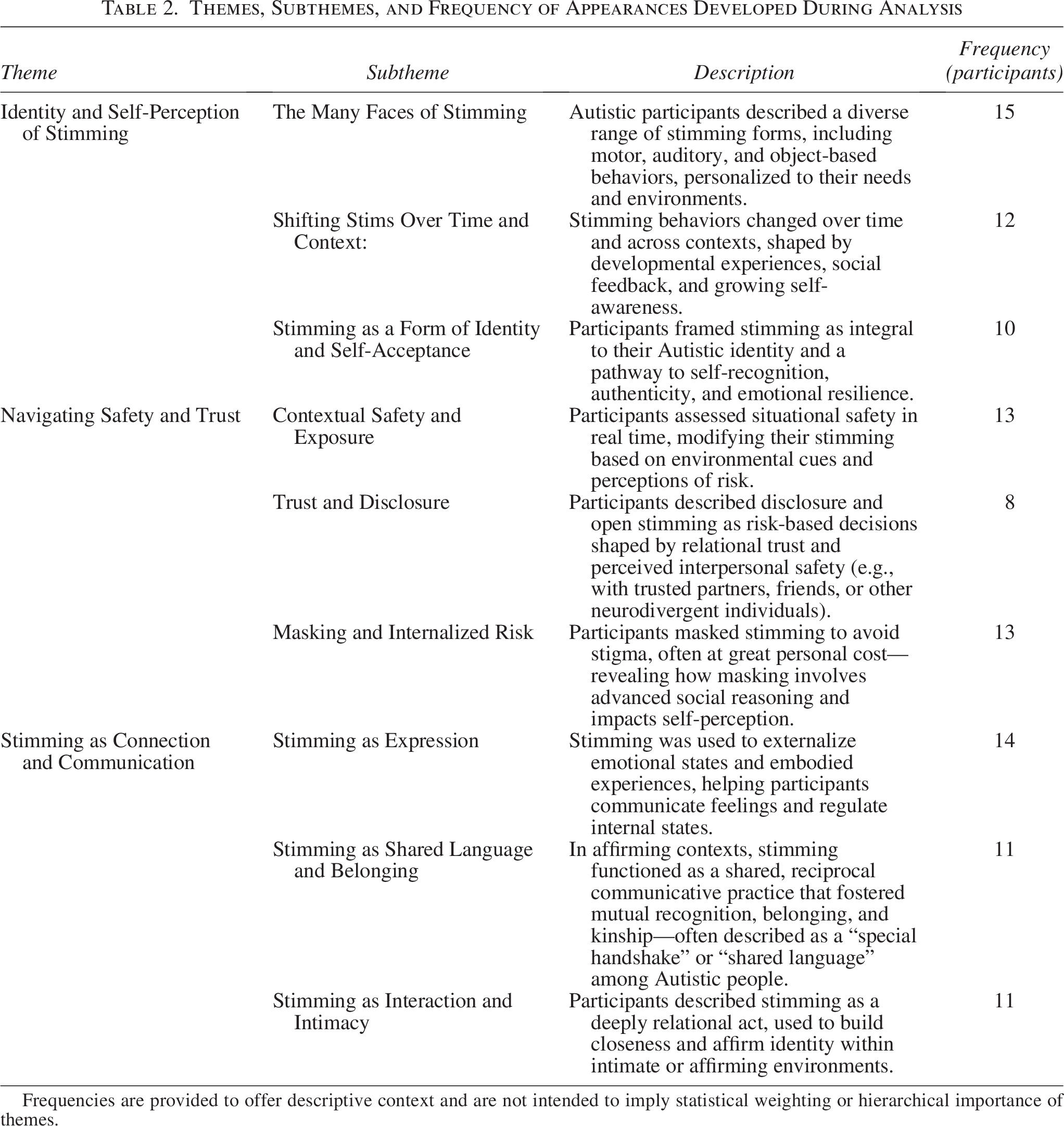
Frequencies are provided to offer descriptive context and are not intended to imply statistical weighting or hierarchical importance of themes.
Below, we explore each theme in depth, illustrating analytic insights with representative participant narratives. Each theme illustrated how stimming operated as more than just a regulatory behavior. It reflected meaning-making, relational dynamics, and experiences of inclusion or marginalization. Together, these themes reflected how stimming evolved as Autistic people grew, reframed their identities, and engaged with different social environments. Participants reflected on how their stimming changed in response to developmental shifts, growing self-awareness, and relational dynamics, revealing its role in self-understanding and continuity of Autistic identity and illustrating that stimming is often an act of shared meaning-making and social intimacy.
Theme 1: Identity and self-perceptions of stimming
As summarized in Table 2, this theme comprises three subthemes that appeared widely across participants’ accounts. Stimming at its core is a diverse and variable action. Participants described a wide range of stimming patterns as well as heterogeneous reasons for stimming. Across participants’ life experiences, long-term relational patterns, social norms, and perceptions of their own stimming evolved. In addition, participants described how their stimming shaped their sense of self and identity. We explored these topics in this first theme.
Three salient main subthemes fit within “Identity and Self-Perceptions of Stimming.” These include: “The Many Faces of Stimming,” “Shifting Stims Over Time,” and “Stimming as a Form of Identity and Self-Acceptance.” First, “The Many Faces of Stimming” establishes what stimming can look like for Autistic individuals while accounting for the variation within it. Second, “Shifting Stims Over Time” explores Autistic participants’ experiences of stimming over time and between contexts. This focused on how stimming can be fluid and adaptive. Last, “Stimming as a Form of Identity and Self-Acceptance” captures participants’ reflections on how they view their stimming in relation to their identity and how they want to be perceived by others. Across the dataset, participants consistently described engaging in multiple forms of stimming. Many reflected on how their stimming shifted across time, contexts, or relationships, and a substantial portion explicitly connected stimming to identity and self-recognition.
Participants described a wide variety of different kinds of stims and often utilized multiple types of stimming. For example, participant Ava (age 31) spoke of using smaller fidget toys like “Pop-it” fidgets in public or at work. By contrast, Ava spoke of using other larger fidgets (e.g., “Rubik’s Cube,” “Slinky”) at home and in other safe spaces. Mary (age 22) described a similar range of items they used for stimming, like Pop-its and an ice roller, while also using their body to stim more discreetly (e.g., “knuckle cracking”). Alternatively, Alex (age 22) primarily described stims that required only their body, such as leg bouncing, hand movements, hair twisting and pulling, chewing on the inside of their cheek, pressing their nails into their skin, and tapping their ears to hear certain sounds.
Some participants engaged in vocal and auditory stimming. Participant Riley (age 41) explained that they “listen to the same song over and over again as a form of stimming.” Riley also stated that they vocally stim by singing, wanting to do it “exactly that way [as the original artist sings].” Riley said they go as far as focusing on “vocal inflections,” “accent,” and “pitch” to figure out how exactly an artist makes a song sound how it does. Other participants, such as Max (age 32) and Grace (age 30), also discussed utilizing vocal stims through “humming.” Overall, we found that our Autistic participants had a variety of ways to stim and often chose how they stimmed according to what felt personally comfortable and safe to them. This subtheme illustrates the diversity and personalization of stimming across people and contexts, underscoring its functional and expressive variability beyond clinical definitions.
While most participants described stimming as affirming and supportive of well-being, a few noted instances where certain stims caused discomfort, pain, or injury, and in those cases, they sought to change or replace them. For example, Mary shared, “I used to bite my hand really hard when I was stressed. It helped in the moment, but I wanted to find something else because it hurt later.” Others (Alex, Riley, Max) described substituting self-injurious stims with less harmful sensory input or using tools to meet the same sensory need. These accounts highlight that affirming stimming also includes supporting modifying or reducing stims when Autistic people themselves identify them as harmful or unwanted.
Shifting stims over time and context
Participants cited long-term relational patterns and social norms that shaped whether they expressed or suppressed stimming across different environments. Family, school, and peer relationships often shaped how participants engaged with stimming. Alex recalled invalidation from their parents and Mike (age 35) from their teachers. Alex also discussed how their peers’ perceptions impacted their stimming: “As a little kid, I didn’t think anything I was doing was weird…but in high school, I got really aware of other people’s perceptions.” Others described how friendships, especially with other Autistic people, supported stimming. Riley shared, “In relationships with other Autistic people…you get to do [stimming] with someone who gets it.”
Participants often described things like growing self-awareness, identity consolidation, and diagnostic validation as reasons for the changes and variety in their stimming. Several participants such as Ava, Alex, and Mary described how learning more about autism itself allowed them to reinterpret their stimming not as strange or problematic, but as essential to their well-being. Others (Jane, Riley, Max) emphasized how social learning from peers, online communities, or Autistic/neurodivergent spaces often enabled them to adopt or adapt their stims in ways that felt more empowering or intentional.
These shifting stims also reflect a broader neurodivergent temporality, sometimes described as crip time. 46 Changes in stimming over time reflect nonlinear developmental paths, which challenge normative timelines of adaptation. Rather than a trajectory of “improvement” or “reduction,” participants described stimming across time as fluid, adaptive, and deeply influenced by social safety and self-knowledge. This lens disrupts pathologizing interpretations of developmental change, instead honoring the ways Autistic people reclaim bodily rhythms and emotional expression on their own terms. This subtheme highlights how stimming evolves over time in response to shifting environments, socialization, and self-awareness, revealing its fluid and adaptive nature.
Stimming as a form of identity and self-acceptance
Participants highlighted how stimming contributed to a coherent sense of self over time. For many, the act of stimming became intertwined with self-recognition and resilience in the face of societal pressure. Participant Ava demonstrated this point when discussing how stimming helps them “genuinely feel like [they] can show up as [them]self” at work. Identity formation was not static but actively negotiated through experiences of masking, acceptance, and affirmation.
Many participants linked stimming to their Autistic identity. Ava celebrated their diagnosis annually, while Riley described it as “gut-wrenchingly beautiful.” Participants emphasized that autism, and stimming, shaped not only how they interacted with others but how they saw themselves. Yet, Alex demonstrated that this identity is often selectively shared, saying: “It’s not worth the hassle…to be seen the way I want to be seen.” Alex’s selective sharing resonated with a deeper, larger theme of navigating safety and trust that will be explored in the next section, but this subtheme demonstrates how stimming becomes central to Autistic identity and self-affirmation, offering a pathway to authenticity in the face of societal stigma. Together, these three subthemes illustrate how stimming shapes and reflects Autistic identity, evolving across contexts and over time as a source of self-understanding, affirmation, and resilience.
Theme 2: Navigating safety and trust
As shown in Table 2, the three subthemes within this theme appeared frequently across the dataset, reflecting the pervasiveness of safety- and trust-related considerations. The second theme related to how Autistic people navigate safety and trust in relation to stimming. Autistic participants described how their comfort with stimming hinged on environmental safety, relational trust, and social risk. While many reported being able to suppress or modify their stimming in certain contexts, this was not universal. The degree of perceived control varied widely, reflecting individual differences in sensory needs, social experiences, and self-regulation strategies. As such, these findings may be more representative of Autistic people who can modulate stimming in some situations and may not fully capture the experiences of those who cannot or do not wish to suppress their stimming.
Many Autistic participants described how their disclosure or expression of stimming was considered in social and environmental contexts. Many participants selectively disclosed or expressed their stimming behaviors based on how safe or supported they felt with various people and in differing environments. During our analysis, we found that participants relayed information about navigating safety and trust that fell into three subthemes. First, “Contextual Safety and Exposure” explored participants’ stimming in relation to their environment and/or surroundings. Second, “Trust and Disclosure” considered participants’ stimming in relation to the people around them and how they made them feel. Lastly, “Masking as a Response to Internalized Risk” investigated participants’ stimming and how they used masking as a tool when evaluating the safety of their environment and the people around them. While Theme 3 explores stimming’s role in active interpersonal connection and communication, Theme 2 focuses specifically on the internal and external safety assessments that shape whether and how Autistic people choose to stim in a given context. Discussions of safety and trust were pervasive across the dataset. Most participants described modifying or suppressing stimming in environments perceived as unsafe, while many also described relationships or settings in which they felt safe enough to stim openly.
Contextual safety and exposure
Participants reported that they assessed safety moment-to-moment, choosing when, where, and how to stim. Quinn (age 30, Asian, nonbinary and transgender) shared that “stimming openly” with other Autistic people “ma[de] [them] feel…safe.” Others, like Mike, weighed safety against authenticity, saying: “…how can I maintain my safety as an Autistic person, but also be as freely Autistic as possible, for my mental health?” Together, these participants indicated that due to outside stigma, judgment, or poor reception, it is not always safe for them to engage in stimming. Thus, the level of trust they had in their environment impacted how safe they felt to freely stim. This subtheme reveals how Autistic people continuously assess environmental safety, selectively engaging in stimming as a strategic response to perceived social risk.
Trust and disclosure
Participants were more likely to stim around trusted individuals, often other Autistic/neurodivergent people. Max explained, “…people who are not Autistic, if I know them and I trust them, there’s less likely to be…an issue with me stimming in front of them.” Disclosure of stimming or Autistic identity often felt risky. Ava reflected that “Disclosure was super hard…[it] caused the most negative feelings.” These experiences point to trust being an important variable influencing when Autistic people choose to potentially disclose their diagnosis through stimming. This subtheme underscores the role of relational trust in shaping whether stimming is disclosed, suppressed, or masked, emphasizing disclosure as a risk-based decision grounded in interpersonal safety. Rather than focusing on the relational meanings of stimming itself, these accounts highlight the conditions under which authenticity becomes possible or constrained. As Riley noted, “I don’t…really know or understand what it would be like to not mask…I don’t really know who I am without that.”
Masking as a response to internalized risk
Several participants described masking their stims in unsafe or judgmental environments. Participant Quinn stated that “stimming is…a very obvious trait that people pick up on. And even if they don’t associate it with autism, they associate it with something negative. And I don’t want…any, like negative preconceptions put on me because of that.” Therefore, masking can become a primary tool for safety. However, not all Autistic people can consistently control when or how they stim. Capacity to suppress, modify, or mask stimming varies by person and context, so these findings may reflect those with modulation abilities more than those without. Participants described masking as an adaptive response to perceived social and relational risk, shaping how stimming was regulated across contexts.
These strategies of masking also reflect sophisticated executive functioning and Theory of Mind (ToM)—capacities often assumed to be impaired in Autistic people.47–49 Participants demonstrated clear understanding of how others might perceive their stimming and adapted their behavior accordingly. Quinn, for example, described how they anticipated “negative preconceptions” and chose to suppress visible stims to avoid judgment. These accounts further challenge assumptions that Autistic people lack ToM or social cognition more broadly. As Hull et al. 47 and Livingston et al. 49 argue, masking involves complex perspective-taking, self-monitoring, and metacognitive awareness. Tracking social expectations, predicting responses, and regulating one’s actions are all relatively advanced forms of social reasoning and self-regulation that require significant cognitive and emotional labor.
Overall, this theme highlights how Autistic people actively assess risk and relational trust in deciding when and how to stim, revealing stimming as a socially negotiated act shaped by safety, disclosure, and belonging. These dynamics of safety and trust shape not only when Autistic people stim but also how stimming later becomes a relational tool, a focus we explore in the next theme. This third subtheme reframes masking not as a social deficit but as a cognitively demanding form of self-protection rooted in advanced social reasoning and lived experience. Whereas Theme 2 centers on the safety, trust, and risk assessments that shape whether stimming is disclosed or suppressed, Theme 3 focuses on what stimming does within affirming contexts—how it operates as a shared communicative practice that builds connection, belonging, and intimacy.
Theme 3: Stimming as connection and communication
As outlined in Table 2, this theme includes three subthemes consistently described across participant narratives. Whereas Theme 2 examined the safety and trust considerations that shape whether stimming is disclosed or masked, Theme 3 centers on what happens within affirming contexts—how stimming functions as a shared language through which Autistic people express emotion, build mutual understanding, and foster belonging and intimacy. Participants consistently framed stimming as a means of communication. Stimming helped participants express emotions, signal needs, and foster interpersonal connection, particularly in affirming, neurodivergent contexts. In this way, stimming allowed participants to connect with others, especially other neurodivergent people.
Under this theme, the research team identified three subthemes. First, “Stimming as Expression” established that stimming may be used to externalize an individual’s internal states. Second, “Stimming as Shared Language and Belonging” explored how stimming can be shared between Autistic people to find kinship and understand one another better. Lastly, “Stimming as Interaction and Intimacy” explored how stimming can be personal and tied to identity. Nearly all participants described stimming as a way to express emotion, and many also described moments in which shared stimming fostered belonging, mutual recognition, or relational closeness.
Stimming as expression
Participants discussed using stimming to externalize internal states. Jane (age 35) shared, “…I think…facilitating stimming allows people to have better communication…and can also just give us clues about…people’s…state of mind.” Relatedly, participant Mike said that seeing the stimming of others “helps [them]…determine what level of ableism and internal[ized] ableism they’re working with” and whether they feel comfortable unmasking around a person. Participants frequently discussed how different stims were tied to particular emotions and/or inner experiences. Riley, Laura, John, Sam, Sophia, and others discussed a wide range of emotions with negative, neutral, and positive connotations tied to stimming. Some of these emotions/experiences included “anxiety,” “stress,” feeling “uncomfortable,” “anger,” “fear,” “boredom,” having excess energy, “joy,” and “excitement,” supporting our previous findings that stimming may be used to upregulate and downregulate emotions. 7 This subtheme positions stimming as an embodied communication strategy that conveys emotion, sensory experience, and self-awareness, especially in the absence of verbal fluency.
Stimming as shared language and belonging
Stimming served as a mutual form of recognition and bonding for many participants. Unlike disclosure decisions described in Theme 2, these accounts emphasize stimming as an active, reciprocal communicative practice that emerges once safety is already established. Jane likened stimming to “a special handshake” or a “particular language” among Autistic people. Participant Max stated that “…when there’s someone else who also stims, especially stims in a similar way…it feels very…affirming, and it… makes you feel like your experience is…valid.” Max also articulated that stimming can be a means through which they connect with others and find like-minded people. In this way, for many, stimming becomes a basis of kinship.
Participants in our study shared similar insights. One participant, Devin, described stimming as “a secret language” shared within the Autistic community, and as a way to communicate and find shared belonging. It is worth noting that while our data reflect participants’ perspectives on stimming within Autistic spaces, stimming and other repetitive movements can also be present and communicative in other neurodivergent or disability communities.50–52 Repetitive movements with communicative or regulatory functions are evident across disability and neurodivergent groups, including Tourette/tic communities, ADHD, and intellectual/developmental disability communities.50,53
In affirming environments, participants reported that stimming enabled mutual recognition and emotional reciprocity. These accounts align with Wiskerke et al.’s 23 findings, which suggest that openly stimming in social settings fosters inclusion and supports Autistic agency. Overall, this second subtheme shows how stimming acts as a culturally specific, nonverbal language that fosters recognition, kinship, and community among Autistic people.
Stimming as interaction and intimacy
Participants often focused on how stimming could initiate immediate, moment-to-moment expressions of connection, particularly in affirming environments or close relationships. Jane described stimming with others as creating “…a sense of greater intimacy” (e.g., creating interactive echoes or sounds together). Some described stimming as integral to how they related to others. Riley stated, “It’s become such an integral part of how I see myself, how I live, and how I interact.” Others, like Lily (age 40), found comfort and affirmation in “sharing stims together” with friends or partners (e.g., sitting side-by-side and rocking in sync while talking, or tapping fingers in rhythm to a shared song). These moments served as both sensory regulation and a form of embodied companionship.
Through communication and connection, stimming appears as both a deeply personal and relational practice, shaped further by identity and life experience. This third subtheme illustrates how stimming facilitates moments of interpersonal closeness, functioning as a relational practice rooted in mutual understanding and embodied presence. Taken together, however, these three subthemes position stimming as a powerful form of embodied communication, one that facilitates connection, intimacy, and shared meaning, particularly within affirming neurodivergent relationships.
Discussion
The current study deepens our understanding of stimming as a dynamic facet of Autistic life. Participants described stimming as communicative, regulatory, and identity-affirming—shaped by context, relationships, and access to safety. While many articulated choosing when, where, and how to stim, others noted that control was limited during periods of heightened sensory, emotional, or cognitive demand. These findings illustrate how participatory methods surface layers of meaning that hierarchical research designs often overlook foregrounding the coproduction of knowledge and centrality of Autistic ways of knowing. Consistent with the testimony of many Autistic self-advocates,54,55 participants emphasized that stimming is a meaningful and generally positive part of their lives. Their accounts also complicate claims that Autistic stimming is primarily involuntary or reflexive, aligning instead with Yergeau’s 56 argument that stimming can be intentional, agentive, and expressive.
Our study contributes to an emerging epistemic shift in autism research, one that centers Autistic lived experience and participatory methods to reframe behaviors such as stimming as meaningful, communicative, and socially embedded. Scholars clearly distinguish between a paradigm shift and an epistemic shift. A paradigm shift reorganizes scientific assumptions and practices, 57 whereas an epistemic shift transforms whose knowledge is recognized, valued, or authorized.58,59 In this case, we highlight the shift from researcher-led interpretations toward knowledge that is coconstructed by and with the Autistic community. This shift reshapes both the content and the process of autism research.
Across interviews, participants described stimming as embedded in how they connect with others, assert autonomy, and navigate environments that often fail to accommodate Autistic expression. Three overarching themes were constructed. First, participants positioned stimming as an anchor for self-knowledge, focus, and executive functioning. They described how stimming helped them manage transitions, organize thoughts, and remain present in overwhelming situations, functions that extend well beyond traditional views of emotional regulation. For many, stimming affirmed their identity and offered a sense of coherence among the body, mind, and environment. These narratives align with Autistic-authored frameworks such as BodyMinds coherence 60 that recognize the integration of sensory, cognitive, and emotional processing as strengths.
Second, participants closely linked stimming to their sense of safety and relational trust. Participants consistently reported modifying, masking, or withholding stims in environments where they feared they would face stigma or judgment. Conversely, our participants expressed greater freedom to stim in contexts that felt affirming, often among other Autistic and neurodivergent people. This aligns with research emphasizing the relational nature of Autistic expression and the importance of reducing social risk.5,6 Participants often suppressed stimming as a survival strategy in unsafe environments and viewed the open expression of stimming as a signal of comfort, trust, and self-acceptance.
Lastly, participants described stimming as an embodied mode of communication. Within Autistic spaces, stimming became a shared language for expressing emotions, signaling needs, and building intimacy. These accounts resonate with neurodivergent rhetorics 61 and reframe stimming as a valid form of social reciprocity rather than a disruption of it. Instead of signaling social deficits, stimming enabled connection, care, and consent within social interactions.
These findings also reflect broader concepts in neurodiversity research. Milton’s 62 double-empathy problem suggests that communication breakdowns are not located within Autistic people, but rather in the mutual communicative misunderstandings between neurotypes (e.g., Autistic and non-Autistic dyads). In this light, stimming becomes a form of communicative resistance. It is an act of embodied autonomy that challenges dominant neurotypical norms of expression. Sherwin’s 63 concept of embodied autonomy further highlights that autonomy is realized not in isolation but through environments that respect differences and promote trust. For many participants, stimming was not only a survival tool, it was also a political act of reclamation of authenticity.
The current study also underscores the value of participatory research approaches. Autistic people helped shape the direction of this research at every stage, and their insights would likely have been obscured in traditional noncollaborative academic research designs. This reinforces the need for Autistic-led and community-based methods that center lived experience, distribute interpretive authority, and actively resist epistemic injustice. Participatory research, when grounded in disability justice, requires researchers to move beyond performative inclusion toward shared codesign and co-ownership.31,64,65 Our design exemplifies how participatory research can illuminate nuanced experiential domains such as stimming. Future autism research should adopt similarly co-constructed frameworks to explore identity, sensory experiences, and relational dynamics.
Finally, our findings carry implications for clinical and policy frameworks. Diagnostic criteria and intervention models continue to describe stimming in pathologizing terms (e.g., “stereotyped behaviors,” “restrictive and repetitive”), shaping practices that aim to reduce or eliminate it (e.g., ABA). Yet participants in our study reported harm from the suppression of stimming and affirmed the value of stimming when expressed safely. Interventions such as ABA that target stimming for removal risk undermine Autistic identity, autonomy, well-being, and overall quality of life.
To support meaningful change, we call on key entities, including the American Psychiatric Association 2 (e.g., DSM language reform), clinical training programs, school-based intervention models, and federal research funders such as the National Institutes of Health (NIH) and National Institutes of Mental Health (NIMH) to adopt frameworks that affirm communicative diversity and reject models that pathologize Autistic expression. Instead, we call for a shift toward stimming-affirming supports across settings. In schools, this might include training educators to understand the functions of stimming, integrate sensory supports, and validate diverse expression. In workplaces, inclusive policies could normalize movement, encourage access to stimming tools, and promote disclosure without penalty or stigmatization. Public campaigns could reframe stimming as a natural aspect of neurodiversity. Crucially, these efforts, along with autism research itself, must be codesigned with the Autistic community to ensure that future research reflects the lived needs and values of Autistic people. By rejecting deficit-based assumptions and embracing stimming as meaningful, this study offers a roadmap for more just, responsive, and affirming approaches to Autistic support.
Future autism research should build on this model to explore other domains such as relationships, education, or sensory experiences with the same collaborative commitment to lived expertise. This approach offers a replicable model for participatory inquiry into other domains of Autistic life such as relationships, identity development, and systems navigation. Researchers must move beyond studying Autistic people as objects of inquiry and instead collaborate with us as co-constructors of knowledge. Researchers, clinicians, and educators should adopt approaches that affirm and support rather than correct neurodivergent ways of communicating and being. By grounding our methods in participatory principles and honoring lived expertise, this study contributes to a growing shift in autism research from studying Autistic people to collaborating with them. At the same time, several limitations must be noted.
Limitations
This study’s limitations fall into three areas: (1) representation, (2) methodological scope, and (3) perspective balance.
Representation
While this study provides rich insights, several limitations must be considered. Despite intentional recruitment efforts, the participant group likely does not capture the full range of Autistic experiences, particularly those of nonspeaking Autistic people, Autistic people with higher support needs, and those who use AAC. Our findings may better reflect Autistic people with some ability to suppress stimming and underrepresent those who cannot or choose not to.
Methodological scope
Because many participants framed stimming positively, our findings may underrepresent those with negative experiences or who wish to reduce certain stims. The cross-sectional design also limits our ability to capture change over time; longitudinal work could examine how stimming evolves across environments and relationships.
Perspective balance
Participation required comfort with Zoom interviews, which may have excluded those who communicate more effectively through other modalities. Future participatory designs should offer multiple modalities (e.g., text-based, AAC, asynchronous options) to increase inclusion of nonspeaking participants. While the topic guide supported preparation, some probes may have introduced implicit framing that limited interpretations. Future studies may benefit from more open-ended or participant-led designs.
Conclusions
This study offers one of the most detailed participatory-qualitative investigations into stimming as a complex, embodied, and relational experience for Autistic adults. By centering Autistic narratives, we challenge the pathologization of stimming and instead position stimming as a vital form of communication, emotional regulation, and identity expression. Participants highlighted how trust, safety, and social dynamics shape the ways they engage in stimming, underscoring the importance of context in interpreting Autistic behavior and communication more broadly. These findings build on and extend neurodiversity-affirming frameworks by emphasizing stimming’s communicative and political significance, not simply as an individual coping mechanism, but as a way of asserting presence, autonomy, and connection.
Practically, this research supports the development of stimming-affirming environments across research, educational, clinical, and community spaces. These environments should be codesigned with Autistic people and rooted in respect for embodied and multimodal communication. Policy and intervention models should move away from behavioral suppression and toward strategies that recognize stimming as a meaningful expression of the self. By grounding our methods in participatory principles and honoring lived expertise, this study contributes to a growing shift in autism research from studying Autistic people to collaborating with them. In doing so, our study lays a foundation for more just, inclusive, and affirming understandings of what it means to be and to communicate as an authentically Autistic person.
Footnotes
Acknowledgments
The authors thank Freya Roherty and Dr. Janet A. Norris for the input they provided for this article.
Author Disclosure Statement
No interests to disclose.
Funding Information
This work was partially supported by the Autism Intervention Research Network on Physical Health (AIR-P), funded by the Health Resources and Services Administration (HRSA) of the U.S. Department of Health and Human Services under grant number (5UT2MC39440-02/15570000151506). Additional support was provided through the AIR-P Scholars Program for the project Flappy Hands are Healthy Hands (5UT2MC39440-05/15570000215257), also funded by HRSA under the AIR-P initiative. The contents are those of the authors and do not necessarily represent the official views of, nor an endorsement by, the HRSA, HHS, or the U.S. Government.
Authorship Confirmation Statement
The article has been sumitted solely to Autism in Adulthood. All the authors contributed to and approved the final article.
Supplemental Material
References
Supplementary Material
Please find the following supplemental material available below.
For Open Access articles published under a Creative Commons License, all supplemental material carries the same license as the article it is associated with.
For non-Open Access articles published, all supplemental material carries a non-exclusive license, and permission requests for re-use of supplemental material or any part of supplemental material shall be sent directly to the copyright owner as specified in the copyright notice associated with the article.
