




Abstract
Autism research has developed through multiple paradigms. Medical models locate difficulty within individual neurology, while social and neurodiversity models emphasize environmental barriers and the legitimacy of cognitive variation. Biopsychosocial and hybrid approaches integrate these perspectives, recognizing that biological, psychological, and social factors all matter. Yet these frameworks remain largely descriptive and offer limited accounts of how these domains dynamically interact across development to produce the wide heterogeneity observed in autistic experience and adult outcomes. This paper introduces the Evolutionary Stress Framework (ESF), a complexity-based model that reframes neurodevelopmental variation as the emergent outcome of stress–energy regulation and predictive processing over time. Drawing on stress physiology, adaptive calibration theory, predictive processing, and disability scholarship, we review traditional medical, social, biopsychosocial, and hybrid models; examine the contributions and limits of the neurodiversity paradigm; and articulate ESF’s core constructs: emergent neurotypes, stress incoherence, and emergent allostasis. Within ESF, autistic traits function as coherent, context-dependent stress–energy strategies rather than separable strengths and deficits. ESF conceptualizes pathology not as deviation from a normative baseline but as stress incoherence—states in which long-standing calibrations become unsustainable under current environmental conditions. This framework helps explain heterogeneity, developmental change, the clustering of physical and mental health conditions, and the disproportionate burden of burnout and health disparities observed in autistic adulthood. ESF shifts intervention targets from trait suppression to environmental design, co-regulation, and individualized support organized around bio-neurotype–specific regulatory needs. We outline implications for research, clinical practice, and policy and identify directions for empirically operationalizing ESF constructs.
Community Brief: A New Paradigm for Understanding Autism
What is the purpose of this article?
This article introduces the Evolutionary Stress Framework (ESF), a way of understanding autism that integrates insights from medical, social, and neurodiversity models. ESF is not a new diagnosis or a replacement for existing paradigms. Instead, it explains ways in which autistic traits develop and why experiences vary so widely across people and life stages.
What is already known about this topic?
Understanding autism has been difficult because existing models each describe only part of the picture. Medical models focus on biology; social and neurodiversity models emphasize environment and acceptance. Biopsychosocial and hybrid approaches integrate these perspectives but remain largely descriptive. None fully explains why autistic people can thrive in some settings and struggle in others, or why health problems and burnout are so common in adulthood.
What personal or professional perspectives do the authors bring to this topic?
The lead author is an autistic researcher whose perspectives are shaped by lived experience of autistic adulthood, long-term engagement with neurodivergent communities, and interdisciplinary work across stress physiology, complexity science, and disability studies.
Why is this important?
Autistic adults face significant health disparities, including higher rates of burnout, mental health challenges, and early mortality. These outcomes are not inevitable features of being autistic; they reflect what happens when environments consistently fail to support autistic ways of regulating. ESF provides a framework for understanding these patterns and identifying where change is needed.
What do the authors recommend?
ESF shifts the focus from “fixing the person” to shaping environments that support regulation. It highlights the importance of predictability, sensory design, communication flexibility, and shared responsibility for co-regulation, not just accommodations placed on individuals.
ESF does not claim that autistic traits are always adaptive or always impairing. Instead, it shows how traits, challenges, and health outcomes emerge from the interaction of biology and environment over time.
How will these recommendations help autistic adults now or in the future?
These recommendations shift the focus of support from trying to change autistic behavior to improving the environments and systems autistic people live within. When environments are predictable, sensory demands are manageable, and support adapts to changing energy levels, autistic adults are less likely to experience burnout, loss of functioning, or chronic health strain. Recognizing autism as a dynamic developmental profile rather than a fixed deficit also encourages flexible support across the lifespan, allowing services to adjust as needs change. This perspective leads to several practical principles:
Autism is not a static diagnosis; it is an emergent, stress-shaped profile. Reducing environmental mismatch may be more effective than behavioral control. Well-being must be defined with, not for, autistic people. Support must be dynamic and individualized over the lifespan. Neurodiversity is a foundational feature of resilient communities, but only when supported by responsive infrastructure.
The goal is to build systems that allow autistic adults to regulate their environments, sustain their energy, and participate in society on their own terms.
Keywords
Introduction
How should medicine understand minds that develop differently? For decades, autism research has oscillated between two incomplete answers. The medical model locates the problem in individual neurology, a disorder to be diagnosed, treated, and ideally corrected. The social model locates it in environmental barriers, a difference disabled by inflexible institutions rather than intrinsic impairment. Each captures something real. Neither explains the whole picture: why the same person can thrive in one context and collapse in another, why “comorbidities” cluster in patterns that resist single-cause logic, and why interventions that help some individuals harm others.
Hybrid approaches have attempted to bridge this divide by combining strengths-based accommodation with targeted treatment of impairing symptoms. Yet these frameworks preserve a fragmented view of the person, treating acceptable parts as to be affirmed and disordered parts as to be fixed, without offering a coherent account of how traits emerge, interact, or change over time. The biopsychosocial (BPS) model advanced the conversation by insisting that biology, psychology, and social context all matter. Still, it describes what should be integrated without explaining how these domains dynamically co-regulate across development.
This paper proposes the ESF as a complexity-based alternative. The ESF does not add another factor. It reconceptualizes the relationship between factors by centering energy regulation and predictive processing as the mechanisms through which biological, psychological, and social systems continuously shape one another. The ESF builds on BPS and hybrid models by providing a process-level account of how biological, psychological, and social systems dynamically co-regulate across development, using energy regulation and predictive processing as a shared explanatory currency. Within this framework, neurodevelopmental traits emerge through adaptive calibration to environmental pressures, not as disorders to be eliminated or differences to be merely tolerated, but as stress-energy strategies that carry context-dependent trade-offs. Pathology, in this view, is not a deviation from a norm. It is a state of the system: what happens when energy-prediction dynamics become unsustainable under current conditions.
The stakes are not abstract. Autistic adults face well-documented disparities in mortality, suicide risk, and burnout—outcomes that reflect chronic energetic mismatch between neurotype-specific regulatory needs and institutional environments, not intrinsic biological defect. A framework capable of explaining both the persistence of neurodevelopmental variation and the conditions under which it flourishes, or collapses, is not merely of theoretical interest. It is a clinical and ethical necessity.
The paper proceeds as follows. We first provide a positionality statement, then examine traditional models: medical, social, BPS, and hybrid approaches, identifying what each captures and where each falls short. We then review the neurodiversity paradigm’s contributions and limitations. The central sections develop the ESF, explaining its core mechanisms and situating it within the broader autism research literature. We conclude with implications for research, clinical practice, and policy, along with limitations and directions for future work.
Positionality Statement
Hogenkamp is an autistic researcher and director of a nonprofit organization focused on stress, neurodiversity, and health. Her perspectives are shaped by lived experience of autistic adulthood, long-term engagement with neurodivergent communities, and interdisciplinary work across stress physiology, complexity science, and disability studies. This positionality informs the ESF’s emphasis on energy regulation, contextual fit, and participatory approaches. It also introduces potential biases toward neurodiversity-affirming and systems-oriented interpretations of existing evidence. To balance these influences, the article engages critically with dominant medical, social, and BPS models; draws on peer-reviewed research across multiple disciplines; and foregrounds work by autistic scholars and disability communities. The framework is offered not as a neutral or final account, but as a contribution to ongoing dialogue among autistic people, researchers, clinicians, and policymakers.
Sanghavi is a doctoral student in school psychology with training in neurodevelopmental differences and inclusive educational practices. She contributed a disciplinary lens on educational and practice-based implications and provided critical feedback throughout the writing and revision process. Natri is a biomedical genomics researcher with a background in evolutionary biology and human genomics. She contributed scientific review, methodological feedback, and disciplinary expertise in genetics and translational research. Both coauthors reviewed and approved the final article. Table 1 defines key terms used throughout this paper.
Evolutionary Stress Framework: Key Terms
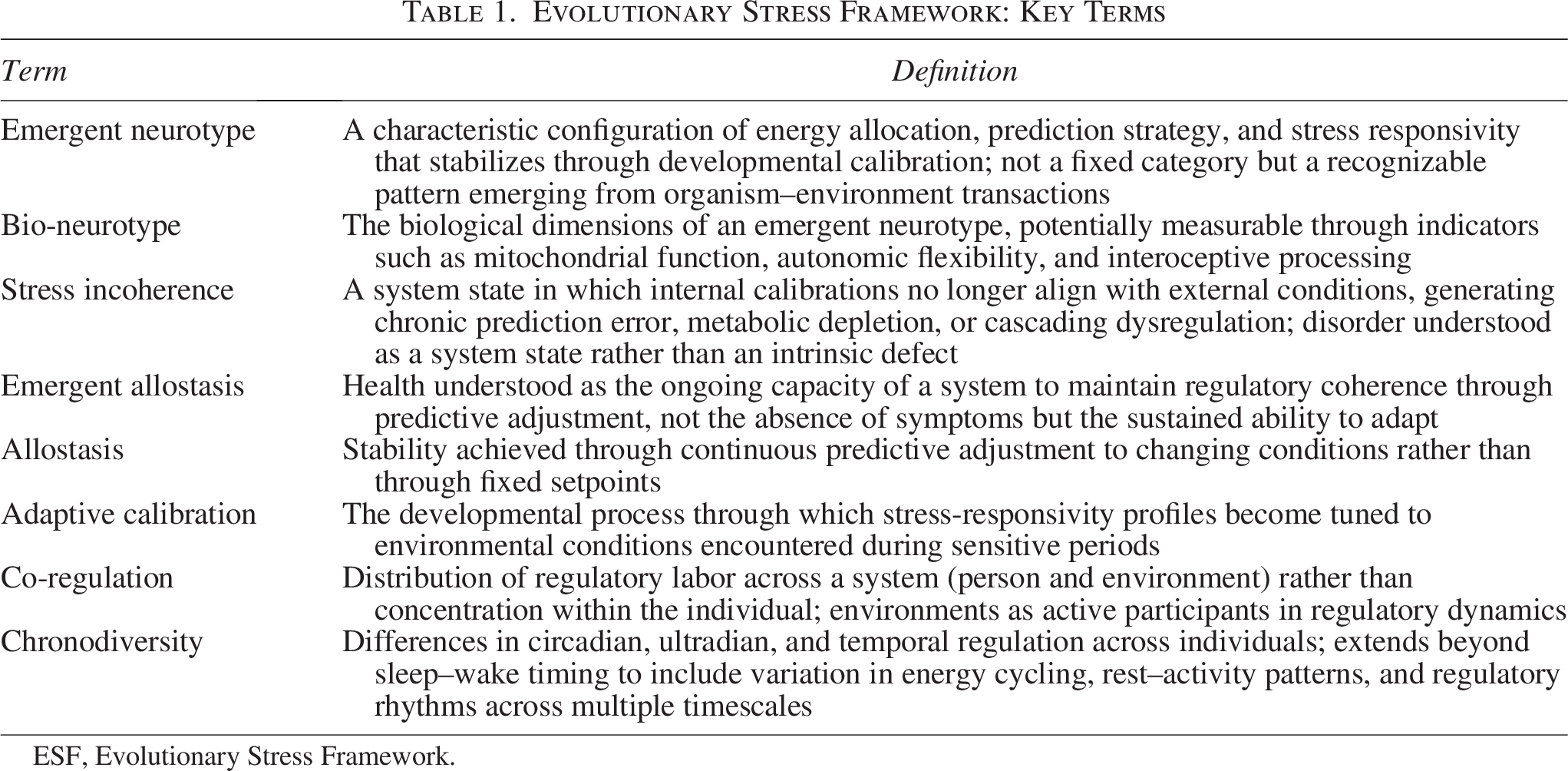
ESF, Evolutionary Stress Framework.
Traditional Models and Their Limits
Understanding why a new framework is needed requires examining what existing models contribute and where each falls short. Four broad approaches have shaped how autism and neurodevelopmental differences are understood: the medical model, the social model and its extensions, the BPS model, and hybrid approaches that attempt to combine elements of each.
The Medical Model
The medical model has dominated clinical and research approaches to autism for over a century.1,2 It locates autism in individual neurology, framing it as a disorder characterized by deficits, amenable to diagnosis, treatment, and ideally correction or cure. This approach enabled research funding, identified genuine support needs, and developed interventions that have helped some individuals. However, it also reduced complex developmental processes to single-cause logic, pathologized difference as deviation from a normative standard, and positioned “normalization” as the primary goal of intervention. Autistic adults have described the costs of this framing: many who learned to camouflage their traits report intense burnout, anxiety, and depression from the sustained effort of passing as neurotypical. 1 Historically, the medical model also contributed to institutionalization, coercive therapies, and eugenic thinking—harms that prompted necessary backlash from the disability rights movement. 3
The Social Model and Its Extensions
The social model of disability, developed by disabled activists in the 1970s and theorized by scholars including Mike Oliver, offered a radical alternative. 4 It argued that disability results not from individual impairment but from environmental barriers and societal attitudes that fail to accommodate human variation. This reframing shifted intervention targets from the person to the environment, advanced inclusion and accessibility, and challenged the stigma attached to bodily and cognitive difference.
Applied to autism, the social model has been invaluable in advocating for communication supports, sensory-friendly environments, and rejection of the assumption that autistic behaviors must be suppressed. Yet critics within disability studies recognized that the original social model risked overcorrection, implying that impairment itself produces no restrictions; only social barriers do.
Carol Thomas5–7 addressed this through the social-relational model of disability. Thomas distinguished between disability (socially imposed restrictions arising from how society responds to impairment) and impairment effects (the direct experiential consequences of bodily or cognitive variation that exist independent of social barriers: fatigue, pain, processing differences, and the need for additional time or support). Her framework acknowledged that even in a perfectly accommodating world, some challenges would remain. As one autistic advocate observed, “I will always be disabled… even if society did a substantially better job… being autistic would still markedly affect how I live.” 8
Thomas’s refinement represents significant progress. Yet the social-relational model remains primarily descriptive: it identifies what interacts (impairment, impairment effects, social barriers, disablism) without providing a mechanistic account of how these dimensions dynamically co-regulate across development. It tells us that biology and society both matter; it does not explain the process through which they shape one another over time.
Anderson-Chavarría’s predicament model extends this further by incorporating biological limitations and psychological dispositions into social model factors, enabling analysis of disability as a situated experience rather than a fixed category. 9 This move toward integration is valuable, but like Thomas’s model, it lacks the process-level architecture needed to explain emergence, calibration, and developmental change.
The BPS Model
George Engel’s (1977) 10 BPS model transformed medicine by insisting that health cannot be understood through biology alone. 11 His nested framework positioned biological, psychological, and social systems as interconnected domains, all relevant to understanding illness and well-being. The BPS model moved clinical thinking beyond biomedical reductionism and has been widely adopted across health care.
Recent work has applied BPS thinking to neurodiversity. Doyle used the framework to argue for workplace accommodations that address the biological, psychological, and social dimensions of neurodivergent experience. 12 Whelpley and colleagues proposed a BPS approach emphasizing person-centered support rather than deficit remediation. 13 Young extended this further with an “embodied biopsychosocial (neuro)diversity” model, arguing that the term neurodiversity is too restrictive in implying primarily biological causation and that psychological and environmental influences require equal emphasis. 14 Dark introduced the Neuro-Cognitive Trait Interaction Model, shifting research design away from diagnostic categories toward neurodivergent experience and trait interactions. 15 These applications represent meaningful advances in how neurodivergence is conceptualized in research and practice.
However, the BPS model has a structural limitation: it treats biological, psychological, and social domains as parallel, rather than as aspects of a single integrated system engaged in continuous exchange. It specifies what should be integrated but does not explain how integration occurs. The model lacks a common currency, a mechanism through which these domains co-regulate across development. In practice, this often results in additive thinking: assess the biological factors, add the psychological factors, add the social factors, then sum them up. But living systems do not work additively. They work through recursive feedback, emergent organization, and continuous calibration. Without a process ontology, the BPS model cannot explain why the same individual thrives in one context and collapses in another, why “comorbidities” cluster in nonrandom patterns, or why interventions that help some people harm others.
Hybrid Approaches: The False Compromise
Recognizing the limitations of both medical and social models, some scholars and advocates have proposed hybrid approaches. As Srinivasan articulates, a representative statement of this position is that a “Dual Approach” to autism combines “strengths-based opportunities” (accommodations, communication tools, inclusive education) with “challenges-based solutions” targeting medical issues and support needs. 16 This framing acknowledges autism’s heterogeneity: one person may primarily need acceptance and employment support; another may need treatment for epilepsy, severe anxiety, or self-injury. The message is that embracing neurodiversity should not mean ignoring genuine suffering.
This balanced perspective has helped defuse polarized debates by fostering mutual understanding between neurodiversity advocates and those aligned with the medical model. A “balanced view of neurodiversity” holds that neurological differences can be valued while specific characteristics are depathologized “unless those characteristics cause harm or discomfort to the individual.” 17
Yet hybrid approaches raise difficult questions. Where exactly is the line between acceptable difference and pathology? Who decides which traits should be preserved as diversity and which should be corrected as disorder? The implicit answer, clinicians and researchers, preserves a fragmented view of the person: acceptable parts to be affirmed, disordered parts to be fixed. This framing does not challenge the core assumption that some aspects of a person are normal while others are broken.
More fundamentally, traits and challenges rarely separate cleanly. A person’s greatest strengths are often entwined with their struggles. 18 Hyperfocus and attention to detail may be inseparable from distractibility or anxiety. Sensory sensitivity that enables pattern detection may be the same sensitivity that produces overwhelm. As researchers have noted, “within any one neurodivergent individual, weaknesses are often the inextricable partner of strengths.” 17 Deciding that certain features should be preserved while others are corrected imposes an artificial split on what, developmentally and neurologically, is an integrated system.
Hybrid models are a step toward integration, but they fail to provide a coherent account of why traits emerge, how they interact, or what produces variation across contexts and time. They manage the tension between medical and social models without resolving it.
The Gap
Each of these models contributes something essential. The medical model takes biological reality seriously. The social model centers on environmental and structural factors. Thomas’s social-relational model and Anderson-Chavarría’s predicament model acknowledge that impairment and context interact.9,19 The BPS model insists on multi-domain thinking. Hybrid approaches recognize heterogeneity and resist false dichotomies.
What none provides is a process-level account of how biological, psychological, and social systems are unified across development, a common currency through which these domains co-regulate, producing the emergent patterns we call neurotypes. Energy regulation and predictive processing offer that currency. The ESF builds on this foundation. Table 2 summarizes how each framework addresses core questions about autism and where the ESF extends them.
Comparison of Frameworks for Understanding Autism
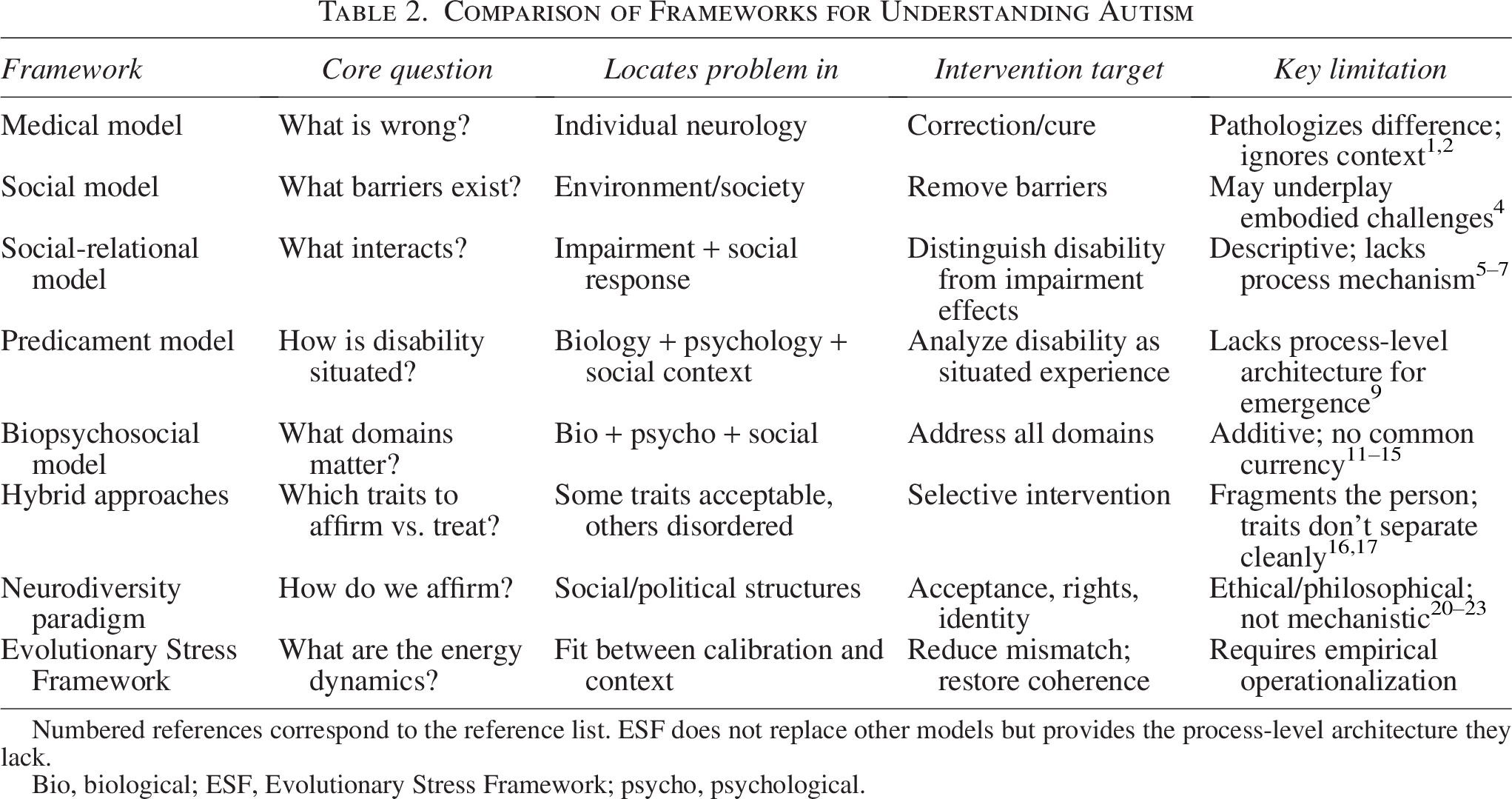
Numbered references correspond to the reference list. ESF does not replace other models but provides the process-level architecture they lack.
Bio, biological; ESF, Evolutionary Stress Framework; psycho, psychological.
The Neurodiversity Paradigm: Accomplishments and Unfinished Work
The neurodiversity movement emerged in the late 1990s and developed collectively within neurodivergent communities rather than through a single founder. 20 It reframed neurological differences—autism, Attention Deficit and Hyperactivity Disorder or ADHD, dyslexia, and related conditions—as natural forms of human variation rather than pathology. 21 Grounded in the social model of disability, the movement challenged deficit narratives by demonstrating that many difficulties associated with autism arise from environmental inflexibility rather than intrinsic impairment. This paradigm shift transformed research ethics and public discourse, centering dignity, agency, and acceptance for neurodivergent individuals.22,23
Critical theoretical advances expanded the framework. Milton’s (2012) Double Empathy Problem empirically demonstrated that communication breakdowns between autistic and non-autistic people reflect bidirectional misattunement rather than unilateral deficit, findings since replicated across multiple studies.24,25 Neuroqueer theory positioned neurodivergence as embodied resistance to cognitive normativity.21,26 Critical autism studies interrogated power structures embedded in diagnostic categories.27,28 These contributions established neurodiversity as both an ethical imperative and an epistemological challenge to normative science.
Walker’s (2021) 29 articulation of the neurodiversity paradigm provides a philosophical foundation for understanding neurodivergence as a form of human biodiversity, dynamic, contextual, and defined by distance from neuronormative expectations rather than by intrinsic deficit. This framing offers an interpretive lens through which research can be understood and evaluated. It does not, however, provide a mechanistic account of how neurological diversity emerges through developmental processes, nor does it explain the physiological dynamics that produce the patterns of strength, vulnerability, and context-dependence that neurodivergent individuals experience.
This is not a criticism but an identification of next steps. Early advocates within the movement recognized the need to move beyond binary oppositions between medical and social models toward more integrative frameworks. 30 As Pellicano and den Houting (2022) and Chapman (2023) 31 have noted, advancing neurodiversity research requires bridging social theory with complexity science, maintaining affirmation while adding mechanistic precision about how neurological variation develops through organism–environment transactions.
The neurodiversity paradigm provides the ethical and philosophical ground. What remains is the scientific architecture: a framework capable of explaining why neurotypes emerge, how they are maintained, and what produces the variable outcomes observed across contexts and lifespans. The ESF offers this architecture.
The ESF: A Complexity-Based Paradigm
The ESF offers a scientifically grounded, systems-based alternative to both the medical and social models of neurodiversity. Rather than asking whether traits are disordered or socially oppressed, ESF asks a different set of questions entirely: What are the energy demands of this system? What forms of stress calibration have emerged over time? What environmental contexts shaped these adaptations? In this view, autism and related neurotypes are not static disorders or fixed identities but dynamic calibrations of a stress-regulating, energy-managing system.
Energy and Prediction as Common Currency
The BPS model correctly identified that biological, psychological, and social domains all matter. What it lacks is a mechanism, a common currency through which these domains co-regulate across development. Energy regulation and predictive processing provide that currency.
Contemporary neuroscience increasingly understands the brain-body system as fundamentally an energy regulator.32–34 The brain does not passively react to the world; it continuously anticipates metabolic needs and allocates resources accordingly. This is allostasis: stability achieved not through fixed setpoints but through constant predictive adjustment to changing conditions.34,35
Predictive processing models describe how the brain minimizes uncertainty under metabolic constraint.36,37 The system generates predictions about incoming sensory and interoceptive signals, compares them against actual input, and updates when predictions fail. Prediction error is metabolically expensive. The brain is therefore motivated to either update its models or seek environments where predictions succeed, reducing the energetic cost of being wrong.
Within this framework, stress is neither an external force nor a psychological state. It is the energetic and informational work required to maintain coherence when predictions fail, when demands exceed capacity, or when the system must adapt to conditions it did not anticipate. Stress, as defined here, becomes the medium through which biological, psychological, and social systems continuously shape one another. This is what the BPS model describes but cannot explain.
Developmental Calibration: How Neurotypes Emerge
If stress and energy regulation are the mechanisms, development is the process through which they produce stable patterns. The Adaptive Calibration Model 38 and the Hidden Talents framework 18 demonstrate that early environments shape stress-responsivity profiles through iterative feedback. Individuals do not develop generic stress systems; they develop calibrated systems tuned to the conditions they encountered.
When environments are unpredictable, unsafe, or resource-scarce, systems calibrate toward vigilance, heightened pattern detection, and energy conservation. When environments are predictable and supportive, systems calibrate toward flexibility, exploration, and social engagement. Crucially, these calibrations are not damage. They are adaptive recalibrations: the system’s best response to the ecology it inhabited during sensitive developmental periods.39,40
These calibrations stabilize into what ESF terms emergent neurotypes: characteristic configurations of energy allocation, prediction strategy, and stress responsivity that persist across time. Autistic traits, sensory sensitivities, intense focus, preference for routine, and differences in social processing can be understood as features of such configurations. They reflect how a particular system learned to regulate uncertainty and conserve energy under the conditions it faced.
This framing accounts for the heterogeneity that has frustrated autism research without fragmenting the population into arbitrary subtypes. Variation is expected in complex adaptive systems. Different developmental ecologies produce different calibrations. What unifies autistic experience is not a single gene, brain region, or behavioral marker, but a recognizable pattern of energy-prediction dynamics. These bio-neurotypes emerge and often converge through shared developmental processes even as they manifest differently across individuals.
Pathology Reconceptualized: Disorder as Feedback, Not Essence
Here, the ESF makes its most consequential move. Pathology, in this framework, is not a deviation from a normative baseline. It is a state of the system: what happens when energy-prediction dynamics become unsustainable under current conditions.
ESF introduces the concept of stress incoherence to describe this state. Stress incoherence occurs when a person’s internal calibrations no longer align with external conditions, when the strategies that once enabled survival now generate chronic prediction error, metabolic depletion, or cascading dysregulation across systems. It occurs when trade-offs accumulate unsustainably: when the costs of a regulatory strategy exceed its benefits in the current environment.
This reframe has significant implications. The same person with the same neurology can present as thriving or as disordered, depending on context. The architecture did not change; the fit between architecture and environment did. Autistic burnout, for example, represents not a defect in the person but a state of allostatic overload produced by sustained mismatch between neurotype-specific regulatory needs and environmental demands. 41
In this view, intervention does not aim to fix a broken person. It seeks to restore coherence: to reduce the energetic mismatch between system and context, to shift conditions so that existing calibrations become sustainable, or to support recalibration where possible and desired. The target moves from the individual to the transaction. Figure 1 illustrates this progression, tracing how developmental calibration produces emergent neurotypes whose outcomes differ by environmental context and accumulate into either stress incoherence or emergent allostasis.
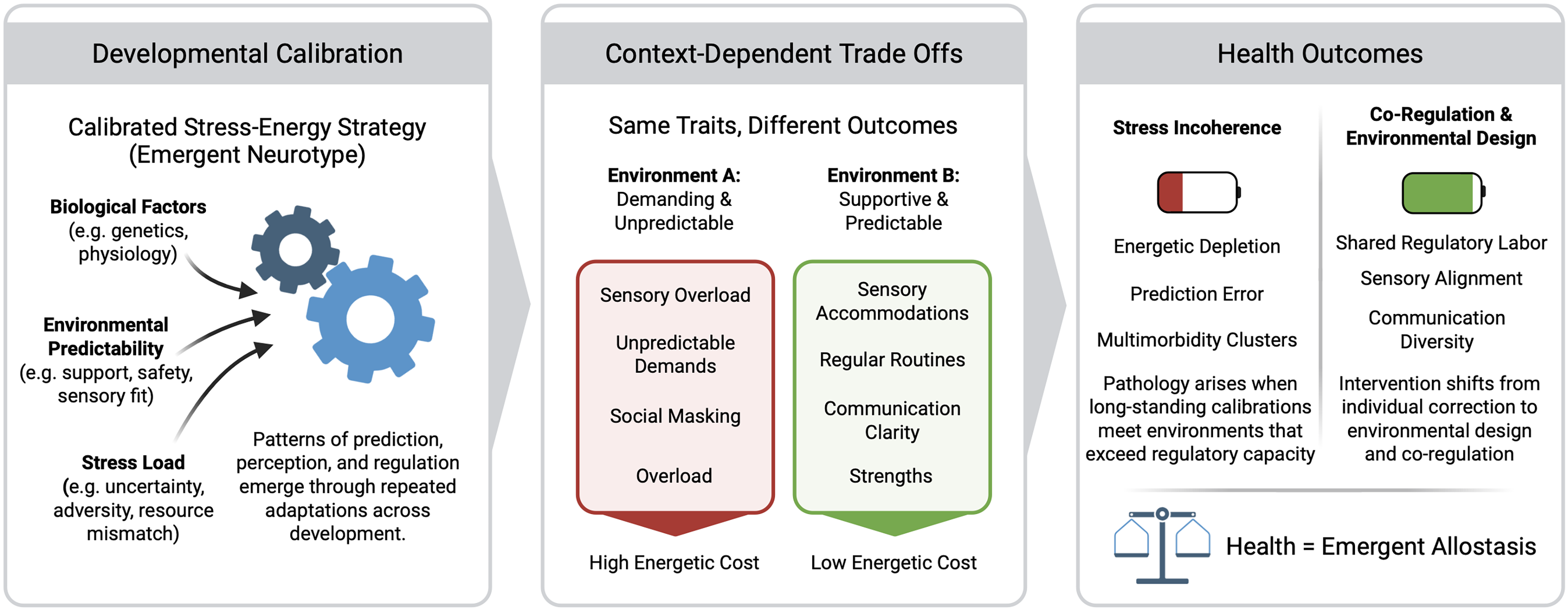
The Evolutionary Stress Framework: From Developmental Calibration to Health Outcomes. This figure illustrates the core logic of the Evolutionary Stress Framework (ESF).
Trade-Offs: Strengths and Vulnerabilities as Inseparable
Every calibration carries context-dependent trade-offs. This is not a limitation of autistic systems; it is a fundamental feature of all biological optimization under constraint.
Heightened sensory precision enables pattern detection and detail-oriented processing. It is also the same system that produces sensory overwhelm in unpredictable or high-intensity environments. Deep, monotropic attention supports sustained focus, expertise development, and flow states. 42 It is also the same system that makes task-switching costly and interruption dysregulating. Reduced reliance on social prediction frees processing for environmental analysis; it also increases the metabolic cost of navigating social ambiguity.
These are not separate traits to be sorted into strengths and deficits. They are outputs of the same underlying regulatory architecture operating under different conditions. This is why hybrid approaches that attempt to preserve the “good” traits while eliminating the “bad” ones misunderstand the system. You cannot remove the vulnerability without altering the strength, because they emerge from the same calibration.
What varies is not the inherent value of the trait but the fit between trait and context. Support, therefore, means optimizing fit by designing environments that reduce the costs of a given calibration while preserving its benefits, rather than demanding that the person become a different kind of system.
Integration with Existing Autism Theories
The ESF does not replace existing theories of autism. It provides the integrative architecture within which they cohere.
Enhanced Perceptual Functioning 43 describes heightened low-level perception and locally oriented processing. In ESF terms, this reflects a prediction regime weighted toward high-precision, fine-grained environmental sampling, an energy-allocation strategy that prioritizes detail over gestalt. Monotropism 42 describes attention concentrated in fewer channels with greater intensity, an efficient strategy for deep learning under metabolic constraint. The Intense World theory 44 proposed hyper-perception and hyper-memory as core features; ESF situates these as consequences of a system maintaining coherence under elevated sensory and metabolic load.
Predictive processing accounts of autism45–47 describe differences in precision weighting and prediction updating. ESF explains why such differences emerge: they are calibrated responses to developmental ecologies that shaped how the system distributes precision across sensory and social domains. The Double Empathy Problem48,49 describes reciprocal misattunement between differing neurotypes. ESF frames this as interacting prediction regimes, systems with different precision weightings generating mutual prediction error, not a deficit in one party.
Each of these theories captures a facet of autistic experience. ESF provides the energetic and developmental context that explains how these facets cohere, why they co-occur, and when they become costly versus advantageous. Table 3 summarizes how ESF integrates these theories within a shared energy-prediction framework.
Integration of Existing Autism Theories Within ESF

Numbered references correspond to the reference list. ESF does not contradict these theories but provides the energetic and developmental context explaining how their observations cohere.
ESF, Evolutionary Stress Framework.
Toward Implications
If neurotypes are emergent stress–energy strategies calibrated across development, then heterogeneity is not noise to be averaged away but signal to be understood. If diversity functions as distributed adaptive capacity at the population level, then systems that impose uniform demands sacrifice the robustness they require.
These principles have concrete implications for how autistic adults are understood, supported, and included.
Implications for Autistic Adulthood
The stakes of this reframe are not abstract. Autistic adults experience significantly reduced life expectancy, though the magnitude of this disparity is debated. Early estimates suggested a 16-year mortality gap, 50 but more recent population-based research indicates the reduction may be smaller, on the order of 5–10 years for those without co-occurring intellectual disability, with prior figures likely inflated by diagnostic ascertainment bias. 51 Suicide risk is significantly increased, particularly among those without intellectual disability. 52 Autistic burnout, characterized by chronic exhaustion, reduced tolerance to sensory and social input, and loss of previously acquired skills, has emerged as a defining experience of autistic adulthood. 41 Yet it remains largely unaddressed in clinical settings. These outcomes are not inevitable consequences of autistic neurology. They are likely consequences of chronic energetic mismatch between neurotype-specific regulatory needs and environments that fail to accommodate them.
Stress Embedding Across Adulthood
Allostatic load accumulates. The energetic costs of sustained mismatch do not reset; they embed across physiological systems over time.53,54 Autistic adults navigating environments designed for neurotypical regulation face continuous prediction error, elevated metabolic demand, and insufficient recovery. Minority stress mechanisms compound these costs: chronic exposure to stigma, exclusion, and the pressure to camouflage compound physiological burden.55,56 Research on camouflaging consistently links masking behaviors to anxiety, depression, and suicidality, not because autistic people are inherently fragile, but because suppressing one’s natural regulatory strategies is energetically unsustainable.57,58
The ESF lens clarifies why the same individual may thrive in environments that align with their calibration and collapse in environments that do not, and why outcomes vary dramatically across contexts and life stages. Transitions—entering the workforce, losing support structures, navigating health-care systems—represent moments of heightened vulnerability not because of an intrinsic deficit but because they impose recalibration demands that the system may lack resources to meet. ESF underscores that calibration plays out differently across developmental periods: the ratio of stressor to non-stressor input shifts as contexts change, and adulthood often concentrates demands in domains where autistic calibrations are most costly.
Multimorbidity as Co-Calibration
Autistic adults experience elevated rates of gastrointestinal, immune, metabolic, and psychiatric conditions.59,60 Traditional frameworks treat these as separate “comorbidities,” co-occurring but independent problems requiring independent interventions. The ESF reframes multimorbidity as co-calibration: interdependent expressions of energy regulation across coupled physiological systems.
The same allostatic architecture regulates sensory processing, immune function, gut motility, and affective states. When that architecture operates under chronic strain, dysregulation cascades across systems. Conditions cluster not by coincidence but because they share regulatory origins, so interventions that target one system while ignoring the others miss the underlying dynamics. Effective support requires recognizing the person as an integrated energy-regulating system, not a collection of separate disorders.
From Accommodation to Co-Regulation
Current inclusion frameworks emphasize accommodation: adjustments made to environments so that individuals can participate. This framing, while valuable, positions the person as the locus of the problem and the environment as making exceptions. The ESF suggests a deeper reframe: from accommodation to co-regulation.
Co-regulation distributes adaptive labor across the system rather than concentrating it within the individual. Environments are not passive backdrops to which people must adjust; they are active participants in regulatory dynamics.61,62 Designing for co-regulation means building contexts that reduce prediction error, provide sensory and temporal predictability, respect chronodiversity (differences in circadian and temporal regulation), and allow diverse regulatory strategies to operate without penalty. It means shifting the question from “How can this person fit in?” to “How can this system support coherent regulation for diverse neurotypes?”
This is not merely a philosophical shift. It has implications for workplace design, health care delivery, educational policy, and community infrastructure.
Discussion
The ESF repositions neurodiversity within a complexity-based paradigm that links stress physiology, energy regulation, and developmental calibration. It bridges the descriptive strength of existing models with the mechanistic precision needed to explain how neurological variation emerges, persists, and produces variable outcomes across contexts. The following discussion outlines implications for research, clinical practice, and systems design.
Research Directions
The ESF invites multilevel research integrating molecular, physiological, interoceptive, and social data within shared stress-energy models. Rather than seeking singular causes or universal biomarkers, researchers can examine how distinct energy-regulation strategies coalesce into coherent neurotypes under different environmental pressures. Future studies might operationalize bio-neurotypes through measurable indicators such as mitochondrial function, 33 autonomic flexibility,63,64 or interoceptive accuracy. 65 Longitudinal designs tracking calibration shifts across developmental transitions could illuminate how context shapes regulatory trajectories over time.
The framework also supports methodological pluralism. Qualitative research on sensory regulation, burnout, and masking can inform quantitative modeling of energy flows in predictive systems, connecting biology, behavior, and lived meaning within a transdisciplinary scaffold. Participatory approaches that center autistic expertise are essential, both for ethical grounding and for ensuring that constructs like “stress incoherence” accurately capture lived experience rather than imposing external categories. 66 Computational models simulating attractor dynamics and calibration shifts offer another avenue, allowing researchers to test ESF predictions about how environmental changes should alter regulatory states.
Clinical Translation
Clinically, the ESF reframes intervention targets. Rather than suppressing traits or training compliance, support aims to reduce energetic mismatch and restore regulatory coherence. This means moving regulatory work off the individual and into the care ecology by designing contexts that lower the metabolic cost of participation rather than requiring individuals to bear it alone.
Leverage points exist across domains. Biological interventions address sleep architecture, circadian alignment, or nutritional support, not to normalize the person but to reduce allostatic burden and support recalibration capacity. Psychological interventions enhance interoceptive awareness, helping individuals recognize and respond to internal signals before dysregulation cascades.67,68 Environmental interventions might reduce sensory unpredictability, increase temporal structure, or create conditions where the person’s existing regulatory strategies can operate without penalty.
Crucially, what stabilizes one person may deplete another. The ESF provides a framework for personalizing support around individual bio-neurotypes rather than applying standardized protocols. A clinician informed by ESF asks not “How do I reduce this behavior?” but “What is this behavior regulating, and how can we meet that need more sustainably?”
Systems and Policy
At the systems level, the ESF has implications for organizational design, education, employment, and community infrastructure. If diverse neurotypes function as complementary regulatory strategies within complex systems, then institutions that impose uniform expectations sacrifice adaptive capacity. Organizations benefit when they cultivate cognitive diversity, balancing stability-oriented and exploration-oriented profiles rather than selecting for a single neurotypical template.69,70
Policy informed by ESF would design environments that increase predictability, reduce unnecessary exposure to stressors, and diversify participation structures. This might include temporal flexibility that honors chronodiversity, sensory design that accommodates diverse regulatory needs, and communication plurality that legitimizes different processing speeds and modalities. Inclusion becomes an ecological practice: sustaining adaptive diversity because the system requires it for its own robustness, not merely because fairness demands it.
What ESF Does Not Claim
The framework requires explicit boundaries. Evolution does not optimize for fairness, autonomy, or flourishing; it describes how variation persists, not how people should be treated. Population-level adaptiveness does not translate automatically into individual well-being. Traits that enhance collective robustness may impose substantial costs on those who carry them, especially when environments fail to support their regulatory needs.
Disability justice frameworks, therefore, remain essential. 71 Biological explanation must never substitute for structural accountability. The ESF clarifies why neurodivergence exists; it does not justify placing adaptive burdens on individuals for the benefit of groups. People are not resources for populations. Individual dignity, consent, and agency override any evolutionary or systems-level narrative. The goal is not to rationalize existing conditions but to transform them by building environments where diverse neurotypes can regulate, adapt, and thrive.
Limitations and Future Directions
The ESF synthesizes empirically grounded constructs—allostatic load, predictive processing, developmental calibration, systems emergence—into a unified architecture for understanding neurodiversity. The individual pillars rest on substantial empirical foundations; the framework’s contribution lies in their integration. Core ESF constructs—bio-neurotype, stress incoherence, and emergent allostasis—operationalize these established principles but require direct empirical testing before the integrative model itself can be validated. The framework generates falsifiable predictions; what remains is the collaborative work of testing them.
Empirical development will require cross-disciplinary collaboration linking cellular, physiological, behavioral, and social data within integrated designs. Longitudinal studies tracking regulatory calibration across developmental transitions, school entry, adolescence, workforce entry, menopause, and aging could test whether ESF predictions about context-dependent outcomes hold. Intervention studies examining whether reducing energetic mismatch (through environmental modification, sensory design, or co-regulatory support) produces measurable improvements in allostatic indicators and quality of life would provide crucial validation. Comparative work examining whether ESF constructs apply across neurodivergent populations beyond autism, ADHD, dyslexia, and developmental coordination differences could clarify the framework’s scope and limits.
Translation presents its own challenges. Complexity science concepts resist simplification, and the language of “adaptation” and “calibration” risks misappropriation, used to deny support needs because traits are “adaptive” rather than impairing. The framework must be communicated carefully to avoid reinforcing the very minimization it seeks to counter.
Finally, the ESF is an open model. It does not provide final answers but aims to open new questions about how difference sustains life. The framework must evolve through ongoing dialogue with autistic scholars, clinicians, and communities, ensuring that theoretical constructs remain grounded in lived experience and accountable to those whose lives they describe.
Conclusion
The ESF offers a unified paradigm for understanding neurodiversity through the lens of adaptive calibration, energetic trade-offs, and the emergence of complex systems. It does not reject previous models but extends them by providing a mechanistic architecture that explains what they describe. The medical model’s observations about biological difference, the social model’s insights into environmental barriers, the BPS model’s insistence on integration, and the neurodiversity paradigm’s ethical commitments all find coherence within a framework grounded in energy regulation and predictive processing. Pathology is reconceptualized not as a deviation from a norm but as a state of the system: what happens when energy-prediction dynamics become unsustainable under current conditions.
This reframe carries practical weight. Each paradigm asks a different question: the medical model asks what is wrong, the social model asks what barriers exist, and the neurodiversity paradigm asks how we affirm. The ESF asks: what are the energy dynamics, and how can we support sustainable calibration? Intervention shifts from trait suppression to environmental design, from accommodation to co-regulation, and from fixing individuals to transforming contexts.
The stakes are immediate: autistic adults experience well-documented disparities in health, mortality, and burnout. These are outcomes of chronic mismatch rather than fixed intrinsic defect. They emerge when systems externalize adaptive labor onto individuals whose regulatory needs differ from dominant norms. Better frameworks enable better conditions.
The theoretical architecture is now available. What remains is implementation—empirical development, clinical translation, and the institutional redesign required to build environments where diverse neurotypes can regulate, adapt, and thrive.
Footnotes
Acknowledgments
Portions of this article were developed with the assistance of AI language models (OpenAI ChatGPT and Anthropic Claude) via their respective platforms. AI was used as a cowriting tool to support drafting, synthesis, and refinement of complex systems concepts. All content generated was reviewed, edited, and fact-checked by the lead author (Lori Hogenkamp) and integrated into original argumentation and evidence synthesis by the human researcher. This reflects an experimental, neurodivergent-led approach to enhancing scholarly writing and interdisciplinary clarity.
The use of AI in this work reflects an intentional collaboration to support the author’s neurodivergent cognition, particularly in externalizing nonlinear ideas and managing executive functioning demands within the writing process. The ethical use of AI was maintained throughout, with transparency, authorship integrity, and intellectual ownership preserved.
Prompts provided to the AI included detailed instructions and philosophical framing, such as:
“Draft a summary of how stress functions as an emergent regulator in energy-constrained environments, drawing from Bruce McEwen, Lisa Feldman Barrett, and Manish Arora.” and “Reframe autism as a systems-level neurodevelopmental calibration profile shaped by environmental stress and bio-neurotype trade-offs, avoiding single-cause logic.”
Authorship Confirmation Statement
Lori Hogenkamp led the conceptualization, original drafting, and formal analysis of the article. She developed the core framework and primary arguments. Dhwani Sanghavi and Heini Natri contributed to writing through review and editing and provided valuable feedback throughout the revision process. All authors reviewed and approved the final version of the article.
Author Disclosure Statement
The authors declare no potential conflicts of interest with respect to the research, authorship, or publication of this article.
Funding Information
No external funding was received for the development of this article.