




Abstract
Background:
Autistic students in postsecondary education face diverse challenges, yet institutions vary significantly in their preparedness and investment in providing adequate support. While individual-level resources are increasing, relational and systemic factors impacting social support remain underexplored. This study investigates the challenges and barriers to social support for autistic university students in Hong Kong.
Methods:
This qualitative study included 30 autistic university students from 14 local higher institutions in Hong Kong. We used semi-structured interviews to gather first-person perspectives on participants’ social support experiences. We used thematic analysis to generate salient themes and subthemes from the interview data.
Results:
We synthesized four major themes that described the challenges to social support: (1) pervasive misunderstanding and negative treatment by others, (2) juggling disclosure of autism across different contexts, (3) gaps in current support systems and services, and (4) the need for self-development to navigate university life. Participants reported pervasive stereotypes, stigma, and inadequate understanding of autism, leading to social isolation and discrimination. Fear of negative consequences and the perceived need for support influenced their disclosure decisions. Systemic barriers included inconsistent services, lack of individualized supports, and unaccepting campus climates. Despite these challenges, students emphasized the importance of self-advocacy, mutual peer support, and moderate parent support.
Conclusion:
Autistic university students in Hong Kong face various relational and systemic barriers to social support. Current support systems are perceived as inadequate, generic, and lacking a coordinated and systematic framework. Efforts to improve campus culture, increase autism awareness, and provide tailored services are essential to better support autistic students and meet their needs in the local environment. Future research should focus on developing comprehensive support systems and exploring the sociocultural factors impacting autistic students’ experiences.
Community Brief
Why is this an important issue?
Autistic students in universities face many challenges that can affect their academic performance, social life, and overall well-being. While there are resources to help them, these supports are often not enough or not consistent. Autistic students deserve the same opportunities and support to be successful in their university life.
What was the purpose of this study?
The purpose of this study was to explore the barriers to social support that autistic university students experience in Hong Kong. We aimed to understand these students’ perspectives on the support they receive, the challenges they face, and how these barriers affect their university life.
What did the researchers do?
The researchers conducted interviews with 30 autistic students from 14 universities and colleges in Hong Kong. We designed these interviews to capture the students’ personal experiences about their social support in university. We then analyzed the interview data to generate common themes and patterns.
What were the results and conclusions of the study?
We developed four major themes that describe the barriers to social support for autistic students. First, autistic students often face stereotypes and stigma from other people, which can make them feel alone and discriminated against. Second, autistic students are not sure whether they should tell others they are autistic because they are afraid of what will happen. Third, there are big gaps in the services and accommodations provided by universities, which are usually general and not made to fit the needs of each student. Fourth, autistic students stress how important it is to speak up for themselves, get help from peers, and make sure everyone feels welcome in university.
What is new or controversial about these findings?
The study highlights the social and cultural factors in Hong Kong that affect the lives of autistic students. It shows how autism is stereotyped and shamed. It also points out how universities in Hong Kong do not have enough support systems, which is a big problem since there are no laws that regulate inclusive education. These findings challenge the current practices and demand that the system be changed to better support autistic students.
What are potential weaknesses in the study?
One weakness is that it only focuses on the students’ perspectives. Including views from other important people, such as university staff and parents, could provide a fuller picture of the support systems. The study only involved local Chinese students and did not capture the experiences of international or exchange students.
How will these findings help autistic adults now or in the future?
These findings can inform universities and policymakers about the specific needs and challenges faced by autistic students. By understanding these barriers, universities can develop more effective support systems and create more inclusive environments. This can lead to better academic outcomes, improved mental health, and a more positive university experience for autistic students. In the future, these insights may also change the social attitudes and policies toward autism.
Introduction
There are available resources to support autistic students in postsecondary education, but institutions around the globe differ vastly in their preparedness and investment in providing services that can meet the diverse needs of autistic individuals.1,2 Recent reviews have revealed that there is a growing availability of resources and services to assist individual autistic university students in addressing their common challenges, including learning needs, social challenges, sensory sensitivity, emotional challenges, and career development.3–5 However, the extant literature has not paid much attention to the systemic issues and implementation barriers that impact the provision of support in the university system. For example, misunderstanding and stigma toward autism and inaccessible or inappropriate services can contribute to an overall negative campus climate that affects autistic students’ socialization, mental health, and personal development.3–5
The present study aims to understand the barriers to social support perceived by autistic university students. Social support can be generally understood as any kind of support one receives from other people, such as tangible support, having someone to talk to or provide emotional support, belonging to or identifying with a group, and developing a positive image in relation to others.6,7 Social support an individual receives from different interpersonal networks and contexts can benefit various facets of one’s physical and psychological well-being. 8 Given its significance, there is surprisingly little research focused on its application in autistic adults. Many autistic adults have reported having smaller social networks,9,10 having lower informal social support, 11 and receiving inadequate medical and psychological professional support 9 compared with neurotypical populations. Some studies found that perceived social and informal support provided by other people was related to a higher quality of life in autistic individuals.11,12 Tangible support was also linked to reduced depression in autistic people, which mitigated their risk of suicidal ideation. 13 What is important appears to be the discrepancy between the support perceived to be necessary and the actual support received. A smaller discrepancy was related to a higher quality of life 12 and lower psychological distress. 9 Autistic adults’ experience of victimization or discrimination was also shown to aggravate the effects of inadequate professional support on their mental health outcomes. 9
In postsecondary education settings, extensive research has documented various academic, social, and personal challenges faced by autistic university students14,15 so the present study goes more in-depth to investigate the relational and systemic barriers to social support. Developing relationships and connecting with people within one’s social network can give access to a broader array of social support for autistic university students. 16 Notwithstanding the varieties in the size of social circle or frequency of interaction, autistic individuals do desire and value meaningful friendships and connections.10,15,17,18 However, the lack of peer acceptance on the university campus can be a barrier for autistic students to initiate friendship. 19 Autistic university students have experienced widespread misunderstanding from people around them and inadequate support from the university, which contributes to their mental health struggles and poor well-being. 17 Transition-age autistic youths have expressed their worries about university life that fall into distinctive domains of macro social world and general support, alongside other, more micro aspects of social and personal challenges. 20 Although relational and systemic barriers are important to our understanding of autistic students’ experience of social support, these factors were only mentioned peripherally in past studies.9,13 Therefore, it is important to consider how autistic university students experience the barriers that significantly impact their social support.13,19 There is also a call for more attention to the first-person experience of autistic students to meaningfully include their perspectives in informing research, practice, and systems change in postsecondary education.21–23
This study is part of a larger research that explores the experiences of autistic students in Hong Kong universities. Compared to the West, few Asian regions have anti-discrimination legislation or disability policies that protect the rights of individuals with disabilities. 24 In Hong Kong, service provision for students with different disabilities [more commonly called Special Educational Needs (SEN)] has been established in grade schools for decades and is consistently supported by the government, despite not being legally mandated.25,26 Although services for autistic children and adolescents are available in school and community, systematic supports for autistic adults beyond school age have long been lacking.27,28 Hong Kong is a signatory to the Convention on the Rights of Persons with Disabilities and has enacted the Disability Discrimination Ordinance to provide legal protection against discrimination on the grounds of disability. Nonetheless, universities tend to control their own policies and systems to support education for students with disabilities, resulting in a varied quantity and quality of support across institutions. 29 Only a few small-scale interview studies have attempted to understand the experiences of university students with physical disabilities,29–30 unspecified types of SEN, 31 and specific learning difficulties among intellectually gifted students, 32 but none of these studies focused on autistic students. Concerns identified in the local university systems included inadequate staff knowledge and skills, inaccessible or inappropriate services and accommodations, and lack of communication and coordination within an inclusive education framework.29–31 However, systematic investigation of autistic university students is absent in the territory. The current study focuses on the situations of autistic students and aims to explore their perceived barriers to social support in Hong Kong universities.
Methods
Positionality
G.Y.H.L. (first author) and J.C.Y.W. (second author) initiated this research, intending to improve the experience of autistic students in postsecondary education in Hong Kong. G.Y.H.L. is an educational/school psychologist with expertise in autism and qualitative research, while J.C.Y.W. is a clinical psychologist providing specialized adult autism services in community-based settings. Despite our neurotypical identities, the team adopted a neurodiversity-affirming framework to understand the needs of autistic students by listening to their first-person perspectives so their experiences can be meaningfully included in future service development and advocacy. We approached this research using a constructivist paradigm 33 to explore autistic students’ interactions with their immediate environment and cultural contexts. Based on our research/clinical experience and prolonged engagement with the local autism community, we were particularly concerned about the lack of, or at best, varied, supports for autistic students in local universities. Recognizing the tremendous service gaps for this population, we hoped to create meaningful changes to benefit more autistic and other neurodivergent university students, but we acknowledged the need to first understand the status quo by listening to the students’ voices.
Participants
We used convenience sampling to recruit autistic students through local organizations that provide autism services, as well as through university and college campuses. Recruitment methods included distributing flyers, sending mass emails, and leveraging personal connections. Inclusion criteria were (1) having a self-reported autism spectrum disorder (ASD) formally diagnosed by a medical doctor or psychologist and (2) being a current student or recent graduate (within one year of graduation) of a full-time program in a local university or college. Thirty autistic students (mean age = 22.5; range = 18–39) (37% females) (autism spectrum quotient [AQ] mean scores = 31; range = 19–41) from 14 different universities or colleges participated in this study. The majority were pursuing a bachelor’s degree (60%), while others were in subdegree (e.g., associate degree, higher diploma; 27%) or postgraduate (13%) programs. Their majors ranged from engineering (23%), science (20%), arts (17%), to education, medicine, social science, media, and others.
Procedures
The Survey and Behavioural Research Ethics Committee at The Chinese University of Hong Kong (SBRE-20-297) approved this study. Interested participants enrolled in the study by completing an online recruitment form. They were then contacted to arrange a desired time for an individual interview using a modality they preferred (online or in person). Prior to the interview, all participants provided informed consent and completed a brief demographic survey about their personal and educational backgrounds. After the interview, participants completed the Traditional Chinese version 34 of AQ 35 to provide their perceptions of their characteristics associated with autism. Each participant received supermarket cash coupons of $100 Hong Kong dollars to compensate for their time and participation.
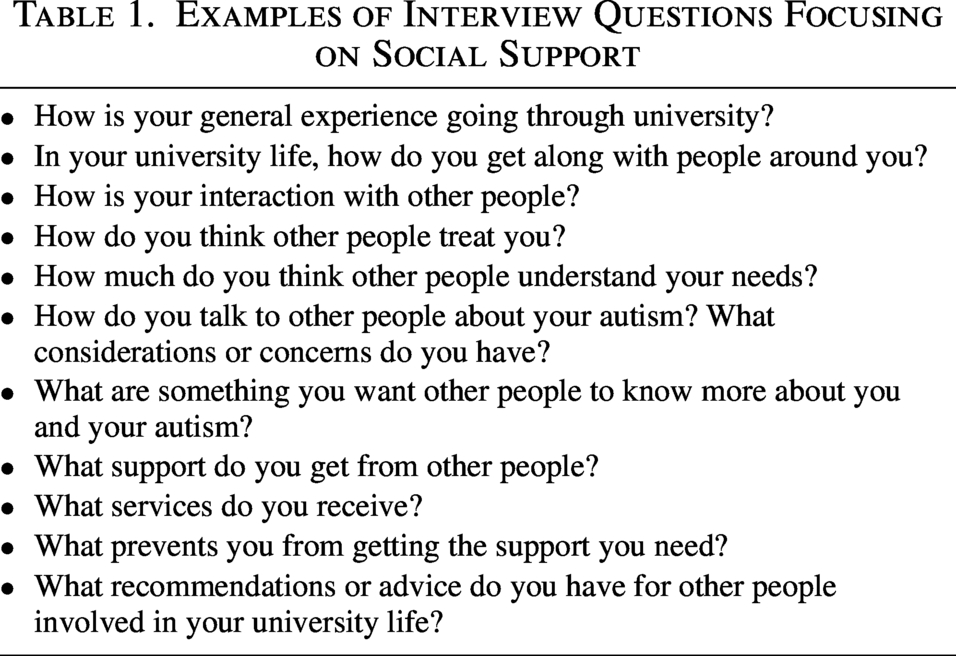
G.Y.H.L. and/or a research assistant conducted all the individual interviews. We used semi-structured interviews to gather participants’ first-person perspectives about their experience, thoughts, and perceptions. 36 G.Y.H.L. and J.C.Y.W. developed an interview protocol with open-ended questions to explore participants’ experiences and perceptions of their university lives. We discussed different aspects of postsecondary education, such as transition from secondary school, academic learning, social relationships, extracurricular activities, jobs, dormitories, and other relevant aspects brought up by participants. This article reported the information obtained from the sections about social support, which were focused on how other people around the autistic students interact with them, perceive them, and support them or lack thereof (see Table 1 for examples of interview questions). When necessary, follow-up prompts were used to guide participants to discuss their support experience with specific people (e.g., peers, professors, and staff) and support contexts (e.g., services, programs, accommodations, and support personnel).
Examples of Interview Questions Focusing on Social Support
All interviews were conducted in Cantonese Chinese. Alternative methods of expression, such as the use of whiteboards and written questions, were flexibly used to accommodate the communication needs of individual participants. We audio-recorded all the interviews with participants’ consent. The mean length of interviews was 79 minutes (range = 50–125 minutes). A team of student research assistants later assisted with the verbatim transcription of interview recordings.
Data analysis
Our analytic approach followed the guidance of Braun and Clarke’s37,38 thematic analysis. MAXQDA was used to manage and assist with data analysis. G.Y.H.L. and the research assistant began with reading the transcripts closely to familiarize ourselves with all the interview data. Each of us independently performed in vivo coding on several transcripts to inductively identify salient content that can answer the research questions. This initial phase of coding yielded different levels of codes and subcodes that can capture similar experiences across participants. 39 During recurring discussions, we compared our coding, clarified the code definitions, and resolved discrepancies between us. We reflected on our at times different interpretations of the data and strived to complement each other’s perspectives in our analysis in order to yield better insights into participants’ experience. 40 We then used the refined coding system to independently code the rest of the transcripts and met regularly to discuss our analysis. Afterward, G.Y.H.L. wrote analytic memos 41 to integrate the information within and across codes, compared across memos to look for meaningful patterns, and synthesized the data into themes and subthemes that can meaningfully represent the participants’ experience. We noticed the rich information about the barriers to social support and the challenges experienced by the participants (instead of the success experience reported in a study by Lam 42 ), so we decided to do justice to this important aspect of participants’ experience by dedicating this article to this topic. 43
To establish trustworthiness,44,45 we invited all participants to member reflection by reviewing the theme structures and descriptions. Several participants responded and endorsed the results without further suggestions. Moreover, we kept observation notes and reflective journals during the interview processes and compared them against our analysis to ensure our interpretation aligned with the participants’ perspectives. Also, we conducted analysis in Cantonese to ensure cultural-linguistic relevance in the findings, while only translating the results to English in writing the report. To enhance transparency and credibility, we included thick descriptions using participants’ quotes close to the original Cantonese narratives to the fullest extent possible.46,47 Recognizing the impossibility of using literal translation to fully represent identical ideas across languages, we provided cultural contexts to the local slang and terms. Original Chinese quotes are available upon request.
Results
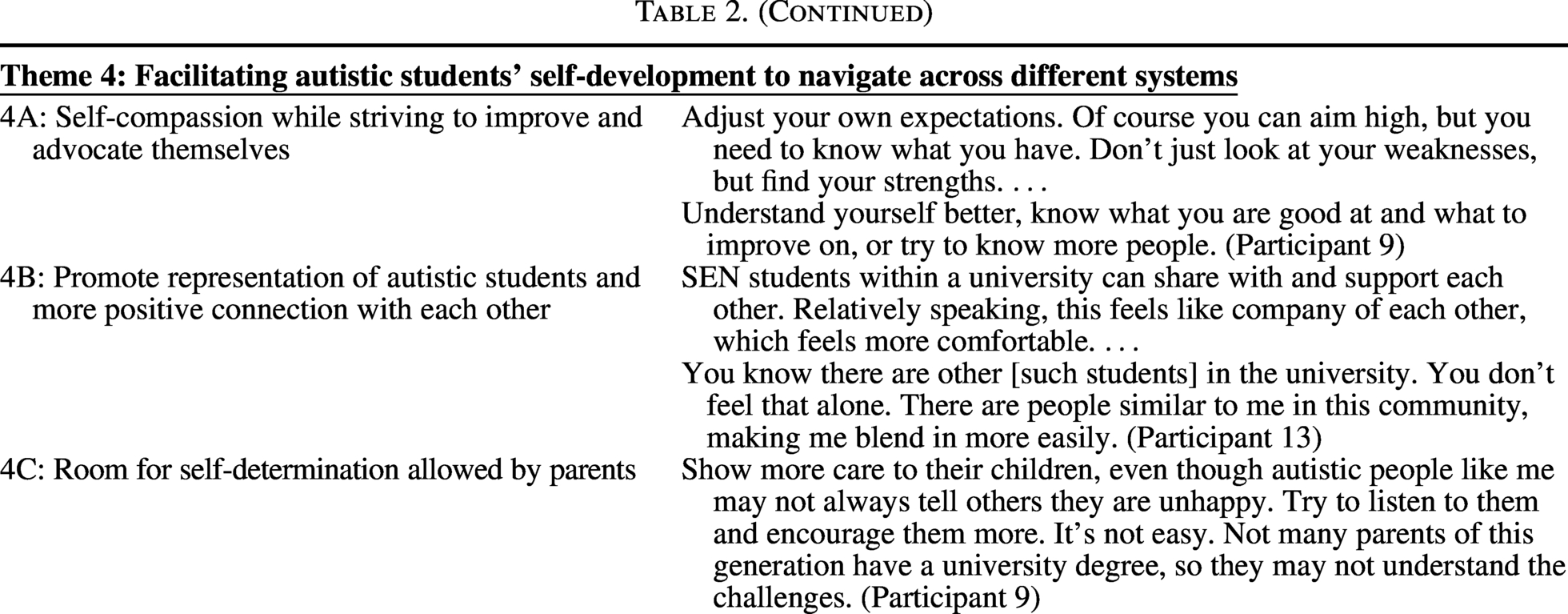
We generated four major themes that described autistic students’ challenges and barriers to social support in Hong Kong universities: (1) Misunderstanding and negative treatment by other people, (2) juggling disclosure across different contexts, (3) support gaps in macrolevel university systems and services, and (4) personal development to navigate across university systems. We included selected original quotes below to illustrate the themes and subthemes (see Table 2 for additional quotes). Quotes were identified by respective participant numbers instead of pseudonyms to maintain clarity due to the large number of participants.
Additional Quotes Illustrating the Themes and Subthemes

Theme 1: Misunderstanding and negative treatment by other people
Subtheme 1A: Others’ misunderstandings toward autism that led to stereotypes and stigma
Recounting their interaction with other people in university, autistic students overwhelmingly recalled others’ misunderstandings toward autism, SEN, or mental health issues in general. Even though “the new generation has more mental health knowledge” (Participant 24), understanding of autism was still very rudimentary, as “the Hong Kong education system only focuses on studying, despite the importance of health issues” (Participant 9). Stereotypes of autism were commonly heard and circulated in the local community, such as “weird, stubborn, don’t need friends” (Participant 7), “snobbish, aloof, like aliens, don’t listen to others” (Participant 9), “only stay at home or in their own world” (Participants 4, 15, and 18), and “like ‘bus enthusiasts/frenzies’” (Participants 15 and 18). Some students were dismissed as “not looking like autistic” (Participants 3, 5, 6, and 16) as if they looked like neurotypical presentations or did not fit the classical or stereotypical autistic characteristics. Participants felt that autism was commonly perceived as either extremely impaired (e.g., autism equals intellectual disability; autistic kids are just “stupid,” “naughty,” or “crazy”) or “extremely smart” (Participant 16), probably due to “the lack of adequate representations” (Participant 3) of the wide autism spectrum in society.
Societal misunderstanding around autism seemed to contribute to students’ own internalized stigma:
Being labelled [as autistic or SEN] will internalize a feeling of inferiority. … The message for other people is that we have special needs, so you need to give way to us. (Participant 1)
Participant 3 felt “stressed out” hearing others talk about autism, as they often focused on “the medical deficit model.” Participant 18’s father did not want her to disclose her autism, “because he fears stigmatization, although he worked in the medical field.”
Subtheme 1B: Low sensitivity and ignorance toward autistic needs
Not understanding what autism is, people in universities seemed to be insensitive or simply did not care about autistic people and their needs. For example, “I have to tell professors about my needs because they may not be aware and ask about the needs of ASD [sic] proactively” (Participant 8). Even if autistic students brought up their concerns, they perceived that “university professors do not think they need to understand [SEN], which is different from primary and secondary school teachers” (Participant 24). They recalled negative reactions and feedback from staff and peers, such as being “cold-shouldered” (Participant 20), “perfunctory” (Participant 30), “finding us annoying” (Participant 5), and “[feeling that we are] wasting their time” (Participant 9). People were ignorant of the broad-spectrum nature of autism and their needs, who would “use normal people’s perspective to judge us [autistic individuals]” (Participants 4 and 7) based on neuronormative assumptions, emphasizing the principle of “treating everyone equally” (Participant 14) and being unwilling to provide accommodation. At the other extreme, some participants recalled that people would treat them as “people with disabilities” (Participants 4 and 14) and consider them “lacking certain abilities, weak, needing others to help, and unable to contribute” (Participant 14).
Subtheme 1C: Microaggressions that rejected, blamed, or invalidated autistic students
People’s nonaccepting and discriminatory attitudes played out in subtle microaggressions. For example, when autistic students shared about their personal challenges, comments like “young people are all inattentive like that” and “we are somewhere on the autism spectrum too” (Participant 3) made them feel “dismissed” (Participant 3) and “ignored” (Participant 18). Participant 18 recalled an instance of disability slur that downplayed autistic people:
When we were talking about SEN and extended time arrangements, a guy said, “Oh! I have [SEN] too! … Just saying. Why can’t I?”… I feel like, what [on earth], really?… He talks frivolously while we are seriously discussing. … It is not the attitude I appreciate. (Participant 18)
Others also invalidated or undervalued their abilities. When Participant 16 had a meltdown as she was frustrated with her own performance and not being able to meet the teacher’s expectations, her teacher “said a lot of things that provoke me … [and] questioned my ability to enter the program.” People would also misconstrue the actual purpose and significance of services and accommodations received by autistic students. For example, extended time was perceived by teachers as ineffective or not helping students improve: “You have to work overtime by yourself in your future job. You have to deal with it and get used to it” (Participant 18).
Autistic students overheard similarly judgmental attitudes toward other kinds of supports, which were perceived as “cheating for extra resources” (Participant 8), “an excuse” (Participant 28), and “sadfishing 1 ” (Participant 14).
Subtheme 1D: Social isolation, unfair treatment, and discrimination
Many autistic students experienced discrimination and alienation, as they recalled “student groups or committees do not welcome autistic students” (Participant 7) and felt like “I am not able to blend in … like I am not a part” (Participant 13). Participant 12 recounted feeling that students in university “prefer not to have [SEN] students in their class” and would “gossip about those students”:
The biggest difficulty is not whether there is anyone helping me. Please don’t “trample on me further” 2 . Don’t just think I am annoying. Because they don’t understand, so I have to spend so much time educating them. (Participant 1)
Citing the history of terminology change of epilepsy in Chinese,3,48 Participant 6 commented, “Even with enough policy support, people’s attitudes are the problem. … People can still use the polite term to tease others.”
A few autistic students raised concerns about possible systemic discrimination in broader society, such as perceiving that their autism would affect university admission or employment in certain professions:
The percentage of students with SEN admitted into university is much lower than typical students. … When getting into secondary schools, many [students with SEN] are assigned to band-three schools 4 , which have fewer resources and quality teachers.
… The minimum academic requirement for university entrance is bullying us autistic students. (Participant 13)
Theme 2: Juggling (non)disclosure across different contexts
Subtheme 2A: Hid to avoid the cost of receiving negative judgments and treatments
Autistic students had different concerns or considerations with the disclosure of their autism. Most of them “hid” (Participants 2 and 14) or “intentionally pretended to be normal people” (Participant 22) to avoid negative judgments and treatments, such as “getting hurt” (Participant 8), “being ridiculed” (Participant 29), “being labelled” (Participant 6), and “others having lower expectations of me” (Participant 18). Compared to being known to be autistic, being perceived as “quiet” (Participant 2) or “aloof” (Participant 14) was “not a big deal” (Participant 14). While many autistic students were known to their secondary schools as being autistic, some regarded university as “a new start” (Participant 16) and concealed their autism to protect their “image,” “face” (Participant 28), and privacy. Practically speaking, some participants felt that they did not need to disclose their autism because “[service] arrangement would not be much different” (Participant 20) and there would be “no additional help” (Participant 10), while others considered their challenges “too mild” (Participant 18) and did not need to disclose for services. Unfriendly institution policies or procedures further discourage disclosure, which in turn impacts the planning and provision of services: “[A college] requested me to submit many documents and undergo many check-ups” (Participant 24). Similarly, disclosure came with the cost to “double one’s effort to defend myself … [and] educate others” (Participant 3), so some would rather overcompensate by “improving myself” instead of disclosing their autism like “tearing open my body” (Participant 4).
Subtheme 2B: Nice people and helpful services motivated autistic students to disclose
People whom autistic students knew well and had better relationships with made them feel more at ease sharing their condition to receive social support (e.g., “my teacher understood I have the potential” [Participant 16]), without the worry of getting hurt or other negative consequences. In other cases, autistic students disclosed in order to assert their “rights” (Participant 4) to entitled learning supports and resources (e.g., accommodation plans, SEN-specific scholarships):
Social workers are trustworthy and professional. They can understand. If I don’t tell them, their strategies may not suit me. (Participant 15)
The motivation for disclosure seemed to be higher when specific learning tasks were perceived as more challenging for certain students, such as “retaking an examination … to complete my Bachelor’s degree” (Participant 28).
Subtheme 2C: Disclosure often took place in an indirect, haphazard manner, not attracting attention
It was more common for autistic students who chose to disclose to talk about their autism subtly instead of directly asserting their autistic identity, such as “when we chatted about my personality, I naturally told [my friends about my autism]” (Participant 10). Some students noted the cultural norm that tends not to talk about one’s own autism or SEN:
I intentionally refrain from discussing that, as it is not customary for Chinese people to do so. I told my peers that I have problems in certain areas, but I won’t be specific. Because I think whether I disclose or not does not affect me. (Participant 13).
At times, peers noticed autistic students using special rooms or extended time in examinations, which hinted at their special conditions. Some autistic students felt it was easier to describe their specific challenges or diagnoses other than autism (e.g., attention-deficit/hyperactivity disorder [ADHD], schizophrenia, depression), as autism seemed to cause confusion and negative attention more easily.
Theme 3: Support gaps in current systems and services at the macro level
Subtheme 3A: Accommodations too generic and reactive
Academic accommodations and services were available to support autistic students in learning and assessment. However, many students questioned their nature and effectiveness. For example, extended time was not relevant to paper writing when it could be done at home in a self-paced manner. Several students believed their accommodation plans in university were directly adopted from the previous arrangement for high school exit exams made by the Hong Kong Examinations and Assessment Authority (HKEAA) 5 :
Because the HKEAA has approved [my accommodations], college must give me [the same plan]. College will follow government organizations and give me all the same exam accommodations like what I had in public exams. (Participant 12)
More proactive, individualized interventions that could develop their academic abilities (e.g., study skills, effective strategies for group projects, vocational preparation) were rarely available. Many also hoped staff and parents can “proactively check in” (Participant 20) to help them early on, instead of assuming they are fully independent. Some support staff (e.g., social workers, counselors, SEN officers, and teaching assistants) were praised for providing individualized support, liaising with stakeholders, and arranging specialized services with outside professionals.
Subtheme 3B: Systemic barriers posed challenges to quality individualized supports and services
Many autistic students observed that “there are fewer supports in university” and “individualized care is not as good as … in the secondary school” (Participant 26), as multitiered systems of support and corresponding services and infrastructure (e.g., SEN teacher training) required in grade schools were not mandated in postsecondary institutions, and thus the intensity and quality of individual casework and follow-up varied tremendously:
The issue with integrated education lies not in its internal processes, but rather in the lack of support once [high school] services are over. We are stranded. It becomes a vicious circle, making us not able to find a job and become jobless for a long time. (Participant 24)
Services could be at times difficult to find, not transparent, with confusing information, and inconsistent, which impacts accessibility and satisfaction. Some also perceived postsecondary systems as inflexible in, for example, providing options for early course registration, substituting group work with individual assignments, and lowering attendance requirements.
Subtheme 3C: Cultivating a more inclusive and accepting attitudinal climate
Some autistic students commented that “the university environment can be very complex” (Participant 8). They stressed the need for postsecondary institutions to cultivate a better attitudinal climate so they would not be judged “weirdo” (Participants 2 and 16) or “deficit only” (Participant 3). Instead, more nonjudgmental and “open-minded” (Participant 2) attitudes were advocated (e.g., “treat us as a person” (Participants 1 and 2) and “see autism not as our entirety” (Participant 16)), even though some behaviors were unexpected or even atypical:
Even if a student falls asleep, don’t scold him/her right away. Don’t hold the impression that they are inattentive in class. They may just need to rest, take a break, and then be attentive again. (Participant 18)
A good climate for some students also meant enjoying the good relationships with instructors and staff, who also gave guidance that made their learning more effective and satisfying.
Subtheme 3D: Development and application of nonacademic and social skills in real-life settings
Autistic students raised concerns over the need to support their social and adaptive skills in daily lives, as they were dissatisfied with interventions that only covered theories and knowledge without practical guidance, which were perceived as “not down-to-earth” (Participant 22) and “too simple”:
I’ve attended these classes. I know what to do. But in the moment when I am overwhelmed by so much information, I lose all the concepts. So I think attending these classes doesn’t help. You need to experience it and try to change your own perspectives. (Participant 12)
Autistic students appreciated programs that combined intentional learning or therapeutic components with more casual and leisure activities (e.g., community services, board game groups), providing opportunities for them to practice necessary skills for postsecondary success and expand their social networks. Examples of peer support or mentorship programs were noted in several institutions, where most autistic students found the experience meaningful and beneficial to their personal development and inclusion in the postsecondary environment. For example, Participant 8 was “paired up with two peers to talk to me and help me adapt to university life … providing me with many suggestions for program transfer. … [and] mental and emotional support.” Participant 11 recalled “bringing an Asperger’s mentee to play board games, which for him/her is already a breakthrough.”
Theme 4: Facilitating autistic students’ self-development to navigate across different systems
Subtheme 4A: Self-compassion while striving to improve and advocate themselves
The goal of self-improvement needed to be balanced with the recognition of one’s limits. For example, Participant 25 emphasized her negative experience with the extremely high social pressure in student activities during orientation camps by saying, “If you feel uncomfortable in some games, you can talk to the organizer to withdraw. … Don’t hesitate. Just seek help!” Some also mentioned the need to speak up and obtain appropriate services, accommodations, and people who can help because “other people don’t know what you really need” (Participant 10) and “that is your right” (Participant 3). Self-improvement was also essential but could look different across students, because “everyone’s story is different” (Participant 2). For example, some argued for the importance of trying different social experiences (e.g., networking, student activities, and expanding one’s interests). Participant 30 reasoned that “some autistics are quite stubborn, so that limits their horizons,” while Participant 16 also appreciated “the unlimited possibilities if you are willing to step out of your comfort zone.” Other students were more content with developing one’s own focused interests, “although not many people accept it” (Participant 12). Some shared their words of encouragement to other autistic students, which conveyed a sense of appreciation and self-compassion: “You are not the only one facing the challenges, so no need to compare, as everyone is different” (Participant 23); “It’s already not easy as an autistic person to get into the university, so don’t be too stubborn” (Participant 13).
Subtheme 4B: Promoting the representation of autistic students and more positive connection with each other
Autistic students commented on the need to increase representation and connection of autistic students on the postsecondary campus. While educators and staff should be equipped with professional knowledge and skills to work with autistic students, institutions should also promote general students’ understanding about autism through “general education courses.”
(Participants 6, 13, and 16). Learning about autism and other diversity topics “is like social issues, similar to the general studies curriculum in university that already includes public health topics like psychiatric disorders” (Participant 6). Some stressed the importance of promoting more “in-person contact” (Participant 8) with autistic people, because “[if you] interact with me, then you can really understand me” (Participant 7). Building the autism community on campus by “gathering a group of ASD [sic] who are on the same wavelength and click” (Participant 5) can strengthen connectedness and well-being for autistic students.
Subtheme 4C: Room for self-determination allowed by parents
Autistic students commented that parents and their autistic college-attending children should be like “concave-convex 6 ” (Participant 28). Parents needed to be hands-off while serving a standby role: “If we don’t ask, [parents] don’t have to ask us, but if we need anything, I hope they will be there to help” (Participant 13). For example, some students suggested that parents reach out to program coordinators and instructors if they sense any difficulties in their children. Parents should not be “too protective and focus only on their problems” (Participant 6), but instead should “let go” (Participant 6) and “let [students] have more space to make decisions” (Participant 12) and “make mistakes” (Participants 5 and 6). It was also important for parents not to blame their autistic children, be aware of their needs and challenges, and help them plan ahead by “developing their interests and potentials … [instead of] forcing them to develop something they are not good at” (Participant 5).
Discussion
This study investigated the perceived barriers to social support faced by autistic university students in Hong Kong. They were dissatisfied with the attitudinal climate and negative treatment by the people around them, which simultaneously affected their decisions about disclosure and service seeking. Autistic students highlighted a range of relational, systemic, and structural issues in the current support systems at local universities, voicing the need to further develop themselves to face the challenges across different systems. Our findings shed light on the limitations of the current university system, which arguably does not provide adequate support to autistic students. We also focus on the sociocultural contexts of Hong Kong to interpret some unique findings and point to future directions of research and practices that can fill the loopholes of the university system.
The experiences of our participants suggested that, despite the improvements in the knowledge about autism within Hong Kong society, long-standing stigma and misunderstandings still exist, creating barriers for autistic university students in accessing opportunities and support. While some misconceptions reflect common misunderstandings of autism as asocial and aloof (ref. social motivation theory 49 ), others are more unique to the local culture. For example, some participants were discontent with the term “bus frenzy,” which refers to fans with intense interests in transportation, who are often viewed negatively by the public, but people also use this term to refer to the stereotypical autistic interests, which causes autistic people to be stigmatized by association. The Chinese term for autism—“自閉”, which literally means self-isolation—also carries a connotation that hints at hikikomori, reinforcing the stereotypical image of social withdrawal. 50 Another criticism focused on the widespread use of functioning labels by local practitioners. Even though some official government guidelines have clarified the updated terminology of ASD, 51 functioning labels are still commonly used in many other local services to distinguish their service targets between those with and without intellectual disabilities. 52 Such practices reflect a low sensitivity to the repercussions of medicalized languages and an inconsistent effort in promoting a clear understanding of the autism spectrum, which may become the basis for overt discrimination and covert microaggression directed to autistic individuals across different university and societal contexts.
Similar to findings from Western cultures,3,5 autistic university students in Hong Kong would hide their autism to pass as non-autistic or “normal” (Participant 22) in environments perceived as unfriendly to autism. Some participants expressed additional considerations for masking to “save face” (Participant 28) as they transitioned to a new chapter of university life, which indirectly suggests that participants felt autism to be a face-losing identity that brings shame and loss of social capital to oneself. In other words, they show “face concern” 53 over their autism, bringing face loss and undermining the social worth of their own or others in their network. While past studies in Chinese communities demonstrated similar face concern in parents of autistic children 54 and individuals with mental health conditions, 55 our finding is novel in documenting face concern in autistic adults. As individuals who have higher face concern are found to be more sensitive to public judgment and more susceptible to self-stigmatization that contributes to poorer mental health, 56 it is important to investigate if a higher degree of face concern in Chinese autistic adults is related to more camouflaging and lower well-being. Furthermore, our autistic participants often disclosed their autism in an indirect, haphazard manner. Such subtle ways to share one’s identity instead of claiming it upfront may be interpreted as internalized stigma within the collectivistic culture, where asserting an aspect of self, especially when it is perceived as too unique, risks standing out from the larger group with strict enforcement of social norms. 57 There is also evidence showing Hong Kong has a higher social dominance orientation (i.e., tendency to accept inequality) than Western cultures, 58 which can make individuals with an explicit autistic identity more vulnerable to attracting negative judgment and unfair treatment that are considered unproblematic by others. Cultivating a healthy autistic identity is conducive to better mental health and well-being, 59 so future research needs to investigate whether (non)disclosure may affect identity development in Hong Kong autistic individuals within this sociocultural context.
Autistic university students perceived that the accommodations and services provided were too generic and did not adequately address skills development or individualization. For example, while the academic accommodation plans inherited from secondary school could serve as an important reference, their effectiveness needs to be continuously evaluated and individualized based on the changing needs of the students and tailored to the wide variety of learning tasks in university courses. 60 Autistic students in Hong Kong also alluded to the structural barriers underlying unsatisfactory support, including inconsistent services across universities, lack of policies regulating service provision and coordination, inadequate training for university staff, and an unaccepting attitudinal environment, which are also reported in studies in other countries.3,61 However, we want to draw attention to the unique challenges faced in Hong Kong. Due to the absence of inclusive education laws, whereas grade schools can rely on regular funding and consistent educational policies to implement support services, 25 no such system is established in higher education. The only legislation protecting the welfare of adults with disabilities, the Disability Discrimination Ordinance, has also been criticized as too reactive and lacking advocacy for the disability community, while there is no apparent plan to move to a more progressive, system-wide reform in the near future. 62 Universities are also given full institutional autonomy to decide on their own governance, 63 which leaves each institution working in silos to create their own student support services instead of working collaboratively to build a common infrastructure that can establish practice standards and delineate common supports that work to provide systematic and coordinated services for university students with SEN in the territory. Given these circumstances, the outlook for a coordinated and consistent service system across all postsecondary institutions in Hong Kong appears pessimistic.
Despite the absence of legal or policy mandates, individual universities can strive to improve their infrastructure by creating more structured, diversified support that is easy for students and stakeholders to navigate. More importantly, measures that promote inclusion and enhance accessibility (e.g., Diversity, Equity, and Inclusion initiatives, neurodiversity-affirmative practices, and Universal Design of Learning64–66), which are often intended for autistic and neurodivergent students, can indeed benefit all students, who can be neurodivergent, disabled, both, or neither. Furthermore, efforts to improve campus culture and awareness surrounding autism can start by educating peers and instructors through didactic teaching66–68 or interactive approaches. 18 However, the large-scale implementation of these methods in campus-wide curricula seems to be an unexplored direction. Future research should learn from similar initiatives (e.g., mental health courses embedded in the university curricula for all students 69 ) and explore how to leverage general education courses to effectively increase autism acceptance. Similarly, social interventions implemented in naturalistic environments and peer mentoring programs involving interaction between autistic and non-autistic peers appeared to be appreciated by many autistic students to facilitate their social development, build positive social connections with others, and foster a more accepting environment on the university campus. Given the emerging evidence of peer mentoring models from Western countries,70,71 future research should evaluate whether the same programmatic elements can be equally effective in Hong Kong. In addition, a more social justice and action-oriented approach can be incorporated in peer mentoring programs to rectify systemic issues. 70 It would be important to investigate if such advocacy efforts by Hong Kong autistic students and their peers could work to enhance inclusivity in local postsecondary institutions against the environment with heavy stigma, as well as the tight social norm of conformity.
Limitations of this study included the sole focus on students’ perspectives, but other stakeholders may have different understandings and experiences regarding their support for autistic students. Including these perspectives would be beneficial for developing a more holistic picture of social support. Furthermore, the university system in Hong Kong has a considerable number of non-Chinese, international, and exchange students, so autistic students from these cultural backgrounds may have different expectations and experiences. Including a more diverse sample would yield results that can be more representative and potentially relatable to different university systems globally. Relatedly, future research should consider strategically recruiting more diverse autistic students with various intersectional identities or needs (e.g., individuals who are nonspeaking or prefer text-based communication; self-diagnosed autistic individuals) to enhance the representation of the entire autistic community. Broadly speaking, more participatory involvement and coproduction throughout the research processes should be adopted in future research so autistic voices and expertise can be meaningfully represented in the research findings and inform implications that are meaningful to them.
Conclusion
Autistic university students in Hong Kong face significant relational and systemic barriers to social support, including stigma, inadequate services, and challenges around disclosure. Despite these obstacles, students actively seek self-development and advocate for more inclusive environments. Findings of this study highlight the limitations of the current support system, which often lacks individualization and inclusivity, and underscore the need for more diverse and accessible support services. The study calls for improved campus climate and inclusive education policies to foster meaningful social support and enhance well-being for autistic students in postsecondary education institutions.
Footnotes
Authorship Confirmation Statement
G.Y.H.L.: Conceptualization, methodology, investigation, formal analysis, resources, data curation, writing—original draft, writing—review and editing, supervision, project administration, and funding acquisition. J.C.Y.W.: Conceptualization, methodology, investigation, resources, writing—review and editing, and funding acquisition.
Author Disclosure Statement
The authors declared no potential conflicts of interest with respect to the research, authorship, and/or publication of this article.
Funding Information
No funding was received for this article.