




Abstract
Background:
Microaggressions—subtle insults, invalidations, or slights directed at marginalized groups—negatively affect mental health and identity. However, little is known about how autistic people experience microaggressions across their daily lives in Japan. To the beast of our knowledge, this is the first qualitative study examining how Japanese autistic people experience microaggressions related to or attributed to their autism.
Methods:
We conducted an online cross-sectional survey in March 2023. A total of 330 autistic individuals (aged 18–39 years) responded to two open-ended questions about direct and indirect microaggressions in their daily lives. We analyzed 288 microaggressive experiences related to or attributed to participants’ autism using codebook thematic analysis. Three researchers generated the initial codes and preliminary themes, which the full team then refined through iterative discussion.
Results:
We identified four themes describing how autistic people in Japan encounter microaggressions in their daily lives. Theme 1: Living with fluctuating standpoints reflects how others position autistic people as either inferior or unrealistically gifted. Theme 2: Living with autism as a symbol of inferiority captures how the term “autism” functions as a metaphor for inadequacy. Theme 3: Living with no safe space highlights repeated invalidation across family, school, workplace, and professional contexts. Theme 4: Living with pressure from social demands shows how cultural norms and institutional structures pressure autistic people to camouflage their characters and conform to neurotypical expectations.
Conclusions:
Japanese autistic people experience microaggressions that arise from ableist assumptions embedded in interpersonal, linguistic, cultural, and institutional environments. These experiences contribute to stigma, camouflaging, and reduced access to affirming spaces. Future research must incorporate autistic perspectives throughout the research process and examine intersectional and cross-cultural dimensions to promote more equitable social environments.
Community Brief
Why is this an important issue?
Autistic adults experience high rates of depression, anxiety, and suicidality. Stigma, discrimination, and harmful social messages contribute to these mental health challenges. Microaggressions—subtle insults, invalidations, or slights directed at marginalized groups—represent one form of minority stress. Although these behaviors may seem minor, their cumulative impact can be harmful. However, little research has examined how autistic adults in Japan experience microaggressions in daily life. Understanding these experiences is essential for creating safer and more equitable environments.
What was the purpose of this study?
We aimed to explore how autistic people in Japan experience microaggressions related to or attributed to their autism across everyday life.
What did the researcher do?
We conducted an online survey with 330 autistic adults aged 18–39 years. Participants responded to open-ended questions about their experiences. We analyzed 288 responses linked to autistic characteristics using codebook thematic analysis. Three researchers coded the data independently and developed themes through collaborative full-team discussion.
What were the results and conclusions of the study?
We identified four themes illustrating how autistic adults experience microaggressions across interpersonal, linguistic, cultural, and institutional contexts:
Theme 1: Living with fluctuating stand points
Participants reported being treated as inferior, childlike, or incapable, while also being expected to have exceptional or “genius-like” abilities. Cultural norms and misunderstandings about autism contributed to these contradictory attitudes.
Theme 2: Living with autism as a symbol of inferiority
Participants frequently observed people using the word “autism” as an insult or metaphor for inadequacy. This linguistic misuse reinforces stigma and contributes to harmful social attitudes.
Theme 3: Living with no safe space
Many participants described being dismissed or invalidated about their autism or related difficulties by family members, teachers, employers, and health care professionals.
Theme 4: Living with the pressure from social demands
Participants received strong pressure from media portrayals, social norms, and institutions to hide their autistic characteristics and conform to neurotypical expectations.
The findings indicate that microaggressions occur through personal interactions, as well as through language, cultural norms, and social systems.
What is new or controversial about these findings?
To our knowledge, this is the first study to explore microaggression experiences among autistic adults in Japan. The finding that “autism” is commonly used as a metaphor for inadequacy highlights how stigma becomes embedded in everyday language. The study also shows that microaggressions extend beyond individual behavior to broader cultural and structural systems.
What are potential weaknesses in this study?
We recruited participants through a job-related mailing list, which may not represent all autistic adults. We relied on self-reported diagnoses and could not fully examine intersections such as gender identity or conduct cross-cultural comparisons.
How will these findings help autistic adults now or in the future?
Our findings can inform efforts to reduce microaggressions, improve public understanding, and promote supportive practices in families, schools, workplaces, and healthcare settings. The study also underscores the importance of involving autistic people in research, policy, and decision-making to promote dignity, respect, and inclusion.
Introduction
Autistic adults have significantly increased rates of mental health difficulties, such as depression, anxiety, and suicide rates, compared with non-autistic adults.1,2 Multiple genetic, biological, environmental, psychological, and social factors interact to shape these mental health outcomes, 3 and minority stress plays a critical role. 4 Minority stress arises when members of stigmatized groups experience prejudice, discrimination, and social marginalization, which contribute to adverse mental health outcomes.4–6 Previous research with autistic individuals has shown that minority stress predicts poorer mental health outcomes. 7
Microaggressions represent a common distal minority stressor. 8 Sue 9 defined microaggressions as subtle insults, invalidations, or slights directed toward individuals based on attributes such as gender, race, religious affiliation, and sexual orientation. 10 Microaggressions occur at interpersonal and environmental levels 11 and accumulate over time, contributing to psychological and somatic distress. 12 It has been reported that microaggressions occur in three subtype categories: microassaults, microinsults, and microinvalidations. 9 Microassaults are offensive slurs and acts that are usually intentional and often used to harm or degrade the targeted individual. Microinsults are subtle, indirect, and often unintentional comments or behaviors that express rudeness or disrespect. Microinvalidations involve dismissing, minimizing, or ignoring an individual’s thoughts, feelings, or lived experiences. 13 Originally, the term microaggression referred to subtle forms of racism; 13 researchers have recently applied it to other marginalized groups, such as gender and sexual minorities.14,15
Individuals with mental health conditions and disabled people experience an additional microaggression defined as “ableist microaggression,” 16 which refers to conscious or unconscious assumptions and practices that result in the unequal treatment of neurodivergent or disabled people. 17 Keller and Galgay 18 qualitatively identified seven main themes of ableist microaggressions among people with visible and invisible disabilities. These included reducing a person to their difficulties, invading their privacy, treating them as inferior or childlike, offering unwanted help, giving patronizing praise, assuming all behaviors stem from difficulties, and denying their difficulty-related experiences. 18 We summarized all themes from Keller and Galgay 18 and sorted them into the three microaggression subtypes based on Sue’s definitions 13 (Supplementary Table S1). Subsequent qualitative studies have applied the themes identified by Keller and Galgay 18 as a foundational framework to individuals with mental health conditions, 19 invisible physical disabilities, 20 and adults who stutter 11 and demonstrated both shared and group-specific patterns. Recent quantitative research has attempted to measure these experiences.16,21 Deroche et al. 22 used the Ableist Microaggressions Scale (AMS), developed from Keller and Galgay’s 18 themes, to compare microaggressions across physically disabled people, individuals with sensory difficulties, individuals with mental health conditions, and neurodivergent people. However, they did not identify statistically significant differences in AMS scores between groups. Although research in this area is growing, inconsistencies between qualitative and quantitative findings persist, and current quantitative approaches have a limited capacity to identify characteristics of microaggressions among specific marginalized groups. Moreover, growing recognition emphasizes the need to take autistic testimony seriously in autism research. 23 Conventional studies have often excluded autistic input, resulting in findings with limited real-world relevance, 24 generating several “false leads,” 25 and contributing to misinterpretations of autistic experiences. 26 Addressing this issue requires centering autistic perspectives, and qualitative methods provide an effective approach. 27
As an identity-based minority, autistic people experience heightened minority stress within stigmatizing social environments. 7 They frequently encounter negative social communication experiences in friendships, 28 romantic relationships, 29 and employment. 30 Many autistic individuals engage in social camouflage to conceal autistic characteristics 31 and conform to neurotypical norms, often in response to stigma and discrimination. 32 These patterns suggest that autistic people experience microaggressions linked to how others perceive and respond to autism. However, no studies have examined autistic people’s microaggressive experiences across their daily lives or life histories.
Furthermore, considering Japanese culture, which shapes human behavior, 33 is crucial when exploring and understanding autistic people’s lived experiences of microaggressions. Japanese society emphasizes conformity and harmonious interdependence, in contrast to Western cultures that prioritize individuality and direct expression. 34 The cultural norms in Japan, such as the expectation to “read between the lines (kuuki wo yomu)” rather than express one’s needs directly, may create distinct experiences for autistic people. 35 However, because most existing research investigating microaggressions reflects Western perspectives, 23 little is known about the experiences of autistic people in East Asian cultural contexts. To our knowledge, this is the first qualitative investigation to address this gap by focusing on Japanese autistic people’s experiences related to microaggressions.
In this study, we aimed to investigate how Japanese autistic people experience microaggressions related to or attributed to their autism across their daily lives.
Methods
We conducted a one-time online cross-sectional survey developed in collaboration with an autistic adult. Given the limited research on microaggressions among autistic individuals, this format allowed us to capture a broad range of lived experiences across participants.
Procedure
In March 2023, we recruited participants via email distributed through LITALICO Inc., a Japanese job-information mailing service for neurodivergent individuals. We invited 3500 subscribers to participate. Participants provided informed consent and submitted anonymized responses through LITALICO, which subsequently transferred the data to the research team.
Participants
A total of 330 Japanese individuals between 18 and 39 years of age who had been diagnosed with autism by psychiatrists participated in this study. We obtained information about the type of diagnosis through self-report. The diagnoses included autism/autistic disorder, Asperger syndrome/Asperger’s disorder, autism spectrum disorder, atypical autism, and pervasive developmental disorder, not otherwise specified. Participants’ demographic characteristics are presented in Table 1.
Demographic Characteristics of the Participants
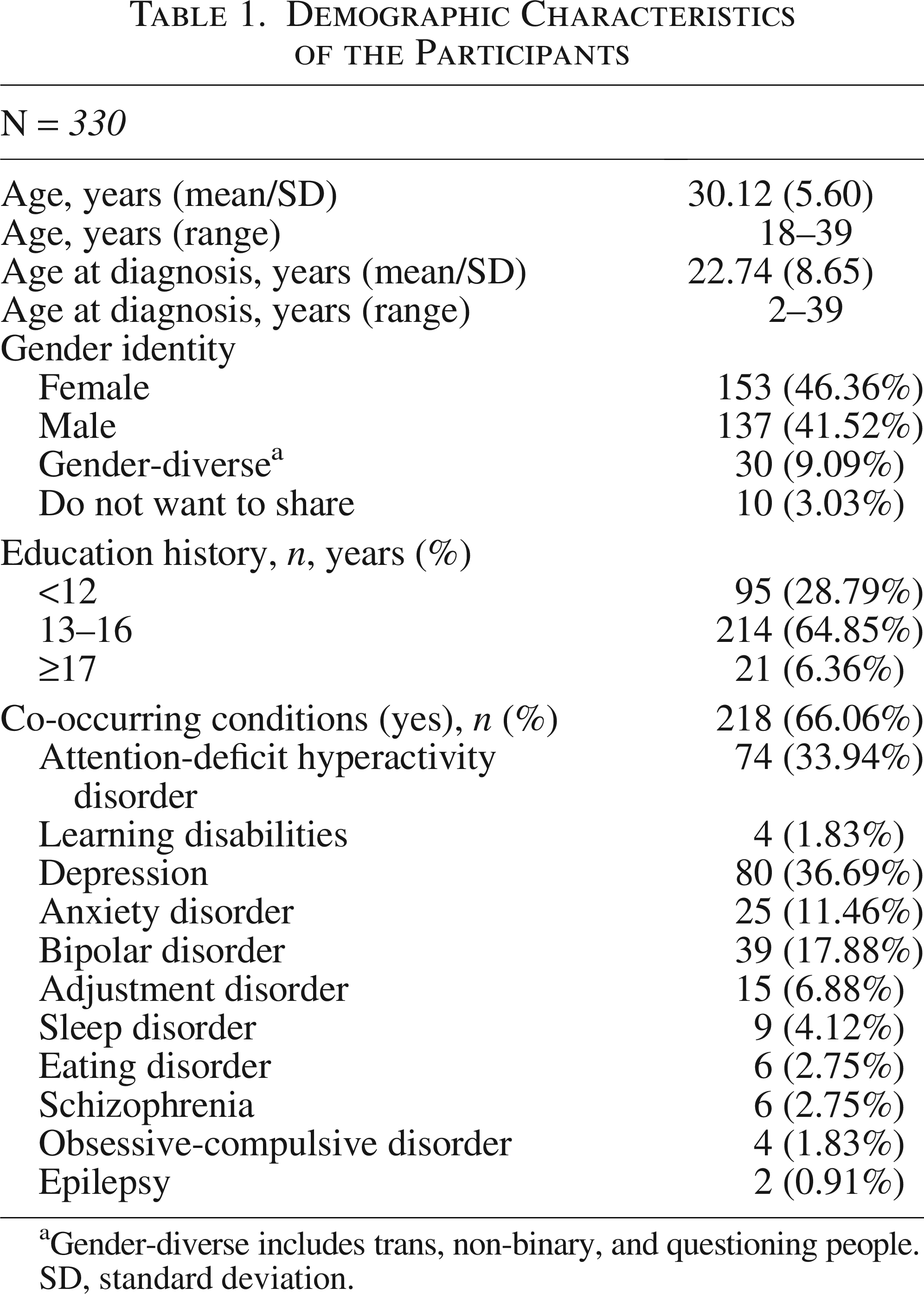
Gender-diverse includes trans, non-binary, and questioning people.
SD, standard deviation.
Materials
The authors (T.K., S.G., H.T., M.T., F.T., and F.O.) developed survey items estimated to take 20 minutes to complete with input from one autistic adult (Supplementary Data). We included two open-ended questions to capture experiences of direct and indirect microaggressions based on the definition provided by Sue. 13
The two primary questions were as follows: “Please describe an incident that you can easily report where you felt mocked, belittled, or misunderstood by others because of your autism.” “Please describe an incident that you can easily report where, even though no one directly did anything to you, you felt that autistic people were being mocked, belittled, or misunderstood.”
Although we did not include the answers in the analysis, we included two closed-ended screening questions with example scenarios to facilitate recall, which asked whether they had experienced microaggressions, directly or indirectly. We also collected the following data: current age; self-identified gender (“female,” “male,” “gender-diverse including trans, non-binary and questioning people,” or “don’t want to share”); age of autism diagnosis; educational history; and co-occurring conditions.
Researcher positionality and community involvement
Our analysis team comprises training in child development (T.K., M.K., and F.O.), psychology (T.K., N.C.O., and F.O.), and medical science (Y.K., M.T., K.J.T., and F.O.). All team members had prior experience working with autistic individuals and their families. We grounded our analysis in the social model of disability 36 and the neurodiversity paradigm. 26 Because we are non-autistic researchers, we incorporated input from autistic individuals during questionnaire development and sought feedback from two autistic adults to evaluate whether our findings resonated with community experiences.
Data preparation
We received 436 responses from 330 participants. Three authors (T.K., M.K., and Y.K.) reviewed all responses to identify accounts that described microaggressions. When we could not reach an agreement, we discussed the case using the definition by Sue 13 and resolved it collaboratively. Because our research focused on experiences attributed to autism or autistic characteristics, we excluded responses primarily centered on other identity dimensions (e.g., gender identity) or contextual factors (e.g., family circumstances) when participants did not explicitly link these experiences to their autism. This decision reflects the analytic focus of the present study. This process yielded 288 autism-related microaggression episodes, including 127 responses to Question 1 (mean length: 137 Japanese characters) and 161 responses to Question 2 (mean length: 122 characters). Of the 330 participants, 84 responded to both questions, 43 responded only to Question 1, and 77 responded only to Question 2.
Analysis
We conducted a codebook thematic analysis at a semantic level to systematically identify patterned meanings across participants’ responses. Codebook thematic analysis provides a structured approach in which researchers develop a shared coding framework and iteratively refine themes within a research team. 37 We selected this approach because it supports structured analysis of textual survey data and facilitates collaborative, team-based interpretation. 37
Data were managed using QSR NVivo 12. The first author (T.K.) led the analysis under the supervision of the second and last authors (N.C.O., and F.O.). Three researchers (T.K., M.K., and Y.K.) independently read the full dataset to familiarize themselves with the responses and then met to generate initial codes and explore preliminary themes. During this stage, we applied a mixed inductive–deductive approach, 37 drawing on existing microaggression literature to inform our initial coding while remaining attentive to novel meanings emerging from the data. Across the 288 responses, we generated an average of 2.47 initial codes per response. We held review discussions with senior authors (N.C.O., M.T., K.J.T., and F.O.) to refine the thematic structure and clarify theme names. The team met repeatedly to review thematic coherence, examine semantic patterns across cases, discuss interpretive differences, and finalize the analytic descriptions.
This study was approved by the Ethics Committee of Chiba University (approval number M10538) and performed in accordance with the Declaration of Helsinki. Informed consent was obtained from all participants.
Findings and Discussion
The research team identified four themes to build an understanding of how Japanese autistic individuals experience microaggressions in their daily lives. We presented participant quotations in italics without modification; some may include deficit-based language.
Theme 1: Living with fluctuating standpoints
This theme illustrates how others position autistic people as either inferior or unrealistically gifted. Participants described microaggressions at both interpersonal and environmental levels. Several reported being treated like a child once others recognized their autism. One participant shared, When I discussed my problems at school with the school counsellor, the counsellor suddenly changed his attitude as if he were talking to a toddler after sharing my autism with him. He said slowly, ‘Don’t worry, I’ll show you how to cope with getting depressed.’ (Other, 22)
Autistic people also felt that the word “autism” seemed to connote a second-class status, implying inferiority compared with others. One reported encountering hostility in job-related social media, I found a flyer stating about employee evaluation on SNS ads. It said that ‘Many companies are adopting the test to screen out neurodivergent individuals or those with low stress tolerance.’ The words made me feel like autism was treated as socially unfit. (Female, 32)
Consistent with prior research showing that non-autistic individuals perceive autistic individuals as dangerous, 38 several participants reported being treated as a potential threat. One participant described colleagues hesitating to inform her about the location of cutter knives at workplace (Female, 35). Another reported being excluded from a university trip because a professor feared the participant might “cause problems” during the trip (Other, 34). These accounts reflect ableist assumptions that position autistic people as inherently problematic or less competent, similar to patterns reported in other marginalized groups.11,19
Concurrently, participants reported receiving excessive expectations of savant-like abilities from others, such as friends, when they disclosed their autism. Although the friends attempted to highlight the positive aspects of autism without malicious intent, the autistic individuals still felt uncomfortable. A female participant described, When I shared my autism to my friend, my friend said, ‘Good for you! Autism means you have some talent, so that’s good!’ She also added ‘Don’t worry! You are not autistic because you can read the line in socialization.’ Even though we have spent so much time together, we cannot understand each other. I felt as though no one understood me. (Female, 37)
This dynamic, which is fluctuating between infantilization and glorification, appears to be a unique microaggression experienced by autistic people. Previous studies have found that nondisabled people tend to assume that disabled people with sensory differences, such as those affecting hearing or vision, possess heightened abilities in other sensory domains. 18 However, no previous reports have described individuals being perceived as both inferior and expected to possess savant abilities. This contradictory stance seems strongly tied to autism stigma 39 and may be amplified by Japanese cultural norms. In Japan, where communication often relies on “reading between the lines (kuuki wo yomu)” 35 well-intended comments about “autistic strengths” may obscure lived difficulties and function as subtle microinsults. Accordingly, raising public awareness of microaggressions, particularly those that clarify how microinsults affect autistic people, is essential.
Theme 2: Living with autism as a symbol of inferiority
This theme illustrates how the term “autism” functions as a metaphor for inferiority in everyday Japanese contexts. Participants described situations in which others used “autism” to signal difference or inadequacy. A male participant described his experience at the workplace, I heard some colleagues’ conversation at work. They talked about another employee and commented, ‘I think Mr. XX might have autism because he is something different, isn’t he?’ (Male, 33)
Another participant described an incident at a coffee shop, When I went to a coffee restaurant with my friend, upon seeing a loud kid nearby, the friend said, ‘Oh, that kid is so loud, is he autistic or something?’ (Other, 38)
A female participant similarly shared, During casual conversations with friends, one laughingly said, ‘Maybe I’m autistic too,’ while sharing experiences such as being late, not understanding the intentions behind others’ remarks, or performing poorly on tests. (Female, 25)
These accounts reveal a linguistic pattern in which “autism” operates as shorthand for undesirable traits. Previous studies on ableist microaggressions have not documented such routine use of diagnostic labels to characterize personality or behavior. The present finding highlights how ableist ideologies become embedded in language, which is known as linguistic framing.40,41 Through repeated social use, the term “autism” acquires additional meanings that extend far beyond its clinical definition. Research consistently showed that non-autistic individuals often perceive autistic people as inferior, 39 a perception reinforced through interpersonal interactions 42 and media portrayals. 43 Moreover, academic and journalistic discourses have also contributed to deficit-oriented representations. 44 Consequently, the term “autism” has acquired stigmatizing and microaggressive connotations. Japanese culture may also influence this increasing language shaping. Japanese cultural values that emphasize group harmony, conformity, and interdependence cause autistic individuals who are perceived as socially atypical to become more salient and negatively evaluated. 45 Since linguistic framing influences the way people conceptualize social matters, political attitudes, events, and situations, 46 the use of “autism” as a metaphor for inadequacy reinforces structural ableism. Therefore, addressing the collective harm of ableist or deficit-based language is crucial for shifting from an interpersonal to a structural understanding of harm and supporting the rights, dignity, and self-determination of the autistic community.
Theme 3: Living with no safe space
This theme illustrates how autistic people experience repeated dismissal and minimization of their autism-related support needs across family, school, workplace, and professional contexts. Participants described a persistent lack of spaces where they felt understood, validated, and safe.
Although families often function as primary sources of support,
47
many participants described experiences of invalidation at home. One participant recalled, At the age of 9, when I shared my difficulties in daily life to my parents and grandmother. My grandmother insisted, ‘Having a disability is not a problem; it’s a talent because you possess unique charm different from others.’ Parents told me that I am part of the gifted community, so ‘do not worry, everything will be fine.’ (Female, 27)
Another participant (Male, 32) shared his mother’s words, “It’s not just you, everyone is making efforts to be normal.”
While these comments from families may be intended as encouragement, participants felt dismissive. When parents interpret autism through deficit-based, 47 they may struggle to recognize and accept their child’s diagnosis and provide proper support. 48 Because children often internalize parental attitudes toward diagnosis, 49 such invalidation can shape identity development and negatively influence mental health. 50
Studies indicate that teachers often invalidate autism-related support needs during school years.
51
Similarly, many participants reported experiences in school settings, particularly during elementary years. A female participant described, During elementary school, I had difficulties with relationships with my classmates and was isolated in class. My homeroom teacher said to me, ‘Even if you’re going through a tough time, crawl back up,’ and ‘If you get depressed over something like this, what will you do in the future?’ This made me despair, thinking I could not survive or live in society. (Female, 23)
Participants’ experiences strongly reflected the Japanese cultural emphasis on harmony and interdependence. 34 Within this cultural context, teachers may interpret individual differences as personal weaknesses rather than contextual mismatches, and they may minimize autism-related support needs instead of accommodating them.
Dismissal continued into adulthood. Aligning with previous research,
23
participants described difficulty securing reasonable accommodations in workplace contexts. One participant stated, Experiencing auditory sensitivity at work, I asked my supervisor for permission to use noise-cancelling headphones, but he did not give me permission. (Male, 24)
Employers may underestimate sensory differences or view accommodation requests as unnecessary. In Japan, everyday social interactions involve relatively limited physical contact; for example, greeting others by bowing rather than shaking hands. 52 This cultural norm may make it more difficult for others to recognize their impact or understand the need for accommodation.
Autistic people have faced discrimination and traumatic experiences at the hands of professionals, such as doctors, psychologists, and support workers.53,54 One participant described, I was experiencing symptoms of olfactory dysfunction regardless of my mental condition, so I visited an otolaryngologist. Once the doctor knew my autism diagnosis, he stopped listening to my full explanation and immediately concluded. He just said, ‘It’s a brain function issue; it might be related to autism.’ (Others, 25)
Another participant described seeking help from a university counselor (psychologist), When I talked about my fear of new things and changes, the counselor said, ‘Isn’t that the same for everyone.’ (Male, 32)
These participants’ reports indicate that professionals still lack an understanding of the perspectives of autistic people 53 and skills for interacting with them. 54
This theme reveals that, throughout their life, autistic people have limited access to safe and affirming spaces. This pervasive lack of safe space may contribute to heightened mental health difficulties. Co-occurring mental health conditions are common among autistic people,1,2 and researchers have documented mental health challenges beginning as early as age four. 55 This theme highlights the need for psychoeducational programs for parents, teachers, and professionals to improve understanding of autism, recognize microaggressions, and develop supportive interaction skills. Creating environments where autistic people feel understood and safe is essential for promoting long-term well-being.
Theme 4: Living with the pressure from social demands
This theme illustrates how autistic people experience pressure arising from social demands shaped by ableist expectations. Participants described how cultural norms, media portrayals, interpersonal interactions, and institutional structures create an environment in which they feel compelled to “social camouflage” 31 or approximate neurotypical standards.
Mass media representations of autism emerged as a major source of pressure (see Supplementary Table S2). Recently, portrayals of autistic characters in entertainment have become more common across various media platforms.
56
Although mass media representations may contribute to improving public awareness,
57
many participants sometimes internalize stigma through self-stereotyping or self-prejudice by comparing themselves to idealized depictions. One participant explained, In a TV drama, there was a genius autistic person as the main character who overcame his characteristics and became very successful. I was depressed by the difference between him and myself… (Female, 32)
Another participant felt that the representation of autism in newspapers was one-sided, presenting only positive aspects. An article in an online newspaper makes autism sound like a genius disease. I thought they wanted people to see autism as a positive thing. But in reality, there aren’t that many gifted types. Most people, at least I, suffer from autism. (Male, 27)
Participants felt that the overrepresentation of savant traits reinforced stereotypes and intensified pressure to demonstrate exceptional ability. 56
Beyond media influences, everyday social interactions also produced significant pressure. Social interaction is essentially a mutual or reciprocal action or influence. However, most people consider the neurotypical interaction style as the norm in society.
58
Consequently, others perceive autistic people’s interaction styles as different and less socially acceptable.
59
Participants described being blamed for communication breakdowns. One participant shared, My supervisor at work pressed me, asking why I could not grasp the intent of what was being said. I explained that I have autism, and it is difficult for me to understand instantly. The supervisor responded, ‘That is because you do not consider other people’s feelings.’ (Male, 28)
The Japanese communicative norm of “reading between the lines (kuuki wo yomu)” 35 may further intensify this pressure. Many participants described engaging in social camouflaging, particularly masking, which involves hiding one’s autistic characteristics and developing different personas or characters 60 to meet neurotypical standards and acceptance. 61 We need to recognize that these behaviors are within the broader social ecology of ableism, rather than as individual shortcomings.
Institutional structures also contributed to social pressure. Japan’s employment quota system (“Law on Employment Promotion of Persons with Disabilities”) aims to increase job opportunities for disabled and neurodivergent people.
62
While the policy improves employment access,
62
participants described unintended stigmatizing effects. One participant observed, I found an advertisement on the internet for a job search navigation service for autistic people where the woman showed up with her back turned and raised her thumb. Are disabled people not allowed to show their faces…? (Female, 30).
Another participant reported feeling labeled after colleagues learned she was hired under the quota, A coworker told me, ‘I envy you because you are OK to stay here, huh?’…. I am feeling I am not treated equally and labeled as an inferior person. (Female, 34)
Taken together, this theme indicates that society designs physical and social environments around neurotypical norms, which render autistic individuals comparatively “less able” within these contexts. 26 These contexts may reflect forms of social stigma shaped by concerns about “loss of face,” defined as a threat to one’s social reputation, moral standing, and acceptance in the eyes of others, as well as the avoidance of social embarrassment within collectivistic cultural values in Japan.63,64 Viewing participants’ experiences through a collectivistic and face-oriented cultural framework helps explain why they described strong pressure to regulate their behavior and minimize visible differences. Addressing these inequities requires shifting attention away from changing autistic individuals and toward transforming social structures that produce discrimination and mental health harm. 65 Although awareness of autism has grown, 57 peers and institutions often lack guidance for inclusive interaction, 66 and research agendas do not consistently reflect autistic priorities.24,25 Ensuring meaningful inclusion of autistic voices remains essential for developing equitable and affirming environments.
Limitations and future directions
This study explored how Japanese autistic individuals experience microaggressions related to or attributed to their autism through analysis of 288 reported episodes using codebook thematic analysis. While the findings highlight interpersonal, linguistic, cultural, and structural dimensions of microaggression in Japan, several methodological limitations remain.
First, our recruitment strategy introduced sampling bias. We recruited participants through work-related websites, which may have excluded individuals not seeking employment or those with limited internet access or digital literacy, thereby narrowing the diversity of autism experiences represented. Voluntary participation may also have led to self-selection bias, with individuals who hold strong opinions or have more salient experiences being more likely to respond. Second, we did not systematically analyze demographic variables such as age, educational history, or socioeconomic status. These factors may influence both exposure to microaggressions and how participants interpret them, limiting representativeness. Third, we relied on self-reported autism diagnoses without external verification, which introduces uncertainty regarding sample composition.
Fourth, although we incorporated autistic input during questionnaire development and invited feedback on our themes, this involvement does not guarantee the full diversity of experiences within the autistic community. Future research should adopt participatory designs that involve autistic people throughout the research process. Expanding recruitment beyond online platforms through community-based approaches, interviews, or focus groups would enhance inclusivity. Deductive or latent analytic approaches 37 may generate deeper theoretical insights, and longitudinal studies could clarify how microaggressions influence mental health over time.
Fifth, we did not examine intersectionality and may have overlooked experiences reflecting participants’ broader lived realities. Our analytic process involved the researcher judgment in determining whether responses were relevant to autism. This process may have shaped the dataset and excluded experiences that reflect intersectional forms of microaggression. Prior research shows gender-related disparities 67 in social affiliation, 68 safety, and healthcare access 69 among autistic women and gender-diverse individuals, suggesting that microaggression experiences may vary across identities. Future studies should address these intersections using more diverse datasets and in-depth qualitative approaches. Some participants may not have recognized certain experiences as microaggressions. Among our participants, 25 out of 330 (7.58%) reported never experiencing microaggressions in response to a closed question. However, participants with co-occurring conditions reported microaggressions more frequently (see Supplementary Table S3). Because childhood adversity may reduce awareness of discrimination, 70 future research should examine how recognition and reporting vary across subgroups.
Finally, although we interpreted our findings within a Japanese cultural context, we did not include a cross-cultural comparison group. Without comparative data, we cannot determine whether these experiences reflect universal dynamics or culturally specific norms. Cross-cultural research suggests that shame differs in quality 63 and intensity 71 in Japanese contexts compared with Western settings. Future comparative studies should explore how cultural norms shape stigma and microaggression experiences to inform culturally grounded advocacy and policy development.
Conclusions
This study shows that Japanese autistic individuals experience microaggressions across interpersonal, linguistic, cultural, and structural contexts. Participants described being positioned as inferior or exceptionally gifted, encountering “autism” used as a metaphor for inadequacy, lacking safe and affirming spaces across life domains, and feeling pressured to conform to neurotypical expectations. These findings demonstrate how cultural norms and ableist assumptions influence autistic people’s daily lives and contribute to stigma and camouflaging. Future studies should adopt participatory approaches and investigate intersectional and cross-cultural dimensions to enhance more inclusive and affirming social environments.
Footnotes
Acknowledgments

Authorship Confirmation Statement
All authors contributed to the conception and design of this study. T.K., M.K., Y.K., M.T., N.C.O., K.J.T., and F.O. performed the analyses. T.K., N.C.O., M.K., and F.O. drafted and revised the article. M.W. and K.J.T. critically reviewed the article and supervised the study. T.K., S.G., H.T., and S.O. coordinated the material preparation and data collection. M.T., F.T., M.W., and F.O. supervised material preparation. All authors have critically reviewed and approved the final version of the article.
Data Availability
The datasets generated and analyzed during the current study are not publicly available due to ongoing research and future publications but are available from the corresponding author on reasonable request.
Author Disclosure Statement
The authors declare no potential conflicts of interest with respect to the research, authorship, or publication of this article.
Funding Information
This study was funded by the JST RISTEX Japan (grant number: