




Abstract
Background:
Autism is a neurodevelopmental disability characterized by differences in communication, social interaction, and behavior. Cognitive behavioral therapy (CBT) is a promising intervention for autistic people, yet research mainly focuses on children.
Objective:
To assess the effects of CBT in autistic adults.
Methods:
We performed a systematic review. We conducted searches in PubMed/MEDLINE, Embase, Cochrane Central Register of Controlled Trials, and ClinicalTrials.gov. We included randomized controlled trials (RCTs) evaluating CBT in autistic adults (≥16 years). We performed study selection, data extraction, and risk of bias assessment in duplicate. We conducted meta-analyses using random-effects models. We determined the certainty of evidence using the Grading of Recommendations, Assessment, Development, and Evaluation methodology.
Results:
We included 10 RCTs (n = 537). Most RCTs had small sample sizes and a high risk of bias, and most meta-analyses showed heterogeneity. For alexithymia, CBT probably caused an important reduction (1 RCT; MD: −5.30 points; 95% confidence intervals: –10.87 to + 0.27; moderate certainty of the evidence) at less than 6 months post-treatment. Regarding other outcomes at less than 6 months, CBT may reduce depression and anxiety and improve quality of life; however, it may have little to no effect on social anxiety, functioning, obsessive-compulsive symptoms, mental health symptom severity, and all-cause discontinuation. For autistic traits, CBT may lead to an increase in scores. The evidence for these latter outcomes remains very uncertain (very low certainty of the evidence).
Conclusion:
CBT showed very uncertain effects across most outcomes in autistic adults. CBT probably reduced alexithymia at less than 6 months post-treatment. These findings are limited by methodological issues in the included RCTs, such as small sample sizes and high risk of bias. Overall, evidence on the effect of CBT in autistic adults remains limited, highlighting the need for more rigorous research to inform clinical practice.
Community Brief
Why is this an important issue?
Existing research on the effectiveness of cognitive behavioral therapy (CBT) in autism has predominantly focused on pediatric populations, leaving a critical gap in understanding its effects in adults. No previous systematic review has reported specific results on the effects of CBT in autistic adults.
What is the purpose of the study?
The purpose was to conduct a systematic review to evaluate the effects of CBT specifically in autistic adults. In addition, we assessed the certainty of the evidence using the Grading of Recommendations, Assessment, Development, and Evaluation methodology.
What did the authors do to review the literature?
We developed a systematic search strategy combining the terms “Autism,” “Cognitive Behavioral Therapy,” “Adult,” and their respective synonyms. We applied this strategy to the PubMed/MEDLINE, Embase, and Cochrane Central Register of Controlled Trials (CENTRAL) databases.
What studies did the authors find?
We selected a total of 11 articles, corresponding to 10 randomized controlled trials (RCTs). Five of these were conducted in the United Kingdom, two in Sweden, and the remaining three in the United States, Japan, and South Korea. The total sample size was 537 autistic people; the mean age ranged from 19.7 to 45.7 years, and the proportion of male participants ranged from 38.1% to 90%.
In summary, what did those studies show?
In summary, CBT probably results in an important reduction in alexithymia at <6 months of follow-up (moderate-certainty evidence). For all other outcomes, such as depression, anxiety, social anxiety, obsessive-compulsive symptoms, functioning, quality of life, mental health symptom severity, autistic traits, and all-cause discontinuation, the certainty of the evidence was very low. The available data suggest that CBT may reduce depression and anxiety and may improve quality of life, while it may have little to no effect on the remaining outcomes. Most RCTs had small sample sizes and a high risk of bias.
What are the remaining gaps in the literature?
The effect of CBT remains unclear for symptoms such as depression, anxiety, social anxiety, severity of mental health symptoms, obsessive-compulsive symptoms, functioning, autistic traits, all-cause discontinuation, and quality of life due to the very low certainty of the available evidence.
Based on this review, what do the authors recommend?
More robust and methodologically rigorous RCTs are needed to better understand the role of CBT in this population and to inform clinical practice.
Introduction
Autism is a neurodevelopmental disability characterized by differences in communication and social interaction, as well as restricted, repetitive patterns of behavior, interests, or activities. 1 According to the Global Burden of Disease Study 2019, approximately 4.3 million disability-adjusted life years were attributed to autism worldwide, reflecting a 38.7% increase since 1990. 2 This rising prevalence highlights the growing need for timely diagnosis, individualized support, and accessible evidence-based interventions aimed at improving participation, autonomy, educational attainment, and quality of life among autistic people. 1
Autistic adults commonly experience persistent anxiety and depressive symptoms,3–4 differences in emotion regulation5,6 and social functioning, 7 and reduced quality of life. 8 Many also report differences in daily living skills, self-direction, employment participation, and maintaining social relationships.9,10 Additional features such as alexithymia (defined as differences in identifying and describing one’s own emotions and an externally oriented thinking style 5 ), sensory processing differences, and differences in executive functioning may further affect social participation, occupational functioning, and subjective well-being.3,4,11 These emotional and functional challenges highlight the need for effective psychological interventions tailored to the specific needs of autistic adults.
Cognitive behavioral therapy (CBT) is a structured, time-limited, and goal-oriented psychological intervention grounded in the cognitive model, which posits that emotions and behaviors are influenced by individuals’ interpretations of internal and external events. 12 CBT focuses on identifying and modifying maladaptive thoughts, beliefs, and behaviors through collaborative empiricism, combining cognitive and behavioral techniques such as cognitive restructuring, behavioral activation, exposure, problem-solving, and skills training. 12 Its underlying philosophy emphasizes the active role of the individual in understanding and modifying cognitive and behavioral patterns that contribute to emotional distress and functional impact.
In the general adult population, CBT is widely used as a first-line intervention for anxiety disorders, depression, stress-related conditions, and differences in emotion regulation and has consistently demonstrated beneficial effects on mental health symptom severity, functioning, and quality of life.13–15 Given the high prevalence of anxiety, depressive symptoms, social functioning difficulties, and reduced quality of life among autistic adults, CBT has emerged as a potentially relevant intervention for addressing these outcomes in this population. 15
While substantial evidence supports the effectiveness of CBT in autistic children and adolescents, the evidence base for autistic adults remains limited and fragmented.16–18 Previous reviews have primarily focused on pediatric populations or have combined data across age groups, limiting the ability to draw conclusions regarding the effectiveness of CBT specifically in autistic adults. 19 Consequently, there is uncertainty regarding the magnitude and certainty of CBT’s effects on mental health, functioning, and quality of life in this population.
Therefore, a comprehensive synthesis of the available evidence focusing exclusively on autistic adults is needed to inform clinical decision-making and guide service provision.
To address this gap, we conducted a systematic review and meta-analysis to evaluate the effects of CBT specifically in autistic adults. In addition, this SR assessed the certainty of evidence using the Grading of Recommendations, Assessment, Development, and Evaluation (GRADE) methodology.20,21
Methods
Design and eligibility criteria
We conducted a systematic review following the Preferred Reporting Items for Systematic Reviews and Meta-Analysis (PRISMA) 2020 guidelines 22 (Supplementary Data S1) to evaluate the effects of CBT in autistic adults. The study protocol was registered in PROSPERO (CRD42024568715).
We included published randomized controlled trials (RCTs) evaluating CBT interventions in autistic adults (≥16 years old) diagnosed as autistic at any stage of life (adulthood, childhood, or adolescence) using any diagnostic criteria. The intervention was CBT-based psychotherapy, defined for this review as any structured psychotherapeutic program explicitly grounded in CBT theoretical frameworks and incorporating at least one core CBT component (e.g., cognitive restructuring, behavioral activation, exposure-based strategies, problem-solving training, or skills training), 12 delivered either as a standalone intervention or as part of multicomponent psychosocial programs. The comparator group included autistic people not receiving CBT, such as those on a waitlist, receiving usual care, or undergoing minimal psychological support. The outcomes of interest were patient-centered and clinical, with a focus on mental health-related measures.
We excluded conference abstracts, protocols in the implementation phase, reviews, editorials, or duplicate publications. No restrictions were applied regarding language, publication date, sample size, or follow-up duration.
Information sources and search strategy
We systematically searched PubMed/MEDLINE, Embase, and the Cochrane Central Register of Controlled Trials (CENTRAL) from inception. The last search was conducted on February 20, 2024. We grouped the key terms into three categories: “Autism,” “Cognitive Behavioral Therapy,” and “Adult.” The complete search strategy is detailed in Supplementary Data S2. In addition, we searched for relevant studies in ClinicalTrials.gov and manually reviewed the reference lists of included articles and previous systematic reviews19,23–26 to identify potentially eligible studies.
Selection process
We imported search results into Rayyan® (Qatar Computing Research Institute, Doha, Qatar), where we manually verified and eliminated duplicates. Two independent groups assessed the eligibility of studies. Group 1 (G.V.-J., A.M.-F., C.H.C.-P.) and Group 2 (J.P.-C. and A.V.S.M.) independently reviewed titles and abstracts of the articles and selected those potentially eligible two authors per group (A.V.S.M. and C.H.C.-P., A.M.-F. and A.B.-C., and G.V.-J., and J.P.-C.) independently conducted full text reviws. Discrepancies were resolved by consensus.
Data extraction
Randomly assigned pairs of authors (G.V.-J., A.M.-F., C.H.C.-P., J.P.C., A.V.S.M.) extracted data, working independently. We developed a standardized data extraction form in a Microsoft Excel sheet to ensure consistency across all data collected. Each pair cross-checked the extracted data for accuracy. In cases of discrepancies, a third author (A.B.-C.) was consulted. We extracted the following information: first author, year of publication, country, study design, sample size, population characteristics (including age, sex, mean intelligence quotient [IQ], comorbidities, inclusion and exclusion criteria, number of randomized participants, and pre-study treatments), follow-up duration, study setting, funding source, total study duration, intervention details (name, frequency and number of sessions, content, individual or group format, delivery mode, and type of facilitator), and characteristics of the control group. In addition, we recorded the outcomes assessed, including the specific time points at which they were measured.
Outcomes of interest
Our protocol specified the evaluation of the following primary outcomes: quality of life (overall well-being across physical, psychological, and social domains); mental health symptoms, including depression, general anxiety, social anxiety (fear of social situations due to possible negative evaluation), alexithymia (difficulty identifying and expressing emotions), and obsessive-compulsive symptoms (intrusive thoughts and repetitive behaviors); functioning (ability to manage daily activities and social roles); and mental health symptom severity (intensity of non-autism-related symptoms such as depression, anxiety, and related emotional difficulties). Additional protocol-specified outcomes included autistic traits (behaviors typically associated with autism) and dropout rates (participants who did not complete the intervention or control for any reason). We reported these outcomes according to the assessment scales used in each study and the follow-up time points evaluated (post-randomization or post-treatment).
Risk of bias assessment
Two authors (J.P.-C. and A.V.S.M.) independently assessed the risk of bias using the Risk of Bias (RoB) tool, 27 which evaluates seven domains: sequence generation, allocation concealment, blinding of participants and personnel, blinding of outcome assessment, incomplete outcome data, selective outcome reporting, and other sources of bias.
We defined other sources of bias according to the Cochrane RoB guidance and included potential conflicts of interest, funding bias, baseline imbalances, and deviations from the study protocol not captured in the other domains. 27 We judged each domain as low risk of bias, high risk of bias, or unclear risk of bias. We resolved discrepancies by discussion with a third reviewer (A.B.C.) until we reached consensus.
For domains that may vary by outcome (blinding of outcome assessment and incomplete outcome data), we performed at the outcome level and summarized them descriptively at the study level in Supplementary Data S3.
Statistical analyses
We conducted meta-analyses using Review Manager (RevMan) Web version 7.4.0. applying a random-effects model with the inverse variance method. For continuous outcomes, we used mean differences (MDs) or standardized mean differences (SMDs) with 95% confidence intervals (CIs) depending on the homogeneity of the measurement instruments. We used MDs when all studies reporting a given outcome employed the same measurement scale, allowing interpretation in the original units. We used SMDs when studies used different measurement instruments for the same outcome to ensure comparability across studies. For dichotomous outcomes, we reported relative risks (RRs) with 95% CIs.
We used intention-to-treat (ITT) results when available, as ITT preserves the benefits of randomization and reduces bias. 28 When ITT data were not available, we used per-protocol results. We analyzed post-treatment values, defined as outcomes measured after the intervention period, and grouped outcomes by short-term (<6 months) and long-term (≥6 months) follow-up. When multiple measures of an outcome were reported, we prioritized longer follow-up, global scores, and the most clinically appropriate instruments within each follow-up category.
We did not perform planned subgroup analyses based on the format of CBT or comorbidities (e.g., anxiety) due to the limited number of studies per subgroup and intervention heterogeneity. We did not assess publication bias, as no meta-analysis included 10 or more studies, the minimum required to reliably evaluate small-study effects.
We provide further details in Supplementary Data S4.
Certainty of evidence assessment
We assessed the certainty of the evidence using the GRADE methodology.20,21 We evaluated all outcomes by consensus among the authors and classified them as high, moderate, low, or very low certainty, based on the standard GRADE domains: risk of bias, imprecision, inconsistency, and indirectness. We applied a partially contextualized approach, using a single threshold for decision-making, the minimal important difference (MID), for each outcome.
To distinguish between trivial and important effects, we used the following MIDs, expressed as the number of cases per 100 patients: ±0.2 SD for SMDs, according to Cohen proposal 29 ; ±2.06 points on the Autism Spectrum Quotient (AQ; range: 0–50 points) for autistic traits; and ±2.04 points on the 20-item Toronto Alexithymia Scale (TAS-20; range: 20–100 points) for alexithymia. We derived these thresholds by translating 0.2 SMD (a small effect) into the original scale units due to the absence of predefined MIDs. 29 For all-cause discontinuation, we used a threshold of ± 10 events per 100 patients, based on RCT data reporting dropout rates around 17% in CBT arms 30 and broader evidence showing rates between 16% and 26% in adult mental health populations. 31 We selected this value as a clinically meaningful cutoff, established by consensus and supported by relevant literature.
We provide a detailed description of the certainty of evidence assessment in Supplementary Data S5. We used GRADEpro software to generate the Summary of Findings (SoF) table. In addition, we grouped RCTs according to two follow-up periods.
Results
Study selection
In our systematic search, we identified 363 articles. Following the removal of duplicates, 239 records underwent title and abstract screening, resulting in 29 articles being assessed in full text. In addition, we evaluated four articles from other sources in full text. Ultimately, 11 publications corresponding to 10 RCTs met our inclusion criteria. Russell 2019/2020 was reported in two publications: a health technology assessment report 32 and a journal article. 33 All others included RCTs30,34–41 were reported in a single publication each. We did not identify any further studies through reference searches of the included publications (Fig. 1). We provide details on excluded studies and reasons for exclusion during the full-text review in Supplementary Data S6.
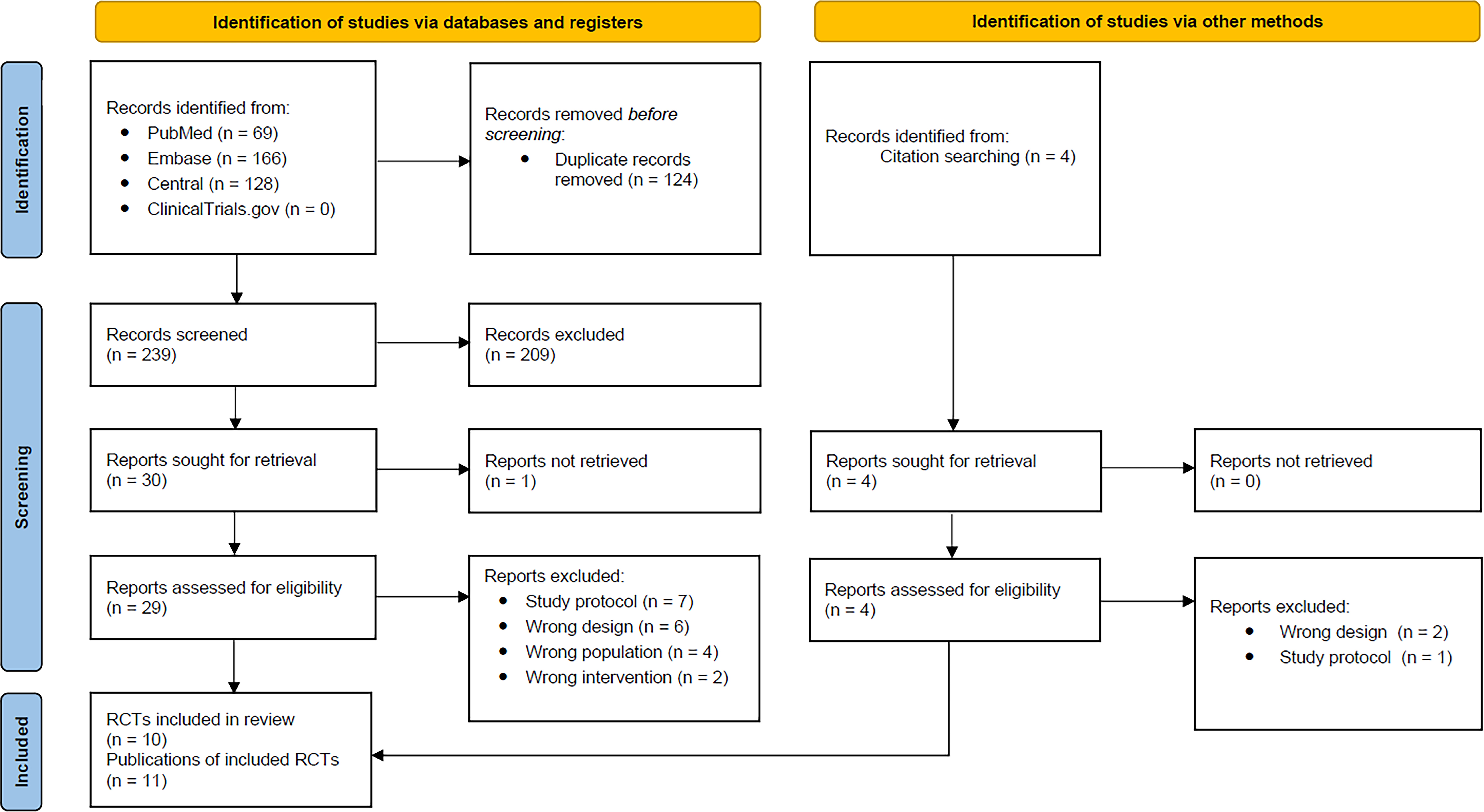
Flow diagram of study inclusion.
Studies characteristics
A is presented in Table 1 presents a summary of the characteristics of the included RCTs. Supplementary Data S7 provides detailed demographic information for each study. We included ten RCTs. Of these, 5 RCTs were conducted in the United Kingdom,32–37 2 RCTs in Sweden,30,39 and the other 3 RCTs38,40,41 were conducted in different countries (United States, Japan, and Korea). The total sample size was 537 patients (range: from 30 to 84), the mean age ranged from 19.7 to 45.7 years, and the prevalence of males ranged from 38.1% to 90%.
Study Characteristics


C, control group; CBT, cognitive behavioral therapy; CUES-A, Coping with Uncertainty in Everyday Situations; DBT, dialectical behavior therapy; ERP, exposure and response prevention; GP, general practitioner; I, intervention group; IAPT, increasing access to psychological therapies; IQ, intelligence quotient; NIHR, National Institute for Health Research; NHS, National Health Service; OCD, obsessive-compulsive disorder; PAT-A©, Personalised Anxiety Treatment–Autism; STEPS, The Stepped Transition in Education Program for Students with autism; UaDE, Understanding and Describing Emotions; UK, United Kingdom; USA, United States of America; VRE, Immersive Virtual Reality Environment–Delivered Graded Exposure Treatment.
Four RCTs30,35,36,41 employed CBT through only in-person sessions, while three of them34,38,39 utilized virtual methods (one as a mobile application, one as an online course, and another as an online treatment program). In addition, three RCTs32,33,37,40 combined in-person and virtual components, with the virtual component consisting of follow-up through phone calls, emails, or chat platforms. In three RCTs, the intervention application was self-administered,34,38,39 while in the others a trained mental health professional administered the intervention. In all RCTs, the frequency of CBT sessions was weekly, while in only one study 34 it was on demand because it was a virtual course.
Regarding the comparator, six RCTs32–35,38,40,41 used a waitlist or treatment as usual control, while four RCTs30,36,37,39 compared the intervention with minimal psychological support. Supplementary Data S8 presents the scales used to assess each outcome.
Risk of bias
Overall, most studies were rated as having a high risk of bias according to the RoB 1.0 tool. Although the majority showed a low risk of bias for allocation concealment, 4 out of 10 RCTs had an unclear risk for sequence generation. We judged all studies to have a high risk of bias for blinding of participants and personnel. Regarding the blinding of outcome assessors, we assessed 3 out of 10 RCTs as high risk, and another 3 as unclear. For incomplete outcome data, 7 out of 10 RCTs presented a high risk of bias. We identified selective outcome reporting as high risk in 2 out of 10 RCTs.
Finally, in the domain of other sources of bias, we rated 5 out of 10 RCTs as high risk due to no information on washout period, 35 COVID-19 affecting follow-up, 37 baseline imbalance in residential and financial status,32,33 baseline differences in anxiety and depression levels and underpowered sample, 30 and self-selection leading to unmatched baseline characteristics. 34 We rated one RCT 40 as unclear (Supplementary Data S3). These judgments describe overall study-level methodological characteristics.
Outcomes and certainty of the evidence
The Summary of Findings (SoF) table is available in Table 2.
Summary of Findings Table for the Effects of CBT in Autistic Adults
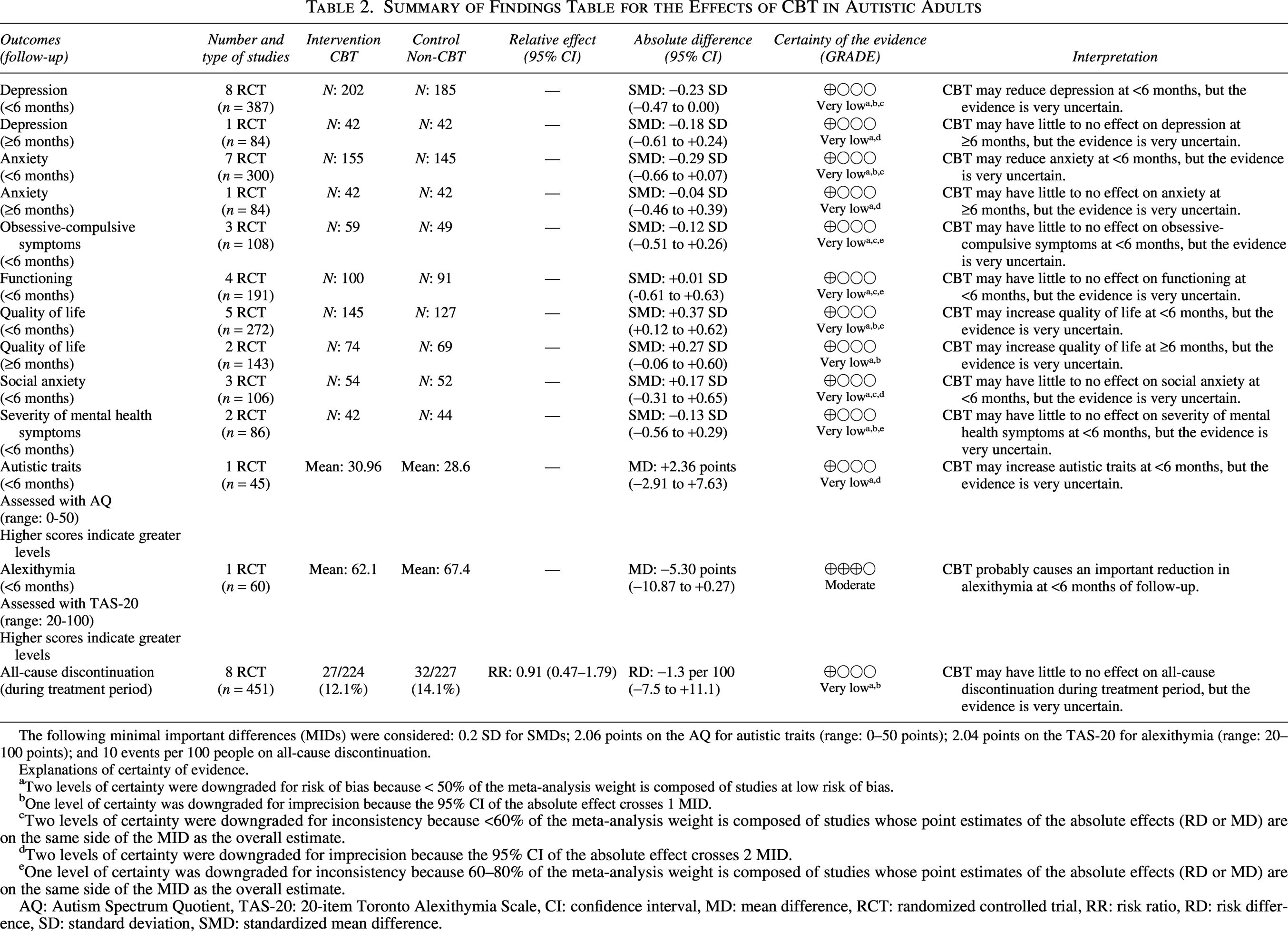
The following minimal important differences (MIDs) were considered: 0.2 SD for SMDs; 2.06 points on the AQ for autistic traits (range: 0–50 points); 2.04 points on the TAS-20 for alexithymia (range: 20–100 points); and 10 events per 100 people on all-cause discontinuation.
Explanations of certainty of evidence.
Two levels of certainty were downgraded for risk of bias because < 50% of the meta-analysis weight is composed of studies at low risk of bias.
One level of certainty was downgraded for imprecision because the 95% CI of the absolute effect crosses 1 MID.
Two levels of certainty were downgraded for inconsistency because <60% of the meta-analysis weight is composed of studies whose point estimates of the absolute effects (RD or MD) are on the same side of the MID as the overall estimate.
Two levels of certainty were downgraded for imprecision because the 95% CI of the absolute effect crosses 2 MID.
One level of certainty was downgraded for inconsistency because 60–80% of the meta-analysis weight is composed of studies whose point estimates of the absolute effects (RD or MD) are on the same side of the MID as the overall estimate.
AQ: Autism Spectrum Quotient, TAS-20: 20-item Toronto Alexithymia Scale, CI: confidence interval, MD: mean difference, RCT: randomized controlled trial, RR: risk ratio, RD: risk difference, SD: standard deviation, SMD: standardized mean difference.
Depression
Compared to the control group, CBT may reduce depression during post-treatment follow-up periods of less than 6 months (8 RCTs; SMD: −0.23 SD; 95% CI: −0.47 to 0.00; very low certainty). However, for follow-up periods of 6 months or longer, CBT may have little to no effect on depression (1 RCT; SMD: −0.18 SD; 95% CI: −0.61 to +0.24), and for both timeframes, the evidence is very uncertain (Fig. 2A).

(continued on next page)
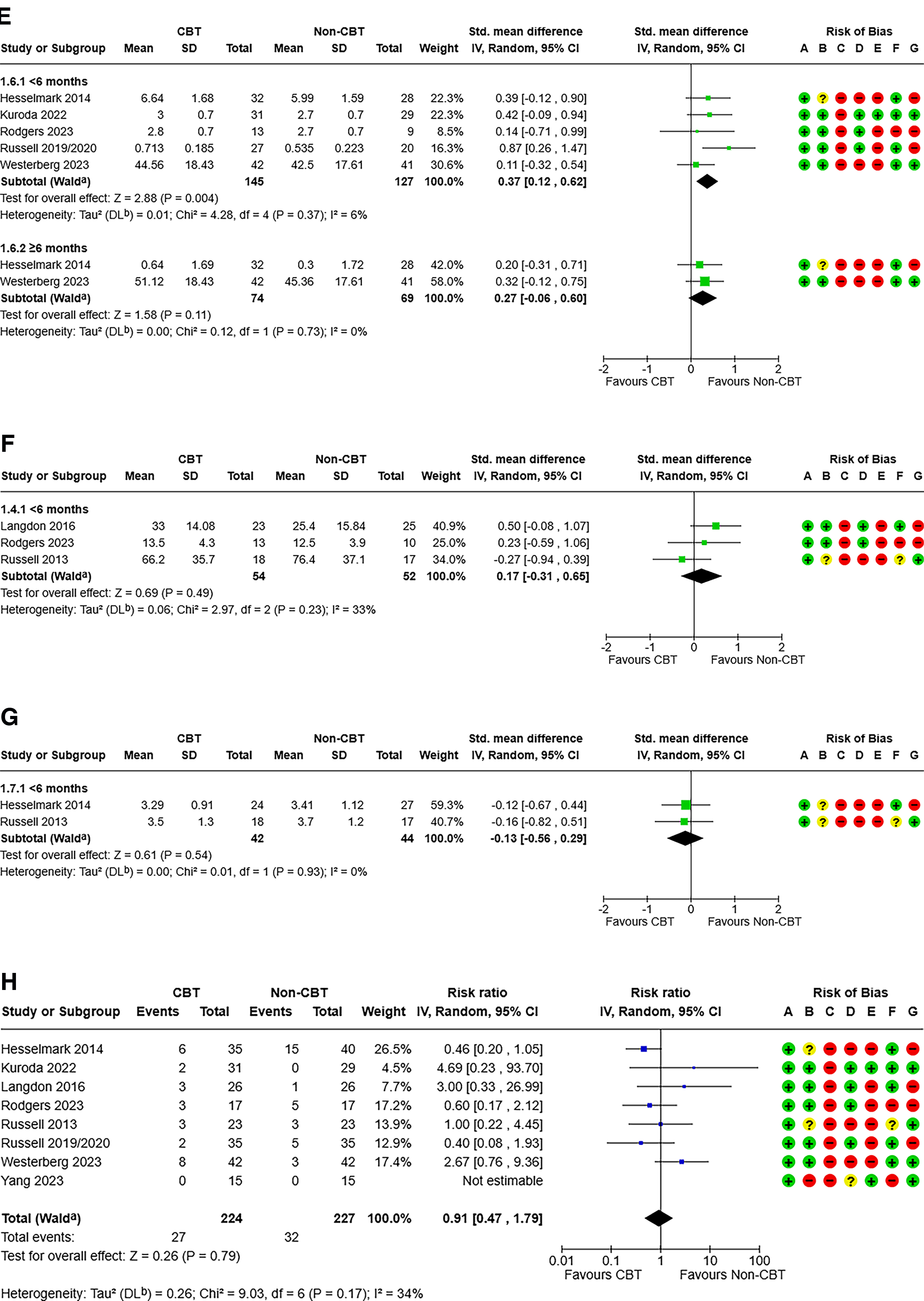
Meta-analysis of the effect of CBT versus non-CBT at <6 months and ≥6 months follow-up periods. Figure panels:
Anxiety
Compared to the control group, CBT may reduce anxiety during post-treatment follow-up periods of less than 6 months (7 RCTs; SMD: −0.29 SD; 95% CI: −0.66 to + 0.07; very low certainty). In contrast, for follow-up periods of 6 months or longer, CBT may have little to no effect on anxiety (1 RCT; SMD: −0.04 SD; 95% CI: −0.46 to +0.39), and the evidence is very uncertain for these findings (Fig. 2B).
Obsessive-compulsive symptoms
Compared to the control group, CBT may have little to no effect on obsessive-compulsive symptoms for post-treatment follow-up periods of less than 6 months (3 RCTs; SMD: −0.12 SD; 95% CI: −0.51 to +0.26; very low certainty), but the evidence is very uncertain (Fig. 2C). No RCTs evaluated this outcome at 6 months or longer follow-up.
Functioning
Compared to the control group, CBT may have little to no effect on functioning during post-treatment follow-up periods of less than 6 months (4 RCTs; SMD: +0.01 SD; 95% CI: −0.61 to + 0.63; very low certainty) (Fig. 2D). No RCTs evaluated this outcome at 6 months or longer follow-up.
Quality of life
Compared to the control group, CBT may increase quality of life during post-treatment follow-up periods of less than 6 months (5 RCTs; SMD: +0.37 SD; 95% CI: +0.12 to + 0.62; very low certainty) and 6 months or longer (2 RCTs; SMD: +0.27 SD; 95% CI: −0.06 to + 0.60). However, the evidence is very uncertain for both periods (Fig. 2E).
Social anxiety
Compared to the control group, CBT may have little to no effect on social anxiety during post-treatment follow-up periods of less than 6 months (3 RCTs; SMD: +0.17 SD; 95% CI: −0.31 to + 0.65; very low certainty) (Fig. 2F). No RCTs evaluated this outcome at 6 months or longer follow-up.
Severity of mental health symptoms
Two studies30,36 included in the meta-analysis reported mental health symptom severity using the Clinical Global Impression (CGI) or CGI-Severity (CGI-S) scales. These scales provide a global evaluation of overall clinical symptom severity based on the evaluator’s judgment, rather than assessing specific domains such as depression, anxiety, or social functioning.30,36 Compared to the control group, CBT may have little to no effect on the severity of mental health symptoms for post-treatment follow-up periods of less than 6 months (2 RCTs; SMD: −0.13 SD; 95% CI: −0.56 to + 0.29; very low certainty) (Fig. 2G), but the evidence is very uncertain. No RCTs evaluated this outcome at 6 months or longer follow-up.
Autistic traits
Compared to the control group, CBT may increase autistic traits during post-treatment follow-up periods of less than 6 months (1 RCT; MD: +2.36 points; 95% CI: −2.91 to +7.63; very low certainty), though the evidence is very uncertain. No RCTs evaluated this outcome at 6 months or longer follow-up.
Alexithymia
Compared to the control group, CBT reduced alexithymia during post-treatment follow-up periods of less than 6 months (1 RCT; MD: −5.30 points; 95% CI: −10.87 to +0.27), though this difference was not statistically significant. Based on moderate-certainty evidence, CBT probably results in an important reduction in alexithymia. No RCTs evaluated this outcome at 6 months or longer follow-up.
All-cause discontinuation during treatment period
Compared to the control group, CBT may have little to no effect on all-cause discontinuation, but the evidence is very uncertain (8 RCT; RD: −1.3 per 100; 95% CI: −7.5 to + 11.1; very low certainty) (Fig. 2H).
Discussion
Summary of main results
We assessed 10 RCTs (n = 537) evaluating the effects of CBT in autistic adults. Most outcomes, including depression, anxiety, social anxiety, functioning, severity of mental health symptoms, all-cause dropouts, obsessive-compulsive symptoms, autistic traits, and quality of life, showed very low certainty evidence with no clear benefit or harm. Alexithymia was the only outcome showing a probable reduction, supported by moderate-certainty evidence, during post-treatment follow-up periods of less than 6 months. Most RCTs had small sample sizes and a high risk of bias, and their results were inconsistent. Overall, the findings are limited by the very low certainty of the evidence, preventing firm conclusions about the effects of CBT in this population.
Agreements and disagreements with other studies or reviews
We compiled the evidence about the effects of CBT in autistic adults. Compared to the extensive research conducted in children, there is a relative paucity of systematic reviews focusing on treatment options for autistic adults. As awareness and understanding of autism in adulthood continue to grow, it becomes increasingly important to clarify current therapeutic trends and to inform comprehensive, evidence-based management strategies for this population.
Our findings indicate that most RCTs focus on anxiety and depression as common mental health comorbidities of autism. The evidence on CBT’s effect on anxiety in autistic adults remains highly uncertain across both short-term (<6 months) and longer-term (≥6 months) follow-up periods. These findings are consistent with a prior systematic review 25 that included both children and adults but did not specify the timeframes used to assess clinical outcomes. Although adaptations of CBT for adults, such as CBT-Adapted Self-Directed and CBT-Non-Adapted Self-Directed, have been examined, their effects were not statistically significant. 25 In contrast, another systematic review 19 reported improvements in anxiety following CBT. However, the magnitude of the effect may depend on the assessment method used, with clinician-rated measures typically yielding more robust results than self-reports. 19
In our review, the evidence on CBT’s impact on social anxiety was also very uncertain, likely due to the small number of RCTs specifically addressing this outcome. This is consistent with findings from an uncontrolled clinical trial that tested an eight-week modified group CBT program targeting social anxiety and social functioning in autistic adolescents and young adults without intellectual disability (ages 16–38). 42 That intervention, which included social skills training, exposure exercises, and behavioral experiments, led to significant improvements in social anxiety (p < 0.001), social motivation (p = 0.032), restricted interests and repetitive behaviors (p = 0.025), and mood symptoms including depression, anxiety, and stress (p < 0.05). 42 Although the effect sizes were small, these results are aligned with the general trends observed in our review.
Regarding depression, the evidence on the effect of CBT in autistic adults remains highly uncertain. A previous systematic review 26 that included a non-randomized controlled study comparing CBT and mindfulness-based stress reduction (MBSR) 43 found positive effects on depressive and anxiety symptoms, as well as reductions in rumination and autistic traits. Similarly, Linden 2023 25 reported that adapted and non-adapted CBT formats might reduce depressive symptoms in autistic adults compared with no intervention, though the certainty of the evidence was low. Taken together, these discrepancies suggest that standard CBT protocols may not adequately address the full range of co-occurring and functional differences present in autistic adults. This highlights the potential relevance of multimodal and personalized intervention frameworks that integrate CBT with complementary therapeutic approaches as an important direction for future research.
Our findings also suggest that the evidence for CBT’s effect on quality of life remains very uncertain. While the point estimates from the included trials appear numerically positive, the very low certainty means we cannot conclude that CBT truly improves quality of life. This contrasts with Schweizer 2024, 26 who emphasized that quality of life in autistic adults is closely linked to anxiety, depression, and the stress associated with “masking.” Reported improvements in that review may reflect CBT’s capacity to reduce emotional distress and enhance coping strategies. The limited availability of tailored interventions for this population underscores the importance of person-centered and communication-adapted approaches. Furthermore, the variability in quality-of-life scores across instruments highlights the need to assess multiple dimensions of well-being and to explore how CBT can be better adapted for autistic adults. In line with these concerns, our review reinforces the urgent need for high-quality trials to clarify the certainty of the evidence and guide effective adaptations.
Consistent with previous work by Elliott, 23 our study confirms that evidence supporting CBT efficacy in autistic adults is limited and of low certainty. This reflects broader concerns about the applicability of standard CBT protocols to this population, given common challenges such as cognitive rigidity, abstract thinking difficulties, and atypical anxiety responses. Nevertheless, Kose 24 suggested that CBT may be more effective when adapted using specific strategies such as parental involvement, visual supports, concrete metaphors, positive reinforcement, and structured instructions. These adaptations may better accommodate the cognitive and behavioral characteristics of autistic people.
Evidence regarding CBT’s effect on functioning was also inconclusive. While our findings show no clear improvement, Weston 19 and Schweizer 26 reported improvements in social and emotional functioning in autistic people, particularly in social interaction, anxiety reduction, and adaptive skills development. These discrepancies suggest that CBT’s functional benefits may be more prominent in specific domains rather than in global functioning, underscoring the need for domain-specific outcome measures in future research. Anxiety may also act as a key mediator of functioning: both Weston 19 and Schweizer 26 emphasized that reducing anxiety can improve social engagement and autonomy, which may explain CBT’s selective impact.
Our review also highlights nuanced findings regarding autistic traits and alexithymia. The increase in autistic trait scores postintervention may reflect greater self-awareness rather than symptom worsening, consistent with literature linking higher trait recognition to poorer quality of life, reduced coherence, and increased emotional distress.44,45 Although CBT may not directly alter core autistic traits, high treatment satisfaction suggests that participants perceive benefits. CBT probably results in an improvement of emotional awareness (reduction of alexithymia) at less than 6 months post-treatment, supported by moderate-certainty evidence. This is consistent with previous studies suggesting CBT may enhance the ability to identify and describe feelings in autistic adults,30–32 targeting a core feature in this population.46–48
Taken together, these findings support the value of tailored CBT adaptations, potentially including psychoeducation or follow-up sessions, to promote emotional regulation and sustain improvements. Future studies should explore long-term outcomes and refinements to CBT that address both emotional and social-cognitive domains to optimize effectiveness in autistic adults.
Finally, our review found the evidence on all-cause treatment discontinuation to be very uncertain, limiting conclusions about acceptability and retention. This aligns with Elliott 2021 23 , who reported high retention (87%) in both CBT and anxiety management groups in an RCT for OCD in autistic people, though certainty was low. Similarly, Weston 2016 19 did not report dropout rates explicitly but noted methodological shortcomings such as limited reporting on engagement, poor handling of missing data, and inadequate monitoring of treatment fidelity.
Although current data are insufficient to draw firm conclusions, these issues highlight the importance of rigorous RCTs that assess acceptability, adherence, and retention as core outcomes, particularly in complex clinical populations.
Certainty of evidence
The certainty of the evidence was primarily affected by small sample sizes and heterogeneity in interventions, which introduced limitations in the reliability and generalizability of our findings. Many of the included RCTs had relatively few participants, reducing the statistical power to detect significant effects and increasing the potential for random variations to influence results. This limitation was further compounded by the variability in intervention formats, including differences in session length, frequency, and delivery methods (e.g., individual vs. group therapy, in-person vs. online, adapted vs. non-adapted CBT).
In addition, the use of diverse outcome measures across studies contributed to heterogeneity, making direct comparisons challenging. While SMDs were used to account for variations in measurement scales, residual differences in how symptoms were assessed and reported may have affected consistency across studies. The heterogeneity in interventions also reflects the broader challenge of adapting CBT for autistic adults, as individual needs vary widely based on cognitive abilities, mental health symptom severity, and comorbid conditions.
As a result, the certainty of evidence was downgraded due to concerns regarding imprecision and inconsistency. The limited number of large-scale, high-quality RCTs further underscores the need for future research with larger, well-powered RCTs that employ standardized intervention protocols and outcome assessments. Addressing these limitations will be essential for strengthening the evidence base and guiding more definitive clinical recommendations for CBT in autistic adults.
Implications for clinical practice
Our findings underscore the need to prioritize the development and evaluation of adapted CBT interventions for autistic adults. The current evidence, derived from 10 RCTs (n = 537), shows very low certainty and inconclusive effects across most outcomes, with very low certainty and no clear benefits for anxiety, depression, obsessive-compulsive symptoms, social anxiety, functioning, quality of life, or autistic traits.
Only alexithymia showed a potential reduction, based on moderate certainty of evidence from a single RCT. However, no other outcome showed clinically meaningful improvement, and the overall certainty of the evidence was compromised by small sample sizes, heterogeneity of interventions, and high risk of bias across studies.
Evidence on CBT, whether adapted or not, remains limited. In addition, the limited number of RCTs addressing outcomes highlights important and persistent evidence gaps.
To enhance clinical relevance, future CBT programs should be tailored to the specific cognitive, emotional, and sensory needs of autistic adults. This may involve structured sessions, visual supports, simplified language, and a focus on emotional awareness and regulation. Interventions of longer duration, inclusion of booster sessions, or implementation within stepped-care models could potentially optimize outcomes, though these strategies remain insufficiently evaluated.
Digital and self-guided CBT formats represent a promising alternative for people with limited access to traditional services. However, these modalities still require rigorous clinical validation before they can be recommended for widespread implementation.
Given the current uncertainty of effects, clinical decisions should be cautious and individualized. Future research should go beyond symptom reduction and emphasize functionally meaningful outcomes, such as autonomy, interpersonal functioning, occupational engagement, and overall quality of life. High-quality RCTs with adequate power, longer-term follow-up, and transparent reporting of intervention fidelity, acceptability, and adaptations are urgently needed to inform evidence-based care for autistic adults.
Limitations and strengths
Our systematic review has several strengths. One of the main advantages is its comprehensive approach to evaluating the effects of CBT. Unlike most studies that focus solely on anxiety as a symptom in autism, our review includes a broad range of research examining its impact on various clinical outcomes. This allows for a more comprehensive understanding of CBT’s effects on different emotional manifestations within autism, representing a significant advancement compared with previous studies with a narrower focus.
Another key strength is the specific focus on autistic adults, in contrast to the majority of available evidence, which primarily targets children. This distinction is important because developmental differences may influence therapeutic engagement, responsiveness, and outcomes.
Finally, the methodological rigor employed in our study is a critical strength. A systematic approach was used for literature review and data analysis, following PRISMA 2020 guidelines, 22 which enhances the validity of the findings. Furthermore, clearly defined inclusion criteria were applied, and a risk of bias assessment of the included RCTs was conducted.
Our study also has several limitations. The first is the small sample size in many of the RCTs included in the meta-analysis, which affects the robustness of the findings. Small samples can lead to less precise results and increased variability, reducing the reliability of observed effects and limiting the generalizability of CBT’s effects in autistic adults.
Another limitation was the insufficient number of consistent studies available to perform a meta-analysis for all clinical outcomes. Third, in most cases, it was not possible to meta-analyze the MDs (pre–post intervention). Therefore, post-treatment values were used instead. This approach may be more susceptible to baseline imbalances and could affect the accuracy of the estimated effect sizes.
Last, there was substantial variability in outcome measurement tools across studies. The use of different psychometric instruments to assess similar constructs limited comparability and highlighted the need for greater standardization. To address this heterogeneity, we used standardized effect size metrics, which facilitated a more accurate synthesis and interpretation of the results across studies.
Conclusion
This systematic review evaluates the effects of CBT across different clinical outcomes in autistic adults. For most outcomes, including depression, anxiety, social anxiety, mental health symptom severity, functioning, all-cause dropouts, obsessive-compulsive symptoms, autistic traits, and quality of life, the evidence was uncertain. Only for alexithymia, CBT probably causes an important reduction at less than 6 months post-treatment.
These findings are substantially limited by methodological shortcomings in the included RCTs, such as small sample sizes, high risk of bias, and inconsistency in results. In addition, the limited use of pre–post intervention comparisons and the reliance on post-treatment data further restrict the interpretability of effects.
In summary, although CBT is widely recommended for autistic children or adolescents, the current evidence in autistic adults remains insufficient to draw firm conclusions regarding its effects across most clinical outcomes. More robust and methodologically rigorous RCTs are needed to better understand the role of CBT in this population and inform clinical practice.
Authorship Confirmation Statement
J.P.-C., C.H.C.-P., G.V.-J., A.M.-F., A.V.S.M., and A.B.-C. participated in the conception and design of the study. J.P.-C., C.H.C.-P., G.V.-J., A.M.-F., A.V.S.M., and A.B.-C. acquired the data. All authors participated in the analysis and interpretation of data. All authors participated in drafting or revising the article.
Protocol Registration Number
PROSPERO CRD42024568715.
Footnotes
Author Disclosure Statement
The authors declare to have no conflicts of interest regarding this article.
Funding Information
This article was self-funded by the authors.
Supplemental Material
Supplemental Material
Supplemental Material
Supplemental Material
Supplemental Material
Supplemental Material
Supplemental Material
Supplemental Material
References
Supplementary Material
Please find the following supplemental material available below.
For Open Access articles published under a Creative Commons License, all supplemental material carries the same license as the article it is associated with.
For non-Open Access articles published, all supplemental material carries a non-exclusive license, and permission requests for re-use of supplemental material or any part of supplemental material shall be sent directly to the copyright owner as specified in the copyright notice associated with the article.
