




Abstract
Accountable Communication Theory attempts to develop a conceptual starting point for integrating perceptual dehumanization (PD) and interpersonal synchrony (IPS) with Cross-Neurotype Communication breakdowns. It is an integrative framework designed to explain communication breakdowns across neurotypes, particularly between autistic and non-autistic people. The theory considers the robust empirical support for differences in social synchronization patterns and organizes them with the Domains of Difference. These domains encompass aspects of immediately observable social behavior (front-end communication) and the neurobiological foundations of social behavior (back-end communication), which vary by neurotype. Differences in the back-end of communication influence the surface-level appearance of social behavior, making it difficult for non-autistic individuals to interpret autistic social behavior accurately. This framework proposes the connection between IPS and PD, as a possible explanation for why phenomena such as the Double-Empathy Problem and Dialectical Misattunement Hypothesis occur. The theory emphasizes that non-autistic individuals must take responsibility for correctly understanding and interpreting autistic communication, rather than making assumptions that lead to negative judgments, forcing autists to rely on masking to meet their needs. Promoting and adopting social skills that aid in decoding autistic communication—referred to as psychological equity and mutual accommodation—go beyond basic neuro-affirming approaches. Instead, they embody Deep-Affirmation, a value system rooted in reclaiming dignity for autistic individuals through clear communication, precise understanding, and accurate interpretation of autistic social behavior as an intervention for dehumanization.
Community Brief
What do we know?
We know that autistic and non-autistic people can have a “mismatch” in communication, often called the Double-Empathy Problem. They may have difficulty relating to each other because of their communication differences.
What perspectives does the author contribute?
A high-masking, late-diagnosed autistic scholar writes this theory from both lived experience and science. The theory uses ideas from psychology, kinesiology, neuroscience, and linguistics.
What is the unique contribution of this theory?
Accountable Communication Theory (ACT) helps us understand why autistic and non-autistic people might misunderstand each other. ACT introduces the “Domains of Difference” (DoDs), which divide communication into two parts. The “back-end” of communication includes the brain and body. The “front-end” of communication is what you can see and hear. The back-end shapes how communication shows up on the front-end.
When people have differences in the back-end, it can affect how they communicate on the front-end. These differences can also affect how people understand the communication they see in others. The DoDs give people simple language to talk about social interactions more clearly. This is important because talking about these challenges can help people find better ways to understand each other.
The main contribution of ACT is that it explains how misunderstandings can affect how non-autistic people see autistic people. Non-autistic people may have difficulty reading or interpreting their communication, which might make it harder to see autists as fully human. This does not happen on purpose. Instead, it happens because the visual and social cues non-autistic people expect do not match what they see. This can affect how non-autistic people respond to or treat autistic people. ACT also introduces new ideas that focus on helping non-autistic people learn better ways to communicate.
What does the author recommend?
The author recommends Deep-Affirmation (DA) to improve communication. DA focuses on reducing stigma by helping people learn more about those who have experienced discrimination. Its main goal is supporting non-autistic people in prioritizing deep understanding during communication, especially with autistic people. DA includes two key practices: Psychological Equity (PE) and Mutual Accommodation (MA). PE means taking personal and professional responsibility for protecting the dignity of others. This includes learning how and why communication can break down to create safer communication. MA builds on this idea. It means adjusting one’s behavior to support psychological safety during communication.
What is the importance of this theory?
ACT helps non-autists understand autistic communication. This understanding can help reduce the harm autistic people experience—like the need to mask, which harms mental health. ACT works toward solutions that reduce the need for masking by helping non-autistic people understand their role in communication. Instead of expecting autistic people to change, ACT supports better communication skills for non-autists. This can reduce the need for autistic people to make up for misunderstandings. Clear and neutral language to talk about communication differences helps to share responsibility for understanding, leading to communication that is more respectful, supportive, and fair for autistic people.
Introduction
Interpersonal communication is a complex process that starts with an individual’s ability to rapidly analyze many aspects of an environment to detect a human mind. This process allows one to achieve a state of interpersonal connectedness through synchrony. 1 Cross-Neurotype Communication (XNTC) presents unique challenges that may impede mutual understanding. The Double-Empathy Problem (DEP) and Dialectical Misattunement Hypothesis (DMH) each provide theoretical accounts of these communication challenges in ways that recognize the bidirectional nature of communication breakdowns. These frameworks outlined an understanding of autistic communication by offering insights that challenge mainstream misperceptions. Both theories conceptualize the biased treatment of autistic individuals, and each names a connection between a social mismatch and the marginalization of autistic people. This article proposes a novel theoretical contribution that extends neither the DEP nor DMH theories, but instead proposes a possible causal mechanism to both phenomena.
The Double-Empathy Problem
Milton clearly outlines the inter-contextual and -dimensional quality of the DEP, stating the following: “Due to differing qualia of experience, social lifeworlds, dispositional viewpoints and discursive repertoires, interactions between autistic and nonautistic people are vulnerable to breaches in mutual understanding, framed as a ‘double problem’ as both parties in the interaction will experience a sense of disjuncture, not simply a deficit in the autistic person’s mind. Whilst this experience may be novel for many non-autistic people, it is commonplace for autistic people.”
2
What many advocates view as neutral “autistic communication,” the notion of deficiency in autistic communication creates not only a social mismatch but also a power imbalance that favors non-autistic individuals.2,3 Mutual misunderstanding occurs as a result of fundamental dispositional differences that impede reciprocal understanding. In addition, there is a social imbalance where social norm-enforcers blame autistic individuals for communication failures under the guise of social communication “deficits.” 4 More information is needed to understand the root cause of both the DEP and DMH, along with actionable steps that can bring repair through deliberate action in everyday social interactions.
The DEP emphasizes that communication challenges in autism stem from mutual misunderstanding, not inherent social deficit. 4 This bidirectional misunderstanding has created a social imbalance that places an undue burden of responsibility for breakdowns in communication because of their social communication “deficits.” 4 Society has pathologized neutral differences in communication while deeming non-autistic communication the standard.3,5,6 The DEP explains that autistic individuals face social difficulties not because of their own shortcomings, but due to differences in worldview and perspectives that destabilize the foundation for mutual understanding.2,4 Indeed, the communication breakdown is bidirectional, rather than due to pathologized differences on the part of an autist. 4 The DEP introduced a new way for researchers and clinicians to think about autistic social behaviors in ways that decenter neuronormativity and deficit-focused frameworks.
The Dialectical Misattunement Hypothesis
The DMH refers to relational strain and misunderstanding based on variance in predictive inferencing models across neurotypes. 7 The DMH references circular causality, which acknowledges interactions between sociocultural, cognitive-behavioral, and biological variations between individuals and groups that can all impact interpersonal relationships and communication. 7 Differences in social processing and neural synchrony produce relational strain that negatively impacts mental health in the autistic population. 7
The DMH’s model of circular causality highlights the relationship between variables such as sociocultural influences, intra- and inter-personal cognitive-behavioral influences, and biological influences that interact with one another and can influence how one perceives and interprets the behavior of others. These variables also serve as representations of the micro-, meso-, and macro-levels of society, and how predictive styles shape it. The proposed theory attempts to further conceptualize this contribution to the autism literature by highlighting the implications of those multi-level interactions that influence XNTC by more deeply integrating it with interpersonal synchrony (IPS) in ways that allow researchers to precisely analyze interactions between variables. This analysis can help researchers name the impact of mismatches on the autist in real-time, in addition to proposing a mechanism that may be at the core of this mismatch. Later in this article, Accountable Communication Theory (ACT) will propose solutions to address mismatches and their impacts on autistic individuals after proposing a clear interpretation that may explain why we see issues such as the DEP and DMH occurring in the first place.
To begin, one can better understand the nature of XNTC challenges with a deeper understanding of human connection and what processes facilitate such a connection. This first calls for an understanding of the relationship between IPS and mind-perception in addition to an understanding of perceptual dehumanization (PD). These two causal chains in the literature may work together to explain why XNT interlocutors experience phenomena such as the DEP and DMH.
Mind-perception and IPS
IPS refers to the temporal adaptability of behavior between individuals in ways that are dynamic and reciprocal. Synchrony requires sustained joint attention, temporal coordination, and real-time behavioral adaptability. 8 This article takes an expansive view of synchrony, recognizing the interpersonal benefits in context with its evolutionary function: survival. Early humans lacked language and had to rely on nonverbal communication, such as eye contact and interpersonal coordination, to ensure they could meet basic needs. 9 The evidence linking synchrony to trust, rapport, and camaraderie1,10,11 is consistent with its evolutionary context. However, researchers have also found instances in which decreased synchrony can be beneficial, particularly when interlocutors adopt different topographical behaviors to reach a common goal. In this case, joint attention and shared goals facilitate cooperation. 12 This is a social contingency 8 that requires interlocutors to adapt to one another in real-time, engaging in action prediction, kinematic encoding, and intention readout, to coordinate with one another 13 for a common good. 12
It is plausible to infer that synchrony is a product of social contingency, since decreased synchrony can benefit interlocutors when they cooperate on a shared goal that requires them to engage in different behaviors to achieve it. 12 Therefore, this article suggests that synchrony may not always refer to synchronized topographical behavior, but rather a real-time adaptation of behavior to meet a common goal or need contingent on present circumstances and constraints. For example, if an individual has specific and nuanced issues with technology, they may reach out to tech support. When they call the tech support hotline, they may hear an automated voice providing menu options to understand the issue. Those options, however, are simply not specific enough, so they wait on the line for a human support person and instantly experience a reduced sense of anxiety when they hear a live, idiosyncratic, relationally present human who can talk through the issue in depth and provide a hyper-personalized solution.
Wheatley et al. 1 compiled evidence supporting a connection between mind-perception and IPS, which highlights the necessity of synchrony in a human’s ability to perceive a human mind via the brain’s Turing Tests. 1 The brain perceptually filters out all non-human elements of an environment and rapidly distinguishes humans from non-human species and objects that appear human. The primary criteria for human mind-perception are that it looks, sounds, and moves like a human. 1 Of note, while some behaviors and movements might be seen as innate in humans, it is critical to recognize the role of socialization as outlined in the DMH’s understanding of circular causality, as sociocultural conditioning likely influences one’s understanding of what is considered normal, therefore shaping neuronormative attitudes. 7 A core argument of the proposed theory is that disruptions in synchrony may impact mind-perception, which the author interprets as a disruption in one’s perception of another’s humanity through the PD process.
PD theory
The theory of PD refers to a change in configural face processing through which an individual perceives a human face in fragments instead of seeing the whole face at once. 14 This form of face processing is the same process by which humans recognize inanimate objects. 14 In other words, the brain processes a human face in the same way it would a chair or a computer. When someone violates social norms, research has found that it triggers this form of perception in those inclined to enforce social norms. In addition, these individuals do not ascribe complex emotions unique to humans to “norm violators.”15,16
PD is not yet deeply intertwined with neurodiversity studies, but PD theory has already done the heavy lifting of connecting PD—the shift in configural face processing—to moral disengagement. Dehumanizing attitudes and propaganda have been at the core of some of the worst atrocities throughout history. 17 The PD literature has already provided evidence for how people justify the harm they cause, though we have not yet explored this concept in relation to neurodiversity studies. PD might provide insights for why autistic individuals are the subject of dehumanizing attitudes,18,19 treatment, and victimization20–22 at such disproportionate rates, in addition to harsher evaluation, specifically when others are unaware the individual is autistic. 23 This may be due to autistic individuals “passing” as non-autistic, yet still demonstrating nuanced differences in synchronization that still eliminate predictability despite masking obvious cues of autism, as research has not yet confirmed the effectiveness of camouflaging. 24 The PD literature suggests that PD occurs perceptually before it occurs behaviorally in the form of victimization. 16 This process may trigger a parallel cycle that puts an autistic individual in a position to rely on compensatory behaviors (masking) to prevent victimization, or perhaps, more precisely, to be viewed as a human.
An Integrated Theoretical Account of Autistic Communication: ACT
ACT suggests that disruptions in synchrony undermine mind-perception ability at the visuo-perceptual level. In this theory, the primary focus is on the well-documented differences in IPS patterns across neurotypes that may impact mind-perception and the ascription of humanity 1 to autistic individuals by non-autists. The goal of this theory is to propose a possible causal mechanism of the DEP and DMH that may explain why communication and relational breakdowns across neurotypes exist in the first place. In addition, ACT connects visuo-perceptual processes to the “othering” behavior observable in the literature. Finally, ACT attempts to develop new constructs that can guide efforts to address the root cause of the DEP and DMH.
For this first iteration of ACT, the author has written these concepts to under the assumption of controlled conditions, meaning it assumes any two interlocutors are a mixed-neurotype dyad with one interlocutor being autistic and the other non-autistic. However, this theory is highly generalizable, as its core suggests that human mind-perception is an innate quality in the vast majority of humans. ACT also suggests that PD is not a conscious act, as people are unlikely to be aware of small shifts in their visuo-perceptual processing. This would mean that if a PD-inducing event occurs, the ACT framework does not see the dehumanizing behavior that is likely to follow as malicious, but rather due to a general lack of awareness of interpersonal dynamics and of the self and exposure to unfamiliar communication patterns. ACT additionally suggests that PD may not always require a power imbalance such as what we see between autistic and non-autistic interlocutors and other socially dominant-vulnerable dyads. The effects of external events on visuo-perceptual processing are likely idiosyncratic and would impact individuals differently depending on individual-level factors such as personality pathology, socioeconomic status, or culture. Additional influences from sociocultural-level factors might include normative expectations and predictive styles consistent with those described in the DMH. 7 The scope of the current conceptualization limits the application of these concepts to autistic and non-autistic interlocutors with no differences in the presence or absence of marginalized identities and intersectionalities.
Synchrony and autism
The rationale for framing disruptions in synchrony—especially in the context of XNTC—as norm violations is the similarity in patterns of IPS and the clinical conceptualizations of social reciprocity (or “lack” thereof) when diagnosing autism. Clinical behavioral observations based on DSM criteria align with IPS-related concepts, such as joint attention, gesture, and social reciprocity. 25 IPS literature demonstrates an overarching theme of reciprocal social interactions that facilitate prosocial behavior.10,11,26 The diagnostic criteria for autism clearly communicate that autistic communication is “disordered” because of its lack of synchronous behaviors associated with prosociality—deficits in social reciprocity in particular. 25 In addition, increased social motor synchrony improves rapport among interlocutors regardless of neurotype. 27
Evidence suggests that IPS is reduced in autism, and there are numerous kinematic differences when comparing autistic and non-autistic kinematic profiles.28–32 There is a robust body of empirical support for the notion that autistic individuals have unique motor and kinematic profiles,32–37 speech and language patterns,38–40 use of nonverbal communication skills,41–44 and generally lower rates of synchrony.45,46 In addition, higher rates of synchrony are associated with increased perceptions of social competence in autistic individuals. 47 The diagnostic criteria for autism as a communication disorder highlight behaviors directly correlated with IPS (i.e., eye contact, emotional social reciprocity). 25 Autistic traits are directly associated with decreased rates of synchrony. 32
While some evidence suggests that autistic individuals demonstrate decreased rates of behavioral synchrony, 32 autistic individuals do not demonstrate decreased rapport or mutual understanding with one another.48–51 In addition, autistic individuals are less reliant on behavioral synchrony for a sense of increased rapport compared with non-autistic individuals.27,51 At present, the literature empirically supports the idea that autistic individuals demonstrate differences in communication 25 in addition to differences in synchrony. 45 Researchers have already identified differences in social behavior that have biological and physiological roots, and ACT highlights those research findings in a way that may help researchers streamline the interpretation of XNTC differences in real-time.
Reconceptualizing difference across the Domains of Difference
ACT suggests that perceptual mechanisms change based on IPS patterns that vary by neurotype. The Domains of Difference (DoDs) refer to known differences in autistic and non-autistic individuals across the literature. The DoDs serve the functional purpose of consolidating findings of XNTC differences found in multiple bodies of literature into a single table for efficient discussion (see Fig. 1). ACT proposes the DoDs to create “shorthand” language for discussing the idiosyncratic complexities of communication breakdowns to support interpretive precision. The researchers who have examined IPS patterns in autistic and non-autistic populations have used their findings to advance the scientific community’s knowledge of difference across these populations, and ACT seeks to frame them in a way that supports efficient reference and discussion. This shorthand language can be used pedagogically for dissemination and to add nuance to conversations analyzing XNTC breakdowns in ways that allow for more precise research questions.
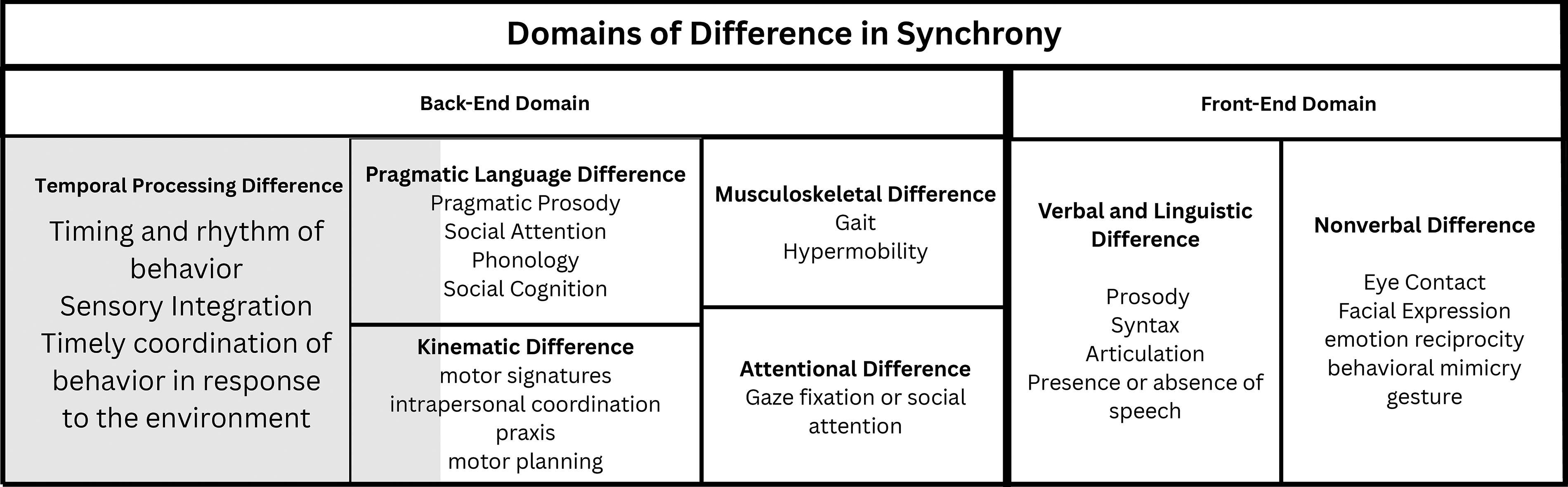
The Domains of Difference illustrate the aspects of communication discussed in the synchrony and kinematic literature. Evidence indicates that differences exist across these facets of nonverbal communication and kinematic skills, based on neurotype. Temporal processing is believed to support the majority of back-end, at least in part.
XNTC differences manifest through idiosyncrasies in IPS patterns that may fall into two domains: front-end and back-end communication (see Fig. 1). Front-end communication refers to topographical social behavior, such as a smile paired with a wave or the gesture of reaching out for a hug. Back-end communication supports the social-behavioral, and may not be immediately perceptible in conversation, such as neural activity, 52 gait and posture,53–55 and kinematic encoding. 36 Back-end communication represents embodied cognition. 56 ACT attempts to provide a framework for the pervasive impact on the perception of embodied cues interlocutors may not automatically recognize as part of an interaction—though these cues may still impact first-impression formation.23,57,58 These differences, while infinitesimal on the surface, may accumulate across domains, shifting perception of how one individual perceives and interacts with another. 59 ACT attempts to provide a framework for addressing not only communication breakdowns at the front-end level, but also the embodied, back-end communication breakdowns that may have more insidious effects on XNT relationships.
The value of framing communication differences in this way is that it synthesizes a robust body of evidence for embodied cognition differences in a way that provides an analytic tool for communication breakdowns. Rather than referring to a communication mismatch in a nebulous way, analysts can begin to accurately conceptualize why breakdowns might occur in real-time to address the gap before it has an opportunity to cultivate hostile relational conditions that harm autistic individuals.18,20,22,60,61 The DoDs connect with synchrony and mind-perception through the idea of disrupted synchrony in the previous sections of this article. While the literature has established the patterns of IPS and rapport-building, ACT builds on this body of work by examining synchrony through its evolutionary functions of survival. In tandem with this epistemological account of synchrony, ACT’s core claim is that communication breakdowns not only in XNTC, but many other forms of intergroup communication may also impact an individual’s visuo-perceptual processing in a way that triggers PD. Synchrony links with social predictability that allows one to feel connected, and when something disrupts that predictability, it might influence one’s perception of the natural human essence in the individual who disrupted the IPS. In the context of XNTC, breakdowns can occur for any of the reasons outlined in the DoDs, which still have room for expansion. ACT suggests that when IPS occurs on the front-end, two individuals metaphorically “reflect” one another’s reality back to each other, as facilitated through various mechanisms on the back-end, building trust and rapport. However, it is plausible that disrupted synchrony, not decreased synchrony, 12 “breaks” that mirror.
Disrupted synchrony: A “broken-mirror moment”
Previously, researchers sought to explain autistic social communication differences with the broken mirror hypothesis (BMH). 62 The BMH explained that communication breakdowns occurred due to a defect in autistic neurology, specifically the mirror neuron system (MNS). 62 Mirror neurons help people find common ground with one another by bringing one’s attention to others who are similar to them. 63 While researchers initially thought that there was a relationship between autistic communication patterns and defects in the MNS, researchers have not consistently replicated these findings, and this network is no longer a popular topic of research. 64 This author believes that while the BMH is no longer a viable way to conceptualize autistic communication differences, 64 the concept of a “broken mirror” may still be relevant when understanding XNTC. The “broken mirror” as an idea (not as a neurological scientific claim) could be helpful in the analysis of communication. When the DEP or DMH manifests in real time, the social miscalibration could be interpreted as a “broken-mirror moment” (BMM), immediately highlighting the mismatch of a specific interaction in the moment, rather than broadly highlighting a mismatch across populations (see Fig. 2).
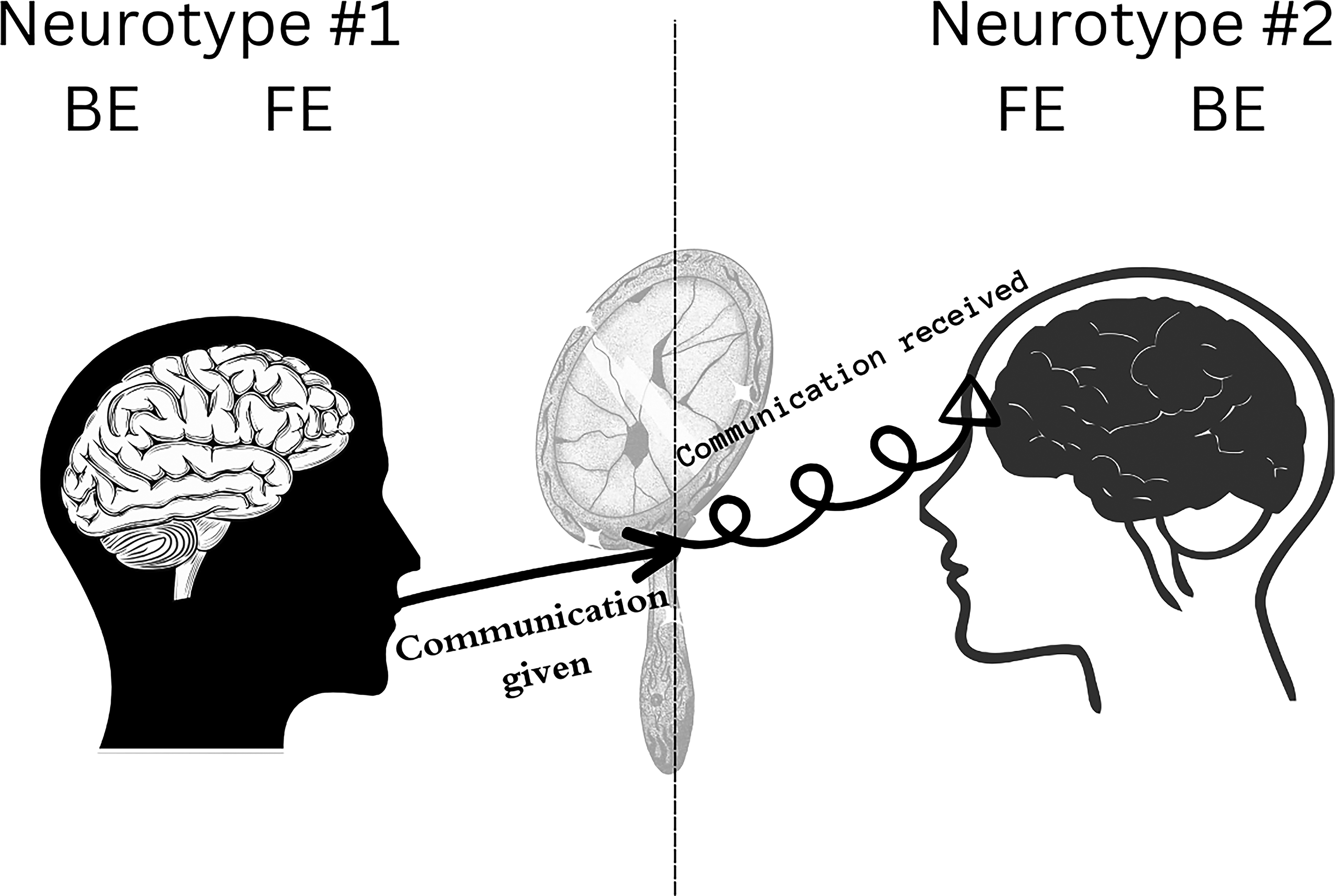
The figure above illustrates various biological, cognitive, and perceptual processes related to synchrony and communication. The way this information is encoded and decoded may vary by neurotype. Each interlocutor has their own front- and back-end communication mechanisms, and different modes of operation (as with neurotype) can impact how information is relayed and received. These are broad areas in which synchrony can be disrupted (see the Domains of Difference section for more). Since much of this process is perceptual, and the brain’s processing of environmental stimuli is rapid, the “broken mirror” may interfere with one’s ability to perceive another as human.
Since the back-end communication differences influence the behavioral outputs on the front-end, ACT suggests that those differences influence the brain’s Turing tests when scanning for an individual to meet the mind-perception criteria (Does it look, sound, and move like a human?) earning them “human status.” Some points in the DoDs may have discrete features that fall within different domains, which may support more nuanced understandings of how front-end social behavior might manifest, potentially supporting more accurate interpretations.
Front-end communication domain examples
Front-end communication is immediately observable to laypeople and clinicians. It refers to behaviors that might be observed to diagnose an individual in an autism assessment, and it does not serve as a comprehensive review of the literature on these categories.
Paralinguistic difference
Gesture
Autists generally rely less on informative gestures during conversation 65 in addition to. 43 Other differences related to gestures may stem from distinct patterns in their functionality, such as variations in the information conveyed by certain gestures. 33 Although a comprehensive explanation of all mechanisms underlying social behavior is beyond the scope of a journal article, understanding differences in communication patterns is essential for grasping how communication is affected when individuals of different neurotypes interact and for identifying effective ways to repair communication breakdowns.
Facial expression and emotion reciprocity
Autistic individuals also show differences in how they use facial muscles to create expressions, which can result in more exaggerated displays than usual. 66 This difference mainly stems from a kinematic variation,67–69 which likely influences readout. 36 In addition, research suggests that autistic individuals exhibit less facial mimicry 70 and fewer shared emotional responses. 25 Some of these differences may arise from unique muscle patterns or motor planning, influencing the quality, speed, and manner of facial movements when expressing emotions, as well as the speed and quality of gestures made with the hands, arms, and body.
Phonology
One study identified differences in the articulatory properties of speech in autistic individuals. The results showed higher articulatory stability, suggesting that autistic individuals are less likely to modify their speech to achieve phonetic alignment. 71 Another study by Kissine and colleagues examined articulation in autistic adults and found that autistic participants exhibited differences in the flexibility of their phonological repertoire 71 and in articulatory precision. 72 Of note, higher articulatory stability may not necessarily indicate social communication deficits. The reduced sense of social mirroring in autistic individuals may simply reflect a mismatch in XNTC, which can contribute to the challenges non-autistic individuals face in syncing with this population—though not necessarily a social deficit.
Linguistic difference
Synchronization in conversation can occur at various levels of linguistic alignment, including sharing content and coordinating speech and language. The literature indicates that autistic individuals demonstrate distinct patterns in their verbal communication.38,73 Importantly, these differences can disrupt social synchrony and may impede rapport development during cross-neurotype interactions. Researchers have noted that autistic individuals show communication variations that impact key aspects of conversational synchrony, arising from differences in both pragmatic functions of speech and language, as well as paralinguistic features. The ACT promotes reframing so-called deficits into clear, neutral language. This method helps us better understand what an autistic person might be experiencing internally, rather than relying solely on a surface-level view of their traits.
Linguistic and pragmatic prosody
Autistic individuals have demonstrated different patterns of producing and perceiving linguistic prosody, especially in more intuitive aspects such as the speech’s information structure, intent, and emotions conveyed through prosody. 39 Different intonations can convey different meanings; for example, a rising intonation often suggests a question, while a falling intonation may indicate a statement or the intent to yield in turn-taking. 39 The prosodic choices one makes may influence natural differences in how someone conveys ideas.
Back-end communication domain examples
Temporal processing differences
Temporal processing is a cognitive function through which a person understands and interacts with their environment in relation to time. 74 It supports the integration of perception and action, often called perceptual-action coupling, which enables a person to coordinate with their environment through motor planning, spatial awareness, and auditory processing. Temporal processing is used to execute structured behavioral sequences to achieve specific goals. 74 An example of temporal processing in real time is someone’s ability to throw and catch a ball. Temporal processing enables hand-eye coordination to catch the ball, aim at the right target, and plan the motor actions involved while yelling “heads up!” and using depth perception to determine the ball’s necessary trajectory.
Autistic individuals often show differences in temporal processing, 52 a vital aspect of IPS across various domains. Research has revealed strong connections between autistic traits and variations in temporal processing and praxis,32,75 suggesting that they may interpret and respond to cues in ways unexpected for non-autistic individuals. Temporal processing is crucial for coordinating one’s movements, which is essential for smooth interaction with others. 28 These differences can create challenges in mutual understanding during XNTC.
Musculoskeletal and kinematic difference
Differences in the musculoskeletal system, such as gait and posture, influence kinematics. Autistic individuals have a unique motor signature in the autistic population through praxis research in this group.33,37,53 One study found that autistic individuals demonstrated differences in gait between the hips and ankles, 76 while a meta-analysis identified wider step width, and differences in gait cycle duration and cadence in autistic participants. 77 Research also suggests reduced sensory integration, postural control, and gait differences.78,79 Kinematics inform action prediction and reading kinematic intent. 36
Pragmatic language
Pragmatic language includes many aspects of communication, such as language functions, socio-cognitive functions, and executive functions. 80 Autistic individuals have shown differences in their pragmatic language skills, such as turn-taking and common ground, which involve adjusting communication based on shared knowledge between speakers. 38 Since pragmatic language is a broad and complex concept, this article does not cover all the details and nuances of cross-neurotype differences; however, a few examples can help demonstrate how the DoDs may appear in BMMs through phonological, prosodic, and paralinguistic speech features.
Prosody
Prosody provides emotional context in communication and requires additional pragmatic and socio-cognitive skills to decode prosodic cues and infer others’ emotional states accurately. 80 A study by Franich et al. 73 found a correlation between speech patterns and motor patterns, both of which depend on temporal processing. The researchers concluded that differences in temporal processing in autism may affect both speech and motor distinctions. One study found that autistic individuals tend to speak with increased intensity (loudness) and longer utterances. In addition, they exhibit higher pitch variability when discussing emotional topics. As a result, autistic individuals more effectively conveyed emotion but were also perceived as sounding less natural than non-autistic controls. 40 Furthermore, differences in the pragmatic functions of prosody were noted in the review by Grice et al., 39 indicating that autistic children did not distinguish questions from statements in their speech, often using rising intonation when making statements as if asking a question. Autistic children were also found to wait longer to begin speaking when it was their turn, according to conversational flow, than what most consider typical. 39
Interrupting PD response with deep-affirmation
A central feature of PD is the inability to ascribe complex emotions to a dehumanized individual. 16 Burkitt argued that emotion is the primary function of meaning-making within relational experiences. 81 However, when one does not ascribe complex emotions (unique to humans) to certain individuals, 16 it may imply that they cannot have a relationship any more significant with that individual than with an animal. In addition, since PD frequently results in moral disengagement, individuals who perceive others in this way likely do not feel accountable, nor could they recognize the extent of the psychological harm they inflict, because they only perceive primary emotions in the individual they perpetrate against.
In my experience (and likely many others) with victimization, my relationships with non-autistic individuals reached a point of turbulence where non-autistic individuals were unable or unwilling to understand my perspective, though I understood theirs. A frequent explanation perpetrator gave was to the effect of, “I’m doing everything I can, maybe we’re just different,” while making no attempt at relational repair despite knowing they caused harm. To maintain the relationship, an autist in my position would have to either compensate for the mismatch with no support or forfeit the connection altogether. When an autist camouflages, they must compensate for differences, mask autistic traits, and assimilate to non-autistic preferences. 82 ACT proposes solutions that would reduce the necessity of such choices for autistic individuals.
The above example represents performative engagement, which is misaligned with neuro-affirming practice (NAP). NAP is a neurodiversity-oriented perspective that advocates for the acceptance of authenticity among neurodiverse individuals. 83 However, some adopt neuro-affirmative practices without a deeper paradigm shift, which can evolve into “neurodiversity-lite” practices that do not often convey a deep understanding of why the neurodiversity movement exists. 84 This support is not truly affirming of neurodiverse people, and is often used for marketing. Performative neurodiversity falls under a wider umbrella of performative allyship, which often benefits the socially dominant groups more than the minority population they claim to serve. 85 Researchers have examined autism acceptance training, which provides evidence that these trainings do successfully reshape behaviors toward autistic people, though implicit biases remain the same. 86 For example, an employer may have a sensory-friendly space in the office to promote neurodiversity, while quietly resenting an autistic employee who uses it because they believe the space is unnecessary and distracting. The employer may have only agreed because their superiors thought it would be good for business, without truly understanding the function and impact of sensory-friendly spaces for an autistic employee.
Deep-affirmation: The values-based second wave of neurodiversity
Instead of performative allyship, ACT encourages Deep-Affirmation (DA), a shift in one’s implicit biases, requiring recognition that all humans are capable of complex emotions such as abandonment, alienation, or inferiority. One can understand DA through two primary mechanisms: Psychological Equity (PE) and Mutual Accommodation (MA), which refer to meaningful and lasting change in the thought and action domains, respectively. ACT asserts that communication cannot be accountable without Deep Affirmation.
Psychological equity: A metacognitive perspective on BMMs
PE as a construct is an intervention for PD. It refers to the intentional advancement of one’s knowledge and social awareness, motivated by a known (not felt) responsibility to protect vulnerable individuals. In practice, that advancement in understanding should act as a catalyst for stabilizing one’s ability to perceive humanity through restructuring one’s understanding of the range of typical social behavior. In addition, PE is an intentional choice to develop a systematic understanding of harm at the micro-, meso-, and macro-levels of society. To communicate responsibly, or accountably, means consciously behaving in ways that reinforce psychological safety, autonomy, agency, and dignity for other individuals rather than allowing heuristics to drive social decision-making.
PE requires an individual to understand the people with whom they interact deeply enough to predict one’s behavior and possible internal states, along with being meaningfully informed on how social behavior varies based on neurotype and other variables within the realm of circular causality. 7 PE differs from active inferencing in its ethical orientation toward social accountability, rather than a focus on how individuals update their previous assumptions about others. It is designed to address harmful dynamics in a way that encourages non-autistic individuals to feel a sense of agency and self-efficacy by making a conscious choice to act in ways that mitigate harm. This choice includes an investment in learning and self-development that would develop the clarity, and the individual would need to understand what shift in behavior would best support the interaction and rapport, and how to execute that shift which requires an internal paradigm shift that regards autistic social contingencies as equal to non-autistic contingencies, including a lower emphasis on interpersonal coordination and the assumption of common ground. 87 In addition, PE requires one to use their knowledge of the DoDs to accurately intuit autistic social cues for more accurate perspective-taking. Perspective-taking is particularly important for non-autistic individuals because that population may demonstrate decreased cross-neurotype perspective-taking ability in XNTC. 88
The knowledge of the DoDs in real time might help individuals infer what specific differences may indicate about an autist’s cognitive load in the moment, such as a knowledge of differences in cerebellar activity influencing postural alignment and how that might influence spatial awareness and motor planning. These nuances do not exist independently of one another. Therefore, if one has the awareness that differences in postural alignment may stem from neurological differences that also influence sensory integration, it may be easier to intuit that an autist may not seem fully engaged in a conversation in a loud restaurant due to competing sensory input, non-social stimuli, and social norms all at once. When one has a baseline understanding of these internal experiences, it becomes much easier to imagine that someone in the autist’s position might simply be overwhelmed, and not disinterested, spacey, or rude.
PE builds on the Emotional Intelligence framework, which refers to the skills one needs to accurately infer and express emotions within oneself and others, effectively regulate emotions, and integrate one’s emotions to use as fuel for motivation, planning, and achieving goals. 89 PE continues this line of thought through a metacognitive process to recognize imbalances in communication. For example, autistic individuals often must mask to navigate neuro-normative spaces at the expense of their well-being,90,91 and they can do so because they have a baseline understanding of non-autistic communication standards. Conversely, non-autistic individuals tend to have lower insight into the social patterns of autistic people. 88
There is a clear imbalance in how each neurotype understands the other and how much personal reflection interlocutors use to ensure successful interactions with people of different neurotypes. 88 In addition, the stakes are different for each group. Autistic individuals mask for more survival-based reasons, such as avoiding victimization, obtaining, and maintaining employment.92–95 In contrast, non-autistic individuals often mask for less dire reasons, such as to distinguish themselves from peers. 96 This statement refers strictly to camouflaging patterns associated with autism, and does not explicitly account for identity management patterns associated with intersecting identities yet. Those nuances are important, though they are beyond the scope of the present paper. 97
MA: Rebalancing the power dynamic
MA refers to the adaptation of social behavior in real-time to match another’s social synchronization patterns. Rather than having a reactive response to a sense of decreased synchrony, non-autistic individuals can seek out synchrony by aligning their own behavior with autistic interlocutors. It builds on the establishment of PE by applying accumulated knowledge of differences across the DoDs to interactions in real time. This new rhythm could include noticing sensory distress and adapting one’s surroundings in real time, so conversations are easier. Now, in that loud restaurant example, an individual can imagine explanatory alternatives to what may first appear to be disinterested. With the ability to imagine plausible explanations of social behavior besides an adverse inference, a non-autist could choose to acknowledge the validity of the internal processes underpinning the front-end behavior. For example, simply saying, “It’s a bit chaotic in here,” with no eye contact to reduce social demands and leaving space for the autist to direct the interaction in a way that feels natural to them, affirming their autonomy in the midst of possible sensory overwhelm. This shift requires an expansion of traditional social skills that allow for more flexibility for communication with those who demonstrate different communication patterns, and neutralizes the power dynamic in such a way that both interlocutors can yield and synchronize in ways that are reciprocal, instead of the autist masking excessively while the non-autist is largely unaware of the psychological toll.
In this example, the DoDs become a tool to recognize the nature of a communication breakdown and the agency to reduce the need for masking in the moment. While mind-reading is infeasible, the DoDs can help individuals generate alternative explanations for socially asynchronous behavior (by traditional norms 87 ) before assigning adverse inferences that create discord. Behaviors that traditionally signal disinterest to a non-autist may simply indicate an autist felt positively and comfortable enough to stop masking. The DoDs promote flexibility in communication, allowing individuals to regulate discomfort in the moment without resorting to social sanctioning behavior.
Future Research
Future research will examine CFP in the context of XNTC to empirically assess whether PD occurs in response to synchrony disruptions. Future research can also examine synchrony disruptions in live interactions to assess physiological responses to synchrony disruptions in the context of ACT’s expansive view of synchrony as the foundation of human connection. Further research can integrate intersecting marginalized identities in relation to camouflaging and identity management to understand the nuances of compensatory behaviors in the context of BMMs. Finally, future work will examine DoDs’ application to interaction analysis to examine communication breakdown patterns, and which types of breakdowns are most detrimental to cross-neurotype relationships.
Conclusion
ACT, while sharing the core philosophy of both the DEP and the DMH, diverges from the two with its proposal of a conceptual link between IPS disruptions, or BMMs, and PD. This theory connects two separate causal chains with the role of differences in social contingencies and synchronization patterns. The relationship between IPS and mind-perception established in the literature helps us understand the role of synchrony in the perception of humanity and the pursuit of connection. In addition, PD theory, which links the CFP shift to moral disengagement in the literature, explains shifts in perception based on social behavior. ACT connects these ideas together by suggesting that disruptions in synchrony interrupt the mind-perception process (dependent on synchrony) and that PD likely follows, which might explain why autistic individuals experience a disproportionate rate of dehumanizing behavior. This theory could potentially explain phenomena such as the DEP and DMH, providing avenues for research that could lead to stopping dehumanization in its tracks.
Footnotes
Acknowledgments
The author would like to extend sincere gratitude to research mentors, Songtian Zeng, PhD, and Kelly L. Coburn, PhD, along with professors, Connie Anderson, PhD, and Jared McGinley, PhD, for their support, guidance, intellectual freedom, and trust in this work. The author is also grateful to all the other wonderful mentors and colleagues at Towson University and the University of Maryland who supported this vision in its earliest stages and provided encouragement as it came to life.
Authorship Confirmation Statement
M.R.T.: Conceptualization, literature search, writing, editing, and visualization.
Author Disclosure Statement
The author reports no conflicts of interest.
Funding Information
This project did not receive any funding.