




Abstract
Introduction:
Cannabinoid CB2 agonists reduce stimulus-evoked behavioral hypersensitivities in preclinical pain models, but their ability to modulate spontaneous pain remains largely unexplored. Spontaneous pain has been assessed in rodents using a conditioned place preference (CPP) approach, given that the relief of pain is described as rewarding and results in the removal of an aversive pain state. LY2828360 is a CB2 agonist that failed in a clinical trial for osteoarthritis pain.
Materials and Methods:
We compared the impact of LY2828360 on evoked and spontaneous pain in a spared nerve injury (SNI) model using a within-subjects design in rats. First, we used an unbiased CPP approach to verify that an analgesic dose of gabapentin (GBP) (100 mg/kg, i.p.) produces CPP in rats with SNI, but not in sham-operated rats (Experiment 1). We then used a within-subjects design to ascertain whether LY2828360 (10 mg/kg i.p., chronic) would suppress both evoked and spontaneous pain in rats with SNI (Experiment 2). To assess spontaneous/affective pain behavior, we tested the ability of chronic dosing with LY2828360, in comparison to vehicle, to prevent GBP-induced CPP in the SNI model, as failure to develop CPP to GBP following treatment with an analgesic has been considered evidence of suppression of spontaneous pain. To assess evoked pain behavior, paw withdrawal thresholds were measured in the same rats used for CPP.
Results:
GBP produced CPP in rats with SNI, but not sham surgery, and suppressed SNI-induced mechanical hypersensitivity in Experiment 1. In Experiment 2, LY2828360 reliably suppressed mechanical hypersensitivity in the paw ipsilateral, but not contralateral to SNI. Furthermore, efficacy was sustained across repeated injections without development of tolerance. The same rats that showed suppression of mechanically-evoked responses following chronic LY282860 treatment did not develop CPP to GBP. However, rats with SNI that were tested in parallel and treated chronically with vehicle showed robust mechanical hypersensitivity but also did not develop CPP to GBP.
Conclusion:
These studies document that CB2 agonist-induced suppression of mechanically-evoked pain is highly robust and reproducible in the SNI model, whereas CPP, used to assess spontaneous pain, is vulnerable to disruption and requires rigorous controls to rule out alternative explanations (e.g., failure to learn).
Introduction
Pain is a complex disorder involving sensory, cognitive, and affective-motivational components. Most preclinical studies measure withdrawal responses to an applied sensory stimulus (evoked pain) rather than spontaneous (ongoing) pain, 1 which is difficult to assess in animal models. 2 Operant paradigms employing pain-motivated behavior provide alternative approaches to assess spontaneous pain and conditioned place preference (CPP) approaches have also been used to determine if analgesics remove an aversive state.3–7 We postulated that a within-subjects design aimed at assessing both evoked and spontaneous pain in the same subjects could facilitate valid conclusions about putative pain therapeutics.
CB2 cannabinoid receptor activation has been shown to suppress evoked pain in pre-clinical models,8–10 but its ability to modulate spontaneous pain remains poorly understood. Our lab previously showed that rats with a spared nerve injury (SNI) self-administered the CB2 agonist AM1241 intravenously through a CB2-dependent mechanism, in a manner suggesting alleviation of a pain-like state. 5 Rats with SNI also worked harder than shams to obtain i.v. AM1241. 5 Mice with partial sciatic nerve ligation also self-administered with the CB2 receptor agonist JWH-133. 7 The CB2 agonist LY2828360 shows antinociceptive efficacy in rodent models of neuropathic pain11–14 and reduces mechanical hypersensitivity in a SNI model in rats. 15 In addition, LY2828360 was not itself rewarding in otherwise naïve rats. 15 However, LY2828360 failed for efficacy in a phase 2 clinical trial of osteoarthritis pain. 16
We used a within-subjects design to test the ability of LY2828360 to reduce both evoked and spontaneous pain behaviors in rats with SNI. Repeated administration of LY2828360 can produce a sustained antinociceptive effect that persists at least 24 h post injection. 15 Drug carryover effects could otherwise interfere with learning associations between LY2828360- and vehicle-paired chambers. We, consequently, examined the ability of chronic LY28282360 treatment to prevent the development of CPP to the shorter-acting anticonvulsant gabapentin (GBP), a first-line clinical treatment for neuropathic pain. 17 GBP can induce CPP in pre-clinical neuropathic pain models.18–20 Therefore, we first extended previous findings by Griggs and colleagues 20 to determine whether GBP (100 mg/kg, i.p.) produces CPP in rats with SNI-induced neuropathy using an unbiased CPP paradigm. Then, we evaluated the impact of chronic dosing with LY2828360 (10 mg/kg/day i.p.) versus vehicle (i.p.) on SNI-induced mechanical hypersensitivity and development of CPP to GBP. Our studies document that CPP, which depends on learning, can be highly sensitive to disruption under conditions in which suppression of evoked pain is observed.
Materials and Methods
Subjects
Adult male Sprague-Dawley rats (Envigo, Indianapolis, IN) were 90–100 days at the start of experiments. Rats were single-housed in a temperature-controlled colony room on a 12/12-h light/dark cycle (lights on at 8 am; lights off at 8 pm). All behavioral testing occurred during the dark cycle under red light. Rats were maintained on ad libitum food and water. A single experimenter (K.G.G.) blinded to drug conditions performed all experimental manipulations. All experiments were approved by the institutional Animal Care and Use Committee and followed guidelines of the International Association for the Study of Pain.
Drugs
LY2828360 (8-(2-chlorophenyl)-2-methyl-6-(4-methylpiperazin-1yl)-9-(tetrahydro-2H-pyran-4-yl)−9H-purine) was synthesized by Sai Biotech (Mumbai, India; purity >98%). LY2828360 was dissolved in a vehicle consisting of 3% dimethylsulfoxide (DMSO; Sigma-Aldrich, St. Louis, MO), and the remaining 97% consisted of emulphor (Alkamuls EL-620; Solvay), 95% ethanol (Sigma-Aldrich), and 0.9% saline at a 1:1:18 ratio for a 10 mg/kg intraperitoneal (i.p.) injection at a volume of 2 mL/kg. GBP was dissolved in saline for i.p. injection at a volume of 1 mL/kg.
Spared nerve injury surgery
SNI surgery was performed to induce neuropathic nociception in the paw ipsilateral to injury.5,6,21 Briefly, rats were deeply anesthetized with isoflurane, and the flank of the rat was shaved and prepared for aseptic surgery. Then, a small incision (∼1.5 cm) was made on the flank, and the underlying biceps femoris muscle was gently separated to expose the sciatic nerve. The common peroneal and tibial branches of the sciatic nerve were tightly ligated with a silk suture (5-0 PERMA-HAND Silk Suture, Ethicon) and then cut, leaving the sural branch intact. The muscle was then closed and held together with a single silk suture before closing the skin incision with nylon sutures (4-0 ETHILON Black Monofilament, Ethicon), which were then removed 1 week post-surgery. Sham surgeries involved separating the muscle to expose the sciatic nerve, but no ligation or cutting of the nerve occurred. Rats were not tested during the initial 2-week period following SNI surgery to allow them to recover from both the surgery and the acute inflammatory phase of SNI. Mechanical paw withdrawal thresholds were measured before and after the induction of neuropathic nociception to verify the presence of mechanical hypersensitivity.
Assessment of mechanical withdrawal thresholds
Mechanical withdrawal thresholds were measured using an electronic von Frey (VF) aesthesiometer (IITC model Alemo 2290-4, Woodland Hills, CA) as described previously.5,6,15 Rats were habituated to a testing table with a stainless-steel wire mesh flooring (1.2 × 1.2 cm gaps) under a clear Plexiglas chamber (13.5 × 13.5 × 23.5 cm) for at least 30 min before testing. The force (g) that elicited paw withdrawal from the VF aesthesiometer was measured. Mechanical stimulation was applied toward the lateral edge of the paw to stimulate the site of injury.21,22 Withdrawal thresholds were measured in duplicate for paws ipsilateral and contralateral to SNI. Sham-operated rats were tested in parallel.
Conditioned place apparatus
A custom-configured three-chamber apparatus was used for CPP (Med-Associates Inc., Fairfax, VT, USA) to permit unbiased assessment of place preference. Two conditioning chambers (21 × 21 × 28 cm) on either side were separated via guillotine doors from a central neutral (gray) chamber (12 × 21 × 21 cm). The conditioning chambers had distinct visual cues (black and white vertical vs. horizontal stripes) and were custom configured to have an equivalent amount of black and white in both chambers in an effort to eliminate chamber bias. Time spent in each chamber was automatically recorded via med-associates software over a 15-min interval during habituation, pre-test and CPP test days and over a 30-min interval during all conditioning days.
Experiment 1: Gabapentin induces conditioned place preference in SNI but not Sham-operated rats
The Experiment 1 protocol is shown in Figure 1A. Withdrawal thresholds were measured 1 day prior to SNI or Sham surgery and 2 weeks after surgical recovery (i.e., prior to the start of CPP). The CPP protocol was initiated 14 days after SNI/Sham surgery. On day 1 of the CPP experiment, rats were placed in the middle chamber and allowed to freely roam between all three chambers to habituate to the apparatus. On day 2, rats were again allowed to freely roam the three chambers for 15 min, after which a baseline preference assessment was conducted to confirm that rats did not show a bias for either chamber prior to drug pairing. Rats who spent more than 720 sec (i.e., 80%) or less than 180 sec (i.e., 20%) of the baseline trial in either chamber were excluded from the study. The remaining rats were randomly assigned to receive active treatments in the left or right chamber (Sham: n = 8; SNI n = 7). Next, rats underwent 3 days of conditioning trials during which they received saline (i.p.) and then were immediately restricted to a single chamber of the CPP apparatus for 30 min in the morning. Then, 4 h after the saline injection, rats received GBP (100 mg/kg, i.p.) before being restricted to the opposite chamber of the CPP apparatus for 30 min. On day 6, rats were placed in the middle chamber with guillotine doors open and allowed to freely roam between all three chambers to assess time spent in each chamber in a drug-free state for 15 min.

Gabapentin (GBP) induced conditioned place preference (CPP) and suppressed mechanical hypersensitivity in male rats with SNI-induced neuropathy. Schematic shows the timeline of the von Frey (VF) measurements and CPP study
Following completion of the CPP protocol, withdrawal thresholds were measured 24 h and 72 h later in a crossover design to assess the time course of analgesic efficacy. In the crossover experiment, half the rats received GBP (100 mg/kg, i.p.) and the other half received saline (i.p.) on the first day. Two days later, each group received the opposite i.p. treatment. Paw withdrawal thresholds were measured at 0.5, 1, 2, and 4 h after each injection.
Experiment 2: Impact of chronic LY2828360 or vehicle treatment on gabapentin-induced place preference in the SNI model
In Experiment 2, all rats received a unilateral SNI. Withdrawal thresholds were measured 1 day before as well as 2 weeks after SNI surgery (i.e., prior to the start of CPP and chronic drug/vehicle treatment). The CPP protocol was initiated 14 days after SNI surgery. On day 1, rats were placed in the middle chamber and allowed to freely roam between all three chambers to habituate to the apparatus. On day 2, rats were again allowed to freely roam the three chambers for 15 min, after which a baseline preference assessment was conducted to confirm that rats did not show a bias for either chamber prior to drug pairing. On days 3–9, rats with SNI received once daily (i.p.) injections of either vehicle (n = 11) or LY2828360 (10 mg/kg) (n = 10) in their home cages. LY2828360 dose was selected based upon our previous work. 15 On day 6 (i.e., day 4 of chronic dosing), paw withdrawal thresholds were measured before (pre-drug baseline) and 1-h post-injection of vehicle or LY2828360. On day 7, the 3-day conditioning phase began. Chamber pairings on conditioning days (i.e, day 7–9) were identical to those in Experiment 1, with the exception that rats in Experiment 2 also received either vehicle or LY2828360 (10 mg/kg, i.p.) 1 h prior to the morning (saline-paired) conditioning trial. All rats received saline (i.p.) and then were immediately restricted to a single chamber of the CPP apparatus (30 min) in the morning. Then, 4 h after the saline injection, all rats received GBP (100 mg/kg, i.p.) before being restricted to the opposite chamber of the CPP apparatus (30 min). On the test day (day 10), no injections were administered, and rats were allowed to explore all three chambers (15 min) to assess the impact of treatment with LY282860 or vehicle on preference for the GBP-paired chamber. Paw withdrawal thresholds were additionally measured 24 h after the CPP test day (i.e., 48 h after the last injection of LY2828360 or vehicle). Paw withdrawal thresholds were measured to confirm that SNI produced mechanical hypersensitivity and document that LY2828360 (10 mg/kg, i.p. chronic), but not vehicle, treatment suppressed mechanical hypersensitivity in the same rats used in the CPP study.
Statistical analysis
Data were analyzed by two-way repeated measures ANOVA followed by two-tailed or one-tailed t-tests as appropriate. Sidak’s multiple comparison post-hoc test was used to assess differences in withdrawal thresholds between groups. Preference scores for CPP data were calculated (test time – baseline time) and analyzed by one-tailed paired t-tests. Statistical analysis was performed using Graphpad prism 7 (Graphpad prism software, San Diego, CA).
Results
Experiment 1: Gabapentin induced place preference in the SNI model
Sham-operated rats did not exhibit differences in time spent in each chamber irrespective of drug pairing or conditioning phase (Fig. 1B; Drug pairing: F1,14 = 0.01962, p = 0.8906; Conditioning phase: F1,14 = 0.04174, p = 0.8410; Interaction: F1,14 = 0.8898, p = 0.3615). In rats with SNI, GBP selectively increased time spent in the drug-paired chamber after conditioning but not before drug-chamber pairing (Fig. 1C; Drug pairing: F1,12 = 0.03821, p = 0.8483; Conditioning phase: F1,12 = 0.3838, p = 0.5472; Interaction: F1,12 = 9.992, p = 0.0082). Prior to conditioning, time spent in either chamber did not differ in rats with SNI (p = 0.2728, paired t-test, two-tailed). After conditioning, rats with SNI spent more time in the GBP-paired chamber compared to the saline-paired chamber (p = 0.0454, paired t-test, two-tailed).
Prior to pharmacological treatment, SNI decreased withdrawal thresholds in the ipsilateral paw relative to pre-surgery baseline (p = 0.0009, two-tailed t-test) (Fig. 1D). GBP (100 mg/kg, i.p.) increased withdrawal thresholds ipsilateral to SNI relative to vehicle overall and in a time-dependent manner, and withdrawal thresholds changed across time irrespective of drug treatment (Fig. 1D; Group: F1,12 = 50.71, p < 0.0001; Time: F4,48 = 3.770, p = 0.0096; Interaction: F4,48 = 5.166, p = 0.0015). GBP increased withdrawal thresholds in the paw ipsilateral to SNI from 0.5 to 2 h (p ≤ 0.0038) but not 4 h post-injection (p = 0.2595). SNI modestly elevated withdrawal thresholds in the contralateral paw relative to the pre-surgery baseline (p = 0.0443, two-tailed t-test) (Fig. 1E). GBP (100 mg/kg, i.p.) also increased withdrawal thresholds in the paw contralateral to SNI relative to vehicle overall, and withdrawal thresholds changed across time irrespective of drug treatment (Fig. 1E; Group: F1,12 = 8.353, p = 0.0136; Time: F4,48 = 3.133, p = 0.0228; Interaction: F4,48 = 1.089, p = 0.7957).
Prior to pharmacological treatment, withdrawal thresholds did not differ in the paw ipsilateral to sham surgery relative to pre-surgery baseline (p = 0.8724) (Fig. 1F). GBP (100 mg/kg, i.p.) modestly but reliably elevated withdrawal thresholds ipsilateral to sham surgery relative to vehicle, and withdrawal thresholds changed across time irrespective of drug treatment (Fig. 1F; Group: F1,14 = 5.941, p = 0.0287; Time: F4,56 = 2.617, p = 0.0446; Interaction: F4,56 = 1.561, p = 0.1973). Sham surgery did not alter withdrawal thresholds in the contralateral paw (p = 0.1667) relative to the pre-surgery baseline (Fig. 1G). GBP (100 mg/kg, i.p.) increased withdrawal thresholds in the paw contralateral to sham surgery relative to vehicle overall, and withdrawal thresholds changed across time (Fig. 1G; Group: F1,14 = 6.458, p = 0.0235; Time: F4,56 = 3.123, p = 0.0217; Interaction: F4,56 = 1.945, p = 0.1156).
Analysis of preference scores confirmed that rats with SNI showed a preference for the GBP-paired chamber (p = 0.0313; one-tailed t-test) compared to the saline-paired chamber, whereas sham-operated rats did not (p = 0.3908, two-tailed t-test) (Fig. 2).
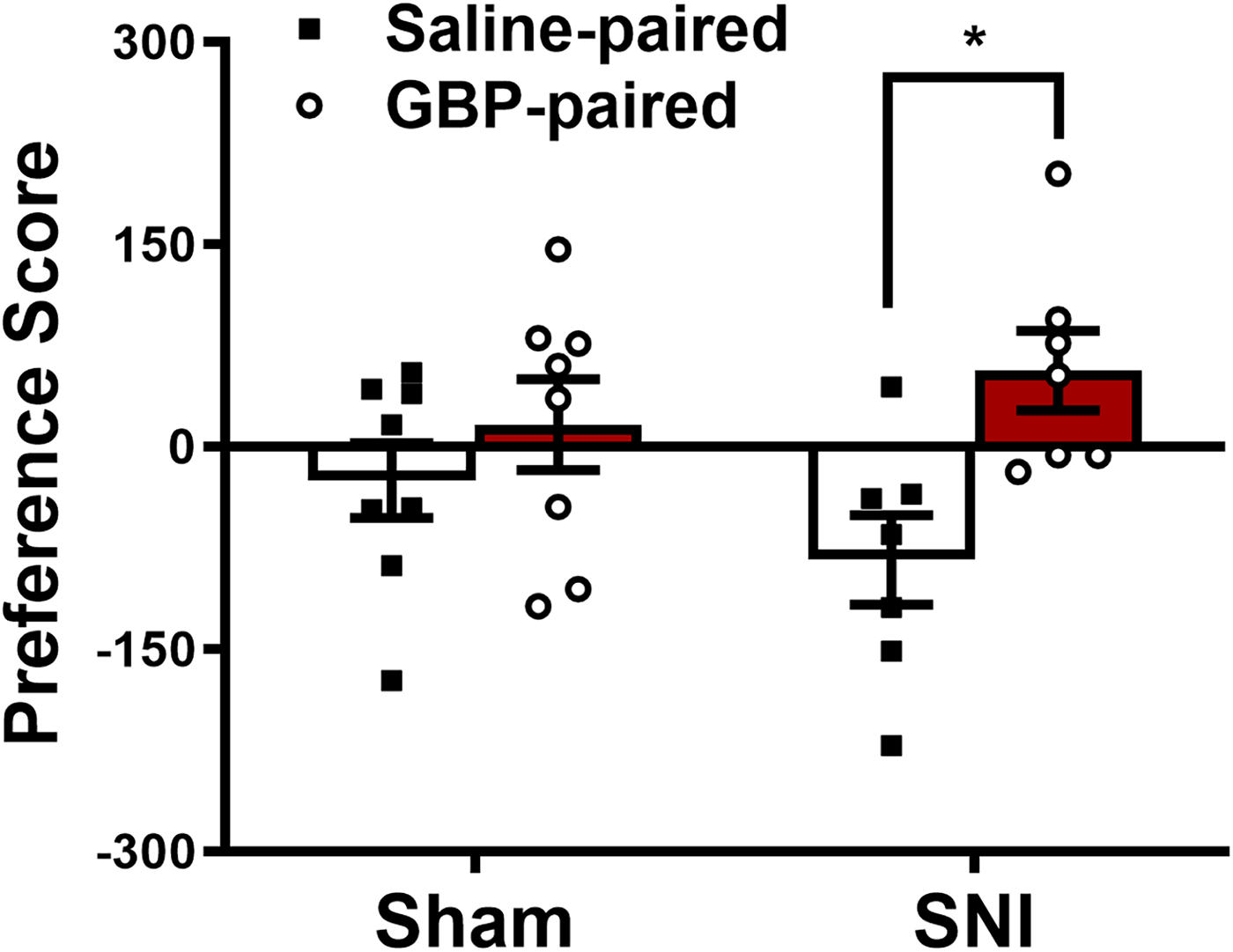
Gabapentin (GBP; 100 mg/kg, i.p.) increased preference scores in male rats with SNI-induced neuropathy but not in sham-operated rats. Preference scores were calculated as post-conditioning time – pre-conditioning time in the drug paired chamber. Data are expressed as Mean ± SEM. One-tailed paired t-test. *p < 0.05.
Experiment 2: Impact of LY2828360 on gabapentin-induced place preference in the SNI model
The Experiment 2 protocol is shown in Figure 3A. Prior to pharmacological treatment, SNI reduced withdrawal thresholds in the ipsilateral paw relative to the pre-surgery baseline (F1,19 = 160.7, p < 0.0001) (Fig. 3B). Prior to implementation of the CPP protocol, repeated LY2828360 (10 mg/kg/day, i.p.) treatment increased withdrawal thresholds relative to vehicle (i.p.) in the paw ipsilateral to SNI, withdrawal thresholds changed across time, and the interaction was not significant (Fig. 3B
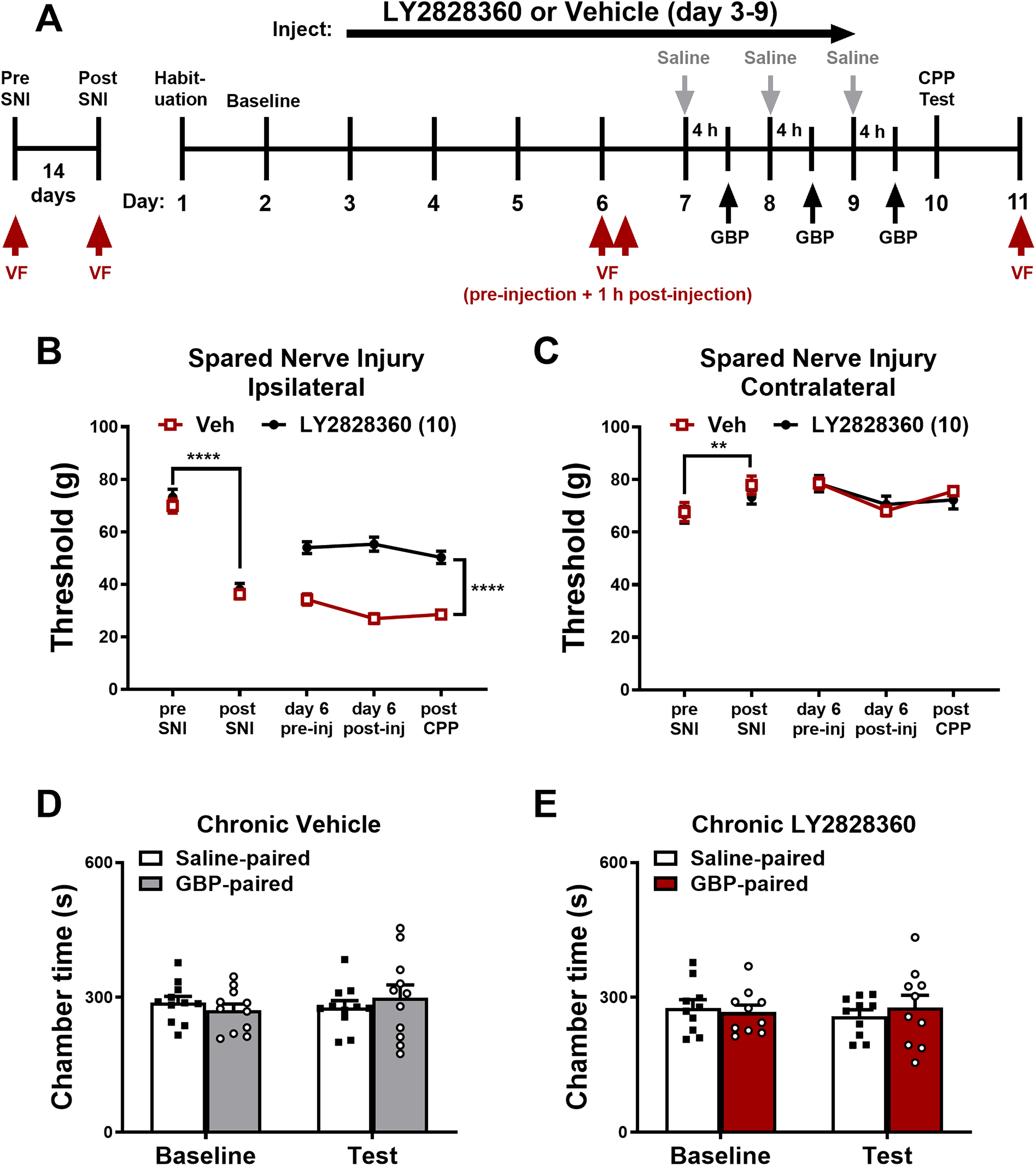
Repeated administration of CB2 cannabinoid agonist LY2828360 suppressed mechanical hypersensitivity relative to vehicle in male rats with SNI, and gabapentin (GBP) did not produce conditioned place preference (CPP) in SNI rats pre-treated with either vehicle or LY2828360. Schematic shows the timeline of pharmacological manipulations, von Frey (VF) measurements and CPP study
In the CPP test, no difference in time spent in the saline- versus GBP-paired chamber was observed in rats with SNI that were pre-treated with either vehicle (Drug pairing: F1,20 = 0.01132, p = 0.9163; Conditioning Phase: F1,20 = 0.3665, p = 0.5517; Interaction: F1,20 = 1.869, p = 0.1867) (Fig. 3D) or LY2828360 (Drug pairing: F1,18 = 0.06950, p = 0.7951; Conditioning phase: F1,18 = 0.03722, p = 0.8492; Interaction: F1,18 = 0.4797, p = 0.4974) (Fig. 3E). Analysis of preference scores showed no preference for the GBP-paired chamber in either the vehicle-treated (p = 0.2435; two-tailed t-test) or LY2828360-treated (p = 0.9325, two-tailed t-test) groups (Fig. 4).
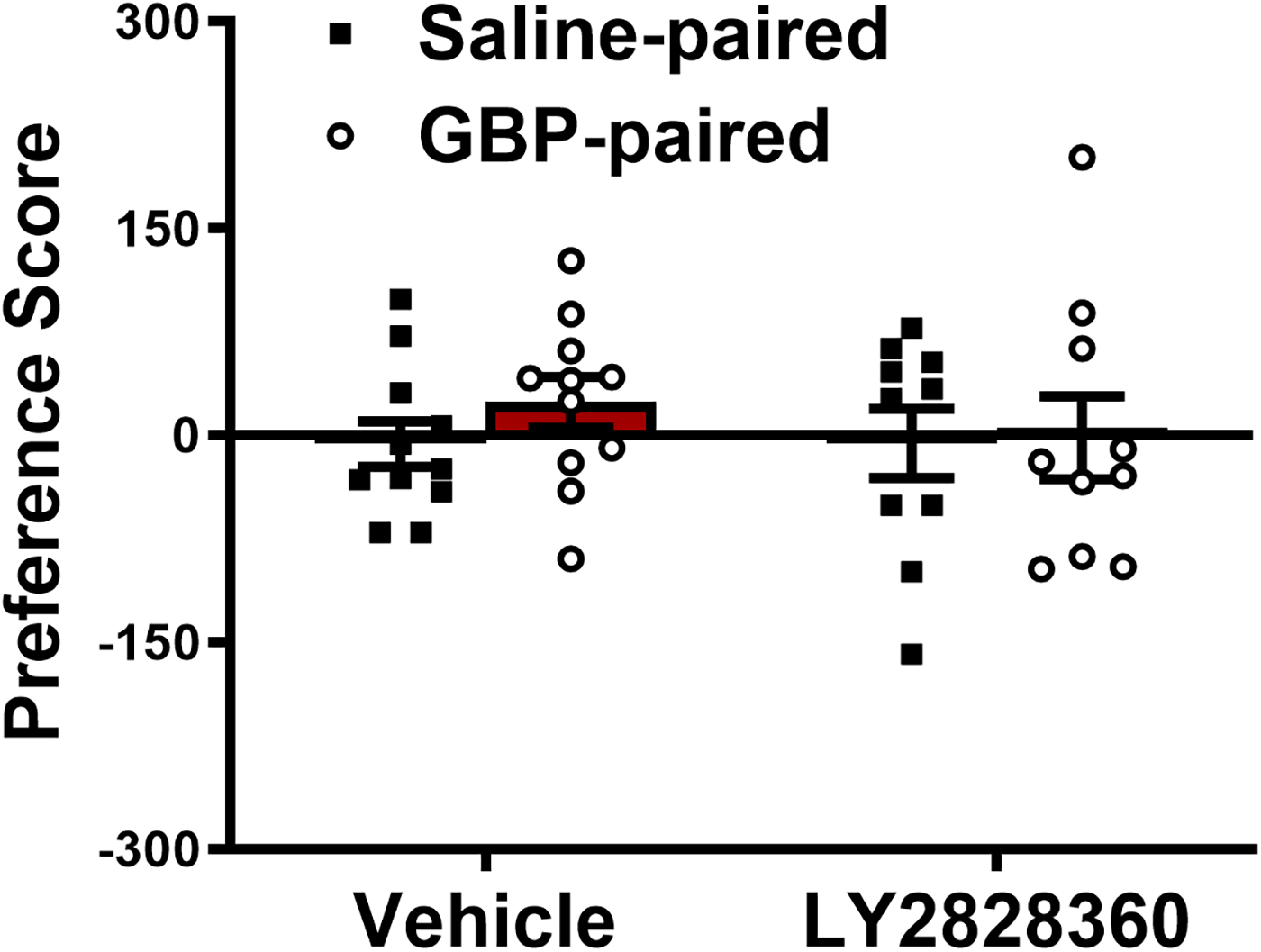
Preference scores for the gabapentin- (GBP; 100 mg/kg, i.p.) and saline-paired chamber did not differ in SNI rats treated chronically with either vehicle or LY2828360 (10 mg/kg i.p.). Preference scores were calculated as post-conditioning time – pre-conditioning time in the drug paired chamber. Data are expressed as mean ± SEM. Two-tailed paired t-test.
Discussion
In our initial model validation study (Experiment 1), GBP produced CPP in rats with SNI, but not in sham-operated rats. These observations provided the foundation for conducting Experiment 2, which aimed to compare the effects of the CB2 agonist LY2828360 on evoked and spontaneous pain in a rat SNI model. As expected, the CB2 agonist LY2828360 selectively suppressed evoked pain behavior in the ipsilateral (injured) paw of rats with SNI, without altering responsiveness in the contralateral (intact) paw. These findings are consistent with our previous work, 15 obtained under conditions in which assessment of CPP to GBP was not interleaved in the same subjects. We did not evaluate whether LY2828360 would, itself, produce CPP in rats with SNI because LY2828360 exhibits a prolonged duration of action following repeated dosing. We, consequently, avoided use of LY2828360 in repeated chamber pairings (i.e., in which LY2828360 would be alternated with vehicle) in order to eliminate possible drug carryover effects. Such carryover effects could be expected to interfere with learning the association between LY2828360- and vehicle-paired chambers and render resulting data inconclusive. Rather, we asked whether once-daily treatment with the CB2 agonist would prevent GBP-induced CPP in rats with SNI-induced neuropathy. However, irrespective of whether rats with SNI received chronic LY282860 or vehicle treatment, we did not observe the phenomenon of GBP-induced CPP. We expected to see GBP-induced CPP in the vehicle condition with our unbiased CPP paradigm similar to what was observed in Experiment 1, and comparable to that reported previously using a biased CPP protocol. 20 Given the failure of our positive control to show CPP to GBP in Experiment 2, it is not possible to conclude that LY2828360 either blocked (or failed to block) spontaneous pain. Rather, we conclude that the absence of CPP may reflect a failure to learn the chamber association in the chronic dosing groups.
Several methodological differences exist between the two experiments. First, additional i.p. injections occurred every morning an hour prior to chamber pairings (i.e., saline i.p. injection/saline chamber paring), which did not occur in experiment 1. In addition, in Experiment 1, conditioning began approximately 2 weeks post-surgery (17 days), whereas in Experiment 2, the chronic LY2828360 study, conditioning began 3 weeks post-surgery. Pregabalin, an anticonvulsant similar to GBP, produced CPP in the SNL model when conditioning trials started 2 weeks post-surgery, but not when conditioning began 4 weeks post-surgery. 23 However, negative affective states only develop several weeks post-SNI surgery. 24 It is possible that repeated mechanical/cold stimulation is required to sensitize animals to permit assessments of ongoing (spontaneous) pain. Nonetheless, we were able to document that rats used in the CPP studies exhibited SNI-induced mechanical hypersensitivity that was reliably suppressed by chronic LY2828360, but not vehicle, treatment. Moreover, LY2828360-induced suppression of SNI-induced mechanical hypersensitivity also persisted 24 h following the CPP test (i.e., 48 h after the last injection). These studies suggest that CB2 agonist-induced suppression of mechanically evoked pain is highly robust and reproducible, whereas the CPP paradigm used here to assess spontaneous pain/negative affective states due to SNI was inconsistent across studies and vulnerable to slight changes in experimental protocol. Our results highlight the importance of including both positive and negative controls and carefully matching experimental protocols to ensure that simpler, alternative explanations (e.g., failure to learn) can be excluded.
We used an unbiased CPP approach wherein the apparatus consists of both drug- and vehicle-paired chambers that each contain black and white stripes in different orientations separated by a central (gray) compartment. Thus, in our study, each drug/vehicle-pairing chamber has equivalent amounts of black and white. This design is important given that rats innately prefer black to white chambers. We largely replicate the observation of CPP to GBP obtained previously with a biased CPP approach, 20 where a white chamber is paired with drug (or saline). Griggs and colleagues 20 used a standard CPP apparatus containing one black and one white drug-pairing chamber, in addition to employing different olfactory cues and intensities of lighting. Some conditions thus required the animal to approach the white side, contrary to their natural preference for the black chamber. Specifically, rats with SNI-induced neuropathy spent more time in a GBP-paired chamber than a saline-paired chamber, whereas sham-operated rats did not show any preference for either chamber in both studies. GBP is also reported to produce CPP in mice with cisplatin-induced neuropathic pain. 18 Other studies have reported pain relief to be negatively reinforcing by producing drug-context associations in the CPP paradigm. Clonidine and ω-conotoxin administered into the spinal cord and lidocaine administered in the rostral ventromedial medulla produce CPP in the spinal nerve ligation (SNL) model. 3 However, one limitation of single-trial CPP studies administering intrathecal agents such as lidocaine to induce CPP, is that the approach includes an unavoidable temporal confound; the first (e.g., morning) intrathecal pairing is always with vehicle, and the second (e.g., afternoon) chamber pairing is always with lidocaine (or the drug that induces the CPP). Nerve block with lidocaine or bupivacaine produces CPP in rats with hindpaw incision2,25 and can activate ventral tegmental area dopaminergic cells and increase dopamine release in the nucleus accumbens. 2 GBP also produced dopamine release in the nucleus accumbens in rats with SNL, and development of GBP-induced CPP is blocked by inhibition of the endogenous opioid system in the anterior cingulate cortex. 26 Lastly, inhibition of excitatory signaling in the anterior cingulate cortex produces CPP in the complete Freund’s adjuvant model of persistent inflammatory pain. 27 The use of the CPP paradigm to examine the motivational component of different analgesic drugs consequently holds promise for inferring the presence of spontaneous pain in select pre-clinical models. In this realm, the SNL model may provide more robust “spontaneous” pain compared to the surgically sterile partial axotomy of the SNI model.
Conclusions
The present studies document that LY2828360, a CB2 cannabinoid agonist that failed in a phase 2 clinical trial, suppresses nerve injury-induced mechanical hypersensitivity but provides no evidence either for or against a role for LY2828360 in suppressing spontaneous pain. In our studies, GBP did not produce CPP in rats with SNI that were treated daily with vehicle or LY2828360. Without a matched vehicle (i.p.) repeated dosing group evaluating CPP to GBP as a positive control, one could erroneously conclude that LY28282360 blocked spontaneous pain. GBP produced CPP in rats with SNI, but not sham surgery, in the same CPP protocol in our initial model validation study. These studies demonstrate the potential instability of the CPP paradigm for investigating spontaneous pain compared to evoked pain, which was shown here to be highly replicable. It is important to investigate spontaneous pain in pre-clinical models given its relevance for translatability to human patients, but the potential vulnerability of CPP to experimental protocols, especially involving i.p. dosing, must be considered. More work should be performed using CPP methods to better understand the therapeutic potential of analgesic compounds, potentially using direct intracranial or intrathecal injections that permit faster onset of analgesic action. Such factors can be expected to facilitate learning associations between behavioral context and drug treatment. Furthermore, because the mechanisms involved in non-evoked pain may differ from those of evoked pain, it is important to gain an in-depth understanding of the rewarding effect of pain relief and limitations of existing experimental approaches to further the goal of developing and validating more effective analgesic strategies.
Authors’ Contributions
K.G.G.—Investigation, conceptualization, formal analysis, visualization, writing—original draft, writing—review and editing. J.D.C.—Software, formal analysis, conceptualization, writing—review and editing, resources, funding acquisition. A.G.H.—conceptualization, formal analysis, visualization, writing—original draft, writing—review and editing, supervision, resources, funding acquisition.
Footnotes
Acknowledgments
K.G.G. was supported by the Harlan Research Scholars program.
Author Disclosure Statement
No competing financial interests exist.
Funding Information
Supported by DA047858 and DA009158 (to A.G.H.) and an Indiana Addiction Grand Challenge Grant (to A.G.H. and J.D.C.).