




Abstract
Teacher education is nationally regulated yet increasingly shaped by cross-border agendas. While internationalisation is widely articulated in institutional strategies, implementation in initial teacher education (ITE) is reported as uneven across contexts and programme components. This narrative review clarifies how internationalisation in ITE is defined, driven, enacted, and critically assessed. We propose a 2 × 2 positioning typology at the intersection of strong National Anchors and intensifying Global Imperatives, identifying four profiles: showcase, faculty-driven, regulation-bound, and embedded internationalisation. Beyond activity lists, we specify mechanisms that can help convert mobility and virtual exchange/COIL into accessible learning: structured preparation, jointly designed tasks, guided reflection, and formal recognition/credit. We foreground an assessment gap – outputs are frequently reported, while outcomes such as intercultural competence, digital-pedagogical capability, and classroom enactment are not consistently evidenced or assessed across studies and institutions. Using a decolonising, language-sensitive lens, we surface equity and knowledge circulation limits in nationally regulated systems. Implications include embedded designs, aligned incentives and professional development, internationalisation-at-home/IoC in core coursework, and credit-bearing recognition. We reframe ITE internationalisation as learning-led design, rather than primarily a quantitative focus.
Introduction
The internationalisation of teacher education unfolds against a shifting sociocultural reality shaped by globalisation and increasing cultural diversity. As societies become more interconnected, classrooms mirror this complexity, positioning teachers at the centre of preparing learners for participation in a globally interdependent world.
Education has always played a foundational role in shaping societies, but it now faces overlapping crises – inequality, democratic backsliding, environmental degradation, and rapid technological change. UNESCO's reimagining our futures together report calls for re-envisioning education as a new social contract based on inclusion, equity, cooperation, and collective responsibility (UNESCO, 2021). For teacher education, this vision demands not only technical and pedagogical skills but also commitments to intercultural understanding, sustainability, and democratic values. Internationalisation is increasingly framed not only as an institutional strategy but also as professionally relevant for preparing future educators to navigate and shape this new reality.
As Dooly and Villanueva (2006) note, education systems are increasingly expected to foster mutual understanding and respect for cultural diversity, linking teacher education directly to broader sociocultural transformations. Across higher education, internationalisation has shifted from a peripheral concern to a central strategic priority. Universities are now expected to have explicit internationalisation strategies, and in the past 25 years, the concept has evolved from ‘a marginal and minor component to a global, strategic, and mainstream factor’ (Knight & de Wit, 2018; Leutwyler et al., 2017). However, available survey and self-assessment evidence suggests that strategic commitments to internationalisation do not translate evenly into programme-level practice in teacher education. Internationalisation is often more visible in institution-wide plans than in teacher education unit strategies and missions, pointing to uneven embedding and resourcing (Kerkhoff et al., 2024; Global Teacher Education, n.d.). A similar gap appears in assessment: intercultural competence and global readiness are frequently invoked as intended outcomes, yet systematic assessment remains limited in many institutions (Deardorff, 2006). In this review, ‘policy–practice gap’ refers to this recurring misalignment between strategic commitments and the extent to which internationalisation is embedded in curriculum, practicum, and assessment within initial teacher education (ITE) programmes.
In this context, teacher education has gained visibility due to intensified internationalisation processes and recognition that teachers are crucial for ensuring education for all (Sieber & Mantel, 2012). Recent scholarship highlights internationalisation in ITE as both a research field and a practical concern (Koh et al., 2025). A growing body of scholarship suggests that teachers need to be supported to develop skills for navigating multicultural classrooms, fostering global citizenship, and engaging in digital collaboration.
The aim of this review is to examine how internationalisation shapes teacher education and to identify emerging trends and practices. It discusses definitions and dimensions, drivers, concrete strategies, and challenges, with a focus on implications for teacher professional development in an increasingly globalised era. While our primary focus is on ITE and the preparation of prospective teachers, the analysis also speaks to broader questions of how institutions and policy environments frame teacher professionalism in an increasingly globalised landscape. Throughout, we read these developments as unfolding under two simultaneous pressures – strong national anchoring and intensifying global imperatives – a tension that later provides the basis for the heuristic framework we propose.
This article adopts a narrative review approach, drawing together foundational and recent work on the internationalisation of higher education, ITE, mobility and internationalisation-at-home (IaH), virtual exchange (VE)/COIL, and the assessment of intercultural competence. As a narrative review, this article does not claim exhaustive coverage of all national systems; rather, it brings together prominent conceptual, empirical and policy-oriented contributions in the internationalisation of higher education and ITE, with a focus on how these strands speak to programme design, assessment, and professional learning in teacher preparation.
Existing discussions of internationalisation in teacher education often catalogue activities, initiatives, or mobility schemes – such as exchange placements, strategic partnerships, and study abroad opportunities – and report their prevalence or perceived benefits (Deardorff, 2006; Kerkhoff et al., 2024; Leutwyler & Lottenbach, 2011), but they rarely consolidate these strands into an analytical frame that explains how they are structured, why they vary across contexts, and how their outcomes are (or are not) assessed, a gap also underscored by the limited and inconsistent evaluation of student learning outcomes such as intercultural competence (Deardorff, 2006). Rather than treating internationalisation as a list of activities, we argue for a design- and learning-oriented reading. We advance three interrelated contributions: first, we propose an integrative 2 × 2 typology that maps how teacher education programmes are positioned between strong national regulation (‘national anchors’) and intensifying global pressures (‘global imperatives’); second, we identify the core mechanisms – such as structured preparation, guided reflection, and academic recognition – that turn mobility and VE into measurable professional learning rather than symbolic activity; and third, we foreground the persistent assessment gap between counting participation and demonstrating outcomes. Taken together, these contributions support a reframing of ITE internationalisation as learning-led programme design rather than a ‘numbers game’ of participation metrics (Ota, 2018). We begin by clarifying how internationalisation is conceptualised in teacher education before turning to its drivers, practices, tensions, and implications for policy and programme design. Our reading brings these strands together through the tension between what we term national anchors – the regulatory, labour-market and accreditation structures that bind teacher education to domestic priorities – and global imperatives, the policy expectations, and sociocultural pressures that position internationalisation as urgent, visible, and often measurable.
Methodology
This article uses a narrative review to synthesise conceptual, empirical, and policy-oriented scholarship on the internationalisation of ITE. Narrative reviews are useful for describing, synthesising, and appraising published work, including supporting broader debates and conceptual framing of a topic (Ferrari, 2015; Green et al., 2006).
We conducted targeted searches during the preparation and revision of this manuscript (2024–2025) using academic databases and search engines (e.g., Google Scholar and, where accessible, ERIC and Web of Science/Scopus). Search strings combined keywords such as ITE/teacher education, internationalisation/internationalization, mobility, IaH, internationalisation of the curriculum, VE, and COIL. We did not impose strict publication-year limits; however, the synthesis primarily draws on work published from 2000 onwards, while also including a small number of earlier foundational texts where they are conceptually pivotal. Sources were included when they directly informed the review's organising questions (definitions, drivers, enactment, and assessment of internationalisation in ITE) and when they provided clear conceptual or programme design leverage.
Rather than formal coding, we used a concept-driven synthesis to trace recurring patterns and develop the heuristic typology. Building on these recurring patterns, we developed a 2 × 2 typology that maps ITE internationalisation at the intersection of national anchors (regulatory, labour-market, and accreditation structures) and global imperatives (policy expectations and strategic pressures to internationalise). Table 1 summarises the core sources used to substantiate the two axes, the four ideal-type profiles, and the review's cross-cutting analytical claims (mechanisms, assessment, and equity/language lens).
Core Sources Informing the Typology (Axes and Profiles) and the Review's Analytical Claims.
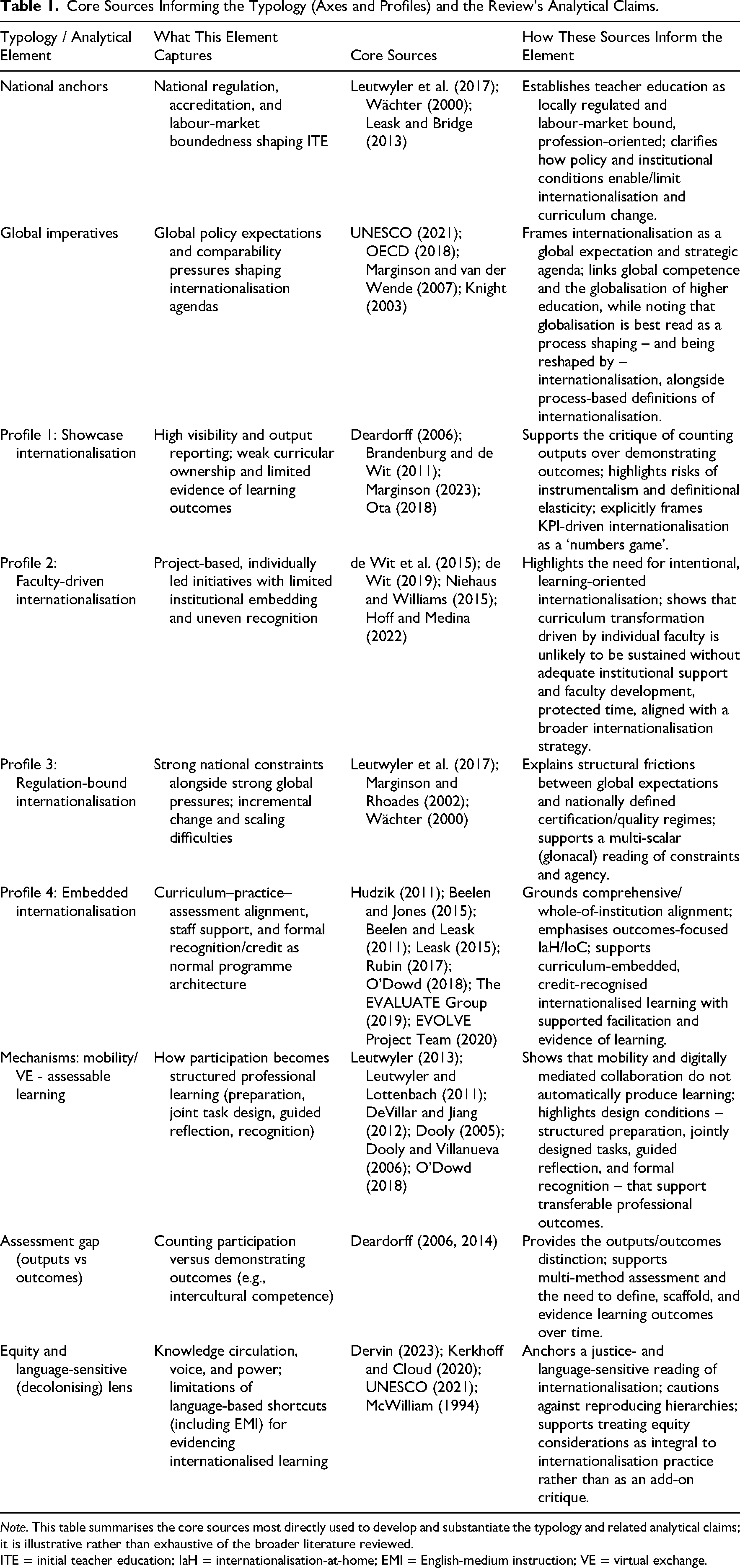
Note. This table summarises the core sources most directly used to develop and substantiate the typology and related analytical claims; it is illustrative rather than exhaustive of the broader literature reviewed.
ITE = initial teacher education; IaH = internationalisation-at-home; EMI = English-medium instruction; VE = virtual exchange.
This synthesis provides the conceptual groundwork for the review; we therefore begin by clarifying how internationalisation is conceptualised in higher education and teacher education before moving to drivers, practices, and the typology.
Conceptualising Internationalisation in Teacher Education
Defining Internationalisation in Higher Education
The concept of internationalisation has been defined in varied ways across higher education, reflecting its evolving scope and purpose. Knight (2003) describes it as the integration of international, intercultural, or global dimensions into the purposes, functions, and delivery of higher education. Building on this, De Wit et al. (2015) frame it as a deliberate process to enhance the quality of education and research for all, while contributing meaningfully to society. Hudzik (2011) extends this to comprehensive internationalisation, emphasising institutional commitment across teaching, research, and service. Teacher education programmes, departments, and faculties are no exception to this trend, and there is evidence of the internationalisation of teacher education across the globe (Larsen, 2016). Together, these perspectives demonstrate a shift from peripheral activities toward embedded processes shaping the core of higher education. This conceptual foundation offers a useful starting point for considering how internationalisation unfolds in teacher education, where global imperatives meet national responsibilities. At the same time, teacher education occupies a distinctive position within higher education: it is both a nationally regulated, profession-oriented field and, increasingly, a site where global expectations around equity, intercultural understanding, and global competence are negotiated in practice.
Internationalisation in Teacher Education
In teacher education, internationalisation has been shaped by broader movements in global and higher education (Koh et al., 2025). It takes many forms: beyond mobility, it includes ‘internationalisation at home’, curriculum and campus initiatives, and programme or provider cooperation (Leutwyler, 2013). However, compared to other disciplines, teacher education remains constrained by national regulation and local orientation, limiting its international reach (Leutwyler et al., 2017). Since national and cultural contexts strongly shape teacher preparation, there is no single pathway to internationalisation (Koh et al., 2025).
Scholars argue that embedding internationalisation within teacher education is essential for preparing teachers with cultural intelligence and global competence. Yet in practice, it has often relied on staff exchanges, research networks, or student mobility, which remain limited when not systematically integrated into programmes (Stewart, 2008). Internationalisation must therefore be pursued as a context-sensitive, multifaceted process shaped by global and local dynamics (Larsen, 2016). Interculturality likewise resists a single definition; as Dervin (2023) notes, its meaning is shaped by glocal contexts, languages, and ideologies, requiring reflexivity and openness to multiple interpretations rather than a single dominant narrative. A key takeaway is that such efforts should be directly linked to equipping future teachers with the competencies needed for the twenty-first century and to rethinking programme design for increasingly globalised classrooms (Budak et al., 2015). In this review, we therefore approach internationalisation in teacher education not simply as a set of activities (mobility, partnerships, English-medium offerings), but as a design question: how programmes prepare future teachers to develop and evidence intercultural, global, and digitally networked competences. Crucially, this process unfolds under two simultaneous forces that shape teacher education in most contexts: strong national regulation and accountability to local labour-markets on the one hand, and intensifying global imperatives around internationalisation, inclusion, and global competence on the other. The interplay between these ‘national anchors’ and ‘global imperatives’ provides the analytical lens for the analysis that follows: we next examine the forces that drive internationalisation in teacher education before returning to how these dynamics are organised, contested, and translated into programme design.
Drivers of Internationalisation in Teacher Education
While we distinguish ‘national anchors’ and ‘global imperatives’ as organising terms, we do not treat them as a binary opposition. Following a glonacal lens, global, national, and local dimensions operate as intersecting planes, characterised by ‘simultaneity of flows’ rather than a linear movement from the global to the local; national and local actors can also challenge and shape wider patterns (Marginson & Rhoades, 2002).
Globalisation and Demographic Change
The rapid increase in global migration has profoundly altered school demographics worldwide, placing new demands on teacher education. Paine et al. (2017) emphasise that future teachers need to be prepared to address the linguistic and cultural diversity shaped by immigration and mobility. Yet in many contexts, teachers still feel underprepared to work effectively with immigrant students, revealing a persistent gap between global demographic realities and teacher preparation (Premier & Miller, 2010).
Policy Initiatives by International Organisations
Teacher education is increasingly framed as a transnational concern shaped by global actors. Organisations such as UNESCO, the OECD, and the World Bank have introduced indicators, assessments, and frameworks – such as TALIS and TEDS-M – that position teacher development as a common global issue (Paine et al., 2017). These initiatives both generate comparative data and promote global agendas like citizenship education and intercultural competence. UNESCO highlights global citizenship, while the OECD has embedded ‘global competence’ into PISA as a key twenty-first-century skill (OECD, 2018). Such policy signals push national governments and universities to integrate international perspectives into teacher preparation, often aligning outcomes with global frameworks and promoting practices like study abroad or internationalised curricula. At the same time, such transnational frameworks are not neutral: international agencies that gather comparative data can contribute to a climate in which cross-national comparisons appear ‘natural’, and policy ideas travel through managerial and professional networks. Read alongside broader higher education debates, these instruments can also align with governance shifts towards performance measurement and accountability (Marginson & Rhoades, 2002).
Institutional Drivers: Quality and Accreditation Pressures
Globalisation has also created new mechanisms for regulating and standardising teacher education. International summits, accreditation frameworks, and quality benchmarks reinforce shared discourses on high-quality preparation (Paine et al., 2017). At the same time, universities face pressures to increase research, publications, and projects, as these outputs are tied to rankings and external evaluations. Such pressures act as neo-liberal mechanisms of control, positioning quality and accreditation as tools that shape institutional priorities (Eriçok, 2023). Comparable dynamics have been described elsewhere: accountability regimes and audit cultures redefine academic and professional work in terms of measurable performance and compliance targets (Ball, 2003); global competition and ranking logics push institutions to demonstrate ‘international’ quality through visible indicators and standardised benchmarks (Marginson & van der Wende, 2007); and transnational policy instruments, including comparative assessments and policy borrowing, encourage systems to align with external expectations in order to signal modernity and competitiveness (Rizvi & Lingard, 2010). However, they also create tensions, as convergence toward global standards may conflict with local traditions and educational needs. In this context, internationalisation may become entangled with market-oriented pressures: neo-liberal policy patterns emphasise shifting costs towards ‘the market’, demanding accountability for performance, and positioning higher education in relation to economic competitiveness (Marginson & Rhoades, 2002; Wächter, 2000). This orientation has been criticised for potentially encouraging market-oriented framings of education, where internationalisation is pursued through competition and visibility metrics rather than as a public-good project centred on learning and equity. These pressures can result in highly visible forms of internationalisation that are strategically promoted and measured, but not always meaningfully embedded into programme design or assessed in terms of teacher learning.
Taken together, these demographic, policy, and institutional pressures generate both urgency and direction for the internationalisation of teacher education. They shape not only how internationalisation is framed rhetorically, but also which practices become prioritised in programmes – from mobility and exchange to IaH, the development of intercultural competence, and emerging forms of digitally mediated collaboration. The next section outlines these key dimensions and practices.
Key Dimensions and Practices
Mobility and Exchange
Mobility remains one of the most visible dimensions of internationalisation in teacher education. Yet being in a foreign context alone does not ensure productive learning; exchange must be purposefully embedded through programme design, guidance, and reflection (Leutwyler, 2013). Exchange programmes strengthen institutional internationalisation while fostering students’ personal and professional development (Leutwyler & Lottenbach, 2011). They promote flexibility, independence, openness, and tolerance, alongside teaching-specific benefits such as intercultural sensitivity, classroom confidence, and concrete pedagogical ideas (Leutwyler & Lottenbach, 2008, 2011). Newer mobility formats, such as short-term and blended mobilities, are increasingly framed as ways to widen participation by lowering barriers for participants with fewer opportunities (European Commission, 2025). However, widening access does not in itself guarantee equity; it depends on targeted support and inclusive implementation. Increasingly, these initiatives are complemented by models that seek to ‘internationalize at home’ through curriculum, cross-border co-teaching, and structured VE – positioned as a complement to physical mobility and as a potential route to intercultural learning for those unable to participate physically (Beelen & Jones, 2015; European Commission, 2025; O’Dowd, 2018; Rubin, 2017).
Intercultural Competence
Mobility intersects with the development of intercultural competence. Dooly (2005) distinguishes between intercultural knowledge – understanding other cultures – and intercultural communication skills, which require empathy and awareness of one's own value system. Such skills depend heavily on teachers’ task design. Intercultural competence is thus both a desired outcome and a critical challenge in internationalising teacher education. In many programmes, intercultural competence is named as an intended learning outcome of internationalisation, yet remains difficult to scaffold pedagogically, to generate credible evidence for, and to accredit in a systematic way (Deardorff, 2006).
Digital Dimensions
Alongside physical mobility, digital innovations provide additional pathways for international learning. VE and online collaboration may widen participation by enabling intercultural engagement when physical mobility is limited. According to Beelen and Jones (2015), such developments are increasingly situated within IaH, understood as the purposeful integration of international and intercultural dimensions into the home curriculum so that all students – not only the mobile few – engage with such learning. Rubin (2017) and O’Dowd (2018) describe COIL as a shared-syllabus model in which instructors in different countries co-design modules and have students collaborate across borders as part of regular coursework. However, VE/COIL are not automatically equitable or scalable: O’Dowd (2018) notes barriers such as limited access to technology, teachers’ limited digital competences, time differences that hinder synchronous communication, and institutional resistance; Rubin (2017) similarly shows how early COIL collaborations were often dependent on dedicated staff and could remain peripheral without institutional support and infrastructure. Deardorff (2014) suggests that, in some cases, online exchanges can support outcomes that may be harder to achieve through traditional mobility alone.
Taken together, mobility and exchange, intercultural competence development, and digitally mediated collaboration illustrate how internationalisation is being operationalised in teacher education. Yet these practices are not neutral or universally accessible: they are unevenly funded, unevenly recognised, and often only partially embedded in core curricula. In many cases, their intended learning outcomes are assumed rather than explicitly assessed. The next section turns to these persistent tensions and limitations.
Challenges and Critiques
National Anchoring and Local Regulation
Despite global pressures, internationalisation in teacher education is often described as progressing more slowly or unevenly than in some other fields. Strong national regulation and the local orientation of labour-markets constrain mobility and programme reforms, reflecting what Leutwyler et al. (2017) terms the ‘parochial nature’ of teacher education. Regional and national policy settings around internationalisation form the background against which institutions formulate policy, and in which academic staff do or do not engage in internationalising the curriculum (Leask & Bridge, 2013). This creates ongoing tension between nationally steered teacher preparation and the intensifying global discourse on internationalisation (Leutwyler, 2013). As a result, internationalisation may be pursued through relatively narrow, lower risk spaces – such as short-term mobility, bilateral agreements, or surface-level curricular references – rather than through structural redesign of the core teacher preparation programme.
Policy–Practice Gap
Institutions frequently promote mobility as a strategic goal but provide limited preparation, support, and recognition for students’ experiences. This politique paradoxale (Kohler et al., 2008) undermines the transformative potential of mobility programmes, leaving outcomes uneven and often restricted to individual gains rather than systemic change.
Similar gaps emerge in other internationalisation efforts: VE and intercultural competence are invoked as strategic priorities, but without consistent preparation, structured reflection, or formal academic recognition, their impact often remains individualised rather than programme-wide.
Defining and Assessing Outcomes
Another challenge lies in defining and evaluating the outcomes of internationalisation. While global mobility programmes are often justified by references to global citizenship and intercultural competence, universities do not consistently establish explicit learning outcomes or robust assessment mechanisms (Deardorff, 2006, 2014). This gap raises questions about the realistic achievements of short-term sojourns and pilots, and about the extent to which internationalisation – whether through mobility, VE, or curriculum internationalisation – contributes to long-term teacher professional growth rather than remaining a temporary, unassessed experience.
Taken together, these challenges suggest that internationalisation in teacher education is neither uniform nor automatically transformative. Instead, it tends to crystallise into recurring patterns: in some cases, internationalisation is highly visible but weakly embedded; in others, it is tightly constrained by national regulation; and in a smaller number of cases, it is intentionally designed as part of core teacher preparation. In the following discussion, we develop an integrative typology to make these patterns explicit and examine the mechanisms through which internationalisation can move from rhetoric and isolated initiatives toward structured, assessable professional learning.
Discussion
Internationalisation in teacher education is both urgent and uneven: it is driven by global expectations, policy agendas, and demographic change, yet constrained by national certification regimes, local labour-markets, and institutional limits. In what follows, we move from description to interpretation. We argue that teacher education sits in a persistent tension between global imperatives and national anchors; we identify the institutional and pedagogical mechanisms that make internationalisation educatively meaningful rather than merely symbolic; and we outline an integrative typology that organises these patterns.
National Anchors × Global Imperatives: From Evidence to Claim
Teacher education is positioned between two powerful forces. On one side are ‘global imperatives’: external expectations, policy signals, and strategic agendas that frame internationalisation as urgent, visible, and measurable. On the other side are ‘national anchors’: the regulatory, labour-market, and accreditation structures that bind teacher education to domestic priorities, certification requirements, and locally defined notions of professional readiness. This section traces how that tension appears in the literature: first, by showing how teacher education is drawn into globalisation; second, by documenting the gap between institutional rhetoric and programme-level reality; and third, by arguing that internationalisation only becomes meaningful for future teachers when it is deliberately designed, supported, and assessed, rather than simply counted. Together, these points lay the ground for the typology we develop later, which interprets internationalisation patterns in teacher education as structured, not accidental.
Higher education has been reshaped by globalisation, with systems, policies, and institutions increasingly influenced by transnational dynamics (Marginson & van der Wende, 2007). Teacher education sits squarely within this shift: programmes have responded to global transformations through a wider ecology of practices – curriculum internationalisation, international service/field/internship experiences, cross-border initiatives, and the rising use of English-medium instruction (EMI) beyond the Anglophone world. These developments underline a simple point: the internationalisation of teacher education cannot be understood apart from globalisation's broader forces (Larsen, 2016).
Yet a persistent tension remains. Despite mounting global pressures, the core practices of teacher preparation have proved remarkably stable over the past century (Goodwin, 2010). Survey evidence reinforces this implementation gap. In one multi-institutional study, roughly two-thirds of respondents reported that internationalisation appears in their institutional strategic plans, but only about half reported the same at the teacher education unit level. Themes included the importance of leadership at college/university levels, inter-institutional collaboration, alignment with certification programmes, and the need for faculty and funding support – along with calls for multi-level backing to connect plans with implementation (Kerkhoff et al., 2024). Similarly, another dataset indicates that while many institutions embed internationalisation in mission statements and strategic plans, only ∼38% of teacher education units’ missions and ∼53% of their strategic plans reflect this emphasis (Global Teacher Education, n.d.). Together, these findings suggest that internationalisation is often anchored rhetorically at the centre of universities but less consistently embedded where teacher preparation is actually designed and delivered.
Context matters as well. Comparative evidence from Greater China and Canada shows that internationalisation in teacher education is shaped by local regulatory and cultural frames as much as by global agendas. Programmes not only respond to global and local imperatives; at times, they also act as agents of globalisation, a dynamic that warrants further empirical, comparative research (Larsen, 2016). This dual movement – between national anchors and global imperatives – helps explain why progress is uneven and why strategies that travel well in one context may stall in another.
Finally, while mobility has clearly expanded across teacher education (Larsen, 2016), its educational return is not automatic. Building on this evidence, we argue that mobility is more likely to yield reliable learning when experiences are intentionally designed, well-supported, and systematically reflected upon, with explicit outcomes that are assessed rather than assumed. This reading connects the literature to the paper's analytic stance: closing the policy–practice gap requires moving beyond counting activities toward aligned curriculum–practice–assessment, sensitive to national constraints yet responsive to global demands.
In this sense, ‘global imperatives’ appear as strategic commitments, policy signals, and international expectations directed at teacher education, while ‘national anchors’ refer to the regulatory, labour-market, and accreditation structures that bind teacher education to local requirements; the uneven alignment between the two is what our typology later seeks to make visible.
Mechanisms that Matter: From Mobility to Learning via Curriculum Design and Faculty Preparation
Internationalisation in teacher education does not automatically produce meaningful professional learning; it depends on how it is designed, taught, supported, and carried back into practice. In this subsection, we read the literature in terms of mechanism. First, we show that cultural and linguistic diversity can be pedagogically embedded into subject teaching, rather than treated as an add-on. Second, we note that international fieldwork yields deeper gains when it is intentionally structured and linked to classroom practice, rather than offered as a one-off experience. Third, we point to the need for programme-level architecture and faculty capacity to sustain these gains beyond individual placements. Taken together, this suggests that ad hoc mobility risks remaining anecdotal, whereas embedded design, guided reflection, and supported faculty practice move internationalisation toward systematic professional learning rather than symbolic activity.
Effective teaching rests on mastery of content and pedagogy, but the assumption that disciplinary integrity – especially in mathematics and science – conflicts with cultural diversity is misplaced. Every school subject accommodates cultural diversity, and culturally responsive teaching concerns not only adding multicultural content but also deploying multicultural instructional strategies; the mechanism lies in pedagogy as much as curriculum (Gay, 2002).
Evidence further indicates that international fieldwork can yield distinctive gains when its design and duration are robust. Well-organised, long-term student-teaching abroad programmes have been shown to enhance pre-service teachers’ intercultural development in ways not typically achieved in local placements. Participants in such programmes also perceived themselves as competent classroom teachers in their U.S. schools, suggesting added value in cultural–linguistic experiences alongside classroom performance and informed self-assessment (DeVillar & Jiang, 2012).
Sustaining these gains requires programme architectures that move beyond discrete, topic-focused courses culminating in a field experience. Structuring preparation around knowledge domains has catalysed shifts in both how teacher preparation is conceived and how it is enacted – toward holistic, integrated designs in which teacher knowledge is inquiry-based and oriented to problem-solving, and teaching is conceptual and flexible rather than tightly bound to subject or technique. These knowledge domains can guide what teacher educators should know and do, potentially prompting parallel change in practice. What remains unresolved is how teacher educators themselves should be prepared and supported for this role – an issue that presupposes agreement that they require formal preparation and induction (Goodwin, 2010; Goodwin & Kosnik, 2013). Put differently, the capacity of teacher education institutions to develop, support, and recognise this work appears less an optional add-on to internationalisation than a precondition for making its effects sustainable.
Internationalisation-at-Home and the Digital Dimension: Access, Equivalence, and Scale
Internationalisation in teacher education is not limited to sending a small group of students abroad. It can also be organised so that all candidates encounter structured intercultural work inside the compulsory programme, including online collaboration across borders. In this subsection, we consider two related strands – IaH and VE/COIL – as attempts to make internationalisation more equitable, more routine, and more institutionally recognised, rather than treating it as an optional enrichment activity.
IaH targets all students by purposefully integrating international and intercultural dimensions into the formal and informal curriculum within domestic learning environments; outcomes – rather than location – are central (Beelen & Jones, 2015). In practice, this means embedding internationalisation in the compulsory programme and its assessment structures (Beelen & Leask, 2011). Electives alone are insufficient, and teaching in English by itself does not constitute an internationalised curriculum if content and learning outcomes remain unchanged (Beelen & Jones, 2015). A boundary-setting view likewise frames IaH as an internationally related activity other than outbound mobility, coordinated institution-wide with central steering and shaped by external conditions such as policy, ICT, and accountability (Wächter, 2000).
Within this framework, VE is positioned as a complement to physical mobility that widens participation by offering online access to comparable gains in cultural awareness and soft skills (European Commission, 2017). The Commission subsequently explored feasibility at scale and launched Erasmus + virtual exchange (EVE) to extend reach through VE (O’Dowd, 2018). A leading implementation model is COIL, conceived not as a technology but as a teaching–learning paradigm: team-taught courses co-develop a shared-syllabus and emphasise experiential, collaborative learning, often in 5- to 7-week blended modules that internationalise learning for non-mobile students (Rubin, 2017). In operational terms, COIL links two or more classes in different countries and has instructors design joint modules so students communicate and collaborate across contexts (O’Dowd, 2018).
Evidence supports making VE/COIL part of routine programme design. The EVALUATE European policy experiment – 25 class-to-class exchanges with 1,018 pre-service teachers across 34 ITE institutions – found that VE drives innovation in formal coursework and builds digital-pedagogical (TPACK), intercultural, and foreign-language competence; it recommends policy integration, academic recognition, and credit-bearing participation, explicitly as a complement to physical mobility (The EVALUATE Group, 2019). Similarly, EVOLVE shows that VE can be mainstreamed across higher education and, when well designed, supports intercultural competences, critical digital literacies, language development, and disciplinary learning at scale (EVOLVE Project Team, 2020).
Read in this way, IaH and VE/COIL do more than widen access: they suggest how internationalisation in teacher education can begin to take the form of planned, credit-bearing, curriculum-embedded work with supported reflection, which in our later typology is associated with a move toward an embedded internationalisation logic rather than ad hoc or purely symbolic activity.
For ITE, these models translate into selectively embedding COIL within methods courses and practicum seminars, providing light professional development for mentor teachers, and aligning tasks with programme outcomes and national standards (O’Dowd, 2018; Rubin, 2017). VE/COIL might complement – rather than replace – school-based learning by providing non-mobile candidates more equitable, structured opportunities to plan, enact, and reflect with peers in other contexts, while encouraging inclusive participation and voice parity (European Commission, 2017; EVOLVE Project Team, 2020; The EVALUATE Group, 2019).
The Assessment Gap: Defining and Measuring Learning Outcomes
Internationalisation in teacher education is often described through ambitions – global competence, intercultural awareness, and readiness for diverse classrooms – but these ambitions are not always translated into explicit, assessable learning outcomes for future teachers. This subsection treats assessment as a structural question: whether institutions can show what candidates actually learn, rather than only report participation or intention. This issue also matters for our typology, because it helps distinguish rhetorically internationalised programmes from those in which internationalisation is embedded, documented, and recognised.
Deardorff (2006) identifies a persistent rhetoric–practice gap: institutions tout internationalisation yet rarely operationalise learning outcomes. She distinguishes outputs (easy-to-count numbers) from outcomes (what students actually learn) and notes that few universities explicitly define or assess ‘intercultural competence’, arguably the most meaningful result. In her sample, only 38% reported assessing students’ intercultural competence – evidence that counting activities often substitute for measuring learning. Closing this gap requires methodological clarity. Deardorff (2006) shows consensus that intercultural competence can be measured; programmes should track degrees/levels over time and prefer multiple methods over any single instrument. Scholars and administrators converge on primarily qualitative approaches (e.g., interviews, observations, case studies), with mixed-methods and triangulation encouraged; inventories alone are insufficient. She also documents tension around pre-/post-testing (administrators favour it; many scholars are sceptical), underscoring the need to align definitions, indicators, and methods from the outset.
Read in the context of teacher education, this suggests that claims about preparing ‘globally competent’ new teachers may remain aspirational unless programmes define the intended learning, support candidates in achieving it, and generate credible evidence that it has been reached. In our framing, this moves internationalisation closer to an embedded internationalisation logic and away from purely showcase internationalisation.
A Decolonising and Language Lens: Equity, Knowledge Circulation, and English-Medium Instruction
Internationalisation in teacher education is not only about expanding EMI or adding ‘global content’ – which often remains at the level of mere ‘accommodation’ (Kerkhoff & Cloud, 2020). It raises fundamental questions about the ‘dominant strain of knowledge’ (UNESCO, 2021): whose knowledge circulates, whose perspectives are centred, and how future teachers learn to recognise ‘power, privilege, and oppression’ (Kerkhoff & Cloud, 2020) as well as ‘power relations’ (Dervin, 2023) in their own classrooms. In this subsection, we read internationalisation through that justice and language lens, treating it as a curricular and institutional question rather than only an ethical appeal. As Dervin cautions against ‘easy recipes’ (Dervin, 2023), and UNESCO reminds us that ‘language is more than a means of communication’ and that some ‘languages, and knowledges have long been marginalized’ (UNESCO, 2021), we treat EMI as, at most, a partial indicator – one that does not necessarily, on its own, provide evidence of internationalised learning or equitable knowledge circulation.
Earlier critiques of teacher education have noted that programmes can struggle to make the political nature of teaching visible, especially under technocratic pressures. Teacher education has shown resistance to new conceptions of knowledge amid technocratic pressures, making a social-justice reframing urgent; pre-service teachers’ ideological conservatism can obscure the political nature of teaching (McWilliam, 1994). Against this backdrop, internationalisation intersects with equity agendas: UNESCO's call for a ‘new social contract’ centred on inclusion, equity, and solidarity signals alignment with global benchmarks, yet tensions persist in a field tightly regulated by national structures (UNESCO, 2021).
Evidence links exposure to globally competent teaching with teachers’ use of global practices in K-12. Participants internationalised curricula by infusing cultural understandings of content, teaching perspective-taking, and resisting Western-centric texts, often leveraging students’ cultural identities and international current events. Three recurring barriers remain: lack of global resources, mandated curricula without global competence, and high-stakes tests that do not assess it. Consequently, teacher education needs to not only justify global education but also model decolonising practices and consciousness-raising; otherwise, global education risks reproducing colonial hierarchies. Bringing critical theory to the forefront of globally competent teacher education is essential (Kerkhoff & Cloud, 2020).
Read in relation to the typology developed later, this suggests two different logics of internationalisation. One is largely symbolic: adopting English-medium delivery or cosmopolitan branding without shifting whose knowledge counts, which may reproduce hierarchy. The other moves toward an embedded internationalisation logic: creating space for multiple epistemic perspectives, supporting candidates to practise perspective-taking, and aligning these aims with programme structures. In this view, equity and decolonising work are not external to internationalisation but part of how it may become substantive, assessable, and professionally relevant.
Importantly, these equity- and language-related concerns are not external to internationalisation; they shape what counts as ‘international’ and who benefits. UNESCO frames curricula as enabling learners to access and contribute to the knowledge commons and to correct omissions and exclusions so that knowledge reflects diverse ways of knowing and being (UNESCO, 2021). In teacher education, decolonising approaches to global learning similarly warn against deficit ‘us and them’ framings and foreground power in knowledge production and classroom practice. Dervin (2023) also cautions against ‘easy recipes’ and treats interculturality as polysemic and language- and ideology-dependent, requiring ongoing critical reflexivity. We therefore carry this lens into the typology below as a cross-cutting criterion alongside structural embedding and assessment.
An Integrative 2 × 2 Typology: National Anchors × Global Imperatives
The literature reviewed in this article points to recurring patterns in how teacher education engages with internationalisation: strong rhetorical commitment without deep curricular change; project-based activity without structural alignment; structural tension between national regulation and global pressure; and, in fewer cases, deliberate integration of international and intercultural aims into core programme design, support, and assessment. We treat these patterns not as isolated anecdotes but as positions within a shared field of constraint and possibility. On this basis, we propose an interpretive 2 × 2 typology that crosses the strength of national anchors with the force of global imperatives. The aim is not to rank programmes but to offer a language for locating where practice currently sits and where leverage for movement may lie.
To interpret heterogeneity in ITE internationalisation, we cross-national anchors (the degree to which teacher education is locally regulated and labour-market bound) with global imperatives (the external and policy pressures to internationalise). Empirically, teacher education ‘supplies a very locally anchored and regulated employment market’ and exhibits a ‘parochial nature’ (Leutwyler et al., 2017), even as it faces an ‘increasing imperative to internationalize’ (Leutwyler et al., 2017). Moreover, institutions ‘do not exist in a vacuum’; governments ‘set limiting or liberating conditions’ via legislation, regulation, and funding, alongside broader forces of globalisation and IT (Wächter, 2000). This warrants a 2 × 2 typology (showcase internationalisation, faculty-driven internationalisation, regulation-bound internationalisation, and embedded internationalisation) to map programme logics, likely practices, risks, and monitoring indicators across contexts.
Global imperatives in teacher education are now articulated through globalisation's restructuring of higher education (Marginson & van der Wende, 2007), competence frameworks (OECD, 2018), and a new social contract for education (UNESCO, 2021). Following Knight's process definition, internationalisation is not a list of activities but the integration of international and intercultural dimensions into institutional purposes, functions, and delivery (Knight, 2003). Using a glonacal lens, these imperatives travel from global norms to national regulation and institutional practice, often producing policy–practice frictions in ITE (Leutwyler et al., 2017; Marginson & Rhoades, 2002). Across the four profiles, we also attend to language and knowledge circulation – whether internationalisation is reduced to visible indicators, or whether it deliberately supports epistemic diversity, language-sensitive participation, and mutual partnerships that do not reproduce asymmetries (Dervin, 2023; European Commission, 2017; Leutwyler et al., 2017; UNESCO, 2021). The typology is intended as an interpretive, heuristic framework that synthesises recurrent patterns in the literature and clarifies how programme logics tend to cluster under different balances of national anchoring and global pressure. It is not proposed as a validated measurement instrument, nor as an exhaustive classification; hybrid cases and movement over time are expected. The short profile descriptions below therefore offer practical diagnostic cues (typical manifestations in curriculum, practicum, recognition, and assessment). Figure 1 summarises the proposed 2 × 2 positioning logic for ITE internationalisation, mapping recurring programme logics at the intersection of national anchoring and global pressure.
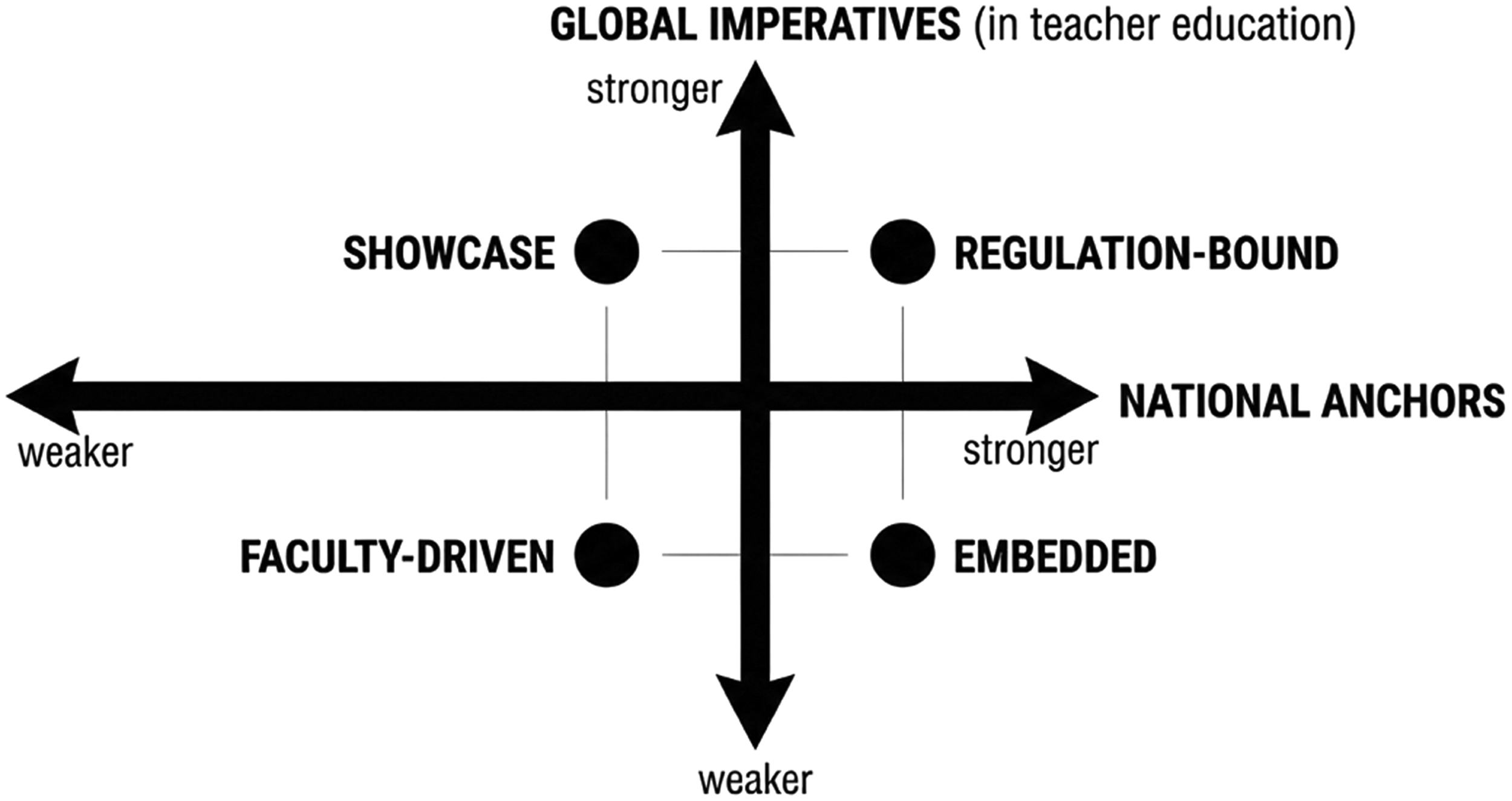
National anchors × global imperatives: a heuristic 2 × 2 typology of internationalisation in initial teacher education (ITE).
The vertical axis indicates the strength of global imperatives, while the horizontal axis indicates the strength of national anchors. The four quadrants represent ideal-type profiles – showcase, faculty-driven, regulation-bound, and embedded – used to locate how internationalisation tends to be framed and organised in ITE programmes. Positions are interpretive rather than predictive; hybrid cases and movement over time are expected.
In the embedded internationalisation position, the lower right placement in Figure 1 reflects the idea that internationalisation is no longer primarily enacted in response to externalised ‘global imperatives’, but has become institutionalised within a strongly nationally anchored programme architecture. Conceptually, this follows process-oriented definitions that treat internationalisation as the integration of international/intercultural dimensions into core purposes, functions, and delivery (Knight, 2003) and aligns with comprehensive approaches that emphasise institution-wide infusion across teaching, support, and governance (Hudzik, 2011). In this sense, ‘weaker’ global imperatives should be read as reduced reliance on visibility- or compliance-driven prompts, because internationalisation is carried by routine curriculum and quality arrangements. This interpretation is consistent with IaH and curriculum perspectives that foreground purposeful integration for all students within the formal curriculum – including pedagogy and assessment (Beelen & Jones, 2015), and with boundary-setting accounts that treat embeddedness as evident when internationalisation is part of the compulsory programme and incorporated into standard assessment tools (e.g., portfolio-based assessment) rather than remaining optional or peripheral (Beelen & Leask, 2011). It also resonates with earlier arguments that internationalisation needs to reach beyond the ‘mobile few’ through institution-wide coordination that normalises international/intercultural learning as a core feature of domestic provision (Wächter, 2000).
Profile 1: Showcase Internationalisation
Institutions often conflate outputs (e.g., mobility numbers) with outcomes (student learning). Deardorff's national study found that only ‘Thirty-eight percent already assess students’ intercultural competence’, underscoring a persistent policy–practice gap (Deardorff, 2006). This reductionism is precisely what Brandenburg & de Wit cautioned against in The End of Internationalisation? – the risk that internationalisation becomes a numbers-driven brand exercise (more exchange, more degree mobility, more recruitment – elevating form over substance and turning instruments into ends) rather than learning-led change (Brandenburg & de Wit, 2011). Conceptually, Marginson argues that overly elastic, uncritical uses of the term ‘internationalisation’ obscure aims and enable misalignment – another driver of showcase internationalisation (Marginson, 2023).
In this position, a programme typically presents internationalisation prominently in strategy documents and public messaging (a high-rhetoric stance), but the core curriculum and practicum remain largely unchanged in practice. Success is described in terms of how many students go abroad, how many agreements are signed, or how many modules are taught in English, reflecting a counting culture in which activity is reported numerically rather than examined pedagogically. In such contexts, internationalisation risks becoming a ‘numbers game’ – where volume and visibility substitute for evidenced learning (Ota, 2018). What matters publicly is volume, not whether future teachers can actually do anything differently in diverse classrooms. Internationalisation work tends to sit with a small number of enthusiastic staff, and it is rarely embedded in assessment criteria, progression requirements, or formal quality assurance; the result is shallow practice. In practice, internationalisation functions as institutional signalling rather than as an articulated component of teacher preparation. In such cases, internationalisation may leave deficit ‘us/them’ framings or Western-centric knowledge hierarchies largely unchallenged (Kerkhoff & Cloud, 2020). It can also drift towards a ‘numbers game’, where the ‘why’ of internationalisation is displaced by visible targets (e.g., mobility numbers, recruitment, or English-taught provision presented as indicators) rather than learning-led curricular work (Brandenburg & de Wit, 2011; Ota, 2018).
Profile 2: Faculty-Driven Internationalisation
The European Parliament's landmark study reframed internationalisation as an ‘intentional process’ that needs to reach all students (via IaH), not just the mobile few – moving beyond mobility counting to purposefully integrated curriculum, pedagogy, and assessment (de Wit et al., 2015). De Wit's critical syntheses likewise flag common risks (instrumentalism, branding, revenue logics) and argue for coherent, learning-led strategies over opportunistic projects (de Wit, 2019; Brandenburg & de Wit, 2011).
In this position, internationalisation is clearly happening, but largely through projectised, ad hoc activity: discrete projects, bilateral partnerships, visiting delegations, short-term exchanges, or COIL-style collaborations initiated by individual staff. These initiatives often produce genuine moments of intercultural engagement and professional growth for participating students, but they sit next to the core programme rather than within it, signalling a weak strategy–context fit. They may not be compulsory, they are not always credit-bearing, and they are rarely accompanied by systematic preparation, mentored reflection, or formal assessment. Responsibility for sustaining such work tends to fall on a small group of committed lecturers, meaning that continuation depends on available funding, personal networks, or goodwill rather than on institutional design and ‘adequate support (Niehaus & Williams, 2015)’ and ‘faculty development (Hoff & Medina, 2022)’. In addition, equity effects can remain uneven, depending on who is able to participate and whether partnerships become genuinely mutual rather than shaped by existing asymmetries in knowledge exchange (UNESCO, 2021). This reinforces the fragility of faculty-driven internationalisation: without institutional support, both continuity and equitable participation are difficult to secure.
Profile 3: Regulation-Bound Internationalisation
Teacher education is ‘traditionally to a very large extent nationally shaped’, closely tied to state regulation and local labour-markets – conditions that slow or filter internationalisation (Leutwyler et al., 2017). A glonacal lens highlights multi-scalar causation across global, national, and local arenas, with no permanent primacy among them (Marginson, 2022; Marginson & Rhoades, 2002).
In this position, characterised by high regulation alongside high global aims, a programme may openly acknowledge the need to prepare future teachers for multilingual, multicultural and globally connected classrooms, yet still struggle to alter core requirements, practicum structures or assessment expectations. National accreditation frameworks, hiring rules and certification standards effectively set the boundaries of what can count as legitimate teacher preparation, creating structural frictions. As a result, curricular change is incremental, international elements are often appended rather than reworked into compulsory components, and innovations in areas such as intercultural competence, global citizenship or digital collaboration may be piloted but cannot easily be scaled or credited. The tension is not simply ideological resistance; it is the difficulty of reconciling external expectations for global readiness with tightly policed national definitions of what a ‘qualified teacher’ is. As Kerkhoff and Cloud (2020) note, even where global competence and social-justice aims are acknowledged, mandated curricula and high-stakes testing regimes can constrain the resourcing, recognition, and systematic assessment of such learning.
Profile 4: Embedded Internationalisation
In comprehensive internationalisation, leadership commits to whole-of-institution alignment – policy, curriculum, support, and assessment – rather than isolated projects (Hudzik, 2011). For IaH, Beelen and Jones (2015) define a learning outcomes focus for all students through the purposeful integration of international and intercultural dimensions into the formal and informal curriculum. Complementing this, principles for IoC emphasise engagement with international scholarship and diversity, defined outcomes, and progressive assessment, adapted by discipline and context (Beelen & Leask, 2011; Leask, 2015).
In this position, internationalisation is intentionally designed and aligned across curriculum, practice, and assessment. It is built into compulsory coursework, school placements, and assessment expectations rather than offered as an optional enhancement. Intercultural and global learning aims are stated in programme outcomes, they are scaffolded in taught modules, and they are revisited in supervised practice, reflection, and feedback. Mentor teachers and university staff are prepared to support this work, and time spent on it is recognised. Activities such as VE, co-taught cross-border modules or locally embedded intercultural tasks carry academic credit and are monitored in terms of what candidates can actually do – for example, adapting pedagogy for linguistically and culturally diverse classes. Here, internationalisation is treated as part of programme design and quality assurance, rather than as an individual initiative.
These features echo earlier sections on mobility design, IaH, and assessment: the emphasis falls on required (not optional) experiences; guided reflection supported by prepared faculty and mentors; formal academic recognition and credit; and evidence of what candidates actually learn. Read this way, embedded internationalisation describes internationalisation as something structurally owned rather than episodic.
Taken together, the four profiles should be read as heuristic positions shaped by different balances of national anchors and global imperatives. They are not fixed labels, and a single programme may display elements of more than one position. The value of the typology is to make visible where internationalisation appears largely symbolic, where it is tactical and project-driven, where it is structurally constrained by regulatory tensions, and where it begins to operate as a designed, supported, and assessable component of teacher preparation. Here, embedding also entails attention to epistemic and linguistic diversity – e.g., working with multiple (including marginalised) voices, negotiating meanings across languages, and designing partnerships that avoid reinforcing hegemony (Dervin, 2023; Kerkhoff & Cloud, 2020; UNESCO, 2021).
Implications for Policy and Programmes
The typology suggests that leverage points for strengthening internationalisation in ITE may differ by programme positioning. Where internationalisation is primarily visible through plans and participation figures, a pragmatic first step is to make intended learning outcomes explicit and to complement output reporting with evidence of student learning – especially for intercultural competence, which is still assessed inconsistently across institutions (Deardorff, 2006). Where activity is largely faculty-driven and projectised, sustainability may depend less on adding new initiatives than on providing light institutional infrastructure (e.g., partner-matching support, instructional design help, and short staff development), as scaling COIL-type collaboration typically requires structured support beyond individual goodwill (Rubin, 2017). In contexts that are tightly regulated, programme teams may focus on incremental, credit-bearing integration within existing coursework and practicum structures, while remaining realistic about the constraints of national requirements; IaH and VE can widen access, but their effectiveness and equity are not automatic and depend on resourcing, staff preparation, and students’ access to technology (Beelen & Jones, 2015; European Commission, 2017; O’Dowd, 2018). Finally, where internationalisation is already more embedded, attention may shift toward quality assurance and continuous improvement – ensuring that curriculum, practicum, and assessment remain aligned and that claims are supported by documented learning rather than participation alone. Taken together, these implications point to internationalisation not simply as mobility expansion but as an institutional capacity question: who is supported to design it, who has access to it, how it is recognised, and how its learning is evidenced.
Conclusion
This narrative review examined how internationalisation is unfolding in ITE and what it implies for programme-level implementation and governance. Across the literature, internationalisation is increasingly framed as professionally relevant in contexts shaped by mobility, cultural and linguistic diversity, and policy expectations around global competence and inclusion. At the same time, ITE remains strongly nationally regulated and tied to domestic labour-markets and accreditation – our ‘national anchors’ – while facing intensifying ‘global imperatives’. This tension creates both opportunities and constraints for how internationalisation can be organised, resourced, and sustained in practice.
A first observation is that internationalisation in ITE is often uneven in form and institutional embedding. It may take the form of mobility and exchange, IaH and Internationalisation of the Curriculum (including VE/COIL), and partnership activity, yet these strands are unevenly supported, recognised, and integrated into core provision. In many settings, internationalisation is still reported through participation and visible activity, while intended outcomes – such as intercultural learning and classroom-relevant capabilities – are not consistently defined, supported, and assessed.
A second conclusion concerns the conditions under which internationalisation becomes credible professional learning. Mobility alone does not ensure impact; outcomes depend on structured preparation, guided reflection, mentoring, and formal recognition. Similar conditions apply to VE/COIL and IaH: these approaches may widen participation beyond the ‘mobile few’, but their educational value depends on inclusive design, facilitation, credit-bearing recognition, and evidence of learning. From an implementation perspective, this foregrounds the need for coherent arrangements linking curriculum, practicum, and assessment rather than relying on isolated experiences.
On this basis, we proposed a heuristic 2 × 2 typology – showcase, faculty-driven, regulation-bound, and embedded internationalisation – to name recurrent programme logics at the intersection of national anchoring and global pressure. The typology is not a ranking; hybrid cases and movement over time are expected. Its purpose is to provide a shared vocabulary for diagnosing how internationalisation is currently organised and for identifying organisational and curricular leverage points for moving from symbolic or projectised activity toward curriculum–practicum–assessment alignment and documented outcomes.
Institutional capacity emerges as a key enabling condition for such movement. Internationalisation is difficult to sustain when it depends on individual enthusiasm alone; it stabilises when it is recognised in workload and evaluation, supported through professional development, and aligned with credit, quality assurance, and routine programme operations. Finally, the literature highlights unresolved equity and language tensions. Internationalisation can reproduce asymmetries when it privileges already mobile students, treats English-medium delivery as a proxy for global competence, or recentres dominant knowledge traditions. Conversely, it can create structured opportunities to practise working across difference – provided that attention to epistemic and linguistic diversity is treated as integral to programme design, partnership arrangements, and assessment rather than as an add-on critique.
Taken together, the central question is less whether internationalisation matters, and more how it can be embedded, supported, and evidenced as professionally meaningful learning under diverse national conditions. Internationalisation in ITE therefore remains an ongoing governance and design challenge connecting curriculum, staff capacity, assessment, access, and the regulatory environments that shape teacher preparation. As a narrative review, this article offers an interpretive, heuristic framework rather than an exhaustive mapping or empirical validation. Future work could translate these profiles into transparent indicators and examine their applicability across contexts (e.g., through comparative case studies and inter-rater classification), allowing the framework to move from heuristic diagnosis toward more empirically grounded typology testing while keeping the focus on learning-led design and evidenced outcomes.
Footnotes
Ethical Considerations and Consent to Participate
This article is a narrative review of published literature and policy documents. It did not involve human participants, patient data, or primary data collection, and therefore, institutional ethical approval and informed consent were not required.
Funding
The author(s) disclosed receipt of the following financial support for the research, authorship, and/or publication of this article: The authors gratefully acknowledge the financial support of TÜBİTAK. This study was supported under the 2219-International Postdoctoral Research Fellowship Programme (Project No: 1059B192302114) and is derived from research conducted at PH Wien during 2025–2026.
Declaration of Conflicting Interests
The authors declared no potential conflicts of interest with respect to the research, authorship, and/or publication of this article.
Declaration of Generative AI and AI-Assisted Technologies in the Manuscript Preparation Process
During the preparation of this work, the author(s) used generative AI–assisted language support (ChatGPT, OpenAI) for wording and clarity in certain passages. After using this tool, the author(s) reviewed and edited the text, and take full responsibility for the content of the final manuscript.
In this study, GPT-4 (OpenAI, version 5.2) was used solely for language correction and formatting. Gemini was used to generate  . However, all AI-generated content has been reviewed by the author(s) for scientific accuracy, ethical compliance, and source reliability, and all responsibility rests with the author(s).