




Abstract
As the number of immigrant students increases worldwide, cultivating immigrant students’ global competence to help them adapt to new environments and cultures becomes one challenge for educational systems and schools. Based on 47,031 15-year-old immigrant students from 26 economies, this study examined the effect of socioeconomic status, teacher support, and cultural values on global competence (awareness of global issues, cognitive flexibility and perspective taking). The results indicate that socioeconomic status and teacher support can significantly predict students’ global competence. Additionally, the findings suggest that teacher support moderates the relationship between socioeconomic status and awareness of global issues, with the moderating effect varying across cultures. Specifically, teacher support widens the gap in awareness of global issues among immigrant students in collectivistic cultures but reduces the gap in individualistic cultures. Policy and practical implications are also discussed.
Keywords
Introduction
As the world is becoming increasingly interconnected as a whole, the trend of global population mobility continues to rise. According to the International Organization for Migration report, the estimated number of international migrants still increased from 272 million immigrants in 2019 to 281 million in 2020 despite the impact of the pandemic, accounting for 3.6% of the world population (McAuliffe & Triandafyllidou, 2021). Among the 281 million international immigrants, about 15% are children (McAuliffe & Triandafyllidou, 2021). Unlike native students, immigrant students not only face normative developmental tasks (e.g., engage in classes, perform well in school, and build relationship with schoolmates), but also face challenges learning languages, new culture values (Caleon et al., 2017; Suárez-Orozco, Suárez-Orozco, et al., 2010; Suárez-Orozco et al., 2018). In this case, how to help them successfully adapt to new environment and cultures becomes a growing challenge for the educational systems of settlement countries. The need for cultivating immigrant students’ capability to cope with cultural differences, namely global competence, increases correspondingly.
Just like other academic performance, global competence is associated with students’ socioeconomic status (SES), higher SES students perform better than low-SES students (OECD, 2020, p. 162). The effect of SES may be attributed to the disparities in social and cultural capital between families. Higher SES families are more likely to invest in children's academic and nonacademic development and offer ample opportunities to develop children's various skills (Atlay et al., 2019; Lareau, 2018; Pong & Landale, 2012; Ren & Zhang, 2020). Conversely, lower SES families often struggle for life and have little time or extra resources for their children (Gándara & Contreras, 2010; Suárez-Orozco et al., 2009). Given the likely disadvantaged family background compared to native students (OECD, 2019a, p. 16), immigrant students may lag behind nonimmigrant peers in developing the essential knowledge, skills, and attitudes to adjust to new environments. Special focuses on immigrant students’ global development become critical to ensure educational equity.
Apart from social and cultural capital, teachers’ support could play an essential role in immigrant students’ development as they spend most of their time in schools (OECD, 2019b). Previous studies indicated that teacher support was associated with immigrant students’ academic achievement (Moon & Lee, 2009; Pong & Landale, 2012; Yeh et al., 2008), cultural empathy and open-mindedness (Lee & Ciftci, 2014), acculturation strategies (Yoo, 2021) and could reduce their intercultural competence concerns (Yeh et al., 2008). As significant proximal settings of students’ development, it is expected that students’ family backgrounds and teacher support may have a combined effect on immigrant students’ global competence development besides their own effects (Bronfenbrenner, 1996). Several studies have explored the indirect effects of teacher support on the relationship between SES and students’ academic achievement and life satisfaction (Xuan et al., 2019; Yan et al., 2021). However, few studies have investigated how SES, teacher support work together to influence immigrant students’ global competence and most studies only focus on specific cultural contexts, which omitted the cultural differences (Oyserman & Lee, 2008). Accordingly, the present study aims to investigate the relationship between family SES and immigrant students’ global competence, and to examine how this relationship is shaped by teacher support at the school level and national cultural values at the macrosystem level within the framework of social-ecological systems theory.
Literature Review
Conceptual Framework
In this study, we employed Bronfenbrenner's social-ecological systems theory as our conceptual framework. From Bronfenbrenner's perspective, human development results not only from characteristics of proximal settings but also from characteristics of broader settings and the interactions among settings (Bronfenbrenner, 1996; Rosa & Tudge, 2013). Based on the point, Bronfenbrenner argued that the ecological environment was a set of nested structures, each inside the next (Bronfenbrenner, 1996), and defined four systems according to their proximity with humans: microsystem, mesosystem, exosystem, and macrosystem.
Microsystem indicates the direct interaction with family, school, and peers. Parents, teachers, and peers’ attitudes and behaviors can directly impact students’ development (Bronfenbrenner & Morris, 1998). Mesosystem refers to the interaction of different settings (e.g., family–school interactions), which may influence microsystems and students. Exosystem are other settings that have influence on students but in which students do not directly participate (Bronfenbrenner & Morris, 1998). Macrosystem includes ideologies and cultural values that have generalized influence on students. The chronosystem was introduced later to illustrate the impact of time on other systems (Bronfenbrenner, 1986) (Figure 1).
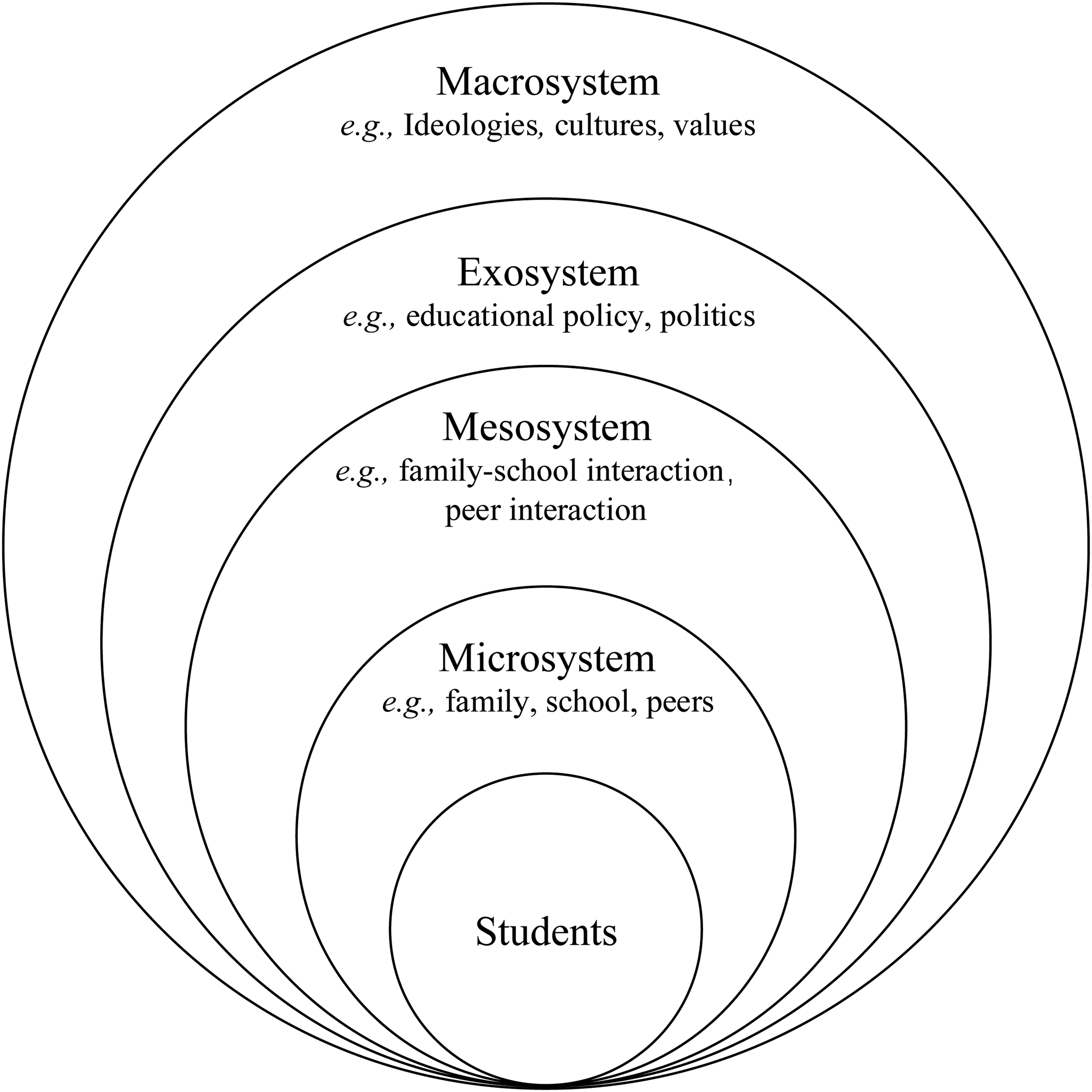
Bronfenbrenner's social-ecological systems theory.
Bronfenbrenner's social-ecological systems theory provides a simple and easy-understanding insight into the direct and indirect effect of families, schools, and communities on students’ development. Many studies have used Bronfenbrenner's social-ecological systems theory to explore how surroundings and their interaction affect students’ study experiences (McLinden, 2017; Paat, 2013), sense of belonging (El Zaatari & Maalouf, 2022), and motivation (Kim et al., 2020). Based on our research interest, we choose the social-ecological systems theory as our conceptual framework in this study. Specifically, guided by Bronfenbrenner's social-ecological systems theory, we examine how influences across nested systems jointly shape immigrant students’ global competence. Family SES and other student/family characteristics are conceptualized as microsystem factors; teacher support represents a school-based microsystem factor, with its moderating role reflecting mesosystem processes that link home and school contexts. National cultural values are framed as macrosystem factors that may condition these associations. The subsequent literature review and analyses are conducted within this framework.
SES and Students’ Global Competence
Global competence has become an increasingly important educational outcome in the context of globalization, migration, and growing cultural diversity. Broadly defined, global competence refers to individuals’ capacity to examine local, global, and intercultural issues, understand and appreciate multiple perspectives, engage in open and effective interactions with people from different cultural backgrounds, and act for collective wellbeing and sustainable development (OECD, 2020). Rather than representing a single skill, global competence is commonly conceptualized as a multidimensional construct encompassing knowledge, skills, attitudes, and values. In large-scale educational research, global competence has been operationalized through students’ awareness of global issues, cognitive flexibility and perspective taking, and related intercultural attitudes and dispositions (OECD, 2020; Solhaug & Kristensen, 2020; Spitzberg & Changnon, 2009). These dimensions capture both cognitive and noncognitive aspects of students’ ability to navigate culturally diverse contexts, making global competence particularly relevant for immigrant students who regularly negotiate multiple cultural frames.
SES was often seen as a combination of financial capital (material resources), social capital (social connections and power), and cultural or human capital (knowledge, skills, and educational level) (Bradley & Corwyn, 2002). As one indicator of family background, SES has an essential effect on students’ development (Bronfenbrenner, 1996). Previous studies had proved the effect of SES on immigrant students’ academic achievement. For instance, Moon and Lee (2009) found that parental education levels and family income were significantly associated with Asian American students’ school achievement. Suárez-Orozco, Gaytán, et al. (2010) found that maternal education, parental employment, and household structure were associated with different trajectories of academic performance, and may exacerbate local and immigrant students’ performance differences (Finch et al., 2021). In addition to academic achievements, many studies also revealed that SES was positively associated with immigrant and nonimmigrant students’ global competence (Schwarzenthal et al., 2017, 2019, 2020). SES was not only positively associated with acculturation (Wilczewska, 2023) and foreign language performance (Bumgarner & Lin, 2014; Butler & Le, 2018; Calvo & Bialystok, 2014) but also related to knowledge of diversity, empathy, emotion, and perspective taking (Solhaug & Kristensen, 2020). Higher levels of SES could help immigrant students resist acculturation stress (Kuo & Roysircar, 2004) and attenuate the detrimental effect of discrimination (Ríos-Salas & Larson, 2015).
The impact of SES on immigrant students’ global competence could be attributed to disparities of social and cultural capital. Higher SES parents may persist attitudes specific to their social class, tend to invest and involve more in their children's cognitive and noncognitive development (Atlay et al., 2019; Lareau, 2018). They were more likely to encourage their children to read at home, interact with others, visit museums (Pong & Landale, 2012), attend nonacademic extracurricular activities (Ren & Zhang, 2020), and think critically (Lareau, 2018). All of these are helpful for immigrant students to widen their knowledge of different cultures, make friends with native peers, increase their intercultural communicative competence and adapt to a new environment. On the contrary, parents of low-SES immigrant students were often ill-equipped to help their children cope with new, complex, or sometimes hostile environments (Gándara & Contreras, 2010; Suárez-Orozco, Gaytán, et al., 2010), tended to adhere to the model of an “accomplishment of natural growth” (Atlay et al., 2019; Lareau, 2018). Lower income and limited leisure time discouraged participation in extracurricular activities for low-SES immigrant students.
Immigrant students often attend racially and ethnically segregated schools, which meant lower access to educational resources (Orfield & Lee, 2006). High-SES schools were linked with abundant learning resources, high-quality teachers and staff, and interaction opportunities (Rumberger & Palardy, 2005). The advantages of higher SES schools lead to a more multicultural learning curriculum, extracurricular activities, and inclusive school climate, which may help students reduce prejudices, increase their understanding toward cultural diversity and global issues (Pettigrew, 1998; Schuh et al., 2017; Soria & Troisi, 2014). Low-SES schools are more likely to face the challenges like insufficient qualified teacher, low quality of facilities and equipment, school safety problems, classroom disruption, and school disorder, which might impede students’ academic and social-emotional development (Palardy, 2013). Students of high-SES classes might develop a normative climate that promotes achievement (Goldsmith, 2011), while students of low-SES classes were less willing to interact with others. This might influence their development of intercultural communication competence (van Ewijk & Sleegers, 2010).
The Direct and Moderating Effect of Teacher Support
Teacher support, as significant components of school contexts, refers to supportive behaviors offered by teachers that assists students in coping with academic problems or struggle situations, can also plays a critical role in students’ development (Bronfenbrenner, 1996; Klem & Connell, 2004). Teacher support can be tangible, emotional, instrumental, informative, academic, or autonomic (Tao et al., 2022).Teacher support may become even more significant in helping immigrant students with intercultural adaptation, academic and nonacademic development, given the barriers like poor foreign language proficiency, low parental involvement, and discrimination climate that immigrant students often encounter (Caleon et al., 2017; Suárez-Orozco, Gaytán, et al., 2010). Considerable studies have explored the association between teacher support and immigrant students’ knowledge about global issues, intercultural skills, and attitudes.
From the view of self-determination theory, teacher support could satisfy immigrant students’ basic psychological needs for autonomy, competence, and relatedness, which might help students be more motivated and engaged learners and lead to better performance (Deci & Ryan, 2000). For instance, Jin et al. (2017) found that teacher support was helpful in reducing students’ foreign language anxiety. Lee and Ciftci (2014) found that perceived social support was positively associated with international students’ academic self-efficacy, and supportive school-based relationships that strongly contribute to immigrant children's academic engagement and school performance (Suárez-Orozco et al., 2009). Nakhaie et al.’s (2022) study revealed that teacher support was associated with immigrant students’ academic persistence and played an essential role in their academic achievement. The OECD report showed that teacher support was positively and significantly related to immigrant students’ perceptions of competence in reading, motivation, learning goals, and was negatively associated with perceptions of difficulty in reading (OECD, 2019a, p. 203). Tao et al.’s (2022) meta-analytic study also revealed a small to medium correlation between perceived teacher support and achievement. In addition to academic performance, studies also found significant association between teacher support and immigrant students’ intercultural skills and attitudes. For instance, Yoo (2021) found that teacher support was significantly associated with Korean multicultural adolescents’ acculturation strategies. Hoferichter et al.’s (2022) study revealed that teacher support was associated with higher levels of coping and lower levels of helplessness. Yeh et al. (2008) surveyed 286 Chinese immigrant high school students and found that higher perceived support from significant others was associated with fewer intercultural competence concerns. Based on 330 US Asian international students, Lee and Ciftci (2014) found that perceived support was associated with cultural empathy and open-mindedness.
SES and teacher support do not affect alone as different settings may interact with each other and have synergic influence on students’ development (Bronfenbrenner, 1996). In fact, teacher support is highly in relation to students’ social backgrounds (Lareau, 2018). Compared with their low-income peers, students from high-income families perceived more facilitative feedback (Ma et al., 2022; Sortkær, 2019), and attended more school-based global learning education (Tsang et al., 2020). Teachers at low-SES schools tended to have lower achievement expectations for students (Rumberger & Palardy, 2005; Tenenbaum & Ruck, 2007). Lower teachers’ expectations could reduce supportive behaviors and interactions with disadvantaged students (Rjosk et al., 2014), fewer challenging learning activities and a slow teaching pace (Gay, 2018). All these may enlarge the gap in global competence among students of different backgrounds.
High-SES students also initiatively request more help from teachers (Nelson & Schutz, 2007), tend to use different strategies to ask for more support from teachers and call out or approach teachers directly (Calarco, 2011). High-SES students might also possess higher levels of entitlement and perceive teacher support more critically (Atlay et al., 2019). Low-SES students, in contrast, usually perceived lower expectations toward teacher support (Bakchich et al., 2023). They tried to deal with problems independently, hesitated to seek help, and were uncertain whether the timing or methods to ask for support were correct (Calarco, 2011). This prevented low-SES students from getting the support needed and might amplify the developmental difference of global competence within classes.
The Moderating Effect of Cultural Values
Cultural values may also influence policy and teaching practices and then have effect on students’ development (Bronfenbrenner, 1996). Studies found that the relationship between SES and immigrant students’ global competence may not always be consistent as cultural context changes. For instance, Torres and Rollock (2004) found that income level did not associate with Hispanic immigrants’ intercultural competence concerns. Lantz-Deaton (2017) found no significant correlation between SES and British students’ intercultural development. Based on 2702 immigrant adolescents settled in Europe, Sam et al. (2008) found that low-SES adolescents reported better sociocultural adaptation than higher SES. Solhaug and Kristensen (2020) surveyed 895 Nordic students and found that higher SES indicated lower intercultural awareness. In this case, more studies in this area are needed to examine the cross-cultural generality of the relationship between SES and global competence.
The effect of teacher support on immigrant students’ intercultural knowledge, skills, and attitudes may also vary across cultures, as different cultural values and norms could affect the approach and effectiveness of students requesting and receiving teacher support (Lee & Ciftci, 2014; McCrae, 2001). Individuals in collectivistic cultures (or western cultures) could be more influenced by their surroundings than those in individualistic cultures (or eastern cultures) (Ahn et al., 2016). In collectivistic cultures, people take compliance with the group norm for granted (Lee & Ciftci, 2014), deemphasizing that sharing problems with a stranger or someone outside the family is embedded in collectivistic cultural norms (Yeh et al., 2008). Students of Asian cultures were often linked with dependence and conformity, while students of western cultures like American or European cultures were encouraged to express themselves individually (Poyrazli et al., 2004). Based on this context, Asians and Asian Americans might be more reluctant to explicitly ask for support from close others than European Americans because they are more concerned about the potentially negative relational consequences of such behaviors (Kim et al., 2008).
Moreover, there may be a gap in students’ perceived support from teachers due to different cultural values. For instance, Nalipay et al.’s (2020) study revealed that students of western cultures perceived more support from teachers than students of eastern cultures did, and may benefit more from support provided by their teachers (Iyengar & DeVoe, 2003). Lei et al. (2018) found that the correlation between teacher support and Western European and American student’s positive academic emotions were even stronger than Eastern Asian students did. To sum up, cross-cultural generality should be considered when exploring teacher support's effect on the relationship between SES and immigrant students’ global competence.
The Present Study
Numerous studies had proved the association between SES, teacher support, and immigrant students’ global competence. The abundant studies in this area provide helpful information for this study. However, there are still some limitations to be overcome. First, the potential moderating effect of teacher support on the relationship between SES and immigrant students’ global competence remains unclear, though some studies explored the indirect effect of teacher support on SES–academic achievement and SES–life satisfaction relationship (Xuan et al., 2019; Yan et al., 2021). Second, most previous studies took teacher support as individual level variable (Wei et al., 2023), and overlooked the fact that variance of global competence and teacher support may exist in both with-in and between-group level. This could result in biased results and increase type I error (Heck & Thomas, 2020; Raudenbush & Bryk, 2002). Third, most studies have examined students of specific cultures (Lantz-Deaton, 2017; Solhaug & Kristensen, 2020; Tsang et al., 2020; Yeh et al., 2008), making it hard to extend the conclusions to other cultures. Fourth, previous studies focused more on international students of tertiary education and only a few focus on K-12 immigrant students.
Based on previous studies and limitations, we attempt to use a multilevel model and examine the moderating effect of teacher support on K-12 immigrant students’ SES–global competence relationship as well as the effect of cultures. Specifically, we aim to address four questions: (1) Can immigrant students’ SES predict their global competence? (2) Can perceived teacher's support predict immigrant students’ global competence? (3) Can teacher support moderate the relationship between SES and immigrant students’ global competence? (4) Does the effect of SES and teacher support vary with cultures? Five hypotheses for the above questions were conducted as follows.
Methods
Data Resources and Participants
The present study employed the PISA 2018 database, which is a triennial flagship program conducted by OECD that measures the abilities of 15-year-old students to apply reading, mathematics, and science knowledge and skills to deal with future challenges on a global scale (OECD, 2020). The program involved over 600,000 students from 79 countries/economies in 2018.
PISA 2018 was the only PISA cycle to date that included global competence as an assessed domain with dedicated instruments, making it uniquely suitable for addressing the research questions of the present study. To measure students’ global competence, both a cognitive assessment and a self-report background questionnaire were administered. About 27 participating countries/economies took the cognitive assessment that focused on knowledge and cognitive skills of three dimensions of global competence. The background questionnaire items covered all four dimensions of global competence and assessed cognitive aspects, social skills, and attitudes in about 66 participating countries/economies (OECD, 2020).
To ensure a comprehensive understanding of the effect, as well as to include as many as participants and schools into the analysis, we selected the self-reported scores as the outcome variables rather than the cognitive assessment scores. As our interest was the impact of teacher support on immigrant students’ global competence, only students whose parents were born other than assessment countries/economies were included (OECD, 2020, p. 233). Consequently, a total of 47,031 immigrant students from 7000 schools from 26 countries/economies were included for our follow-up analysis.
Measures
The measures used in this study were obtained from the PISA 2018 student-reported background questionnaires and were constructed using several items. To ensure the accuracy of the results, we employed a statistical technique called weighted likelihood estimates scores, as recommended by previous studies (Ma et al., 2022; Marsh et al., 2020), to obtain unbiased estimates of the variables under investigation.
Independent Variables
Students’ Socioeconomic Status
Based on item response theory, three family background variables, namely parents’ highest education level, parents’ highest occupational status, and home possessions were scaled to the index of economic, social, and cultural status (ESCS). Consistent with Bronfenbrenner's social-ecological framework, this index was used to capture students’ immediate family context at the microsystem level. Positive values indicated a higher SES level than average OECD students.
Perceived Teacher Support
While teacher support is commonly conceptualized as a multidimensional construct, the present study focuses on a specific dimension that is particularly relevant in the context of immigrant students’ learning experiences. In this study, perceived teacher support was framed as a school-based microsystem factor and operationalized as teachers’ instructional practices that directly promote students’ academic engagement, rather than as a comprehensive measure encompassing all possible dimensions of teacher support. Its moderating role reflects mesosystem processes linking students’ family backgrounds with their school learning experiences.
Given the difficulties immigrant students may often encounter when engaging in reading activities and adapting to host cultures (Chiu et al., 2012; Kaya et al., 2022; Miyamoto et al., 2018), language-of-instruction lessons constitute a key context for teacher support. As demonstrated by previous studies, teachers’ reading instruction acts as a particularly salient and contextually relevant form of instructional support that is closely tied to immigrant students’ academic and cultural adaptation (Kumi-Yeboah et al., 2020; Lau et al., 2020). Accordingly, teachers’ stimulation of reading engagement was selected as a proxy for perceived teacher support in this study.
The index of teachers’ stimulation of reading engagement was constructed by four items (e.g., “The teacher encourages students to express their opinion about a text” and “The teacher helps students relate the stories they read to their lives”). Students were asked to rate how often these practices occurred in their language-of-instruction lessons, with a range from “1” (never or hardly ever) to “4” (in all lessons). The Cronbach's alpha of selected economies ranges from 0.75 to 0.89 (OECD, 2019c). In this study, students’ perceived scores were aggregated as school-level stimulation of reading engagement.
Individualism
Individualism was conceptualized as a macrosystem factor, referring to societies in which ties between individuals are relatively loose and individuals are expected to take care of themselves and act independently. Collectivism, on the contrary, indicates societies in which people are integrated into strong, cohesive in-groups, people of collectivistic cultures seems to rely more on others (Hofstede et al., 2010). A dummy variable was constructed based on Hofstede's individualism index (Hofstede et al., 2010; Hofstede Insights, n.d.), with individualistic countries/economies coded “1” (e.g., Australia, Canada, France, Germany, and Spain), and collectivistic countries/economies coded “0” (e.g., Greece, Hong Kong, Kazakhstan, Macao, and Singapore). Although the dichotomous classification may overlook within-country cultural heterogeneity and Hofstede's individualism–collectivism index relies on relatively dated data, it remains a widely used and parsimonious proxy for cultural values in cross-national research (e.g., Ma et al., 2022; Özcan & Bulus, 2022).
Dependent Variables
Students’ Global Competence
As mentioned above, the self-reported global competence scores were chosen as outcome variables rather than the cognitive assessment scores. Based on scales that often reported in previous studies (Spitzberg & Changnon, 2009), three scales of students’ global competence were selected: awareness of global issues, cognitive adaptability, and perspective taking, which represent the knowledge, skill, and attitude components, respectively.
Awareness of global issues represents how knowledgeable students are about global issues. Students were asked to report how well they are aware of seven global issues (e.g., climate change and global warming; global health; migration; and international conflicts). A four-point scale from 1 (I have never heard of this) to 4 (I am familiar with this and I would be able to explain this well) was given, and the answers were then scaled to an index. A higher score means a better understanding of global issues than average OECD students. The Cronbach's alpha of selected economies ranges from 0.83 to 0.92 (OECD, 2019c).
Six statements (e.g., “I can deal with unusual situations” and “I can change my behaviour to meet the needs of new situations”) were given to measure students’ cognitive flexibility. Students were asked to respond on a five-point scale ranging from “very much like me” to “not at all like me,” with positive values indicating a greater ability to adapt to new situations than their average peers across OECD countries. The Cronbach's alpha of selected economies ranges from 0.79 to 0.89 (OECD, 2019c).
A five-item scale was used in PISA 2018 to measure students’ ability to understand the perspectives of others (e.g., “I try to look at everybody's side of a disagreement before I make a decision” and “I believe that there are two sides to every question and try to look at them both”). Students were asked to respond a five-point scale, ranging from “1” (very much like me) to “5” (not at all like me). Positive values indicate a greater ability to understander others’ perspectives than average students across OECD countries. The Cronbach's alpha of selected economies ranges from 0.72 to 0.88 (OECD, 2019c).
Covariates
At student level, students’ gender and age were controlled since the relationship between teacher support and students’ global competence may vary by gender and age (El Zaatari & Maalouf, 2022; Jia et al., 2009; Solhaug & Kristensen, 2020). At school level, the proportion of immigrant students within schools was controlled as a higher proportion of immigrant students was associated with students’ academic achievement (Karakus et al., 2022). To distinguish the within-group difference and the between-group difference, school mean SES was also added to the school level model, as suggested (Heck & Thomas, 2020; Raudenbush & Bryk, 2002). At the country level, the gross domestic product (GDP) data retrieved from the World Bank was controlled (World Bank, n.d.) and was standardized before analysis.
Statistic Analysis
PISA applied a two-stage stratified sampling design to select eligible participants (OECD, 2019c). In the first stage, schools were selected with probability proportional to size from a complete list of schools containing 15-year-old students at the assessment time. In the second stage, sample students were randomly drawn from within the selected schools. Since the data have a three-level hierarchical structure, with students nested within schools and schools nested within countries/economies, variance exists at the student, school, and country levels. Accordingly, a three-level hierarchical linear model was employed to obtain unbiased parameter estimates. The analytical model is displayed in Figure 2.
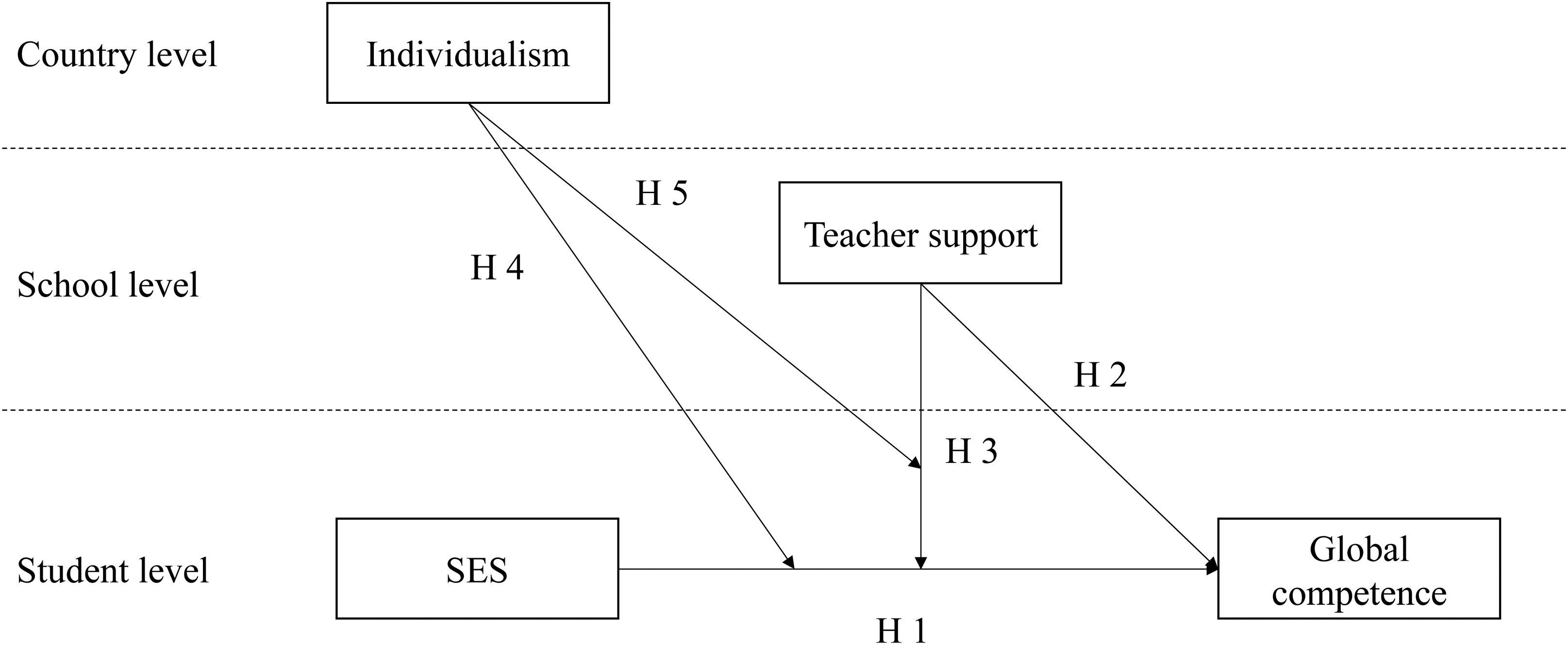
Analytical model.
Moreover, as PISA collects data from samples rather than the whole population, weights associated with the sampling data should be applied to obtain unbiased parameters when analyzing. This study used senate weights to ensure that each country contributes equally when estimating. All weights were rescaled so that they sum up to effective sample size. The missing rate across countries ranges from 0.43% to 31.14%. Missing data were addressed using multiple imputation in SPSS, with all covariates entered into the imputation model. Ten imputed datasets were generated, and parameter estimates were pooled according to Rubin's rules. Regarding the varying sample sizes within each school and our focus on the predicting effect of level 1 variables and the cross-level interaction, the grand mean would result in biased estimation (Heck & Thomas, 2020; Raudenbush & Bryk, 2002). As a result, all level 1 continuous variables were group-mean centered, all level 2 variables were grand-mean centered, and dichotomous variables were left in their natural metric. All data were analyzed using Mplus software (v8.3; Muthén & Muthén, 1998–2017).
Findings
Descriptive Analysis
As presented in Table 1, students in collectivistic cultures scored higher in awareness of global issues (M = 0.14, SD = 1.12) than students in individualistic cultures (M = 0.07, SD = 1.00), students in individualistic cultures scored higher in cognitive flexibility (M = 0.10, SD = 0.99) than students in collectivistic cultures (M = 0.01, SD = 1.04). Students, on average, are 15.81 years old (SD = 0.29), with 49% of them being females. The average SES of immigrant students is lower than their OECD peers (M = −0.17, SD = 1.09). Students in collectivistic cultures (M = −0.21, SD = 1.10), on an average have a lower ESCS than students in individualistic cultures (M = −0.13, SD = 1.07).
Descriptive Statistics and Bivariate Correlations Between Student Level Variables.
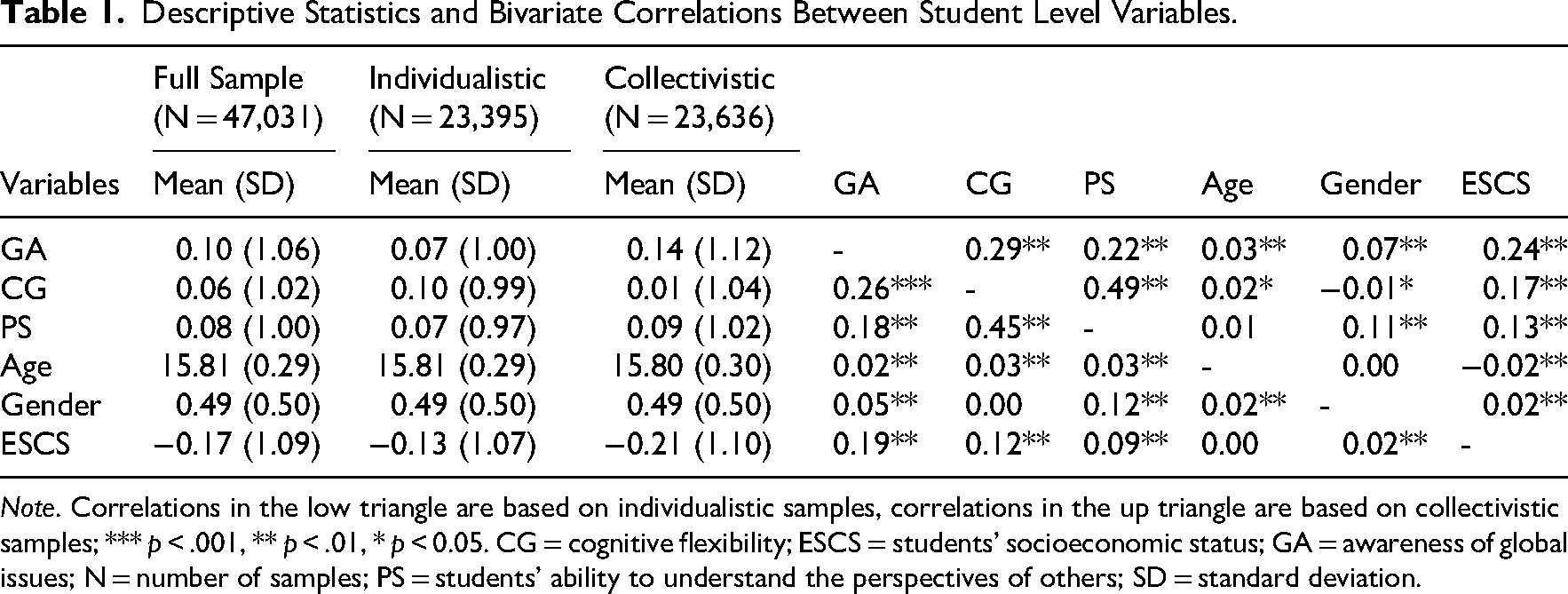
Note. Correlations in the low triangle are based on individualistic samples, correlations in the up triangle are based on collectivistic samples; *** p < .001, ** p < .01, * p < 0.05. CG = cognitive flexibility; ESCS = students’ socioeconomic status; GA = awareness of global issues; N = number of samples; PS = students’ ability to understand the perspectives of others; SD = standard deviation.
Students’ awareness of global issues, cognitive flexibility, and ability to understand the perspectives of others are correlated with each other, with a small to medium correlation ranging from 0.18 to 0.45 in individualistic cultures and from 0.22 to 0.49 in collectivistic cultures. Students’ age is positively correlated with awareness of global issues (r = 0.02, p < .01), cognitive flexibility (r = 0.03, p < .01), and perspective taking (r = 0.03, p < .01) in individualistic cultures. Students’ age is positively correlated with awareness of global issues (r = 0.03, p < .01) and cognitive flexibility (r = 0.02, p < .05), but not with perspective taking (r = 0.01, p > .05) in collectivistic cultures. Female immigrant students scored higher on awareness of global issues and perspective taking in both individualistic and collectivistic cultures, with a small correlation ranging from 0.05 to 0.12. Male immigrant students in collectivistic cultures scored slightly higher than female immigrant students (r = −0.01, p < .05). SES is positively correlated with students’ awareness of global issues, cognitive flexibility, and ability to understand the perspectives of others in both individualistic and collectivistic cultures, with a correlation ranging from 0.09 to 0.24 (ps < .01).
Preliminary Analysis and the Effect of Predictors on Immigrant Students’ Global Competence
Six models were conducted to examine the relationship between predictors of each level and immigrant students’ global competence (awareness of global issues, cognitive flexibility, and perspective taking). As shown in Table 2, in model 1 (null model), the intraclass correlation coefficients (ICC) for students’ awareness of global issues for level 2 is 0.072/(1.022 + 0.072 + 0.028) = 0.064 and is 0.028/(1.022 + 0.072 + 0.028) = 0.025 for level 3. This means that 6.4% of the variance is allocated at school level, and 2.5% of the variance is attributed to the country level. Similarly, the levels 2 and 3 ICCs for students’ cognitive flexibility are 0.021 and 0.029, respectively, and for perspective taking skills, the levels 2 and 3 ICCs are 0.024 and 0.019, respectively. The composition of variance at the school and country levels is not large, however, the data has a nested structure. As the independence assumption would be violated, a multilevel model is necessary to avoid type I error (Heck & Thomas, 2020; Marsh et al., 2012; Nezlek, 2008).
Model Results and Variance Decomposition (GA as Outcome).
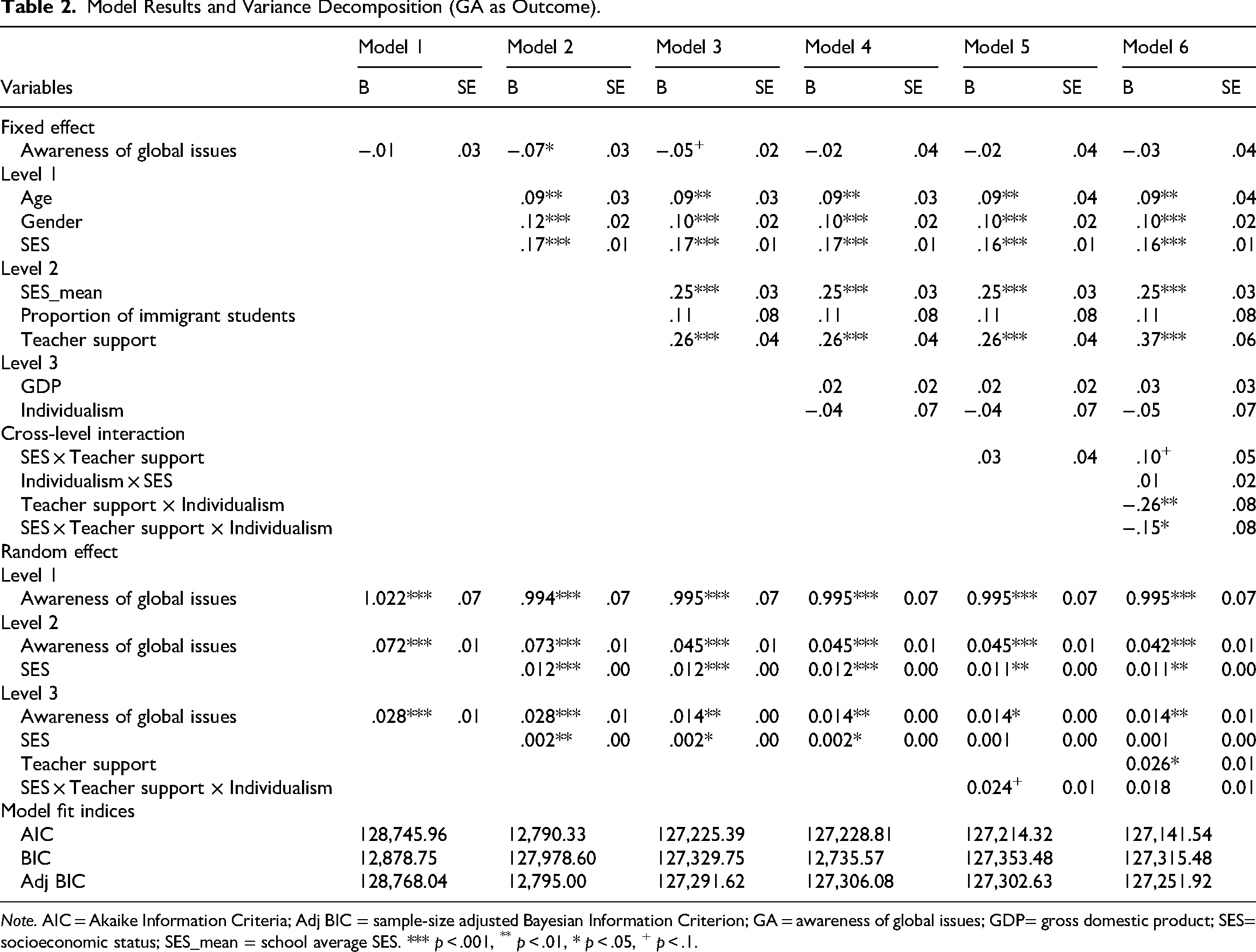
Note. AIC = Akaike Information Criteria; Adj BIC = sample-size adjusted Bayesian Information Criterion; GA = awareness of global issues; GDP= gross domestic product; SES= socioeconomic status; SES_mean = school average SES. *** p < .001, ** p < .01, * p < .05, + p < .1.
The Effect of Predictors on Students’ Awareness Global Issues
In model 2, predictors of student level were specified. As shown in Table 2, students with a one-unit of increment in age are associated with a 0.09 unit increase in awareness of global issues (SE = 0.03, p < .01). Female students scored 0.12 units higher than male students (SE = 0.02, p < .001), a one-unit increase in students’ SES is associated with a 0.17 unit increase in awareness of global issues (SE = 0.01, p < .001). The random effect also shows that about 2.7% of the with-in group variance has been explained.
The output of model 3 in Table 2 indicates that school mean SES is positively related to students’ awareness of global issues (B = 0.25, SE = 0.03, p < .001), students attending a higher SES school tend to score higher than students at lower SES schools. Teacher support is positively associated with students’ awareness of global issues, with a one-unit increase in school-averaged teacher support resulting in a 0.26 unit increase in awareness of global issues (B = 0.26, SE = 0.04, p < .001). No significant association between the proportion of immigrant students and students’ awareness of global issues is found (B = 0.11, SE = 0.08, p = .155). In model 4, country-level variables were added. The results of model 4 in Table 2 illustrate that both GDP (B = 0.02, SE = 0.02) and cultural values (B = −0.04, SE = 0.07) are not significantly associated with students’ awareness of global issues (ps > .05). Table 3 illustrates that 38.4% of the level 2 variance and 50% of the level 3 variance have been explained.
Model Results and Variance Decomposition (CG as Outcome).
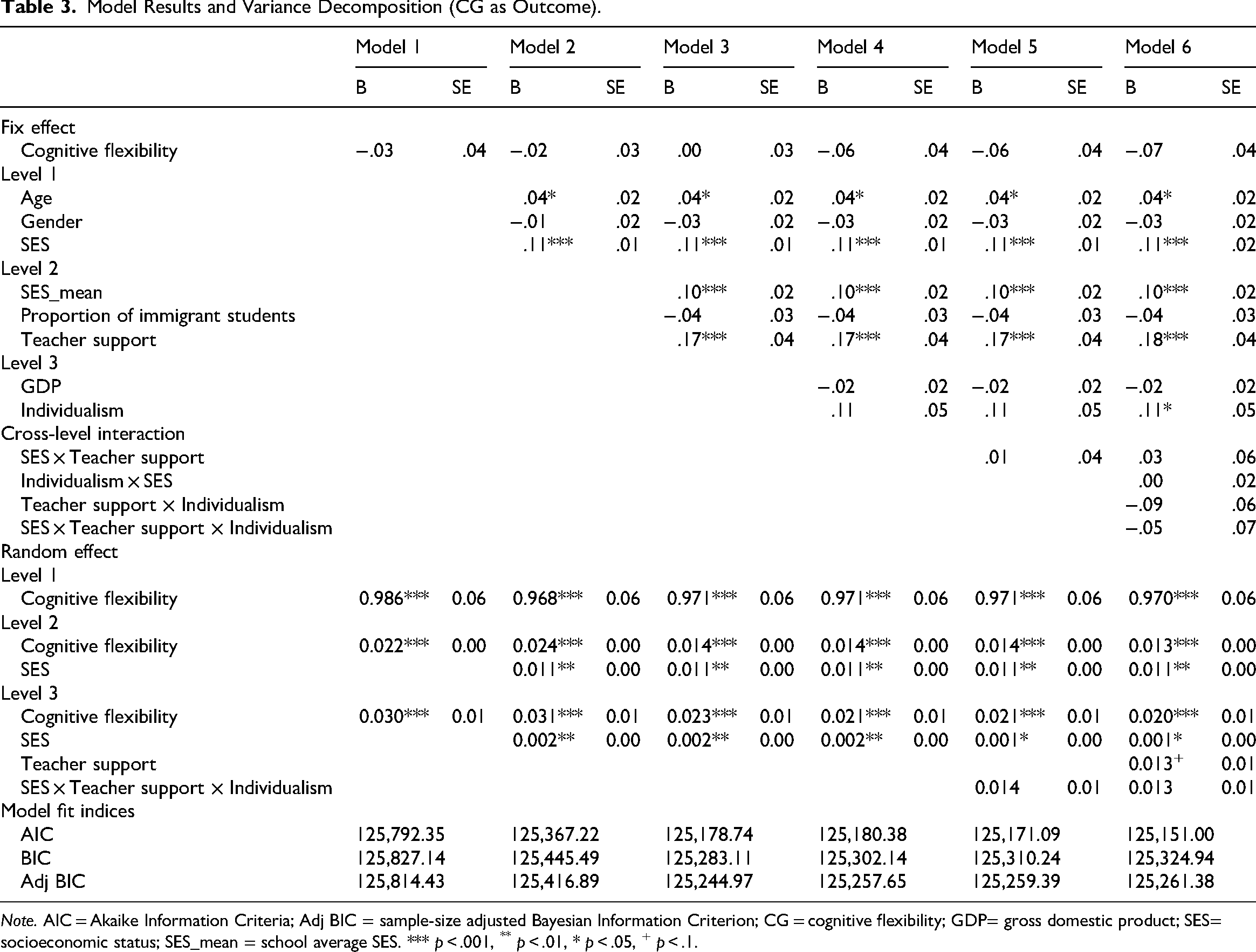
Note. AIC = Akaike Information Criteria; Adj BIC = sample-size adjusted Bayesian Information Criterion; CG = cognitive flexibility; GDP= gross domestic product; SES= socioeconomic status; SES_mean = school average SES. *** p < .001, ** p < .01, * p < .05, + p < .1.
The Effect of Predictors on Students’ Cognitive Flexibility
As shown in model 2 in Table 3, senior students scored higher than younger students (B = 0.04, SE = 0.02, p < .05), students with one-unit higher SES tend to score 0.11 unit increase in cognitive flexibility (SE = 0.01, p < .001). There is no significant difference between female and male students in cognitive flexibility (B = −0.01, SE = 0.02, p = .435). From model 3 in Table 3, the results reveal that school average SES and teacher support are positively related to students’ cognitive flexibility (BSES_m = 0.10, SE = 0.02; BTS = 0.17, SE = 0.40; ps < .001). The proportion of immigrant students does not significantly predict students’ cognitive flexibility (B = −0.04, SE = 0.03, p = .205). In model 4, the output presents that no significant association between GDP, cultural values and students’ cognitive flexibility is found (ps > .05). As displayed in Table 2, level 1 variables accounted for 1.8% of the with-in group variance, level 2 variables accounted for 41.7% of the level 2 variance, and 25.8% of the level 3 variance of awareness of global issues.
The Effect of Predictors on Students’ Perspective Taking
According to the results of model 2 in Table 4, the results illustrate that senior students have a higher score than younger students (B = 0.04, SE = 0.02, p < .05), an increase in SES could result in a 0.07 unit increase in perspective taking skills (SE = 0.01, p < .001). Female students scored 0.21 units higher than male students (SE = 0.03, p < .001). As shown in model 3 in Table 4, school average SES and teacher support are positively associated with students’ perspective taking skills, one unit increase in school average SES or teacher support is accompanied by 0.08 unit and 0.18 unit increase in students’ perspective taking (ps < .001). No significant association is found between the proportion of immigrant students and students’ perspective taking (B = 0.03, SE = 0.03, p = .354). The results of model 4 in Table 4 show that the association between GDP and cultural values is not statistically significant (ps > .05). Results of Table 4 indicate that predictors of three-level accounted for 2.0% of the with-in group variance, 40.9% of the level 2 variance, and 31.6% of the level 3 variance of immigrant students’ perspective taking.
Model Results and Variance Decomposition (PS as Outcome).
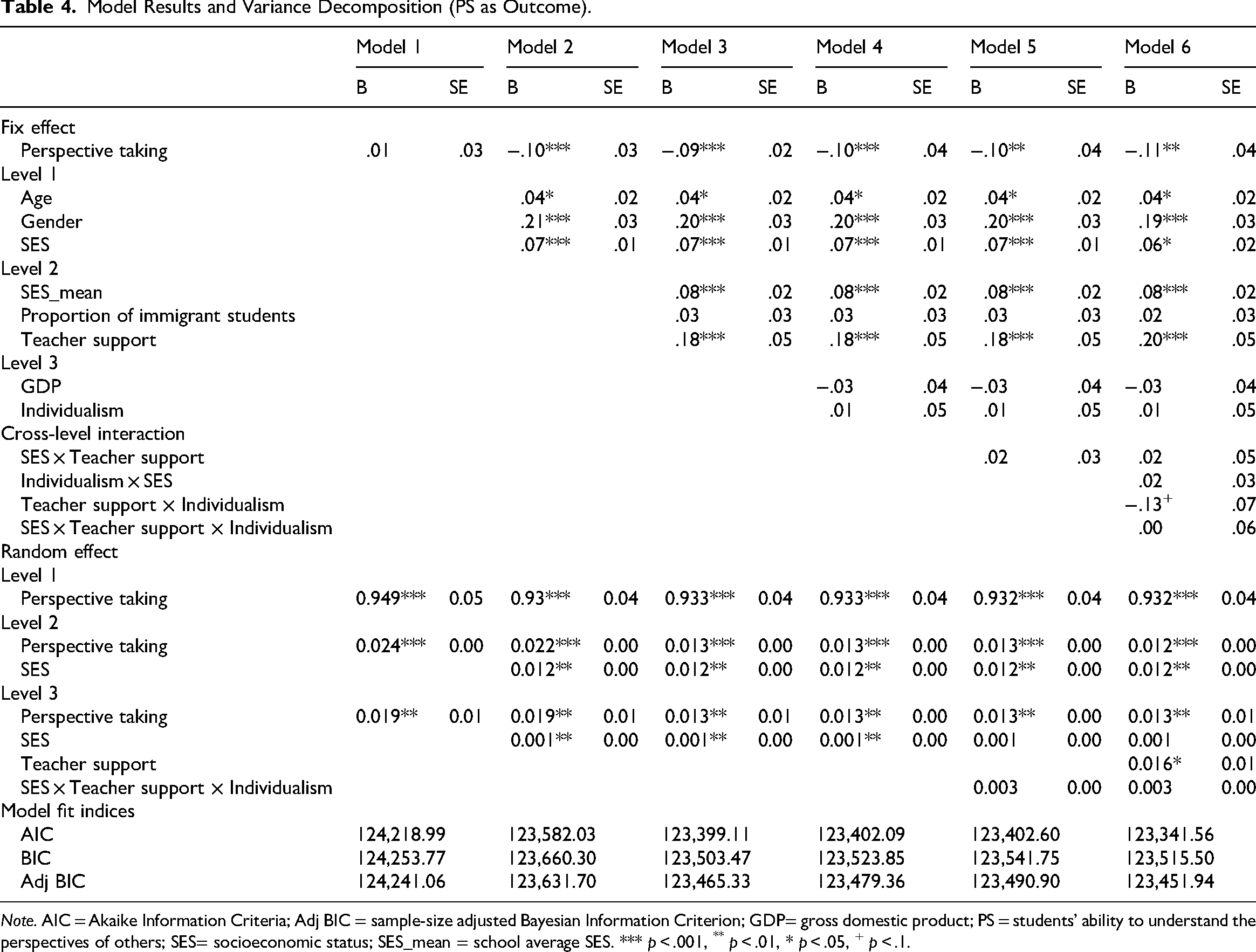
Note. AIC = Akaike Information Criteria; Adj BIC = sample-size adjusted Bayesian Information Criterion; GDP= gross domestic product; PS = students’ ability to understand the perspectives of others; SES= socioeconomic status; SES_mean = school average SES. *** p < .001, ** p < .01, * p < .05, + p < .1.
The Effect of Teacher Support and Cultural Values
Based on model 4, a cross-level interaction term was added in model 5. As shown in Table 2, no significant moderating effect of teacher support on the relationship between SES and students’ awareness of global issues is found (SES × Teacher support, B = 0.03, SE = 0.04, p = .550). However, after specifying the interaction effect of cultural values in model 6, the moderating effect of teacher support is marginally significant (B = 0.10, SE = 0.05, p = .056). The moderating effect of cultural values on the relationship between teacher support and students’ awareness of global issues is significant (Teacher support × Individualism, B = −0.26, SE = 0.08, p < .01), which means the effect of teacher support on students’ awareness of global issues in individualistic cultures is weaker than collectivistic cultures. Moreover, a three-way interaction is significant (SES × Teacher support × Individualism, B = −0.15 SE = 0.08, p < .05), which means that the moderating effect of teacher support on SES–awareness of global issues relationship differs across cultural values. The results indicate that 8.3% of the level 2 variance and 50% of the level 3 variance of the random slope of SES–awareness of global issues relationship has been explained. Cultural values (individualism) account for about 25% of the random slope variance of the moderating effect of teacher support on SES–awareness of global issues relationship.
To illustrate the three-way interaction, a simple slope plot was drawn using the Excel worksheet developed by Dawson (2014). As presented in Figure 3, SES predicts students’ awareness of global issues the least in collectivistic countries with lower teacher support. Students of collectivistic cultures with higher teacher support scored highest. Regardless of family background or cultural values, students with high teacher support scored higher than those with low support. The effect of teacher support is especially strong for high-SES students in collectivistic countries compared to others. Both low- and high-SES students of collectivistic countries benefit more from teacher support than individualistic cultures. In individualistic cultures, high-SES students scored higher in awareness of global issues than low-SES students, and the gap declines as teacher support increases. In collectivistic cultures, the association between SES and awareness of global issues remains positive. However, the gap between students of different SES increases as teacher support grows.
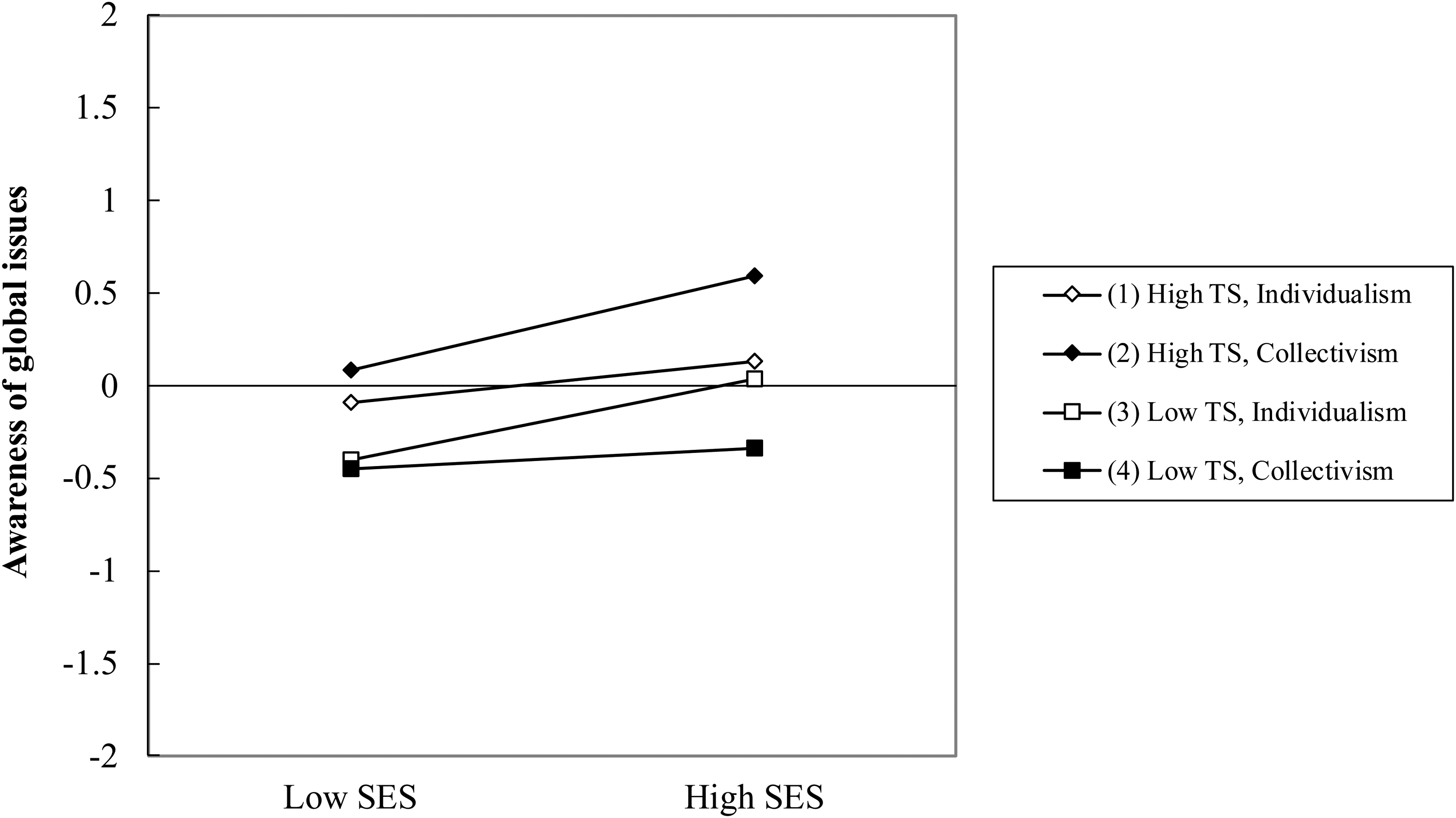
Moderating effect of cultural values and teacher support on the socioeconomic status (SES)—awareness of global issues relationship.
As illustrated in model 5 in Tables 3 and 4, the moderating effect of teacher support on the relationship between students’ SES and cognitive flexibility and perspective taking skills is not statistically significant (ps > .05). The results of model 6 in Tables 3 and 4 also show that there is no statistically significant difference between cultural values in the moderating effect of teacher support (ps > .05). Compared to other models, model 6 has the least AIC (Akaike Information Criteria), BIC (Bayesian Information Criterion), and adjusted BIC, which indicates a better model fit than other models (Lorah, 2018; Raudenbush & Bryk, 2002).
Discussion
Guided by Bronfenbrenner's social-ecological systems theory, this study examines how factors across the micro-, meso-, and macro-levels jointly shape immigrant students’ global competence. Our findings suggest that students’ SES, conceptualized as a microsystem factor within the social-ecological framework, is positively associated with awareness of global issues, cognitive flexibility, and perspective taking skills. Hypothesis 1 is supported. Our findings align with previous studies (Butler & Le, 2018; Schwarzenthal et al., 2017; Solhaug & Kristensen, 2020). From a social-ecological perspective, students’ development is shaped not only by the immediate microsystem but also by the interactions among multiple systems. High-SES immigrant families possess more social and cultural capital that support their children to develop comprehensively. For instance, they are capable and more likely to encourage children to read at home, visit museums (Pong & Landale, 2012), attending nonacademic activities (Ren & Zhang, 2020) that may widen children's horizons, provide opportunities for communicating with others than their low-SES peers. Such efforts may then increase students’ global competence. Similarly, high-SES students often attend high-SES schools with abundant resources and high-quality teachers, constituting another microsystem advantage, whereas low-SES students are more likely to attend schools with limited resources and disciplinary challenges (Rumberger & Palardy, 2005; Tsang et al., 2020). Disparities in social and cultural capital and learning environments stemming from varying family backgrounds may contribute to the disparities in developing global competence among students.
Higher levels of teacher support in school settings are associated with greater awareness of global issues, cognitive flexibility, and perspective taking skills, highlighting the importance of proximal teacher–student interactions within the microsystem. Hypothesis 2 is supported. This is consistent with previous studies (Lee & Ciftci, 2014; Nakhaie et al., 2022; Yoo, 2021). Within the social-ecological systems framework, teacher support represents a key microsystem resource that can directly influence students’ development and interact with other systems to shape outcomes. Drawing on self-determination theory, teacher support can satisfy students’ basic psychological needs, motivate and engage students in classes (Deci & Ryan, 2000). For immigrant students, such support may reduce anxiety in using a foreign language, foster peer connections, and improve language fluency (Jin et al., 2017). It can also bolster self-efficacy (Lee & Ciftci, 2014), persistence (Nakhaie et al., 2022), and reduce their perceptions of difficulty (OECD, 2019a, p. 203) so that they cultivate their global competence. Moreover, teacher support may also help refine students’ acculturation strategies (Yoo, 2021), coping skills (Hoferichter et al., 2022), increase empathy and open-mindedness (Lee & Ciftci, 2014), and reduce intercultural competence concerns (Yeh et al., 2008), which then increase intercultural skills and attitudes.
Beyond the direct effects, our results reveal a significant moderating effect of teacher support on the relationship between SES and awareness of global issues, highlighting a mesosystem process through which school-based support shapes SES-related disparities. In contrast, the moderating effects of teacher support on the relationships between SES and cognitive flexibility, as well as between SES and perspective taking skills, were not statistically significant. Taken together, these findings provide partial support for Hypothesis 3. Specifically, teacher support appears to widen the gap between immigrant students from different family backgrounds. High-SES students benefit more from school-based support, in part because they are more likely to attend high-SES schools with abundant learning resources and highly qualified teachers (Rumberger & Palardy, 2005). Teachers in these schools may offer more global learning opportunities (Tsang et al., 2020), provide frequent feedback (Ma et al., 2022), and hold high achievement expectations toward immigrant students than teachers in low-SES schools. In addition, high-SES students may be more likely to express their needs and seek help when facing challenges in adapting to new cultures (Calarco, 2011; Nelson & Schutz, 2007), whereas lower-SES students often address problems independently and remain silent about their personal needs (Calarco, 2011). These microsystem and mesosystem interactions collectively contribute to the enlarged gap in awareness of global issues between high- and low-SES immigrant students. Importantly, this finding does not contradict the overall positive effect of teacher support but emphasizes how the benefits of microsystem resources can be distributed unequally depending on family background. The nonsignificant moderating effects of teacher support on SES—cognitive flexibility and SES—perspective taking skills may reflect the relative stability of these skills and attitudes, which are less malleable than knowledge-based outcomes.
The relationship between SES and immigrant students’ global competence, including intercultural knowledge, skills, and attitudes does not vary across cultures. Hypothesis 4 is not supported. The moderating effect of teacher support on the relationship between SES and awareness of global issues varies across collectivistic and individualistic cultures, suggesting that macrosystem-level cultural values condition how teacher support shapes SES-related disparities, whereas no such moderation is observed for cognitive flexibility or perspective taking skills. Hypothesis 5 is therefore partially supported. Our results reveal that low-SES immigrant students in individualistic students benefit more than their high-SES peers from teacher support. In other words, in individualistic cultures, teacher support could reduce the gap in immigrant students’ awareness of global issues. This may be because high-SES immigrant students initially scored higher due to their advantaged family backgrounds. They have more resources and opportunities to enlarge their knowledge of global issues and are more willing to ask teachers for support (Nelson & Schutz, 2007; Tsang et al., 2020). Relatively, the effect of extra teacher support appears to be not as strong. However, family background plays a stint role in low-SES immigrant students asking for support though the individualistic norms encourage individuals to speak out about their needs. Low-SES students were left behind at first and the compensatory effect of teacher support appears to be more significant.
In collectivistic cultural contexts, however, high-SES immigrant students benefit more from teacher support than their low-SES peers, resulting in a widening gap in awareness of global issues as teacher support increases. This pattern can be understood by considering the combined influence of social psychological norms and classroom- and school-level conditions. From a social psychological perspective, collectivistic cultures tend to emphasize social harmony and discourage behaviors that may be perceived as burdening others or disrupting group norms (Yeh et al., 2008). Under such norms, students from disadvantaged backgrounds may be less likely to explicitly express their needs or actively seek help from teachers, even when support is available. In contrast, high-SES immigrant students often possess greater cultural capital and communicative confidence, enabling them to engage more actively with teachers and make more effective use of available support (Calarco, 2011). Moreover, teacher support is also embedded within unequal distributions of instructional resources and learning opportunities across schools. High-SES schools are more likely to offer global learning opportunities and provide richer instructional feedback, which may further amplify the benefits of teacher support for high-SES immigrant students (Ma et al., 2022; Tsang et al., 2020). In such contexts, teacher support may unintentionally align with existing advantages rather than function as a compensatory mechanism for disadvantaged students. Together, these findings suggest that teacher support, as a microsystem factor, does not operate as a uniform equalizing force across cultural macrosystems. Instead, its influence on SES-related disparities in global competence is shaped by culturally embedded interaction norms and institutional practices.
Policy and Practical Implications
Based on the findings and discussion above, this study also provides some policy and practical implications. First, our results found that high-SES students scored higher in global competence. This underscores the need to address the developmental disparities arising from SES differences. Without appropriate intervention and support, low-SES immigrant students may face challenges in developing global competence and adapting to host cultures. Thus, schools and educational systems should be cognizant of the potential impact of SES differences and provide extra resources and free courses to help bridge the gap and ensure equity.
Second, our results show that high levels of teacher support are positively associated with immigrant students’ global competence. This finding is relevant to both individualistic and collectivistic cultures and for both low- and high-SES immigrant students. This underscores the critical role of teachers in supporting immigrant students in developing global competence and adapting to new cultures. As the acculturation quality in the host culture is contingent upon their ability to cope appropriately and effectively with stresses associated with cultural adaptation (Kuo, 2014). Therefore, schools and educational systems should provide professional programs to equip teachers with abundant knowledge of global competence and pedagogical beliefs to support immigrant students better.
Third, the findings reveal that the role of teacher support differs across cultural contexts, with contrasting implications for SES-related disparities. In collectivistic cultures, teacher support may inadvertently widen the global competence gap between high- and low-SES immigrant students. To address this challenge, teachers can foster a climate of trust by adopting proactive and culturally sensitive strategies, such as providing individualized feedback, normalizing help-seeking as a routine and expected part of classroom practice, and offering support through informal or private interactions rather than public requests. Creating structured opportunities for supportive, low-stakes teacher–student interaction may reduce students’ hesitation to voice their needs and enhance engagement among low-SES immigrant students. In contrast, in individualistic cultures, where low-SES immigrant students appear to benefit more from teacher support, targeted and sustained instructional support, including structured scaffolding and institutionalized access to teacher assistance, is especially important for narrowing SES-related gaps in global competence.
Limitations and Future Research Directions
First, the analytical sample was restricted to immigrant students, resulting in unequal sample sizes across schools and countries, with some being relatively small. Although the number of higher-level units is generally more important than equal group sizes, and group-mean aggregation was applied as recommended (Raudenbush & Bryk, 2002), such imbalance, particularly the small number of countries, may still affect the stability and precision of the estimates. Future research could address this issue by using larger and more balanced samples or by applying alternative approaches such as Bayesian multilevel modeling.
Second, several key constructs were operationalized using proxy measures derived from large-scale assessment data. In particular, teacher support was conceptualized as teachers’ stimulation of reading engagement, capturing instructional practices that promote students’ academic engagement rather than the full range of teacher support dimensions. Other aspects of teacher support, such as emotional support and feedback, were not examined and may operate through different mechanisms. Similarly, students’ awareness of global issues, cognitive flexibility, and perspective taking were used as proxies for knowledge, attitudes, and skills, and national cultural values were represented using Hofstede's individualism index. Although widely used in cross-national research to capture broad cultural orientations, this index necessarily simplifies within-country cultural heterogeneity and reduces complex cultural value systems to a single dominant dimension. While these operationalizations are theoretically grounded and commonly adopted in cross-national research, they do not fully capture the multidimensional nature of the underlying constructs. Future studies could employ more comprehensive or multi-informant measures to address this limitation (e.g., Schwartz, 1999).
Third, our data is extracted from PISA 2018 database, and the teacher support variable was aggregated at school level based on students’ self-reported scores of their language-of-instruction teachers. Social desirability and cross-cultural differences in self-evaluation (e.g., modesty norms in collectivist contexts) may affect the comparability of responses across countries. Therefore, the findings should be interpreted with appropriate caution. Future studies could integrate self-reports with performance-based measures and external evaluations, as well as examine teacher support across different subject domains, to provide a more comprehensive understanding of its impact. Finally, we only utilized cross-sectional data, which means that we cannot infer causal conclusions in this study. Future studies can employ randomized control treatment group design or other kinds of empirical studies to investigate potential causal mechanism.
Conclusions
The increasingly large share of students among international immigrants presents a significant challenge for host educational systems and teachers. This need for cultivating immigrant students’ global competence to help them adapt to host cultures and cope with acculturation difficulties increases correspondingly. This study employed a three-level multilevel model to examine the effect of SES and teacher support on global competence and the moderating effect of teacher support and cultural values, using a sample of 47,031 15-year-old immigrant students. The findings indicate that SES is positively associated with students’ awareness of global issues, cognitive flexibility, and perspective taking skills and that the effect of SES does not vary across cultures. The moderating effect of teacher support is only significant in the relationship between SES and awareness of global issues, and this effect varies across cultures. Specifically, in collectivistic cultures, teacher support can amplify the gap in awareness of global issues, while in individualistic cultures, teacher support can reduce the gap. Based on these findings, we suggest schools and teachers pay more attention to low-SES immigrant students’ intercultural development, provide more compensated and free courses to disadvantaged students, and offer more professional development programs to equip teachers with relevant knowledge and pedagogical beliefs to support students efficiently. Furthermore, teachers could create a climate of trust and encourage low-SES students in collectivistic cultures to speak out about their needs to narrow the developmental gap. However, due to the complex relationship between SES, teacher support, cultural values, and immigrant students’ global competence, further studies employing quantitative, qualitative, and empirical methods are needed.
Footnotes
Acknowledgments
We sincerely appreciate the reviewers and editors commenting on our manuscripts of this article.

Ethical Considerations
Ethical approval was not required for this study since no empirical studies were conducted, and no human data or participants were involved.
Author Contributions
Qinhui Huang: Conceptualization, Data curation, Formal analysis, Original draft writing, Revising.
Yixin Li: Data curation, Formal analysis, Original writing, Revising.
Alan C.K. Cheung: Conceptualization, Supervision.
Funding
The authors disclosed receipt of the following financial support for the research, authorship, and/or publication of this article: This research was supported by the “Fundamental and Interdisciplinary Disciplines Breakthrough Plan of the Ministry of Education of China (JYB2025XDXM902)” and the “Fundamental Research Funds for the Central Universities” (1253100003).
Declaration of Conflicting Interests
The authors declared no potential conflicts of interest with respect to the research, authorship, and/or publication of this article.
Appendix
Student level (level 1):
School level (level 2):
Country level (level 3):
Among above equations, Global competenceijk indicates the global competence of student i in school j in country k, πpjk, βpqk, and γpqk are intercepts (p, q, k = 0, 1, 2, …), ɛijk, µ0jk, µ1jk, and νpqk (p, q = 0, 1, 2, …) are residual or variance.