



Abstract
In the context of increasing mental health challenges in the workplace—marked by feelings of depression, anxiety and loneliness—this article explores the evolution of the employee value proposition (EVP) through the lens of fostering hope. The article highlights that positive employee sentiment, driven by a well-structured EVP, correlates with higher productivity, strategic re-imagination, enhanced customer commitment and increased shareholder confidence. Building on historical frameworks, the authors propose a new wave of EVP focused on hope, supported by five key principles: aspiration, efficacy/optimism, inventiveness, learning and role modelling. These principles are shown to be effective at both personal and organisational levels, offering a blueprint for HR professionals and leaders to cultivate hope within the workplace. The proposed framework suggests that instilling hope can significantly improve employee attitudes and organisational outcomes, making it a crucial element of modern EVP strategies.
Data and experience suggest that many people face increasing mental health challenges: depressed about the past, anxious about the uncertain future and lonely in the present (Mental Health America, n.d.). These general mental health challenges show up at work, causing business and HR leaders to rethink how to build an employee value proposition (EVP) that improves employee attitude at work. When employees have a positive value proposition as indicated by their sentiment, they are more productive, able to reimagine strategies, increase customer commitment and ensure that shareholders have more confidence in the future (Agyeiwaah et al., 2021; Martin, 2023; McKinsey & Company, 2024; Ulrich, 2022b).
Creating a positive employee attitude and embedding it in a value proposition has a compelling history, as summarised in Figure 1. Each wave of defining sentiment builds on the previous wave, as illustrated with an example of the relationship between an employee and boss in the figure. ‘Boss’ could be replaced by a host of factors that drive sentiment (culture, team, work conditions, rewards/recognition and policies). By sharing this evolution of employee sentiment, we acknowledge and affirm previous work on this important topic.
Waves of Employee Sentiment That Deliver an Employee Value Proposition.

We believe that the general mental health challenges and changing work settings encourage HR professionals and leaders to add the approach of hope to an EVP. We propose that hope evolves the EVP and offers a blueprint of five principles that can increase employee hope.
Why Hope and What It Means
Rather than repackage a definition of hope, let us suggest timeless definitions that capture the essence of hope.
Hope is a waking dream.—Aristotle I hope that I may always desire more than I can accomplish.—Michelangelo And patience [worketh] experience; and experience, hope.—Apostle Paul Hope is being able to see that there is light despite all of the darkness.—Desmond Tutu Learn from yesterday, live for today, hope for tomorrow. The important thing is not to stop questioning.—Albert Einstein Hope is that thing inside us that insists, despite all evidence to the contrary, that something better awaits us if we have the courage to reach for it, and to work for it, and to fight for it. Hope is the belief that destiny will not be written for us, but by us.—Barack Obama
To respond to the emotional challenges of our day, Martin Seligman, the father of positive psychology, has articulated how to replace learned helplessness with intentional hopefulness by highlighting efficacy, optimism and inventiveness (Maier & Seligman, 1976). Research suggests that individuals with hope have higher individual performance and produce better organisational outcomes—so hope is an essential element of an EVP (Ozyilmaz, 2020). Even more, hopefulness can be learned and grown and leaders and HR can, and increasingly must, foster hope in the workplace (Tomasulo & Kaufman, 2021).
A Blueprint of Hope with Five Principles
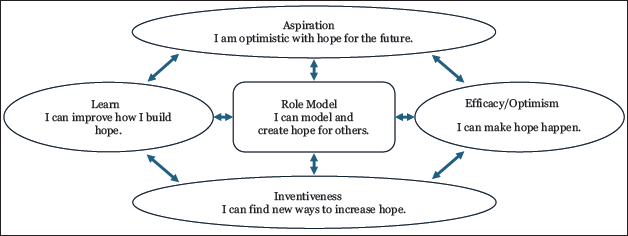
If hope matters in overcoming emotional funk and producing positive outcomes, we progress by recognising principles for creating hope. We propose a blueprint for hope with five principles (Ulrich, 2018). Each of these five principles applies at both individual (personal) and organisational (institutional) hope to make it part of an evolving EVP (see Figure 2).
Blueprint for Hope as Part of an Employee Value Proposition.
Aspiration
Engendering hope begins with focusing forward and aspiring for a better future. Aspiration requires ambition to make a difference, a vision that inspires, and actions to bring it about. Aspiration is a personal mindset that an envisioned future can be created and shaped in ways that are meaningful for the employee. Aspiration means that employees willingly invest in and pay the price for a better future when they recognise that personal goals meld with organisation goals.
Fostering personal hope comes from within. Aspiration is not simply a ‘fake it until you make it’ mindset. Personal aspiration comes when individuals become very clear about what matters most to them based on their values, strengths and desired outcomes. It takes work to refine personal aspirations, but when aspirations are clear to oneself, they more often instil hope in others. It is incumbent on leaders—formal and informal—to task themselves to develop their own aspirations and share it if they expect employees to join in paying the price for that better future. The role of HR in fostering hope is, in our experience, often coaching leaders in sharing their envisioned future in practical and relevant ways.
Fostering organisation hope comes from having a clear sense of the organisation purpose, vision, mission, strategy, goals or direction. While we could parse these concepts, they weave together around an aspiration or a sense of what the future offers for an organisation. Research shows that purpose-driven organisations produce positive outcomes for all stakeholders (Harvard Business Review Analytics Services, n.d.). Hope envisions a positive future that can fold future opportunities into daily actions.
The aspiration of hope gives employees confidence in a meaningful future.
Efficacy/Optimism
Efficacy means that effort will lead to desired outcomes. Historically, this has been called expectancy theory where effort leads to performance that leads to outcomes (Heneman & Schwab, 1972; Vroom, 1964). Efficacy requires interactional awareness to increase the link between aspiration and action (Altizer, 2021). Efficacy leads to pragmatic optimism when employees recognise requirements to reach aspirations and believe that they are able to meet these requirements (Ulrich, 2024b). When leaders are optimistic, they inspire and engage others, build trust, engender collaboration and ensure progress. Efficacy and optimism lead to resilience and the ability to keep going even when things are hard and might go wrong.
For individual employees, leaders foster optimism through a constant balancing act that requires accurate self-perception of their own thoughts and feelings, of how others are reacting to their words and behaviours, and the ability to adjust themselves to others’ reactions—in the moment. Pragmatic optimism requires that employees know and feel that the leader is pushing for optimal, sustainable performance and is plugged into both the potential and the challenges to that performance. The role of HR is often to provide leaders with data and insights into employee perceptions, particularly when the going has gotten tough.
Organisational efficacy comes when aspirations translate into metrics that have positive impact because employees believe that with dedicated effort, they can accomplish the organisation goals. While not easy to create or implement performance metrics, they are critical to ensuring efficacy and optimism (‘I can do it!’). In organisations, this work shows up in key performance indicators or outcome-key-result efforts that increase hope by tracking measures (Chandler, 2016).
The efficacy/optimism of hope gives employees conviction that they know how to and can achieve their aspirations.
Inventiveness
Inventiveness instils hope by discovering new ways to accomplish tasks. Old patterns or habits may be replaced with new actions. Being curious, imagining what’s possible, inventing new ways to do things and experimenting all build a hope mindset with expanded options and opportunities. An inventiveness mindset strengthens decision-making, problem-identification and risk-taking skills.
While inventiveness (also known as openness, curiosity or innovation) is rooted in personality, it can be developed and nurtured for those who find it less natural and tamed and directed for those who have it in abundance (Drenth, n.d.). Less-inventive leaders often unintentionally quash it in their employees while highly inventive leaders often frustrate employees with constant change and redirection. The role of HR is often to provide leaders the tools needed for leaders to self-assess and provide feedback on the impact they are having on others. Inventiveness encourages people to have hope because they continue to ask questions, experiment and be resilient.
Organisations also have the capacity to be more or less inventive by encouraging innovation. Innovation comes in part from innovative leaders but also management practices that encourage risk-taking, discovering new ideas, rewarding creative thinking and organising units for innovative action. Organisational innovation fosters hope because the culture is more focused on ‘what’s next’ than what has been.
The inventiveness of hope encourages employees to create, innovate, imagine and experiment to keep moving forward.
Learn
Learning instils hope when failure is seen as an opportunity to improve. Hope comes from learning by focusing on what is right more than what is wrong, being resilient when things do not go well, and continuously improving.
A valuable enabler of personal learning is developing a growth mindset. We were teaching a group of executives about growth mindset and one asked: are you born with a growth mindset or can you develop it? That is the entire premise of growth mindset where failure is an opportunity to improve that leaders can develop in themselves and others. Learning requires accountability so that both successes and failures provide employees for employees to have hope by focusing on what’s next.
Organisation learning comes by creating a learning agility approach to doing work. We define learning agility as the ability both generate and generalise ideas with impact. Organisations can generate new ideas by benchmarking, experimenting, continuous improvement, competence and acquisition. They can generalise ideas across boundaries of time, geography and business. When they do so, the organisation culture of learning encourages hope.
The learning of hope comes from constantly observing, challenging and learning from all experiences.
Role Model
At the centre of our hope blueprint are leaders who model hope and take care of themselves—so they can take care of others (Ulrich, 2022a). We have all experienced aspirational, optimistic, inventive and learning-oriented leaders who lead by example and who inspire followers. Employees leave interactions with these leaders feeling better about themselves and empowered with more hope to be able to take on new challenges.
In this article, we have posited a role of HR to coach leaders and provide feedback. It is also, and perhaps even more, valuable for HR to help leaders become self-coaching (Ulrich, 2024a).
Individual hope can be encouraged by others and reinforced through HR practices, but it ultimately is a matter of personal choice. Leaders can be challenged to face their assumptions about hope versus fear; optimism versus pessimism and inventiveness versus consistency. When people self-monitor and self-coach, they become examples of delivering hope.
Organisation hope also increases with disciplined diagnosis to make hope a serious element of creating value through strategy reinvention, customer connection, investor confidence and community reputation. When HR professionals can instil hope that these stakeholders will get their needs met, they create enormous value.
Leaders who model hope in their attitudes, words, and actions engender employees that instil hope throughout their organisation.
Implications
In a world of mental health challenges, organisations can be settings for positive sentiment that becomes an EVP. We suggest that hope builds on legacy employee satisfaction, commitment, engagement and experience ideas. When hope becomes part of the EVP, positive outcomes follow. The five principles, with both individual and organisational implications, in our hope blueprint offer some specific ways to engender hope through an evolving EVP.
Footnotes
Declaration of Conflicting Interests
The authors declared no potential conflicts of interest with respect to the research, authorship and/or publication of this article.
Funding
The authors received no financial support for the research, authorship and/or publication of this article.