



Abstract
The COVID-19 pandemic has caused a great ‘reset’ and has challenged many assumptions about work and life in general. Several virtual management practices emerged during the Covid period to solve problems of organisation building and to address concerns about connecting with the people of the organisation and maintaining the culture. Since women are at the forefront of everything today, it is important to focus on the future of global work from a woman’s perspective in the context of multinational enterprises (MNEs).
We take a phenomenon-based approach to describe the important trends and challenges affecting the where, who, how and why of global work from a woman’s perspective. This study aims to understand the relevance of these learnings in the current scenario and in the future by compiling best practices that IT organisations in India used to build ‘Social Capital and Organization Culture’ and define the future of work in the process. For this purpose, we collaborated with NASSCOM and studied nine participating organisations as separate cases. We interviewed HR and business leaders to compile best practices that might define the future of work by answering three broad questions—how to build and maintain networks and relationships, how to build and maintain culture and engagement and, finally, how to integrate new joiners. As we highlight implications for organisations and individuals, we offer a set of four findings to guide future research and inform IHRM practitioners, especially women. This article interconnectedly talks about women at work.
Introduction
The severity of the Covid period that lasted until the end of last year has also been a time of great discoveries and learning about the science of virtual management practices. Many of these practices developed out of necessity as organisations needed to find newer ways to connect with people and maintain their organisational culture. In an increasingly digitised world, as multimodal functionalities have been rising, organisations have been looking forward to building social capital or culture virtually and through in-person interactions, especially because social capital is known to be an important determinant of well-being (Hommerich et al., 2022). Hence, it is important that learnings offered by these virtual management practices are put to good use by collating and upholding this for future consumption. With technology influencing employment patterns by enabling remote work and flexible arrangements (Daher & Ziade, 2024), things only get more complex.
Contemporary leadership emphasises inclusivity and distributed leadership, but women leaders often find the work–life balance more challenging than men (Jacob & Chandrasekhar, 2021, p. 260). While research favours organisational support to women for achieving work–life balance for competent women managers advancing to leadership positions (Jacob & Chandrasekhar, 2021), it also suggests that not enough is being done yet. A September 2024 McKinsey report on women at work, while talking of women’s representation and experiences in the workplace, analyses that while there has been progress, there has been stagnation too, and that the progress that has been there has been extremely fragile. Hence, organisations need to chart real progress on the path to parity (Krivkovich et al., 2024). It is thus only timely and vital that we collate the best practices for building a more resilient work culture riding on social capital, especially for women, and understand the future of work from the perspective of women.
While talking about social capital and the future of work, we define the future of work as ‘a result of many forces of change affecting three deeply connected dimensions of an organization—work (the what), the workforce (the who) and the workplace (the where)’ (Schwartz et al., 2019, p. 2). We further define social capital as ‘a resource comprised of the benefits of social connections and relationships’ (Conrad, 2007, p. 2).
This article is intended to compile practices that NASSCOM member IT organisations in India use to build ‘Social Capital and Organization Culture’ by answering these three research questions:
RQ1: How to build new relationships or maintain existing networks and relationships virtually?
RQ2: How to build and maintain organisational culture and engagement?
RQ3: How to enculture and engage new joiners?
Methodology
To address three primary research questions to understand if the future of work is multimodal, we designed a research methodology that would address existing uncertainties and pave the way for a more context-rich understanding of the topic. This study was undertaken jointly with NASSCOM, to bring together the world of practice and academic thinking around management. A case study method, based on several sources of data and evidence, used for exploratory purposes is one of the best empirical methods to investigate a contemporary phenomenon within the realm of real-life context. It is especially useful when clearly identifying a boundary between the phenomenon and context becomes implausible (Yin, 2009). Hence, to garner diverse perspectives on the future of work, NASSCOM and MDI jointly converged the best from the world of practice and the academic aspect of management by inviting C-Suite perspectives and weaving together research that would declare the best practices in the industry for ages to come. Nine organisations accepted the invitation. The size of these organisations varied from about 5,000 members to over 400,000 members. This constituted the population. HR and business leaders from these organisations, eight of whom were women accepted our call to participate and we studied them as separate cases. Eisenhardt (2021) opines, multi-case studies may use interviews and archival data. She adds that this choice is not inherent to the method but reflects decisions about the best data to collect given factors like the research question and data availability. Based on this justification, the women respondents were interviewed and the interviews were treated as separate cases. The interviews were conducted virtually, based on a structured interview protocol 1 and using a semi-structured questionnaire. Within the structured interview protocol, the discussion was free-flowing, and there was a greater focus on the practices that the HR or business leader themselves found effective from within their organisation.
The interview recordings were later transcribed, analysed and codified under various themes and lessons for virtual management. Further, to triangulate findings, a focused group discussion was held in the form of a roundtable conducted jointly by NASSCOM–MDI to gather feedback from these business leaders.
The two areas of focus of this study were practices that enabled building social capital (the strength and vibrance of relationships within the organisation) and practices that developed organisational culture (the shared understanding of what we value and how we live those values) every day.
The results from the roundtable and anecdotal conversations with business leaders confirmed these concern areas and hence, these were selected for special focus. In this study, we investigate each of the themes further, drawing on the results of our analyses that inform the discussion.
Findings
The rich data collected from the interviews and the focus group discussions were analysed thoroughly to come up with virtual management practices in response to the actual problems faced by leaders in getting work delivered and keeping the workforce connected. A few of these practices existed pre-Covid and were intensified as organisations turned virtual. Several others were created during this time. Several of these practices, while successful at the time, maybe underappreciated as legitimate management practices to be integrated into the post-Covid workplace. Some of this hesitation comes from the prevailing view that a return to office is essential to organisation’s success. These practices were then compiled and classified by which problem they solved and how did they do so. For some of the larger issues, multiple successful solutions were found. These together provide a multi-pronged approach to organisation building.
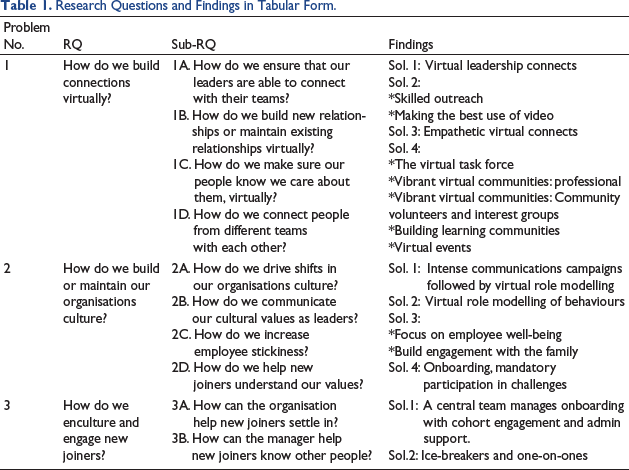
In order to answer the research questions, we broke down each research question into multiple sub-questions and asked questions along those lines.
For example, to find out how we build connections virtually, we broke down the question into four sub-questions as under:
How do we ensure that our leaders are able to connect with their teams? How do we build new relationships or maintain existing relationships virtually? How do we make sure our people know we care about them, virtually? How do we connect people from different teams with each other?
To answer the first sub-question, the vice president and APAC HR Head of one of the multinational IT organisations, said:
…every Tuesday I have my HR cabinet, I ensure that not only my DRs but my extended COA team should come and we sit in a conference room because the discussions are the constructive debates we have. I think you close a lot of productive actionable steps. Not that we don’t do it virtually but it really helps us to put our best foot forward. It really helps. (sic)
While talking about building new relationships or maintaining existing relationships virtually, she shared:
We have a global webcast where we share the global CEO CHRO CFO all the CXOS they shared the strategic plan and priorities business, priorities for FY 2023. So in a pack, we wanted to become a little innovative and creative this time to really touch the core of the employees because almost 90% of the employees joined this annual toast to understand what their leaders are speaking.
Thus, this helped build trust and, hence, improved the social capital.
While talking about people from different teams connecting with each other to build social capital through bridges, she said:
So we have been divided into groups of four and five for a case study. So if you ask me, I have networked with three people besides me from France and two from the US, one from Washington, and one from Texas. So, they became my friends from the different BUs.
While exploring the enculturing and engaging new joiners’ bit, this is what she had to say:
We are right now, doing a POC for a metaverse framework again. The metaverse framework has currently been tested for member onboarding, kind of requirement. And this is to create a simulated or a gamified kind of a persona-based environment for members to come in and they can actually in the metaverse, walk into an office, get to see the facilities and. So so, that’s how it works. (sic)
Likewise, the global head, HR of another software company, while talking about the challenges faced, said:
Though the productivity and all of that was uh not a challenge but we did see that you know, the social interactions, okay, or like say, humans by nature they are supposed to interact socially, okay, that is how our breed is you can say. So we realized that social interaction wasn’t happening, the creativity, the initiative, the satisfaction. You know that networking, collaboration, something somewhere all that was getting diluted.
When asked to take us through the ways new or existing relationships were being maintained, an HR leader said:
We decided that okay, we’ll you know, we did some kind of benchmarking with other IT companies and spoke to our leaders to understand what they are doing. And we realized that if you are kind of doing a soft launch then you may not be fair to all employees because there may be some who are coming to office and there may be some who are not coming to office, you know and they may not even come. So that is why we took, we came up with this guideline where we said that we will have employees working on a hybrid mode which is three days work from office and two days work from home. But again, we did not want to call everybody, go all-out and get everybody on the same day because it would have been very chaotic. (sic)
Another example of hyper personalisation, to touch the core of employees, was very nicely shared by one of the APAC heads. She said:
So in a pack, we wanted to become little innovative and creative this time to really touch the core of the employees because almost 90% of the employees joined this annual toast to understand what their leaders are speaking. So all the leaders went to a studio and was it was a live presentation where we wanted to give that feel of personalization that yes the employees or members are sitting here, and the leaders are talking and we went little overboard. And this is a best practice, I am sharing with you that we connected the face. That somebody is coming and comparing like the way we do in Oscars and all, the entire RNR session. So in this world of hybrid, in this world of virtual, how much creative and hyper personalization, we all can do.
Talking about new joiners, she said:
when we had employees returning to office, there was a welcome committee which was formed because for lot of employees, it was a first time they were even entering into a campus. So there were a lot of mails which were sent to them, FAQs, uh you know, obviously their access cards and you know, I-cards, their welcome kits. We were not able to give to everybody so we ensured that all of that was ready. You know, they had seats to uh where they have to go, who’s their project, what is their manager. So, this was all handed by our systems and the entire return to office was handled digitally.
While the researchers voiced their concern for the impact of the increasingly digital workspace, an APAC Lead of the HR team commented:
Our leadership aims to create ‘REAL’ experiences for our people, empowering them and allowing them to thrive. While technology, for us, is an enabler, moments of truth for our associates are still human. Our leaders go all-out to keep the strength and morale of teams high even when they are physically distant but digitally connected. Each day is dedicated to improving employees’/teams’ lives through training, software, work-from-plans, and virtual fun sessions.
Speaking about employee connects, this is what an HR head had to say:
EdCast, was an app used for improving employee learning, productivity, and performance. In addition, we have tools like TechmighTea that connect random colleagues for virtual coffee/ tea meetings which often leads to serendipitous innovation. We created virtual ‘water-cooler’ moments through initiatives like All Hand Meets with CXO, Lockdown Contests, Location Connects, etc. along with family connects like Virtual Summer Camps, Kahoot, Yoga, etc. These initiatives along with continuous communication plays a critical role in retaining organisational culture. (sic)
Another HR head, while speaking about employee connect shared that they have created a channel on Teams called ‘Oxygen’ wherein this lady answers questions from their employees worldwide personally. Every morning first thing after she opens her laptop she gets a bunch of such questions. The employees trust that she will surely respond to their queries. This is one best practice that was shared that really made a difference to this organisation. Gives a personal touch with the HR. While we were interested to know about building and communicating the organisational culture, the senior HR leader said,
A culture of driving positive change, celebrating each moment, and empowering all to Rise drives us to dream, do, and become more. By living our culture, both as individuals and as a team, we establish and advance our presence as a brand that is global, innovative, and caring. Our culture rests upon a set of core values that guide our actions, both personal and corporate. Our core values—good corporate citizenship, professionalism, quality focus, customer-first, and dignity of the individual—inspire our associates to achieve our core purpose.
During the interview, we saw a massive shift in gender-based thought process as well. In one of the cases, a male business head shared how he is extremely proud to introduce the metaverse framework for employee onboarding to create a simulated or gamified kind of persona-based environment. However, in other organisations, we have seen female leaders focusing more on personalising interactions that really improved the ways employees felt connected. For example, a female HR Head shared:
we would have these bytes by our CEO, okay, or we would have blogs or some articles which would be shared by leaders. Okay then, and it would not only be work-related but even probably my day-to-day types kind of things, you know, which was formal, informal sessions.
In another very unique approach to building good virtual communities, one of the HR heads said whatever initiatives they have come up with, they have been a thought-through approach, like their helpline where they have their in-house counsellors, doctors, and so on, because every family was impacted due to covid. Here’s what she had to say,
everybody’s family had someone or the other who had gone to the extreme situations of covid and had lost people. You know, and mentally people were shaken—all of us were shaken, you know. So, ‘Cyb Helpline’ that time, the co-committee, anybody who was going through anything, they would just drop a mail there. Then, our member would reach out to them—not only connect with the employees but even the extended family members because we do, we did lose some, you know, employees also during covid time. So, like reaching out to their spouses, ensuring their insurance is done, helping them with training, getting them a job at Cybage. So, the ‘Cyb Helpline’ was, you can say, an army, which was there to take care of our employees—not only employees but their family.
Focussing on the importance of personal connect, another people manager, said:
basically I am a people manager when I am, no, when I work out of the development sectors, where we have the uh no, our floor, our team is sitting. I always ensure that I enter through one side and, you know, exit through another side. My-my thought process is to know every individual in the floor. Every, I should know the name of every individual in my team—that will always be my goal, even if-if I do not know the name, if I do not know the uh person. I used to walk towards that person and will ask: what is your name, when did you join, which project do you belong to? Okay, being such a type of person, no, I-I would always like to have that close connect. So what we do is, every week on Friday, where we think, you know, it is relatively a leisure way, we used to have a-a-a video call with the complete team, between 2-3 pm. We have the video call, we ensure everybody come on video and we talk about few things that are outside of the project aspect.
Research Questions and Findings in Tabular Form.
Conclusion
While we relate the findings to the literature, we find that the picture out there in the practical sense is not portrayed completely in the literature. Female jobs are 1.8 times more vulnerable than male jobs and account for 54% of overall job losses, even though women make up only 39% of global employment (Silkin, 2021). Hence, these findings are crucial from the perspective of the women workforce.
Contrary to the general belief that face-to-face is essential for building social capital and an organisational culture, we in fact found a rich repertoire of management and leadership practices that succeeded at doing so virtually.
These practices were often created on the fly as organisations were forced to work virtually almost overnight. And several of these practices were, in fact, quite successful at what they set out to do. This has indeed been a time of much innovation in management practices.
Understanding and compiling these practices allow women leaders to consider which should continue in the post-Covid workplace. A senior HR leader said, ‘There is no normal to return to’.
Several organisations are encouraging people to spend more time in the office. This is often through a hybrid work arrangement where people spend a few days a week in the office and work from home on the other days. Several organisations also have considered allowing some roles or some teams to work largely from home. This is especially beneficial to women at work as a hybrid can truly improve recruitment and retention by addressing barriers such as lack of safety, poor mobility, and care burdens (ETHRWorld, 2023).
Building organisations, particularly large organisations across multiple geographies, has never been easy. Today, it requires skilful practices that combine the ‘face to face’ with the ‘virtual’. Each has a different role to play, and the two together complement each other.
We are living in an increasingly digital world, where successful managers are learning to be multimodal (i.e., operate successfully face-to-face and virtually). The two sets of practices complement each other instead of competing.
As organisations consider re-building the new hybrid workplace, it is our hope that they are able to judiciously make use of the learnings they have had through COVID-19 and integrate these into the new workplace.
Contribution
Ever since the emergence of the pandemic, radical flexibility in the workplace has become a business imperative. The preference for hybrid has gone up by 52% post-Covid (Gorski et al., 2022). Digital agility, collaboration, knowledge sharing and innovation mark Workplace 2.0. Coping and resilience have always been a challenge for women at work and the emergence of hybrid post-COVID-19 has impacted coping and resilience manifold. In view of the same, we have attempted to draw from this research, the best possible way to enhance employee wellness to see through a smooth transition from Workplace 1.0 to 2.0 in these already difficult times. This research provides rich and authentic information for the sheer scale and diversity of data and the project. The main contribution of this paper is to identify the factors to make the organisation future-ready and more adaptive for women. This study underscores the voice of women, as, through this study, women practitioners gain more confidence by hearing from other women in the field and likewise, organisations learn from a women’s perspective of managing work to build more resilience. Employee satisfaction is more pronounced with higher aggregate social capital, and this study describes how social capital can still be built in remote or hybrid settings, thus contributing to both HR literature and the HR practitioners who might be looking forward to some proven best practices.
This study is, therefore, at the intersection of academia and practice and hence benefits both cohorts by contributing new insights to the discourse on best practices in a multimodal work setting. This stands to inform both policy and practice.
Footnotes
Declaration of Conflicting Interests
The authors declared no potential conflicts of interest with respect to the research, authorship and/or publication of this article.
Funding
The authors received no financial support for the research, authorship and/or publication of this article.
Note
Appendix
Bio-sketches
As the founder of Unqbe,