




Abstract
Scholarly evidence indicates that the rise of sexual and health misinformation on social media platforms (SMPs) continues to affect the majority of the global youth population, denying many the right to make safe and informed decisions concerning their health. While existing studies have primarily focused on the prevalence of different types of health risks in online misinformation, the concept of self-disclosure on social media is often overlooked in sexual health communication. This article presents findings from a study that deals with the question of the online trends that catalyze precarious online self-disclosure among Kenyan youth. Specifically, it addresses three areas: SMP preferences, choices of online friendships, and respondents’ demographics, in relation to social media deception. Sixty students aged 18–21 years were randomly sampled from five faculties at Masinde Muliro University of Science and Technology (MMUST). Data were then collected using focus group discussions (FGDs) and questionnaires. We investigated the spread of these falsehoods on three social network sites (SNS): Facebook, WhatsApp, and TikTok. Findings revealed that youth exposure to social media sex lies increases both their indecent self-disclosure and a higher likelihood to engage in risky sexual behavior. Stakeholders can utilize these findings to provide necessary health communication support.
Introduction
There are several reasons for focusing on precarious online self-disclosure related to sexual lies among youth in Kenya. First, research indicates that the rise of health misinformation on social media platforms (SMPs) significantly impacts the majority of the global youthful population,1–4 particularly in low- and middle-income countries, denying many the right to make safe and informed decisions concerning their well-being. Globally, most of the youth live in low- and middle-income countries, 5 including Kenya. While previous studies on online health misinformation focus primarily on the prevalence of different health misinformation on social network sites (SNS) and their overall health risks,6,7 the concept of self-disclosure, which is often neglected in social media sexual health misinformation (SMSHM), 8 is also significant in understanding the precarity of overreliance on social media information. We hypothesize that unchecked self-disclosure among youth on SNS has the potential to significantly affect the decisions they make concerning their sexual and reproductive health.
Research shows that uncontrolled self-disclosure on SNS can expose youth to numerous negative health outcomes, including susceptibility to risky sexual behaviors,9,10 cyberbullying,11,12 and regret after posting on SNS.13,14, Furthermore, disclosing too much personal information on SMPs can easily breach the privacy boundaries,8,15 leading to indecent self-exposure and unproven sexual activities. Hence, amid the diverging opinions surrounding the role of SMPs in mediating sexuality in different parts of the world, 16 a critical question that arises is: To what extent do social media sexual lies expose youth to unchecked self-disclosure? This important question is the subject of this research recently conducted in Kenya, which investigated forms of sex lies on three SMPs: Facebook, WhatsApp, and TikTok, among university students in Kenya. Current evidence shows that these platforms play a critical role in boosting the spread of sexual health falsehoods.17–19 However, young people are increasingly turning to these platforms as their main sources of anonymous information and news. This makes it necessary to interrogate the critical role of SNS in shaping youth’s sexual information-seeking behavior, given the potential risks of misinformation and unsafe self-disclosure.
Social Media and Self-disclosure
The majority of young people spend significant time online, as SMPs provide a source of anonymous support.20–22 In Kenya’s cultural context, where discussions about sexual topics are often treated as taboo subjects, youth often feel embarrassed to ask questions to parents, peers, or health providers about critical issues related to their sexuality. This reluctance stems from the stigma associated with questions pertaining to sexual health.23,24 Furthermore, comprehensive sexuality education (CSE) is not part of the national education curriculum. Thus, in the absence of an authentic body mandated to provide such information to the youth, SNS have become alternative sources of sexual health literacy. This is because, apart from anonymity, such platforms display visually aesthetic and densely packed information, which is often appealing to the youth. 23 Research indicates that these online social networks are particularly conducive to the spread of falsehoods, especially when they lack gatekeeping and regulations. 25 In this view, this state of affairs has the potential to negatively impact the war against health risks. 26 We hypothesize that the unchecked spread of such online misinformation has the potential to mislead youth’s understanding of sexuality, underscoring the need for evidence-based interventions to protect their health.
Little is known about the relationship between online sexual misinformation and youth self-disclosure. The increasing popularity of SMPs necessitates an examination of the users’ self-disclosure of personal information on these social network sites when sexual lies are involved. This is because there are growing concerns over unchecked self-disclosure among young people when engaging with sexual content on online media platforms. 10 Although previous research has investigated the extent to which users reveal personal information on SMPs9,10,14,16 there is limited evidence on the relationship between online sex lies and self-disclosure. A deeper understanding of the types of online sex lies that could lure youth into precarious self-disclosures is crucial for designing successful interventions.
Methodology
The study adopted a qualitative, descriptive research design. The target population comprised second-year undergraduate students at Masinde Muliro University of Science and Technology (MMUST), Kenya. A random sampling technique was used to select five faculties, from which participants were recruited using a contact database provided by the dean of students. From each faculty, 12 undergraduates aged between 18 and 21 years were selected through convenience sampling, resulting in a total sample of 60 students evenly divided between males and females. Data were collected through peer-moderated focus group discussions (FGDs) and administration of questionnaires. As noted in previous studies,8,10 research on online discourse often employs small, focused samples to allow for in-depth exploration of individual experiences and perceptions. In our investigation, the sample of 60 students drawn from five faculties ensured adequate gender balance, disciplinary diversity, and data saturation during both FGD discussions and questionnaire administration. Participants were prompted to reflect on their experiences with TikTok, Facebook, and WhatsApp. The FGDs were transcribed, coded, and analyzed using conventional content analysis. A questionnaire guide titled “SMSHM Questionnaire” was used to elicit information from the respondents. To increase the willingness of the respondents to share these experiences, we provided them with excerpts describing types of online SMSHM and also explained what we meant by self-exposure. This was to ensure clarity of responses based on the variable of the study.
The questionnaire and FGDs were structured into two sections: Demographic and psychographic. The demographic section was used to elicit information about the bio-data of the respondents, while the psychographic section gathered data on personality profiles, lifestyle, interests, perceptions, knowledge, and attitudes toward certain sexual health topics. These methods effectively facilitated open discussions among students regarding their sexuality and sexual health information on SNS. Ethical approval for this study was obtained from the MMUST Institutional Ethical Review Board. Before participation, all respondents were briefed on the study’s purpose and procedures and were assured of confidentiality and anonymity. Informed consent was obtained in writing from each participant before data collection commenced.
Results and Discussion
This section presents and discusses our findings on how social media sex lies influence online self-disclosure among Kenyan youth. We integrate qualitative data from FGDs and quantitative insights from questionnaires to highlight patterns of exposure, types of SMPs used, demographic differences, and the role of peer influence in shaping self-disclosure behavior.
Exposure to Social Sex Lies and Self-disclosure
All respondents reported exposure to and familiarity with TikTok, Facebook, and WhatsApp. However, although they acknowledged the abundance of online sexual health information, they lacked a credible criterion to evaluate the trustworthiness of that information. Nonetheless, they accessed these SNS daily, spending anywhere from 20 minutes to several hours online. Most participants used the SNS for instant messages, social networking, entertainment, and looking for new information. Table 1 presents the respondents’ preferred SMPs and their corresponding usage percentages by gender.
SNS Preference Between Male and Female Students (N = 60).
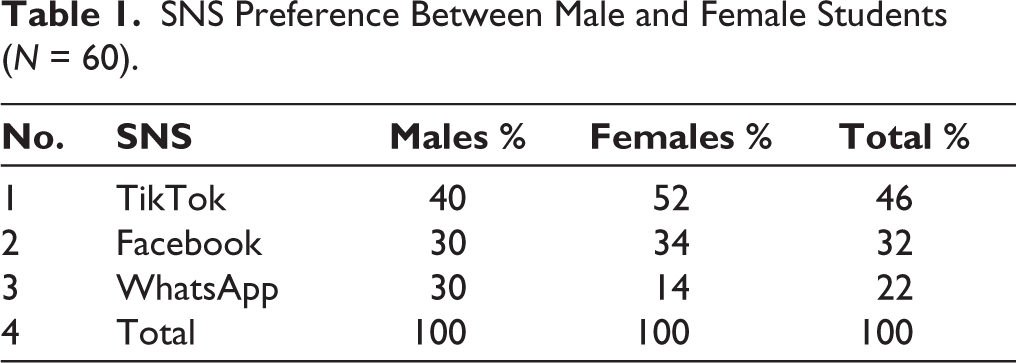
As shown in Table 1, there was a notable variation in the SNS preference between the male and female students. A greater proportion of female students preferred TikTok (52%) compared to males (40%), while males showed a slightly higher preference for WhatsApp (30%) than females (14%). Overall, TikTok was the most popular platform among both genders (46%), followed by Facebook (32%), with WhatsApp (22%) being the least used. As shown in Table 1, TikTok emerged as the most frequently visited SMP, mostly among females, whereas WhatsApp was the least visited. In addition, we established that TikTok had a higher prevalence of SMSHM, and the least SMP was WhatsApp.
A majority of the respondents reported exposure to SMSHM online. Most of them reported that they actively accessed this information in response while trying to network, send instant messages, or follow what had been posted by friends or popular people, and when visiting the sites for entertainment. In a few cases, respondents talked about going online to confirm information they heard or learned from other sources. Their limited exposure to CSE made them heavily rely on SNS as a source of sex-related information. For instance, Discussant 1 stated, “Ordinarily, it is a bit embarrassing to find sex information from family and friends. So when I am on SNS, I usually check on lots of information on these topics posted by my social networks.” Discussant 6 revealed that, “There are a lot of issues I cannot ask my mother or sister. I can get them from online networks, and it is a kind of anonymous conversation that is safe and private.” However, we found that the sexual misinformation accessed by respondents on SMS often involved rumors and misconceptions, which, as noted by previous research, 27 lacks a scientific basis. Discussant 33 added that: “Sometimes I do not check whether the information posted is proven or not. But I find a lot of people following such information, and it is sometimes kind of fun and having to know what other people believe or do in some situations.”
Our findings indicate that some of the sex lies led to indecent self-exposure. For instance, youth would post their body images, share personal photos and videos on the SNS. Discussant 17 observed: When you post on TikTok, you should look good. Most of my friends post pictures and videos with enhanced facials with makeup, tight-fitting clothes that reveal their curvy bodies. In this connection, we found out that self-disclosure among the respondents as a result of social media lies was seen as a way of enhancing self-esteem through showing off one’s beauty or endowment. Exposing oneself was also perceived as a way of covering certain inadequacies in one’s personal life by portraying a well-to-do image. As such, it was an expression of a desperate person seeking attention from viewers.
According to Discussant 7, most celebrities play a significant role in promoting self-exposure by propagating sex lies. He stated, “Most celebrities post videos of erotic body parts such as curves or muscles, stylish walking, and censored sexually provocative clips. They also say a lot of unproven stuff concerning sex.” Spreading unverified information is risky as it has the potential to cause unprecedented social and health risks. 28 However, it was established that this was a way of attracting viewership on SNS. Existing literature suggests that misleading health information may spread more easily than scientific knowledge through social media,1,29,30 observe that the internet can be a source of sexually explicit material or pornography for the youth. Our data indicated that those who either followed SNS explicit content through compromising images and videos became vulnerable to misinformation. Further, they believed that increased viewership of such content was also associated with monetary gain. Moreover, there was a likelihood of making them expose their own explicit images on the SNS while seeking sexual gratification on these platforms and potentially engaging in illicit relations.
Demographics and Self-disclosure
In this section, we examine the relationship between demographic characteristics, particularly gender, and patterns of self-disclosure among the respondents. We interrogate how male and female students differ in their use of various SNS and the implications of these preferences for exposure to sexual misinformation. Table 2 presents the gender-based variations in self-disclosure behaviors among the respondents.
Table 2 presents gender-based differences in self-disclosure behaviors among respondents. A higher proportion of males engaged in body image exposure (45%) and personal disclosures (35%) (e.g., sharing romantic experiences, posting sexual opinions, or revealing intimate relationship details), whereas females expressed greater concern about privacy (50%). These results corroborate previous findings14,31 which indicated that females tend to be more concerned about their privacy on social media than males.
Gender Differences in Self-disclosure Behavior on Social Networking Sites (N = 60).

The respondents suggested that a lot of the females who posted their photos lacked confidence and were seeking self-identity or validation. This was attributed to the fact that many SNS encouraged more posting of photos from female than males. Females who shared photos in tight-fitting clothes, miniskirts, or scanty dressing were regarded as sexy and were more likely to have more followers online. Discussant 21 noted: “My friends use unverified beauty enhancement products such as lightening creams and waist enlargement drugs to look more attractive. These things are advertised online.” Much of the sexual misinformation spread on SNS is not credible and has the potential to generate feelings of apathy, confusion, and mistrust. 32
Respondents argued that such online falsehoods could then lead individuals to disengage from health information-seeking and make decisions that are detrimental to their health. Discussant 12 observed: “Most of the students who post on TikTok are perverts looking for soul mates on the SNS. They get lured by online liars who say that they have a lot of money to spoil pretty girls.” Discussant 31 shared the same view: “Online has a lot of misleading lies on relationships and matters of sexuality. Once you comment on their posts, they start asking for your pretty photos. That is why many young girls share their compromising pictures on Facebook and TikTok.” Thus, youth are being persuaded into self-exposure through deceptive SNS narratives that have the potential to create sexual health risks. 33 The propagation of such misinformation through social media is a major public health concern. This calls for urgent interventions to regulate the quality and public availability of online information. 33 Table 3 illustrates the variation in the nature and extent of self-disclosure between male and female students across different SMPs.
Variation in the Nature and Extent of Self-disclosure Between Male and Female (N = 60).
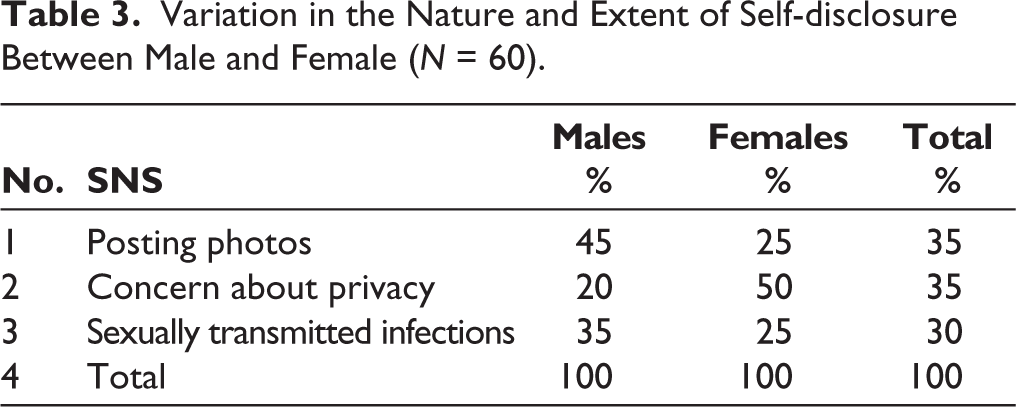
Table 3 shows variations in self-disclosure behavior between male and female students. Female respondents were more likely to post personal photos (60%) compared to males (36%), while males disclosed more about sexual desire (32%) and sexually transmitted infections (32%). These differences suggest gendered tendencies in how personal and sensitive information is shared on social networking sites.
Male students were more likely to search SNS for information regarding their levels of sexual desire and challenges related to sexual dysfunction. For instance, Discussant 24 revealed that: “There are platforms which advertise and sell sex enhancement pills, but little is said about their side effects.” This lack of information was problematic, since such products were being distributed without experts’ prescription. The male students also followed SNS for information on how to build or change their psyche and gain a more muscular and athletic body that could attract girls.
Both male and female respondents accessed information on sexually transmitted diseases (STDs) out of curiosity or after being infected. They admitted to exposure to pop-up advertisements for curing STDs that were not based on scientifically proven methods. Additionally, males tended to view females on social media who revealed their knowledge of STDs with skepticism, perceiving them as potential liars or engaged in illicit relations, and they were also perceived as less confident and were looking for approval.
Types of Friends and Self-disclosure
This section explores how the types of online friendships and social connections influence youth self-disclosure behaviors on social media. It examines the role of peer approval, online interactions, and perceived social validation in shaping the extent to which young people share personal or intimate information online. Results indicate that the perceived lies and misinformation about issues of self-disclosure portrayed the types of friends a young and active social media user would make in the course of interacting with varied content across SMPs. Whereas the posts that expose privacy and self-images were deemed misleading because many of them are not a true reflection of the people that post them, the number of followers of such posts reflected the kinds of friends they would make based on what is posted. For instance, Discussant 13 stated, “Most people are encouraged to post about themselves due to the comments viewers give about a particular post. From such comments, it is possible to tell whether the viewers approve of what is posted or not.” Discussant 51 said, “Sometimes we are made to believe that the dress code and skin complexion of the friends in the photos or videos posted online reveal how they are doing in life. This can lure some of us into disclosing our self-identities to people who post in expensive outfits or in posh buildings. There are also many pretenders online who fake identities to make friends online.” According to Discussant 37, “Some online photos portray the perception that one is liberal and has freedom to make choices in what they do and how they look. This influences the type of friends one would eventually interact with on social media.” As such, the results showed that some indecent self-exposure on the SNS was associated with the type of friends who are a show offs, are perverts, or are lousy and are out to boost their self- esteem or gain fame.
Given the public nature of the internet, privacy emerged as a key concern for young people using social media. 31 Since it has become a common phenomenon on the digital platforms for popularity to be measured by how many friends or likes one collects on an instance of sharing a post on social media, the respondents argued that it is believed that the more one has many “views or followers,” the more they become popular and famous. However, it was established that copying or imitating a celebrity’s lifestyle and sharing photos that expose one’s body image would not necessarily make one gain fame or show that one has made it in life. This was attributed to the fact that some photos are taken in a make-believe environment to fake the image of the person, or they are produced using digital technology such as Snapchat, and this may never be the real person in actual life. Therefore, it is misleading since the motive of the people who post or create the content on social media is far from what the viewers perceive. To believe such content would also be misinforming because different personality types behave differently on SMPs. As such, the self-exposure may not be a yardstick to measure one’s self-confidence or character in their actual life.
Nevertheless, since content creators contribute significantly to what is usually posted on various SMPs, they too have a role in perpetuating sexual health misinformation on self-exposure and privacy. This arises due to a lack of strict adherence to regulations that restrict uncensored content, including exposing body images on social media. There is a need for enhanced awareness among young people who use SMPs about what can possibly cause misinformation or be abused.
Conclusion
This study aimed to examine SMSHM on TikTok, Facebook, and WhatsApp among youthful university students of MMUST. The results indicated a significant amount of SHM occurred on TikTok and Facebook. Such misinformation concerned the engagement of the youth in sexual a ctivities, their knowledge of STDs, and the use of contraceptives. While it appears that SHM through online SMPs is often based on topics popular among the youth, the consequences of the prevalence of misinformation need to be addressed. Researchers highlight a critical gap in potential interventions that could be adopted by the youth to mitigate SHM among social media users. The study concluded that content creators and social media influencers play a critical role in the dissemination of SHM on SMPs. Given the significant role of learning institutions and family members in providing trustworthy information about sexuality, it may be particularly effective to capitalize on these information sources to link the youth to reliable CSE on SNS. Consequently, it is essential to support users, including the youth, in accessing credible information while avoiding unverified sexual health information providers. Relevant authorities should use the challenges posed by misinformation on social media as a basis for enacting policies that regulate the provision of sexual health information.
Footnotes
Authors’ Contribution
Benard Mudogo: Drafting the manuscript and data analysis
David Barasa: Editing the manuscript and writing the literature review
James Matseshe: Data collection and analysis
Consent for Publication
Not applicable.
Data Availability Statement
The data for the study is available upon request.
Declaration of Conflicting Interests
The authors declared no potential conflicts of interest with respect to the research, authorship, and/or publication of this article.
Ethical Approval
The research was approved by the Masinde Muliro University Institutional Ethical Review Board.
Funding
The authors disclosed receipt of the following financial support for the research, authorship, and/or publication of this article: The research was funded by the MMUST grant number (MMU/URF/2024/S-069).
Informed Consent
Informed consent to participate was sought from the respondents through written consent forms.