




Abstract
This narrative review explores the potential neurophysiological correlates of the subjective experience of shared consciousness in romantic intimacy, synthesizing evidence from hyperscanning (simultaneous recording from two brains) EEG (electroencephalography), fMRI (functional magnetic resonance imaging), and MEG (magnetoencephalography) studies. It examines how neural synchrony, specifically through shared gaze, emotional alignment, and coordinated rhythms, correlates with the experience of connection in romantic intimacy. This review explores how these neural patterns relate to the subjective feeling of being “in sync” with a partner and their potential role in supporting social bonding and emotional regulation. It further addresses the bidirectional relationship between neural synchrony and relational depth, considering how romantic attachment both shapes and is shaped by dynamic inter-brain coupling. Long-term neuroplastic effects emerging from sustained dyadic co-regulation are also considered. Beyond reviewing the data, this article discusses theoretical questions regarding the boundaries between self and partner, considering whether romantic connection might reflect a form of shared cognitive processing. In doing so, this review integrates neuroscientific data with frameworks from enactivism, intersubjectivity, and the extended mind thesis, offering a rigorous, interdisciplinary perspective on the potential neural foundations of romantic intimacy. Overall evidence from EEG and functional near-infrared spectroscopy (fNIRS) hyperscanning suggests that transient neural synchrony correlates with subjective intimacy, though causal mechanisms remain to be fully established.
Introduction
Consciousness is often conceived as a private, first-person phenomenon, yet its most profound expressions emerge in shared experiences, nowhere more intensely than in romantic intimacy.1,2 Romantic intimacy refers to the emotional closeness, trust, and affection that characterize a romantic relationship.3–5 Intimate dyads are marked not only by emotional bonding but also by sensorimotor and physiological attunement, where mutual gaze, touch, and nonverbal rhythms mediate intersubjective connection. At the heart of this lies a cognitive paradox: the simultaneous experience of selfhood and togetherness, wherein individuals maintain identity while undergoing partial merging in interaction. 2
This phenomenon is especially salient in romantic relationships, where sustained interaction facilitates increasingly efficient co-regulation of emotion, attention, and behavior. Romantic intimacy thus offers a fertile domain to investigate how cognition and consciousness emerge relationally rather than in isolation. 6
The notion of shared consciousness refers to the subjective experience in which individuals perceive themselves and their partner as interconnected, experiencing moments of joint attention, emotional fusion, or mutual intentionality.7,8 This is more than behavioral synchrony; it is a phenomenological state of “we-ness” in which minds may feel functionally and experientially intertwined. 9 In romantic dyads, such moments are commonly reported as feelings of being “in sync,” “on the same wavelength,” or “merged,” experiences often associated with strong emotional salience. 7 It is important to distinguish this from simple “joint attention” or behavioral synchrony; shared consciousness implies a subjective merging of experience rather than just coordinated focus.10,11
Cognitive neuroscience has increasingly sought to unpack this phenomenon by identifying the neural signatures of such coupling. Oscillatory neural synchrony which is measured through hyperscanning (simultaneous recording from two brains) EEG (electroencephalography), fMRI (functional magnetic resonance imaging), and MEG (magnetoencephalography), provides a temporal and spatial window into how two brains may dynamically align during intimate exchanges. Empirical findings suggest that the experience of shared consciousness may arise not merely from subjective interpretation, but from measurable neural entrainment, where oscillatory rhythms are thought to support affective and cognitive resonance.9,12,23 Neural synchrony is defined as the temporal alignment of neural activity across interacting partners. It has been implicated in fostering mutual understanding, emotional attunement, and even predictive modeling of a partner’s behavior.
This review is grounded in theoretical frameworks that treat cognition and consciousness as relationally constructed rather than individually encapsulated. Enactivism posits that mental processes arise through embodied interaction with the environment and with others.13–15 From this perspective, romantic intimacy is a co-enacted phenomenon10,11: The mind is not confined to the brain but extends into the dyadic system formed through continuous sensory, motor, and affective engagement.16,17 The extended mind hypothesis 18 further proposes that cognitive processes can span across individuals when they rely on shared regulatory loops. In romantic contexts, inter-brain coupling, via mutual gaze, touch, or vocal prosody, may constitute transient forms of extended cognition. 12 As partners coordinate their internal states through interpersonal cues, they form dynamic feedback systems that scaffold shared awareness. 19 This aligns with intersubjectivity theory, which frames the self-other distinction as fluid and context-dependent, particularly in emotionally charged interactions.20,21
These frameworks lead to the hypothesis that neural synchrony may represent a physiological marker of how self-other boundaries are navigated during intimacy. They raise pressing questions: Can two brains temporarily form a unified conscious system? Does prolonged neural alignment support emotional learning and attachment consolidation? And most provocatively, can consciousness emerge between, rather than within, individuals? Crucially, this review interprets neural synchrony primarily as a physiological marker and potential mediator of interpersonal connection, rather than definitive proof of a singular, physically shared consciousness.
Although this review focuses on literature from the past two decades, select pre-2005 studies are included where they offer seminal theoretical grounding. Foundational concepts such as the extended mind thesis, 18 the shared manifold hypothesis, 22 and early models of intersubjective cognition (e.g., Buber, 1992), continue to inform contemporary research into neural synchrony. While these earlier works do not employ hyperscanning or direct neuroimaging, they provide the conceptual scaffolding necessary for interpreting findings on interpersonal neural dynamics, particularly regarding self-other relations and enactive consciousness. Their inclusion ensures theoretical continuity and epistemological depth across the review. Understanding these mechanisms is particularly relevant for psychosexual health, as it elucidates the physiological substrates of emotional and physical closeness.
Methods
A narrative review methodology was chosen for this study to facilitate a broad, interdisciplinary synthesis of empirical neuroscientific findings with the associated philosophical and cognitive theories of consciousness. This approach allows for a thematic exploration that a more constrained systematic review might not accommodate.
To identify relevant literature, a comprehensive search was conducted in academic databases including PubMed, Scopus, Web of Science, PsycINFO, and Google Scholar. The search focused on contemporary research published from 2005 to the present, while also including seminal pre-2005 theoretical works that provide essential conceptual grounding. Keywords included “neural synchrony,” “inter-brain coupling,” “hyperscanning,” “romantic partners,” and “shared consciousness.” This database search was supplemented with “snowball” sampling, where the reference lists of key articles were reviewed to identify additional relevant studies.
Inclusion and Exclusion Criteria
The selection process prioritized peer-reviewed empirical studies that used neurophysiological techniques like EEG, MEG, or fNIRS to investigate inter-brain synchrony in adult romantic dyads during social interaction. Theoretical articles were included if they directly addressed the concepts of intersubjectivity, the extended mind, or enactivism in the context of dyadic interaction. Studies that were focused on animal trials, single-brain imaging, or reviews without primary data were excluded.
Final Selection
This process yielded 30 core empirical studies for synthesis within the review. Selected studies were synthesized using a thematic approach. We extracted data regarding experimental paradigms (e.g., gaze, touch, cooperation) and neural outcomes, categorizing findings into three primary domains: neural mechanisms (frequency bands and anatomical regions); dyadic dynamics (behavioral and physiological correlates); and theoretical implications (interpretations regarding self-other boundaries). This structure allowed for the integration of quantitative neuroimaging data with qualitative theoretical frameworks.
The remaining citations were used to support the theoretical framework, methodological context, and background information. It is important to note that this narrative process is not exhaustive and does not follow formal systematic review guidelines; its aim is to provide a thematic synthesis and critical discussion of the current research on neural synchrony in romantic intimacy.
Review and Discussion
Neural Mechanisms of Synchrony
Neural synchrony refers to temporal coordination of brain activity between individuals. At the neural level, this often means phase locking or coherence of oscillatory rhythms across two brains. Oscillatory synchrony is widely understood as a mechanism for neural communication within a brain (e.g., enabling inter-area information transfer). 24 By extension, inter-brain synchrony might reflect alignment of functional networks across people during interaction. 24
Neural synchrony between individuals is typically quantified using distinct metrics depending on the imaging modality. In EEG and MEG, phase-based measures such as phase locking value (PLV) and phase lag index (PLI), along with coherence, assess the temporal alignment of millisecond-level oscillatory rhythms. 25 MEG studies analogously measure the synchronization of spectral power or phase between brains, suggesting that the phase coupling of neuronal oscillations serves as a putative mechanism for inter-regional communication; interpersonal synchrony suggests this coupling may extend across brains.23,24,26 fMRI and fNIRS rely on the correlation of hemodynamic time courses (BOLD or oxygenated hemoglobin signals), reflecting slower metabolic coupling rather than direct neural oscillations. Both approaches aim to index functional connectivity across individuals, distinct from simple behavioral coordination. 27
Neural oscillations at specific frequency bands are thought to facilitate inter-brain coupling. High-frequency gamma oscillations (~30–90 Hz) have been proposed as a mechanism for rapid coordination between brains. Gamma-band synchrony in temporal-parietal regions has been linked to social cognition (theory-of-mind, emotion regulation) and may provide a fast template for shared sensory processing. Indeed, event-related gamma power increases have been observed for emotional stimuli and perspective-taking, and synchronized gamma between auditory and superior temporal regions suggests a role in mutual attention. 27
Lower-frequency bands (theta, alpha, beta) also play roles: frontal theta and alpha coherence increase during coordinated action or communication tasks. 25 Oscillatory frequency matters: high-frequency (gamma) synchrony might reflect fast reciprocal exchange, whereas lower-frequency (theta/alpha) synchrony might index slower affective or contextual alignment. Therefore, inter-brain synchrony is measured by coherence or phase locking of oscillatory activity, and multiple frequency bands (notably gamma and alpha/beta) have been implicated as substrates for social coordination and shared cognition, and can be measured via coherence, cross-correlation, or sliding-window connectivity analyses.7,24,25
Romantic Intimacy and Brain-to-brain Synchrony
A growing body of hyperscanning research suggests that the neural activity of romantic partners becomes coupled during social interaction; however, it is important to interpret these findings with the understanding that many are exploratory and often based on small sample sizes. Hyperscanning studies that directly measure how neural activity covaries in interacting with romantic partners consistently report higher neural synchrony in romantic partners than in control dyads. EEG hyperscanning has revealed that romantic lovers show distinctive inter-brain coupling compared to strangers or friends. For instance, in naturalistic conversational and cooperative paradigms, a study of 158 participants (79 dyads) demonstrated that long-term romantic couples exhibit significantly higher EEG coherence in frontal and parietal regions compared to unfamiliar pairs. Converging evidence further localizes brain-to-brain synchrony to right temporoparietal regions during face-to-face interaction. 28 In a sample of 104 adults (52 dyads), greater social connectedness, operationalized through familiarity and interactional predictability, significantly predicted stronger coupling within the posterior superior temporal sulcus (pSTS) and temporoparietal junction (TPJ). 27 In laboratory tasks, romantic dyads have shown higher inter-brain PLV/PLI than strangers. For instance, in a cooperative tapping task, lovers had significantly increased synchronization in a right frontoparietal network and better behavioral coordination than strangers.
Further studies have demonstrated that romantic kissing and affectionate touch increase cross-frequency coupling, while fMRI studies implicate the posterior cingulate cortex and TPJ in representing self and other within a unified social context. 1 Studies have shown that touch, for instance, is associated with both physiological entrainment and neural synchronization,29,30 while the development of romantic bonds deepens inter-brain coupling over time. 9 These mechanisms suggest that intimacy may modulate neurocognitive structures to support real-time co-construction of shared states. Over time, such coupling may lead to neuroplastic adaptations that sustain or deepen relational alignment.9,31
Importantly, the modality of interaction appears to modulate the strength of coupling. In a study of 110 participants (55 dyads), handholding elicited significantly higher theta- and alpha-band inter-brain coherence in romantic couples compared to free verbal conversation, suggesting that nonverbal affective contact facilitates more robust neural entrainment than speech alone. 29 Neuroendocrine modulation further amplifies these effects. Specifically, a study involving 18 participants (9 dyads) found that intranasal oxytocin administration significantly enhanced alpha-band inter-brain synchrony during joint movement tasks, particularly spontaneous imitation. This finding supports the role of bonding-related hormones in strengthening interpersonal neural coupling during coordinated social behavior. 32 Conversely, husband-wife pairs listening to affective expressions showed that a perceiver’s EEG could be predicted from the sender’s only when they were romantic partners—an effect absent in mismatched dyads, suggesting partner-specific “neural prediction” channels.
Mobile EEG in realistic settings has extended these findings to embodied intimacy. 33 Couples were recorded in their home setting while engaging in affectionate behaviours (hugging, kissing and emotional speech), exhibited observed lateralized alpha and beta power shifts consistent with stronger left-hemisphere (approach) activity during positive interactions. 34 In a similar mobile EEG experiment, couples exhibited robust inter-brain gamma synchrony when co-viewing an emotional (comedy) film compared to a scrambled baseline, especially across frontal and temporoparietal channels; the strength of inter-brain gamma coherence correlated with self-reported empathy and closeness. Only romantic couples, not strangers, showed time-locked gamma-band power correlations in temporoparietal regions during mutual gaze and moments of shared positive affect. 27 These findings suggest that interactive cues like eye contact appear to facilitate interpersonal neural coherence, reinforcing the embodied nature of synchrony.
These results highlight that nonverbal affective contact (touch, gaze, shared emotional stimuli) enhances neural entrainment in romantic partners. fNIRS hyperscanning (as a stand-in for fMRI connectivity) corroborates EEG evidence. A systematic review reported consistent inter-brain synchronization (IBS) in frontal, temporal, and parietal cortices across 17 fNIRS studies of couples and parent-child pairs. For example, fNIRS showed that during a deception/honesty game, romantic couples with higher honesty rates exhibited greater IBS in the prefrontal cortex (PFC) and right TPJ. 35 It is important to note that fNIRS measures slower hemodynamic coupling (oxygenated hemoglobin), which serves as an indirect proxy for neural activity compared to the direct millisecond-resolution of EEG.
Likewise, mere physical presence of a spouse enhanced prefrontal synchrony: true couples listening together to infant/parent vocalizations showed higher PFC coupling than when tested individually or as matched controls. 36 Frontotemporal regions synchronize more in romantic partners than in acquaintances during face-to-face tasks, suggesting that attachment modulates cortical coherence. 28 EEG and hemodynamic studies agree that romantic pairs exhibit stronger brain-to-brain coherence in social-affective circuits (PFC, TPJ/pSTS) than strangers, especially under emotionally salient or cooperative conditions.
Affective Entrainment and Embodied Coupling
Romantic partners often develop deep behavioral and physiological alignment, which appears reflected in neural coupling. Behavioral synchrony (e.g., matched facial expressions, timing of actions) correlates with inter-brain synchrony. A study directly compared couples, friends, and strangers in two naturalistic tasks. 28 In a joint motor task, couples displayed the highest IBS (notably beta/gamma rhythms in the sensorimotor cortex) combined with the highest movement coordination, yielding faster, more efficient performance. In a socially oriented empathy task, couples showed high behavioral synchrony but lower neural synchrony (versus strangers), paired with the greatest subjective feelings of support. This “brain-behavior complementarity” suggests that intimate partners may rely on shared embodied routines (reducing neural “effort” for the same behavioral alignment), whereas strangers require more neural coupling to achieve mutual understanding. At the same time, this correlation highlights a central interpretive challenge in the field: disentangling whether inter-brain synchrony is a meaningful marker of higher-order intersubjective connection or an epiphenomenon of lower-level sensorimotor coordination between partners. Physiological coupling accompanies neural synchrony in intimacy.
Classic studies have shown that partners’ heart rates and respiration can synchronize when interacting (e.g., during discussion or imitation). 37 Although not yet widely studied with hyperscanning, such somatic entrainment likely contributes to affective neural alignment. For instance, moments of shared gaze and positive affect elicit simultaneous gamma bursts in the superior temporal sulcus (STS) across interacting dyads, implicating a mirror-like resonance. Supporting this, frontal alpha asymmetry synchronization in blindfolded couples engaging in nonverbal emotional connection, with higher left-hemisphere activation linked to greater subjective bonding. 38 Oxytocin’s effect on enhancing neural synchrony may partly reflect its role in aligning physiological states. In sum, romantic partners’ bodies and brains tend to become attuned (“embodied coupling”), such that their oscillatory rhythms lock together during shared emotions or coordinated actions.
While currently correlational, these findings suggest that shared bodily rhythms may scaffold emotional co-regulation. In psychosexual therapy, interventions such as sensate focus may function by re-establishing these physiological and neural feedback loops. By guiding couples to focus on non-demand touching, therapists may help downregulate individual anxiety and facilitate the re-emergence of dyadic neural co-regulation, thereby strengthening the physiological substrate of intimacy. 39
Self-other Boundaries and Shared Consciousness
Neural synchrony in couples implicates the blending of self and other. However, it is critical to interpret these associations cautiously; while phenomenological reports describe a sense of “oneness,” current neurophysiological data provide correlational evidence rather than proof of a literal merging of consciousness. 40 Proponents of 4E cognition argue that inter-brain phase locking could serve as a mechanism for a “conscious extended mind.” 41 From this view, high neural synchrony might allow couples to form a transiently coupled cognitive system where mental processes are not strictly brain-bound but are relationally constituted. This aligns with intersubjectivity theory, which posits that understanding arises in the shared space between minds, potentially blurring self-other distinctions during peak intimacy. 42
This notion is reinforced by experimental findings indicating that high interpersonal synchrony often produces a perceived merging of identities, with participants reporting decreased self-other distinction and enhanced affective resonance. A study has found that individuals engaged in synchrony exhibited elevated feelings of connection but reduced self-regulatory clarity, suggesting that the act of being “in sync” can obscure where one ends and the other begins. 43
Neurobiologically, TPJ/pSTS and frontal midline areas (implicated in self-other distinction and mentalizing) often synchronize between partners, potentially reflecting a neural basis for blurring individual boundaries during intimacy. 1 Studies suggest that such neural coupling may also reduce sensitivity to one’s own bodily states while increasing attunement to the partner’s, an empathetic shift that strengthens the intersubjective field. From a philosophical perspective, romantic synchrony is associated with extended mind and 4E cognition theories. 44
The extended mind thesis holds that cognitive processes can span individuals; evidence of real-time neural coupling provides one mechanism by which minds could literally become entangled. 18 “We propose that inter-brain phase synchronization of neural oscillatory activity is a candidate mechanism for the conscious extended mind.” 41 Intersubjectivity theory similarly posits that understanding arises in the space between minds; neural synchrony may instantiate this shared space. 45
Some evidence further supports the possibility that romantic neural coupling may produce a transient joint state of consciousness. Reports from couples in highly synchronous states often describe experiences of “we-ness” or collective intentionality, in which thoughts and emotions seem to intertwine beyond individual volition. While direct access to the contents of shared consciousness is elusive, longitudinal EEG studies suggest that such neural attunement deepens over time. Inter-brain gamma synchrony increased over several months of romantic bonding, pointing to neuroplastic adaptations that may reinforce dyadic perspective-taking. 9 However, critics of the extended mind thesis argue that social coupling does not necessarily constitute a single cognitive system.46,47 For now, the empirical data encourage a view of romantic consciousness as a coupled system, partially scaffolded by oscillatory entrainment, aligned with enactivist notions of participatory sense-making.
Nevertheless, this does not imply that identity boundaries are permanently dissolved. Most findings suggest that neural synchrony in couples occurs episodically, like during a shared gaze, touch, or shared tasks, and that partners return to individuated cognitive baselines outside such moments. Yet the cumulative effect of recurring neural synchrony episodes may lead to long-term changes in neural coupling patterns, as evidenced by studies showing increased inter-brain coherence over time in romantic dyads. 9 These findings suggest that rather than a permanent fusion of identities, shared consciousness in romantic intimacy may operate as a recursive neurocognitive rhythm: one that dynamically modulates emotional regulation, attentional alignment, and relational memory across interactions. These interpretations regarding shared consciousness remain speculative and require further empirical testing to distinguish between metaphorical and literal “merging” of minds.
Computational Models
A few models have been proposed to explain how inter-brain synchrony emerges. Kuramoto-coupled oscillator models treat each person’s brain (or relevant neural subnetwork) as an oscillatory phase oscillator that can entrain with another. Heggli et al. introduced a four-oscillator Kuramoto model of self-other integration: each individual has a perception and action oscillator, with coupling parameters governing how one brain’s state influences the other’s. 48 Fitting this model to joint tapping data showed that different coupling strengths reproduced distinct synchronization strategies. Such models illustrate how simple coupling can yield self-other distinction or merging.
Other proposals focus on neural mass simulations: Cohen et al. pointed out that increased intracranial gamma oscillations in pSTS accompany mentalizing about self versus other, and they suggest gamma could serve as a fast “template” for cross-brain binding. 49 At a conceptual level, coupling metrics like PLV and coherence already embody a coupling “model”: they quantify phase alignment but do not specify causality. More advanced approaches (e.g., Granger causality or machine learning) are being tested. 50 Markus and Shamay-Tsoory advocate dyadic neurofeedback to probe causality between neural synchrony and behavior. In practice, most analyses remain descriptive (synchrony vs. behavior) rather than mechanistic. 51 Nevertheless, the success of oscillator models hints that inter-brain synchrony in couples may operate by the same principles as coupled neural assemblies within a brain.52,53 In cognitive terms, predictive coding or Bayesian frameworks could also model this phenomenon: partners who predict each other’s actions well would naturally show phase alignment of neural error signals. 54 However, formal models linking prediction error minimization to cross-brain coherence have not yet been fully developed. While oscillator models are foundational, many researchers argue that future progress will likely come from integrating these with predictive coding or Bayesian frameworks. Such models could, in principle, formalize how partners minimize mutual prediction errors, offering a mechanistic link between behavioral adaptation and neural entrainment. Currently, however, the field lacks robust, empirically validated computational models that can fully explain the emergence of shared experience from dyadic brain dynamics, marking this as a critical area for future research. However, a critical gap remains: these computational models are derived primarily from simulations or simple motor tasks. To date, they have not been sufficiently validated against the complex, noisy neural data collected from romantic couples in naturalistic settings. Validating these mathematical predictions against real-world intimacy is a necessary next step.
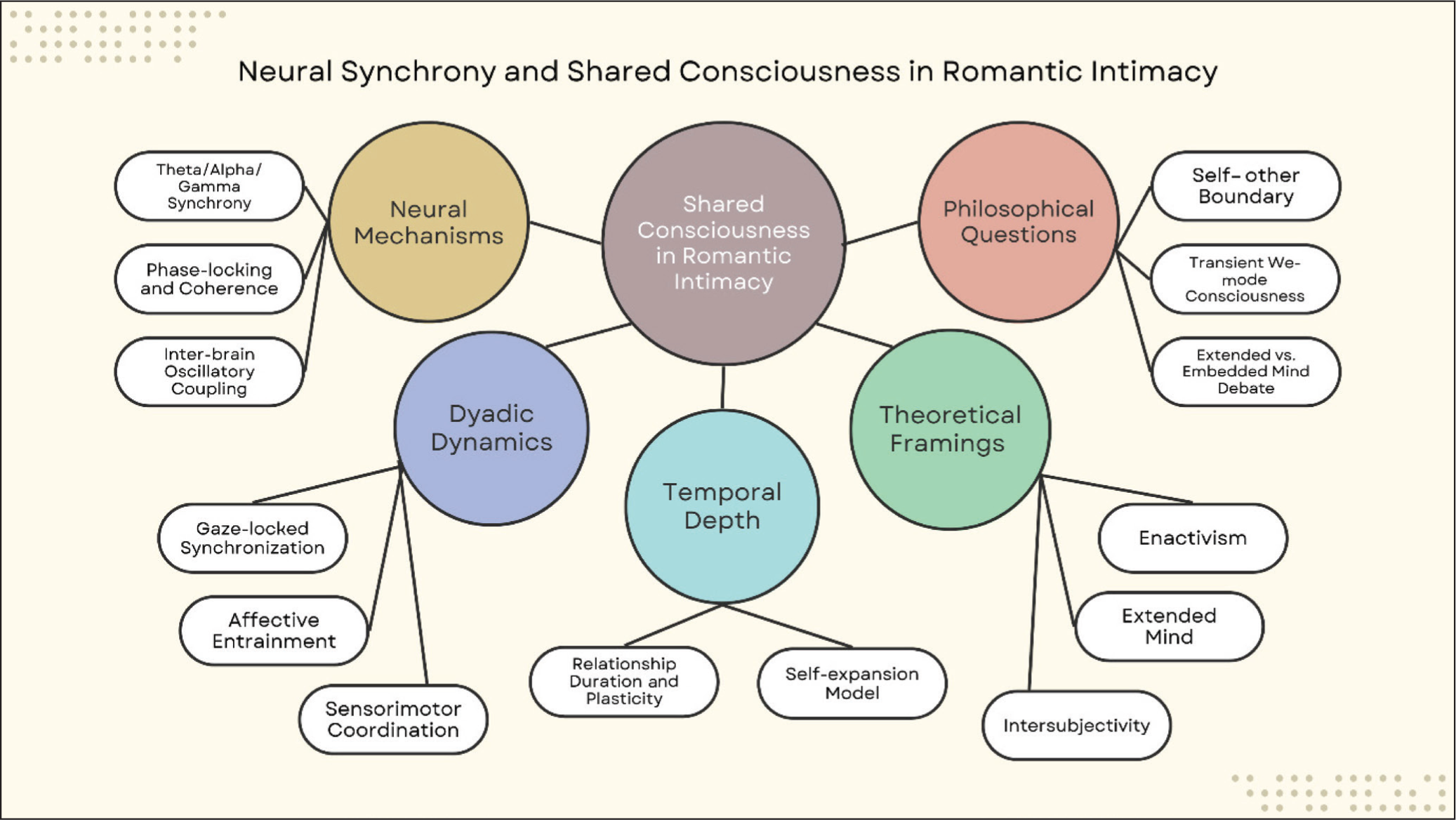
Figure 1 illustrates a radial concept map illustrating key themes related to shared consciousness in romantic intimacy, with the central concept branching into neural mechanisms (e.g., oscillatory synchrony, coherence), dyadic dynamics (e.g., gaze, affect, sensorimotor coordination), temporal depth (e.g., relationship duration, self-expansion), theoretical framings (e.g., enactivism, extended mind, intersubjectivity), and philosophical questions (e.g., self-other boundary, we-mode consciousness), with outer annotations noting relevant neuroimaging methods (EEG, fMRI, fNIRS) and applications in therapy and affective computing.
A Thematic Synthesis of Neural Synchrony and Shared Consciousness in Romantic Intimacy.
Theoretical Frameworks for Romantic Neural Synchrony
The empirical findings across EEG, fNIRS, and computational modeling raise deeper questions about how romantic synchrony is to be conceptualized. Figure 1 summarizes these theoretical intersections, illustrating how neural mechanisms, such as oscillatory synchrony, map onto broader philosophical concepts of self-other merging.
Coupled Oscillator Models
Drawing from dynamical systems theory, coupled oscillator models treat each partner’s brain as a rhythmic system whose phase can lock to the other’s under specific interaction conditions. Sensory cues like gaze, voice, or touch act as coupling forces that bring neural oscillators into sync.12,27,28 These models are well-suited to capturing the real-time alignment observed in EEG and fNIRS studies, and they offer a tractable mathematical framework for simulating entrainment. However, they tend to abstract away from the semantic and affective richness of intimate communication.
Predictive Interaction Models
Inspired by predictive coding, this framework proposes that each brain builds forward models of the partner’s behavior and adjusts in real time to minimize prediction error. Inter-brain synchrony emerges as a result of mutual prediction: the more predictable a partner becomes, the tighter the neural alignment.28,32 Empirical findings support this view, with studies showing that familiarity and relationship depth are associated with increased coupling. This model also accommodates dynamic updating and long-term adaptation in relational systems. 9
Hyper-brain Network Theories
This approach conceptualizes the interacting brains as a single distributed network, a “hyper-brain,” in which nodes span across individuals. Under this model, information can circulate through joint attentional, emotional, or motor loops, especially during cooperative or emotionally salient tasks.35,38 Hyper-brain modeling has been used to demonstrate emergent properties of dyadic interaction, such as joint attention, decision-making efficiency, and task performance improvement.
Enactivist and Intersubjective Frameworks
From an embodied cognition perspective, synchrony is not merely a co-occurrence of neural signals but a co-enacted process of relational sense-making. Enactivism proposes that cognition arises from dynamic sensorimotor coupling between agents and environments: here extended to include other people.14,28,37 In this view, romantic dyads constitute an emergent cognitive unit where each partner’s perception and action loop is entangled with the other’s. From this perspective, the experience of “we-ness” is not merely metaphorical. Instead, it is viewed as a tangible psychological state that emerges directly from the interaction between two nervous systems.
Extended Mind and Shared Manifold Hypotheses
Philosophical models such as the extended mind and shared manifold hypothesis offer conceptual tools for interpreting high synchrony states as transient expansions of consciousness.19,22 Valencia and Froese explicitly propose that inter-brain phase locking might constitute a candidate mechanism for a conscious extended mind, suggesting that some moments of romantic intimacy reflect a distributed experiential system. 41 This is supported by findings that temporoparietal regions involved in self-other distinction often synchronize during intimate interaction1,28 and that dyads report loss of individual self-awareness during peak connectedness. While still speculative, such accounts challenge classical models of cognition as strictly brain-bound and encourage rethinking the mind and self as temporarily distributed processes.
Limitations and Future Directions
Despite increasingly robust evidence for neural synchrony in romantic dyads, the literature continues to face several methodological and conceptual limitations that warrant caution. One recurring concern is methodological heterogeneity, though this must now be qualified. While early hyperscanning studies relied on very small samples, more recent work has employed moderate to large samples (e.g., 100 to 160 participants) using naturalistic conversational and cooperative paradigms. These larger studies strengthen confidence in the reliability of core effects. Nevertheless, many experimental manipulations, particularly pharmacological or longitudinal designs, still involve small dyads, limiting statistical power and generalizability.
Publication bias toward positive findings is a significant concern, as null or negative results are rarely reported. This narrative review itself constitutes a limitation, as it does not employ formal screening, preregistered protocols, or quantitative synthesis typical of systematic reviews. While this approach allowed for conceptual integration across disciplines, it may introduce selection bias and limits replicability. Future meta-analytic and scoping reviews with structured inclusion criteria will be essential for consolidating this growing body of work.
Comparisons often rely on resting baselines or unfamiliar dyads, which may not sufficiently account for attentional alignment or shared sensory input. Although several studies now localize synchrony to social-cognitive regions such as temporoparietal networks rather than primary sensory cortices, fully disentangling genuine interpersonal coupling from common stimulus entrainment remains a central challenge. Rigorous non-interactive and pseudo-interactive control conditions are still inconsistently applied. Consequently, the application of control conditions remains inconsistent across the literature.
The literature also shows empirical inconsistencies as well. Higher emotional and neural synchrony has been associated with high-quality romantic relationships, while similar effects are often weaker or absent in close friendships, underscoring the importance of social context. 55 At the same time, several studies report measurable synchrony even among strangers during shared tasks, albeit typically at lower magnitudes.9,53
Methodological heterogeneity remains a primary challenge. Studies vary significantly in their control conditions (e.g., comparing romantic partners to strangers vs. friends) and their analysis metrics (e.g., PLV vs. coherence). This lack of standardization complicates cross-study comparisons and may contribute to conflicting findings regarding whether synchrony is stronger in romantic pairs compared to platonic friends.32,56
A central theoretical debate concerns whether inter-brain synchrony reflects genuine social coupling or merely shared sensory entrainment. Critics argue that simultaneous exposure to the same stimuli, such as mutual gaze or shared music, may induce spurious synchrony driven by common sensory processing rather than interpersonal alignment.13,29 Although some studies demonstrate minimal gamma synchrony at rest, supporting the role of active interaction, disentangling true interpersonal coupling from shared-input effects remains a persistent challenge. 28
Ecological validity has improved but remains partial. Naturalistic conversation, cooperative tasks, and nonverbal affective contact, such as handholding better approximate real intimacy than scripted tasks. However, these paradigms still capture only brief interactional windows and rarely address relational dynamics across emotionally charged contexts such as conflict, rupture, or repair. Mobile EEG enhances realism but introduces motion artifacts and environmental noise, complicating signal interpretation. Longitudinal and developmental perspectives are notably sparse. Although emerging longitudinal evidence suggests that neural synchrony may increase with relationship duration, implying a reciprocal or dynamic process, causal directionality remains unresolved. No current studies systematically examine synchrony across relationship stages or during transitions such as separation, reconciliation, or therapeutic intervention. Physiological integration beyond neural measures remains limited. While neuroendocrine modulation, including oxytocin administration, has been shown to amplify inter-brain synchrony, such findings are based on small samples and require replication. Broader coupling across hormonal, autonomic, and immune systems remains largely unexplored despite strong theoretical relevance.10,56
Population diversity constitutes a further limitation. The predominance of Western, educated, industrialized, rich, and democratic samples raises concerns about cultural generalizability. Individual differences, including attachment style, personality traits, and neurodiversity, are rarely modeled, despite their likely influence on interpersonal alignment. Similarly, synchrony in couples affected by psychopathology such as depression, PTSD, or autism spectrum conditions remains under-investigated.
Implications of this Study
The review summarized compelling evidence for the functional significance of neural synchrony in shaping shared conscious experiences. These findings have several broad and domain-specific implications. The demonstration of oscillatory coupling during romantic interactions points to the possibility that interpersonal connectedness may not be solely a psychological construct but appears to be deeply rooted in embodied neurophysiological processes. This potential neurobiological grounding of relational intimacy offers a framework for integrating affective neuroscience with theories of intersubjectivity, attachment, and self-other distinction. It suggests that the experience of “we-ness” may be underpinned by temporally aligned cortical processes, particularly in the alpha, theta, and gamma bands.
Along with that, insights have the potential to refine models of social cognition and emotion regulation. If romantic attachment relies on specific oscillatory dynamics, interventions in relationship counseling and psychotherapy may benefit from focusing on real-time interactional synchrony: both behavioral and neural. Specifically, couples’ neurofeedback or synchrony-based therapy may offer promising adjuncts in psychosexual treatment, helping partners visualize and improve their nonverbal attunement. Emerging technologies such as neurofeedback or interpersonal biofeedback could be adapted to foster synchrony in distressed couples or enhance bonding in therapeutic contexts. This review, therefore, contributes to the growing body of research that challenges and potentially redefines the boundaries of consciousness as a relational rather than merely intrapersonal phenomenon. The implications extend to philosophical models of the self, particularly those influenced by enactivism and phenomenology, where consciousness is shaped through co-regulated interactions.
These findings open new avenues in translational and interdisciplinary research. Moreover, the phenomenon of dyadic neural synchrony in romantic partners offers a foundational basis for rethinking how intimacy is cognitively and affectively scaffolded. The empirical patterns of brain-to-brain coupling observed in intimate dyads may indicate not just momentary alignment, but also long-term neuroplastic adaptations that reinforce relational depth. This supports the notion that romantic intimacy can, over time, reconfigure individual neural architectures, pointing toward a neurophenomenological substrate for enduring attachment. Such findings call for further exploration of how recurring interpersonal oscillatory alignment may shape not only affective dynamics but also ongoing self-construction in relational contexts.
Thus, while evidence for romantic neural synchrony is increasingly supported by larger and more naturalistic studies, advancing a robust and generalizable science of interpersonal coupling will require longitudinal designs, multimodal physiological integration, culturally diverse samples, and methodological standards that balance ecological validity with experimental rigor.
Conclusion
In intimate partnerships, neural oscillations between partners often resonate. EEG hyperscanning and fNIRS/fMRI studies converge on the finding that romantic couples exhibit enhanced inter-brain synchrony in social-affective networks, especially during touch, emotional gaze, or cooperative tasks. This synchrony likely reflects both embodied entrainment (aligned heart rate, movement, affect) and cognitive attunement (shared attention, goals). Moving forward, the field must transition from documenting the existence of synchrony to identifying its function. Future research requires longitudinal designs to determine if neural coupling predicts relationship longevity, as well as multimodal approaches that integrate hormonal and autonomic data. Rigorous, experimentally controlled studies are needed to determine if “linking brains” truly facilitates the shared conscious experience of love. Ultimately, while current evidence is compelling, it remains correlational. We cannot yet confirm if synchrony creates intimacy or is merely a byproduct of it. While the current evidence remains correlational, these findings provide a compelling foundation for exploring how oscillatory coupling may reflect the neural basis of shared experiences of intimacy.
Footnotes
Acknowledgements
The authors would like to thank the Division of Psychology and Cognitive Neuroscience, School of Life Sciences, JSS Academy of Higher Education and Research, Mysuru, for their institutional support. Special thanks go to Shubhay Joshua, the first author’s brother, for his unwavering presence, wisdom, and humor. The authors are also grateful to Parthasarathy Vaidya (life alignment and mental health practitioner) for his early collaboration and contributions during the initial brainstorming phase. Additionally, the value of peer discussions is acknowledged, which significantly enriched the conceptual depth and scope of this narrative review.
Authors’ Contribution
Neriah Samraksha: Conceptualization, theoretical framing, investigation, data curation, writing; original draft, visualization, project administration. Neriah led the conceptual development of the review, performed the literature search and data synthesis, and drafted the initial manuscript. She contributed to the philosophical framing of the review. She developed the visualizations and contributed to the integration of empirical and theoretical insights across cognitive neuroscience and philosophy of mind.
Dr. Sangeetha SR: Supervision, methodology, writing; review and editing, validation. Dr. Sangeetha provided domain expertise in cognitive neuroscience, advised on research design and methodology, reviewed multiple drafts, and contributed to ensuring scientific rigor, coherence, and alignment with academic standards.
Dr. Patteswari D: Writing; review and editing, conceptualization, resources. Dr. Patteswari provided theoretical resources and critical feedback during manuscript development and revision as a supervisor.
Data Availability Statement
This is a narrative review article. No new data were generated or analyzed in this study. All data referenced are derived from previously published sources, which are cited appropriately throughout the manuscript.
Declaration of Conflicting Interests
The authors declared no potential conflicts of interest with respect to the research, authorship, and/or publication of this article.
Ethical Approval
Not applicable.
Funding
The authors received no financial support for the research, authorship, and/or publication of this article.
Informed Consent
Not applicable.