



Abstract
Grieving children are at risk for negative outcomes (American Academy of Child and Adolescent Psychiatry, 2020). This study described a collaboration between a community agency and a large school district to create and implement groups for grieving children. A preliminary evaluation of the effectiveness of these groups was conducted. Quantitative and qualitative data from 318 students, 59 group facilitators, and 59 school counselors indicated that the grief group was a promising intervention for diverse students with regard to enhancing awareness about grief, reducing isolation, providing a place to share feelings, and learning coping strategies after the death of a significant person. This research may inform the development, implementation, and evaluation of other important interventions established through community partnerships to prevent negative outcomes associated with unattended grief in childhood.
Approximately one in 14 children in the United States experience the death of a parent or sibling before age 18 (Burns et al., 2020). More recently, a devastating number of children in the United States (over 167,000 children) had parents or caregivers die as a result of COVID-19; the great majority (70%) of these children were ages 13 or younger, and most were children of color (Treglia et al., 2021). The death of a parent or sibling can result in challenges to the emotional, psychological, social, and academic development of the child (American Academy of Child and Adolescent Psychiatry, 2020; Berg et al., 2016). Although most grieving children are resilient and able to adapt to the loss (Bonanno & Mancini, 2008), a subset of children experiences considerable negative outcomes including depression, sleep problems, academic difficulties, and anxiety (American Academy of Child and Adolescent Psychiatry, 2020; Berg et al., 2016; Dougy Center: The National Center for Grieving Children, 2021). Prevention interventions, including those focused on children, have been shown to reduce suffering and enhance long-term health, well-being, and quality of life (American Psychological Association [APA], 2014). The purposes of this study were (a) to describe a collaboration between a community agency and a large school district to create and implement groups for children grieving a death and (b) to provide findings from a preliminary quantitative and qualitative evaluation of the effectiveness of these groups.
Many children do not receive adequate support as they grieve. Family members are often overwhelmed by their own grief (Werner-Lin & Biank, 2013), and peers are typically unprepared to respond (Hill & O’Brien, 2021). Few counselors receive training in grief counseling in their graduate programs (i.e., there are no curricular requirements for competencies related to grieving, death, dying, or end-of-life issues; APA, 2015; American School Counselor Association, 2019; Council for Accreditation of Counseling and Related Educational Programs, 2016; Masters in Psychology and Counseling Accreditation Council, 2017). Moreover, one study found that many school counselors believed that their graduate programs did not prepare them to work with grieving children (Dougherty, 2017).
Varied prevention interventions have been developed for grieving children including individual counseling, groups, away camps, workshops, and family therapy. Intervening with bereaved children is hypothesized to improve functioning and possibly prevent or reduce long-term negative outcomes; however, research is inconclusive regarding the effectiveness of children’s grief interventions (Currier et al., 2007; Metel & Barnes, 2011; Rosner et al., 2010; Siddaway et al., 2015; Tillman & Prazak, 2018). Specifically, one meta-analysis of 13 quantitative studies (of which 12 included groups) found little support for the overall effectiveness of grief interventions for children (Currier et al., 2007). However, an evaluation of a school-based grief group for 14 elementary school students reported an increase in well-being and healthy coping skills (Tillman & Prazak, 2018). Additionally, a case study of 14 grieving children found positive outcomes (i.e., reduced isolation and increased ability to discuss feelings) for a school-based grief intervention (Ross & Hayes, 2004). In England, a qualitative investigation of 23 bereaved children who attended grief groups found reduced isolation among the participants (Metel & Barnes, 2011). Similarly, reduced negative psychological symptoms occurred for 168 children in England after group participation (Siddaway et al., 2015). Studies evaluating the effectiveness of group interventions for children typically had small sample sizes and failed to report the race of the children in the groups (except for the Currier et al. [2007] study in which participants were 68.9% White). Very little is known about the effectiveness of grief groups for diverse groups of children, which is a significant concern given that children whose parents or caregivers died as a result of COVID-19 were more likely to be children of color (Treglia et al., 2021).
Grounded in the ecological model (Bronfenbrenner, 1977) in which interventions with individuals (grieving children), in relationships (peers), and in communities (schools) may facilitate change, a grief group intervention for children was created by a hospice-related community organization (CaringMatters, 2021). The purposes of this intervention, entitled Good Grief Club, were to enhance awareness about grief, reduce isolation, provide a place to share feelings, and teach coping strategies. Knowing that collaborative interventions in schools that begin early for children who are at-risk are desired (APA, 2014; Romano & Hage, 2000), the organization also developed a partnership with a large and diverse school district to provide the grief groups in schools during the school day.
Community prevention interventions like the grief groups are often not evaluated and continue without knowledge of their effectiveness, in part because of the challenges associated with program evaluation and the paucity of resources available to community organizations for assessment of interventions (Wholey et al., 2010). Program evaluation of community interventions is critical because the interventions may not produce the desired outcomes or, at worst, may be harmful to community members; thus, the purpose of this study was to evaluate the effectiveness of Good Grief Clubs with a sample of diverse students in elementary, middle, and high schools. Consistent with the goals of the intervention, participants were hypothesized to have awareness about grief, low levels of isolation, a place to share their feelings, and knowledge of coping strategies that they can use in their grieving process as demonstrated by quantitative and qualitative outcome data.
Method
Participants
At intake, demographic data were collected from all students who participated in groups conducted in academic years 2018 to 2019 and 2019 to 2020 in the mid-Atlantic region of the United States (N = 434; elementary school = 210; middle school = 171; high school = 48; missing = 5). Three students participated in the groups more than once. Most of the students who attended the groups identified as girls (57.4%, 41% as boys, and 1.6% chose not to indicate gender). The students represented diverse racial groups (28.8% Latina/o/x, 28.6% White, 28.1% Black, 6.7% Multiracial, 4.4% Asian, and 3.4% Other). The majority were grieving a recent loss (34.8% within 6 months, 17.1% from 7 months to 1 year, 17.3% between 1 and 2 years, and 28.1% beyond 2 years; 2.8% missing data). Students were mostly grieving the deaths of family members, including grandparents (30%), fathers (27%), mothers (14.5%), and siblings (7.6%), among others. Many students (28.6%) experienced traumatic deaths from suicide, homicide, accidents, or military service; the majority of individuals died from an illness (55.5%).
During the last group session, participants were invited to complete evaluations; 318 students provided feedback about the groups (163 elementary school and 155 middle and high school students; a 73% return rate). In addition, 59 group facilitators (all White females) and 59 school counselors (demographic information not collected) indicated the degree to which students learned and changed through their participation in the Good Grief Club.
Procedure
Over 25 years ago, a community organization developed a partnership with a large and diverse school district (current enrollment = 163,000 students) to provide grief groups in schools during the school day. Annually, a memorandum of understanding is signed that outlines the roles of the community organization, volunteer group facilitators, schools, and school counselors. The groups are facilitated by the trained community volunteers in the presence of school counselors, thus reducing the burden on school personnel to create, prepare, facilitate, or evaluate the groups. The school counselors identify students, obtain parental/guardian consent, reserve a private room for the groups, and choose their degree of participation in the sessions from being present to participating actively as co-leaders.
Good Grief Club: Topics, Objectives, and Activities.
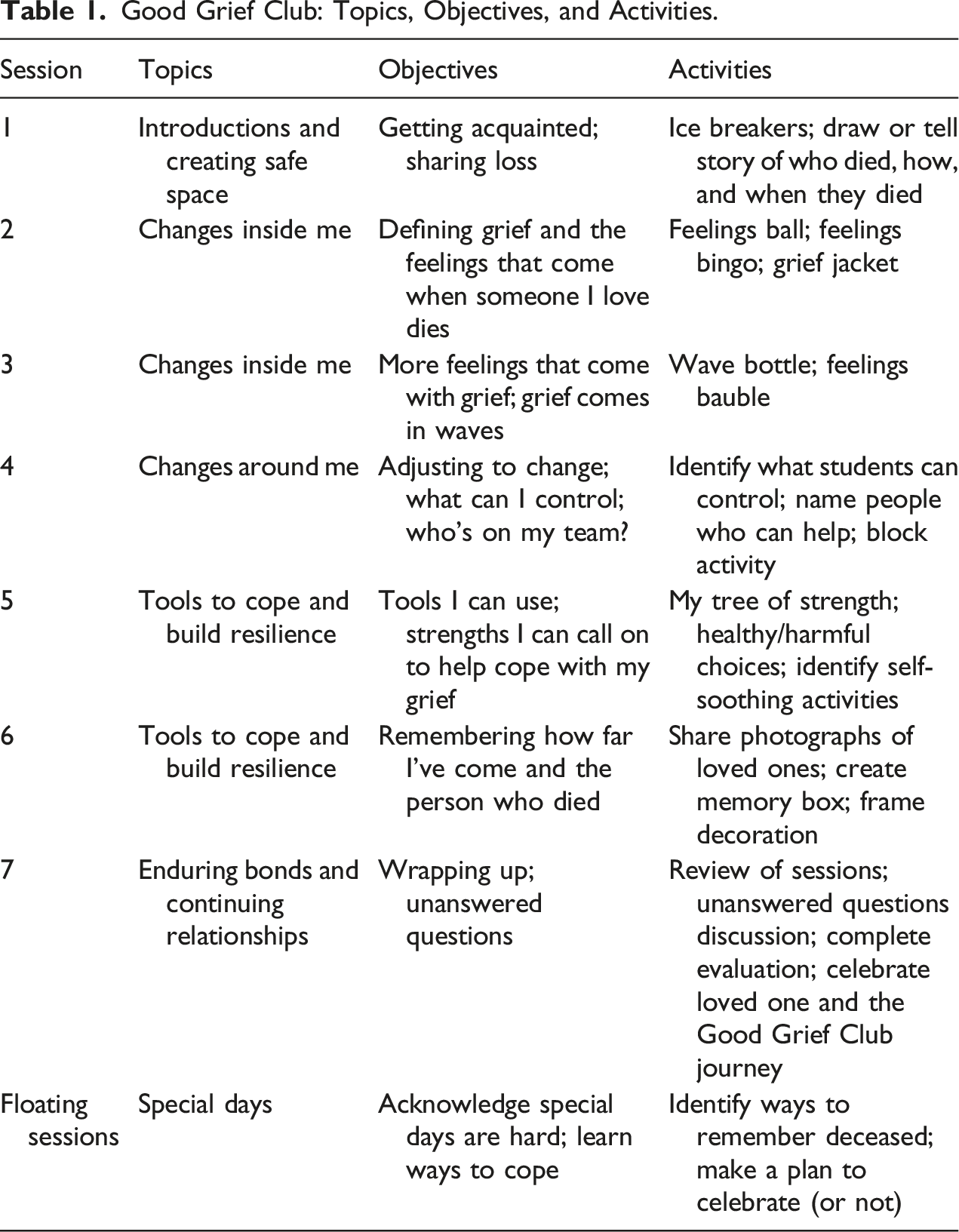
The community organization recruited and trained community volunteers to lead the grief groups. Adult volunteers have been shown to be effective in providing interventions in school settings (e.g., reading programs for struggling readers, Villiger et al., 2019; tutoring for elementary and middle school students, Ritter et al., 2009; and volunteer-facilitated peer support groups, Wassef et al., 1998). The Good Grief Club volunteers participated in a three-day training that provided a comprehensive overview of loss, grief, end-of-life experiences, and hospice care. Volunteers then completed an additional 2-day training on leading grief groups. After completion of both trainings, volunteers were approved to become group facilitators and received a manual outlining the group sessions along with materials for the group activities. Organization staff maintained close contact and provided ongoing support to the facilitators.
Grief groups were scheduled when school counselors contacted the community organization or when community organization staff contacted schools and learned of the need for grief groups. A minimum of four students were required for each group. Students were referred to the groups by teachers, counselors, or parents/guardians. If the school counselor determined that the child was ready and appropriate for the grief group based on individual meetings with the student, written permission from parents/guardians was sought by the counselor. After receipt of permission, an individual intake session was scheduled with the student and the group facilitator to further assess student readiness and suitability for the group and, when appropriate, to invite the student to participate in the grief group. Students who agreed to participate began the seven-session grief intervention. Attendance in the grief groups was approximately 86%.
Based on research, the stated goals/content of the group interventions and the reading level of the students, staff at the community agency developed and revised the assessments over time. They also collected and entered the evaluation data from students, group facilitators, and school counselors. University researchers were then invited to join the community partnership to assist with a preliminary evaluation of the effectiveness of the grief groups. After receipt of Institutional Review Board approval, non-identifiable data were shared with the university researchers.
Measures
Elementary School Student Evaluation.
The community agency developed an evaluation form for students in grades 3 through 5 that asked students to indicate yes (3, illustrated with a smiling face), maybe (2, a face with a line for the mouth), or no (1, a downturned mouth face) to 12 items. Six items that reflected the main purposes of the groups were included in this study: “I know more about grief after Good Grief Club,” “I now know that there are other students who are grieving like me - I’m not alone,” “I learned to talk about my feelings in Good Grief Club,” and “I had a chance to share my feelings about who died.” Students also indicated whether they learned coping strategies (i.e., “In Good Grief Club, I learned some ways to feel better during difficult feelings or times”) and whether they would recommend the group to a friend who experienced a death (i.e., “If my friend had a loved one who died, I would tell them to come to Good Grief Club”).
Middle School/High School Student Evaluation.
An evaluation form was created by the community agency that asked students to rate their agreement with 13 items on a scale from 1 (strongly disagree) to 4 (strongly agree). Five of the items that reflected the main purposes of the groups were included in this study: “I know more about grief after coming to Good Grief Club,” “I now know that there are other students who are grieving like me – I am not alone,” “Good Grief Club has helped me to better identify and talk about my feelings,” “I had a chance to share my feelings and story of loss,” and “I would recommend the GGC to a friend who had a loved one die.” One open-ended question asked students to identify two strategies that they plan to use during difficult times (i.e., “What are two tools/strategies that you plan to use during difficult feelings and times?”).
Group Facilitator and School Counselor Evaluation.
The evaluation form included four Likert-type items assessing observed changes in the students on a scale from 1 (strongly disagree) to 4 (strongly agree). Specifically, group facilitators and counselors were asked to respond to the following items: “Most (over half) of the students learned more about grief,” “Most (over half) of the students learned that there are other students grieving – they are not alone,” “Most (over half) of the students were better able to talk about their feelings,” “and “Most (over half) of the students learned new ways to cope with feelings of grief.”
In addition, one open-ended question asked group facilitators to describe a student who had made a huge positive change as a result of the group intervention. The school counselors were asked to share an anecdote based on their interactions with students in school that described how the Good Grief Club helped a specific child with regard to changes in the child’s emotional, academic, or social behaviors.
Demographics.
The parents/guardians and the children provided the child’s grade in school, gender, race/ethnicity, relationship with the deceased, how the person died, and the length of time since the death.
Data Analyses
With regard to the quantitative data, means and standard deviations were calculated for the items of interest in this study. Directed content analysis was used to identify common themes in responses to the open-ended questions (Roberts, 2001). In this structured form of content analysis, existing research was used to inform initial coding themes or categories for the data (Hsieh & Shannon, 2005). First, guided by prior research and knowledge about the group intervention, possible themes were generated by a research team consisting of one professor, four graduate students (all of whom had conducted grief-related research), and four undergraduate students who were majoring in psychology. Next, teams of two reviewed responses to each question and created additional themes.
After training, two team members independently coded the responses for each question into themes. When there was disagreement about the themes, the team members met to discuss the discrepancies and to achieve consensus. On a small number of responses, the coders were unable to agree and a graduate student or professor contributed a code for the response.
Results
Means and Standard Deviations on the Likert-Response Evaluation Items.

Note. ES = elementary school students; MS = middle school students; HS = high school students. The ES items used a 3-point scale (1–3), while the remaining were on a 4-point scale (1–4).
Using a scale from 1 to 4, the middle and high school students agreed with the statements that they learned more about grief (M = 3.47, SD = .62), they now knew other students who were grieving, and they realized that they are not alone (M = 3.67, SD = .47). The group also helped students identify and talk about their feelings (M = 3.43, SD = .67) and share their feelings about the death (M = 3.66, SD = .50). Almost all of the participants agreed that they would recommend a friend to the grief group (M = 3.69, SD = .54).
The group facilitators, using a scale from 1 to 4, agreed that most of the students learned more about grief (M = 3.45, SD = .50) and learned that they were not alone (M = 3.81, SD = .40). They noted that most of the students in their group were better able to talk about their feelings (M = 3.54, SD = .54) and had identified new ways to manage their grief (M = 3.51, SD = .51). Similarly, the school counselors overwhelmingly agreed that most of the students learned more about grief (M = 3.88, SD = .46), realized that they were not alone (M = 3.91, SD = .43), were better able to talk about their feelings (M = 3.81, SD = .51), and identified new ways to manage their grief (M = 3.78, SD = .53).
In addition, several themes emerged regarding group outcomes for the students as noted by the group facilitators and school counselors (outcomes that were reported at least four times are noted in Table 3; initials of students have been changed in the examples). The most common themes among group facilitators and school counselors were that the groups provided students with a place to share their feelings and that participation in the group activities increased over time. One facilitator wrote: S. had been told her entire life that she is NOT GRIEVING her mother, who died giving birth to S., because she never “knew her.” In this group she heard for the first time in her life that of course she has a right to grieve and deserves support without condition. She flourished in this group, wept often, and smiled in a way her counselor said she had never seen before. She told me at the end that this experience changed her life. Themes for Responses to Questions Posed to School Counselors and Volunteer Group. Facilitators. Note. All themes in which N < 4 were not included.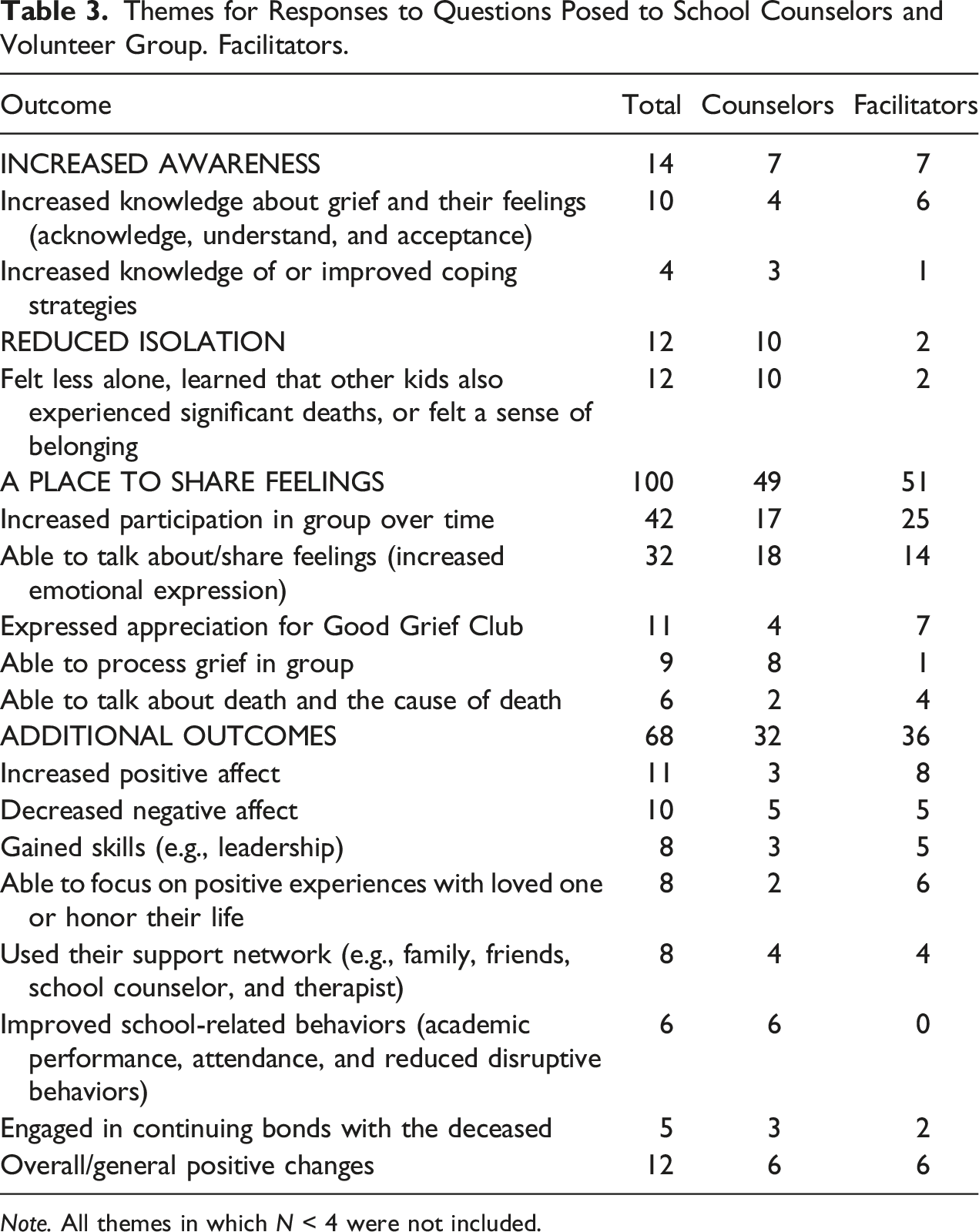
Similarly, another group facilitator wrote: One student who lost [a] family member to death by suicide stated in week 6 that after sharing and talking in group realized they have been thinking about suicide and reached out and spoke to counseling and at home to get help they need.
Additional themes reported by the facilitators and counselors were that the students felt less alone and they learned that others also experienced significant deaths: One student, an 18-year[-]old female, did not talk about death and suicide in her family. This was her first opportunity to talk with others about her grief and to know that others had also experienced loss. In fact, all of the students commented that it was good to know they were not alone.
Furthermore, themes emerged indicating that a number of students gained knowledge of grief and coping skills. For example, one counselor wrote, “Students stated that they understood the grieving process more. They also explained that they had a toolbox of coping skills at their fingertips.” School counselors and group facilitators also observed improvements in affect and positive changes related to school emerged. One school counselor wrote, “One male student had not spoken about his father's death. His coping was to act as class clown. Since his participation in group his grades have improved and his referrals have decreased.” Finally, themes emerged related to group members using their social support networks and demonstrating an enhanced ability to focus on positive experiences related to the deceased: One of our students has done the group two times. He had to process the violent death of his sister and is able to focus more on her life rather than how she died. He is moving on to 6th grade now.
The coding spreadsheets with a list of the themes and the coding of the data for each theme are available from the first author.
Coping Strategies Identified by Middle and High School Students.
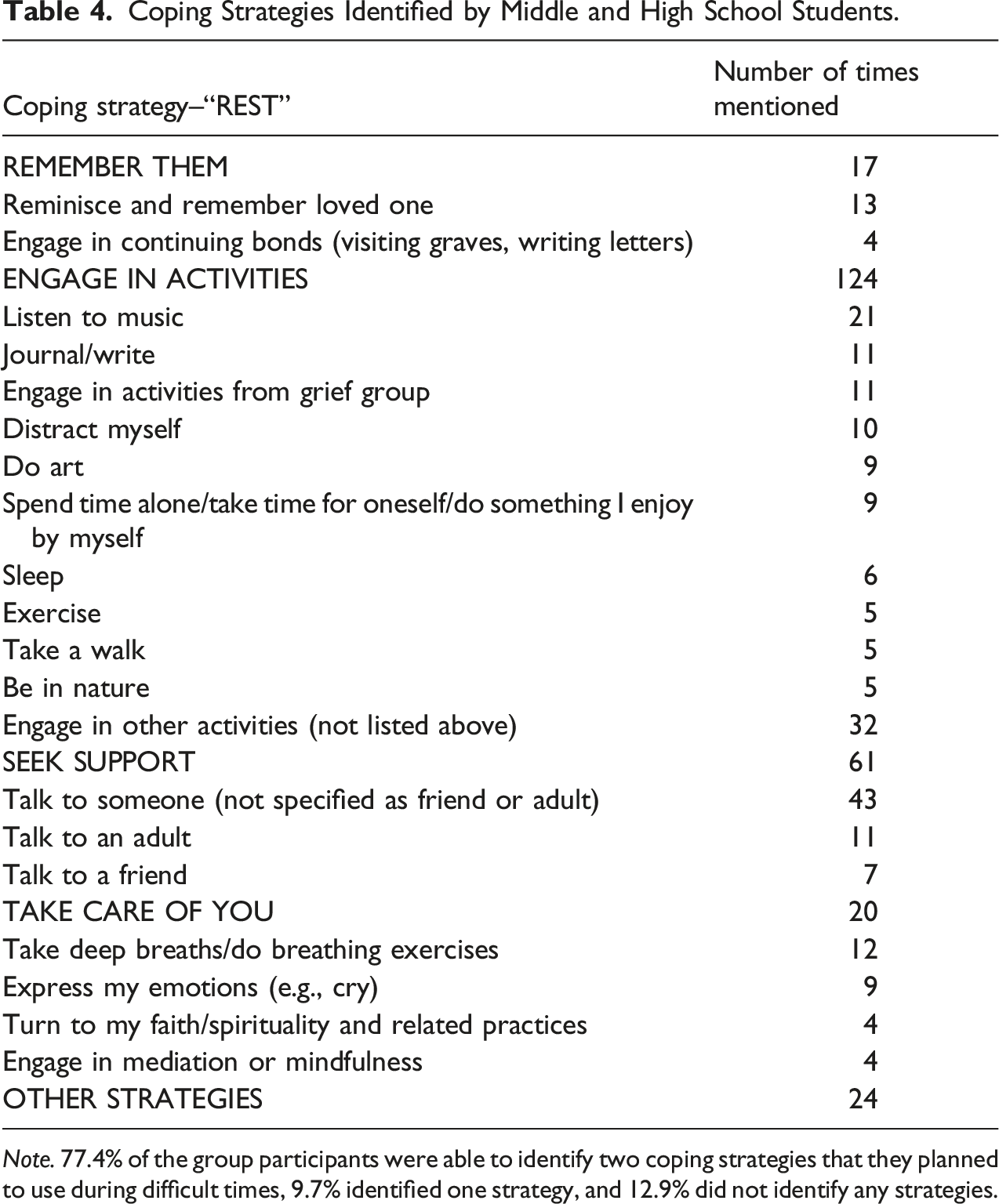
Note. 77.4% of the group participants were able to identify two coping strategies that they planned to use during difficult times, 9.7% identified one strategy, and 12.9% did not identify any strategies.
Discussion
Grieving children are at risk for negative outcomes (American Academy of Child and Adolescent Psychiatry, 2020). This study advanced existing research by conducting a preliminary evaluation of the effectiveness of grief groups for large numbers of diverse students in elementary, middle, and high schools using data collected from students, school counselors, and grief group facilitators. Prior studies typically had small sample sizes; did not include information about race or focused on predominantly White samples; rarely investigated students across elementary, middle, and high schools; and did not collect data from students, school counselors, and grief group facilitators (Metel & Barnes, 2011; Ross & Hayes, 2004; Tillman & Prazak, 2018). Notably, our grief groups were a promising intervention for diverse students with regard to enhancing awareness about grief, reducing isolation, providing a place to share feelings, and learning coping strategies. This research is of considerable importance given the devastating and increasing numbers of children grieving the deaths of parents and caregivers due to COVID-19 (Treglia et al., 2021). If replicated, our findings could inform the improvement of the current Good Grief Club and the development, implementation, and evaluation of future grief group interventions for bereaved children.
Consistent with prior research (Ross & Hayes, 2004), students, group facilitators, and school counselors overwhelmingly noted that the group provided students with a place to share their feelings. Providing the opportunity to express and process feelings after a significant death could potentially prevent negative psychological outcomes that could occur if feelings were not expressed in a healthy manner. Children’s grief may be disenfranchised (i.e., not recognized or acknowledged) by adults who may perceive children as not understanding or being less affected by the death. For many children, the grief group may be their only place to express feelings as children sometimes are reluctant to talk with family members about their grief for fear of causing them more pain.
Consistent with the tenets of prevention interventions, including those focused on children (APA, 2014), the grief groups can be viewed as a mechanism to reduce negative grief outcomes and to enhance long-term health. The Good Grief Club taught diverse children about grief, information that can be used as children age as they may revisit the death of a significant person over time and during special days or events. Moreover, like the findings from Tillman and Prazak (2018), the group helped children identify specific healthy coping strategies, tools that they can use throughout their lives and that may possibly prevent prolonged grief disorder (i.e., continued preoccupation and intense longing for deceased, intense emotional pain, and ongoing difficulty functioning and adjusting to the loss; Prigerson et al., 2009; Shear, 2015). Similar to Metel and Barnes (2011), the children also learned that they are not alone and that other children in their school community experienced profound losses, thus reducing the isolation that many children feel after the death of a significant person. It is possible that children may be more likely to experience posttraumatic growth (i.e., positive changes as a result of a challenging life event; Tedeschi & Calhoun, 2004) over time if they receive support from a grief group after experiencing a significant death.
Several school counselors also reported noteworthy school-related outcomes for the diverse children in the grief groups including improved academic performance. Educating children and teachers about healthy strategies for coping with grief could reduce disruptive behaviors in the classroom. School districts, school counselors, and teachers might be willing to offer grief groups in their schools as they may benefit not only the grieving children, but also their peers and the classroom learning environment.
It is important to note that the grief groups were available to students at no cost and during their school day, thus providing highly accessible and completely affordable services to diverse groups of grieving children. Holding the groups in schools likely increased the number of children who received the intervention as adult family members often are grieving and may be overwhelmed, making it less likely that they could arrange for transporting the children to weekly groups held outside of school. Furthermore, providing free groups to children during school improves equitable access to grief services for families with fewer economic resources.
Limitations
With regard to this study (and reflective of many community intervention evaluations), the greatest limitations were the lack of pre-test data and control groups, which did not allow the assessment of the degree to which the desired outcomes changed over time and as a result of the intervention. In addition, the measures were created by the community organization and did not have established psychometric properties. The question on coping strategies assessed what students planned to do when struggling with their grief, as opposed to what they actually did during challenging times. Furthermore, young children may not answer survey questions in a reliable manner. The group facilitators and school counselors may have been biased toward seeing positive outcomes because of their investment in the grief groups and because of the way in which the questions were worded. Additionally, all of the facilitators were White and demographic information was not collected for the school counselors. Family members were not involved in the intervention; although, their involvement could have extended the benefits of the grief groups for the children by ensuring that family members also had knowledge about grief and healthy coping strategies. Moreover, family members could have provided helpful observations regarding changes in the students as a result of participation in Good Grief Clubs. Finally, the research did not assess whether the effects of the group lasted over time.
Future Research Implications
Future researchers should administer pre- and post-test surveys and conduct randomized clinical trials with control groups to assess the effectiveness of the group intervention. The university researchers might be involved at the start of the project to share knowledge of psychometrically sound measures and access to research databases. In addition, measures with established psychometric properties should be used. Ideally, multiple forms of assessment would include parent/guardian and teacher ratings of change over time. Longitudinal investigations are needed to determine if early intervention prevents long-term negative outcomes, particularly mental health consequences. Students could be surveyed several months after the conclusion of the group to determine if they retained knowledge about grief, used the coping strategies that they learned, and had any suggestions for improvements to the intervention. Furthermore, consistent with the findings of Currier et al. (2007), future research should examine whether group interventions might be most effective for children when delivered close to the time of the death and if the child demonstrates a clear need for treatment. An evaluation of posttraumatic growth after group participation would also be of considerable interest.
In addition, the findings of this and future investigations should be shared beyond academic conferences and journals. In particular, school boards, counselors, teachers, and administrators, as well as PTA/PTSA members and parents/guardians, would benefit from learning about the effectiveness of grief groups for bereaved children.
Future Counseling Implications
School-based grief interventions for diverse students are desperately needed given the devastating numbers of COVID-19–bereaved children, especially children of color (Treglia et al., 2021). Given the promising nature of the intervention, a manual describing the group activities could be standardized and disseminated widely. In communities that may not have the resources to train volunteers to facilitate grief groups in their schools, school counselors can be taught to implement the components of the groups that appeared most helpful (i.e., providing grieving students with a place to share feelings, perhaps through after-school clubs). Knowledge about grieving could be shared in health classes at all grade levels, and students could be educated about how to respond to grieving peers to reduce isolation (Hill & O’Brien, 2021). Grieving students could be taught about common strategies to cope with death using an acronym (REST) based on our findings: remember them, engage in activities, seek support, and take care of you. Moreover, the grief groups could inform the development of community interventions for grieving families to provide family members with a space to share feelings, reduce isolation, and learn coping skills.
Furthermore, as there was considerable diversity among the students who participated in the grief groups and given that culture profoundly affects responses to death and grieving practices (Rosenblatt, 2008), opportunities for children to share their cultural traditions could be integrated into each group session. For example, group participants could be invited to share cultural traditions related to remembering the deceased or bring foods representing their cultures to the final celebratory session of the Good Grief Club. In addition, the recruitment of diverse group facilitators and school counselors to lead Good Grief Clubs could enhance the experiences of the diverse students in the intervention.
Future Implications for Community Partnerships
Working with community agencies to conduct program evaluations provides the opportunity to be involved in meaningful research with significant real-world implications for preventing problems and facilitating positive outcomes. Goodman and colleagues (2004) cautioned against “drive by data collection” in which researchers obtain data from communities with no involvement in their work or no reciprocity with regard to learning and sharing the results of the research. Recently, Barrio Minton et al., 2021 provided a guide for engaging in collaborative partnerships to conduct program evaluations that ensure that the voices of community members are represented. Partnerships with community organizations can advance social justice and ideally enable scholars to both learn from community members and use their knowledge to improve the lives of others (APA, 2017).
Conclusion
Prevention interventions seek to reduce negative outcomes and enhance future well-being (APA, 2014). This preliminary evaluation of school-based grief groups suggested that the Good Grief Club is a promising prevention intervention for diverse students from the perspectives of the students, group facilitators, and school counselors. Continued research is needed to ensure the potential of grief groups to lessen negative outcomes and to promote positive functioning among children who experience the death of a significant person.
Footnotes
Author’s Note
The authors express gratitude to Shereen Ashai, Dylan Cooper, Madelyn Harris, Micah Herman, and Karoline Trovato for their assistance with coding the qualitative data and interpreting the findings.
Declaration of Conflicting Interests
The author(s) declared no potential conflicts of interest with respect to the research, authorship, and/or publication of this article.
Funding
The author(s) received no financial support for the research, authorship, and/or publication of this article.
