




Abstract
Positive psychology interventions (PPIs) have the potential to bypass barriers to seeking mental health services by promoting well-being without the cost and stigma. Research on PPIs thus far has focused on depressed individuals as well individuals who sought out PPIs on their own. It is less clear, however, whether the promising findings on PPIs could extend to PPIs effectively reducing levels of vulnerability factors in individuals at risk for depression. Rumination is a perseverative cognitive process and named as a transdiagnostic risk factor for psychopathology. The current study tested the efficacy of a gratitude-writing intervention in college students who had high scores of rumination. Participants completed either the gratitude-writing or distraction task for 4 days. The gratitude-writing exercise was significantly more effective than the distraction exercise in reducing the brooding subtype of rumination and in increasing positive affect. Implications for the use of this intervention include its potential to increase confidence in PPIs and to serve as a stepping stone for young adults to seek mental health resources.
Access to mental health services is still an issue for many populations, especially young adults and college students (Cadigan et al., 2019). Although most universities provide free counseling and mental health services, a large portion of students reporting high levels of distress often do neither receive care nor attempt to access this care (Eisenberg et al., 2007). College students have reported social stigma and a preference to handle problems alone as critical barriers to care (Ebert et al., 2019). Hence, efforts to promote mental health need to take these concerns into consideration.
Positive psychology interventions (PPIs) are uniquely positioned as possible interventions that could reach a broader audience without the cost and stigma associated with seeking mental health services. Furthermore, these interventions can be self-directed with minimal instruction, which also addresses students’ desire to handle problems on their own. PPIs are unique in that they work to target positive affect rather than reducing negative affect. Clark et al. (1990) provided evidence that depressed individuals not only report high levels of negative affect but also report low levels of positive affect. Much of the work to date treating mental illness has focused on challenging negative thoughts rather than focusing on promoting more positive emotions (Butler et al., 2006; Hofmann et al., 2014). Thus, interventions aimed at increasing positive affect are also worthy of further study as they may target a different mechanism of action.
Positive Psychology Interventions
The introduction of positive psychology in the late 1990s and its associated interventions generated much research excitement. Early studies and meta-analyses (e.g., Sin & Lyubomirsky, 2009) demonstrated medium effect sizes for enhancing psychological well-being and decreasing depressive symptoms. However, follow-up meta-analyses critiqued earlier methodology (e.g., Bolier et al., 2013; White et al., 2019) and suggested that the effect of PPIs on well-being and depression may be much smaller than previously reported. Dickens (2017) conducted a meta-analysis that is specific to gratitude-based interventions. The author made similar observations about gratitude interventions in that while they have significant effects on outcomes such as well-being, happiness, grateful mood, positive affect, and decreased depressive symptoms, the effect sizes tend to be in the small-to-medium range. Given these relatively small effect sizes, White et al. (2019) called for further research to identify the most optimal conditions in order to design more effective PPIs.
Bolier et al.’s (2013) analyses found higher effect sizes on depression outcomes for studies conducted on individuals with psychosocial problems. Similarly, a meta-analysis of PPIs on well-being in clinical samples showed promising results in improving well-being and reducing distress (Chakhssi et al., 2018). As such, one important avenue of examination of the effectiveness of PPIs may be to focus on individuals at risk for depression rather than the general population. To date, research on PPIs has shown promising positive effects in depressed and non-depressed individuals (Sin & Lyubomirsky, 2009), suggesting that PPIs have potential for preventing new onsets of dysphoria and depression in at-risk individuals. However, studies have not tended to examine PPIs’ effect on individual risk factors of depression. Thus, rumination is an important risk factor for depression that is likely a good target for PPIs. Rumination is a perseverative thought process that tends to prolong depressed mood and hasten the onset of depression (Nolen-Hoeksema et al., 2008). More specifically, a gratitude-based intervention may benefit those with high ruminative tendencies the most by replacing their negative thought processes with a more positive pattern of thinking, interrupting the perseverative process that hastens depression onset. The previous research findings on gratitude interventions resulting in greater positive affect also suggest PPIs may promote mental health in individuals at risk for depression (Sin & Lyubomirsky, 2009).
Rumination is considered a transdiagnostic factor, in that it plays a role in explaining both the co-occurrence and etiology of depression and anxiety symptoms (McLaughlin & Nolen-Hoeksema, 2011). These findings highlight the need for interventions that target rumination to reduce the likelihood of inception and/or maintenance of emotional disorders. Treynor et al. (2003) first identified brooding and reflection as two subtypes of rumination. Reflection consists of thinking about how to solve and cope with one’s problems, whereas brooding consists of thinking anxiously about and dwelling on one’s problems, (Treynor et al., 2003). The brooding subtype has stronger associations with experiences of depressive symptoms and is thought to be less adaptive (Hasegawa et al., 2014; Treynor et al., 2003). It is important to identify those at risk based on rumination, but a focus on targeting the brooding component for interventions may be more consequential for reducing and preventing depressive symptoms.
Other factors to consider in the relative effectiveness of PPIs is the duration and intensity of the interventions (White et al., 2019). With regard to duration, Sin and Lyubomirsky (2009) found that PPIs are likely to be more effective in increasing well-being if they are employed over longer periods of time. Studies involving interventions lasting as long as 12 weeks may allow the participants to turn the positive intervention into a habit. At the same time, frequency of PPIs is also an important consideration. Sheldon et al. (2012) demonstrated a hedonic adaptation effect in which benefits of these interventions are not sustained if people participate in the same positive activity over time; participants habituated to the positive effects of the interventions. They recommend that studies vary the positive intervention in which participants engage; or, if participants are engaging in the same PPIs such as a gratitude intervention, they suggest that future efforts vary the gratitude task assigned to encourage consideration of new aspects of their life and experiences for which participants are grateful.
In considering the frequency of PPIs, there is one study to date that showed an iatrogenic effect due to participating in the same gratitude exercise too many times (Renshaw & Hindman, 2017). Participants in the gratitude intervention conducted the activity three times a day for 2 weeks, leading to iatrogenic effects in increased depressive symptoms and lowered gratitude. These findings so far underscore the importance of finding a good balance in terms of frequency and duration of PPIs. Studies to date that had participants engage in an intervention once a day for 1 to 2 weeks produced significant changes in happiness, well-being, positive affect, and depression (Emmons & McCullough, 2003; Mongrain & Anselmo-Matthews, 2012).
Expressive Writing and Gratitude
In terms of gratitude interventions, much of the early work focused on having participants name three good things in their lives. Following a meta-analysis of the current literature, White et al. (2019) suggested that intensity and depth of the gratitude task are important avenues of further study in order to better understand how to maximize the positive impact of gratitude-based interventions. Based on the work on hedonic adaptation (Sheldon et al., 2012) and the earlier finding in increased frequency of a gratitude task having an iatrogenic effect (Renshaw & Hindman, 2017), an effective gratitude task should exceed superficially touching on a topic, yet it should not overtax participants to the extent that positive effects wear off. Gortner et al. (2006) found that an expressive writing task compared to a control condition significantly decreased depressive symptoms in a sample of students with previous history of depression, with effects maintained 6 months after the intervention. Based on Pennebaker’s (1997) expressive writing paradigm, the intervention consisted of three consecutive days of writing for 20 minutes each day. Participants wrote about their deepest thoughts and feelings regarding emotional situations they had experienced.
Expressive writing interventions appear to be a promising method of altering emotional states. In a meta-analysis, D’raven and Pasha-Zaidi (2014) highlighted both gratitude and writing as being effective strategies in interventions. Studies that have combined gratitude and writing have shown that gratitude-focused expressive writing is effective in increasing well-being and decreasing depressive symptoms (Booker & Dunsmore, 2017; Toepfer & Walker, 2009). Taken together, the literature shows that practicing gratitude may have promising outcomes that can be built upon by having participants immerse themselves in an expressive writing task. The present study proposes a 10-minute writing exercise to determine if expanding upon positive aspects in one’s life, as opposed to listing them, can have a greater impact on mood.
To date, the positive psychology literature demonstrates a small-to-medium effect and more research is needed to clarify the circumstances under which PPIs are most effective. The current study proposes targeting highly ruminative individuals, whom are therefore at greater risk for depression, by providing them with psychoeducation and an approachable intervention. Furthermore, we propose to test a gratitude-based intervention that can become self-directed after some instruction and provide greater depth and intensity than previous “name three good things” approaches. We propose that individuals who tend to ruminate and who engage in this intervention will have lower levels of negative affect, depressive symptoms, and rumination, as well as higher levels of positive affect compared to individuals in a distraction condition.
Method
Participants
A total of 603 undergraduate students completed the rumination and depression prescreen measures. Based on this total sample, the upper quartile cutoff for rumination was 24 or higher. Additional inclusion criteria included a depression score of 28 or less, and those individuals did not endorse any level of suicidal ideation. Of the 603 students who completed the prescreen, 72 individuals were excluded for high depressive symptomology and/or endorsing suicidal ideation. In all, 122 students scored in the upper quartile on rumination, met the depression screening criteria, and were eligible to sign up for the study. Of the 122 eligible students, 78 participated in the study. Ten participants failed to complete the necessary follow-up measures and were excluded from further analyses, yielding a final sample of 68 participants. An analysis comparing participants who were included in the final analyses versus those who were excluded indicated that they did not differ in distribution between the two study conditions, χ2(1, N = 78) = .03, p = .862. Additionally, excluded participants did not differ from included participants in demographic variables including gender, χ2(1, N = 78) = 1.52, p = .217, age, t(76) = 1.67, p = .100, ethnicity, χ2(3, N = 78) = 2.56, p = .465, or family income, χ2(8, N = 78) = 6.33, p = .610. Pretest scores were also not different for the depression measure, t(76) = 0.23, p = .823, or the rumination measure, t(76) = −0.88, p = .382 between those who were included and excluded. Overall, these findings indicate that the exclusion of participants from the study was not systematic in nature.
The study analyses were conducted on 68 participants (53 females and 15 males). The average age of the sample was 19.6 (SD = 1.46). The sample was predominantly White (80.9%), 11.8% identifying as Asian/Asian American, 5.9% Black/African American, and 1.5% Latino/a American. The sample was upper middle class with a significant majority (85.3%) reporting family income over $50,000 and more than half of the sample reporting income greater than $100,000.
Procedure
Study procedures and materials were reviewed and approved by the Institutional Review Board. Participants who met the eligibility criteria of the study were invited via email to participate and selected a timeslot that fit their schedule for the workshop portion of the study. Workshops were conducted on Mondays and an equal number of timeslots for the gratitude and distraction conditions were offered. Across different Mondays, the order of which timeslot was associated with which study condition was counterbalanced. For the Monday workshop, all participants completed: (a) baseline (Time 1) measures of rumination, affect, and depression and (b) the instructional workshop on the writing intervention. Participants received either the gratitude-based workshop or the distraction workshop.
For the four consecutive days following the workshop, participants completed their specified writing exercise online once per day, for approximately 10 min each day, at a location of their choosing. On those days, they received the reminder and link to do the task at 5 p.m. and were asked to submit their entry by midnight. On the fourth day of the intervention, participants completed the writing exercise, along with Time 2 rumination and affect scales. Seven days after the intervention began (i.e., the following Monday), participants were emailed the Time 3 assessment measures, which included rumination, affect, and depression scales.
Gratitude-Based Intervention
Each participant attended a 30-min workshop with the experimenter in which they were provided with information on rumination and told they had been selected for the study based on their rumination scores. The experimenter explained the concept of rumination and its association with depression. Participants in the gratitude-writing group were introduced to the writing task and told it may be beneficial to focus more on positive emotions to help overcome their ruminative style of thinking. Focusing on one or two things they are grateful for each day means participants can express in detail how and why those things affect them and what they mean to them. During the workshop, participants practiced the writing technique for 3 min, received feedback, and were given examples of topics to explore in their writing. The distraction and gratitude-writing group workshops were identical, except for the task explanation. Participants in the distraction group were told that writing objectively about their day may serve as a distraction from their negative emotions. Subsequently, participants practiced the writing technique for 3 min, received feedback, and were given example topics to explore in their writing.
Both groups in this study were presented with a writing prompt as their experimental manipulation, for which they were expected to type a response for 10 min per day. Pilot testing suggested a character requirement of between 1,700 and 3,000 to capture 10 min of writing. The form would not submit unless the participants’ writing fell in that range. Participants in the gratitude condition were prompted each evening to write in-depth about one or two things they noticed throughout the day for which they were grateful. Participants in the distraction condition were given a distraction task that prompted them to write in detail about how they had spent their time so far that day. This prompt for the control condition mirrors those used as control conditions in traditional expressive writing studies (e.g., Gortner et al., 2006).
Measures
Rumination
The current study used a short-form of the Ruminative Response Scale (RRS; Nolen-Hoeksema & Morrow, 1991; Treynor et al., 2003), which consists of 10 questions with half of the items tapping into the construct of brooding and the other half tapping into reflection. Each question is rated on a Likert scale from 1 (almost never) to 4 (almost always). Participants are asked to indicate how often they engage in certain brooding behaviors, with items such as, “Think about a recent situation, wishing it had gone better,” and reflective behaviors, such as, “Analyze recent events to try to understand why you are depressed.” The original RRS consisted of 22 items, but authors had expressed concerns about item overlap deemed similar to items measuring depression (Conway et al., 2000). The 22-item RRS has demonstrated good internal consistency (α = .68–.80) and moderate test–retest reliability over a 6-month time interval (ICC = .53) among college samples (Roelofs et al., 2006). Treynor et al. (2003) conducted a further analysis to remove similar item content, resulting in the short-form of the RRS comprised of brooding and reflection subscales. We had selected vulnerable participants based on the overall 10-item questionnaire. However, Nolen-Hoeksema et al. (2008) suggested that the reflection subscale may be neutral or positive in nature. Thus, only the brooding subscale was examined at follow-up to capture changes in the negative aspects of rumination. The brooding subscale has demonstrated good concurrent (r = .44) and predictive validity (r = .37) with depression, as measured by the Beck Depression Inventory (BDI; Treynor et al., 2003). For the Time 2 and 3 assessments, the scale was adapted to assess for a specified period (e.g., “the past 4 days” for Time 2). Internal consistency for the RRS for the present sample at α = .73 is comparable to that found for previous studies (Treynor et al., 2003). The internal consistency for the brooding scale (α = .66) is adequate but slightly lower than the .77 found in previous studies (Treynor et al., 2003).
Affect
The Positive and Negative Affect Schedule (PANAS; Watson et al., 1988) is a 20-item self-report scale used to assess affect in adolescents and adults. Participants are asked to rate the extent to which they feel certain emotions on a scale from 1 (very slightly or not at all) to 5 (extremely). Sample items on the scale include “Interested,” “Distressed,” and “Enthusiastic.” The PANAS has two 10-item subscales, which separately measure positive and negative emotions denoting positive and negative affect. The current study used the PANAS to assess how participants felt in the present moment. Previous research has shown that the psychometric properties of the PANAS for the “present moment” are very good; internal consistency for the PANAS is strong, with Cronbach’s alpha of .89 for the Positive Affect scale and .85 for the Negative Affect scale (Crawford & Henry, 2004). In the current sample, internal consistency is also very strong for positive affect (α = .94) and negative affect (α = .85). Negative affect on the PANAS has demonstrated good convergent validity with the Depression, Anxiety and Stress scale (DASS; Lovibond & Lovibond, 1995), depression subscale (r = .60) and anxiety subscale (r = .60); Crawford & Henry, 2004). The PANAS has also demonstrated discriminant validity as the positive affect scale negatively correlated with the DASS depression subscale (r = −.48) (Crawford & Henry, 2004.)
Depressive symptoms
The BDI-II (Beck et al., 1996) assesses depressive symptoms. The BDI-II is a 21-question self-report scale measuring depression in adolescents and adults. Participants are given a series of statements for each topic and asked to choose which one best describes how they are feeling; the statements have point values ranging from 0 to 3. Scores on the BDI-II range from 0 to 63, with higher scores representing higher levels of depression; specific ranges are given for minimal (0–13), mild (14–19), moderate (20–28), and severe (29–63). In the present study, participants were asked about their feelings only in the past week, in order to assess changes in depressive symptoms after the intervention. The BDI-II has demonstrated very good internal consistency with Cronbach’s alpha of .92 and .93 for clinical and non-clinical samples (Arbisi, 2001). In the present study, internal consistency is high (α = .84). Test–retest reliability is also high, correlating at .93 after 1 week (Arbisi, 2001). When scores on the BDI-II were compared with scores on the Hamilton Psychiatric Rating Scale for Depression-Revised (Riskind et al., 1987) in a clinical sample, adequate convergent validity was found (r = .71). A moderate correlation (r = .47) was found between scores on the BDI-II and the Hamilton Anxiety Rating Scale-Revised (Riskind et al., 1987), indicating good discriminant validity.
Results
Overview of Analyses
Data screening was conducted and two outliers were found in this sample, such that their scores were more than three standard deviations above the mean for depression score at Time 3 and rumination score at Time 3, respectively. These outliers were winsorized, meaning that they were replaced with next highest score, which was not an outlier, to preserve their rank while reducing their influence (Field, 2013).
Mixed-factorial analyses of variance were conducted for each dependent variable to determine if the gratitude-writing group had scores indicating lower rumination (brooding), higher positive affect, lower negative affect, and lower depressive symptoms following the intervention when compared with the distraction group. For the mixed-factorial analyses, Time was a within-subject factor and Intervention was the between-subject factor.
Randomization Check
Participants in the study chose a convenient timeslot in which the timeslots that were associated with the gratitude or distraction condition were counterbalanced (e.g., the Monday 1 p.m. workshop was the gratitude condition 1 week and the distraction condition the next week). We conducted analyses to check that participants in the two study conditions were not different from each other on demographic and baseline study measures. Of the 68 participants who took part in the study, 36 were in the gratitude-writing group (52.9%) and 32 were in the distraction group (47.1%). The groups did not differ in demographics including gender, χ2(1, N = 68) = 1.29, p = .255, ethnicity, χ2(3, N = 68) = 3.17 p = .367, or family income, χ2(8, N = 68) = 7.04, p = .533. At pretest, scores did not differ in depression (BDI-II) scores (t(66) = −0.12, p = .905), or rumination (RRS) scores (t(66) = −0.14, p = .891). In contrast, participants in the distraction group (M = 19.22, SD = 1.24) were slightly younger than the participants in the gratitude group (M = 19.94, SD = 1.57), t(65.14) = 2.13, p = .037. Despite the group differences in age, we did not include it as a covariate because age did not correlate with any of the study variables including rumination, brooding, reflection, positive affect, negative affect, or depression (r’s between −.07 and .14). The randomization check demonstrated that the two groups were largely similar to each other at the baseline.
Study Analyses
Baseline BDI-II scores for the sample was 10.90 (SD = 6.63), and the rumination score was 25.87 (SD = 3.93). In terms of dosing, 88% of the participants completed all four daily writing prompts and the remaining 12% completed three writing prompts.
Brooding
A 3 (Time) × 2 (Intervention) mixed-factorial ANOVA was conducted to test for differences in brooding scores. 1 There was a significant interaction between time and intervention group, F(1.55, 102.05) = 4.76, p = .017, η2 = .07. Post-hoc analyses were conducted to contrast the change between Time 1 and Time 2 versus Time 1 and Time 3. There was a significant Time-by-Intervention interaction for Time 1 and Time 2 (F(1, 66) = 6.61, p = .012, η2 = .09) such that participants in the gratitude-writing group experienced a greater decrease in brooding scores from Time 1 (M = 13.53, SD = 3.02) to Time 2 (M = 9.64, SD = 3.29) compared with those in the distraction group from Time 1 (M = 12.47, SD = 2.49) to Time 2 (M = 10.88, SD = 3.80). The interaction pattern is weaker when comparing Time 1 to Time 3 (M = 10.59, SD = 3.50), F(1, 66) = 3.79, p = .056, η2 = .05. No differences were found between groups from Time 2 to Time 3, F(1, 66) = 1.77, p = .188, η2 = .03. Interaction effects for brooding are displayed in Figure 1.
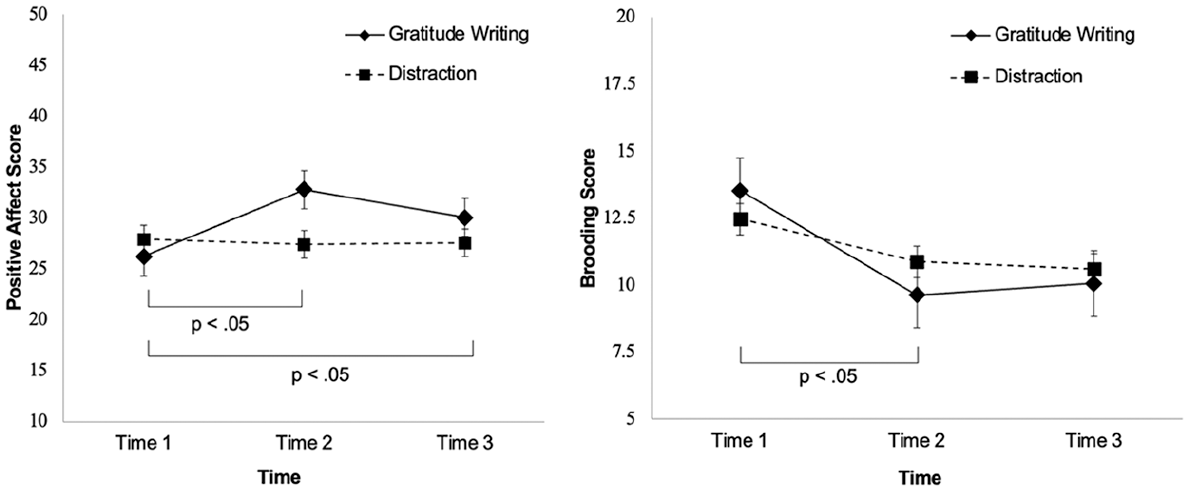
Changes in positive affect and brooding scores across three time points.
Positive affect
A 3 (Time) × 2 (Intervention) mixed-factorial ANOVA was conducted to test for differences in positive affect scores. There was a significant interaction between time and intervention group, F(2, 132) = 7.56, p = .001, η2 = .10. Post-hoc analyses indicated a significant Time-by-Intervention interaction from Time 1 to Time 2 (F(1, 66) = 12.60, p = .001, η2 = .16) such that participants in the gratitude-writing group experienced a greater increase in positive affect scores from Time 1 (M = 26.22, SD = 10.01) to Time 2 (M = 32.78, SD = 10.50) compared with participants in the distraction group from Time 1 (M = 27.91, SD = 8.72) to Time 2 (M = 27.41, SD = 10.89). Another significant interaction was found between intervention groups from Time 1 to Time 3 (M = 30.06, SD = 11.34), (F(1, 66) = 5.56, p = .021, η2 = .08) with the gratitude-writing group having a greater increase in positive affect scores compared to the distraction group. This pattern was not found between groups from Time 2 to Time 3, F(1, 66) = 2.86, p = .096, η2 = .04. Interaction effects for positive affect are displayed in Figure 1.
Negative affect
A 3 (Time) × 2 (Intervention) mixed-factorial ANOVA did not find a significant interaction (F(2, 132) = 1.12, p = .330, η2 = .02), nor a main effect of intervention, F(1, 66) = .15, p = .703, η2 < .01. However, there was a main effect of time (F(2, 132) = 4.50, p = .013, η2 = .06) across the three time points. Across both groups, negative affect scores changed significantly among Time 1 (M = 18.85, SD = 6.72), Time 2 (M = 16.74, SD = 5.99), and Time 3 (M = 17.74, SD = 6.83). Post-hoc analyses indicated a significant main effect of time between Time 1 and Time 2 (F(1, 66) = 9.36, p = .003, η2 = .12), such that both intervention groups had lower negative affect scores at Time 2 compared to Time 1. There was no main effect of time found between Time 2 and Time 3 (F(1, 66) = 2.12, p = .15, η2 = .03).
Depression
A 2 (Time) × 2 (Intervention group) mixed-factorial ANOVA on BDI scores was conducted because BDI was not measured at Time 2. There was no interaction effect, F(1, 66) = 1.67, p = .201, η2 = .03, and no intervention effect, F(1, 66) = .01, p = .926, η2 < .01. There was, however, a main effect of Time with depression scores being significantly lower at Time 3 (M = 7.59, SD = 6.67) compared to Time 1 (M = 12.31, SD = 6.61), F(1, 66) = 58.47, p < .001, η2 = .47.
Discussion
The purpose of the current study was to test a more approachable intervention to reduce rumination in university students. The present study compared a gratitude-based expressive writing intervention to a distraction writing intervention in individuals who tend to ruminate. Existing interventions targeting rumination or depression are usually administered by a trained therapist, and therefore not as accessible to a broad population. However, a unique model of delivery was utilized in this study in which a therapist was not involved in its implementation. The gratitude-writing intervention technique was distinctive; in that, it was based on positive psychology and aimed to increase positive emotions, compared to typical interventions that seek to reduce negative emotions or pathology.
The study hypotheses were largely supported with the gratitude-writing group experiencing greater reduction in brooding and greater increases in positive affect compared to the distraction group. However, this pattern of finding did not extend to measures of negative affect and depressive symptoms. Nevertheless, considering that the participants scored highly on rumination and may often dwell on the negative rather than the positive, the increase in positive affect in this particular sample is especially important and very encouraging. Given the previously demonstrated impact of gratitude-based interventions on promoting positive affect in both the general population and in depressed samples (Sin & Lyubomirsky, 2009), the present results are particularly noteworthy for extending the pattern of results to at-risk individuals. One implication is that the intervention promotes mental well-being and has the potential to prevent depression onset. More research is needed with longer follow-up to better assess the longevity of the effect on promoting positive affect and reducing brooding. In addition, long-term follow-up is needed to evaluate whether the intervention lowers the likelihood for developing depressive symptoms with increased doses of the intervention and sustained positive affect over time for participants.
All participants in the study attended a brief in-person workshop that explained what rumination is and involved practicing their respective intervention (gratitude or distraction). It is possible that scores on brooding, the more deleterious subscale of rumination (Treynor et al., 2003), were lower at follow-up due to a subject-expectancy effect. However, participants in the gratitude intervention group experienced a larger decline in brooding scores compared to participants in the distraction group, suggesting that the effect is due to something unique to the gratitude task and not simply their awareness of scoring highly on rumination. It should be noted that participants in the gratitude-writing intervention group experienced decreases in rumination similar to the pattern seen for brooding but with slightly smaller effect sizes. The contrast of effect sizes for reductions in rumination and brooding further highlights the current intervention’s distinct ability to target the more harmful aspect of rumination. This pattern of results suggests great promise for PPIs not only to increase positive emotions but also to actively reduce perseverative negative thinking patterns, which have been identified as a transdiagnostic risk factor for psychopathology (McLaughlin & Nolen-Hoeksema, 2011).
The gratitude intervention was also associated with greater increases for positive affect compared to the increases for the distraction intervention condition. Clark et al. (1990) noted that depressed individuals not only experience higher negative affect, but also experience lower positive affect compared to individuals who are anxious. Hofmann et al.’s (2014) meta-analysis on cognitive behavioral therapies for depression demonstrate that the treatments tend to lower negative affect. Clark et al.’s (1990) work would suggest that increasing positive affect should also be an important target for intervention. Interventions focused on increasing positive affect may be used alone or in combination with traditional therapy that reduces negative affect. To date, behavioral activation is one of the few traditional therapies that aims to increase positive affect. The premise of behavioral activation is to perform activities that are pleasant and positively reinforcing to strengthen the individual’s connection between their behavior and well-being. Behavioral activation has been shown to increase positive affect in a range of populations among clinical and non-clinical samples (Mazzucchelli et al., 2010). Thus, the gratitude-writing intervention in the current study provides an additional avenue to increasing positive affect.
It should be noted that while positive affect increased greatly as a result of the gratitude-writing intervention, there was no effect on negative affect. Since the exercise was rooted in positive psychology, the intervention had a greater capacity to change positive affect from the start. It is possible that negative affect in participants may take longer to be influenced in that the exercise was not designed to target negative thoughts directly, but rather indirectly over the course of time. Additionally, the mechanisms used to target negative affect and positive affect could be entirely different. Due to a need for techniques to specifically target negative affect, more studies should examine the influence of PPIs on negative affect.
In addition to negative affect scores, the gratitude intervention did not predict a differential reduction in depression scores. The current sample did not include any participants with clinical depression, so drastic changes in depression scores should not be expected to occur over just 1 week for these participants. Furthermore, 1 week is a short time to expect changes in depressive symptomatology. Interventions targeting rumination that have shown decreases in depressive symptomology among mildly depressed or dysphoric populations were typically employed over multiple weeks (e.g., Watkins et al., 2012). Research has shown that the brooding subtype of rumination, which decreased significantly in the current study, is associated with experiencing depression in the past (Hasegawa et al., 2014), at the present time (Raes et al., 2011; Whitmer & Gotlib, 2011), and in the long term (Schoofs et al., 2010; Treynor et al., 2003). Since brooding was reduced in the current study, it seems promising that depression could be reduced as a result of this type of intervention. For instance, Chakhssi et al. (2018) found a significant reduction in depression for PPIs lasting longer than 8 weeks in clinical samples.
Post-hoc tests for all significant interactions showed that the largest change in outcome scores occurred between Time 1 and Time 2. This pattern in change may have occurred because 4 days of consecutive writing occurred between these two time points, and the outcome measures were examined at the end of the active intervention. The pattern of results shows that the gratitude-writing intervention had immediate effects in increasing positive affect and in reducing brooding following the writing exercise. Furthermore, this pattern of results following 4 days of the writing intervention suggests that there may be a dosing effect and the effect may not last as consistently to day 7 without continued engagement. Nevertheless, it is noteworthy that despite days without doing the gratitude-writing intervention, the increase in positive affect and decrease in brooding appear to have been sustained in that the main effect of time was significant from Time 1 to Time 3. This finding raises the question of whether individuals must consistently perform these tasks in order to maintain the positive effects of the intervention. In keeping with the hedonic adaptation model, the dosing and frequency of performing the task may be altered to produce the greatest effects. For example, Emmons and McCullough (2003) showed the effects of a 2-week gratitude intervention were maintained 9 weeks later. These findings suggest that rather than viewing the gratitude-writing intervention as an “intervention,” it may need to be employed as a newly adapted habit in order for the positive effect to be sustained.
Limitations and Future Directions
The promising findings in the present study should be considered alongside a few limitations. First, the sample consisted of mostly White, upper-middle class, female college students. It is unknown if the results would be generalizable to other populations, such as individuals of different ethnic backgrounds, income levels, or other age groups. Conversely, an advantage in the current study was the ability to select individuals who tend to ruminate more frequently, granting the opportunity to examine the effects of an intervention on an at-risk sample. However, this quality of the study may also play out as a disadvantage in that a universal prevention approach cannot be taken. The current findings suggest that gratitude interventions may be able to interrupt people’s ruminative experiences if a targeted sample of at-risk individuals can be selected. Some evidence suggests that inducing a positive mood after a stressor reduced rumination compared to control groups (Bahrami et al., 2012). This hypothesis would need to be further investigated, as well as the increase in positive affect as a potential mediator of reducing rumination. Future work is also needed to examine whether people can self-identify as high ruminators and self-select for a targeted intervention. Another limitation of the present study is the intervention length, which included a workshop and the 4 days immediately following it. It is unclear if the positive impact of the intervention could be sustained over time. The study design matches that of traditional expressive-writing designs, but given the positive findings, it is worth exploring additional dosing frequencies and longer follow-up periods to test what might be the most optimal program frequency and length.
Conclusions
The gratitude-writing intervention developed for the current study was effective in reducing brooding and increasing positive affect in college students with a tendency to ruminate. The novel intervention combined gratitude and expressive writing while targeting a population vulnerable to depression. The delivery method of the intervention is easily accessible and largely self-guided. Further research investigating the efficacy of differential dosing and intensity may provide a sustainable, self-guided therapeutic outlet to promote mental health and well-being. Finally, this type of positive psychology intervention has the potential to increase confidence in individuals who have had little exposure to psychological interventions or those who may be reluctant to seek out mental health resources.
Footnotes
Declaration of Conflicting Interests
The authors declared the following potential conflicts of interest with respect to the research, authorship, and/or publication of this article: We wish to confirm that there are no known conflicts of interest associated with this publication, and there has been no significant financial support for this work that could have influenced its outcome. This research did not receive any specific grant from funding agencies in the public, commercial, or not-for-profit sectors. We confirm that the manuscript has been read and approved by all named authors and that there are no other persons who satisfied the criteria for authorship but are not listed. We further confirm that the order of authors listed in the manuscript has been approved by all of us. We confirm that we have given due consideration to the protection of intellectual property associated with this work and that there are no impediments to publication, including the timing of publication, with respect to intellectual property. In so doing, we confirm that we have followed the regulations of our institutions concerning intellectual property. We further confirm that any aspect of the work covered in this manuscript that has involved human participants has been conducted with the ethical approval of all relevant bodies and that such approvals are acknowledged within the manuscript. We understand that the corresponding author is the sole contact for the editorial process (including editorial Manager and direct communications with the office). They are responsible for communicating with the other authors about progress, submissions of revisions, and final approval of proofs. We confirm that we have provided a current, correct email address which is accessible by the corresponding author and which has been configured to accept email from
Data Availability Statement

Funding
The authors received no financial support for the research, authorship, and/or publication of this article.