



Abstract
Research into disability is often complex and simultaneously involves multiple aspects of patients, health professionals, carers and the situations within which patients live and care is received. Qualitative research into healthcare in general, and more specifically disability, must likewise incorporate the multiple important components of the care situation. In this paper I present the declarative mapping sentence method for conducting qualitative research with a particular emphasis upon its use in undertaking studies into disability and rehabilitation. The declarative mapping sentence is a sentence in ordinary English language that incorporates the important features (facets) of a domain of research interest along with sub-divisions of these facets (called elements). The facets are joined together using ordinary language (connective ontology) with great care so as to suggest the real life relationships between facets. In this paper I explore the components of the declarative mapping sentence in some detail and offer illustrative examples of a declarative mapping sentence developed for use in disability research. I draw attention to and discuss the advantages of using this method in disability and other health related research and suggest that the approach offers a framework within which to understand patients and healthcare professionals within context.
Keywords
Introduction
Over the preceding seven decades much psychological research, and other forms of research that are concerned with patient well-being, have adopted a top-down approach 1 in which the hypothetico-deductive method has been employed and theories have been tested.2,3 This approach has strength in the confidence that statistical procedures are able to offer to their results, but this strength is also its weakness as the outcome of analyses is either significant or not significant and respectively the hypothesis or theory that underpinned the research. Furthermore, it has been argued 4 that in this type of enquiry, research questions may be operationalisations of the research hypothesis through the empirical description of the independent and dependent variables. However, there have been advocates for a more bottom-up approach in psychology that undertakes data to theory research. 5
Research into health in general and into disabilities in particular has a subject matter that recommends itself to qualitative forms of data gathering and analysis. Furthermore, it may be argued that the way a researcher attempts to understand the health of individuals or groups of people is intimately related to the philosophical ideas and stance they take towards research. 6 Researchers such as Hackett and Hayre, 7 Rapport and Braithwaite 8 and many others would argue that meaningful insight into patients and their experience of health, illness, disease and well-being can best be achieved using qualitative research approaches. Such a statement is at least in part due to the subject matter often being related to sensitive issues, features of life that are socially taboo or which possess a stigma, personal experiences, etc. In these situations participants may be unwilling to reveal such intimacies when surveyed. In such instances a researcher may have to employ an approach that includes some form of observational procedure along with openly talking, participating and sharing with those they are interested in. Taking such an approach, they hope, will allow them to get to know their participants and to be trusted by them. Ultimately it is believed that this form of research will yield data in which researchers may have confidence. Thus, qualitative data research has a unique relevance in the study of all forms of health, well-being and illness. With the particular strengths and appropriateness of qualitative research (data collection and analysis) in mind, the declarative mapping sentence method 9 for designing, conducting and analysing qualitative research is proposed as an additional or alternative approach that is useful to health and disability researchers.
Approaching qualitative research and analysis
Qualitative research is widely used in health-related research (see for example10,11) and may be thought of as existing within two overarching types. The first of these involves the transformation of qualitative data by converting it into some form of numerical information. 12 By turning qualitative data into a quantitative format the researcher is able to make initial hypotheses about the nature of the subject of the research.
We will not dwell on this approach as we are concerned with an approach to qualitative research that preserves the integrity of the richness of the insights present in the data by maintaining its qualitative nature. On this second understanding of qualitative research data takes the form of narratives that may be thematically coded. 12 It is often the case that the development of a coding procedure is not a one-off process that comes before an analysis but rather is an active undertaking during which theories are generated about the content of the data and the interrelationships of themes that are present in its content. Coding is not developed and then analysis performed but rather initial coding hypotheses are generated and refined, deleted, added-to, etc.,13,14 throughout the analytic process. During this process theories are redesigned and reintegrated in the light of the researcher’s reflections and by doing such things as writing memos about the properties of the theoretical structural categories that the researcher has developed 1 .
The declarative mapping sentence method9,15–17 is an extension of the above immersive qualitative approach to analysing qualitative research data that has been used in many substantive research areas, which include: the characteristics of clinical reasoning 18 ; ethnographic health research19,20; the impact of Covid-19 on transport planning in Austria 21 ; for use within a talk-therapy setting as a clinical tool 22 ; illuminating relationships between people, technologies and concepts in complex systems 23 ; the appreciation and understanding of fine art24–28; student experiences of their higher education and their lives29–31; visual impairment27,28; religious experiences 32 ; bird behaviour 33 ; the classification of Cetacea 34 ; Philosophy35–37; racial discrimination 38 ; using information technology. 39
When using a declarative mapping sentence the process I have alluded to of continually revisiting the original data throughout an analysis is combined with explicitly stating the initial structure or categories hypothesised to be present in the data and modifying this initial theory regarding the content of the research domain. Thus, the declarative mapping sentence utilises an explicit coding procedure involving continually revisiting and revising in the theory development process. By bringing together as a single analysis procedure a researcher’s initial explicit hypotheses with continually revisiting the data results in the development of theories about the data’s structure. It is also a systematic and thorough way of generating theories about the meaning of the data being analysed. Furthermore, as the initial hypotheses are not rigidly held and are constantly tested and revised they do not hinder theory development by imposing a pre-determined coding schedule upon a data set.
Another benefit of the declarative mapping sentence method is that its use does not impede the subtle and sensitive understanding that the researcher develops of the qualitative information that is being analysed. Instead, the method aims to draw out such sensitivities toward the data and the generation of theories based upon a growing appreciation of its content. Using a declarative mapping sentence depends upon the empathetic understanding and skill of the researcher. Furthermore, the use of this method allows direct comparability between two or more researchers who are working on the same data set, whilst not meaning that they necessarily arrive at exactly the same result. The essence of the declarative mapping sentence is that it has a structure but that it also allows for vagueness and individuality in theory generation. The declarative mapping sentence affords this by offering an initial theory that is intimately associated with the information being analysed, that is consistent and is an integrated format. The theoretical structures embodied in a declarative mapping sentence are also readily turned into research procedures that are able to interrogate the proposed theoretical structures.
Another characteristic of the declarative mapping sentence method is that it simultaneously addresses multiple hypotheses which are not all assumed to structure or to have an influence within the data at a similar level of generality or specificity: the level of generality becomes apparent through the researcher continually revisiting the data (Devine-Wright 23 comments on such an interactive process when using declarative mapping sentences). However, the hypotheses are assumed to intermingle to constitute the domain of interest within a definite theoretical structure.
The declarative mapping sentence method is different to that employed in an analytic induction approach,40–42 which also has the aim of producing an integrated account of a research domain. However, differently to the declarative mapping sentence analytic induction also aims for exact and universally generalisable theories that are associated with causes of specific occurrences and experiences. Declarative mapping sentence method takes a different approach to analytic induction and proffers not proofs but credible and equitable propositions as to the theoretical structure and content of the domain being investigated. Causal associations are not a necessary or even likely outcome from the use of a declarative mapping sentence method and circumstances, situations, effects, dimensions, sorts, types, categories and sub-categories, processes, etc., are the more frequent outcome. Furthermore, declarative mapping sentence methods do not require similar types of data within a single or multiple studies. Any format of qualitative data that arises from observations, interviews, ethnography, projective techniques, netnography, textual narratives, auto-ethnography, etc., gathered in person or online, may be included in a declarative mapping sentence method study. In addition, quantitative methodologies may also be embodied in the declarative mapping sentence methodology either on their own or in combination with qualitative approaches (mixed method).
The declarative mapping sentence method
So far in this paper I have described some of the qualities of the declarative mapping sentence method to qualitative research and I will now present the method in greater detail. The first thing to note is that the method starts at the stage within a research project of generating ideas that underpin the study and are influential at all stages of the research process including the design of a research procedure, analysis, interpretation of findings and the suggestion of the meaning of results and the proposition of future research. The declarative mapping sentence method can be understood by thinking about the eight stages involved in its usage. Stage one is made up of the often somewhat vague cogitations by the researcher upon his or her area of research interest. The researcher then progresses through reflexion on this, integration and organisation of their thoughts in regard to their experiences and the literature that exists that impacts upon the area of research interest. At this stage the researcher is jotting down what he or she is starting to think are the pertinent features of their research domain. When using the declarative mapping sentence method the pertinent features in a research domain are termed facets and sub-aspects of these are called elements. Stage two takes the jottings that have been developed in stage one and refines these into a smaller subset of features (facets and elements) which the researcher joins together in the form of a sentence which suggests the initially expected relationships between the main aspects (facets and elements) of the area of interest. During this time initial attempts are also made to identify which aspects, amongst all of the pertinent features of a research domain, may be seen as categories (or facets) that contain other features (or elements) and which are the sub-categories (elements) of which categories (facets). During stage three the researcher writes an initial declarative mapping sentence during which the facets and elements identified in the previous stage are incorporated into the sentence. Words and phrases are tentatively chosen to reflect the hypothesised relationship between the facets and their elements in reference to the domain of interest. It should be kept in mind at this stage that this initial declarative statement is very likely to be altered as the research design progresses. Stage four embodies a process that is repeated throughout the use of the declarative mapping sentence method and that involves the researcher in standing back from the research process and reflecting upon the declarative mapping sentence produced in relation to the research domain and if necessary modifying the sentence in terms of the facets and elements it contains and their interrelationships. In stage five when conducting primary research the researcher has to design their data gathering approach based upon the declarative mapping sentence. Questions, observations, analysis templates, focus group interview schedules, in-depth interviews, digital ethnographies, etc., are produced using the structural hypotheses present in the study’s declarative mapping sentence. That is, instruments are developed that incorporate the facets and elements of the declarative mapping sentence organised in such a manner as suggested by the sentence and its connective phrases. Data are then gathered using the instruments designed. Stage six begins the analysis. At Stage 6A the researcher considers and compares features, events, incidents, etc., in the data that are germane to description offered by the facets and elements in the sentence and seeks to add, delete or modify these declarative components. Stage 6B involves attempts to bring together the facets and elements in a way that provides a greater understanding of the way in which the facets interact in the experiences of those who are taking part in the study. This is a repetition of stage 4 and results in the modification of the initial declarative mapping sentence stated in stage 3. In essence this involves the honing of the sentence in relation to the data and results in the stating of a modified declaration of the pertinent components of an analysis in a declarative mapping sentence format.
During the processes involved in stages 6a & b the researcher codes events, incidents, states of affairs, etc., using the facets and elements present in the sentence and repeatedly compares and contrasts a current event or incident in the data with those coded earlier. By doing this, modifications of the sentence are suggested and these are noted. By comparing how different events have been coded using the sentence’s facets and elements suggests the bounds and the theoretical nature of the facets and elements and these may be modified accordingly. The more data that is coded the more fully the researcher comes to appreciate the ways in which the facets exist in the lives of participants and when and where the facets are particularly important, irrelevant, consequential, etc. They also become aware of how these facets and elements interact with the other facets and elements that are present in the declarative mapping sentence 2 .
At all points in the analysis process the researcher is encouraged to keep memos about the theoretical ideas that come to the researchers mind regarding the coding process and the structure of the sentence they are working with. It is imperative that the insights that a researcher has when working with a declarative mapping sentence to code data are recorded at the time of the analysis. This is of particular significance so as to allow sensitive and skillful insights that may be revealed during analysis to be incorporated into the study's declarative mapping sentence. It is also important that the analysis process is not rushed and that the researcher has the time to reflect methodically and systematically on the relationship between the data and the structure of the sentence in terms of its facets and elements and the ways in which these are connected together. The importance of this process cannot be overemphasised as it is to be remembered that the declarative mapping sentence not only attempts to provide an account for the pertinent aspects of a research domain it offers a plausible suggestion as to how these categorial aspects come together in the real world for participants in the study
3
. Stage seven involves using the declarative sentence developed in stage 5 to frame writing about the research that has been undertaken. This involves using the mapping sentence’s components (the facets and elements) to structure the presentation of a researcher’s findings and to offer details about how the data has been analysed. It also requires a researcher to reflect upon and justify their results and to use verbatim quotations and other forms of data to bring credibility to their interpretations. Stage eight requires the researcher to overtly delimit the extent of their findings and the bounds of the theoretical statements contained within the declarative mapping sentence.
It should be noted that the eight stages I have presented serve to illustrate the process of using a declarative mapping sentence. However, they suggest a rigid sequential procedure that is often not how the method ends up being used as the researcher who employs a declarative mapping sentence continually revisits the earlier stages of this process. It is also worthy of note that the declarative mapping sentence method may be used in team research projects to enable researchers to reflect upon points they may have missed or miscoded. In team research it is also possible to compare how each team member has used the sentence to code a given data set and to become aware of the similarities and differences between these.
Throughout the research project it is worth the researcher revisiting the procedure adopted when facets and elements are considered in relation to the declarative mapping sentence as a whole and to reflect upon these in relation to the empirical nature of the research domain. This commences by reflection on the experiences of researchers and the literature from which the study’s declarative mapping sentence was built. Once data is being scrutinised in analyses, notes, memos, etc., this feedback allows modification of the sentence’s facets and elements (Figure 1). Initial declarative mapping sentence for health practitioners’ assessment of the needs of a patient.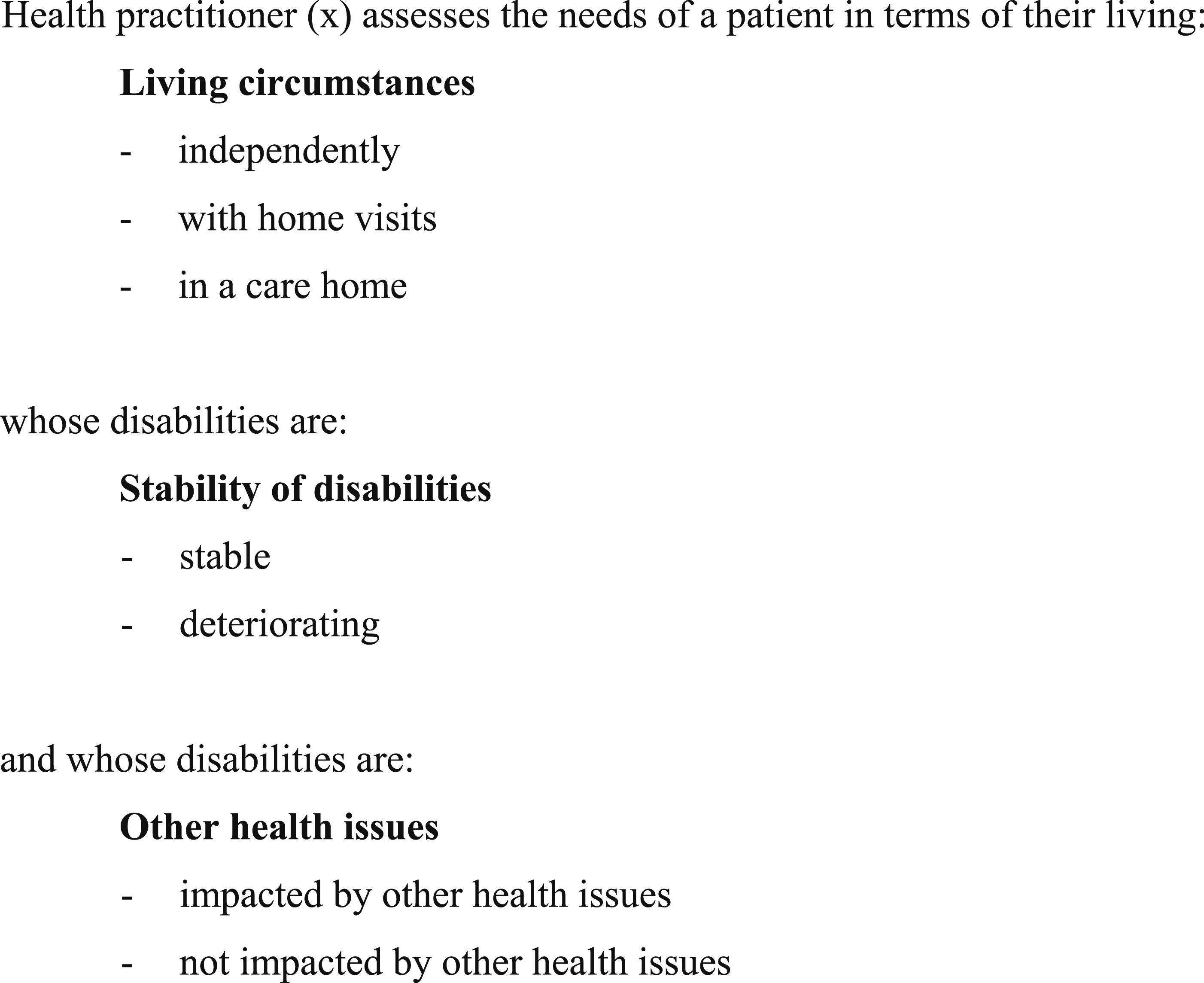
For example, if we take a piece of research that was concerned with how health practitioners understand the needs of their disabled patients, a very simple initial declarative mapping sentence was first written for the study as follows:
This example is an extremely simplified illustration of a declarative mapping sentence. In reality there would probably be more facets and facet elements with highly detailed connective phraseology. This example will however allow a greater understanding of the declarative mapping sentence and how this structure is modified during data analysis.
Returning to the example, the initial declarative mapping sentence was developed out of the researchers’ experiences with health professionals who care for people with disabilities and also out of their familiarity with literature on this topic. Data was gathered using the declarative mapping sentence to design an open-ended questionnaire and the sentence was used as a framework for coding the resulting narratives. It was found when analysing transcripts from a series of interviews with health professionals that the sample of professionals evaluated the mobility needs of patients and then modified their assessments based upon the progress of the patient’s disability. Once it had been discovered that the stage of a patient’s condition was intimately related to assessment of their mobility needs concentration was turned to better understanding in greater detail the elements or sub-aspects of the patients’ mobility. For example, patient autonomy in terms of determining their mobility was discovered to be an extremely important element of the facet of their mobility. This led to the inclusion of a facet of mobility (Figure 2): Modified declarative mapping sentence for health practitioners’ assessment of the needs of a patient.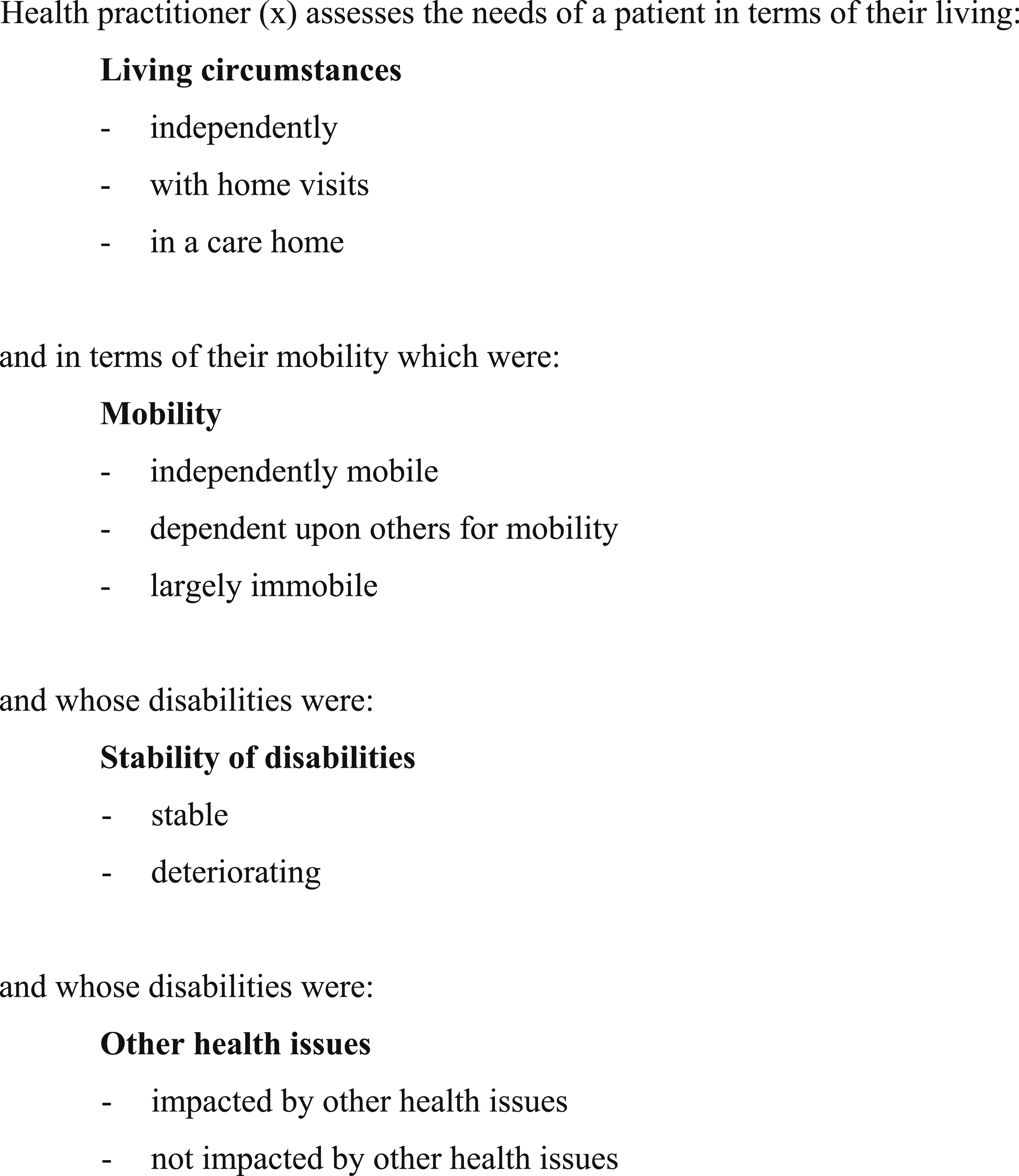
By using the declarative mapping sentence method it was possible to clearly specify and to draw bounds around the scope of the research study: health practitioners understand of the needs of their disabled patients. However, the flexibility of the approach enabled a new facet of professional consideration to be incorporated within the declarative mapping sentence and to refine the understanding of health practitioners’ relationship with their patients. It also became apparent that patients stories about their loss of mobility were related to the other facets (their living circumstances, the stability of their disabilities and their other health conditions) and the mapping sentence suggested a framework for the holistic experiences of patients. In this way the originally hypothesised facets were integrated with other facets that emerged during the research process. By using the declarative mapping sentence method with different health professionals and their clients it is possible to further develop a theory of health practitioners understanding of the needs of their disabled patients.
As I have already noted, as well as providing an account of the content of a domain of interest the declarative mapping sentence places boundaries around a research domain. That is, as well as declaring the pertinent aspects of a research domain it states what is not within the mapping sentence as not being part of the particular study. This boundary of exclusion is also flexible and is likely to move in response to the data that is gathered. For example, mobility was initially not considered as part of the domain of our research project but its inclusion became essential in order to understand the data that had been gathered. Thus, the declarative mapping sentence method mitigates against the inclusion of what could be irrelevant and overwhelming data whilst not being so rigid that it is not responsive to the evidences that is gathered. As more research with the declarative mapping sentence is conducted the sentence’s theoretical structure hardens and becomes more trustworthy as large modifications of the sentence become fewer. Modifications of the sentence do continue to occur but these tend to become in terms of the addition, deletion or modifications of facet elements and the words or phrases used to connect facets rather than the facets themselves. Such alterations are made to achieve a more logical structure to the sentence or to more clearly, parsimoniously and accurately define the nature of the phenomena under investigation. The connective phraseology in particular is subject to modification so as to better suggest the lived experience of the facets in the sentence. Elements may also be reduced in their number as overlap and redundancy may become apparent.
As well as the declarative mapping sentences’ content facets, background facets may be present that have an impact upon the domain of interest. In reference to the declarative mapping sentence for health practitioners’ assessment of the needs of a patient, a background facet that specified the type of profession a practitioner came from could be incorporated at the start of the sentence thus:
It is obvious that the understanding a health professional has of the needs of their patients will be influenced by their professional training and role with the patient. In the example in Figure 3 the professions of community nurse, hospital nurse, doctor, occupational therapist and social worker are specified but these may differ between patients. Each of these different types of professional would be expected to understand patient need and experiences in a slightly different way and this would impact upon the content of research interest. Therefore, background facets must be incorporated within a declarative mapping sentence in order to provide a full declaration of the research content. However, background facets, such as health professional type, are not actually a part of the experience of clients’ needs but rather they segment the types of experiences that professionals may have. Modified declarative mapping sentence for health practitioners’ assessment of the needs of a patient with background facet.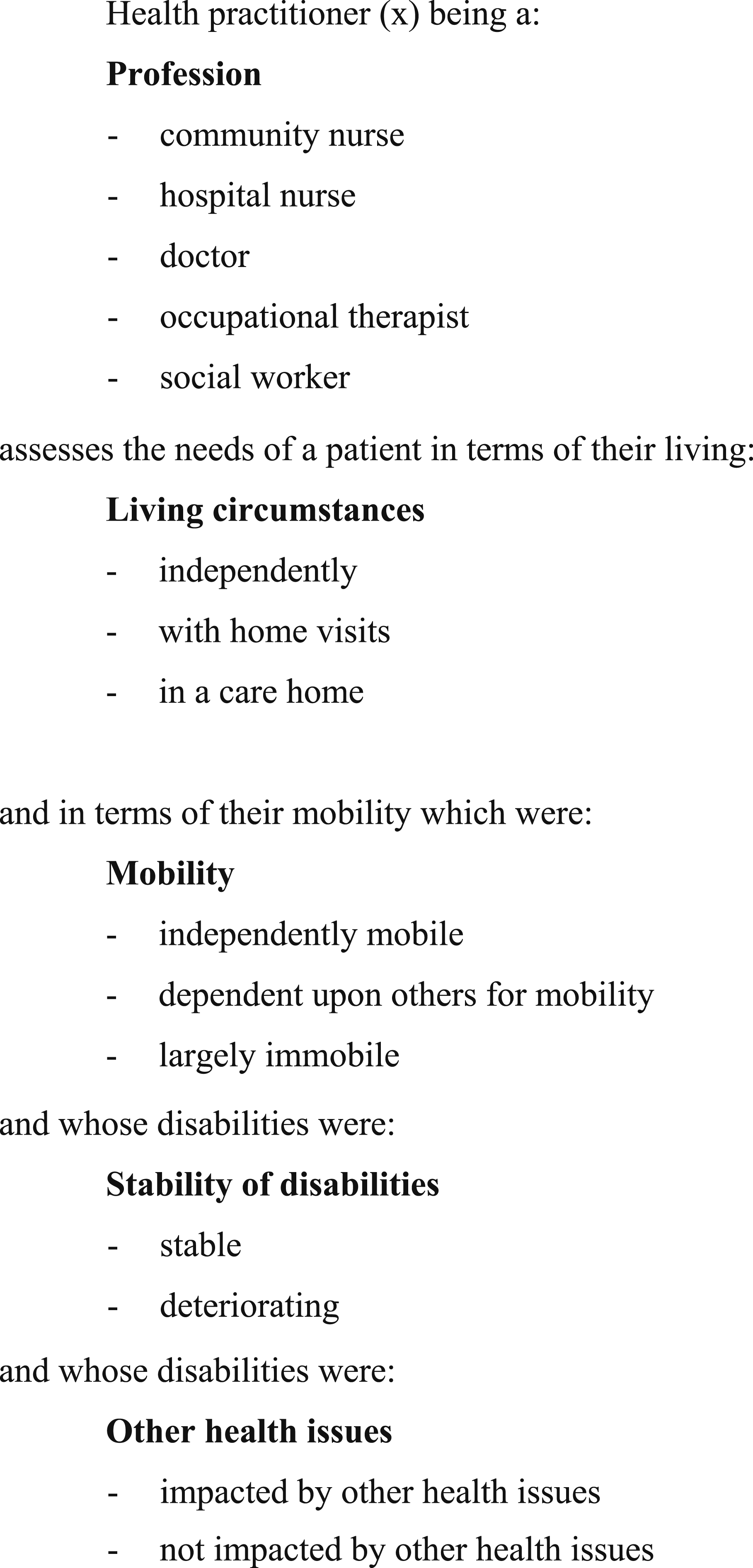
Through the thorough and sometimes exhaustive inclusion and exclusion of facets and their elements in a declarative mapping sentence it becomes a theory of the structure of the content of interest. Through further refinement it is also possible that the theory in the sentence may be modified to be appropriate for other similar areas of research. In the present example, through careful and reflective consideration and later data collection the declarative mapping sentence for the understanding a health professional has of the needs of their patients that we developed in relation to patients with a disability may be extended so as to be appropriate to other types of patients or to patients in general. It should be noted here that the generalisable aspects of the sentence are likely to be the content facets and the connective phraseology. The facet elements and the background are more likely to be specific to a given type of patient or healthcare situation. It is through the statement of an initial declarative mapping sentence and then its use with different types of patients, health professionals and within different medical situations that the declarative mapping sentence may be used to gather data and be found to have a more general application.
It is also the case that as a specific declarative mapping sentence is used in multiple studies and with a greater body of research data the process of data analysis becomes more focussed. The researcher develops an understanding of the qualitative data he or she is working with and coding and is able to delimit the facets and facet elements into which he or she is coding in accordance with the mapping sentence and more detailed and refined appreciation of the data becomes possible. It is then possible therefore to apply more energy to the exact nature of the categories or themes (facets) a respondent employs rather than the development of the categorial or thematic structure a respondent is employing. It also becomes obvious that the categories (both the facets and their elements) are eventually theoretically full or complete. The repeated use of a declarative mapping sentence to code data will suggest that when a phenomena has been coded on multiple occasions into a given category it is relatively easy to identify when a new or novel aspect of the phenomena can be coded in this way or if a modification of the facet is needed in terms of element adaptation.
A declarative mapping sentence is a collection of independent facets of personal experience that are comprised of sub-elements that are themselves independent aspects of the facet’s content. The elements of a facet are increased in number or sub-divided until they become saturated and new data can be coded without the addition of a new element. The process of adding, modifying and deleting facets and their elements is central to any project in which the declarative mapping sentence is employed. Indeed, in such research the statement of an initial declarative mapping sentence is the theoretical start of the research which continues through a series of modifications to the sentence and ends in the statement of the refined sentence as an empirically upheld statement of the research content.
A declarative mapping sentence is a theoretical delimitation of a research content in terms of the facets and elements used to describe it. Confidence is established in the declarative mapping sentence through the saturation of it categories by the data collected. If necessary, more data is collected in order to extend the theoretical limits of the sentence. However, this is a frugal exercise as the data gathered is analysed within the structural qualities of the declarative mapping sentence, which allows the paring down of large amounts of qualitative information. This mitigates against the problem that may come about when dealing with large amounts of data themes and categories can become almost arbitrary and may not lead to the establishment of consistent understanding of a research area.
Writing a research report using the declarative mapping sentence method
When writing a research report or other document based upon the findings of a research project that has used a declarative mapping sentence methodology the facets and the elements of the sentence form the titles or sections within which writing is broken-down. For example, research that used the mapping sentence in Figure 3 would be likely to have section that discussed the influence upon health care professionals understanding of their patients’ needs of the living circumstances of their patients, where particular consideration would be given to, independent living, living independently but with home visits from health professionals and living in a care home. Mobility would form a section in the writing and this would have sub-sections that explored the effects of being independently mobile, of depending upon others to be able to get around and being immobile to a large extent. The stability of the disabilities as these were experienced by a patient would be considered in terms of these being stable or deteriorating and finally a section would explore the texts that had been gathered that addressed other health issues in terms of the extent to which these impacted upon a patient’s experience of their disability. Along with the declarative mapping sentence suggesting a framework for writing about the research findings the background facets, in our example the different health professionals who were involved in the care of the sample of patients, would be used to differentiate between alternate perspectives that health professionals may have of disabled patients. In this way, the full richness of participants’ stories would be presented within a framework that allowed for the emergence of the comonalities and differences in health professionals perceptions and evaluations of their patients’' needs.
In order to write within and about a facet’s content, it is necessary to assemble the notes and transcripts that have been coded within this facet and to further sub-divide these into facet elements. This is a less onerous task than may be expected as the facets were initially used to design the research and assembling data in this way may suggest further analysis and insights. Once the data has been assembled in this way it may be accessed to allow verbatim illustrations to be used.
Conclusions
When using the declarative mapping sentence method the characteristics of the area that is being studied are specified in a coherent and logical theory of content that is present in the facets, elements, connective ontology and in the declarative mapping sentence as a whole. It is important to note that the method may be used as either an exploratory or a confirmatory approach. The declarative mapping sentence is used exploratively in order to examine a research domain that has not previously been investigated using this approach so as to develop a coherent thematic structure that accounts for variation in the qualitative data. In this situation the researcher may bring a tentative understanding of the research area’s content with him or her to the analysis situation which has come from their previous experience or findings in related qualitative literature on similar research content. They may also come to the analysis with a relatively open-mind and allow the data itself to almost completely guide their coding. When the research is confirmatory the research area will have previously been investigated using the declarative mapping sentence method and the sentence that arose from the findings of the previous research will be used to guide research design, coding and the interpretation of the new content area. The existing sentence will then be confirmed, refuted and/or modified in reference to the new area it has been applied to. The declarative mapping sentence method also offers a consistent approach for undertaking longitudinal research which provides a framework within which to understand changes in patients’ responses over time. 43
Glaser 44 (p. 443) notes, ”a perennial problem with qualitative analysis is conveying the credibility” of the analysis that has been performed. This difficulty may be addressed by showing how an analysis resulted in its claims by presenting data to support the conclusions drawn. However, when an analysis and its findings are complex offering data to illustrate findings may result in a document that is difficult to read. When a qualitative health researcher is using the declarative mapping sentence method in their research, conclusions are readily formulated in the form of the theoretical declarations that the mapping sentence embodies in terms of its facetted structure. This structure is stated prior to the commencement of data collection and is referred to throughout the entire research process. The coding of data and the explanations regarding the final thematic structure of an analysis are constant and the reader of the research findings is not struggling to understand how the coding came about or how conclusions were reached. The pursuance of analysis within an explicitly stated framework also mitigates against the feeling that the reader may have that analysis of the qualitative data in a research project is somewhat imprecise and impressionistic.
It is important however that analysis is undertaken sensitively and the data is not forced to fit within the mapping sentence’s structure. The author has not found this to be a problem as pressure is not placed upon a researcher to stick to the initially stated structure and equal kudos is accorded whether a declarative mapping sentence’s structure is supported in its original form or modified to a smaller or greater extent. The declarative mapping sentence method requires the researcher to continually revisit the data being coded and attempt to make sense of both the data and the sentence’s structure, which aids in understanding the facets and elements along with their interrelationships. By undertaking such an open and declared process the credibility of interpretations is enhanced.
The declarative mapping sentence forms a complex structural hypothesis in relation to the data that is being analysed. Repeated applications of the sentence to different data sets allows consideration of the patterns of similarity and difference present in the data and for confidence to grow in the interpretations that the sentence proclaims in its structure and for theory to be developed in regard to the research content. As the sentence is transferrable to different research context subsequent analyses both uphold or modify the structure and also to provide further insight into the changing relationships between the facets and their elements. For example, as a health professional gathers more information about a disabled patient, his or her understanding of the extent to which the loss of mobility may change and these changes may alter how he or she thinks about and explains these changes and ultimately the interactions she or he has and the care they provide. The declarative mapping sentence method, through its constant though flexible format, is sensitive to the exploration of such dynamic situations.
The declarative mapping sentence represents ideas and themes that are more general than the data that is being analysed. This is due to the fact that the facets and elements represent qualities around which underlying similarities and differences in the data gathered may vary. When a declarative mapping sentence method is used to analyse a substantive area that is new to scrutiny through the method, what arises from analysis is a theory of the structure of this area: For example, a theory of health practitioners’ assessment of the needs of a patient. When the declarative mapping sentence method has been used within a substantive area before and the existing declarative mapping sentence is used to design the new research, the researcher is engaging in expanding the extent of generality from a specific case to the process of formal theory development for that conceptual area. Furthermore, the method allows for the development of understanding of the content of a declarative mapping sentence (facets and elements) in relation to specific contexts and it also facilitates propositions based upon the sentence and its facets and elements. Understanding is usually the key motive when using the method in an exploratory form, whilst when using the method in a confirmatory role may result in more propositional results. For instance, in exploratory research it may be sufficient to understand that mobility and other health conditions are related aspects of a disabled person that a health professional considers in their assessments. In confirmatory research disabled patients with low mobility and multi health concerns may be assessed as requiring enhanced levels of support by health professionals.
Finally, it should be noted that the declarative method has been developed to be used with qualitative data. However, a slightly modified form of mapping sentence, one which incorporates a numerical outcome measure exists and may be used with quantitative data.45–48 However, the content facets for both forms of mapping sentence, if held constant, may enable the bringing together of quantitative and qualitative research (mixed-method research) within the same research project and for the findings from both methods to be directly comparable. 16
Implications for rehabilitation
• Qualitative research offers peerless insight into disabilities, rehabilitation and the lives of individuals • The declarative mapping sentence method for use in qualitative research offers a flexible and responsive framework for investigating disability and rehabilitation • The method places the individual at the centre of the research process • The declarative mapping sentence method allows for the comparison between different studies designed using the method and for the development of cumulative knowledge and theory
Footnotes

Funding
The author received no financial support for the research, authorship, and/or publication of this article.
Declaration of conflicting interests
The author declared no potential conflicts of interest with respect to the research, authorship, and/or publication of this article.