




Abstract
The etiology of aortic stenosis can vary from congenital abnormalities of the aortic valve and acquired causes, such as rheumatic heart disease, to degenerative aortic valve disease. In this report, we describe a distinct morphological feature of the aortic valve causing severe stenosis with aortopathy in a middle-aged man.
Case Image
A middle-aged man with a prior diagnosis of chronic obstructive airway disease (COAD) presented to our hospital with complaints of angina and dyspnea on exertion for the last 4 years. An initial transthoracic echocardiography was suggestive of good left ventricular systolic function with a calcified aortic valve and a dilated ascending aorta. In view of poor transthoracic echocardiographic windows, transesophageal echocardiography (TEE) was planned to better assess the aortic valve and the ascending aorta.
The TEE images (2D, color, X-plane) showed a dilated ascending aorta with eccentric flow turbulence arising from the level of the aortic valve in the mid-esophageal view. Images in the modified short-axis view showed a single commissure and a small aortic valve orifice (Figure 1A-1C). Three-dimensional echocardiography of the aortic valve confirmed it to be anatomically a unicommissural–unicuspid aortic valve (Figure 1D). In view of a severe aortic valve gradient with symptomatic status, the patient was referred for surgery.
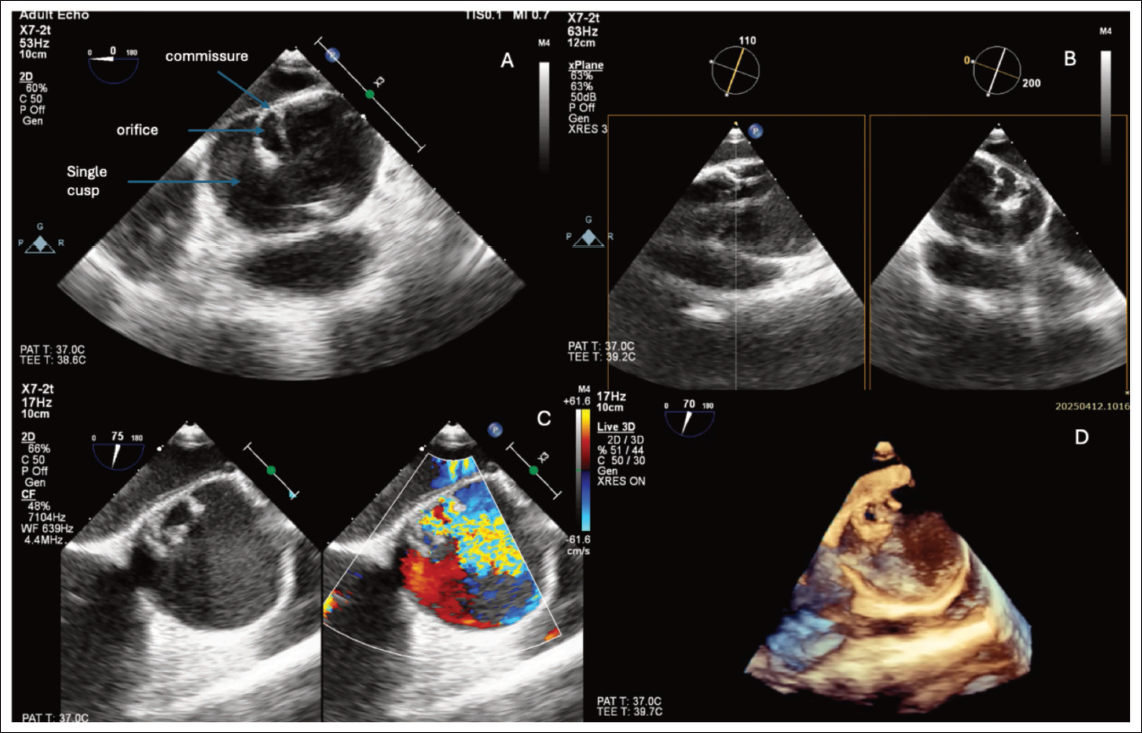
While bicuspid aortic valve disease is a relatively common cause of aortic stenosis with aortopathy, unicuspid aortic stenosis is rare. 1 Unicuspid aortic valves have a single aortic cusp, which, based on the presence or absence of a commissure, has been classified into two types: (a) unicuspid–unicommissural aortic valve and (b) unicuspid–acommissural aortic valve. Unicommissural valves have a single-point attachment to the aortic annulus, while the acommissural valves have no attachment to the annulus. Unicuspid–unicommissural aortic valves have a teardrop- or keyhole-shaped orifice because of the presence of a single commissure. On the other hand, unicuspid–acommissural valves have a central circular orifice due to the absence of a commissure. A single cusp surrounds this orifice on all sides. 2
It is clinically important to recognize the aortic valve morphology during echocardiography, as treatment options differ. While surgical aortic valve replacement is the preferred treatment for unicuspid aortic valves, transcatheter aortic valve implantation (TAVI) is preferred for tricuspid aortic valves (Class I) and is increasingly used for bicuspid aortic valves (Class IIb), especially in older adults. 3 Furthermore, frequently associated aortopathy may mandate aortic root replacement during valvular surgery in unicuspid aortic valves.
Footnotes
Declaration of Conflicting Interests
The authors declared no potential conflicts of interest with respect to the research, authorship, and/or publication of this article.
Ethical Approval and Patient Consent
Ethical permission is not required for case image publication as per our institute. Patient consent was obtained.
Funding
The authors received no financial support for the research, authorship, and/or publication of this article.
