



Abstract
Electronic monitoring has been increasingly used internationally with recent implementation in Australia for those convicted of domestic violence offenses. It is timely and important to gain a better understanding of the physical, psychological, social, and offending-related experiences and impacts of electronic monitoring on this group to inform further implementation. This study describes the experiences of individuals who were subject to a post-release electronic monitoring program for domestic violence in the state of New South Wales, Australia. Semi-structured phone interviews were conducted with 16 men who had recently experienced electronic monitoring. Thematic analysis was used to investigate common themes across participants’ experiences. Demographic and basic quantitative health data were also collected. Five themes were identified: (a) confusion regarding program practices, (b) awareness and pressure of monitoring, (c) social exclusion effects, (d) felt and enacted stigmatization, and (e) “for them not for me.” The findings reveal participants were highly aware of their being monitored, with a mix of positive and negative responses to this cognizance. Being electronically monitored had several flow-on effects on participants’ lives, creating challenges in social spheres across work and personal life. Stigma, both felt and enacted, featured heavily in participants’ responses. Individual factors that may affect program adherence were also identified, including education level and intent to commit a crime. Further quantitative work will be useful for informing a more complete understanding of the relationship between program experiences and outcomes such as reoffending and post-release community integration.
Introduction
Electronic monitoring (EM) refers to the use of an on-body device (e.g., anklet or bracelet) to track the whereabouts of an individual. EM has been used internationally within criminal justice systems in Europe, the United States, and South America since the 1980s and is commonly used to supervise individuals at three stages of justice system contact: pretrial, as a primary sentencing option, and post-release (Black & Smith, 2003; Paterson, 2015). It was introduced with the intention of providing a supervised, low-cost alternative to imprisonment and is traditionally used for the purposes of detention, restriction and/or surveillance, home detention (house arrest), and the monitoring of the whereabouts of people convicted of sex offenses (Black & Smith, 2003). In the face of what has been described as “sobering findings” regarding inconclusive EM effectiveness (Belur et al., 2020) and a lack of adequate thought or evidence regarding its secondary effects (Renzema & Mayo-Wilson, 2005), evidence regarding the subjective experiences, benefits, and consequences of such programs are urgently needed to inform future implementation. Laurie and Maglione (2020) note that future research addressing both empirically and theoretically the subjective effects of EM in context is most needed.
The majority of the literature regarding EM focuses on the effectiveness of EM for reducing recidivism (e.g., Killias et al., 2010). A systematic review by Belur et al. (2020) identified 18 published quantitative studies that aimed to examine the effect of EM on recidivism. The authors conclude that EM has a statistically significant effect on reducing time to recidivism. However, approximately half of the identified studies were assessed as “low quality” and sourced from the grey literature. They concluded that the effectiveness of EM is likely to be a complex issue, with a wide range of behavioral and situational variables involved.
Theoretical discourse on the issue of crime surveillance also exists (see Haggerty et al., 2011); however, theoretical engagement with EM specifically has been limited (Laurie & Maglione, 2020). The dominant theoretical influence has been Michael Foucault’s (1977), Bentham-inspired idea of the “panopticon” where the potential for surveillance can be just as impactful as surveillance itself. This equivalence is mediated through self-governance or a self-policing subject and importantly is contingent on sufficient background knowledge the subject has of the surveillance system in place (Simon, 2005). According to Simon (2005), people who are ignorant, or susceptible to being irrational or impulsive would be immune to the effects of panoptic power. Surveillance using EM technology lends itself to such concepts, whereby participants develop an internalized resistance to reoffending because of wearing an EM device. Bentham idealized that “as a result of the panoptic arrangement, the inmate's attention is focused on ‘doing the right thing’ rather than on scheming further transgression” (Simon, 2005). Despite its legacy as the core theory of surveillance, there has been limited focus on whether such effects are felt by those being electronically monitored.
More recent discussion on the rise of EM surveillance has focused on hierarchies of power brought about by surveillance technologies and their potential societal consequences (Gilliom, 2001; Goffman, 2009). However, there has been minimal empirical attention paid to the impacts of EM as a mode of crime surveillance. A common thread throughout these discussions and preliminary quantitative and qualitative findings regarding EM effectiveness is the potential for such programs to have unintended secondary consequences beyond policing criminal behavior. The lack of evidence on the effectiveness of EM and unintended secondary consequences has, over the decades, contributed to debates on the “proper place” of EM in the criminal justice system (Burrell & Gable, 2008; Corbett & Marx, 1991). In the context of the rise of EM, some scholars argued that criminal justice systems have “fallen prey to a series of technofallacies which undermine practice”—that is, a panacea is offered to criminal justice authorities without a full understanding of the less visible and/or less measurable impacts such technology may have on people being electronically monitored (Corbett & Marx, 1991, pp. 399–400) as well as a lack of consideration of the pragmatic and cultural contexts within which these programs are run (Graham & McIvor, 2017).
Qualitative investigations offer valuable insight into the subjective experience of EM. So far, despite growing international interest in and use of EM programs, qualitative findings are scarce (see Howard, 2020). Themes identified in existing studies suggest impacts beyond the EM technology and program itself, reaching into areas of daily living such as employment and relationships, as well as psychological impacts of self-reflection, stigma, and emotional distress (Bales et al., 2010; Gibbs & King, 2003; Hucklesby, 2009; Maidment, 2002; Rados, 2019; Staples & Decker, 2010; Vanhaelemeesch et al., 2014). There is a related need to attend to additional supervision and support measures to accompany EM (Graham & McIvor, 2017).
Recently, several jurisdictions in Australia have expanded their use of EM to monitor individuals sentenced for family and domestic violence (DV) crimes following their release from prison (see Nancarrow & Modini, 2018 for a review). Differing from the traditional uses of EM, the intimate and often complex nature of the relationships that exist within a DV context may have unique social and behavioral impacts for those being monitored. So far, only one published report is available regarding the effectiveness and participant experiences of EM programs for DV from across six Midwest, South, and West jurisdictions in the United States (Erez et al., 2012). Key emergent themes from in-depth interviews with individuals who had been monitored (N = 74) included the burdensomeness or hardship of supervision and control felt as a result of the EM, restrictions to employment, forced changes to living arrangements, and strains on relationships (Erez et al., 2012). As a newly emerging target population, it is timely to collect focused evidence to aid the evaluation of the effectiveness and impacts of EM surveillance in the context of DV.
The present study investigates the experiences of those released from prison after serving a sentence for a DV crime, who subsequently participated in an EM program in the state of New South Wales, Australia. It aims to explore factors that may impact the effectiveness of EM for deterring reoffending, as well as the secondary effects of being monitored for this population.
Method
The data used in the present study derives from an evaluation of the domestic violence EM (DVEM) program in New South Wales (NSW), commissioned by the “NSW Department of Justice” is now known as the “NSW Department of Communities and Justice”. Ethical approval for the study was obtained from the University of New South Wales Human Research Ethics Committe (UNSW HREC) (reference: HC17469) and from the Corrective Services NSW Ethics Committee (reference: 100309).
Participants, eligibility, and recruitment
Community corrections staff at Corrective Services NSW are responsible for selecting and managing individuals leaving prison who are placed on the EM program. Eligibility for the DVEM program is determined based on six criteria:
A score on the level of service inventory–revised (LSI-R) that indicates a medium–high or high risk of reoffending. The LSI-R is an actuarial assessment tool designed to identify the offender's risks and needs with regard to reoffending (Watkins, 2011). The individual is subject to a current parole order or intensive corrections order (a supervised community sentence) (Wang & Poynton, 2017) for a domestic violence offense. The individual has demonstrated a pattern of repeat domestic violence offending or is considered a threat to the victim's safety. The individual has an active no-contact apprehended domestic violence order (ADVO) with metered geographical restrictions in place. The individual and victim live in an area where EM may be managed effectively. The residential address of the victim can be verified.
Inclusion criteria for the present study included any individual who had participated in and exited, the New South Wales DVEM program for any reason, in the past 2 months. Recruitment for the interviews occurred between June 2019 and March 2020.
An information package regarding the study was prepared by the research team and sent to community corrections officers, who advised eligible individuals about the study. Prospective study participants were provided with an information and consent form, and for interested individuals, permission was sought to pass on their contact details to the research team. The contact details of interested individuals were emailed to the research team, who contacted the individual by phone to obtain verbal consent to participate in an interview.
Methods
Semi-structured phone interviews were designed to explore: the emotional, psychological, social, and physical impacts of the DVEM program on participants. Interviews were a mix of multiple-choice and open-ended questions conducted by two researchers using a script that included interview questions and specific prompts. Interviews were audio-recorded and transcribed for analysis.
At the end of each interview, a brief demographic questionnaire was administered along with several quantitative measures to assess the representativeness of the interviewed sample compared with the entire DVEM cohort and to further contextualize their responses to the interview questions. Psychological distress and daily functioning were measured via the Kessler Psychological Distress Scale (K-10) (Kessler et al., 2002) and Five level EQ-5D (EQ-5D-5L) (Herdman et al., 2011), respectively. Mean total scores were computed for the K-10. For the EQ-5D-5L, a single “utility” score to represent health status was computed based on an available value set from the United Kingdom (Devlin et al., 2018). Details regarding the duration that the individual was monitored and the reason for exiting the program were also collected from community corrections officers with the individual's consent. Participants were a mailed gift card valued at 60 AUD for their participation.
Analysis and rigor
Interview transcripts were imported to NVivo (QSR International Pty Ltd, 2012) software for analysis. Thematic analysis with an inductive approach (Braun & Clarke, 2006) was chosen for the present study.
An analysis was conducted by the lead author (JH). First, JH read all the transcripts to grasp the data in their entirety. Each transcript was then read carefully, and all text coded into “codes.” Coding was conducted at the semantic level, such that text was taken at face value with no further interpretation. Codes that were similar in meaning were further organized into broader categories. Categories were further organized into basic “sub-themes” in an iterative process guided by Patton’s (1990) principles of “internal homogeneity” and “external heterogeneity,” such that each theme was internally coherent while being sufficiently different from other themes. After this, the emergent subthemes and transcripts were re-read to ensure that the themes accurately reflected the data as a whole. Finally, the subthemes were organized into five themes. Theorized associations between themes and the quantitative data (psychological distress, daily functioning, and reasons for program exit) were presented visually in a thematic network (Figure 1) (Attride-Stirling, 2001).

Thematic map of emergent major themes, subthemes, and quantitative findings.
Four of Creswell’s (1998) evaluative criteria for qualitative research were used to enhance the rigor of the collected data. The first involved triangulation of the results with quantitative data. Considering both types of data helps facilitate a deeper understanding of the results and allows for a richer account of the phenomenon being studied. In some cases, additional information was also sought from stakeholders of the DVEM program to clarify and further contextualize some of the qualitative findings. Stakeholders included community corrections, and staff from the External and EM Group, who oversees EM of all offenders in NSW. The second was researcher reflexivity. The two interviewers attended a briefing at the commencement of the study to discuss any biases, expectations, or concerns regarding interviewing domestic violence offenders, with a clinical research nurse who had experience with violent offenders and victims. This was followed by regular debriefs during data collection. This ensured each interview was administered as a “blank slate.” The detailed interview schedule also minimized the imposition of any biases in the collected responses. The third was a thick, rich description. In the present results, each theme is described in detail and accompanied by several illustrative quotes to ensure the reader can evaluate the extent to which the conclusions drawn from the data are valid. Finally, a negative or deviant case analysis was used. Any responses in the data that appeared to contradict the presented themes are given consideration in the results and conclusions.
Results
Participant characteristics
A total of 16 participants were recruited for interviews. Table 1 details the demographic characteristics of interview participants, compared with all offenders who were electronically monitored in the first year of the DVEM program. Interview participants were comparable to the wider sample in age, gender, indigenous status, country of birth, and socioeconomic status. No women participated in interviews. Six (38%) participants had exited the program due to the successful completion of their order, eight (50%) had exited due to their order being revoked for a DV-related reoffense or compliance issues with the program. The remaining two (12%) were removed from the program prematurely due to returning to custody for a non-DV offense and no longer meeting program criteria. Interviewed offenders had been on the program for an average of 5 months (159 days).
Demographic characteristics of participants compared to entire cohort who participated in the DVEM program (November 2018–2019).
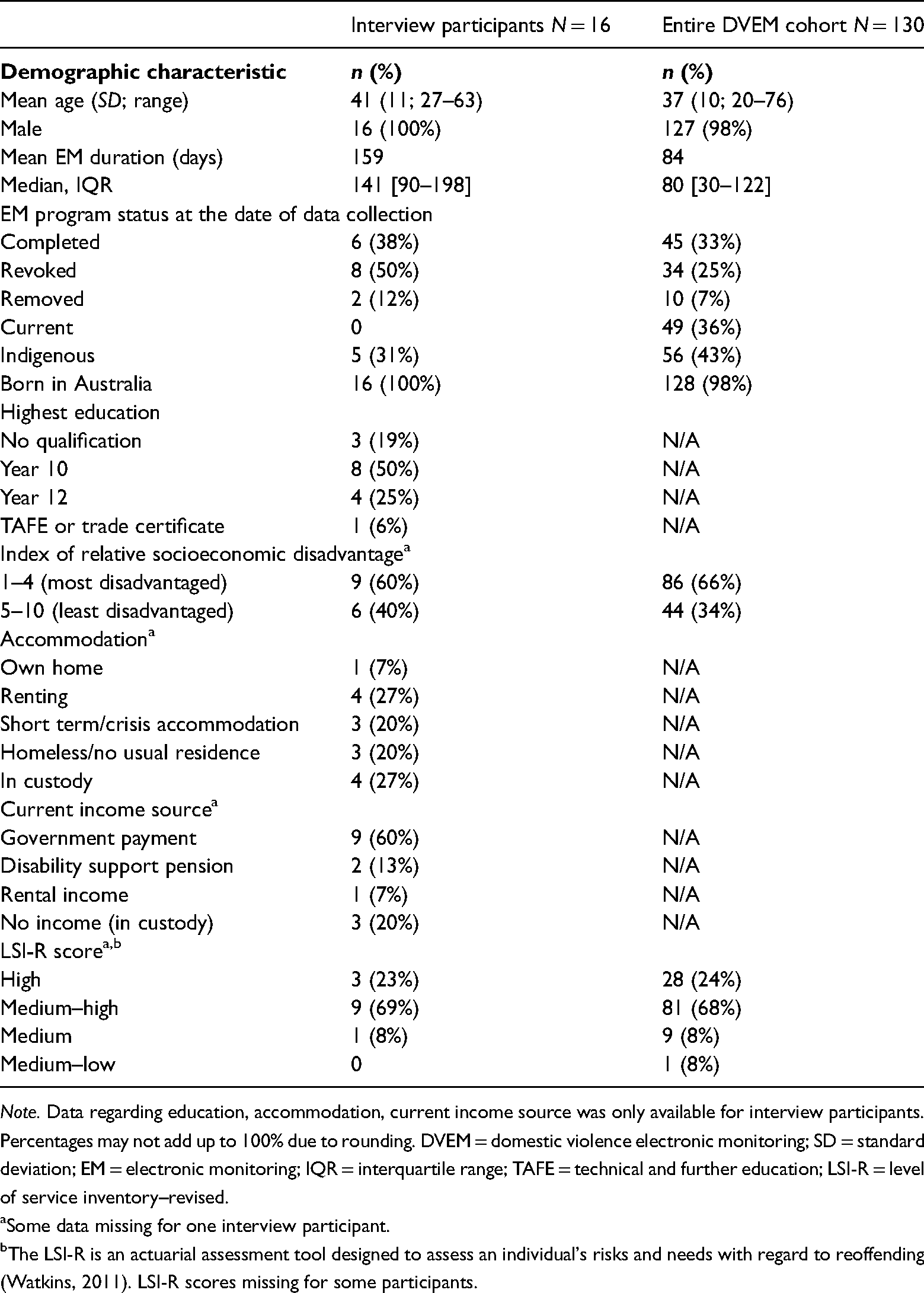
Note. Data regarding education, accommodation, current income source was only available for interview participants. Percentages may not add up to 100% due to rounding. DVEM = domestic violence electronic monitoring; SD = standard deviation; EM = electronic monitoring; IQR = interquartile range; TAFE = technical and further education; LSI-R = level of service inventory–revised.
Some data missing for one interview participant.
The LSI-R is an actuarial assessment tool designed to assess an individual's risks and needs with regard to reoffending (Watkins, 2011). LSI-R scores missing for some participants.
Overall, participants displayed a high level of psychological distress (Table 2) with 74.0% scoring in the high–very high range in psychological distress, compared with 9.7% of a population-based sample of Australian males of similar age (Australian Bureau of Statistics, 2015).
Kessler psychological distress scale scores (K-10) for interview participants.

Note. Data missing for one participant. The total score and range are not available for ABS data.
Health problems and overall self-rated health of interview participants are displayed in Table 3. Offenders had a lower health index value (0.74) and lower self-rated health (70) compared with males (25–64 years) from a population-based sample from a different Australian state (n = 927) (index value = 0.92, self-rated health = 79) (McCaffrey et al., 2016). For the present sample, the most commonly reported difficulties were in anxiety and depression (n = 10; 66.67%).
Health problems and overall self-rated health of interview participants according to EQ-5D-5L scores (N = 15).

Note. Data missing for one participant.
Themes
Five themes emerged: “confusion regarding program practices,” “awareness and pressure of monitoring,” “social exclusion effects,” “felt and enacted stigmatization,” and “for them not for me.” Major themes, subthemes, and quantitative findings are presented in a thematic map in Figure 1.
Confusion regarding program practices
When asked about their initial experiences of the program, most participants reported a lack of understanding regarding program rules. Slightly less than half of the participants (43%) reported feeling “poorly informed” or “not informed” about the rules and conditions of their EM. Several expressed a lack of information about maintaining the device, while others described confusion or difficulty in understanding exclusion zones. Issues raised mostly reflected an adjustment period during the early days of participation in the program.
I didn't really understand the, actual conditions that I was on at the time … I didn't understand it quite well, because I can't read, and I can't write, so it made it hard. So I didn't really understand the conditions properly.
I didn't find there was enough information when got fitted to me, on me, and I didn't feel like I had enough information, yeah, about the upkeep and all that of the electronic monitoring device.
Awareness and pressure of monitoring
Another emergent theme was in participants’ awareness of their being monitored. This was reflected in regular contact with surveillance authorities and the physical reminder provided by wearing the device. Participants commonly reported inconvenience related to charging. The need to keep the device charged, and the frequent calls from program staff when the device was not charged, were described to be highly disruptive to their daily life.
Well, um, I felt constricted by having to charge it twice a day for ninety minutes, and there's three hours of your day gone virtually, in just charging.
Yeah, when I wake up in the morning, they’d be texting me messages “can you put your anklet on the, on charge straight away.” So I was doing all the right things, but they keep ringing me up telling me to recharge it. You know, it's just like I’m not even getting out for the day, and I’m getting bothered by somebody.
Participants commonly expressed physical discomfort as a result of wearing the EM device. The most common word used to describe the device was “bulky.”
The weight and that, it's a pain … I had pains in the ankle, couple of times cos it was rubbing and that.
Also, participants expressed awareness of being monitored in that they believed that the device worked with respect to surveillance effectiveness and alerting authorities. Relatedly, most participants (73%) believed EM would make it more likely for them to be caught for any crime while they are being monitored.
They can track your every movement, and you really can't do anything.
They’d be able to pinpoint exactly where you were at the time of the crime.
Some participants expressed that EM could be beneficial for them in providing evidence of their whereabouts should they be wrongly accused of a crime.
They know where I am at all times and then me wanting to behave and everything, no one could actually set me up and make me out like I was in a place that I wasn't.
Regarding their awareness of being tracked, some explained that they were not bothered by the tracking because they were not doing anything wrong.
I wasn't doing nothing wrong so therefore it didn't really bother me.
Others expressed stress and feelings of restriction. This at times caused participants to feel anxious and paranoid. Some reported that they felt “over-tracking” was occurring, in terms of being questioned or monitored in areas of their lives that were unrelated to their parole conditions.
I’ve got a couple of mates that are on it too. When all of us are together, they’re like “what are you going here for?” Which it had nothing to do with my parole.
Felt like somebody was watching me all the time. I could understand having it on, just not to go to the area where, where um, I was supposed to not go, but being monitored was always on my mind. Like every time I seen a police car, I thought they was, they were here for me.
Two participants reported that these feelings of restriction and stress consequently compelled them to violate their parole conditions.
And that's what sort of caused a lot of stress on me, and there was times, you know, when I just went over the [exclusion zone], just for the fun of it, you know, cos I was stressing out, and I was feeling like I was still in prison.
It makes you, makes you want to do something to come back to custody, just to get off it, just so you don't have to be on it.
Social exclusion effects
Participants described several flow-on socioeconomic effects of being electronically monitored. They expressed that EM served as a barrier in seeking and maintaining stable employment. Most (75%) felt that EM affected their ability to find and keep a job, while some (25%) reported the EM had minimal or no impact on their employment. Some of the barriers to finding and keeping a job related to the exclusion zones and being monitored.
Like one day parole said, “what are you doing hanging around [the local] train station”? And it was a simple fact that one of the jobs I was going for, that employer wanted to meet me at the train station. I guess to Parole it looked like, I don't know what it looked like to them on the screen. You know, I was hanging around the train station. I was just going about my business. It's very hard to get a job these days. But what I’m saying, is yeah, it did impact the way I had to go about getting it.
Participants described difficulties with prospective and current employers, colleagues, and customers as a result of being monitored. As a result, participants sometimes hid their devices. One participant left their job due to the judgementalism experienced at work.
My boss said to me “your job's still here when you get back, but you can't come work for me with the monitoring device on,” and then I went to seventy, eighty jobs, and every one of these jobs turned me down due to the ankle monitoring device.
Once the boss sort of said to me like, the people who own and run this [business], you know, are a bit like sort of you know, I’m not wanted here. It got too much for me emotionally. You know what I mean?
Sixty percent of participants reported that EM had a medium or significant impact on their housing situation. Some barriers related to finding and keeping adequate housing related to exclusion zones.
It just mucked up my whole living arrangements, everything. Parole just kept pushing me from address to address to address to address. Hey, I had to go five different addresses, till they were happy with the one I ended up with in the end.
I got kicked out of my home, hometown, away from my support network, and made to go into the city. I lived on the streets for three weeks.
Some participants described difficulties in explaining the device to potential housemates.
Oh, it's just hard. You know, you gotta find places, people will see [the monitoring device] you know, and they ask questions, why is that plugged in there?
[An acquaintance] let me stay at his place, and it was more the electricity issue. He thought the charger and the beacon used a lot of electricity.
The majority of participants reported some impact on their existing and new relationships for two main reasons: adhering to EM guidelines and social barriers. First, participants reported difficulty maintaining existing relationships with their family and friends because they were excluded from doing so by the conditions of their monitoring.
[The exclusion zones] caused stress on me and my family, cos half of them, my family live on that side of town where [the victim] lives. I couldn't go near anyone. I couldn't go close to anyone, couldn't see Mum and Dad, couldn't see nobody.
It didn't just disrupt my life, it disrupted like the rest of my family's life. If I went down to see my mum, … my mother, she's in the exclusion zone … She had to come and see me at my brother's.
They also described the inconvenience posed by having and maintaining the device.
If I wanted to go and stay at my mate's place, I, I’d, I’d have to ring them up and tell them that I’m not staying where I’m staying tonight, and then I’d have to take all the [equipment] with me to plug it in where I am.
I wasn't happy cos like once I met a girl, I went back to her place, as you do, and I went back and stayed the night at her place, and I had to explain what I was, why I was there for at this particular address for a whole night … I was really mad.
There were also some social barriers that posed challenges to maintaining or developing new relationships. Participants generally reported that their “real friends” and families were mostly understanding and unbothered by the monitoring device but new relationships were harder to establish due to their apprehension of disclosing their EM situation.
It affected meeting new friends. I, I, I didn't want to meet new friends while I was on it, cos I didn't want to have to explain to them. I stopped visiting people and going out. I just stayed at home in me room.
So obviously I went out in order to try and start new social lives and relationships, and things would kick off good until I actually mentioned [the device]. Because I don't like lying, I say “listen, this is what I’m on.”
These challenges in employment, housing, and relationships were compounded with one another to create difficult financial and welfare circumstances for some offenders.
I couldn't obviously have a job and like get paid like normally, I moved into a place and wasn't able to pay rent and stuff, and that sort of thing. And um, I ended up moving away, away from that because I couldn't pay for the rent and stuff, as well. I ended up having to move in with family and stuff.
I had to go stealing and that just to get food … and I couldn't find a house because I had no money or support income.
While most participants expressed that they would rather be wearing the device than in prison, three participants (19%) said, in hindsight, that they would have rather stayed in prison. Reasons for this included feeling too restricted while being monitored and that the device caused important relationship breakdowns.
I reckon it's more, you’re entrapped in yourself. And what you can and can't do. You know, you’re supposed to be given a second chance out to society, and yeah, you’re getting out and you’re feeling like you’re more in prison. Like anyone, I’d recommend to them stay in jail. And that's just my honest opinion.
Felt and enacted stigmatization
A recurrent theme was the stigma that surrounded EM, and the related psychological distress, shame, and embarrassment that they felt while being monitored. Stigma was both felt (internal or self-stigmatization) and enacted (external stigma or discrimination). All participants reported feeling embarrassed and to some extent ashamed of wearing the device.
I felt ashamed even wearing it, you know what I mean? It sort of degraded my life, like it made me feel out of place.
It made me feel like I haven't done my time, I’m still being punished for what I’m doing, and here I am to be judged by the people, my friends and family as well.
All participants mentioned experiences of judgment by others while wearing the EM device. Offenders were of the unanimous view that people negatively judge wearers of EM.
I think subconsciously they put you in a different category. And think you’re extremely dangerous or something, they are very judgmental of it.
They described experiences of being judged by others, being questioned about the device, and people staring at the offender. This resulted in feelings of isolation, difficulty being out in public, and discrimination.
I didn't want to go in public places cos I got sick of getting judged. I’d be judged or people wanted to move away from me, or they didn't, you know, they broke off the conversation.
I went to the doctors one day and when I was there, I just turned around to my left and this lady was just giving me a filthy look. Like. You know, like “I wonder what this piece of shit's done.” You know. Like just a real dirty look.
A commonly expressed view was that people associate EM with sex offenders.
Nine times out of ten they think that you’re a paedophile.
People had phoned [police] in the community saying that there's someone in the area being monitored, cos the school was just down the road from my house. They assumed that I was being monitored cos I was a sex offender.
For them, not for me
When asked whether they believed the program would deter others from breaching an ADVO, participants expressed that EM would be a deterrent for DV offenders in general. However most described that it did not affect their own personal likelihood of breaching, because they did not intend to breach anyway. This reasoning also carried over into their beliefs about committing other crimes or violating parole.
It had no effect. I just had my mindset, with or without the monitoring, that I was staying away from her … It didn't have any effect on me to commit offences cos I didn't want to go back to jail.
No. No, I have no reason to contact any of my ex partners or anything.
When asked if EM is a suitable program for perpetrators of DV in general, most participants described that they believed the program would best suit those who were highly violent, and thus a higher threat to their victims, their family, and wider society.
My case was just a couple of stupid text messages, so I thought it was bullshit. But for blokes who beat the crap out of their missus and that, yes, I think it's um, I think that's a good thing.
These extracts illustrate how some participants constructed differentiations between themselves and other, more intractable offenders, who they believed EM would be better suited for.
Discussion
Summary of Findings
This study provides novel insight regarding the experiences of individuals who are subject to EM following release from prison for DV convictions. Five key themes were identified: “confusion regarding program practices,” “awareness and pressure of monitoring,” “social exclusion effects,” “felt and enacted stigmatization,” and “for them not for me.” Overall, participants expressed awareness and pressure associated with constant monitoring, reported limited perceived impact of the program on their own likelihood of reoffending, experienced flow-on socioeconomic effects of program participation related to housing and employment and relationships, and emphasized experiences of stigmatization. These findings, considered in light of the quantitative data, offer a number of useful insights regarding the effectiveness of EM as a deterrent for this group as well as theorized issues of surveillance, stigma, and other unintended consequences for those subject to EM surveillance.
The findings provide novel theoretical insights into the use of EM technologies as a surveillance strategy for a crime. Participants were highly aware of being monitored and were cognizant of the immediate consequences of breaching their order. Participants had several physical reminders of being monitored, including wearing the physical device, and ongoing contact with surveillance staff. The subjective experience of this was varied, with some participants responding more positively to the idea of constant surveillance than others. In addition to expressing no real concern or discomfort because of constant surveillance, some felt the EM would rather provide beneficial evidence regarding their compliance. This aligns with findings from the United States where individuals believed the monitoring allowed them to avoid any false accusations of contact by victims (Erez et al., 2012).
Conversely, some offenders felt oppressed and pressured by the monitoring, sometimes to the extent that they felt compelled to rebel. Stress, anxiety, and paranoia were reported, with most complaints focusing on an “over-tracking” whereby participants felt the surveillance meant to deter them from re-contacting the victim unjustly spilled over into other unrelated areas of their lives. Such findings support debates regarding potential unintended consequences of EM technologies (Burrell & Gable, 2008; Corbett & Marx, 1991), including “net-widening” whereby new practices may serve to ensnare individuals in ways not originally foreseen or desired (Bartels & Martinovic, 2017). These findings suggest that the internalization of surveillance by those being monitored and resultant will to avoid offending, which was Bentham's panoptic surveillance theoretical premise (Simon, 2005), does not necessarily occur for all who are monitored. For some, the subjectivizing effects of constant monitoring have negative and detrimental effects on both mental wellbeing and behavior, which may interact with other social impacts.
Interviews revealed flow-on effects of EM on a range of areas of the participants’ lives, creating challenges in social spheres, or “social exclusion effects.” As has been found in past studies (Gibbs & King, 2003; Staples & Decker, 2010; Vanhaelemeesch & Vander Beken, 2014), EM appeared to create barriers to obtaining and maintaining stable housing and employment. These findings were complemented by demographic data, which indicated comparative socioeconomic disadvantage, low education levels, transient housing situation, and social welfare dependence for the majority of interviewees. Also raised was the exclusion of individuals from their support networks as a result of EM. It is important to consider the impact of EM on the already disadvantaged socioeconomic situation faced by most people in contact with the justice system. This will be important not only from a human rights perspective but in understanding their risk of reoffending. A similar trial of EM for early release in Swedish prisoners with an added condition regarding having a secured daily occupation to return to, among other conditions, found favorable results for reoffending in EM individuals compared with those who served their full sentence (Marklund & Holmberg, 2009). Future quantitative studies that examine the associations between housing, health, employment, and reoffending outcomes and trajectories of EM wearers are needed to theorize associations between such impacts and subsequent offending behavior. Such studies could be used to identify significant predictors of revocation versus successful completion of EM programs.
Importantly, the challenges posed by EM on aspects of daily living appeared to often stem from stigma and negative social perceptions of EM wearers. Stigma has been consistently discussed as a barrier to housing, employment, and relationships in previous qualitative research with EM wearers (Howard, 2020). Feelings and experiences of stigma, shame, and embarrassment were commonly expressed by offenders in the present study. In some instances, the stigma became a personal barrier to developing new workplace and personal connections. In other instances, offenders were subject to experiences of direct stigmatization by members of the general public, such as being unwanted in places near schools or experiencing difficulties in the workplace.
Relatedly, high levels of psychological distress were reported in the present sample. From the present study, we are unable to ascertain whether this distress was the result of EM or preceded it. Those convicted of a crime are particularly prone to stigmatization (LeBel, 2012; Moore et al., 2018). Key aspects of harmful “self-stigmatization” (Corrigan et al., 2006; Moore et al., 2018) were notably evident in the present sample and may be related to the levels of high psychological distress reported in the quantitative data. Participants displayed “perceived stigma,” whereby an individual perceives stigma from their community. They also experienced “stereotype agreement,” expressing the negative stereotypes that the community tends to have regarding those who are electronically monitored. Finally, a level of “anticipated stigma” was evident in participants’ expectations regarding their employment. Recent research highlights mental ill-health as a key risk factor for these aspects of stigmatization (Moore et al., 2018). The likely cyclical relationship between psychological vulnerability and stigmatizing experiences of EM may create compounded ill-effects not only on participants’ wellbeing but also on their employment, housing, and relationships with possible flow-on implications for reoffending. It will be useful to clarify these temporal associations to identify and minimize any such negative flow-on effects of EM.
The findings also present individual factors that may influence the effectiveness of EM programs. First, participants’ education level and subsequent comprehension of program practices may have important implications for program effectiveness and adherence. During the initial stages of program participation, participants reported confusion regarding program practices. Half of the participants felt they were not adequately informed regarding program practices, their exclusion zones, and device maintenance, and expressed difficulty in understanding program details. This finding is particularly important given the lower level of education in the interviewed sample, of which 69% had not completed secondary schooling, as well as the higher than expected prevalence of mental illness, learning difficulties, and intellectual disability in offender populations in Western countries (Dias et al., 2013; Salekin et al., 2010). As EM programs continue to be expanded to new offender populations, it will be important to focus on ensuring participants are fully informed and confident in their knowledge of program practices and guidelines.
Differences in education level may also affect program adherence. A survey of offenders subject to a year-long intensive supervision program in the United States reported offenders’ education level to be significantly associated with the perceived severity of community-based sanctions (Wodahl et al., 2013). Those who had not completed high school level schooling viewed alternative sanctions such as electronic monitoring and community treatment more harshly than those with higher levels of education. Possible reasons for this include that those with higher levels of educational attainment may have stronger ties to society and feel they have more to lose (e.g., employment opportunities) from imprisonment, and that they may be better able to appreciate the rehabilitative benefits of community-based sanctions in comparison with those with lower levels of education, who may be more focused on the punitive effects of such programs (Wodahl et al., 2013).
Another potential influential factor is the intent to commit a crime while being monitored. Participants expressed that being electronically monitored did not impact their likelihood of committing any crime, whether related to DV or any crime in general. Participants described that this was because they did not intend to commit any crime, regardless of the EM. This is interesting when considering half the sample had re-committed a DV-related offense by the time of the interview. It is possible such claims may reflect socially desirable responding to the researchers. The dynamics of stress and impulsivity may also be a contributing factor, in terms of participants underestimating the influence these psychological states may have in impeding commitments to future plans (Raio et al., 2020). In this sense, as Simon (2005) proposes, these people may become immune to the effects of the panoptic power of EM. Notwithstanding, further exploration of factors that may explain or moderate the relationship between intent to commit a crime and the act of doing so while on EM would be useful.
Taken together, these findings suggest the possibility of an “Inverse U” or Yerkes–Dodson (see Teigan, 1994) type relationship between negative experiences or pressures associated with monitoring, and resultant offender adherence to the program, which may be further mediated by personal and environmental characteristics of those being monitored. That is, awareness of monitoring, experiences of stigma, and secondary effects on daily life may provide motivation to abstain from future offending, however, only to a certain extent, at which point program nonadherence may result. Factors that may act as mediators from the present findings include education level, program comprehension, social supports, and employment. This theory may help explain the varied experiences of the present sample, of which almost half had not successfully completed the program. It will be useful for future research to investigate the likelihood of such a theory and test models using quantitative measures of pressure and program adherence.
Limitations
The recruited sample for the present study was comparatively smaller than other qualitative studies from the United States and Europe (Staples & Decker, 2010). This likely occurred due to recruitment occurring once individuals had exited the program and supervision ceased, as well as the transient lifestyles of this population. Given this, sufficient data saturation was reached, with clear emergent themes across participant responses.
There was also a lack of representation from women participants. According to administrative data, women accounted for 2% of DVEM participants, meaning there were only three women available for recruitment (Table 1). The few available studies examining gender differences in experiences of EM report that women tend to view community supervision orders as more punitive than men (Wodahl et al., 2013) and that they may suffer disproportionately in terms of support for parenting and new relationships (Maidment, 2002). Notwithstanding, the interviewed sample was largely comparable in terms of demographic characteristics to the wider sample of all who had participated in the program (Table 1). This is a strength of the study, as it has represented a range of both individuals who successfully completed their order as well as those who breached.
There is a possibility that participants gave answers that were socially desirable. This may apply most to questions relating to reoffending. Steps were taken to minimize the possibility of socially desirable responses. Interviewees were fully informed that their participation would be voluntary, anonymous, and not affect their relationship with community corrections or any program stakeholders. Further conclusions regarding the effectiveness of EM on preventing recidivism should be considered in light of quantitative evidence observing reoffending outcomes in those who participate in EM programs.
Footnotes
Acknowledgments
The authors acknowledge the valuable contribution of the men who participated in the present interviews, as well as the support of key stakeholders of the New South Wales DVEM program.
Declaration of conflicting interests
The authors declared no potential conflicts of interest with respect to the research, authorship, and/or publication of this article.
Funding
The authors disclosed receipt of the following financial support for the research, authorship, and/or publication of this article. This work was supported by the NSW Department of Communities and Justice, Justice, Strategy and Policy Branch (grant no. RG181313).
