



Abstract
Following a vehicle too closely (otherwise known as tailgating) is a high-risk behavior and major contributor to motor-vehicle collisions and injuries. Both legal and nonlegal countermeasures are currently in place in an attempt to prevent this behavior, yet there has been limited research that has examined the effectiveness of both legal and nonlegal factors on engagement in the behavior. Therefore, this research utilized a combination of the three most salient deterrence-based theories used in road safety to understand the impact of both legal and nonlegal sanctions on following a vehicle too closely. A survey was completed by 887 Queensland drivers aged 17–84 years (Mage = 49 years; 55% males). Variables from Classical Deterrence Theory, the reconceptualized deterrence theory and the extended deterrence-based model (that includes perceived internal loss, physical loss, and social sanctions), as well as measures of following a vehicle too closely were used. The majority of the sample (98%) reported following a vehicle too closely at some point, with the average frequency ranging from rarely to sometimes. Significant predictors of more frequent unsafe following distances included: being male, younger in age, and avoiding punishment for the behavior. Meanwhile, significant predictors of less frequent unsafe following distances included knowing others who have been punished for the behavior, as well as fearing the physical and internal losses resulting from unsafe following distances. Notably, the severity of the punishment was also a significant deterrent, while the perceived certainty of being apprehended for the offence was low and did not impact engagement in behavior. These results have a number of important implications on how to maximize both legal and nonlegal countermeasures to further prevent following a vehicle too closely.
Following a vehicle too closely (otherwise known as tailgating) has been reported as the most stressful and frustrating driving behavior caused by another road user (Scott-Parker et al., 2018), being amongst the top five complaints of road users (Wickens et al., 2013). Following a leading vehicle too closely without a safe stopping distance is considered tailgating (Queensland Government, 2015). Rear-end crashes attributed to following a vehicle too closely have led to over 500,000 avoidable injuries and fatalities across the world (National Centre for Statistics and Analysis, 2015; Mohamed et al., 2017; Department of Transport and Main Roads [TMR], 2020b). In Queensland, Australia, over 10,000 injuries and fatalities were attributed to following a vehicle too closely between 2018 and 2019 (TMR, 2020b). However, only 3,120 drivers received an infringement notice for the behavior between 2019 and 2020 (TMR, 2020a). This discrepancy in infringement notices and reported injuries highlights the difficulty in enforcing this behavior, which is an area of concern for many other road behaviors. For example, failing to stop at a road crossing was attributed to 35 pedestrian fatalities in Queensland in 2017 (Centre for Accident Research & Road Safety – Queensland, 2020), yet there were only eight infringement notices recorded for the behavior in the state (Queensland Government, 2020). The primary countermeasure for following a vehicle too closely involves legal enforcement and sanctions. Therefore, it is important for research to identify how drivers’ perceptions of these legal sanctions influence their unsafe following distance, as well as how factors beyond legal sanctions influence engagement in this behavior. Such findings can be used to inform what countermeasures are currently effective, and what needs to be improved.
Deterrence theory
Classical Deterrence Theory, which has informed numerous road safety countermeasures (Homel, 1988; Watson & Freeman, 2007), provides a clear starting point for understanding the effectiveness of legal countermeasures for following a vehicle too closely. Specifically, Classical Deterrence Theory argues that the perceived fear of legal sanctions can deter an individual from offending behavior, should the threat of being apprehended be certain and the punishment perceived as severe, and implemented swiftly (Beccaria, 1764/1986; Becker, 1968; Freeman et al., 2015). The perceived certainty of apprehension (i.e., the seeming threat of detection or punishment) has been recognized as the most important component of Classical Deterrence Theory, followed by the perceived severity of the punishment (i.e., fear of incurring a fine and demerit points 1 ) (Piquero et al., 2011). In road safety research, the perceived swiftness of punishment is consistently a nonsignificant predictor, most likely due to the delay between engaging in the behavior and being caught (e.g., Freeman et al., 2020; Freeman et al., 2021). Research has yet to apply deterrence theory to the behavior of following a vehicle too closely. Given the significant number of road crashes attributed to the behavior, this is an important area in road safety to investigate.
Research in Iran (Foroutaghe et al., 2020) and the United States (Pantangi et al., 2020) have examined the broad impact of legal sanctions on tailgating behavior. Although no specific measures of deterrence theory were used, it was suggested that an increase in infringement notices decreased road traffic incidents, including tailgating (Foroutaghe et al., 2020). While the presence of law enforcement vehicles on the roadside was suggested to help reduce tailgating behavior (Pantangi et al., 2020). These studies have not utilized deterrence theory so it is unknown how the specific components of legal sanctions may influence the behavior of following a vehicle too closely. However, based on the application of deterrence theory in previous road safety research, it may be suggested that the perceived certainty of being apprehended and the perceived severity of punishment have predictive utility in explaining following a vehicle too closely (while the perceived swiftness of punishment would be low and subsequently unlikely to influence engagement in this behavior).
When examining the relationship between measures of deterrence and following a vehicle too closely, it is important to consider that such measures do not account for alternative experiences with enforcement. A reconceptualized deterrence theory was created by Stafford and Warr (1993) to address this limitation, which proposed four categories that take into account direct (i.e., personal experiences) and vicarious (i.e., experiences of friends and family of an individual) experiences with punishment and punishment avoidance. The model consists of direct punishment, direct punishment avoidance, indirect punishment, and indirect punishment avoidance. Punishment involves being caught and punished for the behavior, whereas punishment avoidance involves a driver engaging in the offending behavior without being caught by law enforcement. When individuals are influenced by personal and vicarious experiences of punishment, the expectation is that their engagement in the particular behavior will decrease (Piquero & Paternoster, 1998). Meanwhile, if an individual has experiences with the avoidance of punishment, it is expected that their engagement in offending behavior will increase (Piquero & Paternoster, 1998). Further, it has been suggested that individuals are more influenced by personal experiences (if they have such experiences) compared to vicarious experiences (Piquero & Pogarsky, 2002).
Notably, previous research in road safety has found that direct punishment avoidance consistently explains a large amount of variance in predicting engagement in the road rule violations of speeding, drink driving, drug driving, and using Snapchat while driving (Freeman et al., 2021; Truelove et al., 2019; Truelove et al., 2021b). Given the discrepancy in infringement notices received compared to injuries reported for following a vehicle too closely, it may be suggested that experiences with direct punishment avoidance would be a distinctly salient predictor of this behavior. Furthermore, previous research has found indirect and direct punishment to be successful deterrents for illegal behaviors such as phone use while driving (Truelove et al., 2019), therefore, it may be suggested that these variables also have predictive utility for the behavior of following a vehicle too closely.
Stafford and Warr’s (1993) reconceptualized deterrence theory has also been used to help address the issue of causal ordering in deterrence research. The causal ordering issue refers to the problem associated with cross-sectional deterrence survey designs which capture engagement in past offending behavior and current perceptions of deterrence, with the statistical relationship between these variables incorrectly accounting for additional variance (Minor & Harry, 1982; Saltzman et al., 1982). An assumption of deterrence theory is that deterrence perceptions influence future engagement in the behavior. Stafford and Warr (1993) state that their variables can be used in addition to classical deterrence measures in cross-sectional survey designs as they are accounting for an individual's past experiences with punishment and punishment avoidance. This is supported by previous research that has utilized cross-sectional studies to examine the impact of Stafford and Warr’s (1993) variables on engagement in offending behavior (e.g., Freeman & Watson, 2009; Paternoster & Piquero, 1995; Piquero & Paternoster, 1998; Piquero & Pogarsky, 2002; Szogi et al., 2017).
Although deterrence measures have shown to correlate with road safety behaviors, a large amount of variance remains unexplained in previous studies (e.g., Kaviani et al., 2020; Szogi et al., 2017; Truelove et al., 2019). Thus, it should be recognized that factors beyond legal sanctions influence offending behavior. Homel (1988) created an extended deterrence-based model for drink driving that proposed that offending behavior is also influenced through nonlegal sanctions, namely internal loss, social sanctions, and physical loss. Internal loss involves the fear of internal shame associated with engaging in the offending behavior, while social sanctions refer to the fear of disapproval or loss of respect from friends and family. Finally, physical loss involves the fear of injuring yourself as a result of a crash caused by engaging in the offending behavior. Previous literature has found evidence to support Homel's contributions, which suggests that nonlegal sanctions are indeed also effective in preventing risky driving behavior for speeding, drink driving and phone use while driving (Allen et al., 2017; Freeman et al., 2016; Kaviani et al., 2020; Truelove et al., 2017). While research has yet to apply these variables to following a vehicle to closely, previous research by Michael et al. (2000) indicated that a roadside sign (consisting of “Help prevent crashes please don’t tailgate”) significantly increased driving headways (i.e., following distances), providing preliminary support for the application of the nonlegal variables to prevent the behavior of following a vehicle too closely. However, it is important to apply these variables more explicitly to the behavior of following a vehicle too closely in order to have more confidence in their efficacy in predicting the behavior.
Despite following a vehicle too closely being a major contributor to motor-vehicle collisions resulting in hospitalizations and fatalities, there is limited knowledge concerning the factors that predict engagement in the behavior. Based on previous road safety research, it may be suggested that deterrence related theories will be beneficial in explaining the behavior. Therefore, the current study aims to address this critical gap in the literature, by identifying how legal and nonlegal sanctions influence frequency of following a vehicle too closely.
Material and methods
Participants
Overall, 887 Queensland licensed drivers over the age of 17 years (55% male) completed the survey. The average age was 49 years (SD = 16, 17–84 years). The majority of participants held an open driver's license (95%), 25 participants held a provisional 2 driver's license, 20 participants held a provisional 1 driver's license, while two participants reported having a restricted license 2 .
Materials
Survey items comprised demographic information, measures of following a vehicle too closely, and legal and nonlegal deterrence measures. Refer to Table 1 for correlations, means, and Cronbach's alpha for all measures.
Mean, standard deviation, correlations, and Cronbach's alpha for following a vehicle too closely and predictor variables.
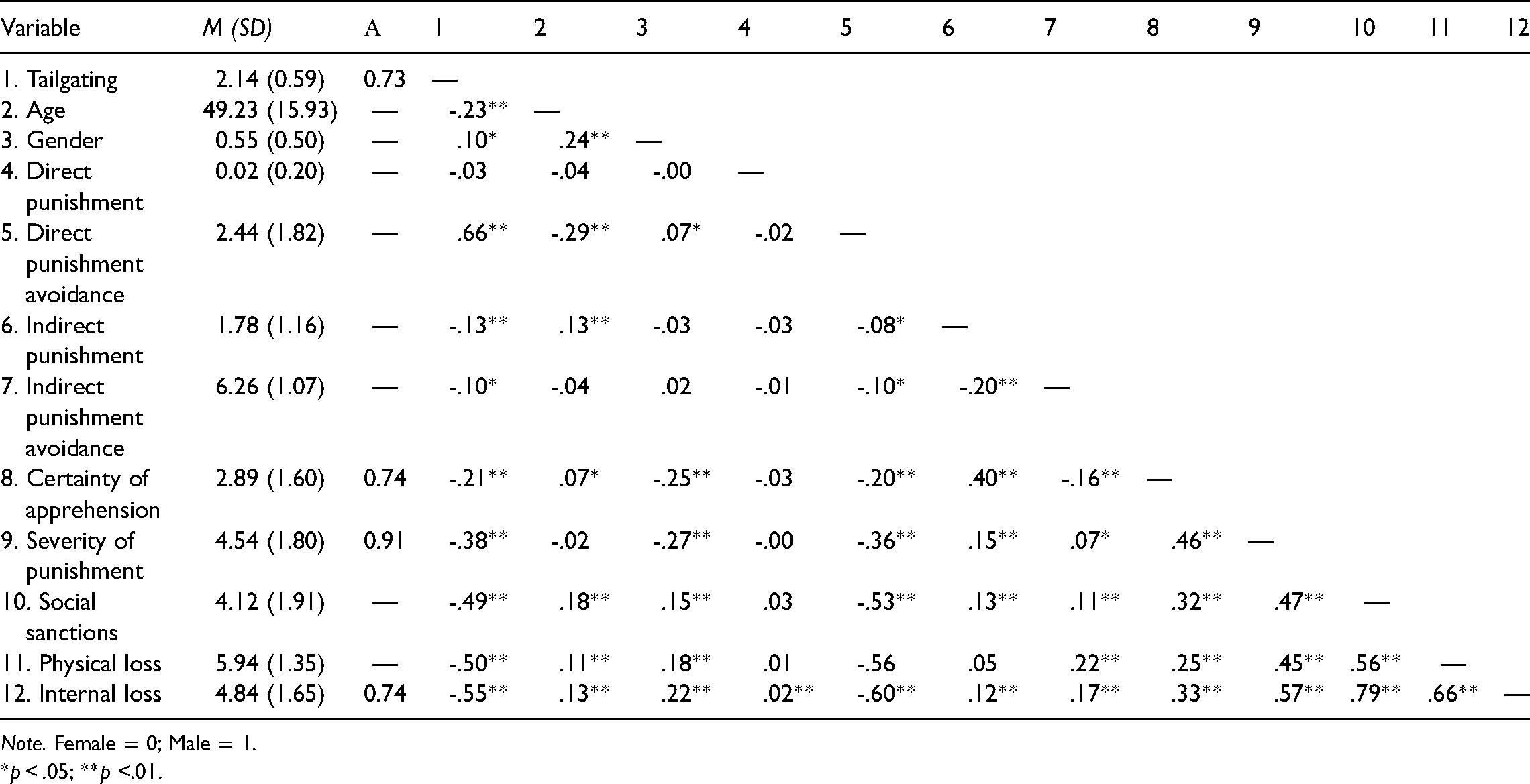
Note. Female = 0; Male = 1.
*p < .05; **p <.01.
Demographic measures
Demographic information included age, license type, gender, and knowledge of tailgating. Age and gender were controls as previous studies have demonstrated associations between these variables and risky driving behaviors (e.g., Allen et al., 2017; Duarte & Mouro, 2019; Truelove et al., 2017).
Following a vehicle too closely
Seven-items were presented on a 5-point Likert scale ranging from 1 (never) to 5 (always) with higher scores indicating higher likelihood of following a vehicle too closely. Example items include: “you have felt you were travelling too close to a vehicle in front of you” and “when on the highway you travel at a safe distance to the vehicle in front.” Two items were reversed scored prior to items being averaged.
Legal deterrence
Legal deterrence items were based on previous research (Freeman et al., 2006; Freeman & Watson, 2009) and included concepts of Classical Deterrence Theory and reconceptualized deterrence theory (Beccaria, 1764/1986; Stafford & Warr, 1993). Unless otherwise stated, all items were measured on a 7-point Likert scale ranging from 1 (strongly disagree) to 7 (strongly agree). Certainty of apprehension for following a vehicle too closely was measured with the mean of two items: “if I tailgated, I think the chance I would be caught is high” and “the chances of getting caught for tailgating are high.” Severity of punishment was measured with the mean of two items: “I won’t tailgate because I don’t want to lose points from my licence” and “I won’t tailgate because I don’t want to get a fine.” Indirect punishment was measured by the statement “people I know have been caught and punished for tailgating,” while direct punishment avoidance was measured by the statement “I tailgate often without being caught.” Indirect punishment avoidance was measured by the statement “Other drivers tailgate often and are not caught.” Finally, direct punishment was measured by asking “how many times have you received an infringement notice (e.g., ticket) for tailgating?.” This question was answered by entering the number of times (e.g., 0 times).
Nonlegal deterrence
Nonlegal deterrence items were based on previous research (Freeman et al., 2020; Homel, 1988). All items were measured on a 7-point Likert scale ranging from 1 (strongly disagree) to 7 (strongly agree). Internal loss was measured with the mean of two items: “I would feel stupid if I was to tailgate” and “if I had received a punishment for tailgating, I’d feel ashamed to mention this to other people.” Social sanctions were measured by the statement “if I were to tailgate I would be ashamed if my friends found out.” Finally, physical loss was measured by the statement “I think tailgating would increase my risk of getting hurt.”
Procedure
The survey was advertised for a total of 4 months from October 2020 through to February 2021. Participants were recruited through social media platforms (including paid Facebook advertising and general posting), the University of the Sunshine Coast research participant platform, and student newsletter. Participants were asked to complete an anonymous online survey, which took approximately 20 min to complete. On completion, participants were given the option to enter a prize draw to win one of 10 $AUD50 gift cards. Approval for this project was granted by the University of the Sunshine Coast Human Research Ethics Committee (S201469).
Statistical analysis
Data was analysed through the IBM Statistical Package for the Social Sciences (SPSS) version 27. A preliminary check of all variable bivariate correlations was completed. A hierarchical linear regression was conducted to investigate whether the legal and nonlegal sanctions predicted the behavior of following a vehicle too closely. Gender was dummy coded representing females = 0 and males = 1. Step one factors included gender and age. Step two factors included legal and nonlegal sanctions. Unless otherwise stated, all statistical assumptions were met.
Results
Engagement in following a vehicle too closely
Overall, 21 participants (2.4%) reported never following a vehicle too closely, while 866 participants (97.6%) reported following a vehicle too closely at some point. The mean score for the measure was 2.14 (SD = 0.59), which represents rarely to sometimes on a 5-point Likert scale. These figures represent how common following a vehicle too closely was amongst the sample of Queensland drivers.
Predictors of following a vehicle too closely
A hierarchical multiple linear regression was conducted to examine the predictors of following a vehicle too closely. Results are presented in Table 2. Model 1 (age and gender) was statistically significant, F(2, 884) = 37.44, p = <.001, and accounted for 8% of the variance in predicting frequency of following a vehicle too closely. Both age and gender were significant individual predictors of following a vehicle too closely, indicating that males and younger drivers were more likely to engage in unsafe following distances. Model 2 (including legal and nonlegal sanctions) was statistically significant, F(11, 875) = 77.25, p = <.001, accounting for an additional 42% of the variance in the frequency of unsafe following distances (R2 = 0.49).
Hierarchical multiple linear regression results for following a vehicle too closely.
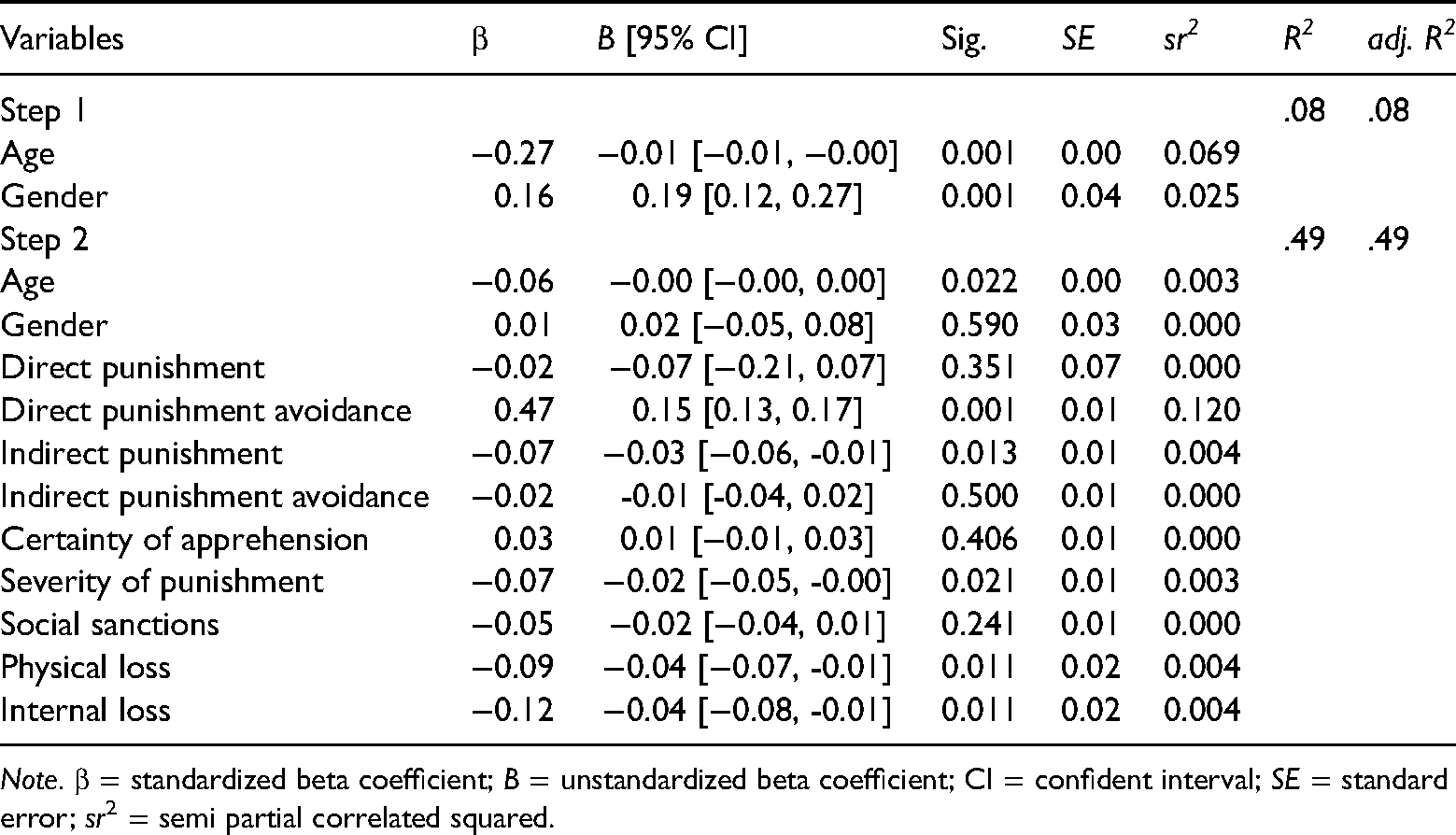
Note. β = standardized beta coefficient; B = unstandardized beta coefficient; CI = confident interval; SE = standard error; sr2 = semi partial correlated squared.
Legal sanctions
The following legal sanctions predicted the behavior of following a vehicle too closely: Severity of punishment, direct punishment avoidance, and indirect punishment. These findings indicate that participants who reported following a vehicle too closely more frequently and have not been punished for the behavior, are more likely to continue engaging in the behavior. Further, participants who know of family or friends that have received an infringement for following a vehicle too closely are less likely to engage in the behavior. Finally, participants who perceive the fine and demerit points for the behavior as high are less likely to engage in following a vehicle too closely. The variables direct punishment, indirect punishment avoidance, and certainty of apprehension did not predict the behavior.
Nonlegal sanctions
The following nonlegal sanctions predicted following a vehicle too closely: Physical loss and internal loss. These findings indicate that participants who think following a vehicle too closely increases their risk of injury are less likely to engage in the behavior. Finally, participants who fear internal shame for following a vehicle too closely are less likely to engage in behavior. Social sanctions did not predict the behavior.
Discussion
Following a vehicle too closely is a major contributor to motor-vehicle collisions and injuries, yet minimal research has investigated predictors of the behavior. Therefore, the current study aimed to establish the impact of legal sanctions and nonlegal sanctions on the behavior. The findings have indicated that age, gender, severity of punishment, direct punishment avoidance, indirect punishment, physical loss, and internal loss are significant predictors of following a vehicle too closely, whereas direct punishment, indirect punishment avoidance, certainty of apprehension, and social sanctions were not associated with engagement in the behavior. The current findings are important in that they have the potential to inform both legal and nonlegal countermeasures to decrease the behavior.
A notable finding from this study was that the majority of the sample had engaged in following a vehicle too closely (98%). This finding is higher than previous Queensland research, where headway observations (N = 503,400) were collected through video footage on high traffic areas and indicated that over 64% of cases were following the leading vehicle too closely (Rakotonirainy et al., 2017). It could be argued that the study might have underestimated actual numbers due to examining within a single time point. In contrast, the present study was based on self-report data and was not restricted to a single time point. Nonetheless, both studies suggest that following a vehicle too closely is a persistent behavior, particularly on Queensland roads.
Age and gender were both significant predictors of following a vehicle too closely, indicating that males and younger drivers were likely to report engaging in the behavior more often. These results are consistent with previous research, finding younger drivers (Horswill et al., 2020; Kaiser et al., 2016; Liew et al., 2017; Monteiro et al., 2015; Rashid, 2016) and male drivers (Liew et al., 2017; Rashid, 2016) engage in unsafe following distances more frequently than older drivers and female drivers, respectively. Admission of following a vehicle too closely in the current study (98%) was significantly higher than admissions of other illegal behaviors such as drink driving (25%; Freeman et al., 2016) and phone use (58%; Truelove et al., 2019) in previous studies. This may be explained by the low perceptions of certainty of apprehension for the behavior.
Indeed, certainty of apprehension was not a significant predictor of following a vehicle too closely, which is a consistent finding in other road rule violations such as phone use while driving, speeding, and drink driving (Freeman et al., 2016; Kaviani et al., 2020; Truelove et al., 2019). For example, if a driver believes there is a low chance of being caught for following a vehicle too closely, then the punishment associated with the offence may not act as a deterrent for the driver. This idea is supported by previous deterrence literature which has suggested that the perceived severity of a punishment only acts as a deterrent if there is also a high perceived certainty of being apprehended (Homel, 1988; Zimring & Hawkins, 1973).
Similarly, experiencing a direct punishment for following a vehicle too closely was not a significant deterrent for the behavior, most likely due to the low numbers of participants who have reported receiving a legal sanction for the behavior. Direct punishment avoidance was a significant predictor of following a vehicle too closely, which is a consistent finding to other road rule violations such as speeding, drink driving, drug driving, and using Snapchat while driving (Freeman et al., 2021; Truelove et al., 2019; Truelove et al., 2021b). This finding indicates that participants who are not caught for following a vehicle too closely are likely to continue engaging in the behavior. These results are consistent with previous research in Queensland, Australia, which found that 30% of the sample thought the absence of legal enforcement would decrease the chances of being caught for following a vehicle too closely, while 58% of the sample indicated it would be “extremely unlikely” to be punished for following another vehicle too closely (Rakotonirainy et al., 2017). Taken together, these findings suggest that the difficulty in enforcing following distances can help explain why this behavior was reported to occur frequently among the current sample.
In relation to drivers’ knowledge of others’ experiences of enforcement, indirect punishment avoidance was not a significant predictor of following a vehicle too closely. It may be suggested that participants were not as cognizant of other drivers’ experiences with avoiding punishment for following a vehicle too closely, which is why this variable had limited impact on an individual's offending behavior. On the contrary, indirect punishment was a significant deterrent for the behavior, suggesting that participants who know of friends and family receiving an infringement notice for following a vehicle too closely, are less likely to engage in the behavior. This is consistent with previous road safety literature, finding indirect punishment to be a significant deterrent for both phone use while driving (Truelove et al., 2019) and speeding (Freeman et al., 2021; Szogi et al., 2017). The results imply that when an individual knows someone who received a punishment for following a vehicle too closely, this information can spread widely, thus more people become aware of the punishment. This provides some support for the effectiveness of legal countermeasures, as this awareness of other drivers being apprehended then influences individuals to engage in the behavior less frequently themselves. It is also likely that drivers talk more about receiving a punishment than avoiding a punishment, which can help further explain the different results for indirect punishment and indirect punishment avoidance.
Notably, while the perceived certainty of being apprehended for following a vehicle too closely did not predict behavior, severity of punishment was a significant predictor of the behavior, indicating that those who perceived the threat of demerit points and a fine as a severe punishment, were less likely to engage in the behavior. This is an encouraging finding, as it suggests that even though drivers believe the chance of being caught for following a vehicle too closely is low, the punishment remains a salient deterrent. This was also found in similar research indicating that certainty of apprehension was only a predictor of speeding when mediated by the severity of punishment, suggesting the threat of apprehension is only a deterrent when legal sanctions are perceived as severe (Truelove et al., 2021a). Further, previous research has identified that perceptions of certainty of apprehension can fluctuate over time (e.g., Minor & Harry, 1982; Saltzman et al., 1982; Truelove et al., 2020) and in diverse environments (Nagin, 1998). In relation to following a vehicle too closely, drivers may perceive there is a high chance they would be caught engaging in the offending behavior if there is a visible police presence, yet this perception may decrease dramatically with no visible police presence. This fluctuation may provide an alternative explanation as to why the perceived certainty of apprehension was not a deterrent while the perceived severity of punishment was a deterrent; the perceived certainty of apprehension may average out as low, yet the severity of the punishment has been identified to be more stable over time (Truelove et al., 2020).
As driver's knowledge of other's receiving a punishment (indirect punishment) was found to influence less frequent offending behavior, it may be suggested that this knowledge could have at least partially contributed to the fine and demerit point punishment acting as deterrent (as drivers may have been made aware of this punishment via others). Nevertheless, it is important to highlight that drivers’ perceptions of enforcement certainty remained low and many drivers reported avoiding punishment for the offence which reinforced the continued engagement in following a vehicle too closely.
This is especially pertinent given that previous deterrence literature has identified that the perceived certainty of being apprehended is a more important deterrent than the perceived severity of the punishment (Freeman et al., 2017; Mungan, 2017; Piquero et al., 2011). Therefore, it can be suggested that the fine and demerit point penalty for following a vehicle too closely is a sufficient deterrent, however, there needs to be a substantial increase in enforcement efforts to maximize the deterrent effect. Increased police operations as used in detecting mobile phone use while driving is one way to increase enforcement of following a vehicle too closely. For instance, there have been police operations to aid in phone use while driving enforcement that involve capturing drivers from high above (e.g., double-decker bus or overpass) or encouraging the community to submit dash cam footage of vehicles that are following too closely (Snow, 2019). Such operations may also be feasible ways to increase the certainty of being apprehended for following a vehicle too closely. In addition, the introduction of technology (such as cameras) that captures this offending behavior may be a promising avenue for increasing drivers’ perceived certainty of being apprehended, as well as minimizing their experiences with avoiding punishment. The use of enforcement cameras to create a larger deterrent effect can be supported by previous research that has utilized enforcement cameras to reduce running red lights, speeding, mobile phone use while driving, and increase seatbelt usage (Alghnam et al., 2018; Cohn et al., 2020; Hoye, 2014).
The application of Homel’s (1988) nonlegal deterrence-based model proved successful in identifying nonlegal predictors of engagement in following a vehicle too closely. Perceived internal loss was a significant predictor of less frequent unsafe following distance, indicating that feelings of embarrassment or shame can discourage the behavior. Perceived physical loss was also a significant predictor of less frequent unsafe following distance, suggesting that participants who think following a vehicle too closely increases their risk of injury are less likely to engage in the behavior. This finding is consistent with drink driving (Freeman et al., 2016) and speeding (Truelove et al., 2017) research. Meanwhile, perceived social sanctions were not a significant predictor of less frequent unsafe following distance, suggesting that the behavior may not be perceived as a socially unacceptable behavior. Alternatively, any social stigma related to following a vehicle too closely may not be widely discussed, which could result in drivers not being cognizant of social sanctions, helping to explain why this variable was not a significant predictor. This is an area for future research to explore. Taken together, these results provide preliminary support for campaigns that elicit a sense of internal loss and physical loss to decrease following a vehicle too closely, yet future research is required to examine this more directly.
Limitation and future direction
This study has uncovered limitations that are important to note. Firstly, the study relied on self-report data, and therefore the possibility of reporting bias cannot be eliminated (Podsakoff et al., 2003). However, the findings have addressed an important gap in the literature, which can guide future research using objective measures of following a vehicle too closely, such as detection systems to electronically identify following distances from inside a vehicle (Zellmer et al., 2014). Consistent with previous road safety research, engagement in the offending behavior was measured on a scale from never to always (Szogi et al., 2017; Truelove et al., 2017; Truelove et al., 2019). However, a possible area of future research is to measure a more specific time period of the behavior, such as over the last month. Furthermore, participants were only recruited from Queensland, Australia, which needs to be considered in the generalizability of the findings. Future research is needed to test whether the results can be applied elsewhere and are representative of the wider population. Future research should also compare results within different regions (e.g., metropolitan, regional, and rural areas), to determine if the legal and nonlegal variables examined in this study differ between regions.
Conclusion
The current study provided an important addition to the large gap in the literature by utilizing three of the most prominent deterrence-based theories to understand how both legal and nonlegal factors influence drivers’ engagement in following a vehicle too closely. The findings demonstrate that indirect experiences of punishment and the threat of the severity of the punishment influences less frequent unsafe following distance, providing some support for the effectiveness of current legal countermeasures for the behavior. Nevertheless, the perceived certainty of being apprehended was not a significant deterrent, while drivers who experienced punishment avoidance were likely to continue following a vehicle too closely. These findings highlight the need for increasing drivers’ perceived enforcement certainty for the behavior, which may be achieved by more police operations and the use of enforcement cameras to capture the behavior. In addition to the legal sanctions, this study also identified that the perceived fear of both internal loss and physical loss associated with following a vehicle too closely influenced less frequent engagement in the behavior (while social sanctions did not influence this behavior). These findings provide preliminary support for campaigns that can target following distances, which can be more directly explored in future research. Given that following a vehicle too closely is a major contributor to motor-vehicle collisions and injuries, and this risky behavior continues to occur among the majority of drivers, this study provides necessary and timely knowledge to improve countermeasures.
Footnotes
Declaration of conflicting interests
The authors declared no potential conflicts of interest with respect to the research, authorship, and/or publication of this article.
Funding
The authors disclosed receipt of the following financial support for the research, authorship, and/or publication of this article: This work was supported by the Motor Accident Insurance Commission, Road Safety Research Colloboration funding.
