



Abstract
Recently the concepts of ‘compassionate courts’, ‘humane justice’, ‘kindness in court’, and trauma-informed practice have emerged in legal theory and practice in the US, England, Scotland and Australia. This article uses a trauma-informed practice framework to examine how South Australian superior court judges acknowledge defendant trauma in sentencing. Trauma-informed sentencing practice requires that judges realise the presence of trauma, recognise its relevance, respond in a way that is informed by trauma and act to resist re-traumatisation. By using this ‘4Rs’ framework to analyse sentencing remarks of 448 defendants published in 2019, the presence of trauma-informed practice was explored. Analysis indicated that judges realised trauma was present in the lives of many defendants, particularly women and Aboriginal peoples, but did not always overtly recognise a link between trauma and criminal behaviour and were unlikely to refer to a defendant’s trauma history or use trauma-informed principles of practice in their sentencing response. Research findings were presented to judicial officers at a Judicial Development Day in 2021. The article reflects on those discussions as well as the primary research, when making recommendations for future sentencing practice primary for the judiciary, but also for legislators and legal practitioners.
Keywords
Introduction
Imprisonment does not reduce re-offending and may instead increase the risk of re-offending compared to non-custodial sanctions (Day et al., 2021a, 2021b; Petrich et al., 2021). Consequently, in the US, UK and Australia, alternative sentencing approaches have emerged, including ‘compassionate courts’ (Hueston, 2021), ‘humane justice’ (Rowles & Haji, 2020), ‘kindness in court’ (Smith, 2019), and trauma-informed criminal justice (Bagaric et al., 2019; Bradley, 2017; Durr, 2020; Ellison & Munro, 2017; Jackson et al., 2021; Kezelman & Stavrolpoulos, 2016). These strategies are intended to reduce future offending and protect the safety of the community more effectively than incarceration by recognising that many people who offend have experienced (and continue to experience) significant adversity, trauma and social exclusion which is associated with their offending behaviour. Trauma-informed practices have been found to be effective in prisons and the community, as behaviour management strategies, safety strategies for correctional staff and clients (Jones, 2018; Miller & Najavits, 2012) and are of particularly interest to those who work in Indigenous justice in countries like Australia given the capacity to strengthen understanding of the cultural context in which criminal behaviour and criminal sanctions occur. At a minimum, trauma-informed criminal justice requires that practitioners recognise engagement with the criminal justice system need not be fundamentally traumatic.
Trauma and crime
There is no universally accepted definition or understanding of the construct of ‘trauma’. In this study, trauma is understood to be the negative impacts of adversity. Adversity includes distressing acute events and chronic adverse experiences (Randall & Haskell, 2013). Chronic adverse experiences may be either a series of repeated experiences, ongoing experiences or a combination of intergenerational trauma and direct trauma. Intergenerational trauma specifically relates to trauma ‘across familial generations’ (Menzies, 2019, p. 2), such that ‘unacknowledged or unresolved trauma in previous generations [is] linked to dysfunction within an extended family in later generations’ (Atkinson et al., 2014, p. 294). Intergenerational trauma has been identified as an important construct in the Australian context, particularly in relation to Aboriginal and Torres Strait Islander peoples who have layered experiences of chronic and cumulative trauma, from the time of colonisation and continuing today (Anthony, 2013; Atkinson, 2008). 1 Thus, in this study, ‘complex trauma’ (i.e. the compounded impact of multiple or prolonged traumatic stressors, leading to chronic dysfunction; Kezelman & Stavrolpoulos, 2012) is understood to be the psychological, emotional or physiological impact of adversity on an individual’s functioning and wellbeing.
The concept of ‘complex trauma’ is differentiated from post-traumatic stress disorder (PTSD), which is a psychiatric diagnostic category used to understand the impact of specific traumatic experiences (Bottalico & Bruni, 2012, p. 112; see also APA, 2013). Researchers and practitioners have found that relying on a PTSD diagnosis as a measure of traumatisation is limited because ‘the diagnostic category of PTSD was developed in response to the symptoms seen in survivors of one-off, or relatively contained events, such as a natural disaster … [not capturing] the effects of chronic and/or multiple types of victimisation’ (Wall & Quadara, 2014, p. 2). Thus, while PTSD by definition is a medicalised marker of the presence and impact of trauma, it is not the only reliable indicator (Boswell, 2016).
Almost 30 years ago, Judith Herman (2014, 2015) introduced complex PTSD (cPTSD) to explain the psychological trauma exhibited by people who had experienced prolonged adversity. While cPTSD is not a recognised medical condition in the DSM-5, the World Health Organization (2018) recognised cPTSD in 2018. The new diagnosis describes cPTSD as: … a disorder that may develop following exposure to an event or series of events of an extremely threatening or horrific nature, most commonly prolonged or repetitive events from which escape is difficult or impossible (e.g., torture, slavery, genocide campaigns, prolonged domestic violence, repeated childhood sexual or physical abuse). All diagnostic requirements for PTSD are met. In addition, Complex PTSD is characterized by severe and persistent 1) problems in affect regulation; 2) beliefs about oneself as diminished, defeated or worthless, accompanied by feelings of shame, guilt or failure related to the traumatic event; and 3) difficulties in sustaining relationships and in feeling close to others. These symptoms cause significant impairment in personal, family, social, educational, occupational or other important areas of functioning (WHO, 2018).
This definition goes beyond the DSM-5 criteria for PTSD, recognising that individuals may experience lingering trauma-related distress or dysfunction in unique and individualised ways.
The symptoms and manifestations of trauma (whether recognised as PTSD, cPTSD or another diagnostic label) are often risk factors for crime and predictors of criminogenic needs (Baglivio et al., 2015; Basto-Pereira et al., 2022; Caspi et al., 2002; Widom, 1989).
Trauma-informed sentencing
Sentencing in South Australia
Sentencing plays an important role in how the criminal justice system responds to crime; imposing sanctions designed to punish people who offend, reduce future crime, and consequently improve community safety. Judges must give regard to the sentencing calculus which comprises sentencing purposes, principles, individual factors, and which is influenced by non-legal considerations such as defendant characteristics (e.g. gender, race, social class, and even physical attractiveness; Jeffries & Bond, 2009, 2010) and judges’ characteristics such as age, experience, and religious and political beliefs (Barry, 2021). In South Australia, s 3 of the Sentencing Act 2017 (SA) (‘the Act’) specifies that the primary purpose of sentencing is to protect the safety of the community. In his article, Ben Livings (2020) proposed that this primary purpose was intended to be read expansively, given the Act also introduces a range of non-custodial sentencing options, which are … designed to create a sanction that offer some of the ‘bite’ of custody but spare offenders many of the social disadvantages of imprisonment such as disconnection with family and community, loss of employment and limited access to programs that could address factors underpinning offending, for example, drug and alcohol, gambling and mental health supports … (AGD, 2015, p. 9).
Regardless of Parliament’s intention, discretion allows judges to take their own approach when sentencing to protect community safety. In SA and more broadly, community safety is most often equated with rehabilitation for young people (e.g. R v Williams [2018] SASCFC 14 at para 42) and individuals with limited criminal histories (Bagaric & Alexander, 2012; Livings, 2021). When sentencing people with serious offending histories, whose criminal behaviour is considered more entrenched, judges are more likely to equate protecting the safety of the community with deterrence and incapacitation (Bagaric & Alexander, 2012; see also: Livings, 2021).
Section 10(1) of the Act sets out general principles of sentencing. Parity (or ‘consistency’; Krasnostein & Freiberg, 2013) requires that ‘equally situated offenders should be treated equally’ (Livings, 2020, p. 399), and is typically applied narrowly to ensure comparable sentencing of co-offenders. Totality typically requires that judges ensure that the sanction imposed is not so severe as to be ‘crushing’, such that the defendant gives up all hope of a life beyond prison (Livings, 2020). Parsimony aims to ensure ‘the imposition of a sentence is no more severe than is necessary to achieve the objectives of the sentence’ (Bagaric et al., 2021, p. 9). Proportionality supports the imposition of sanctions that reflect the seriousness of the offence without being too harsh or lenient (Judicial Commission of NSW, 2006, para 2-230). Proportionality has been described as ‘the central doctrine of sentencing’ (Kirchengast, 2010, p. 197), yet it has also been described by legal scholars as ‘devoid of clear criteria’ and ‘a meaningless, abstract aspiration’ (Bagaric et al., 2017, p. 790f). In the next section, relationships between sentencing principles and trauma are discussed.
Importantly, the High Court, in Elias v The Queen (2013) 248 CLR 483 emphasised that ‘[t]he administration of the criminal law involves individualised justice’ (pp. 494-495, para 27). Individualised justice is partly achieved through the consideration of factors specified in the Act, including ‘the defendant’s character, general background and offending history’ (s 11(1)(d)); the defendant’s ‘mental condition (including any cognitive impairment)’ (s 11(1)(f)); and ‘the defendant's prospects of rehabilitation’ (s 11(1)(h)). Each of these factors may be influenced by defendant trauma.
Trauma in sentencing
Judges currently recognise trauma in sentencing. Judges acknowledge the impacts of crime on a victim’s wellbeing (refer s 11(b) of the Act), and this is often included in sentencing remarks. Judges are also aware of the potential for defendant trauma due to contact with the criminal justice system, particularly if the judge imposes a prison sentence (SAC (Vic), 2016). Defendant trauma (and the potential for re-traumatisation because of incarceration) may influence the sentencing purposes judges rely on, the priority given to sentencing principles, and the importance of the defendant’s background and history. When citing specific sentencing purposes in their remarks, judges who rely on deterrence are less likely to impose sanctions informed by trauma than those who focus on rehabilitation. For defendants with trauma histories, parity may be interpreted as the recognition that to ‘stand equally before the law’ should not be regarded as the need to punish equally but rather to have the same opportunities for all relevant factors, including individual factors, to be taken into consideration (JCV, 2020). Judges who prioritise proportionality may use defendant trauma as either a mitigating or aggravating factor. Judges may also establish ‘exceptional circumstances’ to circumvent elements of mandatory sentencing in SA legislation (e.g. s 54(2) of the Act). Yet these are examples of partially ‘trauma-informed’ sentencing, for trauma-informed sentencing requires the intentional application of a practice framework.
Trauma-informed sentencing practice framework
The concept of ‘trauma-informed’ emerged in 2001 in the work of Maxine Harris and Roger Fallot (2001). Trauma-informed practice requires that service providers ‘recognize, understand and minimize’ the long-term impact of trauma (Kubiak et al., 2017, p. 92). Trauma-informed practice is premised on trauma theory from the work of Judith Herman (2015) who proposed that to resolve the impact of complex trauma it is necessary to work through the stages of recovery. This resonates strongly with contemporary Aboriginal conceptualisations of healing (The Healing Foundation, 2021). The trauma-informed practice has been articulated as four steps (‘the 4Rs’) by the US Substance Abuse and Mental Health Services Administration (SAMHSA, 2014, p. 9f), as shown in Figure 1. Specifically, a service must first realise what trauma is and the potential impacts of adversity. The service must recognise trauma symptoms experienced by the individual accessing the service. The service must respond appropriately to the individual’s unique trauma while also resisting re-traumatisation by avoiding insensitive or inappropriate responses when providing services (SAMHSA, 2014).
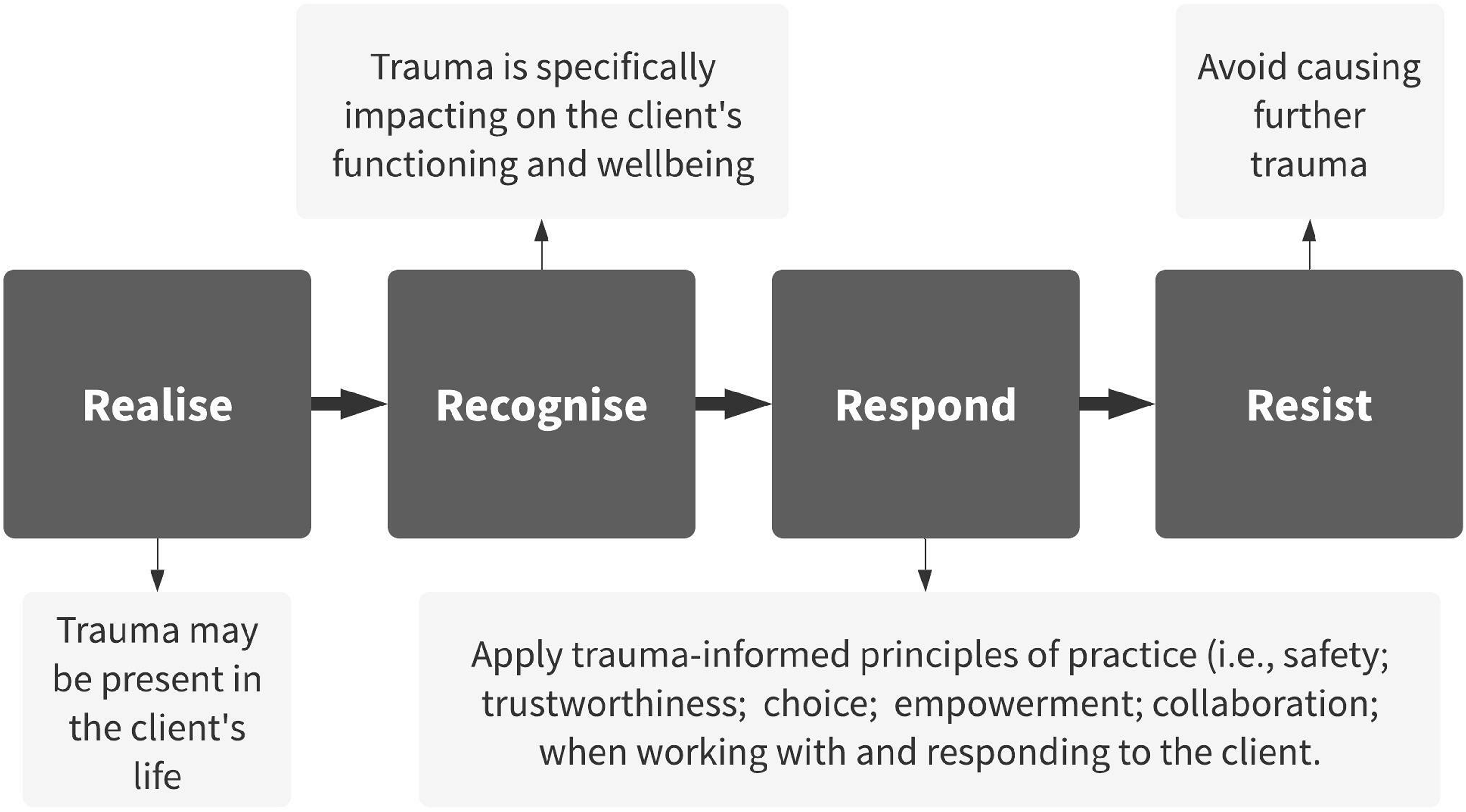
The 4Rs trauma-informed practice framework.
Work from the US (Fallot & Harris, 2011), UK (Covington, 2016) and Australia (Henderson et al., 2018a, 2018b) has established common principles that underpin trauma-informed practice. Blue Knot (Kezelman & Stavrolpoulos, 2012) refers to ‘five foundational principles’ of trauma-informed care: safety, trustworthiness, choice, collaboration, and empowerment. Safety aims to provide effective and consistent physical and emotional safety to service users when they access services; ensure service users feel welcome, included and heard by the service provider; and educate users and workers regarding client rights, feedback processes, and protective policies and practices. Trustworthiness refers to the establishment of mutually understood, clear and consistent expectations and boundaries, enabling a relationship of trust to be built between the service provider and the service user. Choice involves providing service users with control regarding their service preferences through information, options, and an awareness of users’ rights and responsibilities. Collaboration requires that service users have the opportunity to participate in the planning and shared decision-making around activities and settings related to service provision. Empowerment aims to promote the skills-development of service users through a strengths-based approach; and recognises the importance of individual characteristics, such as culture, history and gender, when designing an effective service to promote change and recovery (Fallot & Harris, 2011; Kezelman & Stavrolpoulos, 2012; SAMHSA, 2014). Once again, this language resonates strongly with the idea of self-determination and community-led justice responses which have been identified by Indigenous researchers as so important to the effective administration of justice across Australia (e.g. Dudgeon et al., 2014). In criminal justice, trauma-informed correctional care (TICC) is being applied in mainstream prisons, and trauma-informed lawyering is emerging (Gohara, 2018; Martin et al., 2019), yet little is known about trauma-informed sentencing.
Trauma-informed sentencing may be regarded as a form of therapeutic jurisprudence (McLachlan, 2021), actively targeting underlying causes of crime to reduce future crime. Like therapeutic jurisprudence, a trauma-informed sentencing process seeks to treat defendants (and other parties in the court) humanely and respectfully while also avoiding re-traumatisation because of court practices (see Halsey & De Vel-Palumbo, 2020; McLachlan, 2021). A small body of literature has examined how sentencing may be informed by trauma (Bagaric et al., 2019) and, more specifically, trauma-informed (Jackson et al., 2021; McKenna & Holtfreter, 2021; Smith, 2013). Trauma-informed sentencing requires that judges:
realise trauma may be present, acknowledge the prevalence of adversity in defendants’ lives, and how adversity may result in trauma (e.g. impacting brain function, emotional regulation, and ability to read and respond appopriately to social cues); recognise specific adversity in a defendant’s life and how the resulting trauma has impacted the defendant’s functioning and (criminal) behaviour; respond by applying the trauma-informed principles of practice to the sentencing process and imposing sanctions likely to promote recovery and community safety; and resist re-traumatisation for the defendant and others by working to avoid traumatic triggers throughout sentencing. In what proportion of sentencing do judges realise that defendants are often exposed to adversity across the life-course? In what circumstances do judges recognise a relationship between defendant trauma and criminality? To what degree do defendants currently experience trauma-informed sentencing procedural responses? How does defendant trauma influence the sentencing response in terms of sanction? What characterises a ‘trauma-informed sanction’? When do judges seek to resist re-traumatisation?
This paper expands on existing literature by examining:
Method
Data were drawn from sentencing remarks downloaded from the SA Courts Administration Authority website (CAA, 2022). Sentencing remarks can bring transparency to judicial decision-making by outlining the elements in the sentencing calculus relied on in reaching a decision, enabling sentencing to be better understood by the public. The sample consisted of 448 sentencing remarks dated 1 May 2019 to 30 November 2019 inclusive, capturing most matters within the time frame. 2 The 448 remarks sentenced 447 individuals, as one defendant was sentenced twice (BM).
Content analysis was used to analyse the data. Content analysis, at its core, aims to identify patterns, trends, meaning and significance in qualitative data (Webley, 2010). Quantitative content analysis (sometimes simply referred to as content analysis) ‘seeks to categorise and quantify documents and text in a systematic way’ while qualitative content analysis ‘allows us to ask more of the “why” by allowing a detailed exploration of key themes that occur within the data’ (Caulfield & Hill, 2014, p. 198f). The content analysis highlighted trends in sentencing remarks where sentencing was trauma-informed, such as whether defendants with specific demographics or offending behaviour were more likely to receive a trauma-informed response or whether particular judicial officers recognised trauma in defendants’ lives more often than other judges. This approach: … is perfectly suited for examining aspects of judicial method. Questions researchers have pursued include the types of authorities judges cite in their opinions; the argumentative, interpretive, or expressive techniques judges use in different circumstances, and the various meanings of important social conceptions (such as family or equality) that their written opinions tend to reflect (Hall & Wright, 2008, p. 93, citations omitted).
Quantitative and qualitative content analysis identified how and when trauma influenced sentencing, in terms of ‘how judges reason to their conclusions’ (Hall & Wright, 2008, p. 90), how they identified and understood adversity and trauma, and whether trauma-informed practice existed in sentencing.
Analysis
Realising trauma
In what proportion of sentencing do judges realise that defendants are often exposed to adversity across the life-course?
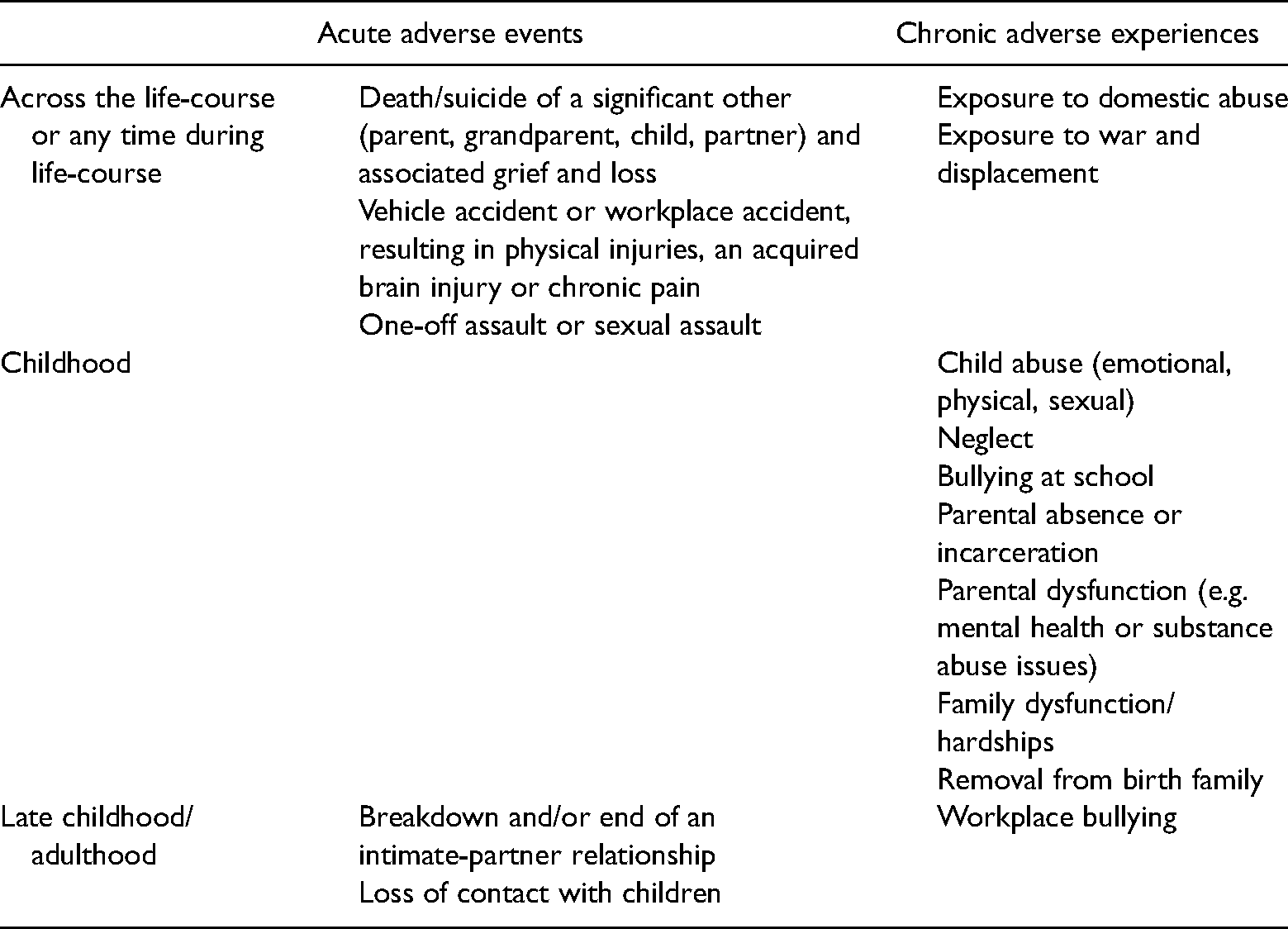
The majority of defendants were non-Aboriginal men (n = 336), 3 and for most (n = 187, 55.7%) judges did not ‘realise’ adversity or trauma was present. For most Aboriginal and female defendants (and all female Aboriginal defendants), judges realised that adversity was present in their lives. Judges realised that adversity included acute traumatic events, chronic trauma experiences, as well as exposure to multiple, adverse experiences (refer to McLachlan, 2022 for more information about the judicial sentencing responses to Aboriginal defendants). Judges realised that most defendants who experienced acute stressors, such as the death of a significant person (n = 62), or a vehicle or work accident (n = 17), had also previously been exposed to other adverse experiences. Judges and experts often cited acute stressors as marking the beginning of exposure to a series of adverse events. As outlined in Table 1, acute adversity such as death and accidents could occur at any time across the life-course. For some defendants, a relationship breakdown was significant, and for some parents, typically mothers, loss of access to their children was identified by judges as traumatic.
Types of traumatic events and experiences identified by judges when sentencing defendants.
In realising adversity was present, judges stated: You are the product of a devastating long-term effect of serial childhood abuse of one sort or another (R v ABT).
[When you were 14] you came home from school to find that your parents had left for interstate. You and one older brother had been abandoned (R v HCD).
At age nine you witnessed your father’s suicide. It was particularly gruesome, occurring directly in front of you (R v KRB).
You had a very dysfunctional and difficult relationship with your biological mother who was a drug addict and who was absent and neglectful of you during your childhood. On two occasions she left you as what you would describe as ‘collateral’ with a drug dealer for debts owed and you were subjected to abuse during those times (R v KJB).
While judges’ language meant the range and types of adverse experiences of each defendant could not be quantified, most remarks included less than 10 references to adversity or trauma in the life of a defendant (n = 219; 94.0%). Judges made more than 11 references to adversity in the sentencing remarks of 14 defendants. Poverty, large families and childhood dysfunction characterised this cohort.
Even when judges identified the presence of adversity in defendants’ lives, they were unlikely to articulate explicitly how adversity led to trauma. Although the Act refers to ‘cognitive impairments’ in ss 5 and 11(1)(f), defined as both developmental disabilities and mental illness, judges were more likely to realise that exposure to adversity was associated with ‘distress’ (e.g. in sentencing LMM; CLDS; CJT; BH; DRB; AD, DK; BA, HKO; JPR; JA; SB). 4 or ‘trauma’ (e.g. BAJC). Where judges identified defendants with complex trauma, this was based on evidence in expert reports of psychologists and psychiatrists. By relying on diagnostic labels, judges often overlooked cultural conceptualisations of trauma and the presence of intergenerational trauma and its association with crime. While the ALRC (2017) recommended sentencing ‘judges take into account unique systemic and background factors affecting Aboriginal and Torres Strait Islander peoples’ (p. 204), this is an uncommon practice in Australian courts and acknowledgement of intergenerational trauma was completely absent in this sample.
Recognising trauma
In what circumstances do judges recognise a relationship between defendant trauma and criminality?
Judges were less likely to recognise how adversity and trauma were associated with criminality. Judges overtly recognised that trauma influenced criminal behaviour in 111 of the 233 sentencing remarks (47.6% where trauma was realised), including 26 female defendants (55.3% of females) and 13 Aboriginal defendants (36.1% of Aboriginal people). Judges associated trauma with criminality most often when:
the defendant had experienced a discrete adverse event in adulthood (despite such adversity being less common in defendants’ lives than adverse childhood experiences). trauma resulted in formal mental health diagnoses. In the sentencing remarks of at least 80 defendants with trauma histories (34.3%), judges recognised defendants had been diagnosed with psychiatric conditions, including schizophrenia, mood disorders (e.g. bipolar disorder and depression), anxiety disorders (including PTSD), personality disorders (most often borderline personality disorder) and substance use disorders. trauma manifested as substance dependency closely associated with criminal behaviour (e.g. JLK; PMG). While offending behaviour was diverse, a trauma-crime association was recognised for a considerable proportion of people convicted of drug-related offences, for example, drug trafficking, drug possession or drug use while on bail or parole (n = 42; 37.8% of the sample). I accept the offending arose out of your all-consuming drug addiction, in the context of your ongoing grief at the loss of your brother. However, this explains, but does not excuse the offending.
A minority of judges identified that while a trauma-crime association ‘goes some way’ to explaining criminal conduct, it in no way excuses criminal behaviour (e.g. ST; MEW; SBP; JLK; PAW). In sentencing ST, the judge said:
Sometimes this was true even when expert evidence highlighted a link between unresolved complex trauma and criminal behaviour.
Responding to trauma
To what degree do defendants currently experience trauma-informed sentencing procedural responses?
To identify the trauma-informed process, the content of sentencing remarks was used as a proxy measure of each principle of practice, as follows:
Safety was represented by judges referring to defendants directly and by name. Safety was lacking when judges referred to defendants indirectly (i.e. in the third person) even when defendants were present in court. Trustworthiness of judges was indicated when judges explained an element of the sentencing process to the defendant. Safety and Empowerment occurred when judges asked the defendant whether they understood the sentencing sanction. Choice, collaboration and empowerment were represented by judges asking defendants whether they accepted and would abide by the sentencing decision.
The sentencing process for 64 defendants (27.5%) was characterised by all five principles of practice. One or more of the trauma-informed principles of practice were present in 67.4% of the 233 sentencing remarks. For 15 individuals, the only example of the trauma-informed practice was the judge addressing them by name. Although this does not seem significant, when judges dehumanised defendants, their remarks were confronting to read, such as Judge #6 who consistently referred to defendants present in the courtroom as ‘the offender’ (e.g. NJW; SBP; RC, JBB; WSW, ZH).
How does defendant trauma influence the sentencing response in terms of sanction? What characterises a ‘trauma-informed sanction’?
Trauma-informed sanctions were based on judges’ intentions (n = 82; 35.2%), not because the resulting sanction was necessarily evidence-informed. Judges tended to either downgrade the sanction from incarceration to a community-based penalty or reduced the length of imprisonment. Short prison sentences were well-intentioned but non-custodial sentences are more effective in reducing recidivism than prison sentences shorter than 12 months (O'Donnell, 2020). While 89 defendants with trauma histories received non-custodial sentences (i.e. a bond, suspended sentence and bond, no further penalty, new non-parole period, mental health licence), not all these remarks were explicitly imposed in response to defendant trauma.
Trauma-informed sanctions were used to promote rehabilitation and community safety rather than deterrence. Proportionality was prioritised by sentencing judges. When judges focused on proportionality, this sometimes meant that trauma information was used to mitigate the sanction imposed. Nevertheless, trauma was sometimes also perceived as an aggravating factor, increasing the risk of future offending, and reducing the likelihood of successful rehabilitation.
Resisting re-traumatisation
When do judges seek to resist re-traumatisation?
In 74 sentencing remarks (30%), judges acknowledged a lengthy prison sentence would lead to traumatic impacts on the defendant, the defendant’s children or other dependents. In the sentencing remarks of 32 defendants (17 women and 15 men), judges focused on how a sentence of incarceration would traumatise the defendants’ children or family members. In some cases, judges identified that the impact of incarceration on children met the threshold of ‘exceptional circumstances’.
Discussion
The existence of trauma-informed practice in sentencing
This research aimed to examine whether trauma-informed practice existed in sentencing in SA. In most cases, sentencing was only partially trauma-informed. A trauma-crime association was recognised in half (47.6%) the 233 sentencing remarks where judges realised that trauma was present. Even when judges realised defendant trauma was present and recognised a trauma-crime link, this did not guarantee a trauma-informed response or that the judge would resist re-traumatisation. Further, trauma-informed sentencing experiences were not linear. Recognising a trauma-crime association was not necessarily a pre-cursor for a trauma-informed sentencing response or for a judge to resist re-traumatisation.
Policy and practice recommendations
Given judges recognised (at least in some cases) that trauma ‘explains’ criminal behaviour, judges should now endorse that a trauma- and evidence-informed approach is a key strategy to achieve the primary purpose of sentencing: to promote community safety. Trauma-informed sentencing could be enhanced through further education, information-sharing and legal reform.
Education
Evidence-informed sanctions would allow for justice-reinvestment, diverting funds from prison sentences to more effective, intensive community-based sanctions that better promote community safety. Recent Australian research found that judges recognised the need ‘for a much-expanded range of [sentencing] options, including education and treatment, which is needed for effective sentencing and diversion, but, importantly, … a considerable and credible (re)investment of resources’ (Bull et al., 2021, p. 14). To achieve the goal of trauma- and evidence-informed sentencing, current information and resources need to be made available to judges. Trauma research is evolving more quickly than the lay understandings of legal counsel and judicial officers regarding the relationships between trauma and criminal behaviour. Judges should be provided with educational material regarding the prevalence and relevance of adversity and resulting trauma in an online, trauma-focused bench book. In the interim, judges could be directed to the ‘Bugmy Bar Book’ an online, living resource developed for public defenders in NSW which summarises ‘key research relating to experiences of disadvantage and deprivation’ (The Public Defenders (NSW), 2022).
In addition, judicial officers (and legal practitioners) should be provided with training and education regarding intergenerational trauma experienced by Aboriginal and Torres Strait Islander peoples. Judicial officers and court staff should also be provided with education and training regarding the value of trauma-informed practice and how to model and apply trauma-informed practice principles in their work. Finally, an education strategy could be developed to promote greater public awareness of evidence-informed policy and practice to combat the punitive public myth. The widely held assumption that the general public supports punitive approaches appeared to influence sentencing judges, despite a lack of evidence (Day et al., 2021a, 2021b). Community members learn about sentencing, and specific sentencing outcomes from media reports rather than official records, such as sentencing remarks (Mack et al., 2018). The media often feeds the public assumption that the judiciary is out of touch with community sentiment.
Information
If sentencing remarks were easily accessible and clearly articulated, they could be used to educate the public. Sentencing remarks should be made available free of cost to the general public by the CAA for longer than the current four weeks, to assist in de-mystifying sentencing decision-making. To ensure they are more clearly articulated, a model template for remarks could be developed in consultation with judges. While instinctive synthesis does not require a formulaic approach to sentencing, a consistent approach may provide clarity and transparency to the sentencing process and include a comprehensive explanation of how the sentencing decision was reached.
Funding should be available to establish a process for the provision of expert cultural advice and reports as well as expert reports about adversity and trauma. Such an approach could build on Canadian legal practices where all Aboriginal defendants have what are referred to as ‘Gladue’ rights, 5 that is, the right to have specialist reports prepared before sentencing to advise the judge of circumstances relevant to the Aboriginal defendant, focusing on rehabilitation (Legal Services Society, 2011). Trauma reports could include how trauma is relevant (if at all) and how best to respond to achieve sentencing purposes. While many psychiatric and psychological reports currently include reference to trauma, its relevance to mental health and offending, and trauma-informed strategies to address criminogenic needs, these experts are not obliged to include this information. Were such reports to focus on criminogenic risk rather than diagnostic information, they could better assist judges in forming a sentencing response likely to reduce recidivism and better promote community safety.
Reform
A key mechanism to achieve many of these recommendations would be to re-establish the South Australian Sentencing Advisory Council. Sentencing Advisory Councils can help to enhance knowledge of sentencing and build public confidence (Freiberg, 2021), and currently exist in Queensland, Victoria, NSW and Tasmania.
Given the significant traumatic impact of parental absence, dysfunction, incarceration, and intergenerational trauma experienced by adult defendants, sentencing judges have a responsibility to minimise further traumatisation of defendants’ children. While it should not be the principal consideration in sentencing, it should be a sentencing factor that judges consider, particularly for non-violent, non-serious offending. Thus, family hardship should be explicitly included as a sentencing factor in the Act to lower the threshold from ‘exceptional circumstances’ to ‘probable’ harm, and to acknowledge the human rights of children (Walsh & Douglas, 2016), as well as the intention to actively avoid inflicting further intergenerational trauma.
Finally, to ensure that the criminal justice system can achieve its purpose of enabling defendants to ‘contribute to a safe and secure community and promote a law abiding way of life’ (Productivity Commission, 2021b), it is vital that ‘all the sentencing options provided to [sentencing judges] by law are actually available. When [judges] order someone to participate in drug treatment, for example, it is understandable if they are then left feeling let down when they find that the [individual] can’t access those services quickly’ (Bowen, 2020, p. 9). Prison is far more readily available than substance abuse treatment, mental health services or supported accommodation, despite being both criminogenic and less cost-effective. Justice reinvestment strategies are crucial to better achieve sentencing purposes. Judges and the courts could work with other agencies to build on TICC and develop a whole criminal justice system strategy to promote trauma-informed, gender-specific, culturally-appropriate strategies to better achieve community safety (see also Productivity Commission, 2021a).
Postscript: Discussing the research with South Australian judicial officers
As part of a knowledge translation and exchange strategy, the findings of this study were discussed with approximately 30 judicial officers at a Judicial Development Day in November 2021. There was little resistance by the judiciary to trauma-informed sentencing in principle, indeed there was recognition that it is being prioritised in the Youth Court. Two District Court judges argued that if they mentioned adversity in their remarks, it was implicit that they had realised it was relevant and associated with criminality. One judicial officer argued that there is no empirical evidence indicating trauma causes crime (and presumably therefore it would be improper to make such a link in sentencing remarks). While evidence has not established that trauma causes crime, there is considerable evidence to argue that trauma influences criminality (Malvaso et al., 2018). Judicial officers highlighted the need for defence lawyers to be sufficiently funded to source quality and timely expert (trauma and culture) reports. Judges agreed that parliament should stop drafting legislation that restricts judicial discretion and undermines judges’ ability to devise individualised sanctions to protect community safety. Finally, one District Court Judge suggested that the use of phrases such as ‘explains but does not excuse’ were required to reassure the Court of Criminal Appeal that the sentencing process and sanctions were based on defensible decision-making.
Limitations of sentencing remarks as a data source
Because sentencing remarks outline ‘the basis of fact and the reasons why a sentencing option has been chosen’ (JCV, 2020, para 2.49), sentencing remarks which do not acknowledge trauma cannot be used as a measure of the proportion of defendants who have not experienced trauma. Arguably, the most trauma-informed remarks were those which articulated little detail of the defendants’ lives, protecting the privacy and safety of the defendant. By relying on sentencing remarks as a data source, this research was valuable in testing the efficacy of sentencing remarks as clear summaries of judges’ deliberations and decision-making.
Conclusion
Trauma-informed practice was developed more than 20 years ago and has emerged as a way of working in corrections, and broader contexts such as health and education services. Nevertheless, there has been little research examining whether trauma-informed practice exists in sentencing. This research addresses that unacknowledged and overlooked research gap and provides a useful baseline as to how the current system works, to better inform future justice reform. By using the SAMHSA’s trauma-informed practice framework, this research focused on how defendant trauma is currently realised, recognised, responded to, and re-traumatisation resisted by sentencing judges in South Australia. By identifying existing trauma-informed practice from sentencing remarks, this research establishes a baseline of how defendant adversity and trauma are recognised and responded to in sentencing. This research has uncovered a judicial appetite for fair and just sentencing options while working within a sentencing calculus that contains unhelpful constructs such as personal deterrence which lacks empirical rigour. Empirical data supports the benefits of trauma-informed sentencing and highlights the possibilities if it is fully embraced in sentencing and not simply viewed as one component in a litany of considerations. There is no reason to suggest that judicial officers will turn away from it. There is every reason to suggest that it will transform their deliberations.
Sentencing remarks
R v ABT (Supreme Court of SA, #1 J, 25 September 2019)
R v AD & DK (District Court of SA, Judge #14, 9 May 2019)
R v BA & HKO (District Court of SA, Judge #18, 19 November 2019)
R v BAJC (District Court of SA, Judge #2, 22 November 2019)
R v BH (District Court of SA, Judge #14, 4 June 2019)
R v BM (District Court of SA, Judge #11, 14 May 2019)
R v BM (District Court of SA, Judge #17, 31 October 2019)
R v CJT (District Court of SA, Judge #7, 23 August 2019)
R v CLDS (District Court of SA, Judge #8, 19 June 2019)
R v DRB (District Court of SA, Judge #18, 28 June 2019)
R v EJG (District Court of SA, Judge #18, 3 May 2019)
R v GT (Supreme Court of SA, #19 J, 20 August 2019)
R v HCD (District Court of SA, Judge #10, 11 October 2019)
R v INR (District Court of SA, Judge #15, 27 June 2019)
R v JA (District Court of SA, Judge #15, 18 October 2019)
R v JLK (District Court of SA, Judge #17, 13 June 2019)
R v JPR (District Court of SA, Judge #7, 9 September 2019)
R v KJB (District Court of SA, Judge #4, 14 August 2019)
R v KRB (District Court of SA, Judge #22, 2 October 2019)
R v LMM (District Court of SA, Judge #24, 3 July 2019)
R v MEW (District Court of SA, Judge #17, 5 August 2019)
R v NJW (District Court of SA, Judge #6, 22 October 2019)
R v PAW (District Court of SA, Judge #7, 12 June 2019)
R v PMG (District Court of SA, Judge #11, 13 June 2019)
R v RC & JBB (District Court of SA, Judge #6, 21 November 2019)
R v SB (District Court of SA, Judge #11, 2 October 2019)
R v ST (District Court of SA, Judge #7, 28 August 2019)
R v SBP (District Court of SA, Judge #6, 21 November 2019)
R v WSW & ZH (District Court of SA, Judge #6, 12 November 2019)
Footnotes
Acknowledgements
Thanks to Professor Andrew Day for reviewing earlier drafts of this article.
Declaration of conflicting interests
The authors declared no potential conflicts of interest with respect to the research, authorship, and/or publication of this article.
Funding
The authors disclosed receipt of the following financial support for the research, authorship, and/or publication of this article: This work was supported by the Australian Government Research Training Program Scholarship.
