




Abstract
Image-based sexual abuse (IBSA) is a growing, global problem. This article reports on a mixed-methods, multi-jurisdictional study of IBSA across the United Kingdom, Australia and Aotearoa/New Zealand. Attitudes of blame and minimisation of harms among a sample of the general population (n = 6109) were analysed using two multiple regression analyses that assessed the ability of three demographic and three experiential characteristics to predict attitudes. Interviews were also conducted with 43 stakeholders and analysed thematically. Survey respondents who attributed more blame and minimised harms to a greater extent tended to be men, heterosexual, and had experienced or perpetrated more IBSA behaviours. Those who reported greater engagement in sexual self-image behaviours were also more likely to minimise harms. Interview participants suggested attitudes of blame and minimisation may be linked to broader problematic attitudes around sexual violence and sexual double standards, with women more likely to experience blame for IBSA. Our findings are of international relevance and highlight the need for multifaceted policies, education campaigns and training that challenge these attitudes.
Introduction
Researchers continue to find that people attribute blame towards victims of sexual violence based on factors such as alcohol or drug consumption, what the victim was doing or wearing, and their relationship with the perpetrator (Burgin & Flynn, 2021; Pinciotti & Orcutt, 2021). Such attitudes not only increase the harm experienced by victims, who may internalise these negative judgments but also create barriers to help seeking (Anderson & Overby, 2021; Flynn, 2015; Henry, Flynn & Powell, 2015; Lichty & Gowen, 2021; Trottier et al., 2021). Research further suggests that when these attitudes are held by police and first respondents (e.g., support workers, family, and friends), they can negatively shape the responses victims receive (Mourtgos et al., 2021; O’Neal, 2019). This can lead to self-shaming and poor mental health outcomes for victims and contribute to reduced social understandings of sexual violence.
Image-based sexual abuse (IBSA) is an emerging form of sexual violence that involves the non-consensual taking, distribution, and/or threat to distribute nude or sexual imagery of another person. Much of the research to date has focused on non-consensual image distribution (Eaton et al., 2018; Lenhart et al., 2016) and its detrimental impacts on victims (Bates, 2017; Powell et al., 2022b; Rackley et al., 2021). There has also been a body of work on consensual image-sharing (‘sexting’), particularly focused on attitudes, behaviours, and potential adverse outcomes among adolescents (Dobson & Ringrose, 2016; Doyle et al., 2021; Ringrose et al., 2013). Less knowledge exists on attitudes that are held in relation to IBSA.
This article responds to this knowledge gap, examining attitudes of blame and minimisation of harms drawing on a quantitative general population survey of 6109 respondents aged 16 to 64 years across the United Kingdom (UK), (n = 2028), Australia (n = 2054) and Aotearoa/New Zealand (ANZ) (n = 2027). Qualitative interviews were also conducted with 43 stakeholders (n = 10 ANZ; n = 33 UK) 1 including those working with sexual and/or domestic and family violence victims; policy, government and non-government organisations; internet safety organisations; and legal stakeholders (e.g., police, lawyers, investigators). 2 Informed by original analyses of the data, this article explores factors associated with attitudes towards sexting, IBSA, victim-blaming and minimisation of harms, including demographic characteristics, past engagement in sexual self-image behaviours, and self-reported experiences of victimisation and perpetration.
The article begins by providing a brief discussion of related literature, before outlining our methodology. We then report the results, including stakeholder perspectives on victim-blaming and harm minimisation attitudes, the sources and impacts of these attitudes, and the correlates for respondents holding such attitudes. In particular, we explore patterns in attitudes of blame and minimisation, and the differential impacts these may have on victims’ support-seeking behaviours. We conclude by discussing key findings, implications and study limitations.
IBSA, blame and harm minimisation
IBSA is a serious form of technology-facilitated sexual violence. Research has found IBSA to be relatively common (Eaton et al., 2018; Henry et al., 2019a; Patel & Roesch, 2022; Lenhart et al., 2016; Snaychuk & O’Neill, 2020) and increasing (Powell et al., 2022a). Consistent among these studies is a higher rate among people who are gender and sexuality diverse, mirroring the victimisation experiences of other forms of sexual violence. Research has also identified a range of harms from victimisation, including anxiety, depression, suicidal ideation, social isolation, and employment loss (Bates, 2017; Flynn & Henry, 2021; McGlynn et al., 2021; Powell et al., 2018). As a response, many countries – including those examined in this study (Abusive Behaviour and Sexual Harm (Scotland) Act 2016; Criminal Justice and Courts Act 2015 (UK); Harmful Digital Communications Act 2015 (ANZ); Online Safety Act 2021 (Cth)) – have criminalised the non-consensual distribution of nude or sexual images (Flynn & Henry, 2019), and increasingly, jurisdictions are criminalising threats to distribute such images, and the taking and creation of such images, including where the image is digitally altered (Flynn, Clough et al., 2021). Despite this, attitudes that blame victims and minimise IBSA harms have been found among members of the general public, law enforcement, and victims’ family and friends (Bond & Tyrell, 2021; Henry et al., 2019b; Zvi & Schechory-Bitton, 2020).
The limited research on IBSA and attitudes towards blame suggests that men are more likely than women to blame victims, while women are more likely to perceive the situation as serious and police intervention necessary (Bothamley & Tully, 2018; Scott & Gavin, 2018). In an Australian survey (n = 4272), Henry et al. (2019b) found that 49% of male respondents, compared with 32% of female respondents, held attitudes that either minimised IBSA harms, blamed victims, or excused perpetrators. In another Australian study on IBSA (Flynn, Cama et al., 2022a), attitudes towards blame and harm minimisation among participants were low. However, men were more likely than women to report that IBSA could have positive impacts on victims and that there are some circumstances in which IBSA is acceptable.
Research further suggests that people attribute greater blame to victims where there is higher nudity (i.e., where breasts are exposed), where the images were consensually taken but non-consensually shared, and where participants accept sexual double standards, that is, that women and girls should be judged more harshly for their sexual behaviour than men and boys (Crawford & Popp, 2003; Endendijk et al., 2020; McKinlay & Lavis, 2020; Pina et al., 2021; Zvi & Shechory-Bitton, 2021). Research suggests sexual double standards also affect views of consensual sexting. In focus groups with 115 teens aged 13 to 19 years, Ricciardelli and Adorjan (2019) found participants perpetuated these standards, with young women who sent sexual images labelled as ‘sluts’, compared to young males’ sending of ‘dick pics’ being labelled ‘typical behaviour’. In their sexting study, Lippman and Campbell (2014) similarly found that girls were judged harshly when they shared their nude images (‘sluts’) and when they did not (‘prudes’), while boys received no such censure. Ringrose et al. (2013) also found that while young people may perceive sexting as a normative part of social and sexual development, negative judgments persist towards women who sext.
These findings suggest there is a need to further examine attitudes that may contribute to victim-blaming and the minimisation of IBSA harms. This is especially so, given research conducted with IBSA victims suggests they experience feelings of blame when first disclosing, which can act as a barrier to reporting and/or help-seeking (Bates, 2017; McGlynn et al., 2021). This article addresses an important knowledge gap by examining the relationship between demographic characteristics (gender, sexuality, age) and experiential characteristics (sexual self-image behaviours, IBSA victimisation and IBSA perpetration) with attitudes of blame and harm minimisation, as well as whether sexual double standards and broader misconceptions about sexual violence affect how IBSA victims are viewed.
Method
Survey
Informed by our previous research (Henry et al., 2017; Henry et al., 2019b; Powell et al., 2019), a survey was conducted in mid-2019 with 6109 general population respondents aged 16 to 64 years from the UK (n = 2028), Australia (n = 2054) and ANZ (n = 2027). Respondents were recruited by a non-probability online sample provider (Qualtrics Panels). Invitations and reminders for participation were sent by Qualtrics to in-scope panellists, and incentive payments were given for completed surveys. There are three main advantages to using a panel provider for survey research. First, the provider can more successfully target participants based on particular demographic characteristics than traditional recruitment methods. This is achieved through quota sampling and pre-screening questions where panels match respondents to the study requirements (Mullen et al., 2021). Second, panel providers distribute requests to a large database who have given permission to be contacted for research, improving conscientious responding, timeliness and completion rates. Finally, it is cost-effective compared to other recruitment methods. However, there are some limitations. Concerns exist regarding the potential for ‘cheaters’ or ‘speeders’ (Chambers et al., 2016; Smith et al., 2016), that is, respondents who misrepresent their identity to complete the survey, attempt to participate multiple times, or who progress excessively quickly, thereby potentially impacting data validity. Panels are also criticised for using a non-probability sampling strategy, raising generalisability concerns (Mullen et al., 2021). To address these criticisms, Qualtrics have implemented techniques including a ‘prevent ballot box stuffing’, which uses internet browser cookies to prevent multiple survey completions and RelevantID, which ‘assesses participant metadata to detect fraudulent behaviors’ (Mullen et al., 2021, p. 223). Further, while not statistically representative, and to be interpreted with caution, research using non-probability online panels, including Qualtrics, have demonstrated similar results to probability-based panels that are population-based (Belliveau et al., 2022; Mullinix et al., 2015).
We used quota sampling according to census data on age and gender to approximate the population across the three countries and provide additional confidence in the findings. Overall, our sample compared favourably with census data. Of the 6109 respondents, 52.1% (n = 3181) identified as female and 47.9% (n = 2928) as male (census rate is 51% female in all countries). The average respondent age was 39.02 years (SD = 13.47) (census data show average ages as UK = 40 years, AUS = 38 years, ANZ = 37 years). Most respondents identified as heterosexual (88.9%, n = 5430), while 11.1% (n = 679) identified as sexuality diverse, including lesbian, gay or bisexual (LGB + ). 3 Demographic characteristics, experiential characteristics, and attitudes towards IBSA are presented in Table 1.
Respondent demographic characteristics, experiential characteristics, and attitudes towards IBSA.

Respondents were asked whether they had ever experienced or engaged in 10 different sexual self-image behaviours using a five-point scale ranging from 0 = ‘never’ to 4 = ‘frequently’. For example, ‘have you ever … sent someone you just met a nude or sexual image of yourself?’. A ‘sexual self-image behaviour’ variable was then created by dichotomising respondents’ scale responses (0 = ‘no’, 1-4 = ‘yes’) and totalling the number of ‘yes’ responses across the different sexual self-image behaviours. Respondents reported experiencing or engaging in an average of 3.03 (SD = 3.64, ranging from 0 to 10) different sexual self-image behaviours.
Respondents were also asked how often they had experienced 30 different forms of IBSA victimisation. For example, ‘Thinking about your experiences since you were 16 years of age, has someone taken a nude or sexual image of you without your permission where you are partially clothed or semi-nude?’. All items were measured using a six-point scale ranging from 0 = ‘no’ to 5 = ‘5 or more times’. An ‘IBSA victimisation’ variable was then created by dichotomising respondents’ scale responses (0 = ‘no’, 1–5 = ‘yes’) and totalling the number of ‘yes’ responses across the 30 different forms. Respondents reported experiencing an average of 3.32 (SD = 6.89, ranging from 0 to 30) different forms of IBSA.
Respondents were then asked whether they had engaged in 27 different forms of IBSA perpetration. For example, ‘Thinking about your experiences since you were 16 years of age, have you ever personally taken a nude or sexual image of someone else (aged 16 years or over) without their permission where they were partially clothed or semi-nude?’. All items were measured using no/yes response options. An ‘IBSA perpetration’ variable was then created by totalling the number of ‘yes’ responses to the 27 different forms. Respondents reported engaging in an average of 1.56 (SD = 4.60, ranging from 0 to 27) different forms of IBSA.
Finally, respondents completed an 18-item sexual image-based abuse myth acceptance (SIAMA) scale, modelled on rape myth acceptance measures. The SIAMA scale comprises two components. The ‘blame’ component contains six items (α = 0.87, for example: ‘If a person sends a nude or sexual image to someone else, then they are at least partly responsible if the image ends up online’), and the ‘harm minimisation’ component contains 12 items (α = 0.93, example: ‘Women should be flattered if a partner or ex-partner shows nude or sexual images of her to some close friends’). All items were measured using a 7-point scale ranging from 1 = ‘strongly disagree’ to 7 = ‘strongly agree’, where higher agreement corresponded to more victim-blaming and harm minimising attitudes. Respondents had an average blame score of 3.79 (SD = 1.60, ranging from 1 to 7) and an average harm minimisation score of 2.50 (SD = 1.25, ranging from 1 to 7).
Analyses were conducted using IBM SPSS Statistics Version 27 on the unweighted sample and comprised two multiple regression analyses (enter method) that assessed the ability of three demographic (gender, sexuality and age) and three experiential (sexual self-image behaviours, IBSA victimisation and IBSA perpetration) characteristics to predict attitudes of blame and harm minimisation.
Interviews
Semi-structured interviews of approximately one hour were conducted with 43 stakeholder participants from the UK (n = 23 England and Wales [E&W]; n = 10 Scotland [SL]) and ANZ (n = 10) between November 2017 and July 2018, either face-to-face, using Skype or via phone. All interviews in ANZ were conducted one-on-one, but several of the UK interviews were conducted with two or more participants from the same organisation to accommodate availability.
Recruitment involved opt-in, opportunity sampling using social media advertising, direct email invitations, and stakeholder newsletters and bulletins, drawing from the project team's professional networks. Snowball sampling was also used, with participants asked to forward details of the project to other potential participants. We were not concerned with issues of generalisability and representativeness (Parker et al., 2019), as we were seeking people working in specific fields of interest to this study, thus the sampling strategy was deemed appropriate (see Leighton et al., 2021). All participants worked in advocacy relating to IBSA or in positions that respond to IBSA victimisation and/or perpetration, including representatives from domestic, family and sexual violence advocacy and support organisations; policy, government and non-government organisations; internet safety; and criminal justice. Interview topics included: the nature of IBSA; police responses; laws; lessons from other jurisdictions; challenges; social and corporate responsibility; victim-blaming; and education and prevention.
The interviews were recorded and transcribed by a professional company, operating under a confidentiality agreement. The authors assigned pseudonyms to protect anonymity using generic names (e.g., Jane), country (e.g., SL for Scotland) and an assigned profession group from four categories: support; policy (including education and prevention); criminal justice (e.g., police, lawyer and investigator); or internet safety. The de-identified transcripts were uploaded into the qualitative analysis software NVivo. A coding schema was developed by the authors to analyse the transcripts, based on key themes and existing literature. For this article, key themes included attitudes towards sexting and IBSA (code example: sexting positive and sexting negative), victim-blaming (code example: minimise harm and support perpetrator), IBSA harms and impacts (code example: psychological and economic), victim and perpetrator demographics (code example: age and sexuality), and responses (code example: police positive and police negative).
Attitudes of blame and minimising the harms of IBSA
Across the public sample, attitudes of blame were relatively low, with an average ‘blame’ score of 3.79 (SD = 1.60), which equates to ‘slightly disagree’/‘neither agree nor disagree’. However, respondent averages ranged from 1 to 7, with 32.1% of respondents averaging a blame score of 5 or more (i.e., ‘slightly agree’, ‘agree’, ‘strongly agree’), meaning approximately one in three respondents held victim-blaming attitudes. In the interviews, stakeholders identified attitudes of victim-blame and stigma as relatively common for both consensual sexting and IBSA, particularly when the person in the image was a woman. As Eve (support, ANZ) described, this type of attitude takes the form of: ‘“What was she doing sharing that?” … “You know that that's [IBSA] what could happen [from sharing an image]. You know what guys are like”’.
Reflective of Eve's comments, other stakeholders perceived victim-blaming attitudes to centre on a belief that people (particularly women), should not send nude images to another person in the first place. In this way, stakeholders suggested greater blame and stigmatisation were attributed to IBSA victims who had either consensually shared or agreed to have the image taken, before then experiencing IBSA. Abney (support, E&W) explained: When we promote articles or we promote posts on social media … most of the comments will be, ‘Well, that's what you get for sharing images’, ‘Well, they shouldn’t have shared them in the first place’, ‘What did they expect?’. … It's blaming the victims.
Another observed: We’ve come to a place in society where if someone walks down the street and gets physically mugger [sic], they’re a victim of a crime. If a 25-year-old female forms a relationship and sends pictures inside a trusted relationship which are then used against them, she's stupid. (Jack, internet safety, ANZ)
Further to such views being present in general population attitudes, a small number of stakeholders themselves exhibited attitudes of blame towards people who engaged in sexting. Charlotte (criminal justice, ANZ) claimed, ‘I just don’t think anyone should take pictures if they don’t want anyone else to ever see them. … Never, ever, ever take a picture you don’t want someone else to see’. Such comments place responsibility onto victims to protect themselves from IBSA and for allowing IBSA to happen. Isla (criminal justice, SL), went further, comparing being a victim of IBSA, with being hit by a car: We’ve slipped into this notion that if we find ourselves in a bad situation, it's because a bad person took us into that situation. … It's like cars are really dangerous, so we have crossings. And we’re taught from a very young age you don’t just run out into the middle of the road. But equally so, I suppose if someone did … run out in the road … and they got knocked over, [we’d say], ‘what were they thinking?’ And that victim, it's sad and it's unfortunate, but there was something there that they weren’t keeping themselves safe. … You have to not run out in front of the car for a laugh and then complain when it hits you.
While these views were only evident in the comments of a minority of participants, it is concerning, as they were elicited by individuals who may be among the first to hear victims’ disclosures of IBSA. One stakeholder described the consequences she observed when such attitudes are held by frontline responders, including police: … trying to link women in with the police and criminal justice, the attitudes were appalling. … It was like … almost another level of trauma that was inflicted. … And clearly the message at that time was that, ‘well, you’re kind of to blame for this’. (Sam, policy, SL)
The implications of police holding victim-blaming attitudes, such as those identified by Sam, were detailed in Henry et al.'s (2018) study of IBSA and policing, which described impacts on reporting rates, a victim's sense of self-worth, and their confidence in the legal system as a ‘justice’ option. Bond and Tyrell (2021) similarly found that victim-blaming attitudes held by police resulted in low reporting rates, and victims feeling stigmatised. Such findings demonstrate how important it is to challenge and revise victim-blaming attitudes among frontline workers, in addition to the broader community.
In regard to attitudes that minimised IBSA harms across the survey sample, these were relatively low, with an average ‘harm minimisation’ score of 2.50 (SD = 1.25), which equates to ‘disagree’ and ‘slightly disagree’. Only 6.4% of respondents averaged a harm minimisation score of 5 or more (i.e., ‘slightly agree’, ‘agree’, ‘strongly agree’), suggesting that while victim-blaming attitudes may have been present, there was greater acceptance of IBSA harms. In the interviews, stakeholders noted that one of the key reasons people minimise the harms of IBSA is due to it occurring digitally. Jack (internet safety, ANZ) for example, described the change in attitudes as soon as the word ‘cyber’ comes into play: I see it in certain professionals, both in the health sector and sometimes in the police, where the minute you put the word cyber into it, you can see a difference in the person that's dealing with that particular issue.
This fixation on physical violence being more harmful than ‘cyber’ violence as highlighted by Jack, is a common finding in digital crime research (Bates, 2017; Henry et al., 2018; Flynn et al., 2022; Flynn, Powell, Scott & Cama, 2021). It demonstrates a potential problem in responding to IBSA, where frontline responders may perceive online harms to be less serious than physical forms of harm, which must be addressed through improved training on the harms, types and consequences of IBSA.
Attitude sources
Sexual double standards
The interviews pointed to the existence of sexual double standards as informing attitudes, with participants noting women were pressured and expected to engage in sexting, but then blamed and punished for doing so. This was illustrated in Elizabeth's (policy, SL) comments, wherein she described the ‘huge pressure on women to be highly sexualised in a very narrow expression of sexuality’, and then described the blame assigned when they conform to these expectations or experience IBSA: ‘the culture pushes women towards this and then judges them for doing that’. Stakeholders described the judgment that women and girls received for both sexting and then any subsequent IBSA experienced as something men and boys did not encounter. Simon (support, SL) observed: ‘there's still is a perception that girls share images [of] themselves … they’re silly little girls who should know better’. Jemimah (support, E&W) likewise said, ‘yeah, it's not like boys get called names, it's just lasses who get called “slags” and that’. Chloe (support, E&W) also reflected on this, saying a shift was needed to move the focus onto perpetrators: ‘the fact is, it's not about why you took the pictures, it's about the mindset of the person who decided they were going to share the pictures’.
As evident in these comments, the crux of victim-blaming attitudes observed by stakeholders involves a focus on victims and their actions, something seemingly underpinned by the ‘just world hypothesis’ (Russell & Hand, 2017), whereby individuals who experience IBSA are seen to get what they deserve, because their own actions placed them at risk. According to participants, this was again more prominent for female victims. Annie (policy, SL) reflected: All the focus is on the girls and why they’re doing that and why they’re taking risks. So again, that kind of victim-blaming … and then for boys and young men, they’re often quite invisible in all of this.
In addition to sexual double-standards with respect to victims, the survey data further indicated that gender is a significant explanatory factor for attitudes towards IBSA victims, with male respondents attributing higher levels of victim-blame and being more likely to minimise IBSA harms than female respondents (see Tables 2 and 3). For instance, in the survey, the regression model for the blame component was significant and explained 10.2% of the total variance, F(8, 6108) = 87.83, p < .001. Regarding demographic characteristics, all three were statistically significant in the model: gender (beta = .13, p < .001), sexuality (beta = −.05, p < .001), and age (beta = .22, p < .001). In other words (as indicated by the beta coefficient results), being male increased the likelihood of holding victim-blaming attitudes, as did being older, and identifying as heterosexual. Similarly, all three experiential characteristics were statistically significant: sexual self-image behaviours (beta = −.06, p < .001), IBSA victimisation (beta = .17, p < .001), and IBSA perpetration (beta = .09, p < .001). Those respondents who had engaged in fewer sexual self-image taking behaviours, and those with experience of either IBSA victimisation or perpetration were more likely to victim-blame.
Multiple regression analysis summary for demographic and experiential characteristics predicting attitudes of blame.

Note. Adjusted R2 = .102 (N = 6,109, p < .001)
Multiple regression analysis summary for demographic and experiential characteristics predicting attitudes of harm minimisation.
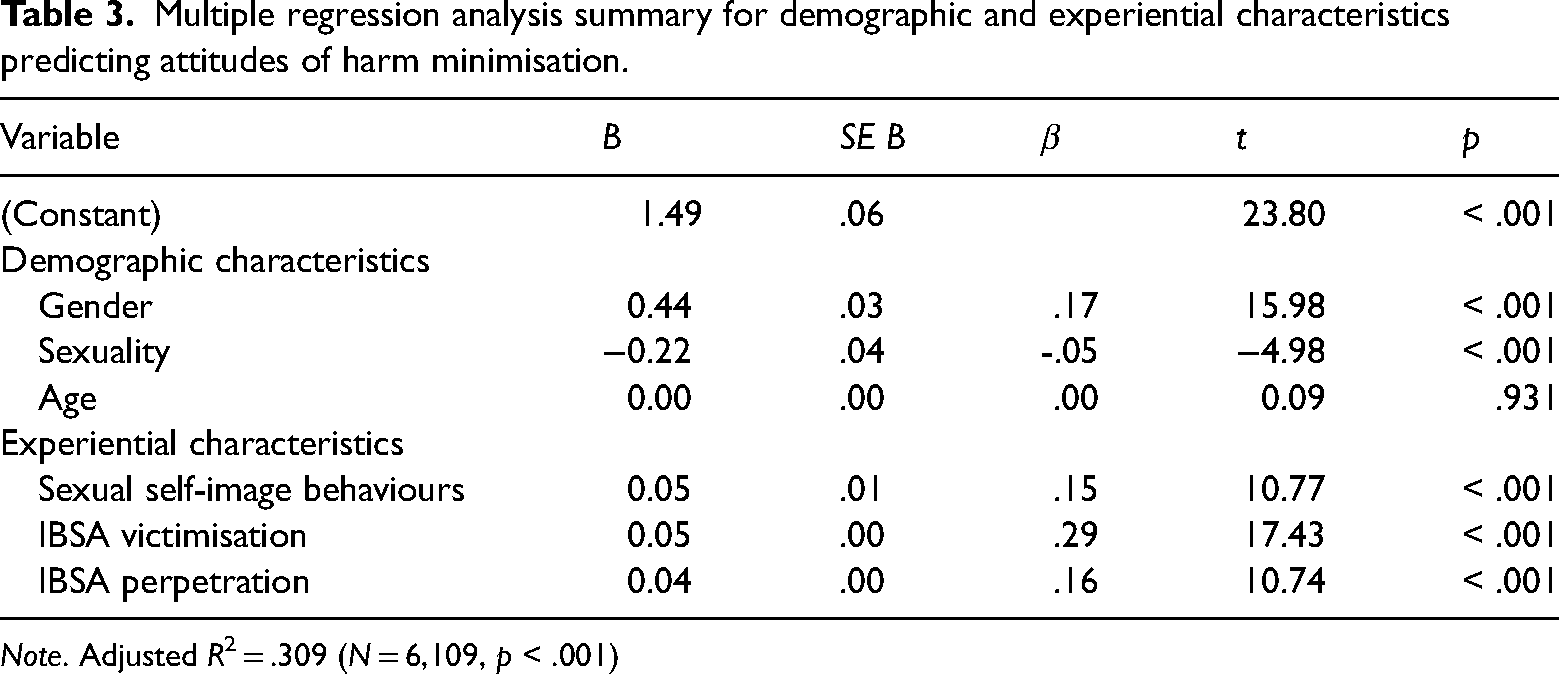
Note. Adjusted R2 = .309 (N = 6,109, p < .001)
The regression model for the harm minimisation component was also significant and explained 30.9% of the total variance, F(8, 6108) = 324.43, p < .001. Regarding demographic characteristics, two were statistically significant: gender (beta = .17, p < .001), and sexuality (beta = -.05, p < .001). These results reflect those for victim-blaming attitudes above, such that being male and identifying as heterosexual increased the likelihood of holding harm minimising attitudes. However, age (beta = .00, p = 931) was not significant for harm minimisation. Regarding experiential characteristics, all three were again statistically significant: sexual self-image behaviours (beta = .15, p < .001), IBSA victimisation (beta = .29, p < .001), and IBSA perpetration (beta = .16, p < .001); with each of these associated with an increased likelihood of holding harm minimising attitudes.
In summary, male respondents, older respondents, and heterosexual respondents were more likely to blame IBSA victims than female respondents, younger respondents, and LGB + respondents. Male respondents were also more likely to hold harm minimising attitudes than female and LGB + respondents. This may reflect broader trends relating to the ‘gendered digital divide’ (Joiner et al., 2015) and theories of male peer support (DeKeseredy & Schwartz, 2016) that not only involves supporting, ignoring, or legitimising harassment of women online, but also in prioritising more masculine identities. Although there is limited research on respondent sexuality and attributions of blame, there is some evidence to suggest these differences also exist more broadly in attitudes towards sexual violence (Davies & Hudson, 2011). The higher levels of blame and minimisation among heterosexual respondents may also be due to the gendered and heteronormative dynamics that shape risk, blame and responsibility in sexual image-sharing, something that was present in the interviews in relation to sexual double standards. Further, the sharing of images of one's body is perceived to be a normative practice among gay men in particular (Comunello et al., 2021), which might help to explain why LGB + respondents held lower attitudes of blame and minimisation.
In relation to age, the higher rates of blame among older respondents may be reflective of younger people having a higher uptake of digital technologies in general, and a higher engagement with digital technologies for intimacy purposes (such as dating apps and sexting), and therefore having a better understanding of the context in which IBSA can occur (Anderson & Jiang, 2018; Garcia et al., 2016; International Telecommunications Union, 2021). This is exemplified by the following comment from Peter (criminal justice, ANZ), who reflected on generational differences in practices of image-sharing: One of the things that surprises me, and it's probably because I’m of the generation that I am, is what's all this taking of the images firstly? Why would you want to take them? And, secondly, if you were the subject [of the image], why would you want to let them be taken?
Although we were unable to examine variations in blame according to the demographic characteristics of the victim, our interview findings indicate that the gendered nature of IBSA is complex and worthy of further investigation using both qualitative and quantitative methods.
Social norms and acceptance of sexual violence
Participants attributed attitudes of blame surrounding IBSA as being linked to broader attitudes around sexual violence, where an unjustified view exists that victims – female victims in particular – put themselves at risk of abuse: Twenty years ago, we kind of blamed women for being raped or sexually assaulted, because we said, ‘Well, why did she go out at midnight? Why did you wear a skirt above your knee? … If you didn’t do that, this wouldn’t have happened’. And it's really the same kind of attitudes. (Abney, support, E&W)
Placing the onus on female victims for IBSA, as highlighted by Abney, and a perception that victim-blaming was a broader societal issue permeating various settings was commonly expressed by participants. Elizabeth (policy, SL) described victim-blaming as a ‘wider cultural and societal’ issue that comes ‘from within the home, it comes from our schools, it comes from our establishments’. The role of ‘establishments’ and social norms in perpetrating victim-blaming as articulated by Elizabeth, was further described by Sam (policy, SL), who reflected on witnessing a school make students who had experienced IBSA stand up in front of peers at assembly to promote the message: ‘if you didn’t take images of yourself, then you wouldn’t be like these girls’. Reflecting on the problematic nature of the narrative such actions create, Sam (policy, SL) further observed, ‘I thought, “this is how we treat victims?” … It's framed as “these are the bad girls”’.
The tendency to focus on the victim's actions and to render perpetrators invisible was identified as a common feature in prevention efforts around IBSA and sexting more broadly, which then problematically informs social norms and attitudes. Danni (support, ANZ) described this as being akin to ‘abstinence’ sex education, arguing that focusing on deterring people from consensual sexting in order to prevent IBSA was ineffective, and fuelled attitudes of blame. Elizabeth (policy, SL) similarly commented: I remember being young and going out with a short skirt on, and people were like, ‘you don’t want to go out [dressed like that]’. It's not the clothes that makes somebody rape you, it's the person. So, there is something about how we need to shift those views. … There's something about that gender lens that needs to be shifted … [and] that needs to come through education and consistent messaging.
The importance of appropriate prevention messaging as noted by Elizabeth has also been observed in research analysing education campaigns directed towards IBSA prevention (Albury & Crawford, 2012; Flynn et al., 2022b). In many of these campaigns, the focus is on the victim doing the ‘wrong’ thing by sexting, as opposed to the perpetrator non-consensually sharing the image, contributing to a culture of shame and blame (Ringrose & Dobson, 2015). It is clear from the comments expressed by stakeholders in our study that such views continue to hold influence in many victims’ experiences.
Although most stakeholders believed that victim-blame was key in narratives and responses to IBSA, some perceived there was a shifting acceptance of consensual sexting socially: ‘I think a few years ago when we were really like, “Why would anyone take these photos?” … I think now we’re much more widely accepting that yeah, people actually do this’ (Deb, support, ANZ). This change identified by Deb can also be seen in the shifting attitudes expressed according to respondent age in the survey, whereby older respondents were more likely than younger respondents to believe that victims should know better than to send nude or sexual images, and that victims should not be surprised if these images end up online. As flagged previously, this may partially be the result of younger respondents having a higher uptake of digital technologies and engagement in sexting. For example, research has found the consensual practice of sending and receiving sexual images decreases as age increases (Garcia et al., 2016; Scott et al., 2022). The attitude difference may also be suggestive of a broader shift in youth cultural views and understandings of consensual and non-consensual sexual behaviours (Fairbairn, 2020).
Self-blame narratives
Notably, survey respondents’ own sexual self-image behaviours were related to their adherence to victim-blaming and minimising attitudes, though in contradictory ways. Respondents were more likely to minimise the harms associated with IBSA if they experienced or engaged in more sexual self-image behaviours, had experienced more IBSA victimisation, and/or had engaged in more IBSA perpetration (see Table 3). In relation to victim-blame, respondents were more likely to express attitudes of blame if they had experienced or engaged in fewer sexual self-image behaviours, experienced more IBSA victimisation, and/or engaged in more IBSA perpetration (see Table 2). This means that those with fewer sexual self-image behaviours were more likely to blame victims and those with higher self-image taking behaviours were more likely to minimise its harms. Whilst this might appear at odds, it makes some sense that those without much experience taking sexual self-images might hold victims more responsible for doing so, while those with more experience taking sexual self-images might have a self-interest in maintaining a belief the harms would not be substantial if their images were misused. This reflects research which has shown that while some victims report experiencing very serious and lasting harms (McGlynn et al., 2021), others report experiencing less intrusive harms, such as ‘annoyance’ (Powell et al., 2022b).
Respondents who had experienced or perpetrated more IBSA behaviours also attributed more blame to victims and were more likely to minimise its harms. This suggests there may be parallels with prior research that not only do people blame victims of sexual violence to distance themselves from the victim and feel they are unlikely to experience similar abuse (Pinciotti & Orcutt, 2021), but victims themselves can adhere to self-blaming by internalising broader societal attitudes (Hansen et al., 2020). Alternatively, it may suggest victims adopt a psychological adherence to ‘just world beliefs’ (Russell & Hand, 2017) that can enable people to feel safer participating in the world when they believe outcomes are based on an individual's actions. Previous research has found that perpetrators of sexual violence are likely to hold victim-blaming and harm minimising attitudes (Trottier et al., 2021; Yapp & Quayle, 2018), yet it is unclear the extent to which these attitudes might pre-exist and be causally linked to a perpetrator's behaviours, and/or might be a self-justifying and protective mechanism. An implication of this for both perpetrators and victims is that such attitudes may prevent victims from seeking support or reporting the abuse, and prevent perpetrators from seeking intervention and treatment, or recognising their behaviour as harmful and wrong.
Discussion and conclusions
IBSA is a growing problem globally that causes serious harms (Flynn, Powell, Scott & Cama, 2021; Powell et al., 2022b). This paper shines light on the problems that exist in preventing and responding to IBSA, where victim-blaming and harm minimisation attitudes thrive. This includes reduced support or help-seeking rates among victims, increased blame towards victims, removal of blame and responsibility from the perpetrator, and enhancing the harms experienced by victims. It is well-established that concerns about not being believed or facing attitudes of blame act as a barrier to reporting and support-seeking among sexual violence victims (Mennicke et al., 2021). As this study suggests, it also leads to a failure to hold perpetrators accountable for their actions, impacting on prevention efforts and treatment seeking for abusers. Further, it impacts on social norms and understandings of sexual violence, leading to inaccurate views of what constitutes sexual violence and who is a ‘good’ victim (see also, Wheildon et al., 2022). These findings highlight why minimising the harms or seriousness of IBSA can be so damaging, especially when it supports the misconception that digital forms of abuse are less serious than physical abuse.
To our knowledge, this is the most comprehensive examination of attitudes of blame and harm minimisation of IBSA worldwide, but there are some limitations. Further to the potential criticisms of the methodology discussed (e.g., use of a panel provider), a key limitation is that the survey is not representative. Although we used quota sampling in the survey, the outcomes cannot be interpreted as representative. In addition, the survey is cross-sectional and thus causality cannot be inferred. This has important implications for the directions of some of the relationships between variables. For example, we suggested those who show greater engagement in sexual self-image behaviours might have an interest in minimising IBSA harms. An alternative interpretation is that those who perceive IBSA harms to be more minimal are more likely to engage in sexual self-image behaviours, due to a lowered perception of personal risk. Our study was also unable to examine attitudes in relation to victim demographics, which may shape other understandings of attitudes.
This study does however contribute to both broader theoretical understandings of victim-blaming and those specific to IBSA, such as self-blame narratives, sexual double standards, and social normalisation and acceptance of sexual violence. It also offers a unique empirical contribution through a multi-country, mixed-methods study. The findings demonstrate that gender influences victim-blaming and harm minimising attitudes in ways that are similar to other forms of sexual violence. Further, this research offers unique insights into how an individual's own exposure to, and participation in, sexual self-image behaviours and IBSA influence attitudes. In addition, we found that stakeholders perceived abstinence-based education and prevention measures or responses that focus on the victim's actions to be ineffective in addressing perpetration or recognising harms.
As the interviews revealed, even some of the stakeholders tasked with working in support and policy fields held attitudes that placed blame onto victims. While this view was not common, given that blaming responses to the disclosure of sexual violence can have harmful effects on victims, including disengagement from support seeking (Anderson & Overby, 2021), these findings point to the need to ensure that support workers receive education and training to challenge these attitudes, in order for professionals to respond to and remedy some of the concerns identified. It also highlights an area for further research to establish how widespread these attitudes are among those working in first-responder roles and the potential implications of this in terms of victims’ engagement in reporting and support-seeking.
This study has demonstrated the potential consequences of victim-blaming and harm minimisation attitudes in the context of IBSA. As such, it remains apparent that policy and practice seeking to respond to or prevent abusive behaviours, as well as campaigns aimed at IBSA prevention, must challenge victim-blaming attitudes and messages that minimise its harms. Future resources should aim to empower victims to seek support and report IBSA. This should be combined with additional training on IBSA harms for first-responders, the needs and support options available for victims (and perpetrators), and the consequences of such abusive behaviours for those likely to come in contact with IBSA victims and/or perpetrators. Such training will empower first responders with the requisite knowledge and skills to potentially remedy some of the concerns this article has identified. Research on technology-facilitated abuse more broadly suggests that additional training focused on improving communication with the diversity of victims who experience abuse, including IBSA, and improving police and support workers’ understandings of online harms, with a specific focus on reporting barriers, is vital (Flynn et al., 2022; Flynn, Powell & Hindes, 2021; Henry et al., 2020; Powell, Flynn & Hindes, 2022). This resonates with our findings that specific groups, particularly young women, are more likely to experience increased levels of victim-blame.
Overall, the survey findings point to the need for further examination of the complex relationships between blame, harm minimisation, engagement in sexual self-image behaviours, and IBSA victimisation and perpetration, with a greater focus on inclusivity to reach respondents across representative characteristic groups. It highlights key future focus areas for researchers and first responders in understanding where victim-blaming and cultural ideologies interact, including the need to examine how the demographic characteristics of victims could influence attitudes of blame and minimisation. Further research should also be undertaken to explore effective and ineffective IBSA prevention and education messaging among diverse populations.
This article has provided important insights into attitudes of blame and minimisation of harms relating to IBSA across large multi-jurisdictional samples, with supporting interview data highlighting the importance of examining the persistence of sexual double standards and misconceptions about sexual violence in driving attitudes of blame. It is vital future criminal justice policy, prevention measures and research further seek to engage with and address the challenges victims face in seeking justice for IBSA, and how attitudes that attribute blame or minimise the harms can be dispelled. Ultimately, efforts to address victim-blaming attitudes need to be integrated into our response and prevention strategies across multiple forms of violence, abuse and inequality.
Footnotes
Acknowledgments
The authors acknowledge the research funding provided by the Australian Research Council DP170101433 ‘Revenge Pornography: The implications for law reform’, and the contributions of the Chief Investigators, Nicola Henry, Asher Flynn and Anastasia Powell, and Partner Investigators, Clare McGlynn, Erika Rackley, Nicola Gavey and Adrian Scott in providing ideation, data and/or underpinning conceptualization. The authors also thank the anonymous reviewers for their feedback.
Declaration of conflicting interests
The author(s) declared no potential conflicts of interest with respect to the research, authorship, and/or publication of this article.
Funding
The author(s) disclosed receipt of the following financial support for the research, authorship, and/or publication of this article: This work was supported by the Australian Research Council (grant number DP170101433).
